FEATURE
WHAT A DAY! What’s so special about a leap year? asks Claire Brine APPY leap year! To many of us, this H Saturday may feel like any other day. But the reality is, it’s not. It’s a day that
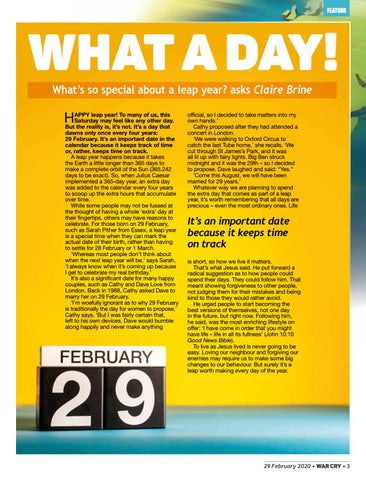
dawns only once every four years: 29 February. It’s an important date in the calendar because it keeps track of time or, rather, keeps time on track. A leap year happens because it takes the Earth a little longer than 365 days to make a complete orbit of the Sun (365.242 days to be exact). So, when Julius Caesar implemented a 365-day year, an extra day was added to the calendar every four years to scoop up the extra hours that accumulate over time. While some people may not be fussed at the thought of having a whole ‘extra’ day at their fingertips, others may have reasons to celebrate. For those born on 29 February, such as Sarah Pither from Essex, a leap year is a special time when they can mark the actual date of their birth, rather than having to settle for 28 February or 1 March. ‘Whereas most people don’t think about when the next leap year will be,’ says Sarah, ‘I always know when it’s coming up because I get to celebrate my real birthday.’ It’s also a significant date for many happy couples, such as Cathy and Dave Love from London. Back in 1988, Cathy asked Dave to marry her on 29 February. ‘I’m woefully ignorant as to why 29 February is traditionally the day for women to propose,’ Cathy says. ‘But I was fairly certain that, left to his own devices, Dave would bumble along happily and never make anything
official, so I decided to take matters into my own hands.’ Cathy proposed after they had attended a concert in London. ‘We were walking to Oxford Circus to catch the last Tube home,’ she recalls. ‘We cut through St James’s Park, and it was all lit up with fairy lights. Big Ben struck midnight and it was the 29th – so I decided to propose. Dave laughed and said: “Yes.” ‘Come this August, we will have been married for 29 years.’ Whatever way we are planning to spend the extra day that comes as part of a leap year, it’s worth remembering that all days are precious – even the most ordinary ones. Life
It’s an important date because it keeps time on track is short, so how we live it matters. That’s what Jesus said. He put forward a radical suggestion as to how people could spend their days. They could follow him. That meant showing forgiveness to other people, not judging them for their mistakes and being kind to those they would rather avoid. He urged people to start becoming the best versions of themselves, not one day in the future, but right now. Following him, he said, was the most enriching lifestyle on offer: ‘I have come in order that you might have life – life in all its fullness’ (John 10:10 Good News Bible). To live as Jesus lived is never going to be easy. Loving our neighbour and forgiving our enemies may require us to make some big changes to our behaviour. But surely it’s a leap worth making every day of the year.
29 February 2020 • WAR CRY • 3
Fully booked On World Book Day, children across Britain and Ireland will be dressing up as characters from stories, receiving tokens that they can exchange for books and meeting authors. Ahead of the day, children’s writer CLAIRE FAYERS tells Philip Halcrow how books have made a world of difference to her HIS is the story of T how a girl named Claire would sit in a
library, reading stories – and then grew up to write her own. Claire Fayers is the author of fantasy books for children, and on World Book Day (5 March) she will be aiming to inspire children at a primary school to discover the joys of reading and storytelling. Once upon a time, Claire was making such discoveries herself. While growing up in Newport, south Wales, she ‘practically lived’ in her local library. ‘I loved the adventure of stories,’ she says. ‘They showed you things that you couldn’t experience in real life and gave you the sense that there was something bigger out there. ‘When I was only about seven or eight years old, I found a children’s book of Greek legends in the library and just devoured the whole thing. Then I moved on to Welsh folklore and British legends. ‘I think I was attracted to
8 • WAR CRY • 29 February 2020
rs ye a F Claire
the idea of leaving your home and things that were familiar and then going off and discovering the world, learning more about yourself as you battled monsters, overcame obstacles and looked for the reward at the end of it all.’ When Claire left home, she voyaged to Canterbury, to study English and comparative literature at the University of Kent. By the time she graduated in 1989, she was unsure of what line of work she wanted to pursue. She started an accountancy course. ‘But I realised that the only thing I wanted to do was to tell stories,’ she says. ‘So I started writing short stories for women’s magazines and built that as a freelance career on the side while doing a part-time job.’ The short stories lengthened to serials. Becoming more ambitious, she attempted an epic
fantasy ‘that today would probably be seen as a Game of Thrones clone’. She says: ‘It’s never going to see the light of day, because it was very bad. ‘I then found that I was writing a lot of comedy, and I began to combine that with the adventure and quest stories that I liked when I was growing up. I didn’t even realise I was writing for children. I just wrote a story about pirates going on a big quest and used a lot of silly jokes. I entered it into a competition and then I was contacted by a literary agent, who said: “What age group is it for? I think it’s for 10-year-olds.” I said: “Oh, yes, of course it is.”’ Claire seemed to be heading in the right direction. Upon its launch, her debut, The Accidental Pirates: Voyage to Magical North, was selected as
ok Waterstones children’s bo bes cri des e Sh . of the month in her latest, Storm Hound – ng nti hu the of which one hounds of the Norse god Odin gets trapped inside the body of a puppy in Abergavenny – as a ‘mash y, log tho my rse No of up Welsh folklore and a realworld setting’. Claire often visits schools to talk about how she became an author and to of try to fire the enthusiasm s – children for reading storie and for telling them. ‘Society is getting more and more divided,’ she says. ‘People on one side k of a divide often don’t tal to people on the other. Or if they do, it’s just an nt argument. So it’s importair to get people to share the personal stories and have n that moment of connectio
INTERVIEW Claire talks at a book event for schoolchildren
with others, who can then say, “Ah, yes. Now I understand what’s in your head.”’ In telling her stories, Claire continues to draw from the Greek, Norse and British tales she has always enjoyed. She detects in those old myths and legends truths about human life – as she does in one particular ancient book. ‘CS Lewis, who had a great love of fantasy in literature, said that if everything about all these other stories was completely wrong, he would be a bit suspicious of the Bible,’ explains Claire, who attends a church near her home in Cardiff. ‘People are grasping for the truth, and occasionally everyone gets a glimpse of it. ‘As well as being the word of God, the Bible is
the ultimate story of God and us. The story of God coming down to us, and us being able to see something of what’s beyond our world, can speak to everyone. When our lives fit into that story, they start to make sense in a way they didn’t before.’ Claire links that ‘ultimate story’ with her early experiences, when reading opened a new chapter in her life. ‘As a child, I had the
sense that there is something beyond us that we can discover if we open our eyes to it. It’s at that point our world meets something much wider than any of our imaginations.’
l Storm Hound is published by Pan Macmillan
THE END
WORLD BOOK DAY
As a child, I had the sense that there is something beyond us
29 February 2020 • WAR CRY • 9
‘The line between good through the middle Former prison worker MIM SKINNER tells Emily Bright why society should rethink its attitude towards people in jail were trialled by women FownAIRYTALES in jail when they performed their pantomime, Snow White
Mim Skinner
I wanted to be part of changing the narrative
10 • WAR CRY • 29 February 2020
and the Seven Co-accused. The theatrical endeavour was part of a creative programme of activities run at the women’s prison, and in-house art teacher Mim Skinner decided to help out. ‘We wrote a plot about Snow White as a reformed cocaine addict,’ she explains. ‘There was a great deal of creativity and a sense of friendship and family among the residents.’ It can be all too easy to cast the typical female prison inmate as a wicked witch. But, after working as an arts and crafts teacher and serving with the chaplaincy team in a women’s prison between 2014 and 2017, Mim feels that this is an oversimplification. She has now written a book, Jailbirds, about her experiences, and the rights to it have been sold to make a TV programme. Through the book, Mim sought to correct some of the stereotypical ideas people on the outside of prisons have about those on the inside, so it includes stories from the prison residents themselves. ‘I felt like the stories being told about women in prison painted them as either defeated, miserable or villainous characters,’ she reflects. ‘But the people that I met in prison were all sorts of other things as well, so I wanted to be part of changing the narrative.’ When she began working at the prison, she was shocked at how many inmates had come from the care system or had a troubled past. ‘I met very few people who hadn’t been the victim of abuse at some point,’ she says. ‘There were also a great number of women who had been taken advantage of or coerced.’ But Mim asserts that, despite their traumatic past, the women she worked with were remarkably resilient. ‘It’s easy to think of prison residents as charity cases who need rescuing, but actually I met people who were resourceful and creative. They had so much potential.’ She held arts and crafts sessions in a bid to harness that potential. Activities included developing a temporary Apprentice-style business for Christmas cards, making aspirational collages, sewing, and painting a seaside mural
INTERVIEW
and bad goes of every human heart’
on one of the prison’s walls. ‘Art is a way of exploring your identity and expressing yourself,’ she explains. ‘It doesn’t pressurise people, or require them to have a succinct answer. It allows them to explore a little bit about themselves in a safe space. ‘I heard people’s stories and saw them change. The prison residents would be so brave in sharing their experience, especially since lots of them have had negative encounters with authority figures.’ While working in the prison, Mim also decided to become a chaplaincy assistant, using her Christian faith to help run prayer groups and Bible studies. Prison residents could light a candle in memory of a loved one, attend a church service or simply request to talk to the chaplaincy team. Mim’s faith helped her as she encountered situations that might otherwise have appeared hopeless. ‘The transformation that can come from people gaining faith means that there’s nobody for whom I believe there’s no hope,’ she says. ‘One of the big tenets of Christianity is that we are all broken and flawed. The line between good and bad goes through the middle of every human heart, and we’re all in need of grace.’ She says that she has seen the restorative power of the Christian faith firsthand, within the prison walls and also in the housing project she now works for. ‘I still get to see women whose lives have been massively transformed. I currently job share with a woman who had done about 30 sentences in prison. I’ve spoken to prison
officers about her transformation and they say that they can’t believe it, as she was the most difficult prisoner on the wing. She sold the most drugs and she was the most violent. If she can turn her life around, anyone can.’ Mim believes that rehabilitative justice is beneficial not only for offenders, but for wider society too. ‘All the research that’s done on prison shows that helping people reform leads to fewer crimes and fewer victims of crimes,’ she says. Mim’s own relationship with God and knowledge of the Bible also shape the way that she perceives prisoners. ‘In the Bible, there is a long history of people being in prison,’ she reflects. ‘Biblical characters such as Paul and John the Baptist all spent time in prison. Jesus himself spent time in custody before receiving the death penalty. ‘The Christian faith doesn’t allow you the luxury of thinking that we should leave prison out of what we do. I think we do the Church a massive disservice if we do not see the potential and value of people who are in prison.’
There’s nobody for whom I believe there’s no hope
l Jailbirds is published by Seven Dials 29 February 2020 • WAR CRY • 11
EXPLORE Prayerlink THE War Cry invites readers to send in requests for prayer, including the first names of individuals and details of their circumstances. Send your Prayerlink requests to warcry@salvationarmy.org.uk or to War Cry, 101 Newington Causeway, London SE1 6BN. Mark your correspondence ‘Confidential’.
Becoming a Christian There is no set formula to becoming a Christian, but many people have found saying this prayer to be a helpful first step to a relationship with God Lord Jesus Christ, I am truly sorry for the things I have done wrong in my life. Please forgive me. I now turn from everything that I know is wrong. Thank you that you died on the cross for me so that I could be forgiven and set free. Thank you that you offer me forgiveness and the gift of your Holy Spirit. Please come into my life by your Holy Spirit to be with me for ever. Thank you, Lord Jesus. Amen
Nigel Bovey gives chapter and verse on each book in the Scriptures
2 Thessalonians HE missionary Paul had visited T Thessalonica as part of his ambitious plans to spread the Christian faith across
the Roman Empire. In this second letter to the church he helped to establish, he tries to clarify his thinking on the return of Jesus. In his first letter, Paul said that Jesus would gather those believers who had died and those who were alive to be with him for ever (see 1 Thessalonians 4:13–17). Paul refused to speculate on the date and time of Christ’s return. Instead, he warned that the church should not be taken unawares (1 Thessalonians 5:1–9). In this later letter, Paul addresses reports – allegedly from him – saying that the day of Christ’s return had already happened. Some believers have become ‘unsettled or alarmed’ by some prophecy, report or letter supposed to have come from Paul and his friends’ (2 Thessalonians 2:2). Paul now sets the record straight. Christ’s return has not happened. Although he is not party to the complete timetable – not even Jesus knew (see Matthew 24:36) – he does know that certain events will happen as a prelude to the Second Coming. There will be a rebellion against God. There will be the emergence of ‘the man of lawlessness’ (2:3). The mention of such an apocalyptic figure is reminiscent of Jesus’ reference to the ‘abomination that
causes desolation’ in Matthew 24:15. Other letters in the New Testament describe the ‘antichrist’ and ‘beast’. Paul says this man will oppose everything that is holy and proclaim himself to be God
Paul refused to speculate on the date and time of Christ’s return (2:4). Whoever this man is, he is not Satan. Through the power of Satan, however, he will work counterfeit miracles, signs and wonders and deceive many people (2:9–11). On the day of his return, Christ will destroy him (2:8). Also on that day, God will judge righteously those who oppose his people and those who disobey the gospel (1:5–10). Until that day, believers are to stand firm against opposition and hold fast to the teaching they have received (2:15).
Key verse
d he will ‘The Lord is faithful, an ect you ot pr d strengthen you an salonians es from the evil one’ (2 Th Version) 3:3 New International
"
Extract from Why Jesus? by Nicky Gumbel published by Alpha International, 2011. Used by kind permission of Alpha International
Looking for help? Just complete this coupon and send it to War Cry 101 Newington Causeway London SE1 6BN Basic reading about Christianity Information about The Salvation Army Contact details of a Salvation Army minister
12 • WAR CRY • 29 February 2020
Name Address