23 November 2019 • WAR CRY • FILM 3
Life, liberty and the pursuit of Harriet
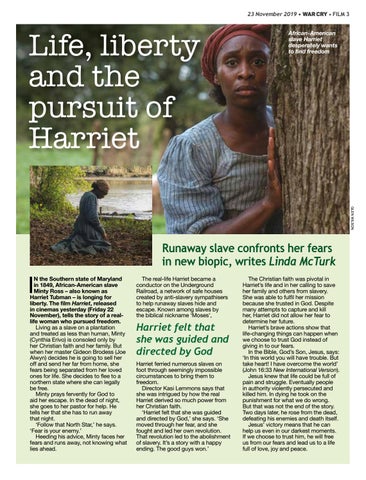
African-American slave Harriet desperately wants to find freedom
GLEN WILSON
Runaway slave confronts her fears in new biopic, writes Linda McTurk
I
N the Southern state of Maryland in 1849, African-American slave Minty Ross – also known as Harriet Tubman – is longing for liberty. The film Harriet, released in cinemas yesterday (Friday 22 November), tells the story of a reallife woman who pursued freedom. Living as a slave on a plantation and treated as less than human, Minty (Cynthia Erivo) is consoled only by her Christian faith and her family. But when her master Gideon Brodess (Joe Alwyn) decides he is going to sell her off and send her far from home, she fears being separated from her loved ones for life. She decides to flee to a northern state where she can legally be free. Minty prays fervently for God to aid her escape. In the dead of night, she goes to her pastor for help. He tells her that she has to run away that night. ‘Follow that North Star,’ he says. ‘Fear is your enemy.’ Heeding his advice, Minty faces her fears and runs away, not knowing what lies ahead.
The real-life Harriet became a conductor on the Underground Railroad, a network of safe houses created by anti-slavery sympathisers to help runaway slaves hide and escape. Known among slaves by the biblical nickname ‘Moses’,
Harriet felt that she was guided and directed by God Harriet ferried numerous slaves on foot through seemingly impossible circumstances to bring them to freedom. Director Kasi Lemmons says that she was intrigued by how the real Harriet derived so much power from her Christian faith. ‘Harriet felt that she was guided and directed by God,’ she says. ‘She moved through her fear, and she fought and led her own revolution. That revolution led to the abolishment of slavery. It’s a story with a happy ending. The good guys won.’
The Christian faith was pivotal in Harriet’s life and in her calling to save her family and others from slavery. She was able to fulfil her mission because she trusted in God. Despite many attempts to capture and kill her, Harriet did not allow her fear to determine her future. Harriet’s brave actions show that life-changing things can happen when we choose to trust God instead of giving in to our fears. In the Bible, God’s Son, Jesus, says: ‘In this world you will have trouble. But take heart! I have overcome the world’ (John 16:33 New International Version). Jesus knew that life could be full of pain and struggle. Eventually people in authority violently persecuted and killed him. In dying he took on the punishment for what we do wrong. But that was not the end of the story. Two days later, he rose from the dead, defeating his enemies and death itself. Jesus’ victory means that he can help us even in our darkest moments. If we choose to trust him, he will free us from our fears and lead us to a life full of love, joy and peace.
8 INTERVIEW • WAR CRY • 23 November 2019
‘I was fighting to reasons to live
Television presenter SIMON THOMAS tells Emily Bright how his faith sustained him through the pain of suddenly losing his 40-year-old wife to cancer
A
Simon, Gemma and Ethan
CUTE myeloid leukaemia: three words that would spell tragedy for former Blue Peter and Sky Sports presenter Simon Thomas and his eight-year-old son, Ethan. Just three days after receiving the diagnosis of a rare blood cancer, Simon’s wife, Gemma, passed away. They had been together for 16 years. When the doctor first delivered the devastating cancer diagnosis, Simon and Gemma turned to their Christian faith for hope. ‘Our faith had been the glue that held things together when life got tough,’ Simon tells me. ‘After the diagnosis we spent time reading the Bible together, listening to worship songs and praying. Both of us felt incredibly close to God. He felt very much in that room, in that hospital over those three days.’ Full of faith, Simon was convinced that God would help Gemma to recover. He sat at his wife’s bedside, earnestly praying for a miracle. For a while, the treatment appeared to work. Her white blood cell count fell from 450 to 37, much nearer to the normal count of less than 10. Gemma was awake and talking to her friends. But within hours, her condition deteriorated, and doctors discovered that there was bleeding on her brain. Family and friends
After Gemma died, I felt incredibly angry gathered to say goodbye, and Ethan whispered in his mummy’s ear how much he loved her. As the sun set on 24 November 2017, Gemma passed away. Simon sobbed in the arms of his sister Rebecca. But his sorrow quickly turned to rage at the injustice of it all. ‘After Gemma died, I felt incredibly angry,’ he recalls. ‘I came out of hospital and screamed “Why?” at God endless times. I couldn’t understand why he’d left Ethan without a mum. And at that point, all I was seeing was God as the cause. ‘So I vented my spleen at him, and was full of anger and questions about who the
heck was God. I kept being told he was a God of love, but right then, he didn’t feel very loving.’ In the weeks that followed, Simon’s perspective gradually shifted. ‘I came to realise that God didn’t cause this. He didn’t want Ethan to grow up without a mum. He didn’t want Gemma’s life to be cut short. If that was the character of the God I followed, I would have dropped my faith there and then. ‘Being a Christian, however strong our faith is, does not immunise us against the harsh realities of what is essentially a broken world. I’ll ultimately never know why he didn’t intervene, but I found peace in the fact that God did still love me.’ As Simon undertook the painful task of preparing for Gemma’s funeral, he keenly felt God’s presence. ‘I experienced the peace of God that surpasses all understanding, which the Bible speaks about,’ he says. ‘I was going to places like the funeral directors and the crematorium, and God’s peace came in amidst the chaos, pain and brokenness. ‘I came to see Jesus as the figure that got alongside me at times when I felt at my lowest and most broken. He was a figure of understanding and compassion, who actually knows what it is like to mourn.’ In the weeks that followed, Simon was racked with grief, and struggled with loneliness and insomnia. The simplest tasks felt impossible. He broke down and wept in a supermarket aisle and even driving became a challenge. ‘When something like this happens, you are fighting to find reasons to live again. Your plans and dreams for the future have been torn up. ‘You don’t feel part of life any more. Your world feels like it has stopped and everything has ground to a halt while the relentless rhythm of life keeps beating and people carry on all around you. ‘There were a couple of moments when I thought: “I’m done, I can’t do this. I’m not
Turn to page 10
➥
find again’
God didn’t cause this. He didn’t want Ethan to grow up without a mum
23 November 2019 • WAR CRY • INTERVIEW 9
10 INTERVIEW • WAR CRY • 23 November 2019
From page 8 strong enough.”’ One such moment was when he walked into his garden early one December morning. When he reached the end of the garden, he began screaming in rage at the pain of losing his wife and the mother to his son. Exhausted, he walked down to the bank of the River Thames. He was feeling hopeless. ‘I felt like rolling in and giving up,’ Simon remembers. ‘But Ethan’s face was incredibly vivid in my mind, and I thought: “I cannot do this. He has lost his mum; he doesn’t need to lose his dad.” ‘I also tangibly felt this presence alongside me, as if the figure of Jesus was sitting next to me, not saying anything but
I had to find strength from somewhere weeping tears. It was at that point that I thought there was absolutely no way I could give up.’ Ethan played a key role in helping Simon through his grief, providing quiet reassurance when it was needed the most. ‘I don’t know what life would have looked like had I not had Ethan,’ Simon reflects. ‘He supported me with hugs, words of kindness and the wisdom that came out of his mouth. It was having him alongside me that took me through. I had to be there for him, I had to find the strength from somewhere.’ To help each other through their grief, Simon decided to set aside time to share treasured memories of Gemma with Ethan. ‘I felt that I needed to keep his mum part of the conversation, to still talk about her and share memories about her,’ he says. ‘For the first few months, we did a mummy memory every single night at bedtime. Sometimes now he’ll say a little prayer to mummy, just to tell her what he has done that day.’ Simon would also put notes in Ethan’s lunch
box, reminding him of how much he was loved and how Gemma lived on in him. In turn, Simon derived strength from family and friends, who scheduled visits and carried out everyday tasks. ‘God was working behind the scenes through the kindness of others and the amazing support we had in the early weeks,’ he says. ‘Friends looked after a lot of the practical things such as meals, sorting out all Gemma’s affairs and closing her bank accounts, picking up Ethan from school if I was struggling, or
driving my car. Through their love and generosity, Ethan and I weren’t left alone for 16 weeks.’ As Gemma’s birthday approached in May last year, Simon was determined to turn a painful day into a celebration of her life, with family and friends in attendance. He decided to plant a tree in her memory and scatter her ashes round it, while his church worship leader sang. ‘It was an emotionally charged day, less than six months after she died,’ says Simon.
23 November 2019 • WAR CRY • INTERVIEW 11 ‘But I just felt this sense that the rest of my life didn’t need to be second-rate, because I didn’t want that for Ethan. He can still have a joyfilled life full of amazing things. ‘It might be difficult, but why can’t life be as good again in a different way? I thought: I’m going to make the best of however many years I’ve got left with Ethan.’ Reflecting on his own experience of loss, Simon has considered what may be the best ways to help someone who has been bereaved. He says: ‘It’s hopelessly inadequate to say to someone that there are no words, because actually there are a phenomenal amount of words in an English dictionary. If you’re struggling to find the right words, then just saying how sorry you are is enough. ‘Be practical. Arrange where their next meal is coming from, do the shopping and sort out all the affairs of the person they’ve lost.
It might be difficult, but why can’t life be as good in a different way? ‘Grief is not a short-term project. I liken it to a house on fire. People are very good at rushing in when the house is ablaze and making sure everyone is OK, but when it comes to rebuilding the house – helping to rebuild that person’s life – we’re not so good.’ To those seeking to reconstruct their lives after bereavement, Simon counsels: ‘Time is a healer. Over time, life does get easier and feels like it can be embraced again. Your journey through grief is going to be as unique as the person you lost. There’ll be feelings of denial, loneliness and anger, and you’ll have
to find peace within that. ‘Hold on with whatever strength you have, even if it’s just by a fingernail, because God won’t leave you.’ l Simon tells the story of his bereavement in Love, Interrupted: Navigating Grief One Day at a Time, published by Trigger
12 INNER LIFE • WAR CRY • 23 November 2019
Prayerlink YOUR prayers are requested for Nicky, who is in need of hope; and for Kirsty, that her health problem will heal. The War Cry invites readers to send in requests for prayer, including the first names of individuals and details of their circumstances. Send your requests to Prayerlink, War Cry, 101 Newington Causeway, London SE1 6BN. Mark your envelope ‘Confidential’.
Becoming a Christian There is no set formula to becoming a Christian, but many people have found saying this prayer to be a helpful first step to a relationship with God Lord Jesus Christ, I am truly sorry for the things I have done wrong in my life. Please forgive me. I now turn from everything that I know is wrong. Thank you that you died on the cross for me so that I could be forgiven and set free. Thank you that you offer me forgiveness and the gift of your Holy Spirit. Please come into my life by your Holy Spirit to be with me for ever. Thank you, Lord Jesus. Amen Extract from Why Jesus? by Nicky Gumbel published by Alpha International, 2011. Used by kind permission of Alpha International
Nigel Bovey gives chapter and verse on each book in the Scriptures
Luke LUKE was not one of the 12 apostles nor was he a Jew. He was a doctor by profession, and his gospel was specifically aimed at non-Jewish readers. The exclusive contents of Luke’s Gospel reveal its author’s concern to emphasise the inclusivity of Jesus. God’s Kingdom, Luke contends, is available to everyone, regardless of ethnicity, class, status, age or gender. Working shepherds, and not landed gentry, are the first to see the newborn Jesus (2:1–20). In his one-to-one encounters, Jesus demonstrates how God’s love extends to everyone. He heals a crippled woman (13:10–17) and a man with dropsy (14:1–4) on the Sabbath, offending religious leaders in the process. He also raises a widow’s son from the dead (7:11–15), forgives a woman of ‘ill repute’ (7:36–50), heals ‘untouchable’ lepers (17:11–14) and forgives a cheating tax collector (19:1–10). Through his parables, Jesus emphasises God’s limitless mercy. The good Samaritan (considered a worthless outsider by Jesus’ audience) is the least-expected hero of the story (10:25–37). The parable of the marriage
Key verse
to seek ‘The Son of Man came ke 19:10 (Lu t’ and to save the los ) on rsi Ve New International
feast indicates that God values those society doesn’t – ‘the poor, the crippled, the lame, the blind’ (14:1–14). In the parable of the great banquet, ‘successful’ people reject God’s invitation,
Through his parables, Jesus emphasises God’s limitless mercy whereas society’s marginalised are invited and take their places (14:15–24). The parables of the sheep, coin and prodigal son illustrate divine determination to seek, find and recover people who are lost (chapter 15). In arguably his most scandalous parable – which contrasts a pious religious leader with a Rome-collaborating tax collector – Jesus pinpoints his most essential message: self-righteous, show-off religion does not earn God’s forgiveness; it is those who recognise their sinfulness and need of divine mercy who are forgiven (18:9–14). Even in his dying moments, Jesus reaches out to those beyond polite society. Exclusively, Luke reveals that, while being crucified, Jesus accepts the confession of a dying criminal and, consequently, reassures him of his place with him in God’s Kingdom (23:39–43).
"
Looking for help? Just complete this coupon and send it to War Cry 101 Newington Causeway London SE1 6BN Basic reading about Christianity Information about The Salvation Army Contact details of a Salvation Army minister
Name Address