FEATURE
RAISING THE BAR
Fairtrade Fortnight is set to wage a campaign against inequality, writes Emily Bright ANY of us think that chocolate is divine (as can be seen by the fact M that we devour an average of three bars a week in the UK). But for one organisation, it actually is. Divine Chocolate will be one of the
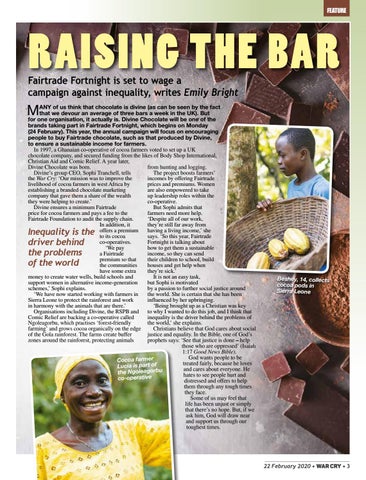
brands taking part in Fairtrade Fortnight, which begins on Monday (24 February). This year, the annual campaign will focus on encouraging people to buy Fairtrade chocolate, such as that produced by Divine, to ensure a sustainable income for farmers. In 1997, a Ghanaian co-operative of cocoa farmers voted to set up a UK chocolate company, and secured funding from the likes of Body Shop International, Christian Aid and Comic Relief. A year later, from hunting and logging. Divine Chocolate was born. The project boosts farmers’ Divine’s group CEO, Sophi Tranchell, tells incomes by offering Fairtrade the War Cry: ‘Our mission was to improve the prices and premiums. Women livelihood of cocoa farmers in west Africa by are also empowered to take establishing a branded chocolate marketing up leadership roles within the company that gave them a share of the wealth co-operative. they were helping to create.’ But Sophi admits that Divine ensures a minimum Fairtrade farmers need more help. price for cocoa farmers and pays a fee to the ‘Despite all of our work, Fairtrade Foundation to audit the supply chain. they’re still far away from In addition, it having a living income,’ she offers a premium says. ‘So this year, Fairtrade to its cocoa Fortnight is talking about co-operatives. how to get them a sustainable ‘We pay income, so they can send a Fairtrade their children to school, build premium so that houses and get help when the communities they’re sick.’ have some extra It is not an easy task, money to create water wells, build schools and but Sophi is motivated support women in alternative income-generation by a passion to further social justice around schemes,’ Sophi explains. the world. She is certain that she has been ‘We have now started working with farmers in influenced by her upbringing. Sierra Leone to protect the rainforest and work ‘Being brought up as a Christian was key in harmony with the animals that are there.’ to why I wanted to do this job, and I think that Organisations including Divine, the RSPB and inequality is the driver behind the problems of Comic Relief are backing a co-operative called the world,’ she explains. Ngoleagorbu, which practises ‘forest-friendly Christians believe that God cares about social farming’ and grows cocoa organically on the edge justice and equality. In the Bible, one of God’s of the Gola rainforest. The farms create buffer prophets says: ‘See that justice is done – help zones around the rainforest, protecting animals those who are oppressed’ (Isaiah 1:17 Good News Bible). God wants people to be r me far a Coco treated fairly, because he loves Lucia is part of and cares about everyone. He the Ngoleagorbu hates to see people hurt and ive rat pe co-o distressed and offers to help them through any tough times they face. Some of us may feel that life has been unjust or simply that there’s no hope. But, if we ask him, God will draw near and support us through our toughest times.
Inequality is the driver behind the problems of the world
Beshey, 14, collects cocoa pods in Sierra Leone
22 February 2020 • WAR CRY • 3
Collared As the fifth series of ITV’s Grantchester comes to an end, writer DAISY COULAM is questioned by Claire Brine about crime-solving clergy Screenwriter Daisy Coulam
Daisy, you developed Grantchester for television and have written episodes for every series. What was it about James Runcie’s novels that appealed to you? As soon as I read the first novel (which I devoured on a train journey) I could picture it clearly. The characters were so vivid and even though the book was set in 1953, the themes that James Runcie explored felt pertinent for our modern times. His books aren’t just murder mysteries – James always says they’re ‘whydunnits’ more than ‘whodunnits’. He looks at faith and death and the human condition in a really interesting and complex way. That’s what I loved most. How familiar were Christianity and the Church to you before you began writing the series? We always knew that faith had to be front and centre in the show. This show 6 • WAR CRY • 22 February 2020
ITV
I
N 2014, fictional clergyman the Rev Canon Sidney Chambers began solving murder mysteries in the ITV series Grantchester. Based on the 1950s crime novels by James Runcie, the first series (starring James Norton) was a hit with viewers. Unsurprisingly, four more series followed. Writer Daisy Coulam has been responsible for taking the Grantchester stories from the page to the screen since the beginning. Last year, when actor James Norton left the series, she introduced a new vicar-cumdetective to the crime scene. The arrival of the Rev Will Davenport (played by Tom Brittney) assured fans that the series wasn’t about to disappear without trace. In fact, Daisy feels that with a new vicar at the helm, Grantchester still has plenty of life in it.
INTERVIEW The Rev Canon Sidney Chambers (James Norton) was succeeded by the Rev Will Davenport (Tom Brittney, bottom) as the vicar of Grantchester
We always knew that faith had to be front and centre in the show was going to be a murder mystery, but it was also going to be about Christianity. My grandad was a vicar, so I grew up with the church in my life. He was in charge of the parish of Newchurch on the Isle of Wight and in his latter years worked as a prison chaplain at HMP Parkhurst. He had started out life as a bricklayer so his faith tended to be quite practical and straightforward. It was interesting to me that, in the books, Sidney’s faith is so much more complex. Sidney questions everything and struggles with himself and his choices in relation to God. When it came to creating the character of Will, we were interested in exploring a different notion of faith again – one in which Will is thoroughly dedicated to the church and God, but with a sense that his steadfastness is a way for him to escape the troubles of his past. Also – on a side note – I loved it when my grandad put on his
robes. I told him once he looked like Darth Vader. That was a high compliment at the time! What research did you undertake to ensure that the characters of Sidney and Will were believable as vicars? We have been very lucky: Diederick Santer, who executive produced the first four series of the show, is the son of Bishop Mark Santer (former Bishop of Birmingham). So Bishop Mark became our full-time adviser. We would run the scripts past him and talk to him about the themes we wanted to explore (for example, the notion of punishment or forgiveness). He’d always give very thoughtful and useful notes. He helped us make individual choices too: Sidney delivers his sermons not from the pulpit, but from the front of the church. Some viewers felt this was anachronistic, but Bishop Mark agreed that it was the kind of thing a progressive vicar like Sidney might have done. Sidney wants to look his congregation in the eye, not look down on them. Bishop Mark has now handed over the
Turn to page 8
➥
22 February 2020 • WAR CRY • 7
From page 7 baton to Father Gillean Craig (who, incidentally, was the inspiration for Tom Hollander’s character in the BBC comedy Rev). He was incredibly helpful in shaping the character of Will and giving us useful guidance on the themes of the later series. Was there any part of creating the series that you found particularly enjoyable or poignant? One of my favourite parts of filming is sitting in the beautiful church of St Andrew and St Mary in Grantchester. Even with a full crew in there, it’s such a peaceful space. The vicar there, the Rev Rachel Rosborough (who doesn’t fight crime on the side!), has been very warm and welcoming – as have the villagers. We’re very lucky. Also, I’ve spent a lot of time over the years with James Runcie, and he very graciously talked to me about his father, former Archbishop of Canterbury Robert Runcie. James had written the books with his father in mind – he was a source of inspiration for the character of Sidney. Like Sidney, James’s dad lived through the Second World War. He was a member of the Scots Guards, a tank commander who had experienced horrors, just as Sidney had. Like many men of the time, he came home but the shadow of war (as James’s first book is titled) was a constant reminder of all he’d survived. I found it very moving to talk about a man who was so clearly a huge part of James’s life and, indeed, so influential within the Church of England.
platform to change things: ‘We have a boat, why not rock it?’ I love that about Will. If he sees injustice, he will challenge it. Others may think Will is radical, but he doesn’t see it as radical to want a just society. Will wants to change the world, not just preach about it, and I think that’s highly admirable. How would you describe Will’s faith in God and how it develops throughout the series? The character of Will started with an unlikely inspiration: the politician Tony Benn. We talked a lot about Benn’s attitude to his faith: he was quoted as saying that he believed in ‘Jesus the prophet. Not Christ the King’. Benn’s faith was egalitarian – he believed that no man was
When Sidney left Grantchester the villagers welcomed in their new vicar, the Rev Will Davenport. What do you admire about Will’s faith? The first time we met Will, he told Sidney that he considers himself ‘a boat rocker’. As a vicar he feels he has a
Will wants to change the world, not just preach about it
8 • WAR CRY • 22 February 2020
Will and Sidney have both worked to solve crime alongside DI Geordie Keating (Robson Green, top left)
INTERVIEW
Faith isn’t a static state: it shifts and changes ITV
above another. God, as he saw it, sent his Son not to side with rulers and kings, but to be one of us. It was a very refreshing approach and felt fitting for Will: he arrives in 1956 when the world was changing, when Elvis and rock’n’roll were taking over the world. It felt optimistic and modern and so different from Sidney. Will’s faith is much more steadfast than Sidney’s. It’s people that Will struggles with – the injustice and unfairness he sees in society. How has writing about a vicar’s faith influenced your personal view on faith in God? Writing this show has given me a new appreciation for anyone who does have a faith. It strikes me that faith isn’t a static state: it shifts and changes with each new challenge in life. It takes a lot of hard work to keep faith through good times and bad – I admire anyone who can do that. And I very much admire those of religion who give back to their community. That’s a wonderful thing. Have Sidney or Will taught you anything? I think in a strange way they have. I’m much more outward-looking than I was before. I try to give to more charities and to be aware of those around me who are less fortunate. Maybe it’s because writing this show has coincided with a time when the world has become so much more divisive.
It seems like now more than ever we need to be compassionate. Why do you think a series where faith is so prominent has become so popular to a largely secular audience? That is a very good question! I’m not sure I have the answer. But I do believe that people are looking for meaning. In a world where we have all the answers at our fingertips, I feel like people are still striving to understand their lives. To make sense of the world. Maybe we give them a bit of that. Along with a handsome vicar, a cute dog and some lovely countryside! On top of Grantchester, you also wrote Channel 4’s Deadwater Fell, a rather dark crime thriller. What are the challenges and joys you find with both styles of writing? I had a strange time last year where I was writing both programmes simultaneously. But the strange thing is, although they’re totally different, they both explore similar themes: the nature of good and evil; the lengths that humans will go to – both good and bad; the grey areas in all our lives. And the notion of community: the responsibility we have to look after each other.
latest series of Grantchester is • The available on the ITVHub
22 February 2020 • WAR CRY • 9
EXPLORE Prayerlink YOUR prayers are requested for Peter, that he will find strength, hope and courage; for Keeley, who has pain in her legs; and for Connor, who wants to strengthen his bond with his son. The War Cry invites readers to send in requests for prayer, including the first names of individuals and details of their circumstances. Send your requests to Prayerlink, warcry@salvationarmy.org.uk or War Cry, 101 Newington Causeway, London SE1 6BN. Mark your correspondence ‘Confidential’.
Becoming a Christian There is no set formula to becoming a Christian, but many people have found saying this prayer to be a helpful first step to a relationship with God Lord Jesus Christ, I am truly sorry for the things I have done wrong in my life. Please forgive me. I now turn from everything that I know is wrong. Thank you that you died on the cross for me so that I could be forgiven and set free. Thank you that you offer me forgiveness and the gift of your Holy Spirit. Please come into my life by your Holy Spirit to be with me for ever. Thank you, Lord Jesus. Amen Extract from Why Jesus? by Nicky Gumbel published by Alpha International, 2011. Used by kind permission of Alpha International
Nigel Bovey gives chapter and verse on each book in the Scriptures
1 Thessalonians AUL’S missionary visit to Thessalonica P (the modern-day Greek city of Thessaloniki) is recorded in Acts 17. While
there, in the synagogue, he used the Jewish Scriptures in ‘explaining and proving that the Messiah had to suffer and rise from the dead’ (Acts 17:3). Some Jews and many Greeks became Christians, but others chased Paul out of town (Acts 17:1–10). In the first of two letters to the Christians in the city, Paul reminds them that they ‘turned to God from idols to serve the living and true God’ (1 Thessalonians 1:9). Their faith is well known and they are ‘a model to all the believers in Macedonia and Achaia’ (1:7). He is grateful for their response to, and partnership in, the gospel (chapter 2). Paul’s main topic is the second coming of Jesus. The day of Christ’s return – the ‘day of the Lord’ (5:2) – will be unmistakable. He writes: ‘The Lord himself will come down from Heaven, with a loud command, with the
voice of the archangel and with the trumpet call of God’ (4:16). God will then gather two groups of Christian believers: those who have died and those who are alive. God will raise the dead (those who have ‘fallen asleep’) to life (4:14). Indeed, they
Paul is grateful for their response to, and partnership in, the gospel
will be raised before Christ attends to the living (4:16). To the bereaved, this offers the hope of an eternal reunion. The living will then be ‘caught up together with them in the clouds to meet the Lord in the air’, after which they will be with him for ever (4:17). Paul goes on to say that such insight requires a twofold response: the avoidance of speculation and a constant state of readiness. Times and dates are not the issue (5:1). To the unprepared, though, Christ’s return will be as unannounced, unexpected and unwanted as the workings of a thief (5:4). Paul, therefore, urges his r ffe su to us readers to be alert and ‘For God did not appoint tion through lva sa alive in their faith (5:6– ive ce re to t bu h wrat 9 5: s ian 22). He prays that God lon sa es (1 Th our Lord Jesus Christ’ will keep them ‘blameless ion) at the coming of our Lord New International Vers Jesus Christ’ (5:23).
Key verse
"
Looking for help? Just complete this coupon and send it to War Cry 101 Newington Causeway London SE1 6BN Basic reading about Christianity Information about The Salvation Army Contact details of a Salvation Army minister
12 • WAR CRY • 22 February 2020
Name Address