ITV
Moments of truth
TELEVISION
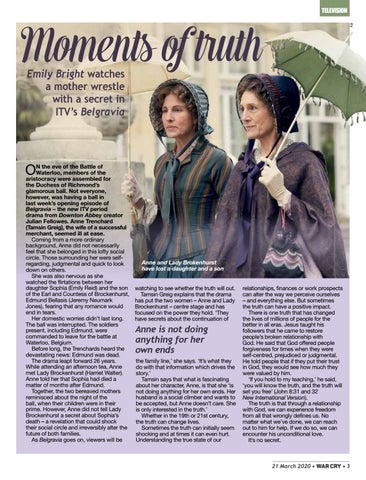
Emily Bright watches a mother wrestle with a secret in ITV’s Belgravia
N the eve of the Battle of O Waterloo, members of the aristocracy were assembled for
the Duchess of Richmond’s glamorous ball. Not everyone, however, was having a ball in last week’s opening episode of Belgravia – the new ITV period drama from Downton Abbey creator Julian Fellowes. Anne Trenchard (Tamsin Greig), the wife of a successful merchant, seemed ill at ease. Coming from a more ordinary background, Anne did not necessarily feel that she belonged in this lofty social circle. Those surrounding her were selfregarding, judgmental and quick to look down on others. She was also nervous as she watched the flirtations between her daughter Sophia (Emily Reid) and the son of the Earl and Countess of Brockenhurst, Edmund Bellasis (Jeremy Neumark Jones), fearing that any romance would end in tears. Her domestic worries didn’t last long. The ball was interrupted. The soldiers present, including Edmund, were commanded to leave for the battle at Waterloo, Belgium. Before long, the Trenchards heard the devastating news: Edmund was dead. The drama leapt forward 26 years. While attending an afternoon tea, Anne met Lady Brockenhurst (Harriet Walter). Anne told her that Sophia had died a matter of months after Edmund. Together, the two bereaved mothers reminisced about the night of the ball, when their children were in their prime. However, Anne did not tell Lady Brockenhurst a secret about Sophia’s death – a revelation that could shock their social circle and irreversibly alter the future of both families. As Belgravia goes on, viewers will be
Anne and Lady Brokenhurst have lost a daughter and a son watching to see whether the truth will out. Tamsin Greig explains that the drama has put the two women – Anne and Lady Brockenhurst – centre stage and has focused on the power they hold. ‘They have secrets about the continuation of
Anne is not doing anything for her own ends the family line,’ she says. ‘It’s what they do with that information which drives the story.’ Tamsin says that what is fascinating about her character, Anne, is that she ‘is not doing anything for her own ends. Her husband is a social climber and wants to be accepted, but Anne doesn’t care. She is only interested in the truth.’ Whether in the 19th or 21st century, the truth can change lives. Sometimes the truth can initially seem shocking and at times it can even hurt. Understanding the true state of our
relationships, finances or work prospects can alter the way we perceive ourselves – and everything else. But sometimes the truth can have a positive impact. There is one truth that has changed the lives of millions of people for the better in all eras. Jesus taught his followers that he came to restore people’s broken relationship with God. He said that God offered people forgiveness for times when they were self-centred, prejudiced or judgmental. He told people that if they put their trust in God, they would see how much they were valued by him. ‘If you hold to my teaching,’ he said, ‘you will know the truth, and the truth will set you free’ (John 8:31 and 32 New International Version). The truth is that through a relationship with God, we can experience freedom from all that wrongly defines us. No matter what we’ve done, we can reach out to him for help. If we do so, we can encounter his unconditional love. It’s no secret.
21 March 2020 • WAR cry • 3
On International Day of Forests, PETE CARTHY tells Emily Bright how his community organisation is reconnecting people with nature in a bid to boost their well-being
H
e o t h a f l l C
OME to creatures great and small, the forests of Great Britain and Ireland have played host to generations of campers, walkers and cyclists as well as Scouts and Brownies keen to earn their bushcraft badge. Through International Day of Forests (21 March), the UN encourages people to discover even more about their wooded wonderlands. In Scotland, the community organisation Instinctively Wild is already tapping into the potential of forests. It runs a Branching Out programme of activities, designed to help people who are facing mental health problems. Developed by Scottish Forestry and run in partnership with the NHS, Branching Out encourages people to discover, explore and conserve wild places, and share their experiences with others. Clients can be referred by their GP or by mental health services. Pete Carthy, the founder of Instinctively Wild, explains: ‘In Branching Out we do lots of different activities, such as mindfulness, listening to birdsong, building shelters and fires, and learning about natural history. People can carry out surveys and conservation work by building bird boxes, planting flowers and observing wildlife.’ A study conducted during the first year of the programme found that it led to an increase in participants’ physical activity, and boosted their self-esteem, confidence, motivation and social skills. Branching Out is not the only programme that Instinctively Wild offers. For the past seven years, in partnership with the NHS, the organisation has also run an eco-therapy programme for people with early-onset dementia. ‘We use sensory experiences in nature to rekindle memories,’ explains Pete. ‘It’s an eight-week programme where clients might create environmental art, use tools, listen to birdsong and do tea tasting.’ Pete says that eco-therapy has many benefits for people with dementia. Not only does it trigger memories, but it
8 • War Cry • 21 March 2020
Pete Carthy
w ild
INTERVIEW
also creates community. ‘It’s quite isolating having dementia, especially in a rural community,’ he says. ‘So people find it helpful to come to a group where others have got a comparable condition to theirs. It’s helpful for the carers as well, because it allows them to talk to other people who are in a similar situation. ‘The social aspect of eco-therapy benefits everyone. It gives them something to look forward to. It raises their confidence and makes them feel better about themselves, helping them to realise that they’re not alone in their circumstances.’ Pete says Instinctively Wild’s eco-therapy programme has already had tangible results. ‘There was a guy who hadn’t played the guitar for years, because he’d lost his
We’re building communities and a positive ethos confidence and forgotten how to do it. We encouraged him to bring his guitar, and he sat and played. ‘It’s about raising the confidence of people, whether in the short or long-term.’ Pete’s recognition of the therapeutic power of nature spans decades. He first twigged that he wanted a career in environmental education as a geology graduate. Realising that he needed teaching experience, he studied for a PGCE and began working in a school. Twenty years on, his longawaited opportunity emerged when Edinburgh City Council advertised a training scheme for teachers to help run programmes where children learnt in the great outdoors. Three
years later, after much research and receiving a grant from a Scottish company, he set up Instinctively Wild. Running the organisation has not always been straightforward. At one time, it was on the brink of collapse because of a lack of finance. As a crucial meeting with a philanthropist approached, Pete turned to his Christian faith. ‘I prayed about it, and I got everybody I know to pray about it,’ he remembers. ‘I went to see the man and eventually he wrote me a cheque. And I think that was the work of God.’ It was not an isolated experience in Pete’s running of the venture. ‘My faith has played a big part in the project. I think of Instinctively Wild as my calling,’ he says. ‘Although we don’t tell anyone about Christianity on the programmes, we’re building communities and a positive ethos, which is very Christian. ‘We work with people where they’re at. We don’t judge anybody; we’re just treating people as we find them.’ As he seeks to serve and support people through nature, Pete draws his inspiration from a 19th-century Scottish Christian conservationist. ‘I agree with what John Muir once said: “Everybody needs beauty as well as bread, places to play in and pray in, where nature may heal and cheer and give strength to body and soul.”’
21 March 2020 • War Cry • 9
‘I found hope when my mother didn’t want me’ Y mother told me many times that she ‘M wished she had never had me,’ says Nona Jones. ‘When I was a child, my mom used to hit
me a lot. I was never sure what I had done wrong. But I grew up feeling worthless and very much alone.’ Nona is now a successful businesswoman and speaker living in Florida. But when she was five years old, her mother’s boyfriend moved into the family home and began sexually abusing her. The abuse continued until she was 11 years old. Nona’s young mind could not process the trauma of the sexual abuse or understand her mother’s behaviour. One day, when she was nine years old, she reached breaking point. ‘I was ready to end my life,’ she says. ‘I happened to see a story on a talk show about a toddler who had died after drinking bleach. So I went to the laundry room to see if we had any. We only had laundry detergent, so I drank that instead. I ended up with a very upset stomach and threw up. ‘The second time I tried to end my life was when I was 11 years old. Again, my mom had said something to push me over the edge. I slit my wrists because I felt so worthless. But it didn’t work.’ When she was six years old, Nona had summoned up the courage to tell her mother about the sexual abuse she was suffering. She remembers: ‘My mom had him arrested. He went to prison, and I thought the abuse was over. But, after his release from prison, my mom brought him back home, and the abuse continued. ‘I felt hopeless and desperate. I thought I had no value.’ Because of the trauma she was facing at home, Nona struggled at school. She was labelled a ‘problem child’ and was thought to have a learning disability. No one asked her why she was so unhappy. But one friend, Betty, invited her to church. ‘That Sunday, the pastor preached that God is a Father to the fatherless. My own father had died shortly before my second birthday,’ Nona explains, ‘and there were so many nights when I had cried myself to sleep, wishing my father was alive. Hearing about God being a Father piqued my interest. I thought: “Who is this God?” ‘I asked if I could take a Bible home, and I started to read the Psalms. I found so much comfort in the Scriptures. I wanted to learn more.’ The more Nona learnt about God, the deeper her faith became. It gave her courage in confronting the
Nona Jones tells Claire Brine how her life has changed after a traumatic childhood pain of her past and helped her find healing. ‘My relationship with Jesus has given me hope,’ she says. ‘It helps me to understand that I have deep worth and purpose. At the same time, that relationship doesn’t answer all of my questions, such as why I was born to a mother who didn’t want me. But I don’t have to know why certain things happened to me to know that God can turn pain into purpose.’ One way in which Nona has found fresh purpose is by sharing her story. In her book, Success from the Inside Out, she describes how she found healing from her traumatic childhood. ‘I forgave my mother a long time ago,’ she tells me, ‘but it’s a process I have to go through every day. And that’s because forgiveness isn’t natural. What’s natural is to become bitter and angry when people hurt us. To be able to forgive requires supernatural power. For me, that power comes from prayer. I give my pain to God.’ Despite Nona’s attempts to make peace with her mother, the two no longer have a relationship. Nona continues to pray for her every day, which, she says, ‘has helped me to see her with eyes of compassion’. After years of living in pain, shame and fear, today Nona is happily married with two children and enjoys a successful career at Facebook. She recognises how much life has changed for her – and she’s grateful to God for it. ‘Occasionally whispers of shame come into my mind,’ she says. ‘But these days I come back to those whispers with shouts of victory because the Bible tells me that I am fearfully and wonderfully made. So whenever I feel discouraged, I believe there is hope for the future.’
Forgiveness is a process I have to go through every day
10 • War Cry • 21 March 2020
l Success from the Inside Out is published by Zondervan
INTERVIEW
21 March 2020 • War Cry • 11
EXPLORE Prayerlink YOUR prayers are requested for Robert and for his wife, who has dementia; and for Fredrick, who feels alone. The War Cry invites readers to send in requests for prayer, including the first names of individuals and details of their circumstances. Send your Prayerlink requests to warcry@salvationarmy.org.uk or to War Cry, 101 Newington Causeway, London SE1 6BN. Mark your correspondence ‘Confidential’.
Becoming a Christian There is no set formula to becoming a Christian, but many people have found saying this prayer to be a helpful first step to a relationship with God Lord Jesus Christ, I am truly sorry for the things I have done wrong in my life. Please forgive me. I now turn from everything that I know is wrong. Thank you that you died on the cross for me so that I could be forgiven and set free. Thank you that you offer me forgiveness and the gift of your Holy Spirit. Please come into my life by your Holy Spirit to be with me for ever. Thank you, Lord Jesus. Amen Extract from Why Jesus? by Nicky Gumbel published by Alpha International, 2011. Used by kind permission of Alpha International
Titus
Nigel Bovey gives chapter and verse on each book in the Scriptures
ITUS, a Greek by birth, was a co-worker T with the Early Church leader Paul and accompanied him to Jerusalem for his sum-
Believers must respect the rule of law and live peaceably (3:1 and 2). Three times Paul outlines the foundational Christian belief that Christ died to save the world from the consequences of its sin. Jesus Christ ‘gave himself for us to redeem us from all wickedness’ (2:14). Paul expands on the theme by writing that ‘when the
mit meeting with other leading members of the Church (see Galatians 2:1–10). He later travelled with Paul to Macedonia and the church in Corinth. Paul regarded him as a ‘true son in our common faith’ (Titus 1:4). When Paul writes his letter to him, Titus is in Crete to put the church there in order (1:5). It will be a big challenge. Crete is notorious for its waywardness. Cretans are known for being ‘always liars, evil brutes, lazy gluttons’ (1:12). The churches have been infiltrated by ‘rebellious people … full of deception’ (1:10). To combat this, Titus must ‘rebuke them sharply’ (1:13) and warn troublemakers. If kindness and love of God our Saviour they do not listen, he is to ‘have nothing to do appeared, he saved us, not because of rightwith them’ (3:10). eous things we had done, but because of his Titus must also appoint elders in every mercy’ (3:4 and 5). church. They are to be faithful to their wives, He goes on to say that God ‘saved us hospitable, above reproach and teachers of through the washing of rebirth and renewal ‘sound doctrine’ (1:6–9). by the Holy Spirit … so that, having been Paul outlines what constitutes sound doc- justified by his grace, we might become heirs trine. It is twofold: sound belief and sober having the hope of eternal life’ (3:5–7). behaviour. This, says Paul, is the sound belief the In contrast to the pervading culture, older Cretans need to understand, live by and share men are to be temperate, self-controlled and with others. ‘sound in faith’ (2:2). They are to be an example to younger men, encouraging them also to be self-controlled as well as sound of speech (2:6–8). Older women are to be reverent in their behaviour, not engaging in appeared that ‘The grace of God has slander or addicted to drink (2:3). ople’ (Titus 2:11 offers salvation to all pe They should be role models for on) younger women (2:4). New International Versi
Believers must respect the rule of law and live peaceably
Key verse
"
Looking for help? Just complete this coupon and send it to War Cry 101 Newington Causeway London SE1 6BN Basic reading about Christianity Information about The Salvation Army Contact details of a Salvation Army minister
12 • War Cry • 21 March 2020
Name Address