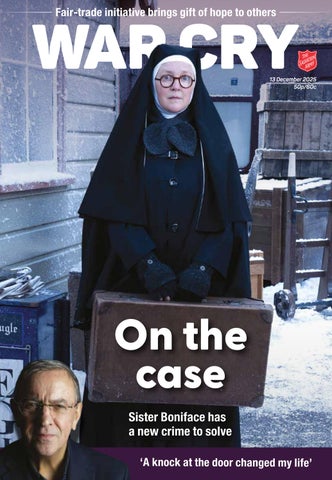
‘A knock at the door changed my life’ Fair-trade initiative brings gift of hope to others
On the case

Sister Boniface has a new crime to solve
What
The Salvation Army?
The Salvation Army is a Christian church and registered charity seeking to share the good news of Jesus and nurture committed followers of him. We also serve people without discrimination, care for creation and seek justice and reconciliation. We offer practical support and services in more than 700 centres throughout the UK. Go to salvationarmy.org.uk/find-a-church to find your nearest centre.
What is the War Cry?
The Salvation Army first published a newspaper called the War Cry in London in December 1879, and we have continued to appear every week since then. Our name refers to our battle for people’s hearts and souls as we promote the positive impact of the Christian faith and The Salvation Army’s fight for greater social justice.
Editor: Andrew Stone, Major
Managing Editor: Philip Halcrow
Staff
Staff
Staff
Editorial
Graphic
Emily Bright
Claire Brine
Ewan Hall
Linda McTurk
Mark Knight
Graphic Designer: Natalie Adkins
Email: warcry@salvationarmy.org.uk
The Salvation Army
United Kingdom and Ireland Territory 1 Champion Park London SE5 8FJ
Tel: 0845 634 0101
Subscriptions: 01933 445445 (option 1, option 1) or email: subscriptions@satcol.org
Founders: Catherine and William Booth
International leaders: General Lyndon Buckingham and Commissioner Bronwyn Buckingham
Territorial leaders: Commissioners Jenine and Paul Main
Editor-in-Chief: Major Julian Watchorn

December is a busy month. As people rush round trying to get everything ready for Christmas Day, it can feel as if there isn’t enough time to do all that needs to be done. Interruptions and disruptions to our already packed schedules are very rarely welcomed.
So we can only imagine what was going through the minds of Rob and Dianne Parsons when, in 1975, there was an unexpected knock on their door two days before Christmas. In an interview in this week’s War Cry, Rob tells us how they opened the door to a man who was experiencing homelessness and how he went on to live with them for the next 45 years.
Answering the door that night changed the lives of Rob and Dianne – and of Ronnie, the man they welcomed into their home and into their lives. It’s not an action they would necessarily recommend to everyone, but Rob is keen to encourage us to think about how we can help other people.
‘We will all have people who will knock on our door, either physically or metaphorically,’ he says. ‘And sometimes the tiniest bit of kindness, like looking in somebody’s eyes and giving them the dignity of asking their name, can change everything.’
In this week’s issue we also find out about a way in which we can help people who live far away through the gifts we choose to buy.
Others is a Salvation Army initiative which provides opportunities for workers in Bangladesh and Kenya to earn a fair wage by producing seasonal items such as Christmas decorations and cards, as well as wooden kitchen utensils, coasters and handwoven textiles. In the UK, these items are available to buy online.
By making such purchases, we can help to make a significant difference in people’s lives. It’s an opportunity, in the middle of our busyness, to do some good – and that’s always worth making time for.



INFO INFO
Your local Salvation Army centre

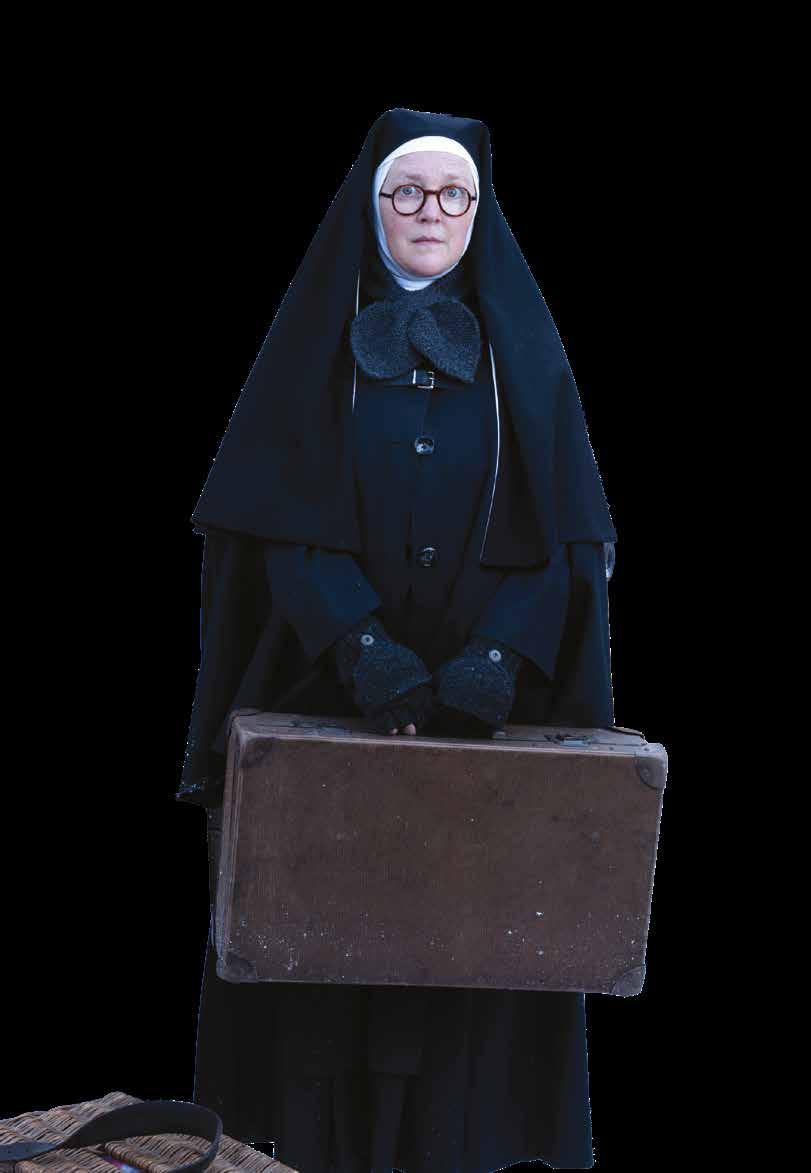
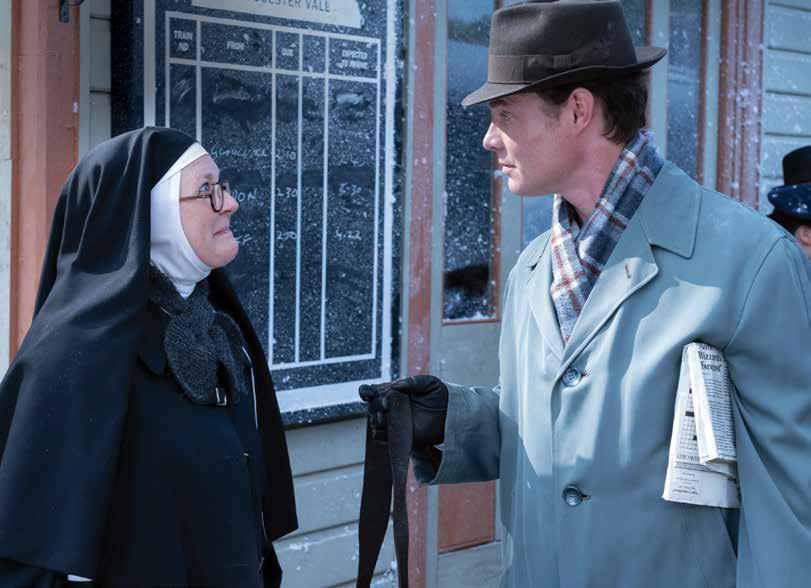
Sister Boniface and DI Sam Gillespie meet at the train station
Loco-motives
Who would want to derail Christmas by robbing a train?
By Claire Brine
Atrain mysteriously decouples. Passengers are left stranded. The power fails. Outside, the snow is falling fast. The chances of having a merry Christmas are looking slim in Sister Boniface Mysteries: The Star of the Orient
The seasonal special of the 1960sset whodunnit series begins with much excitement, as the nuns at St Vincent’s Convent in the Cotswolds are counting down the days till Christmas with an Advent calendar. Elsewhere, DI Sam Gillespie (Max Brown) is packing up presents, all ready to pay a visit to his relatives in Oxford. And his landlady Mrs Clam (Belinda Lang) is happily unpacking decorations for the Christmas tree.
But the part-time forensic scientist Sister Boniface (Lorna Watson) is feeling a little less joyful. Bumping into DI Gillespie at the train station, she explains that she’s heading home for Christmas to take care of her poorly mother.
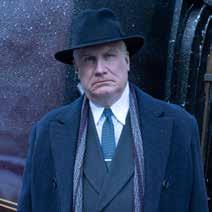
Also boarding the train is Sir Swinton Usher (Rupert Vansittart), who’s travelling with his son and daughter-in-law to take a priceless family jewel to the British Museum. Believing the jewel to be cursed, he’s desperate to get rid of it before it causes any more harm to his loved ones. He deposits it in a safe located in one of the carriages – and only he knows the combination to unlock it.
Despite reports of bad weather, the journey gets under way. But then the train stops. And when it finally pulls away, it leaves a number of carriages behind. Sister Boniface, DI Gillespie, Sir Swinton and others are left stranded in a snowdrift.
Feeling nervous, Sir Swinton tells his fellow passengers that the bad luck could be connected to the jewel. But when he opens the safe to check it, it has disappeared.
‘Intriguing,’ comments Sister Boniface. ‘A priceless ruby vanishes from a safe to which only Sir Swinton knew the combination.’
So who could have taken it? As DI Gillespie begins to question the passengers – all of whom seem suspicious – Sister Boniface looks for clues.
But uncovering the thief is just one of the group’s problems. Outside, it’s getting colder. And if the passengers aren’t rescued soon, they could be at risk of freezing to death.
Although viewers sitting cosily at home may feel far removed from the dramas of missing jewels and stranded trains, it’s likely that many will be able to identify with the fear that occurs when faced with problems that seem unsolvable.
Perhaps we are experiencing endless financial worries or someone in our family is suffering illness. Maybe we feel lost in life
and don’t know which direction to take next.
When we feel afraid or stuck in our circumstances, a book favoured by Sister Boniface points us in the right direction. The Bible reveals stories of a God who loves us and who is willing to help us, whatever our past. We can find strength in his promises that he will always be with us. And we can experience his peace through our turmoil when we trust him with the problems on our heart.
One prayer in the Bible describes the guidance which God gives as ‘a light that shows the path’ we should take (Psalm 119:105 Easy-to-Read Version).
In times when life seems bleak, or when we feel clueless and alone, we can turn to God – because spending time in his presence will reveal endless evidence of his comforting love.
TV preview: Sister Boniface Mysteries: The Star of the Orient Friday BBC1 and iPlayer
Sir Swinton Usher is troubled by a family jewel that he believes to be cursed
Tat’ll do nicely
Claire Brine gives her take on a story that has caught the attention of War Cry reporters
It’s not surprising to hear a clergyman declaring the main joys of Christmas as ‘the good news of the birth of Jesus’ and worshipping in church. But I was happy to see in The Times that the dean of Salisbury Cathedral is extolling the virtues of other ‘Christmas-related joys’.
The article highlighted a booklet, entitled The Twelve Joys of Christmas, in which the Very Rev Nicholas Papadopulos writes of the pleasure to be found in ‘the stuff we’re probably not meant to talk about in church. You know, the Christmas tree. The presents. The food.’ Such frills, he argues, do not detract from the Christian story of the Nativity.
‘At Christmas,’ he explains, ‘we celebrate the divine becoming visible in the earthly, don’t we? Isn’t it just possible that in this other stuff – this decidedly earthly stuff – we catch glimpses of the divine? I believe that it is.’
I’m going to embrace the tackiness
On the subject of ‘tasteless’ Christmas jumpers, which could appear to have nothing to do with the true meaning of Christmas, the dean suggests: ‘Here’s the thing. God is tasteless too. That’s actually the heart of the good news... God does not discriminate. God does not exclude. So wear that jumper with pride.’
At this time of year, as my to-do list grows ever longer, I find myself becoming consumed by all kinds of festive demands – getting a costume for my daughter’s school Nativity play, buying a big tin of Roses and wrapping a million presents.
I enjoy doing all these things, but sometimes I feel guilty that Jesus is barely getting a look-in at his own birthday.
I think that’s why I find the dean’s perspective so helpful. Rather than compartmentalising Christmas into ‘the holy stuff’ and ‘the secular stuff’, he suggests that I see all of my preparations as part of celebrating Christ’s birth. I can acknowledge that everything I’m doing is because I believe that God gave us his Son, Jesus.
So this Christmas, I’m going to embrace the tackiness of the tinsel and the sparkle of the festive socks, remembering that they point me towards a moment in history that changed everything.
talk talk Team talk Team talk ‘ ’ j TEA M TALK
WAR Train training to boost wellbeing
A Christian organisation that supports people who work on the railways has launched a training programme to help them manage the mental and emotional demands of their work.
Railway Mission’s new Paideia Coaching programme has been designed to help railway staff – from frontline workers to managers – recognise the signs of stress and develop strategies to promote wellbeing in an industry where people can feel the pressures brought by long hours and safety responsibilities.
The professional training programme was developed by Railway Mission – which provides support to railway workers and passengers through its network of chaplains – in collaboration with the Chartered Institute of Railway Operators.
Visits to Your Local Pantry network, a membership-based food club organisation run by charity Church Action on Poverty, have passed the one million mark.
The network gives residents access to high-quality groceries for a small weekly fee, helping families to save money and avoid food crises.
Research by the charity found that the Pantries reduce food bank reliance, improve health and strengthen communities.
WAR CRY

Child actors found value in Narnia
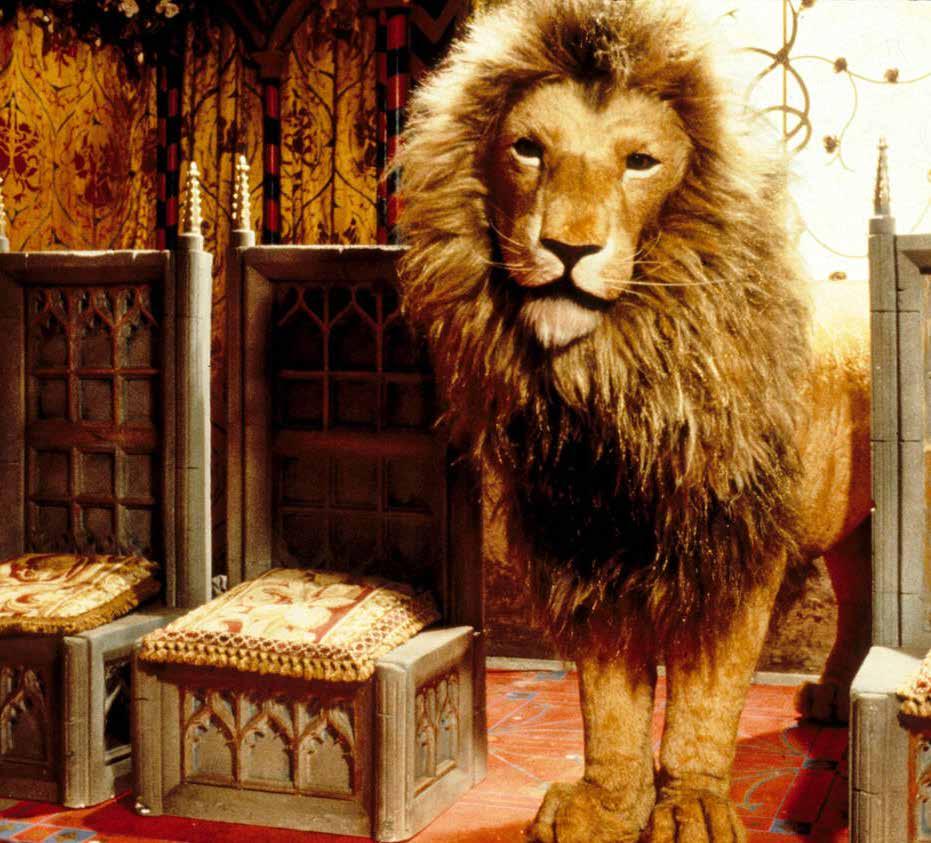
The actors who starred in the 1988 BBC drama The Lion, the Witch and the Wardrobe – based on the book by CS Lewis – reflected in The Times on their positive experiences of making the series.
Sophie Cook, who played war evacuee Susan at the age of 13, told the paper that after her adventures in the fictional world of Narnia, she found ‘succour’ in the story’s Christian elements. She explained: ‘The Pevensie children take morality into Narnia – the values of justice, integrity and fairness.’
The article also revealed that Sophie, along with the other actors who found fame in the series as children, had recently filmed a two-hour documentary about their experiences, entitled Return to Narnia
Aslan the lion in the BBC’s 1988 adaptation of CS Lewis’s story
Time for another series of drama with faith themes
The BBC has announced the third series of the Jimmy McGovern Bafta-winning drama Time, which explores life behind bars for offenders and prison staff and has previously raised questions relating to faith.
Set in a young offender institution, the new series will star David Tennant as prison officer Bailey, with Siobhan Finneran reprising her role as the prison chaplain, Marie-Louise. The programme will explore the impact of locking up teenagers and the effects on those who look after them.
Speaking to the War Cry after the first series was broadcast, Jimmy McGovern (pictured) explained why he was keen to write dramas that explore the value of religion.
‘Heads of drama do not always see the importance of faith,’ he said. ‘They don’t realise how much faith there is in society – which means they’re missing a trick. I’m always looking for good stories, and faith is full of them.’
Other ways

CHRIS BREKKE, general manager of Others Global, explains why its handcrafted products appeal to Christmas shoppers looking for meaningful gifts
Interview by Ewan Hall
The festive rush is in full swing.
Shops are buzzing with people hunting for the perfect gifts. But if any of those shoppers are looking for inspiration, the products made by Others – a Salvation Army initiative – could be the answer they are looking for.
‘Others started in Bangladesh in 1997,’ explains Chris Brekke, general manager of Others Global. ‘It was inspired by the Salvation Army community development work that had previously gone on in the country, and by the fact that most people want the chance to earn a fair income, support their families, save money and educate their children.’
Others exists to create opportunities for people who would otherwise struggle to find meaningful work or who are forced into poor working conditions. Participants often work on a piecework basis, giving even parents and carers the flexibility to earn an income.
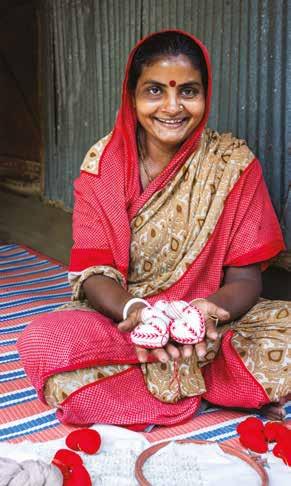
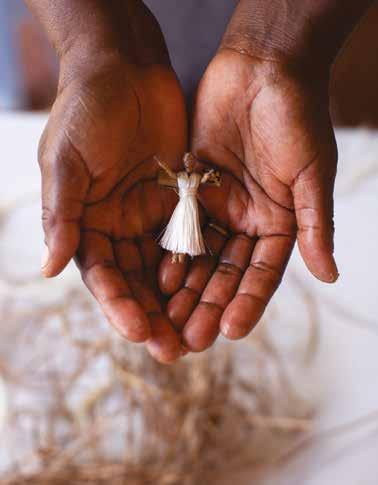
The artisans who join Others are trained in traditional and contemporary techniques, enabling them to produce high-quality goods such as Christmas cards and decorations, wooden kitchen utensils, coasters and handwoven textiles. For many of them, it represents their first experience of paid employment.
Production relies on traditional skills
Since its beginnings in 1997, the initiative has expanded. It now employs artisans in Kenya as well as Bangladesh. Its products are sold in several countries, including the UK.
As well as supporting the artisans who make the goods, Others focuses on protecting the environment and ensuring that production is culturally sensitive as
well as being economically viable.
‘We want all our producers to use locally available, natural and sustainable materials, avoiding plastic and complex manufacturing processes,’ says Chris. ‘Production relies on traditional handicraft skills, adapted for designs that work in global markets.
‘The Salvation Army maintains control of the supply chain, ensuring fair wages and fair-trade standards. Around 800 artisans are involved, many using skills passed through generations.
‘Our artisans are often women in rural areas with few job options, and the items are simple to make with basic tools and can be made from home.
‘But it’s not just women that the initiative supports – handloom weaving in Bangladesh, for instance, is predominantly carried out by men.
‘We aim to create opportunities where they’re most needed and help close
to give

gender gaps.’
Others has transformed the lives of many artisans. The extra income gives them and their families the resources to improve their quality of life.
We show God’s love to others through tangible service
‘O
ver the years,’ says Chris, ‘many of our artisans have shared how Others has allowed them to save and invest in their children’s education by covering school fees, uniforms and books.
‘The money they make also enables them to improve their homes or farms, creating new income streams. That surplus income is a game changer for families who once lived hand-to-mouth.
‘Others also has ties to other Salvation Army projects. We’ve trained people supported by Salvation Army rehabilitation programmes for survivors of human trafficking as well as those working in the sex industry. While this represents a small portion of our artisans, we still work with these groups to offer alternative livelihoods – which is an important way that we can make a difference.’
Chris explains that the work of Others is a way for The Salvation Army to live out its mission.
‘Our name reflects The Salvation Army’s vision and core message,’ he says. ‘In communities in Bangladesh, where Christianity is a minority religion, we show God’s love to others through tangible service.’
The artisans supported by the initiative have been busy creating Christmasthemed items. In the UK, there are
opportunities to browse and purchase their products online as well as in person in the cafés at The Salvation Army’s International Headquarters and UK headquarters in London.
‘Christmas is a big season for us,’ says Chris. ‘It’s a time when people want to show they care about each other. Giving gifts is about expressing love and care –and an added element can be choosing gifts that have a meaningful story.
‘These artisans are skilled producers making quality products that we sell because of their design and appeal, and not just because of the story behind the people who made them. But their story does add value, showing that buying these items makes a difference.’
l For more information visit sps-shop.com and tradeforhope.com
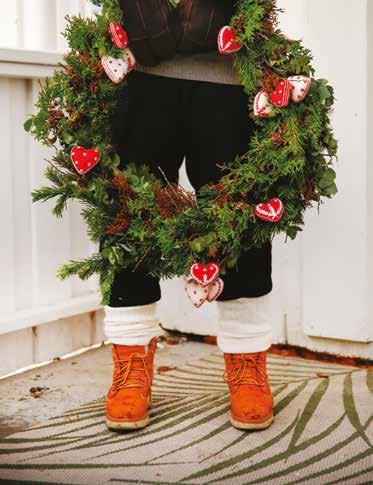
Christmas products made by Others artisans include embroidered baubles, hearts and angel ornaments
METTE RANDEM
HÅKON SAND

Knock knock. Who’s there?

Rob Parsons
Aknock on the door in December can often signal the arrival of Christmas parcels, festive groceries, friends or family. But the unexpected knock on the door of young married couple Rob and Dianne Parsons on 23 December 1975 led to their opening up their home to a virtual stranger for the next 45 years.
When Rob answered the door of his home in Cardiff, he vaguely recognised the figure who stood before him, holding a frozen chicken. The man – who had learning difficulties and grew up in a care home – was a former Sunday school acquaintance, Ronnie Lockwood.
Rob and Ronnie’s first introduction as primary school-aged children had been a rather unconventional one.
‘The first thing he did,’ remembers Rob, ‘was to put my friend in a headlock. The second thing he did was to hide our Sunday school teacher’s handbag. He was an unusual boy. But we did get to know and like him. Then, when he was 11 years old, he disappeared.’
Rob solved the mystery many years later when he was carrying out research for his book, A Knock at the Door, which tells how he, Dianne and Ronnie were brought together.
‘The local authority had thought it was a good idea to send Ronnie about 200 miles away to a school which the report disgracefully described as being
Author ROB PARSONS explains how an unexpected Christmas visitor became a lodger and transformed his family’s life
Interview by Emily Bright
for subnormal boys,’ Rob tells me. ‘He had no social worker, no family, no friends, no teachers that he knew there.
‘Then, when he was 16, they brought him back to Cardiff and practically ejected him from the care system. I used to see him occasionally when he dropped in at a youth group that I was running.’
He was deeply wounded by his childhood
Now aged 30 and without a place to live, Ronnie stood at Rob’s door. In his right hand, he clutched all his possessions in a black plastic bag, and in his left, he held the frozen chicken which someone had given to him for Christmas. Rob invited Ronnie in, and Dianne cooked him a meal.
Afterwards, Rob and Dianne decided to let him stay with them over Christmas. Then they extended his stay for another night. Then another. He would end up living with them until his death in September 2020.
After consulting their church’s homelessness centre, the couple realised that Ronnie was caught in a vicious cycle – he needed an address to get a job but needed a job to afford to rent an address. They agreed to let him stay until he got back on his feet. But neither Rob nor
Dianne could bring themselves to ask him to leave.
‘I think the saddest thing of all,’ says Rob, ‘and perhaps the hardest, was to see how strongly his childhood and the care home experience had affected him. He was deeply wounded. A constant phrase on his lips was, “Have I done a bad thing?” We’d say: “No Ronnie, you haven’t done a bad thing.”’
Living with Ronnie did, however, bring certain challenges.
‘There was the difficulty of having a stranger in your home day by day who had got certain needs,’ says Rob. ‘Dianne bore the brunt of it, and she was incredible. But she would sometimes say: “I don’t know whether I’m his friend, his sister, his social worker or his mother.” And those were real tensions.’
Rob reveals that there were complicated patterns of behaviour that stemmed from Ronnie’s traumatic childhood in care, such as his putting people in headlocks and hiding car keys.
‘When I talked to a psychologist about it, he said: “The headlock thing might be his desire for touch. And the hiding of car keys or handbags might be a little bit of control where he’s in the driving seat in a
From page 9
life that’s had no control.”’
Five or six years after Ronnie moved in, Dianne became ill with ME. It was during her illness that he really stepped up. He helped the household not just by performing his usual chores but also by providing childcare for the couple’s two children, Katie and baby Lloyd.
‘My vibrant wife was suddenly gone,’ recalls Rob. ‘We went through a very difficult time. Dianne’s sister Barbara used to help look after Lloyd, and I’d do my best.
‘But at that time, Ronnie came into his own. He made up baby bottles for Lloyd. He used to sit watching Play School with Katie while I pushed Lloyd around the block, trying to get him off to sleep. He
used to make us beans on toast, his favourite meal.
‘Somebody we both loved was ill and we were both trying to get her through it. And it was an incredible thing to watch. When Ronnie had joined us, he was a lodger, and then he became a friend, but now suddenly he became the brother I never had.’
Often, people saw Ronnie simply as the beneficiary of the couple’s kindness. But Rob is adamant that they benefited from having Ronnie with them.
‘When he’d been with us a short time, he got a job as a dustman,’ Rob explains. ‘And Dianne used to say to me: “Rob, please take him to work at least for the first month, just to make sure he gets
there on time.”
‘I used to drop him off, then go to work as a lawyer. I’d get home at night and he’d be smiling. And I’d say: “Ronnie, when I get home, you’re always smiling. What amuses you so much?” He said: “Rob, when you take me to work in the mornings, the other men ask, who’s that who brings you to work in the car? And I say, oh, that’s my solicitor.”
‘I thought a lot about that. I don’t think Ronnie was proud of being taken to work specifically by a lawyer. I think it was that he’d never had a mother take him to his first day of school. Never had a father say when he was 11: “How did it go in the big school today, son?” And now at last somebody was at the gate for him. I learnt that we all need somebody at the gate.’
Rob says that Ronnie was also one of the most generous people he had ever known.
‘He never had a lot of money, but he loved to give,’ he says. ‘Our church operates a homelessness centre. Very quickly after he joined us, Ronnie used to go down there every Sunday night and help wash up afterwards. And one night he came back, and he had a dirty pair of old trainers on.
Would we have done it again? Yes, we would
‘Isaid: “Where are your new shoes?”
He said: “I gave them to some guy who needed them.” The idea of a homeless man literally walking around in Ronnie Lockwood’s shoes is too ironic to imagine.’
Gradually over their time with him, Rob and Dianne opened their hearts to Ronnie, and learnt the importance of telling people that they are loved.
‘Tell people who matter to you that you love them,’ Rob encourages. ‘Just say the words, even if sometimes it’s an act of the will and not the heart.
‘About two or three years before he died, I said to Dianne: “Darling, I think Ronnie’s never had anybody tell him they love him. When he pops his head in the door to say goodnight, I’m going to say, I love you, Ronnie.”’
Those words became all the more poignant when Ronnie became seriously ill.
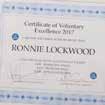
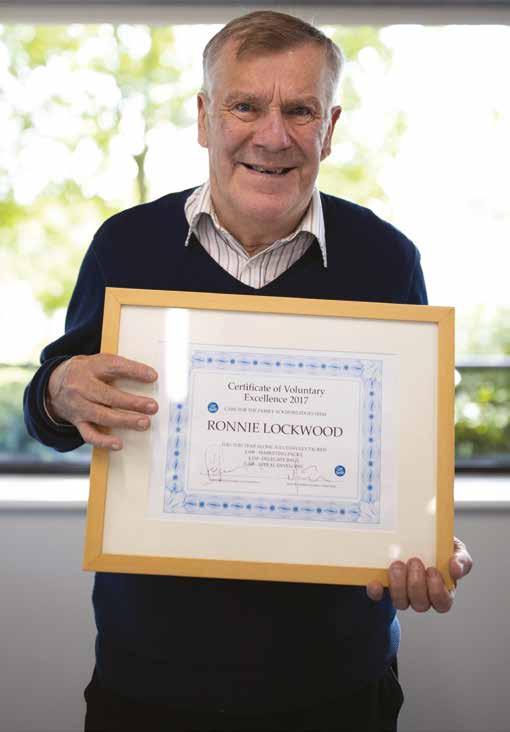
Ronnie Lockwood received a certificate for his voluntary work with charity Care for the Family
‘In the middle of Covid, he had a stroke and we couldn’t go to the hospital with him. As the ambulance doors were closing, I shouted: “I love you, Ron.” He shouted back: “And I love you.”’
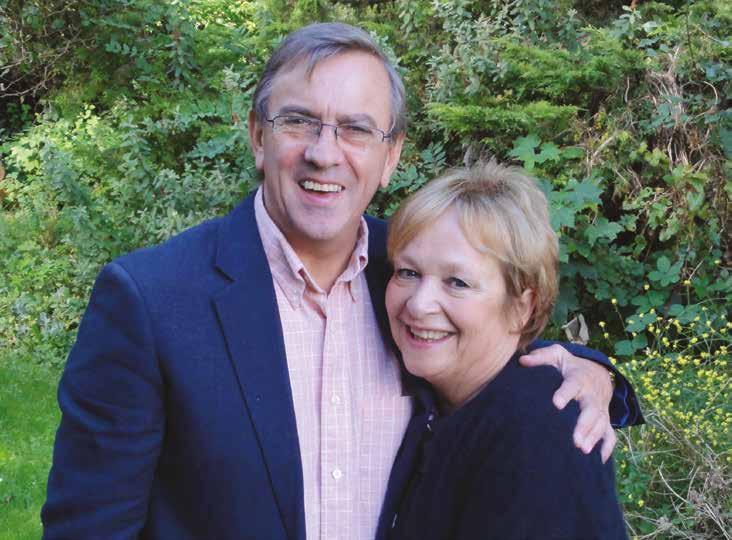
Rob and Dianne
Months later, as Ronnie’s health deteriorated further, Rob and Dianne were allowed to visit him in hospital.
‘We were with him as he died,’ says Rob. ‘I was hugging him, telling him I loved him.
‘And then Dianne lay next to him and began to sing a song that Ronnie would have sung in Sunday school, “Jesus Loves Me, This I Know”. If we can grasp the love of God to us through Jesus, it changes everything.’
The love of God has been a constant in the lives of the Parsons family. During Dianne’s illness, they learnt to rely fully on him. At that time, Rob was ‘a hotshot lawyer’, a senior partner in a law practice, and lecturing all over the world to thousands of other lawyers.
‘But I couldn’t fix Dianne’s illness,’ he says. ‘I realised then that I have a deep need of God. Sometimes people say to me: “Your faith in God is a crutch.” And I say to them: “You’re probably right. But I wasn’t meant to make it on my own. I was meant to lean.”’
After Dianne’s gradual recovery, she and Rob felt called by God to set up the charity Care for the Family, which they did
in 1988. Among the services it provides is support for the bereaved, as well as parents and couples, helping them to weather life’s storms. Ronnie became an enthusiastic volunteer, packing more than 10,000 pieces of post for the charity. The certificate of recognition he received became one of his proudest possessions.
And, when Rob and Dianne first took in Ronnie, it was faith that drove their decision-making too.
‘I did an interview recently about A Knock at the Door with Radio 4,’ says Rob. ‘And the host asked: “Why did you do it?” I said: “Well, to be honest, it was because of Jesus.”’
Rob recalls the passage in the Bible where Jesus tells people at the Last Judgement that in caring for others –feeding those who are hungry, clothing the naked or visiting those in prison – they were, effectively, doing those things to him.
‘I’ve got no doubt that faith was the driving force behind our decision to invite Ronnie in,’ says Rob.
And given his time again, Rob wouldn’t change that decision.
‘Dianne has often asked: if we’d known
it all, all the pain and hassle, would we have done it again? And we both said yes, we would have.’
Rob believes that Ronnie’s story has a wider resonance during the festive period.
‘In all of our lives and on all of our doors, there will be at least one knock this Christmas from somebody we love or care about,’ he says. ‘We can’t answer them all. And I certainly don’t recommend what we did – it just went by from day-today for 45 years.
‘But we will all have people who will knock on our door, either physically or metaphorically. And sometimes the tiniest bit of kindness, like looking in somebody’s eyes and giving them the dignity of asking their name, can change everything.’
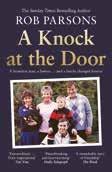
l A Knock at the Door is published by William Collins
The War Cry invites readers to send in requests for prayer, including the first names of individuals and details of their circumstances, for publication. Send your Prayerlink requests to warcry@salvationarmy.org.uk or to War Cry, 1 Champion Park, London SE5 8FJ. Mark your correspondence ‘Confidential’.
Becoming a Christian j
There is no set formula to becoming a Christian, but many people have found saying this prayer to be a helpful first step to a relationship with God
Browsing the Bible
Nigel Bovey gives chapter and verse on each book of the Scriptures
Luke
Luke was not one of the 12 apostles nor was he a Jew. He was a doctor by profession, and his Gospel was specifically aimed at non-Jewish readers.
The exclusive contents of Luke’s Gospel reveal its author’s concern to emphasise the inclusivity of Jesus. God’s Kingdom, Luke contends, is available to everyone, regardless of ethnicity, class, status, age or gender.
Working shepherds, and not landed gentry, are the first to see the newborn Jesus (2:1–20).
In his one-to-one encounters, Jesus demonstrates how God’s love extends to everyone. He heals a crippled woman (13:10–17) and a man with dropsy (14:1–4) on the Sabbath, offending religious leaders in the process. He also raises a widow’s son from the dead (7:11–15), forgives a woman of ‘ill repute’ (7:36–50), heals ‘untouchable’ lepers (17:11–14) and forgives a cheating tax collector (19:1–10).
Lord Jesus Christ, I know that I have done things in my life that are wrong and I’m sorry.
Thank you that I can ask you for forgiveness because of the sacrifice you made when you died on the cross.

Please forgive me and help me to live a better life in the future as I learn how to love you and follow your way of living.
Thank you, Lord Jesus.

Through his parables, Jesus emphasises God’s limitless mercy. The good Samaritan (considered a worthless outsider by Jesus’ audience) is the leastexpected hero of the story (10:25–37).
The parables of hosting and feasting (14:7–24) indicate that God values those society doesn’t – ‘the poor, the crippled, the lame, the blind’ (14:13 New International Version). In the parable of the great banquet, ‘successful’ people reject God’s invitation, whereas society’s marginalised are invited and take their places.
The parables of the sheep, coin and prodigal son illustrate divine determination to seek, find and recover people who are lost (chapter 15).
In arguably his most scandalous parable – which contrasts a pious religious leader with a Rome-collaborating tax collector – Jesus pinpoints his most essential message: self-righteous, show-off religion does not earn God’s forgiveness; it is those who recognise their sinfulness and need of divine mercy who are forgiven (18:9–14).
Even in his dying moments, Jesus reaches out to those beyond polite society. Exclusively, Luke reveals that, while being crucified, Jesus accepts the confession of a dying criminal and, consequently, reassures him of his place with him in God’s Kingdom (23:39–43).

If you’ve prayed this prayer, scan the QR code or contact us using the coupon on this page



























To receive basic reading about Christianity and information about The Salvation Army, complete this coupon and send it to



War Cry 1 Champion Park London SE5 8FJ a

Or email your name and postal address to warcry@salvationarmy.org.uk















QUICK QUIZ
1 2 3 4 5 6
Which former racing driver recently published her memoir Driven?
Which British monarch was featured on the world’s first postage stamp, the Penny Black?
Siân Brooke and Katherine Devlin play rookie police officers in which TV drama series?
What 1984 film starred Kevin Bacon as dancer Ren?
Jimmy Wales and Larry Sanger launched which online encyclopedia in 2001?
Which visitor attraction is centred on two theme parks in Marne-la-Vallée, France?
What’s the world coming to?
King and adventurer talk climate change
TV preview: Steve Backshall’s Royal Arctic Challenge Thursday ITV1 and ITVX
By Claire Brine
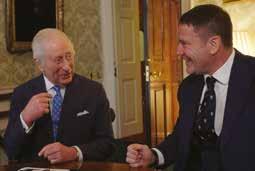
EThe King tells Steve Backshall about his experiences in the Canadian Arctic
nvironmentalist Steve Backshall is ready for an adventure. He’s heading to the Canadian Arctic, where he plans to retrace the steps of King Charles, who took a royal tour to the continent 50 years ago. In the documentary Steve Backshall’s Royal Arctic Challenge, the pair meet at Buckingham Palace to reflect on the King’s trip, while also discussing the devastating effects of climate change on the area today.
Determined to mirror as many of the King’s experiences as possible, Steve travels to Nunavut, where he tries dog sledding and ice diving. He’s thrilled to spot polar bears and enjoys chatting with Inuit people about their culture. The beauty of the landscape fills him with awe.
‘The Arctic is an extraordinary place,’ he says. ‘But it’s changing faster than anywhere else on Earth.’
Steve’s point hits home when he visits the terminus of a glacier, which has retreated by almost a mile since the King’s expedition in 1975.
‘Within a decade or so, all of this ice is going to be gone,’ he explains. ‘It’s being affected by our world, our life, our choices.’
With the Arctic thousands of miles away, it can be too easy, perhaps, to put its problems to the back of our minds. But many of the choices that we make as we go about our lives in the UK have global consequences. Animals, nature and communities are affected – endangered – by our actions.
Climate change is not someone else’s problem. It belongs to everyone who calls the Earth their home. And the God who created our world wants us to care for it and the people living in it.
He sent his Son, Jesus, to preach an important message: ‘Love your neighbour’ (Matthew 22:39 New International Version).
Christians believe that showing love to their neighbour –whether they live next door or on the other side of the world – means caring about what happens to them. It means taking action that will prevent and alleviate their suffering.
This is the love Jesus showed – and when we follow his example, we are taking steps towards making the world a better place.

Steve takes in the scenery

3. Strike (3)
7. Cake (6) 8. Sell (6)
9. Self-assurance (6) 10. Perfect society (6)
11. Tree trunk (3)
12. Erase (6) 14. Scottish dish (6) 17. Motor (6)
21. Lethargy (6)
24. Craze (3) 25. Faith (6) 26. Ravenous (6) 27. Bank cashier (6) 28. Truly (6) 29. Extremity (3)
1. Specimen (6)
Previously (6)
Meek (6)
Water container (6) 5. Physically powerful (6) 6. Two-piece bathing suit (6)

12. Stain (3)
13. Yellowish brown (3) 15. Electrical unit (3) 16. Wily (3) 18. Required (6)
19. Hanging frozen water
HONEYCOMB


Out of sight
Short oar
Simultaneous action

(6)
Exertion (6)
Stick (6)
Yearly (6)
Fence (6)
Hit. 7. Gateau. 8. Retail. 9. Aplomb.
Utopia. 11. Log. 12. Delete. 14. Haggis.
Engine. 21. Apathy. 24. Fad. 25. Belief.
Hungry. 27. Teller. 28. Really. 29. Toe.
Before. 3. Humble.
Trough. 5. Strong. 6. Bikini. 12. Dye.
Tan.
Amp. 16. Sly. 18. Needed. 19. Icicle.
Effort. 21. Adhere. 22. Annual. 23. Hurdle. HONEYCOMB
Fringe. 2. Crayon. 3. Hidden.
Paddle. 5. Siesta. 6. Unison.
Hair over forehead
Stick of coloured wax


Pork and turkey pies
INGREDIENTS
METHOD
Preheat the oven to 160C/Gas Mark 3.
For the filling
250g diced pork, finely chopped
100g sausage meat
Salt and ground black pepper, to taste
125g turkey breast, finely chopped
25g dried cranberries
25g smoked bacon, finely chopped
5g dried sage
For the pastry
125g lard
175ml water
300g strong white flour
Salt, to taste
1 egg, beaten, to glaze
Place all the filling ingredients in a bowl and mix well. Set aside.




To make the pastry, place the lard and water in a pan and heat until the lard has melted. Tip in the flour and salt. Mix until combined, then form a soft dough.
Leaving enough to make lids, divide the dough into 50g pastry balls to line the holes of a muffin tin, with a little lip above the top of each hole. Load each pastry with enough filling to form a slight mound at the top.
Divide the rest of the dough into 30g pastry balls, flatten into discs, then place as lids on top of each pie, pressing the edges down. Smooth the edges, then use a knife to make a small hole in the top.
Glaze the pies with the beaten egg, then place in the oven for 45-50 minutes, until the pastry is golden and crisp and the filling is cooked. Allow the pies to cool slightly before removing from the tin, to serve.
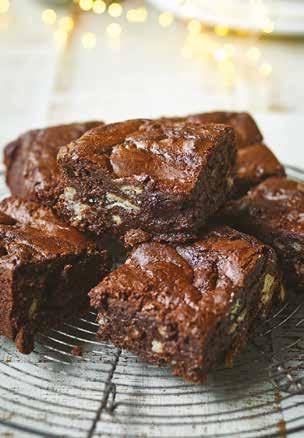
Mince pie brownies
INGREDIENTS
250g baking margarine
400g caster sugar
75g cocoa powder
4 eggs
150g gluten-free self-raising flour
100g dark chocolate chips
250g leftover mince pies, broken into bite-sized pieces
150g mincemeat
METHOD
Preheat the oven to 160C/Gas Mark 3 and line a 30cm x 23cm baking tray.
Heat the margarine in a pan on a low heat until melted, then take the pan off the heat and add the sugar and cocoa powder. Mix well.
Beat the eggs together in a separate bowl, then add to the cocoa mixture. Combine. Add in the flour and mix again. Gently stir in the chocolate chips, mince pie pieces and mincemeat.
Pour the mixture into the baking tray and smooth down the top. Bake in the oven for 30-35 minutes, until slightly risen and just set.
Once cooked, remove from the oven and cool completely in the tin.
Refrigerate the brownies until cold before cutting to serve.

From ‘See, amid the Winter’s Snow’ by Edward Caswall