INTERVIEW
Going the ‘Extra, extra!’ mile C
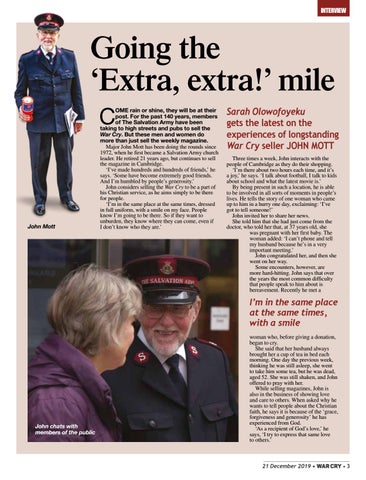
John Mott
OME rain or shine, they will be at their post. For the past 140 years, members of The Salvation Army have been taking to high streets and pubs to sell the War Cry. But these men and women do more than just sell the weekly magazine. Major John Mott has been doing the rounds since 1972, when he first became a Salvation Army church leader. He retired 21 years ago, but continues to sell the magazine in Cambridge. ‘I’ve made hundreds and hundreds of friends,’ he says. ‘Some have become extremely good friends. And I’m humbled by people’s generosity.’ John considers selling the War Cry to be a part of his Christian service, as he aims simply to be there for people. ‘I’m in the same place at the same times, dressed in full uniform, with a smile on my face. People know I’m going to be there. So if they want to unburden, they know where they can come, even if I don’t know who they are.’
Sarah Olowofoyeku gets the latest on the experiences of longstanding War Cry seller JOHN MOTT Three times a week, John interacts with the people of Cambridge as they do their shopping. ‘I’m there about two hours each time, and it’s a joy,’ he says. ‘I talk about football, I talk to kids about school and what the latest movie is.’ By being present in such a location, he is able to be involved in all sorts of moments in people’s lives. He tells the story of one woman who came up to him in a hurry one day, exclaiming: ‘I’ve got to tell someone!’ John invited her to share her news. She told him that she had just come from the doctor, who told her that, at 37 years old, she was pregnant with her first baby. The woman added: ‘I can’t phone and tell my husband because he’s in a very important meeting.’ John congratulated her, and then she went on her way. Some encounters, however, are more hard-hitting. John says that over the years the most common difficulty that people speak to him about is bereavement. Recently he met a
I’m in the same place at the same times, with a smile
John chats with members of the public
woman who, before giving a donation, began to cry. She said that her husband always brought her a cup of tea in bed each morning. One day the previous week, thinking he was still asleep, she went to take him some tea, but he was dead, aged 52. She was still shaken, and John offered to pray with her. While selling magazines, John is also in the business of showing love and care to others. When asked why he wants to tell people about the Christian faith, he says it is because of the ‘grace, forgiveness and generosity’ he has experienced from God. ‘As a recipient of God’s love,’ he says, ‘I try to express that same love to others.’
21 December 2019 • WAR CRY • 3
We had news for FLORE JANSSEN of The Salvation Army’s International Heritage Centre tells Emily Bright about the War Cry’s early history
S
INCE the dawn of the printing press, editors have faced the formidable task of hitting deadlines. Whether their journalists jauntily jot down words only at the last minute or the technology crashes at the eleventh hour, it’s not always easy. But when Salvation Army founder William Booth commissioned the creation of the War Cry 140 years ago, the first issue barely made it into print. By 1879, The Salvation Army’s services had spread so quickly that the existing monthly publication The Salvationist could no longer contain all its news. So William decided to create a weekly alternative, as Flore Janssen, of the church and charity’s heritage centre, explains: ‘William Booth, who planned the War Cry with his second-in-command George Scott Railton, decided it would be a four-page
format. He wanted it to be printed on The Salvation Army’s own printing press, which was situated behind its headquarters in the East End of London at the time. ‘But the printing press that they had wasn’t up to the job, so it stopped working. They had to send all the forms to a different, much larger firm to finish printing the issue. ‘It was then a mad dash, getting cabs through a thick fog to the train stations in time to distribute it across the country. Railton later wrote about all the “complicated contrivances by cabs and otherwise to get parcels to the newspaper trains, to induce the companies to pay attention to the new invader”.’ Why did they go to such lengths in order to create a newspaper? ‘The idea was to spread the word and raise awareness of what The Salvation
Flore Janssen Army was doing,’ says Flore. ‘William Booth made a speech in which he said that readers should see the character of The Salvation Army’s work in the War Cry. It should be as if they could watch the open-air processions, hear the solos sung and the truth spoken.’ Holbrook Jackson, a prominent newspaper editor in the early 20th century, commended the publication for its transparent and alternative approach. His comments were cited in the War Cry’s 1915 yearbook. ‘He is full of praise for the War Cry,’ Flore says. ‘He says that it’s completely independent of all the things that you normally expect periodicals to be invested in. ‘It doesn’t court the front row of the bookstores and it’s not
They embraced the novelty of colour printing
The ‘War Cry’ printing machine featured in an 1886 issue of the paper 4 • WAR CRY • 21 December 2019
distributed by newsagents. But what he finds most astonishing is that it’s independent of advertisers, which was very rare for that time.’ Each issue was crammed with songs, poems and reports. Flore explains that the sheer array of content was designed to attract a broad audience, but its popularity and the mass contributions of readers led to some tough editorial decisions. She cites an 1887 issue containing a polite disclaimer to
you appease War Cry contributors, which stated: ‘Some of the reports are cut down to what the authors may consider a terrible extent. They must put it down to the desire of the department to satisfy the demands of as many contributors as possible.’ Within the same issue, Flore tells me, the writers included an article called ‘a peek behind the scenes’, charting how the War Cry was produced. The piece explored all the newspaper’s departments, starting from the editors and ending with the printers. The paper was printed at the Campfield Press, which was owned by The Salvation Army and known as a good employer. ‘In our records there’s an extract from an autobiography by a man who worked as a compositor at the Campfield Press in 1912,’ Flore says. ‘He talks about how there were always tea breaks and there was time for worship during their working day. And he says the place was painted white and cream throughout and was light, airy and clean. It was clearly a pleasant place to work.’
INTERVIEW
Colour covers for the Christmas and Coronation issues The War Cry team were always looking for ways to be at the forefront of the publishing world. They not only trialled alternative feature ideas, but also experimented with layouts and first introduced colour more than 100 years ago. ‘They had their first colour Christmas covers from 1900, and from then on
Salvation Army officers selling the ‘War Cry’ in public houses
there’s a strikingly coloured Christmas cover every year,’ Flore says. ‘They also had colour supplements for the coronations of George VI and Elizabeth II, so they clearly embraced the novelty of colour printing. ‘From about the 1880s, they started having at least one or two images on the cover, and in the early days, often there’d be portraits and even cartoons.’ Flore highlights one particular front-page cartoon that summed up the ambition of The Salvation Army using the War Cry to introduce its readers to the Christian life. A man stands up, arms raised in joy. ‘It shows someone going through a moment of salvation,’ Flore says. A front-page cartoon 21 December 2019 • WAR CRY • 5
The front page of the first ‘War Cry’
8 • WAR CRY • 21 December 2019
FEATURE
The talk of the town Sarah Olowofoyeku visits a place that made front-page news in the very first War Cry 140 years ago
‘B
The Salvation Army was ordered to stop its open-air services Major Ged Nicoll is a minister at The Salvation Army in Boston today
OSTON is a pretty quiet town. It does not like to be disturbed,’ were the first words of a report on the first page of the first issue of the War Cry, published on 27 December 1879. One Salvation Army officer, Captain Taylor, the report explains, ‘has disturbed it all’. The report came after the rousing words that ended the issue’s introductory article: ‘Let the War Cry go everywhere! Quick!’ That rallying cry explained the purpose of the new publication, which aimed to spread the gospel as well as the good news of how it was being spread. One hundred and forty years ago, Captain Josiah Parsons Taylor, who led the Salvation Army church in the small East Anglian market town, was spreading the good news, but was being met with opposition from some residents. He was holding Salvation Army services outdoors in the marketplace. However, the landlord of the neighbouring Angel pub felt disturbed, explaining that the noise was having such an effect on his ill mother-in-law that he and his family ‘could scarcely keep her in bed’. A formal complaint was made to the magistrates that the Salvation Army services were noisy and an inconvenience. The War Cry article reported that other neighbours had supposedly spoken to the landlord, asking him to start a petition to put an end to the services. He did. When the residents were asked what they wanted, twelve were in favour of the services continuing; seven would not say a word against them; and eight considered them a nuisance. The appeal was taken to the bench, and the bench ordered The Salvation Army to stop its open-air services in the marketplace. But they continued, and Captain Taylor was summoned for causing an obstruction. The magistrates came to the conclusion: ‘In this particular instance, as you have stated, there was no preaching, and you were there for a very short time for the purpose of giving out
Turn to page 10
➥
21 December 2019 • WAR CRY • 9
Boston marketplace at the end of the 19th century
From page 9 a hymn, and were about to retire when the constable spoke to you; the case is dismissed. But for the future we cannot allow an obstruction to take place either in the marketplace or elsewhere.’ The War Cry ‘gladly’ reported its support of the Boston magistrates’ decision. But the peace was disturbed again and, in 1881, more complaints were made about the noise. The magistrates introduced a ban that stopped The
A ban stopped The Salvation Army playing brass instruments Salvation Army playing brass instruments in the streets of Boston on a Sunday. In response, Captain Taylor’s successor, Captain Samuel Rees, used three concertinas, an accordion, a triangle and a banjo instead. The captain later broke the ban. When the town’s brass band accompanied a mayoral procession one Sunday, he led 10 • WAR CRY • 21 December 2019
the Salvation Army band through the streets at the same time. He was arrested and, on refusing to pay a fine, sent to Spalding jail for ten days. One of the sentencing magistrates, however, broke ranks, went to the prison, paid the fine and took Captain Rees back to his home in Boston for a bath and a meal. Later a public protest claimed that, regarding the playing of brass instruments on a Sunday, there was one rule for the mayor and another for The Salvation Army. After that, the Army was mostly left alone to hold marketplace and street services with its brass band. And in June 1884, when Boston council was approached by other councils to sign a petition calling on the Home Office to give them more powers to ban The Salvation Army from the streets, it declined.
ne hundred and forty years later, O The Salvation Army is still at work in Boston. It holds services in its church
building and its band was recently invited to play in the marketplace.
Majors Ged and Jayne Nicoll are now the ministers at the church. The dayto-day goings-on keep them busy. On Mondays, Wednesdays and Fridays, the church holds a drop-in café. ‘It’s there to provide basic support for people who are homeless or vulnerable,’ Ged says. ‘We offer soup, toast, teas and coffees. But we also use it as a means of connecting with people if they need additional help with clothes or food parcels. ‘On a Wednesday morning, we run a parent-and-toddler group, Honeypots, which is very well attended. The centre also runs an over60 club and a women’s group. ‘We have good links with other churches and people in the town,’ says Ged. ‘The
FEATURE
school next door is very multicultural – about 50 per cent of the pupils are foreign nationals or the children of foreign nationals. We’ve started a maths class for the parents of some of those children. The school also uses our building for its harvest and Christmas services.’ Ahead of the Christmas season, the church started its annual present appeal to help make this time of year easier for families in need. ‘We work with social services, children’s services and schools to identify families that are in need,’ says Ged. ‘A local supermarket and a department store allow us to put a Christmas tree up in their shop. On each Christmas tree we put cards up with information such as ‘little boy, 4 years old’, and it invites people to buy a present and donate it. We get toys in, and they are then distributed to hundreds of families. We also provide them with food parcels.’ Over the past 140 years, the town has experienced changes, and those changes have brought new challenges, such as an influx of migrants from Europe. A language barrier sometimes exists even between The Salvation Army and the people it wants to help. ‘It’s difficult to identify the needs,’ Ged explains. ‘But often they have come here with the promise of a job, and then they find that the job isn’t there. ‘We have linked with other agencies in an attempt to make a breakthrough. We have consultants with Employment Plus, the Salvation Army service that helps people to find work or manage their finances.’ There are other needs in the town that The Salvation Army is able to meet because of its wider work. ‘I had a chap who was homeless in Spalding just the other week,’ he says. ‘He was in tears when he approached me. I think he was at the end of his tether. Because the Army has a hostel in Skegness, I was able to talk to the manager there, and the man is presently living in the hostel, getting the kind of support that he needs.’ Connecting with people is an important part of Boston Salvation Army’s work, and some of those connections are made through the selling of the War Cry. Rick Wray is the present War Cry seller – or ‘herald’ – and has been for the past
Connecting with people is an important part of Boston Salvation Army’s work ten years. Before him, a man named Jack Webb had been selling the magazine for 80 years. ‘It was quite a thing to take over from Jack,’ says Rick. ‘I was a bandmaster for 35 years and when I retired, I started helping out with the heralds – Jack was about 98 then.’ Being a War Cry herald involves selling the magazine every week, sometimes outdoors, no matter the weather. ‘I do it twice a week on market days, and I’ve made a lot of friends in the marketplace,’ says Rick. ‘I go for three hours on a Wednesday and a Saturday. You build relationships with a lot of people, and with that relationship comes a lot of responsibility because they tell you all sorts of things.’ Rick says that, although the Army faced some hostility when the first issue of the War Cry was being produced, it is now well respected. He believes that for those he encounters on the streets, he is ‘their church’.
‘Some people will come to talk to me but they wouldn’t go into a church building. They talk to me about personal things. I haven’t got all the answers, but I do my best to help.’ Rick says he has to be ready to help in all kinds of ways. ‘An old lady came to me to say her husband had died and she had sorted his stuff out. She wanted the Army to have it, but she didn’t have any means of getting it anywhere. So I went to her house to collect it, and I put it in a clothes bank. ‘Another couple invited me to a 40th wedding anniversary party, and they presented the Army with a cheque for £900. ‘A few months ago, a man came to tell me his son had committed suicide – he just wanted to stand and talk and talk. Some people come who have health problems. But I’m able to have a word of prayer with them or tell them that the church will pray for them. It’s a privilege to get involved with people.’
21 December 2019 • WAR CRY • 11
EXPLORE Prayerlink YOUR prayers are requested for Debbie, who is in need of hope and strength; and for Lucy, that she will get better soon. The War Cry invites readers to send in requests for prayer, including the first names of individuals and details of their circumstances. Send your requests to Prayerlink, War Cry, 101 Newington Causeway, London SE1 6BN. Mark your envelope ‘Confidential’.
Becoming a Christian There is no set formula to becoming a Christian, but many people have found saying this prayer to be a helpful first step to a relationship with God Lord Jesus Christ, I am truly sorry for the things I have done wrong in my life. Please forgive me. I now turn from everything that I know is wrong. Thank you that you died on the cross for me so that I could be forgiven and set free. Thank you that you offer me forgiveness and the gift of your Holy Spirit. Please come into my life by your Holy Spirit to be with me for ever. Thank you, Lord Jesus. Amen Extract from Why Jesus? by Nicky Gumbel published by Alpha International, 2011. Used by kind permission of Alpha International
Nigel Bovey gives chapter and verse on each book in the Scriptures
The letters HE majority of the New Testament is T made up of 21 letters or ‘epistles’, 13 of which identify their sender as ‘Paul’.
The ‘Pauline’ letters are addressed to two types of recipients. First, there are open letters to churches that were springing up, some of which the evangelist had visited on his missionary journeys. These letters offer congregations encouragement, address issues of conflict, correct wrong doctrine and give teaching. They explore the implications of Jesus’ life, death and resurrection and set out how belief in him should be lived out against a background of Roman polytheism and Jewish antagonism. The other letters – those addressed to Timothy, Titus and Philemon – are more personal in nature and deal with particular issues of concern. Some scholars believe that Paul wrote the letters to the churches in Ephesus, Philippi and Colossae, and the personal letter to Philemon, while imprisoned in Rome. The other Early Church leader, Simon Peter, who figures throughout the gospels and in the opening chapters of Acts, is identified as the author of two letters to Christian converts. Two brothers, James and Jude, generally also regarded as brothers of Jesus, each have a letter ascribed to them.
Like James, who addresses his letter to the 12 Jewish ‘tribes scattered among the nations’ (1:1), the unknown writer of Hebrews focuses on the connection between Jesus and the precepts and practices of the Old Testament. The
The letters explore the implications of Jesus’ life, death and resurrection letter depicts Jesus as the complete fulfilment of Old Testament teaching. The final letter-writer is named as John. Like Peter, he was one of Jesus’ 12 disciples, and was at the forefront of those who founded the Church. Scholars generally estimate that all the letters were written between AD49 and the last decade of the 1st century and that James and Galatians are the earliest, with John’s letters being the last. Originally written as typical letters of their day, they, along with the rest of the New Testament, were divided into chapters and verses in 1227 by Stephen Langton, Archbishop of Canterbury.
"
Looking for help? Just complete this coupon and send it to War Cry 101 Newington Causeway London SE1 6BN Basic reading about Christianity Information about The Salvation Army Contact details of a Salvation Army minister
12 • WAR CRY • 21 December 2019
Name Address