JAKE GILES NETTER
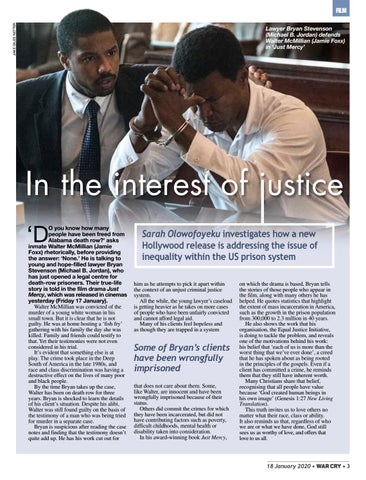
FILM Lawyer Bryan Stevenson (Michael B. Jordan) defends Walter McMillian (Jamie Foxx) in ‘Just Mercy’
In the interest of justice ‘D
O you know how many people have been freed from Alabama death row?’ asks inmate Walter McMillian (Jamie Foxx) rhetorically, before providing the answer: ‘None.’ He is talking to young and hope-filled lawyer Bryan Stevenson (Michael B. Jordan), who has just opened a legal centre for death-row prisoners. Their true-life story is told in the film drama Just Mercy, which was released in cinemas yesterday (Friday 17 January). Walter McMillian was convicted of the murder of a young white woman in his small town. But it is clear that he is not guilty. He was at home hosting a ‘fish fry’ gathering with his family the day she was killed. Family and friends could testify to that. Yet their testimonies were not even considered in his trial. It’s evident that something else is at play. The crime took place in the Deep South of America in the late 1980s, and race and class discrimination was having a destructive effect on the lives of many poor and black people. By the time Bryan takes up the case, Walter has been on death row for three years. Bryan is shocked to learn the details of his client’s situation. Despite his alibi, Walter was still found guilty on the basis of the testimony of a man who was being tried for murder in a separate case. Bryan is suspicious after reading the case notes and finding that the testimony doesn’t quite add up. He has his work cut out for
Sarah Olowofoyeku investigates how a new Hollywood release is addressing the issue of inequality within the US prison system him as he attempts to pick it apart within the context of an unjust criminal justice system. All the while, the young lawyer’s caseload is getting heavier as he takes on more cases of people who have been unfairly convicted and cannot afford legal aid. Many of his clients feel hopeless and as though they are trapped in a system
Some of Bryan’s clients have been wrongfully imprisoned that does not care about them. Some, like Walter, are innocent and have been wrongfully imprisoned because of their status. Others did commit the crimes for which they have been incarcerated, but did not have contributing factors such as poverty, difficult childhoods, mental health or disability taken into consideration. In his award-winning book Just Mercy,
on which the drama is based, Bryan tells the stories of those people who appear in the film, along with many others he has helped. He quotes statistics that highlight the extent of mass incarceration in America, such as the growth in the prison population from 300,000 to 2.3 million in 40 years. He also shows the work that his organisation, the Equal Justice Initiative, is doing to tackle the problem, and reveals one of the motivations behind his work: his belief that ‘each of us is more than the worst thing that we’ve ever done’, a creed that he has spoken about as being rooted in the principles of the gospels. Even if a client has committed a crime, he reminds them that they still have inherent worth. Many Christians share that belief, recognising that all people have value because ‘God created human beings in his own image’ (Genesis 1:27 New Living Translation). This truth invites us to love others no matter what their race, class or ability. It also reminds us that, regardless of who we are or what we have done, God still sees us as worthy of love, and offers that love to us all.
18 January 2020 • WAR CRY • 3
From here to ete Director Terrence Malick’s new film A Hidden Life tells the true story of how an Austrian farmer refused to fight for the Nazis during the Second World War – and how, motivated by their Christian faith, he and his wife were prepared to stick by their beliefs whatever the cost. Philip Halcrow talks with AUGUST DIEHL and VALERIE PACHNER about playing the couple who took a stand
R
August Diehl and Valerie Pachner 8 • WAR CRY • 18 January 2020
ESEARCHING the real-life woman she was playing on screen, actress Valerie Pachner came across an interview. Fani Jägerstätter had been through extraordinarily tough times. During the Second World War her husband, Franz, had been put on trial by the Nazis for his refusal to swear allegiance to Hitler and fight in the army. The other inhabitants of their Austrian village labelled him a traitor and ostracised the couple. Fani outlived Franz. Valerie remembers: ‘In the interview I saw, Fani was something like 96 years old – she lived to turn 100 – and she was this old, fragile woman, yet she was not broken at all. She was beaming, she was happy. ‘And that really hit me. I realised it was going to be important to remember that, although she’s going through the worst things, she does not lose trust in the good and she doesn’t lose faith. She still believes that there is good on Earth.’ Before she joined the cast of Terrence Malick’s film A Hidden Life, which was released in cinemas yesterday (Friday 17 January), Valerie knew a little about the story
INTERVIEW
rnity
of her compatriots the Jägerstätters, ‘though they’re not national heroes or anything like that’. She says: ‘What interested me most about them was the strength that the two of them must have had in order for Franz to go through with his decision. Fani supported her husband although it meant making a great sacrifice. She had
Following what is right, no matter what, makes you strong to know in her heart what was right. I had the feeling that following what is right, no matter what, and not compromising yourself, elevates you and makes you feel like you can do everything. It makes you
strong, and I was drawn to that.’ As well as trying to find out about the Jägerstätters, Valerie set about ‘getting connected’ with the rural lifestyle of the couple, who lived with their children and Franz’s mother and sister-in-law as farmers in the mountain village of St Radegund. ‘My grandparents were farmers, and in my childhood I often spent time at the farm. I also grew up not far from Radegund, so I know about farm life. I know what it’s like to live in the countryside.’ And Valerie believes that understanding where Fani lived is important in understanding her as a character. ‘I’ve led quite an urban life over the past ten years, and before the shoot, when I went to a farm just to get reconnected with the ground, I realised that if you live in those surroundings, you have a different
perception. You have a different relation to the world, to the earth, to the sky because you’re so much in nature. ‘I felt that was very important for the character of Fani – that she is very grounded but on the other hand has access to something that is beyond. She is in nature, and yet, at the same time, being in nature makes it easier to be connected to something bigger.’ A Hidden Life shows how Fani and Franz were driven to take their decisions by something bigger. They are living a happy life until Nazi Germany gears up for war and, having annexed Austria, begins enlisting men from St Radegund. Most of the village are happy with what Hitler is doing. Not Franz. He refuses even
Turn to page 10
➥
18 January 2020 • WAR CRY • 9
From page 9 to contribute financially to the war effort. He is sent for military training, where soldiers cheer film footage of Nazis killing and conquering, but he writes to Fani: ‘My dear wife, what’s happened to our country?’ On his return to St Radegund, he cannot hide his misgivings. He will not go off to fight. ‘We’re killing innocent people, preying on the weak,’ he says. And he cannot see it as compatible with his Christian faith. ‘If God gives us free will,’ he says, ‘we’re responsible for what we do, what we fail to do, aren’t we?’ He seeks advice from members of the clergy, but even if they are sympathetic to him, they are worried about what will happen to him and his family – and they are scared for themselves. The Nazis are melting church bells and turning them into bullets. However, through everything that happens to him – hostility from fellow villagers, the realisation that he may have to be torn from Fani and their children, and the threat of execution – he cannot escape what he sees as the demands of the faith that
plays a pivotal role in his and Fani’s life. It’s a faith that is tested many times through the film, as the actor who plays Franz emphasises. ‘It’s a conflict that is going on in Franz,’ says August Diehl. ‘Now we say he was a
It’s a conflict in Franz. You could say he’s abandoning his family hero because he didn’t fight in the war. But when he was in the middle of this process, there were a lot of reasons why he should make another choice – you could say he’s abandoning his family, he’s letting his children down. It was a huge decision and it was a fight, it was a conflict within him I think until the end.’ Writing to Fani from cells where he is imprisoned, Franz talks of seeing beyond
The Jägerstätters have their domestic bliss destroyed by the war
10 • WAR CRY • 18 January 2020
survival at any price and of feeling flooded with new light. He can reassure her: ‘Mine is the smallest of crosses.’ But at other times the couple struggle to understand what is happening. Fani prays: ‘Lord, you do nothing.’ August says: ‘When he was directing us, Terrence said it was important that we don’t see Franz as a pious farmer who absolutely knows that he’s right. That was not the case. The further Franz goes in the process, the more doubt comes in, not only about his decision but also in God, in faith. He wonders if what he is doing is actually right. ‘So later on we can say, “OK, he was a hero”, but no hero in the world is aware of being a hero while he’s doing something heroic.’ August says that, in his eyes, the film is about something beyond faith. He suggests it is about simplicity, and says that his main work in playing Franz was to ‘enter a state like a child’. He says: ‘Every child knows what is right and what is wrong. It’s only later when we become adults and have all these different points of view that we become confused. But actually it’s pretty simple – to kill somebody is wrong. Everybody knows this. ‘So when I was making the film I wanted to get back into the state of simplicity – I wouldn’t say naivety, but soberness and clearness. ‘The film is about finding a way to see what is right and what is wrong.’ Both August and Valerie are sure that this story set in the 1940s can say something in the 21st century. ‘There’s a tendency,’ says Valerie, ‘to think about power in a brutal and aggressive way, but it’s important to find this other kind of strength that is quiet and helps you realise that love is stronger than anything else.’ August believes that the world is in need of people who are willing to think and act differently from others. He says he has been thinking about certain kinds of political party ‘gaining power again in Europe’ and about
INTERVIEW
Sometimes a simple ‘no’ would be enough to change the world
how generally ‘more or less everybody in society is on a “yes” trip and rushing in one direction’. He explains: ‘If you imagine that a small group sitting in a room decides to do something, but just one person says “no”, then everybody else gets a little angry and starts asking that person whether he thinks he’s better than them – but they might also question why they are saying “yes” so fast. ‘Saying “no” can be very unattractive and annoying, but it’s lacking in our society. We need more people to say “no”. Without being aggressive, without fighting, sometimes a simple “no” would be enough to change the world.’ In A Hidden Life Franz is repeatedly challenged to explain whether he thinks his defiance will do any good, especially when no one will know about it. ‘Looking back from the outside,’ says August, ‘you could say that it did have an impact. It was the question that was put to Franz till the very end: what will his protest change? But to me personally, that is not the question. Franz’s choice is much simpler. It is just: “I can’t do this. I can’t go a way which I can see is wrong.” ‘That’s all. It’s not even a philosophy, which can be discussed. It is simply a personal act. But in it lies so much power.’
Franz suffers for refusing to swear allegiance to Hitler
18 January 2020 • WAR CRY • 11
EXPLORE Prayerlink THE War Cry invites readers to send in requests for prayer, including the first names of individuals and details of their circumstances. Send your requests to Prayerlink, War Cry, 101 Newington Causeway, London SE1 6BN. Mark your envelope ‘Confidential’.
Becoming a Christian There is no set formula to becoming a Christian, but many people have found saying this prayer to be a helpful first step to a relationship with God Lord Jesus Christ, I am truly sorry for the things I have done wrong in my life. Please forgive me. I now turn from everything that I know is wrong. Thank you that you died on the cross for me so that I could be forgiven and set free. Thank you that you offer me forgiveness and the gift of your Holy Spirit. Please come into my life by your Holy Spirit to be with me for ever. Thank you, Lord Jesus. Amen
Nigel Bovey gives chapter and verse on each book in the Scriptures
2 Corinthians AVING been forthright in his advice H on unacceptable behaviour in his earlier letter to the church at Corinth,
the apostle Paul was more conciliatory when he wrote again. His second letter is a response to those in the church who did not respect his leadership (see 1 Corinthians 1:12–14). As such, it reveals much about Paul’s psyche – including his insecurities. Paul is defensive when he explains that a proposed trip to the church did not happen. He also refers to a ‘painful visit’ he made (2 Corinthians 2:1). The personal nature of the letter can be seen in the fact that in his explanation, he uses the word ‘I’ 20 times (1:12 to 2:4). Nevertheless, he urges his readers to forgive those who are in the anti-Paul faction (2:5–11). Paul sets about defending his record as a church pioneer. He had been commissioned by God (2:17), and the existence of the church in Corinth itself testified to his ability (3:2). Paul asserts that, while leadership is stressful and attracts detractors, his motivation has
always been honest (chapter 4). His mission is to preach that sinful people can be reconciled to the holy God through faith in Christ’s atoning death (5:11–21). For this, Paul has been misunderstood, mislabelled and mistreated (6:3–10; 11:24–28). Paul is aware that his first letter caused
The letter reveals much about Paul’s psyche – including his insecurities
heart-searching and pain among the church members, but he is glad that they changed their ways as a result (7:8–13). He refutes the charge that he is timid when face to face but assertive when behind the pen (chapter 10). At the same time, he admits that he is ‘untrained as a speaker’ (11:6). Paul reveals his fragilities. At times in his missionary work, he had ‘despaired of life itself’ (1:8). Despite great success at spreading the Christian gospel, Paul has also been plagued with a ‘thorn in the flesh’ that God refused to remove (12:7–10). Speculation abounds as to whether Paul meant a physical ailment or mental fragility. Whatever the case, Paul says he is prepared to pay new the ist, ‘If anyone is in Chr the emotional, mental and e, physical cost of preaching creation has come: the old has gon new life through faith in 7 5:1 s ian the new is here!’ (2 Corinth Jesus Christ.
Key verse
New International Version)
Extract from Why Jesus? by Nicky Gumbel published by Alpha International, 2011. Used by kind permission of Alpha International
"
Looking for help? Just complete this coupon and send it to War Cry 101 Newington Causeway London SE1 6BN Basic reading about Christianity Information about The Salvation Army Contact details of a Salvation Army minister
12 • WAR CRY • 18 January 2020
Name Address