TELEVISION
There may be trouble ahead T’S a storm in a teacup, she said. But the storm is still brewing for Iseries Maggie, who has upset most of the village of Thurlbury in ITV’s drama The Trouble with Maggie Cole.
The story so far is that local historian Maggie (Dawn French) agreed to be interviewed on radio about the village ahead of its 500th anniversary. After a few too many drinks, she began to desperate to make amends for the wander off-topic and share juicy hurt she had caused her neighbours. and embellished stories about her However, not many of them wanted fellow villagers. Later, when they all to know. gathered together to listen to the In last week’s episode, Maggie radio broadcast, Maggie’s revelations targeted her GP for her first apology. shocked them. Claiming she had trenchfoot, she Feeling mortified, Maggie became refused to leave the surgery until she could say sorry to Carol for suggesting that her husband was having an affair. The fact that he wasn’t meant that Maggie had a lot of grovelling to do. In the episode next Wednesday (18 March), Maggie continues to attract glares and stares whenever she steps outside her front door. She fears going into the corner shop after saying on air that Roxanna, the daughter of the man who runs it, has been ‘carrying on’ with lots of men. Maggie also needs to clear the air with her best friend. During the broadcast, she had said that Jill wasn’t ‘the sharpest tool in the box’. Jill, however, is too hurt to forgive her. Dawn French understands why the other characters
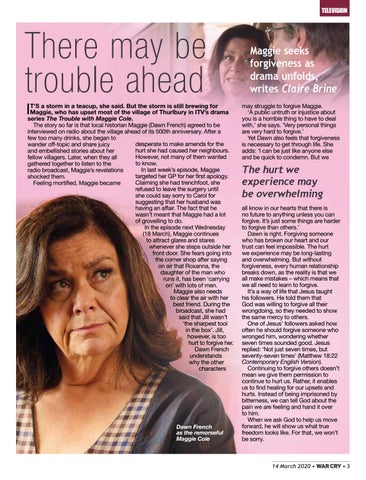
Dawn French as the remorseful Maggie Cole
Maggie seeks forgiveness as drama unfolds, writes Claire Brine may struggle to forgive Maggie. ‘A public untruth or injustice about you is a horrible thing to have to deal with,’ she says. ‘Very personal things are very hard to forgive.’ Yet Dawn also feels that forgiveness is necessary to get through life. She adds: ‘I can be just like anyone else and be quick to condemn. But we
The hurt we experience may be overwhelming all know in our hearts that there is no future to anything unless you can forgive. It’s just some things are harder to forgive than others.’ Dawn is right. Forgiving someone who has broken our heart and our trust can feel impossible. The hurt we experience may be long-lasting and overwhelming. But without forgiveness, every human relationship breaks down, as the reality is that we all make mistakes – which means that we all need to learn to forgive. It’s a way of life that Jesus taught his followers. He told them that God was willing to forgive all their wrongdoing, so they needed to show the same mercy to others. One of Jesus’ followers asked how often he should forgive someone who wronged him, wondering whether seven times sounded good. Jesus replied: ‘Not just seven times, but seventy-seven times’ (Matthew 18:22 Contemporary English Version). Continuing to forgive others doesn’t mean we give them permission to continue to hurt us. Rather, it enables us to find healing for our upsets and hurts. Instead of being imprisoned by bitterness, we can tell God about the pain we are feeling and hand it over to him. When we ask God to help us move forward, he will show us what true freedom looks like. For that, we won’t be sorry.
14 March 2020 • WAR CRY • 3
KOBY ADOM talks to Sarah Olowofoyeku about his work on TV drama Noughts + Crosses and what has shaped his frame of mind
ae
Vit
EPHY has caught Callum’s eye from across the room. S The two have not seen one another for years. But when they reunite, there’s a spark between them. The only problem
is that Sephy is a Cross and Callum is a Nought, and a relationship between them would be forbidden. In BBC One’s new drama series Noughts + Crosses, which began last Thursday (5 March), viewers will find out if their love can conquer all. Living under Aprican rule in the fictional nation of Albion, where racism divides, the white Noughts are the underclass. They are subjected to police brutality. With bad housing and poor job prospects, their futures are bleak. The ruling black Crosses have a higher standard of living, and young people are afforded better opportunities. Relationships between the two groups are not just frowned upon, but banned. Malorie Blackman, the author of the book on which the series is based, has said that Albion is a reflection of modern-day Britain, but with society turned on its head. For instance, in one scene, a white character cuts his hand and must use an alienating brown plaster – something that happened to the author in reverse as a child. ‘People will be given a different perspective by the drama,’ says Koby Adom, who has directed the final three episodes of the six-part series. ‘And I hope that they will have the conversation. Race can no longer be the elephant in the room, because people like me have dealt with it their whole life.’ Koby, who recently turned 30, is Ghanaian and grew up in Thamesmead in south London.
I used my instincts to make the programme realistic
Koby Adom 8 • WAR CRY • 14 March 2020
His experiences influenced his work on the drama. He describes the role of a director as being the ‘visual leader’ of a project, and on Noughts + Crosses he wanted to be authentic. ‘Thamesmead has lots of Yoruba people, and Yoruba culture has been used in the show,’ he says. ‘Thamesmead is also a place where you will see white poverty, so I used my instincts and things that I knew to make the programme realistic. ‘At the centre of the show, though, is love, and I believe that love should be at the centre of life because, to me, God is love.’ Koby’s Christian faith has been central to his career. ‘God knew I was going to become a director. I didn’t have a clue,’ he laughs. He became a director through a series of events, including an unexpected
INTERVIEW
Koby reviews footage on the set of his film ‘Haircut’ tweeted invitation to a film workshop in Los Angeles. Before that, his time at sixth-form college had given him opportunities to explore the craft. ‘In media studies I did a project with my friend,’ he says. ‘We recorded content and then I obsessed over editing it. I thought: I really love this.’ But after taking a university course that was not what he had expected, Koby lost sight of his path. ‘I didn’t know what I wanted to do,’ he says. ‘I had blurred vision.’ Things soon began to fall into place, however. The LA workshop pointed him towards London Film School, where Koby was given a place and a much-needed bursary. ‘At film school I was learning so much and wanted to put it into practice,’ he says. ‘So I started directing and writing. I raised some money and shot my
own film.’ He enjoyed the experience, but after he graduated, he found his working life going off in an unwanted direction. ‘I was in a job that I hated,’ he says. ‘I was walking home one day feeling an internal conflict. Then I started praying and a thought came to me.’ That thought was the idea for a short film about a barber. The film, Haircut, opened up new possibilities for him. He gained an agent, and Haircut was featured at the London Film Festival. It was during that difficult time that Koby also ‘found God’. He remembers: ‘My car got towed, I had to move in with my older sister. All I had was a blow-up bed, two bin bags of clothes and my Bible. I was raised a
Christian, but when it was just me and God in that place of isolation, I found him for myself. From then on, he became my foundation.’ Whether he is fulfilling his directorial role as a ‘visual leader’ on set or navigating a theme of Noughts + Crosses – racism – in real life, Koby is influenced by something beyond what he can see. ‘My ethos is that I live by faith, not by sight,’ he says. ‘I don’t just look at what is logical. So when I have to deal with racial profiling or microaggressions, I know, because of my faith, that God is with me and nothing can challenge God. ‘I understand that I’m not perfect, but God is there for me.’ BBC/Mammoth Screen/ILZE KITSHOFF
Sephy (Masali Baduza) and Callum (Jack Rowan) are attracted to each other, but interracial relationships are forbidden in the Aprican world 14 March 2020 • WAR CRY • 9
A life-saving act of JOE WALSH tells Sarah Olowofoyeku why he decided to give one of his organs to a stranger HILE washing up and listening to the radio one W day last year, Joe Walsh made the decision to change somebody else’s life. He was listening
Joe Walsh
10 • WAR CRY • 14 March 2020
to a programme about kidney donation and was immediately interested. ‘I did some research straightaway about the risks and benefits,’ says Joe, a housing support officer from Leeds. ‘It seemed clear to me that one kidney was enough, that the risks would be low for me and that the potential benefit for the recipient – and to the NHS – would be huge.’ While it was a straightforward decision for Joe, some of his friends and family had serious reservations. ‘Not everyone reacted positively to me wanting to give my kidney,’ he says. ‘I think some people didn’t understand and others were concerned for my well-being.’ He was discouraged by their responses and by the fact that he didn’t know anyone else who had donated a kidney. But he still felt it was something he wanted to do. Then Joe learnt about an initiative called 40 Acts. Run by Christian charity Stewardship, 40 Acts is a generosity challenge that runs during the Christian season of Lent, a time of reflection in the weeks leading up to Easter. For each of the season’s 40 days, participants are emailed a short message challenging them to be generous that day. Joe signed up, along with his wife and some of her work colleagues.
INTERVIEW
kindness ‘I found the challenges thought-provoking,’ he says. ‘Some were about how we steward the environment, and others were about being generous for future generations.’ What he did not know was that 40 Acts would give him a boost in his journey towards organ donation. ‘I was encouraged by stories of how other Christians were living radically for God, and there was another Christian who wanted to donate their kidney,’ he says. ‘At a time when I was feeling discouraged, that really helped me.’ Joe signed up to be a living donor, offering to give his kidney to somebody he didn’t know. He had to undergo a series of tests to assess his suitability. ‘You have to have all kinds of scans and x-rays,’ he says. ‘You even have a psychological assessment to make sure you’re not doing it for the wrong reasons. The hospital tells you all the stats and all the risks.’ The NHS organ donation website states that the tests are to ensure the living donor is fit and healthy enough to donate. The assessment usually takes a few months, and the donor can decide to withdraw at any stage in the process. Living kidney transplants have a very high success rate in the approximately 1,100 such operations performed in the UK every year. As with all operations, there is risk in donating a kidney, but most complications are minor. The risk of death for the donor is 1 in 3,000, similar to the risk in having an appendix removed. After undergoing tests, Joe was deemed
eligible to donate and chose to continue with the process. ‘I had a sense of God’s peace through it all,’ he says. ‘Even on the morning of the operation, I felt calm about it. I woke up from
More than 5,000 people in the UK are in need of a kidney the anaesthetic feeling quite comfortable. I spent one night at the hospital and was home the next day. ‘When I switched from the hospital’s pain relief to paracetamol there was some discomfort, but after a week I was okay. I just had to avoid heavy lifting and give myself plenty of rest.’ Since the operation, Joe has had no health difficulties, and has only been advised by doctors not to smoke, drink excessively or become overweight. While his life has not changed drastically, he has been able to change someone else’s
life. There are more than 5,000 people in the UK who are in need of a kidney. The average waiting time is three years, and hundreds die before a donation has become available. Through his donation, Joe was able to help one of the people on the waiting list. As what is called a non-directed altruistic donor, he donated his kidney to somebody he didn’t know – and his faith played a big part in his decision to do so. ‘It comes down to knowing you are loved by God,’ he says. ‘When you know God’s love and the sacrifice that he has made for you, then it’s natural to want to share that with other people.’ Non-directed altruistic donors are unlikely to know the identity of their recipient or hear from them. But Joe was able to exchange a letter with his recipient. He learnt that the operation had gone well and that she was now able to play with her grandchildren. ‘The person who received my kidney could have been anyone and had any characteristic, but I can say contentedly that I would have given my kidney to anyone, whoever they were. It’s my way of giving back to God and sharing his love with people around me.’
14 March 2020 • WAR CRY • 11
EXPLORE Prayerlink YOUR prayers are requested for Roy, that he will have strength and hope; for Dave, who has lost his wife; and for Charlotte, who has anxiety and depression. The War Cry invites readers to send in requests for prayer, including the first names of individuals and details of their circumstances. Send your Prayerlink requests to warcry@salvationarmy.org.uk or to War Cry, 101 Newington Causeway, London SE1 6BN. Mark your correspondence ‘Confidential’.
Becoming a Christian There is no set formula to becoming a Christian, but many people have found saying this prayer to be a helpful first step to a relationship with God Lord Jesus Christ, I am truly sorry for the things I have done wrong in my life. Please forgive me. I now turn from everything that I know is wrong. Thank you that you died on the cross for me so that I could be forgiven and set free. Thank you that you offer me forgiveness and the gift of your Holy Spirit. Please come into my life by your Holy Spirit to be with me for ever. Thank you, Lord Jesus. Amen Extract from Why Jesus? by Nicky Gumbel published by Alpha International, 2011. Used by kind permission of Alpha International
Nigel Bovey gives chapter and verse on each book in the Scriptures
2 Timothy HE second letter from Paul to his T protégé Timothy was traditionally regarded as the apostle’s last piece of
correspondence before his execution in Rome around AD65. Writing from prison (1:8) and knowing that he is close to death (4:6–8), Paul urges his co-worker in preaching the gospel to be faithful to his divine calling – even if, like Paul, he has to suffer for it (1:3–14). Paul reminds Timothy that Jesus Christ is the essence of the gospel, for which he is imprisoned, saying that Christ has ‘destroyed death and has brought life and immortality to light’ (1:10). To endure hardship, says Paul, Timothy must be as disciplined as a soldier, athlete or farmer (2:3–6). Part of that personal spiritual discipline requires Timothy to ‘flee the evil desires of youth and pursue righteousness, faith, love and peace’, as well as to avoid arguments and graciously deal with his opponents (2:22–25). Paul encourages Timothy to be a craftsman in the way he teaches the Scriptures – a workman who ‘correctly handles the word
Key verse
‘Everyone who wants to live a godly life in Christ Jesus will be persecuted’ (2 Timothy 3:12 New International Version)
of truth’ (2:15). He stresses the role of Scripture in bringing people to faith, urging Timothy to continue in his preaching of it (3:14 to 4:4). Paul adds the warning that the last days – the time immediately preceding the return of Jesus Christ – will be characterised by godless and hedonistic people. Timothy is to avoid them (3:1–9). Writing during the time of the Roman
Faithfulness will reap an eternal inheritance emperor Nero’s persecution of Christians, and with his own state-sponsored death imminent, Paul does not see either spiritual virtue or special reward in martyrdom. Rather, writes the former persecutor of Christians, persecution is an expected consequence for ‘everyone who wants to live a godly life in Christ Jesus’ (3:12). Faithfulness, though, will reap an eternal inheritance. Quoting from a contemporary hymn or creed about Jesus, Paul writes: ‘If we died with him, we will also live with him; if we endure, we will also reign with him’ (2:11 and 12). While Paul will shortly receive a ‘crown of righteousness’ (4:8) for his faithfulness to Christ, Timothy must ‘endure hardship’ and ‘do the work of an evangelist’ (4:5). In other words, carry on the selfless ministry of his mentor.
"
Looking for help? Just complete this coupon and send it to War Cry 101 Newington Causeway London SE1 6BN Basic reading about Christianity Information about The Salvation Army Contact details of a Salvation Army minister
12 • WAR CRY • 14 March 2020
Name Address