TELEVISION
Changing places A
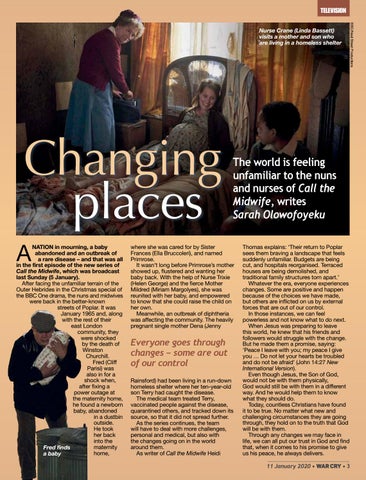
NATION in mourning, a baby abandoned and an outbreak of a rare disease – and that was all in the first episode of the new series of Call the Midwife, which was broadcast last Sunday (5 January). After facing the unfamiliar terrain of the Outer Hebrides in the Christmas special of the BBC One drama, the nuns and midwives were back in the better-known streets of Poplar. It was January 1965 and, along with the rest of their east London community, they were shocked by the death of Winston Churchill. Fred (Cliff Parisi) was also in for a shock when, after fixing a power outage at the maternity home, he found a newborn baby, abandoned in a dustbin outside. He took her back into the maternity Fred finds home, a baby
The world is feeling unfamiliar to the nuns and nurses of Call the Midwife, writes Sarah Olowofoyeku
where she was cared for by Sister Frances (Ella Bruccoleri), and named Primrose. It wasn’t long before Primrose’s mother showed up, flustered and wanting her baby back. With the help of Nurse Trixie (Helen George) and the fierce Mother Mildred (Miriam Margolyes), she was reunited with her baby, and empowered to know that she could raise the child on her own. Meanwhile, an outbreak of diphtheria was affecting the community. The heavily pregnant single mother Dena (Jenny
Everyone goes through changes – some are out of our control Rainsford) had been living in a run-down homeless shelter where her ten-year-old son Terry had caught the disease. The medical team treated Terry, vaccinated people against the disease, quarantined others, and tracked down its source, so that it did not spread further. As the series continues, the team will have to deal with more challenges, personal and medical, but also with the changes going on in the world around them. As writer of Call the Midwife Heidi
Thomas explains: ‘Their return to Poplar sees them braving a landscape that feels suddenly unfamiliar. Budgets are being cut, and hospitals reorganised. Terraced houses are being demolished, and traditional family structures torn apart.’ Whatever the era, everyone experiences changes. Some are positive and happen because of the choices we have made, but others are inflicted on us by external forces that are out of our control. In those instances, we can feel powerless and not know what to do next. When Jesus was preparing to leave this world, he knew that his friends and followers would struggle with the change. But he made them a promise, saying: ‘Peace I leave with you; my peace I give you … Do not let your hearts be troubled and do not be afraid’ (John 14:27 New International Version). Even though Jesus, the Son of God, would not be with them physically, God would still be with them in a different way. And he would help them to know what they should do. Today, countless Christians have found it to be true. No matter what new and challenging circumstances they are going through, they hold on to the truth that God will be with them. Through any changes we may face in life, we can all put our trust in God and find that, when it comes to his promise to give us his peace, he always delivers. 11 January 2020 • WAR cry • 3
BBC/Neal Street Productions
Nurse Crane (Linda Bassett) visits a mother and son who are living in a homeless shelter
FAITH ON THE A
Emily Bright sees the horrors of war depicted in new film 1917 and discovers how a real-life chaplain brought belief to the First World War battlefields At a press conference for the film at the Imperial War Museum in London, George MacKay, who plays Schofield, elaborated on the significance of the filming style. He told me: ‘In those long sequences of the one-shot format it was easy to lose yourself in the scene for ten minutes because no man’s land was abominable. Getting lost in the scene gave us as close to a real-person character as we could have got.’ To create the most realistic characters
they could, members of the cast went to France and Belgium to study the First World War, took part in military and fitness training and read first-person accounts of the war. The costumes team painstakingly replicated the Brodie helmets worn by British and Commonwealth soldiers during the First World War. But Sam Mendes, who this week won a Golden Globe for directing the film, didn’t want the film to be simply a history lesson. ‘It’s about the experience of war
Entertainment One
TICKING time bomb haunts two British lance corporals as they are sent to avert the massacre of 1,600 compatriots on the Western Front. For one of them, the mission is particularly poignant – his brother is among those he is hoping to save. But can he, aided by his friend Schofield, rescue him from a German trap? In the film drama 1917, which opened in cinemas yesterday (Friday 10 January), the action never cuts away from the two characters, following them as they march through the trenches, navigate no man’s land, and seek to escape death’s clutches. Benedict Cumberbatch, who plays the fictional Colonel MacKenzie, thinks that the film’s ‘one-shot’ format presented new challenges, saying: ‘You know it’s only ever going to be one take. You’re committing to something in a very different way.’
Dean Charles-Chapman (Lance Corporal Blake), director Sam Mendes and George MacKay (Lance Corporal Schofield) 8 • WAR CRY • 11 January 2020
FEATURE
FRONT LINE
lthough the film is fictional, the frontline A war it depicts was real for millions of men. One such man was Military Cross recipient and Salvation Army chaplain Colonel William McKenzie, who served at Gallipoli and on the Western Front. Daniel has written a biography of his life, entitled The Man the Anzacs Revered. As a Salvation Army officer before the war, McKenzie worked as editor of the New Zealand edition of the War Cry before moving on to Australia. But when war arrived, he felt duty bound to sign up, and was appointed as chaplain to the 4th Battalion of the Australian Imperial Force’s 1st Brigade in mid-September 1914. ‘A chaplain’s role officially was to take the services every Sunday, to bury the dead, and boost morale,’ Daniel says. ‘Unofficially, the role was as big as you liked, which was dangerous for McKenzie.’ Being a chaplain could involve conducting Bible Daniel Reynaud
studies and confirmations, as well as hosting informal meetings where the soldiers would sing and pray. In addition, chaplains were encouraged to organise sports and recreation, concerts and canteens and even to create cinemas as part of their bid to boost morale. McKenzie took his responsibilities to the men very seriously. ‘The guy just oozed energy, enthusiasm and passion. His first campaign was Gallipoli, where he was in the trenches as much as possible. He’d meet with men in small groups, pray with them, sing with them and chat.’ McKenzie even put himself in the line of fire for the men he served. On 7 August 1915, during the Battle of Lone Pine, an army officer spotted a chaplain working on wounded men in the Turkish trenches while the fighting was still under way. Men were buried three and four deep, with the wounded and dead intermixed. That chaplain was McKenzie, and his heroics led to him being named ‘Fighting Mac the Salvationist’. He pulled out the wounded, gave them first aid and dragged them back to Australian lines. Over the course of three weeks, he buried 450 men. By the end, he was suffering from dysentery and could barely crawl on his hands and knees. McKenzie was later awarded the
The Salvation Army Museum, Austra lia
rather than the historical moment,’ he explained. ‘Through a tiny keyhole of one or two people’s experiences you see the panorama of destruction that was the Great War. ‘My way of honouring the men and civilians who fell during that time, not just on the British side but on both sides, is to tell the story of these men in just over two hours.’ Historian Daniel Reynaud, who has a doctorate in war film, agrees that it’s important not to regard the film as a history lesson, but instead engage with the powerful storytelling. ‘Film is a different media from writing, and it tells its stories differently. Films tell an emotional truth rather than a factual truth, and I hope this film tells an emotional truth.’
William McKenzie
Military Cross for his bravery during the battle. A year later, he was posted to the Western Front. Daniel says that life in the trenches switched between the ‘completely hellish’ reality of the front line and the ‘dangerously routine’ tasks of everyday survival, such as bringing up supplies and fixing or draining trenches. He explains in his book that soldiers would spend up to a month in the trenches, with seven or ten days on the front line. They might take part in a battle once or twice a year, but even in quiet times men were killed by shelling and snipers, or through ailments such as trench foot, trench fever, influenza,
Turn to page 10
➥
The guy just oozed energy, enthusiasm and passion. He was in the trenches as much as possible 11 January 2020 • WAR CRY • 9
From page 9
Entertainment One
pneumonia and frostbite. Without downplaying the harsh realities of the front line, Daniel adds that for about two thirds of the time soldiers weren’t actually posted in the trenches. Therefore, entertaining the soldiers and boosting their morale was an important part of McKenzie’s role. ‘He would run formal and informal entertainments. Typically, he’d gather up several hundred men, write down a list of who would perform, and they’d have a concert. By the time they’d finished, they might have 1,500 men there.’ But, as Daniel explains, McKenzie preferred being close to the action. ‘He would, as far as possible, be with the troops when they had their spells in the trenches. He organised canteens close behind the front line, serving hot drinks such as Bovril or tea to men coming out of the trenches in the cold.’ He highlights how McKenzie sought to mark the anniversary of the Gallipoli landings, which became known as ‘Anzac Day’, on the Western Front. Using
Lance Corporals Blake and Schofield clamber over no man’s land in ‘1917’
10 • WAR CRY • 11 January 2020
regimental funds, he purchased 200kg of fruitcake from a canteen located 8 miles away, distributing a single piece to each man. One soldier wrote that, although a beer would have been preferable, the slice ‘caused much … amusement among the men’. But a far more serious responsibility in McKenzie’s eyes was that of the spiritual
He would pray earnestly and weep at night, over his own soul and over their souls well-being of the men in his care. ‘He would pray earnestly and weep at night, over his own soul and over their souls,’ Daniel says. ‘He writes in his diary about looking into the faces of soldiers while preaching, and knowing there’s a big battle coming up before next Sunday. He talks about seeing
the potential for eternity in the faces of those men.’ Two such battles on the Western Front were Pozières and Mouquet Farm, which were part of the Somme offensive. The 4th Battalion was at Pozières as the battle commenced on 23 July 1916, and were withdrawn from the line on 27 July, with more than 100 dead and 300 wounded. ‘Those battles were really full on,’ says Daniel. ‘Pozières was probably the worst shelling the Australians ever experienced. They lost two thirds of their officers and about half of their men through death or injury. ‘They faced three German divisions, one on each side and one in front. So they were being shelled from three directions, by three divisions’ worth of artillery, which just pounded and pounded. The landscape was unrecognisable. Red smudges of brick dust in the white chalk were the only way they knew where the village was. ‘The conditions were horrific. Men
FEATURE
would be buried by shellfire, they’d be dug out and then they’d be buried again. The official Australian historian said that they came out of the line glassy-eyed and glazed over.’ Daniel says that the brutal nature of war took a spiritual toll on McKenzie. ‘He even wondered at times how there could be a loving God. He was a man who was subjected to intense highs and intense lows. ‘But his faith was everything. He would invest enormous energy in ensuring his own spiritual state was as connected as it could be. And that gave him the fire and the energy and the drive.’ Indeed, McKenzie’s courage stemmed from his close relationship with God, who seemed to draw near in the darkest and most dangerous of times. Citing McKenzie’s letters, Daniel reveals: ‘There were multiple occasions when McKenzie would hear an audible voice say to him, “Stand still”, “move to your right such a distance” or “you are safe in this place”. It gave him so much assurance.
‘He felt that, as long as he was in tune with that voice, he was safe. And even if he was killed, he was safe because God had said: “This is your time.” So he could do some really crazy things, and it just didn’t bother him.’ In one such instance chronicled in his letters, McKenzie felt a guardian angel say: ‘Get away from here quickly.’ He was 25 yards away when a shell landed on the very spot where he had been standing just moments before. Emboldened by his faith, McKenzie helped to rally the men’s spirits with his courage and heart. Daniel explains: ‘At the battle of Pozières in 1916, he went into no man’s land repeatedly at night to bury the dead and bring back any wounded he found. He wrote the “Sunshine Song”, which became legendary. He stood on a mound in no man’s land and sang it at the top of his very powerful voice – the Germans didn’t shoot at him. It was an amazing thing to do.’ McKenzie survived the war. He died in 1947. Reflecting on McKenzie’s life, Daniel
sees that Christianity played a central role throughout the war and beyond. ‘His absolute conviction was that he was doing what God had called him to do, and he sought to do it to the max,’ he says. ‘His faith harnessed his charisma to a particular goal, and I can hardly think of anyone else who had his energy, charisma and impact. He was truly a unique man, a man who stood out in his generation.’
l The Man the Anzacs Revered is published by Signs Publishing
The conditions were horrific. Men would be buried by shellfire, they’d be dug out and then they’d be buried again
11 January 2020 • WAR CRY • 11
EXPLORE Prayerlink YOUR prayers are requested for Phyllis, who is concerned about her family; for Vicky’s friend, that he will know a time of reconciliation and forgiveness; and for Donna, who has lost her father. The War Cry invites readers to send in requests for prayer, including the first names of individuals and details of their circumstances. Send your requests to Prayerlink, War Cry, 101 Newington Causeway, London SE1 6BN. Mark your envelope ‘Confidential’.
Becoming a Christian There is no set formula to becoming a Christian, but many people have found saying this prayer to be a helpful first step to a relationship with God Lord Jesus Christ, I am truly sorry for the things I have done wrong in my life. Please forgive me. I now turn from everything that I know is wrong. Thank you that you died on the cross for me so that I could be forgiven and set free. Thank you that you offer me forgiveness and the gift of your Holy Spirit. Please come into my life by your Holy Spirit to be with me for ever. Thank you, Lord Jesus. Amen Extract from Why Jesus? by Nicky Gumbel published by Alpha International, 2011. Used by kind permission of Alpha International
1 Corinthians
Nigel Bovey gives chapter and verse on each book in the Scriptures
HE first of two surviving letters written T by the missionary Paul to the church in Corinth is a plea for unity among mem-
a Christian may do anything that is legal, not everything legal is helpful to a person’s spiritual journey (chapters 8 to 10). Paul also notes that the observance of some religious ceremonies had become unruly. Some participants went hungry; some got
bers who had been divided by quarrels. Paul’s aim is to put them straight on the contentious issues. Some in the church were saying they followed Paul’s teachings; others said they Paul tells them that Jesus followed different church leaders, such as Peter and Apollos. Paul tells them that Jesus alone should be the focus alone should be the focus of their faith and that the salvation made possible through his of their faith death and resurrection was God’s idea, not the product of human intelligence. The apos- drunk. Rather than unifying believers, these tles, therefore, are not to be hero-worshipped, ceremonies were dividing them (11:17–34). but regarded simply as ‘servants of Christ’ At Pentecost, Paul explains, God had given (chapters 1 to 4). different supernatural gifts to the believers, A man was reportedly sleeping with his enabling them to continue the ministry of father’s wife. Worse still, the church lead- Jesus. But members of the church had been ers had not disciplined him. Paul says they judging each other on the basis of which should have (chapter 5). gifts they possessed, and they were misusing There were also legal disputes between some of them. Paul directs them to the motive believers. Paul says disagreements were to be behind all expressions of the gospel, which is sorted out within the congregation rather than love (chapters 12 to 14). through the civil authorities (chapter 6). Paul concludes by examining the crucial In the letter, Paul promotes monogamy, in importance of the Resurrection. He explains which husband and wife are equal partners, that it is the foundation of Christianity and of but insists unmarried people are also to be the faith’s understanding of the life hereafter seen as blessed (7:1–38). (chapter 15). Paul also tells his readers to refrain from eating food that has been offered by non-Christians to idols. They should give up such food not because idols have any power, he argues, but : faith, hope ‘Now these three remain because a Christian’s behaviour of these is love’ st and love. But the greate is an example to others. The ) w International Version guiding principle is that, while (1 Corinthians 13:13 Ne
Key verse
"
Looking for help? Just complete this coupon and send it to War Cry 101 Newington Causeway London SE1 6BN Basic reading about Christianity Information about The Salvation Army Contact details of a Salvation Army minister
12 • WAR CRY • 11 January 2020
Name Address