BBC Studios/Iolo Penri
TELEVISION
Coast lines up new horizons Documentary series explores the lay of the land and sea, writes Sarah Olowofoyeku
O
H, we do like to be beside the seaside – and it seems we like to watch documentaries about it too. Following on from programmes such as Coast, Sea City and Scotland: the Edge of the Land, BBC Two’s Our Coast, which begins this week, is shore to please. The series, presented by Adrian Chiles, Mehreen Baig and a team of experts, features four coastlines linked by the Irish Sea. It explores their histories and the environmental changes that are taking place in them and, along the way, highlights people whose lives have been affected by the coast. The first port of call for the series is Merseyside. In Liverpool, Adrian climbs aboard the Queen Mary 2, the largest oceancrossing liner in the world. On board, he meets a passenger whose father worked on the original Queen Mary years ago, as well as the restaurant manager, who informs him that the kitchen staff prepare 16,000 meals a day. Food is again on the menu when reporter Joe Lindsay pays a visit to another vessel. The boat, called Floating Grace, is a restaurant and a ‘place of refuge on the water for ex-servicemen and women’. The business was started by Peter Kenny, a former member of the Territorial Army, who wanted to help veterans turn their life around. One of the trainees working on board suffered from post-traumatic stress for 30 years after serving in the military. He says that, since being given the opportunity to be a part of the crew, he had ‘felt a little bit of self-worth again’. Sometimes, as Mehreen sees, the coast itself can be a difficult environment. She joins a lifeboat
crew in Hoylake, a seaside town in the Wirral, who have the task of watching over the area’s mudflats. She rides in a hovercraft that the crew use to navigate the thick, sticky mud, which would be too soft for
The coast can be a difficult environment land vehicles and has water that is too shallow for boats. People on a walk – and animals – can easily get trapped in the mud, and Mehreen helps in a practice rescue of a victim. Many people find in life that they are in deep water, whether it is through
events outside their control or because of their own mistakes – and they would welcome a helping hand. Rescue can come through the support of loved ones or a community. Countless Christians have experienced such help in their own lives, but they have also found something else that will weather any storm – God’s care for them. One Bible writer explains that God’s promise to help us is certain, describing the hope it can bring as ‘an anchor for the soul’ (Hebrews 6:19 New International Version). It’s a hope that is available to us all. If we choose to put our trust in God, he will keep his promises to love us, help us discover our worth and to work for our good. Will we get on board with him?
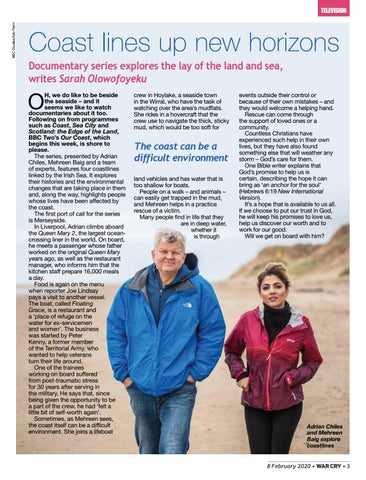
Adrian Chiles and Mehreen Baig explore coastlines 8 February 2020 • WAR CRY • 3
‘We can’t prevent earthquakes, but we can help communities recover’ Ahead of the International Day of Women and Girls in Science next Tuesday (11 February), American seismologist JESSICA VELASQUEZ tells Linda McTurk how she came to study earthquakes for a living
E
Jessica Velasquez
8 • WAR CRY • 8 February 2020
ARTHQUAKE researcher Jessica Velasquez has been fascinated by rocks from the time she could walk. As a young child, she kept a collection of them in a toy vanity case, filling up every compartment she could find. ‘I’ve always loved science,’ she says. ‘My entire life I’ve wanted to know why and how things work. I’m curious, but also sceptical – I never believe the first thing that people tell me. I have to figure it out for myself.’ Jessica’s parents encouraged her curiosity about the world. When she would ask them questions, they would urge her to explore further and seek out answers. ‘When I was about six years old, I remember asking my dad about how the sun rises and sets and him showing me a globe with a flashlight,’ she says. Her fascination with the world eventually led her to study geology, through an Earth science course at university. Taking her first physics and Earth science courses at the same time, she recognised that she could ‘use so many of the physics principles to explain what was going on in the Earth’. Then when someone told her that people cannot predict
INTERVIEW
earthquakes, Jessica became determined to change that. She was convinced that even if she couldn’t predict earthquakes exactly, she would be able to do something to help. Jessica has what might be considered an unusual view of earthquakes. ‘I love just about everything about earthquakes, except the impact that they have on people,’ she says. But her path to becoming a seismologist was not straightforward. She was outnumbered by her male colleagues. ‘The field of Earth science is dominated by men,’ she explains. ‘That was the case with the vast majority of my professors. It was very difficult to find a woman in the field. At first, I didn’t think anything of it. I just thought I could keep up. ‘But then in graduate school I started to recognise how alone women were in the geophysics side of things. Many of my female colleagues didn’t make it through their programmes. I didn’t really understand why so many of my women colleagues didn’t finish their programmes versus the men. ‘It’s hard to put into words, but the expectation was that if you were a woman, you probably didn’t understand all these complicated maths concepts and the nittygritty physics, and that you were probably a little more qualitative than quantitative. It’s not an overt thing – but of course, it isn’t fair.’ Jessica attained her geological sciences PhD some years ago. But the latest data shows that less than 30 per cent of researchers
worldwide are women, according to the United Nations. In order to help women and girls to ‘participate fully in science’, the organisation declared 11 February as the International Day of Women and Girls in Science. Regardless of any gender bias that she may have faced, there is no question that Jessica has made a valuable contribution as
I love just about everything about earthquakes, except the impact that they have on people a seismologist to the scientific community and beyond. As part of her job at a catastrophe modelling company in California, she helps to design research models that inform insurers about what kind of damage they can expect in the event of an earthquake. Financial experts can use these models, she says, to ‘cover vulnerable populations, the ones who don’t have insurance and don’t have the means to supply for themselves’ because they are financially poor. One of her recent projects was to work on
a catastrophe bond that could be sold to raise funds to protect lifelines – essential pieces of infrastructure – for communities in Nepal. In the event of another major incident like the magnitude 7.8 earthquake that struck the country in 2015, the money made in the purchase of the bonds could then be used to help people recover faster. Jessica sees her Christian faith as an important part of her personal mission as a scientist. ‘The Lord loves people and so do I,’ she says. ‘People are vulnerable to things that they don’t understand. I want people to understand that they don’t have to be terrified of an earthquake. It’s a scientific process. We can’t prevent them from happening, but we can try to make sure that communities have the resources they need to recover after they happen.’ An avid lover of both science and faith, Jessica is convinced that the two do not have to contradict each other in our understanding of the world. ‘For me, science only addresses the how, whereas faith addresses the why and the who,’ she explains. ‘They address completely separate things. ‘I love seeing how intricately God put everything together. He designed all of our physical laws – our laws of physics, biology and chemistry. I’m still trying to figure out how everything works together.’ 8 February 2020 • WAR CRY • 9
Talking on air
10 • WAR CRY • 8 February 2020
INTERVIEW
Ahead of World Radio Day, Capital Xtra presenter ROBERT BRUCE chats to Sarah Olowofoyeku about his broadcasting career and why radio is worth celebrating
R
OBERT BRUCE was just a teenager when he knew exactly what line of work he wanted to get into. ‘When I was 15, a radio DJ gave me a shout-out and it was the best feeling ever,’ he recalls. ‘I wanted to give someone else that same excitement and joy, so I decided to get into radio.’ Rob, who is now 25 years old, went off to university to study broadcast journalism. While presenting on the university’s student radio station, he was scouted by London-based Capital Xtra, which plays dance and urban music to 1.9 million His Saturday show features guest artists who people across the UK each week. His join him in the studio to have a chat. ‘I’ve done professional radio career began as he was one interview a week for the past two years, finishing his degree. and that has been a highlight,’ he says. That was three years ago, and today he The interviews with some of the UK’s top presents his own radio show on the station. artists, including Stormzy, Ella Mai, Jorja ‘My show is on from 7 to 10 pm, Monday Smith and Wretch 32, are also shared on to Thursday. On Saturday from 4 to 7 pm I Capital Xtra’s Youtube channel. present Homegrown and play only UK music.’ For more than 100 years, radio has been a As well as playing new tunes on the radio, significant medium for sharing people’s music Rob spends time out of the studio, hosting and stories, as well as a valuable form of mass music events, putting on live shows and communication for news and political affairs. reporting from occasions such as the European World Radio Day on 13 February, which was premiere of the film Black Panther and the established by the UN in 2013, highlights radio Mobo awards. as a medium ‘for celebrating humanity in all its diversity’. Radio, the UN says, is ‘a powerful tool’ and ‘the most widely consumed medium’. For Rob, radio is worth celebrating because ‘the relationship you can build with your listeners is unique’. He says: ‘There’s no face time, so listeners are always relying on a voice. That voice can become a comfort, a friend, something that people tune in to on their commute or in the car. Whatever someone’s routine is, it can line up with certain presenters, so cool relationships can be built. And because people are on the radio throughout the year, no matter what listeners are going through, presenters are there for them all the time. ‘There’s a mum who listens to my show every Saturday with her Rob presents on the radio as well as hosting daughter, who is about five years old. It’s nice live events and reporting from red carpets
that it’s family-friendly and, though you’re not part of the family, you’re there with them to keep them company. ‘You’re on your own in the studio, but I like the interaction with people when they message in, or let me know they’re listening to the show. ‘Also I introduce many new artists, which is amazing. I love getting to see their careers grow from making music in their bedroom for fun to selling out big stages and touring around the world.’ While Rob interviews a lot of artists and musicians, he wants those who are tuning in to
The people I interview get scrutinised a lot know that everyone has a story and that each story is valuable. ‘The people I interview are in the limelight, and they get scrutinised a lot,’ he says. ‘But they’re not perfect people. And we can all learn from each other. I don’t ever cast judgment on anyone I interact with, and I hope my listeners get that through the show.’ Even away from his radio show, Rob wants to communicate, through the way he lives, something else that he considers important. ‘I grew up in a Christian family,’ he says. ‘I’ve been going to church all my life too, but when I was about 13 or 14, I said to God: “If you’re real, show yourself to me.” Since then, it has been a whole journey of discovering God and Jesus’ love and seeing where I fit into that picture. ‘Since I was about 16, I’ve always had a sense that God’s there with me and knows what he’s doing, even if my reality doesn’t align with that. I know that I can’t convince anyone about faith, or of why they should go on a faith journey. But my idea is that if God loves me, then it’s my job to love all the people around me. And I’ve seen that sort of love transform people’s lives.’ 8 February 2020 • WAR CRY • 11
EXPLORE Prayerlink YOUR prayers are requested for Phyllis, who is concerned about her family; for Christopher, that he will get the support he needs; and for Lynn, who has been struggling since the loss of her mother. The War Cry invites readers to send in requests for prayer, including the first names of individuals and details of their circumstances. Send your requests to Prayerlink, War Cry, 101 Newington Causeway, London SE1 6BN. Mark your envelope ‘Confidential’.
Becoming a Christian There is no set formula to becoming a Christian, but many people have found saying this prayer to be a helpful first step to a relationship with God Lord Jesus Christ, I am truly sorry for the things I have done wrong in my life. Please forgive me. I now turn from everything that I know is wrong. Thank you that you died on the cross for me so that I could be forgiven and set free. Thank you that you offer me forgiveness and the gift of your Holy Spirit. Please come into my life by your Holy Spirit to be with me for ever. Thank you, Lord Jesus. Amen Extract from Why Jesus? by Nicky Gumbel published by Alpha International, 2011. Used by kind permission of Alpha International
Philippians
Nigel Bovey gives chapter and verse on each book in the Scriptures
HE eventful visit of early Christian T leader Paul to the Macedonian city of Philippi is recorded in Acts 16.
bling or arguing’ (2:14). He urges two of the congregation to settle their differences (4:2). They are also to be watchful of false evangelists who require Gentile converts to be circumcised as a sign that they bind themselves to keeping the Law, which God had
Fabrics-dealer Lydia and members of her household responded to the gospel. Paul delivered a slave girl from an evil spirit, for which he and his companion, Silas, were flogged and imprisoned. While in Paul maintains that the their cell, Paul shared the gospel with his jailer, and he and his family put their faith only thing that counts is in Jesus. Now imprisoned in Rome, Paul writes to the that ‘Christ is preached’ church in Philippi, a congregation who hold a special place in his affection (1:3–11). He given to the Jewish people in Old Testament describes them as ‘my joy and crown’ (4:1). times. He assures them that his present incarceraPaul asserts that God makes us right with tion is not a setback to the spreading of the him not by us obeying rules, but through the gospel. On the contrary, his guards know atoning death of Jesus. When we put our faith about his faith, other believers have been in him, we are made right with God and will emboldened to talk about Jesus (1:12–14) be raised to new life. and some in Caesar’s household have become To illustrate his point, Paul describes his Christians (4:22). religious background. He was a clean-living The theme of the letter is unity. He man, but recognised that his goodness was knows that some people preach Jesus out of useless in earning God’s forgiveness. For that, questionable motives. However, rather than he needed to put his faith in Jesus (3:1–11). allowing this to become a divisive distraction, Paul maintains that the only thing that counts is that ‘Christ is preached’ (1:18). Stressing the need for unity, he exhorts his readers not only to be like-minded, but also to have the same attitude – yes, to know the as Jesus, who was hum‘I want to know Christ n’ (Philippians 3:10 bly obedient to God’s will power of his resurrectio (2:1–11). They are to do on) New International Versi everything ‘without grum-
Key verse
"
Looking for help? Just complete this coupon and send it to War Cry 101 Newington Causeway London SE1 6BN Basic reading about Christianity Information about The Salvation Army Contact details of a Salvation Army minister
12 • WAR CRY • 8 February 2020
Name Address