The Salvation Army is a Christian church and registered charity seeking to share the good news of Jesus and nurture committed followers of him. We also serve people without discrimination, care for creation and seek justice and reconciliation. We offer practical support and services in more than 700 centres throughout the UK. Go to salvationarmy.org.uk/find-a-church to find your nearest centre.
What is the War Cry?
The Salvation Army first published a newspaper called the War Cry in London in December 1879, and we have continued to appear every week since then. Our name refers to our battle for people’s hearts and souls as we promote the positive impact of the Christian faith and The Salvation Army’s fight for greater social justice.
Editor: Andrew Stone, Major
Managing Editor: Philip Halcrow
Staff Writer: Emily Bright
Staff Writer: Claire Brine
Staff Writer: Ewan Hall
Editorial Assistant: Linda McTurk
Graphic Designer: Mark Knight
Graphic Designer: Natalie Adkins
Email: warcry@salvationarmy.org.uk
The Salvation Army United Kingdom and Ireland Territory 1 Champion Park London SE5 8FJ
Tel: 0845 634 0101
Subscriptions: 01933 445445 (option 1, option 1) or email: subscriptions@satcol.org
Founders: Catherine and William Booth
International leaders:
General Lyndon Buckingham and Commissioner Bronwyn Buckingham
Territorial leaders: Commissioners Jenine and Paul Main
Editor-in-Chief: Major Julian Watchorn
The eyes of the sporting world will be turned towards Italy this week as nearly 3,000 athletes representing 90 nations will compete in the 25th Winter Olympics.
A total of 116 events will be staged across 19 days, and Team GB will be entering 53 athletes, including skiers Dave Ryding and Andrew Musgrave, who are both competing for the fifth time.
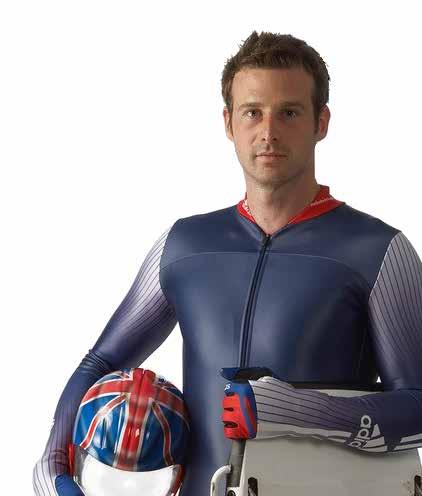
Back when they took part in their first Olympics, one of their teammates was Adam Pengilly.
In an interview in this week’s War Cry, Adam recalls his experiences of competing in the skeleton at the Winter Olympics in 2006 and 2010. He tells us how he went to Turin for his first Games hopeful of gaining a medal – but his time in Italy ultimately proved to be disappointing.
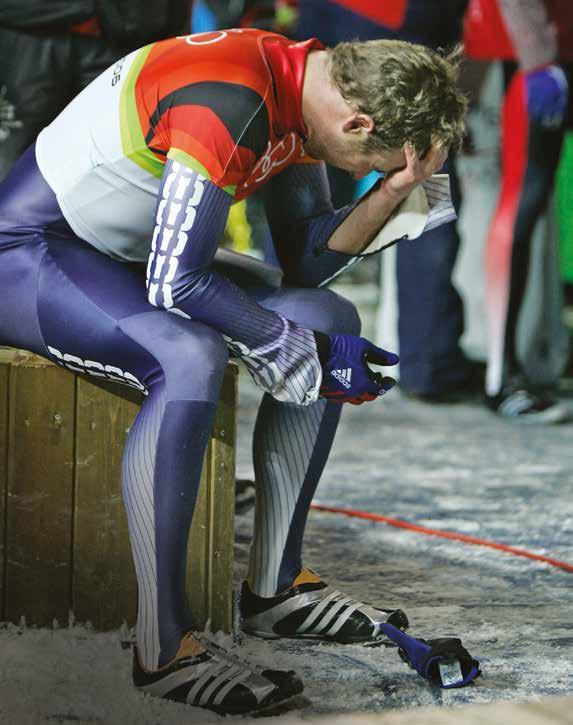
‘I knew that I had a good chance of winning a bronze medal,’ he says. ‘But on my second run, I made a mistake on the most important corner of the track. I’d gone into it at the wrong angle, which killed my speed. I dropped to eighth position and that’s where I finished. I was gutted.’
Looking back on that experience today, Adam is able to put that frustration into perspective.
He reflects: ‘I realise now that even if I had won gold at the Olympics, I’d have probably felt elated for a few hours, but it wouldn’t have really satisfied my soul. Experience has taught me that only God can do that.’
As a Christian, Adam explains how he understands that his worth comes not from any sporting success but from his relationship with God.
‘I used to need good results in sport in order to find validation,’ he says. ‘But the truth is that I’m defined by God’s forgiveness and grace, and I’m deeply loved by him. It bowls me over.’
It doesn’t matter how we see ourselves. If we decide to accept God’s love and forgiveness, we will be on track for something that’s worth more than gold.
INFO INFO
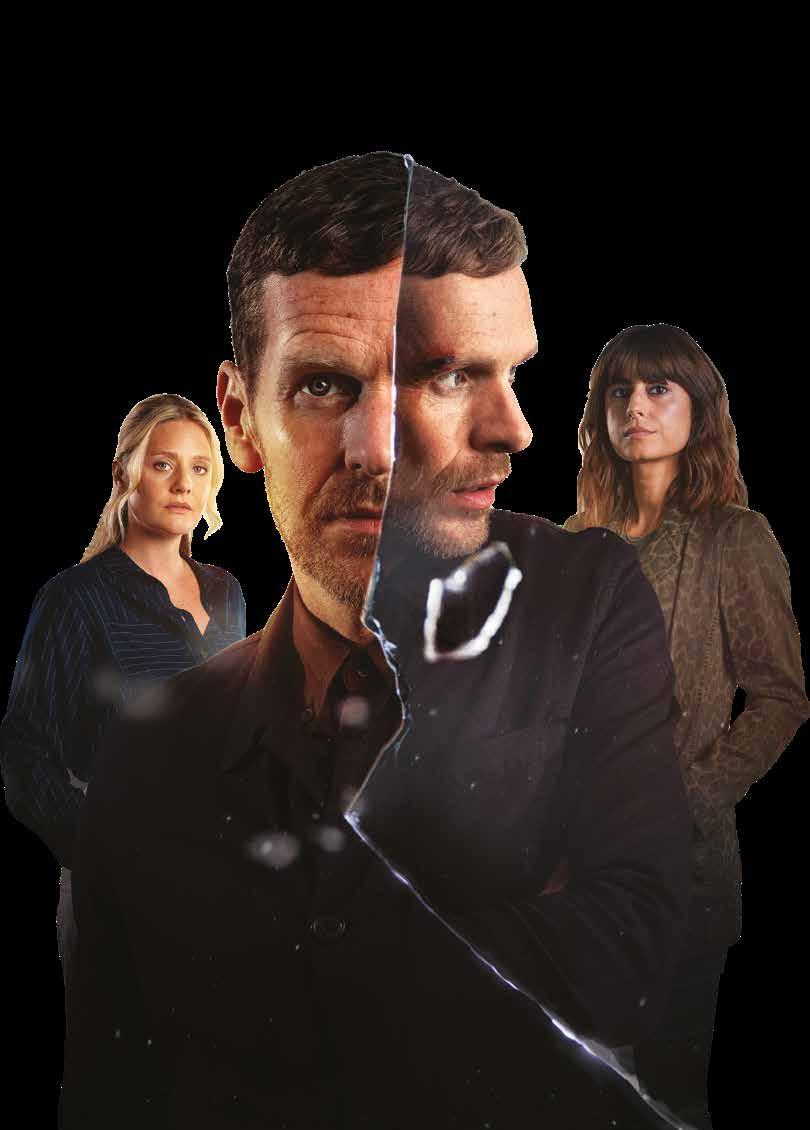
After 20 years of working for MI5, John Hughes (Shaun Evans) might have thought that he had seen it all. But when a rendezvous with a contact goes wrong, it proves that he hasn’t.
Following his instincts rather than the rules, John agrees to meet Ehsan (Waj Ali), an influential gang member who claims to know of a potential threat to UK national security. However, when the two meet, Ehsan is assassinated in front of John, and in response John kills the attacker.
When ITV’s espionage thriller Betrayal begins next week, viewers encounter John as he tries to balance his work and family life. Returning to headquarters without any intelligence from Ehsan, John faces harsh disciplinary measures for his actions, which could cost him his job. His MI5 superiors believe that he fell into a trap set by Ehsan and conclude that John has accidentally become involved in a gang turf war.
the investigation. But the pair form an alliance as John puts his job on the line to convince his new colleague of the potential threat to the nation.
know what it is like to carry our problems alone. Maybe we don’t want to worry those around us about what’s happening or are too afraid of the repercussions if we do. But the longer we try to hide the truth, the heavier the secrets hang on us – and it can become exhausting.
Christians, though, take comfort in their belief that God already knows their secrets. And they are sure that, because of his love for them, they don’t have to deal with their troubles on their own.
One early believer described how ‘there is nothing in the whole world that can hide from God. He sees everything clearly and he knows everything’ (Hebrews 4:13 Easy English Bible).
John is adamant that the case in front of him is more than just gang violence, but none of his bosses believe him. To make matters worse, they bring in a former MI6 operative called Mehreen (Zahra Ahmadi) to take over
As if John didn’t have enough on his plate at work, he is also facing problems at home. Even though his wife, Claire (Romola Garai), knows that he works for MI5, he can’t tell her where he is going or what he is doing, and the secrecy has eroded the trust in their marriage. After years of vague stories and excuses, his wife feels she is being denied the truth, and she has reached breaking point. Any relationship built on secrets is unlikely to thrive. And many of us may
God invites us into an open and honest relationship with him, even though he already knows our burdens and our darkest secrets. If we accept his offer, we gain a friend who fully knows the truth about who we are and still offers us love and understanding.
Then we can confide in him without fear, giving us the freedom to let go of everything that holds us back. Trusting God makes it possible to be our true selves – after all, he has seen it all.
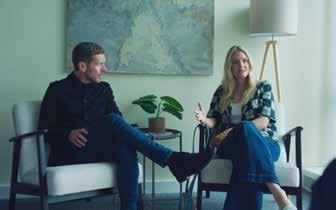
John and his wife attend marriage counselling
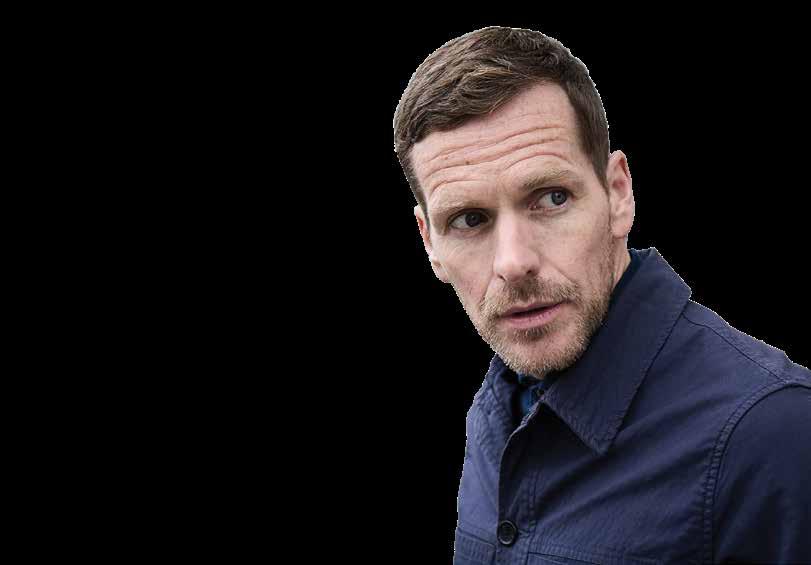
John Hughes is on the lookout for intelligence
talkTeam talk ‘ ’ j TEA M TALK talkTeam talk
WAR
Actions come after campaigns
Good lads!
Claire Brine gives her take on a story that has caught the attention of War Cry reporters
Last year, like a lot of Netflix viewers, I was gripped by the series Adolescence. The fictional story of a teenage boy who murdered a girl at his school was billed by The Guardian as ‘the drama that will horrify all parents’.
As the programme picked up awards left, right and centre, commentary online exploded with professionals discussing the problems facing teenage boys today. Keir Starmer even mentioned the drama in parliament, saying that the ‘violence carried out by young men influenced by what they see online [was] abhorrent’ and needed tackling.
They showed maturity and common sense
Having heard hardly any positive stories in the news about young men recently, I was encouraged to read in The Times about two teenage boys who ‘rescued a group of adults from a snowy ridge’ in the Lake District. The article explained that Caelan Blades, 16, and Rowan Kay, 15, had been climbing an ice-filled gully on Helvellyn when they came across a ‘distressed group of five adults dressed in trainers and jeans’. Because the boys had ‘the necessary gear’ – including ice axes – with them, they helped the inexperienced climbers descend by cutting steps in the snow. Caelan explained how he walked at the front of the group and ‘under the others in case they slipped and I could stop their fall’.
Though the adults should never have attempted to climb a peak that they were ill prepared for, I was encouraged to read of Caelan and Rowan’s actions. These two teenage boys were knowledgeable and experienced in fell-walking. They showed maturity and common sense to a group in trouble. They were kind and caring as they led the adults to safety. No wonder Rowan’s mum, Deborah, was quick to tell the paper that they are ‘genuinely good lads’.
With the media often reporting bad news more than good, I can understand why it’s tempting to make snap judgements about certain groups of people. TV shows often carry the narrative that adolescents can be trouble.
But it’s wrong to look at young people solely through a lens of doom and gloom. There are loads of children and teenagers out there doing good things. The challenge for adults is to follow their example.
Politicians have announced actions to address two social issues on which The Salvation Army has been campaigning for change: opioid deaths and loneliness.
The UK government has launched a consultation on widening access to naloxone – a life-saving drug that temporarily reverses opioid overdoses. The Salvation Army has been campaigning to raise awareness of the drug, saying that it should be made available on high streets similarly to the way that defibrillators are.
Meanwhile the first minister of Scotland John Swinney, has pledged £3 million to combat loneliness, after Salvation Army research published in December revealed that 1.8 million adults in the UK, including 130,000 Scots, would spend Christmas Day alone.
Lieut-Colonel Nick Coke, The Salvation Army’s secretary for communications, said: ‘Preventing opioid overdoses and tackling loneliness and isolation might seem like two very different campaigns, but they have one thing in common: The Salvation Army and our supporters speaking out for vulnerable people.’
WAR CRY
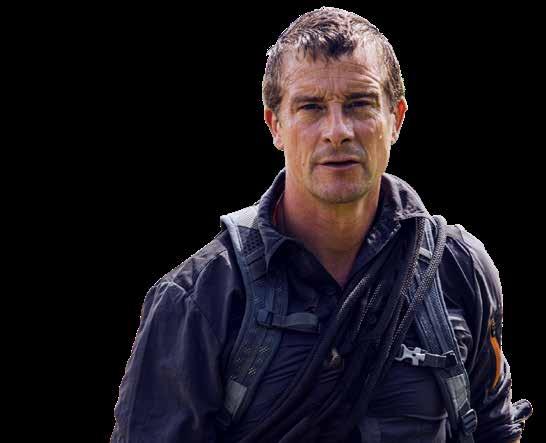
Adventurer Bear is wild about faith
TV adventurer Bear Grylls (pictured) described himself as a ‘faithfilled, never-give-up man’ in an interview with In a Q&A with the paper, the presenter of the BBC programme Bear Grylls – Wild Reckoning available on iPlayer, also said that he felt love as the ‘light of the Almighty in my heart’.
When asked for his thoughts about what happens when we die, Bear answered: ‘We finally get to be with Jesus, face to face.’
Last year, Bear released a book about the life of Jesus, called The Greatest Story Ever Told: An Eyewitness Account, which became a Sunday Times bestseller.
Service marks 80 years of UN
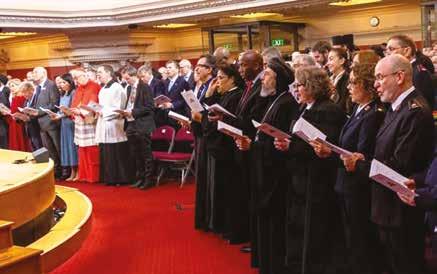
The international leaders of The Salvation Army were among the representatives of churches who attended a service in London marking the 80th anniversary of the United Nations.
General Lyndon Buckingham and Commissioner Bronwyn Buckingham joined UN secretary-general António Guterres, government ministers and members of the public at the service of thanksgiving, which was held in the Methodist Central Hall in Westminster, where the first UN general assembly took place in 1946.
The service included Bible readings, music and an act of remembrance for all those killed in the service of the UN. In a sermon, the recently retired Archbishop of Westminster, Cardinal Vincent Nichols, noted how the delegates who attended the first general assembly had gathered in a ‘Methodist sanctuary – a beacon of the gospel’s call to justice and mercy’.
The Salvation Army holds consultative status at the UN, meaning that it can participate in meetings of the United Nations Economic and Social Council. Through the relationship, the church and charity aims to speak up for human dignity and social justice.
Dog partnership leads to homelessness help
The Salvation Army in Wales has teamed up with animal welfare charity Dogs Trust to help people who are experiencing homelessness settle their dogs safely into its Lifehouse accommodation centres.
The two organisations are giving dog owners starter packs, which include collars, leads, beds and bowls, and are providing access to free vet care.
The Salvation Army is also offering Lifehouse residents direct help from specialist support teams if they need advice on training their dog.
Rodrick Alexander, 18, who experienced homelessness as a result of an unstable home life, was worried he wouldn’t be able to take his dog, Juno, with him into Ty Diogel, a Salvation Army Lifehouse for young people in Cardiff.
‘Knowing my dog is truly welcome here has been such a relief,’ he says. ‘Juno got me through the hardest time of my life, and having this support means we can both feel safe and cared for.’
Rodrick and his chihuahua, Juno
The Salvation Army’s leaders (right) at the service
‘Those
who develop an addiction have often experienced trauma’
Staff at a Salvation Army centre in Swindon describe its compassionate and practical approach towards people experiencing addiction
Feature by Emily Bright
ASalvation Army centre in Swindon is celebrating a life-changing anniversary. One year ago, Booth House Lifehouse, which supports people experiencing homelessness and addictions, launched its Needle and Syringe Programme.
Drug users can safely dispose of their used needles at the centre in exchange for clean ones. A disposal unit for ‘sharps’ is accessible through the fence, while a vending machine with clean equipment is situated by the entrance. The easy-toreach locations mean that people don’t have to go inside the Lifehouse itself if they don’t want to.
Over the past year, Booth House has issued 976 pieces of equipment and has enabled 109 needle exchanges. It has also provided pre-filled syringes containing naloxone, a drug that temporarily reverses opioid overdose.
There are multiple benefits to the Needle and Syringe Programme, which is run with support from Swindon Borough Council and the drug and alcohol service Change Grow Live. For instance, the wider community is less at risk from the dangers of discarded needles, and the use of clean needles helps reduce the spread of blood-borne viruses such as hepatitis C and HIV.
While some people may say that the programme appears to encourage drugtaking, The Salvation Army champions a
harm-reduction approach, having found that combining practical support with compassion is effective.
Support worker Connor Graham believes that if Booth House didn’t provide clean needles, people would reuse old ones or find discarded ones.
‘We’re not giving them the idea to use,’ he says. ‘We’re giving them the means to stay safe and protect their health. Most importantly, we’re creating a chance to talk.’
Captain Brian Ward, a chaplain at the Lifehouse, agrees that people would take drugs, whether or not the scheme exists.
‘People with an addiction talk about being in the madness, doing all sorts of crazy things,’ he says. ‘When you’re stuck in a certain mindset, you stop caring about consequences.
‘Through the Needle and Syringe Programme, we offer them a safer way. We’re trying to save the person from falling into a whole range of other problems until they’re well enough to get the support that they need not to just survive, but – as it says in the Bible – find “life in all its fullness”.’
Connor adds that The Salvation Army’s work sends a wider message to drug users: that ‘hope and help are always available’.
Those with an addiction may feel daunted at the prospect of crossing the threshold into Booth House to seek extra
help. But if they do, they are welcomed.
‘At first, clients are quick – they just want to get out of the room,’ explains Connor. ‘But after they realise we’re not there to judge, we start having meaningful conversations.
We meet people where they’re at
‘T hey might mention a health concern or talk about what led them to us. That’s our chance to intervene, to signpost them to grief counselling, drug and alcohol services, or other support. It’s about building a bridge.’
As well as the Needle and Syringe Programme, Booth House has 50 beds, providing 24-hour accommodation to men and women experiencing homelessness. It offers healthcare, life skills training, employment support and an addiction recovery programme. Brian also leads a Core Recovery church at the centre – part of a Salvation Army initiative across the
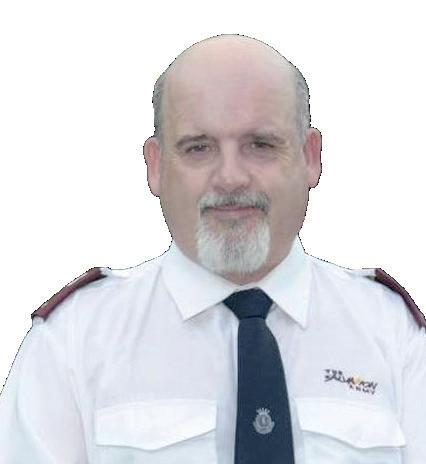
Booth House chaplain Captain Brian Ward
country which offers distinct kinds of services.
‘Core Recovery is for anyone who would not attend church for whatever reason,’ he says. ‘For instance, somebody who has an addiction, a learning disability or a mental health difficulty is not necessarily going to sit quietly in church for an hour.
‘So our church is interactive – people can ask questions, we have a couple of songs and group prayers. We have a reflection, then a discussion. Then we have “shares”, where people can talk about how they’re getting on and what’s important to them.’
A non-judgemental approach is a key part of the church.
‘Core Recovery is about meeting people where they’re at,’ says Brian. ‘You don’t berate them or tell them that they’re bad people. You don’t dismiss them. Every person has a story and a reason why they ended up the way they are.
get ill or die. That’s safeguarding their body and their mind. Then people might stop using drugs or other substances.
‘The Salvation Army is into harm reduction, making sure that people don’t
‘Those who develop an addiction have often experienced a trauma, or something difficult has happened. Most people who have a sense of self-loathing self-harm through drugs or other ways. Core Recovery is about reminding people of their innate worth.’
Brian says that when people understand their value to God, it has a transformative effect.
‘Your belief system is the foundation for your actions. If people start to believe that they are loved, that’s a game changer.
‘I met a man who had been taking cocaine for 30 years. After he came to faith, he told me: “I’ve been taking cocaine for all these years, but I’ve never felt this good.”
‘He knew that he belonged and that he had an innate value. It didn’t matter if he was homeless, a drug user or had done things he wasn’t proud of. He was still a child of God.’
Booth House’s disposal unit for used needles
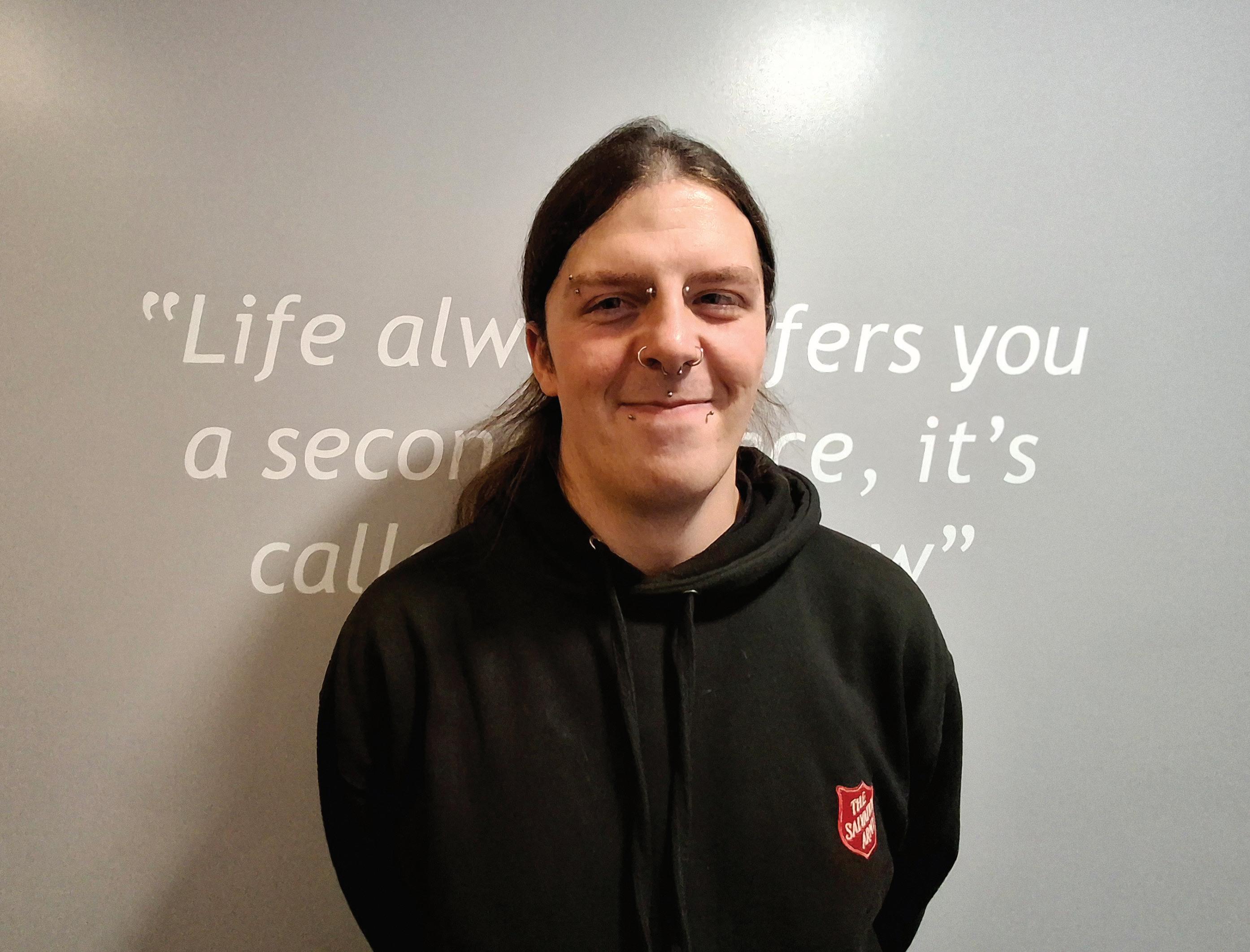
Support worker
Connor Graham
Championships in 2009. His next goal was to win a medal at the 2010 Winter Olympics in Vancouver.
‘When I started the new season, I was in good shape,’ he recalls. ‘But then I injured my knee and was rubbish for a while.
‘When it came to the Team GB skeleton qualifiers, it was between me and another guy, who was my friend. I beat him in the final three races, but he had a better overall ranking than me, so the selection team had to choose between us. In the end, they chose me.
‘Normally, when you’re selected for the Olympics, you’re over the moon, but it was hard to feel joyful because I knew that my mate had worked so hard. He congratulated me, but it felt difficult.’ By the time the Games came around,
spirits were high in the Olympic villages of Whistler and Vancouver. Fans were excited about the sporting schedule ahead. But on the day of the opening ceremony, there was tragic news.
on the last race day, it was too late. I performed poorly, and I finished in 18th place.’
‘The Georgian luge athlete Nodar Kumaritashvili died during a training run on the track,’ says Adam. ‘It was just awful. Desperately sad for all of us. To compete after that was really hard.’
Though Adam had felt confident about his upcoming races, he didn’t perform as well as he had hoped.
‘I made the wrong call about the runners to use on the sled,’ he explains. ‘They didn’t have as much grip as I needed, and I hadn’t identified that they wouldn’t work so well on this particular track. By the time I changed them for some different runners
Adam retired from competing in the skeleton in 2012, but his career in elite sport wasn’t over. In 2010 he had been named an athlete member of the International Olympic Committee, the movement responsible for organising and staging the Games, and he remained in the role until 2018.
‘I was treated like sporting royalty,’ says Adam, ‘travelling the world, staying in top hotels with first-class flights and seeing brilliant sport. Instead of being “Adam the athlete”, I became “Adam the sports official”. So my transition away from the track was a nice one, although, over time, I did become disillusioned about how sport is run.’
As Adam looks forward to the Games which start this week in Italy, he reflects on his own mixed experiences of competing and what he learnt.
‘Everyone goes to the Olympics with the dream of winning something or giving their best performance,’ he says. ‘But not everyone can do that. So a lot of people come away with disappointment.
‘When I won silver at the World Championships in 2009, I celebrated. It felt amazing to achieve something I’d wanted for two decades. But that feeling lasted just a couple of hours. It was so temporary.
‘I realise now that even if I had won gold at the Olympics, I’d have probably felt elated for a few hours, but it wouldn’t have really satisfied my soul. Experience has taught me that only God can do that.’
Adam was raised in a Christian family, so faith has been part of his life for almost as long as he can remember. But he admits that there were times when he focused on competing more than his relationship with God.
‘For a time, sport became my idol – I let it become too important,’ he says. ‘But I absolutely believe that faith and sport can be compatible if you get the balance right and the Lord remains everything.
Adam sits dejected after crossing the finishing line at the 2006 Winter Olympics, where he missed out on a medal
‘For me, sport is 100 per cent a gift from God. It brings joy to millions of people, whether they are kicking a ball in the park, going for a jog or competing in the Olympics. But, as with all good things, if we place too much value on sport – and place it above God – then we’re getting it wrong.
‘Today, I can see that being an athlete was not my sole identity. I’m one of God’s children. I’m adopted by him because Jesus’ death on the cross and his resurrection paid the price for my mistakes.
‘I used to need good results in sport in order to find validation. And that mindset can still be a challenge for me at times. But the truth is that I’m defined by God’s forgiveness and grace, and I’m deeply loved by him. It bowls me over.’
As the years passed and Adam moved into his 40s, he found himself assessing the truth about the kind of man he was – and who he wanted to be.
‘God opened my eyes to my natural selfishness and thoughtlessness towards others,’ he says. ‘The two most important roles I had in my life were as a husband and a father, but I wasn’t very
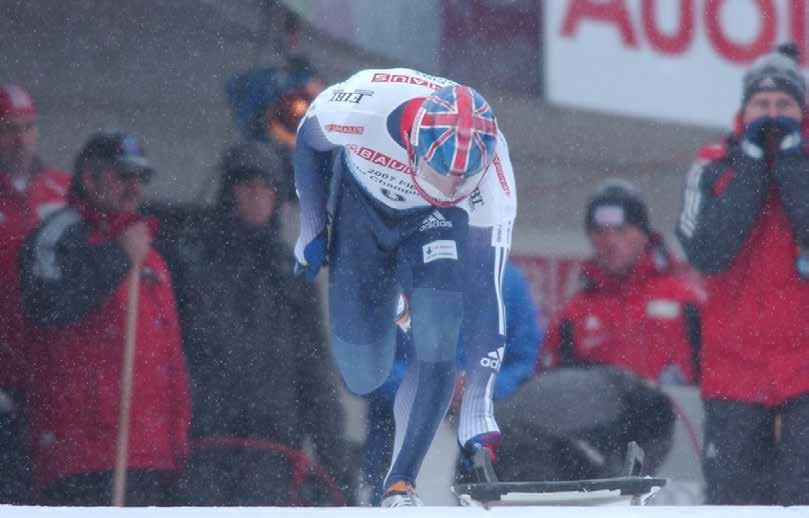
Adam on a skeleton run
good at them. I was close to everything falling apart in my life in a significant way.
‘It was then that I realised how much I needed to trust God, listen to him and not be too proud to ask for help from my wife, who also asked for help from our church pastor.
The Lord was softening my heart
‘One of my problems was anger. So, after trying for some time to change myself without success, I got down on my knees and begged God to take the anger away from me. I didn’t feel any change, but a few weeks later, I did notice that things which used to rile me weren’t bothering me so much any more. The Lord was softening my heart.
‘To be honest, selfishness and the potential for anger are still areas of challenge for me and ones that I pray about daily. I have to rely on God a lot for help. Proverbs 3:5 – “Trust in the Lord with all your heart and lean not on your own understanding” – is a helpful Bible verse for me. I also think that Romans
8:39 is brilliant in reminding me that my performance is irrelevant, because it says “nothing can separate us from the love of God”.’
It’s a love that has not only changed Adam’s life, but has also helped him find clarity and peace as he reflects on events of the past.
‘Sometimes I wish that my second run at the 2006 Olympics had gone differently,’ he says. ‘Would I have finished third then? I don’t know. I didn’t come third.
‘But what I do know is that the Lord is sovereign and knows me better than I know myself. He’s got a greater plan for me than I could ever come up with – and that’s evident from the start of my story, when I didn’t get into the sports school I wanted, and ended up at the sixth-form college where my teacher got me into bobsleigh. What I saw as a total disaster back then was actually God’s intervention to change the direction of my life. And he changed it massively.
‘Today I see that my purpose in life is not about achievement – it’s about daily submitting and remembering that I’m a forgiven child of the living God, and bringing glory to him.’
The War Cry invites readers to send in requests for prayer, including the first names of individuals and details of their circumstances, for publication. Send your Prayerlink requests to warcry@ salvationarmy.org.uk or to War Cry, 1 Champion Park, London SE5 8FJ. Mark your correspondence ‘Confidential’.
Becoming a Christian
There is no set formula to becoming a Christian, but many people have found saying this prayer to be a helpful first step to a relationship with God
Lord Jesus Christ,
I know that I have done things in my life that are wrong and I’m sorry.
Thank you that I can ask you for forgiveness because of the sacrifice you made when you died on the cross.
Please forgive me and help me to live a better life in the future as I learn how to love you and follow your way of living.
Thank you, Lord Jesus.
If you’ve prayed this prayer, scan the QR code or contact us using the coupon on this page
Nigel Bovey gives chapter and verse on each book
of the Scriptures
2 Corinthians
Having been forthright in his advice on unacceptable behaviour in his earlier letter to the church at Corinth, the apostle Paul was more conciliatory when he wrote again. His second letter is a response to those in the church who did not respect his leadership (see 1 Corinthians 1:12–14). As such, it reveals much about Paul’s psyche – including his insecurities.
Paul is defensive when he explains that a proposed trip to the church did not happen. He also refers to a ‘painful visit’ he made (2 Corinthians 2:1 New International Version). The personal nature of the letter can be seen in the fact that in his explanation, he uses the word ‘I’ 20 times (1:12 to 2:4). Nevertheless, he urges his readers to forgive those who are in the anti-Paul faction (2:5–11).
Paul sets about defending his record as a church pioneer. He says he had been commissioned by God (2:17), and the existence of the church in Corinth itself testified to his ability (3:2).
He asserts that, while leadership is stressful and attracts detractors, his motivation has always been honest (chapter 4). His mission is to preach that sinful people can be reconciled to the holy God through faith in Christ’s atoning death (5:11–21). For this, Paul has been misunderstood, mislabelled and mistreated (6:3–10; 11:24–28).
While Paul is aware that his first letter caused heart-searching and pain among the church members, he is glad that they changed their ways as a result (7:8–13).
He refutes the charge that he is timid when face to face but assertive when behind the pen (chapter 10). At the same time, he admits that he is ‘untrained as a speaker’ (11:6).
Paul reveals his fragilities. At times in his missionary work, he had ‘despaired of life itself’ (1:8). Despite great success at spreading the Christian gospel, Paul has also been plagued with a ‘thorn in the flesh’ that God refused to remove (12:7–10).
Speculation abounds as to whether Paul meant a physical ailment or mental fragility. Whatever the case, Paul says he is prepared to pay the emotional, mental and physical cost of preaching new life through faith in Jesus Christ.
To receive basic reading about Christianity and information about The Salvation Army, complete this coupon and send it to
War Cry 1 Champion Park London SE5 8FJ
Or email your name and postal address to warcry@salvationarmy.org.uk
QUICK QUIZ
1 2 3 4 5 6
What is the title of Harry Styles’s new single?
The play Shadowlands is based on the life of which author?
Who was appointed interim head coach of Manchester United last month?
Who hosts the Radio 4 show Desert Island Discs?
In which year was the first Barbie doll launched?
The region of Patagonia is located at the southernmost tip of which continent?
Dr Nikki Alexander helps police to investigate criminal cases
MATTERS OF LIFE AND DEATH
Crime drama Silent Witness is 30 years old
TV feature by Claire Brine
It’sofficial: the Sir William Bowman Centre of Excellence has opened its doors, marking a new era for the forensic pathologists who carry out the vital crime-solving work at the centre of the long-running BBC1 drama Silent Witness. While Dr Nikki Alexander (Emilia Fox) and her team have already started to crack on with a series of cases in their new lab in Birmingham, fans of the show may find themselves reflecting on past investigations as the programme reaches its 30th anniversary.
When Silent Witness first hit our screens on 21 February 1996, viewers were introduced to Sam Ryan (played by Amanda Burton), a forensic pathologist whose first case required her to examine the body of a young girl found floating in a river. Created by Nigel McCrery – a former murder squad detective – the series proved a success and has been broadcast in 235 territories since.
In an interview for the BBC last year, Emilia Fox explained why she thought the programme had resonated with fans for so long.
‘To look at solving crime with a lead female pathologist in a man’s world was inspired,’ she said. ‘Finding clues through the body was a new way of looking at crime-solving.’
She also reflected: ‘A show about death makes you think about the meaning of life. It’s got more depth to it than just solving who did it.’
However deeply we may ponder the meaning of our existence, perhaps some questions remain that feel too big for us to answer. But 2,000 years ago, a man called Jesus went on a mission to point people towards a God who loved them. When they believed in him, Jesus said, they would find purpose for their life. And when they confessed their wrongdoing, they would receive God’s forgiveness, setting them free from the burdens of their past.
Forming a relationship with God, said Jesus, was possible by following him. ‘I am the way, the truth, and the life!’ he promised (John 14:6 Contemporary English Version).
When we follow Jesus’ teaching, and allow the love of God to transform our heart, life can take on a whole new meaning. Millions of people across the world have witnessed it.
1. Associate (7)
5. Swift (5)
7. Separated (7)
8. Enticed (5)
10. Be sullen (4) 11. False praise (8)
13. Go back (6) 14. Boundary (6) 17. Longing (8) 19. Operatic song (4) 21. First performance (5) 22. Obstructs (7)
350g sweet potato, peeled and diced into 2cm pieces
2 large ripe bananas, peeled and broken into large pieces
100g selfraising flour
1tsp baking powder
40g cocoa powder
Heat the oil in a pan over a medium heat and cook the onion, until soft. Add the garlic and cook for a further 2 minutes. Add the paprika and stir for 1 minute, then add the beef and cook, until browned.
Gradually pour in the stock while stirring and bring to a simmer. Cover and continue to simmer for 1 hour on the hob.
Stir in the red pepper, parsnip, carrot, mushrooms and lentils. Bring back to the boil and simmer for a further 30 minutes, uncovered, or until the beef, lentils and vegetables are tender. Season with black pepper. If needed, add a little extra water.
While the stew is simmering, cook the rice according to the packet instructions.
Spoon the goulash over the rice, to serve.
Sweet potato chocolate muffins
METHOD
Preheat the oven to 190C/Gas Mark 5.
Cook the sweet potato in boiling water for about 15 minutes, until soft. Drain and set aside to cool slightly.
Place the sweet potato and banana in a food processor and blend until smooth. Add the remaining ingredients and mix for a further 30 seconds. Scrape the sides and mix for another minute, until combined.
Divide the mixture between 8 cases on a muffin tray and bake in the oven for 40 minutes. Test with a skewer to see if the muffins are done. The muffin mixture may be slightly wet, but should not be runny.
Turn on to a wire rack to cool thoroughly, before serving.
GIVING, NOT GETTING, IS THE WAY GENEROSITY BEGETS GENEROSITY