Course Pathways
SGY 2026-27


LastUpdated:February3,2026


SGY 2026-27
LastUpdated:February3,2026
Everything we do at Saltus is designed to prepare students for a fast-paced, everchanging world. It’s an all-encompassing approach to learning, from Junior Kindergarten through to Graduation, and embraces each students’ potential as learners, as human beings and as ethical members of a global community.
The Saltus Graduate Years (SGY) Program is a two-year Program which covers the last two years of high school. Through the SGY Program, students will be continually assessed with three grading periods in SGY1 and two grading periods in SGY2.
Examinations, both internal and external, begin very soon after the return from the Spring break of SGY2. It is expected that SGY students will also sit the SAT exam at least once. As part of our preparation for these external benchmarks, we provide some in-house SAT prep as well as opportunities for students to sign up for sessions with organizations such as The Princeton Review and Kaplan. Students will receive personalized guidance from our University Support and Guidance Counsellor who will work closely with each student to ensure they graduate with a clear path for their continued education.
It is compulsory for students to take both English and Mathematics. In both subjects there are options for students to select from, based on their academic confidence and performance. Students are also required to take Physical Education and University Prep.
Students will choose four subjects from our course list, providing optimum flexibility for their future pathways.
Supported by the internationally recognized College Board (www.collegeboard.org), the AP Program encourages students to engage in advanced discussions about complex issues; solve problems individually and collectively; and write clearly and persuasively. Students experience the discipline required for university level achievement which enhances their determination and confidence.
Universities in North America, the United Kingdom, and Europe look at AP exams as one
of the indicators that qualify students for the rigors of post-secondary education. Students may even receive special designations from the College Board for excelling in these studies.
Since 1975, Saltus has offered a robust and growing Advanced Placement Program
Other external exams are offered in some cases, including College Level Examination (CLEP) for Sociology.
Our flexible Program offers courses that prepare students for post-secondary education and are also recognized by universities. These are assessed internally and provide maximum flexibility to our student’s schedules. The one-year nature of these courses also means that we are able to run mixed year group classes, providing additional flexibility and student choice.
Students will also be expected to participate in Physical Education, Community Service and University Prep. The flexibility of our schedule also means that we are able to build in one period of ‘private study’ every other day to allow students to work independently on assignments and projects.
Option Blocks will be created based on the course selections of the 2025/26 SGY1 cohort. Courses will run based on class size, student choice, staffing and timetabling availability. Please also be aware that in terms of the externally examined courses, students will be expected to pass their SGY1 year in order to move onto the second year. Entry for exams is based on exam readiness.
Entry into a number of courses is dependent upon certain prerequisite grades. These are to ensure that students are able to succeed to their full potential. If they don’t meet these criteria, then they may be invited into school to discuss their choices.
In SGY1, there will be three grade periods: one in the first term, one in the second term, and one in the third term. All students will also sit the SGY1 end of year subject exams during May of the third term. AP exams available at the end of SGY1 include: English Language, Economics, and Physics 1.
In SGY2, there are two grading periods: one in the first term and one in the second. The examination period, both internal and external, begins very soon after the return from the
Spring break. There may be the opportunity for qualified students to take a CLEP exam if there is no AP in a particular subject.
The Saltus Assessment System is designed to be comprehensive, dynamic and ongoing. It is comprehensive as it gathers multiple indicators of each of the dimensions of student learning aligned with learning goals not simply the acquisition of content knowledge. It is dynamic as a system that considers assessment as an integral part of learning, and therefore includes assessments of learning as well as assessments for learning. It is ongoing as it collects information about student learning over time, rather than solely at one or two points in a term.
In the SGY Program, marks from each grade period, as well as from the internal examinations, will be used to determine grades which are recorded on school transcripts. These are very important indicators of university potential for university admissions officers reviewing high school transcripts
UNIVERSITY PREP
Our scheduled University Prep Program serves a number of functions. Our University Guidance Counsellorswill provide comprehensive guidance on careers, work experience, the university admissions process, and scholarship applications.
AP English Language and Composition
Intended Audience: SGY2
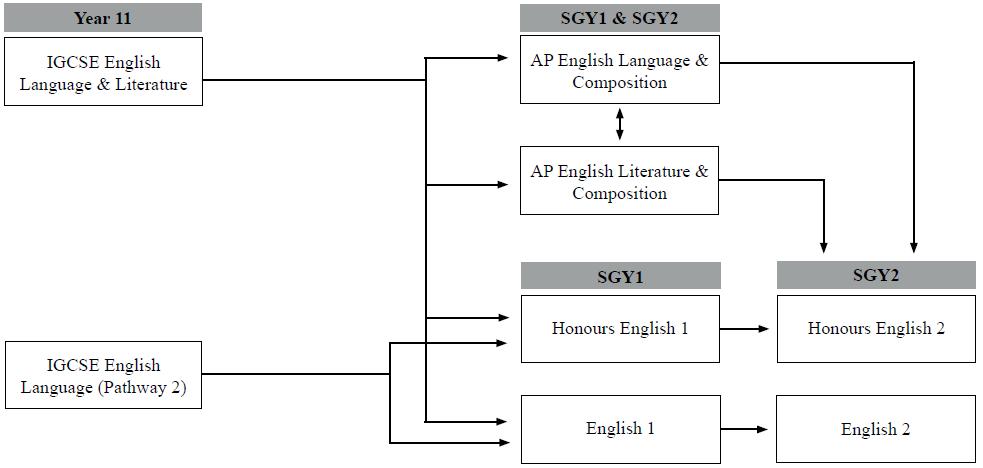
AP English Language and Composition is open to SGY2 students. It can be taken as a one-year course in SGY2 after successfully completing either the SGY1 Honours English 1 course or AP English Literature and Composition. This class focuses on advanced rhetorical analysis, argumentation, and non-fiction writing.
Prerequisites/Selection Process:
• For students entering in SGY2: Grade of B in SGY1 Honours English or AP Grade of 3 in AP English Literature and Composition.
Major Outcomes:
The AP English Language and Composition course not only instills in students the ability to evaluate, synthesize, and proficiently cite research to substantiate their arguments but positions them as formidable candidates in university applications. This rigorous and highly valued course not only strengthens students' evidence-based analytic and argumentative writing but also cultivates a research-oriented mindset crucial for higher education and future endeavours. Emphasizing rhetorical analysis of nonfiction texts, students delve into the decision-making processes of writers during composition and revision, developing a crucial skill set for academic success. The course's holistic approach, including the analysis of rhetorical elements and images across disciplines and
historical periods, equips students with adept critical thinking, strong research skills, and effective communication abilities. This robust foundation not only enhances their academic journey but also positions them competitively for university admissions and future professional endeavours.
Instructional Focus:
The following highlights key areas of emphasis in this college-level course, inquiry-based course:
• Rhetorical Analysis: Students acquire skills to identify and analyze diverse rhetorical strategies employed by writers for effective communication and persuasion.
• Argumentative Writing: Students translate rhetorical insights into their own argumentative writing, enhancing the precision and impact of their written expression.
• Information Synthesis: Students develop the ability to synthesize information from varied sources, strengthening the persuasiveness of rhetorical strategies in their writing.
• Enhanced Writing Skills: Students dedicate time to improving structural, grammatical, and syntactical accuracy, fostering overall improvement in their writing capabilities.
• Cultural and Textual Diversity: Students explore a rich array of non-fiction texts from diverse ethnic, historical, social, and cultural backgrounds, broadening perspectives and enriching rhetorical analysis.
• Contextual Understanding: Students foster the skill of forging connections between texts and their contexts, appreciating how writers' unique preoccupations and concerns influence their composition.
• College-Level Preparation: Students are equipped with the necessary skills and knowledge to excel in a college-level English course, laying a strong foundation for academic success.
• Critical Appreciation: Students cultivate a critical appreciation for the interplay between rhetoric, context, and diverse voices in non-fiction writing, enhancing analytical abilities.
• Preparation for AP Exam and Beyond: Students prepare for the AP exam through rigorous academic exploration, while simultaneously acquiring skills that make students competitive in university applications and various professional endeavours, regardless of their chosen career path.
Intended Audience: SGY2
AP English Literature and Composition is open to SGY2 students. It can be taken as a one-year course in SGY2 after successfully completing either the SGY1 Honours English course or AP English Language and Composition. This class provides an enriching opportunity to engage deeply with literature and advanced literary analysis.
Prerequisites/Selection Process:
• For students entering SGY2:
o Grade of B in SGY1 Honours English or
o AP Grade of 3 in AP English Language and Composition.
Major Outcomes:
This highly valued program, accessible after completing the SGY1 Honours English or the one-year AP English Language & Composition course, transforms students into proficient literary analysts and articulate communicators. The course's focus on reading, analyzing, and writing about imaginative literature from fiction and poetry to drama enriches students' literary appreciation. Through close reading and critical analysis, students delve into the intricate ways writers use language to convey both meaning and pleasure. The exploration extends to a work's structure, style, themes, and the use of figurative language, imagery, and symbolism. Writing assignments, ranging from expository to analytical and argumentative essays, challenge students to thoughtfully analyze and interpret literary works. The outcomes of this comprehensive course not only prepare students for the AP exam but also cultivate skills essential for success in university applications and various professional pursuits, making them competitive and versatile contributors in any chosen career path.
Instructional Focus:
The following highlights key areas of emphasis in this college-level, inquiry-based course which provides opportunities to analyze and respond critically to a wide range of poetry and prose.
• Imaginative Literature Exploration: Students delve into fiction, poetry, and drama from various periods, fostering a deep appreciation for imaginative literature's diverse forms and themes.
• Close Reading and Critical Analysis: Students develop skills in close reading and critical analysis, enabling them to explore how writers use language to convey meaning and pleasure within literary works.
• Structural, Stylistic, and Thematic Examination: Students engage in a
comprehensive exploration of a work's structure, style, and themes, unraveling the intricate choices made by writers in crafting their narratives.
• Figurative Language and Symbolism Mastery: Students analyze the use of figurative language, imagery, and symbolism within literary works, enhancing students' ability to discern and interpret the nuanced layers of meaning.
• Diverse Writing Assignments: Students tackle a variety of writing assignments, including expository, analytical, and argumentative essays. These assignments require students to articulate thoughtful analyses and interpretations of the imaginative literature studied.
• Effective Communication Skills: Students hone effective communication skills, emphasizing the articulation of complex ideas in written expression, a crucial asset for both academic and professional success.
• Literary Appreciation: Students cultivate a profound appreciation for literature beyond the classroom, fostering a lifelong passion for the power of language and storytelling.
• Preparation for AP Exam and Beyond: Students prepare for the AP exam through rigorous academic exploration, while simultaneously acquiring skills that make students competitive in university applications and various professional endeavors, regardless of their chosen career path.
Honours English 1 and 2
Intended Audience: SGY2
Honours English serves as a preparatory course, laying the groundwork for advanced English studies. Upon successful completion, students gain the foundation to pursue either the one-year course in AP English Language & Composition or the AP English Literature & Composition course. Alternatively, students can opt for Honours English or SGY University Bound English in SGY2, ensuring a versatile and comprehensive English education tailored to their academic goals and aspirations.
Prerequisites/Selection Process:
Grade of B in IGCSE English Language and/or a Grade of 6 in IGCSE Literature.
Major Outcomes:
The major outcomes of the Honours English course extend beyond examination readiness, fostering critical thinking, effective communication, and literary appreciation. This course empowers students to navigate advanced English studies with confidence and lays the groundwork for a comprehensive understanding of language and literature. This versatile preparatory course serves as a catalyst for academic excellence, shaping students into adept communicators and analytical thinkers, establishing a robust
foundation for advanced English studies. With its predominant focus on using literature as a conduit for skill development, Honours English offers a seamless transition from IGCSE level study. Designed to align closely with the skill set emphasized in the AP Literature & Composition course, this program provides a natural progression for those inclined toward this particular AP course. However, students who attain success in Honours English are also adeptly prepared to venture into the one-year AP English Language & Composition course in SGY2, showcasing the adaptability and readiness fostered within this comprehensive preparatory course.
The following outlines key areas of emphasis in this preparatory, inquiry-based course, offering opportunities to critically analyze and respond to a diverse range of poetry, prose, and non-fiction texts:
• Literary Exploration: Students are immersed in a diverse array of literature, including poetry, prose, and drama, spanning different periods and genres.
• Exploration of Literary Elements: Students develop a nuanced comprehension of literary elements and techniques, guiding students to analyze how these components intricately weave together to create profound meaning within the selected works.
• Literary Skill Development: Students are exposed to literature as a vehicle for skill development, providing a seamless transition from IGCSE level study.
• AP Literature & Composition Alignment: Students are prepared for advanced literary analysis and composition.
• Analytical and Communicative Proficiency: Students develop their analytical thinking and communication skills, laying a strong foundation for advanced English studies.
• Adaptability for AP English Language: Students are equipped with the readiness and adaptability to pursue the one-year AP English Language & Composition course, broadening their academic options.
• Gateway to Diverse Pathways: Students are presented with a versatile gateway, opening doors to various academic and professional avenues beyond advanced English studies.
Intended Audience: SGY2
Prerequisites/Selection Process:
SGY English is a compulsory course for all SGY2 students who are not studying Honours
English or AP English courses.
The two-year course is thoughtfully designed for students aspiring toward post-secondary education or the workplace, with a special focus on those who may feel less academically inclined or find English challenging. This inclusive approach ensures that all students, regardless of their starting point, can flourish and thrive in a supportive learning environment. By engaging critically and creatively with a diverse range of texts, this course becomes a stepping stone for students to enhance their analytical, communication, and research skills. The aim is to empower every student, fostering not only a deeper understanding of literary traditions but also instilling the confidence and abilities necessary for success in future studies. Beyond language and literature, the course uniquely tailors its outcomes to nurture critical thinking, effective communication, and research proficiency, ensuring that every student becomes a valued and thoughtful member of the academic community.
Instructional Focus:
The following highlights key areas of emphasis in this entry-level, inquiry-based course:
• Literary Analysis: Students engage with a diverse selection of novels, plays, and poems, fostering a deepened understanding of evolving literary traditions. Students will analyze and interpret texts, exploring themes, characters, and literary techniques.
• Critical Thinking: Students develop critical thinking skills, and are encouraged to question assumptions, engage in thoughtful discussion, and analyze complex literary and societal issues.
• Communication Skills: Students refine written and oral communication skills, encompassing essay writing, public speaking, and close reading analysis. Students will learn to express themselves eloquently and persuasively.
• Understanding Cultural Context: Students explore historical, social, and political contexts that shape literature. Students will understand how literature reflects and influences the societies in which it was created.
• Research Skills: Students conduct in-depth investigations and synthesize information from various sources. This prepares them for academic research and scholarly writing.
• Functional Skills: Students will learn to navigate university-level expectations, including critical reading, research, and academic writing. The course extends beyond literature study, concentrating on foundational functional skills essential for success, regardless of the future paths students choose after high school.
Intro to AP Calculus
Intended Audience: SGY1 (1 year course)
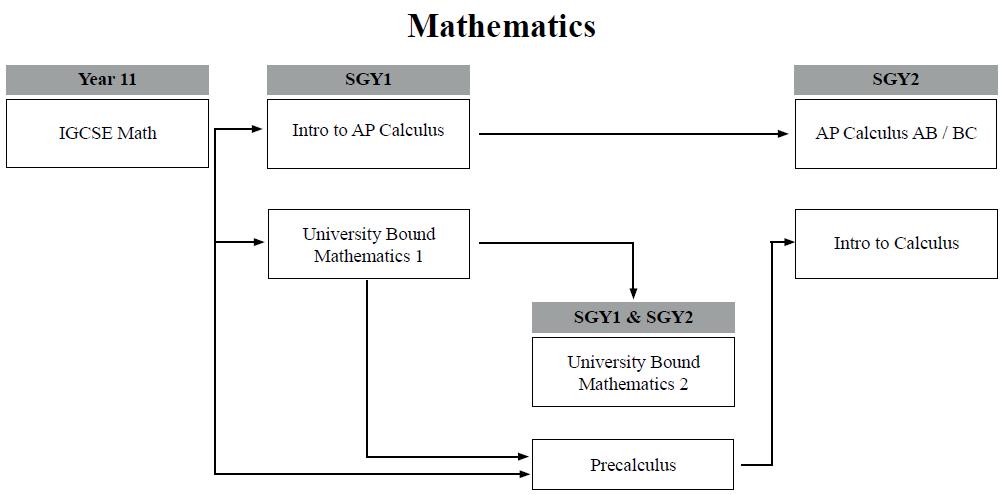
Prerequisites/Selection Process: Grade of 8 in IGCSE Mathematics
Major Outcomes:
• Relational understanding of algebraic concepts in preparation for the AP Calculus AB/BC course in SGY2
Instructional Focus:
SGY1 will be spent working through Pre-Calculus AP topics, learning concepts in preparation for the AP Calculus course in SGY2. These topics include but are not limited to:
• Complex numbers
• Polynomials
• Composite functions
• Trigonometry
• Vectors
• Matrices
• Conic sections
• Logarithmic functions
• Limits
University Bound Mathematics 1
Intended Audience: SGY1 (1 year course)
Prerequisites/Selection Process: Grade of 4 in IGCSE Mathematics
Major Outcomes:
• Relational understanding of statistical analysis and solving real life problems involving geometry.
Instructional Focus:
This course is predominantly concepts related to geometry and is taught and assessed using real life practice performance tasks, online learning checkpoints, group projects and summative exams.
The topics taught will include but are not limited to:
• Algebra
• Functions and relations
• Trigonometry
• Financial literacy
University Bound Mathematics 2
Intended Audience: SGY2 (1 year course)
Prerequisites/Selection Process: Successful completion of University Bound Math 1 course.
Major Outcomes:
Students will have the ability to work with data and solve complex statistical problems using different mathematical approaches.
Instructional Focus:
The students will cover a range of statistical concepts, such as:
• Measures of location and dispersion
• Data representations
• Probability
• Correlation
• Regression
• Discrete random variables
• The normal distribution
Precalculus
Intended Audience: SGY1 and SGY2 (1 year course)
Prerequisites/Selection Process: Grade of 6 in IGCSE Mathematics
Major Outcomes:
Relational understanding of algebraic concepts and introduction to rates of change
Instructional Focus:
This course covers some of the content from the Precalculus AP course, but also includes more concepts from the AS level mathematics course.
These topics include but are not limited to:
• Algebra and functions
• Equations and inequalities
• Sketching curves
• Coordinate geometry
• Sequences and series
• Differentiation of basic functions
• Integration of basic functions
AP Calculus AB/BC
Intended Audience: SGY2 (1 year course)
Prerequisites/Selection Process: Successful completion of Intro to AP Calculus (SGY1)
Major Outcomes:
• Success in the end of year AP examinations
• Students will feel confident in solving complex problems involving rates of change and how to apply Calculus concepts to real world examples.
Instructional Focus:
AP Calculus AB and AP Calculus BC focus on students’ understanding of calculus concepts and provide experience with methods and applications. Although computational competence is an important outcome, the main emphasis is on a multi-representational approach to calculus, with concepts, results, and problems being expressed graphically, numerically, analytically, and verbally. The connections among these representations are important.
The topics included in AP Calculus:
• Functions, graphs, and limits
• Analysis of graphs,
• Limits of functions (including one-sided limits),
• Asymptotic and unbounded behaviour,
• Continuity as a property of functions 2,
• Derivatives, concept of the derivative, derivative at a point
• Interpretations and properties of definite integrals,
• Applications of integrals techniques and applications of anti-differentiation.
Intended Audience: SGY2
Prerequisites/Selection Process: Successful completion of the Precalculus course
Major Outcomes:
Students will use their knowledge from the Precalculus year to learn and understand the basic concepts of Calculus, including more work on the differentiation and integration of functions. Students will feel confident in solving problems involving rates of change and how to apply Calculus concepts to real world examples.
Instructional Focus:
This course will be spent learning concepts in preparation for some of the necessary mathematics courses at university. Some of the topics will be from the Intro to AP Calculus, others will be from the A Level Core units. These topics include:
• Algebra and functions
• Solving inequalities and equations
• Sketching curves
• Sequences and series
• Differentiation of polynomials
• Trigonometry
• Coordinate geometry
• Radicals and indices
• Integration of polynomials
• Exponentials and logarithms
• The binomial expansion
• Trigonometric graphs
Intended Audience: SGY1
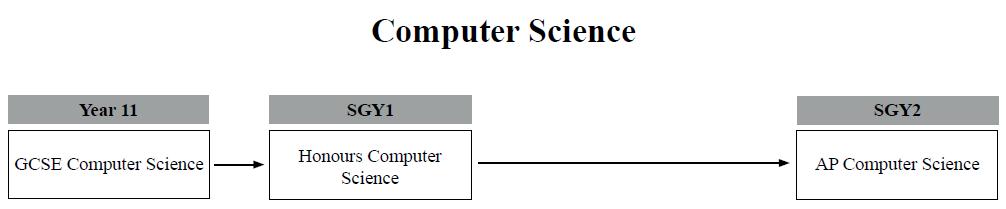
Prerequisites/Selection Process: It is preferred that students have obtained a Grade of 6 in Computer Science GCSE or have some previous experience of programming principles.
Major Outcomes:
The pre AP Program of study will look at the principles of programming without focusing on a specific language. Students will develop an underpinning knowledge of objectoriented programming. It is essential that students taking this course have strong mathematical and logical thinking skills. The course will cover the basics of programming, computer hardware and software.
Instructional Focus:
The course will incorporate gaining in-depth practical programming experience in Java, as well as theoretical aspects of computer science including: Problem solving, data structures, abstraction, data and information and algorithms. Students will develop techniques in designing, analysing and implementing solutions to problems. Students will work independently as well as in collaboration with others as would happen in a realworld development team.
Intended Audience: SGY2
Prerequisites/Selection Process: Honours Computer Science or significant programming knowledge.
Instructional Focus:
AP Computer Science is centered on the Java programming environment. Students will learn to read and write in the Java language and will develop practical skills in programming. Students continue to develop their understanding of concepts of objectoriented programming and be able to apply this to the Java programming language. It is essential that students taking this course have strong mathematical and logical thinking skills.
The course continues to develop programming skills to an advanced level including using and implementing some standard algorithms, as well as developing and implementing new solutions. Students will learn how to write, run, test and debug programs in the Java programming language utilizing standard classes from the Java library and interfaces from the AP Java subset.
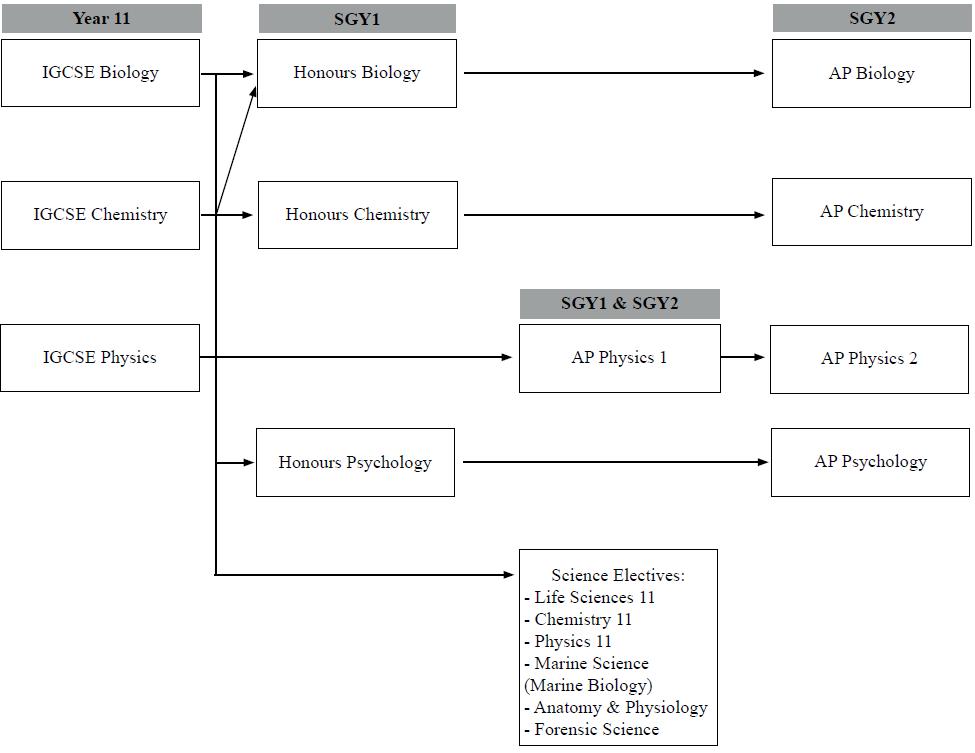
Honours Biology
Intended Audience: SGY1
Prerequisites/Selection Process: Grade of 6 at IGCSE Biology, Chemistry, and Math REQUIRED (not recommended). Students who do not achieve a grade of 6 should be encouraged to take Anatomy and Physiology instead.
Major Outcomes:
Honours Biology is an introductory college Biology course that leads to the AP Biology course offered in SGY2. Students who take this course develop advanced inquiry and reasoning skills by engaging in science practices. Laboratory work is essential as part of the course and its emphasis is on more student-directed, inquiry-based experiences. It provides students the opportunity to design experiments, collect data, apply mathematical routines and methods, and refine testable explanations and predictions.
Instructional Focus:
The key concepts of this course are organized around a few underlying principles, which encompass the core scientific principles, theories and processes governing living organisms and biological systems. Students will explore topics such as ecology, natural selection, the chemistry of life, cell structure and function and cellular energetics.
Intended Audience: SGY2
Prerequisites/Selection Process: Grade of C / 3 AP or higher in SGY 1 Honours Biology and a grade of 3 AP / C or higher in the end of SGY1 end of year exam.
Major Outcome:
AP Biology continues from the introductory course in SGY and is designed to give students a solid foundation in college-level biology. Students cultivate their understanding of biology through inquiry-based investigations as they explore a variety of topics. It provides students with the opportunity to enhance their skills in experimental design, modeling and application of statistics and evaluating case studies.
Instructional Focus:
This course continues with the focus on laboratory work and student-directed, inquirybased experiences that were introduced in the prerequisite course as they explore additional topics in college-level biology including cell communication and the cell cycle, heredity and gene expression and regulation. At the conclusion of the course, students are expected to sit the AP examination.
Intended Audience: SGY1
Prerequisites/Selection Process: Grade of 6 in IGCSE Chemistry and Mathematics.
Major Outcomes:
Having a deep understanding of chemistry principles implies the ability to connect and relate knowledge across various scales, concepts and representations in and across domains – symbolic, microscopic (particulate), and macroscopic (observations). Students will be able to use these representations and models to communicate scientific phenomena and solve scientific problems. The result will be readiness to study advanced topics in subsequent college chemistry courses.
Instructional Focus:
In this course, students will cultivate their understanding of chemistry through inquirybased investigations, as they explore fundamental topics, such as: stoichiometry, atomic
structure, bonding, and chemical reactions. Students will develop their scientific inquiry skills by designing experiments, analyzing data, and constructing arguments in a collaborative setting. They will also be challenged to solve scientific problems using models or visual representations, appropriate mathematics and scientific explanations and theories.
AP Chemistry
Intended Audience: SGY2
Prerequisites/Selection Process: Grade of C / 3 or higher in SGY 1 Honours Chemistry and a grade of 3 / C or higher in the end of SGY1 end of year exam.
Major Outcomes:
Having a deep understanding of chemistry principles implies the ability to connect and relate knowledge across various scales, concepts and representations in and across domains – symbolic, microscopic (particulate), and macroscopic (observations). Students will be able to use these representations and models to communicate scientific phenomena and solve scientific problems. The result will be readiness to study advanced topics in subsequent college chemistry courses.
Instructional Focus:
In this course, students will further their understanding of chemistry, with particular focus on the more advanced topics of kinetics, thermodynamics, and equilibrium. Students will be encouraged to connect and relate knowledge across various concepts and representations. Scientific inquiry will be central to the course, as students engage in scientific questioning to extend their investigations and establish lines of evidence to develop and refine testable explanations and predictions of natural phenomena. By the end of this course, students should be able to use scientific principles, theories, and processes to discuss and explain the particulate nature of matter underlying the observations they make about the physical world.
AP Physics 1
Intended Audience: SGY1
Prerequisites/Selection Process: Grade of 6 in IGCSE Physics and Mathematics REQUIRED.
Major Outcome:
Having a deep understanding of physics principles implies the ability to reason about physical phenomena using important science process skills such as explaining causal relationships, applying and justifying the use of mathematical routines and physical models, designing experiments, analyzing data, and making connections across multiple
topics within the course. This course pairs essential physics knowledge with the fundamental scientific reasoning skills necessary for authentic scientific inquiry. The result will be readiness for the study of advanced topics in subsequent college courses
Instructional Focus:
Students will study classical mechanics, mechanical waves, and electricity. Such study will center on Newtonian mechanics, quantification and transfer methods of energy, and electrical circuits. Students will develop scientific inquiry skills to enable them to solve assigned problems, as well as those emerging from their investigations. This course emphasizes depth of understanding and is highly practical in nature, with high expectations for both experimental design and synthesis of results. By the end of the course, students should be confirmed Newtonian thinkers with the ability to critically analyze unfamiliar problems and should be comfortable carrying out a deep, meaningful discourse centered on the physical world.
Intended Audience: SGY2
Prerequisites/Selection Process: AP Physics 1 score of AP 3 or higher. For interested students, there is the option of doing AP Physics C mechanics concurrently.
Having a deep understanding of physics principles implies the ability to reason about physical phenomena using important science process skills such as explaining causal relationships, applying and justifying the use of mathematical routines and physical models, designing experiments, analyzing data, and making connections across multiple topics within the course. This course pairs essential physics knowledge with the fundamental scientific reasoning skills necessary for authentic scientific inquiry. The result will be readiness for the study of advanced topics in subsequent college courses.
Instructional Focus:
In this class, designed for those who intend to study physics or engineering at university level, students build on the framework they developed in previous physics courses. AP Physics 2 delves into many rich topics not discussed in prior classes, including fluid mechanics, thermodynamics, geometrical optics, magnetism, and atomic & nuclear physics. In addition to developing scientific process skills through inquiry, this course showcases new and exciting areas of physics not normally discussed until university courses.
Honours Psychology
Intended Audience: SGY1
Prerequisites/Selection Process: Grade of 5 in any IGCSE Science and English.
Major Outcomes:
This course develops students’ understanding of the basic concepts of Psychology. By the end of the course students will begin to be able to employ psychological research methods, including ethical considerations, as they use the scientific method, analyze bias, think critically, evaluate claims and evidence, and effectively communicate ideas.
Instructional Focus:
The Honours Psychology course introduces students to the systematic and scientific study of human behaviour and mental processes. While considering the psychologists and studies that have shaped the field, students explore and apply psychological theories, key concepts, and phenomena associated with such topics as the biological bases of behaviour, sensation and perception, learning and cognition, motivation, developmental psychology, testing and individual differences, treatment of abnormal behavior, and social psychology.
AP Psychology
Intended Audience: SGY2
Prerequisites/Selection Process: Grade of C / 3 AP or higher in SGY 1 Honours Psychology and a Grade of 3 AP / C or higher in the end of SGY1 end of year.
Major Outcome:
This course builds on the introductory course and provides students with a college-level foundation to support future advanced work in Psychology or related fields. This course further develops students’ understanding of the basic concepts of Psychology. By the end of the course students will begin to be able to employ psychological research methods, including ethical considerations, as they use the scientific method, analyze bias, think critically, evaluate claims and evidence, and effectively communicate ideas.
Instructional Focus:
The AP Psychology course introduces students to the systematic and scientific study of human behaviour and mental processes. While considering the psychologists and studies that have shaped the field, students explore and apply psychological theories, key concepts, and phenomena associated with such topics as the biological bases of behaviour, sensation and perception, learning and cognition, motivation, developmental psychology, testing and individual differences, treatments of psychological disorders, and
social psychology.
Students will sit the AP Psychology Exam at the end of the course. This will measure students’ knowledge, understanding and application of key topics and fields of study in psychology. It also tests their ability to define, compare, and apply concepts and research findings. Questions are based on key terminology, scientific methodology, and theories associated with each subfield. Free-response questions may require students to interrelate different content areas and to analyze and evaluate psychological constructs and, more generally, theoretical perspectives. Free response questions will test students’ ability to analyze a unique scenario using concepts from different theoretical frameworks or sub domains in the field (Free Response Question type 1) and design, analyze, or critique a study (Free-Response Question type 2).
Life Sciences 11
Intended Audience: SGY1 and SGY2
Prerequisites/Selection Process: Grade of 4 in an IGCSE Science or Grade of C in an SGY science class
Major Outcomes:
Life Sciences 11 explores the fundamental principles of biology, focusing on interactions at the molecular and cellular levels, evolutionary processes, and the classification of organisms based on shared characteristics. Students will develop skills in scientific inquiry, data analysis, and experimental design while investigating topics such as cell structure and function, genetics, natural selection, and biodiversity. By the end of the course, students will be able to apply biological concepts to real-world situations, critically assess scientific information, and engage in discussions about the role of biology in society.
This course prepares students for Anatomy and Physiology 12.
Instructional Focus:
Through hands-on laboratory work, field investigations, and collaborative projects, students will engage in the systematic study of living organisms and biological systems. They will explore the molecular basis of life, examine the mechanisms of evolution, and analyze how organisms are classified based on evolutionary relationships. Students will also learn to evaluate scientific claims using evidence, interpret experimental data, and apply biological concepts to local and global contexts. Ethical and environmental considerations in biological research will be emphasized throughout the course.
Intended Audience: SGY1 and SGY2
Prerequisites/Selection Process: Grade of 4 in an IGCSE Science or Grade of C in an SGY science class
Major Outcomes:
Chemistry 11 introduces students to the foundational principles of chemistry, including atomic and molecular theory, the behaviour of matter, and the conservation of mass and energy in chemical reactions. Students will develop a strong understanding of chemical processes, the mole concept, solubility, and the significance of organic chemistry in human health and the environment. Emphasis is placed on experimental design, data collection, and analytical thinking to support scientific reasoning.
This course prepares students for Chemistry 12.
Instructional Focus:
Students will engage in laboratory investigations, inquiry-based experiments, and problem-solving activities to develop a conceptual understanding of chemical principles. Topics include atomic structure, bonding, stoichiometry, reaction kinetics, and the impact of chemistry on everyday life. Students will gain experience in precise measurement, safe handling of chemicals, and the interpretation of experimental results. Real-world applications, including environmental and technological implications of chemistry, will be explored throughout the course.
Intended Audience: SGY1 and SGY2
Prerequisites/Selection Process: Grade of 4 in an IGCSE Science or Grade of C in an SGY science class
Major Outcomes:
Physics 11 provides students with an understanding of the fundamental principles governing motion, forces, energy, and waves. Students will explore how objects move and interact, how energy is conserved and transferred, and how mechanical waves behave. Through scientific inquiry and mathematical modeling, students will develop problem-solving skills and an appreciation for the role of physics in technology and everyday life.
This course prepares students for Physics 12.
Instructional Focus:
Through hands-on experiments, real-world applications, and data-driven analysis,
students will investigate key concepts in kinematics, dynamics, work and energy, and wave behaviour. Emphasis will be placed on developing critical thinking and quantitative reasoning skills while using scientific methods to analyze motion and forces. Students will also explore the broader implications of physics in engineering, medicine, and environmental science, making connections between theory and practical applications.
Intended Audience: SGY2
Prerequisites/Selection Process: A science background at IGCSE or an equivalent level of study.
Major Outcomes:
This inquiry-based, student-directed course introduces students to marine biology and ecology. It explores the interconnections of the natural world through a marine lens and fosters an understanding of the role humans play in marine systems.
Instructional Focus:
Through building a working knowledge of scientific research skills and marine science, students will come to understand marine systems, how we can conserve them and apply principles of sustainable development. Project-based learning and relevant field experiences provide the means to introduce students to scientific investigation and data analysis. Students will become proficient in types of scientific communication and writing techniques.
Anatomy and Physiology (one-year course)
Intended Audience: SGY2
Prerequisites/Selection Process: A science background at IGCSE or an equivalent level of study.
Major Outcomes:
This course introduces students to principles of human anatomy and physiology. This course will explore the interconnections of cellular and human biology, allowing students to develop an interest in and understanding of how the human body systems are integrated to maintain homeostasis. This course will incorporate the Big Ideas of Homeostasis, Gene Expression and Organ Systems. The first half of the course will focus on cellular biology, and the half of the course will cover the major systems of the body, focusing on anatomy and physiology.
Instructional Focus:
Through building a working knowledge of scientific inquiry skills and anatomical knowledge, students will come to understand the many body systems and to understand
how to take care of the human body. Project-based learning and relevant laboratory experiences provide the means to introduce students to scientific investigation and data analysis. Students will become proficient in types of scientific communication and writing techniques framework to pursue knowledge and skills linked to human anatomy and physiology. In addition, students will be evaluated in many platforms of learning, from independent projects to unit exams, a midterm exam, and a final exam.
Intended Audience: SGY2
Prerequisites/Selection Process: A science background at IGCSE or an equivalent level of study.
Major Outcomes:
This hands-on, student-directed course introduces students to Forensic science. It explores the application of science (chemistry, physics, and biology) to criminal and civil laws and aims to encourage a curiosity in science. The course aims to help students to discover areas of interest and potential career opportunities. Forensic Science is a field of study that involves the integration of many of the courses offered at our school, including but not limited to biology, chemistry, earth science/geology, physics, and some history (law and general history of forensic science). By affording students an opportunity to take this course, it is hoped that they will become more motivated and interested in looking into the other fields of science.
Instructional Focus:
Forensic Science is the use of scientific methods, physical evidence, deductive reasoning and their interrelationships to gain knowledge of the events leading to the commission of a crime. Forensic Science is a course that focuses on giving students a chance to gain and apply knowledge from the areas of history, math, biology, chemistry, physics, earth science, archeology, anthropology, law, medicine, and professional/technical writing. Through building a working knowledge of basic forensic science concepts, hands-on learning and relevant field experiences provide the means to help students become proficient in scientific inquiry, data analysis, reasoning and scientific communication. This course will expose students to current forensic science methods as well as discussing past practices and reasons for advancements in technology. This course will include a series of labs, discussion of case studies, field trips and guest speakers (dependent on availability), and research that will allow students to strengthen skills of observation, interpretation, reasoning, and formal presentation. It will cover fingerprinting, fiber analysis, ballistics, arson, trace evidence analysis, poisons, drugs, blood spatters, and blood samples. Techniques such as microscopy, chromatography and spectroscopy will also be examined.
Intended Audience: SGY1
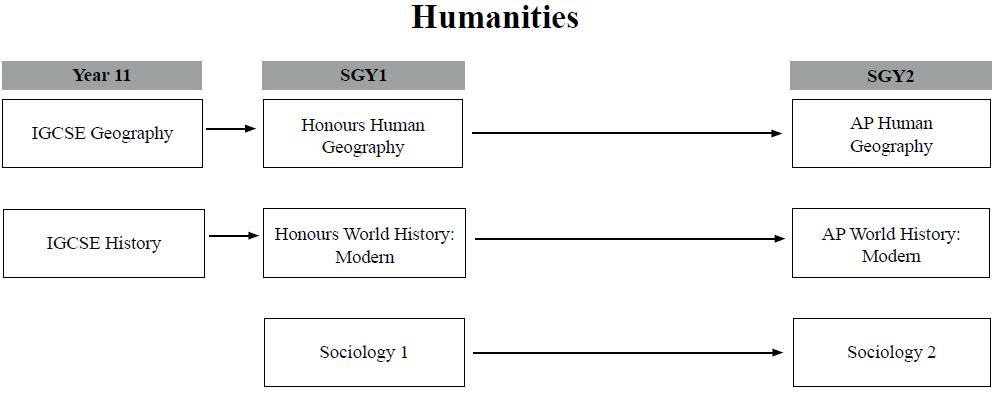
Prerequisites/Selection Process: Grade of 6 in IGCSE Geography. Those who have not taken GCSE Geography, should excel in English, achieving an A on IGCSE English Language. The course requires a lot of reading and comprehension of various text-based resources.
Major Outcomes:
Students will learn to:
• think critically by synthesizing a variety of perspectives and information from various sources.
• analyze various forms of geospatial data.
• knowledge and understanding of geographical concepts and appreciate the importance of these concepts to our changing world.
• develop a framework of spatial awareness in which to appreciate the importance
of the location of places and environments at a range of scales.
• demonstrate an appreciation that people have different views of, and attitudes to, the world, its environments and its issues.
• foster an awareness of global issues and recognize the challenges of moving towards a sustainable future
Instructional Focus:
During the first year of the course students will examine the following topics:
• Thinking Geographically: An Introduction to Geography
• Population and Migration Patterns and Processes
• Cultural Patterns and Processes
• Political Patterns and Processes
Intended Audience: SGY2
Prerequisites/Selection Process: Grade of C / 3 AP or higher in SGY 1 Honours AP Human Geography and a Grade of 3 AP / C or higher in the end of SGY1 end of year exam.
Major Outcomes:
AP in Human Geography students will learn to:
• think critically about the complexity and fragility of ecosystems
• develop and apply their knowledge and understanding of the effects of human activities on the planet
• understand the principles of sustainability and resource management and evaluate various approaches to achieve a more sustainable relationship between the environment, society, and the economy.
Instructional Focus:
In AP Human Geography students will prepare for the AP Human Geography examination. In addition to the above they will complete units on:
• Agriculture and rural land-use patterns and processes
• Cities and urban land-use patterns and processes
• Industry and development patterns and processes
Honours World History: Modern
Intended Audience: SGY1
Prerequisites/Selection Process: Grade of 6 in IGCSE History or B in English Language. A keen interest in History.
Major Outcomes:
• Grade of 3 or higher during the end of year internal exam in US History: the early years (SGY1)
• Evaluating primary and secondary sources
• Analyzing the claims, evidence, and reasoning you find in sources
• Putting historical developments in context and making connections between them
• Developing a claim or thesis and explaining and supporting it in writing
Instructional Focus:
World History: 1200-1750
• State formation, decline, and political, social and cultural developments
• Development of global exchange and trade
• Age of empire, development of religion
• Ocean exploration, the development of new maritime empires, and the effects of new cross-cultural encounters.
• Revolutions
AP World History: Modern
Intended Audience: SGY2
Prerequisites/Selection Process: Grade of 3 or higher in World History: 1200-1750 at the end of SGY1 exam.
Major Outcomes:
• AP in World History
• Evaluating primary and secondary sources
• Analyzing the claims, evidence, and reasoning you find in sources
• Putting historical developments in context and making connections between them
• Coming up with a claim or thesis and explaining and supporting it in writing
Instructional Focus:
World History: 1750-present
• Revolutions
• Consequences of industrialization
• Global conflict
• Cold war and decolonization
• Globalization
Intended Audience: SGY1 and SGY2
Prerequisites/Selection Process: None
Major Outcomes:
The course is designed to give students an overview of issues in contemporary society and consider them sociologically. It provides a sound basis for those who want to continue the course in SGY2 with the intention of sitting the College Level Examination Program (CLEP) exam in Sociology. Wherever possible, study will be concerned with its application to Bermuda. A number of North American universities accept success in this exam for credit in a student’s first year of university.
The exam is broken down as follows:
30% Social Stratification (process/structure) 20% Institutions
15% Social Patterns
20% Social Processes
15% Sociological Perspectives
Instructional Focus:
SGY1 Sociology topics will include:
• Origins and founders of sociology
• Culture
• Social structure and group behaviours
• Socialization
• Social stratification and class
• Politics and the economy
• Population and the environment
• Cities and urban life
• Education
• Deviance and crime
• Race and ethnicity
• Gender, age and health
• The family
• Sports and entertainment
SGY2 – Sociology topics will include: (with a view to taking the CLEP at the end of the year)
• Culture, society and social change
• Interactions, groups and organizations
• Socialization
• Population, ecology and urbanization
• Inequalities of social class
• The political order
• The economy
• Education and religion
Accounting 1
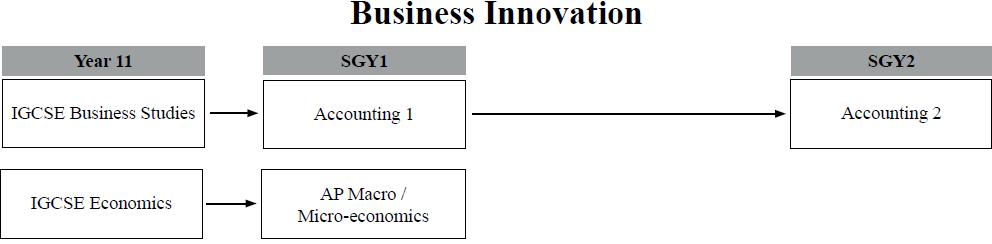
Intended Audience: SGY1
Prerequisites/Selection Process: Grade of 5 or higher in GCSE Mathematics is preferred.
Major Outcomes:
The Program of study that develops a range of skills and knowledge of accounting principles.
Instructional Focus:
During the Program you will learn: Accounting concepts, principles and practices. The role of accounting as an information system for monitoring, problem-solving and decision making and the place of accounting in changing economic, social and technological environments.
Intended Audience: SGY2
Prerequisites/Selection Process: Grade of C or higher in the end of year exams for SGY1
Major Outcomes:
The Program of study that develops a range of skills and knowledge of accounting principles.
Instructional Focus:
Students will examine and evaluate accounting policies and practices critically and analytically. They will learn how to communicate, analyze, interpret and present both qualitative and quantitative accounting information.
Intended Audience: SGY1
Prerequisites/Selection Process: Grade of 6 or higher in GCSE Mathematics and English or a 6 in IGCSE Economics or Business.
Major Outcomes:
An examined Program of study, the Economics Program builds on previous GCSE learning. This course will lead to the AP exam in Macroeconomics.
Instructional Focus:
Students will gain a wealth of knowledge and develop skills including: How to explain and analyze economic issues and arguments and how to evaluate economic information and organize, present and communicate ideas and judgements clearly. The course will cover the foundation of economic ideas including: Comparative advantage, supply and demand, price elasticity, deadweight loss, economies of scale, fiscal policy, monetary policy, unemployment, GDP, The Federal Reserve, externalities and income inequality.
Intended Audience: SGY2
Prerequisites/Selection Process: Grade of 6 or higher in GCSE Mathematics and English or a 6 in IGCSE Economics or Business.
Major Outcomes:
An examined Program of study, the Economics program builds on previous GCSE learning. This course will lead to the AP exam in Microeconomics.
Instructional Focus:
Students will gain a wealth of knowledge and develop skills including: how to explain and analyze economic issues and arguments and how to evaluate economic information and organize, present and communicate ideas and judgements clearly. The course will cover the foundation of economic ideas, and topics covered will include: Comparative advantage, supply and demand, price elasticity, deadweight loss, economies of scale, profit maximization, perfect competition, oligopoly, game theory, externalities and income inequality.
Design Technology: Design, Manufacture and Engineering
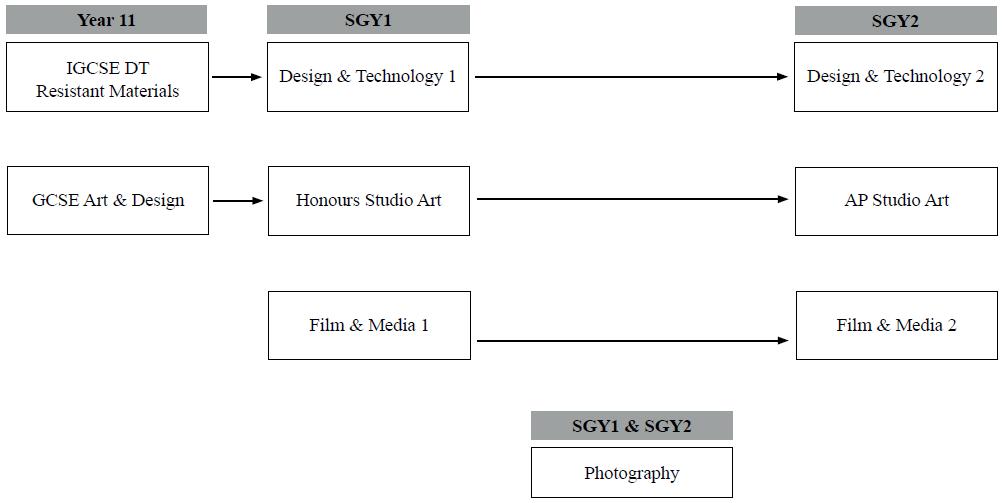
Intended Audience: SGY1 and SGY2
Prerequisites/Selection Process: None
Major Outcomes:
This course can lead towards higher education courses such as Architecture, Engineering and Interior Design or can be used as a base to improve problem solving and practical skills.
Instructional Focus:
In this course, SGY1 and SGY 2 are taught together. In the first half of the year, students will have a choice between two projects and two more in the second half. Each project has a separate focus, but all rely on the design process, use real world problems and are done in conjunction with outside agencies and real clients wherever possible.
For example, students may have the choice in the first half of the year between ‘set design and construction’, working with the drama department to design and build the set for the school musical, and ‘Art in Design’, an opportunity for students to show off their creative flair using the wide variety of machinery we have available (this could also include jewelry). In the second half they may have a choice between working with remotely operated underwater vehicles and a graphic design project. At the end of the first year, students are not obliged to continue with the course (with four new projects to choose from), but it is of course encouraged!
Intended audience: SGY1
Prerequisites/Selection Process: Grade of 5 above at GCSE is preferred.
Major Outcomes:
This course will pursue a program of study leading to the Advanced Placement in Art and Design in SGY2. Students can utilize their portfolio of work produced in this course to enter into a number of higher education courses including Fine Art, Graphic Design, Interior Design, Architecture, Product Design, Computer Aided Design, Animation to name but a few.
Instructional Focus:
The portfolios offered include: 2-D Design, Drawing and 3-D Design. Whilst students will have the opportunity to pursue any one of these portfolios, it is highly likely that the majority of students will pursue either the Drawing or 2-D Design Portfolio. As such, concepts covered in this course will include, but are not limited to: advanced drawing concepts or alternatives; exposure to three-dimensional objects which would allow development of the skill in translating 3D subjects onto a 2D surface. Other skills include: use of various spatial systems, various subject matter, e.g., human figure, landscape, still life etc.; both observational and imaginative imagery; a variety of media; elements of design, (e.g., line, shape, illusion of space, illusion of motion, pattern, texture, value and colour) and principles of design (e.g., unity/variety, balance, emphasis, rhythm, and proportion/scale).
Intended Audience: SGY2
Prerequisites/Selection Process: It is highly recommended that students take the Honours Studio Art course in SGY 1.
Major Outcomes:
The AP Art and Design Program consists of three different courses and AP Portfolio Exams AP 2-D Art and Design, AP 3-D Art and Design, and AP Drawing. Students may choose to submit any or all of the AP Portfolio Exams, however most will choose only one. Students create a portfolio of work to demonstrate inquiry through art and design and development of materials, processes, and ideas over the course of a year. Portfolios include works of art and design, process documentation, and written information about the work presented. In May, students submit portfolios for evaluation based on specific criteria, which include skillful synthesis of materials, processes, and ideas and sustained investigation through practice, experimentation, and revision, guided by questions. Students may choose to submit any or all of the AP Portfolio Exams.
Instructional Focus:
AP Art and Design courses will address the following learning outcomes: the ability to (1) conduct a sustained investigation through practice, experimentation, and revision, guided by questions; (2) skillfully synthesize materials, processes, and ideas; and (3) articulate, in writing, information about one’s work.
The AP Art and Design course framework is composed of course skills, big ideas, essential questions and enduring understandings, learning objectives, and essential knowledge statements. All three AP Art and Design Portfolio Exams contain two sections. The Selected Works section requires students to demonstrate skillful synthesis of materials, processes, and ideas in 5 Selected works. The Sustained Investigation section requires students to conduct a sustained investigation based on questions, through practice, experimentation, and revision and presented as 15 digital images. Both sections of the portfolios require students to articulate information about their work.
Film & Media 1 and 2
Intended Audience: SGY1 and SGY2
Prerequisites/Selection Process: Grade of 5 or above in GCSE English Language or Literature for SGY1. Students may opt to study the course over one year or two. They may enter at SGY1 level OR SGY2 level.
Major Outcomes:
This is an internally assessed course. Students will be assessed through the completion of a range of film and media related projects, with practical and theoretical work being undertaken individually and as a group. Students will submit coursework projects throughout the year as well as sit an end of course, internally assessed exam or exhibition of learning. While the course is internal, students produce a portfolio of works that has consistently secured early entry into film and media courses at university.
Instructional Focus:
Film and Media aims to develop students as proficient interpreters and makers of film, media and multi-media texts. Students examine film and media concepts, theories, practices and ideas from multiple perspectives, challenging their own viewpoints and biases in order to understand and value those of others.
Students experiment with film and multi-media technologies, acquiring the skills and creative competencies required to successfully communicate through the language of the medium and to master new technologies and share this knowledge with others. They develop an artistic voice and learn how to express personal perspectives through film and media including fiction and documentary film, screenwriting, advertising, website design, multi-media and print media, news and social media.
The Film and Media course emphasizes the importance of working collaboratively. Students are placed in real world situations, working on practical projects that require them to address a client brief, identify and appeal to a target audience, manage schedules and production elements and challenge themselves to understand alternative views, to respect and appreciate the diverse cultures that exist within film and media, and to have open and critical minds. They do this within a model of real-world Film and Media teams – learning the roles of producers, directors, designers, cinematographers, writers and creators.
At the core of the film and media course lies the need for creative exploration and innovation. Students are challenged to acquire and develop critical thinking, reflective analysis and the imaginative synthesis that is achieved through practical engagement in the art, craft and study of film and media.
The film and media course culminates in the production of a portfolio of works that enables students to successfully gain advanced placement in university film and media courses.
Photography (one-year course)
Intended Audience: SGY1 and SGY2
Prerequisites/Selection Process: There is no prerequisite for this course other than access to a digital camera and a keen interest in photography and digital media.
Major Outcomes:
This course will pursue an internal program of study that will culminate in students producing a final portfolio and final exam. Students will be expected to complete weekly or bi-monthly homework assignments as well as class projects on time.
Instructional Focus:
This is an introductory course, where students will study the history and application of Photography. In addition to practical assignments, students will be asked to produce images for the School’s annual yearbook. All these skills will be utilized when students work on a self-initiated final project in the Spring term.
Both group and individual critiques, a common structure in the college classroom, will be employed to teach students how to analyze their own work and their peers’ work critically, and enables both students and teacher to assess the strengths and weaknesses in the work.
Intended Audience: SGY1 and SGY2 (1- or 2-year course)
Prerequisites/ Selection Process: Grade of 6 or above in either Drama and/or Music at GCSE. Students may opt to study the course over one year or two. They may enter at SGY1 OR SGY2 level, however SGY2 task requirements require greater skill and rigor than SGY1.
Major Outcomes:
• Students will develop skills in all areas of Performing Arts in this internally assessed course.
• Students may opt to focus on one discipline or multiple disciplines for core performance work.
Instructional Focus:
Students will explore the real-life of a Performing Artist through a variety of different realworld experiences. The course will provide a unique environment for anyone with an interest in on-stage or off-stage disciplines - from drama, dance and singing to set design, technician skills, music technology and management. Students will complete three core areas:
• Performance - As a Performing Arts course, students will be required to produce practical performance work in their chosen Performing Arts discipline for a live audience. Students may also present work in film and digital forms. Students may opt to perform monologues, duologues or scenes, musical works, compositions, dance performances, or any combination of Performing Arts disciplines.
• Community Project - All students will engage in a Community based Performing Arts project to prepare them for a career in Performing Arts and to understand the place of Performing Arts within the community. This develops their entrepreneurial skills and ability to plan and organize events and instigate projects of their own creation to benefit the school community (SGY1) and wider community (SGY2)
• Course Work - Depending on their chosen discipline, students will complete course work with a discipline focus. This may include anything from Directing, scriptwriting and acting, to music technology, composition, film sound, and vocal performance.
Sport Science
Intended Audience: SGY1 and SGY2
Prerequisites/Selection Process: GCSE PE or a science background would be preferable.
Major Outcomes:
This course introduces the students to sports science and will provide the student with information on the three topics of: sociology in sport, psychology in sport and anatomy and physiology. Students will focus on preparing for an internal examination at the end of SGY1 and SGY2.
Typical Jobs:
PE Teacher, sport coach, sport therapist, sport, exercise psychologist, personal trainer, Sport administrator, fitness center manager, exercise physiologist, physiotherapist, etc.
Instructional Focus:
Students are expected to develop theoretical knowledge alongside applied practical skills in the following topics:
Nutrition, respiratory system, cardiovascular system, information processing, skill acquisition, development of physical education, potential barriers to physical activity, energy systems, injury in sport, personality, attitudes, ethics in sport and elite performance.
Assessment is based on classwork; written, oral or practical exams. Students will also be required to conduct a piece of independent research on a topic of their choosing.
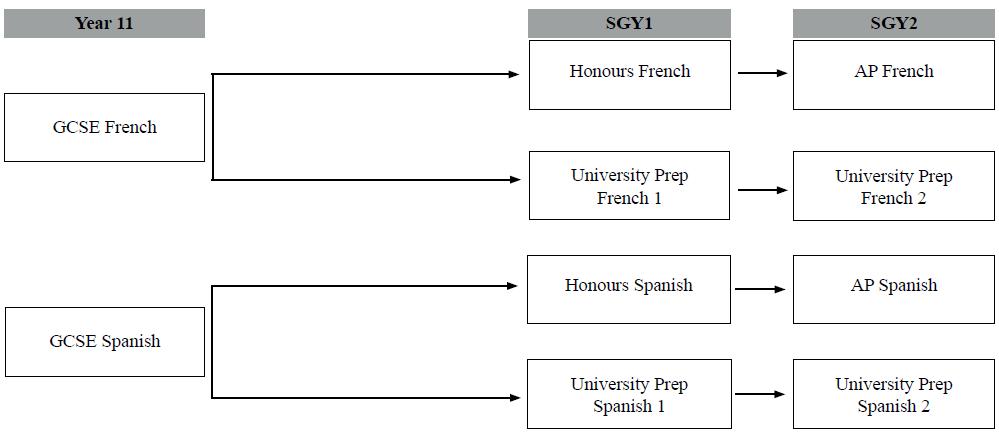
Intended Audience: SGY1
Prerequisites/Selection Process: Grade of 6 or higher at GCSE Spanish or an equivalent level of study.
Major Outcomes:
The course is divided into thematic units which are further based on recommended contexts and guided by essential questions. Corresponding cultural elements are integrated into the study of the units, and activities are directed with those cultural connections in mind. Discussion of the topics completely in Spanish is a requirement for this course. The course focuses on the integration of authentic resources including audio, and audiovisual resources, as well as literature, essays, magazine and newspaper articles with the goal of providing a rich, diverse learning experience.
Instructional Focus:
AP Spanish Language and Culture is equivalent to an intermediate level college course in Spanish. Students cultivate their understanding of Spanish language and culture by applying interpersonal, interpretive, and presentational modes of communication in reallife situations as they explore concepts related to family and communities, personal and public identities, beauty and aesthetics, science and technology, contemporary life, and global challenges. This course engages students in an exploration of culture in both contemporary and historical contexts. The course develops students’ awareness and appreciation of cultural products (e.g., tools, books, music, laws, conventions, institutions); practices (patterns of social interactions within a culture); and perspectives (values, attitudes, and assumptions).
Intended Audience: SGY1 and SGY2
Prerequisites/Selection Process: Grade of 5 or higher at GCSE Spanish or an equivalent level of study
Major Outcomes:
Students will focus on preparing for an internal examination at the end of SGY1 and SGY2, which will test communication skills in listening, reading, writing and speaking in the target language.
Instructional Focus:
This course draws on a variety of themes to promote extensive development of listening, reading and writing skills. It will also reinforce and extend oral communication skills. Spanish speaking countries' cultures and topical issues will be studied through a variety of authentic materials. Students will be expected to produce written and oral assignments, including formal essays and presentations. They should also be prepared to study Spanish language and culture outside the classroom, reading news articles, short stories, watching films, and listening to Spanish music. The course is aimed directly at students who wish to study Spanish at a higher level or improve their proficiency in the language for travel or work purpose.
Intended Audience: SGY1
Prerequisites/Selection Process: Grade of 6 or higher at GCSE French or an equivalent level of study.
Major Outcomes:
The course is divided into thematic units which are further based on recommended contexts and guided by essential questions. Corresponding cultural elements are integrated into the study of the units, and activities are directed with those cultural connections in mind. Discussion of the topics completely in French is a requirement for this course. The course focuses on the integration of authentic resources including audio, and audiovisual resources, as well as literature, essays, magazine and newspaper articles with the goal of providing a rich, diverse learning experience.
Instructional Focus:
AP French Language and Culture is equivalent to an intermediate level college course in French. Students cultivate their understanding of French language and culture by applying interpersonal, interpretive, and presentational modes of communication in reallife situations as they explore concepts related to family and communities, personal and
public identities, beauty and aesthetics, science and technology, contemporary life, and global challenges. This course engages students in an exploration of culture in both contemporary and historical contexts. The course develops students’ awareness and appreciation of cultural products (e.g., tools, books, music, laws, conventions, institutions); practices (patterns of social interactions within a culture); and perspectives (values, attitudes, and assumptions).
Intended Audience: SGY1 and SGY2
Prerequisites/Selection Process: Grade of 5 or higher at GCSE French or an equivalent level of study.
Students will focus on preparing for an internal examination at the end of SGY1 and an internal or external examination at the end of SGY2, which will test communication skills in listening, reading, writing and speaking. Students can also use the course as preparation for the SAT examination.
Instructional Focus:
This course draws on a variety of themes to promote extensive development of listening, reading and writing skills. It will also reinforce and extend oral communication skills. Francophone cultures and topical issues will be studied through a variety of authentic materials. Students will be expected to produce written and oral assignments, including formal essays and presentations. They should also be prepared to study French language and culture outside the classroom, reading news articles, short stories, watching films, and listening to French music. The course is aimed directly at students who wish to study French at a higher level or improve their proficiency in the language for travel or work purposes.