Research Article Page 4 of 7
Pre-course diagnostics for differential calculus
diagnostic questions for the compulsory background and essential vocabulary checks.
work habits: (1) What do you need to do to take responsibility for your own learning? and (2) What is required of you to work constructively in group situations?
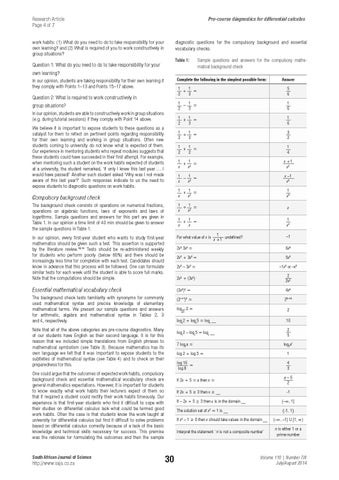
Table 1:
Question 1: What do you need to do to take responsibility for your
Sample questions and answers for the compulsory mathe matical background check
own learning? Complete the following in the simplest possible form:
In our opinion, students are taking responsibility for their own learning if they comply with Points 1–13 and Points 15–17 above.
Question 2: What is required to work constructively in group situations? In our opinion, students are able to constructively work in group situations (e.g. during tutorial sessions) if they comply with Point 14 above. We believe it is important to expose students to these questions as a catalyst for them to reflect on pertinent points regarding responsibility for their own learning and working in group situations. Often new students coming to university do not know what is expected of them. Our experience in mentoring students who repeat modules suggests that these students could have succeeded in their first attempt. For example, when mentoring such a student on the work habits expected of students at a university, the student remarked, ‘If only I knew this last year … I would have passed!’ Another such student asked ‘Why was I not made aware of this last year?’ Such responses indicate to us the need to expose students to diagnostic questions on work habits.
Compulsory background check The background check consists of operations on numerical fractions, operations on algebraic functions, laws of exponents and laws of logarithms. Sample questions and answers for this part are given in Table 1. In our opinion a time limit of 40 min should be given to answer the sample questions in Table 1.
Essential mathematical vocabulary check The background check tests familiarity with synonyms for commonly used mathematical syntax and precise knowledge of elementary mathematical terms. We present our sample questions and answers for arithmetic, algebra and mathematical syntax in Tables 2, 3 and 4, respectively.
1 – 1 = 2 3
1 6
1 x 1 = 2 3
1 6
1 ÷ 1 = 2 3
3 2
1 x 1 = 2 2
1 4
1 x 1 = x x2
x +1 x2
1 – 1 = x x2
x –1 x2
1 x 1 = x x2
1 x3
1 ÷ 1 = x x2
x
1 x 1 = x x
1 x2 1 undefined? x +1
–1
2x3.3x5 =
6x8
2x3 + 3x3 =
5x3
2x3 – 3x3 =
–1x3 or –x3
2x3 ÷ (3x5)
2 3x2
(2x3)2 =
4x6
(2x+1)3 =
23x+3
2
2=
2
loga2 + loga5 = loga __
10
loga2 – loga5 = loga __
2 5
7 log2a =
One could argue that the outcomes of expected work habits, compulsory background check and essential mathematical vocabulary check are general mathematics expectations. However, it is important for students to know exactly what work habits their lecturers expect of them so that if required a student could rectify their work habits timeously. Our experience is that first-year students who find it difficult to cope with their studies on differential calculus lack what could be termed good work habits. Often the case is that students know the work taught at university for differential calculus but find it difficult to solve problems based on differential calculus correctly because of a lack of the basic knowledge and technical skills necessary for success. This premise was the rationale for formulating the outcomes and then the sample
http://www.sajs.co.za
5 6
log
Note that all of the above categories are pre-course diagnostics. Many of our students have English as their second language. It is for this reason that we included simple translations from English phrases to mathematical symbolism (see Table 3). Because mathematics has its own language we felt that it was important to expose students to the subtleties of mathematical syntax (see Table 4) and to check on their preparedness for this.
South African Journal of Science
1 + 1 = 2 3
For what value of x is
In our opinion, every first-year student who wants to study first-year mathematics should be given such a test. This assertion is supported by the literature review.10,14 Tests should be re-administered weekly for students who perform poorly (below 80%) and there should be increasingly less time for completion with each test. Candidates should know in advance that this process will be followed. One can formulate similar tests for each week until the student is able to score full marks. Note that the computations should be simple.
log2a7
log 2 + log 5 =
1
log 16 = log 8
4 3 a–5 2
If 2x + 5 = a then x = If 2x + 5 ≥ 3 then x ≥ __
-1
If – 2x + 5 ≥ 3 then x is in the domain __
(–∞, 1]
The solution set of x2 = 1 is __
{-1, 1}
If x2 – 1 ≥ 0 then x should take values in the domain __ Interpret the statement: ‘n is not a composite number’
30
Answer
(–∞, –1] U [1, ∞) n is either 1 or a prime number
Volume 110 | Number 7/8 July/August 2014