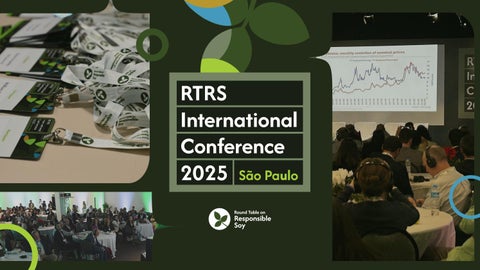
ENG | Final Report – International Conference 2025
Towards a regenerative transition. Speech by the RTRS Vice-President
Purpose-driven leadership: Marina Muscolo and the new phase of RTRS
Session 1. How RTRS creates value from farm to consumer
Session 2. Opportunities for Brazilian soy in the low-carbon era
Keynote speech: Marcos Jank. “Brazil needs an integrated strategy to maintain global leadership in soy”
Session 3. Certification, regeneration, and sustainability in the soy value chain
Session 4. Policies and certifications that promote responsible soy in Brazil
Opening of the second day. Innovation and opportunities in international markets
Session 5. From soil to market: practical pathways for regenerative and competitive soy
Session 6. Advances in soy traceability and monitoring in Brazil
Technical visit. RTRS promotes a technical visit to Castrolanda and LDC and highlights Brazil’s role in sustainable soy
Closing. Global 2027 strategy to strengthen responsible production
Towards a regenerative transition.
Speech by the RTRS Vice-President
Under the theme “Creating solutions for a sustainable future”, the International Conference of the Round Table on Responsible Soy (RTRS) brought together diverse stakeholders from across the value chain on 18–19 September in São Paulo.
On this occasion, Juan Carlos Cotella, Vice President of the association, presented RTRS’s progress in promoting responsible soy. Since its founding in 2006, the association has consolidated itself as a global platform that now connects over 220 members in 32 countries, linking producers, traders and end users.
One of the major highlights was the growth of certification in 2025, which has already shown a 15% increase compared to the previous year. RTRS currently has 54,500 certified producers in six countries and more than 430 Chain of Custody sites across 15 countries. In 2024, certified production reached 6.8 million tonnes, and physical sales doubled, hitting 900,000 tonnes — a 102% increase compared to 2023.
The moment was also an opportunity for Cotella to present the new RTRS Strategic Plan, which sets goals through 2027. The proposal seeks to strengthen the association’s governance, make certification more competitive, enhance member experience, and increase market impact.
Despite the progress, Cotella reminded that RTRScertified soy still represents only 2.8% of global production. To expand this share, he emphasized the need for joint action among producers, industry, civil society and consumers. According to him, soy is no longer just a commodity — it has become a strategic tool for transformation. “It is time to dream big and deliver concrete solutions — not tomorrow, but today,” he concluded.
Soy is no longer just a commodity; it has become a strategic tool for transformation.
Juan Carlos Cotella
Purpose-driven
leadership: Marina Muscolo and the new phase of RTRS
During the 2025 RTRS International Conference, Marina Muscolo was officially announced as the new Executive Director of RTRS. In her remarks, she highlighted her trajectory in the agricultural sector, thanked the Executive Board, and reinforced the importance of global collaboration to advance responsible soy production.
Marina has extensive experience in regenerative agriculture, having led sustainable practices on a 20,000-hectare farming operation. She also worked at Corteva, where she significantly advanced good practices certification in the Southern Cone and contributed to the development of national standards with broad social participation.
Beyond her corporate career, she founded the Reinas de Corazones initiative, which trained nearly 5,000 women in beekeeping in Argentina. More recently, she led grain businesses that connect production with international markets. For her, RTRS represents the meeting point between her technical experience and her commitment to generating positive impact.
To conclude, Marina used the metaphor of bees to symbolize collective work and the protection of the common good. “Just as bees protect the hive, we must act together for a fairer, cleaner, and more balanced world,” she emphasized. Her commitment is to lead with listening, transparency and closeness.
My personal commitment is to be a leader in service: to listen attentively, build bridges, foster closeness and transparency, and create conditions for everyone to thrive.
Marina Muscolo
Read the full article:
Marina Muscolo takes on the role of Executive Director at RTRS and reinforces the importance of global collaboration for responsible soy – RTRS
1.
How RTRS creates value from the farm to the consumer
Session 1, “Following the soy: what happens as we move it along a certified value chain?”, highlighted how RTRS certification and traceability strengthen the soy supply chain, connecting production and consumption with environmental, social and economic impact.
During his presentation, James Allen, Director at consultancy OLAB, emphasized that the value of certification is dynamic and requires shared responsibility and increased communication across the supply chain.
As part of the roundtable, RTRS Vice President Juan Carlos Cotella showed how certification benefits the entire rural community and questioned the difference between the value of physical soy and certified credits. For him, a long-term vision and more communication are necessary to engage producers: “Integrity is everything.”
Also taking part in the discussion was Fernanda Teixeira Saturni, Sustainability Manager at Louis Dreyfus Company (LDC) Brazil. In her remarks, she stressed that RTRS certification provides predictability and long-term value for both the market and producers. She also emphasized that the label must be better explained to consumers, becoming part of the commercial strategy and the narrative of positive impact.
Ronaldo Freitas, Sustainable Supply Chains Manager at Natura Cosméticos, highlighted traceability and the partnership with RTRS as pillars for a cleaner supply chain. “RTRS certification strengthens transparency with consumers and improves our internal processes on quality and control. We want to be closer to producers and build alliances that drive sustainable development,” he stated.
Finally, Tomás Pueta, General Manager of Control Union Brazil, identified lack of awareness as a central challenge and advocated for broader understanding of certification’s impact. By bringing these points to the table, all participants reinforced that value is not just about price: it is about trust, impact and sustainability.
The value of certification is dynamic and requires shared responsibility.
More communication, more education and more visibility of the value chain. Integrity is everything.
RTRS certification strengthens transparency with consumers.
It is essential to explain what the RTRS label means and why it creates positive impact.
The main challenge is making the real value of certification visible.
Read the full article:
Responsible soy: from production to the consumer,
Fernanda Teixeira Saturni, Louis Dreyfus Company
Ronaldo Freitas, Natura Cosméticos
Tomás Pueta, Control Union Brasil
James Allen, OLAB
Juan Carlos Cotella, RTRS
Session 1. How RTRS creates value from the farm to the consumer
2. Opportunities
for Brazilian soy in the low-carbon era
2.
Opportunities for Brazilian soy in the low-carbon era
Session 2, titled “Understanding the context: changes we cannot ignore”, analyzed Brazil’s repositioning in the face of growing global demand for regenerative and lowcarbon credits. The invited experts addressed topics such as green taxonomy, emissions measurement, climate finance and strategic communication to strengthen the image of Brazilian soy abroad.
In his presentation, Phillipe Käfer, Financial Innovation Manager in Brazil at the Global Innovation Lab for Climate Finance of the Climate Policy Initiative (CPI), explained how the Brazilian taxonomy can act as a catalyst for
sustainable finance by clearly defining which agricultural activities are considered green and by aligning with international standards.
Next, Patrícia Sugui, Director of ESG and Corporate Communications at CJ Selecta, brought the private sector perspective and stressed the need to correct the negative image of Brazilian soy in international markets. She pointed out that many global methodologies do not consider aspects such as multiple harvests or the regenerative practices adopted in Brazil.
Closing the panel, Benjamin McMurray, Sustainable Agriculture Strategist at ACT, presented the progress of corporate sustainability targets and their direct impact on the soy supply chain. With more than 12,000 companies worldwide committing to emission-reduction goals, he stressed that regenerative practices are becoming valued as a competitive advantage.
Phillipe Käfer, Climate Policy Initiative (CPI)
A producer who adopts low-carbon practices tends to have a lower risk of non-compliance and greater long-term resilience.
Patrícia Sugui, CJ Selecta
We need dialogue, clear communication and methodologies that consider tropical realities.
Benjamin McMurray, ACT
Climate targets and environmental reporting are increasingly integrated into business models.
Read the full article:
Global demand for regenerative and low-carbon credits gains momentum – RTRS
Keynote speech: Marcos Jank
“Brazil needs an integrated strategy to uphold its global leadership in soy”
Marcos Jank, Full Professor of Agribusiness at INSPER, a prestigious Brazilian higher education and research institution, and Coordinator of the Insper Global Agro Centre, where he leads studies and dialogues on global agri-food systems. delivered the keynote address at the 2025 RTRS International Conference, presenting an analysis of Brazil’s role in the global soy market.
In his presentation titled “Trends and innovations for the soy sector”, he advocated for a coordinated national strategy to maintain leadership, focusing on certification, sector agreements and strong public policies. During his remarks, Jank warned about geopolitical risks, new trade barriers and requirements such as the European Union Deforestation Regulation (EUDR). He also highlighted the importance of Brazil consolidating itself as a reliable supplier, with solid traceability and governance, especially after the end of the Soy Moratorium.
Recalling key aspects of the moratorium, he proposed models based on incentives and good practices. “Brazil needs to seize the fourth technological wave to advance regenerative agriculture and low-carbon practices,” he said. Among the opportunities, he pointed to carbon credits, biofuels and access to demanding markets. For him, sustainability will play a key role in Brazil’s image and in international negotiations, reinforcing that “the world is moving in that direction, and Brazil needs to lead that transformation.”
Sustainability is an irreversible trend — Brazil needs to turn challenges into opportunities.
Read the full article:
Keynote speech by Marcos
at the RTRS Annual Conference: “Brazil needs an integrated strategy to maintain global leadership in soy” – RTRS
Marcos Jank
Jank
3.
Certification, regeneration and sustainability in the soy value chain
Session 3, “Expanding horizons: market trends and opportunities”, brought together experts to discuss the main challenges and opportunities related to responsible soy.
Lucas M. Moino, Partner at Boston Consulting Group (BCG) and moderator of the session, highlighted the importance of aligning technology, financing and a shared vision to strengthen the competitiveness of Brazilian agriculture.
Sustainability was also addressed from the aquaculture perspective by Marianne Mont, Sustainability Lead at BioMar, who emphasized the role of certified soy in the salmon value chain. In her presentation, she noted that chain-of-custody certification provides greater transparency and credibility in demanding markets such as the United States and Japan.
Next, Jonas Mendes de Oliveira, Sustainability Projects and Corporate Affairs Manager at Syngenta, presented the recovery of degraded pastures as the greatest potential for agricultural expansion without deforestation in Brazil. With more than 40 million hectares available, the country is well positioned to lead a sustainable transformation, provided access to credit is facilitated.
Logistics infrastructure was another relevant point. In this segment, Helcio Tokeshi, CEO of Corredor Logística e Infraestrutura (CLI), warned about bottlenecks in transporting production but also acknowledged important progress, such as the strategic role of Matopiba. He also advocated for the certification of entire areas in the new agricultural frontier, which would allow the added value of sustainable production to reach the farm level.
Following this, Professor Shenggen Fan from the China Agricultural University contributed an international perspective, stressing that Brazil is a key player for China’s food security. “Demand for sustainable food is growing, and certifications will be decisive for securing access to the Chinese market,” he stated.
For her part, Alessandra Fajardo, Senior Advisor for COP and Executive Director at the Brazilian Business Council for Sustainable Development (CEBDS), emphasized the importance of adapting regenerative agriculture metrics to the tropical climate and creating more accessible financial mechanisms for producers in order to make sustainability a viable practice.
Lucas M. Moino, BCG
There are enormous opportunities for expansion, especially in the Cerrado region.
Jonas Mendes de Oliveira, Syngenta
Farmers are at the center of everything and must be protagonists. They know what to do, but they need the conditions to act.
the full
Marianne Mont, BioMar
We want to continue advancing with quantifiable data on environmental and social variables, especially in calculating soybean carbon footprints.
Helcio Tokeshi, CLI
If we manage to certify an entire area, the premium for sustainable soy will no longer be captured only by logistics operators — it will reach the producer.
Shenggen Fan, China Agricultural University
If we want to move forward, we need to work together to build common sustainability standards.
Alessandra Fajardo, CEBDS
We must balance audit rigor with farmers’ reality. If the process becomes overly bureaucratic, it discourages the adoption of sustainable practices.
4.
Policies and certifications driving responsible soy in Brazil
Session 4, “The role of voluntary and regulatory initiatives in making soy more responsible”, moderated by James Allen, Director at consulting firm OLAB, highlighted the alignment between regulatory actions and voluntary tools as an essential path for consolidating low-impact production practices.
Representing the government, Carlos Ernesto Augustin, Special Advisor at the Brazilian Ministry of Agriculture and Livestock (MAPA), presented two strategic initiatives: Caminho Verde Brasil, which aims to restore up to 40 million hectares of lowproductivity pastures, and Agro Brasil +Sustentável, a free and public platform for certification and traceability of agricultural products.
During the panel, Taciano Custodio, Head of Sustainability for South America at Rabobank Brazil, addressed the importance of certifications in the context of global competitiveness and highlighted the historical role of the Soy Moratorium as a mechanism for valuing deforestation-free
products. According to him, certifications generate concrete benefits for producers, such as access to differentiated markets, better credit conditions and positive environmental and community impacts.
Next, André Nassar, Executive President of Abiove, reinforced the advances brought by the moratorium which, although initially questioned, improved the image and security of Brazilian soy for international buyers. In his presentation, Nassar noted that the current challenge is aligning the interests of the supply chain with global zerodeforestation demands without losing efficiency or competitiveness.
James Allen, OLAB
Aligning voluntary initiatives with public policies is essential to consolidating more responsible soy production.
Session 4. Policies and certifications driving responsible soy in Brazil
André Nassar, Abiove
The Soy Moratorium brought a perception of value and protection for Brazilian soy in terms of market creation.
Taciano Custodio, Rabobank Brazil
Certifications secure access to new markets, enable more competitive credit lines and generate positive environmental and social impacts.
Read the full article:
Brazil advances public and voluntary tools for more responsible soy – RTRS
Carlos Ernesto Augustin, MAPA
We need to move forward with mechanisms that financially reward producers who adopt good practices.
Opening of Day 2
Innovation and Opportunities in International Markets
The opening of the second day of the 2025 RTRS International Conference featured remarks by Marcello Brito, Special Envoy for COP30, who highlighted soy as a strategic pillar of Brazilian production and exports. According to Brito, the intensive use of science, technology and traceability positions Brazil as a global example of agricultural innovation.
Throughout his speech, Brito warned about the country’s dependence on China — the destination of nearly 70% of Brazilian soy — and advocated for the creation of networks for exchanging technologies and good practices among countries to mitigate risks and expand opportunities.
To address variables such as climate, market and critical inputs, he stressed certification,
management and risk anticipation as pillars of resilience. “Sustainability will only attract investments if it is accompanied by clear models of return and impact, aligned with producer profitability,” he stated.
In closing, Brito emphasized the importance of strategic communication for sustainable transformation. Transparency, data integrity and valuing local knowledge must guide green finance. “Science, finance and human beings are the pillars of change,” he concluded.
Sustainability will only attract investments if it is accompanied by clear models of return and impact, aligned with producer profitability.
Marcello Brito
5.
From Soil to Market: Practical Pathways for Regenerative and Competitive Soy
Session 5. From Soil to Market: Practical Pathways for Regenerative and Competitive Soy
From Soil to Market: Practical Pathways for Regenerative and Competitive Soy
Session 5, Hands-on – Solutions for Regenerative Agriculture and Carbon, presented practical pathways to advance regenerative agriculture and carbon, moderated by Helen Estima Lazzari, RTRS Regenerative Agriculture and Carbon Consultant. On this occasion, she presented the RTRS pilot project Regenerative Incentive System (RIS), which will be implemented on five farms in Mato Grosso and aims to encourage regenerative practices that deliver environmental benefits and financial returns through certified credits.
As part of the roundtable, Tiago Agne, Sustainability Manager at SLC Agrícola, highlighted technical progress in the use of bioinputs, no-till farming and robust metrics to validate the impacts of regenerative agriculture. He noted that productivity, carbon sequestration and sustainability must advance together, and that clear indicators are essential to connect the field with the market.
The scientific perspective was delivered by Marco Antonio Nogueira, a researcher at Embrapa, who showed how regenerative practices strengthen soil biodiversity and increase productivity with lower impact.
Pamela Moreira, Sustainability Director for South America at Bunge, emphasized that digitalization, traceability and payments for good practices are connecting producers and markets in a scalable and sustainable way.
Next, Aline Locks, CEO of Produzindo Certo, presented the Reg.Ia consortium, which already applies artificial intelligence across 37,000 hectares, promoting practices such as organic fertilization and crop rotation. In her remarks, she argued that accurately measuring impacts turns regenerative agriculture into a competitive advantage and a requirement for export.
Session 5. From Soil to Market: Practical Pathways for Regenerative and Competitive Soy
Tiago Agne, SLC Agrícola
It is essential to transform technical results into clear indicators for the market and for society.
Marco Antonio Nogueira, de Embrapa
Regenerative solutions increase productivity and promote carbon immobilization in the soil.
Helen Estima Lazzari, consultora de RTRS
RIS is a model that financially rewards those who adopt regenerative practices in a measurable and transparent way.
Pamela Moreira, Bunge América del Sur
We are building a bridge between those who produce and those who consume, ensuring traceability and positive impact.
Aline Locks, Produzindo Certo
When we manage to measure and integrate these indicators, regenerative agriculture becomes a decisive factor for export.
farm to market: how regenerative agriculture boosts soy – RTRS
6.
Advances in Traceability and Monitoring in Brazilian Soy
In Session 6, Hands-on – solutions for traceability and monitoring, speakers discussed pathways to enhance transparency in the soy supply chain.
Silvia Regina de Oliveira Bento, coordinator at the Ministry of Agriculture and Livestock (MAPA), presented the Agro Brasil + Sustentável platform, which integrates data securely through blockchain and geomonitoring to validate information and ensure reliability.
Connecting technology and markets, Breno Felix, Chief Product Officer (CPO) at Agrotools, explained how traceability and monitoring complement each other: while monitoring covers territory and legal compliance, traceability focuses on products. According to him, the challenge lies in ensuring logistical control up to the port and final destination.
Vivian Ribeiro, Director of Consulting and Research & Development at Meridia, highlighted Brazil’s position in relation to new requirements under the European regulation (EUDR). She noted that the country has stronger structures than others to meet the technical criteria required. “The closer collaboration between companies and suppliers strengthened the chain and generated strategic benefits,” she said.
Breno Felix, Agrotools
Meanwhile, Paloma Carrilli, Sustainability Manager at ADM (Archer Daniels Midland) for Latin America, reinforced traceability as a competitive advantage for sustainable agribusiness. She stressed the importance of promoting practical actions and communicating environmental commitments clearly, emphasizing that different initiatives along the supply chain complement each other and add value.
Monitoring ensures compliance with environmental regulations, while traceability is linked to specific commodities.
The Agro Brasil + Sustentável platform acts as an integrating environment focused on rural producers.
Silvia Regina de Oliveira Bento, del MAPA
Session 6. Advances in Traceability and Monitoring in Brazilian Soy
It was a long process, but today the benefits are clear: supply chains have become more resilient and reliable.
Traceability is the key point for the sector.
Access the full article:
Traceability and monitoring, keys to greater transparency in agriculture – RTRS
Paloma Carrilli, ADM
Vivian Ribeiro, de Meridia
Technical Visit
RTRS promotes technical visit to Castrolanda and LDC, highlighting Brazil’s role in sustainable soy
The RTRS International Conference went beyond the debates in São Paulo and organized a technical visit with 13 representatives from different companies to the Castrolanda cooperative and Louis Dreyfus Company (LDC) in Paraná, from September 18 to 20.
Castrolanda presented its cooperative model and the “Safra do Futuro” program, which supports producers on the path toward certifications. “We showcased the strength of the cooperative and the robustness of our sustainable rural management program,” said Pamela Ahlert, Castrolanda Quality Coordinator. The cooperative’s president, Willem Bouwman, noted that the visit was an opportunity to demonstrate producers’ commitment. “We hope this project generates direct benefits for property management and adds value to production,” he stated. He also highlighted industry interest in following certification progress.
Among the visitors, Vanina Zaccardi, Farm Management Manager at Establecimiento La Rosita SA (Argentina), highlighted the learning and collaboration among producers. “It was a unique opportunity to expand our understanding of production and international trade. When this effort aligns with RTRS’s philosophy, the results can be truly transformative.”
Juliana Souza Oliveira, ESG Supervisor at CJ Selecta, reinforced the importance of RTRS as a network of good practices and said that the exchange strengthens commitments to more conscious and sustainable agriculture. “Seeing the practices of other certified producers up close reinforces the value of RTRS certification as a seal of responsible production. This exchange of experiences strengthens our work toward agriculture that is increasingly aligned with market expectations on sustainability.”
“RTRS field visits aim to bring representatives from various international organizations closer to the reality of the field and provide a learning experience about certification,” concluded Cid Sanches, RTRS Market Consultant in Brazil.
Access the full article:
RTRS promotes technical visit to Castrolanda and LDC, highlighting Brazil’s role in sustainable soy – RTRS
Closing
Global Strategy 2027 to Strengthen Responsible Production
RTRS concluded its 2025 International Conference reaffirming its global leadership in promoting responsible soy.
In his closing speech, the association’s Vice President, Juan Carlos Cotella, highlighted advances in certification, regulatory challenges and the global strategy toward 2027, which aims to position RTRS as an international benchmark in sustainability and governance in the soy value chain.
Under the theme “Creating solutions for a sustainable future,” the event gathered representatives from across the entire value chain—producers, industry, certifiers, civil society and financial institutions—from more than 32 countries. Cotella emphasized that RTRS currently connects more than 220 members and operates as a platform that integrates local and global efforts for more sustainable agricultural production.
In his remarks, the Vice President highlighted three central pillars: the integral value of certification, which goes beyond economic benefit and generates positive community impact; recognition of producers’ efforts, who receive incentives for their commitment to responsible practices; and a long-term strategic vision, focused on governance, new generations and crop diversification. Cotella also addressed new regulatory challenges, such as the end of the Soy Moratorium and the European Union Deforestation Regulation (EUDR), stressing
that RTRS offers certified and verifiable solutions aligned with international standards. Presenting the four pillars of the 2027 strategy, he invited all actors in the chain to remain united, strengthening commitments and transforming soy production into a global engine of sustainability, innovation and positive change.
Access the full article:
RTRS closes its 2025 International Conference, reaffirming leadership in responsible soy – RTRS
Stay tuned for updates on the 2026 International Conference and this year’s events. We look forward to continuing this journey together towards a regenerative and sustainable future.