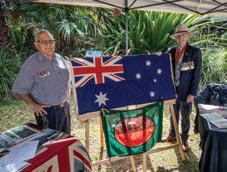
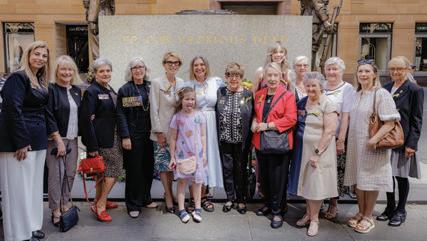
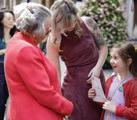
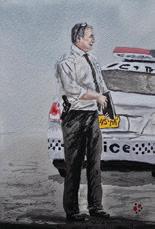
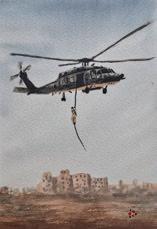
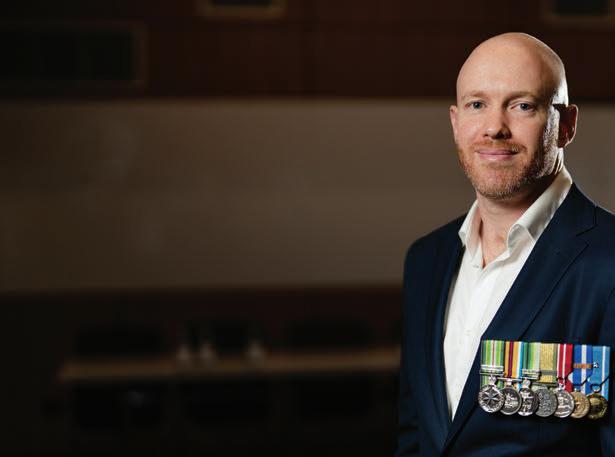
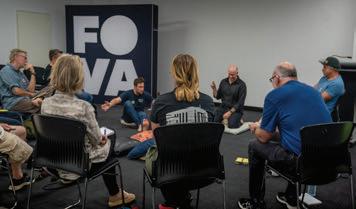
A summary of the Sydney CBD commemoration, plus a spotlight on the unswerving service of Cenotaph attendants.
18
VETERANS IN THE ARTS
For these veterans, creative endeavours are an outlet for both self-expression and mental wellbeing.
26 UNDER THE HOOD
How RSL NSW is building a brighter future for the veteran community by working in consultation with members.
30 MEMBER SPOTLIGHT
Why Camille Baldwin has stepped into leadership at her subBranch and completed Wellbeing Support O cer training.
RSL NSW NEWS
New Acting President announced, the latest on the Advocacy Support Program, commemorating Kokoda Day, and more.
SUB-BRANCH NEWS
Events and stories from sub-Branches and their members across the state.
A letter from RSL NSW covering new leadership, outcomes from the 2025 State Congress and AGM, and more.
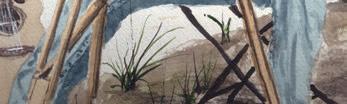
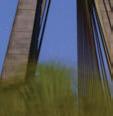
The Anzac Bridge's 30th anniversary.
LETTER FROM RSL NSW
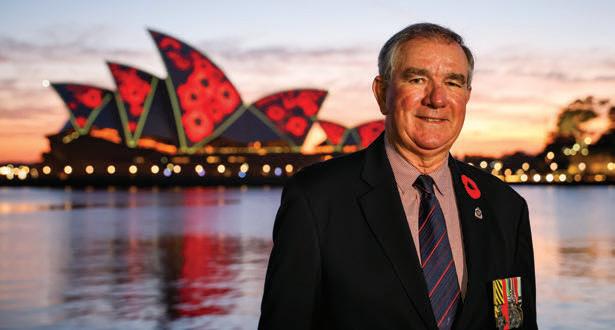
The RSL NSW Board has appointed Vince Williams as Board Director and Acting President of RSL NSW. He made his first public appearance in the role at the 2025 State Congress and AGM.
Following the resignations of four directors from the RSL NSW Board in October, RSL NSW moved to fill the vacancies in a process set out under clause 9.22 of the RSL NSW Constitution, which requires both the Board and the District Presidents’ Council (DPC) to approve the appointment of a new Director.
The Board commenced the process to fill the first of the casual vacancies by emailing
all RSL NSW members calling for expressions of interest. The recruitment process was overseen by a selection panel made up of RSL NSW Directors and the Chair of the DPC.
“RSL NSW remains firmly focused on its mission – providing care, camaraderie and charitable support for veterans and their families.”
— Louise Sullivan, RSL NSW Board of Directors
Acting President Vince Williams recited ‘The Ode’ at a Remembrance Day Dawn Service.
Following the appointment of Williams, the Board has now released an Expression of Interest to all members for the remaining three casual vacancies, and is working closely with the DPC to ensure business continuity and leadership stability.
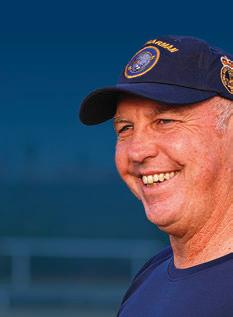
Vince Williams met with current Defence personnel at the Gate to Gate Run at HMAS Penguin
“RSL NSW remains firmly focused on its mission – providing care, camaraderie and charitable support for veterans and their families, and ensuring they have access to the services they need, when they need them,” said RSL NSW Board of Directors Chair Louise Sullivan.
Future planning
RSL NSW members gathered to plan the future of the League at the 2025 RSL NSW Annual State Congress and AGM, which this year was held for the first time in Tamworth. The event was o cially opened by Her Excellency the Honourable Margaret Beazley AC KC, Governor of NSW, with other guests including the Honourable Kevin Anderson MP, Member for Tamworth, and Russell Webb, Mayor of Tamworth.
Outcomes from Congress sessions and the AGM will
now inform the development of the RSL NSW Strategic Plan beyond 2026. There will be ongoing consultation with subBranches and members as RSL NSW continues to bolster the delivery of support and services to veterans and their families, and advocate to government on behalf of the veteran community.
The revitalisation of local RSL sub-Branches through grassroots activities is proving successful in attracting younger veterans. A number of individuals and sub-Branches were recognised at Congress for their e orts and dedication to the League. A special mention goes to the City of Penrith RSL Auxiliary, which was awarded the Lady Woodward Cup, rewarding excellence in fundraising and support of the local veteran community.
Congress and AGM presentations are available on the sub-Branch Portal Resource Centre.
THE RETURNED AND SERVICES LEAGUE OF AUSTRALIA (NEW SOUTH WALES BRANCH)
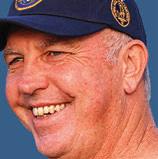
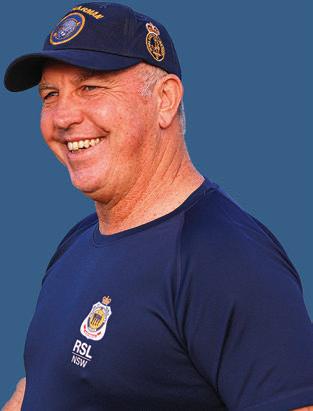
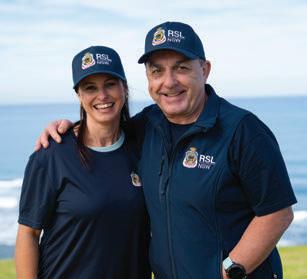
Brigadier Vince Williams CSC (Retd.) has been named Board Director and Acting President of the state’s largest veterans’ charity.
Vince Williams is the first to admit the organisation has undergone a challenging few months, both in the public domain and with its reputation among the member base.
“I want to stress that the RSL NSW Board is unified in its mission to represent and advocate for our members,” he said. “We must show unity from the very top of the organisation.
“To this end, our charitable purpose to support veterans and their families continues to be our priority. And a crucial element of this is the execution of the recommendations of the Royal Commission into Defence and Veteran Suicide.”
A former Brigade Commander of the Australian/New Zealand Brigade Group along the East Timor-Indonesia border, Williams brings 36 years of full-time military experience to the role.
He said one of the biggest responsibilities of being president is engagement with all levels of the organisation.
“I like to think of it as an exercise in passing the reasonable person test. Our members want to see an image of cohesion, and that's achieved by a clear message consistently delivered.”
Williams, who was previously the Secretary of the Forestville RSL sub-Branch and Secretary of the Northern Beaches District Council, is honest about the need to keep the organisation 'viable' by attracting younger veterans to sub-Branches.
“Demographics is one of our major challenges,” he said. “It's wonderful we've reduced the average age of RSL NSW members, but that doesn't necessarily translate to all sub-Branches and Districts. At my sub-Branch, for example, our average age hasn't come down.
“I'm also passionate about making it easier to transition between sub-Branches and between states. RSL Australia is the key to all of this. If we have a national approach that cascades down through to Districts, sub-Branches and members, then we'll ensure an e ective national organisation.”
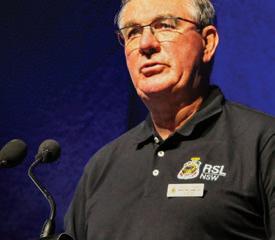
Vince Williams made his first o cial appearance as RSL NSW Acting President at the State Congress and AGM.
Peter
NATIONAL ADVOCATE FOR VETERANS
Peter Tinley AM has been elected as the new President of RSL Australia, replacing Greg Melick, who had served in the role for more than six years.
Tinley, a retired Special Air Service Regiment
Major and former Western Australia Minister for Veterans Issues, said the League has a responsibility to advocate for and support living veterans just as much as commemorate the fallen.
“The RSL must continue to develop a stronger reputation as the national advocate [for veterans],”
Tinley said. “I will pursue funding sources for the national o ce and build stronger policy and advocacy capability.”
KOKODA'S LASTING LEGACY
On 3 November, veterans and their families paused to remember the sacrifice of those involved in the Kokoda Campaign during World War II, including a number of Papua New Guinean locals.
Dozens of veterans, family members and school students commemorated Kokoda Day with a service held at the Kokoda Track Memorial Walkway in Sydney.
The Kokoda campaign lasted three months and cost Australians more than 600 lives, while several thousand were wounded and su ered from sickness or disease.
Donations made by RSL sub-Branches, via the RSL NSW Veteran Support Fund, help to keep the memorial in pristine condition, and a place of reflection and contemplation for the community.
The Kokoda Day service at the Kokoda Track Memorial Walkway
Tinley AM is the new President of RSL Australia.
Providing advocates with the support they need to deliver the highest quality assistance to veterans
What is the Advocacy Support program?
The RSL NSW Advocacy Support Program (ASP) is dedicated to equipping Advocacy Training and Development Program (ATDP) Advocates with the tools, systems, and support they need to deliver the highest quality assistance to veterans and their families.
By providing guidance on processes and establishing development pathways, the ASP helps advocates enhance the support they offer throughout the claims process and wellbeing journey, ensuring veterans receive expert guidance and empathetic care.
How the ASP supports sub-Branches
All veteran advocates must meet national standards before providing advice to the veteran community.
The RSL NSW Advocacy Support Program ensures all RSL NSW accredited Advocates operating for RSL NSW sub-Branches are recognised by ATDP and covered by VITA insurance.
Connect with the RSL NSW Advocacy Support Team Get in touch via advocacysupport@rslnsw.org.au
Contact with the ASP to register advocates working with your sub-Branch
Learn more about the Advocacy Support Program
Refer advocates to the ASP to connect them with support and development opportunities
ADVOCACY
SUPPORT PROGRAM
ENHANCING SUPPORT FOR THE STATE’S DEDICATED ADVOCATES
More than 100 accredited wellbeing and compensation advocates gathered in Hexham for the 2025 NSW Veteran Advocates Conference.
Delivered in partnership with Legacy Australia, the Veterans’ Wellbeing Network and RSL LifeCare Veteran Services, the event was part of the RSL NSW Advocacy Support Program.
As the largest gathering of its kind in NSW, the conference o ered a day of learning and connection, strengthening the quality and consistency of advocacy for veterans across the state.
Attendees received updates on the implementation of the Veterans’ Entitlements, Treatment and Support (Simplification and Harmonisation) Act 2024, the Advocacy Training and Development Program, and reforms to DVA’s MyService and MyOrg platforms.
Repatriation Commissioner Kahlil Fegan AM also spoke, emphasising the critical role veteran advocates play in supporting those who’ve served, and expressing admiration at seeing the advocates working together.
Sub-Branches are encouraged to register all advocates engaged in advocacy activities on their behalf with the Advocacy Support Program.
SUB-BRANCH TRAINING WELLBEING SUPPORT OFFICER UPDATE
A library of free resources for authorised volunteer Wellbeing Support O cers (WSOs) is available to enhance their knowledge, skills and practice. The WSO Resource Centre contains:
Resources for performing the WSO role
RSL NSW Guidelines
RSL NSW Resources
Recent months have seen training sessions take place in locations as diverse as Cooma, Penrith, Shortland and Nambucca Heads. Training is expected to take place each month in a new location.
Number of subBranches with a registered WSO: 110
REGISTERED WSOs can scan the QR code to access the WSO Resource Centre.
The Veteran Advocates Conference was the largest gathering of its kind in the state.
COMMEMORATION
MAJOR COMMEMORATIONS MARKED BY MEMBERS
War widows and widowers were among those recognised at commemorations recently.
On 19 October, veterans, family members and current Defence personnel gathered at the Martin Place Cenotaph in the
Sydney CBD to recognise the contribution made by war widows and widowers.
War Widows Day acknowledges the birthday of Jessie Vasey CBE, founder of the Australian War Widows Guild. Vasey is the great-grandmother of RSL NSW Board Director Clare Phelan.
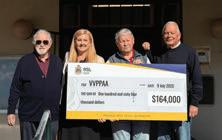
Presenting RSL sub-Branches' donations to the VVPPAA in 2025
More than 9,800 war widows and widowers live in NSW.
United Nations Day was marked on 24 October, a chance to acknowledge the service of those joining UN-led peacekeeping operations. The day marks the anniversary of the UN Charter coming into e ect in 1945.
CLOSING SOON
Don’t forget that 31 December is the deadline for donations to the Veteran Support Fund (VSF) for the current period. The approved initiatives and targets for the 2026 calendar year will be published on the RSL NSW website on 1 January.
BACKED by the VSF, the Vietnam Veterans, Peacekeepers & Peacemakers Association continues its decades-long commitment to helping veterans and families access the support they deserve. Scan the QR code to read more.
A War Widows Day service, organised by the Families of Veterans Guild, was held at the Martin Place Cenotaph.
VETERAN SUPPORT FUND DONATION WINDOW
rslnsw.org.au/find-help/
ETERNAL VIGILANCE
On Remembrance Day, as at every commemoration, a dedicated group of RSL NSW volunteers stands sentinel at the Martin Place Cenotaph. Their quiet service continues a nearly century-old tradition.
Words by Girard Dorney
In August this year, rain bucketed down on the Vietnam Veterans’ Day commemoration at the Martin Place Cenotaph. While dignitaries and attendees were sheltered under awnings, the Cenotaph attendants remained at their posts.
As was typical, they had arrived an hour early, checked the Cenotaph was clean, removed security chains and raised the appropriate flags. One stood at each corner as the rain fell, passing wreaths from one person to the other to make room for the next placements, then stood at attention for the Last Post.
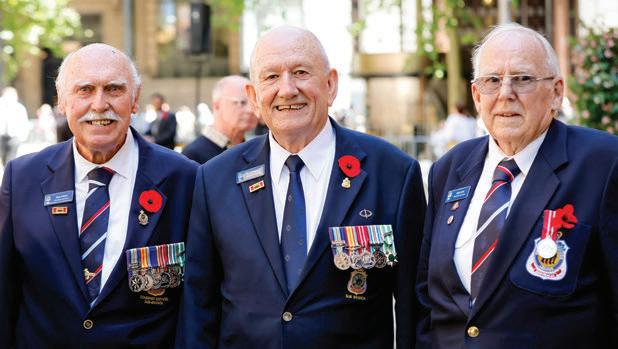
Cenotaph attendants Ron Webb, Rod Holtham and Bob Hall at this year's Remembrance Day service in the Sydney CBD
“We got totally drenched,” recalls Terry James, former President of the Hornsby RSL sub-Branch. Can they sit if they need to? “I've never done that. I never would do that. You just stand and suffer the consequences.”
And there can be consequences. At 78 and with 16 years of experience, Rod Holtham is the oldest and longest serving attendant, and he’s seen former colleagues require medical attention. Meanwhile, the youngest attendant, Charles Gallagher, was born in 1961 and jokes he’s the baby of the group.
Each humbly downplays the difficulty of their role, even in the face of recognition for their efforts; the attendants were finalists at this year’s NSW Volunteer of the Year Awards.
"It was nice to be recognised,” says Holtham. “Although it's a bit embarrassing when you get to the awards and you find out the types of work that a lot of people do as volunteers. You feel as if you're not quite up to what everybody else is doing.”
That’s one way of looking at it. Another is to remember that all the attendants served in Defence, and the four on duty for that rainy day ceremony were also being honoured by it: they’re Vietnam veterans. Attendant Ron Webb was conscripted as a corporal in the Army’s fire service and lost two friends to a landmine.
“It would be good to see a mix of people, both male and female, to carry on the tradition at the Cenotaph.”
— Ron Webb, Combined Services
RSL sub-Branch
“I remember them every year when we are on post there at the Cenotaph,” he says. “I've had 55 more years of life and they haven't had any.”
Stories to tell
Most of the attendants have fond childhood memories of commemoration, often at the sides of their veteran parents and grandparents. James’s father served and he has a strong memory of seeing Boer War veterans march in the 1950s. He never planned on military service.
“But one day in 1966, I got this letter from the government saying you're conscripted for two years,” he says.
Posted to the 5th Battalion of the Royal Australian Regiment, he fought at the Battle of Binh Ba, one of the few times in the war Australians engaged in sustained close-quarters combat.
“We did house-to-house fighting for three days,” he says. “You can
control yourself – you've got your training, your discipline – but it was very scary.”
Despite this, Australians didn’t welcome James home with open arms.
“There were about five of us in army uniform and there was a group of World War II veterans at the bar. They asked if we were just back from Vietnam. We said, ‘Yeah, we’re just waiting to get discharged.’ And we were proud of it, you know? They said, ‘That wasn’t a war.’”
The friends James lost in combat and his recurring nightmare of being slowly bayoneted begged to differ. But the sentiment of indifference was widespread in the public and he took it to heart.
He wasn’t alone. Iain Finlay is a third-generation RSL NSW member who made corporal in Vietnam. As a boy he even played bass drum in the Drummoyne ANZAC Day march. But when he came back, he couldn’t view commemoration the way he once had.
“Being a Vietnam veteran was a little bit different. You weren’t really accepted. It took me a while to actually go to an ANZAC Day march.”
Changing attitudes and commitment to fellow veterans won out. Finlay has been an RSL sub-Branch President, an IntraMural District Council President, and an adjutant of the RSL Corps of Guards. »
Commemoration
AN ICON REMEMBERED
The most famous and longest tenured Cenotaph attendant was Walter ‘Wally’ Scott Smith OAM. From 1946 to 2018 he was an icon of the memorial. Many current attendants have fond memories of him.
“He was not a very big bloke, but he wouldn't take a backward step,” says Holtham. "If anybody came onto the Cenotaph he'd tell them to get o because it was a sacred site.”
Smith would interview prospective attendants and show them the ropes. He retired at age 96, a year before he died.
“After he retired, he still came to the Cenotaph to make sure we were doing the right thing,” laughs Gallagher.
Webb suspects that not even death could stop his supervision.
“We know he’s watching us, and if we don’t do the job properly we’d better watch out,” he says. “He was known by so many people and loved by them.”
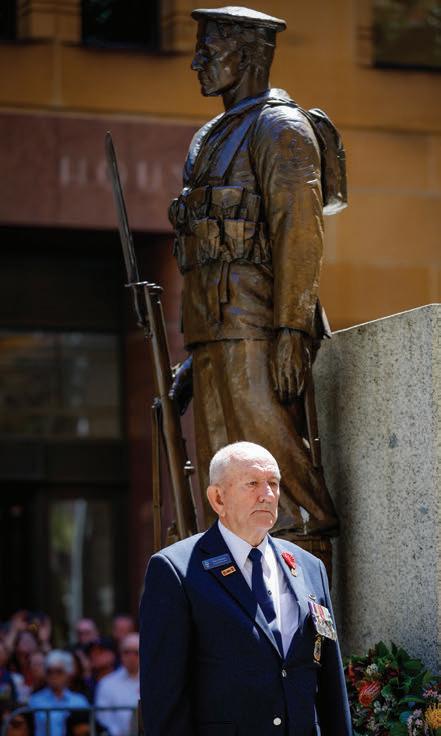
Cenotaph attendant Rod Holtham
Walter ‘Wally’ Scott Smith OAM died in 2019.
He’s devoted a large portion of his life to ensuring remembrance is done correctly.
“I’ve been to quite a few bad services,” he says with a wry laugh. “You come away disappointed. That’s why it’s important that the people organising it and who are out front are getting it right.”
Most of the attendants have held or hold multiple roles related to veteran welfare. Gallagher is President of Rose Bay RSL sub-Branch and an RSL NSW Wellbeing Support O cer. He says his volunteering is driven by a passion for helping veterans but also has personal benefits. “It's good for your mental health. What I mean by that is you're in your zone with your comrades.”
It’s a volunteer role, so when there’s a service the call goes out to the seven current attendants to see who’s available.
“It would be good to see a mix of people, both male and female, to carry on the tradition at the Cenotaph, because it's a very special place,” says Webb.
When Holtham started, there used to be 40 or more services a year, not counting those related to ANZAC Day. Now there are less than half that. As veterans pass on, the service for their specific regiment or unit falls o . But that doesn’t mean attendance is down generally.
“As a matter of fact, the Dawn Service has grown a lot since I've been doing it. It’s wall to wall,”
says Holtham. “I think younger people have become more aware.”
So the attendants aren’t the last of their kind, watching a flame go out. They’re the most recent in a long line of veterans who keep the fire alive. When a service ends, they ceremoniously take down the flags, secure the chains, and head to The Barracks for a chat. They’ll be back soon. Services end, but remembrance doesn’t. »
Register your interest to become a Cenotaph attendant by emailing the Member Support Team.
WITNESSES OF HISTORY
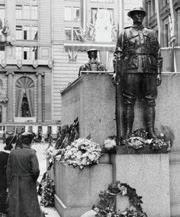
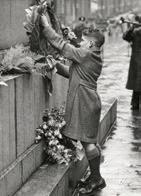
The Cenotaph’s location was chosen by the RSL in 1923 because it was a crucial site for World War I recruitment and remembrance. The monument was completed in 1929. The tomb-like monolith bears “To Our Glorious Dead” on its southern side and “Lest We Forget” on the northern side.
Two statues modelled after World War I veterans guard the east and west ends. They’ve seen so much: recruitment kiosks for World War II, jubilant crowds on V-J Day, and innumerable gestures of respect, grief and love from relatives, comrades and grateful civilians; salutes, the laying of wreaths, quiet tears.
ANZAC Day commemorations at the Cenotaph in 1938
TOGETHER TO REMEMBER
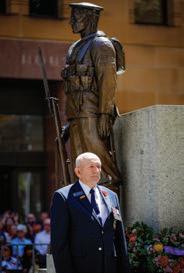
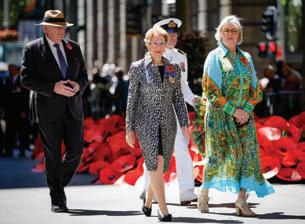
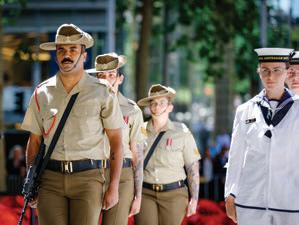
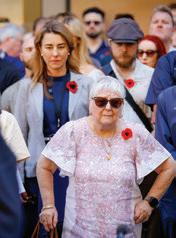
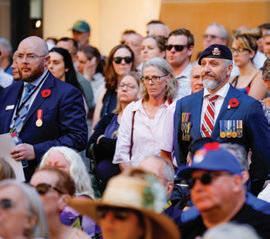
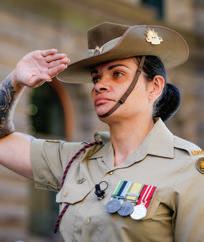
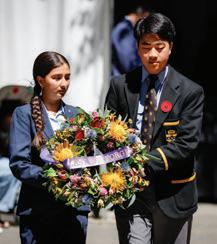
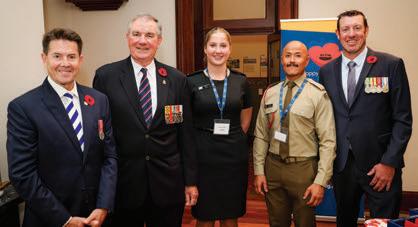
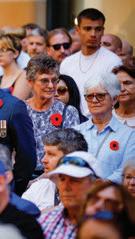
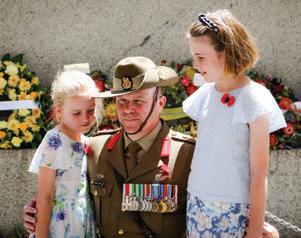
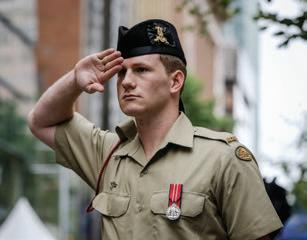
Four Cenotaph attendants were among the thousands of veterans both serving and ex-serving, families and members of the public who joined the Sydney CBD Remembrance Day service.
2 3
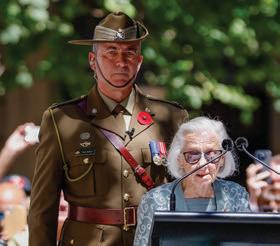
1. Major Mark Beretta OAM, Channel 7 presenter and RSL NSW member, was the event’s MC. Grace Wood, formerly of the Australian Women's Land Army, recited ‘The Ode’.
2. Many current Defence personnel were among those in attendance.
3. Premier’s Anzac Memorial Scholars Syedda Nazeeya, of Macarthur Girls High School, and Benji Loh, of Sydney Grammar School, recited John McCrae’s ‘In Flanders Fields’.
4. Her Excellency the Honourable Margaret Beazley AC KC, Governor of NSW (centre), was invited to lay a wreath.
5. The 176 Air Dispatch Squadron (9th Force Support Battalion) provided the Catafalque Party.
6. MPs and sta joined RSL NSW Acting President Vince WIlliams for the inaugural ‘Poppies in Parliament’, supporting the annual RSL NSW Poppy Appeal.
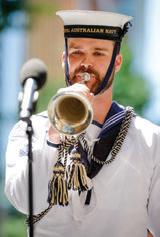
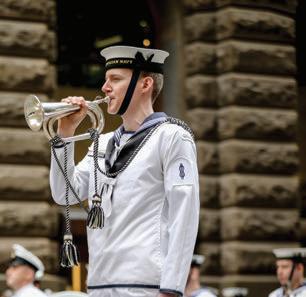
7. Able Seaman Connor Jenkinson
8. The assembled crowd during the minute's silence
9. Red poppies were among the first flowers to grow in the battlefields of France and Belgium.
10. Brigadier Rob Calhoun DSC, Chief of Sta of the 2nd (Australian) Division, provided a poignant reflection on the fallen
STROKE OF GENIUS
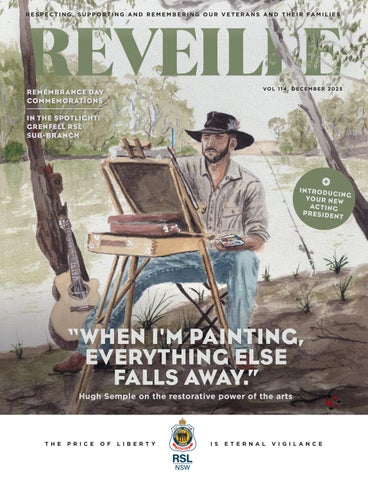
Military life centres on pride, teamwork and success. For veterans, this can make solo creative pursuits that require vulnerability feel uncomfortable. Yet they can be exactly what's needed when it comes to reigniting purpose, identity and connection.
HWords by Caroline Riches
ugh Semple had planned a lifelong career in the Army. He loved driving Bushmasters with the Royal Australian Corps of Transport, but three years in he su ered a shoulder injury and never recovered.
By 2021, he was medically discharged and back in his birthplace of Wagga Wagga. With his future suddenly wide open, he felt like he'd lost his identity and purpose, and plunged into depression.
“My long-term career was cut short,” the RSL NSW member explains to Reveille. “I missed my purpose, the structure and the prestige of the job. I started missing tying my boots in the morning, which was one of the things I used to hate. I just wished I could do it again.”
A year later, he stumbled across an online video that quite literally changed his life. “I watched a video about art and thought, 'Maybe I could do that.'
"I bought some cheap brushes and paint from the Reject Shop, did one painting, then sat back and thought, 'Wow, I created that.' I wanted to do more and I haven't stopped since." »
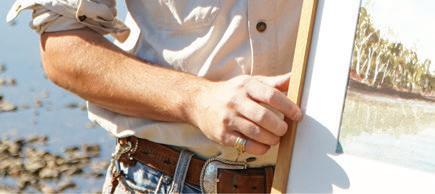
Once Hugh Semple picked up a brush and canvas, he never looked back.
On the cover
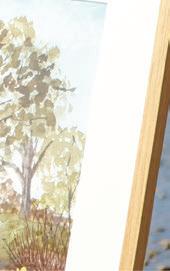
Semple began creating acrylic paintings for family and friends, then switched to watercolour –a cleaner, more portable medium for working outdoors in the sun. He painted things he liked: the country landscape, rodeos, tall ships on the ocean. With a paintbrush in hand, his mind would go quiet, a welcome experience.
"When I'm painting, I focus on one thing, and everything else falls away. It's a way to connect with myself and others in the art community."
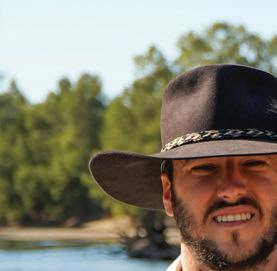
Semple’s art is now taking him in new directions – from painting landscapes to exploring the inner landscapes of people’s minds, and from the art world back into the heart of the veteran community. Alongside filmmaker Warwick Young, he’s one of two Veteran Artists in Residence at the Anzac
Memorial, supported by the RSL & Services Clubs Association through its Veterans Benevolent Fund.
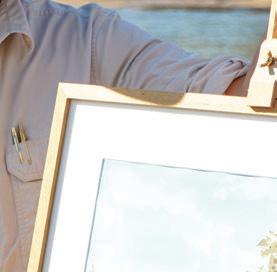
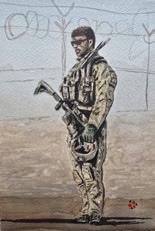
His project, Beyond Service: Veterans’ New Journeys, enables the public to watch over his shoulder as he paints portraits of veterans finding new passions to restore their purpose and identity – just like he has done.
“I wanted my art to mean something. Many veterans I know haven't found something they can focus on and enjoy, and I wanted to show how incredible it is when they do.”
— Hugh Semple
"I wanted my art to mean something,” he says. “Many veterans I know haven't found something they can focus on and enjoy, and I wanted to show how incredible it is when they do.
"I sit with them, talk about their creative journeys, then paint their emotions. It’s therapeutic for them, and helps me understand myself better too."
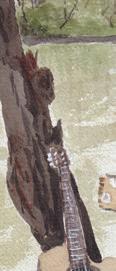
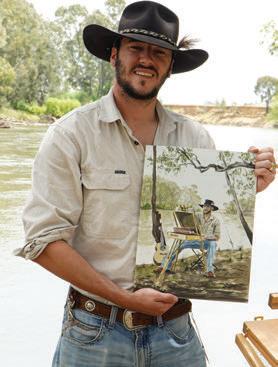
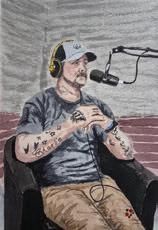
It's a wonderful example of art imitating life. His first residency work, Into the Melody, was inspired by Army veteran Thomas Polyzoidis, who lost his way after being medically discharged – until he picked up an electric guitar and amplifier.
"He threw himself into it, and a year later he was playing things you wouldn’t believe. He told me it used to be all darkness and monsters, but now it’s light, happiness and warmth.
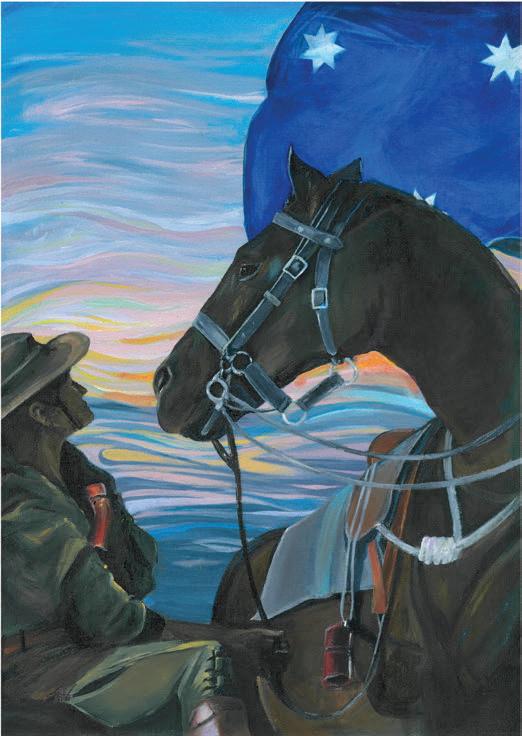
One of the pieces featured in Semple's exhibition at the Anzac Memorial
"So I painted a guitar fretboard stretching like a bridge, with Thomas, a guitar slung around his shoulder, crossing from a tunnel of darkness into a glowing future. It's his music transforming pain into possibility."
Semple hopes his portraits make his subjects proud that they've found something powerful, while inspiring the wider community to find joy through creativity.
"Leaving any long-time role leaves a void. I want people to see that creativity can give you another way to enjoy life. It’s about self-discovery and purpose – as vital to life as water."
Peeling back the onion
Like Semple, Army veteran Steve Cotterill has turned to art to release emotions long suppressed by his years in uniform. »
as painting, writing, music or photography –either in the sub-Branch or at an easily accessible outdoor location
art exhibitions showcasing members’ artwork, photography or poetry tied to themes of service, identity and resilience
Storytelling or oral history projects to help veterans capture and share their lived experiences through audio, video or written form
Music and performance groups such as choirs, bands or Guitars for Vets
and
such as woodworking, scale model building or sewing, potentially based around a theme such as Christmas or ANZAC Day
as photography walks, writing circles or mindfulness-based art classes. Funding is available for sub-Branches to organise creative activities.
featuring veteran-made productions or Australian military history, followed by a discussion
feel
After 14 years of service –including deployments to Afghanistan, Lebanon and Israeli-occupied Syria – Cotterill left Defence in 2017 and began confronting feelings "that needed to come out".
"I started to write them down, and later realised that this English without structure was a poem," he recalls.
Though he never considered himself creative, that didn't stop
EXCERPT
him harnessing poetry on his journey to self-discovery.
"Creativity is a journey towards truth, a way to peel back the onion. It can fill our cups in ways nothing else can."
Now the inaugural Poet Laureate for the veteran community through the Australian National Veterans Arts Museum in Victoria, Cotterill leads workshops and talks, and supports mentoring programs
FROM STEVE COTTERILL’S POEM ‘TRIGGER WARNING’
that help others rediscover themselves through creative expression. One of the poems he's proudest of is 'Trigger Warning', written in response to the Lived Experience Report from the Royal Commission into Defence and Veteran Suicide.
"That piece told a shared story – what the community was feeling – but also my journey,” he says. “In a way, I was asking policymakers to allow themselves to feel, and to realise
this has not been a conventional trigger warning this is a plea, from me, from those we have lost, from those they left behind please listen please feel let the blood, pain, grief and tears woven through these pages mean SOMETHING
let their sacrifice finally ignite the fire of change please help us to fill the cracks to weave nets to catch to save those who are yet to fall
that changes that seem minor can mean everything to people in dark times."
When he later shared the poem during a Brisbane walk organised by The Flannel Project to raise awareness and funds for veteran survivors of suicide, he says it sparked powerful conversations.
"It created a space for people to hold their grief and sadness, and start to process it. Veterans need connection and community."
Finding one's story
Cotterill often draws inspiration from a quote by First Nations veteran and artist Ron Bradfield Jr: "If we can stand strongly and authentically in our own stories, we won’t be so fragile when we hear someone else’s."
"That quote made me realise that we can't truly connect with others unless we're connected to ourselves. If someone else's story makes us feel sad, we need to interrogate those thoughts to understand why," he says. "Once we understand our own story, we can choose which masks to wear, which crowds to put ourselves in, and which spaces to enter."
For Cotterill, writing has provided a path to authenticity.
"I used to identify as a chameleon – someone who could read the room and fit in. Now I choose not to fit in. If I don’t belong in a room, that’s okay –we’re all meant to be di erent. I’ve let go of victimhood and
people-pleasing. I’m far more in touch with my true self and able to express that openly.
"That agency and empowerment, that's the real impact of art. And I wanted to help other people find their story too."
Musician, conductor and Army veteran Dr Geo Grey has long championed the wellbeing of serving members and veterans through creativity, leading the Australian Defence Force’s Arts for Recovery, Resilience, Teamwork and Skills program. He says life in Defence constantly reiterates the importance of the collective mission, often at the expense of self-expression.
"Many military people struggle to separate their Defence identity from their personal one, so when they transition out, they lose a very big part of themselves. Without their uniform or rank, they’re not always sure who they are or where they fit in."
Grey says creative outlets such as music, art and writing can
help veterans reconnect with their emotions and discover who they really are. But he also warns of another obstacle born from service: the deep-seated belief that failure is unacceptable.
"Military people don’t believe in failure, and that can stop them trying new things. People wonder, ‘Can I write that song, play that guitar, pen that poetry or paint that picture?’ And the answer is, of course, yes. Anybody can.
"If you enjoy singing or playing a song, do it again. If painting lights you up, join an art class. If you love poetry, attend a poetry night," he adds. »
“Once we understand our own story, we can choose which masks to wear, which crowds to put ourselves in, and which spaces to enter.”
— Steve Cotterill
Steve Cotterill ran a poetry workshop during the Festival of Veterans Arts in 2025.
On the cover
“Creativity isn’t about perfection – or even success. It’s about trying, failing, trying again and finding satisfaction in the process. That’s where creativity builds real resilience.”
— Dr Geoff Grey
"Creativity isn’t about perfection – or even success. It’s about trying, failing, trying again and finding satisfaction in the process. That’s where creativity builds real resilience."
A path to healing
Art therapy – from painting to creative writing, drama to mask-making – has proven benefits for veterans' physical and psychological wellbeing, according to a 2022 study, The E ect of Creative Arts Therapy for Veterans
Further research shows it improves self-awareness, social connection and emotional regulation while reducing distress, anxiety and PTSD symptoms.
Dr Zena Burgess, CEO of the Australian Psychological Society, says art therapy o ers a way for veterans to express themselves when words fail.
"Some traumatic memories are stored nonverbally, and art therapy can access those recollections by engaging the senses," she tells Reveille. "Selfexpression helps veterans tap into their inner world – giving an outlet to their feelings, thoughts and experiences – some of which may be confronting. Creative
expression may also help build a sense of purpose, identity and connection with others, reducing feelings of isolation."
Burgess adds that art can act as a powerful bridge between veterans and the community.
"Through creative expression, veterans can share their personal stories and perspectives, helping to humanise their experiences. Opportunities for community engagement such as art exhibitions or workshops may also allow civilians to engage with veterans, promoting empathy and helping veterans to feel connected."
Grey’s PhD research also shows how creative activities help veterans rebuild confidence and identity – key steps toward healing and finding new directions in life and work.
He says both group and individual creative work are essential: group sessions to allow people to connect and share together, the solo work to help people learn to engage creatively by themselves.
The stories of others
For Angela Lougheed, creativity came naturally. Since childhood
she has loved to paint and always dreamed of becoming an artist – before deciding that joining the Army was a more viable career path.
Though she'd left her dream behind, the passion stayed with her, o ering comfort and solace through two decades of service.
"To escape the testosteronefilled environment, I enrolled in art school at TAFE. Then, after being medically discharged in 2000, painting courses helped me process my PTSD," she explains.
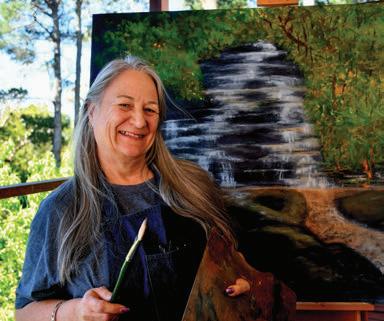
Lougheed paints mainly in oils to capture the landscapes she loves – the bushland, valleys and waterfalls of the Blue Mountains.
"I spend a lot of time in nature, taking photos and sketching before turning them into paintings," she says. "Creating something others can enjoy brings me a sense of calm and purpose, while art classes keep me connected socially."
Invited by the Anzac Memorial to create an artwork for International Women’s Day 2026, Lougheed is drawing on the experiences of women who have served in a maledominated environment.
"There are so many missing stories missing from our cohort of women because many left early to start families, but we achieved some pretty amazing things because we were forced to thrive in a very maledominated environment," she says.
Lougheed is also looking to run art classes for women, supported by the Women Veterans Network Australia, at an RSL sub-Branch in the Blue Mountains, to help female veterans reconnect with each other and their service.
Cotterill believes the first step towards creativity is curiosity.
"How we frame problems shapes the solutions: if veterans are told they’re broken, they’ll feel broken. If people tell themselves they’re not creative, they won’t even try. Creativity can start with simple curiosity – noticing the world around you, practising mindfulness in the morning and seeing what unfolds."
He says that same curiosity should also extend to other veterans. Too often, veteran chatter centres on comparison – of jobs, ranks, deployments, medals – which actually prevents connection, he adds.
"I rarely mention my former military rank when I meet people. That’s not the conversation we need to have. Comparison breeds competition, and competition blocks connection and leads to people not feeling safe.
"I’d rather ask, ‘What do you enjoy creating?’ Those kinds of conversations help us reconnect – with society, with our families and with ourselves."
Cotterill still has moments where emotions need to come out.
"I just let them. I try not to understand what they mean. And then later I'll decide if I have a story worth sharing, and whether it would serve others if I do so."
Semple, meanwhile, is determined to inspire veterans to find healing through creativity.
"I want to keep evolving, finding new ways to tell veterans' stories," he says. "And with that continued purpose, I feel at peace."
“Creating something others can enjoy brings me a sense of calm and purpose, while art classes let me connect socially without needing to talk.”
— Angela Lougheed
VIEW HUGH SEMPLE’S WORKS at the Anzac Memorial in Sydney until 31 January 2026.
Angela Lougheed has been invited by the Anzac Memorial to create an artwork for International Women’s Day 2026.
26 Under the hood
By collaborating closely with sub-Branches, RSL NSW is fostering a MEMBERS-FIRST FUTURE
Words by Troy Deighton and Lachlan Haycock
The state’s largest veterans’ charity is no stranger to change.
There's new leadership at the top of the organisation, the next round of regularly scheduled elections for the RSL NSW Board of Directors is set for 2026, and members are stepping into leadership positions at RSL subBranches across NSW.
Members are the life and heart of the organisation, and nowhere was this more evident than at the 2025 Annual State Congress and AGM. This year's gathering, held in Tamworth for the first time, saw fruitful consultation between ANZAC House and more than 400 RSL NSW members. The message that resonated through every discussion was clear: the League’s future depends on unity, collaboration
and a shared commitment to care, camaraderie and charity.
A series of presentations, including from representatives from the Department of Veterans’ A airs and the Defence and Veterans’ Services Commission, was followed by a full-day strategic planning workshop, which formed the centrepiece of this year’s Congress.
In groups of members attached to metropolitan, regional and rural sub-Branches, delegates engaged in constructive discussions about what RSL NSW is doing well and how it can improve to meet the evolving needs of veterans and their families.
Participants shared candidly the challenges facing subBranches at the grassroots level, from volunteer recruitment
and administrative pressures to financial sustainability and community engagement. The workshop was just the start of the consultation phase for the next RSL NSW Strategic Plan.
Next chapter
A recurring theme was the need for practical, consistent support from ANZAC House to ensure every sub-Branch can continue to fulfil its charitable mission.
To address this imperative, it was announced that, to encourage a dialogue with members and sub-Branch leaders, RSL NSW will undertake a comprehensive consultation process across the coming year.
This will include a series of faceto-face roadshows across each region of the state. »
BIGGER AND BETTER
A lot more is on the way from RSL NSW in the new year to help sub-Branches support veterans and families in the community. Here are three examples.
1.
The RSL NSW Advocacy Support Program is empowering RSL NSW Advocacy Training and Development Program advocates and supporting their critical work with veterans.
2.
The RSL NSW Wellbeing Support O cer Program is training more members to provide practical support and service referrals to veterans and their families.
3.
The RSL NSW Sport & Recreation Program is helping more subBranches design activities that work in their community.
RSL NSW members Joanna Stewart and Jed Saunders
28 Under the hood
“RSL NSW is placing people on the ground, like me, who are connected with the community.”
— Jonathan ‘Jono’ Tuckfield, Community Relations Partner
These consultations will shape the development of the RSL NSW Strategic Plan 2026–31, which will outline the organisation’s priorities for the next five years.
As part of its strategic planning, the Board is reviewing whether the organisation's operating model is fit for purpose, to ensure RSL NSW can continue to deliver on its charitable objectives for veterans and their families for generations to come. That review will form part of forthcoming member consultations.
NEW ROADMAP
Planning for the next iteration of the RSL NSW Strategic Plan is underway. Here’s what you need to know.
In 2026, RSL NSW will consult directly with members and subBranches in a series of regional roadshows.
Feedback from these sessions will inform the priorities and initiatives that will shape the League’s next five-year plan.
The present aim is to have the new RSL NSW Strategic Plan 2026-31 in place ready for the Annual State Congress and AGM in October 2026.
Acting RSL NSW President Vince Williams said Congress was an opportunity for attendees to have their say on the future of a muchloved institution.
“The [original] Strategic Plan was a fantastic document,” he said. “It provides us … with a roadmap, which we have followed – and you now have the opportunity to redesign the new roadmap.”
It's expected the new Strategic Plan will be in place ahead of the next Annual State Congress and AGM in October 2026.
Community conduit
As delegates departed Tamworth, one message carried through: unity is the key to the League’s success.
The challenges ahead are real – from changing community expectations to the evolving needs of veterans – but so too
is the collective strength of RSL NSW members.
The League’s future will not be secured by standing still or apart, but together, including with likeminded organisations such as our sister charity in the north.
As previously announced, a multimillion-dollar investment made by RSL Queensland will help to evolve a common operating service model that will deliver consistent RSL services for veterans and families in NSW.
This funding is helping RSL NSW to create a sustainable, e cient and impactful statewide service delivery model, and to simplify access to a wide network of veteran services and support.
Significant additional tranches will follow in the coming years, all of which will be dedicated to these and other programs.
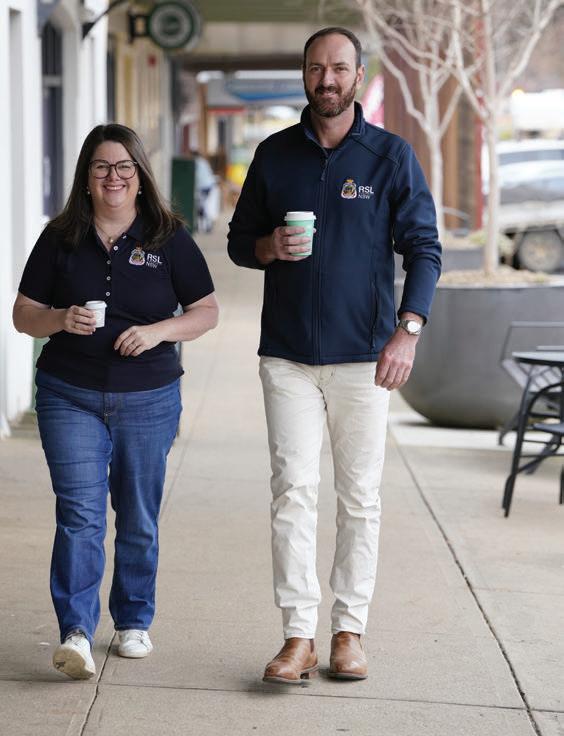
Helping sub-Branches engage veterans and their families in their communities is the focus for the new Community Relations Partner (CRP) roles.
A CRP is a dedicated local resource that provides on-theground support to RSL subBranches. The CRP pilot, made possible by RSL Queensland funding, is currently operating in the Riverina/South West, Hunter, Central West and New England/North West districts, ahead of a potential statewide rollout in the future.
The positions aim to support, upskill and connect sub-Branches with resources and external stakeholders to enhance community engagement and development – empowering sub-Branches to better serve their veteran community.
Jonathan ‘Jono’ Tuckfield, an RSL NSW member and former Board Director, is three months into his role as the CRP for the South West and Riverina Districts of NSW.
“RSL NSW is placing people on the ground, like me, who are connected with the community and understand the values that come with living in regional and rural parts of the state,” said Tuckfield.
“Frankly, I reckon I've got one of the best jobs in the world. I'm out here in the region and I’m not tied to a desk – my car is my desk, basically. I’m excited to be motivating my fellow veterans and their families to get involved in their local sub-Branch.”
ESSENTIAL TOOL
The RSL NSW Veteran Support Navigator is ready for subBranches to use to support veterans and families in their area. Navigate through the services to identify what help they need, now and nearby.
ACCESS the Navigator by scanning the QR code.
FUTURE-READY
At the 2025 State Congress and AGM, sub-Branch representatives said they needed the following to be better equipped to support veterans and their families.
1.
Responsible investment to ensure financial sustainability of all sub-Branches
2.
Assistance with volunteer recruitment and retention
3.
Training in leadership skills, and health and wellbeing support
4.
Standardised ICT systems for sub-Branches and artificial intelligence training
5.
Streamlined governance and reporting requirements, face-to-face roadshows and communication from ANZAC House
6.
All tiers of RSL NSW united and culturally aligned, with stronger partnerships and enhanced marketing support
ONE DOOR CLOSES, ANOTHER OPENS
When Camille Baldwin, Secretary of the Grenfell RSL sub-Branch, was told she couldn’t join the cadets, she turned the moment into a lifelong commitment to service and community.
As told to Julia Abbondanza Australian Army Cadet members at an annual training event
Istill remember standing at the gates of Henry Lawson High School in Grenfell, watching my brother march proudly in his cadet uniform. It was the early 1980s, and I wanted nothing more than to join him. But girls were not allowed in the cadets back then because there were no female o cers. I was told, politely but firmly, that it was not for me.
That didn’t sit well. I used to sneak my brother’s ration packs just to feel part of it, so when I later moved to Canberra, I decided to do something about it. I joined the 8th Signal Regiment, part of the Royal Australian Corps of Signals. Its motto, Certa cito, means 'swift and sure', and that has stayed with me ever since. I was 25 years old, full of determination and ready to prove myself.
Life in the corps
The role of the signals corps is to keep communication lines open through radio, fibre-optic, microwave and satellite links so commanders can control operations anywhere in the world.
My world quickly filled with cables, radios and call signs. When I enlisted, I went through literacy, psychology and fitness assessments at Ingleburn
Military Base before pledging my allegiance and receiving my service number. Training was tough but exhilarating. We spent 15 days at Ingleburn Military Camp learning drills, weapons handling and communications.
I trained on the PRC-77 radio set, then the PRC-106 and PRC-186 on the back of a Land Rover. We also ran lines with fibre-optic cable, erected aerials and learned to keep everything operational no matter the conditions. I can still remember cleaning the Land Rovers at the end of every exercise and storing the gear in containers.
We paraded weekly and went out once a month for field training. During the field stage, my instructor, Corporal Priest, looked after our section. Sometimes he had to drag me through the slime-filled water obstacle because I was holding my nose closed with one hand.
“Today, as Honourable Secretary, I help run meetings, coordinate events and support members. We host one of the best ANZAC Day marches in the district.”
— Camille Baldwin, Grenfell RSL sub-Branch
It was hard work but full of laughs. Doing it all with mates made a world of di erence.
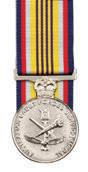
I served for almost three years and was awarded the Australian Defence Medal, presented in 2010, along with the veteran lapel pin which allows Australians to recognise service members even when they are not in uniform. Defence gave me purpose, mateship and a sense of belonging that I have carried ever since.
A family of cadets
After leaving the Army, I found a new way to stay connected through the Australian Army Cadets. My family has been involved for more than 45 years. My parents, brother and even my son have all worn the uniform. I joined the Grenfell Cadet Unit in 2006, and have spent 18 years leading and mentoring young cadets. »
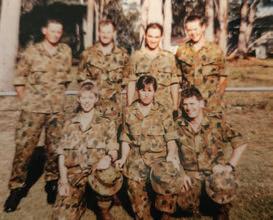
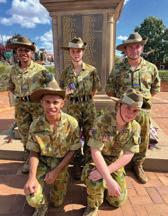
LEFT: Camille Baldwin (bottom left) in 1993. RIGHT: Baldwin's unit conducting a training course.
Member spotlight
I worked my way through the ranks, completing the Australian Command and Sta course for the rank of captain. This year I received the Australian Cadet Forces Service Medal for 15 years of qualifying service. The cadets have been like a second family, and it has been a privilege to see young people grow in confidence.
Joining a sub-Branch
For a long time, I thought the RSL was just for older veterans. Many of the members were in their 70s or 80s, and I wasn’t sure I would fit in.
Over time, I saw how much the organisation changed. It began welcoming younger Defence personnel and Reservists from every era. Now at our sub-Branch you’ll see people in their 20s sitting alongside Vietnam veterans, all treated with equal respect.
When I joined as a full member in 2019, that sense of belonging returned to me.
As Honourable Secretary, I help run meetings, coordinate events and support members. We host one of the best ANZAC Day marches in the district with cadets, flag bearers and even a Hercules flypast. The pride in our little town on that day is something I will never forget.
Building connection
Outside of events, I am also a trained RSL NSW Wellbeing
Support O cer. Through my job with NSW Health, I often meet veterans at the community health centre. You can spot them a mile away, often wearing a service pin or badge. I always stop to chat. Many do not realise how much support is available, so I help them access services, apply for a White Card or navigate MyGov.
Some of our older members are not confident with technology, so I sit with them to complete forms or upload documents. It is the small things that matter.
In regional areas, there are not many women involved in the RSL, but those of us who are have formed a strong bond.
A message to others
What drives me is simple: it’s all about community. Growing up in the country taught me to help others without expecting anything in return; the cadets gave me leadership and structure, and the RSL sub-Branch lets me share that with others.
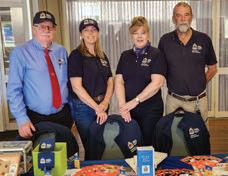
TOP: Michael Pocock, Cherie Weiss, Camille Baldwin and Keith Engelsman of the Grenfell RSL sub-Branch.
LEFT: The Grenfell Cadets on ANZAC Day this year.
Our meetings are informal and full of laughter. We get through business, then share pizza and a beer. There is banter, warmth and genuine friendship. It is mateship in its purest form.
For anyone, especially women, who might feel hesitant about joining a subBranch, my advice is to come along and try it. You do not have to prove anything. You just have to show up. The RSL is no longer a boys’ club. It is a community that thrives on inclusion, shared stories and respect.
Some members are young Reservists, some are Vietnam veterans and others are people like me: women who wanted to serve and found their way in through di erent doors. What unites us is the desire to belong, to contribute and to honour those who came before us.
That is what keeps me coming back each month. It is family in the truest sense of the word.
Join RSL NSW
No fees, simple sign-up, open to serving members and veterans
There should be no barrier for any current serving member or veteran of the ADF to join RSL NSW. That’s why we’ve made membership fee-free.
Members receive:
A membership badge
Reveille magazine
Access to RSL services and support
Connection to community
Mateship and connection to others who have served
Opportunity to volunteer and support veterans and coordinate commemorations
Scan code to learn more
Sub-Branch news
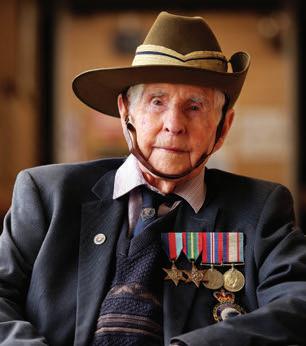
VALE BRUCE ROBERTSON
Words by Katherine Kirk, Castle Hill & District RSL sub-Branch
The wireless operator who raised the alarm when Japanese submarines entered Sydney Harbour in 1942 has passed away.
It is with great sadness that we share the passing of RSL NSW member and WWII veteran Bruce Robertson on 14 October 2025.
Born in Lakemba on 23 March 1920, Robertson enlisted in the Air Force in April 1941, serving as a wireless operator with 30 Squadron Beaufighters. He saw action
at Milne Bay and in the Battle of the Bismarck Sea, and flew on ground support operations during the Kokoda Campaign.
Earlier this year, Robertson celebrated a remarkable 105th birthday surrounded by family, friends, and members of the Castle Hill & District RSL subBranch. He remained an active participant at commemorative services, including the Victory in the Pacific Day service at the Kokoda Track Memorial Walkway in August, where he
met the Hon Margaret Beazley AC, Governor of NSW, and at the 103rd birthday celebrations of the Air Force last year.
He was older than the Air Force he served with.
Robertson lived an extraordinary life of service and spirit. He will be deeply missed by all who knew him.
READ Bruce Robertson’s reaction to the end of WWII by scanning the QR code.
LEFT: Bruce Robertson enlisted in April 1941. RIGHT: Robertson has died aged 105.
FAMILY-FRIENDLY SAILING FOR VETERANS’ CHILDREN
Words by Clay Marks, President of Oatley RSL sub-Branch
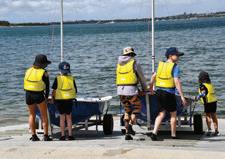
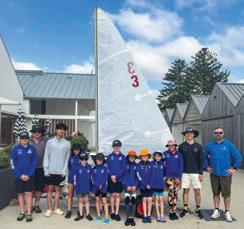
The shore of Sans Souci thrummed with youthful energy at a recent sailing event as part of the RSL NSW Sport & Recreation Program.
To promote community engagement, the Oatley RSL subBranch has partnered with the St George Sailing Club to deliver a pioneering school holiday sailing program for veterans’ children and grandchildren. We recently held the inaugural school holiday Learn to Sail Camp in Sans Souci. A total of 12 children, aged between six and 12, participated in the week-long event. The program aimed to introduce young family members of veterans to the fundamentals of sailing, from knot tying and rigging boats to reading weather and tide reports.
Throughout the camp, children gained practical skills, experiencing firsthand how to sail yachts. Importantly, the program also embraced a family-friendly atmosphere, with parents and grandparents invited to stay, watch and volunteer during the training sessions.
The initiative is part of a broader e ort by the sub-Branch to introduce more family-oriented sporting and recreational activities in 2025. This approach has resulted in a noticeable increase in younger veterans and their families joining the sub-Branch.
We encourage all veterans interested in attending an upcoming event to reach out for more information.
Submit your sub-Branch news and images news@rslnsw.org.au
4 IDEAS FOR INCLUSIVE SPORT AND RECREATION EVENTS
1. Spring
Host a trivia or games night with friends.
2. Summer
Organise a family lawn bowls or archery event followed by a BBQ dinner.
3. Autumn
A dozen children took part in the inaugural sailing event.
Bring families together for egg-and-spoon races, tug-of-war and more at the local oval.
4. Winter
Join a knitting, painting or woodworking class.
DISCOVER more event ideas by scanning the QR code.
Sub-Branch news
TIPS
KEITH WHELAN'S ADVICE FOR A SUCCESSFUL SUB-BRANCH GRANT
RSL sub-Branches are reminded to make the most of helpful resources on the Member Portal aimed at helping them apply for a grant.
In the previous edition of Reveille, we revealed four essential tips for preparing a successful grant application, drawing on the insights of grants expert Keith Whelan.
A series of succinct but informative videos are now available on the website, alongside a recording of a fulllength webinar in which Whelan outlines the steps to success.
And don’t forget that RSL NSW is able to auspice sub-Branches in making an application.
SCAN the QR code to view the recordings.
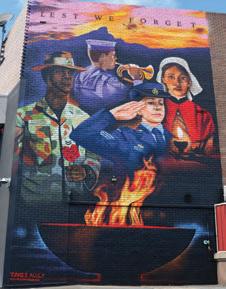
MAGNIFICENT MURAL FOR NORTHERN RIVERS COMMUNITY
A new mural installed in Murwillumbah is already turning heads.
For the town’s RSL sub-Branch, the old adage that a picture is worth a thousand words has never been more apparent.
The side of the Murwillumbah Services Club has been adorned with a large and colourful mural depicting impressions of four personnel in uniform, representing the di erent services of Army, Navy and Air Force, alongside a WWII-era nurse.
The side of the Murwillumbah Services Club has been given an inspiring facelift. Artwork by James Alley, Metagraphics.
The Club has reintroduced a military memorabilia display inside the building, and has also installed a digital display that can be used to research the service history of family members.
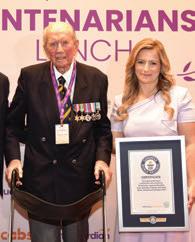
CENTENARIAN RECOGNISED AT RECORDBREAKING EVENT
RSL NSW member John Ryrie, a self-confessed avid reader of Reveille, has turned 101. Attached to the Rose Bay RSL sub-Branch, Ryrie was recently one of more than 150 centenarians invited to a function at Parliament House, an event that broke the Guinness World Record for the largest gathering of centenarians.
Join the largest sport and recreation program for veterans in Australia
The RSL NSW Sport & Recreation Program has set a gold standard for encouraging the physical and social wellbeing of veterans and families.
It’s free to all RSL sub-Branches to take part. Benefits of signing up for the program include access to:
> A regular newsletter full of inspiration for events you can organise in your local area
> A free, curated and frequently updated suite of resources designed to help encourage sub-Branches in conceptualising what’s possible in their area
> Funding support to assist your sub-Branch in organising activities
> A range of fun competitions and giveaways
Hear stories from other sub-Branches, get inspired, and be supported throughout the program.
“ The camaraderie before, during and after the event was so tangible. ”
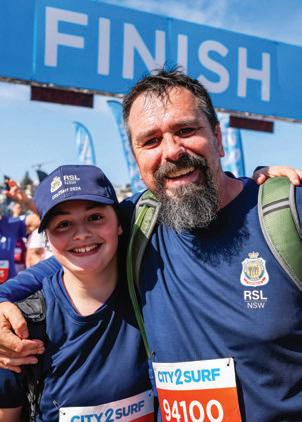
– RSL NSW participant in City2Surf, organised as part of the Sport & Recreation Program
Access the events calendar
Take a look at the activities other RSL sub-Branches are organising by scanning the QR code – and register for the program.
“LEST WE FORGET”
Remembering the service and bravery of those who have served our country.
NAVY
ALBROW, NJ 8548001
ALLNUTT, DG R42101
ALTHAM, MR R37091
ANDERSON, MR 164760
BAILEY, KM 96120
BARNES, JE A29479
BARRETT, D 6385
BIRD, IJ R47838
BOTWOOD, DS R54748
BOUGHTON, PF S8752
BOYD, AW R64668
BROADSMITH, MJ R96019
BROWNING, AF R93634
CARTER, WD R43372
CHESTER, KW R45556
CRAGG, DK S7651
CROWLEY, HE S7773
DUNNETT, CW 106893
EUSTACE, W R104767
EWINGS, CG R47403
FROST, PD R104293
GENT, GA R37139
GOLDTHORPE, TW R65296
GORDON, PJ R42444
GRIFFITHS, LB S116160
GROSS, TN R65702
GRUNDY, P P54771
HERRON, BS R37951
HILL, BF R54115
HORTON, RT R63408
JEFFRIES, A R46930
JORDAN, DC R53986
LACHLAN, J R49853
LILLYMAN, BC R57121
MARTIN, DR R51949
MARTSCHENKO, E R53811
MARVIN, MF S5146
MCGRATH, BG WR/871
MCGREGOR, C R94070
MCKENZIE, WB R62046
MCKENZIE, AJ R93145
MELVILLE, BJ R51789
MORROW, G S107247
MOSS, SP 142804
NEEDHAM, A O1696
OSBORNE, RS R54280
PENGELLY, RA 53035
POPE, CR 38308
RAATZ, CL R53835
SKENE, J R63049
SPEARPOINT, AG R39402
STORRIE, JM R66033
STRACHAN, WS R53355
VASS, RJ R42007
WARE, PJ R59644
WHALE, RK R49211
WHITTARD, DA R37085
WILSON, KW R45187
WINCH, JW R64052
WYLLIE, PM S10043
ARMY
ALEXANDER, R 217888
ALLEN, WH 2790386
ALLPORT, RJ 2781888
ANDERSON, EJ 2152216
BARN, GJ 2786279
BARRY, R 2239649
BATEMAN, P 2792501
BEYNON, DL 2412180
BOON, RB 185091
BOTTON-JAMES, JL 216568
BRENNAN, TJ 2785070
BRIDGE, LW 2786506
BROWN, JR NX156655
BRYCE, SY 211964
BUCKLEY, LG 214937
BURGESS, FJ NX147964
BURGESS, GP 2798869
CAMPBELL, RJ 2794158
CLARKE, PB 2792903
COLLESS, DS 2786887
COTTLE, EA NX167927
COX, JK 237710
CREMIN, NB 2712877
CUBITT, RJ 2785749
CUNNINGHAM, DW 37824
DACHS, BG 225534
DALE, GA 1200330
DAVISON, J NF455470
DEVINE, TP 2793121
DONNELLY, PJ 2786147
DOUGLASS, KL NX130616
DOWNES, PG 233942
DOWNEY, MR 2243031
EDNEY, DG 2/7931
EDWARDS, JM 13331
ELDER, IC 2905022
EVANS, AR 217319
FINN, R 3789166
FOAT, WD NX180420
GOLDMAN, D 2794295
GRANT, HS 311558
GRAY, EM F2/426
GRUNOW, HW 15735
HALL, SR 226365
HALPIN, ID 216571
HAMPSON, JM 8507040
HANDLEY, IG 2708227 »
HARDIE, DB 2411549
HARRIS, KJ 2794259
HARRIS, JP 49909
HATTENFELS, GR 235907
HAWKINS, RC 2785313
HAYES, FJ 2/765970
HEGARTY, H 220044
HIGGINS, BH 214610
HINCHCLIFFE, BJ NX128176
HINWOOD, KW 2793510
HOOK, CW N450739
HOWARD, GR 63704
HOWARD, B 2/766719
HOWARD-SMITH, L 212510
HOWES, W 2786688
HUGHES, LJ 2786263
HUNT, TE 44180
JONES, MJ 17872
KEIR, GG 2794991
KING, DW 2790593
KNAGGE, PJ NX206383
LAHOOD, C N483022
LANYON, KJ 3/750809
LAVIS, GM 216326
LAWRENCE, IK 627162
LINDROOS, NJ 3410957
LOW, KP 8265172
LUTHER, FG NX204950
LYNCH, WB 217342
MACHON, SA NX502832
MARTIN, JA 8239253
MCCABE, JS 216180
MCFADDEN, MJ 2412199
MCGILL, B 2784250
MCGRATH, JM 118799
MCKENZIE, GJ 1201739
MCQUEEN, PA 2791994
MELBIN, TJ 54021
MILLARD, JW 2/723597
MOIR, CS N186032
MOLONEY, KJ NX169854
MORGAN, IM 38258
MORRIS, SJ 2785360
MORRIS, BW 22183
MORRISON, MC 235166
MOSLEY, DW 29007
MUNNS, RO 2/411674
NANCE, GJ 220951
NASH, N 3/751466
NELSON, JI 12886
O'DWYER, RM 2789647
PEDERGNANA, RH 2789059
PRATT, JL 223456
PROSSER, WA 2140341
PULIS, JV 2786773
RAM, SG A320326
REED, JP 2793945
REILLY, E F63079
RENNIE, DB 22656723
ROBERTS, JT 8214131
ROWE, PJ 4720890
RUDD, AG 2783806
RUMBLE, DP 2784297
SEATON, NE 2754579
SHEAVES, SB 2786431
SHOTTER, RG 4718460
SHUTE, GS 2792223
SMITH, TW 2411409
SMITH, PE 2790854
SMITH, JL 28938
STEPHENSON, WJ 2787849
TABER, NO NX180727
TOMKINS, ES NX180817
TREMAIN, N 2785384
TUNKS, J F238596
TURNER, WA 2140626
VANDERVEER, PH 2152308
WELLS, GA 217488
WHITTON, TR 217749
WILSON, DR 2785592
WILSON, DE 321128
RAAF
AGGAR, DA R29966
BALZER, BF A18408
BENTLEY, JE 3022107
BEVAN, TH 25126
BRIERLEY, J A47463
BYRNE, MT B4171118
COOK, BC A34236
CULLEN, J A24278
CUMMING, MI 174147
DE LANTY, RP A13802
DOUGHTON, BW O229136
EVANS, WR 433204
GEORGE, EK 445702
GREENE, GS 2511883
GUNTON, G 216566
HALL, PB A223627
HINES, JE 167122
HORTON, JW 443627
HOUSTON, DR 162492
HOY, LR A221620
KEADY, SL 70246
LANE, P A54014
LANG, JH 449911
LEASK, A 432524
LOWE, AE 17372
MAKIN, RJ A219135
MCALPINE, RH 445025
MCMILLAN, TD A61862
MEIZER, AN A217606
MERCHANT, JM 135791
MOORE, TW 166846
MUIR, TB B4171118
MULLAN, JA 229047
OLIVER, RO 163224
O'LOUGHLIN, JJ A19864
PETERSON, DJ 177309
PICKEN, PL 425098
PIKE, RL A25181
ROBERTSON, DB 411387
SANDERS, AJ 436256
SARGENT, MJ O228525
SCOTT, CM L234792
SIMPSON, EA 109418
SMITH, KW 121781
SMITH, AG 419061
SMITH, KW A11816
SQUIRES, JC 138119
STALKER, P L232055
STUHMCKE, JW A14442
SUNNERS, GJ A224739
TOMS, B 443697
WELLS, KR A217867
WHITE, DF 162737
WILKIN, GM 47868
WILSON, DD A218345
WOODGER, ST A223135
WOOLF, GM A214568
The information contained in the Last Post has been provided by the DVA and RSL members. Where possible we have attempted to provide all service details. We regret any missing information.
Member recruitment tools
The RSL NSW Member Recruitment Toolkit is a one-stop shop for sub-Branches to engage their veteran communities and attract new members.
The RSL NSW Member Recruitment Toolkit contains resources to empower RSL NSW members reach out to veterans in their community and encourage them to join, including:
Advertising material, including signage, posters and banners, to help you publicise your sub-Branch to local veterans and their families
Social media resources, templates and guides so you can put your sub-Branch’s best foot forward
Event-in-a-box collateral to help create opportunities to speak with local veterans and build community
A new member welcome kit, to turn interest into long-term membership and active sub-Branch involvement
The toolkit is free to download for all sub-Branches.
Share how your sub-Branch is using the toolkit to reach out to and engage new members and their families – it can help us develop even more effective tools for sub-Branches.
part of
Tag RSL NSW on social media or email us using the QR code.
30
3 DECEMBER 2025
Originally known as the New Glebe Island Bridge, the Anzac Bridge in Sydney’s Inner West serves as a memorial to the ANZAC spirit.
The bridge was completed in 1995 but was given its current name on Remembrance Day in 1998.
The Australian flag flies from the eastern pylon and the New Zealand flag from the western pylon.
Twin four-metrehigh bronze soldiers are installed at either end of the bridge, one representing each country.
The 345-metre structure is the longest cable-stayed bridge in Australia.
In the early 1960s, Australian support for South Vietnam was largely in keeping with the policies of Allied nations - particularly the United States - to stem the spread of communism across Asia, with the South Vietnamese government repeatedly requesting security assistance. The arrival of the Australian Army Training Team Vietnam - thereafter known as the ‘Team’ - in South Vietnam in August 1962 was the beginning of Australia’s involvement in the Vietnam War. Now recognised as some of the bravest service personnel in our military history, The Bradford Mint is proud to honour all veterans who served - male and female, military and medical, artillery and ancillary - and remember their selfless service and sacrifice with this meticulously crafted, fully etched, Silver Commemorative Coin. One of just 1,975 minted worldwide - in line with when the war ended - the coin celebrates the pride of our ANZACs - their attributes, battles and Australia’s pivotal part in that tortuous conflict. Accompanied by a fact-filled booklet and Certificate of Authenticity - issued under the authority of Ascension Island and approved by Buckingham Palace - this pure silver coin signifies the pride, respect and recognition that all personnel who served in Vietnam deserve - then and now.
HONOURING ALL VIETNAM VETERANS SILVER COMMEMORATIVE COIN -
ISSUING AUTHORITY Ascension Island, approved by Buckingham Palace
OBVERSE Portrait of His Majesty King Charles III
REVERSE Finely etched legendary Australian slouch hat, boomerang and a rosemary wreath commemorating Australian heroes in the Vietnam war, along with the word, ‘PRIDE’.
Call one of our Senior Executives today on 02 9841 3324 to secure your limited-edition celebration of EVERY Vietnam Veteran for just $99.00.