Department of Music
School of Performing & Digital Arts
![]()
Department of Music
School of Performing & Digital Arts
28 September 2023, 8.00pm
Picture Gallery, Founder’s Building
royalholloway.ac.uk/music/events
We are pleased to welcome you to our 2023-24 International Concert Series at Royal Holloway.
We, at the Department of Music, cannot wait to showcase the varied talent of our students and staff, but also bringing internationally renowned musicians to the College. For 2023-24, we are back and better than ever with more student and staff opportunities throug h the creation of 'The Platform', an open opportunity for the community at the Department of Music to share with you what makes us so special. Alongside our popular Midweek Music and Pocket Concert Series, we are excited to continue our special partnerships with the Young Classical Artists Trust and BBC New Generation Artists and continue our alumni recital series by bringing back the epoch ensemble. We are pleased to also bring a wealth of international artists to our series, including pianists Pina Napolitano , Mary Dullea, Sholto Kynoch , Alexander Soares , and Joseph Havlat , violinst Darragh Morgan, guitarist Laura Snowden, clarinettist Jonathan Leibovitz,
sitarist James Pusey, mezzosoprano Helen Charlston, jazz group Solstice, and the London Mozart Players . 2023 also marks the final season for our quartet -in-residence, the Tippett Quartet, as we say farewell to this stellar group with their final concert at Royal Holloway.
All in all, this season is representative of the world -class talent our community at the Department of Music has fostered as we showcase our students and the range of music performance we programme and encourage; from jazz to world music, orchestral performance to solo piano , as well as presenting performers from the international stage We look forward to welcoming you to our series this year.
International Concert Series 2023 -24
Thursday , 28 September 2023
Picture Gallery, Founder’s Building
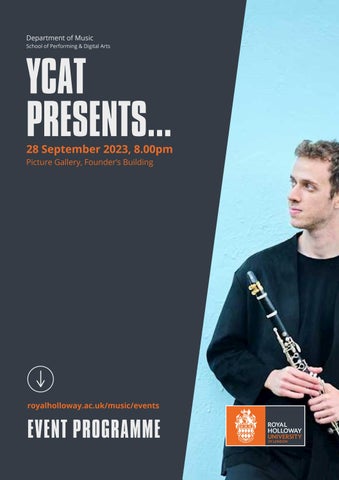
with Jonathan Leibovitz Clarinet
Joseph Havlat Piano
Mieczysław Weinberg (19191996)
Clarinet Sonata Op. 28 (1945)
I. Allegro
II. Allegretto
III. Adagio
Johannes Brahms (1833 - 1897)
Clarinet Sonata No. 2 in E-flat Op. 120
Estimated finish time: 9.15pm
There will be no interval during this evening’s event
Please no flash photography or visual/audio recording throughout the event.
For news about our future events, please visit royalholloway.ac.uk/music/events
I. Allegro amabile
II. Allegro appassionato
III. Andante con moto - Allegro
Francis Poulenc (1899 - 1963)
Clarinet Sonata (1962)
I. Allegro tristamente (Allegretto – Très calme –
Tempo allegretto)
II. Romanza (Très calme)
III. Allegro con fuoco (Très animé)
Mieczysław Weinberg (19191996)
Clarinet Sonata Op. 28 (1945)
I. Allegro
II. Allegretto
III. Adagio
By 1945, Polish-Jewish-Soviet composer Mieczysław Weinberg (19191996) had undergone something of a radical but painful transformation. He fled his native Warsaw in 1939, leaving his parents and sister, and he was granted entry to the Soviet Union only to have to flee again following another Nazi invasion in 1941. By 1945, he had settled in Moscow at Shostakovich’s personal invitation and his life assumed the kind of normalcy that allowed him to devote time to chamber works, including a piano quintet, a rapid succession of string quartets, and his Clarinet Sonata, Op. 28. The piece is marked by its reference to Klezmer elements, including in its blending of major and minor tonalities, clarinet melodies that invite glissando slides between notes, and the mini-cadenzas that appear for the clarinettist.
The piece is set in three movements, with the opening established a whimsical and lighthearted tone. Here, Weinberg sets aside the stringent experimentation that he pursued in other pieces written
at the same time and instead gives a humorous or even nostalgic mood for the opener – though the coda section is marked by hints of doubt, à la Shostakovich’s Cello Sonata. The middle Allegretto movement picks up a child-like Poulenc idiom that wouldn’t have been out of place in a pre-war café or salon, but like the opening movement, it soon moves to explor e darker territory. The emotional heart of the work is in its finale; the piano opens with a heartfelt solo, whose intensity balances out the lightheartedness of the opening movement. Ending with a slow movement may seem unusual, but it came to be a stock device in Weinberg’s chamber music. Overall, the Clarinet Sonata provides a substantial contribution to the clarinet repertoire that is thankfully receiving more attention as the Weinberg revival continues apace.
Clarinet Sonata No. 2 in E-flat Op. 120
II. Allegro appassionato
III. Andante con moto - Allegro
Around 1890, Brahms declared to friends and wrote to his publisher that he would retire as a composer. But he happened to witness a performance of the German clarinettist Richard Mühlfeld who Brahms called the greatest wind player in the world. Brahms was so inspired that he deferred his retirement long enough to write four final works all featuring the clarinet in a starring role. Comprising a quintet, a trio and two sonatas, these last works have an aura that has been called autumnal due to the circumstances of Brahms' career, the mood of the music and the magic tone of the clarinet.
The sonata in E-flat, Op. 120, No. 2 is the second of the two sonatas Brahms wrote for clarinet and piano. A glowing warmth pervades the first movement sonata perfectly matching word amabile in its title: sweet, tender, lovingly. The central movement is a lightly swaying scherzo typical of Brahms's intermezzi both in his chamber works and his late pieces for solo piano. The trio section of its ternary form takes a slightly more sombre cast with music of a dignified procession, almost hymn-like, before the initial theme returns, slightly recast and developed to take on some of the
solemnity of the trio. The finale begins with the same glowing warmth of the first movement merged with the poised promenade of the trio in the second movement suggesting a composite work of unified character with minimal contrasts. But this turns out to be a theme for generating a set of variations whose dreamy, almost wistful character once again suggests the indescribably gentle charm of the late piano intermezzi and these final clarinet compositions from this erstwhile lion of German romantic music softly humming his final notes.
© John HenkenClarinet Sonata (1962)
I. Allegro tristamente (Allegretto – Très calme –Tempo allegretto)
II. Romanza (Très calme)
III. Allegro con fuoco (Très animé)
The supreme master of mélodies in the 20th century, Poulenc also composed widely in other forms and genres, particularly works for the theatre and the church. He was equally accomplished as a pianist, touring as a soloist and as an accompanist for singers, especially the baritone Pierre Bernac and the soprano Denise Duval. Curious and independent, he had little use for the more systematic dogmas of his century, but accepted other influences, such as jazz and neoClassicism.
In the final years of his life, Poulenc seems to have embarked on a series of sonatas, completing three for woodwinds: the Flute Sonata, Op. 164 (1956-1957), and sonatas for clarinet (Op. 184) and oboe (Op. 185) in 1962, Poulenc’s last works before he died of a sudden heart attack in January 1963. (He may have had a bassoon sonata in mind when he died, but there are no sketches or musical evidence of his future plans.)
A number of his late works carry memorial dedications, and the Clarinet Sonata is dedicated to Arthur Honegger, who had died in 1955. The
Oboe Sonata is dedicated to Sergei Prokofiev, but there is speculation that in the posthumous publishing of these pieces, the dedications were switched, since it is the Clarinet Sonata that seems full of allusions to Prokofiev’s music. Its premiere was given at Carnegie Hall by Benny Goodman and Leonard Bernstein in 1963.
The opening Allegro tristamente is dramatic, self-consciously overwrought, and sassy, with its own internal slow elegy. The Romanza is a gentle lament, marked très calme . The concluding Allegro con fuoco is bright and brittle, its circus-like energies yielding to one of Poulenc’s wistfully spun melodies, derived from the first movement.
In 2022 Jonathan was a prizewinner at the Young Classical Artists Trust (YCAT) and Concert Artists Guild (New York) International Auditions held at Wigmore Hall.
He went on to receive the prestigious Arthur Waser Foundation and Lucerne Symphony Orchestra Award and is also a top prize winner at major competitions in Israel and Europe, including 1st Prize at the prestigious Crusell Competition in Finland and a Special Prize at the Carl Nielsen Competition in Denmark.
Highlights of Jonathan’s 23/24 season include performances at the Alte Oper Frankfurt, Konzerthaus Berlin, Concertgebouw Amsterdam and Vancouver Recital Society, plus numerous appearances in the UK, including at Saffron Hall, Wigmore Hall and St. George’s Bristol, as well as a concerto performance with the London Firebird Orchestra at St George’s Hanover Square. Jonathan will also complete his debut recording with Delphian Records, alongside violinist Charlotte Saluste-Bridoux and pianist Joseph Havlat.
Jonathan will also be appearing as both a soloist and in chamber performances throughout Europe and beyond, including the Vancouver Recital Society, Kiel Musikfreunde, Brandenburgische Sommerkonzerte and the Festspiele MecklenburgVorpommern.
In the 22/23 season Jonathan was nominated as a 2022 Rising Star Artist by Classic FM and appeared as soloist with the Lucerne Symphony Orchestra, London Mozart Players, Gävle Symphony Orchestra, Slovak State
Philharmonic Košice conducted by Tomaš Brauner, Jyväskylä Sinfonia conducted by Yoel Gamzou, and the Israel Sinfonietta. He also recorded and performed chamber music with Südwestrundfunk in Bruchsaal and gave concerts in the Verbier Festival, the Crusell, Rauna and Hauho Festivals in Finland.
Jonathan also attended the Bendigo Chamber Music Festival in Australia and undertook a tour of Colombia. He performed with the Gävle Symphony Orchestra, conducted by Rodolfo Barraez, and performed at the Amsterdam Concertgebouw, where he will be returns this season.
Previous solo highlights include appearances with the Israel Philharmonic, Israel Chamber, Haifa Symphonic, Ostrobothnian Chamber, Lapland Chamber and
Kuopio Symphony Orchestras working with conductors including Elena Schwarz, Adrien Perruchon and Tung-Chieh Chuang.
An avid chamber musician Jonathan founded the Avir Wind Quintet, and has collaborated with the ‘Mietar Ensemble’ and the Israeli Contemporary Players. He has given recitals across Israel; in Germany, Switzerland and Finland.
Jonathan made his debut with the Israel Philharmonic Orchestra at the age of 18 performing Mozart’s Clarinet Concerto. During the 2019/20 season he joined the Israel Philharmonic as a member, and has appeared as guest with the Jerusalem Symphony Orchestra, Israel Chamber and Jerusalem Camerata.
Born in Tel-Aviv in 1997, Jonathan’s musical education began with Eva Wasserman. He went on to study with Yevgeny Yehudin at the Buchmann Mehta School of Music where he won numerous awards including 1st Prize laureate of the Aviv Competition of the AICF (2020) and the Israeli Wind Competition (2016 & 2018). In 2022 Jonathan completed his Masters at the Music Academy in Basel with François Benda, and is currently staying on in Basel to complete a 'Master soloist' degree.
Joseph Havlat is a pianist and composer from Hobart, Australia, based in London. Working as a soloist and chamber musician for music very new, very old and some things in between, he has performed in major concert venues around the UK, Europe, America, Japan and Australia.
Joseph is a leading interpreter of new music, having collaborated with such composers as Hans Abrahamsen, John Adams, Thomas Adès, Gerald Barry, Brett Dean, Sir Harrison Birtwistle, Michael Finnissy and Thomas Larcher. As a chamber musician he has performed with William Bennett, James Ehnes, Steven Isserlis, Katalin Károlyi and Jack Liebeck, alongside regular duo partners Lotte Betts-Dean, Charlotte Saluste-Bridoux and Tim Posner. He is also a member of the LSO
percussion ensemble with whom he has released a CD on the LSO Live label, featuring the premiere recording of John Adams’ two-piano work ‘Roll Over Beethoven’.
As a composer his music often explores the sounds of the natural world, imbued with the harsher shapes of human modernity. He has written music spanning from solo voice to large ensemble, including for Ensemble x.y, of which he is a founding member. Current work includes a piano trio for Trio Mazzolini, and a mixed ensemble piece for the Australian Festival of Chamber Music.
Joseph studied at the Royal Academy of Music in London under Prof. Joanna MacGregor from 2012 -18, where he received his BMus and MMus with distinction, including awards for exceptional merit in studentship and the highest recital mark for a postgraduate pianist. He has been a Young Artist of St. John’s Smith Square, the Oxford Lieder Festival and Kirckman Concert Society, and was a first prize winner of the Royal Overseas League Music Competition.
Recent highlights include playing Adès’ In Seven Days with the LSO under the baton of the composer, as well as the premiere of his Növények at Wigmore Hall. In late 2021 he appeared with the BBC Philharmonic giving the premiere of Robert Laidlow’s piano concerto Warp, broadcast on BBC Radio 3, and in
2022 he made his debut at the Concertgebouw Recital Hall in a programme of Dohnanyi and Mendelssohn with cellist Tim Posner.
In 2023 Joseph will be featured on several CD releases: Finnissy vocal works on Divine Art Metier (with Lotte Betts-Dean and Marsyas Trio), Lisa Ilean’s Weather a Rare Blue and Rebecca Saunders’ murmurs for NMC (with Explore Ensemble), and two solo CDs, one with Debussy, Schumann and Abrahamsen, and the other the premiere recording of Isabella Gellis’ The Dissolute Society Comprised of All Sorts.
The notes created for this event programme have been written by a team of students at the Department of Music, as part of the Concert Management & Artist Personnel Programme (where listed).
This is a professional development initiative run by the Concert Office where students are able to experience first-hand what goes on behind-thescenes, who organises the publicity for an event, to even how to coordinate and manage a rehearsal schedule. All members of the programme are mentored by the College's Performance Manager, Nathan James Dearden, and receive training from industry specialists.
royalholloway.ac.uk/music/events
Royal Holloway and Bedford New College is a registered charity in England and Wales
Registration No XN69536