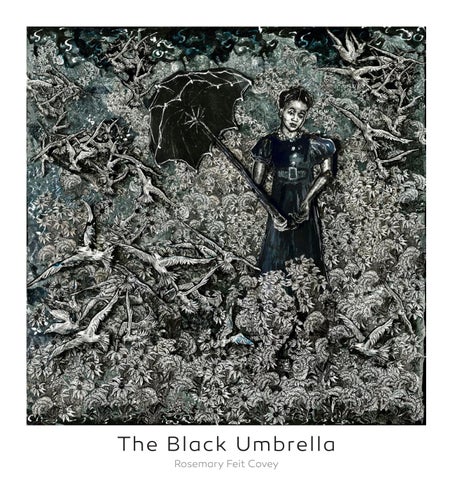
The Black Umbrella Rosemary Feit Covey
Rosemary Feit Covey was born in Johannesburg, South Africa. She is an experimental printmaker, who works primarily with wood engraving. Covey is a prolific, award-winning artist who maintains a working studio at the Torpedo Factory in Alexandria, Virginia. Solo museum exhibitions have included the Butler Museum of American Art, The Delaware Center for Contemporary Arts and the International Museum of Surgical Science in Chicago. In 2014, a retrospective of her, prints, paintings, and installation work was featured at John Hopkins University’s Evergreen Museum. From 2007 to 2008, Covey served as Artist-in-Residence at Georgetown University Medical Center. She has exhibited world wide, including Buenos Aires, Geneva, and with the British Wood Engraving Society in England. Articles on her work have been featured in publications including Art in America, Juxtapoz, and American Artist Magazine.
ADDRESS STUDIO 224, 105 North Union Street, Alexandria, VA 22314 PHONE 703-346-6918 EMAIL rosemary@rosemaryfeitcovey.com WEBSITE rosemaryfeitcovey.com INSTAGRAM rosemary@rosemaryfeitcovey
“The living may forget the dead, but the dead never forget.” ANONYMOUS
The following story is inspired by a South Carolina folktale (ghost story) from the 1930’s called Black Umbrella. This tale was primarily passed down verbally in the African American community and not attributed to any one author. In my adaptation of the story, the young woman represents an artist finding her voice and talent through a strange incident involving ghosts in a graveyard. This theme of an artist’s struggle to forge a path on her own has deep meaning for me personally. I also wanted to pay homage to the gospel singers of this era who tried to build unique careers for themselves against all odds.
IMAGES © ROSEMARY FEIT COVEY 2022
One rainy afternoon as a young housekeeper went about her work she heard a mournful song being sung in a nearby cemetery. The distant notes and whipping of the wind, created a sense of sadness and she felt melancholy.
She looked out the window and felt drawn to the sound. She loved to sing in her church choir but she was shy and did not stand out. She always stood in the back and sang softly. However, these voices were different. Despite the rain, she felt compelled to join the mourners.
As she approached the grave she heard them singing: “No more rain gonna wet you— No more… No more cold gonna chill you— No more… Oh lord, I wanna go home— Go home... Bring me home…” The mourners continued to sing even when the wind picked up, and the rain came down harder.
A tall male mourner dressed all in black approached the housekeeper. He had a strange look to his eyes, they seemed to see right through her. He handed her a black umbrella stating that a beautiful voice like hers should not get wet and needed to be heard. She sang out proudly under his gaze.
As the song waned the young housekeeper bowed her head for a moment to offer her own silent prayer to the dead. When she looked up confusion overtook her. All the mourners were gone. They seemed to have disappeared into thin air. The man in black was gone too. The cemetery was completely silent. The sun was out, flowers bloomed everywhere and the earth at her feet was dry.
She felt strangely moved as she hurried back across the street. She heard music in her mind, it was her own story in song, sad but beautiful. It sounded unlike anything she had heard before.
As she entered her employers’ house, she realized that she was still holding the black umbrella. She placed it carefully in a corner of the front entrance and returned to her work.
Later that day the lady of the house called out to her, “ You have left your black umbrella by the door.” She did not pick up the umbrella. She kept on walking and never looked back.
CLICK HERE FOR MORE ON BLACK UMBRELLA