BARBARA KNEZEVIC
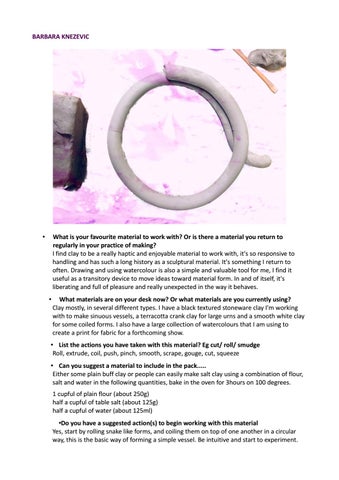
What is your favourite material to work with? Or is there a material you return to regularly in your practice of making? I find clay to be a really haptic and enjoyable material to work with, it's so responsive to handling and has such a long history as a sculptural material. It's something I return to often. Drawing and using watercolour is also a simple and valuable tool for me, I find it useful as a transitory device to move ideas toward material form. In and of itself, it's liberating and full of pleasure and really unexpected in the way it behaves.
•
•
What materials are on your desk now? Or what materials are you currently using? Clay mostly, in several different types. I have a black textured stoneware clay I'm working with to make sinuous vessels, a terracotta crank clay for large urns and a smooth white clay for some coiled forms. I also have a large collection of watercolours that I am using to create a print for fabric for a forthcoming show.
• List the actions you have taken with this material? Eg cut/ roll/ smudge Roll, extrude, coil, push, pinch, smooth, scrape, gouge, cut, squeeze • Can you suggest a material to include in the pack..... Either some plain buff clay or people can easily make salt clay using a combination of flour, salt and water in the following quantities, bake in the oven for 3hours on 100 degrees. 1 cupful of plain flour (about 250g) half a cupful of table salt (about 125g) half a cupful of water (about 125ml) •Do you have a suggested action(s) to begin working with this material Yes, start by rolling snake like forms, and coiling them on top of one another in a circular way, this is the basic way of forming a simple vessel. Be intuitive and start to experiment.
ANNA SPEARMAN
• What is your favourite material to work with? Or is there a material you return to regularly in your practice of making? It is hard to choose as I have so many favourites! I like things that are easily available and that would otherwise be thrown out like old newspaper, cardboard, plastic containers. And tape - masking tape is great. • What materials are on your desk now? Or what materials are you currently using? Right now I am working from home and am using what I have around the house cardboard, paper, recycled containers along with paint and glue. • List the actions you have taken with this material? scrunched, attached, painted, glued • Can you suggest a material to include in the pack..... masking tape • Do you have a suggested action(s) to begin working with this material? • using tape attach two or more things together to make a new shape • scrunch up old newspaper or wrapping paper to make a shape that you like and use tape to hold it together Think about how you are going to use the tape before you do. Use is as sparingly as you can.
MICK O'HARA What is your favourite material to work with? Or is there a material you return to regularly in your practice of making? The material I have traditionally worked most with is metal – mild steel, bronze, brass, aluminium. Some element of it normally finds a way into my practice. What materials are on your desk now? Or what materials are you currently using? On one desk I have my computer and I am currently using two software programs. One, Maya, is a 3D rendering software program and the other Substance Painter is texture painting program for texturing and painting 3d models. On my other desk I have my drawing materials. List the actions you have taken with this material? I have been spending the last few weeks painting textures on a 3d model. The program Substance Painter is basically a painting program that allows you to paint textures and colours much as you would on paper or canvas. The purpose is to make textures that look realistic. In my case I am trying to paint an object that is meant to contain iron and brass. So painting textures allows you to add scratches, rust, dust etc. Layering these textures is an important part of the process. These painted surfaces are then imported into Maya and mapped onto previously 3d rendered objects. The process is slow and detailed yet quite satisfying when it works! On my other desk I am developing a set of drawings using clutch pencils on gesso panels. The drawing process entails making a set of marks that are repetitive. The process involves laying down a layer of marks and then adding another layer that dictates tonal value. The process is very slow and methodical. Can you suggest a material to include in the pack..... Perhaps a bag of clay that can be divided up into butter size pieces. This could be used to create a basic moulding material to cast into. You could get a small bag of plaster to cast with but even cooking chocolate could be used for this.
HELEN HUGHES
What is your favourite material to work with? Or is there a material you return to regularly in your practice of making? Resin (plastic) and balloons. most of my materials are hazardous and unsuitable for use at home. I wear specialised equipment - respiratory protective masks with specialised filters, full overalls, gloves - when I work with them and would only use them in a studio environment with lots of ventilation, never at home. Resin/polyurethane gives such a gorgeous finish but unfortunately is pretty toxic stuff to work with. I wish I could resist! What materials are on your desk now? Or what materials are you currently using? Jesmonite, silicone, expanding foam, resin, balloon List the actions you have taken with this material? Poured, squashed, punctured, deflated Can you suggest a material to include in the pack As you know most of the work also contains balloons. Maybe something experimental could be done by papier mache-ing different shaped balloons (very basic I know but something that's so appealing too!) and building sculptures with them which could then be painted??