Rams Monthly - Jan 2026

Page 1


RAMS

Dean’s Challenge Ignites Motivation at VVC’s Pre‑Fire Academy Training Day

Last month, Victor Valley College’s dedication to student success took center stage during the Pre-Fire Academy Physical Fitness Training Event, where Dr. Brian Quarles, Dean of the School of Public Safety and Industrial Technology, stepped in to issue his own Dean’s Challenge. His participation sent a strong message: VVC faculty and staff are fully committed to supporting students as they prepare for careers in public safety.

The event was supervised by Jose Arredondo, Director of Fire Technology, and Valarie Trujillo, Administrative Assistant of the Regional Public Safety Training Center. Roughly 40 future firefighter candidates— joined by several VVC staff members— completed a demanding series of physical assessments designed to reflect the realworld expectations of the fire service. Participants faced multiple physical tests, including:

* 1.5-mile run under 15 minutes

Maximum sit-ups, pull-ups, and push-ups performed in two minutes each

* 10-flight stair climb while wearing a weighted vest

* Quarter-mile sprint to conclude the challenge

All participants finished the event safely,

showcasing resilience, determination, and the fitness discipline required in emergency response careers.

Among the standout reflections of the day was a message from Jodi Murcia of Academy 65, who shared the impact of the experience:

“PT Day was a reminder that preparation matters and hard work shows. It showed me what the fire academy is really about — discipline, teamwork, and pushing past your limits. This is only the beginning, and I’m grateful to be part of this academy.”

Following the event, Dr. Quarles and Mr. Arredondo offered words of encouragement as students continue their training journey. Dr. Quarles also announced his intention to make the Dean’s Challenge a recurring tradition alongside the Pre-Fire Academy Physical Fitness Training Event. His goal is to strengthen the sense of unity between faculty, staff, and students while reinforcing the importance of physical fitness for both professional readiness and long-term wellbeing.

The training day highlighted the collective spirit of the Victor Valley College community—one rooted in teamwork, perseverance, and a shared commitment to excellence.

THE MORE YOU KNOW

FIRE 95 – Basic Firefighter Training Course

Overview

FIRE 95 introduces students to the essential foundations of modern firefighting through a challenging blend of classroom learning and hands‑on training. Designed for those beginning their journey into the fire service, the course emphasizes discipline, teamwork, and the core values expected of today’s fire professionals. Students gain a strong understanding of fire behavior, safety principles, and the practical skills needed to operate confidently in emergency environments.

What You’ll Learn

Throughout the course, students develop real‑world skills in key areas, including:

Fire behavior and characteristics — understanding how fires start, spread, and behave in various environments.

Basic fire suppression strategies — introductory tactics used to control and extinguish fires safely. Hands‑on rescue techniques — foundational methods for assisting and removing victims during emergency incidents.

Safety in all operations — learning to recognize hazards, use protective equipment, and operate with a safety‑first mindset.

Principles of public service and professionalism — building the ethical framework and communication skills vital to serving the community.

FIRE 95 is an essential first step for students preparing to enter a full fire academy and ultimately seek employment within the fire service industry.

Prerequisites

Before enrolling in FIRE 95, students must complete all of the following courses or hold equivalent state‑recognized certifications:

EMS 60 – EMT Certification or a valid Paramedic License

Proof of State or NREMT Certification required beginning Fall 2026

FIRE 61B or California State Fire Marshal

Confined Space Awareness Certificate

FIRE 66 or California State Fire Marshal ICS 200 Certificate

FIRE 82A or CSTI HazMat First Responder

Operational Certificate

Please note: Online only certificates (FEMA, OSHA, etc.) are not accepted for prerequisite equivalency.

New 2026 California Laws Thats College Students Should Know

Here’s 5 NEW LAWS that could impact VVC students in California

The new year means that California is ushering in a new era with a list of laws aimed at addressing a diverse array of issues. From healthcare to transportation, these legislative changes promise to reshape the landscape of the Golden State. Here’s a quick overview of key laws taking effect:

1. CSU AUTOMATIC ADMISSION (SB 640)

Beginning January 1, 2026, California is implementing a new direct admissions program for the California State University (CSU) system. According to the CSU system and multiple statewide reports, qualified high school students will be automatically admitted to participating CSU campuses without needing to apply first.

The law aims to streamline access to higher education by:

Using verified high school transcript data through CaliforniaColleges.edu to determine eligibility.

Sending direct letters of admission to students who meet CSU academic standards.

Continuing to require students to submit a Cal State Apply application to receive their formal acceptance letter. [calstate.edu]

State leaders said the law was crafted to reduce stress, reverse declining CSU enrollment, and create a more equitable pathway from public high schools to public universities. [cbs8.com], [abc10.com] What this means for VVC students: These changes may influence future VVC applicants and strengthen transfer relationships with CSU campuses, especially as the law also expands the existing Dual Admission Program and reinforces clearer pathways to a four-year degree.

2. LGBTQ+ RESOURCES ON STUDENT ID CARDS (AB 727)

Starting July 1, 2026, all California public middle schools, high schools, and colleges — including community colleges — must print The Trevor Project’s 24/7 LGBTQ+ suicide prevention hotline on student ID cards. According to the Governor’s Office and recent legislation, this measure expands existing ID-card requirements that previously mandated the 988 Suicide & Crisis Lifeline. [gov.ca.gov], [transvitae.com]

The hotline provides confidential crisis support via:

Call: 1-866-488-7386

Text: “START” to 678-678

Lawmakers emphasized that LGBTQ+ youth face disproportionately higher rates of bullying, harassment, and mental-health challenges, and that immediate access to support resources could be life-saving. [losangelesblade.com]

What this means for VVC students: VVC will be required to update all newly issued student ID cards to include these resources, reinforcing campus efforts to support student safety, inclusion, and well-being.

3. HEALTHIER CAMPUS FOOD: RESTRICTIONS ON ULTRA-PROCESSED FOODS (AB 1264)

California is implementing the nation’s first major law limiting ultra-processed foods in public schools, including community colleges. According to legislative documents and state announcements, AB 1264:

Establishes a formal definition of “ultra-processed foods.”

Directs the Department of Public Health to identify “foods of concern” by July 1, 2026. Requires schools to begin phasing out restricted items by July 1, 2029. Fully prohibits vendors from offering these foods in schools by 2032. [legiscan.com], [gov.ca.gov]

Advocates — including educators, physicians, and agricultural groups — say the law aims to improve student health and reduce exposure to chemical additives linked to adverse health outcomes. [a46. asmdc.org]

What this means for VVC students: Campus dining options will gradually shift toward fresher, less processed foods over the next several years. Expect menu changes, vending machine updates, and new nutritional guidelines.

4. NEW COMMUNITY COLLEGE TRANSFER SUPPORT REQUIREMENTS

As part of the state’s 2026 education package, California Community Colleges are now required to expand programs that create a smoother transfer pathway

to four-year universities. According to the Governor’s Office, this includes streamlining general education requirements and improving transfer advising. [gov.ca.gov]

This legislation works alongside existing transfer initiatives — such as the Associate Degree for Transfer (ADT) pathway — and supports statewide efforts to remove barriers that disproportionately affect first-generation, low-income, and underrepresented students. What this means for VVC students: Students planning to transfer to CSU or UC can expect:

Clearer degree maps

Improved advising tools

Fewer duplicate or unnecessary course requirements

This should make it easier and faster for VVC students to advance to a bachelor’s degree.

5. APPLIANCE REQUIREMENTS IN RENTAL

HOUSING (AB 628)

Beginning January 1, 2026, California law will require landlords to provide and maintain working stoves and refrigerators in all new or renewed residential leases. According to property-management publications and statewide housing guidance, these appliances are now part of the minimum habitability standards under Civil Code §1941.1. [provestrealty.com], [aptnewsinc. com], [coastlineequity.net]

Key details include:

Applies when a lease is entered, amended, or renewed on or after Jan. 1, 2026.

Recalled appliances must be repaired or replaced within 30 days of notice. Tenants may bring their own refrigerator only if documented at lease signing; stove opt-outs are not allowed.

Some housing types — such as dorm-style facilities with communal kitchens — are exempt. [provestrealty.com], [hbrrentals. com]

What this means for VVC students:

For students renting apartments in the High Desert — including Victorville, Hesperia, and Apple Valley — this law provides stronger protections. A rental lacking these appliances may now be considered legally uninhabitable, strengthening tenant rights.

VVC Rams Will Soon Use Hydrogen Fuel Cell Buses

The Victor Valley Transit Authority (VVTA) marked a major milestone in sustainable public transportation today with a grand ribbon-cutting ceremony unveiling 13 new hydrogen fuel cell buses, an interim hydrogen fueling station, and the agency’s bold new branding.

The event brought together local, regional, and state leaders, industry partners, and members of the Greater High Desert Chamber of Commerce to celebrate VVTA’s continued commitment to innovation, environmental stewardship, and enhanced service for riders throughout the High Desert. These enhancements will also significantly benefit Victor Valley College students, many of whom rely on VVTA for daily transportation.

“This is an exciting and important day for our agency and our region,” said James Noble, Chair of the VVTA Board of Directors. “What we are celebrating today represents years of collaboration, planning, and partnership. It reflects VVTA’s commitment to innovation and our role as a regional leader in moving the High Desert toward a cleaner, more connected future that benefits our riders and our communities.”

The introduction of hydrogen fuel cell buses represents a significant step forward in reducing emissions while maintaining reliable, high-quality transit service. Hydrogen fuel cell buses produce zero tailpipe emissions, emitting only water. This

advancement will provide cleaner, more sustainable transportation for thousands of daily riders, including the large Victor Valley College student population.

“Today’s unveiling is more than new buses or a fueling station, it’s a statement about our responsibility to the communities we serve and the environment we share,” said VVTA CEO Nancie Goff. “By introducing 13 hydrogen fuel cell buses and an interim fueling station, VVTA is advancing zeroemission transit, cleaner air, and a more sustainable future. This milestone, along with our new VVTA branding, reflects the power of strong partnerships and our commitment to investing wisely today for generations to come.”

The project was made possible through critical partnerships and funding support from the Federal Transit Administration, San Bernardino County Transportation Authority (SBCTA), CalACT, California Air Resources Board (CARB), GO_BIZ, and other regional and local partners. VVTA also recognized the contributions of New Flyer, Linde, ZeroMission, Ballard, GMV Syncromatics, and Keolis North America, in addition to the project and construction teams and VVTA staff whose work brought this initiative to life.

Leading VVTA’s advancement into hydrogen fuel cell technology is Chief Maintenance Officer Dustin Strandberg. “VVTA has a long-standing history of leadership in clean transportation,” said Strandberg.

“For decades, our buses have operated on renewable natural gas, and in 2019, we further expanded our commitment to zero-emission solutions with battery electric buses. Transitioning to hydrogen fuel cell technology is a natural next step, one that aligns with our operational needs, our desert environment, and our long-term vision for a more sustainable future.”

In addition to the new buses and fueling infrastructure, the event marked the official launch of VVTA’s new branding. The transition from “Victor Valley Transit” to “VVTA” reinforces clarity, consistency, and regional identity as the agency continues to grow. Under the direction of Chief Maintenance Officer Dustin Strandberg, Senior Marketing Manager & Public Information Officer Chris Ackerman led the development of a refreshed brand identity defined by modern design, an edgy visual presence, and a forward-moving aesthetic. The new branding symbolizes progress, innovation, and momentum—aligning with VVTA’s investments in clean technology and its commitment to moving the High Desert confidently into the future.

Together, these investments reinforce VVTA’s mission to deliver safe, reliable, and environmentally responsible public transportation while positioning the High Desert—and the Victor Valley College community it serves—as a regional leader in clean transit technology.

VVC Alum Named Dean of the School of Business, Law & Academic Resources at Victor Valley College

Victor Valley College (VVC) has appointed Dr. Malia Carpenter as Dean of the School of Business, Law & Academic Resources (BLAR), marking a homecoming for the proud VVC and Victor Valley High School alumna whose 20-year career at the college spans student services, curriculum and scheduling, and campuswide equity initiatives.

“I didn’t set out with a grand plan to work in higher education,” Dr. Carpenter said. “I was a brand-new college graduate looking for a foothold—and VVC was one of the places that opened a door. Twenty years later, I’ve fallen in love with helping students chase their dreams. I strongly believe life has a way of leading you to where you belong.”

Carpenter was promoted from her position as Director of Academic Success and Equity Programs. Prior to that, she served in the Office of Instruction as the Curriculum and Scheduling Coordinator. She started her career at VVC as an Administrative Secretary in Admissions & Records. She holds an MBA from the University of La

Verne and a doctorate in Community College Leadership from San Diego State University. Her dissertation examined the experiences of Southeast Asian women in California community colleges, reflecting her commitment to uplifting student voices and building inclusive learning environments.

“Stepping into this role at my alma mater, in the community I call home, is incredibly meaningful,” she said. “This college helped shape who I am, and now I get to help shape where it’s going. It feels a little like coming home—just with a bigger set of keys and an even bigger sense of responsibility and gratitude.”

A collaborative BLAR culture—by design BLAR unites business, law, and academic resources, with faculty who often teach across disciplines—an environment Dr. Carpenter describes as “organic and supportive.”

“My role is to protect and nurture this culture,” she said. “When passionate, student-centered people have space to share ideas, try new things, and support

each other, students feel it—in the classroom and in the services they receive.”

Equity and success as the everyday lens “For me, equity and student success aren’t ‘initiatives’—they’re the lens I look through in everything I do,” Dr. Carpenter said. “I’m consistently asking: Who is this working for? Who might be left out? We want the same thing: to prepare students for the future in the best way possible.”

She emphasized lifting the lived expertise of BLAR faculty and staff—those closest to students’ day-to-day needs—and translating those insights into programs and policy. Smart, flexible delivery that meets students where they are.

With recent experience as both an educator and in-person doctoral student, Dr. Carpenter brings a pragmatic view to hybrid and online learning. “There isn’t a one-size-fits-all answer,” she noted. “We serve students who grew up with a smartphone in their pocket and others who never had a computer at home. My goal is to stay flexible, keep listening, and partner with department chairs and faculty to build schedules that reflect how our students live, work, and learn.”

Workforce confidence and transfer momentum

“This is where BLAR really feels like the ‘real world’ part of the college,” she said. “We help students build confidence in navigating professional systems—communicating, problem-solving, advocating for themselves—while also developing practical skills with common digital tools.”

On transfer, Dr. Carpenter highlights community college as a “digestible on-ramp” that teaches independent skills—time management, balancing responsibilities, and staying on top of coursework—that help students thrive at universities and at work.

An alumna’s perspective

A formative memory from her VVC days still fuels Dr. Carpenter’s student-first approach. Facing an unexpected surgery mid-semester, she worked with her math professor, Steve Toner, to complete coursework from home. “He wanted to see me succeed,” she said. “It changed my perspective, and I’ve been the biggest advocate for students using faculty office hours. Success is a partnership.”

Dr. Wanner Steps in as HASS Dean with 25 Years of Community College Leadership

Victor Valley College is proud to announce the appointment of Dr. Daniel Wanner as the new Dean of the School of Humanities, Arts & Social Sciences (HASS). With more than 25 years of dedicated service in California community colleges and three degrees from Columbia University in New York, Dr. Wanner brings a powerful combination of scholarly depth, artistic creativity, and a lifelong commitment to equitable student success.

Dr. Wanner’s academic journey began at Columbia University, where he earned his Bachelor’s degree, Master of Music, and Doctor of Musical Arts. His formative years in New York City, immersed in the diversity and intellectual rigor of Columbia’s historic Core Curriculum, established both his leadership philosophy and his belief in the transformative power of the liberal arts.

“My education at Columbia exposed me to foundational works across literature, philosophy, history, science, music, and art. It was difficult, but it taught me to think critically and engage with complex questions from multiple perspectives,” he said. “But it was the diversity — the people — that shaped me most. That same diversity is what inspires me in community colleges today.”

A Career Built on the Mission of Community Colleges

Dr. Wanner has spent his entire professional career in community colleges as a professor, department chair, and dean. For him, the community college is not a stepping stone — it is the foundation of opportunity in American education.

“There is an unfortunate stigma that community colleges are ‘not real college.’ Nonsense. Community colleges are the bedrock of society. We take the top 100% of students, and we change lives, families, and communities.”

He recalls teaching students ranging from recent high school graduates to adults returning later in life — including an 86-year-old student preparing to transfer. These experiences continue to shape his belief that education is a public good that must remain accessible, meaningful, and empowering.

With long-standing interests in strategic planning, curriculum development, outcomes assessment, accreditation, critical thinking, and student equity, Dr. Wanner arrives prepared to build upon HASS’s momentum. One of his leading priorities is strengthening critical thinking across all transfer disciplines.

“Critical thinking, problem solving, and written communication are consistently ranked as the top skills employers seek. In a world shaped by AI, our students must be able to evaluate information, write strong prompts, and use AI as an analytical tool — not a shortcut.”

Dr. Wanner is currently collaborating with HASS faculty on pilot studies examining how effectively critical thinking is taught and measured in VVC’s curriculum. Findings will be shared during All-College Day as part of a broader initiative to expand academic rigor and equitable learning outcomes.

Equity Through the Humanities, Arts & Social Sciences

Dr. Wanner’s career is filled with moments where the arts and humanities reshaped a student’s life trajectory. One former student — who arrived at college after years of homelessness and addiction — discovered a passion for music in Wanner’s classroom, transferred to the San Francisco Conservatory on a full scholarship, and is

now a professional composer.

“Our job as educators is to create those moments — those sparks — that alter a student’s path. And when we change a single life, we change every life that student touches. That’s the true power of equity work.”

A Creative Leader With a Scholar’s Lens

As an active composer, pianist, and music theorist, Dr. Wanner’s creative process informs his leadership style.

“In music, you learn to collaborate, to improvise, to analyze what isn’t working, and to create solutions with both rigor and imagination. Those same skills apply directly to academic leadership.”

He speaks often about the “sublime” — the awe one feels in front of great art or nature — and sees the humanities and arts as essential to inspiring deeper thinking and personal growth in students.

Championing Open Educational Resources

Dr. Wanner is also a national advocate for Open Educational Resources (OER). His OER text, Harmony and Musicianship with Solfège, co-authored with Laszlo Cser, attracts over 30,000 visitors each year and has become a widely-used resource for music students.

“OER enhances accessibility and reduces cost barriers. It allows faculty to innovate, customize, and redesign entire courses around active learning rather than static textbooks.”

His long-term goal: to create pathways in every HASS program that students can complete without purchasing a single textbook.

A Vision Rooted in Impact

Dr. Wanner emphasizes that community colleges do more than educate — they shape futures, families, and communities.

“Every student we support has the potential to uplift countless others. Our work has a ripple effect across an entire region. What we do is noble, and I’m energized by the opportunity to help lead HASS into its next chapter.”

Victor Valley College welcomes Dr. Daniel Wanner with excitement and gratitude for the expertise, creativity, and profound dedication he brings to our campus and our students.

Innovative Vision for HASS at VVC

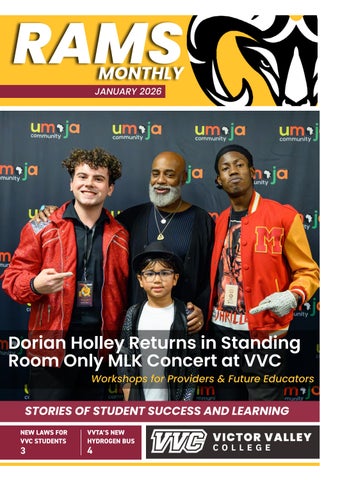
Reimagining King of Pop to Honor the Dream: VVC Welcomes Back Dorian Holley for MLK Jr. Day

Victor Valley College hosted a powerful one-night-only performance on Monday evening as acclaimed vocalist Dorian Holley headlined a sold-out Michael Jackson tribute concert in honor of Rev. Dr. Martin Luther King Jr. Day.

Victor Valley College hosted a powerful one-night-only performance on Monday evening as acclaimed vocalist Dorian Holley headlined a sold-out Michael Jackson tribute concert in honor of Rev. Dr. Martin Luther King Jr. Day. The event filled the VVC Performing Arts Center to capacity, delivering a moving fusion of musical excellence, cultural reflection, and community celebration.

Holley is known worldwide for touring with Michael Jackson for nearly three decades, beginning with the 1987 Bad World Tour. Now Holley is ready to hit the road, premiering a new and intimate concert experience titled MJ and Me, offering audiences the rare opportunity to hear Jackson’s music reimagined through the voice of someone who lived it onstage with the King of Pop.

“What’s the best way to share all of these years with Michael?” Holley reflects on his website. “I took some of his songs back into the studio with incredible musicians and asked: how do we make them new — without losing the classic vibe?” Holley’s intent was clear on the VVC stage: familiar melodies reshaped with fresh artistry, woven together with special stories about his life performing alongside the world icon.

A Night of Emotion, Legacy, and Cultural Impact

The evening also served as an opportunity for students in VVC’s Umoja Program and Black Student Union to experience music as both entertainment and a vehicle for cultural

history.

Umoja student president Julien Rockafort shared, “To take something so timeless and make it feel new again — that takes brilliance. The energy he brought to Michael’s music was incredible.”

Fellow Umoja student Elizabeth Irwin described the performance as deeply emotional. “I’m a huge Michael Jackson fan, and his version of Human Nature was my highlight. The way he used the band! Every instrument, every detail, it was awesome.”

For BSU member D’Anthony Robinson, dressed in MJ’s iconic red Thriller letterman jacket, the concert was transformative. “It really felt like Michael himself. His spirit was alive. There was so much history, and Dorian gave so much life through the whole show. I was speechless.”

Community Partnership in Action

The concert was sponsored in collaboration with DVL Project (Dreamers, Visionaries & Leaders), UMOJA, and the VVC Associated Student Body, highlighting VVC’s ongoing commitment to cultural programming that uplifts diversity, creativity, and community voice.

ASB Science Senator Toneka Richardson said the experience was unforgettable: “It snatched my soul, honestly. It felt like MJ was still there. The sound, the performance — it was perfect.”

Honoring Dr. King Through Art

Held in recognition of Rev. Dr. Martin Luther

King Jr. Day, the event connected the power of artistic expression with the legacy of the civil rights movement. Through Holley’s stories, reinterpretations, and musical mastery, the audience experienced a tribute that blended reflection, celebration, and the unifying force of music.

As Holley notes, MJ and Me is designed to sound “new and vintage” at the same time — a fitting parallel to Dr. King’s enduring impact: timeless, relevant, and continually re-imagined by each new generation.

Victor Valley College extends its gratitude to Dorian Holley, the partnering organizations, and the students and community members who helped make this evening an unforgettable celebration of art, history, and cultural legacy.

Op-Ed: It’s time to rethink California’s tragically ineffective conservatorship

Just two days after Rob and Michele Reiner were found fatally stabbed inside their Brentwood home last weekend, their 32-year-old son, Nick—who has struggled with addiction and intermittent homelessness for over half of his life, and who had recently been diagnosed with schizophrenia—was charged with his parents’ murder.

In the wake of the tragedy, many have wondered: why couldn’t anyone force Nick to seek substantial support before it was too late? And if the Reiners could not help their son, what hope is there for the families of the other 1.2 million Californians living with a serious mental illness?

Six years ago, my own family suffered the consequences of a decades-old California law that—to this day—makes it nearly impossible to involuntarily hospitalize a loved one in crisis. During the last decade of her life, my aunt, Amy, had struggled with addiction and alcoholism in addition to severe mental health issues. She cycled through myriad rehabilitation facilities, endured a half-dozen 5150 holds—72-hour involuntary psychiatric commitments named for the section of the California code that introduced them—and shuffled in and out of jails. Near the end of her life, Amy was living in her car and refusing medication or hospitalization for her schizoaffective disorder.

On Christmas Eve 2019, for reasons unknown to anyone but Amy, she rented an SUV and drove it across the southern border. Two weeks later, her body was found in the back of her rental car in Hermosillo, Mexico. Her brutal murder remains unsolved to this day.

In the last years of Amy’s life, there was almost nothing our family could do to help her, due in large part to California’s strict conservatorship laws. Conservatorships allow an appointed thirdparty individual to make decisions for an adult

conservatee—usually their family member— who is gravely incapacitated by mental illness, alcoholism, or addiction.

In 1967, California passed the Lanterman-PetrisShort (LPS) Act, which stated that a mentally ill person could not be involuntarily committed or otherwise “conserved” unless she posed an imminent threat to herself or others. Other kinds of conservatorships (for those who struggle with alcoholism or addiction but have not been diagnosed with a psychiatric disorder, for example) have similar constraints.

The glaring problem in the cases of Nick Reiner and Amy—and tens of thousands of other struggling Californians—is that families often cannot secure conservatorships for their loved ones until the worst has already come to pass. The LPS act “is attributed by various people as having transformed Californian society in many, many ways,” says Jonathan Simon, Lance Robbins Professor of Criminal Justice Law at the University of California, Berkeley. “Today we attribute many of our most persistent evils in this state to having gotten this law either wrong or not right enough – and that includes unhousedness, that includes rampant public drug use and drug sales in the center of many of our large cities, it includes mass incarceration,” and so on. Recently, celebrities like Britney Spears and Wendy Williams have brought the issue of conservatorships to national attention; their controversial conservators have received backlash for allegedly leveraging their positions to abuse their conservatees and benefit financially from the management of their estates. However, scholars and activists have argued that Spears’ and Williams’ cases are exceptions to the rule. “In nearly all cases, the [conservatee] is indigent, and there is no potential financial gain to the family,” said Jill Escher, president of the National Council on Severe Autism. “To the contrary, the conservatorship imposes on conservators many affirmative duties, responsibilities, and burdens, with no potential tangible gain apart from the knowledge that they can use their legal authority to advance the well-being of their loved one.”

In most cases, conservatorships are difficult to manage, and even more difficult to acquire.

A 2020 report by California’s state auditor found evidence that in Los Angeles County, nearly ten thousand people had been placed on at least 10 holds in their lifetime—however, only about 1 in 16 of these temporary holds resulted in a conservatorship. According to the most recent statistics from the Department of Health Care Services, fewer than 1,500 Californians are on LPS conservatorships.

There is evidence, though, that when conservatorships are granted, they are largely effective. In one California study of 35

patients placed under conservatorships, “29 (83 percent) remained stable as long as the conservatorship lasted, but for the 21 patients whose conservatorship was terminated, only 9 (43 percent) remained stable after termination.”

In an effort to lower barriers for those seeking conservatorships, in 2022, Gov. Gavin Newsom proposed the CARE Act.

The act would allow Californians to request intervention by “CARE Court” on behalf of family members with severe mental illnesses and/ or substance use disorders. The legislature approved it with bipartisan, near-unanimous support.

However, when CARE Court was introduced statewide last year, it hardly lived up to its potential. Eligibility for participation had narrowed, covering only people with severe psychosis and not those with substance abuse issues. The petition process had become much more unwieldy than the one originally proposed. Since the launch of CARE Court, the state has mandated treatment of a mentally ill person in only a handful of cases, and has not fined counties that have failed to provide court-ordered services to participants. In another effort to modernize conservatorship proceedings in California, Gov. Newsom signed a law in 2023 updating the LPS Act for the first time in over 50 years.

The new law expands eligibility for conservatorship to anyone unable to secure their personal safety due to either substance use or mental health issues. Now, conservatorship laws “[encompass] people with a severe substance use disorder, such as chronic alcoholism, and no longer [require] a co-occurring mental health disorder.” Like the CARE Act, this law took effect last year but counties can postpone its implementation until 2026.

Of course, Californians with mental illnesses and substance use disorders should retain their agency and autonomy to the fullest possible extent. Conservatorships and involuntary treatments should be temporary measures of last resort. Still, I hope that California lawmakers will consider amending conservatorship laws so that after all other avenues have been exhausted, families might have the option to secure help for their incapacitated loved ones before they become agents or victims of tragedy.

Megan Cole is an assistant professor of English at Victor Valley College. Success is a partnership.

This Op-Ed has been featured in several publications under Southern California News Group.

Turn static files into dynamic content formats.

Create a flipbook
Issuu converts static files into: digital portfolios, online yearbooks, online catalogs, digital photo albums and more. Sign up and create your flipbook.