C oFFEY/ KEMPTHoRNE
C oNTINUED
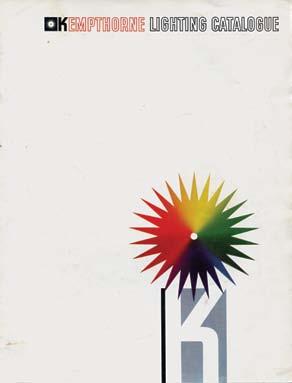
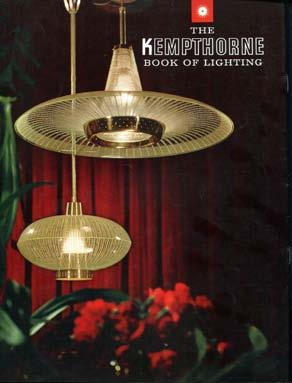
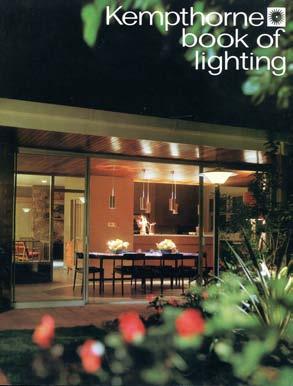
and bent to fine tolerances, from ordinary flat sheet glass’. 27 The process ‘came into being in an attempt to make a small lighting company independent of the need to import glassware, and also independent of large Australian suppliers of blown glassware.’ 28 It gained an Honourable Mention in the Prince Philip Prize for Australian design in 1968 and was one of a considerable number of Australian and world-wide patents Coffey took out. Kempthorne also won a Good Design Award for its Nordic Swivelites and other products.
While the Coffey brothers remained directors and managers, Kempthorne was innovative and forward looking, controlling all aspects of the supply chain. It is believed to be the first Australian lighting company to package its lights in printed cartons (these contained instruction sheets for installing the fittings), produce accompanying product bulletins, the first to use colour advertising leaflets, and the first to produce full colour catalogues. 29 Responsible for the introduction of track lighting in Australia, Kempthorne also established one of the first private company-owned photometric laboratories in Australia. Kempthorne was publicly listed under the name Kemtron from about 1960 and at some point in the 1960s there was an internal re-organisation of management. Of the four Coffey brothers Selwyn alone remained but retired from day to day involvement in 1970. For Joyce Coffey, who had worked closely with Selwyn, it marked the end of a remarkably successful twenty-five year career as an industrial designer.