
pro grow news






pro grow news Winter 2019 board committees
PRESIDENT
Tim Hay, MCH
Bigelow Nurseries, Inc.
Tel: (508) 845-2143
VICE PRESIDENT
Peter Mezitt, MCH
Weston Nurseries, Inc.
Tel: (508) 435-3414
SECRETARY/TREASURER
Chris O’Brien, MCH Howard Designs, Inc.
Tel: (617) 244-7269
PAST PRESIDENT
Jim Stucchi, MCH
Stucchi Landscape and Design, LLC
Tel: (774) 233-2151
DIRECTORS
Deborah Trickett, MCH
The Captured Garden
Kerry Preston, MCH
Wisteria & Rose, Inc.
Steve Charette
Farm Family Insurance Family
David Vetelino, MCH
Vetelino Landscape, Inc
Jean Dooley, MCH Mahoney’s Garden Centers

EDUCATION & RESEARCH COMMITTEE
Kathy Bergmann, MCH — Chair
Bergmann Construction
Tel: (508) 435-3414
FINANCIAL COMMITTEE (FINCOM)
Steve Corrigan, MCH — Chair
Mountain View Landscapes & Lawncare, Inc.
Tel: (413) 536-7555
Chuck Baker, MCH — Vice Chair
Strictly Pruning
Tel: (508) 429-7189
GOVERNMENT RELATIONS COMMITTEE
Chris O’Brien, MCH — Chair
Howard Designs, Inc.
Tel: (617) 244-7269
HISTORY COMMITTEE
Philip Boucher, MCH — Chair
Elysian Garden Designs
Tel: (508) 695-9630
Skott Rebello, MCH — Vice Chair Harborside P.S.
Tel: (508) 994-9208
MAGAZINE COMMITTEE
Gaele McCully, MCH MCLP — Chair
Mahoney’s Garden Center
Tel: (781) 729-5900
MASSACHUSETTS CERTIFIED HORTICULTURIST BOARD (MCH)
Jack Elicone, MCH — Chair
John R. Elicone Consulting
Tel: (617) 527-5706
PRODUCTS COMMITTEE
Peter Mezitt, MCH — Chair
Weston Nurseries, Inc.
Tel: (508) 435-3414
GOVERNMENT RELATIONS DIRECTOR
Jason Wentworth
Tel: (617) 417-4050
EXECUTIVE DIRECTOR
Rena M. Sumner
Tel: (413) 369-4731

AsLooking Ahead
ByTim Hay
I write this message with the intention of looking to 2019, I think about what a year it has been! Mother Nature gave us a spring with more rain and lower temps than average. If that wasn’t enough for us to overcome, she thought, “Why not give them almost 24 inches of rain and a 6–9-inch snowfall in the last three months just to keep them on their toes?” The one good thing with all this rain is that plants went into winter with plenty of moisture for the season. Maybe Mother Nature will be nice and give us a mild and short winter.
Government Affairs Director Jason Wentworth has joined the team, and having him onboard in time to help us with the November election cycle has been a blessing. MNLA has many new faces to meet at the State House in the coming year. I hope many of you will be able to participate in encouraging the new members to learn about MNLA and what we all add to the Massachusetts economy.
As I look at 2019, MNLA has many new events and programs to take advantage of. It begins on February 26–27 with the
Mark Your Calendar
Meet your Board of Directors at MNLA’s Annual Meeting Luncheon on February 27, 2019.
MNLA
Events in 2019
February 26 & 27, 2019 - Green Industry Winter Forum “Dreams & Solutions”
February 26, 2019 - MCH EXAM
February 27, 2019 - MNLA Annual Meeting
July 25, 2019 - Down to Earth Summer Conference & Trade Show, hosted by Sylvan Nursery, Westport, MA
August 21, 2019 - Plant Geek Day, Location to be confirmed
November 6, 2019 - Plant Healthcare Day at Elm Bank, Wellesley, MA
MNLA Winter Forum & Job Fair and the MNLA Annual meeting in a new location: We are moving east to Marlborough. The Down to Earth Summer Conference is set for July 25 at Sylvan Nurseries in Westport. It is great to be able to visit a member site and a place that is full plants and plant geeks, and I can’t wait to see you all there this summer. We will offer a Down to Earth grower tour of some Rhode Island nurseries on July 26. This will coincide with their 100th anniversary. Congratulation to RINLA for reaching that milestone. We have Plant Geek Day in August, and the Education Committee has planned a Plant Healthcare Day in November at Elm Bank. Look for more information from the MNLA office or go to www.mnla.com.
Tim Hay, MCH Bigelow Nurseries, Inc. MNLA President

History Committee
Fast Forward: The Backstory
Don’t miss the opportunity to read the History Committee’s first Past Forward article in this issue. It highlights the long career of an extraordinary man in a young industry in the early 1900s and up through the 1950s. It is a story that embodies the spirit of hard work and recognizes what is important for everyone.

Did you notice we had some significant help in compiling just one man’s career and contributions to our industry? Loren Wood did not have to do what he did to complete his project. Instead, he stepped up to clarify a jumble of papers that might otherwise have been an unrecognizable story. We were lucky to receive that gift from Loren and know that it will not always go that way.
The Committee is most concerned that we are not always aware of everyone’s post-association work, commitments, or passions. You can help. If you know of someone involved in
continued volunteer work — in or out of the industry — who deserves recognition, please bring it to our attention. Even better, perhaps you could write the piece yourself. You may be the person best able to convey the heart of the story. Or give us what you can plus some contact information, and allow us a little editorial license to complete the article. We will share it with you before press time. Pretty simple.
Do not let a good opportunity go by. More important, do not let their opportunity to be recognized go by. Not everyone wants their story told, but please ask. You may be surprised.
Sometimes it takes the work of a village to accomplish what is ahead. If you can help, this committee of three would gratefully and graciously accept your assistance.
Philip Boucher, MCH Elysian Garden Design MNLA History Committee Chair


Holyoke, MA (800) 862-0089
Charlton, MA (508) 987-0101
Wilmington, MA (866) 830-5909
Norwalk, CT (203) 831-9748
Plainville, CT (888) 889-9996
Hamden, CT (203) 288-2222
Smithfield, RI (401) 232-2597
Albany, NY (518) 650-6228


Established in 1910, Cavicchio Greenhouses is a fourth-generation New England farm working more than 250 acres in Sudbury. As a horticultural grower and landscape distributor, we cultivate and supply an extensive variety of annuals and perennials, nursery stock, stone, masonry and landscape materials. With a hard-earned reputation for service, quality, selection and sustainability, we work with professionals and garden centers throughout the area to keep our region beautiful.

110 Codjer Lane, Sudbury, MA 01776 978.443.7177 www.cavicchio.com
Discovering the True Definition of
By Trevor L. Smith, MCH, AOLCP, LEED GA
sus•tain•a•bil•ity (noun) Avoidance of depletion of natural resources in order to maintain an ecological balance.
The Problem

“Sustainability isn’t about how much we can ‘safely’ take from the earth, but how much we give back.”

The most dangerous phrase ever uttered is, “This is the way we’ve always done it.” When I founded Land Escapes, the latest and greatest cell phone was the flip phone. People emailed, but phone and mail was preferred, and it was good to have a website, but not essential. Varieties like Endless Summer Hydrangea and Knockout Roses were just about to hit the market, and N, P, K was all you needed to know about lawn and garden care. Today, I have a small computer in my pocket, clients all email but prefer text, and if you don’t have an online presence you may as well not exist. Varieties like Endless Summer Hydrangea and Knockout Roses are everywhere and N, P, K is still all people know about lawn and garden care.
During that time, an abundance of information regarding the importance of native plants and habitat, the amazing world of the soil food web, and the dangers and problems with synthetic fertilizers and stormwater runoff have been propelled to the forefront. Despite these changes, many landscape designers and city planners create pretty landscapes, parks, and green spaces installed by landscape or construction crews as if they were putting together Ikea furniture or painting by numbers.
The time for “this is the way we’ve always done it” is over. We can no longer simply landscape for aesthetics and install without understanding. We must evolve in our approach to the planet as we evolved in the way we communicate and do business. Just as our phones do more, our designs need to do more, and just as we needed to learn how to use those phones, we need to learn to use the emerging technologies — especially when it comes to green infrastructure (GI).
The Need
There is a deficit in the landscape industry of well-trained GI professionals. Many landscape companies follow installation instructions and specifications without a true understanding of how these systems actually work and why they are
now being standardized by various government and municipal agencies. There are few resources available for GI-specific training; we need projects that will help bring awareness and hands-on training to this relatively new industry if we plan to have a skilled workforce in the future. We can no longer environmentally afford to look at and treat the landscape as a canvas; landscapes, parks, and greenspaces must do more than look nice. Every design needs to address planet and people. Every design needs to address the needs of the people. To address the planet means to make choices that consider the soil, water, plant species, and the impact on wildlife such as birds and pollinators. To address the people means to look beyond the factors of space and use and make choices that consider health, education, enjoyment, and functionality
The Solution
Architects, planners, and designers must ask more from their designs. Each project, no matter how small, should address as many environmental and human issues as possible. For example, a project could call for fifty street trees to be planted. Instead of putting in a standard tree pit, where tree life expectancy is five to seven years due to improper planting, compaction of the base, and neglect, what if we asked for more? What if the plan was to plant the tree properly in combination with a stormwater catchment system? Knowing compaction is a problem, why not protect the base of the pit with a permeable material to prevent compaction and to allow maximum water infiltration? What if a maintenance plan was designed from the beginning to ensure that the tree lived its full lifespan, providing generations of enjoyment and benefits? That would be pretty awesome, but what if we took it a step further and used the tree planting and establishment period as a GI training opportunity? We would have a group of entry level workers (maybe from second-chance or skills programs) who know how to plant the trees, install the stormwater catchment system properly, and maintain the trees for the first year in conjunction with a basic horticulture class. Then we would have a ready-to-hire group of properly trained individuals with an understanding of the benefits of street
Sustainability

trees and their role in the urban landscape and in stormwater management. The more everybody understands, the more inspired and environmentally aware they will become.
Once we start asking more from our designs and calling on ourselves to do more and go further, we will be amazed at how powerful even the smallest project can be. Moving forward, I believe we need to evaluate each project for four major opportunities:
1. Maximum environmental impact. Have we addressed every environmental opportunity?
2. Skills training. Can this project be a training opportunity for a future workforce? Is there opportunity to write a requirement to use entry-level workers or skills programs into the RFP?
3. Job creation. Are we creating the need to hire additional personnel, or are we creating a demand for new job opportunities, such as raingarden or green-roof maintenance companies?
4. Community education or involvement. Is there an opportunity to reach out to the community to explain the project and its intention? This could be in the form of signage describing the benefits — This is a raingarden; it is designed to…. Or it could be a community meeting or project, e.g., a plant-a-pollinator garden at the library with the scouts or a science class.
Case Studies
Here are four small case studies to illustrate this new approach and demonstrate how easy it is to rewrite the way things are done. All of these projects were grant-funded and designed to prove the green infrastructure method works.
Boston Green Roof Bus Shelter Initiative Objectives:
• Prove the low cost/high impact of green infrastructure methods
• Prove entry-level job training opportunity
• Highlight opportunity for underserved communities
• Bring GI to street level to start conversation
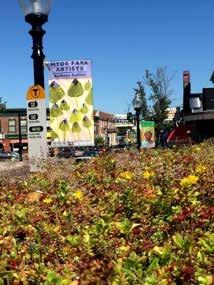
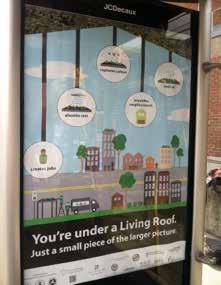
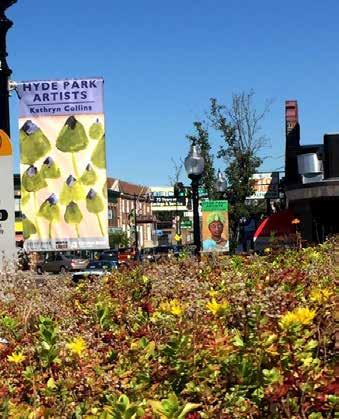
The Green Roof Bus Shelter Initiative was a trial workforce development program in which the students of Youth Build Boston installed, maintained, and monitored six green roofs on bus shelters around the city. The three-year program offset a combined total of 12,964 gallons of storm water. The roofs were retrofitted onto existing shelters and were planted with a hardy, five-sedum mix and seeded with native flowers. The total soil depth was four inches and the total saturation weight was twelve pounds per square foot. The students visited the shelters once a month to capture data on rainfall, the growth and health of the plants, stormwater runoff, and green-roof impact on the heat island effect. This pilot project was coupled with two major community outreach engagements: presentation of the program to a group of community leaders and to a high-school science class. Finally, each shelter was fitted with info-posters depicting the intent of the program and what was happening on the roof above.
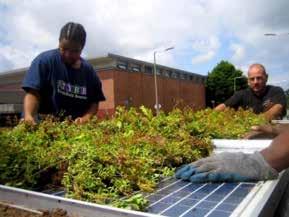
The Youth Build Boston team installed green roof on top of a bus shelter with instruction from Trevor Smith
Green Roof Atop a Bus Shelter Bus Shelter Signage
Somerville Raingarden Project Objectives:
• Prove the low cost/high impact of green infrastructure methods
• Prove entry-level job training opportunity
• Highlight opportunity for underserved communities
• Highlight examples of GI to start conversation
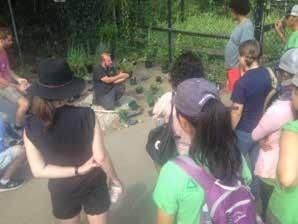
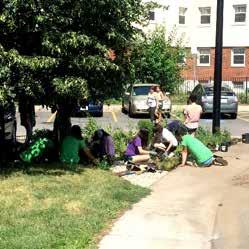
The Somerville Raingarden Project installation was a workforce development program where the youth members of Groundworks Somerville installed and maintained two raingardens. Prior to installation, a presentation outlined the project and the green-job intent to the residents of the housing community where the raingardens were being installed and to the members of Groundworks Somerville. Participants were taught the importance and function of a raingarden as well as how to properly site, construct, plant, and maintain a raingarden. They were also exposed to basic green industry skills such as plant and weed identification.
Upham’s Corner Community Garden Objectives:
• Prove positive reclamation of vacant lots
• Bring healthy local food opportunities to underserved communities
• Involve youth (Boston Food Project) and community in neighborhood improvement
• Highlight examples of GI and start a conversat
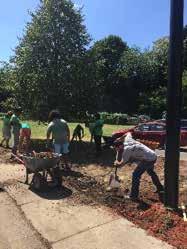
In the Upham’s Corner Community Garden project, youth members of the Boston Food Project worked to repurpose a vacant lot. With the help of the neighborhood, the site was cleared and capped due to high levels of lead in the soil. Raised beds were constructed, and the site was given to the care of the neighborhood. Instead of becoming more housing or remaining a blight in the neighborhood, this lot remained a greenspace and became a community gathering and nourishing space.
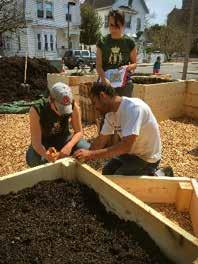
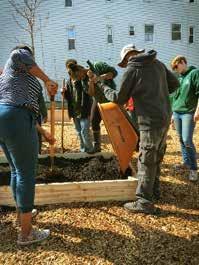
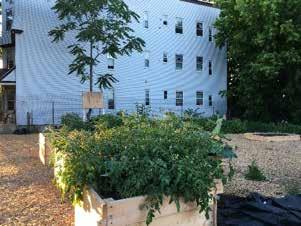
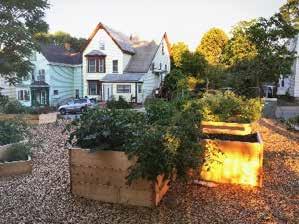
Clearing the Site
Learning about Plant Placement
Planting the Raingarden
Assembling and Filling Planter Beds
Community Garden Bounty
MORE YOUR ALLY THAN YOUR AGENT

With AMERICAN NATIONAL, you’ll get an agent who has the know-how and products to help you properly manage your family’s risks. An open appointment book, along with options for home, auto, life, farm and business coverage, means you can feel good that you’re getting more an ally than just an agent.
Wherever you are in Massachusetts, there’s a American National agent close to you. Give us a call for more information.


Dorchester 100 Tree Initiative Objectives:
• Prove the low cost/high impact of green infrastructure methods
• Prove entry-level job training opportunity
• Highlight opportunity for underserved communities
• Bring GI to street level to start conversation
During the Dorchester Tree Initiative, a group of young men from Strive (a GED job-skills training program) spent five weeks planting trees at various housing developments around Dorchester (a section of Boston). In addition to learning proper tree planting and pruning techniques, the project included classes in basic tree care and pest/disease identification. The long-term goal was to teach tree and landscape maintenance so these young men could go on to be hired by the property management company as landscape maintenance professionals. The project finished ahead of schedule and under budget, so an additional thirteen trees and forty shrubs were planted.
In all of these projects, simple low-cost installations led to large impact, and the much-needed green infrastructure addressed planet and people with the future of the industry in mind. If we install forty raingardens around a city, we have created the need for raingarden maintenance. By installing and maintaining small green roofs on bus shelters, a young person can go to a company and say they have experience. Improvements start by asking more of our designs and the construction process. By addressing as many environmental issues as we can in each design and rewriting requests for proposals to include green job training, we can achieve both the immediate installations we need while building our future workforce, creating opportunity and awareness, helping our community, and healing our planet.
There is a lot of work to be done. To move forward sustainably and to address the environmental challenges we face, we will need to adopt new methods and technologies. To find effective solutions, we will need to look at the issue on a larger scale — not a quick fix. As we work to become a part of the solution by building and educating in this manner, we will set the standards to secure a healthier, more productive future for all. These challenges are common when introducing new ideas that involve change.
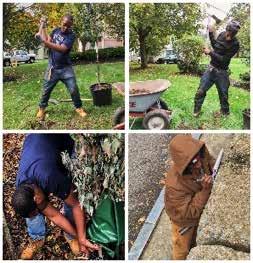
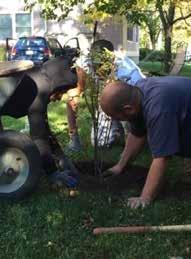
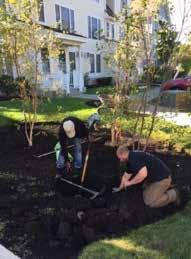
All photos from Trevor Smith.


Planting and Documenting Tree Variety and Size
Creating a Watering Well Learning Proper Width and Depth
Favorite Spring Plants
Corinne Jean, MCH, MCLP
Horticulture Manager
Wisteria & Rose
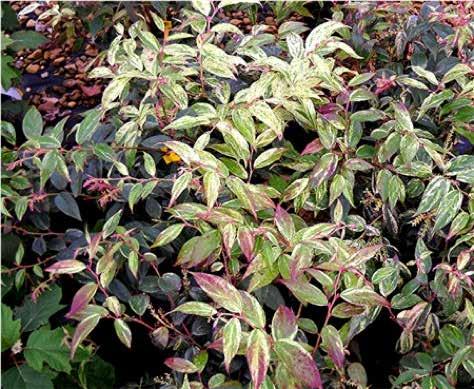
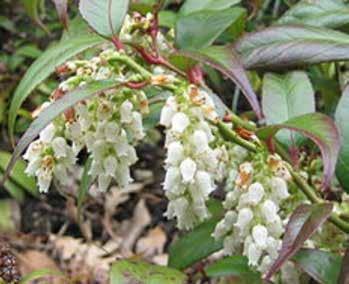
Leucothoe fontanesiana ‘Rainbow’
We can’t keep this evergreen alive in the city, but I love the pop of mixed colors and the drooping shape on the border of
Kerry Preston,
MCH
NOFA AOLCP
Wisteria & Rose
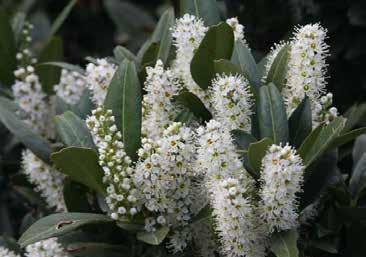
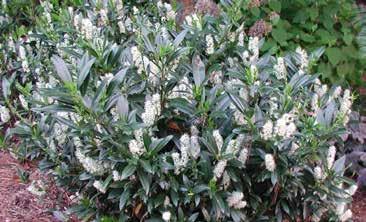
Prunus laurocerasus ‘Otto Luyken’
This is a fantastic alternative to a traditional broadleaf evergreen hedge. It needs well-drained soil and, once established, is tolerant of many conditions. We have successfully grown it in full sun and full shade (under a large oak); in both situations, it has flowered beautifully. The flowers grow in upright clusters and have a delicate fragrance in the spring. Summer fruits are loved by birds and, while there is no fall color change, the deep-green lustrous foliage looks healthy and lush during the winter months. I have noticed it can be a little temperamental after it has been planted, but settles in once established. This variety is a slow grower, maxing out at about 4 feet tall by 6-7 feet wide, perfect for the small urban garden.

— MCH Style!
Jack Elicone, MCH MNLA
MCH Committee Chair
Since I am a shade garden enthusiast, I have a couple of favorites. My first in the herbacious variety is Pulmonaria ‘Mrs Moon.’ It is a fabulous shade plant with variegated foliage and pink-to-blue flowers. Since it is an early bloomer, it is always a sign that spring is finally here.

My woody selection is a tree, Stewartia pseudocamellia, because it also does well in the shady garden as an understory tree with interesting bark, a camellia-like flower, and beautiful fall color.



Tracy
van
Schouwen MCH, MCLP Project Manager
Merrifield Garden and Design
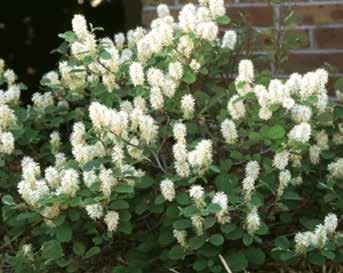
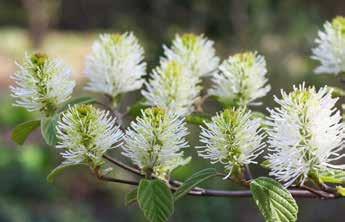
Fothergilla
Fothergilla is my favorite plant because of the delicate white flowers in the spring that brighten up the bare landscape. It also has jaw-dropping red foliage that I crave in the fall.
2018 Government Relations Retrospective

By Jason Wentworth
As I thought about a 2018 MNLA retrospective, an event at the close of 2017 weighed heavy on my mind. The passing of Henry S. Gillet brought sadness and uncertainty to many of us, and whether close friends or clients or both, it was hard to envision a world without his ever-present counsel. Calm but passionate, professional, steady, informed, and engaged — these are words that fall short in describing Henry and his impact on the people who knew him.

In May 2018, I left MDAR to serve four of Henry’s clients (including MNLA) and started my lobbying and consulting firm, Peacefield Strategies. I chose the name because of the historic connection between John Adams and agriculture. Like many of our Founding Fathers, farming was not simply a refuge from politics but a way of life. It provided an important, tangible context when they left their farms to do the people’s work, and with that connection, it would be hard for them to minimize or forget the plight of the nation’s farmers. Henry would appreciate the significance of the name as a symbol bringing the voices of agriculture, horticulture, and the green economy to policymakers. He was always fond of noting that the best advocates were the ones in the field making it happen, and that’s a philosophy I wholeheartedly share with him. Almost immediately upon coming on with MNLA, we needed to mobilize those voices and the voices of others to affect change.
Legislative language added as an amendment to the Environmental Bond Bill that would have stripped MDAR of regulatory authority over agricultural composting and transferred authority to the Department of Environmental Protection (DEP) managed to make it through the House and Senate to Governor Charlie Baker’s desk. This language was problematic for a host of reasons. For one, MDAR is not the regulator of choice for agriculture and horticulture because the agency is a rubber stamp. Because of its mission of both regulating and promoting, the agency has directed a considerable amount of time, effort, and material resources toward providing technical assistance to commercial agriculture and horticulture. Clearly, no one in the panoply of state
agencies is better equipped to handle regulation and guidance of agricultural composting operations. Additionally, this legislation struck many as a solution in need of a problem. Under a tight timeline, MNLA and the Massachusetts Flower Growers’ Association brought together a coalition of more than a dozen stakeholder organizations including groups like the Massachusetts Farm Bureau, NOFA Massachusetts, and regional buy-locals to sign on to a letter asking the Governor to veto that portion of the bill.
Governor Baker made the right choice, even if it wasn’t politically expedient, and vetoed the language as requested. It was an example of Governor Baker’s commitment to policy standards aligned with both the environment and the private sector. Combined with his support for a strong, well-funded MDAR and administration programs like Greening the Gateway Cities, the Baker-Polito administration continues to demonstrate a commitment to supporting the nursery and landscape sector. Because of this commitment and leadership, the MNLA Board of Directors, at the recommendation of the Government Affairs Subcommittee, has decided to award the Henry S. Gillet Environmental Leadership Award to Governor Charlie Baker. We are hopeful he can join us in person at our annual meeting to personally accept the award and allow us to celebrate this honor with him.
Back on the Legislative front, big bills like the annual budget and the Environmental Bond Bill went late into the formal session. The usual two-year churn brought by elections was still more than half a year away when Senator Stanley Rosenberg stepped down as Senate president last December and subsequently resigned in May. Senator Harriet Chandler served as Senate president until July, when Senator Karen Spilka garnered enough votes to assume the presidency.
Losing someone like Senator Rosenberg, who was wellsteeped in agricultural issues, and the power that comes with the presidency would be tough but, in President Spilka, we are very optimistic that we have someone who will listen and understand our issues and concerns as we work toward supporting our members with good policy. Her open-mindedness and good spirit were on display at MNLA Past-President Mark Ahronian’s annual end-of-summer garden party. She worked the room, introduced herself to attendees, listened to their stories, and shared her own about how and why she chose to enter public service and how her background
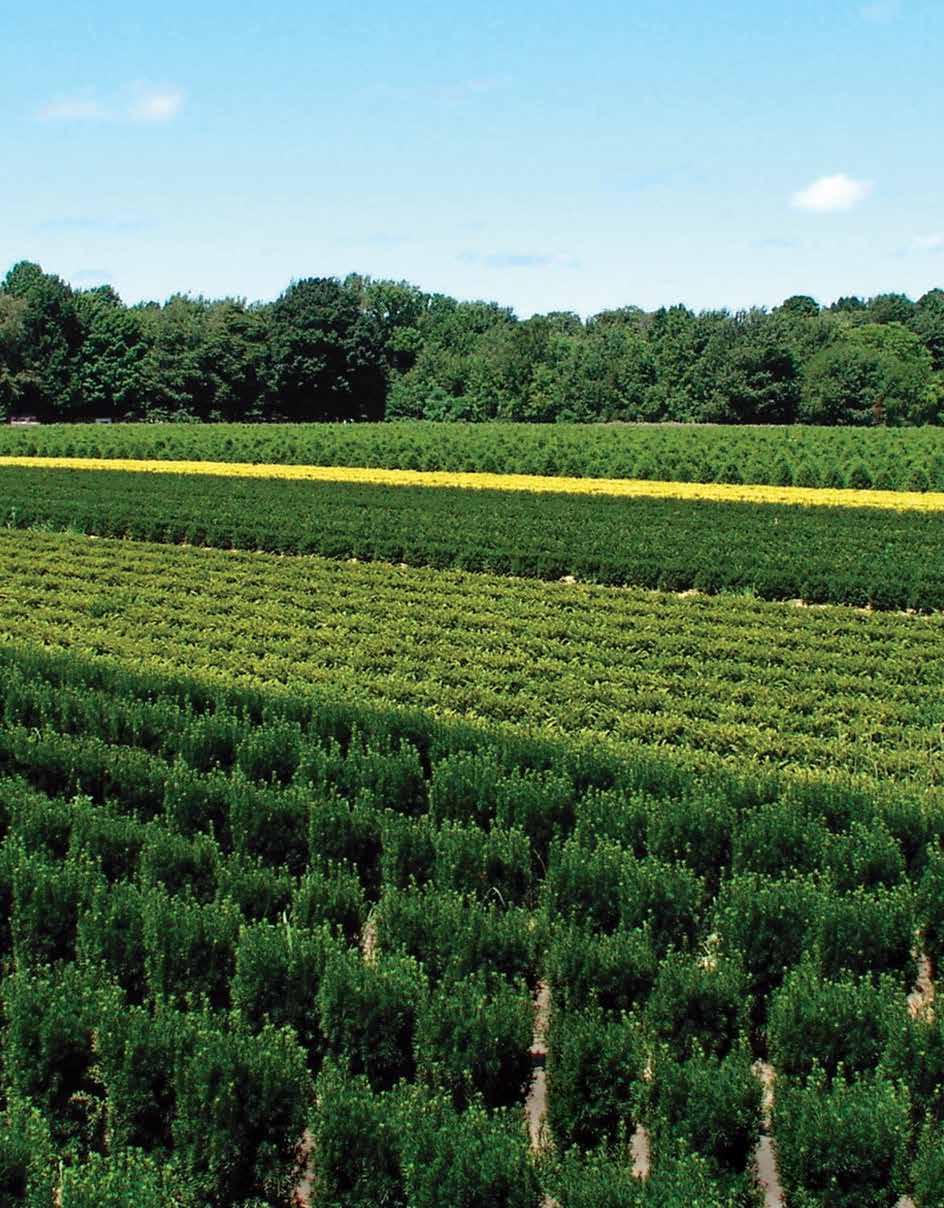
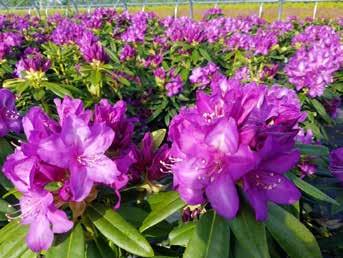


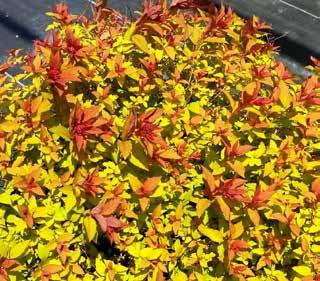

Magic Carpet Spirea Purple Passion
Rhododendron
Pieris Mountain Fire
Mandarin Lights Azalea
Woodward Arborvitae
instructs her view of policy and its effect on real people. It was a great introduction, and we look forward to working with her on the challenges that lie ahead. Thank you to Mark and his lovely wife Linda for their gracious hospitality in providing food, refreshments, and an idyllic setting to enjoy conversation and the company of friends new and old. Also joining us at the garden party was our good friend and long-time ally, State Representative Carolyn Dykema. As someone who worked in the Legislature with Representative Dykema, I’ve always been impressed with her approach, passion, and knowledge on the issues. Immediately upon commencement of my work with MNLA, she once again exhibited those admirable traits, showing a great deal of understanding and flexibility as we worked on language regarding neonicotinoids that would be more favorable to our members but would ensure that the basic intention of her bill be achieved. Working with the MNLA Board of Directors and the Government Affairs Subcommittee, we have taken a position that — while there may still be apprehension about regulating pesticides through the Legislature — we are aware that the alternative to legislation and the byproduct of inaction and stalling would inevitably be a ballot petition and, if a ban of neonics went on the ballot, we would most assuredly lose. That would remove a critical and important tool in our

toolbox, leaving members to choose from a much more expensive, inefficient, and dangerous list of options. One only need to look at what happened with the farm cruelty ballot question and the preceding legislative struggles stretched over several sessions as instructive to what could happen if we don’t work toward a beneficial compromise. While I have worked with Rep. Dykema on behalf of MNLA and Flower Growers’, we have now brought the Farm Bureau and the cranberry growers on board to try to find a solution that will achieve consensus support and ensure our objectives are attained. Discussions remain ongoing.
As we look to the coming 191st session of the Great and General Court and the beginning of another four-year term for the Baker-Polito administration, we face a measure of uncertainty. While there is no indication of any personnel changes on the executive level that might affect us, it’s the governor’s prerogative to make such changes, and we will continue to monitor the scene for such developments. In the Legislature, Senate President Spilka begins her first full term as president, but there is still no indication as to who will be appointed Senate Chair of Ways and Means. We are hopeful that Senator Anne Gobi, one of our great champions for agricultural and horticultural issues, will retain her role as Senate Chair of the Committee on Environment, Natural Resources,
YOUR ALL SEASON PROPERTY MAINTENANCE PARTNER



and Agriculture (ENRA), continue her balanced leadership of that committee, and maintain her standing as a go-to voice in the Senate for MNLA and other ag stakeholders.
On the House side, the untimely passing of Representative Peter Kocot and the retirements of Representatives John Scibak and Steve Kulik have left a gaping hole relative to agricultural and horticultural issues in the Legislature. Representative Kulik’s departure (who also served as Vice Chair of the House Committee on Ways and Means), coupled with the election loss of Chair of House Ways and Means Representative Jeff Sanchez, means Speaker Robert DeLeo will have significant vacancies to fill. We are hopeful that someone is assigned with at least an open mind toward commercial agriculture and horticulture and the nursery and landscape sector in particular. Additionally, we hope that ENRA House Chair Representative Smitty Pignatelli is reappointed. It’s been a pleasure to work with him and Chairwoman Gobi. Both of them have knowledgeable, approachable and helpful staff, and the chairs themselves remain exemplars of good legislators and outstanding leaders.
I have truly enjoyed working with and getting to know the Government Affairs Subcommittee and the MNLA Board of Directors. With a flurry of activity at the end of

formal sessions and some pressing weighty issues needing immediate attention, I was required to hit the ground running. Looking back on 2018, I believe I was able to successfully do that, but only because of the amazing team we have. Executive Director Rena Sumner, President Tim Hay, Government Affairs Committee Chair Chris O’Brien, and the whole Board of Directors have welcomed me, supported me, and allowed me to grow into this role and build my knowledge base and confidence. Thinking about the year behind us, we were able to accomplish much in short order, and I am truly excited to work with this team for the benefit of our members for many years to come.

THE VERMONT MULCH COMPANY
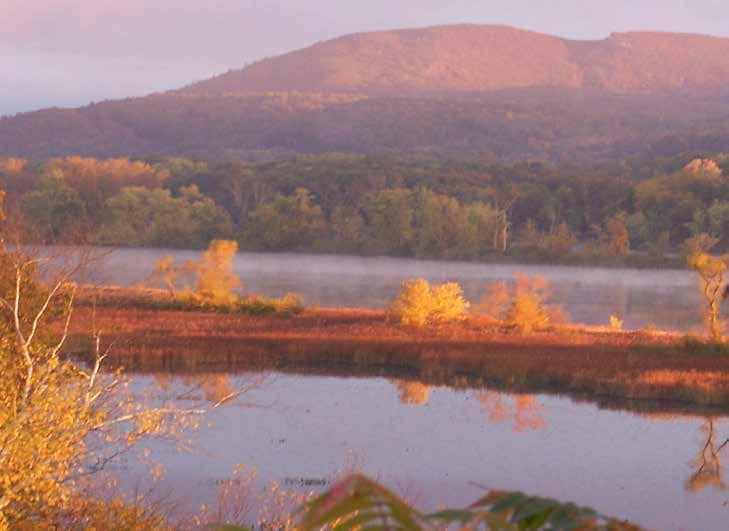
The Vermont Mulch Company is located on the banks of the majestic Connecticut River, in the far southeast corner of Vermont. This strategic location allows us to e ectively service Vermont, New Hampshire, Massachusetts, Connecticut, Eastern New York and New Jersey markets. Premium Bark Mulch


Hemlock Mulch
Aged Hemlock Mulch
Fragrant Forest
Dark Bark
Cedar Mulch
Hardwood Mulch
Colorlast
Playground Chips




Past Forward: Harlan P. Kelsey
By Philip Boucher, MCH
This is a story about two men: Harlan P. Kelsey, a past-president of Massachusetts Nursery Association (MNA) in 1932 and a notable green-industry figure with numerous lifetime achievements, and a timely angel in the form of Loren Wood, a biographer. How their lives crossed and intersected is a fascinating story, but first allow me to re-introduce Mr. Kelsey to you.
In the March/April 2001 issue of Nursery News, History Committee Chair and Past-President Dick Bemis wrote about Mr. Kelsey in his Did You Know? column. He told a detailed story of the man’s life from his birth in Kansas, his formative years in North Carolina, and his work as a town and city planner to his later career in Massachusetts as a nurseryman. For nearly sixty years, he distinguished himself by developing planned communities from Florida to New York, numerous military camps and forts in the eastern half of the country, and many projects for the National Park Service. As a collaborator to the NPS, his work ranged from the Great Smokey Mountain National Park to the Mississippi River Parkway Commission. He became known as the consulting “parkitect” whenever large projects arose.

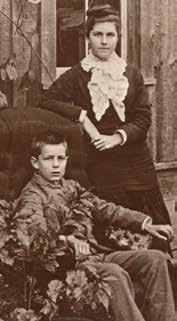
Kelsey started his nursery and landscaping business in 1912, yet his sense of duty to both civic and professional affairs drew him to contribute and improve things that affect our industry. Quarantine legislation to protect imports and plant health, standardized plant names, and promotion of native ornamentals were projects he pursued until he succeeded. Even with all his accomplishments, what he held most dear was the honorary degree of Doctor of Science from the University of Massachusetts in 1948.
Loren Wood, a member of the Boxford Horticultural Commission and an occupant of Kelsey’s house, was intrigued with the man, his two-story house, and the detailed layout and nursery inventory of his three-acre plot of land. The house contained boxed business papers and plans on the first level, but Wood’s most urgent job was to erect a nine-foot deer fence to protect the remnants of Kelsey’s nursery. His reasons for writing the Kelsey biography were never revealed.
After exhausting the local Historic Society and National Park Service information, he was made aware that MNLA had a lot of material on Harlan Kelsey. That first contact began Wood’s retrieval and cataloging of the records of MNLA’s Cornell/Davis historic collection from the Northfield storage building. His extraordinary work of dusting, cleaning, making photocopies, and developing a sorting method produced 24 cartons of properly protected archival works on Harlan Kelsey. It took him a year to complete, and we are forever grateful to Wood. Through his high standard, he helped us produce a template of what we need to do in the future. In return, he was equally delighted to begin his original work and said, “Because of you (MNLA), most of my important questions have been definitively answered, and I have answers to questions I didn’t know to ask.”
Note: Space prevents the reproduction of the Dick Bemis article and no further material on H.P. Kelsey’s work could be entered here. The entire original article from 2001 and other historic materials will be available or on display at the Winter Forum in February 2019.
Philip Boucher, MCH Elysian Garden Design MNLA History Committee Chair

How to Interview and Hire the Right People
By John Terhesh
Recently, I walked into a landscape supply store where managers and owners from three other companies were standing around waiting to be helped. As I listened to their conversation, a few snippets of stood out. “We have too much work and no people.” “Yes, this generation doesn’t want to work.” “I don’t have anyone even applying.” This is a reality for much of the industry and is a problem that our department used to struggle with — a problem that has mostly been solved. The way I see the current hiring process, the green industry has three options:

• The first option is to fight each other over the limited number of students coming out of school. This isn’t a terrible option, but if the candidate pool is incredibly small for the position, how can you decide who best fits your company?
• The second option is to try to steal employees from competitors. Poaching other people’s employees doesn’t make much sense. You lose your reputation in the industry, and other companies who wouldn’t have poached from you in the past now have no issues with doing it in return. When you get a bad reputation, it is hard to change that view.
• That leaves us with the final option: Train people with no experience in the green industry. This now seems like the best option for long-term planning. There is a nearly limitless pool of employees to select from, but it takes more time to hire and train. This is the option we have implemented with great success.
Who are we focused on attracting? The short answer is people who have entered the job market but have been unable to start a career. The reality for much of the current generation is that while unemployment is low, it is high for younger workers. Close to half of younger workers are in the service or retail industries, but a large number are underemployed and looking for a career. Market your company to these recent additions to the job market.
Stop reading for a moment and think about what makes your company special. These new employees are offering to help your business. What do you offer that the retail or service industries can’t offer? What can we offer to these next great employees to entice them to work for our businesses?
The one thing everyone in the green industry can offer is training. Can someone learn from you to make a career in the green industry? Training is something fast food, coffee shops, and retailers are not doing or cannot do. There are great employees out there who are stuck or underemployed after graduating. Let’s get them in this industry.
The Job Posting
The first step in attracting new employees is to update your job posting. In my first attempt at writing a posting, I only attracted six applicants. After reaching out to a friend who was a recruiter
at a top-500 company, I had around 85 potential applicants. Here are some of the pointers she gave me in writing a help-wanted ad.
• Be honest. Do not paint an unrealistic idea of what you think the applicant is looking for. You do not want the applicant to fall in love with your ad but not the job. If you work in a high-stress environment, say so. You want to attract people who have the right skill set for your job.
• Post the pay you are offering. You want to convey that your “competitive salary” is not minimum wage. This lets applicants instantly know whether they can take a risk and leave their current job. Talk about the training they will receive. I tell them I am training them to fulfill x position, which takes around x years to learn.
• Use requirements to filter applicants, but only use the most necessary ones. For every requirement that is listed, you will cut the number of applicants by about half. So if you start with 200 potential applicants and list five requirements, only six people will still want to apply. I only list two requirements: Applicants must be able to work outside in all weather conditions, and applicants must be willing to work in a drug-free workplace.
• Leave out the experience-needed section. I make a commitment to train someone who is willing to learn. Every business does things differently, so even people with experience will need to be retrained. Why leave out good employees just because they have not entered the industry yet?
The Interview
Interviews at our company have become more important now that candidates have no green-industry experience. These candidates should have all the necessary soft skills to make them successful. Every question you ask the candidate should have the clear goal of determining whether this person has the right skills to be successful at your company. Do not make any concession on the candidate’s skills, saying they are a “close-enough” fit.
I start interviews with a mix of standard interview questions like “Tell me about yourself” and “What’s your biggest weakness?” The only question I am trying to answer is whether the applicant prepared for the interview. The answers should have been rehearsed beforehand, and it would be a red flag if they can’t answer them.
I then talk about the company and about the job. I honestly do not say one good thing about our company here. I am not trying to sell someone on the job; I am trying to paint a realistic picture for someone outside the industry. I don’t exaggerate about the bad, but I tell them honestly what they are in for. I explain to them why I am doing that. Some of us love what we do, but it isn’t for everyone, and we want them to be a good fit for themselves and for us.
After this, the interview gets more relaxed. We talk more about hobbies, pets, travel, what they like to do for fun. I am trying to get them out of interview mode, of having rehearsed
answers. I want to see their personality, make sure they will fit in with their coworkers and our company culture. I would be asking for trouble if I put a liberal, outspoken vegetarian with a group of conservative hunters or vice-versa.
Once they are out of the interview mind frame, I ask about old jobs and bosses. More times than not, I will get real answers of how they are at work. Do they need a lot of direction? Can they operate with or without being constantly managed?
I wrap up the interview with a question they can’t prepare for: “Every day we deal with questions we do not have answers for. If you were given the job to paint the moon blue, how many gallons of paint would you need?” I let them take their time to think, but how they respond gives you a look into how their mind works. How would they figure out how much paint to use? Do they talk about costs of doing this project? Do they talk about needing research of moon paint absorption? You can see whether they are operationally minded or scientifically minded. You can see if they try to answer this question or blow it off as stupid. You can see how they respond to the stress of not knowing the answer. I couldn’t care less if they can figure out the real answer; I just want to see if they try.
Training
The number one reason people leave a job is the lack of opportunity. By focusing on training, you can address this issue. Hiring outside the industry and training people for a job they would not have received without your training will keep new hires engaged. Your company needs to change its attitude with training in mind. Your training practices can no longer be a baptism by fire or an exercise where only the toughest survive. Training must be a dedicated effort not only from you, but from other managers, supervisors, and the new employee’s co-workers. Failures by the new employee must be seen as an opportunity for training.
The days of employees coming to you begging for a job are over. We must now market ourselves to career-focused recent graduates who are lost on what path to take. This solves problems for both us and for them, giving these lost job seekers a path to build a career, learn new skills, and become active in the industry. Every problem our businesses face has an answer; we just need to change the way we think to solve them.
John Terhesh is head grower at Willoway Nurseries in Avon, Ohio. Meet John at the MNLA Winter Forum on February 27, 2019www.mnla.com for more information.


Arborjet provides cutting edge solutions to the green industry’s insect and disease problems. From high tech equipment to formulations that change the way we think about plant health care, Arborjet offers the tools you need to save America’s landscapes.

Birds Find More Worms in Native Gardens
Non-native plants can be very common in residential yards in part because of the horticultural preferences of homeowners and developers. But these plants do not support the same diversity of insects as native plants and could reduce habitat quality for insect-eating consumers like songbirds. The authors of this study compared the prey availability, diets, reproduction, and survival of Carolina chickadees across a gradient of non-native plants from low to high biomass. They found that as non-native plants increased in abundance, caterpillar and spiders declined and chickadees switched diets to less preferred prey.
In general, chickadees avoided breeding in yards with high non-native plants, and those that used non-native yards experienced a reduction in the number of young that fledged from the nest. The authors found that population growth of chickadees declines as non-native plants increase, and only yards with less than 30 percent non-native plant biomass had the possibility of contributing to a sustainable population of chickadees. The authors conclude that homeowners should plant native, insect-producing plant species to improve habitat for breeding songbirds and support local food webs in urban and suburban landscapes.
Take Home Points
• Insect prey availability is lower in yards landscaped with non-native plants because evolutionarily novel plant species do not support the same abundance and diversity of insects.
• Because reproduction is limited by food availability, insect-eating birds produce fewer young and cannot sustain populations in yards landscaped with non-native plants.
• To improve the habitat quality of urban and suburban areas for songbirds, homeowners should landscape yards with more than 70 percent native plant foliage.
Reference
Read the full paper here: Narango, D.L., Tallamy, D.W. and Marra, P.P., 2018. Nonnative plants reduce population growth of an insectivorous bird. Proceedings of the National Academy of Sciences, 115(45), pp.11549-11554.
•
•
•
•
•
•
•

In Memoriam: David Austin
David C. H. Austin, the rosarian and founder of David Austin Roses Ltd., died December 18, 2018, at the age of 92. For over 75 years, David’s dedication to roses brought fragrance and beauty to gardens all over the world. A perfectionist at heart, he bred more than 200 English Roses during his extraordinary career, unwaveringly in pursuit of an ever more beautiful rose. Over the past 20 years, U.S. and Canadian gardeners came to know Mr. Austin as the creator of beautiful, fragrant English Roses. In the UK, he was personally known to millions who met him, time and again, at the Austin gardens in Albrighton and at Chelsea in London.
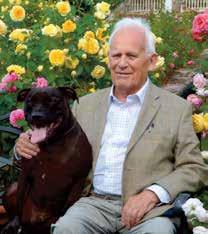
Enjoy two perspectives on Austin’s life at https://gardennewsbreak.com/david_austin/releases/David_ CH_Austin/index.html.







What to Do When a Key Employee Leaves
By Jeffrey Scott
At some point in the life of your company, you will lose a key team member or manager — or two or three — possibly someone you thought was your best person ever or someone you were counting on for a successful year.
After the initial feeling of disappointment and a quick (!) evaluation of what you might have done differently, you must pick yourself up and realize that you have been given a gift, because when a door closes, a window of opportunity has opened. Pick up your head and look around!

For example, an ambitious contractor in the south had been grooming his #2 person. He hired him last year, spent the year investing in him, and was counting on him for a breakout season. But the #2 guy called in to say that for various reasons, he would be gone for the spring, then back in the summer. What does one do in that situation?
In all businesses, there comes a time when you need to step back, reflect, and regroup to move forward stronger and faster. Einstein said it best: “The shortest distance between two points is not a straight line.” He must have had a landscape business on the side.
Four questions to consider when a key person leaves:
1. What is there about that person’s job that you need to tweak, improve, or streamline?
2. Where were you held back by this person, and you could now move forward?
3. What can you now accomplish at a higher level with a different and better person?
4. What opportunity does this gap create for your current staff to step up and prove themselves? The best leaders, all things being equal, are those who develop through your ranks because they are aligned with systems, culture, and clients.
When someone leaves you high and dry, don’t speak disparagingly because your employees will wonder, “What would the boss say about me if I left?” Be kind, be positive, and be oriented to the future.
Jeffrey’s Breakthrough Idea
Embrace every drop in altitude as an opportunity to retool, speed up, and reach new heights. Take action. Be proactive. Develop a contingency plan. Look at each key position and ask yourself and your team what the company should do if it suddenly lost that person. Who would do what, who would step up, and what processes would you simplify or stop doing? This type of planning will prepare your mindset and help streamline your current operations.
Jeffrey Scott, MBA, author, business coach, and hall-of-fame consultant, is the expert in growth and profit maximization in the lawn and landscape industry. He grew his company into a successful $10 million enterprise and is now devoted to helping others achieve profound success. Over 6,000 readers follow his monthly newsletter. To sign up go to www.jeffreyscott.biz. Jeffrey facilitates the Leader’s Edge peer group for landscape business owners. To learn more, visit www.GetTheLeadersEdge.com

•Extensive selection of
•Hardscape & Masonry Supply
•Landscape Lighting
•Residential & Commercial Irrigation Supply
•Custom seed blending
• Equipment Rental (Bobcat, Ditch Witch, Turf Equipment & More)
• Bulk Mulch, Loam & Stone
Northeast Turf & Irrigation Supply
•New England Delivery Routes


Northeast Greenhouse & Nursery Supply
•
• Pots, Growing Media, Fertilizer, Irrigation & more
& Turf Supply
• Complete Turf & Ornamental Mangement line
•
•
Northeast Arbor Supply