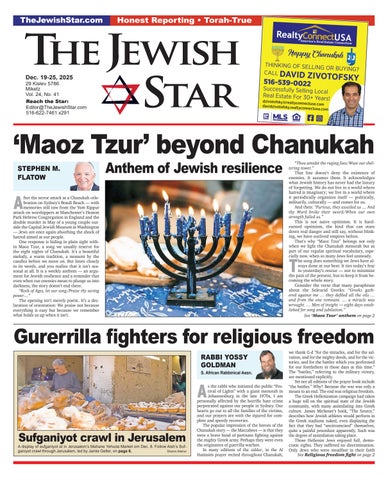
TheJewishStar.com
Honest Reporting • Torah-True
Happy Chanukah
THINKING OF SELLING OR BUYING? CALL DA VID
ZIVOTOFSKY
Dec. 19-25, 2025
516-539-0022
29 Kislev 5786 Miketz Vol. 24, No. 41 Reach the Star: Editor@TheJewishStar.com 516-622-7461 x291
Successfully Selling Lo cal Real Estate For 30+ Ye ars!
dzivotofsky@realtyconn ectusa.com davidzivotofsky.realtyc onnectusa.com
‘Maoz Tzur’ beyond Chanukah STepHen M. FlaTow
anthem of Jewish resilience
A
fter the terror attack at a Chanukah celebration on Sydney’s Bondi Beach — with memories still raw from the Yom Kippur attack on worshippers at Manchester’s Heaton Park Hebrew Congregation in England and the double murder in May of a young couple outside the Capital Jewish Museum in Washington — Jews are once again absorbing the shock of hatred aimed at our people. One response is hiding in plain sight within Maoz Tzur, a song we usually reserve for the eight nights of Chanukah. It’s a beautiful melody, a warm tradition, a moment by the candles before we move on. But listen closely to its words, and you realize that it isn’t seasonal at all. It is a weekly anthem — an argument for Jewish resilience and a reminder that even when our enemies mean to plunge us into darkness, the story doesn’t end there. “Rock of Ages, let our song/Praise thy saving power…” The opening isn’t merely poetic. It’s a declaration of orientation: We praise not because everything is easy but because we remember what holds us up when it isn’t.
“Thou amidst the raging foes/Wast our sheltering tower.” That line doesn’t deny the existence of enemies. It assumes them. It acknowledges what Jewish history has never had the luxury of forgetting. We do not live in a world where hatred is imaginary; we live in a world where it periodically organizes itself — politically, militarily, culturally — and comes for us. And then: “Furious, they assailed us … And thy Word broke their sword/When our own strength failed us.” This is not naive optimism. It is hardearned optimism, the kind that can stare down real danger and still say, without blinking, we have outlived empires before. That’s why “Maoz Tzur” belongs not only when we light the Chanukah menorah but as part of our regular spiritual vocabulary, especially now, when so many Jews feel unsteady. he song does something we Jews have always done at our best: It ties today’s fear to yesterday’s rescue — not to minimize the pain of the present, but to keep it from becoming the whole story. Consider the verse that many paraphrase about the Seleucid Greeks: “Greeks gathered against me … they defiled all the oils … and from the one remnant. … a miracle was wrought. … Men of insight — eight days established for song and jubilation.” See ‘Maoz Tzur’ anthem on page 2
T
Gurerrilla fighters for religious freedom Rabbi YoSSY GoldMan S. African Rabbinical Assn.
A Sufganiyot crawl in Jerusalem
A display of sufganiyot at in Jerusalem’s Mahane Yehuda Market om Dec. 8. Follow Aish’s SufSharon Altshul ganiyot crawl through Jerusalem, led by Jamie Geller, on page 6.
s the rabbi who initiated the public “Festival of Lights” with a giant menorah in Johannesburg in the late 1970s, I am personally affected by the horrific hate crime perpetrated against our people in Sydney. Our hearts go out to all the families of the victims, and our prayers are with the injured for complete and speedy recoveries. The popular impression of the heroes of the Chanukah story — the Maccabees — is that they were a brave band of partisans fighting against the mighty Greek army. Perhaps they were even the originators of guerrilla warfare. In many editions of the siddur, in the Al Hanissim prayer recited throughout Chanukah,
we thank G-d “for the miracles, and for the salvation, and for the mighty deeds, and for the victories, and for the battles which you performed for our forefathers in those days at this time.” The “battles,” referring to the military victory, are mentioned explicitly. Yet not all editions of the prayer book include “the battles.” Why? Because the war was only a means to an end. The end was religious freedom. The Greek Hellenization campaign had taken a huge toll on the spiritual state of the Jewish community, with many assimilating into Greek culture. James Michener’s book, “The Source,” describes how Jewish athletes would perform in the Greek stadiums naked, even displaying the fact that they had “uncircumcised” themselves, quite a painful procedure apparently. Such was the degree of assimilation taking place. Those Hellenist Jews enjoyed full, democratic rights. They suffered no discrimination. Only Jews who were steadfast in their faith See Religious freedom fight on page 2
‘Maoz Tzur’ anthem…
Continued from page 1 It is worth pausing on what that means. More than simply a battle against foreign soldiers. the Hasmonean struggle was against a worldview held by many Jews of the time that demanded Jewish distinctiveness be diluted, domesticated or erased. The defiling of the oils was not a random act of vandalism — it was a message: Your holiness is fragile. Your worship is replaceable. Your identity is negotiable. And yet, the Jewish response was not despair. It was repair. It was persistence. It was the audacity to search for even a “one remnant” of purity and light it anyway. That is the lesson for our moment. When terror strikes, the goal is not only to kill bodies. It is to break spirit — to convince Jews that public Jewish life is too dangerous, that visibility is too costly, that hope is irresponsible. Terror wants Jews whispering, hiding, shrinking. “Maoz Tzur” teaches the opposite: In the face of darkness, we do not negotiate away our light. We protect it, we kindle it, we multiply it. That doesn’t mean being reckless. Jewish law does not glorify needless risk. We take security seriously, and we use wisdom. We lock doors and hire guards, and coordinate with law enforcement because preserving life is a sacred duty. But we do not respond by surrendering our Jewishness. We do not internalize the message that our faith must be practiced only behind closed blinds. We do not allow murderers and their cheerleaders to become the authors of our communal future. he final verse’s plea — “Unsheath your holy arm … bring the end that is salvation … claim the vengeance of your servants’ blood … for the hour has lengthened on us, and there is no end to the days of evil” — is uncomfortable for modern ears, and it should be treated with seriousness, not slogans. It is not a license for vigilante rage. It is the cry of a people who have learned, repeatedly, that evil does not retire on its own. It is a prayer that history bends toward justice and that the moral order of the universe is not a fairy tale. In other words, it is a plea that the world not become numb. When Jews sing that verse, we are not celebrating vengeance for its own sake. We are insisting that innocent blood matters, that the
T
Continued from page 1 who were oppressed by the Greeks. The Greeks worshipped the body, not the soul. And it was the Jewish soul, our Torah values, which they attacked and tried to uproot and eradicate. hanukah is different from Purim, when Haman attempted to physically annihilate “every single Jewish man, woman and child.” Accordingly, we celebrate Haman’s downfall with physical celebrations — a Purim feast, eating and drinking in merriment. As for Chanukah, our enemies’ target was not our bodies, but our souls. And so, our celebrations are more spiritual. Yes, there are latkes and doughnuts, but the main commemorations are kindling the lights of the menorah and reciting Hallel, each spiritual in nature. The Greeks were not like Hitler or Hamas, who simply wanted to kill Jews, whether religious or not. In the Chanukah plot, Jews who were willing to assimilate into Greek culture and give up their faith could live quite comfortably and enjoy all their physical liberties. The Maccabees were religious freedom fighters. They led their brethren in insisting on their right to be different and to practice a minority faith. The military triumph was but a necessary prelude to the spiritual and religious freedom it brought about.
C
In the face of darkness, we do not negotiate away our light. We protect it, we kindle it, we multiply it. slaughter of Jews is not background noise and that G-d — and human society—must not treat it as normal. And then comes the quiet miracle: Despite that pain, the song remains ultimately hopeful. It is not a dirge. It is not a eulogy for Judaism. It is a soundtrack for Jewish continuity. That’s why it can be sung each week. Imagine if we treated “Maoz Tzur” the way we treat other weekly anchors — “Lecha Dodi” or “Adon Olam” — as a spiritual recalibration. Not only “remember what happened,” but “remember what always happens”: Enemies rise, and they fall; threats gather, and they scatter; the Jewish people get knocked down, and we get up — sometimes with bruises, sometimes with tears, always with stubborn faith. This is not denial. It is defiance. It is saying: The darkness of these days, as it was in the days of the struggle against the Seleucid Greeks, will be broken. Not by pretending it isn’t dark, but by refusing to let it become permanent. So, dear reader, sing it — by the menorah, yes. But also when the news is heavy. When a Jewish community is mourning. When you feel that familiar ache of vulnerability that Jews know too well. Sing it in synagogue. Sing it at your Shabbat table. Sing it with your children so they learn that Jewish history is not only a catalog of enemies but a record of survival — powered by faith, fortified by community, and lit, again and again, by one more flame than the darkness expected. It reminds us — quietly, stubbornly, beautifully — that all is not lost. Because “Maoz Tzur” is not only a Chanukah song. It is a Jewish answer to fear. With thanks to Rabbi Nasanyl Braun of Long Branch, NJ, who on Dec. 5 asked the question in the synagogue, “Why do we sing it?” Write: Columnist@TheJewishStar.com
Religious freedom fight…
1324354
December 19-25, 2025 • 29 Kislev 5786 THE JEWISH STAR
2
We must fight the fire of terror with the fire of our faith. With the horrific terror attack in Sydney, the intifada has again been globalized. We pray that there will finally be a strong and unequivocal response from the Australian government and, indeed, from leaders around the world. We pray that this is the end of such attacks — and not the first of a new wave. As we say in the second blessing recited when we kindle the chanukiyah, “Blessed are you, our G-d and King of the universe, who performed miracles for our forefathers in those days at this season.” We need miracles not only in “those days” of old, but in “this season” of our lives and our people, in Israel and all over the world. May we all be safe, sound and protected from harm. And, no matter what, may we continue to practice our faith proudly and even defiantly in the face of hate, terror and tyranny. We need light now more than ever. We must fight the fire of terror with the fire of our faith. May the Chanukah lights continue to burn brightly in Bondi and the world over. Amen. Write: Columnist@TheJewishStar.com
3 THE JEWISH STAR December 19-25, 2025 • 29 Kislev 5786
ALIYAH IS
Ready for a dreidel trade-in? WWW.NBN.ORG.IL 1325338
WORKING IN PARTNERSHIP TO BUILD A STRONGER ISRAEL THROUGH ALIYAH
In Europe, some move their menorahs indoors
1327596 1280832
December 19-25, 2025 • 29 Kislev 5786 THE JEWISH STAR
4
By Canaan Lidor, JNS After moving to a different house in his native Netherlands, Marco Schouwenaar was looking forward to lighting a large menorah on the windowsill, following the Chanukah custom of publicly advertising the miracle of the holiday. This year, however, that ritual will change. At his wife’s urging, Schouwenaar will instead place the menorah inside the living room of their home in Nijmegen, its light reaching only those inside. The subtle shift reflects a broader response by European Jews to a sharp rise in antisemitism — an increase that has been building for roughly 25 years but intensified dramatically after Hamas-led terrorist attacks in southern Israel on Oct. 7, 2023. While some have reacted by projecting their identity outward with defiance, others are pulling back, withdrawing public expressions of Judaism due to violence, intolerance, intimidation and growing doubts about the long-term viability of a robust Jewish presence in Europe. Both reactions coexist in the household of the Schouwenaar, who are both Jewish and have four children. “I think we should celebrate visibly and publicly, without fear,” Schouwenaar, 57, said. “But it’s making my wife uneasy, and I’m going to follow her lead here.” Jews and Jewish community leaders in several countries told JNS of a growing reluctance to display a menorah at home this Chanukah. In Antwerp, Belgium, some Jews “asked not to do it now, because it’s so terrible, the antisemitism,” said Broness Regine Sluszny, president of the Forum of Jewish Organizations of Belgium’s Flemish Region. Sluszny, an 86-year-old Holocaust survivor, said the trend marks a return to pre-genocide norms. “Antwerp Jews didn’t generally display menorahs. It was part of living in a non-Jewish environment,” she said, noting that this began to change in the 1960s. Back then, Belgium saw Jewish immigration from Eastern Europe and the United Kingdom. “Today, very few people who weren’t born here would start a Jewish family here. There’s too much hostility,” she said. A 2024 European Union survey of nearly 8,000 Jews in 13 member states found that about 40% were “rarely” or “never” open about being Jewish at work or school, while 33% and 41% said they frequently hid their Jewish identity in those settings. Italy, the Netherlands and Germany recorded their highest-ever numbers of antisemitic incidents in 2024, while the United Kingdom and France reported their second-highest tallies. On Oct. 7, the terrorists killed 1,200 people and abducted another 251, triggering Israel’s two-year war against Hamas in Gaza and subsequent conflicts with Hezbollah, Iran and the Houthis in Yemen. The attack prompted street celebrations by thousands of Muslims across Europe, alongside an initial wave of solidarity with Israel. But this later faded as Israel pursued its military campaign. Mass protests against Israel followed, accompanied by media coverage that Israel’s advocates say fueled antisemitism. Yoni Wieder, Ireland’s chief rabbi, said that “even in the best of times, some Irish Jews prefer not to place a chanukiyah in the window — not out of fear, but because they don’t want to ‘stick out’ too much or simply don’t feel comfortable doing so.” That said, he added, “I wouldn’t be surprised if this year some people here are more hesitant about displaying Chanukah lights visibly.” Others have moved in the opposite direction. In Malmö, Sweden, Ilana Edner has increased her public displays since Oct. 7. She places menorahs in both her street-facing and rear-facing windows and flies Israeli flags on her balcony alongside the European-style date “7/10.” More than merely a statement, these symbols carry risks in a city that has been a hotbed of an-
Children enjoy a Chanukah menorah-lighting in Amsterdam in 2020. Canaan Lidor
tisemitism for the past 20 years and where about a third of the population is Muslim, including many thousands of Iraqis, Syrians and Palestinians. “I find it important to demonstrate that I exist, unafraid,” she said, despite harassment from students at a nearby, heavily Muslim high school. “After Oct. 7, I don’t care anymore what they think.” Across Europe, public menorah-lightings — often organized by Chabad — will still take place, including in Nijmegen and across Amsterdam, such as the annual event on Dam Square. Yet even these have grown harder to stage. In Amsterdam’s heavily Jewish Buitenveldert neighborhood, a public menorah lighting at the Gelderland Square mall was canceled at shop owners’ request, said resident Marja Goldstoff, noting that Christmas decorations remain ubiquitous. The Goldstoffs, who in 2023 camouflaged their mezuzah for security reasons, have also since moved their menorah indoors. “It just doesn’t feel safe anymore,” she said. Last month, the Royal Concert Hall in Amsterdam canceled a Jewish group’s Chanukah event because the cantor scheduled to perform in it was an Israeli who serves in the Israel Defense Forces. The concert was rescheduled amid legal action, a public outcry and allegations of open antisemitism. While some Jewish leaders reported no concerns about menorah displays, including in places like Halle, Germany, where a neo-Nazi targeted a synagogue in 2019, others said they would refrain this year. A Jewish woman in Bologna told JNS that she would not display a menorah anywhere in the city. An Israeli living in Paris said the decision is highly location-specific, with detached homes and streetfacing windows posing greater risks. “In an apartment building, there’s no problem. In a detached home, a rear-facing window’s better. It depends on the neighborhood and even traffic outside the relevant window,” he said, speaking anonymously. “But right now, I don’t think it’s wise to mark your home, self and family. It’s sad, but I think that’s how it is.” One Israeli, Nimrod Hazan, plans to display a menorah publicly for the first time after moving with his wife from an urban setting to a small village in the Netherlands. “For the first time, the menorah’s going to be on the windowsill, and the mezuzah will be on the outside of the doorframe,” he said. Rabbi Menachem Margolin, chair of the European Jewish Association, said authorities are making efforts to secure Chanukah celebrations, including high-profile events attended by European Commission leaders. “At the same time,” he said, “Jews are afraid to show their Jewish identity in public, so much work remains to be done.” Back in Nijmegen, Schouwenaar said the question of where to place a menorah pales beside larger uncertainties. Oct. 7, he stated, “let the genie of antisemitism out of the bottle.” With one son in Israel and three in the Netherlands, he hears a question increasingly voiced by Jews around him: whether that genie can be put back or whether it is time to leave Europe altogether.
5 THE JEWISH STAR December 19-25, 2025 • 29 Kislev 5786
MUSEUM OF JEWISH HERITAGE A LIVING MEMORIAL TO THE HOLOCAUST
EDMOND J. SAFRA PLAZA 36 BATTERY PLACE | NYC MJHNYC.ORG
1328072
“There is no use painting flowers or landscapes any more. Art must be mobilized – like everything else.”
December 19-25, 2025 • 29 Kislev 5786 THE JEWISH STAR
6
Olim celebrate their first Chanukah as Israelis Among those gathering around their menorahs this Chanukah are olim who are lighting for the first time as Israeli citizens. Etty Wiener, who moved from New York to Jerusalem this summer with her husband and two children, still marvels at seeing menorahs in store windows and hearing her son come home from school excited over what he learned about Chanukah. “In New York, Chanukah was beautiful, but always overshadowed,” she said. “Here, it feels like the whole country is celebrating with us.” Her family plans to adopt the custom of placing their menorah outside, something people in the Diaspora generally can’t do. “Chanukah is about showing the miracle of the Jewish people. Being in Israel for that, it feels like the light at the end of the tunnel,” she said. “It’s Jewish pride illuminated.” In a year when light has felt particularly precious, the festival of lights carries new meaning for those who chose to begin their lives anew in the Jewish homeland, through Nefesh B’Nefesh in cooperation with the Ministry of Aliyah and Integration, the Jewish Agency for Israel, Keren Kayemeth LeIsrael, and Jewish National Fund-USA. A sense of belonging resonates deeply with Nicole Horne, who moved to Tel Aviv from Washington DC in May. “Elsewhere, you sometimes feel like an outsider for being Jewish,” she said. “But here? Chanukah isn’t the alternative holiday, it’s just part of life.” Like other ollim, Horne was struck by the difference in being surrounded by the holiday rather than explaining it. She laughed remembering how early her workplace in Israel began decorating, and she admitted she is “unreasonably excited” for sufganiyot. “Seeing so many menorahs everywhere is something I’ve never experienced be-
fore. It feels special. It feels like home.” In Ra’anana, Irving Safdieh, who made aliyah from New Jersey, noticed his children embracing a new sense of independence, something he and his wife hoped aliyah would offer them. “Our kids take the bus on their own now. They have made so many friends. They’re thriving,” he said. Celebrating Chanukah in Israel has only amplified that joy. Instead of Christmas décor, their outings are filled with glowing Hanukkiot, and they’ve turned sampling sufganiyot into a family-wide ranking competition. Safdieh said that “going to public menorah lightings with Israelis, really makes you feel part of something bigger.” Yaffa Troodler, a Bat Sherut (National Service Volunteer) who made aliyah from Philadelphia, has spent her sherut leumi (volunteer service) working in schools for children with disabilities. “Doing anything in my power to give back to the country is my way of bringing more light into Israel as an Israeli,” Troodler explained. “After making aliyah, I finally felt a sense of be-
longing,” she reflected. Celebrating Chanukah in Israel has only strengthened that feeling. You really feel the presence of Chanukah here, it’s warm, it’s home.” For Troodler, lighting the menorah this year isn’t just a personal milestone, it’s the beginning of a legacy. “Because of me, my future generations will celebrate Chanukah here,” she said. For Daniel Friedman, who moved from New Orleans to Tel Aviv this summer, Chanukah brings his aliyah experience full circle. His first visit to Israel was during Chanukah a few years ago, and returning as a citizen feels symbolic. “Rededicating myself to Judaism, returning to the land, it mirrors the Chanukah story,” he said. “You get eight nights instead of one. Now I am here, and that alone feels like a miracle.” Just a few months into her life as an Israeli, Adina Spiewak is looking forward to building her own traditions. After years of celebrating Chanukah in the US with events, gifts, and obligations, she’s embraced the quieter, more intentional rhythm she’s found in Israel.
“I want to bring light to other people,” she said. “Each of us is a vessel for our neshama (soul), and when our lights come together, they shine brighter. A former campus Chabad president who helped guide students through the turmoil of October 7th, she said her move feels deeply right. “There’s no time like the present.” In the northern city of Maalot Tarshiha, Scott Friedman and his family, who joined a cohort of English-speaking families that also made aliyah, are preparing to celebrate Chanukah in a tightly knit, warm community in Israel’s periphery. “Growing up in the States, the holidays sometimes felt like a third-person story,” Friedman explained. “Here, it feels like first-person. It feels like ours.” Their daughter has already integrated into school, and the community even created a special Chanukah program for the new olim. “We finally get to use a pey on our dreidels,” he laughed. “And we’re even looking for a box so we can put our menorah outside like everyone else.” For Dr. Talia Sudai, a family physician from Toronto now working in a kupat cholim (health clinic) in the center of Israel, Chanukah brings a sense of warmth during a challenging transition. “In Canada, the holiday could feel isolated,” she explained. “Here, I feel connected, even to people I don’t know, the sense of community is so strong.” She hopes to organize a candle-lighting with her brother, who also made aliyah, a small gesture of the light she wants to bring to her new home. As these new Israelis prepare for the holiday, their journeys reflect the story of Chanukah. A story of resilience, renewal, and an unwavering belief that even in difficult times, light endures. This year, their candles burn not only for ancient miracles but for the modern miracle of coming home. By Nefesh B’Nefesh
Menorah-lighting comic cheered after terror attacks By Debra Nussbaum Cohen, JNS Jewish comedian Alex Edelman’s performance of “What Are You Going to Do” on Sunday night at the Brooklyn Academy of Music in Fort Greene hit differently than most comedy shows. It was the first night of Chanukah, and the night after 15 Jews were slaughtered at a celebration for the holiday at Bondi Beach in Sydney. The day before, a masked man entered a Brown University classroom and sprayed students preparing for their final exam with bullets, killing two and seriously injuring several more.
When Edelman appeared on stage, with a large Chanukah menorah in his hand, he seemed visibly shaken. After putting the first Chanukah candle and shamash into the menorah, he paused and turned to his father, who was in the audience, to check if the candles ought to be lit before or after reciting the blessings. The crowd in the full, 2,096-seat theater sung the blessings along with the Tony- and Emmy-Award-winning writer, seemingly with an air of defiance. When Edelman, 36, thanked BAM security,
and then brought out Ben Folds, the Emmynominated singer-songwriter, who played several songs, including “Hava Nagila,” with the audience singing along. Folds, who isn’t Jewish, smiled and faced the crowd. “I’m just a white guy from North Carolina,” he said, to audience laughter. One of Edelman’s best-received jokes of the night revolved around his brief career as a hospital clown. He went to the hospital in full clown attire — squeaky shoes, painted face with a red nose and a rainbow wig. One hospital patient,
an adolescent Palestinian boy, had an arm amputated below his elbow. Through multiple visits from Edelman as a clown, the boy stayed sullen. Edelman used every trick he could think of until one day, the boy spoke. In hesitant English, the patient said that “for four years, I have not had my arm. For four years this,” he said, gesturing to his amputated arm. “But still, you are the worst thing I have experienced,” he said. The audience laughed at his joke as Edelman laughed at himself along with it.
Sufganiyot Crawl: Jerusalem’s Chanukah treat By Sharon Altshul, JNS Sufganiyot, the deep-fried pastries that honor the miracle of the oil in the windows of Jerusalem bakeries appear more inventive each year. This season, Aish culinary director Jamie Geller led a “Sufganiya Crawl” across the city a week before Chanukah, inviting JNS to join the journey. The judging criteria were serious business: freshness, texture, originality, filling quality, presentation — and, naturally, oiliness. Across continents and generations, fried dough has taken countless forms: doughnuts, sufganiyot, ponchiks, krapfen, berliners, pączki, sfenj and more. Europe perfected the craft early, while America industrialized it. Jewish inventors played an outsized role — from Adolph Levitt, who created the first automatic doughnut machine in New York in 1920, to William Rosenberg, the son of Jewish immigrants who founded Dunkin’ Donuts. But Israel transformed the doughnut into something uniquely its own. The sufganiya — a soft, yeasted, jelly-filled sphere — became synonymous with Chanukah, a pastry as much cultural as culinary. Stop 1: Teller Bakery The crawl began at Teller Bakery on Agripas Street, long known for its artisan breads and elegant pastries. Its sufganiyot — with exotic flavors such as Trix cereal and blueberry cheese-
Jamie Geller and her production team at Aish pose in the Mahane Yehuda Market on Dec. 8. Sharon Altshul
cake — were beautifully executed and priced at 12 to 18 shekels (around $3.70 to $5.60). It was a powerful start to our tour. Stop 2: Yolo Bakery Trendy and minimalist, Yolo (which is outside the Clal Building) offered only two varieties, including a rich chocolate version. With thinner dough and no powdered sugar, these were the “lowcarb” rebels of the crawl. At 14 shekels ($4.35), they also provided a sufganiya essential: paper napkins. Stop 3: Helen The newest hotspot, Helen on Agripas Street, drew long lines, and for good reason. Helen offered just one sufganiya — a Lotus biscuit masterpiece, oversized and dramatically filled. At 37 shek-
els ($11.50), it was the day’s most expensive contender, but fans proclaimed it their favorite. Stop 4: Gagou de Paris A Jerusalem classic since 1994, though currently surrounded by light-rail construction, Gagou de Paris on King George Street displayed a dazzling variety: pistachio, dulce de leche, classics and new experiments. At 15 shekels ($4.65) each, these sufganiyot were as photogenic as they were delicious. Stop 5: Aish Rooftop At the new Suzana and Ivan Kaufman Aish Institute for Women’s Education on King George Street, the crawl paused for sunshine, views — and more sufganiyot delivered from bakeries farther afield. Sanhedria Bakery (Har Nof) offered understated but excellent options with non-dairy fillings, priced around 8 NIS. Brooklyn Bakery (Geula) delivered American-style nostalgia with doughnuts, cronuts and glazes at 10 NIS. New York Bakeshop sent six varieties, including jelly, custard, Bavarian cream and Boston cream (though the Boston native on our team remained unconvinced). Prices ran 16 to 18 NIS. Haba at Mahane Yehuda Market, an Iraqi-Israeli bakery once famous for sfenj (a Maghrebi doughnut), now produces traditional sufganiyot made fresh on-site. At 7 shekels, they were the most affordable and served piping hot, though not the top-rated overall.
7 THE JEWISH STAR December 19-25, 2025 • 29 Kislev 5786
“SIGGI WAS A MAN OF COURAGE AND FAITH” —ELIE WIESEL
NOBEL PEACE PRIZE WINNER
1326876
Purchase At: UnstoppableSiggi.com
December 19-25, 2025 • 29 Kislev 5786 THE JEWISH STAR
8
Israel faces a potent ‘sting of the bee’ threat as it ponders the use of its nuclear weapons LOUIS RENé BERES
Even while Jerusalem remains the only regional nuclear power, an ‘asymmetrical nuclear war’ with a nonnuclear enemy remains worrisome.
Princeton University
I
n 1965, Manhattan Project physicist Leo Szilard offered a clarifying term on nuclear military power. In some circumstances, he explained, belligerent use of nuclear weapons could be selfannihilating. Because a type of honey bee dies after it has stung, he described certain “weaker” nuclear states as ones with “sting of the bee” survival limitations. This imaginative comparison is relevant to Israeli security matters. Even while Israel remains the only regional nuclear power, an “asymmetrical nuclear war” with a non-nuclear enemy remains worrisome. Even a not-yet-nuclear Iran could bring Israel to a point where Jerusalem’s only strategic options would be qualified capitulation or relentless escalation. Already, the Islamic Republic is rebuilding and enlarging its ballistic missile delivery capabilities. One meaningful nuclear war scenario describes an Iranian non-nuclear attack on the Jewish state’s Dimona nuclear reactor. Another considers enemy launches of radiation dispersal weapons ( “dirty bombs”). Significantly, such low-tech nuclear attacks could be accomplished by state or sub-state (terrorist) foes. Escalations could follow in the wake of the enemy resorting to biological or electromagnetic pulse (EMP) ordnance against Israel. In a next-to-worst-case scenario, Israel would be prevented from striking preemptively against
Chicago Pile One scientists at the University of Chicago. Back row, from left: Norman Hilberry, Samuel Allison, Thomas Brill, Robert Nobles, Warren Nyer and Marvin Wilkening. Middle row: Harold Agnew, William Sturm, Harold Lichtenberger, Leona Woods and Leó Szilárd. Front row: Enrico Fermi, Walter Zinn, Albert Wattenberg and Herbert L. Anderson, on Dec. 2, 1946. Los Alamos National Laboratory via WikiCommons
vital enemy targets by Russian, North Korean, Pakistani or Chinese nuclear threats. A plainly worstcase scenario would involve a “bolt-from-the-blue nuclear attack launched by Russia, North Korea or Pakistan. hat are the odds? Nothing genuinely scientific could be predicted about such scenarios. This is because logic-based probabilities must always be based on the determinable frequency of relevant past events. During war against any aspiring nuclear adversary, Israel could calculate that it had no choice but to launch multiple and mutually reinforcing preemptive strikes. At the same time, Russian, North Korean or Pakistani threats of support for Jerusa-
W
lem’s enemy could lay the groundwork for a multistate nuclear war. Such a war could eventually involve the United States and/or China. There would be important, qualified assessments. To the extent that they could still be estimated, the risks of an Israel-involved nuclear war would depend on whether the anticipated conflict would be intentional, unintentional or accidental. Apart from applying this three-part taxonomy, there would be no reason to expect any gainful strategic projections. Jerusalem should bear in mind that even the Jewish state’s physical survival could never be guaranteed. At some point, ipso facto, even a conspicuously powerful Israel could be left with “sting of the bee” nuclear capability. There will be further clarifications and nuances. An unintentional or inadvertent nuclear war between Israel and an enemy state or enemy surrogate state could take place not only as the result of miscalculations or misunderstandings between rational leaders, but as the unintended consequence of mechanical, electrical or computer malfunctions. This signals an additional distinction between an unintentional/inadvertent nuclear war and an accidental nuclear war. hough any accidental nuclear war would be unintentional, not every unintentional nuclear war would be accidental. On one occasion or another, an unintentional or inadvertent nuclear war could represent the outcome of human misjudgments on enemy intentions. Any such catastrophic outcome could be irremediable and irreversible. Among other things, Jerusalem ought always to disavow strategic counsel drawn from “common sense.” As evidenced by President Donald Trump’s “peace” for Israel, complicated strategic problems can never be solved by “seat-of-the-pants” political judgments. For Israel, nothing could prove more important than to reject common-sense understandings and delegate complex nuclear calculations to intentionally small cadres of “high thinkers.” On its face, this intellectual task is not suitable for politicians or pundits of any ideological stripe. To progress, Israel’s strategic planning should emphasize a prompt policy shift from “deliberate nuclear ambiguity” to “selective nuclear disclosure.” The core rationale of this necessary shift would not be to re-state the obvious (that Israel is already a nuclear power), but to remind all wouldbe aggressors that Jerusalem’s nuclear weapons are operationally usable at every imaginable level of warfare. Reduced to its essentials, a worst-case scenario for Israel would commence with variously explicit threats from Moscow. Israel, aware that it could not reasonably expect to coexist indefinitely with a nuclear adversary backed by Russia, would proceed with a new cycle of preemptions in spite of Russian warnings. In a subsequent response, Rus-
T
1325806 1249534
sian military forces could act directly against the Jewish state, seeking to persuade Jerusalem (not a foreseeably difficult task) that Moscow is in a superior position to dominate absolutely all escalations. Alternatively, Putin could delegate such military nuclear responsibilities to North Korea, an Iranian ally that has already been augmenting Russian military forces against Ukraine. hat about Trump’s declared peace for Israel? Unless the United States is willing to enter an already-chaotic situation with credible support for Israel, Moscow would have no difficulties in establishing “escalation dominance.” In this connection, Israel’s supporters could overestimate the Jewish state’s relative nuclear capabilities and options. There is simply no way in which the capabilities and options of a state smaller than America’s Lake Michigan could “win” at competitive risk-taking vis-à-vis Russia or North Korea. For Israel, in such matters, self-effacing candor would be much safer than self-deluding bravado. As a strategic objective, Jerusalem’s avoidance of “bee sting” nuclear capacity must always be overriding. In his continuing war of aggression and genocide against Ukraine, Russian President Vladimir Putin has been recycling provocative elements of Soviet-era strategic thinking. One critical element concerns the absence of any apparent “firebreak” between conventional and tactical nuclear force engagements. Now, much as it was during the Cold War, Moscow identifies the determinative escalatory threshold with a first-use of high-yield, long-range strategic nuclear weapons, not tactical or theater nuclear weapons. This perilous nuclear escalation doctrine is not shared by the United States and could at some point erode any once-stabilizing barriers of intrawar deterrence between the original superpowers. Whether sudden or incremental, such erosion could impact the plausibility of both a deliberate and inadvertent nuclear war. As Israel could need firm US support in countering Russian nuclear threats, Putin should be granted a prominent place in Israel’s “high thinking” threat assessments of Iranian nuclear progress. For Israel, the bottom line of all nuclear-warfare analysis is an obligation to analyze preemption options as intellectual problems. Reaching rational judgments on defensive first strikes against a still pre-nuclear state enemy will require fact-based anticipations of (1) Russian, North Korean and/ or Pakistani intentions; and (2) US willingness to stand by Israel in extremis. Israel’s growing nuclear war hazards are varied and without precedent. Remembering physicist Leo Szilard’s illuminating metaphor, Jerusalem should remain aware that even with visibly refined nuclear weapons and nuclear doctrine, Israel could sometimes be left with a starkly inadequate “sting of a bee.” Significantly, in Jewish historical terms, that fate could signify “End of the Third Temple Commonwealth” harms. Louis René Beres, professor emeritus of international law at Purdue University, was chair of Project Daniel (Iranian nuclear weapons) for Israeli Prime Minister Ariel Sharon in 2003-04. Write: Columnist@TheJewishStar.com
W
THE JEWISH STAR December 19-25, 2025 • 29 Kislev 5786
1328318 1294756
9
December 19-25, 2025 • 29 Kislev 5786 THE JEWISH STAR
10
Ahavat achim. For the love of Israel.
TheJewishStar.com 1322454
Busy, diverse chesed month for the girls at Central At Central (the Yeshiva University High School for Girls), December is a time for students to step forward and create real change, embracing chesed as both responsibility and joy. Throughout the month, the school partners with organizations throughout the New York area to perform volunteer work. On, Dec. 1, the class of 2026 traveled to Yad Leah Warehouse and Volunteer Center in Passaic to contribute bags of donated clothing and help them in their efforts. On Dec. 10, Wildcats performed hands-on work with several organizations — freshmen with the Israel Chesed Center, while sophomores and juniors chose among Yachad Ivdu of Brooklyn, Masbia Soup Kitchen, Bobbie’s Place and JCC RP, preparing free kosher meals for those in need, distribute clothing to lo-
Mike’s Bistro MTA visit
Mike’s Bistro owner Mike Gershkovich told MTA’s new Marketing and Media class, created by Business and Entrepreneurship teacher Melanie Felsman, how he worked for nearly a decade to perfect his craft, navigate challenges and discover the “secret sauce” that shaped his brand. He shared how he built a clear identity and meaningful in-house marketing that fueled long-term success. Mike’s Bistro has thrived for more than 20 years, and Mike still greets customers each night with the same passion and dedication that built his reputation.
Chumashim at HALB
cal families, and assisted children with a day of learning. Russian-speaking Wildcats helped put on a Chanukah party for senior citizens. Other highlights of Chesed Month include: guest speaker Micah Kaufman, who discussed chesed work on Dec. 12, the annual Central Blood Drive on Dec. 23, and a month-long toy drive benefiting both Chai Lifeline and At the Top of My Lungs. Chesed Month includes travel-based service opportunities embedded in Central life. Last year, a group of sophomores and juniors traveled to Asheville, North Carolina, to help rebuild homes destroyed by Hurricane Helene. Working in partnership with the Orthodox Union Relief Missions, students spent days clearing debris, repairing damaged structures, and supporting a homeowner who had lost their home to the storm. This year, juniors Elianah Aminova, Liel Benlulu, Coco Hazan, Atara Krieger, Annabelle Kreitner, Kayla Leb, Aden Muskat, Eliana Sobolev, Sarah Wagman, and Avigail Weiss, chaperoned by Central Learning Center Specialist and Junior Grade Dean Sophie Blumenthal, had a similar transformative experience in Tampa, Florida, where communities are still recovering from recent storm devastation. In the Tampa mission, also in conjunction with OU Relief Missions, students engaged in, labor-intensive chesed while learning the profound impact compassion can have on the larger world. “Even small things we do can make a real difference in someone’s life,” said junior Coco Hazan. “This felt like a way for me to help out however I can, and it’s a special kind of opportunity that doesn’t come around often.” The goal is simple: to help students understand that their actions — small and large — can change lives. To commemorate Fire Safety month, HANC children discussed in their Central thanks Director classrooms what to do in case of an emergency and created 911 signs. They of Religious and Israel Guidpracticed calling 911 and performing “Stop, Drop and Roll,” and other ways ance and Senior Grade Dean to keep themselves safe in an emergency. Then, to their great surprise, fiery Yael Axelrod, and Director red, shining fire engines came by and firefighters taught the yeladim how to of Student Activities Sydney remain safe in case of a fire. Of course, sitting in the fire truck and seeing all Yaros, who worked to faciliof the fascinating equipment was a memorable experience. tate Chesed Month.
HANC EC fire safety
HALB’s second grade boys celebrated receiving their new chumashim at a Chagigat Chumash. The boys were excited to begin learning with their their very own chumashim!
YCQ notches high scores at SAR debate tourney
Led by Miles Ehrenkrenz (center), Yeshiva of Central Queens dominated the Debate Tournament at SAR.
Avigail Cohen and Loren Moradov took top honors as Best Team with Avigail winning Best Speaker. Cohen
and Moradov achieved a combined perfect score of 120 in one round, with Cohen setting the all-time YCQ
individual record at 118/120. Additionally, Leah Vaysband and Abigail Inoyatov secured Second Place
Team. The overall performance was unprecedented, with multiple scores of 58, 59 and 60.
THE JEWISH STAR December 19-25, 2025 • 29 Kislev 5786
SCHOOLS
11
December 19-25, 2025 • 29 Kislev 5786 THE JEWISH STAR
12
WINE AND DINE Think of modern-day Maccabees at Chanukah EthEl G. hofmAN
R
ebellion was brewing in the Middle East in 165 BCE. The Syrian Greeks, led by their king, Antiochus, had attempted to impose heathen practices on the Jewish population. The practice of circumcision was forbidden, as well as observance of Shabbat and the traditional Jewish festivals. Copies of the Law of Moses were burned. The final blow: Antiochus invaded Jerusalem, turning the Temple into a pagan shrine. It was little wonder that the Jews rebelled. An army led by five brothers, all members of the Hasmonean family, fought to recapture the Temple. After the fact, only one sealed jug of oil could be found — enough to burn for one day. Miraculously, the oil lasted for eight days, giving time for the holy site to be cleaned and rededicated. According to one theory, Judah, the army leader, was given the name Maccabee (“the Hammer”) because of his outstanding strength and determination to save the Jewish population. Think about it. The story of the Maccabees is all about restoring safety, dignity and freedom, as well as saving a people and a nation. It’s what Israelis have been doing for the past two years: serving as modern-day Maccabees. And not just soldiers and reservists, but emergency workers, first responders and medical personnel. They act swiftly when needed, sometimes putting their own lives in danger. In Israel, they operate north to south, east to west, in a small country marked by crises. In America, these highly trained professionals cover every town, city and state, including rural areas. They work to protect lives — to ensure that people can live freely and in safety. Keep this in mind: Due to candles, cooking, heating devices and holiday decorations, December brings with it higher rates of house and office fires. As we light the candles on the menorah and heat up the oil for typically fried foods, let’s keep these workers in mind — those who battle like
Air-Fryer latkes.
Ethel G. Hofman
Maccabees to protect us every day. That includes police and other law enforcement. A smile, a wave or a kind word in passing shows respect and appreciation. Chanukah is an especially good time to let them know they matter. Drop off a plate of cookies or a box of jelly doughnuts to neighborhood firefighters or police officers with a note of thanks — and a promise to keep an eye on those candles. Wishing you eight nights of light and delicious fried foods!
Empty olive oil bottles in the olive oil factory in Meshek Achiya.
Sebi Berens, Flash90
Fried Gefilte Fish, British-Style (Pareve) Makes 4 to 6 servings Cook’s Tips: •Any combination of fish, including salmon, may be used. Ingredients: • 1 lb. haddock fillets • 1/2 to 3/4 lb. cod fillets • 1/4 medium onion, cut into chunks • 2 eggs, lightly beaten • 1-1/2 tsp. salt
Latke frying in hot olive oil.
• 1/8 tsp. white pepper • 1/2 to 3/4 cup matzah meal, plus more to coat • Vegetable oil for frying Directions: Cut haddock and cod into 2-inch pieces. Place in the food processor. Add the onion. Pulse until coarsely chopped. Transfer to a mixing bowl. Stir in the eggs, salt, pepper and enough matzah meal to form a soft but workable mixture. See Think of modern-day on page 14
Jonathunder via Wiki Commons
13 THE JEWISH STAR December 19-25, 2025 • 29 Kislev 5786
WE NOW ACCEPT WIC
KOLSAVE FRESH FLOWERS STARTING AT $5.99!
ORDER NOW ON
TM
Prices Good Sunday, December 21st through Friday, December 26th, 2025
5
2/$ 2/
6
6
3
5
2/$
2
Goodman’s Rice & Vermicelli
Riverhead Cholent Mix or Barley
1
99¢
$ 89 8 oz
79¢
4
2/$
Gefen Couscous
2
S Salad Mate Dressings D
4
$ 99 12 oz Hass Avocados
Green Squash
Snow White ����������
Tuscanini Mini Gnocchi
$ 49 16 oz
16 oz
3
4/$
LB
3
$ 99 24 oz
YYo Crunch YYogurt
4
W Walla Tuna or Egg Salad
Sungrow Broccoli ������������ Florets
Ed Ice Edy’s Cre Cream
$ 99 48 oz
3
$ 99 8 oz
1199
$
8 Pack - 10 Pack
$ 99 8 oz
3.5oz
112 Pack
Bowl & Basket Instant Oatmeal
Stella D’Oro Swiss Fudge Cookies
6 oz
M Mehadrin CChocolate LLeben
5
5
Galil Rice Cakes
10
10/$
2/$
$ 99 16 oz
8 oz
Dagim Chunk Light Tuna
8 Pack
Ha’olam American Cheese
Imperial Mushrooms
3/$
Nestle Rich Milk Hot Cocoa
1
3 oz
3
Paskesz Cracker Cuts
$ 99 12 oz/13 oz
R Ramen Express R Ramen Noodles
2/$
$ 99 14 oz
���������������������
$ 99 25 oz
1
3
2 Liter
3/$
12 oz
��������� ����������
33/$
Osem Mini Mandel
Coke, Diet Coke, Fresca, Sprite
Ge General Mills Chex Cereals Ch
4 Pack
2
$ 99
99¢
8 oz
Kellogg’s Eggo Pancakes
3
$ 49 12 oz/14 oz
Large Navel Oranges
3
4/$
LB LB
R Rib Steak
1349
$
1399
$
LB
Minute Roast
9
9
Chicken Breast
Beef �����
8
9
Chocolate Pretzel Poppers
1199
$
$ 99 LB
7
$ 49 LB
Wing On
2
$ 89 LB
Tuna Steaks
10 1
$
9
$ 49 LB
$ 49 LB LB
$ 99 LB
Minute Steak
LB
Square Cut Roast
$ 99 LB
Honey Glazed ������������
Beef Stew
FFamily Pack
99 LB
�������������������
6
$ 99 EA
LBB
|
Egg Salad 7 oz
4
$ 49 EA
������������������
6
$ 99 LB
Savings Plaza | 11 Lawrence Lane, Lawrence, NY | (516) 371-6200 | info@kolsavemarket.com | /kolsavemarket Hours: Sunday-Tuesday: 7am-8pm | Wednesday: 7am-10pm | Thursday: 7am-11pm | Friday: 7am-2 hours before Shabbos �������������������������������������������������������������������������������������������������
1326843
B Boneless FFlanken
Think of modern-day Maccabees at Chanukah… • 6 Tbsp. apricot preserves, warmed • 1 cup chopped apricots • 3/4 cup golden raisins • 6 Tbsp. chopped walnuts • Cinnamon to sprinkle Directions: Preheat oven to 350 degrees. Spray Large baking sheet with nonstick vegetable spray. In a large bowl, whisk the eggs and sugar until thick and pale, 2 to 3 minutes. Stir in the oil. Fold in the flour gradually. Refrigerate for 1 hour. Divide the dough into three pieces. On a floured board, press one piece into a rectangle about 6×10 inches. Spread 2 tablespoons of preserves over the dough. Sprinkle ⅓ cup apricots, 1/4 cup raisins and 2 tablespoons chopped nuts over top. Dust with cinnamon. Roll up as for a jelly roll, sealing ends tightly. Place on prepared baking sheet. Repeat with the remaining dough. Bake in a preheated oven for 35 minutes. Cool. Cut into slices 1/2-inch thick. Freezes well.
Continued from page 12 With wet hands, shape into oval patties about 3×2 inches and 3/4-inch thick. Dredge in additional matzah meal to coat on both sides. Heat about 1/4 inch of oil in a large heavy skillet. Fry patties over medium heat, turning once until nicely browned on both sides, about 6 minutes total. Drain on paper towels. Serve hot or at room temperature with the Egg and Lemon Sauce.
Egg and Lemon Sauce (Pareve) Makes 1-1/2 cups Cook’s Tips: •May be chilled or used at room temperature. To reheat, place the sauce in a small pan and whisk over low heat until warm. Ingredients: • 1 cup vegetable broth • 1 Tbsp. cornstarch • 2 eggs • Juice of 2 large lemons • 1/4 tsp salt • Pinch of cayenne Directions: In a small saucepan, heat 3/4 cup broth over medium heat until simmering. In a bowl, blend the cornstarch with the remaining 1/4 cup of cold broth. Whisk in eggs, lemon juice, salt and cayenne. Gradually whisk this mixture into the hot broth in the saucepan. Cook over medium-high heat, whisking constantly until thickened to the consistency of heavy cream, 2 to 3 minutes. Remove from heat immediately. Do not let the sauce boil. Use warm or at room temperature.
Strudel in the Czech Republic.
WikiCommons
Air-Fryer Latkes (Pareve) Makes 8 to 10 Cook’s Tips: •In a pinch, you could use frozen hash-brown potatoes. •Use Russet or Idaho potatoes Ingredients: • 2 medium potatoes, peeled • 2 large eggs, lightly beaten • 1/3 cup chopped onion • 1 Tbsp. matzah meal • 2 Tbsp. all-purpose flour • 1 tsp. salt • 1/4 tsp. each white pepper and garlic powder • Olive cooking spray to brush Directions: Grate potatoes in a food processor on a grater blade or with a box grater. Place in a clean towel. Squeeze firmly to drain off any liquid. Transfer to a bowl. Add the eggs, onion, salt, pepper, garlic
Sephardic Olive-Oil Cake.
Ethel G. Hofman
powder, matzah meal and flour. Mix well. Preheat the air fryer to 375 degrees. Spray the tray with olive3/4oil baking spray. In batches, drop mixture by 1/4 cupfuls onto tray. Press lightly to flatten. Spray lightly with olive to oil baking spray. Cook for 14 to 16 minutes until latkes are nicely browned and crisp. Turn once halfway through cooking. Serve with applesauce or sour cream for a dairy meal.
Spongy Apricot Strudel (Pareve)
Makes 3 to 6 pieces Cook’s Tips: •In place of self-rising flour, use 3-3/4 cups all-purpose flour mixed with 4-1/4 teaspoons baking powder. Ingredients: • 4 eggs • 1 cup sugar • 1 cup vegetable oil • 3-3/4 cups self-rising flour
Sephardic Olive-Oil Cake (Pareve) Serves 12 Cook’s Tips: •Must use extra-virgin olive oil to create a moist texture. •Do not use a flavored olive oil. Ingredients: • 2 large eggs • 2/3 cup sugar • 1/2 cup extra-virgin olive oil • 1/3 cup milk • 3 Tbsp. orange juice • 1 cup, plus 2 tablespoons, all-purpose flour • 1 tsp. baking powder • 3/4 tsp. nutmeg • 1/4 tsp. salt • Confectioners’ sugar to dust • Diced candied orange peel to garnish (optional) Directions: Preheat oven to 350 degrees. Line the bottom of an 8-inch baking pan with a circle of wax paper. Spray the pan with nonstick baking spray. In large bowl, whisk the eggs until well beaten. Add sugar, ⅓ cup at a time, whisking until thick and creamy. Add the oil and whisk until blended. In a separate bowl, mix the flour, baking powder, nutmeg and salt. Gradually fold into egg mixture, mixing until smooth. Transfer to the prepared cake pan. Bake in preheated oven 30 to 35 minutes until a toothpick inserted in center comes out clean. Cool 15 minutes or so in the pan. Turn onto a wire tray to cool completely. Peel off the wax paper. Serve: Dust with confectioners’ sugar and garnish with diced candied orange peel (optional). Write: Columnist@TheJewishStar.com
Start Shabbos early Get your Star on Wednesday throughout the year.
Making Jewish journalism great again!
New York’s most trusted Jewish newspaper. Honest reporting. Torah-true.
1262192
December 19-25, 2025 • 29 Kislev 5786 THE JEWISH STAR
14
1312214
Mayor Eric Adams at a term-ending roundtable discussion with community media reporters at City Hall on Monday. Ed Weintrob, The Jewish Star
wife, Larisa Kleytman, from gunfire. New York Police Department Commissioner Jessica Tisch told reporters that the public will see “an enhanced uniform presence, specialized patrols, heavy weapons teams, community affairs officers, counterterrorism resources and
bomb squad deployments where appropriate.” “As always, we will follow up on any tips, leads and intelligence, and we are marshalling all available resources to ensure the safety of New Yorkers,” she added. Tisch, who has said she will retain her post in
HOOKED ON FRESHNESS?
We cater that.
the administration of mayor-elect Zohran Mamdani (who also decried the Sydney attack but has repeatedly declined to denounce the phrase “globalize the intifada”) said she was “going to be blunt — this is not an isolated incident.” “It is part of a wider assault on Jewish life, an environment in which hatred far exceeds rhetoric and erupts into horrifying acts of violence,” she said. “Jewish communities are being forced to confront a threat that is persistent, adaptive and is evidenced yet again today, global in scope. That’s why the NYPD is acutely focused on prevention. We calibrate our presence to meet the threat, no matter where it lurks or whom it targets.” Tisch, who is Jewish, noted that part of the ritual of the holiday is pirsumei nisa, publicizing the Chanukah miracle. “That is why candles are lit publicly in windows, in front yards, in open and visible spaces. It’s a declaration of faith, resilience and continuity. That is what the Jewish community in New York City does every year, and this year will be no different,” she said. “I want Jewish New Yorkers to know the NYPD will always be there to protect Jewish communities’ right to worship freely, to gather openly and to celebrate without fear.”
Cater your next event
Shop online at GourmetGlattOnline.com
gourmetglatt
1326803 1326804
By Rikki Zagelbaum, JNS After the horrific Sydney attack on Sunday, New York City announced increased security at Jewish houses of worship and Chanukah events. “We need to acknowledge and call it for what it is. This was just not a random act of violence that took place. It was antisemitic and targeted Jewish people,” Mayor Eric Adams said during a press briefing. “Words have meaning. Words have impact, and words have power. Everyone needs to understand what words mean before they repeat them, before they shout them, before they defend them,” the mayor said. “That attack in Sydney is exactly what it means to ‘globalize intifada.’ We saw the actual application of the globalization of intifada in Sydney, because the attacker knew who he was targeting and he knew why.” “Among the murdered victims of the attack,” he said, were a “rabbi who had ties to Crown Heights, as well as a Holocaust survivor. Let me say that again. A rabbi and a Holocaust survivor killed for being Jewish.” The rabbi, Eli Schlanger, a Chabad emissary, left behind a wife and five children, including a two-month-old. Alex Kleytman, a Holocaust survivor, reportedly died while shielding his
THE JEWISH STAR December 19-25, 2025 • 29 Kislev 5786
NY public Chanukah events ‘no different’ this year
15
December 19-25, 2025 • 29 Kislev 5786 THE JEWISH STAR
16
כוכב של שבת Jewish Star Torah columnists: Rabbi Benny Berlin, spiritual leader of BACH Jewish Center in Long Beach; Rabbi Avi Billet of Anshei Chesed, Boynton Beach, FL, mohel and Five Towns native; Rabbi Binny Freedman, rosh yeshiva of Orayta, Jerusalem; Dr. Alan A. Mazurek, former ZOA chair, retired neurologist, living in Great Neck, Jerusalem and Florida. Contributing writers: Rabbi Sir Jonathan Sacks zt”l, former chief rabbi of United Hebrew Congregations of British Commonwealth; Rabbi Yossy Goldman, president South African Rabbinical Association; Rabbi Dr. Tzvi Hersh Weinreb, OU executive VP emeritus. To submit commentary, inquire at: Editor@TheJewishStar.com. Contact our columnists at: Columnist@TheJewishStar.com.
Fri Dec 19 / 29 Kislev
Miketz • Chanukah Five Towns candles: 4:12 • Havdalah: 5:21 Scarsdale candles: 4:11 • Havdalah: 5:16
Fri Dec 26 / 6 Teves
Vayigash Five Towns candles: 4:15 • Havdalah: 5:25 Scarsdale candles: 4:14 • Havdalah: 5:20
Tue Dec 30 / 10 Kislev Fast of Asarah B’Teves
Fri Jan 2 / 13 Teves
Vayechi Five Towns candles: 4:21 • Havdalah: 5:31 Scarsdale candles: 4:20 • Havdalah: 5:25
Five Towns Candlelighting: From the White Shul, Far Rockaway, NY Scarsdale Candlelighting: From the Young Israel of Scarsdale, Scarsdale, NY
Our thoughts disguised, but G-d hears our cry rabbi Sir JonaThan SaCkS zt”l
J
oseph is now the ruler of Egypt. The famine he predicted has come to pass. It extends beyond Egypt to the land of Canaan. Seeking to buy food, Joseph’s brothers make the journey to Egypt. They arrive at the palace of the man in charge of grain distribution: Now Joseph was governor of the land [Egypt]; it was he who dispensed food to all its people. When Joseph’s brothers arrived, they bowed down to him, their faces to the ground. Joseph recognized his brothers as soon as he saw them, but he acted like a stranger and spoke harshly to them. … Joseph recognized his brothers, but they did not recognize him. Gen. 42:6-8 We owe to Robert Alter the idea of a “typescene,” a drama enacted several times with variations; these are particularly in evidence in the book of Bereishit. There is no universal rule as to how to decode the significance of a type-scene. One example is boy-meets-girl-at-well, an encounter that takes places three times, between Abraham’s servant and Rebecca, Jacob and Rachel, and Moses and the daughters of Jethro. Here, the setting is probably not significant (wells are where strangers met in those days, like the water-dispenser in an office). What we must attend to in these three episodes is their variations: Rebecca’s activism, Jacob’s show of strength, Moses’ passion for justice. How people act toward strangers at a well is, in other words, a test of their character. In some cases, however, a type-scene seems to indicate a recurring theme. That is the case here. If we are to understand what is at stake in the meeting between Joseph and his brothers, we have to set it alongside three other episodes, all of which occur in Bereishit. he first takes place in Isaac’s tent. The patriarch is old and blind. He tells his elder son to go out into the field, trap an animal, and prepare a meal so that he can bless him. Surprisingly soon, Isaac hears someone enter. “Who are you?” he asks. “I am Esau, your elder son,” the voice replies. Isaac is not convinced. “Come close and let me feel you, my son. Are you really Esau or not?” He reaches out and feels the rough texture of the skins covering his arms. Still unsure, he asks again, “But are you really my son Esau?”
T
Four scenes, four disguises, four failures to see behind the mask.
The other replies, “I am.” So Isaac blesses him: “Ah, the smell of my son is like the smell of a field blessed by G-d.” But it is not Esau. It is Jacob in disguise. Scene two: Jacob has fled to his uncle Laban’s house. Arriving, he meets and falls in love with Rachel, and offers to work for her father for seven years in order to marry her. The time passes quickly: the years “seemed like a few days because he loved her.” The wedding day approaches. Laban makes a feast. The bride enters her tent. Late at night, Jacob follows her. Now at last he has married his beloved Rachel. When morning comes, he discovers that he has been the victim of a deception. It is not Rachel. It is Leah in disguise. Scene three: Judah has married a Canaanite girl and is now the father of three sons. The first married a local girl, Tamar, but died mysteriously young, leaving his wife a childless widow. Following a pre-Mosaic version of the law of levirate marriage, Judah married his second son to Tamar so that she could have a child “to keep his brother’s name alive.” Tamar’s second husband was loathe to have a son that would, in effect, belong to his late brother so he “spilled his seed,” and for this he too died young. Judah is then reluctant to give Tamar his third son, so she is left an agunah, “chained,” bound to someone she is prevented from marrying, and unable to marry anyone else. he years pass. Judah’s own wife dies. Returning home from sheep-shearing, he sees a veiled prostitute by the side of the road. He asks her to sleep with him, promising, by way of payment, a kid from the flock. She asks him for his “seal and its cord, and his staff” as security. The next day he sends a friend to deliver the kid, but the woman has disappeared. The locals deny all knowledge of her. Three months later, Judah hears that his daughter-in-law Tamar has become pregnant. He is incensed. Bound to his youngest son, she was not allowed to have a relationship with anyone else. She must have been guilty of adultery. “Bring her out so that she may be burnt,” he says. She is brought to be killed, but she asks one favor. She tells one of the people to take to Judah the seal, and cord, and staff. “The father of my child,” she says, “is the man to whom these things belong.” Immediately, Judah understands. Tamar, unable to marry yet honor-bound to have a child to perpetuate the memory of her
T
first husband, has tricked her father-in-law into performing the duty he should have allowed his youngest son to do. “She is more righteous than I,” Judah admits. He thought he had slept with a prostitute. But it was Tamar in disguise. hat is the context against which the meeting between Joseph and his brothers must be understood. The man the brothers bow down to bears no resemblance to a Hebrew shepherd. He speaks Egyptian. He is dressed in an Egyptian ruler’s robes. He wears Pharaoh’s signet ring and the gold chain of authority. They think they are in the presence of an Egyptian prince, but it is Joseph — their brother — in disguise. Four scenes, four disguises, four failures to see behind the mask. What do they have in common? Something very striking indeed. It is only by not being recognized that Jacob, Leah, Tamar and Joseph can be recognized, in the sense of attended, taken seriously, heeded. Isaac loves Esau, not Jacob. He loves Rachel, not Leah. Judah thinks of his youngest son, not the plight of Tamar. Joseph is hated by his brothers. Only when they appear as something or someone else can they achieve what they seek — for Jacob, his father’s blessing; for Leah, a husband; for Tamar, a son; for Joseph, the nonhostile attention of his brothers. The plight of these four individuals is summed up in a single poignant phrase: “Joseph recognized his broth-
T
ers, but they did not recognize him.” Do the disguises work? In the short term, yes; but in the long term, not necessarily. Jacob suffers greatly for having taken Esau’s blessing. Leah, though she marries Jacob, never wins his love. Tamar had a child (in fact, twins) but Judah “was not intimate with her anymore.” Joseph — well, his brothers no longer hated him but they feared him. Even after his assurances that he bore them no grudge, they still thought he would take revenge on them after their father died. What we achieve in disguise is never the love we sought. But something else happens. Jacob, Leah, Tamar and Joseph discover that, though they may never win the affection of those from whom they seek it, G-d is with them; and that, ultimately, is enough. A disguise is an act of hiding — from others, and perhaps from oneself. From G-d, however, we cannot, nor do we need to, hide. He hears our cry. He answers our unspoken prayer. He heeds the unheeded and brings them comfort. In the aftermath of the four episodes, there is no healing of relationship but there is a mending of identity. That is what makes them, not secular narratives but deeply religious chronicles of psychological growth and maturation. What they tell us is simple and profound: those who stand before G-d need no disguises to achieve selfworth when standing before humankind.
RABBI BENNY BERLIN
Jewish Star columnist BACH Long Beach
T
here is a fascinating halacha about lighting Chanukah candles. When the menorah is placed at the entrance of the home, as was originally done, it is positioned on the side opposite the mezuzah. The Gemara (Shabbos 22a) explains that in this way a person is “surrounded by mitzvos,” walking through a doorway framed by kedusha on both sides. But here is what is puzzling about this hala-
cha. The mezuzah is always placed on the right side when entering a home, so positioning the menorah opposite it means that the Chanukah candles are on the left as one walks in. Chazal consistently associate the right side with strength and primacy (Yoma 15b), while the left is associated with restraint and limitation (Zohar I:17a). Why, then, would a mitzvah that celebrates light, victory, and spiritual triumph be placed specifically on the less dominant side? Rav Shlomo Zalman Auerbach offers a beautiful answer. The confusion, he explains, comes from assuming that a doorway only functions in one direction, as a point of entry. In reality, a doorway works both ways. We do not only enter our homes. We also leave them.
Surrounded by mitzvos. When entering the house, the mezuzah is on the right and the menorah appears to be on the left. But when leaving the house, the picture reverses completely. Now the Chanukah candles are on the right, and the mezuzah is on the left. he menorah was never meant to be understood as a “left-side” mitzvah at all. It is positioned so that as a person steps out into the world, the light stands on the right, accompanying that moment of transition from the protected space of home into the wider world. This distinction reflects the different roles
T
these two mitzvos play. The mezuzah represents the kedusha of the home itself. The Rambam writes that the mezuzah is meant to awaken a person from routine and habit, reminding them of Hashem’s oneness and their love for Him, and guiding them back toward awareness and proper conduct (Hilchos Mezuzah 6:13). The Chanukah candles, by contrast, are about pirsumei nisa, publicizing the miracle. The Gemara rules that they are lit facing outward, “ad shetichleh regel min hashuk,” until foot traffic ceases from the marketplace (Shabbos 21b). These lights are not meant to remain contained within the home. They are meant to be seen. They are meant to illuminate the outside world. See Berlin on page 22
In Tanach: The greatest story almost never told DR. ALAN MAZUREK Great Neck and Baka
T
his is not the column I intended to write. In fact, I expected to write about the paradox of why the “regular“ haftara from Melachim 1 (for parshat Miketz which, because it almost always falls on Shabbat Chanukah, is superseded by the haftara for Chanukah, from Zechariah). Though it was last recited in 2023 it is not recited this year, and in fact will not be recited again until 2040. Before 2023, it had been most recently
recited in 2000. So it is rare, but I call it the “greatest story” because arguably it is the most popular story in all of Tanach, known by Jews and non-Jews alike. It is the famous story of his eponymous “Solomonic decision” when Shlomo Hamelech is confronted by two women claiming the same baby. His brilliant tactic of threatening to slice the baby in half reveals the real mother and results in true justice. It also establishes Shlomo Hamelech’s reputation for extraordinary wisdom. But as I write this, it is mere hours since news of the horrific terrorist attack in Sydney Australia. At last count, 15 have been brutally murdered, including the Chabad Shaliach, Rabbi Eli Schlanger, zt”l, Hashem Yikom Damam, and dozens were injured. Like all of you, I am depressed,
This is what it means to be a Jew. angry, upset and frustrated. How do you celebrate the Festival of Lights, Chag Urim, when there is so much darkness and hate that surrounds us? How do you enjoy stuffing yourself with latkes and sufganiyot, play dreidel with your kids or grandkids, ply them with Chanukah gelt, attend Chanukah parties, when one is so suffused with sadness? How do you say Hallel with kavana, when you feel like crying out to Hashem, “ad matai — for how long?!”
T
he answer is not simple and the process is not easy, but something that has helped me is another piece of “news,” a video on social media of six young hostages in Gaza lighting Chanukah candles, singing neirot halalu and maoz tsur, despite being held in barbaric captivity. Watching them, gaunt, unwashed and unshaven, yet with a determination and strength that seems incomprehensible, fulfilling the mitzvah of lightning Chanukah candles, and sanctifying G-d’s name. One is filled simultaneously with incredible pride for them, as well as intense heartbreak, because we know the terrible end result of their captivity. Yet, most decisively, it demonstrates to us all, this is what it means to be a Jew. See Mazurek on page 22
2 kinds of people with fundamental differences RABBI DR. tZvI hERsh wEINREB Orthodox Union
I
am sure that you all have heard one variation or another of this theme — that “there are two kinds of people.” We seem to have a well-ingrained habit of dividing people into two categories (for example, we say that there are those for whom the cup is half-full, while others for whom the cup is halfempty). Such dichotomies are simplistic, failing to take the complexity of human beings into account; few of us are rigidly one-dimensional. It is fascinating to find such dichotomies in our traditional Jewish sources. Perhaps the most
famous of them relates to two schools of thought that pervade Talmudic literature: Hillel and Shammai. These great sages debate each other on hundreds of subjects. Many scholars have assumed that fundamentally, different philosophies of life were at the root of their disagreements. One attempt to identify such an underlying rationale was made by a sage of the last generation, Rabbi Solomon Joseph Zevin, who fortunately escaped the prisons of the Soviet Union and lived to teach and write in Jerusalem. Rabbi Zevin believed that all of Hillel and Shammai’s differences could be reduced to one basic difference between them. Shammai, he argued, held the future potential of a situation to be more critical than the actual current situation. Shammai was concerned with probable future consequences; Hillel, with present realities.
Our 2,000 year old victory is ever present. Hillel felt that the actual situation with which a person is confronted takes precedence over considerations of what might happen in the future. Rav Zevin’s dichotomy puts Shammai’s priority on potential eventualities against Hillel’s belief that actual present circumstances took priority. heir contrasting approaches to religious life is exemplified in the well-known story of the aspiring convert to Judaism who approached first Shammai and then Hillel with the request that they teach him the entire Torah while standing on one foot. Shammai angrily
T
rejected him, while Hillel welcomed him, famously declaring that the essence of the Torah could indeed be taught while standing on one foot: “Do not do unto others what is hateful to you.” Hillel then went on to advise him that the rest of the Torah was just commentary that he could study independently. Following Rav Zevin’s approach, when Shammai was confronted with the bizarre request of the convert, he suspected, with good cause, that this man would not be a good candidate or a lasting conversion — sooner or later, he would revert to his pagan ways. Characteristically, Shammai considered potential. But Hillel was not troubled by what the potential future might hold in store. Here was a man who wished to convert. That was all that mattered. The actuality of the present moment prevailed. See Weinreb on page 22
The timing of Chanukah is not coincidental AKIvA GERsh
J
udaism is all about bringing light into the world — affecting and improving it through positive acts, awareness, kindness and compassion. This mission is especially meaningful during the darkest of times and in the darkest of places, when light is not just comforting but transformative. The notion that each person can contribute to the illumination of the world is central to Jewish thought and practice, and it is this principle that Chanukah — the “Festival of Lights” that comes in the heart of winter, when days are shortest
and nights longest — so beautifully exemplifies. Chanukah commemorates a specific historical event — the victory of a small band of Jewish fighters over the powerful Greek army — but its significance runs deeper than a military triumph. Each night, we light candles to remember a miracle: a single jar of oil, enough for only one day, burned for eight. The lights are meant to remind us of the inner light that we are called to cultivate and share. To grasp the depth of this spiritual light, we can look back to the beginning of Creation. In the opening verses of the Torah, the world is described as completely dark. The first thing G-d creates is light — not the sun, moon or stars, which appear only later, but a pure, spiritual light that gives life, direction and vision to the forming world. This primordial light represents the Divine potential inherent in all things and all
Menorahs bring spiritual illumination into our lives and the world around us. beings. By lighting the Chanukah menorah, we participate in a continuation of that original act of creation, bringing spiritual illumination into our own lives and the world around us. ust as G-d brought light into a dark world, we light the menorah at night, embodying the Chassidic teaching that “a little bit of light pushes away a lot of darkness.” Chanukah is, in essence, a time to “be like G-d” by infusing the world with light at its darkest moment. And this light is not merely decorative; it is active and transformative. It represents good-
J
ness, kindness and compassion — the forces capable of countering darkness and despair. As we celebrate the holiday this year, let us remember that the lights we kindle are more than tradition — they are invitations. They invite us to illuminate the world with love, justice and compassion. They remind us that even the smallest light can push back great darkness. And they encourage us to expand our understanding of freedom, extending it to all beings who share this world with us. In doing so, our celebrations become more than commemoration. They become acts of creation, echoing the original light that brought the universe into being and continuing the sacred work of bringing light into the world. Akiva Gersh, active with Jewish Vegan Life, lives in Pardes Hanna. Write: Columnist@TheJewishStar.com
THE JEWISH STAR December 19-25, 2025 • 29 Kislev 5786
The light of Chanukah follows us out the door
17
December 19-25, 2025 • 29 Kislev 5786 THE JEWISH STAR
18
TheJewishStar.com Honest Reporting • Torah-True • Kosher and Fat-Free • Established 2002 Published weekly except during certain religious and civil holidays by The Jewish Star LLC
New York City office: 5676 Riverdale Ave Suite 311, Bronx NY 10471 • LI office: 2 Endo Blvd, Garden City NY 11530
Here’s how to reach The Jewish Star — Write: Editor@TheJewishStar.com. Call: 516-622-7461 ext 291 Editor & Publisher: Ed Weintrob 516-622-7461 ext 291 Jewish Star Associate: Nechama Bluth 516-622-7461 ext 241 Content: The Publisher endeavors to ensure that our content is within the bounds of normative halachah and hashkafah. Anyone who feels anything we publish may be inappropriate in this regard is urged to bring the item in question to the attention of the Publisher. Advertising is accepted at the sole discretion of the Publisher and should conform to standards appropriate for distribution in an Orthodox community. Send us your news! Editor@TheJewishStar.com Advertising: Publisher@TheJewishStar.com Kashrut: The Jewish Star is not responsible for the
kashrut of any product or establishment featured in its pages. If you have questions regarding any establishment or product, including its supervision, please consult your rabbi for guidance. Submissions: All submissions become the property of The Jewish Star and may be edited and used by the Publisher, its licensees and affiliates, in print, on the web and/or in any media that now exists or will exist in the future in any form, including derivative works, throughout the world in perpetuity, without additional authorization or compensation. The individual or entity submitting material affirms that it holds the copyright or otherwise has the right to authorize its use in accordance with The Jewish Star’s terms for submissions. Opinions: Views expressed by columnists and other writers do not necessarily reflect the position of the Publisher or of The Jewish Star LLC.
Distribution: The Jewish Star is available free in kosher food establishments, stores, synagogues, and curb-side newsboxes on Long Island, in New York City and elsewhere. To request free delivery to your location, write Publisher@TheJewishStar.com. Copyright: All content is copyright and may not be republished or otherwise reproduced without written permission by The Jewish Star; to do so without permission is against the law and halacha. For content reproduction write to Publisher@TheJewishStar.com. The Jewish Star subscribes to JNS. It, or its contributors, own the copyrights on material attributed to them. The length and content of JNS material and all other submitted material may be edited by The Jewish Star. Member: American Jewish Press Association. This newspaper contains words of Torah. While it is not considered shaimos, please dispose properly.
OPINION COLUMNISTS
Mitchell Bard, foreign policy analyst, authority on USIsreal relations; Ben Cohen, senior analyst, Foundation for Defense of Democracies; Stephen Flatow, president, Religious Zionists of America-Mizrachi and father of Alisa Flatow, murdered in an Iranian-sponsored Palestinian terrorist attack in 1995; Yisrael Medad, Americanborn Israeli journalist and political commentator; Rafael Medoff, founding director of David S. Wyman Institute for Holocaust Studies; Fiamma Nirenstein, Italian-Israeli journalist, author of 13 books, leading voice on Israeli affairs, Middle Eastern politics and antisemitism; Melanie Phillips, British journalist; Moshe Phillips, national chairman, Americans for a Safe Israel; Thane Rosenbaum, Distinguished University Professor at Touro University (published by Jewish Journal); Jonathan S. Tobin, editor-in-chief, Jewish News Syndicate.
Gut-punches are lobbed from both left and right. We must confront them with equal moral clarity. SArAH N. STErN Founder-President, Endowment for Middle East Truth
T
o describe the state of American Jewry after the warm spring of the 1950s through the early 1970s is akin to watching a shriveled brown leaf fluttering aimlessly in the wind in the midst of a cold and bitter winter. At mid-century, the images of the Holocaust were still seared into the consciousness of the American public. Today, young students and even congressional staffers I meet on Capitol Hill dismiss it as “ancient history.” The moral memory that once anchored US society has been steadily eroding. A major turning point came in 1979, when Edward Said revolutionized the study of the Middle East with “Orientalism,” a book that insisted that racism, sexism and Western views of the region all stem from a singular, malign “occidental narrative.” According to this doctrine, only a “native” of the region may legitimately speak about the region and its people — conveniently excluding the Jewish people who returned to their ancestral homeland after 2,000 years of dispersion, itself one of the great strategic and moral triumphs of the Zionist project. We all remember the barbarity of Hamas and Palestinian terrorists that wreaked havoc in southern Israeli communities on Oct. 7, 2023: babies burned alive in ovens before their parents’ eyes; parents murdered or kidnapped in front of their children; children and infants slaughtered or dragged into Gaza; young women and even men at the Nova music festival raped by jihadists before being murdered or taken hostage. At least 1,200 human beings were butchered during that Black Shabbat, with another 251 dragged into Hamas’s terror tunnels. Yet on that very day, Columbia University professor Joseph Massad took to The Electronic Intifada to express his “jubilation and awe.” He praised “the Palestinian resistance fighters” who stormed border checkpoints and “broke through Israel’s prison fence,” celebrating the “millions
of jubilant Arabs” watching the atrocities unfold. On Oct. 15, Cornell University professor Russell Rickford publicly declared that Hamas had “challenged the monopoly of violence,” calling the massacre “exhilarating” and “energizing.” This rhetoric is endemic to the more than 250 chapters of Students for Justice in Palestine in the United States and Canada. By Oct. 12 — just days after the atrocities in Israel — National SJP held a nationwide “day of resistance,” distributing celebratory imagery of the very paragliders used to attack festival-goers at Nova. SJP itself was co-founded by University of California, Berkeley’s Hatem Bazian, now chair of the school’s department of “Islamophobic studies.”
W
hat began in Middle Eastern Studies departments has metastasized across the humanities and social sciences, and is now filtering into elementary, middle and high schools, where anti-Jewish and anti-Israel indoctrination are becoming firmly entrenched. A September 2025 report by Paul Zimmerman of the Defense of Freedom Institute documents how radical-left ideologies — fixated on dismantling supposedly racist Western institutions and combating “settler-colonialism” — have transformed America’s teacher unions. Once proud supporters of Israel, these unions now demand boycotts, divestment and sanctions against the world’s only Jewish state, even in the
On the far left, it is framed as anti-colonialism, antiracism, and ‘deconstructing power.’ On the far right, it is wrapped in the language of nationalism, traditionalism and cultural defense.
wake of the deadliest attack on Jews since the Holocaust. Union activists use their influence to saturate teacher trainings and curricular materials, beginning in preschool, with propaganda targeting Israel and “the Zionists.” At a House Education and Workforce Committee hearing on Sept. 10, Rep. Kevin Kiley (R-Calif.) warned that this crisis extends well beyond institutions of higher learning. “Antisemitism is also a growing problem in our K-12 education system,” he noted. “At some schools in my home state, the environment is so hostile that Jewish children are withdrawing and transferring elsewhere. Even California’s own Department of Education has found ethnic-studies curricula to be antisemitic across multiple districts.” Many students emerging from these environments lack critical thinking skills and simply repeat, parrot-like, the rhetoric of their teachers and professors. Meanwhile, the Qatar Foundation offers millions of dollars to K-12 teachers, complete with “supplemental guides” on Arabic culture and language, and funnels billions into American universities. Qatar’s “Education City” in Doha hosts satellite campuses of Arkansas State University, Carnegie Mellon, Georgetown’s School of Foreign Service, Northwestern University, Texas A&M, Virginia Commonwealth and Cornell’s Weill Medical College. This is in addition to the billions directed to American think tanks and funneled through the Council on American-Islamic Relations (CAIR) to influence US policymakers. et it would be dangerously incomplete to focus solely on the antisemitism emanating from the radical Left. In recent years, an unmistakable and deeply troubling current of antisemitism has also emerged on the right — sometimes overt, sometimes cloaked in coded language, and sometimes masquerading as \ “anti-elitism” or “anti-globalism.” Far-right figures such as former Fox News host and current podcaster Tucker Carlson, an influential conservative media personality, have dabbled in rhetoric that echoes classic antisemitic conspiracies. His repeated invocations of “replacement theory” — the idea that elites are deliberately replacing Americans with foreign populations — draw from the same ideological See Stern on page 22
Y
GLOBAL FOCUS
BEN COHEN
N
o recent news story better encapsulates the febrile nature of these times than the November exercise in which representatives of Israeli government ministries, welfare agencies and core service providers gamed out various responses to what they termed a “mass immigration event.” Israel has, as is well known, a wealth of experience in dealing with such events. The state was barely a year old when it airlifted nearly 50,000 Yemeni Jews to a new life in the Jewish state. It more than doubled that number shortly afterward, flying more than 120,000 Iraqi Jews to Israel. Similar operations were executed decades later in Ethiopia, with three airlifts transporting the African nation’s beleaguered Jews in the mid-1980s and early 1990s. And it absorbed more than 1 million Jews from the Soviet Union following the collapse of the communist bloc. Throughout its existence, Israel has made good on its historic pledge to provide a haven to
One wonders: What would be the response of the people in the countries we might leave?
Immigration prior to the establishment of the modern-day State of Israel, July 18, 1947. Palmach Archive
any Jew seeking one. Yet that experience may be of limited value in the present context, as Israeli officials prepare for a not-inevitable-but-distinctly-possible mass influx of Jews fleeing a major upsurge of antisemitism. he exercise held at the Israeli College of National Resilience in Ramle was an opportunity to test a playbook developed by the Immigration and Absorption Ministry to deal with large-scale aliyah triggered by a mass ter-
T
ror attack, antisemitic rioting or a more general upheaval that targets Jews. “We are imagining events in a country with a difficult economic situation, where the government won’t be able to protect its citizens,” Avichai Kahana, the director-general of the Immigration and Absorption Ministry, told the Times of Israel. “There are concrete large-scale threats to the Jewish community in numerous countries, and hardly a week goes by that a largescale incident isn’t thwarted by security forces.”
But these countries are not Yemen or Ethiopia in the throes of famine or Russia in a rare moment of freedom in the aftermath of communist rule. Instead, these are affluent democracies where, since the Holocaust, Jews have lived, studied, worked, built their communities and enriched the wider society without seriously believing that events would conspire to drive them out. We’re talking about countries like Australia and France, Canada and Britain, and maybe even the United States. These are places where Jews have visibly impacted nearly every aspect of commercial, cultural and political life in conditions where they enjoyed — and technically speaking, continue to enjoy — full civic and social equality. Historically, antisemitism has been a topdown phenomenon, seized upon by autocrats and dictators, and implemented through legislation and state-sponsored persecution to the point of outright genocide in the case of Nazi Germany. Over the last half-century, however, it has behaved more as a horizonal phenomenon, spreading to different but overlapping branches — the media, the universities, local governments, professional associations, activist organizations and so forth. Jews are now facing a form of hybrid warfare, where a tangible physical threat to their security is blended with psychological pressure, social ostracism and repeated denunciations on social-media platforms. The trend has been steadily building, perhaps more than many people realize, for most of this century. In that sense, the wave of antisemitism that followed See Cohen on page 22
Blasting a broken record. This time, Bondi Beach THANE ROSENBAUM Distinguished University Professor Touro College
T
he Festival of Lights just plunged Australia, and its beleaguered Jewish community, into darkness Down Under. One thousand Aussies gathered on Bondi Beach for the lighting of the menorah on the first night of Chanukah. An Israeli intelligence officer told Fox News that his Australian counterparts were on notice about the probability of a Chanukah attack. The Australian Jewish Association posted on Facebook, “How many times did we warn the Government?” Doubtlessly, Australian intelligence agencies, and Prime Minister Anthony Albanese, ignored those warnings. Five Australian policemen were reportedly watching nearby and did nothing. One of the shooters was known to the police — not for shoplifting, but violence against Jews. All these Australian officials had long trivialized the colossal rise in antisemitic hatred that was occurring in Australia ever since the global license to kill Jews was implicitly issued on Oct. 7, 2023. Two terrorists with assault rifles positioned themselves on a bridge and for more than ten minutes engaged in target practice against a mass of defenseless Jews. At least 16 Jews were murdered while another 29 were rushed to local hospitals. Prime Minister Albanese announced soon after the shooting that “An attack on Jewish Australians is an attack on every Australian.” Even on such a tragic day, that statement is laughably
Radical Islam is the gift that keeps on giving.
Mourners gather at the Bondi Pavilion in memory of the victims of a shooting at Bondi Beach in Sydney, on Dec. 16. Saeed Khan, AFP via Getty Images via JNS
hollow and contemptible. The past several years have not been pleasant for Australian Jews — and Albanese surely knows that. hether taking orders from Allah or Iran, Islamists torched a kosher cafe in Sydney’s Bondi suburb in October 2024. There was an arson attack on the Adass Israel Synagogue in Melbourne in December 2024. Over the past 12 months, synagogues in Sydney and Melbourne have been targeted with arson and graffiti. A day care center and an Israeli restaurant were attacked, as well. Meanwhile, mobs of screaming, marching Muslims have repeatedly taken to the streets, making it known that they prefer a Jew-slaughtering intifada any day over rooting for the Collingwood Magpies Australian rules football team. Here are two sidenotes: Shootings are rare in Australia, a nation with among the lowest gunrelated deaths in the world. And Australia has more Holocaust survivors than any country after
W
Israel. At least one such survivor is reported to be among the dead at Bondi Beach. Radical Islam continues to be the gift that keeps on giving. Where would the West be without it? France just announced that it is cancelling its annual New Year’s Eve celebration. •Does incoming New York City mayor Zohran Mamdani still believe that “Globalize the Intifada!” is an innocuous statement, and that Islamists who welcome martyrdom should not be disarmed? •Do the presidents at Columbia, Harvard, Berkeley and Brown universities still believe that “From the River to the Sea” — the eradication of all Jews from the land between the coastal waterways of Greater Israel — is merely a harmless exercise of free speech and academic freedom? peaking of universities, Columbia just released its final report from the Task Force on Antisemitism it had convened. It relentlessly exposes the rot within the Ivy League, emblemized by the “moral” support its
S
faculty and students gave to Hamas almost immediately after the October 7 massacre. Anyone who blithely minimized the misery Jews experienced on Columbia’s campus should be chastened by the report’s findings. An instructor in public health regaled his 400 students with the blood libel that Columbia’s Jewish donors used their gifts to “launder blood money.” He also denied the existence of the Jewish state. Those who complained were chastised as “privileged white students.” Malevolently antisemitic professors believed that Columbia had provided them with lecture rooms not to teach but to demonize the Jewish state and intimidate Jewish students. An Israeli professor’s class on Zionism (the only one on campus that did not vilify Israel) was overtaken by masked students. A professor told an Israeli student who once served in the IDF — in front of her classmates — that she was a murderer. Another instructor mocked an Israeli student, “You must know a lot about settler colonialism. How do you feel about that?” Another Israeli was labeled an “occupier.” A Jewish, non-Israeli student was told, “It’s such a shame that your people survived [the Holocaust] in order to commit mass genocide.” And these were not even classes where Israel should be mentioned! n introductory astronomy class commenced with the “genocide” in Gaza. Similar deviations for the curriculum were reported in classes on photography, architecture, nonprofit management, film, music, humanities and Spanish. The report confesses that seemingly in every subject imaginable, professors “condone[d] (or even celebrated) terrorist atrocities, deploy[ed] antisemitic tropes, and peddle[d] bigoted stereotypes.” One student emailed her professor to object to how Israel was being presented. At the next class he read her email out loud, mocking each of her arguments. A professor who taught a class on advocacy, See Rosenbaum on page 22
A
THE JEWISH STAR December 19-25, 2025 • 29 Kislev 5786
Israel preparing for a ‘mass immigration event’
19
December 19-25, 2025 • 29 Kislev 5786 THE JEWISH STAR
20
A growing humanitarian front against Israel melanie phillips
British journalist
N
A
mazing news: Amnesty International has now acknowledged that night follows day! Well, almost. In a report just published, Amnesty has stated for the first time that Hamas and other Palestinian armed groups committed war crimes and crimes against humanity, including murder and torture, on and after the Oct. 7, 2023 attack on Israel. A statement of the blindingly obvious? Of course — but not on Planet Amnesty, which habitually devotes itself to demonizing Israel with malicious falsehoods and distortions while sanitizing its murderous foes. Yet in this report, Amnesty actually says that based on video, testimonial and other evidence, it found that while some civilians were killed by Israeli forces on Oct. 7, the vast majority of those who died were killed by Palestinian Arabs. You don’t say.
Mass murder has been branded as conscience to mess with people’s minds.
Having finally and correctly identified the unconscionable onslaught against Israeli citizens, Amnesty nevertheless reverts to absurdly accusing Israel of “genocide” in the war of defense that followed. evertheless, this report does mark a significant development in what passes for Amnesty’s mind. It also concludes that sexual violence, including rape and gang rape, was perpetrated on Oct. 7, and that Hamas used sexual violence against the hostages. In stating this, Amnesty goes further than the United Nations, which, although it acknowledged possible cases of sexual violence on Oct. 7, has failed to accept the reality that this was widespread or systematic. So why has Amnesty, which has done so much to poison the West against Israel with a sustained and malevolent campaign of lies designed to destroy it, suddenly lurched toward at least some acknowledgment of the truth? Perhaps it feels the hot breath on its neck of the Trump administration, which is now threatening to take condign action against those who have assisted the Palestinian Arab terrorist armies in their war of extermination against Israel. Officials in the administration have reportedly held advanced discussions on hitting the UN Relief and Works Agency for Palestine “Refugees” (UNWRA) with terrorism-related sanctions. Both Israel and the Trump administration have accused UNWRA of links with Hamas, allegations the agency has vigorously disputed. See Phillips on page 23
An Amnesty International demonstration in Senate Square in central Helsinki on Nov. 21, 2023.
It also says that all those taken to the Gaza Strip were “unlawfully detained as hostages and that all were subjected to psychological abuse,” and it calls on Hamas to investigate serious violations of international humanitarian law, including crimes under international law, committed by their forces during the Oct. 7 attacks and since. Put out the bunting? Has the implacable en-
emy of Israel and the truth suddenly seen the light? Not quite. It also asks Israel to “end violations of international law against Palestinians” and “take concrete steps towards ensuring justice and accountability for violations and crimes committed by Israeli forces, including genocide and apartheid.” So the same old same old eye-watering lies.
Lord Byron: ‘Mockery sits on Salem’s throne’ Yisrael medad
L
ord Byron became a household name in Israel this past two weeks. Or rather, just Byron. As Israel is part of a regional group that includes Greece and Cyprus, which together make up the Southeastern Mediterranean storm-naming cluster, this winter season’s list of possible storm names included “Byron” for the second storm. It is the fifth year that Israel has participated in the project. The naming of a storm is intended to indicate to the populations a high potential for damage. This being Israel, much information on the expected results of the storm, its winds and amount of precipitation, flood warnings and thanks for the rainfall for our agriculture were well published. Alerts were broadcast. What was not provided to Israelis was: Who was Byron? Nor was his relevance to the modern-day State of Israel emphasized. Lord George Gordon Byron, a major figure of the Romantic movement, is regarded as one of the greatest British poets. He composed in late 1814 and early 1815 some 30 poems that were published as “Hebrew Melodies.” They were set to music by Isaac Nathan, who, upon Byron setting out to participate in the Greek war for liberation, similar to that of the Maccabees in 164 BCE, sent him a farewell gift of matzah.
Byron’s more than a storm.
S
everal of the poems deal with the unfortunate historical plight of the Jews, suffering not only from antisemitism but the circumstances of a stolen homeland. Byron’s poetry is quite emotional. As a commentator noted: “Zionism was a thing of the future, but the sense of persecution, lost community and threatened tradition which led to Zionism was ever-present, and Byron was well aware of the issues.” Allow me to quote lines from several of his poems there. “A people nationless … stubborn Israel still!” (Magdalen) “And where shall Israel lave her bleeding feet? And when shall Zion’s songs again seem sweet? And Judah’s melody once more rejoice. … The wild-dove hath her nest, the fox his cave, Mankind their Country, Israel but the grave.” (Oh! Weep for Those) “The wild Gazelle on Judah’s hills, Exulting yet may bound, And drink from all the living rills That gush on holy ground. … The cedars wave on Lebanon, But Judah’s statelier maids are gone. … Our temple hath not left a stone. And Mockery sits on Salem’s throne.” (The Wild Gazelle) More than two centuries ago, the non-Jewish Byron was aware that Jews were in exile. He knew from where they had come and to where they desired to return. He recognized the hatred that was the Jews’ lot, but also foresaw an aspiration returning home. He wasn’t the only one. n 1876, the novel “Daniel Deronda” was published. Written by George Eliot, the pen name of the Christian Mary Ann Evans, its main character discovers his Jewish origin and roots and realizes a new life-mission: “The idea that I am possessed with is that of restoring a political existence to my people, making them a nation again, giving them a national center…That is a task which presents itself to me as a duty; I am resolved to begin it. … At the least, I may awaken a movement in other minds,
I
Lord Byron’s Stone in Tepelenë, Albania.
such as has been awakened in my own.” Mordecai, the mentor of Deronda, asked if he was moved by “a spiritual destiny embraced willingly,” corrected him and said, “It was the soul fully born within me, and it came in my boyhood … [from] men who made the ancient language live again … they still yearned toward a center for our race.” The novel that appeared before Theodor Herzl’s “The Jewish State” and before the Hovevei Zion (“The Lovers of Zion”) first aliyah pioneers, mentions “the ruins of Jerusalem” and, at its end, there is a “departure to the East,” to the Land of Israel. In a section that reads as if written for today’s attempts to erase Jewish national identity, by pro-Palestine adherents and anti-Zionist Jews, Mordecai tells Deronda: “The soul of Judaism is not dead. Revive the organic centre: Let the unity of Israel, which has
Gashi Bujar via WikiCommons
made the growth and form of its religion, be an outward reality. Looking toward a land and a polity, our dispersed people in all the ends of the earth may share the dignity of a national life … which will plant the wisdom and skill of our race so that it may be, as of old, a medium of transmission and understanding.” And he adds: “There is store of wisdom among us to found a new Jewish polity, grand, simple, just, like the old — a republic where there is equality of protection, an equality which shone like a star on the forehead of our ancient community. …Then our race shall have an organic centre, a heart and brain to watch and guide and execute; the outraged Jew shall have a defense in the court of nations. … And the world will gain as Israel gains … let there be another great migration, another choosing of Israel to be a nationality.” See Medad on page 23
DANIEL S. MARIASCHIN
B’nai B’rith International
T
It’s past time for a deep dive to fully investigate who funds and who drives violence against Jews. demonstration in Gaza. Special longer-length articles on “starvation” in Gaza were blared on the front pages of newspapers — most notably, the New York Times photo duplicity ostensibly depicting a mother and her starving child, but in reality showing a child with a severe pre-existing medical condition. The social-media industry, powered by influencers whose résumés would suggest no knowledge whatsoever of the Middle East, was eagerly racing to outdo each other in trumpeting Israel’s “war crimes.” In what has become an unbridled obsession, Israel has been cast as a demonic outlier and its supporters as equally complicit in its nefarious deeds. One is tempted to make analogies to Europe in the 1930s, when Jews were first made to feel unwelcome and then officially barred from the societal mainstream. ake more modern-day examples: An Israeli orchestra conductor and a prominent cantor who happens to do service in the IDF are canceled from performing in Flanders and Amsterdam, respectively. Applicants for academic posts are asked questions about ties to Israel. The European music scene spent weeks grappling over whether or not Israel should be allowed to participate in next year’s Eurovision song contest. Is it any wonder, then, that those with automatic weapons or explosives are motivated to attack Jews where they live, work or celebrate?
T
If you suggest, as Albanese has, that Israel is intentionally starving children, or, in the case of incoming New York City mayor, Zohran Mamdani, will not discourage chants like “globalizing the intifada,” you have the essential elements necessary for people to act on their own. Hate and disdain are in the air, and it is becoming ever more poisonous. With very few exceptions, there are now no checks on the floodgates of loathing that have brought us to this stage. We have good friends in most of these places, but to a large extent, their voices are being drowned out by a mob of pro-Hamas operatives, useful idiots, all-politics-is-local political figures, diplomats who run in packs where the prevailing winds are to push Israel into a corner and “don’t-confuseme-with-the-facts” media types. It is past time that responsible political leaders, members of parliament, clear-eyed journalists and community leaders do a deep dive into who is funding much of this madness and what is out there that drives it. Rather than whipping the haters into a murderous frenzy, like a deranged father and son who took it upon themselves to murder 15 people on Bondi Beach and wound three times that number, there needs to be a reckoning by public officials and others in the public eye about the violent acts to which their words contribute. Within the memory of those who still might evoke Germany in the 1930s, that this kind of piling on Israel and its supporters — and Jews everywhere — should resurface is an outrage. In contemporary times, we experienced this once. We cannot ever accept that it is happening again. Daniel S. Mariaschin is CEO of B’nai B’rith International. Write: Columnist@TheJewishStar.com
REPORTER
WANTED
1st Candle
2nd Candle
3rd Candle
4th Candle
Position offers expert mentoring, of $36,400 toall Salary ($35,000–$38,000) offers aa starting menu ofsalary benefits including $39,520, and a menu of benefits including all Jewish holidays. Jewish holidays.
5th Candle
6th Candle
7th Candle
8th Candle
Candidates who have reporting and news-writing experience Candidates who have reporting and news-writing experience (professional collegiate)are areinvited invitedtotoemail emailaaresume resumewith withclips (professional oror collegitate) clips or links to Jobs@TheJewishStar.com. or links to Jobs@TheJewishStar.com
8 nights of Chanukah
Sun night Dec 14
Mon night Dec 15
Tue night Dec 16
Wed night Dec 17
is is looking toto add a full-time reporter toto our team asas wewe expand our looking add a full-time reporter our team expand coverage of local to Modern Orthodox our coverage ofnews local that’s news important that’s important to Modern Orthodox communities on LI and in Queens, Riverdale and Westchester. communities on LI and in Queens, Riverdale and Westchester. Thu night Dec 18
Fri night Dec 19
Sat night Dec 20
Sun night Dec 21
1326816
EACH ONE A LITTLE BIT BRIGHTER
1326819 1309481
I
n recognizing an undefined Palestinian state on Aug. 10, Australia’s Prime Minister Anthony Albanese said that “the situation in Gaza has gone beyond the world’s worst fears. The Israeli government continues to defy international law and deny sufficient aid, food and water, to desperate children.” Ignoring the flow of reports carefully disputing charges of “starvation,” Albanese couldn’t resist joining the French, British and others in a reckless rush to punish Israel for a war it didn’t start and for its military campaign to defeat a genocidal, asymmetrical enemy. Albanese’s Australia has ideologically run its relationship with Israel and the Jewish people off the road. The Australia that was an international leader in the fight for free emigration of Soviet Jews and that has been known for its staunch support for Israel inside a UN system that feeds on incessant opprobrium of Israel has now become a leading voice in a camp of ostensible democracies seeking to isolate the Jewish state at every turn. Words do have consequences. The list of violent attacks on Jews globally is lengthening. The mass shooting on Bondi Beach joins a litany over the years that includes shootings at the Neve Shalom synagogue in Istanbul; the Jewish Federation of Seattle; the Jewish community center in Kansas City; the Tree of Life*Or Simcha Synagogue in Pittsburgh; the synagogue in Halle, Germany; the Great Synagogue in Copenhagen; Chabad of Poway, Calif.; a synagogue in Monsey, NY, in-
volving a knife attack; a synagogue in Djerba, Tunisia; a synagogue in Colleyville, Texas; a kosher supermarket in Jersey City; a “free the hostages in Gaza” march in Boulder, Colo.; and at the Jewish museum in Washington, DC. The actual list is longer, but these are the ones that made the news for more than a single day. Especially since the Hamas-led terrorist attacks on Oct. 7, 2023, the steady drumbeat of venom spewed against Israel and its supporters hasn’t abated. he callous, reckless, blood libelous charges of war crimes, genocide and starvation that emerged from the war in Gaza — brought by diplomats, mainstream media reporters, news anchors and pundits, and, of course, the social-media influencers who rush to see who can be the first to flay Israel — are taking their toll. The stain of these big lies will seemingly not wash out. The brutality of Hamas’s horrific attacks is fading from public discourse. Even now, the terror organization brazenly says it will not disarm, nor will it stay out of future governance in the Gaza Strip, despite President Donald Trump’s 20-point plan that calls clearly for that to happen to bring about a more stable and secure region. The verdict that has produced the conventional wisdom is clear: The victim on Oct. 7 has, in two years, become the victimizer. The term that comes to mind for all of this is “open season.” There was no pushback from academic administrators when pro-Hamas demonstrators bullied and intimidated Jewish students by declaring “Zionist-free zones” on university campuses, and presidents and prime ministers from Chile, Colombia, Ireland, Spain, Norway, the United Nations and others threw around the genocide charge like sweets at a pro-Hamas
Ed Weintrob Editor-Publisher • Nechama Bluth, Associate • Stuart Richner, RCI President
THE JEWISH STAR December 19-25, 2025 • 29 Kislev 5786
And now, Bondi. The list keeps growing longer
21
December 19-25, 2025 • 29 Kislev 5786 THE JEWISH STAR
22
Berlin…
Continued from page 17 This tension between home and world is one of the great challenges of Jewish life. Psychologists have long observed how people often develop separate identities for different contexts. There is a “home self” and a “public self.” For some, religion becomes something private, practiced sincerely at home but muted in the public sphere. For others, religious behavior is shaped by social pressure, displayed outwardly but not carried back into the privacy of one’s inner life. here was a well-known case of a university ethics professor who was caught engaging in unethical conduct. When confronted about the gap between what he taught and how he lived, his response was startling. “If I were a geometry professor,” he said, “would I be expected to be a triangle? I teach geometry. I teach about triangles. I am an ethics professor. I teach ethics. That has nothing to do with me personally.” Judaism fundamentally rejects that mindset. When we enter the home, the mezuzah reminds us that this space is built on Torah. When we leave, the Chanukah candles remind us that what we build inside must accompany us outside. Kedusha does not stop at the door. We are meant to be the same person in private and in public. This Chanukah, as we light the menorah, we can ask ourselves honest and uncomfortable questions. Does the honesty we practice with our families govern our business dealings? Does the kindness we show at our Shabbos table extend to the stranger we meet on the street? And just as importantly, does the integrity we display in public penetrate our private moments as well? Do I bring the same presence and sincerity to saying Shema alone at night as I do when I am standing before the amud in shul? Judaism demands consistency. When we enter the home, the mezuzah is dominant, grounding us in kedusha. When we step outside, the Chanukah candles become dominant, calling on us to carry that kedusha into the marketplace. May we merit to live truly surrounded by mitzvos, our light steady and sincere, both inside our homes and out in the world. Wishing everyone a freilichen Chanukah. Rabbi Benny Berlin is spiritual leader of BACH Jewish Center in Long Beach (bachlongbeach. com). Write: Columnist@TheJewishStar.com
T
Mazurek…
Continued from page 17 The whole world may be against us, they want to and will kill us, yet despite it all, lamrot hakol, we will stand up, be proud, like Mattityahu did centuries ago and say “Mi lashem ailai! — whoever is with Hashem, come to me!” It is in our DNA. When you watch what these incredible young people — Hersh Goldberg-Polin and his five comrades — did under the most extreme circumstances, how can you not celebrate Chanukah, light the candles, sing the songs? As has been often said, better to light a candle, then curse the darkness. Or as the Lubavitcher Rebbe, zt”l, said, even a single candle’s light can be seen far and wide in total darkness. I always thought those words were nice sentiments but not realistic. I see now the wisdom that they contain. eturning to Solomon and his wisdom, the reason why that haftara portion is the”regular” one for Miketz, is because of the commonality of the Yosef story in the parsha and the story of how young Shlomo, the new King of Israel acquired wisdom. Both had dreams, and both interpreted their dreams wisely. But most importantly, both realized that their wisdom came not from themselves, but from Hashem. As Yosef says to Pharaoh, “that is beyond me; it is G-d Who will respond with Pharaoh’s
R
welfare”(Bereishit 41:16). And Shlomo Hamelech, who requests of Hashem, “may You grant Your servant an understanding heart, to judge Your people, to distinguish between good and evil; for who can judge this formidable people of Yours?” (Melachim1 3:9). They both understood that true wisdom comes from Hashem. We see that in this insane world: When G-d’s ethical and moral guidance is rejected, it leads to absolute chaos , barbarism and tragedy. Besides spreading the light we must spread the wisdom that Hashem has given to us in our Torah. And to borrow from the haftara that we do read on this and most Shabbat Chanukah from Zechariah (4:6): “Lo b’chayil v’lo b’koach, ki im b’ruchi amar Hashem tzvaot (not through army and not through strength, but through My spirit, said Hashem, Master of Legions)”. Shabbat Shalom v’Chanukah Sameach! Write: Columnist@TheJewishStar.com
Weinreb…
Continued from page 17 With another of their many debates, we finally come to this week’s special Shabbat, the Shabbat of Chanukah. Hillel ruled that one begins the holiday by lighting just one candle and then increases the number of candles day by day. Shammai ruled in the opposite manner, beginning with eight candles and then gradually decreasing the number of candles night after night. e are all so accustomed to lighting one candle of the menorah on the first night and then adding an additional candle for each successive night that many of us are unaware that this procedure follows Hillel’s opinion. Shammai insisted that things should be done differently. He and his entire school lit eight candles on the first night and proceeded to light in descending order, from eight down to one. Applying Rav Zevin’s analysis offers a fresh understanding of the candle lighting ceremony of Chanukah. For Shammai, the miracle was powerful at that specific time in history when it occurred. But, concerned as he was about the potential future, he was convinced that, with time, the memory of that miracle would fade and its lessons would be forgotten. Hillel had a different view, asserting that we can return to the moment in history when the miracle occurred. At first, on day one, the phenomenon was almost insignificant. But as each day passed and the oil of the Temple’s menorah continued to burn, the wonder grew and grew. That was the nature of the situation at that moment in time, the awe increasing gradually day after day. Hillel had an additional insight. Always holding the present moment in focus, he realized that that bygone moment did not have to disappear over time. It could be preserved. It could forever be experienced in all of its wonder. The victory of more than 2,000 years ago remains ever present, right up to this very year. Memories need not fade. Such is the nature of the Jewish historical memory: events can be relived. Hillel’s teaching about the primacy of the present moment and our ability to perennially relive that moment lies at the core of the Chanukah holiday. This teaching is encapsulated in the words of the blessing we recite just as we light the menorah: “Blessed are You, L-rd our G-d ... who performed miracles for our ancestors in those days, and at this time.” Write: Columnist@TheJewishStar.com
W
Stern…
Continued from page 18 well that has historically targeted Jews as the imagined architects of demographic or cultural change. Though he does not always name Jews directly, the dog whistle is unmistakable to those who listen for it, including extremist groups who
have publicly praised his commentary. Even more explicit is Nick Fuentes, a selfdeclared white supremacist and Holocaust denier whose movement, which is thinly disguised under the banner of “Christian nationalism,” has gained traction among disaffected young men. Fuentes openly glorifies Adolf Hitler, denies the historical reality of the Holocaust and insists that America must be remade into a theocratic state that excludes Jews. It is a testament to the erosion of civic norms that such an openly bigoted figure has not been relegated to political obscurity, but instead has cultivated a following and even met with political figures who should have known better. Then there is far-right political commentator Candace Owens, whose influential media presence brings a different but equally corrosive form of rhetoric into mainstream conservative spaces. While not a white supremacist herself, she has repeatedly adopted narratives that minimize antisemitism, trivialize the suffering of the Jewish people, or recast Jews as powerful “elites” oppressing others. Her recent statements excused or relativized antisemitic attacks; promoted conspiratorial thinking about Jewish influence; and portrayed Jewish communal institutions as hostile forces. And they have energized an online ecosystem that blends anti-Jewish and anti-Israel sentiment into a broader narrative of cultural grievance. inally, the rhetoric emanating from institutional leaders on the right cannot be ignored. Kevin Roberts, president of the Heritage Foundation — one of the most powerful conservative think tanks in America — has increasingly trafficked in the language of “civilizational conflict” and “globalist subversion,” frameworks historically weaponized against Jews. While Roberts does not invoke Jews explicitly, these narratives provide fertile ground for interpretation by extremists. And when mainstream conservative institutions flirt with such abstractions, they risk making bigoted ideas respectable and offering cover for those who interpret these metaphors as license to target Jews and other minorities. What unites these figures is not a coherent ideology but a shared willingness to exploit fear, resentment, and cultural polarization — and in doing so, to normalize narratives that have historically placed Jews in the crosshairs. Antisemitism does not survive without oxygen. Today, it finds oxygen across the political spectrum. On the far left, it is framed as anti-colonialism, anti-racism, and “deconstructing power.” On the far right, it is wrapped in the language of nationalism, traditionalism and cultural defense. Both currents feed the same ancient hatred. Both put American Jewry at risk. Both must be confronted with equal moral clarity. To be American entails standing up for our foundational principles. For American Jews, these principles are seriously at risk from the left and the right. Write: Columnist@TheJewishStar.com
F
Cohen…
Continued from page 19 the Oct. 7, 2023, Hamas-led pogrom in Israel was not a sudden explosion, but rather a dramatic escalation. t doesn’t take a huge stretch of the imagination to envisage the kinds of attacks that could result in mass immigration to Israel. A full-scale riot at a synagogue is a distinct possibility, based on what has happened recently in Manchester, England; New York City; and Los Angeles (the jury is out on whether the police would respond with appropriate force). So are gun and bomb attacks on Jewish community centers and schools. Growing sections of our cities, particularly those heavily populated by Muslims, have become no-go areas for Jews, just as
I
many university campuses went the same way a good while ago. I don’t know a single Jewish individual who hasn’t thought twice about whether to display visibly religious symbols in public, with most people who find themselves in this situation erring on the side of caution. And when we see Rep. Marjorie Taylor Green (R-Ga.) embracing Code Pink, and former Fox News host and current podcaster Tucker Carlson embracing the likes of Francesca Albanese, UN special rapporteur on the so-called Occupied Palestine Territories, many see the writing on the wall at the same time. How much of a tragedy would it be if Western countries were to be emptied of their Jewish populations? I see no reason not to offer an answer to this question with complete candor. If we accept that there is a difference between how we think and how we feel, between how we interpret events and how we experience them, then — at the level of pure feeling — I don’t buy the notion that it would be a tragedy. A tragedy for whom? For the Jews? •Many of us are thoroughly sick of living in societies where the barely literate are catapulted to the top in a competition as to who can say the most hateful things about us. •Many of us look down upon (yes, look down upon) a society that demands we take a rodent like the neo-Nazi Nick Fuentes seriously. •Many of us resent the fact that we are — still! — made to feel grateful for permission to live among non-Jews whose lives we have so greatly enhanced, knowing that they would never have scaled these heights without our contributions to science, literature, law, journalism and more. •Many of us are disappointed in our nonJewish neighbors and friends, who have largely failed to rise to our defense and who have passively accepted the normalization of antisemitism. •Many of us dream of waking up each morning in Israel, freed from having to breathe the same air as these people. It is reassuring to know that Israel is preparing for a “mass immigration event” because only a fool would discount the possibility. Still, one wonders what the response of the broader population might be. Will our departure be welcome? Will we face legal and bureaucratic hurdles in moving our families and property with us? Will pro-Hamas demonstrators try to block our way to the airport to prevent more “white adjacent” Jews from “colonizing” the homeland of the Palestinians they fetishize? Will anyone step up to take the necessary legal and political actions that might convince us to stay? Perhaps. Otherwise, next year in Jerusalem. Write: Columnist@TheJewishStar.com
Rosenbaum Continued from page 19 openly proclaimed that “accounts of sexual violence by Hamas were exaggerated or fabricated.” A student in another class was told that the founder of Zionism, Theodor Herzl, was himself an antisemite, and that Jews from Eastern Europe were “not really Jewish.” Is it any surprise that when the organization StopAntisemitism just this past week issued its report card on campus life for Jews in America, Columbia received an “F”? The report cited the appalling practice of “singling out” and “scapegoating” Jews and Israelis. I have been writing and speaking out against violent antisemitism being tolerated on campus and around the world for several years now. Much of it, in fact, began long before Israel’s justified self-defense in Gaza after Oct. 7, 2023. If I’ve sounded like a broken record, so be it. I am looking forward to a day when there will be a symphony of broken records. Published in Jewish Journal. Write: Columnist@TheJewishStar.com
Medad…
Continued from page 20 he present storm named Byron was over the hills and coast of Israel, but there is also a storm of anti-Zionism that is raging as well. We hear rumblings of Jews as colonialists and thundering charges of Jews as supremacists, as stealing another people’s land and of committing genocide. But the sun will yet shine. And shine, too, will the candles we’ll be lighting for the upcoming Chanukah holiday. The festival, though, is not only about the sufganiyot, the Israel-style doughnuts, or the latkes, the fried potato batter. Nor is the importance on the exchange of gifts. The eight days of Chanukah mark not only religious elements, family customs or a counterpoint to Christmas. The holiday commemorates the rededication of the Temple in Jerusalem, won back from the occupation forces of the Greek-Seleucid regime that attempted to force Jews of the second century BCE in Judea to adopt foreign culture. The Temple candelabrum was on the Temple Mount in Jerusalem, where struggles of Jewish identity and freedom on another scale are still taking place. There, too, it is stormy. However, we Jews must fixate on the lights we need to kindle still. We must, as Byron wrote, deny those who wish to mock Jerusalem. Write: Columnist@TheJewishStar.com
T
1262170
T
T
Proudly Jewish. Proudly Zionist. Proudly American.
1262692
Continued from page 20 Washington halted funding in January 2024 after Israel accused about a dozen UNRWA staff of taking part in the Oct. 7 attack. Israel has also accused UNRWA of taking and guarding hostages, as well as consistently glorifying terrorism in its schools, and teaching its children to hate and murder Jews. However, the use of humanitarian institutions to launder the war of extermination against Israel goes much further. An NGO Monitor report that was recently released has revealed — from scores of internal Hamas documents — the astonishing extent of the terrorist group’s infiltration and exploitation of international NGOs’ operations in Gaza. he organizations involved include Catholic Relief Services, funded by Ireland, the United States and the United Nations; the International Medical Corps funded by the European Union, France, Germany, Italy, Canada, the United Kingdom, the United States and the United Nations; and Medical Aid for Palestinians, whose funders include UNICEF, the World Health Organization and the UN Office for the Coordination of Humanitarian Affairs. According to the report, the evidence confirms that these NGOs in Gaza do not operate independently or neutrally. They are instead embedded in an institutionalized framework of coercion, intimidation and surveillance that serves Hamas’s terror objectives. All NGOs operating in Gaza, it says, are required to adhere to strict Hamas security protocols, which include regular engagement with the terror group’s Ministry of Interior and National Security and other ministries. Local Gazan “guarantors,” approved by Hamas, serve as the point of contact between Hamas and the Nos. At least 10 such “guarantors” were Hamas members or supporters, or employed by Hamas-affiliated authorities. The report details how — as part of a Norwegian Refugee Council program funded by the United Kingdom and the European Union to provide cash assistance to families selected by the Hamas-controlled Ministry of Social Development — a council delegation, including the Gaza head and five other employees, visited a beneficiary’s apartment. This resident was chosen because of his poor medical and living conditions. During the visit, he asked whether “the reason that the floor collapsed was that there was a tunnel” beneath his home. No one else followed up on his question. And he never received an answer. While the Trump administration is reacting to UNWRA’s terrorist links in the way any civilized government should do, the British government is doubling down on supporting it. The UK’s junior foreign office minister, Hamish Falconer, expressed shock that Israeli police had entered UNWRA’s Jerusalem headquarters. The Israelis had raided it because of what they said were several years of unpaid property taxes and to gather intelligence on who was operating the compound, since an Israeli ban on UNRWA has been in force since January. Fumed Falconer on X: “This appears to be a blatant disregard of Israel’s obligations to protect and respect UN premises. UNRWA must be able to continue their essential work supporting millions of Palestinians.” But Falconer has expressed no shock that members of UNRWA’s staff took part in the Hamas-led atrocities in Israel on Oct. 7. He has expressed no shock that hundreds of UNRWA staffers have been revealed as Hamas members. He has expressed no shock that some Israeli hostages were imprisoned by UNRWA staff members in their homes. He has expressed no shock that Gaza’s children have been taught in UNRWA schools to hate and murder Jews. Instead, his government continues to fund
23 THE JEWISH STAR December 19-25, 2025 • 29 Kislev 5786
Phillips…
and support UNRWA while he expresses shock at Israel for having the audacity to disrespect an agency that has so much Jewish blood on its hands. he reason for the dramatic difference in approach to UNWRA isn’t just because of the difference between President Donald Trump and Britain’s Prime Minister Keir Starmer, leader of the Labour Party. It’s because for the liberal elites that run the United Kingdom, international human rights are the nearest thing to a secular religion, and the global humanitarian establishment — the United Nations, UNRWA, NGOs like Amnesty and the international courts — are its priesthood. Yet this entire establishment has led the legal and cognitive war of extermination against Israel, in concert with Hamas and other Palestinian Arab terror outfits. Driving the moral bankruptcy of the West through the Palestinian cause, it has weaponized antisemitism and called it conscience. This has seriously messed with people’s minds. As Mike Huckabee, the US ambassador to Israel, observed this week, people assume that if an organization calls itself a humanitarian NGO, then it must be doing G-d’s work. “People who would never give money to a terror organization can’t imagine that there would be any group founded for the sole purpose of funneling money to bad people,” he said. Very true. That’s why the campaign of lies waged against Israel by the entire human rights and humanitarian complex has made untold numbers in the West believe that the genocidal attacks by Hamas were justified “resistance” and that Israel’s defense against it is genocide. Western liberals repeatedly describe UNRWA as “indispensable” and as a “neutral, humanitarian actor” in the Middle East drama. By contrast, a US State Department official called it a “corrupt organization with a proven track record of aiding and abetting terrorists.” As Huckabee also observed about the Hamas-associated NGOs, to be silent is to be complicit. The United States is putting itself on the side of civilization. The silent, complicit United Kingdom and the rest of the liberal West have chosen to side with barbarism. Write: Columnist@TheJewishStar.com
? t e Y L A P A Y Are
Chanukah Gelt! ng eati ! S r y it the Lea MPG C 47
2026 Toyota Camry SE Hybrid Leather Seats with Cloth Accents, Blind Spot Monitor, Push Button Start, Power Driver Seat, Wireless Charger, Wireless Apple CarPlay, Wireless Android Auto, Bi-LED Headlights, and Much More!
$ $1,000 Damage Waiver Included!
299
month* 42m lease, 7.5k miles/year
24 Mo n Leathth Lease D 7 Pas er Seatin eal! senge g r SUV !
2026 Hyundai Santa Fe SEL AWD Leather Seating, Power Trunk, 7 Passenger, Parking Sensors, Heated Seats, Wireless Phone Charger, Wireless Apple CarPlay, Wireless Android Auto, and Much More!
ting Sea er r e g th Lea Passenpecial! S 8 ag T Red
$
399
month* 24m lease, 7.5k miles/year
2026 Honda Odyssey EX-L 8 Passenger, Sunroof, Leather Seating, Power Trunk, Wireless Apple CarPlay, Wireless Android Auto, Wireless Phone Charger, Remote Start, and Much More!
$
399
month* 42m lease, 5k miles/year
$1,000 Damage Waiver Included!
You Know Us. Let Us Know You!
Plaza Auto Leasing & Sales
718.975.9000
WhatsApp PALS Daily Lease Deals
Don’t Delay!
2753 Nostrand Avenue | Brooklyn, NY 11210 | www.PlazaAutoLeasing.com
Lowest Prices. Any Make. Any Model. Any Time. Huge Invenry. *Expires 12/31/2025 or while supplies last, whichever comes first. "Subject to tier 1+/A+ credit approval". Due at lease signing: 1st-month payment, Registration Fee and applicable taxes, and Bank Fee/CCR of $1,445. Some deals may require lease loyalty or lease conquest. Some deals may require a security deposit. Residency restrictions may apply. Car(s) pictured in this ad, are for representation purposes only. Not responsible for typographical errors.
| Plaza Auto Leasing & Sales is a dba of Crystal Motors of Bayside Ltd. | DCA Lic#: 1312589 | DMV#: 7084665 |
1326833
Open: Monday - Thursday 9am - 6pm | Friday 9am - 1pm