


Continued from page 1
troubling score on the Mamdani Index or simply want to understand what warning signs to watch for, this guide explains how to recognize these candidates, what tactics they use, and, most importantly, what you can do to stop them before Election Day.
Perhaps you’ve already raised concerns with local Jewish organizations, and they’ve told you not to worry, that you’re overreacting, that the candidate has moderated, that engaging would be divisive.
Do not listen to them. These organizations do not have the experience or expertise to operate in advocacy, plus they are organized as 501(c)(3) organizations that are prohibited from engaging in electioneering.
That exact pattern — concerned community members raising alarms, establishment organizations dismissing them, and problematic candidates winning as a result — has repeated across the country. In 2022, it happened in West Hollywood, Calif., with Chelsea Byers. In 2025, it happened in New York City with Zohran Mamdani. In both cases, the warning signs were visible. In both cases, the candidates won.
IYou don’t need permission to protect your community. You need documentation, coordination and the willingness to act before Election Day.
f you’re reading this because you suspect a Mamdani-type candidate is emerging in your community, trust your instincts. These candidates deny, minimize and reframe. Organizing boycott, divestment and sanctions campaigns becomes “advocating for human rights.”
Leading anti-Israel protests become “standing up for free speech.” The language shifts; the record remains.
Do not accept reframing at face value. If a candidate claims they were merely supporting “free speech” or “human rights,” ask them directly: Do you support Israel’s right to exist as a Jewish state? Have you ever participated in chants calling for Israel’s elimination? What is your position on BDS? Document their answers.
Many of these candidates are genuinely likable. They present extreme positions calmly and reasonably. They use humor to deflect criticism. They emphasize identity markers like LGBTQ+ status, immigrant background and youth that make attacks feel uncomfortable.
Mamdani’s campaign included a rap video and regular displays of wit. When confronted about “Globalize the intifada,” he didn’t become defensive; he softly reframed it while appearing reasonable, making his critics seem shrill by comparison.
Do not let personal charm distract from documented positions. Evaluate candidates on their organizational affiliations and public statements, not their campaign persona.
These candidates build broad progressive coalitions whose members do not scrutinize their Israel-related positions since those positions are most often unrelated to the members’ priorities. Union endorsements, environmental groups, LGBTQ+ organizations and housing advocates lend credibility while steering attention toward domestic issues.
Mamdani’s mayoral campaign benefited from DSA infrastructure, Palestinian American activist Linda Sarsour’s fundraising and even international support from Jeremy Corbyn, former leader of the British Labour Party, despite his documented antisemitism controversies. The coalition provides cover, but the toxic ideology remains.
Perhaps the most effective shield is endorsement or defense from Jewish organizations themselves. Mamdani-type candidates actively cultivate relationships with progressive Jewish groups and individual Jewish leaders who can vouch for them when concerns arise.
When Chelsea Byers faced scrutiny during her 2022 West Hollywood campaign, a letter signed by leaders from Democrats for Israel chapters, Progressive Zionists of California, the California Young Democrats Jewish Caucus and
other Jewish organizations declared that she “is not antisemitic” and that “her views have evolved.” The letter urged voters to focus on local issues, arguing that “this race should be about West Hollywood, not the West Bank.” This is the playbook. Jewish organizational cover allows candidates to dismiss criticism as bad-faith attacks while pointing to Jewish endorsers as evidence of their moderation. The signatories may be well-meaning, but their intervention provides exactly the legitimacy these candidates need to neutralize opposition.
When evaluating such endorsements, consider whether the endorsers actually reviewed the candidate’s full record or simply accepted their current self-presentation. Ask whether they have the political experience and ongoing leverage to hold the candidate accountable after the election, or whether they are primarily focused on social services, interfaith work or other communal priorities that leave them poorly equipped to vet political candidates.
Jewish cover is the most valuable currency a Mamdani-type candidate can acquire. Once obtained, it becomes extremely difficult to raise concerns without appearing to attack the Jewish community itself.
Here is the difficult truth: Legacy Jewish organizations will often tell you not to engage. They will insist that the concern is exaggerated. They will warn that raising the issue publicly will be divisive or counterproductive. They will counsel patience and quiet diplomacy. This approach has failed repeatedly.
In 2022, when community members raised concerns about Byers in West Hollywood, several establishment figures insisted she was harmless. Some attacked those who raised alarms as divisive. The result: Byers won by 54 votes. Understanding why these organizations fail requires recognizing what they are and what they are not.
Most local Jewish community infrastructure, such as Federations, Jewish Community Relations Councils and regional offices of the AntiDefamation League, exists primarily to provide social services, facilitate interfaith dialogue and respond to incidents of Jew-hatred after they occur. They’re not built for political engagement. They lack the expertise, appetite, and, often, legal structure to intervene in electoral campaigns.
When a Mamdani-type candidate emerges, these organizations default to their institutional comfort zone: convening conversations, issuing measured statements and hoping the problem resolves itself. Direct political confrontation is outside their operational DNA.
Many mainstream Jewish organizations are led by professionals and board members who identify strongly with progressive movements. They see Jewish communal priorities — social justice, immigrant rights and LGBTQ+ inclusion — as naturally aligned with the broader progressive coalition.
This creates a structural blind spot. When a candidate emerges from progressive networks with troubling positions related to Israel, organizational leaders may view criticism as an attack on the coalition, rather than a defense of Jewish interests. They may choose to prioritize

By Menachem Wecker, JNS
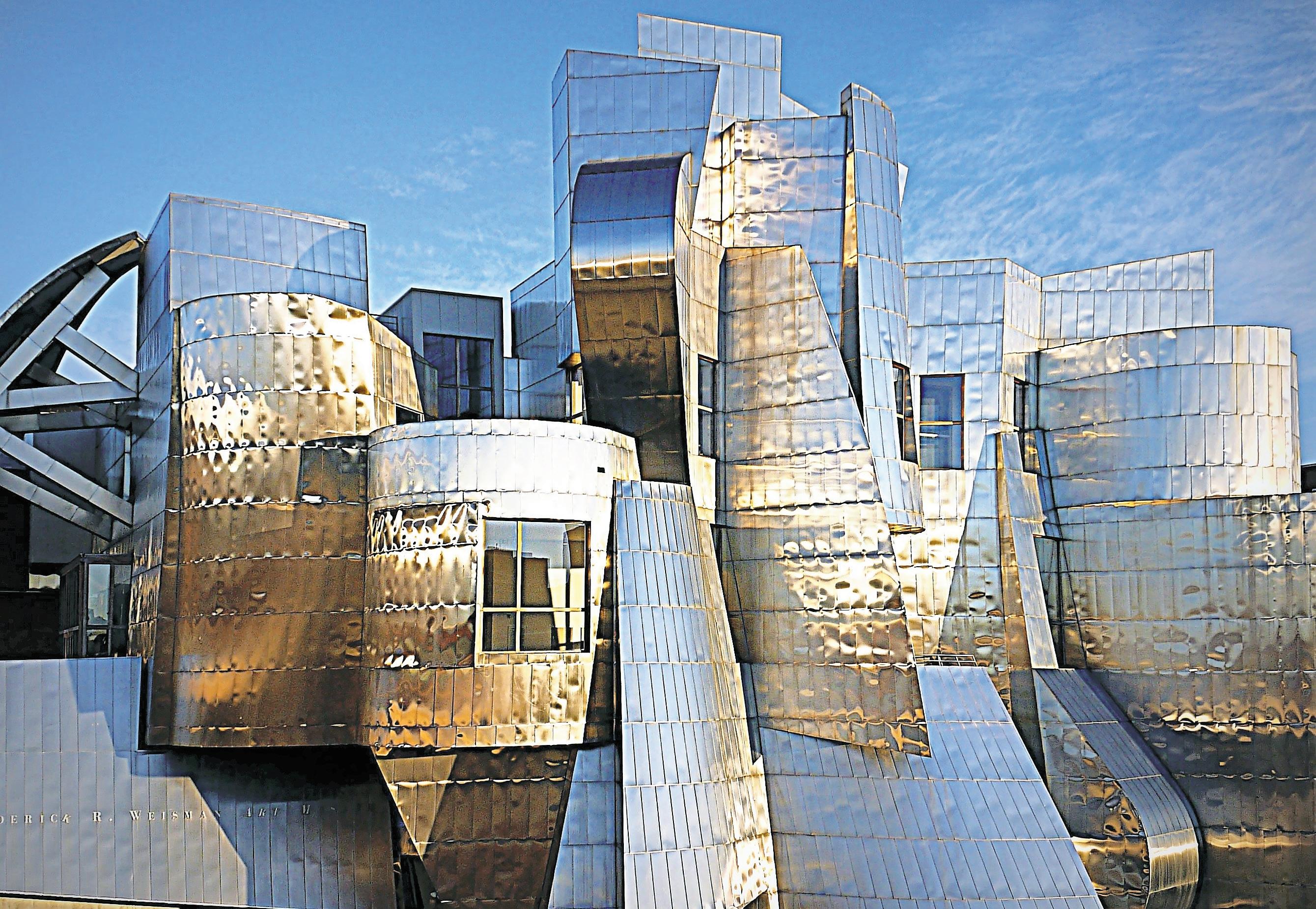
Frank Gehry, one of the most renowned architects of his era whose iconic buildings look like rolling sculptures, died in Santa Monica, Calif., on Friday. He was 96.
The artist was the “mind behind some of the most iconic architectural feats in the world,” according to California Gov. Gavin Newsom.
“Drawing on his working-class background, Frank’s designs embraced the reality of living and the beauty of the everyday,” Newsom stated. “His work encouraged imagination and freedom of thought and recognized the value and the beauty of working people and neighborhoods, seeking to make room for everyone in this world — especially the misfits like himself.”
While none of the political figures who eulogied Gehry noted that the architect — born Ephraim Owen Goldberg in Toronto on Feb. 28, 1929 — was Jewish, Sen. Adam Schiff (D-Calif.) suggested Gehry was a coreligionist without saying it outright.
“Today, we lost a giant of American architecture with the passing of Frank Gehry, whose iconic designs personified the creativity and dynamism of Los Angeles and California,” the senator stated. “May his memory be a blessing, and may his family, friends and all he inspired take comfort in the lasting legacy of his work.”
Daniel Libeskind, a renowned architect and the son of Holocaust survivors, told JNS that “even though Frank Gehry was reluctant to unveil his Jewish identity until later in life, his work displays subversion of convention.”
“That aspect is certainly a Jewish sensibility,” said Libeskind, whose many designs include the master plan for the rebuilt World Trade Center site, Jewish Museum Berlin (2001), San Francisco’s Contemporary Jewish Museum (2008) and the Wohl Centre (2005) at Bar-Ilan University in Ramat Gan in Israel.
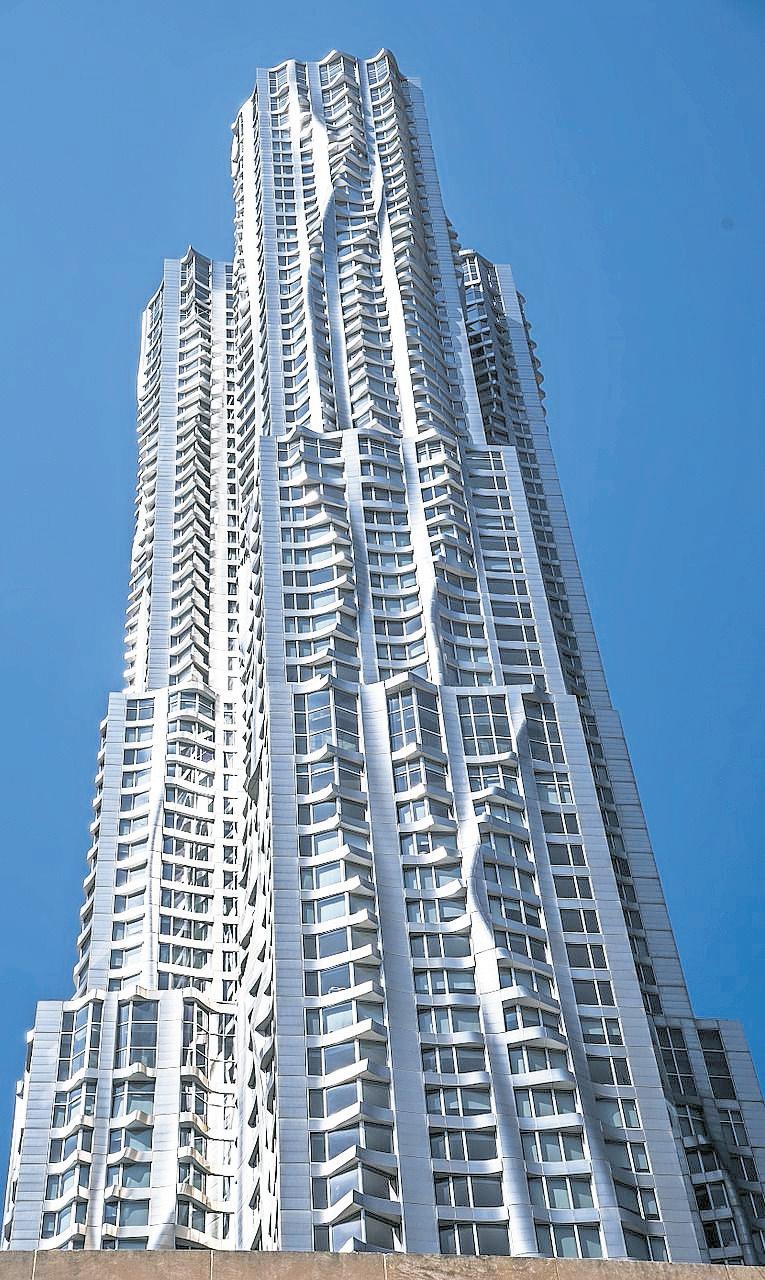
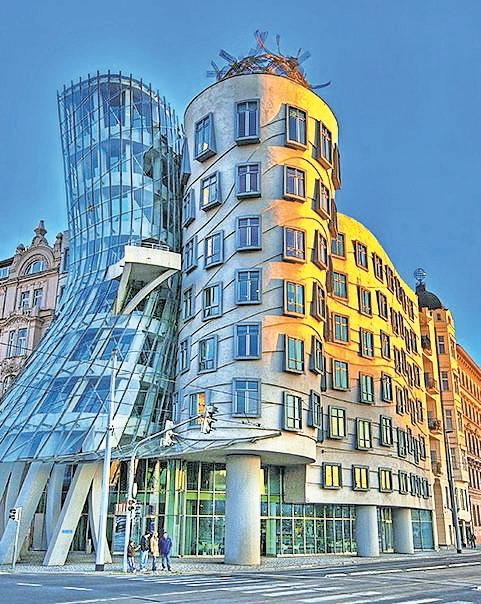










“He was renowned and remarkably successful in changing the image of architecture and paving the way for a more unorthodox approach,” Libeskind told JNS of Gehry.
When Gehry was growing up, his father moved the family to an Ontario mining town, where he supplied slot machines to local establishments until gambling became illegal there, according to the Jewish Museum in New York. The Goldbergs then moved to Los Angeles, where the artist studied architecture at University of Southern California. Before he graduated, he changed his name in 1954.
“He had been picked on as a child and wanted to be admitted to the university’s architectural fraternity,” the Jewish Museum said.
He subsequently studied at Harvard Graduate School of Design and then returned to California, where after working at other firms, founded Frank O. Gehry & Associates in 1962. In 2002, he created Gehry Partners.
The Jewish Museum showed “Fish Forms: Lamps by Frank Gehry” from Aug. 29 to Oct. 31, 2010, which included “colorful, luminous lamps,” which, it said, explored “the significance of fish imagery in Gehry’s work.” The museum showed the lamps in “near darkness to create a gallery of glowing sculptural fish lit from within.”
According to the museum, Gehry broke a piece of ColorCore, a laminate product made by the Formica Corporation. The company had asked him to create something out of the material in 1983. “The resulting shards reminded him of fish scales and gave him the idea for the fish lamps,” the Jewish Museum stated.
“The lamps are beautiful, whimsical works from a mind of great ingenuity and creativity,” Ruth Beesch, deputy director for program at the Jewish Museum who curated the show, said at the time. “They are a fantastic blending of idea and material with the translucent shards perfectly fulfilling Gehry’s artistic vision.”
The museum said that fish forms had been an “indelible and vibrant element” of Gehry’s work since the 1980s and “embodied his desire to create motion in architecture and represented a perfection that he could never realize in his buildings.”
“At a time when architects were inspired by ancient Greek temples, Gehry said, ‘If you really want to go back into the past, why not do fish?’” the museum said.
It quoted Gehry’s 1986 talk at the Walker Art Center in Minneapolis, during which he said that “in Toronto, when I was very young, my grandmother and I used to go to Kensington, a Jewish market, on Thursday morning.”
“She would buy a carp for gefilte fish. She’d put it in the bathtub, fill the bathtub with water, and this big black carp,” he said in the talk, “would swim around in the bathtub and I would play with it.”
In 2004, Gehry designed Jay Pritzker Pavilion in Chicago’s Millennium Park — near Anish Kapoor’s reflective sculpture “Cloud Gate,” which is commonly called “The Bean.”
In 2020, Gehry’s Dwight D. Eisenhower Memorial was finished in Washington, and the following year, he designed an interior expansion and renovation at the Philadelphia Museum of Art, which included a new cafe, whose ceiling evokes the architect’s iconic style — that resembles “undulating free-form sculpture,” according to Britannica.
The same year, a more than 150,000 squarefoot tower that Gehry designed in Arles, France, a city associated with Vincent van Gogh, opened on the LUMA Foundation’s 27-acre campus. The foundation called the building a “twisting geometric structure finished with 11,000 stainless steel panels.”
“We wanted to evoke the local, from van Gogh’s ‘Starry Night’ to the soaring rock clusters you find in the region,” Gehry said at the time. “Its central drum echoes the plan of the Roman amphitheatre.”
Among many architecture and other prizes that Gehry won are a National Medal of the Arts in 1998 and a Presidential Medal of Freedom in 2016.
Karen Bass, mayor of Los Angeles, stated that the city “mourns the loss of one of its most beloved and impactful cultural giants.” Gehry was “not only a legendary architect, but a true visionary who transformed the way our city, and the world, sees and experiences Los Angeles,” she said.
“Frank’s imagination reshaped our skyline into something unmistakable, iconic and unique,” she said. “His genius knew no bounds, and he displayed a magnanimous love for the cities he worked in.”
She added that over more than 60 years, Gehry “made Los Angeles his home, his canvas, and his proving ground” and that he volunteered and developed housing for homeless veterans.
Rep. Eric Swalwell (D-Calif.) stated that Gehry was the “most brilliant architect of our time,” who “had the greatest eye and most visionary mind,” but his heart “towered over every magnificent building that will forever carry his name.”
“When you talk about the most creative, worldchanging Californians of all time, I know Walt Disney, Steven Spielberg and Steve Jobs may first come to mind. But always, always remember Frank Gehry,” the congressman said. “I know I will.”
“Frank Gehry was an architectural icon whose bold designs have shaped cityscapes all over the world,” stated Mark Carney, the Canadian prime minister. “I send my condolences to his family and admirers. Frank’s work will continue to inspire generations to come.”
Rep. Nancy Pelosi (D-Calif.) called Gehry “a gentleman titan of architecture and a master communicator of the future,” who “recognized that architecture is not just designing a building — it is creating a work of art.”
He is survived by his wife Berta Aguilera and their two sons Sam and Alejandro; Brina Gehry, a daughter from his prior marriage to Anita Snyder; and his sister Doreen Gehry Nelson, according to the New York Times. The paper reported that Leslie Gehry Brenner, another daughter from his first marriage, died in 2008.


There are many ways to support Israel and its people, but this Chanukah, no gift is more transformative than one to Magen David Adom, Israel’s emergency services system. Your support of MDA isn’t just changing lives — it’s literally saving them — providing critical care and hospital transport for everyone from victims of heart attacks to rocket attacks, and every emergency in between. Donate today at MagenDavidAdom.org or call 866.632.2763.




By Debra Nussbaum Cohen, JNS
On a bitterly cold Thursday night last week, more than 1,000 Jewish New Yorkers braved the freezing temperatures to participate in a solidarity rally outside the Orthodox synagogue which was targeted by anti-Israel protesters two weeks earlier.
At the Dec. 4 rally, the mood was one of pride and determination.
“This felt like ‘We are Jewish New Yorkers. Don’t you dare [expletive] with us.’ It was the necessary response to those crazy hoodlums trying to intimidate Jews. Because we’re not going to allow it,” said Shira Dicker, a writer and publicist from the Upper West Side.
On Nov. 19, Nefesh b’Nefesh held an event at Park East Synagogue promoting aliyah when demonstrators outside chanted “death to the IDF” and “globalize the intifada,” as well as “we don’t want no Zionists here.” One organizer from the Palestinian Assembly for Liberation reportedly told the 200-person crowd, “We need to make them scared.”
“I was glad to see the Jewish community organize this rally,” said participant Daniel Treiman, an attorney who lives on the Upper East Side. “It’s really important to stand up against this abominable, genuinely hateful trend of protests outside Jewish institutions in which they chant unambiguously murderous slogans.”
The rally was organized by UJA-Federation of New York and had a long list of co-sponsors, including synagogues of every denomination and Jewish day schools.
The Federation began planning it the day after the anti-Israel protest outside Park East, said Hindy Poupko, the agency’s senior vice president for community organizing and external relations, by email.
“We held this rally to stand up for our community, our core values and our unwavering sup-
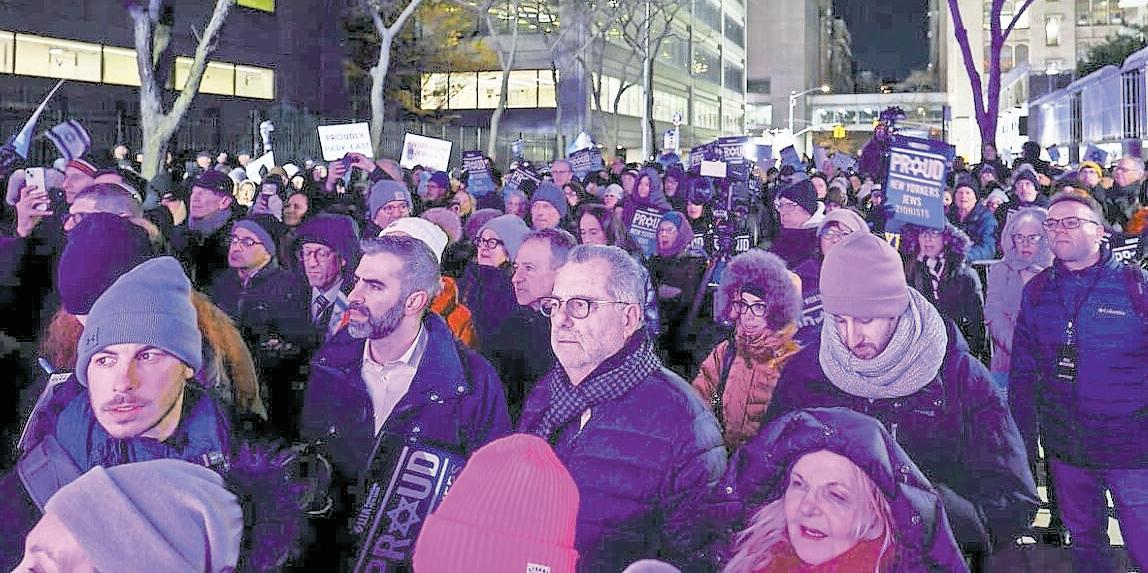
port for Israel’s right to exist as a Jewish homeland,” she said. “With nearly 100 partners for the rally, we showed we are united, strong and proud Jews, News Yorkers and Zionists.”
Speakers included Rabbi Arthur Schneier, longtime spiritual leader of Park East Synagogue and a Holocaust survivor; incoming NYC comptroller and current Manhattan Borough President Mark Levine; Rabbi Joseph Potasnik, executive vice president of the NY Board of Rabbis; Rabbi Joanna Samuels, CEO of the Marlene Meyerson JCC of Manhattan; and Rabbi David Ingber, founder of Congregation Romemu and senior director for Jewish life at 92Y.
Matisyahu sang, as did the children’s choir of Park East Day School, which sang “Am Yisrael Chai,” with many rally attendees singing along.
Anti-Israel, anti-Zionist protests are taking place worldwide. One this week picketed a donut shop in London for being Israeli-owned.
Israeli- and Jewish-owned businesses all over New York City have been damaged by graffiti and broken windows by anti-Israel protesters.
“It’s a very fraught time for Jews. Here in New York City, we never expected this. It’s been shocking in many ways,” said rally attendee Beth Mann, who works as chief development officer at the Manhattan JCC.
Speakers’ focus at the rally was on community and the centrality of Jewish presence in New York City. With 1.4 million people in the metro New York City area, it is the largest Jewish population of any city in the world after the Tel Aviv metro area.
Unlike at the anti-Israel protest outside Park East last month, police presence at the unity rally was strong, with rally-goers contained by barricades to one long block, which they mostly filled, with surrounding streets closed. Every speaker thanked the police.
New York City Police Department Commission-
DESK of RABBI S.M.
er Jessica Tisch — who is Jewish — apologized for the police not being better prepared the night of the anti-Zionist event outside Park East. This week, she apologized to incoming mayor Zohran Mamdani after her brother Benjamin Tisch, CEO of the Loews Corporation, referred to him as an “enemy” of the Jewish people at a Jewish charity benefit.
Mamdani has said that he will keep Tisch on as police commissioner and that he will appoint an antisemitism senior adviser once he takes office.
Mamdani, who responded to November’s anti-Israel protest at Park East Synagogue with what many Jewish New Yorkers considered a problematic statement, was not mentioned by name at the rally. The mayor-elect’s press secretary said after the Park East protest that all New Yorkers have the right to enter their places of worship unimpeded by intimidation, but also that “sacred spaces should not be used to promote activities in violation of international law.”
Concern about the influence and impact of his staunch anti-Zionism and anti-Israel views wasn’t far from many rally attendees’ thoughts even though his name wasn’t mentioned.
Naomi Mark, a psychologist who lives on the Upper West Side and participated in the rally, said that she thought the strategy of not citing Mamdani’s name “was wise.”
“They have to work for the better good. That is the message that our leaders have to promote,” said Mann, the Manhattan JCC official who lives in Stuyvesant Town. “We need leaders who inspire us to be better.”
Dicker said “one of the conversations around every Shabbat dinner table is what people’s Plan B is,” or where they will go if things get even worse for Jews in New York City. But, said Mark, “We are trying to hold on to our vision of New York, loving America and loving Israel. We’re not going anywhere so fast. We can’t be erased. People aren’t surrendering.”
Note the ACCOLADES from our CLIENTS
RE: SYNAGOGUES and YESHIVOS
Dear Rabbi Leiner,
Thank you for replacing the Insurance for our Synagogue, with a Savings of almost 50%.
B.F. Executive Director
RE: REAL ESTATE CORPORATION
Dear Rabbi Leiner, You and Your Experts, have saved our Corp. Very Substantial Sums, with your Quality Insurance Replacement on our Real Estate Buildings. Thank you, M.B. Pres.
RE: HOMEOWNERS INSURANCE
Dear Rabbi Leiner, Our Insurance Company Refused to renew our Insurance Homeowners Policy. However, You and Your Experts were able to Secure for us other Insurance Coverage, even at a much lower Premium, than the Prior Canceled Insurance Policy. Thank You So Much. Mrs. D.S.
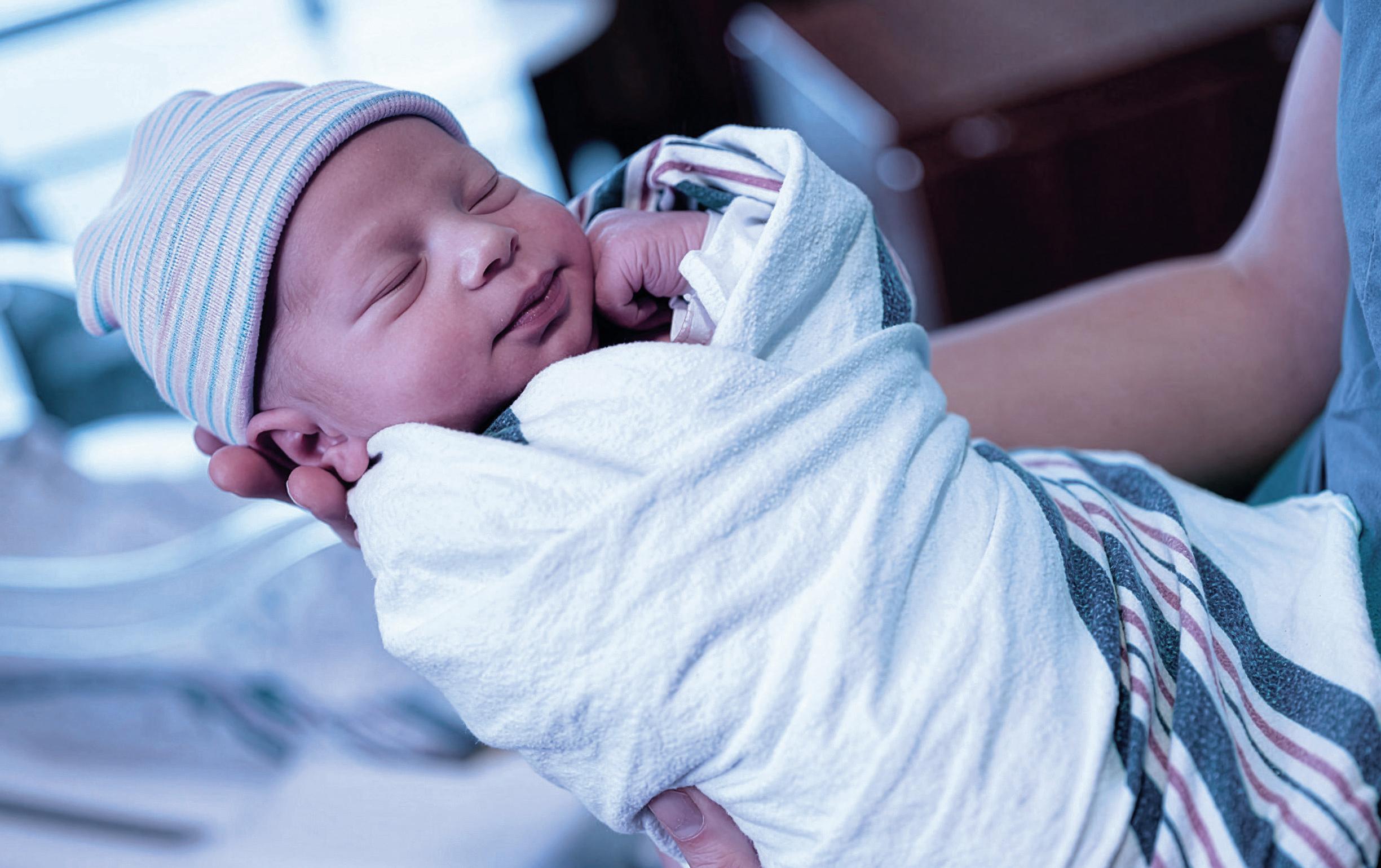
If you’re getting ready for the birth of your baby, choose Mount Sinai South Nassau, the only hospital on the South Shore to be rated High Performing in maternity care four years in a row by U.S. News & World Report ® We’re proud to provide safer, more empowering experiences for mothers and babies through:
• Reduced C-section rates for low-risk, first-time mothers
• Increased VBAC rates
• Low rates of unexpected newborn complications
• Commitment to exclusive human milk feeding
• Transparency on racial/ethnic disparities
• Low episiotomy rates
• Birthing-friendly practices
Learn more at southnassau.org/maternity, or call 877-SOUTH-NASSAU.
Yeshiva of Central Queens hosted a Yom Yachad, with achdut, tzedakah and cheer, bringing together 300 seventh-grade girls from seven yeshivot — Barkai, JFS, Hillel, Magen David, HALB, Yeshivah of Flatbush and YCQ.
YCQ’s principal, Rabbi Mark Landsman, opened the event, followed by words from Mashie Kopelowitz, director of Judaic studies, and Yakir Wachstock, founder of the Boots for Israel organization.
Wachstock described how his group
came to be and the continuing need. Representatives from each school presented him with the donations.
Students united to sing songs like Acheinu and ended the program with a sense of togetherness.
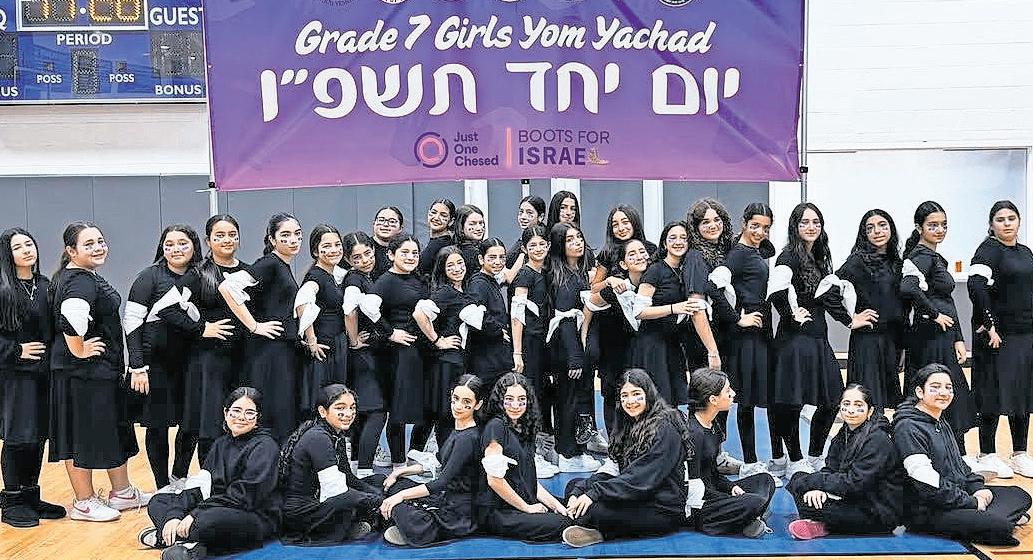

During the lunch that followed, girls from different neighborhoods and yeshivot mingled and forged new friendships.
Students returned to their homes with a renewed sense of community and shared purpose.
YCQ thanks Morah Tali Brody for leading its students in dance, and Jacob Grossman (Director of Junior High School Student Activities) for organizing the event.
At the Yeshiva University High School for Girls (Central), academic excellence takes many forms.
Now in its third year, the Adira Rose Koffsky A”H Humanities Scholars Program (helmed by Humanities Department Chair and Director of College Guidance Rena Boord, pictured) continues to offer an immersive experience for students who demonstrate talent in literature and visual or performing arts.
“The program’s objective is to get the students excited about the humanities,” Boord said. “There’s something about sitting in a small group and talking about literature and artwork. That experience can bring work to life.”
Established in memory of

2022 alumna Koffsky, who was a beacon of the creative and performing arts while a student at Central, the program guides participants in exploring major works of literature through the lens of history, art, and philosophy.
“They have to commit to the humanities in a
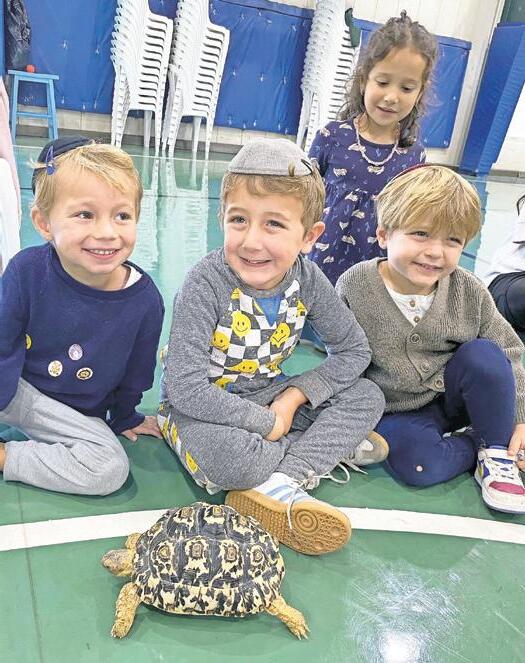
Leading up to Parshat Noach, Party Pets visited Lev Chana and HALB. Students had a great time learning about and petting the animals and reptiles!
whole-hearted way in order to strengthen their connection,” Boord said.
Semester plans include the Broadway show “& Juliet,” a lecture from YU’s Dr. Ann Peters, who will address the current junior and senior reading assignment, “The Age of Innocence,” and a trip to YU’s Stern College Dramatics Society for a play.
Central’s Rambam Bekiut program is a cornerstone of the school’s Judaic Studies curriculum. Led by YUHSG’s Rosh Beit Midrash, Judaic Studies faculty Rabbi Zvi Lew, it is designed for students seeking deeper Talmudic exploration, with participants engaging in guided study all four years of high school.
Another program is the
Science Institute. Junior Annabelle Klein presented her summer research project, ”The Effect of DNA Protective Buffers on Recovering DNA Evidence From Challenging Samples,” at Hofstra University’s Summer Science Research Program poster session. And senior Kayla Etra was chosen to present her project, “Performance Enhancement of Anion Exchange Membrane Fuel Cells via ZnO Atomic Layer Deposition and Silver Nanoparticle LB Trough Coating,” at the Materials Research Science conference in Boston.
By
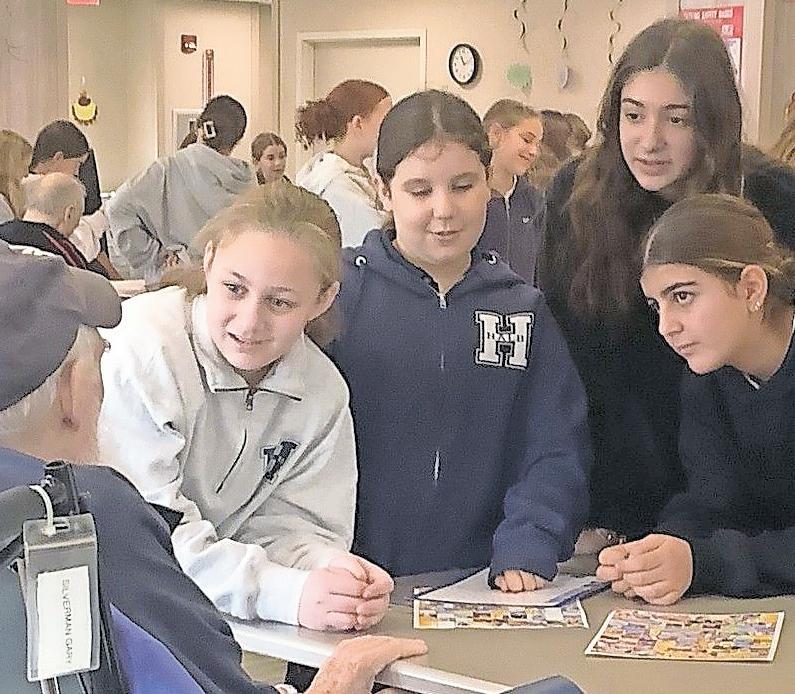
HALB sixth grade students spent one morning this week visiting the residents at the Five Towns Premier Nursing and Rehabilitation Center. They paired up with different residents and enjoyed working on Chanukah projects, singing, dancing and simply talking and spending time together. It was a special morning for the students, the morot and the residents alike.
Elizabeth Pinkhasov, Sophomore HAFTR High School’s open house showcased the school’s impressive facilities and innovative curriculum.
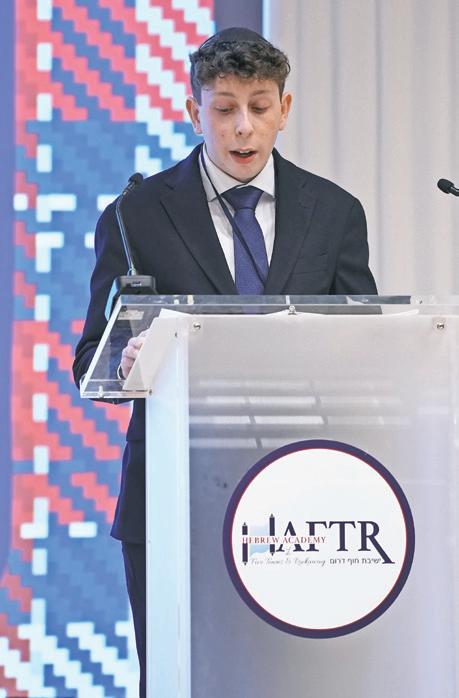
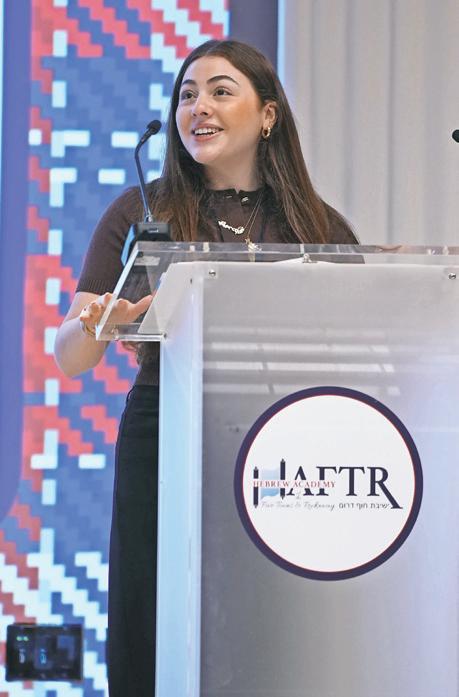
As prospective students and their parents entered the building, they were welcomed with banners, upbeat music, and warm smiles. The program began with welcoming remarks from aomi Lippman, head of school; Dr. Joshua Wyner, principal; Rabbi Ira Wallach, rosh yeshiva, and Student Council Presidents Tehilla Kaffash and Zachary Strauss (pictured).
Participants were able to glimpse HAFTR life through an engaging podcast video featuring students sharing their positive experiences.
Participants broke up into groups and began touring the building, stepping into classrooms, meeting teachers, and experiencing a bit of what a day at HAFTR feels like.
They attended informational sessions and mini-lessons, getting a preview of many of HAFTR’s engaging courses, including in the Humanities, Limudei Kodesh, STEAM, and Science Departments.
Parents participated in “Creating Connections,” where they could speak with adminis-
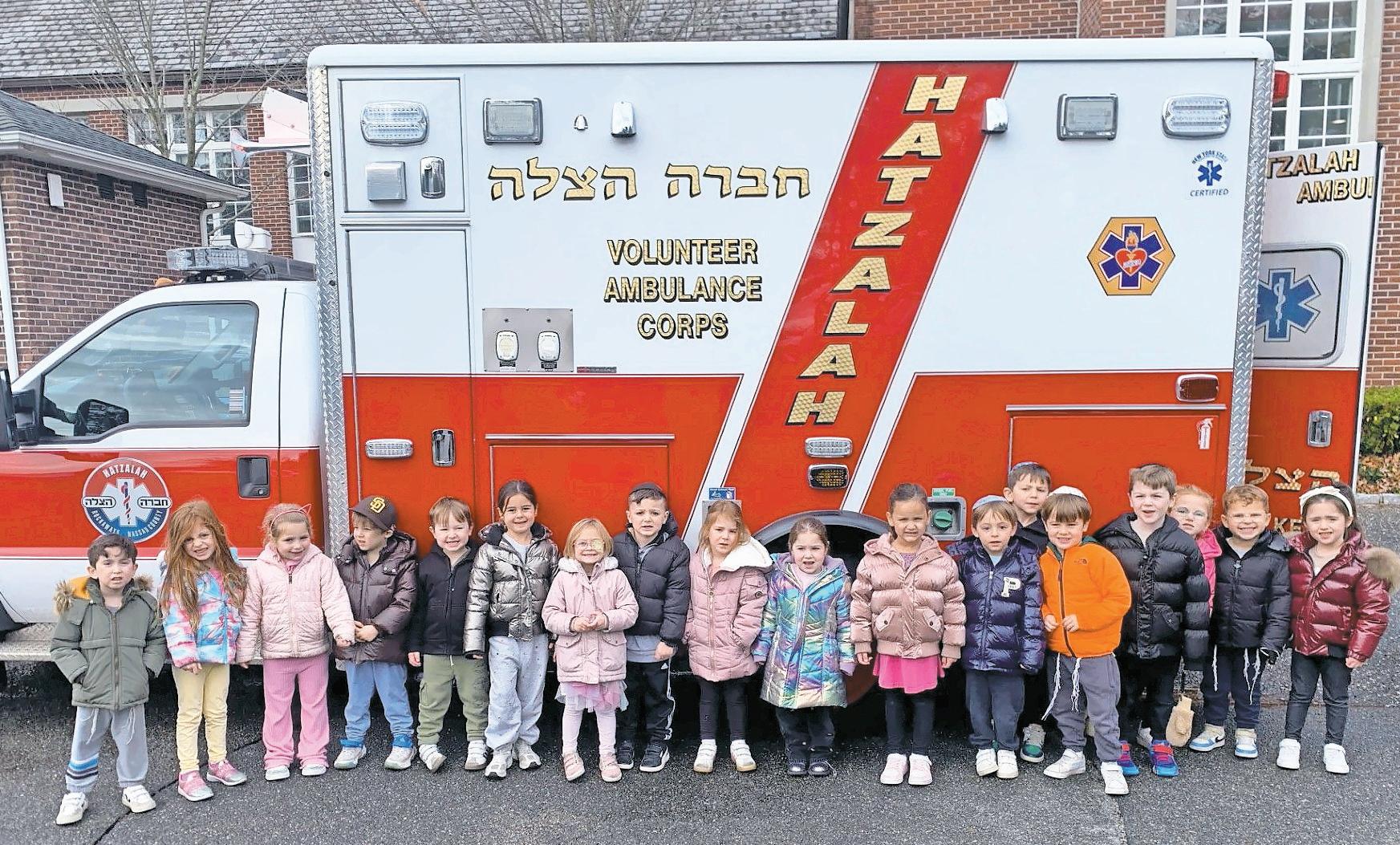
While learning about the letter “hey” students got a special visit from a Hatzolah truck! They learned all about how Hatzolah helps people in the community and they even got to try on some of their gear.
tration and faculty in a round-robin format. Meanwhile, students met with Elie Hirt, student engagement and ecruitment coordinator, and student representatives.
After the tour, everyone gathered in the gym for a beautiful collation, ending the program on a delicious note.
Visitors saw a display of clubs and extracurricular programs, learned about academic support and college counseling, explored displays from the Technology and Innovation Center and Art Institute, STEM and Robotics projects, and digital design work that showcased the hands-on spirit at HAFTR High School.
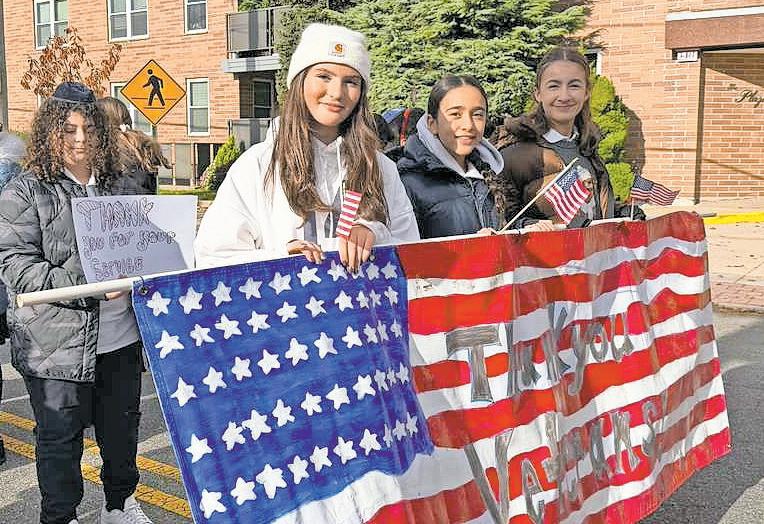
Students from grades N3 through 8 at Brandeis Hebrew Academy marched through the community to honor the men and women who have served America.
The event was a meaningful reminder of the values of service, respect and unity
Brandeis is proud of its students for demonstrating such enthusiasm and appreciation as they paid tribute to our nation’s heroes.
Kosher Kitchen
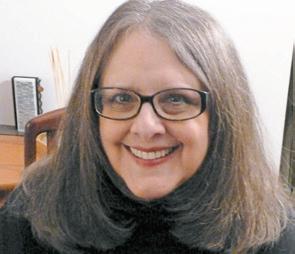
JoNI SchocKEtt Jewish Star columnist
t’s latke time! I have loved latkes since I was very little — but I rarely eat them except at Chanukah.
I come from a long line of once-a-yearlatke makers. My grandmother made latkes only once a year. My aunts made latkes once a year. My mother made latkes once a year. So, once a year, we had at least eight days of latkes. The rest of the year we dreamed about the latkes we would have the next year.
The latkes my grandmother made were delicious. They were also deadly. She made them with homemade schmaltz and the gribenes she made every Shabbat. As this special Chanukah batch of gribenes cooled, she chopped them and added them to the potato mixture, deftly removing the pieces of chicken skin and adding only the deep golden onions.
She then shredded the potatoes on an old grater that had a crisscross of wires, in a frame with a metal handle. She placed this over her wooden bowl and grated away for a very long time. My mother inherited that device and discovered it was perfect for grating hard boiled eggs for egg salad and nothing more.
My mother made her latkes with an old fashioned box grater. By the time the last potato was grated, (and her knuckles bandaged) the first potatoes were already browned. Grating the onion was brutal; she always sent me out of the room. She (and my aunts) used a mixture of something called Nyafat (fake schmaltz) and Crisco for frying.
Today, we peel a potato, place it in a large feed tube and in about 5 minutes, we have a mound of perfectly white grated potatoes. Onions are chopped in a snap, and we can use all kinds of fats for frying. Plus, nothing says that latkes can only be made with potatoes, so we experiment and add lots of healthy veggies to the mix.
Given our modern conveniences, there is no excuse for not making latkes year-round. I make mine in my air fryer (fewer calories and almost no oil). And, if you are averse to totally potato latkes, you can make these which use
lots of veggies and very little potato. Are they calorie savers? It’s Chanukah! You can worry about calories for the other 51 weeks because, even though we can, we probably won’t make latkes again until next Chanukah!
• 1/4 cup Canola Oil
• 1 large onion, chopped
• 2 shallots, thinly sliced
• 1 carrot finely shredded
• 1 cup fresh baby spinach leaves, chopped
• 2 to 3 scallions, chopped
• 5 cups mashed potatoes, unseasoned
• 1 egg
• 1 to 2 Tbsp. flour
• 1/2 tsp. baking powder
• 1 tsp. salt, or to taste
• Freshly ground pepper, to taste
• FOR DAIRY: 3/4 cup grated Parmesan cheese or grated smoked Gouda
• Oil for frying
• Optional: Breadcrumbs, plain or Panko for coating for crispier latkes. Heat a large skillet and add half of the oil. Add the onions and shallots and caramelize for 15 to 20 minutes over medium-low heat, until deep golden brown. Set the onions aside in a large bowl. Add the rest of the oil to the pan and add the carrots. Sauté for about 2 minutes or until the carrots begin to soften. Add the spinach and cook until wilted. Add the scallions and heat for 1 minute. Add the mixture to the onions and mix well. Mash the potatoes (through a ricer if possible) to a smooth consistency. Add the egg, flour, baking powder, and salt and pepper and mix well. Add to the onion mixture. Add the cheese and mix thoroughly. Add more flour to thicken the mixture, if needed, and then form patties. Dip in bread crumbs, if desired, for a crispier latke. Place on a plate.
Take a large, clean skillet and heat for a few seconds or until a tiny drop of water skittles across the pan and evaporates. Add a quarter to inch of oil to the pan and let it heat until shimmery. Add the patties and let cook until deep golden on the bottom. The latke should move easily and freely when cooked properly. Flip once and cook until golden. Drain on brown paper while completing the latkes. Makes about 12 to 18 latkes.


• 1 head cauliflower, cut into 1 inch florets
• 1 large onion, chopped
• 1 leek, about 6 to 8 inches of white part, sliced
• 2 to 3 cloves garlic
• 2 to 3 Tbsp. freshly chopped flat leaf parsley
• 1 tsp. fresh dill, minced
• 1 zucchini, about 6 to 8 inches
• 1 large Russet potato, peeled
• 2 extra-large eggs
• 1 tsp. baking powder
• 1 tsp. salt, to taste
• 1/2 tsp. black pepper, to taste
• 1/4 to 1/2 tsp. cayenne pepper or Aleppo pepper
• 1/2 to 2/3 cup breadcrumbs
• 1/3 to 1/2 cup extra virgin olive oil
Place the cauliflower florets in a pot of boiling water. Cook until fork tender. Drain thoroughly. Place half the cauliflower in the bowl of a food processor and pulse until very smooth. Transfer to a large bowl. Place the onion, leek, and garlic in the processor and pulse until very finely chopped and a bit liquid-y. Add to the bowl. Place the remainder of the cauliflower, the parsley and dill in the processor and pulse until chopped into 1/8 –inch pieces. Transfer to the bowl.
Change to a fine shredding disc and shred the potato and the zucchini. Place in a colander and press out as much liquid as possible. Add to the bowl and mix well.
Add the eggs, baking powder, salt, black pepper and Aleppo or Cayenne pepper and mix well. Add enough of the breadcrumbs to make a mixture that will hold together. Add more breadcrumbs, if needed.
Heat a large skillet. Add 1/3-inch canola oil and, when shimmery, add tablespoons of the mixture. Flatten to 2 to 3-inches across. Fry, undisturbed until you can see deep golden up the sides of the latkes. Flip and cook until golden. Place on brown paper to drain. Makes about 2 dozen latkes.
• 2 lbs. red skinned potatoes
• 1 leek, white part only, about 5 inches each, sliced, washed and drained
• 2 small shallots
• 2 to 3 scallions, green part only
• 1 small can artichoke hearts, (about 8 to 10 ounces total) drained well, chopped
• 2 cups baby spinach leaves roughly chopped
• 2 extra-large eggs
• 1 tsp. salt, to taste
• 1/2 tsp. black pepper, to taste
See Latkes bring a new taste on page 14
































































































































Continued from page 2
maintaining relationships with progressive allies over confronting a candidate who threatens the Jewish community specifically.
The result is rationalization: the candidate’s views are “evolving,” the concerns are “exaggerated,” and engaging would be “divisive.” These organizations choose coalition comfort over communal protection.
Some Jewish organizations believe that building relationships with problematic candidates will moderate their behavior once in office. They offer endorsements or refrain from criticism in exchange for promised “dialogue” or “access.”
This is a losing trade. Mamdani-type candidates benefit from Jewish organizational cover during the campaign the one moment when they are vulnerable and face no accountability for policy development and implementation afterward.
Before raising public concerns, build a comprehensive record. Archive socialmedia posts, especially anything that may be deleted as a campaign approaches. Collect student newspaper articles, organizational newsletters and event announcements from the candidate’s campus years. Obtain disclosure forms via public records requests and cross-reference them against public statements. Screenshot LinkedIn profiles, organizational bios and conference speaker listings. Record public statements at candidate forums and community events.
Documentation transforms suspicion into evidence. Without it, concerns are easily dismissed.
The window for effective intervention is narrow. By the time concerns reach mainstream awareness, early voting may have begun. Raise issues publicly as soon as a candidate announces, not during the final weeks of a campaign.

If a candidate lies about their history, say so with evidence. If they deny affiliations that appear on disclosure forms, publish the discrepancy. If institutions provide cover, name them and explain why their assurances should not be trusted.
Silence creates the false impression that there is nothing to be concerned about. Do not be silent.
Mamdani-type candidates do not rise alone. They benefit from endorsements, appointments and political cover provided by other officials. These enablers must face consequences for their role in advancing anti-Israel candidates.
When a sitting official endorses a Mamdanitype candidate, they are lending their credibil-
ity to legitimize that candidate’s record. Track these endorsements. Make clear that endorsing candidates with anti-Israel, antisemitic backgrounds will be remembered and will affect future support, donations and endorsements in their own races.
Silence is also a choice. When a Mamdanitype candidate emerges and elected officials who should know better refuse to speak up, they are prioritizing their own political comfort over their community’s well-being. Document which officials remained silent when it mattered. Their silence should be a factor in future electoral support.
Some officials will acknowledge a candidate’s troubling background but urge voters
to overlook it, arguing that the candidate has “evolved,” that the concerns are “overblown,” or that other issues are more important. This minimization is as damaging as outright endorsement. It provides cover while maintaining plausible deniability.
The goal is to create a political cost for enabling Mamdani-type candidates. If officials know that endorsing, appointing, excusing, or staying silent about anti-Israel candidates will affect their own standing with pro-Israel voters and donors, they will calculate differently. Accountability must extend beyond the candidates themselves to the network that elevates them.
If you are reading this article, you likely already suspect that something is wrong. A candidate in your community has a troubling background. You’ve raised concerns and been told to stand down. You’re uncertain whether to trust your instincts or defer to organizations with more experience and resources. Trust your instincts.
The tactics documented here are not theoretical. They have succeeded in communities across the country. They succeed because concerned individuals are talked out of acting by institutions that prioritize comfort over confrontation.
You do not need permission from legacy organizations to protect your community. You need documentation, coordination and the willingness to act before Election Day, not after. The warning signs are visible. The tactics are documented. The counter-strategies are clear. The next election is mere months away. The question is whether our communities will be ready.
Dillon Hosier is CEO of the Israeli-American Civic Action Network. Charles Jacobs heads the Jewish Leadership Project.
Write: Columnist@TheJewishStar.com
from page 12
• 1/2 tsp. dried oregano, to taste
• 1/2 cup unbleached flour
• 3/4 to 1-1/4 cups breadcrumbs
• 1 to 2 cups Canola oil for frying
Wash the potatoes carefully and cut out any imperfections. No need to peel unless you prefer to. Using the medium shredding disc, process the potatoes and place in a colander over a bowl. Let drain.
Change to the s-blade and chop the leeks, shallots and scallions into very small pieces. Transfer to a large bowl.
Squeeze out any more moisture from the potatoes and add to the leeks. Process the artichoke hearts until chopped into pieces about 1/4–inch. Add to the bowl. Mix well. Add the spinach and mix well. Add the eggs, salt and pepper, oregano, and flour and mix well. Add the feta cheese and mix. Add just enough breadcrumbs to hold the mixture together. Form 3-inch patties and place on a lightly floured plate.
Heat a large skillet and add the oil. Heat until shimmery and then add several patties. Fry until deeply golden on one side. Flip carefully and fry until golden on both sides. Let drain on brown paper. Repeat, adding more oil as needed. Season with salt and pepper and serve hot. Makes 20 to 30 latkes. Serve with Tzatziki Sauce.
A rosti is a Swiss potato “latke” that is partially fried on top of the stove and finished in the oven.
• 4 to 6 large Russet potatoes
• 1/2 stick pareve Trans-fat free margarine
• 1/2 cup Canola oil
• 2 to 3 large onions, finely minced
• 2 large leeks, finely minced
• 4 to 5 shallots, finely minced, enough to

equal 1/2 cup
• 2 tsp. kosher salt
• 1/2 tsp. freshly cracked black pepper
• 1 tsp. onion powder
• 1 egg
• 1/4 cup flour
Preheat the oven to 450 degrees.
Peel and process potatoes using the fine grating disc of the food processor. Pour the potatoes in a colander and drain any liquid. Process the onion, leeks and shallots with the regular “S” blade of the processor until finely minced, but not liquidy. Pour into a large bowl. Add egg, flour, salt, onion powder and pepper and mix well. Add the drained potatoes, squeezing out any excess liquid as you transfer them. and mix thoroughly.
Heat a large oven-proof skillet (cast iron works the best) and add half the oil and half the margarine. When bubbly, add half the potato mixture and smooth the top. Cook for 10 to 15 minutes, but do not move the latke. When the bottom is golden brown, drizzle some oil over the top of the latke and place in the oven for 10 to 20 minutes, or until deep golden brown. Carefully remove the pan from the oven and let cool for 5 to 10 minutes. Run a knife around the edge of the latke to loosen and place a large plate or foil lined cookie sheet over the pan and invert. The latke should slip out with just a bit of coaxing.
Repeat with the rest of the potato mixture. Reheat the first latke in the oven with the second
one for 3 to 5 minutes. Sprinkle with salt and or pepper, to taste. Cut into pie-like wedges, 4 to 8 per large latke. Makes two large latkes that will serve 8 to 12 people.
Shred the potato, carrot, celeriac, parsnip, and beet in a food processor using a fine shredding disc. Remove them to a strainer over a large bowl and replace the shredding disc with the “s” blade.
Cut the onions in cubes and process until finely chopped but not liquidy.
Scrape the draining vegetables into a large bowl and add the onions. Mix well. Add the eggs, matzo meal or flour, salt and pepper. Mix well.
Heat a large, heavy skillet until a drop of water “dances” across the pan and evaporates. Add about an inch of oil and heat for a few seconds. Slide spoonfuls of the vegetable mixture into the oil and fry until golden brown, 6 to 8 minutes. Gently turn and cook until golden. Drain on paper bags or paper towels and serve hot. Makes about 12 latkes.
Write: Columnist@TheJewishStar.com
Temple Sholom, Ohio
Bexley is an upper-middle-class enclave in Columbus, Ohio, where many, if not most, of the area’s Jewry lives. There are four synagogues on Broad Street, the busy thoroughfare that runs through it: two Orthodox, one Conservative and one Reform. On any given Saturday morning, observant Jewish residents can be seen walking on the sidewalks of Broad Street to synagogue. Given where they live, Bexley Jews are empirically successful and “well-off” financially. This, according to some, qualifies them as being considered “white.”
Assigning the adjective “white” as a pejorative to Jews is currently in vogue, especially among pundits on the left. Books such as Karen Brodkin’s “How Jews Became White Folks and What That Says About Race in America” and articles such as Dave Schechter’s “Are Jews White? Yes and No” opine on the subject.
Count me as one who would also assign the adjective “white” to describe some of the Jews walking on to shul Broad Street, though not for the same reasons.
What do I mean?
In my capacity as a volunteer shomer guard at one of these synagogues, I’m stationed in a place that provides a view of Broad Street. Despite calls advocating for self-protection and situational awareness in a time of rising antisemitism, the reality is that in far too many places, Jews do not pay attention to their surroundings — in this case, despite cars driving in both directions on a busy street with the very real possibility of unanticipated “drive-by” attacks. What makes these Jews “white”?
According to “Cooper Color Code,” which rates levels of situational awareness, white is the color assigned to individuals who pay virtually no attention to their surroundings.
The code posits five conditions of awareness/ preparedness, each assigned a color:
•The first is white. White represents complete unawareness and unpreparedness. A person in that condition is not paying attention to his or her surroundings and therefore probably not prepared to respond to a potential threat. Being focused on one’s cellphone or daydreaming are prime examples — as is walking casually on a busy street wearing a kippah and tallit — and not even occasionally turning one’s head to observe cars going by. Condition white is fine when at home, sitting in one’s living room or study, or at the Shabbat dinner table with the doors and windows securely locked. It is not fine when walking down a main thoroughfare and being readily identified as “Jewish.”
•The next condition is yellow. This indicates a state of “relaxed” awareness. A person who is in this condition is aware of his or her surroundings and is prepared to respond if necessary. Staying in “yellow” makes a person more inclined to notice potential threats, giving more time to react. It is recommended that a person stay in this condition whenever he or she is outside one’s home or any other secure space.
•Orange is when there is a heightened alertness. You may notice a person behaving in a suspicious way, which causes increased vigilance and planned responses on your part. A person can remain in condition orange for a long period of time, though it can be physically and mentally draining.
•Facing a direct threat means the situation is a condition red. The threat has been
identified, and the response is one of focused alertness and a clear plan of action. This may mean escape, a call for help, the use of physical force (armed or unarmed), or possibly all three. Essentially, condition red signals the time for action — whatever action may be best for the individual, given the circumstances.
•Black represents being overwhelmed by panic and stress caused by a physical attack and an accompanying inability to respond effectively.
Regular training for maintaining situational awareness is essential for the code to be most effective. But training is only effective when a person is mentally and physically prepared.
For too long, conventional wisdom among American Jews has been that it’s their fate to be victims. Perhaps victimhood as a default position has contributed to our “white”-ness.
But recent events — beginning with the mass shooting at the Tree of Life*Or L’Simcha synagogue in Pittsburgh in 2018, another shooting six months later at Chabad of Poway, Calif., and culminating in the mass-casualty terrorist attacks in Israel on Oct. 7, 2023 — have given the extended Jewish community clear signals that it cannot wallow in victimhood any longer, and that remaining “white” can and will be hazardous to their individual and collective health.
From a practical perspective, adopting Jeff Cooper’s code into our daily routine is advisable. In other words, it is time that “white” Jews in America become Jews of “color.”
From a religious perspective, adhering to this code is a useful aid that can be viewed as reminiscent of the covenant given at Sinai, part of which commands: “Rak hee-shamair l’kha u-shmor nafshekha (Be sure to take utmost care, and guard yourself scrupulously)” (Deuteronomy 4:9).
Write: Columnist@TheJewishStar.com

















































Jewish Star Torah columnists: Rabbi Benny Berlin, spiritual leader of BACH Jewish Center in Long Beach; Rabbi Avi Billet of Anshei Chesed, Boynton Beach, FL, mohel and Five Towns native; Rabbi Binny Freedman, rosh yeshiva of Orayta, Jerusalem; Dr. Alan A. Mazurek, former ZOA chair, retired neurologist, living in Great Neck, Jerusalem and Florida.
Contributing writers: Rabbi Sir Jonathan Sacks zt”l, former chief rabbi of United Hebrew Congregations of British Commonwealth; Rabbi Yossy Goldman, president South African Rabbinical Association; Rabbi Dr. Tzvi Hersh Weinreb, OU executive VP emeritus.
To submit commentary, inquire at: Editor@TheJewishStar.com.
Contact our columnists at: Columnist@TheJewishStar.com.
Fri Dec 12 / 22 Kislev
Vayeshev • Shabbat Mevarchim
Five Towns candles: 4:10 • Havdalah: 5:19
Scarsdale candles: 4:09 • Havdalah: 5:13
Fri Dec 19 / 29 Kislev
Miketz • Chanukah
Five Towns candles: 4:12 • Havdalah: 5:21
Scarsdale candles: 4:11 • Havdalah: 5:16
Fri Dec 26 / 6 Teves
Vayigash
Five Towns candles: 4:15 • Havdalah: 5:25
Scarsdale candles: 4:14 • Havdalah: 5:20
Fri Jan 2 / 13 Teves
Vayechi
Five Towns candles: 4:21 • Havdalah: 5:31
Scarsdale candles: 4:20 • Havdalah: 5:25
Five Towns Candlelighting: From the White Shul, Far Rockaway, NY
Scarsdale Candlelighting: From the Young Israel of Scarsdale, Scarsdale, NY
rabbi Sir
JonaThan
SaCkS zt”l
The deception has taken place. Joseph has been sold into slavery. His brothers dip his coat in blood. They bring it back to their father, saying: “We found this. Try to identify it. Is it your son’s robe or not?” Jacob recognizes it and replies, “It is my son’s robe. A wild beast must have eaten him! Joseph has been torn limb from limb!” We then read: Jacob tore his clothes, put sackcloth on his loins, and mourned for his son for many days. All his sons and daughters tried to comfort him, but he refused to be comforted and said, “I will go down to Sheol (to the grave) mourning for my son.” His father wept for him. Gen. 37:34–35
There are laws in Judaism about the limits of grief —shiva, sheloshim. There is no such thing as a bereavement for which grief is endless. The Talmud says that G-d admonishes one who weeps beyond the appointed time, “You are not more compassionate than I.” And yet Jacob refuses to be comforted.
A Midrash gives a remarkable explanation. “One can be comforted for one who is dead, but not for one who is still living,” it says. In other words, Jacob refused to be comforted because he had not yet given up hope that Joseph was still alive
That, tragically, is the fate of those who have lost members of their family (the parents of soldiers missing in action, for example) but have as yet no proof that they are dead. They cannot go through the normal stages of mourning because they cannot abandon the possibility that the missing person is still capable of being rescued. Their continuing anguish is a form of loyalty; to give up, to mourn, to be reconciled to loss is a kind of betrayal. In such cases, grief lacks closure. To refuse to be comforted is to refuse to give up hope.
Yet on what basis did Jacob continue to hope? Surely he had recognized Joseph’s bloodstained coat — he said explicitly, “It is my son’s robe. A wild beast must have eaten him! Joseph has been torn limb from limb!” Do these words not mean that he had accepted that Joseph was dead?
Why was Jeremiah sure that Jews would return? Because they refused to be comforted — meaning, they refused to give up hope.
The late David Daube made a suggestion that I find convincing. The words the sons say to Jacob — haker na, literally “identify it please” — have a quasi-legal connotation. Daube relates this passage to another, with which it has close linguistic parallels:
If a man gives a donkey, an ox, a sheep, or any other animal to his neighbor for safekeeping, and it dies or is injured or is taken away while no one is looking, the issue between them will be settled by the taking of an oath before the L-rd that the neighbor did not lay hands on the other person’s property. … If it (the animal) was torn to pieces by a wild animal, he shall bring the remains as evidence and he will not be required to pay for the torn animal. Exodus 22:10–13
The issue at stake is the extent of responsibility borne by a guardian (shomer). If the animal is lost through negligence, the guardian is at fault and must make good the loss. If there is no negligence, merely force majeure, an unavoidable, unforeseeable accident, the guardian is exempt from blame. One such case is where the loss has been caused by a wild animal. The wording in the law — tarof yitaref, “torn to pieces” — exactly parallels Jacob’s judgment in the case of Joseph: tarof toraf Yosef, “Joseph has been torn to pieces/limb from limb.”
We know that some such law existed prior to the giving of the Torah. Jacob himself says to Laban, whose flocks and herds had been placed in his charge, “I did not bring you animals torn by wild beasts; I bore the loss myself” (Gen. 31:39).
This implies that guardians even then were
exempt from responsibility for the damage caused by wild animals. We also know that an elder brother carried a similar responsibility for the fate of a younger brother placed in his charge, as, for example, when the two were alone together. That is the significance of Cain’s denial when confronted by G-d as to the fate of Abel:
Am I my brother’s keeper (shomer)?” Gen. 4:9
We now understand a series of nuances in the encounter between Jacob and his sons upon their return without Joseph. Normally they would be held responsible for their younger brother’s disappearance. To avoid this, as in the case of later biblical law, they “bring the remains as evidence.”
If those remains show signs of an attack by a wild animal, they must — by virtue of the law then operative — be held innocent. Their request to Jacob, haker na, must be construed as a legal request, meaning, “Examine the evidence.” Jacob has no alternative but to do so, and by virtue of what he has seen, to acquit them.
A judge, however, may be forced to acquit someone accused of a crime because the evidence is insufficient to justify a conviction, while still retaining lingering private doubts. So Jacob was forced to find his sons innocent, without necessarily trusting what they said. In fact, Jacob did not believe it, and his refusal to be comforted shows that he was unconvinced. He continued to hope that Joseph was still alive. That hope was eventually justified: Joseph was still alive, and father and son were ultimately reunited.
The refusal to be comforted sounded more than once in Jewish history. The prophet Jeremiah heard it in a later age:
This is what the L-rd says:
“A voice is heard in Ramah, Mourning and great weeping, Rachel weeping for her children Refusing to be comforted, Because her children are no more.”
This is what the L-rd says:
“Restrain your voice from weeping, And your eyes from tears, For your work will be rewarded,” says the L-rd.
“They will return from the land of the enemy. So there is hope for your future,” declares the L-rd,
“Your children will return to their own land.” Jeremiah 31:15–17
Why was Jeremiah sure that Jews would return? Because they refused to be comforted — meaning, they refused to give up hope.
So it was during the Babylonian exile, as articulated in one of the most paradigmatic expressions of the refusal to be comforted: By the rivers of Babylon we sat and wept, As we remembered Zion…
How can we sing the songs of the L-rd in a strange land?
If I forget you, O Jerusalem, May my right hand forget (its skill), May my tongue cling to the roof of my mouth If I do not remember you, If I do not consider Jerusalem above my highest joy.
Psalms 137:1–6
It is said that Napoleon, passing a synagogue on the fast day of Tisha b’Av, heard the sounds of lamentation. “What are the Jews crying for?” he asked one of his officers. “For Jerusalem,” the soldier replied. “How long ago did they lose it?” “More than 1,700 years ago.” “A people who can mourn for Jerusalem so long, will one day have it restored to them,” the emperor is reputed to have replied.
Jews are the people who refused to be comforted because they never gave up hope. Jacob did eventually see Joseph again. Rachel’s children did return to the land. Jerusalem is once again the Jewish home. All the evidence may suggest otherwise: it may seem to signify irretrievable loss, a decree of history that cannot be overturned, a fate that must be accepted. Jews never believed the evidence because they had something else to set against it — a faith, a trust, an unbreakable hope that proved stronger than historical inevitability.
It is not too much to say that Jewish survival was sustained in that hope. And that hope came from a simple — or perhaps not so simple — phrase in the life of Jacob. He refused to be comforted. And so — while we live in a world still scarred by violence, poverty and injustice — must we.
As we approach Chanukah, we again encounter the holiday’s familiar relationship with the Torah portions of Vayeshev and Miketz. It is interesting that they always coincide, but it is no coincidence. Many have noted this before, but in these trying times since Oct. 7, it bears repeating.
Alongside the continued deployment of troops, the loss of life and injury, the displacement of families and livelihoods, ongoing terror
attacks, and the heart wrenching suicides of soldiers struggling with post traumatic wounds, we also face a deep political and religious divide. It has become clear to many that the major cause of this catastrophe — arguably the greatest to befall Israel and the Jewish people since the State’s founding — is our persistent disunity, our sinat achim.
The same theme appears in these Torah portions — brother against brother. The Yosef narrative and the Chanukah story share four striking parallels:
1. Sinat achim (internal conflict).
2. An overwhelming sense of tragedy.
3. Miraculous events that unfold through seemingly natural means.
4. Deliverance, success and redemption.
Yosef’s brothers, angered by his dibah (slander of them) and apparent haughtiness expressed in his expectation that he would rule over them, sought to kill him before ultimately selling him into slavery. They deceived their father about the whole affairs for 22 years.
In the Chanukah era, the Jewish people faced the Hellenization of their society. Shabbat, circumcision and Torah study were outlawed. Pagan sacrifices were forced upon the Temple. When Mattityahu cried, “Mi la’Hashem
elai (whoever is with Hashem, come to me),” the first person he slew was not a Greek but a Hellenized Jew. Chanukah was a civil war between Jews before it became a revolt against SeleucidGreek tyranny.
In Yosef’s story, tragedy afflicts everyone. Yosef is nearly murdered, sold, and ultimately imprisoned on false charges. Yehuda loses stature, leaves home and marries outside the family. The brothers suffer guilt and blame each other. Yaakov loses his beloved son and watches his family fracture. A famine ravages the land.
The Chanukah story is similarly devastating. Thousands abandoned Judaism, willingly or under pressure. Cruelty and violence spread. Maccabees I — not part of the Jewish canon but
Bronnie Ware discovered something profound during her years as a palliative care nurse. Spending her days with people in their final weeks of life, she listened during those intimate hours when pretense falls away and truth emerges.
She asked what her patients wished they had done differently and later compiled these reflections in her book “The Top Five Regrets of the Dying,” which has been read by millions worldwide and translated into 32 languages. The number
one regret, expressed more than any other, was this: “I wish I had had the courage to live a life true to myself, not the life others expected of me.”
What does it mean to live a life true to oneself? Perhaps the answer lies not in grand declarations but in small moments of choice, in deciding whether to speak or remain silent, whether to face uncomfortable realities or look away. Our parsha offers a masterclass in this very struggle. Yosef’s brothers have thrown him into a pit and must now decide what comes next. Yehudah speaks up: “What profit is there if we kill our brother and cover up his blood? Come, let us sell him to the Ishmaelites. Let our hand not be upon him, for he is our brother, our own flesh” (Bereishis 37:26-27).
Yehudah appears to be the voice of mercy, preventing murder and reminding his brothers
defining moment.
that Yosef is family. Yet something profound is missing. If Yosef truly is “our brother, our own flesh,” why does Yehudah not propose the obvious solution: lift him from the pit and bring him home?
Rav Nissim Alpert explains that Yehudah knew what was right but lacked the courage to fully act on it. Returning Yosef meant facing Yaakov and admitting what they had done. It meant enduring their father’s disappointment. The truth felt too costly, so Yehudah chose a path that would make the problem disappear.
Rashi comments that Yehudah was demoted by his brothers. When they witnessed their father’s devastating grief, they confronted him: “You told us to sell him. Had you told us to return him, we would have listened” (Rashi to Bereishis 38:1). Yehudah enters what the Torah describes as a yeridah, a descent both physical and spiritual.
During this descent, Yehudah’s sons Er and Onan marry Tamar, but both die young. According to the norms of the time, Yehudah should give his third son, Shelah, to Tamar so she can bear children and secure her place in the family. Yet he does not. Years pass, Shelah grows, but Yehudah avoids the obligation.
Tamar, however, refuses to disappear quietly. She positions herself along the road where Yehu-
Why do we find ourselves in certain places and in different situations?
King David wrote in Psalm 37, “The steps of man are directed by G-d.” King Solomon said it in his own way in Proverbs 16. “In their hearts humans plan their course, but the L-rd establishes their steps.”
We think we know where we’re going and why, but it doesn’t always turn out that way. There is a higher plan (not necessarily of our own making) guiding and directing our path in life.
In this week’s Torah reading, Vayeschev, we begin the famous, dramatic tale of Joseph and his brothers. The whole story was initiated when Jacob asked Joseph to go and check out how his brothers were doing with the flocks in the fields. The brothers were already angry — jealous of Joseph — and plotted to kill him. In the end, he was thrown in the pit and then sold into slavery down in Egypt.
As the story unfolds later, Joseph will have risen from prisoner to prime minister of Egypt and he brings Jacob and the whole family down to Egypt, where he promises to sustain them.
But how did it all start? With these words of Jacob to Joseph: “He (Jacob) said to him (Joseph), ‘Go now and see how your brothers are and how the flocks are faring, and bring me back
word.’ So, he sent him from the valley of Hebron, and he came to Shechem.”
The obvious question is why would Jacob send Joseph into the lions’ den? Surely, he was aware of the animosity of the bothers to Joseph.
Rashi explains that there is much more to this than meets the eye. In fact, Hebron was situated on a mountainous area not a valley at all. What, then, does the “valley of Hebron” mean? Says Rashi: “He sent him in consequence of the profound counsel of that righteous man who is
buried in the depths of Hebron.”
In other words, this entire narrative took place to fulfil that which was told to Abraham by G-d generations earlier that “your descendants will be strangers in a foreign land (Egypt).”
It was an elaborate design — an intricate scheme for G-d’s promise to Jacob’s grandfather Abraham to be set into motion. This was the very beginning of how the Jews would find themselves in Egypt, later become slaves, eventually leave Egypt in triumph as a free nation, and at Mount Sinai, become “a kingdom of priests and a holy nation” with a universal mission and purpose. It all began with Jacob sending Joseph to see how his brothers were doing.
The little brother who was lost in a strange and distant land would become the chief engi-
Envy is one of the most insidious of human emotions, self-destructive because it often leads a person to act against his own best interests. It is also damaging to relationships and can have disastrous social effects.
Our sages include envy, along with lust and the search for glory, in their list of items that are sure “to drive a person from this world.”
That envy can lead to great national tragedy is one of the lessons of Jewish history. This week’s Torah portion, Vayeshev, describes the deteriora-
tion of a family brought about by the envy that Joseph’s brothers had toward him. This envy led to the hatred which motivated them to sell him into slavery.
Hatred between brothers, and the consequences of this hatred, is sadly at the root of Jewish history. Sinat chinam (unwarranted hatred) remains a stubborn problem in the ongoing story of our people.
The Talmud blames Jacob for the brothers’ treacherous deed, and for the future course of the history of his descendants. It comments:
One should never favor one child over his other children, for it was the mere two shekels worth of silk, which Jacob gave to Joseph over and above that which he gave to his other children, that caused the brothers to be envious of him, leading eventually to our forefathers’ descent into Egypt.
The multicolored garment, with which Jacob showed special favor to his son Joseph, provoked the envy of the other brothers, and the rest is Jewish history.
Can we discern any connection between the favoritism demonstrated by Jacob, and condemned by our sages, and the festive holiday of Chanukah?
I think we can, and I share this admittedly novel idea with you, dear reader.
The central mitzvah of Chanukah is, of course, the lighting of candles each of the eight nights. Strictly speaking, this mitzvah can be fulfilled by the head of the household lighting a single candle on behalf of the entire family — Ner ish u’bayto (a candle for the master of the house on behalf of the entire household).
However, the prevalent custom is that ev-
ery member of the family, every child and every boarder and every guest, kindles his or her own menorah. No favorites here. Everyone gets to light a menorah.
Can it be that this custom arose as an antidote to the tendency some parents have to play favorites among their children? Can it be that the central message of Chanukah is that all children have an equal role to play in this holiday, and, moreover, in the very destiny of the Jewish people? I have found no
in our
for
Editor & Publisher: Ed Weintrob
516-622-7461 ext 291
Jewish Star Associate: Nechama Bluth
516-622-7461 ext 241
Content: The Publisher endeavors to ensure that our content is within the bounds of normative halachah and hashkafah. Anyone who feels anything we publish may be inappropriate in this regard is urged to bring the item in question to the attention of the Publisher.
Advertising is accepted at the sole discretion of the Publisher and should conform to standards appropriate for distribution in an Orthodox community. Send us your news! Editor@TheJewishStar.com
Advertising: Publisher@TheJewishStar.com
Kashrut: The Jewish Star is not responsible for the
When faced with a problem, the political class knows what to do: They pass a law that, while not always useless, is usually more about dealing with appearances than substance.
That’s the best way to understand legislation proposed in the New York state legislature to regulate the protests outside of synagogues, which are the latest manifestation of the surge of antisemitism that has made itself felt across the nation since the Hamas-led Palestinian Arab attacks in southern Israel on Oct. 7, 2023.
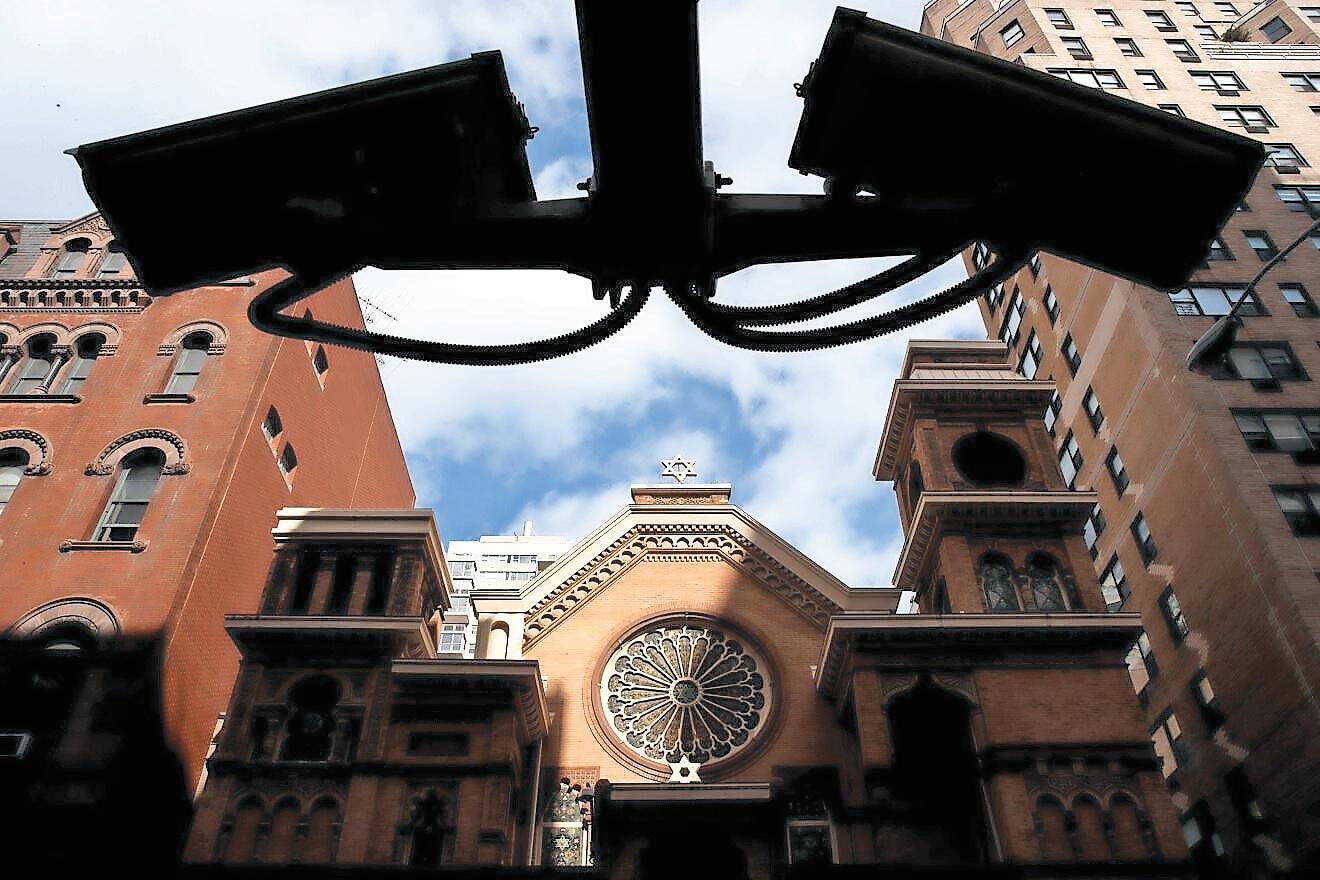
The bill, which seeks to create a 25-foot buffer zone around houses of worship within which protesters may not enter, is the most tangible response yet to what happened last month when raging pro-Hamas demonstrators laid siege to Park East Synagogue on Manhattan’s usually quiet Upper East Side because of a Nefesh B’Nefesh program held there with information on how to go about moving to Israel. But after this week’s equally shocking assault on individuals entering a pro-Israel event at the Wilshire Boulevard Temple in Los Angeles’s Koreatown neighborhood, we may expect similar attempts to use the law to protect Jewish congregations across the country.
The impulse behind such efforts may be laudable, and the law may ease the plight of Jews who find themselves being accosted by antisemitic mobs in such circumstances. Nevertheless, the problem can’t be fixed simply by a state regulation.
What needs to be recognized is that if synagogues are now as controversial and as much a focus of aggressive protest as abortion clinics once were, it’s no longer possible to pretend that Jew-hatred in the United States hasn’t reached a tipping point.
The analogy isn’t arbitrary.
The New York bill is, in fact, an attempt to amend existing legislation that creates buffer zones around abortion clinics to make it possible for medical personnel and patients to enter and exit without harassment from anti-abortion protesters. Politicians aim to do the same when it
kashrut of any product or establishment featured in its pages. If you have questions regarding any establishment or product, including its supervision, please consult your rabbi for guidance.
Submissions: All submissions become the property of The Jewish Star and may be edited and used by the Publisher, its licensees and affiliates, in print, on the web and/or in any media that now exists or will exist in the future in any form, including derivative works, throughout the world in perpetuity, without additional authorization or compensation. The individual or entity submitting material affirms that it holds the copyright or otherwise has the right to authorize its use in accordance with The Jewish Star’s terms for submissions.
Opinions: Views expressed by columnists and other writers do not necessarily reflect the position of the Publisher or of The Jewish Star LLC.
Distribution: The Jewish Star is available free in kosher food establishments, stores, synagogues, and curb-side newsboxes on Long Island, in New York City and elsewhere. To request free delivery to your location, write Publisher@TheJewishStar.com.
Copyright: All content is copyright and may not be republished or otherwise reproduced without written permission by The Jewish Star; to do so without permission is against the law and halacha. For content reproduction write to Publisher@TheJewishStar.com.
The Jewish Star subscribes to JNS. It, or its contributors, own the copyrights on material attributed to them. The length and content of JNS material and all other submitted material may be edited by The Jewish Star. Member: American Jewish Press Association.
This newspaper contains words of Torah. While it is not considered shaimos, please dispose properly.
Mitchell Bard, foreign policy analyst, authority on USIsreal relations; Ben Cohen, senior analyst, Foundation for Defense of Democracies; Stephen Flatow, president, Religious Zionists of America-Mizrachi and father of Alisa Flatow, murdered in an Iranian-sponsored Palestinian terrorist attack in 1995; Yisrael Medad, Americanborn Israeli journalist and political commentator; Rafael Medoff, founding director of David S. Wyman Institute for Holocaust Studies; Fiamma Nirenstein, Italian-Israeli journalist, author of 13 books, leading voice on Israeli affairs, Middle Eastern politics and antisemitism; Melanie Phillips, British journalist; Moshe Phillips, national chairman, Americans for a Safe Israel; Thane Rosenbaum, Distinguished University Professor at Touro University (published by Jewish Journal); Jonathan S. Tobin, editor-in-chief, Jewish News Syndicate.
comes to houses of worship.
But those appalled by what happened at both Park East and Wilshire Boulevard need to recognize that a law to essentially force police officers to do what they failed to may make it harder for protesters to achieve their goal — which, as one of the leaders of the mob at Park East made clear, is to make Jews “scared” — the key issue is the way that much of America’s political class have essentially legitimized the reason why these thugs are turning out to harass Jews in the first place.
After Oct. 7, the proverbial Overton Window of acceptable discourse moved to accommodate the pro-Hamas crowds. Not long ago, support for the cause of destroying the one Jewish state on the planet was considered a sure sign not merely of hatred and bigotry, but of the sort of extremism that ought to be confined to the fever
swamps of the far left or far right. These days, advocacy for such a genocidal goal is seen as a legitimate political and societal discussion.
This was best illustrated by mayor-elect Zohran Mamdani’s reaction to the Park East incident, when he stated that he opposed demonstrations outside synagogues that aim to intimidate people but still chided the congregation, saying that “these sacred spaces should not be used to promote activities in violation of international law.”
The reference was to the event being held there that night by the 20-plus-year-old Nefesh B’Nefesh group that promotes immigration to Israel. Doing so is actually protected by international law. Later, his stand was justified in a piece published by the Forward which said the argument behind Mamdani’s comment was an assertion based on the issue that since some Jews who
make aliyah wind up in the heart of the ancient Jewish homeland in Jerusalem — or in Judea and Samaria (which Israel-bashers think ought to be Judenrein) — and are therefore “settlers,” the shul was essentially facilitating the creation of international criminals.
That’s an outrageous smear. But similar justifications were presented on behalf of the thugs who sought to disrupt the Los Angeles event because it was organized by the Israeli Consulate to discuss security strategies with a focus on AI innovations and included the Elbit Systems firm. Elbit is an Israeli technology company that is under fire because of its role in developing tools used by the Israel Defense Forces to defend the country from terrorism.
The problem isn’t what Elbit or the IDF does. It’s the fact that the bizarre alliance of red-green leftists and Islamists that oppose Israel’s existence defines such efforts to protect Jews from the horrors of Oct. 7-style terrorist attacks — incorporating rape, torture, murder and kidnappings — as not merely illegitimate but “genocide.”
That’s why the focus on the narrow issue of impeding the ability of threatening mobs — who chant slogans about wiping out the Jews and their state to inspire fear in everyday citizens — by making synagogues no-go zones misses the point why these outrages are happening.
What those who are concerned by these incidents need to address is the way such vile arguments about “genocide,” which are nothing more than modern blood libels about the Jews, have been legitimized by educators, union members, journalists and politicians who would never be seen shouting a rude remark or getting into a shoving match with a person entering a synagogue.
What those who want to respond to these incidents should be doing is not merely denouncing the vulgarians — who are, to no small extent, succeeding in scaring American Jews — for going overboard in expressing their hostility to Israel. Rather, they should stop treating the claims about “genocide” and famine in Gaza and “apartheid” inside the Jewish state as reasonable assertions any more worthy of debate than the claims of latter-day Nazis like “groyper” leader Nick Fuentes about the Jews controlling banks, the weather and the world.
Like a stubborn stain that clings to your shirt no matter how many times you clean it, Jeremy Corbyn, the former leader of the ruling Labour Party in the United Kingdom, refuses to disappear.
Not a few pundits believed that with Corbyn’s expulsion from Labour in 2024 over his continuing denial of the antisemitism scandals that plagued his term, he would fade into obscurity. But he continues to sit in the House of Commons as a Member of Parliament in an independent alliance with four Islamist colleagues who were recently elected in heavily Muslim constituencies on anti-Israel platforms.
Last weekend, Corbyn was in the city of Liverpool, for the inaugural conference of Britain’s latest far-left experiment, known as “Your Party.” In theory, at least, the launch of a new vehicle for the far left should fill critical observers with dread, particularly at a time when extremists are making deepening political strides in an unhappy, polarized Britain. What we saw in Liverpool, however, was more like a form of comedy.
Delegates, who were decked out in the sorts of colors you would normally encounter in a
For a new generation of activists, Corbyn is a fossil.

bowl of Froot Loops, yelled and squabbled over procedure. Their voices echoed awkwardly throughout a cavernous hall that organizers claimed would fill with more than 13,000 activists, yet attracted only about 2,500.
No decisions — on the name of the new party, on its leadership structure, on who was permitted to actually attend the conference and who wasn’t — were reached without acrimony. For many of those watching the debates or catching clips on social media, it was all deliciously reminiscent of the famed scene in Monty Python’s 1979 comedy “Life of Brian,” where the Judean People’s Front sit in an amphitheater showering abuse on the People’s Front of Judea.
In truth, we should not be at all surprised that Your Party’s first conference will be remembered for its recriminations and infighting. This has been the party’s story since its conception earlier this year. Ironically, the most imme-
diate victim may be Corbyn himself.
Now in his mid-70s, Corbyn is no longer the cherished leader who was serenaded with chants of “Oh, Jeremy Corbyn” at the Glastonbury music festival in 2017. For a new generation of activists, he is something of a fossil. His bid to lead the party, as well as his opposition to the collective leadership model that was eventually adopted, was coldly rejected by the conference. His very public rift with the other key figure in Your Party — the far-left Member of Parliament Zarah Sultana, who resigned from Labour in July — has done him no favors.
Increasingly, Corbyn is presented within Your Party circles as an intemperate, elderly white man trying to muzzle the voice of a young Muslim woman.
Some of the issues dividing Corbyn from Sultana are internal, stemming from her decision over the summer to announce the party’s forma-
tion without his signoff, along with her funneling of more than $1 million in supporter donations into a bank account under her control. Some of them are more overtly political, getting to the heart of what still divides the secular revolutionary left from the Islamists it has so enthusiastically made common cause with.
As the Your Party delegates were rudely reminded last weekend, Islamists — whether they are Hamas terrorists or members of the British parliament — believe that there are only two genders, male and female, and that the latter must always be subordinate to the former. Despite declaring herself a proud Muslim, on this question, Sultana is firmly in the secular camp, which holds that there are multiple genders, a message reinforced by multiple speakers from the podium.
In addition, and this is really quite incredible, several of the delegates in Liverpool accused Corbyn, who turned the Labour Party into a living hell for its Jewish supporters, of not being sufficiently inimical toward Zionism.
Again, this dispute is rooted in a generational pivot. For boomer leftists like Corbyn, it has been routine to include boilerplate condemnations of Jew-hatred alongside their declared hostility to Zionism.
For this new generation, the term “antisemitism” is abruptly divorced from its past, understood only as a suspicious construct designed to censor pro-Palestinian voices by reinforcing supposedly Zionist notions of “Jewish privilege,” thus perpetuating “Jewish supremacy.” This trend has been particularly marked since the Hamas pogrom in Israel on Oct. 7, 2023.
As well as being denounced as a cryptoZionist, Corbyn failed to win the leadership of
See Cohen on page 23
Much of the Jewish state and its socialmedia cheerleaders in the Diaspora have been tripping over themselves to crown Dana International the new Golda Meir. The way people are gushing over her latest Instagram posts, you’d think the transgender Eurovision legend, who won in 1998 with “Viva La Diva,” had just displayed unprecedented patriotism. After the Netherlands, Spain, Ireland and Slovenia announced they were pulling out of the 2026 Eurovision Song Contest — because the organizers decided to allow Israel to compete despite the controversy surrounding the war in Gaza — she wrote, in English:
I have performed in your countries numerous times. … I was always welcomed with warmth and love, and you … connect[ed] to the message I brought with me: a message of equality, acceptance, human dignity and the basic rights of every person. She went on:
You know, Israel is the only country in our region that is this liberal. Tel Aviv Pride parade is one of the largest in the world. We are also the Holy Land, the land of the Bible — whose capital, Jerusalem, holds the holiest sites of the three monotheistic religions, and draws people from all around the world to pray. But we are also the land of Tel Aviv, of beaches … and of epic parties. Beyond that, we’ve been part of the Eurovision Song Contest for many years. We try our best in the competition, and sometimes we even succeed.
She continued with weepy earnestness: So, explain to me how and why you have turned against us and announced your withdrawal? You no longer want us singing with you? Do you understand how violent and insulting that decision is? How much it adds only hatred and harm?
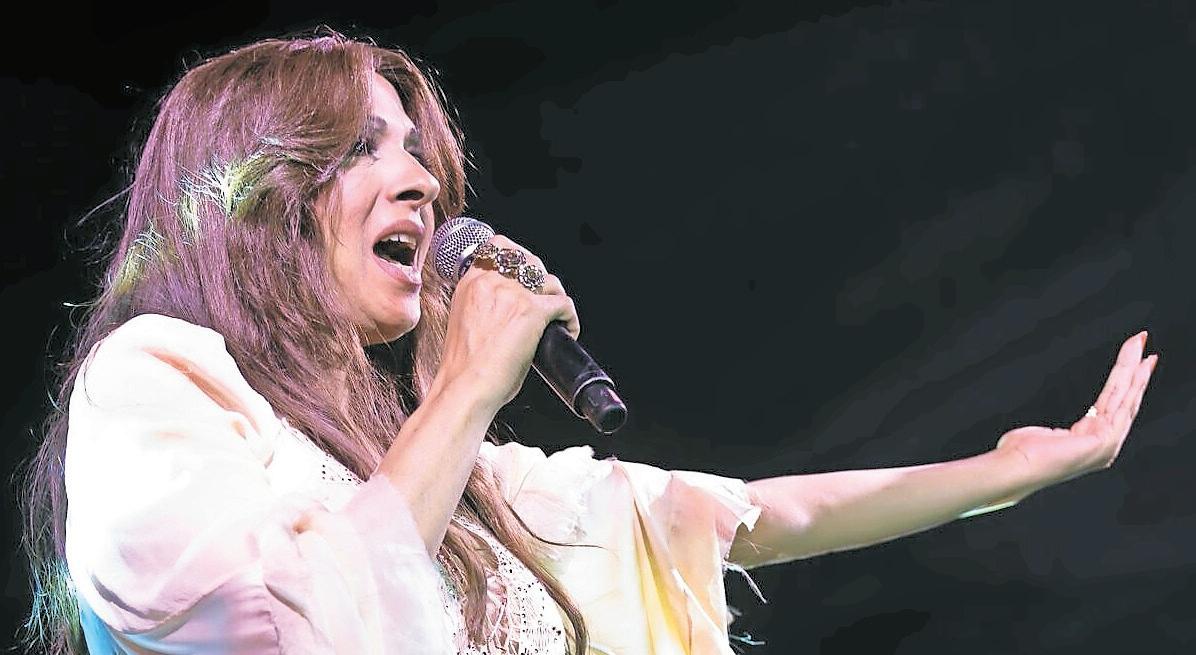
So far, so good. Sort of. Though begging enemies for their affection and appreciation is as tiresome as it is futile.
Of course, no such appeal from a celebrity would be complete without a wink to those foes. Don’t worry, she assured, “A large part of the people in Israel do not agree with our government. They want a different government. You don’t punish an entire country because you disagree politically with its government. The unbearable war that went on far too long has ended. It is legitimate to criticize it and to resent how long it lasted.”
Uh, sorry, no.
Luckily she mentioned that “Israel is a country fighting for its existence, trying to balance security challenges with sanity and liberal values, things that are not well accepted in the region we live in.”
Indeed, she added, “Hamas executes people for being gay. Almost every Eurovision winner would have been hanged in the town square in Gaza.”
Quick to resume her attempt at finding common ground with those who accuse Israel of wrongdoing, she stressed, “That doesn’t justify anything, and of course we must fight for peace and reconciliation with all human beings. … a withdrawal from Eurovision harms the very idea of peace, harms Israel and harms the contest itself. I believe this decision will be reversed, and that we will all celebrate together at Eurovision with this message of equality, love and acceptance, and with the music that brings people together. Because that is what Eurovision is truly about.”
With defenders like Dana, who needs critics? Hey, but let’s give credit where it’s due to the performer for presenting an unvarnished version of the above, “between us, in Hebrew, which only we understand.” You know, among likeminded Israelis who think Israel is at fault for garnering negative attention.
“I am shocked … and deeply pained by the situation,” she began. “How did we reach the point where even in Eurovision, a European
In case anyone in her milieu doubted the correctness of her politics, she set him/her (no
pun intended) straight.
song competition that always accepted us with a big hug and included us in the campy celebration and the Good Evening, Europe!’ — even though, oops, we’re not Europe — how is it that the attitude toward us has changed?”
After all, she argued, “The archaic approach that used to belittle this competition has nearly vanished. … Eurovision once again became glamorous and influential, and we understood that it is one of the only stages that allows Israel to show a different side from the one in which we star in the news, [that] on the musical front we’re doing fine — not only in wars.”
She proceeded to ask: “How did we get here? How did the place that loved us so much and embraced us become hostile? … How is it that we lost the battle of hasbara [public diplomacy]? … How did we become one of the most hated countries in the world?”
Her answers were as awful and telling as her questions.
“It’s too easy to explain this with antisemitism or hatred of Israel, because historically, the attitude toward Israel was different,” she stated.
“After the Six-Day War, we were seen as a brave, strong and beloved … During the Oslo process, the world embraced the country striving for peace. And now? The world no longer sees liberal Israel, the high-tech nation, Tel Aviv, the beach-and-tourism city that embraces and welcomes everyone. … Since my Eurovision victory, I’ve been telling the world about the liberal and beautiful Israel. I’ve happily collaborated
Does Paul Simon have a soft spot for killers? The iconic singer-songwriter last week signed a petition demanding freedom for the Palestinian Arab terrorist Marwan Barghouti, a convicted multiple-murderer.
Barghouti is currently in an Israeli prison for his role in five murders. In 2001, he sent terrorists to ambush motorists on the outskirts of Jerusalem; they killed a young Greek Orthodox priest named Father Germanos. The following year, Barghouti masterminded an attack on a Tel Aviv restaurant that left three dead and 35 wounded.
But Barghouti is not the first killer to enjoy Paul Simon’s friendly attention. That distinction belongs to Salvador Agron.
Agron was a member of a Brooklyn street gang called The Vampires. In 1959, he stabbed two boys to death on a New York City playground. The victims, Anthony Krzesinski and Robert Young, Jr., were just 16. The press called Agron “The Capeman” based on eyewitness descriptions of his clothing.
In 1998, Simon created a Broadway play called “The Capeman,” which portrayed Agron as a victim of society. Members of the Krzesinski and Young families, together with a group called Parents of Murdered Children, picketed the opening night performance.
The protesters charged that Simon was glorifying the killer, and objected that the deaths

of their loved ones were being exploited for entertainment and profit. Robert Young’s cousin Kim carried a sign that read “Our Loss is $imon’s Gain.”
Simon said in an interview at the time that he was moved to bring Agron’s story to Broadway because “I was drawn to the environment that shaped him — the street culture, the poverty, the sense of being outsiders.”
It’s a shame that Simon has never taken an interest in the environment that has shaped young Palestinian Arabs, including Marwan Barghouti. Growing up, Barghouti was immersed in the virulent hatred of Jews and glorification of terrorism that permeates the Palestinian Authority’s school curricula, summer camps, news media, sermons in mosques,
and speeches by political leaders.
Here’s what then-Senator Hillary Clinton had to say about the antisemitism in the Palestinian Authority’s schools:
Their textbooks are still preaching such hatred. …Young minds are being infected with this antisemitism. …These messages of hatred and these enticements for martyrdom in these textbooks and on the media, take young minds and twist and pervert them and create a new generation of terrorists and insurgents. … Using children as pawns in a political process is tantamount to child abuse, and we must say it has to end now!
That’s the environment which inspired Barghouti to join the Fatah terrorist group when he was 15 years old. He wasn’t protesting “Netanyahu’s policies” or “settlements.” Yitzhak Rabin
was prime minister at the time, and only a handful of settlements existed. Fatah’s goal was the destruction of Israel. That’s the path that led Barghouti to become a mastermind of the suicide bombings and machine-gun massacres of the Second Intifada. Wouldn’t that make for an interesting play?
Or how about a play about Barghouti’s victims? Each of them has a compelling back story.
Salim Barakat, 33, was a policeman who heard the shooting at the Tel Aviv restaurant and ran towards the gunfire, not away from it. He left behind a wife, a four year-old daughter, and seven siblings.
Yosef Haybi, 52, died while using his body to shield his wife from the terrorist’s bullets. A friend described him as “a magnificent soul,” a brilliant businessman, and a generous philanthropist. He left behind two children.
Eli Dahan, 53, came to Israel as a child when his family fled persecution in the Arab world. Yet he had many Arab friends and ran a cafe that was popular with Jews and Arabs alike. His coowner called him “the symbol for existence.” He had four children and three grandchildren.
Father Germanos was raised in a deeply impoverished family in rural northern Greece. He left school at age 12 to earn money for his family by working in a fabric factory. When he turned to a religious lifestyle, he gave away his possessions and moved to the Holy Land to join St. George’s Monastery, near Jerusalem.
A play, or even just a song, about the victims of Palestinian Arab terrorism might not be popular among today’s political and cultural elites. But it would be the right thing to do.
Published in the Jewish Journal of Los Angeles.
Write: Columnist@TheJewishStar.com
Celebrity narcissists looking for another virtue to signal have alighted upon a fresh cause appropriate to their moral stature: freedom for a notorious mass murderer.
Some 200 high-profile actors and musicians, including Benedict Cumberbatch, Mark Ruffalo, Cynthia Nixon, Sir Ian McKellen, Paul Simon, Sting and Brian Eno, have called for pressure on Israel to release the former Fatah terrorist leader, Marwan Barghouti, from prison.
Barghouti, 66, consistently tops polls asking Palestinian Arabs who they want to replace 90-year-old Mahmoud Abbas as head of the PA.
Now these celebrities have jumped on the bandwagon, describing Barghouti as a “powerful symbol of unity and a longtime advocate for freedom and dignity for the Palestinian people” and claiming that he has been “illegally held by Israel” for more than two decades.
The petition and its signatories are listed on a campaign website under the slogan “Free Marwan.” The site presents Barghouti as “a husband and a father” and a “nation-builder” who has “consistently believed in a future rooted in international law.”
Even by the standards of today’s morally degenerate celebrity followers of the Palestinian cause, this is jaw-dropping.
Barghouti was properly convicted in 2002, with overwhelming evidence, for orchestrating multiple deadly terror attacks during the
years of the Second Intifada, in which he murdered five people, including four Israelis and a Greek monk. The court determined that Barghouti also bore moral responsibility for numerous other terror attacks in which many more Israelis were murdered.
On entering the courtroom before being found guilty, Barghouti flashed a victory sign with his shackled hands and declared to all: “So long as occupation continues, the intifada will not stop. As long as Palestinian mothers are weeping, Israeli mothers will also weep.”
This is the man who these celebrities have described as “a longtime advocate for freedom and dignity for the Palestinian people” and have likened to Nelson Mandela, the South African leader who, for the West, is the nearest thing to a secular saint.
Actors and other showbiz types habitually support ridiculous causes. It goes with the territory for individuals whose lives are a performance, playing roles and gazing at their own image in rapt adoration. Posturing as high-minded idealists, they tend to be the worst kind of liberal hypocrites.
This type of person generally maintains a principled opposition to war on the basis that civilized people oppose violence and believe instead in reason, negotiation and compromise. Yet here they are promoting as a hero someone who has committed heinous acts of mass murder that they don’t even seem to register as violence, and certainly not as attacks against the innocent.
Their ignorance is epic. They know nothing about Israel or the Middle East other than what they have absorbed as Palestinian propaganda. Even so, choosing to support a monster like Barghouti requires further explanation.
This is part of a pattern of behavior among people on the left going back centuries. Ever since the French Revolution, they have been drawn to revolutionary violence, manifesting itself in more recent times as support of bloody tyrants such as Stalin, Che Guevara and Pol Pot, or terrorist causes such as the IRA in Ireland or the Palestinian Arabs.
Such left-wingers appear to be seduced by the apparent romance of the revolutionary, someone who practices a violence that they themselves
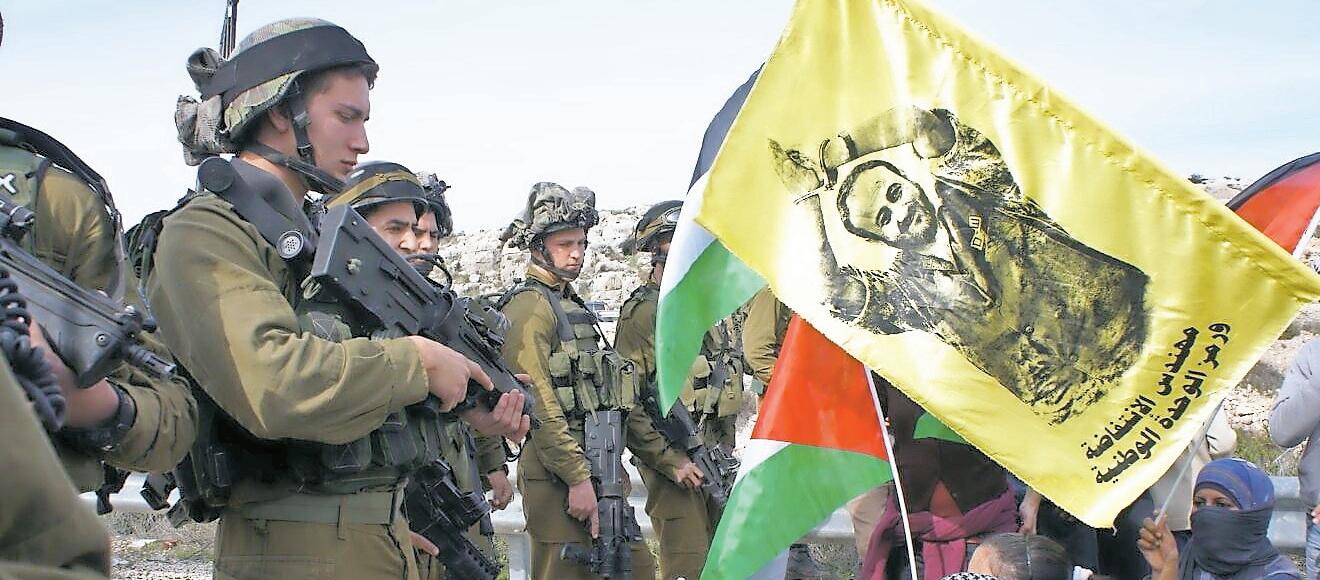
wouldn’t dream of using. For such people, violence is what’s used by people of whom they disapprove, such as Israelis. Violence against Israelis isn’t violence but resistance.
Consumed by various types of guilt — their privileged backgrounds, their wealth, their whiteness— they outsource its expiation to individuals demonstrating resistance to an equivalent oppression.
Believing that only by such “resistance” can their ideals be realized about the betterment of society, they tell themselves that bringing about the end of oppression justifies the means. The terrorist’s violence is thus sanitized, and the innocents he has murdered are dehumanized. The celebrities think these victims deserved what they got because their very existence was an offence against the righteousness of the cause.
And the righteousness of the Palestinian cause is held to be axiomatic. Throughout the “progressive” world, it is the cause of causes.
One reason for this is its promotion by the global human-rights humanitarian complex. Led by the Hamas-sympathizing United Nations, which has betrayed its role as the global avatar of peace and justice, and instead turned into the tool of tyrants, kleptocrats and fanatics, this complex has weaponized international law to persecute the
world’s only Jewish state.
A new report by NGO Monitor has highlighted just how corrupt this complex is. Based on internal Hamas documents, the report spotlights the terrorist group’s systematic control of foreign NGOs operating in Gaza.
Hamas operatives describe their surveillance of NGO officials and offices, their methods for manipulating foreign-funded humanitarian groups, and the military and intelligence-gathering considerations that guide the limitations they impose on NGO activity. Similarly, the documents reveal that NGOs have hidden or downplayed Hamas abuses and acquiesced to its demands.
One document from 2021 suggests that Oxfam worked with a Hamas-linked local group on an infrastructure project that appears to have contributed to Hamas military preparations.
Medical Aid for Palestinians-UK’s “administrative director” in Gaza works in Hamas’s military arm and “is affiliated with Hamas and has pledged allegiance to its rule.”
The “guarantor” for US-registered Catholic Relief Services, the director of the NGO in Gaza, is “affiliated with the Popular Front [for the Liberation of Palestine] (PFLP)” which is designated


Ed Weintrob Editor-Publisher • Nechama Bluth, Associate • Stuart Richner, RCI President
Continued from page 18
The ability of Hamas to get respectable liberal publications like the New York Times and outlets like CNN or MSNBC (now known as MS NOW) to legitimize their lies about Israeli actions has been an astonishing success.
A generation of young people who get all their news from TikTok and other social-media feeds is an ideal audience for these falsehoods. They’ve been convinced to believe that the exaggerated casualty figures — in which all the Palestinian dead in the fighting with Israel, including terrorists, are counted as women and children — are accurate. And they either don’t know about or don’t believe the truth about the Palestinian atrocities committed on Oct. 7 or just think the Israeli victims had it coming.
They’ve been conditioned by their educational experiences and what they read or hear from opinion leaders to think that Jews have no rights. They have been taught to believe that Jews are “white” oppressors, no different from the bad guys in the Jim Crow South or apartheid-era South Africa, rather than a mix of citizens from
Continued from page 17
accepted by scholars and religious authorities as a reliable historical text — records the horrors Jews suffered even before the war began.
Yet, in both eras, redemption emerges naturally through what can only be called the miraculous. Yosef is pulled from prison because a minister suddenly remembers him. He attributes his interpretive power to Hashem and becomes Egypt’s leader — second only to Pharaoh himself — and saves nations from famine.
The Maccabim, steadfast in faith and unity, endured loss and defeat but never wavered. They overcame the greatest empire of their time and miraculously restored Jewish sovereignty.
Brothers (achim always), filled with fair in HaKodosh Baruch Hu, overcome incomprehensive odds to miraculously send the Greek troops packing. I say miraculously, because that’s what they appear to be. Yet an impartial observer could argue these are all events that don’t mention G-d intervention and could be explained as natural by those so inclined.
Both stories culminate in heartfelt reunification and renewal. Yosef reveals himself; the brothers weep, embrace and forgive. Yaakov’s descent to Egypt completes the family’s healing. The Maccabim march into Jerusalem, restore the mizbei’ach and discover a cruse of pure oil — a symbol of spiritual resilience. They reestablish an independent Jewish state, and the Temple stands for more than two centuries.
These parallels exist for a reason. Our history teaches that unity makes us indestructible. Hamas, by its own admission, perceived our internal strife as weakness. Though we came together after Oct. 7, the threat of internal hatred remains.
History also teaches that tragedy has purpose, even when hidden from us. We recite on every festival, mipnei chata’einu galinu mei’artzeinu (because of our sins, we were exiled from our Land). Hashem asks us repeatedly throughout Tanach to look inward.
Finally, we are instructed that despite our failings, Hashem forgives. He keeps His covenant even when we falter. When catastrophe seems insurmountable, redemption often arrives in ways that appear “natural.”
Except for the miracles of the Exodus, Hashem’s intervention is rarely open, yet we endure while our enemies fade. Nothing happens without His will, least of all the fate of His people.
Finally, history teaches that once salvation comes, we celebrate it — and then too often forget its lessons. The cycle repeats, again and again, like a terribly unfunny version of Ground-
all parts of the world, including Middle Eastern countries that kicked them out long ago.
There are consequences when the Times treats advocacy for the “genocide” blood libel as a defensible opinion. The same is true when Democratic and Republican politicians listen to claims that the Jews are purposefully seeking to wipe out an entire people, rather than being the intended victims of Palestinian attempts at Jewish genocide. Their failure to push back against such outrageous falsehoods sends a message to the entire country that transcends any effort to regulate the most unruly protesters.
The willingness to normalize Mamdani is the most obvious symptom of what has gone on.
That a person for whom the destruction of the one Jewish state on the planet is the driving force of a burgeoning political career — he is, after all, 34, and the mayorship will be his first significant political position — and the organizing principle of his advocacy is an appalling turn of events. But rather than treat him as a pariah, as
hog Day. We seem to suffer from the lather, rinse, repeat shampoo theory of history.
This time, let’s set it right, and learn from our Avos what to do and what not to do, to love one another and know that all comes from Hashem. As Hillel said, the rest is commentary. Shabbat Shalom.
Write: Columnist@TheJewishStar.com
Continued from page 17
dah will pass and covers her face. Yehudah does not recognize her. She takes his signet ring, cord, and staff as a pledge for future payment.
Three months later, Yehudah is told that Tamar is pregnant. His response is swift: “Bring her out and let her be burned” (Bereishis 38:24). But as she is being led to execution, Tamar sends a message, holding up the signet ring, cord, and staff: “I am pregnant by the man to whom these belong. Please identify whose these are” (Bereishis 38:25).
Notice what Tamar does not do. She does not publicly name Yehudah. She does not expose him or destroy his reputation. The Gemara teaches that from here we learn that it is better for a person to be thrown into a fiery furnace than to publicly shame another (Sotah 10b). Instead, Tamar creates a space in which Yehudah may choose. You may step forward and speak the truth, or you may remain silent and let me die with your secret.
This becomes Yehudah’s defining moment. Until now, when faced with difficult truths, he has retreated into silence. When faced with confronting Yaakov about Yosef, he avoided it. But now, with an innocent woman about to die because of his actions, something shifts within him.
Yehudah steps forward before the entire community and declares, “Tzadkah mimeni. She is more righteous than I, because I did not give her to my son Shelah” (Bereishis 38:26). The man who spent years avoiding truth now speaks the most difficult truth of all, publicly, fully aware of the cost to his reputation and standing.
The Gemara in Sotah teaches that because Yehudah was willing to acknowledge the truth despite the humiliation involved, he merited that kingship would descend from him (Sotah 7b).
From Yehudah comes Dovid HaMelech, and from Dovid will come Mashiach. The capacity for leadership, the Torah teaches us, flows directly from the courage to face truth even when doing so costs us everything.
We are called Yehudim because we descend from Yehudah. When Leah gave birth to her fourth son she said, “This time I will
the chattering classes would behave if someone like Fuentes or David Duke, leader of the Ku Klux Klan, were elected to any office, he’s been feted and fussed over by leaders on both sides of the aisle. That not only includes leading Democrats, but President Donald Trump and Vice President JD Vance.
While they aren’t wrong to praise his skill as a manipulator of the media, treating his antisemitic beliefs as merely a curious eccentricity or merely a questionable aspect of his appeal to young voters is to normalize such abhorrent views. Instead, they are treating anyone who dares to call him out as an “enemy of the Jewish people” — as Benjamin Tisch, the brother of New York City Police Commissioner Jessica Tisch, recently rightly did — as the problem. That Commissioner Tisch publicly apologized for her brother’s accurate comment undermines the notion that she will be an effective check on the mayor-elect’s excesses. It also sends Mamdani, his Jew-hating advisers and members of the pro-Hamas mobs besieging synagogues that they are legitimate actors.
thank Hashem,” and she named him Yehudah from the word hodaah, meaning gratitude or acknowledgment (Bereishis 29:35). Yet the word modeh carries a dual meaning. It means both to thank and to admit. To be a Yehudi means to carry both capacities: gratitude for blessings and the courage to admit failure.
The people Bronnie Ware cared for realized that avoiding truth does not spare us pain. It only defers and magnifies it, allowing it to grow in the darkness of silence. Yehudah’s story offers hope because it demonstrates that transformation remains possible at any moment. We are not defined by our years of avoidance but by our willingness, when the moment arrives, to finally stand in truth.
This is the work of being a Yehudi. Not perfection, but the willingness to acknowledge imperfection. Not a life free of mistakes, but the courage to admit those mistakes and grow from them. The courage to live a life true to oneself is found in choosing, moment by moment, to face rather than flee, to speak rather than hide, to acknowledge rather than deny. Like Yehudah, we can also, in a single moment of courage, transform everything.
Rabbi Benny Berlin is spiritual leader of BACH Jewish Center in Long Beach (bachlongbeach.com) Write: Columnist@TheJewishStar.com
Continued from page 17
neer of Divine Providence and the “vast eternal plan” of the Almighty. Who could have known what was really playing out in this little tale? The ways of Providence are infinite, unknowable and often unfathomable.
How and why did Jews emigrate to the bottom of Africa? Or Down Under to Australia? Or, for that matter, to places like Alaska, Hawaii or Uruguay? In some instances, of course, Jews were fleeing Europe and found safe refuge elsewhere. But clearly, G-d wanted Torah and Jewish life to reach even the furthest continents and most remote locations.
Growing up in New York, I never dreamed that I would be living in South Africa. But the Lubavitcher Rebbe sent us there back in 1976 and, thank G-d, we’ve never looked back.
All of us can probably share personal stories of the twists and turns in our own lives and how things turned out in ways we could never have imagined.
Here are just two of my own. It was around 1977 when we were still new in Johannesburg. Out of the blue, I developed double vision. The
The question isn’t, as the sponsors of the New York synagogue buffer zone legislation said, how they can protect the free-speech rights of protesters without making the lives of synagogue-goers hell. Rather, it is how leading liberal opinion leaders, including many left-wing Jews who never miss an opportunity to bash the Israeli government or to bolster arguments that strip Jews of rights that no one would deny to any other people, now fail to treat antisemitism as a disqualifying character flaw.
More than that, such sentiments should deem them unfit for office or a position of influence in academia or journalism.
We should welcome efforts to protect synagogue-goers. But what we should really be pushing back against is a cultural climate in which Israel and the expression of normative Jewish beliefs are now considered illegitimate. As long as that is true of mainstream American public discourse, the safety of worshippers or any other action of an identifiable Jew will always be in question.
Write: Columnist@TheJewishStar.com
doctors were quite concerned, and I was admitted to the old Princess Clinic for a battery of tests. One neurologist literally put the fear of death in me with his dire diagnosis. In the end, it was only a loose nerve that healed itself with some simple eye exercises.
But why did I have to experience this? What was it all about?
Well, it turned out that my roommate in the hospital was a gentleman named Mervyn Stein. He was recovering from encephalitis and also had double vision, so we were both wearing eye patches. I remember that when Professor Harry Reef came in to see us, he asked: “Is this some kind of Jewish status symbol?” A bunch of Moshe Dayan wannabees?
In the morning, when I put on my tallit and tefillin, and prayed the morning service, Mervyn became quite nostalgic, remembering his own late grandfather who, too, would pray regularly. I helped Mervyn with the tefillin, and this was the beginning of a spiritual awakening that led him to become a fully observant Jew, a leader in his own community, and later, even the chairman of the Union of Orthodox Synagogues in South Africa. As far as I am concerned, that was the reason I had double vision and needed to find myself in the Princess Clinic. Many years ago, I was asked by South Africa’s former chief rabbi, Cyril Kitchener (“C.K.”) Harris, to fly to Gaborone, Botswana, to consecrate a small patch of land as a Jewish cemetery and then officiate at the funeral of a British professor who had been living there.
Frankly, it wasn’t a simple task to find a minyan of Jews in Gaborone. But they came out of the woodwork. They weren’t religious or even traditional, but they heard that they were needed and arrived. We dedicated a Jewish cemetery — it was tiny, maybe 10 graves, but it became a sacred Jewish burial ground. I led the seven circuits, reciting the special prayers with the minyan following behind me.
Then, I conducted a fully Orthodox funeral service. In attendance were 10 Jews and a few hundred Tswanas, the local African people, including the dean and faculty members from the University of Botswana. I explained everything in English, and they were not only interested and intrigued but very respectful. This story of Jacob and Joseph formed part of my eulogy. It was an experience I hadn’t planned or ever envisioned, but it remains one of the most memorable ones in my rabbinic career.
The ways of providence are indeed infinite and unknowable. Wherever we may find ourselves, we should remember that we are walking in the steps ordained by G-d. Knowing there is a higher plan and a higher purpose always helps.
Write: Columnist@TheJewishStar.com
Continued from page 17
this interpretation. But nonetheless, it feels right to me. I find it dramatically significant that on the very Sabbath in which we read of how Jacob singled out Joseph from his other children, we also celebrate Chanukah and light candles in a manner in which no one child is singled out as superior, in which all have an equal share.
The lessons of Chanukah are many, but here is a novel lesson, and a very important one: Envy can wreak havoc in a family. One way for parents to avoid this poisonous emotion is by treating all their children fairly and equally, and not by playing favorites.
One of the wise sayings of Ben Sira, the Jewish sage whose work did not quite make it into the Bible but which has much to teach us, is that “envy and wrath shorten life.”
Wise parents will take this lesson to heart and not discriminate among their children. Instead, they will learn the lesson of Chanukah and give all children an equal role in celebrating this beautiful holiday, the “festival of lights.”
I would like to take this opportunity to wish everyone a Happy Chanukah!
Write: Columnist@TheJewishStar.com
Continued from page 19
Your Party. Instead, delegates chose a laughably unwieldy collective leadership structure that excludes serving parliamentarians from the top roles on its executive committee. Corbyn also failed to prevent members of far-left sects like the Socialist Workers’ Party from joining Your Party, in another victory for Sultana, though one she may well end up regretting when these same sects inevitably turn their ire upon her.
Corbyn’s predicament is another example of how, as an 18th-century French writer put it amid the bloodshed that followed the overthrow of the Bourbon monarchy, “the revolution devours its children.” In his case, it is perhaps fitting that his latest difficulties emanate from the objections of his ostensible supporters and not from those inside and outside the British Jewish community, who have long opposed his proHamas, anti-NATO, pro-Russian policies and his indulgence of the most vicious antisemites.
Your Party’s current hero is the 34-year-old mayor-elect of New York, Zohran Mamdani, who was hailed by Sultana for having secured a win “in the very heart of Empire,” thereby ensuring that “a new politics emerges.”
Like Sultana, Mamdani comes from the ranks of the far left. Both of them are likely to discover in the coming years that their erstwhile comrades will try to grasp them in a bear hug, lest they be tempted to make the sorts of compromises needed to govern effectively.
Still, what unites these quarrelsome leftists is an unshakeable commitment to the Palestinian cause and a determination to make “Palestine” the standout issue in a package that also includes environmentalism, wealth redistribution and rejecting efforts to defend against Russian and Chinese destabilization efforts as “militarism” and “imperialism.”
If history is any guide, then Your Party will go the same way as other initiatives in Britain to create a left-wing party outside Labour’s environs — straight into its trash bin.
Even so, as we’ve learned bitterly over the last two years, the far left doesn’t need to be in government to make life miserable, particularly for Jewish communities. They can do exactly that from their perches in the universities, municipal government, national legislatures and non-governmental organizations.
Judging by the antics in Liverpool, Your Party may well be headed for organizational and electoral catastrophe, but beware. Its spirit will live on. Write: Columnist@TheJewishStar.com

Continued from page 19
with the Foreign Ministry and embassies around the world in public-diplomacy activities, in videos. I truly love Israel; it is the country that made my dream of becoming a successful singer come true. It is my beloved home. I am proud of Israel — in every language.”
Great. Should we give her a medal of valor for daring to diverge from so many of her fellow “artists” at home and abroad?
Not so fast. In case anyone in her milieu doubted the correctness of her politics, she set him/her (no pun intended) straight.
“But hey,” she said, “something went wrong in how the world views us, and we need to acknowledge that and do everything to change it. Whoever wants [National Security Minister Itamar] Ben-Gvir, [Finance Minister Bezalel] Smotrich, the ‘full, full right’ and a never-ending war should understand that this is the price — that this is a path that leads to the vision of ‘a nation that dwells alone.’ And whoever wants us to return to being the Israel that the world loved should raise their voice.”
In other words, Dana International blames Israeli leaders and members of the public who elected them for European lies, not the moral rot of the Continent. And she longs for the days of the Oslo Accords, a direct line — albeit distant — to the atrocities of Oct. 7, 2023.
That the “anybody but Bibi Netanyahu” protest movement is pleased with her pontification makes perfect sense. The problem is with the fawning followers who aren’t anti-government activists.
Either they don’t know how to read or they prefer cherry-picking the palatable parts, grateful for any morsel of praise for Israel from a homegrown celebrity. It’s as pathetic as the majority of Eurovision entries.
Write: Columnist@TheJewishStar.com
Continued from page 20
as a foreign terrorist organization by the United States, the European Union and Canada.
None of this is likely to make a shred of difference among the celebrities calling for Barghouti’s release. This is because the Palestinian cause has helped destroy the West’s moral compass.
This cause stands for nothing less than the destruction of Israel. The Palestinian Arabs say so repeatedly.
They teach their children to hate and murder Jews. They demonize the Jews as rats, snakes or octopuses — monstrous demonic figures said to be secretly controlling the world in their own interests.
This is why many Jews in the West view the forest of Palestine flags on their streets as a forest of Nazi flags. It’s why British Jews view the hospital nurse or business associate who confronts them wearing a Palestine pin with as much dread as if they’re wearing a swastika.
Yet for “progressives,” the Palestinian cause is their badge of conscience.
This is why it has corrupted Western discourse and thinking. Those who have embraced that cause parrot the same blood libels about Israel, the same visceral disgust of Jews, the same deranged and poisonous fantasies, the same recycling of the ancient stereotypes — “Jewish supremacy,” the “chosen people,” the blood libels.
Posing as the championing of an oppressed people, the Palestinian cause has legitimized such vile discourse and made it respectable in Western society. It has also normalized the inversion of truth and lies, victim and victimizer, aggression and defense.
This has not just caused Western useful idiots to promote a mass murderer as a hero. It has not just damaged the West’s ability to acknowledge the Islamist war of extermination against Israel. It has also undermined the West’s ability to acknowledge the Islamist war of conquest against itself.
Write: Columnist@TheJewishStar.com
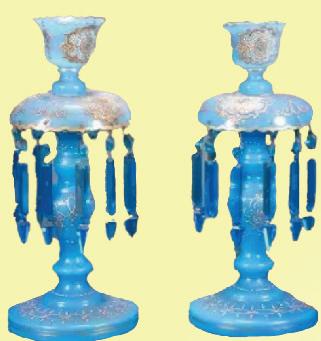


is looking to add a full-time reporter to our team as we expand our coverage of local news that’s important to Modern Orthodox communities on LI and in Queens, Riverdale and Westchester.
is looking to add a full-time reporter to our team as we expand our coverage of local news that’s important to Modern Orthodox communities on LI and in Queens, Riverdale and Westchester.
Position offers expert mentoring, a starting salary of $36,400 to $39,520, and a menu of benefits including all Jewish holidays.
Salary ($35,000–$38,000) offers a menu of benefits including all Jewish holidays.
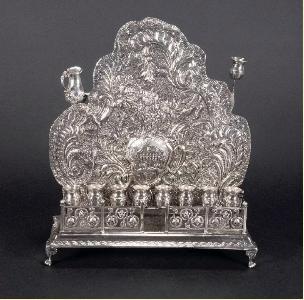
Candidates who have reporting and news-writing experience (professional or collegiate) are invited to email a resume with clips or links to Jobs@TheJewishStar.com.
Candidates who have reporting and news-writing experience (professional or collegitate) are invited to email a resume with clips or links to Jobs@TheJewishStar.com
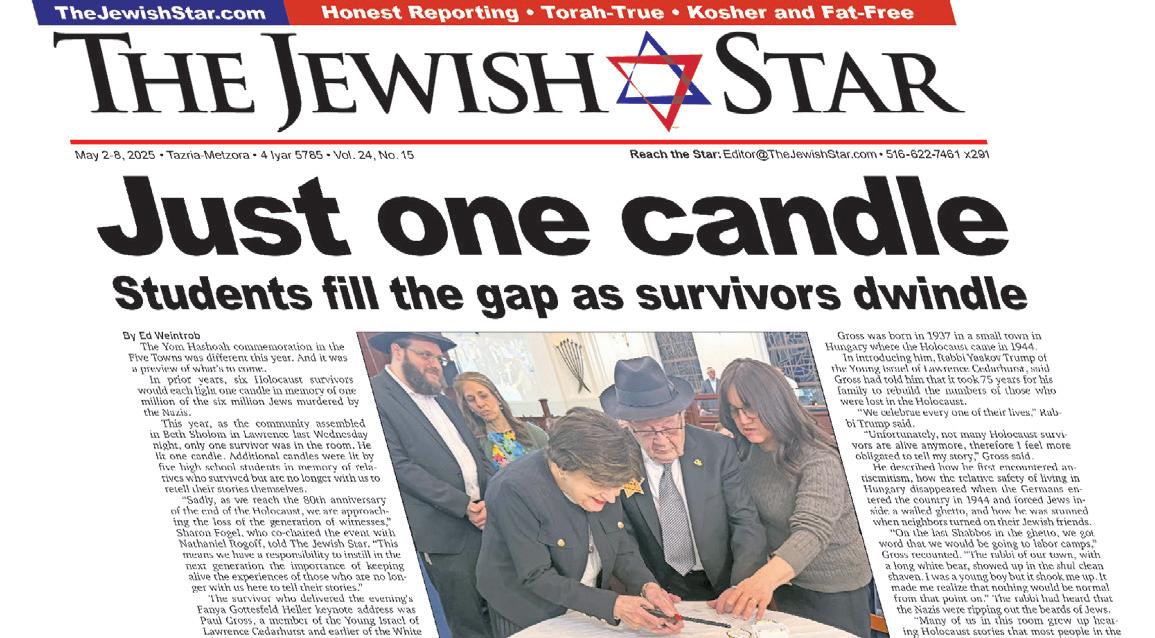








Leather-Cloth Combo Seating, Power Driver Seat, Push Button Start, Wireless Apple CarPlay, Wireless Android Auto, Wireless Phone Charger, Blind Spot Monitor, and Much More!






































































Seating, Parking Sensors, Moonroof, Heated Seats, Remote Start, Wireless Apple CarPlay, Wireless Android Auto, Wireless Phone Charger, and Much More!
























Seats, Power Trunk, Parking Sensors, Driver Memory Seating, Wireless Phone Charger,Wireless Apple CarPlay, Wireless Android Auto, and Much More!