


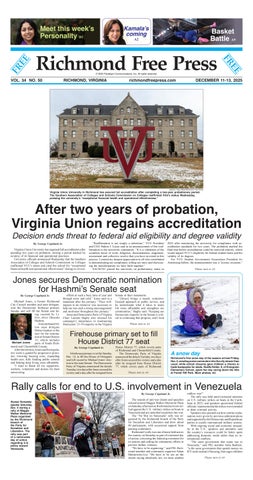

Virginia Union University in Richmond has secured full accreditation after completing a two-year probationary period. The Southern Association of Colleges and Schools Commission on Colleges reaffirmed VUU’s status Wednesday, praising the university’s “exceptional financial health and operational effectiveness.”
By George Copeland Jr.
Virginia Union University has regained full accreditation after spending two years on probation, closing a period marked by scrutiny of its financial and operational practices. University officials announced Wednesday that the Southern Association of Colleges and Schools Commission on Colleges reaffirmed VUU’s status and cited the school for “exceptional financial health and operational effectiveness” during its review.
“Reaffirmation is not simply a milestone,” VUU President and CEO Hakim J. Lucas said in an announcement of the reaffirmation to the university community. “It is a validation of the countless hours of work, diligence, documentation, alignment, assessment and collective resolve that you have invested in this process. I extend my deepest appreciation to all who contributed to demonstrating our compliance, telling our story and showcasing the transformation we have built together.” SACSCOC placed the university on probationary status in
By George Copeland Jr.
Michael Jones, a former Richmond City Council member and state delegate, won the Democratic firehouse primary Sunday and will fill the Senate seat being vacated by Lt. Gov.-elect Ghazala Hashmi.

Jones defeated fellow state delegate Debra Gardner in the race for the nomination in Senate District 15, which includes parts of South Richmond and Chesterfield County.
After the election, Jones said his legislative work is guided by progressive priorities: lowering housing costs, expanding health care, fully funding public schools and helping keep living costs affordable.
“I want to thank all my supporters, workers, volunteers and donors for their unwavering
efforts at such a busy time of year and through snow and cold,” Jones said in a statement after the primary. “Their willingness to do whatever was necessary to help me was such a strong encouragement and motivator throughout this primary.” Jones and Democratic Party of Virginia Chair Lamont Bagby also stressed his campaign’s importance in maintaining Democrats’ 21-19 majority in the Virginia
Senate in their statements.
“[Jones] brings a steady, solutionsfocused approach to public service, and he understands what it takes to make life more affordable and strengthen our communities,” Bagby said. “Keeping our Democratic majority in the Senate is critical to continuing that progress, and I look
Please
By George Copeland Jr.
A firehouse primary is set for Sunday, Dec. 14, to fill the House of Delegates seat left vacant by Michael Jones’ election to the state Senate. The Democratic Party of Virginia announced the details Tuesday, two days after Jones secured his victory and a day after he resigned from
House District 77, which covers parts of Richmond and Chesterfield County. The Democratic Party of Virginia announced the details Tuesday, two days after Jones secured his victory and a day after he resigned from House District 77, which covers parts of Richmond
2023 after monitoring the university for compliance with accreditation standards for two years. The probation marked the final step before accreditation could be removed entirely, which would impact VUU’s eligibility for federal student loans and the validity of its degrees.
For VUU Student Government Association President Ivi Armstrong-Edlow, the announcement was a “joyous occasion,”


By George Copeland Jr.
The sounds of anti-war chants and speeches echoed around Maggie Walker Memorial Plaza on Saturday afternoon as Richmond activists rallied against the U.S.’ military strikes on boats in Venezuela and any potential escalation into war.
The “No War on Venezuela” rally was organized by the Richmond branch of the Party for Socialism and Liberation and drew about 40 participants, with occasional support from passing commuters.
Richmond’s rally was one of many held across the country on Saturday as part of a national day of action, criticizing the federal government for its actions and calling for community efforts to prevent further violence.
“We have to be organizing,” said PSL Richmond member and community organizer Adam Malinowski-Liu. “We have to be out on the streets saying absolutely not, we deny another
endless war!”
The rally was held amid increased attention on U.S. military strikes on boats in the Caribbean in 2025, and speakers questioned federal officials’ statements that the strikes were intended to deter criminal activity.
Speakers also pointed out how similar explanations were given by previous administrations and supported by the Democratic and Republican parties to justify international military actions.
With ongoing social and economic inequality in the U.S., speakers and attendees said the country’s resources could be better spent addressing domestic needs rather than on international conflicts.
“The same government that wants war in Venezuela,” said PSL member Sofia Barbieri, “is the same government that spends money on ICE raids instead of housing, that cages children
Kamala Harris to appear in Richmond to discuss ‘107 Days’
Free Press staff report
Former Vice President Kamala Harris will visit Richmond on Feb. 2 for a conversation inspired by her bestselling book, “107 Days.”

The event at the Altria Theater, which begins at 7 p.m. with doors opening an hour earlier, will feature Harris reflecting on her life story, historic presidential campaign and the experiences that shaped her personal philosophies. She will share insights on finding hope and resilience in the face of adversity, especially for people feeling disconnected from the political process.
Tickets go on sale Friday, Dec. 12 at 10 a.m.; prices have not been announced. Meet and greet tickets are available as an add-on and include a photo with Harris and a signed copy of her book. A separate book add-on is also offered through Fountain Bookstore.
According to a news release, Harris will lead a candid discussion about charting a blueprint for a new vision for the country, offering nuance and perspective from her time in public service.
School Board seeks interim 6th district representative
Free Press staff report
The 6th District seat on the Richmond School Board will soon have a new occupant, at least temporarily, as the board begins the search to fill the vacancy left by Shonda Harris-Muhammed’s resignation effective Dec. 31.
The board is accepting applications for an interim appointment. The selected candidate will serve until a special election is held and the winner qualifies for office. Eligible applicants must be registered voters in Richmond and reside in the 6th District. Candidates must submit a letter of interest, a resume including home address and phone number, and proof of district residency to School Board clerk Patrece S. Richardson by 4:30 p.m. Jan. 5. Submissions can be sent by email to schoolboard@rvaschools. net or by mail to 301 N. Ninth St., 17th Floor, Richmond, VA 23219. Late applications will not be considered.
Interviews for selected applicants are scheduled for Jan. 20, with additional interviews if needed on Jan. 22. The board plans to vote on the interim appointment during its Feb. 2 meeting, with the oath of office tentatively scheduled for Feb. 6. The appointee’s first official board meeting will be March 2.
Fritz Sassine named director of Division of Legislative Automated Systems
Free Press staff report
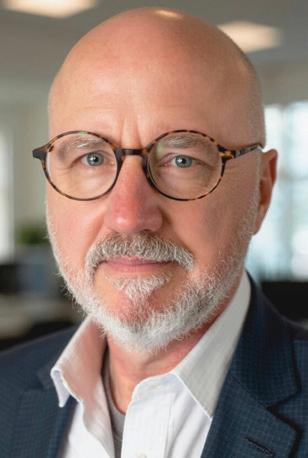
Fritz Sassine has been named director of the Division of Legislative Automated Systems at Capitol Square in Richmond, the Virginia General Assembly announced.
Sassine, an information technology and cybersecurity leader with more than 30 years of experience, most recently served as assistant director of IT cybersecurity and project management for the Virginia Office of the Attorney General. He has led enterprise-wide application implementations and high-performing development teams delivering secure, scalable solutions aligned with business and mission goals.

He is recognized for organizing internal development teams and establishing standards and practices that support the delivery of complex, multiyear technology roadmaps.
Sassine also serves as a company commander with the Virginia Defense Force Cyber Battalion. He holds a bachelor’s degree in business and information systems and certifications including a Nessus Certificate of Proficiency, a SCRUM Master Project Management Certificate and a Lean Six Sigma Green Belt. He applies ITIL 4 principles to build repeatable, high-quality IT services.
Outside of his professional roles, Sassine founded HaitiKids to support medical mission trips and has flown patients and families for medical treatment as a private pilot with Angel Flight. As DLAS director, Sassine will oversee personnel who provide technical services and access to legislative information for the General Assembly and the public, primarily through the Legislative Information System. The division also manages the General Assembly’s Bill Room, performs computing and programming services, supports legislative branch initiatives and maintains collaborative relationships with legislative agencies, stakeholders and the public.
DLAS is a legislative branch agency that reports to the Committee on Joint Rules. Sassine’s appointment took effect Wednesday.

Free Press staff report
The Virginia Chamber of Commerce unveiled its long-term economic strategy, Blueprint Virginia 2035, during the 2025 Virginia Economic Summit and Forum on International Trade, presenting the plan to Gov.-elect Abigail Spanberger.
The plan is the result of a yearlong statewide effort aimed at strengthening Virginia’s position as a top state for business over the next decade. The summit was co-hosted by the Virginia Chamber Foundation and the Virginia Economic Development Partnership.
“Blueprint Virginia 2035 reflects a unified statewide vision for the economic future of all Virginians,” said Keith Martin, interim president and CEO of the Virginia Chamber. “We are grateful to the more than 10,000 business leaders, community partners and regional stakeholders who shared their expertise during this process.”
The Blueprint Virginia 2035 effort was co-chaired by Monica Schmude, president of Anthem Blue Cross and Blue Shield in Virginia, and Edmond Hughes, executive vice president and chief human resources officer of HII. Schmude said the process revealed consistent concerns across regions about health care access and affordability.
“Throughout the Blueprint Virginia tour, one message rang clear across every region of the Commonwealth: Virginians want a healthier future that’s also more affordable and easily accessible. This plan reflects the voices of our communities — and with strong partnerships across sectors, we can turn this vision into real and lasting impact,” Schmude said.
Spanberger received the plan as part of a tradition upheld by recent incoming

Spanberger picks Candi
Gov.-elect Abigail Spanberger on Tuesday named Del. Candi Mundon King as Virginia’s next Secretary of the Commonwealth, choosing a lawmaker and longtime community advocate to oversee constituent services and state board appointments in the incoming administration.
“The Secretary of the Commonwealth plays a vital role in ensuring that the Office of the Governor is responsive to the needs of Virginians, and I’m proud to announce the appointment of Delegate Candi Mundon King to serve in this role,” Spanberger said. “Throughout her career, [she] has worked to bring people together
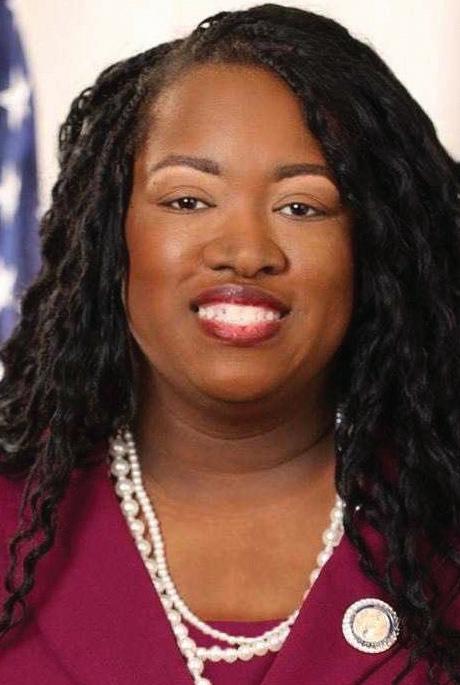
to get results for the people of Virginia, and she has demonstrated dedication, courage and a commitment to delivering on the promise of our Commonwealth.”
King said she was honored by the selection. “Throughout my career, I have been committed to improving government accessibility and ensuring our institutions work effectively for every community. I will bring that same dedication to managing the critical functions of this office,” she said.
King has represented the 23rd District, covering parts of Prince William and Stafford counties, since 2021. She chairs the House Committee on Counties, Cities and Towns and serves as vice chair of Public Safety. Her legislative work has included efforts on maternal health, renters’ rights, teacher pay, human trafficking protections and paid sick leave for home health care workers.
Before joining the House, she held roles at CARE and the Gates Foundation, focusing on advocacy, global food security and community relations. The Portsmouth native holds a political science degree from Norfolk State University and lives in Dumfries.
Free Press staff report
Greg Weatherford has been named the communications director for the Virginia State Corporation Commission. He replaces Andy Farmer, who retired this year.
Weatherford joined the SCC in 2023 as deputy director of its Information Resources Division after communications roles with Virginia Commonwealth University and the State Council of Higher Education for Virginia.
He began his career as a reporter and editor in 1994, covering business and other topics for the Richmond Times-Dispatch, The Associated Press and The Virginian-Pilot, among others. Weatherford’s work has earned state, regional and national awards including two national prizes for editorial excellence in 2020 for Virginia Business magazine. He holds a B.S. in mass communications and an MFA in writing, both from VCU.
Free Press staff report
With less than a year remaining in the city’s current Poet Laureate term, Richmond officials have opened applications for the next poet to serve in the role.
The selected Poet Laureate will serve a two-year term from 2026 to 2028 and become the city’s third laureate, following Roscoe Burnems, who served from 2021 to 2023, and current Poet Laureate Joanna Lee, whose term runs from 2024 to 2026.
“A big part of what the Poet Laureate of a place should do is to write to and for that place — to bear witness to the times we are living through, and to be a voice for the people who call that place home,”

Lee said. Lee and Burnems will serve on this year’s selection jury alongside city officials, local poets and community partners. The jury will review applications and make recommendations to Mayor Danny Avula, who will select the next laureate.
“The city’s next laureate will help us build a stronger, more connected Richmond by using their art to bring people together,” Avula said. “We’re looking for somebody who does the art form well, who loves
this city, and who helps it tell its stories and create paths to healing. Richmond has been so lucky in our first two laureates, and I can’t wait to see the immense talent of this next group of applicants.”
The Poet Laureate will receive a $5,000 annual stipend and $2,000 in initial project development funds to carry out a community-based project connecting residents through poetry.
Applicants must be at least 18 and live, work or study in Richmond. They must also have an established record of poetic achievement and fostering literary community.
Nominations and applications will be accepted through Jan. 12. More information is available at go.rva.gov/poet-laureate.
Sports Zone
Every
Live
Multiview
Watch up to four games at once.



Jones secures
Dem nomination for Hashmi’s Senate seat
Continued from A1
forward to serving with him in the Senate.”
The short primary race lasted about a week but still saw controversy when Gardner’s team criticized Jones over allegations of violence in an ad released ahead of Sunday’s election.
Both candidates saw support from leading Democratic officials statewide and locally. Jones submitted a letter resigning from his delegate seat Monday.
Hashmi will vacate her seat in January, while Jones will face Republican John R. Thomas in the special election on Tuesday, Jan. 6. Thomas, who has worked as a government contractor, had challenged Gardner for her House seat in November’s general election and lost with around 31% of the vote.
“Tonight is not the outcome we hoped for, but I am filled with pride in what we built together,” Gardner said in a social media post after the primary. “To my opponent, I congratulate you and truly hope that you will serve this district with integrity, accountability and compassion.”Early in-person voting for the special election begins Monday, Dec. 22. Voter registration offices will open for early voting Saturday, Dec. 27. Requests for mailed absentee ballots are accepted through Monday, Dec. 29. Voter registration and information updates can be completed until Tuesday, Dec. 30.
The special general election will be held Tuesday, Jan. 6, from 6 a.m. to 7 p.m.
Firehouse primary set to fill House District 77 seat
and Chesterfield County.
At the time of publication, two candidates had announced their bids for the Democratic nomination — former City Council president and mayoral candidate Michelle Mosby and former ACLU attorney and community activist Charlies Schmidt.
Mosby cites her experience as a small-business owner, nonprofit leader and former elected official, along with her community ties, as qualifications for the seat. Her campaign says she would focus on housing, public safety, youth support and economic development.

“We need leadership that is prepared, steady, compassionate and ready to work from day one,” Mosby said when announcing her campaign. “I am prepared to bring my experience, my relationships, and my unwavering commitment to the people of District 77 to the floor of the House of Delegates.”
Schmidt describes himself as a progressive candidate with experience challenging powerful institutions and working on civil rights issues. His platform includes support for housing and health care, union workers, public schools and protections for environmental, LGBTQ+, voting and reproductive rights.
“Throughout my life and my legal career, I have worked to protect the vulnerable, seek justice and ensure our government is accountable to the people,” Schmidt said. “Now I want to take that experience to the General Assembly.”
Mosby and Schmidt have won endorsements from several Richmond and Chesterfield officials and groups, including one for Mosby from Jones.
Prospective candidates for the primary have until 9 a.m. Friday, Dec. 12 to submit a Certificate of Candidate Qualification and Statement of Economic Interest, along with a filing fee, with the HD-77 Nominating Committee.
Voting will run from 10 a.m. to 6 p.m. at Richmond High School for the Arts, 4314 Crutchfield St., and Providence Middle School, 900 Starlight Lane in Chesterfield. The nominee will advance to a special general election Tuesday, Jan. 6.
Rally calls for end to U.S. involvement in Venezuela
instead of feeding the poor, that militarizes the police instead of raising wages. Imperialism abroad goes hand in hand with repression at home.”
The rally also included testimonies from immigrants and community members as well as speeches from representatives of the immigrant defense network Richmond Defensa and 50501 Virginia, who encouraged attendees to inform and engage the public on the issue.
“While we may not see more people here, what we can do as people of the community of Richmond is continue to spread the word, continue to tell people the truth,” said University of Richmond student Chris Melendez.
Free Press staff report
A Virginia state trooper, along with several Good Samaritans, helped rescue a Maryland man from a burning Tesla early Friday.
The crash occurred around 7 a.m. on Interstate 95 northbound at the 111-mile marker when a 2024 Tesla Model Y ran off the left side of the road and struck a tree.

Virginia State Police Sgt. S. Page was driving northbound when he noticed the vehicle. “I initially was trying to decide if I should go northbound or southbound on 95 … I was thinking I should just go southbound because I wanted to check the rest area. But then
something told me to go northbound. So I was like I’ll just go northbound. And then driving northbound I happened to look over to my left-hand side and saw the Tesla,” Page said. The Tesla’s doors were locked and would not open. Page broke the window, cut the airbag and, with the help of others, pulled the driver to safety. Afterward, Page checked the vehicle to ensure no one else was inside. The driver, Foday Kanu, 34, of Upper Marlboro, Maryland, suffered serious but nonlife-threatening injuries and was taken to a hospital. Winter weather is being considered as a possible factor in the crash. The accident remains under investigation.
one she’s seen celebrated by the other students on campus.
“The standards that were challenged have been addressed,” she said, “and that should reinforce anyone’s confidence in Virginia Union University’s stability and future direction.”
Armstrong-Edlow, an Entrepreneurial Management major from Newport News, transferred to VUU in spring 2024 after officials outlined the university’s efforts to maintain its accreditation.
VUU SGA members, including Armstrong-Edlow, took part in SACSCOC’s evaluation and, during panel interviews, offered feedback on the campus’ strengths, areas for improvement and their own experiences.
Since transferring, Armstrong-Edlow said the university has made progress not only in addressing SACSCOC’s concerns but also in meeting student needs, including adding a Sports Management minor she can pursue alongside her English minor.
With VUU’s probation behind it,
Armstrong-Edlow said she hopes the university will continue to improve. She plans to promote transparency among students, faculty, staff and university leaders in her role as president.
“[I will be] helping the students, the faculty, the staff and everyone come together to remember that, yes, while we may be off of the probation, that we have to continue to move forward and progress or else we can go right back to where we were,” Armstrong-Edlow said.
SACSCOC did not respond to requests for comment by press time.



By Shaban Athuman VPM News
Richmond Mayor Danny Avula and City Council members met for three hours Dec. 4 to open a new budget process where they work closer together, going over their priorities and sharing concerns about how to pay for them.
The joint session, held in a meeting room at the downtown Hilton hotel, was run by a “facilitation team” that included Eric Scorsone, the executive director of the University of Virginia’s Weldon Cooper Center for Public Service.
While the meeting didn’t entirely meet its intended goal and questions remain after the fact, it ended with the city’s elected officials voicing enthusiasm for the new approach to crafting a spending plan for fiscal year 2027. They agreed broadly on goals to improve government services for residents, build more affordable housing and support Richmond Public Schools and economic development. Officials also discussed ongoing efforts, like improving the city’s water treatment plant and maintaining free bus fare.
The effort is a shift from the traditional process that Avula agreed to after councilors began calling for more input.
Richmond’s mayor and administration typically draft a budget proposal that council amends slightly and votes on, but the nine-member body doesn’t help come up with the spending plan.
Council President Cynthia Newbille (7th District) said Thursday that the old way had councilors and other officials working in silos.
Chief Administrative Officer Odie Donald said the meeting was just the beginning of working closer together on a budget: “I know you’re talking about the baking of the cake. It

includes a lot of ingredients. This is ingredient one.”
Officials didn’t appear on the same page when Thursday’s meeting started, with some councilors questioning why they were discussing priorities instead of using specific financial numbers to plan ahead.
With Avula sitting next to her,
Councilor Kenya Gibson (3rd District) said the meeting felt “very marketing” to her and that the city doesn’t have the luxury of limiting itself to a handful of areas to focus on.
Gibson said the meeting presented good ideas for the future, but that’s not the goal she believes they should be aiming for.
“The reality is we’re not in a conceptual place, we are in a reality in which we are continuing to increase how much it costs for residents to live here,” she said. “We’re ending up with a surplus and yet we still have escalating costs.”
But Donald said councilors and the administration have heard from residents at town halls and should use that feedback to come up with their priorities.
“With limited resources, unless there’s an appetite to raise taxes and increase the burden on our customers, which I haven’t heard, then we have to prioritize,” he said. “Otherwise, we’re continuously left with more
month than money and no way to spread it across.”
Gibson said she wasn’t sure why the joint session didn’t include a discussion about revenue figures, including a potential $22 million surplus from last year’s budget. Without them, she said, officials don’t know enough about Richmond’s financial state to make decisions.
Avula said that number is not final but the city’s “best guess,” and that using that projection to consider city spending could put officials in a tough position and require additional work for staff.
Once the discussion shifted to priorities, officials seemed to come
together on what they found important, including housing, public safety and health care.
“Public housing redevelopment is [at] the very top of my list,” Avula said.
Newbille raised concerns about health care access to Medicare and Medicaid during federal changes: “In a minute, I’m not sure that we won’t have even more people leaving here because they won’t have access to health care. I’m hopeful but, in January, we don’t know what that’s going to look like.”
Vice President Katherine Jordan (2nd District) said she felt addressing issues at the city’s finance and planning departments was a top need as well.
The discussion also turned to constraints in Richmond’s ability to expand its real estate tax base because of tax-exempt state-owned properties, which officials said limits their ability to raise money.
Councilor Ellen Robertson (6th District) joked with the facilitation team about coming up with the money to fund budget initiatives: “Since you all agreed to facilitate this meeting, are you going to come back with a pot of revenues and resources to pay for everything?”
The goal of the meeting was to find about six spending priorities, but the final list grew to about eight. Avula said what started as a “focusing exercise” ended up being an “expansion exercise.”
Donald praised the officials for the progress they made Thursday, which he reminded them was just the start of their budget work. He told them to give themselves grace because they decided to have a more cooperative approach when they didn’t have to.
“It’s not going to be perfect — it’s government,” Donald said, “but the standard has been raised [above] what it was the year before, and the year before that, and the year before that.”

It happens to the best of us. You’re led to believe that you have a say in how things might happen at your job or organization, but instead you realize that the solicitation of your opinion was an exercise in “performative consultation.” That term has gained traction in recent years, particularly in political and academic contexts. It refers to the moments when an organization asks for input and appears to be interested in a collaborative process, but is only checking boxes.
It’s not a good feeling to be on the receiving end of this kind of performance. It’s disrespectful, discouraging and can cause you to question your trust in leadership. I haven’t taken a poll of students and faculty at Armstrong High School, but I would wager that some of them might feel a certain way about the School Board’s recent decision to change the name of their school. The unanimous vote came last week, months after results from a survey of students and staff, conducted by Richmond Public Schools, indicated that 70% wanted to keep their name intact.
Many in the community, who were surveyed as well, didn’t see it that way — and they were vocal about it. They offered sound arguments about history, inclusivity and honoring the community’s memory. Although the vote surprised many, we can see why the board members were swayed by the alumni and supporters of Kennedy High School, some of whom felt that their school had been erased from history. In the near future, they’ll be able to see and hear the name of their beloved alma mater on a regular basis once again and this long drawn-out chapter of Richmond history will be over.
It’s unfortunate that the voices of young people, who walk the halls of the high school every day, were largely disregarded. They were overruled by adults — something that happens to teenagers on a regular basis, but that doesn’t make it any less frustrating. These are the students whose diplomas and transcripts will bear a decision made over their objections.
A school’s name shapes its culture, its pride and its sense of belonging — feeling shut out of the process to rename it could dampen school spirit. As the alumni of Kennedy cherish their stories and memories, the students in that building right now need space to create their own.
We hope that as the school division decides how to institute the changes to the school, that current students are involved in every step of the process. Armstrong’s young people should not just inherit a decision. They deserve a voice in shaping what comes next.
Have you heard of Khalid? If you’re the average age of a newspaper reader, then you probably don’t recognize the name. According to a news release, he’s a “multi-platinum global superstar,” which sounds impressive, considering that people aren’t buying CDs like they used to buy newspapers. He’s known for his hits “Location” and “Young Dumb & Broke” and his chart-topping album “Free Spirit.” He’s worked with other well-known artists such as Marshmello, Billie Eilish, Halsey and Normani. The streaming platform Apple Music describes him as an R&B star “whose music sneaks its way under genre boundaries.”
So why should someone who’s probably 57.9 care about this emerging star? Well, his scheduled appearance at one of the city’s newest venues, Allianz Amphitheatre at Riverfront, in June 2026 is remarkable in that he’ll be one of the few African American artists to grace its stages as a headliner since it opened in June.
Perhaps this signals a more inclusive direction for the venue, which, out of nearly 40 acts booked since opening, has hosted only a few Black headliners, including pop group Boyz II Men and retro soul artist Leon Bridges.
Booking diversity is just one challenge the venue faces. Patrons have complained about parking, lack of shade and neighborhood disruption. There’s a lot of room for improvement, and we hope the stage begins to reflect the city’s full musical and cultural spectrum.

Sometimes, one crisis seems to lead to another for President Donald Trump — and he’s got plenty of trouble brewing.
For months now, Trump’s approval rating has taken a beating for the knock-on effects of the government shutdown and the ongoing fiasco over the Jeffrey Epstein files. In November, his administration came under fire over newly reported de tails about the airstrikes on drug-traffick ing suspects in the Caribbean, which seem to indicate that wounded people were deliberately killed in violation of the conventions of war. Trump also responded to the shooting of two National Guard members in Washington — allegedly by an Afghani refugee who had formerly worked with American intelligence in Afghanistan — by suspending all Afghani immigration cases, leading many critics to decry the move as collective punishment.

social media that he was revoking temporary protected status for Somalis living in Minnesota.
“They contribute nothing,” Trump told reporters in a rambling tirade in the Cabinet meeting. “I don’t want them in our country.”
Trump further averred that the war-torn East African country from which they fled “stinks” and that they are “garbage.”
Even for Trump, who once infamously dismissed African
nations and other developing nations as “shithole countries,” the malevolence and vulgarity of his anti-Somali outbursts was stunning.
And what end did he imagine they served?
Casting a broad shadow of suspicion on immigrants from other nations, especially nonwhite and Islamic ones, has been a yearslong pattern for Trump and his deputy chief of staff for policy, Stephen Miller.
Amid all this anguish, Trump took the opportunity at a Cabinet meeting Tuesday to advance collective punishment against another immigrant group that he doesn’t like: Somalis.
On Nov. 21, Trump posted on
Consumers love a sale. We love the little red tag, the “limited time only,” the breathless “50% off!” that promises we’re getting over on somebody. At this time of year, the sales signs practically scream at us, and we rush to stores convinced we’ve won a battle against high prices. But here’s the truth that retailers hope you never pause long enough to consider: If a store can slash a price by half and still make money, were you ever getting a real deal?
That’s the mystery of the markdown.

And once you pull back the curtain, the mystery dissolves into a simple equation: The retailer is not losing money — far from it.
Let’s start with math. Most consumers imagine that when they buy a $100 sweater, somewhere in Bangladesh a worker made it for $60 or $70, and the retailer added a modest markup. Not! That $100 item cost the retailer between $20 and $40, or even less if it’s fast fashion. What happens when the store announces “50% off”? That $100 sweater becomes $50 at the register. Sounds like a steal, right? But if the retailer paid $30 for it, they’re still pocketing $20 in profit. That’s a 40% margin, even after the dramatic price “cut.” No pain. No loss. Just business. The “deal” is not on the clothes. The “deal” is on your behavior. Retailers understand psychology even better than economics. They know the dopamine hit of thinking we beat the system. They know the urgency of a ticking clock. They know we walk in for “one thing” and walk out
But the Somali angle likely has much to do with the recent Trump administration tack of punishing blue states and Democratic political leaders. The largest Somali expatriate community in the U.S. resides in Minnesota, home to U.S. Rep. Ilhan Omar and Gov. Tim Walz, two favorite subjects
with a cart. Savings is the bait; profit is the switch. We’ve all nipped at the bait. I’ve driven dozens of miles to a mall for a sale. I’ve stood in line for half-off designer clothing. I’ve bought junk I did not need because it was “on sale.” That was a lifetime ago. These days I shop in my overflowing closet. I tell myself I will never need a new item of clothing again. Kind of. I can’t tell you when I last bought “new stuff.” But I confess that when faced with the possibility of a high-visibility event, I called my favorite “Black girl”
Julianne Malveaux
store (Katula in Los Angeles) to ask them to send me pics of something fabulous. Regaining good sense, I called hours later to say, “Never mind, I got this.”
Bait and switch. Even the so-called “regular price” is a fiction. In many states, a retailer can raise a price for a few weeks, then proclaim a markdown that feels massive but is meaningless. Those “compare at $149!” stickers? Often invented numbers. Those “before and after” tags? Carefully engineered illusions. The real misery behind the markdown isn’t felt by the retailer or the bargain-seeker. It’s borne by the workers whose low wages make the whole system possible. By the warehouse crews who don’t see their families during the holidays. By the delivery drivers forced into 16-hour shifts. By the sales associates who smile through exhaustion for $15 an hour — if that.
This entire ecosystem of discount culture is built on someone else being discounted. Retailers have gotten more sophisticated, not less. Today’s “sales” are algorithmically timed,
of Trump invective. Some 80,000 people of Somali birth or ancestry reside in the state, and the vast majority are U.S. citizens. Omar emigrated from Somalia in 1995 as a child.
Minnesota’s Somali community has taken a public relations hit recently following reports of the U.S. Department of Justice’s prosecution of individuals involved in a wide-ranging scheme to defraud Minnesota and federal government programs during and after the COVID-19 pandemic.
It’s a major issue, and more than $1 billion in taxpayer money has been stolen, according to The New York Times. The DOJ investigation, started during the Biden administration, centers on a nonprofit group called Feeding Our Future, which worked with the Minnesota Department of Education and the U.S. Department of Agriculture to distribute meals to children.
The defendants, who are mostly but not all members of the Somali community, submitted false invoices and meal count sheets, set up bogus programs for autistic children, and took or gave kickbacks for participation in the fraud.
It’s disgraceful behavior, and it’s good that the fraudsters are being prosecuted. However, Trump could not help himself from taking the outrage across the line of collective calumny.
psychologically targeted and strategically priced. Businesses know exactly how much inventory they can move at each price point, and they build markdowns into their annual plan. The sale is not a surprise — it’s the strategy.
A retailer might lose money on one “doorbuster” TV, but that’s a deliberate sacrifice to lure you into a store filled with 200% markups. You came for the deal; you stay for the illusion. And you leave thinking you’ve triumphed, not realizing you’ve played the part retailers wrote for you.
So as the holiday season barrels toward us, and as communities — especially Black communities — are bombarded with pressure to buy, buy, buy, it’s worth asking: What do we really gain from chasing sales that were never sales in the first place?
For many of us, the cost isn’t just financial, it’s emotional. We feel guilty when we don’t spend. We feel inadequate when we can’t gift lavishly. And too often, we sacrifice long-term financial well-being for short-term “joy” engineered by an industry built on extraction. It’s called predatory capitalism.
The markdown is not serving you or your family, not serving the workers whose bodies absorb the true cost of America’s bargain culture.
The retailer isn’t slashing their profits. They’re slashing your perception.
Why do we keep celebrating the privilege of being played?
This year, let’s refuse the hustle. Let’s stop applauding fake generosity.
Let’s protect our wallets, our dignity and our sanity.
The markdown isn’t a gift. It’s a business model. It only works if we keep falling for it. The writer is a D.C.-based economist and author.
Picking up on allegations by Christopher Rufo, a senior fellow at the conservative Manhattan Institute, and Ryan Thorpe, a reporter for the institute’s City Journal, that money stolen from Minnesota programs has gone to al-Shabab, an al-Qaida-linked militant group that controls parts of Somalia, Trump branded the Minnesota Somali community “a hub of fraudulent money laundering activity” and vowed to send them “back to where they came from.”
“We can go one way or the other, and we’re going to go the wrong way, if we keep taking in garbage into our country,” Trump said. “Ilhan Omar is garbage. She’s garbage! Her friends are garbage!”
In response to the president, Omar fortunately kept her cool. “I hope,” she said graciously, “he gets the help he desperately needs.” From your lips to God’s ear, Congresswoman. The writer is a columnist for the Chicago Tribune.




Virginia is moving steadily toward approving adult-use marijuana, with a regulated market expected to begin in 2026. This will include dispensaries and privately operated retail stores authorized by the Cannabis Control Authority. While many Virginians support a regulated cannabis market — and I count myself among those who believe regulation is better than chaos — we must confront an uncomfortable truth: Legalization, without strong safeguards, will place our children in jeopardy.
I recently attended a meeting of the General Assembly committee responsible for drafting the resolutions that will shape Virginia’s adult-use marijuana law. During that meeting, several advocates from Virginians for Safer Cannabis, speaking in support of the legalization
lawmakers.

of adult-use cannabis and the inclusion of minority business partners in all components of the cultivation, distribution and retail markets, expressed serious concerns about what happens after marijuana is legally purchased by adults and brought into homes where children live. Those concerns are real, urgent and cannot be ignored. Public schools operate under very strict policies regarding drugs on campus. A student who brings marijuana to school — even if it was legally purchased by an adult family member — can face severe consequences. Possession can be treated as
intent to distribute. Suspension, expulsion and involvement with the juvenile justice system are very real possibilities. These penalties do not disappear simply because marijuana becomes legal for adults.
The risk is clear: Once
marijuana is legally available for sale across Virginia, young people will have more opportunities than ever to access it. Not because they are purchasing it legally, but because it is present in their homes. From elementary school through high school, students will be exposed to marijuana in ways we have not adequately planned for. College campuses will face similar challenges, where students under the age of 21
will inevitably be exposed to cannabis possessed by students who are legally allowed to buy it.
We have been here before.
Virginia allowed vape shops to proliferate without fully understanding how easily those products could put THC into the hands of students. By the time we grasped the consequences, schools were already facing a crisis. We cannot afford to repeat that mistake with cannabis. The stakes are simply too high.
Let me be clear: A regulated cannabis market is better than an unregulated one. Regulation brings oversight, accountability and public health protections. We are not opposed to legalization itself. What we are calling for is responsibility — shared responsibility among parents, educators, school boards and
School boards must begin addressing how adult-use marijuana will impact students. They must communicate with the state Board of Education, which in turn must engage directly with legislators crafting this policy. Parents must be educated on their legal and moral responsibilities to keep marijuana securely stored and out of the reach of young people. This is not optional — it is essential.
Without communitywide education and thoughtful safeguards, students will be punished for mistakes that begin with adult carelessness. A young person caught with marijuana at school could carry the burden of a criminal record or expulsion — not because they had access to a dispensary, but because someone at home failed to protect them from adult-only substances. As Virginia moves closer to legal adult use of marijuana, we must do so with our eyes open. Protecting children must be part of the legalization framework, not an afterthought. This moment demands action, coordination and education — before harm is done. Everybody must be involved — parents, school boards, educators, state agencies and legislators. If we do this right, we can create a regulated cannabis system that serves adults without sacrificing the futures of our young people. If we don’t get it right, our children will pay the price. The writer is the president of the Richmond chapter of the Southern Christian Leadership Conference and a former school administrator.
The headlines this month about white men, college admissions and the fallout from ending affirmative action startled a lot of people. Stories of declining enrollment and shrinking opportunity for young white men were treated as if they had materialized out of nowhere. Many found it surprising. I didn’t.

It reminded me of a conversation I had a little over a decade ago on a Delta Air Lines flight from Atlanta to Memphis — one of those brief moments in transit that stays with you because it tells the truth long before the data catch up.
A white man in a bright red
shirt with a Confederate flag over his heart sat down next to me. He stuck out his hand and said, “Hi, I’m Bill.” As he introduced himself, I looked more closely at his shirt and realized that under the flag it said “Ole Miss Football.” It was a booster shirt. We chatted. He
asked what I did. I told him I led the NAACP. He blinked, then leaned in with a sincerity I recognized.
“Ben,” he asked, “what’s the purpose of affirmative action?”
I told him the truth: Its purpose is to help dismantle nepotism as the operating system of this country. He slapped his knee. “Sign me up for that. But tell me this — what good does that do for the boys in my family?”
Then he told me what he meant. The men in his family had been, as he put it, “in and out of prison since we came here on the wrong side of the Georgia penal colony.” He was the lone exception — a gifted high school football player who earned a scholarship to Ole Miss.
A coach introduced him to business leaders in Memphis. That was his way out. The booster shirt wasn’t a provocation. It was a keepsake from the only open door his family ever had.
Bill’s story is not the one America tells about white men. But it is the story millions are living. And it mirrors something larger happening across this country.
For years now, researchers have documented serious headwinds facing working-class
that is fair, focused
“New Orleans is a city with a soul. Our culture, our neighborhoods, our traditions and our deep sense of community shape how we live and how we keep each other safe. Any law enforcement activity in our city, including federal operations, must honor that reality. It must reflect an understanding of our local laws, our norms and our people.”

Of all the cities in the nation, New Orleans perhaps best exemplifies the virtues of the American melting pot. Just as our signature dish, gumbo, depends upon the many distinct ingredients and culinary styles that come together to create something rich, flavorful and unsurpassed, New Orleans’ beauty and strength come from the interwoven cultures and traditions of its diverse population.
Any federal law enforcement operation in New Orleans, especially one focused on immigration, must respect those cultures and traditions.
Recently, I was proud to stand with Rep. Troy A. Carter Sr., New Orleans Mayor-elect Helena Moreno, New Orleans City Council members, advocates from civil and immigra-
tion rights groups, and faith and other community leaders to demand transparency, safeguards against discriminatory enforcement, and humanitarian protections during the ongoing federal immigration sweep of Operation Catahoula Crunch.
Immigrant communities power New Orleans’ hospital-
Marc H.
ity industry, our restaurants, our music and our traditions. When they suffer, the entire city suffers. Local hotel operators and restaurateurs are already worried about staffing shortages due to fear of raids, which could affect tourism and Mardi Gras celebrations.
Immigration enforcement in New Orleans has already created fear and uncertainty among thousands of families. People are staying home, businesses are closing, and workers are afraid to show up — even those with legal status.
This is not just an immigrant issue — it’s an economic issue. When immigrant workers disappear, restaurants close, hotels struggle and tourism declines. That hurts every New Orleanian.
Families are terrified of being torn apart. Many immigrants cannot “go back” because their countries are plagued by vio-
lence or instability. Deportation is not just relocation — it’s a life-threatening risk for many.
Community organizations like Familias Unidas en Acción are stepping up to provide food and support, but they are no substitute for fair and humane policies.
These raids are part of a larger national trend of aggressive immigration enforcement under the Trump administration, which has sparked protests and unrest in cities across the country.
I join Rep. Carter in requesting a full field hearing to be held in New Orleans so that local leaders can directly address and assess these pressing issues openly, among the people who are most affected.
Immigration is not a threat — it is a strength. America’s greatness comes from its diversity and its ability to welcome those seeking a better life.
We must reject fear-based policies and embrace solutions that keep families together, protect workers and strengthen our economy. Immigration reform should reflect our values: fairness, opportunity and respect for human dignity. New Orleans thrives when immigrants thrive. Protecting them protects the soul of our city — and the promise of our nation.
The writer is a former mayor of New Orleans.

American men: wages that stagnate or fall, especially for men without college degrees; fewer men in college even as women’s enrollment rises; more men detached from the labor force; rising suicide and overdose deaths in many hardhit communities; and marriage becoming less common and less stable for men with the weakest economic prospects.
White working-class men feel this acutely. But they are not alone.
White men may have made the headlines, but similar trends are affecting Black, Latino, Native and Asian men — especially those from poor and working-class backgrounds. In today’s economy, class and education now do as much work as race in deciding whether a man will be seen as “marriageable,” employable and likely to climb beyond the station of his birth.
So if you’re wondering why a Black civil rights leader cares about the struggles of white men, the answer is simple: In a democracy, you cannot fix poverty for anyone unless you fix it for everyone. Every major leap forward in opportunity in this country has depended on multiracial coalitions. Progress comes when we face the full truth — not when we ignore parts of it.
Which brings us to the conversation we are actually having. Or rather, not having.
It’s time to readjust our thinking about white men, college admissions and DEI. The left and the right have both turned this into a culture war when what we really need is a reality check.
On the right, the headlines became a grievance weapon — proof, some claim, that diversity efforts were out to “replace” white men. On the
left, the reaction was defensive, as if acknowledging hardship among white families would somehow undermine the fight for racial justice. Neither response had much to do with the truth. And if we’re wondering why we can’t seem to have a real conversation about opportunity, we should start where political scientist Martin Gilens warned us decades ago. By portraying poverty disproportionately with Black faces, American media helped make the white poor — and much of the working class — invisible. That distortion robbed us of the ability to see the full picture of suffering and the full map of shared struggle. When entire communities are invisible, their pain doesn’t get counted. Their boys don’t get counted. Their decline doesn’t make the front page until it shows up as a political shock.
That invisibility hurts everyone. It hurts white families like Bill’s. It hurts Black and brown families navigating the same broken ladders. It hurts the communities trying to build stable futures for their children.
Before we talk solutions, we need full visibility — a willingness to see all who are struggling, not just the ones who fit our old narratives.
And yes, part of that conversation may involve something like affirmative action for working-class families — including white men. Not the caricatured version people argue about on cable news, but the real kind colleges have long used: giving a boost to students from lowincome families, high-poverty neighborhoods, under-resourced schools and overlooked rural counties — from Appalachia to the Mississippi Delta to remote parts of Alaska.
Race-based affirmative ac-
tion sat alongside these classand place-based efforts; it never replaced them. And even after the Supreme Court’s decision, colleges can still use class-based affirmative action because it recognizes a basic truth: A child’s chances in life are shaped powerfully by ZIP code, wealth and opportunity. The headlines surprised many because they showed only one part of the story. It’s time we tell the whole story. Only then can we rebuild opportunity — for Bill, for the boys in his family and for every family fighting for a fair shot. The writer is a professor of practice at the University of Pennsylvania and a former national president and CEO of the NAACP.




The Associated Press
A selection of Inuit artifacts returned by the Vatican is now at the Canadian Museum of History, after First Nations, Inuit and Métis leaders for years called for the repatriation of Indigenous items.
Pope Leo XIV gave the artifacts — including a traditional Inuit kayak — and supporting documentation to the Canadian Conference of Catholic Bishops, which said it would return the items to Indigenous communities “as soon as possible.”
The items — 62 in all — ultimately will be returned to their communities as part of the Catholic Church’s reckoning with its role in helping suppress Indigenous culture in the Americas.
First Nations, Inuit and Métis leaders welcomed the dozens of artifacts at Montreal’s airport on Saturday, and Inuit leaders showed some of the returned items to a small group of Indigenous representatives and journalists on Tuesday.
The Inuit kayak, elegantly hand-built from driftwood, sealskin and sinew, was one of the artifacts earmarked for repatriation.
Inuit Tapiriit Kanatami President Natan Obed said it’s not known how the kayak, an essential item to the life of the community and likely used for beluga hunting, ended up in the Vatican.
Along with the kayak, the items on display Tuesday included a handful of smaller Inuit items, including a soup ladle, needle casings
and an ulu knife.
Obed said the items will not be on public display anytime soon as a group of Inuit advisers works to trace each artifact back to its community of origin. The artifacts will be kept for now at the Canadian Museum of History in a secure facility with temperature controls.
For a century, the items were part of the Vatican Museums’ ethnographic collection, known today as the Anima Mundi museum. The collection has been a source of controversy for the Vatican amid the broader debate over the restitution of cultural goods taken from Indigenous peoples during colonial periods.
Most of the items in the Vatican collection were sent to Rome by Catholic missionaries for a 1925 exhibition in the Vatican gardens. The Vatican insists the items were “gifts” to Pope Pius XI, who wanted to celebrate the church’s global reach, its missionaries and the lives of the Indigenous peoples they evangelized.
But historians, Indigenous groups and experts have long questioned whether the items could really have been offered freely, given the power imbalances at play in Catholic missions at the time.
During the display on Tuesday, Inuit leaders demonstrated for journalists how the items were made and how they would have been used. Onlookers were allowed to touch the objects as Paul Irngaut, acting president of Nunavut Tunngavik

Free Press staff report
The Virginia Museum of Fine Arts has deaccessioned and returned 41 ancient polychrome terracotta reliefs after an investigation by the Manhattan District Attorney’s Antiquities Trafficking Unit determined they had been looted.
“The Virginia Museum of Fine Arts takes seriously and responds to all restitution claims for works in our collection,” said VMFA Director and CEO Alex Nyerges. “Based on the evidence shown to VMFA, we are convinced that we do not have clear title for these reliefs. We are therefore happy to be working with the Antiquities Trafficking Unit of the Manhattan District Attorney’s Office to return all of the polychrome terracotta frag-

“I’m sure that there were some people who are curators who might have been quite
ments in question to Türkiye.”
The reliefs, valued at around $400,000, were part of a large series from a 6th-century B.C. Phrygian temple at Düver in southwestern Turkey. The site was illegally excavated and looted between 1962 and 1968, and the fragments were sold on the international art market.
VMFA acquired 34 of them in 1978 from Summa Galleries in Beverly Hills, California; six more were gifts from Chicago dealer Harlan J. Berk; and an additional fragment came from Summa Galleries the following year.
VMFA’s curatorial and provenance staff supplied extensive documentation, including sales receipts, invoices, bills of sale, shipping records and correspondence, in response to the resti-
tution claim submitted Nov. 3.
On Nov. 17, retired Marine Col. Matthew Bogdanos, head of the Antiquities Trafficking Unit, presented what the museum described as “clear, compelling and irrefutable evidence that the works under investigation were stolen or looted and should be repatriated to Turkey.”
“The Virginia Museum of Fine Arts is committed to returning any antiquities that are discovered to be unlawfully held,” said Dr. Lisa Brody, VMFA’s Jack and Mary Ann Frable Curator of Ancient Art. “When, as in this case, there is indisputable evidence that objects were obtained through illicit excavation and illegal export, we consider it essential to return these works to their country of origin.”
“Stolen or looted art has no place in our collection,” said Artistic Director and Chief Curator Dr. Michael Taylor. “We are therefore delighted to return these works and thank Col. Bogdanos and his team of investigators for alerting VMFA to the presence of these illegally excavated works in our ancient art holdings.”
According to a news release, the museum follows guidelines set by the American Alliance of Museums and the American Association of Art Museum Directors regarding provenance research. In 2023, the museum repatriated 44 works of ancient art to Italy, Egypt and Turkey. Since 2004, the museum has resolved four Nazi-era art claims, returning three to rightful owners and retaining one through a compensation agreement.


r
r
r


Left, Ahmad Britt #23 of John Marshall High School drives to the basket during the “Battle of Richmond” at the VSU Multipurpose Center on Saturday, Dec. 6. John Marshall defeated Richmond School for the Arts 78-51. Right, Nick Byrd Jr. #4 of S3 Academy looks to distribute the ball during the “Battle of the Burg.”

Division I talent was on full display Saturday night as nationally ranked Petersburg and city rival John Marshall delivered commanding victories in “The Battle 2025” doubleheader at Virginia State University’s Multipurpose Center.
In the nightcap, sixth-ranked Petersburg showcased why it’s among the nation’s elite, defeating S3 Academy 67-52 behind King Bacot’s game-high 21 points. The Crimson Wave, whose roster features five D1 recruits, proved too deep and talented for their opponents.

The Richmond Kickers have signed fullback Mujeeb Murana, pending league and federation approval.
Murana, 25, brings experience at the MLS and the USL Championship levels and is expected to add depth on the right side of the back line. He most recently played for Miami FC and Birmingham Legion FC in the USL Championship.
“Mujeeb has some great experience at both the MLS and USL Championship levels. He is dynamic going forward and his presence in defending is a priority for us in 2026,” said Chief Sporting Officer and Head Coach Darren Sawatzky. “We look forward to watching him intervene in opposition attacks, then impose his quality as we work to score goals in the attack.”
A product of the Houston Dynamo academy, Murana joined the system at age 12 and worked his way through each level, eventually captaining the U-19 squad. He later earned a Homegrown contract with the Dynamo first team and made his debut during the 2023 U.S. Open Cup Round of 32 in a 1-0 victory against Sporting Kansas City. Houston went on to win the tournament, defeating Inter Miami FC 2-1 in the final.
Murana was also a key contributor for Houston Dynamo 2 during the 2022 MLS NEXT Pro season. He made 22 starts in 23 appearances as the club recorded 10 clean sheets. That season, he totaled 12 key passes, 64 accurate long balls and added an assist in the conference semifinal.
“Coming to Richmond for me means that I am who I say I am — when no one believes in me, I always believe in myself and will rise above,” Murana said. “Richmond has the best fans in the league. I look forward to scoring lots of goals and setting a new decibel record for City Stadium.”
Before turning professional, Murana played at Saint Louis University, where he earned All-Atlantic 10 honors in back-toback seasons.
Bacot, a Division I recruit, was efficient throughout, shooting 7-for-12 from the floor and 6-for-10 from the freethrow line while grabbing eight rebounds in 27 minutes. His performance was complemented by a balanced attack that saw Oklahoma State commit Latrell Allmond contribute six points and a team-high eight rebounds, while Mississippi State-bound Ladarius Givan added eight points, five rebounds and four assists.
Fellow D1 recruits Kelvin “Pop” Anderson and Cam Claiborne each chipped in eight and four points respectively, demonstrating the Crimson Wave’s overwhelming depth. Petersburg shot 41.7% from the field and dominated at the free-throw line, converting 22-of-27 attempts (81.5%).
S3 Academy, led by Stephon Cherry’s 20 points and seven rebounds, couldn’t overcome Petersburg’s firepower. D1 recruits Nick Byrd and Jamese Jordan combined for just 12 points as Petersburg’s defense clamped down. The Crimson Wave outscored S3 Academy in every quarter except the fourth, building a 25-20 halftime lead and never looking back.
In the opening game, John Marshall set the tone for the evening with a dominant 78-51 victory over Richmond High School for the Arts. D1 recruits Troy Tomlin and Ahmad Britt led the Justices to a wire-to-wire victory that was never in doubt.
John Marshall exploded out of the gates, racing to a 2514 first-quarter advantage. The Justices’ relentless pressure and transition game extended the lead to 54-30 by halftime, effectively putting the game away before the break. By the end of the third quarter, John Marshall led 73-45.
Jermaine Brown paced Richmond HS for the Arts in the losing effort, but the team — competing under the banner of the former George Wythe location — struggled to match John Marshall’s size, athleticism and depth.
The doubleheader provided a showcase of Richmond-area basketball talent, with both winning teams featuring multiple Division I recruits and college-level skill. The atmosphere at VSU’s Multipurpose Center gave all four squads a taste of what awaits them at the next level.

Free Press staff report
Richmond’s student-athletes were celebrated Dec. 3 during the third annual Maxie Awards banquet at the Robinson Theater Community Arts Center.
Organized by Clarence Kenney of Noah Renaissance, the event recognized standout football players and coaches from Armstrong, Huguenot, John Marshall and Thomas Jefferson high schools.
The awards, founded in 2023 by Ken-
ney, are named after Maxie C. Robinson, the legendary Armstrong High School football coach who led the program for 40 years. Kenney, an Armstrong alumnus, created the awards to honor Richmond’s football legacy and inspire young athletes to excel both on and off the field.
The evening began with a dinner, followed by a motivational speech from McDaniel Anderson, an Armstrong alumnus who played under Robinson. Awards were then presented, with Donzell Jones Teal of Armstrong receiving the Maxie Trophy for Player of the Year. Armstrong head coach Jeremy Pruitt was named Angier Lawrence Coach of the Year, and Curtis Allen of Virginia Union University was honored as Black College Player of the Year. Armstrong High School received the Lou Anderson City Champion award. The 2025 All Maxie Team included players from Armstrong, Huguenot and Thomas Jefferson high schools and Richmond High School for the Arts.
Free Press staff report
Virginia Union University’s track and field teams opened the indoor season with a surge of early success, highlighted by multiple school records, event wins and breakout performances across two meets.
At the season opener, freshman Kornti Searles broke the indoor school record in the women’s weight throw, with fellow freshman Ellis Oshawnna moving to No. 2 all-time in the event. In the long jump, Angell Garrison and Taylor Porter opened their seasons with personal bests.
placed third with a collegiate-best mark of 23 feet, 6½ inches.
Freshman J’meriyon Osborne delivered the top men’s performance of the opener, winning the men’s open long jump ahead of 22 competitors in his collegiate debut. Timothy Butler broke the indoor school record in the weight throw and advanced to the finals, finishing sixth in a field of 29 athletes. In the invitational long jump, Jeremiah Palacious
“The first day of the meet was a strong showing for both the men’s and women’s teams — a great way to kick off the season,” said Franck Charles, VUU head track and field coach.
The Panthers carried that momentum to Liberty University, where day two produced three more women’s school records.
Yamilet Cruz broke a 15-year-old school record in the shot put with a throw of 11.83 me-
ters, surpassing Shakeema Browne’s 2010 mark. Abijah Jepkemboi set a new program record in the 5,000 meters with a time of 19:47, eclipsing the previous record set in 2017. Victoria Louis added the third record of the day, finishing the 300 meters in 42.08.
“Day two was another good day for our ladies as they broke three more school records,” Charles said. “Our women’s team is heading in the right direction and, in total, they’ve already shattered four school records this season.
Free Press staff report
Nearly 350 acres of farmland where Triple Crown champion Secretariat once roamed as a colt will remain permanently protected, preserving one of the most important landscapes in thoroughbred racing history.
The property, known as The Cove, is bordered by the North Anna River and served as the nursery for the broodmares and foals of Meadow Stable, founded in 1936 by Christopher Chenery. Secretariat, the 1973 Triple Crown winner and still the Kentucky Derby and Belmont Stakes record holder, spent part of his early life on the rolling pasture.
Other racing standouts connected to The Cove include Riva Ridge, winner of the Kentucky Derby and Belmont Stakes, and Somethingroyal, the broodmare that gave birth to Secretariat. The property played a central role in establishing Meadow Stable as one of the most influential breeding operations in American racing.
The land is now protected by a conservation easement held by the Capital Region Land Conservancy after its 2023 purchase by Kevin Engel of Engel Family Farms.
“Purchasing The Cove and restoring it to its heyday when Secretariat was running around on it has been a dream of mine for many years,” Engel said. “It is so important for my business to secure farmland from the threats of big warehouses, solar panels, data

centers and housing subdivisions but also for my grandchildren to be on land that is preserved without asphalt and concrete everywhere.”
Kate Chenery Tweedy, daughter of Meadow Stable’s founder and Secretariat’s longtime owner, said the preservation honors the farm’s racing history.
“Our family has highly valued conservation easements to protect lands. We are so grateful to know that Kevin is carrying forward the stewardship of this historic property and he has seen fit to put a conservation easement on it,” Tweedy said. “My mom and granddad would be so pleased by this action.”
The Cove sits just north of The Meadow Event Park in Caroline County, once part of the original Meadow Stable operation. The park, now home of the State Fair of Virginia, includes Secretariat’s foaling shed and original barns, which are designated state and national historic landmarks.
While the easement protects cropland and forestland, its most enduring value may be its link to racing history. The preservation ensures that the landscape tied to one of the sport’s greatest champions will remain largely unchanged for future generations of racing fans.
“Many future generations will appreciate their generosity to conserve The Cove and preserve the home of Secretariat,” said Parker Agelasto, executive director of the Capital Region Land Conservancy.


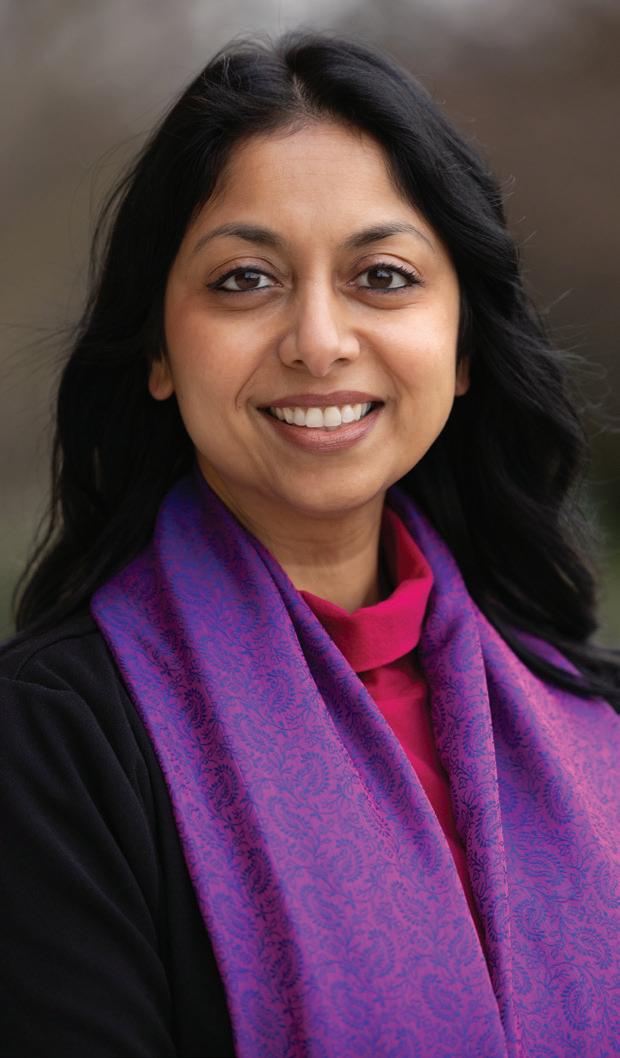
Linzy George’s story didn’t begin in Richmond, but that’s where her passion for community involvement continues to grow. As the new host of CreativeMornings Richmond, she helps foster a space where diverse stories spark creativity, build supportive relationships among attendees and lay the groundwork for collaboration.
CreativeMornings is a free monthly breakfast lecture series for creatives around the world. Across 70 countries, 255 chapters meet each month. In Richmond, each event features a new speaker who shares their story or journey in an intimate setting designed to build a more creative community.
“At CreativeMornings, we have different speakers and different audiences,” George said. “Your life story has many versions. We are layers of our experiences. Inspiration comes from our experiences. We’re not defined by them, but they are a part of us.”
Born in India and raised in New York, Richmond wasn’t on George’s radar until a job opportunity brought her here. She expected to stay only a short time, but 20 years later, she’s still in the city. She and her husband, another big-city transplant, have made their home in Bon Air, which she says reminds her of her hometown in upstate New York. They have raised three children; two are in college and one is living at home.
George came to the U.S. at age 5 after living with her grandparents in India while her parents immigrated to find jobs and a home. Her grandfather recorded her voice on cassette tapes to send to her parents as they settled in America. As an immigrant, she had to navigate
the balance between her Indian culture and life in the U.S.
“I went from South India to the South Bronx at age 5,” she said. “People would make fun of my parents’ accent. Growing up in New York, I wasn’t Indian enough or American enough. Younger me didn’t embrace who we were.”
George’s family later moved to Nyack, New York, where she enjoyed being surrounded by her large extended family. She earned a bachelor’s in organizational management from the State University of New York at Binghamton. Those early bonds with family and friends keep her connected to New York, and she still stays in touch with a friend from second grade.
“Community is big in Indian culture,” she said. “I didn’t know how special my bubble was then.”
George has built a career in marketing, brand management and communications, with storytelling as a common thread. She is now the chief strategy officer at the United Way of Greater Richmond.
“I’ve been there for a year to amplify the organization’s work,” she said. “It’s aligned with everything I believe in. I’m a professional dot connector. The beautiful collision of all this is my career.”
What is CreativeMornings?
It’s a breakfast lecture series — a space for creativity and inspiration. It started in New York City, and now there are 255 chapters worldwide. The Richmond chapter began in 2016, and we meet every third Friday of the month from 8:30 to 10 a.m. Each month, a different speaker shares their journey, leaving you inspired
to continue yours.
When was Creative Mornings founded?
It was founded in Brooklyn, New York, in 2008. How long have you been involved with the series?
Since 2008, when they started in Brooklyn. I was working with an agency in Atlanta when they started the chapter there and, in 2017, I heard about the chapter in Richmond. I wanted to be a part of it. I worked on the communications team for a while.
What is CreativeMornings’ purpose?
Everyone is creative, and everyone is welcome. You can find your people, every month, gathering in 255 cities across 70 countries, for free.
What programs does CreativeMornings offer?
Our focus is really on the once-a-month breakfast. We have a newsletter that highlights what people are up to. We also do Community 360, where three
people get 60 seconds to tell their story.
What kind of speakers do you have at CreativeMornings?
We’ve had chefs, boxers and artists. It’s about hearing someone else’s journey. Our next speaker is Michael Millions, a local rapper, songwriter and engineer.
What’s special about CreativeMornings?
It’s more than just coffee, creativity and inspiration. It’s about connecting with the community. People feel inspired to show up as themselves. We believe in the power of community. When you get into a room and leave your title at the door, so many things can happen. It’s our superpower. We really pride ourselves on that. There’s always a waitlist. It’s free, but we want to keep it small enough to connect with people. Who should get involved in CreativeMornings?
Everyone! If you are stuck, this is the place for you. If you’re looking for inspiration, it’s the place for you. If you want to grow and evolve, this is the place for you. Come and get inspired by other people’s journeys. It’s for anyone in the messy middle or anyone who’s overcome the messy middle. Tickets are released at 8:04 a.m. on the Monday before the event.
What are some examples of the inspiration you’ve seen at CreativeMornings?
There was a woman at one of our lectures — an artist and empty nester — who had put her art on hold to raise her children. I ran into her a few years later and she told me that she had
just gotten her first commission. How is CreativeMornings funded?
Creative Mornings is built on volunteer power, with 10 volunteer organizers. Each chapter is a 501(c)(3), so we have some local partnerships that fund breakfasts and venues. Frontier, a consultancy in town, is one of our in-kind partners. We are seeking more local funding but, globally, Adobe supports Creative Mornings.
How do you start the day?
I start with a really deep breath and most days I’m thankful that I’m still here. All of it involves coffee.
What do you do in your downtime?
I love being with my kids, going for walks, being outside, staring at the James River or just sitting with a friend.
What inspires you? I get inspired by seeing others inspired. It fuels me. What are some causes that are important to you?
The arts, culture, children, humanitarian relief, education, human rights, science and technology.
Who has influenced you the most?
My parents — my mom’s silent strength and my dad’s drive. The immigrant story and my parents’ sacrifices resonate with me so much now.
What’s next?
I am just being present — letting things fall where they do and being curious about what’s next. I’d love to explore what that means to other people, and taking the helm of CreativeMornings is the space where I want to continue doing that.


Free Press staff report
Downtown Ashland has turned a local raccoon’s viral fame into a holiday scavenger hunt.
The Downtown Ashland Association announced that “The Great Raccoon Hunt,” which began Tuesday, will continue through Dec. 31, inviting visitors to search for small raccoon stickers hidden in participating local businesses. Participants can snap a photo, tag AshlandVirginia on Instagram, and scan a QR code at the register to enter a holiday prize drawing.
The event was inspired by the “Ashland ABC Bandit,” a raccoon that drew international attention late last month. The animal broke into the Virginia ABC liquor store in Ashland, tore through the shelves drinking spirits, and was later discov-


Free Press staff report
The Library of Virginia is planning a major renovation of its downtown Richmond building at 800 E. Broad St., reimagining more than 112,000 square feet on the first and second floors to improve accessibility, flexibility and community engagement.
The multiyear project will include upgrades to conference and event spaces, reconfigured reading rooms, consolidated service points, enhanced exhibition areas and a new permanent “Virginia Experience” gallery. The café and gift shop will be relocated to the street level to encourage public interaction.
Richmond-based architectural firm Baskervill will lead the schematic design, joined by Boston-based Shepley Bulfinch, known for its library work, to guide a design phase with extensive stakeholder engagement.
“We’re excited to work with Baskervill and Shepley Bulfinch to create spaces that inspire learning, foster connection and celebrate Virginia’s rich history,” said Librarian of Virginia Dennis T. Clark.
Anca Lipan, principal at Baskervill, said the renovation will “revive and reimagine the landmark’s most defining strengths, extending the building’s role beyond its community into a living center of knowledge that connects local heritage with wider networks of discovery.”
Planning and pre-construction work is expected to con-

Dec. 11
Santa’s Symphony Soirée at Virago Spirits, Scott’s Addition, 6 p.m. Holiday-themed chamber music evening hosted by the Richmond Symphony, featuring festive favorites and seasonal refreshments. Tickets are $150. richmondsymphony.com
Candlelight Christmas Carols on Strings at John Marshall Ballrooms, 8:45 p.m. String-quartet performance of seasonal carols by candlelight. Ticketed. Tickets are $41.50$68. feverup.com
Dec. 13
Winter on the Green at Historic Hanover Courthouse Green, 7496 County Complex Road, 5 to 8 p.m. Grand illumination ceremony at 5:15 p.m., Santa visits at 5:30 p.m., live seasonal music, local artisans, food vendors, horse-drawn carriage and trackless train rides and cookie decorating with Mrs. Claus. Free. hanovercounty.gov
Holiday Harp Ensemble Concert at St. John’s United Church of Christ, 3 p.m. A holiday performance by GreenSpring American Youth Harp Ensemble titled “Making Spirits Bright.” Dec. 14
Winter Wander 2025 at The Valentine, Court End neighborhood, noon to 4 p.m. Free carriage rides, open houses in historic homes and seasonal activities. Free. thevalentine.org Dec. 16
Christmas with the Richmond Pops at Altria Theater, 7:30 p.m. Features Christmas carols, festive favorites and a visit from a North Pole resident. Soloists Sarah Walston and Tracey Welborn perform. Free; donations suggested. richmondpops.org tinue through 2027, with phased construction set to begin in early 2028 and last about twoand-a-half years, focusing on
maintaining continuity in public services and staff operations. For more information, visit lva.virginia.gov.

ered passed out drunk in the store’s bathroom — a tale that quickly went viral.
Collette Maranda, owner of Ashland Dance Academy and 110 Thompson, came up with the idea as a way to celebrate the furry mammal while supporting local businesses.
“People around the world are enchanted by our Bandit,” Maranda said. “Why not use that excitement to support our small businesses, especially during the holiday season? It’s silly, it’s family-friendly, and it brings people right through the door.”
The scavenger hunt ends on Dec. 31, coinciding with the release of new “Gonna Be Golden” milk chocolate bars — a collaboration with Ashland Dance Academy, Minuteman Press of Ashland and the association. For more information, visit LightUpTheTracks.com.

Free Press staff report
Richmond Ballet’s annual production of “The Nutcracker” is being presented at the Carpenter Theatre through Dec. 23, marking the company’s continuation of a signature holiday tradition.
Set to Tchaikovsky’s score and performed with the Richmond Symphony, the ballet follows Clara’s journey from her family’s holiday party to the Kingdom of Sweets, including the Battle with the Mouse King, the Waltz of the Snowflakes and the Dance of the Sugar Plum Fairy.
“‘The Nutcracker’ brings the magic of the season to life,” Richmond Ballet Artistic Director Ma Cong said. “It has become a treasured holiday tradition and a heartfelt gift to share with your family and those you love.”
The production features original direction and choreography by Stoner Winslett. The runtime is about two hours, including one 20-minute intermission.
Tickets are $31.60 to $169.10 and are available at etix.com or by calling (804) 344-0906, ext. 224.



By Adelle M. Banks Religion News Service
Once a week, the Rev. Mitchell J. Stevens, a Baptist minister and the interfaith chaplain at Xavier University of Louisiana, hosts an intimate gathering for students at the New Orleans school’s University Center to discuss campus life over coffee and doughnuts.
“We have Muslims that will come, Christians, different denominational groups,” said Stevens, who used the most recent session to guide participants in talking about what was good and challenging about their fall semester and what they will do differently in the spring. “It is, across the board, to make sure that all of our students are feeling welcomed in our space of faith.”
What makes Stevens’ weekly sessions rare for a Catholic school such as Xavier is less the range of faiths represented and more that most of the students in attendance are Black.
Xavier, the nation’s only Catholic historically Black university, has fostered inclusion as a core value since it was founded 100 years ago by now-St. Katharine Drexel of the Sisters of the Blessed Sacrament, who left behind the life of a Philadelphia socialite to minister to Native Americans and African Americans. For decades, it has been recognized for producing Black students who go on to graduate from medical school.
Today, the share of the school’s student body that is Black, at about 80%, is slightly higher than other historically Black colleges and universities and vastly surpasses that of other Catholic higher education institutions.
The average Black or African American fall enrollment at HBCUs overall was 74.8% of students from 2018 through 2023, according to the United Negro College Fund’s Frederick D. Patterson Research Institute. By comparison, Black undergraduate enrollment has remained relatively steady at Catholic institutions, fluctuating between 9.6% and 9.7% from the 2018-19 academic year to 2023-24.
Black students’ graduate enrollment at Catholic schools decreased from 10.4% to 9.7% during that time, according to U.S. Department of Education statistics.
But Xavier’s Catholic population hovers around 5%, according to 2024-25 statistics posted on its website.
Xavier’s centennial year, which has featured pomp and ceremony, has been marked by significant financial ups and downs. On Oct. 31, the school announced it was cutting 46 employees, comprising 5.8% of its full-time staff, including, according to alumni familiar with the cuts, a decades-long director of campus ministry.
“In an effort to ensure the
institution’s long-term financial health, continued support of student success, and ongoing commitment to our mission, the university has made the difficult but necessary decision to adjust staffing levels,” the administration said.
Weeks later, the school received a significant monetary boost: a $38 million gift from philanthropist MacKenzie Scott.
“These funds will enable us to expand our affordability initiatives, which directly support talented students from diverse backgrounds,” Xavier President Reynold Verret said in a statement. “Ms. Scott’s belief in Xavier’s mission strengthens our resolve to carry forward the legacy of St. Katharine Drexel and prepare future generations to lead with truth, justice, and service.”
Stevens, the interfaith chaplain, who is Black, is a twotime alumnus of the university, having earned his bachelor’s in music in 1992 and doctorate in educational leadership in 2024. On some Sundays, after ministering at the two local Baptist churches that he pastors, he heads to 12:30 Mass at Xavier’s St. Katharine Drexel Chapel.
He’s hardly the only nonCatholic at the worship service, where the Gospel Choir sings traditional and contemporary gospel music — Richard Smallwood’s “Total Praise” was recently featured — along with piano, organ, percussion and liturgical dancers. Kente cloth often accents the altar linens.
“Some students that are in Gospel Choir, all of them are not Catholic,” he told Religion News Service. “We’re for all students and so we encourage all students to become involved in Mass, or even if I have an interfaith service.”
A Finals Prayer Service, held in the chapel on Monday (Dec. 1), drew hundreds, more than typically attend Sunday Mass. At the end of the service — led by Christian and Muslim students with a guest speaker from a local Baptist church — Stevens distributed a leaflet offering “Prayer Before Exams,” encouraging attendees to place it on their microwave or refrigerator and refer to it during the week.
Stevens and the Rev. Victor Laroche, the Catholic priest who


St. Katharine
serves as university chaplain and special assistant to the president for Catholic identity, often pray at other campus events. At Xavier’s centennial Founders’ Day convocation in October, Laroche spoke of Drexel’s humility and dropped her name into his slight adaptation of the prayer of St. Francis of Assisi that he used to open the occasion: “For it is in giving, like St. Katharine Drexel, that we receive. It is in pardoning that we are pardoned and it is in dying that we are born to eternal life.”
In the benediction, he returned to the lectern, prayed that “Xavierites” would continue to follow her example of working for the poor and oppressed and called students to cheer for her as he shook a small tambourine.
Though religion may not be regularly addressed in some of the specialties for which the university is known — such as pharmaceutical studies and biomedical sciences — students are required to take at least one faith and society course among their core curriculum options.
Sister Mary Ann Stachow, who died in 2024, was the last Xavier faculty member who belonged to the Sisters of the Blessed Sacrament and is remembered for teaching theology courses.
“She was very passionate
about teaching us,” recalled Amare Landry, who earned her B.A. at Xavier and is now a graduate student there in public health. “She made sure that we weren’t only taking in the information from a standpoint of, ‘Oh, this is a class that we have to take,’ but that we were actually appreciating the information that she was teaching and wanted to incorporate that into our daily lives.”
Landry, who follows other Xavier alums in her family — one a data analyst and another in pharmacy school — was raised in the Baptist church and is now a nondenominational Christian. She continues to read the Bible each morning, a practice she developed after being inspired as an undergraduate by Stachow.
Kathleen Dorsey Bellow, a theology professor at Xavier and a Black Catholic from birth, said her goal is to help introduce Black Catholic theology to her students, teaching some for the first time about the creation story in the Book of Genesis and the Gospel of Luke’s Christmas story. She is also often the first to inform her students that Black Catholicism culture has African roots and did not begin with contact with white Americans in the days of slavery.
“Very few of my students are
Catholic, but I tell them, you chose to come to a Catholic university, and you also chose to come to an HBCU. So it’s important that you leave here having a better understanding of yourself as a Black person, or as a person who is not Black, but is here studying in Black space,” she said. “And then for you to also understand the Catholic roots of Xavier University and what Catholicism has to offer you, particularly in the area of Catholic social teaching, which is very universal.”
Bellow is also the director of the Institute for Black Catholic Studies, founded in 1980, which drew about 75 students of different races and ethnicities — about 20% nonBlack — to the campus for three weeks over the summer to take courses in a master of theology degree program or for continuing education on topics such as ethics and spirituality from a Black Catholic perspective. Some Xavier alumni have been excited about news that Pope Leo XIV’s lineage includes Creoles of color. “We think of Leo as our brother,” said Nadrea R. Njoku, an educational research consultant and founder of the 1925 Society, which has worked to reinvigorate Xavier’s homecoming ac-
tivities. “We’re excited to have him in the group. But being a Creole myself, we can recognize that. We can recognize people, and so I don’t think I was surprised to find out Leo’s roots.”
Njoku, who said she was raised as a Black Catholic in an eight-generation New Orleans family but doesn’t practice Catholicism anymore, recalled the everyday influence of the Sisters of the Blessed Sacrament on the diverse population when she was a student there — where prayers were often said before class, and Mass attendance was encouraged.
“The majority of our students weren’t Catholic when I went to Xavier in the early 2000s,” she said. “They were Baptist, nondenominational, Muslim, agnostic. But their parents felt comfortable sending them to that space, and they got to experience Catholicism in a way that they maybe would have not had they not attended Xavier.” At the fall convocation ceremony, Sister Stephanie Henry, who was elected the second African American president of the Sisters of the Blessed Sacrament in 2022, gave the keynote address.
“Katharine Drexel, as a woman of faith, was rooted in faith,” she said. “And being rooted in faith is what leads us to be resilient.” Drexel and the sisters in her order, Bellow said, are models of perseverance for those who support and study and work at the school today. Two decades after rebuilding after Hurricane Katrina, Bellow said she expects the school to keep going beyond any current obstacles.
“God has blessed this community with grace and with strength and with unity,” she said. “So that whenever there is a problem, that we’ve been able to come together and find a solution, and we’ve been able to pick up and move on. Even after these layoffs, we have to do the work of picking ourselves back up, finding a resolution and moving forward to the next day.”










By Doug Feinberg Associated Press
A’ja Wilson stood atop the WNBA again in 2025, winning an unprecedented fourth MVP as her Las Vegas Aces earned a third championship in four seasons.
For that, she earned The Associated Press Female Athlete of the Year on Wednesday for the first time in her career. It’s the second consecutive year a basketball player won the award after Caitlin Clark was honored in 2024.
“It’s an honor when you think about the group of women who have won before,” Wilson said in a phone interview. “Just to have my name be a part of it, I’m blessed.”
Wilson is only the fifth basketball player to be honored as the Female Athlete of the Year since it was first presented in 1931, joining Sheryl Swoopes (1993), Rebecca Lobo (1995), Candace Parker (2008, 2021) and Clark.
A group of 47 sports journalists from the AP and its members voted. Wilson received 17 votes, tennis star Aryna Sabalenka was second with nine and Paige Bueckers was third with five.
“The things she’s done on the court have never been done. To me, she’s in a category all her own,” Aces coach Becky Hammon said of Wilson. “People always ask who’s on your Mount Rushmore? I’m saying she’s on Everest — there’s nobody up there with her.”
Shohei Ohtani won the AP Male Athlete of the Year on Tuesday for the fourth time.
Hammon has been impressed with everything about Wilson in her four years coaching in Las Vegas.
“Her relatability, her being down to earth makes her a great superstar,” Hammon said. “Her skill set is unmatched, but she’s also the easiest player to coach. To have that mixture of humility, grace and skill, there’s a reason why she’s doing things that have never been done.”

greatest and why my team is part of a dynamic dynasty.”
Wilson raised her game even further in the playoffs, helping the Aces survive decisive winner-take-all games in the quarterfinals and semifinals. She then helped Las Vegas sweep Phoenix in the WNBA Finals, hitting the winning shot in Game 3.
“It’s fair to say the expectations for her are so sky high now, she’ll be compared to a degree to the unanimous MVP she was the year before,” ESPN analyst Rebecca Lobo said. “Even though she wasn’t unanimous MVP this year, the journey she had this season was different and she was playing the best basketball of her career in the playoffs.”
“Every year, you wonder how she’ll get better, and she always does.”
Wilson became the first player in either the WNBA or NBA to win the MVP, Defensive Player of the Year, Finals MVP and lead the league in scoring in the same season. Wilson broke a tie with Swoopes, Lisa Leslie and Lauren Jackson, who all won the WNBA MVP three times. She plans to have another relaxing offseason as she won’t play overseas or in Unrivaled, the domestic 3-on-3 league. She’s already crossed one thing off her bucket list, meeting her idol Beyoncé at the Formula 1 race in Las Vegas last month.
day of January, 2026 at 9:00 a.m. and protect her interests.
A Copy, Teste: FRANK D. HARGROVE, JR.,
Clerk I ask for this: Law Office of Dorothy M. Eure, P.C. Dorothy M. Eure, Plaintiff’s Attorney VSB# 27724 8460 Mount Eagle Road Ashland, VA 23005 (804 798-9667
VIRGINIA: IN THE CIRCUIT COURT FOR THE COUNTY OF HANOVER ANGELIA BRANCH, Plaintiff v. AUGUSTIN BRAXTON, Defendant. Case No.: CL25004064-00 ORDER OF PUBLICATION
The object of this suit is to obtain a divorce from the bond of matrimony from the defendant on the ground of living separate and apart without any cohabitation and without interruption for a period exceeding twelve months.
It is ORDERED that the defendant, whose whereabouts are unknown, appear here on or before the 9th day of January, 2026 at 9:00 a.m. and protect his interests.
A Copy, Teste: FRANK D. HARGROVE, JR., Clerk I ask for this: Law Office of Dorothy M. Eure, P.C.
Wilson rallied her team to wins in the final 16 regular-season games to secure the No. 2 seed, and Las Vegas went on to win the championship.
“This season I found myself through the adversity and mud we went through,” she said.
Despite her numbers being on par with her unanimous MVP season the year before, Wilson
This season was different for Wilson and the Aces, who had cruised to their previous two titles as a heavy favorite. This year, with a month to go, the Aces were sitting at .500 and were in danger of missing the playoffs after coming off a record 53-point loss against Minnesota.
heard the chatter that she wasn’t playing as well and that she wasn’t the front-runner to repeat as the league’s top player.
The 29-year-old used that as fuel on the court. She led the league with 23.4 points and 2.3 blocks per game.
“The way they talk about us, the way they talk about me, I’m ready for that, I’m ready for the noise,” Wilson said. “It’s always going to be something. If we sit here and try to please everybody, we’re going to go insane. I’m just going to continue to prove why I’m one of the
“It was super cool, Beyonce is someone that I’ve always wanted to meet because I just admired her work,” Wilson said.
The Aces great is that way herself for so many. She launched a shoe and clothing line with Nike. Her shoe sold out minutes after it went on sale.
“It’s amazing, something that I think about every day when I look around and see people just wearing my shoe. Every day it’s a gentle reminder that you know it’s a special moment that we’re living in and I’m so grateful when I look back on it.
Public Notice – Environmental Permit
Dorothy M. Eure, Plaintiff’s Attorney VSB# 27724 8460 Mount Eagle Road Ashland, VA 23005 (804 798-9667
VIRGINIA: IN THE CIRCUIT COURT FOR THE COUNTY OF HANOVER CLEON SLATER, Plaintiff v. DESIREE JACKSON, Defendant. Case No.: CL25004098-00 ORDER OF PUBLICATION
The object of this suit is to obtain a divorce from the bond of matrimony from the defendant on the ground of living separate and apart without any cohabitation and without interruption for a period exceeding twelve months.
It is ORDERED that the defendant, whose whereabouts are unknown, appear here on or before the 9th day of January, 2026 at 9:00 a.m. and protect her interests. A Copy, Teste: FRANK D. HARGROVE, JR., Clerk I ask for this: Law Office of Dorothy M. Eure, P.C. Dorothy M. Eure, Plaintiff’s Attorney VSB# 27724 8460 Mount Eagle Road Ashland, VA 23005 (804 798-9667
VIRGINIA: IN THE CIRCUIT COURT FOR THE COUNTY OF HANOVER ANDREW MCKENZIE, Plaintiff v. KATHERINE MCKENZIE, Defendant. Case No.: CL25004195-00 ORDER OF PUBLICATION
The object of this suit is to obtain a divorce from the bond of matrimony from the defendant on the ground of living separate and apart without any cohabitation and without interruption for a period exceeding twelve months.
It is ORDERED that the defendant, whose whereabouts are unknown, appear here on or before the 14th day of January, 2026 at 9:00 a.m. and protect her interests. A Copy, Teste:

Clerk I ask for this: Law Office of Dorothy M. Eure, P.C. Dorothy M. Eure, Plaintiff’s Attorney VSB# 27724 8460 Mount Eagle Road Ashland, VA 23005 (804 798-9667
VIRGINIA: IN THE CIRCUIT COURT FOR THE COUNTY OF HANOVER CHAD MORRIS, Plaintiff v. IRA MORRIS, Defendant. Case No.: CL25003253-00 ORDER OF PUBLICATION
The object of this suit is to obtain a divorce from the bond of matrimony from the defendant on the ground of living separate and apart without any cohabitation and without interruption for a period exceeding twelve months.
It is ORDERED that the defendant, who has been served with the Complaint by posted service appear here on or before the 14th day of January, 2026 and protect her interests.
A Copy, Teste: FRANK D. HARGROVE, JR., Clerk I ask for this: Dorothy M. Eure, Plaintiff’s Counsel VSB# 27724 The Law Office of Dorothy M. Eure, P.C. 8460 Mount Eagle Road Ashland, VA 23005 (804 798-9667 ABC LICENSE
Touch Your Mullet, LLC Trading as: Touch Your Mullet LLC DBA Terroirizer 2915 W Leigh St, STE C Richmond, VA 23230 The above establishment is applying to the VIRGINIA ALCOHOLIC BEVERAGE CONTROL AUTHORITY (ABC) for a ABC Internet Retailer Application - , Wine, Beer, Consumed license to sell or manufacture alcoholic beverages. Note: Objections to the issuance of this license must be submitted to ABC no later than 30 days from the publishing date of the first of two required newspaper legal notices. Objections should be registered at www.abc.virginia. gov or 800-552-3200.
PURPOSE OF NOTICE: To seek public comment on a draft permit from the Department of Environmental Quality that would allow impacts to wetlands in Richmond, Virginia
PUBLIC COMMENT PERIOD: December 12, 2025 to January 11, 2026
PERMIT NAME: Virginia Water Protection Permit issued by DEQ pursuant to applicable water laws and regulations
APPLICANT NAME, ADDRESS AND PERMIT NUMBER: Standard Development Partners LLC; 1015 18th Street NW, Suite 601, Washington D.C. 20036; VWPP Permit Application No. 25-0065
PROJECT DESCRIPTION: The applicant has applied for a new permit for the German School Townhomes project. The project is located at 250 East German School Road in Richmond, Virginia. The proposed activity is the construction of an income-restricted (affordable), forrent townhouse complex complete with access roads, parking, landscaped areas, stormwater facilities, as well as amenities such as a club house and leasing facility, an outdoor community green, dog park, and children’s playground area on an approximately 14.14-acre development site. The proposed activity would affect 9.85 acre(s) of wetlands. The proposed activity would affect wetlands associated with unnamed tributaries to Reedy Creek in the James River watershed. To compensate for the surface waters affected, the applicant would purchase 19.7 wetland mitigation credit(s). DEQ’s tentative decision is to issue the permit.
HOW TO COMMENT AND/OR REQUEST A PUBLIC HEARING: DEQ accepts written comments and requests for public hearing by hand-delivery, e-mail, or postal mail. All comments and requests must be in writing and be received by DEQ during the comment period. Submittals must include the names, mailing addresses or email addresses of the commenter/requester and of all persons represented by the commenter/requester. A request for public hearing must also include: 1) The reason why a public hearing is requested. 2) A brief, informal statement regarding the nature and extent of the interest of the requester or of those represented by the requestor, including how and to what extent such interest would be directly and adversely affected by the permit. 3) Specific references, where possible, to terms and conditions of the permit with suggested revisions. A public hearing may be held, including another comment period, if public response is significant based on individual requests for a public hearing, and there are substantial, disputed issues relevant to the permit.
CONTACT FOR PUBLIC COMMENTS, DOCUMENT REQUESTS AND ADDITIONAL INFORMATION: DEQ Contact Emily Kuplack; Valley Regional Office, 4411 Early Road, Harrisonburg, Virginia 22801; Phone: 571-866-6210; E-mail: Emily.kuplack@deq.virginia.gov@deq.virginia.gov. The public may review the draft permit and application at the DEQ office named above by appointment or may request copies of the documents from the contact person listed above.


Music Director Fourth Baptist Church, Richmond, VA, seeks a part-time music director who plans and leads the church’s music ministry, selecting and preparing music, rehearsing choirs, and coordinating with other church staff. Applicants must mail a resume to Fourth Baptist Church, 2800 P Street, Richmond, VA 23223 Attn: Personnel Committee or email a resume
Terracon Consultants, Inc. seeks Staff Engineer in Richmond, VA to manage and execute small projects of minimal complexity. Engineer-inTraining (EIT) or Engineering Intern (EI) certification required. Apply at www.jobpostingtoday.com/ Ref #30941.
Software Engineer III: ( Richmond, VA or remote) Solve complex biz problems through innovative & modern techs; Work w/in & across Agile teams to design, dvlp, test, implmnt, & maintain apps & interfaces across full stack of techs. Reqs Bachelor’s in Comp Sci or rltd field + 5 yrs software engg exp. Send resumes to Julie Gibson, Estes Express Lines, 1501 N. Hamilton St., Richmond, VA 23230.