bord bia brexit barometer respondents who identified their logistics partners as being willing or able to act as their customs agent for the UK market Brexit Barometer 2019 Almost half (49%) of respondents are aware that in order to prepare for a Hard Brexit, they must register with the Department of Agriculture, Food and the Marine (DAFM) to import from and export to the UK. For companies using a customs agent to handle PEOPLE the import procedure, they must ensure those agents are IMPACT also registered with DAFM, FSAI and other relevant bodies. In the context of being as prepared as possible, it is important for to Bord interviews, many businesses toAccording understand the impactBia of controls on products of animal and plant origin, such as: have charged a member of their companies Sanitary & Phytosanitary requirements senior leadership(SPS) team with ownership of Brexit Registration with DAFM planning. In most cases, this individual has then Registration with the EU TRACES system created a cross-functional Brexit taskforce. Awareness of documentation and identification checks for imports Knowing that UK been establishments exporting to Ireland must Brexit has a time-consuming issue for be listed as EU approved establishments businesses to deal with. Many companies have Pallets for consignments to the UK should be IPSM15 had to divert key staff time from activities that compliant would enable execution andinspections. drive Potential delays due tostrategy animal, plant and product Bord Bia’s Brexit Action Plan offers guidance on how to manage growth into Brexit planning projects. This point these issues.
Industry Findings The Landbridge to the Continent
’
After decades of easy access to Europe via the UK, over half (53%) of respondents are dependent on the UK landbridge for exports to other markets and 51% report concern on how Brexit will impact CHANGES TO COST BASE AS A this route. 57% are dependent on the landbridge for their imports RESULT OF BREXIT into Ireland. The main issues causing concern amongst manufacturers are longer travel times, potential delays for both There is an expectation that and Brexit will disturbance, add imports and exports due to inefficiencies weather significantly to the cost of doing business, as well as increased costs. All these factors could cause customer throughincost in customs and compliance as dissatisfaction both the domestic market and on the continent. Just over half of respondents are either planning alternative routes well as supply chain and logistics. Unfortunately, to avoid the UK (38%)can or have implemented many oflandbridge these costs be already quite high and, in plans most to avoidcases, it (14%).are unavoidable.
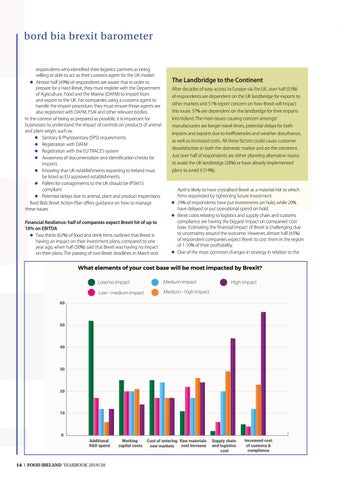
April is likely to have crystalised Brexit as a material risk to which firms responded by tightening future investment. 29% of respondents have put investments on hold, while 20% have delayed or put operational spend on hold. is supported by feedback from the Bord Bia Brexit costs relating to logistics and supply chain and customs client meetings, with many citing Financial Resilience: half of companies expectcompanies Brexit hit of up to the compliance are having the biggest impact on companies’ cost base. Estimating the financial impact of Brexit is challenging due 10% on EBITDA opportunity cost in relation to employee time to uncertainty around the outcome. However, almost half (45%) Two thirds (62%) of food and drink firms outlined that Brexit is spent on Brexit. of respondent companies expect Brexit to cost them in the region having an impact on their investment plans, compared to one of 1-10% of their profitability. year ago, when half (50%) said that Brexit was having no impact One of the most common changes in strategy in relation to the on their plans. The passing of two Brexit deadlines in March and
What elements of your cost base will be most impacted by Brexit? Low/no impact
Medium impact
Low - medium impact
Medium - high impact
High impact
60
50
40
30
20
10
0 Additional R&D spend
14 | FOOD IRELAND YEARBOOK 2019/20
Working capital costs
Cost of entering Raw materials cost increase new markets
Supply chain and logistics cost
Increased cost of customs & compliance