
Welcome to the first Rendcomb Pastoral and Well-being Publication! It is my intention to produce a termly publication which focuses on some relevant topics and signposts further reading or information for those that would like to find out more. We have an expert pastoral team here at Rendcomb who support our pupils through PSHEE lessons, medical advice, counselling and individual interventions and conversations
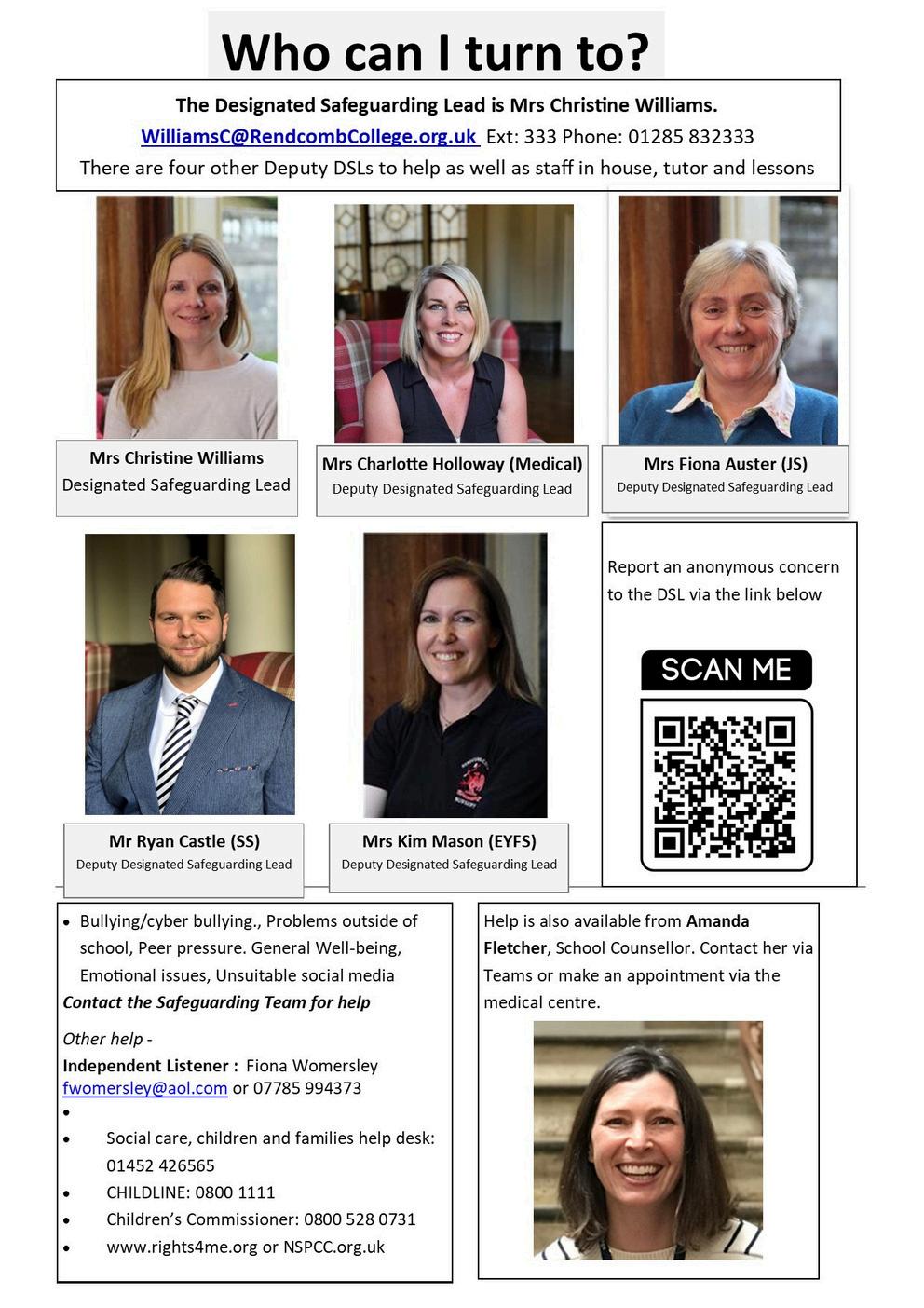
One highlight of the term so far for me has been the huge number of pupils that signed up to the Mental Health First Aid qualification, demonstrating a desire to understand and support others. Those that were already trained were keen to offer themselves as ‘ peer support’, appearing on our ‘Who Can I Speak To?’ poster, which is displayed around the school site I look forward to seeing many of our newly trained pupils appear on next year’s poster.
This Pastoral and Well-being issue highlights the PSHEE curriculum this term, provides more information on Girls on Board, and focuses on understanding anxiety and the importance of healthy eating
If you have any queries or concerns, please reach out to us to discuss. Contact details for the members of the Safeguarding team are at the back of this booklet
Wishing you a wonderful festive break when it arrives.
Christine Williams Deputy Head (Pastoral)

Eating a healthy, balanced diet is an important part of maintaining good physical, mental and emotional health and well-being, and can help to keep you feeling at your best and prevent illnesses
A healthy balanced diet includes a wide variety of foods, in a rainbow of colours, which provide you with essential vitamins, minerals and nutrients
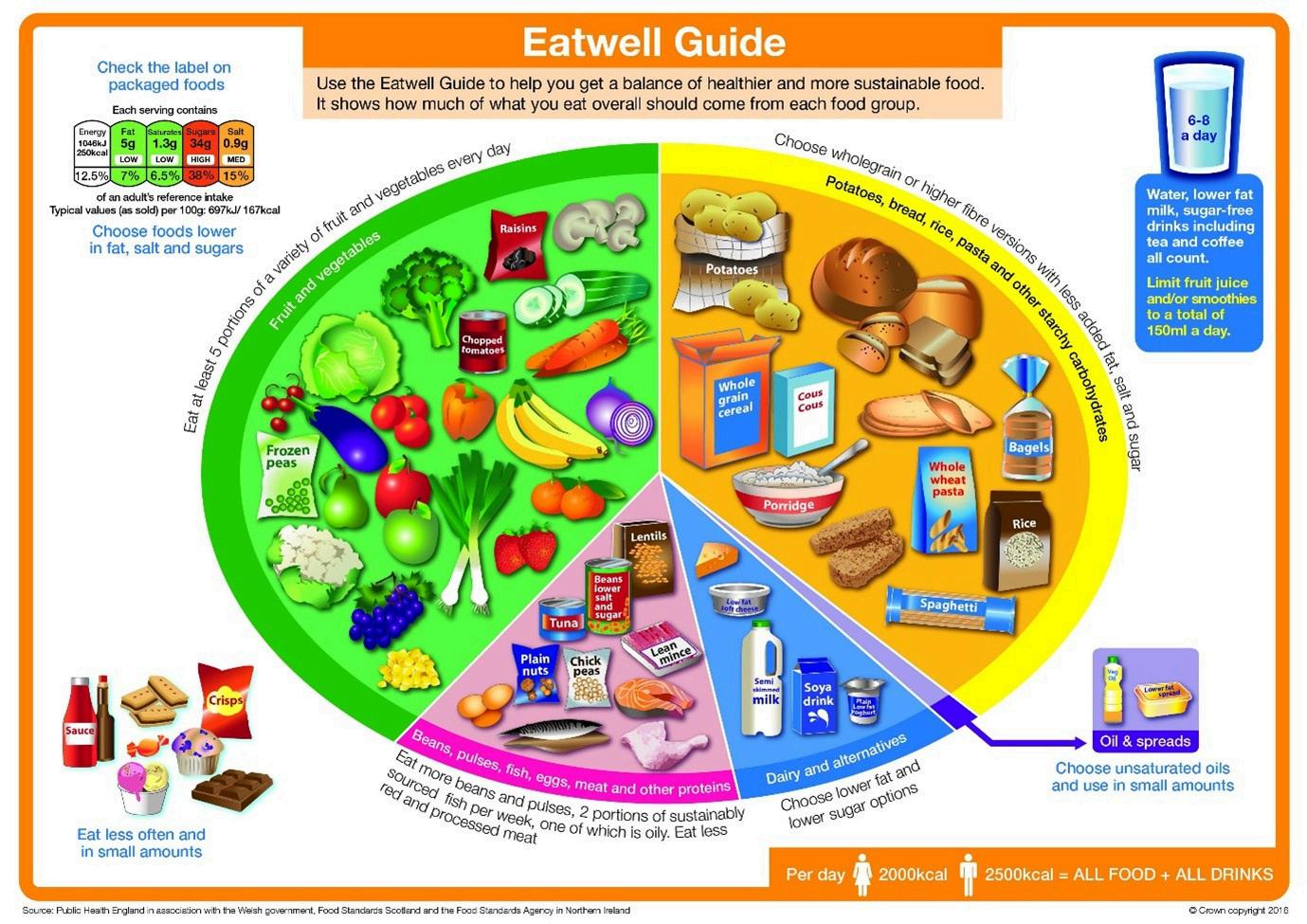
The NHS Eatwell guide provides visual guidance on how to portion the different food groups up on your plate and shows a variety of options within these food groups The Eatwell guide is for everyone over the age of 2 years old
The Eatwell guide also advises about looking at food labels and choosing foods lower in sugar, fat and salts, and recommends limiting highly processed foods such as:
sweetened drinks
crisps
packaged cakes and biscuits
ice cream
sweets and chocolate
some ready meals
packaged meat pastries like pies and pasties
These foods can be used to give us a boost when we are needing an energy boost, but they are short acting and can actually make us feel more sluggish and tired in the long term. It is better to have slow-release carbohydrates or Low GI foods to help maintain blood glucose levels and energy
Drinking plenty of water is very important. This prevents dehydration, which can lead to headaches, lack of concentration and focus in class, dizziness and low blood pressure
The European Food Safety Authority (EFSA) has developed a set of fluid requirements for children of different ages:
Boys and Girls between 4-8: between 1.1-1.3 litres of water daily
Boys aged 9-3: between 1 5-1 7 litres of water daily
Girls aged 9-13: between1 3-1 5 litres of water daily
�� Primary School aged children should have a 750ml water bottle at school
�� Secondary School aged children should have a 1ltr water bottle at school
�� All children should aim to finish their water bottle by the time they finish school each day
Maintaining a healthy gut is pivotal in your overall well-being, influencing everything from digestion to immune function and even mental health. The gut microbiome influences mood, skin health (such as acne), and hormone balance too. Your gut plays a vital role in synthesizing essential vitamins, producing neurotransmitters crucial for mood regulation, and generating anti-inflammatory substances. Probiotics can help maintain a healthy gut. Probiotics can be found in certain yoghurt drinks, yoghurts and supplements
Wholegrain foods such as wholegrain bread, rice and pasta are higher in fibre and help to aid digestion, which can prevent constipation, bloating and other digestive problems.
Why not look at your diet and try and make a few healthy adjustments and hopefully you will feel the benefits
This year, we are launching a small pilot of the Working with Boys programme with our Year 7 cohort. The Girls on Board strategy, developed by the same author, has already helped many girls become more confident in resolving friendship issues.
The boys’ programme is designed to help boys better understand themselves and those around them, with a focus on building emotional literacy, strengthening friendships, developing respectful communication, and promoting positive, healthy attitudes towards growing up Although we are only in the early stages, initial feedback has been very positive. We hope to continue developing and expanding the programme in the future as part of our ongoing commitment to supporting every pupil’s personal growth and well-being
The ever-changing online world is one in which many of us, as parents, often feel ill-equipped to navigate. Just as we begin to understand one issue, another seems to emerge. As a school, we have taken the decision to extend the no-phones rule from Y7-9 to include Years 10 and 11, in order to support pupils in developing healthy habits.
In PSHEE, we regularly explore the issues surrounding internet use, particularly social media In Year 7, we begin by looking at social media, its role in society, and its possible impacts on mental health. Online safety is first introduced in Year 8 and then examined in more depth in subsequent years

In Year 9, pupils learn about sexual content, followed by a focus on pornography, social influences, pressure, and personal data in Year 10. In Year 11, we address topics such as sextortion, grooming, and revenge porn. These are hard-hitting subjects, but it is important that our young people are fully aware of the risks involved
The UK Safer Internet Centre emphasises the importance of maintaining an ongoing dialogue at home and suggests the following tips to help:
Talk with your child about responsible use of their phone
Discuss what it is okay and not okay to use their phone for. Talk about time limits and expectations of where the device can and cannot be used, this could include things like the phone being charged outside their bedroom overnight
Discuss what to do if something upsetting or worrying happens
Give them the strategies they need in case something concerning happens whilst they are using their device. This could be to lock the screen and tell an adult, to make a report to the platform they are using, or to block the user
Take a look at the controls available both on the phone itself and on your home Wi-Fi Talk these through with your child too. Parental controls are a helpful tool, but an open conversation with your child is the most important thing
As a school we have also seen the power of parents agreeing common ground rules amongst friendship groups. To support your discussions at home you might find the following useful https://www internetmatters org/ a helpful leaflet covering many of the topics your child will be discussing in PSHEE.
Alice George Senior School Teacher
My name is Amanda Fletcher, I am a qualified counsellor and am the school counsellor here at Rendcomb College. Any pupil from years 7 to 13 can access me for mental health support whilst at school. I adapt my approach according to the needs of the pupil – which can be anything from exam nerves or anxiety to depression, grief or friendship issues.
Part of my role at Rendcomb is psychoeducation, where I help make mental health issues easier to understand Every year I do a talk to the new year 7s about understanding anxiety. Often they arrive in year 7 feeling apprehensive and anxious about what lies ahead of them, so my talk aims to help them understand exactly what anxiety is – and what it isn’t!
I start by explaining exactly what anxiety is, and where in the body we tend to feel our anxiety I then talk about the difference between helpful anxiety (that motivates you and sharpens your focus) and unhelpful anxiety (which stops you from doing what you want and need to do).
We discuss in groups what happens to us when we avoid doing things that make us feel anxious – how we can miss out on opportunities to learn and feel good about ourselves, and I then reiterate the message that the more you do something, the easier it gets I then educate them about panic attacks, how to recognise one and what to do to help manage one. Then, importantly, we talk at length about strategies to cope with and ways to reduce anxiety – we practise breathing techniques, learn about grounding and the importance of moving our bodies. We finish with them being really clear about who they can talk to if they feel anxious – myself, members of staff, friends and most importantly YOU, as parents or guardians

Girls on Board is an approach which helps girls, their parents and their teachers to understand the complexities and dynamics of girl friendships. It is based on what it calls the ‘existential imperative’: that all girls feel a need to be in a friendship with at least one other girl – a need so strong that it feels like they are drowning if they don’t achieve this.
The language, methods and ideas of the programme seek to empower girls to solve their own friendship problems The programme has been adopted by schools in over 21 countries, and Rendcomb introduced it last year.
The model is explained to the girls, and we explore the different types of behaviours that are seen in girl friendships, as well as different group sizes (most common are pairs, threes and fours), and the pros and cons of these groupings
We role-play short scenarios which are very powerful in coaching girls. They instantly recognise the issues presented, and the exercise allows them to debate about fairness, inclusion, empathy and bullying
The Girls on Board programme provides advice for parents as they support their
daughter through natural (but often distressing) relationship turbulence:
- Don’t try to micro-manage unless bullying is REALLY happening. You can always come and share your concerns with teachers without necessarily asking for action or intervention Once the school is aware of what might be happening we can make gentle and discrete enquiries and try to get to the bottom of things to prevent bullying
- Stay connected but don’t push it, don’t pump for information. Give her SPACE, allow her to make mistakes, to try on ‘different hats’, to come at issues from different angles
- Be there for her; listen and comfort but try hard NOT to offer solutions Don’t tell her what to do. Instead, describe the behaviour you respect. Work with her as she comes up with a plan that describes specifically what she wants to happen differently, and how she can make that happen.
- Monitor social media, internet activity, mobile phone messages. Texting, and social networks allow girls to continue to ‘discuss’ their issues at all times of the day and night Come to an agreement that phones and devices will be switched off at a certain moment in the evening during the school week. You can find more information at Girls On Board
by Sue Knowles, Bridie Gallagher and Phoebe McEwen
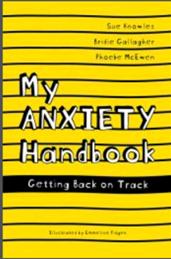
An attractively set out and written book aimed at ages 12-18. The text is broken up by charts, lists and pictures so it is easy to read and nicely spaced out The book is on the ‘Reading Well for Teens’ list put together by The Reading Agency. This programme recommends reading and digital resources to help teens understand their feelings and boost their confidence Both teens and experts have chosen the books together.
The book is an anxiety survival guide, helping teens to recognise and manage symptoms and overcome worries It has chapter heads such as ‘Understanding where my anxiety comes from’ and ‘Tackling anxious thoughts’ as well as guidance putting together their own ‘Anxiety Survival Plan’ which takes them through a list of questions to identify symptoms, what they can do to help themselves and also who can help them.

A fiction book with a 14 year old main character called Audrey. She has been suffering from social anxiety after a bullying incident Audrey is very reluctant to leave the house. She meets Linus, her brother’s friend and things gradually start changing through his empathy and patience Contemporary, Young Adult and part romance this story deals with anxiety and depression in a sensitive way, it shows the unconditional support of her family and that recovery is gradual and can have setbacks along the way.