<TRAILBLAZERS>
CS+social justice
Coding for good
Digital tech is driving social change and making a difference
SHUTTERSTOCK /FREDA CHIU
C
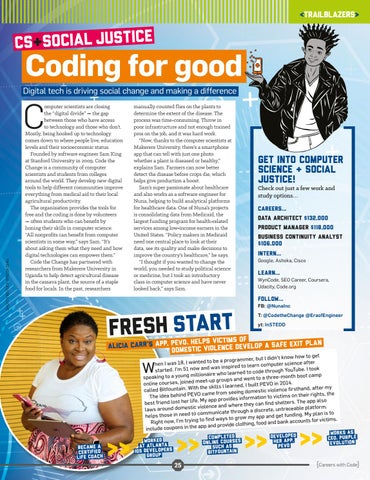
omputer scientists are closing the “digital divide” — the gap between those who have access to technology and those who don’t. Mostly, being hooked up to technology comes down to where people live, education levels and their socioeconomic status. Founded by software engineer Sam King at Stanford University in 2009, Code the Change is a community of computer scientists and students from colleges around the world. They develop new digital tools to help different communities improve everything from medical aid to their local agricultural productivity. The organization provides the tools for free and the coding is done by volunteers — often students who can benefit by honing their skills in computer science. “All nonprofits can benefit from computer scientists in some way,” says Sam. “It’s about asking them what they need and how digital technologies can empower them.” Code the Change has partnered with researchers from Makerere University in Uganda to help detect agricultural disease in the cassava plant, the source of a staple food for locals. In the past, researchers
manually counted flies on the plants to determine the extent of the disease. The process was time-consuming. Throw in poor infrastructure and not enough trained pros on the job, and it was hard work. “Now, thanks to the computer scientists at Makerere University, there’s a smartphone app that can tell with just one photo whether a plant is diseased or healthy,” explains Sam. Farmers can now better detect the disease before crops die, which helps give production a boost. Sam’s super passionate about healthcare and also works as a software engineer for Nuna, helping to build analytical platforms for healthcare data. One of Nuna’s projects is consolidating data from Medicaid, the largest funding program for health-related services among low-income earners in the United States. “Policy makers in Medicaid need one central place to look at their data, see its quality and make decisions to improve the country’s healthcare,” he says. “I thought if you wanted to change the world, you needed to study political science or medicine, but I took an introductory class in computer science and have never looked back,” says Sam.
Get into Computer Science + social justice! Check out just a few work and study options… careers... Data Architect $132,000 Product Manager $118,000 Business Continuity Analyst $106,000 Intern... Google, Ashoka, Cisco
Learn... WynCode, SEO Career, Coursera, Udacity, Code.org
Follow... FB: @NunaInc
Fresh start
T: @CodetheChange @EraofEngineer yt: InSTEDD
VO, helps victims of Alicia Carr’s app, PE mestic violence develop a safe exit plan do
get t I didn’t know how to to be a programmer, bu d nte wa er I aft 18, e s enc wa I hen computer sci was inspired to learn k started. I’m 51 now and e through YouTube. I too cod to d rne lea o wh e air lion p mil cam ng t speaking to a you to a three-month boo et-up groups and went me ed join s, rse 14. cou online I built PE VO in 20 th the skills I learned, , after my called Bit fountain. Wi estic violence firsthand dom ing see m fro e cam VO rights, the PE ir ind the beh The idea ation to victims on . My app provides inform also life app her e t Th los rs. nd lte frie t bes where they can find she and ce len vio rm. ic tfo est te, untraceable pla laws around dom nicate through a discre mu com n is to to pla d My nee g. in din se helps tho app and get fun find ways to grow my victims. for ts oun acc k ban Right now, I’m trying to g, food and app and provide clothin include coupons in the works as Developed completed CEO, Purple p, ap worked es her urs co e Onlin Evolution PEVO at Atlanta such as s iOS Developer BitFountain group
W
became a Certified Life Coach
25
{Careers with Code}