Volume 17:5
EVIEW R March 29, 2018
Roncalli High School
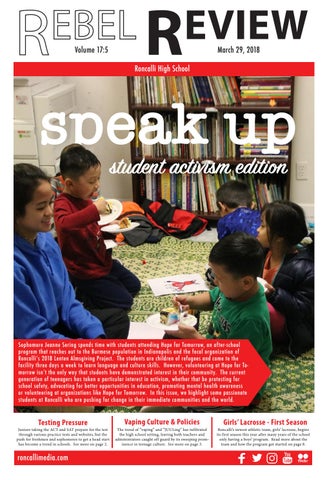
speak up student activism edition
Sophomore Jeanne Sering spends time with students attending Hope for Tomorrow, an after-school program that reaches out to the Burmese population in Indianapolis and the focal organization of Roncalli’s 2018 Lenten Almsgiving Project. The students are children of refugees and come to the facility three days a week to learn language and culture skills. However, volunteering at Hope for Tomorrow isn’t the only way that students have demonstrated interest in their community. The current generation of teenagers has taken a particular interest in activism, whether that be protesting for school safety, advocating for better opportunities in education, promoting mental health awareness or volunteering at organizations like Hope for Tomorrow. In this issue, we highlight some passionate students at Roncalli who are pushing for change in their immediate communities and the world.
Testing Pressure
Juniors taking the ACT and SAT prepare for the test through various practice tests and websites, but the push for freshmen and sophomores to get a head start has become a trend in schools. See more on page 2.
roncallimedia.com
Vaping Culture & Policies The trend of “vaping” and “JUULing” has infiltrated the high school setting, leaving both teachers and administrators caught off guard by its sweeping prominence in teenage culture. See more on page 3.
Girls’ Lacrosse - First Season Roncalli’s newest athletic team, girls’ lacrosse, begins its first season this year after many years of the school only having a boys’ program. Read more about the team and how the program got started on page 8.
news
www.roncallimedia.com
Dresses showcased for sale
3.29.18
Students buy prom dresses from girls posting on social media, concerns about general modesty arise BY SOPHIA EGOLD Staff Writer
P
rom takes place the weekend after spring break, which means that the rush to buy a dress or tux, find a date or group to go with, decide whether to go to a restaurant or eat at prom and order a corsage or boutonnière is closely approaching. Out of all these factors that go into prom, the biggest struggle for girls is finding the right dress. There are many different options when it comes to finding a dress that include going to stores and trying them on, renting a dress, buying online and the newest trend: buying a used dress using social media. Many people see an immense amount of Instagram or Snapchat “stories” that show dresses from previous years being sold by high schoolers. Some people may click through the stories and not give them a second glance, but other people may click on the story and give the girl who is trying to sell her dress an offer. Senior Hannah Rollins posted a picture of her dress on social media, and senior Emma Barnett took to word of mouth and had people come up to her asking to buy her dress. Both ended up having someone who was willing to buy their dresses. “I posted my dress on my Instagram story, and once [junior] Ellen [Schrader] told me she wanted it,” Rollins said. “I told her she did not need to pay me, but she gave me $40.” Many girls will buy their dress for a certain amount of money and then sell it for less than what they originally bought it for. This is a good opportunity for someone to get a good price on a dress that was once really expensive. Selling a dress is good way for a girl to make some money off of something they are never going to wear again. “I used the money from my dresses to purchase concert tickets for the summer,” Barnett said. Another stressful aspect of buying a prom dress is being able to meet the school requirements. As many girls have been informed each year, there are clear statements in the school handbook that say exactly what boys and girls are allowed to wear to prom. “[The school is] trying to be broad and not be so restrictive, but the key is to encourage modesty,” assistant principal Mrs. Shellie Hartford said. “[The school] does understand how hard it is to buy a dress, so [we] don’t expect everyone to arrive in a turtleneck.” In the handbook, the guidelines state that bare midriff and bare back are not allowed. The question of the matter, however, is what qualifies as bare midriff and bare back.
“Two-piece dresses are allowed, the issue is how much midriff is showing,” Hartford said. “An inch is not a problem. A bare back means the dress goes down so low that it shows the entire full bareback.” If someone is concerned with their dress and they are not sure if the dress is appropriate or not, they can always email Hartford a picture of their dress. Once the day of prom actually approaches, the worries will likely fade, and the fun will begin.
PHOTO SUBMITTED
PROM DRESS SALES: Seniors Emma Barnett and Grace Silver pose at last year’s prom, which was hosted at the Children’s Museum of Indianapolis. Barnett, like many other girls at Roncalli, sold her dress from last year and her dress from sophomore year both at a discounted price.
Standardized testing prep Counselors emphasize ample preparation before taking SAT or ACT, students begin practicing earlier BY NICHOLAS PLAHITKO Staff Writer
E
very spring, juniors prepare to take tests that they are told will determine their future. Stress runs rampant, numbers are crunched, practice tests are taken and all final preparations are made as students schedule tests at various testing centers. Yet a lot of the stress of taking the SAT and ACT can be avoided the earlier test preparation is started. “I’ve taken the ACT three times since seventh grade,” sophomore Ellie Murphy said. Getting exposure to the types of questions that are on standardized tests is one of the most important parts of preparation. The earlier students can get an idea of what the test feels like, the more likely they will feel comfortable taking it. This allows them to focus more on all facets of the questions and less on the stress of actually taking the test.
PHOTO BY NICHOLAS PLAHITKO
PREPARING EARLY: Sophomore Ellie Murphy utilizes Khan Academy to get ready to the SAT she is taking this summer. Khan Academy is a free resource for students to get personalized practice for the SAT.
2
That’s not to say everyone should take the SAT or ACT this early. Most students take the PSAT three times at Roncalli and the practice ACT once during junior year. For many, this is preparation enough, as these tests are designed to give students experience with these types of questions. “It is common for a student to take the PSAT [and] use their test and scores to focus on preparation for the SAT [so] their scores jump significantly,” guidance counselor Ms. Shelly Fitzgerald said. “If a student does not prepare for the SAT, their scores will likely be similar to their PSATs.” The scores on the PSAT can be linked to a Khan Academy account to give students individualized practice as early as their freshman or sophomore years. “It is great that you can link the PSAT scores,” college counselor Mrs. Kelly Meyer said. “It personalizes test practice for you.” As for how many times one should take the test, the guidance department stresses that it is a very individual process. Typically students take each test once and then are recommended to retake the better of the two. However, students like Murphy who are pushing for a highly competitive score may opt to take the tests multiple times until a ceiling is hit. “I think [taking the tests multiple times] is annoying but helpful,” Murphy said. “By the time it really counts, you’re going to do really well.” The guidance counselors emphasize that there is no need to worry about being illprepared to take these tests. “We find that generally our students do well on standardized tests,” Meyer said. “We [also] have a good history of National Merit Scholars.” The most important takeaway as standardized tests approach is to recognize that no amount of preparation is too much preparation, and every student’s approach is unique and individual to him or her. Resources such as Khan Academy and the ZAPS ACT preparation program are readily available for all students to take advantage of, and the guidance office is always willing to help students find a direction that is right for them. “At the end of the day, the most important admissions criteria is your daily academic work,” Fitzgerald said. Students should be continually striving to do their best to prepare for their future, remembering not to stress too much for standardized tests, but that they are a large factor in college decision-making right around the corner.
www.roncallimedia.com
3.29.18
www.roncallimedia.com
“Fortnite” gains popularity
news
Students express interest about gaming experience, give opinions on features
BY RYAN BRANDENBURG Staff Writer
V
PHOTO BY RYAN BRANDENBURG
HIT AMONG YOUNG PEOPLE: The main menu of Fortnite allows players to start the game and create custom characters. The video game has garnered the interest of many teenagers who appreciate the ability to choose both solo or group gameplay.
PHOTO SUBMITTED
POPULAR VIDEO GAME: Fortnite, a trending video game among teenagers and young adults, can be played on both Xbox and PlayStation. The game recently gained popularity due to its novelty and various methods of gameplay.
ideo games have been a popular activity since they became mainstream in the late 70s. From the arcades of the 80s to the gaming consoles of today, games have been a way for people to settle down and have fun. One game has recently captured gamers since its release, especially at Roncalli. The game is called “Fortnite,” and students have been buzzing about how entertaining and addicting it is. “I started playing a couple weeks ago,” junior John Harris said. “My brother told me about it.” First released in July 2017, “Fortnite” is available on Xbox One, PlayStation 4 and PC. It includes Battle Royale mode, which is a 100-player Player vs. Player game where gamers fight until there is one person standing. The game is also free, which makes it more conveniently available for players. “I play almost every night after I finish my homework,” junior Garrett Freeman said. With the popularity of “Fortnite” rising since its release, students around school are talking about their own experiences playing the game. “My friends told me about it, and it sounded fun,” Freeman said. Opinions on this game are very good, and with the help of the media and great social appeal, word on “Fortnite” is spreading like wildfire. “I would definitely recommend this game to others,” freshman Joshua Wormann said. “Fortnite is easily the best free game to come out in the past year and is fun for any gamer.” Updates in the game are very common , which means that new aspects are being added almost every week. “The updates are awesome,” Harris said. “The hunting rifle is lit, but the mini gun is trash.” There are also three different game modes that players can choose in Battle Royale: solo, duo and squad. Players have their own favorite modes and experiences. “Squad is the best,” Harris said. “You’re with a bunch of friends, so even if you die you can still get carried.” Playing with friends is always fun, and “Fortnite” is an example of how people can connect to others and play a few games. “I think squads is the best because you can play on the same team as your friends,” Wormann said. Students around the school are raving about how fun of a game “Fortnite” is, and with popularity for the game increasing, they will likely continue to play it. Games like “Fortnite” are changing the way video games are played with its great game play and aspects. With that, people, like Harris, Wormann and Freeman are excited to see what’s next for the game.
Vaping fad creates concern Recent trends of “vaping” and “JUULing” have rapidly permeated teenage culture and taken adults by surprise BY WILL ALLEN Staff Writer
T
he Roncalli administration started a campaign against the JUUL when it realized its popularity among students was growing. In fact, its appearance in the halls (and bathrooms) of Roncalli has led to numerous student disciplinary actions. But to analyze this in the most effective and fairest light, first it must be explained what a JUUL is and why it has started such a controversy. A JUUL is a sleek, slender, palm sized, vaping contraption that can contain excessive amounts of nicotine. Traditional vapes and E-cigarettes have been around for a relatively long time, reaching mainstream status in the later 2000’s. But it wasn’t until the summer of 2017 that the JUUL swept across the adolescent nation - and never looked back. “To err on the side of conservative, I have probably confiscated around 15,” dean of students Mr. Tim Puntarelli said. “It all started in November, so I’ve had at least 15 from November until now.” With strict policies in place - referrals, write ups, detentions - students are also faced with the additional possibility of suspension. But the punishment really stops there. Roncalli has never expelled a student for any sort of vaping misconduct. “I don’t think anyone would ever get expelled for vaping at school,” Puntarelli said. “We don’t have an impulse to kick someone out because they vape.” Yet even 18-year-old students aren’t exempt from the vaping rules - the federal legality of a vape is not protected in the eyes of the Roncalli student handbook. “Even if you are 18 you cannot [vape] at school because [you’re] at school,” Puntarelli said. “I am over 21, I can drink, but I can’t drink at school. Even though it is socially acceptable, some things just can’t happen at school.” Puntarelli noted that high nicotine levels, in addition to the teenage capacity to take risks, may be making vaping during the school day harder to resist. However, he still feels strongly that students should understand and comply with the rules set in place, emphasizing that Roncalli creates its handbook to encourage the growth and advancement of young people in a safe environment.
PHOTO BY WILL ALLEN
VAPING SUPPLIES CONFISCATED: Administrators have collected JUULs and other vaping supplies from students after noticing an increase in the use of the devices in November. Although there is no legal punishment for students over 18, tightened protocol was necessary to limit the use of the vaping devices in the hallways, bathrooms and classrooms.
www.roncallimedia.com
3
SPEAK UP
www.roncallimedia.com
3.29.18
Building southside community BY GRACE MURPHY
E
Staff Writer
very year, thousands of Burmese immigrants flee to the United States, running from war, persecution and death. They find shelter in a foreign country where they do not know the language, the culture or the people. “I can remember being the only one sitting in class because I didn’t know when the other kids went to lunch,” Hope for Tomorrow founder and Burmese refugee Justin Thang said. “You feel crazy because you can’t communicate.”
Luckily for the refugees seeking asylum in Indianapolis, Hope for Tomorrow provides the necessary resources and education to assimilate into American society. The after school program meets three days a week and provides tutoring for children of Burmese refugees. Citizenship classes are available for adults to help them pass their citizenship test. Since its creation 11 months ago, the after school program has been incredibly successful. Over 200 students have been helped through the tutoring program, and 20 adults have passed the citizenship test. Roncalli students have played an important role in the success and day-to-day functions of the program, including senior Story Ellis. “When I first started volunteering, there were not enough volunteers, so I had to help tutor multiple grades, which is not ideal,” Ellis said. “But now, because more people know about Hope for Tomorrow, more people show up consistently.” After choosing Hope for Tomorrow as this year’s Lenten Almsgiving project, more and more Rebels have been volunteering there. The excitement of the student body has greatly contributed to the success of the project. By focusing more on a local rather than international program in need of help (last year’s project supported countries lacking clean drinking water), students were better able to see the results of their generosity. “The Burmese people are a part of our community,” director of campus ministry Mr. Jeff Traylor said. “Hope for Tomorrow builds bridges between communities, and build[s] one southside culture.” Roncalli can continue to leave a tremendous impact on the Burmese community in Indianapolis by volunteering and being welcoming toward everyone, no matter their background or heritage. “You don’t have to be famous to change the world,” Thang said. “Start with your family and community.” Thang did just that. By creating a program that embraced and accepted his fellow Burmese refugees, Thang began to establish a relationship between the Burmese and American communities. He hopes that the program will continue to grow to accept people from all heritages and backgrounds and connect them with American society. If that dream becomes reality, the southside community will be forever changed to be more inclusive and accepting.
PHOTO BY GRACE MURPHY
GIVING CHILDREN HOPE: Roncalli graduate Grace Alberston and Hope for Tomorrow children celebrate director Justin Thang’s birthday. Thang’s mission is to help Burmese refugees assimilate into American life.
School safety walkout
Co m m un i
ty
EA P S
Staff Writer
4
Chuck Weisenbach to discuss his or her reasoning for walking out and presenting some form of parent permission. Weisenbach stated that many options were discussed, but the one put in place was ultimately the best fit for Roncalli. “It provided those students who wanted to express their voice the opportunity to do so but did not interrupt the educational day for the remainder of the students who did not wish to participate,” Weisenbach said. Nearly 20 students participated in the walkout at Roncalli on the 14th with the permission of Weisenbach and their parents, and though the numbers were small, the message was mighty.
Sc h o o l S
A
small group of students huddled at the side of the school, shivering in the below freezing March air as senior Connor Mahern stood on a bench and delivered a speech. “We as young people won’t stand for our legislatures not representing their constituents’ right to peace of mind,” Mahern said in his speech. Mahern’s address voiced what some Americans, both young and old, are calling for: gun law reform and school safety. On Wednesday, March 14, high school students across the nation walked out of their schools in solidarity with the recent school shooting victims in Parkland, Fla., voicing their dissatisfaction with the current state of gun laws in the United States. Since they are unable to vote, many teenagers used walking out to advocate for school safety after the latest in a long string of deadly school shootings in America. “It could’ve been any school,” sophomore Emma Woolsey said. “It could have been our school, and I think [that’s] something everyone should be aware of.” Set exactly one month after the Parkland shooting, students in all time zones walked out at 10 a.m. and remained out of class for 17 minutes, one minute to honor each of the students and staff members killed in the Parkland shooting. Though the students’ goal was simple, the execution was not. Leaving the school building without administrative approval is considered truancy, and some schools treated the walkout as such. For instance, a statement warning students that participation in the walkout would result in a three-day suspension was issued by superintendent of Texas Needville Independent School District Curtis Rhodes in advance of the walkout. The district has followed through with the superintendent’s claims according to a statement it made to NPR. In response to administrative policies like that of Needville, several colleges made statements on social media saying that punishments or disciplinary records due to peaceful protesting would not hinder a student’s chances of being accepted into those respective colleges. Many students, even those not protesting, expressed their gratitude at this decision. “It’s anyone’s right to protest what they want to and [colleges] are recognizing students’ rights,” junior Camille Woods said “I think that’s what the schools should do.” Students at Roncalli were free to walk out after individually meeting with principal Mr.
y t e f a
BY ELIZABETH BRADLEY
PHOTO BY LIZZY HOSTY
LISTEN UP: Senior Connor Mahern delivers a speech to those who participated in the walkout. After listening to Mahern’s speech, the protesters took turns reading biographies of the 17 Parkland shooting victims.
www.roncallimedia.com
www.roncallimedia.com
3.29.18
SPEAK UP
Student advocates for education BY KARA HOUSE Staff Writer
S
ophomore Paige Moore is a typical teenager. She’s involved in cross country and plenty of clubs, and she has homework on top of all her extracurriculars. Just like any other student, she’s missed school for doctor’s appointments, dentist visits, and the occasional sick day; however, several weeks ago, Moore had a different excuse for skipping class: visiting the Indiana Statehouse. “When I asked Paige why she wouldn’t be at school, I wasn’t expecting the response I received,” history teacher Mr. Kevin Banich said. “I’ve never had a student tell me they were testifying before our legislature, and I could not have been more excited for her.” Advocating for students whose needs aren’t fully met, Moore has been pushing for House Bill 1420 to be passed. This bill allows students in private schools to have dual enrollment with Indiana School for the Deaf or Indiana School for the Blind. Working closely with State Representative Bob Behning, he wanted to ensure that Moore, along with other private school attendees, could academically reach their full potentials. “She wanted to still attend Roncalli and it was either change the law or change schools,” Behning said. “So we chose to change the law.” Wednesday, March 14, 2018, the bill was passed. Without Moore’s persistence and dedication in favor of the bill, dialogue about private school access to Indiana School for the Deaf would’ve been postponed. “[Moore] is the only student who advocated for [the bill],” Behning said. “If the bill hadn’t passed this year, it would have to be reintroduced next January, and the process would start over again.” Having been diagnosed with Meniere’s disease at age four, Moore has completely lost hearing in her right ear and partially in her left, posing hardships throughout her high school career. Her teachers wear a microphone that sends sound straight to her hearing aids, but the system is not always effective. When teachers mumble or cover their mouths, Moore has a hard time deciphering what has been said. She also struggles working with groups in class where numerous students are all speaking at once. “If it wasn’t for her determination to stay at Roncalli, we wouldn’t be discussing this possibility of dual enrollment,” Banich said. Because of her hardship, Moore even considered switching schools to have the split schedule opportunity, which was a difficult decision on her part. Starting over at a public school would mean new friends, teachers, and classes, but Moore decided that she loved the Roncalli family too much to leave. “I was going to transfer fully into Indiana School for the Deaf,” Moore said, “but we realized you can’t beat Roncalli’s education. I was
AK UP
then going to switch to [Franklin Central], but I had so many friends and good teachers here, [and] I didn’t want to lose all of that.” Despite the adversity she faces daily, Moore is still pursuing a high level education. With dreams of attending an Ivy League school, she is determined to get the best schooling possible, which is attainable now that the bill has been passed. “Paige deals with challenges that not everyone has to overcome,” Banich said, “but she won’t let anything stop her because of her love for Roncalli. It’s Paige’s story and determination that will make the difference for many students.” Later this year, in either April or May, a ceremony will take place in which the governor of Indiana signs House Bill 1420. Moore will be invited to witness the momentous event as requested by Behning, whom regards her as a “strong advocate”. Though the bill has been passed, it will not be in effect until July 1. Until then, Moore is focusing on her studies and making the most out of her full days left at Roncalli.
E
du
io cat
n
Me n t
al
alth He
T
PHOTO SUBMITTED
SIDE BY SIDE: Sophomore Paige Moore and her mother, Keri Moore, who went to testify as a parent and give moral support, pose in the Indiana Statehouse. Moore said without her mom by her side, she would have been much more nervous during the testimony.
Mental health initiative BY MAX CROSS Staff Writer
he Inspiring Change program has made people laugh, breathe deeper, meditate and be happier within in the school environment. The program took place during a six week period from English department co-chair Mrs. Kim Striby and Roncalli social worker Ms. Kelley Fisher put a lot of thought into the program “The SAP group always wants to address mental health in school, [so] wanted to come up with tools to help with stress,” Fisher said. Striby and Fisher have received great feedback back from the program. Their only problem is how to move forward with it. “Our goal is to keep pushing forward,” Striby said. “[Fisher and I] have been soliciting suggestions from different people to see what we can do.” Before the program started, there was a lot of stress going around the school from work, school and extracurriculars. Striby and Fisher decided to incorporate the idea to the characteristics of St. John XXIII. “We figured since St. John XXIII is a role model everybody follows, doing the stress exercises based on him [would] help inspire students for the better,” Fisher said. There were many different stress exercises throughout the six week period like drawing scribbles on paper, breathing and meditation, or screaming and dancing in the hallways. “My favorites ones were the ones that involved gratitude. For the students, it was the music and drawing exercises” Striby said. The plan is to take at least two minutes off each period sometime in the future to make room for the stress and meditation exercises.
“I think life is about [managing] stress,” Striby said. “The program was more about ways to give strategies to teachers to help students deal with their stress.” Depending on whether or not people think the inspiring change program has made an impact, it will still move forward. It left its mark on the school environment and let all Rebels know that stress is present but can be managed.
PHOTO BY STEFAN WELSH
BRAIN BREAK: Mr. Stefan Welsh’s eighth period class takes a break during the period to move and stretch. Activities similar to this “brain break” were implemented throughout the duration of the Inspire Change Program.
www.roncallimedia.com
5
opinion
www.roncallimedia.com
3.29.18
Last minute kick
Hand In Hand With SAINT JOHN XXIII
Procrastination could result in higher creativity, experts suggest BY CAMERON IRWIN Staff Writer
P
The Rebel Review wants you, as a Roncalli student, to learn more about our school’s namesake. Each month, we will be including a paraphrased excerpt from the book “A Pope Laughs,” by Kurt Klinger
J PHOTO SUBMITTED
LATE NIGHT RUSH: It’s not until late at night when senior Ben Asdell finally gets down to work, as pictured here, and that is when he is most creative. Waiting an extra 10-15 minutes to begin after looking over the homework assignment may result in better overall work.
ideas combine with your experiences to form new [ideas].” The brain uses what we already know to form our ideas. From this logic, it would make sense if we were able to mull over our past experiences for a longer amount of time and come up with better examples. “The first ideas are always the best because other ideas that come to you are based off the first,” Singh said. Yet this idea contradicts what has been tested. Earlier, it was noted that the longer someone thinks over an idea, the better the final result is. But, the better ideas stem from the first idea. In that sense, it can be concluded that the first idea is best because it stimulated your brain to come up with even better ideas. After being in school all her life, McGill has had time to look over her days of procrastinating. After all, pro”Kraft”ination used to be her nickname (Kraft is her maiden name). It has allowed her to grow in her teaching and develop to meet the needs of her students. “I’m a better teacher [now] because I can relate to the desire to procrastinate, and that helps me develop teaching strategies to overcome it,” McGill said. As a result, McGill likes to plan out the week and give it to the students so they can anticipate what is to come. It’s not that procrastination has to be overcame. It just has to be dealt with based upon the individual needs of the student. “[Procrastination] is a double-edged sword,” Asdell said. “If you’re going to choose to procrastinate, you definitely have to set a time to do [your work] or you’ll never make the deadlines. Judge your own ability. Not everyone can delay things up to the last minute.” Take it from the valedictorian. After years of experience in school and dealing with school work, he knows what he’s talking about.
Staff Writers
6
Editor-in-Chief Editor-in-Chief
Grace Silver Meghan Looney
Online Editor Copy Editor
Julie Albertson
Adviser
ohn XXIII paid considerable thought to all the problems which faced him. He gave his closest attention to every task or request, no matter how small. More than ever before in his life, John felt the responsibility that had been placed upon him in his position as pope. He did not feel it as a burden, as he often assured those around him, but more as a God-given mission, which he therefore carried out joyfully. For this reason John could surmount almost all difficulties with ease. His goodness used to turn opponents into repentant followers. He could never understand how men who held high office in the Church could complain about the burden of their pastoral and official tasks. Once a man is called by the Holy Spirit to be a priest, he used to say, he must assume the responsibility to preach and to practice the love of one’s neighbor. In the first private audience he had been granted, a newly appointed bishop complained to John XXIII that the added burden of his new office prevented him from sleeping. “Oh,” said John compassionately, “the very same thing happened to me in the first few weeks of my pontificate, but then one day my guardian angel appeared to me in a daydream and whispered: ‘Giovanni, don’t take yourself so seriously.’ And ever since then I’ve been able to sleep.”
TIME GRAPHIC BY CAMERON IRWIN
CREATIVITY GRAPH: As shown by the graphic above, as students take more time to think over their work, their finished product is better. After about 10 minutes, students’ work reaches a peak where their ideas are most creative.
2017-18 Editorial Policy
Roncalli Media Staff Lizzy Hosty Dave Schrader
Humility
CREATIVITY
rocrastination is a word we are all familiar with. It’s safe to assume that everyone in this building, whether willing to admit to it or not, has fallen victim to procrastination. And I’ll bet you money on that. So what does the word even mean? “It obviously has a negative connotation,” English teacher Ms. Tristan McGill said. “It makes me think of laziness or prioritizing.” But is she right? A study done by Jihae Shin, a current professor at the University of Wisconsin, conducted a study within two companies. She asked their bosses to give them a topic to create a project with and analyzed how their produced their work. The study suggested that procrastination actually helps people become more creative up to a certain point. After five to ten minutes of thinking through an idea, business executives agreed that the person who had time to think through the prompt had better presentation ideas than the person who went with the first idea they had. Procrastinating until the deadline is not where students become the most creative; instead, it’s the few moments directly after receiving a task. For example, the prewriting space before some essays allows students to jot down ideas, allowing them to be more likely to filter out the “bad” ideas and roll with the better, more concrete ones. Adam Grant, a professor at the Wharton School at the University of Pennsylvania, singled out two types of people from the study: the pre-crastinators, a term he coined, and the procrastinators. Pre-crastinators are those who worry about deadlines way ahead of time and are most likely to roll with the first idea they have just for the sake of completing the assignment. As a result, those people are less creative. As for the procrastinators, after only 10 minutes were they able to come up with better ideas for the same topic to present on than the pre-crastinators were with their first idea. But as time passed, the procrastinators who took longer than 10 minutes to come up with ideas were as creative than the pre-crastinators. Then another question arises: does this work for everyone? Senior valedictorian Ben Asdell is an expert in procrastination. And quite obviously from his distinction at the top of the class, it works for him. “I come up with the best ideas that I am not ready to commit to the topic because I want to make sure it’s the best idea,” Asdell said. “That’s the weird thing about procrastination; it goes hand in hand with perfectionism.” In a way, he is right. By trying to perfect what has already been started, you might procrastinate on finishing the project or assignment. But when one thinks of procrastination, this is not what first comes to mind. As McGill said, procrastination has a negative connotation. Junior AP Psychology student AJ Singh has had nearly a year’s experience dealing with the brain and its functions. He notes that when given a topic for the first time, ideas flow freely. “The brain goes back to what experience you have and tries to relate old info with new info,” Singh said. “Over time, your
Maddie Aldrich Will Allen Elizabeth Bradley Ryan Brandenburg Max Cross Sophia Egold
Kara House Cameron Irwin Isabel Laut Grace Murphy Nick Perkins Nicholas Plahitko
We accept submissions from all faculty, staff and students, which can be emailed to rhsrebelreview@gmail.com or delivered to Room 203. Please keep these letters short, roughly 200-300 words. They will be accepted under the circumstances that they are signed and noted to which article it is in response. Letters that contain misinformation or are meant to libel another will not be published. The decision to publish any content will be decided by Roncalli Media adviser Julie Albertson. We also accept photographs and articles written by students, teachers and staff members.
www.roncallimedia.com
3.29.18
www.roncallimedia.com
Falling in Wonderland
fine arts
Tech crew designs unique set with tilted stage that proves challenging for actors to maneuver
BY MADISON ALDRICH Staff Writer hree hours. That’s how long it took to strike down the set for “Alice’s Adventures in Wonderland,” which took three solid weeks to build. This would be the last Roncalli stage 20 seniors would ever step foot on. “Alice’s Adventures in Wonderland” was set on top of a raked, or sloped, stage. The set was created and designed by theater director Mr. Phil Anderson, along with a number of parents and students who helped bring his vision to life. It is a whimsical optical illusion, filled with misleading lines and slopes. This set was difficult to build due to not having specific plans drawn out ahead of time. Anderson had a vision in his head, and he had to just begin with the building stages. Creating this fanciful set took time because of the hills used to create a new dimension. “I just wanted something different that would represent the crazy world of Wonderland,” Anderson said. While the set itself provided many challenges to the actors who had to run, jump and dance on top of these multiple levels and slopes, it also added a whole new dimension to
T
“Wonderland,” bringing the fantasy world to life. For the actors, maneuvering this optical illusion was fun but also terrifying. Misstepping could lead to tripping, stumbling or even falling props. “It can be a bit scary running around on an uneven stage, especially in heels,” said senior Shannon Mitchel, who played the Red Queen in her last Rebel Theatre production. For months, Mitchel, along with 19 other seniors, spent countless hours throughout multiple practices and shows which were all destroyed in hours. Some nights they were here until 10:30 p.m., correcting and tweaking scenes. During production week, all actors stay at Roncalli after school, and each night they have “family dinners”. At these dinners, all actors, technology members, and directors sit down together and eat as one. “All of the hours seem so insignificant when it comes to actually performing,” Mitchel said. “There’s no amount of work that would make performing a show on the Roncalli stage seem less amazing.”
PHOTO BY DAVE SCHRADER
PHOTO BY DAVE SCHRADER
RED HOT: Senior Shannon Mitchel, the Red Queen, yells at senior Cassie Petroff, Alice, during the first act. This is the final production in their Rebel theatre career.
CRAZY CAT LADIES: Juniors Allie Pena and Mia Roberts along with senior Lizzy Hosty played the role of Cheshire Cat. They had to maneuver the hills on stage while staying together as one.
Eagle scout gives back Schutte facilitates the refurbishing and delivery of instruments for Jamaican students BY NICK PERKINS Staff Writer
A
PHOTO BY NICK PERKINS
JUST LIKE NEW: Junior Henry Schutte cleans his trumpet for his next band practice. Instruments like this will be gathered from local musicians in the Indianapolis area to be refurbished.
7
chieving the rank of “Eagle Scout” is not only a major milestone in a Boy Scout’s life, but also serves as a monument to his work ethic and multi-talented abilities, especially when considering that only 4 percent of all Scouts have actually attained the honor. Some of the prerequisites for this award include earning 21 different merit badges (which are received by completing character-building tasks), completing a lengthy essay and, most importantly, completing a community service project. These projects range in size, from constructing benches and fences to more elaborate service projects, and junior Henry Schutte is looking to do something that is unique to his talents. “I’m trying to put on a concert in May to make money for cleaning up and fixing instruments that I’m going to collect from the Indianapolis area to eventually send down to a school in Jamaica,” Schutte said. Schutte, now being a three year member of Roncalli’s Jazz Band, Concert Band, Marching Band, and Pep Band, has close ties to band director Ms. Kathy Peach, from whom the idea of donating instruments to Jamaica came from. “I started a music program about 30 years ago at a school called Sam Sharpe Teachers college,” Peach said. “I only lived there for about a year, but I try to visit every other year to see friends and former students.” When Peach visits Jamaica, she brings along Rebel students involved in any instrumental or band with her. Band students take the trip every other year, and Schutte is attending the trip next year to see the results his project has yielded. “The trip next year starts literally the day after graduation, so I’m excited to enjoy my first day as a graduate down in Jamaica,” Schutte said. The concert that funds this operation will be put on by the Roncalli Jazz and concert bands along with some local professionals performing solos. Once Schutte submits his roughly 12 page long essay detailing the purpose of this project along with the financial statement to the Eagle Board (based downtown) to be judged as legitimate project, he will be given the green-light to proceed. Schutte is currently working on this project and says that his concert will be held around the middle of May at an undecided location within the local area. The money going towards the recycled instruments are all being donated to Herbert Morrison Technical, a school near Sam Sharpe Teachers College which Peach has connections to.
www.roncallimedia.com
sports
www.roncallimedia.com
Unusual sports scholarship
3.29.18
Hicks receives managing opportunity from Ohio State, works with university on what could be a bright future BY GRACE SILVER Staff Writer
S
enior Tyler Hicks became a student assistant for the boys’ basketball team during his junior year. Despite what seemed to be a late start to the program, Hicks formed experience from managing freshman football, operating his own Butler twitter account with over 1700 followers, and doing some work on different Butler basketball websites. “My sophomore year, Coach [Michael] Wantz asked me if I was interested in being a student assistant for the basketball team,” Hicks said. “I couldn’t that year because I was still playing club and school volleyball, [but] I decided that’s what I wanted to do junior year.” Hicks decided he did not want to play basketball during his time at Roncalli, because he decided he would not be athletic enough to continue to play basketball. Continuing his love for sports, Hicks tried out for volleyball as an underclassman and loved playing for the Rebels before becoming a student assistant. “[Basketball is] my favorite sport though, so I wanted to stay involved with it,” Hicks said. “My role with the team has allowed for me to do so.” Ever since Hicks was a kid, he has always loved watching and playing sports. He seemed to always need to be involved with them any way he could. His love for the competition and thrill only grew more over time. “Growing up, I had SportsCenter or some game on just about anytime I was in front of a TV,” Hicks said. “Sports have always been my first love. I played soccer, football, basketball, baseball and volleyball at various times and really enjoyed them all.” Recently, the basketball coaching staff at The Ohio State University has gotten in contact with Hicks and have expressed interest in having him become a manager for its team. “Originally, I was planning on attending Butler and working for [the coaches] there,” Hicks said. “Since they moved [to Ohio State], they’ve always made it clear that they’d love to have me join them in Columbus.” Being a Butler fan all of his life, Hicks was lucky enough to have grown close with the coaching staff at Butler. This past summer, most of the Butler coaching staff relocated to Columbus to help the Buckeyes when Chris Holtmann, the former Butler head coach, moved to The Ohio State University as head coach along with assistants Ryan Pedon, Terry Johnson, and Mike Schrage. “The night the rumors began that they were going to Ohio State, one of the coaches, Coach Schrage, actually called me personally at about 12:30 a.m. to tell me the news,”
PHOTO SUBMITTED
BUCKEYE FOR A DAY: Senior Tyler Hicks (right) visits The Ohio State University during a home game with his brother, Ben Buechler. After distinguishing himself as a critical component of the Roncalli boys' basketball team, Hicks was invited to be a part of OSU's program as a manager for the next four years.
Hicks said. “That’s stuck with me a lot.” As a student assistant for the boys’ basketball team at Roncalli, Hicks was expected to be at practice each day, get uniforms put away or ready for a game, get video for games, run the scoreboard at practice, step in for various drills when needed, track stats and keep the team hydrated with the water. Sometimes, the task was as simple as retrieving a Pepsi for Coach John Hasty or Wantz. Read the full story on our website, roncallimedia.com.
New team takes to field
Girls' lacrosse team begins its first season, gives students a new opportunity in spring athletics BY ISABEL LAUT Staff Writer
T
PHOTO BY ISABEL LAUT
FUNDAMENTALS: Head coach Bill Niezgodski works with sophomore Alyson McElwain on how to get better at lacrosse. Niezgodski hopes to help the girls learn the game and grow as a team.
PHOTO BY ISABEL LAUT
GRIP IT AND RIP IT: Junior Riley Seddon practices throwing with teammates. Seddon is among one of many students that are excited to see how the new team does.
8
he girls' lacrosse team is new to the Roncalli athletic fields this year, led by head coach Bill Niezgodski. He has been involved with the Roncalli boys lacrosse team for five years as his son was a member of the team. “I was one of the founding members of the Junior Rebel Lacrosse organization, the feeder system to Roncalli Lacrosse,” Niezgodski said. “I have [also] been coaching a 5th-8th boys and girls lacrosse basics program for the past four years.” There have been attempts to create a girls’ lacrosse program, but they were not successful. “I tried to start a team my freshman year, but there was not enough interest,” senior Kathleen Soller said. This year a lot of interest was shown, which led to the creation of the team. Soller, juniors Riley Seddon and Kaylee Tenbarge and freshman Mia Niezgodski were all pivotal in getting the team started by getting their fellow classmates to join the program. “Once we knew we had the backing of a core group of girls and parents, we received the blessing from the school to move forward,” coach Niezgodski said. Twenty-five girls showed up to the field for the first day of practice, many of them having little to no experience with lacrosse. “We are a first-year JV program, so we are not very competitive,” Soller said. The team practices four times a week to prepare for their upcoming games. The focus of their practices is learning the game and mastering lacrosse skills. “At a typical day of practice we work a lot on skills and technique,” junior Seddon said. “Lacrosse is so different from any other sport I have played, so there are new things to learn every day at practice.” The team started its season with a scrimmage against Avon which is another first year program. This season, players hope to learn a lot about the sport and be competitive, even though they have a difficult roster. “We are a first year program with a lot of room to go, but we know how to have fun while we do it since we are such a close-knit team,” Seddon said. This new program gives girls from different athletic backgrounds an opportunity to learn a potentially unfamiliar sport and grow as a team. The girls look forward to distinguishing themselves in order to build the program in the future.
www.roncallimedia.com