fasteners
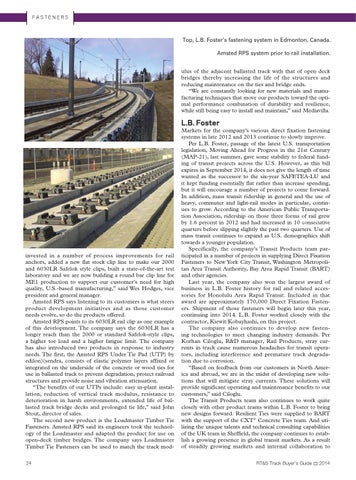
Top, L.B. Foster’s fastening system in Edmonton, Canada. Amsted RPS system prior to rail installation.
ulus of the adjacent ballasted track with that of open deck bridges thereby increasing the life of the structures and reducing maintenance on the ties and bridge ends. “We are constantly looking for new materials and manufacturing techniques that move our products toward the optimal performance combination of durability and resilience, while still being easy to install and maintain,” said Mediavilla.
L.B. Foster
invested in a number of process improvements for rail anchors, added a new flat stock clip line to make our 2000 and 6030LR Safelok style clips, built a state-of-the-art test laboratory and we are now building a round bar clip line for ME1 production to support our customer’s need for high quality, U.S.-based manufacturing,” said Wes Hodges, vice president and general manager. Amsted RPS says listening to its customers is what steers product development initiatives and as those customer needs evolve, so do the products offered. Amsted RPS points to its 6030LR rail clip as one example of this development. The company says the 6030LR has a longer reach than the 2000 or standard Safelok-style clips, a higher toe load and a higher fatigue limit. The company has also introduced two products in response to industry needs. The first, the Amsted RPS Under Tie Pad (UTP) by edilon)(sendra, consists of elastic polymer layers affixed or integrated on the underside of the concrete or wood ties for use in ballasted track to prevent degradation, protect railroad structures and provide noise and vibration attenuation. “The benefits of our UTPs include: easy in-plant installation, reduction of vertical track modulus, resistance to deterioration in harsh environments, extended life of ballasted track bridge decks and prolonged tie life,” said John Stout, director of sales. The second new product is the Loadmaster Timber Tie Fasteners. Amsted RPS said its engineers took the technology of the Loadmaster and adapted the product for use on open-deck timber bridges. The company says Loadmaster Timber Tie Fasteners can be used to match the track mod24
Markets for the company’s various direct fixation fastening systems in late 2012 and 2013 continue to slowly improve. Per L.B. Foster, passage of the latest U.S. transportation legislation, Moving Ahead for Progress in the 21st Century (MAP-21), last summer, gave some stability to federal funding of transit projects across the U.S. However, as this bill expires in September 2014, it does not give the length of time wanted as the successor to the six-year SAFETEA-LU and it kept funding essentially flat rather than increase spending, but it will encourage a number of projects to come forward. In addition, mass transit ridership in general and the use of heavy, commuter and light-rail modes in particular, continues to grow. According to the American Public Transportation Association, ridership on those three forms of rail grew by 1.6 percent in 2012 and had increased in 10 consecutive quarters before slipping slightly the past two quarters. Use of mass transit continues to expand as U.S. demographics shift towards a younger population. Specifically, the company’s Transit Products team participated in a number of projects in supplying Direct Fixation Fasteners to New York City Transit, Washington Metropolitan Area Transit Authority, Bay Area Rapid Transit (BART) and other agencies. Last year, the company also won the largest award of business in L.B. Foster history for rail and related accessories for Honolulu Area Rapid Transit. Included in that award are approximately 170,000 Direct Fixation Fasteners. Shipment of those fasteners will begin later this year, continuing into 2014. L.B. Foster worked closely with the contractor, Kiewit/Kobayhashi, on this project. The company also continues to develop new fastening technologies to meet changing industry demands. Per Korhan Ciloglu, R&D manager, Rail Products, stray currents in track cause numerous headaches for transit operators, including interference and premature track degradation due to corrosion. “Based on feedback from our customers in North America and abroad, we are in the midst of developing new solutions that will mitigate stray currents. These solutions will provide significant operating and maintenance benefits to our customers,” said Ciloglu. The Transit Products team also continues to work quite closely with other product teams within L.B. Foster to bring new designs forward. Resilient Ties were supplied to BART with the support of the CXT® Concrete Ties team. And utilizing the unique talents and technical consulting capabilities of the UK team in Sheffield, the company continues to establish a growing presence in global transit markets. As a result of steadily growing markets and internal collaboration to RT&S Track Buyer’s Guide
2014