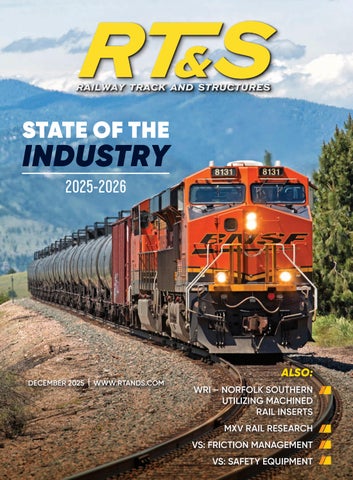
RTS December 2025

Page 1


Vol. 121, No. 12 Print ISSN # 0033-9016, Digital ISSN # 2160-2514

EDITORIAL OFFICES 1025 Rose Creek Drive Suite 620-121 Woodstock, GA 30189 Telephone (470) 865-0933 Website www.rtands.com

DAVID C. LESTER Editor-in-Chief dlester@sbpub.com

JENNIFER M c LAWHORN Managing Editor jmclawhorn@sbpub.com

EDITORIAL BOARD

Brad Kerchof, formerly Norfolk Southern Robert Tuzik, Talus Associates

Gary Wolf, Wolf Railway Consulting David Clark, CSX

CORPORATE OFFICES 1809 Capitol Avenue Omaha, NE 68102 Telephone (212) 620-7200 Fax (212) 633-1165

ARTHUR J. MCGINNIS, JR. President and Chairman

JONATHAN CHALON Publisher

MARY CONYERS Production Director

NICOLE D’ANTONA Art Director

HILLARY COLEMAN Graphic Designer

JO ANN BINZ Circulation Director

MICHELLE ZOLKOS Conference Director

CUSTOMER SERVICE: 847-559-7372

Reprints: PARS International Corp. 253 West 35th Street 7th Floor

New York, NY 10001 212-221-9595; fax 212-221-9195 curt.ciesinski@parsintl.com

Celebrating America’s 250th

How About Special Paint Schemes?

ISouthern Railway observed the Bicentennial in 1976 with banners honoring the seventeen signers of the Declaration of Independence.

t seems all but certain we won’t have a 2026 edition of The American Freedom Train. Union Pacific President and CEO

Jim Vena says he wants to run the railroad’s restored 4-8-8-4 Big Boy steam locomotive and a UP business train across the country to celebrate the 250th Anniversary. While this will be great and exciting to see, it doesn’t have quite the depth of meaning held by The American Freedom Train

Those who were around in 1976 will recall that nearly every railroad in the country, when there were approximately 60 Class I railroads, painted one or more in-service locomotives in a red, white, and blue Bicentennial paint scheme. A Bicentennial observance of note was Southern Railway’s, which didn’t include a red, white, and blue scheme, but red banners with white letters honoring each of the seventeen signers of the Declaration of Independence on the sides of each green, gold and light gray E8 locomotive assigned to pull the Southern Crescent.

The role of railroads in developing the United States over the centuries is well understood. Perhaps one of the best notations around this appeared in the 1976 issue of Trains magazine in a piece entitled “America – The Land That Railroads Made Possible,” by editor David P. Morgan. In his introduction, he points out that Charles

Carroll, the last living signatory of the Declaration of Independence, at age 90, was on hand for the groundbreaking for the laying of the first stone for the Baltimore & Ohio Railroad on July 4, 1828. Morgan quotes Carroll’s remarks about the gravity of what he was doing: “I consider this among the most important acts of my life, second only to my signing of the Declaration of Independence – if even it be second to that.”

Several short lines have already introduced America 250 paint schemes. Among them are the Wheeling & Lake Erie Railway, the Lake State Railway Company, and the Reading & Northern Railroad. I encourage Class Is and other short lines to adopt a new and creative paint scheme for the 250th. Even some of the paint schemes from 1976, applied to new or existing modern power, would be neat to see. Despite some of the political upset over the past decade, our country is still strong and our progress is inextricably linked to the railroad industry.

The rail industry should fire up those paint booths and get to work. Our 250th Anniversary of freedom and independence demands nothing less.

Influence of De-anchor Length on RNT after Cold Temperature Rail Breaks

A Review of Testing at the Facility for Accelerated Service Testing (FAST®)

Cold weather rail breaks in continuously welded rail (CWR) track are a common occurrence during colder months. Re-establishing the rail neutral temperature (RNT) to the target RNT is important for RNT management and track

buckle prevention. The current guidance for CWR track is to de-anchor the rail through the affected influence zone before re-welding. 1-2 The influence zone is defined as the region where the longitudinal rail forces (i.e., the RNT) are affected by the rail break, and the distance may extend up to 600 feet in each direction of the break, depending on rail temperature at the time of the break, the RNT, and the longitudinal resistance (i.e., track type).

De-anchoring through the influence zone has been considered an important step in the treatment of cold weather rail breaks in order to free up the rail by reducing longitudinal restraints. The reasoning for de-anchoring was avoiding unintentional low RNT regions during the re-welding process. However,

de-anchoring is a time and laborintensive practice, and MxV Rail, through the Association of American Railroads (AAR) Strategic Research Initiative (SRI) Program, investigated how reducing the de-anchor length affects the RNT profile. Figure 1 shows a conceptual diagram an RNT profile from Read and Kish. 2

Field Testing

To investigate the effect of de-anchor lengths on RNT profiles, testing was conducted between January and March 2024 in a long tangent section at the Facility for Accelerated Service Testing (FAST®) as described in Technology Digest TD24-017. 3 The test region consists of 136RE rail, mixed hardwood ties with cut spikes, and every other tie anchored. At the time of the first

Figure 1. Conceptual Diagram of RNT Profile with Half of Influence Zone Adjusted2

cut, the track had accumulated only 5 million gross tons (MGT) since its initial construction, so all fastening components (spikes, anchors) were tight. The nearest change in track structure was approximately 750 feet away in either direction (i.e., a turnout in one direction and a change from timber to concrete ties in the other).

Eight RNT monitoring locations were established on one rail. A strain gauge was placed at each monitoring location to determine the longitudinal rail force at different distances from the cut (see Figure 2). Thermocouples were placed on the web of the rail at Locations #2 and #6 to measure rail temperature and ascertain RNT. The RNT is calculated using both the rail temperature and longitudinal rail forces determined by strain gages. While RNT has historically been assumed to be rail temperature independent, all previous strain gauge monitoring has shown a slight dependence where higher rail temperatures produce higher RNT. To avoid temperature dependencies, the RNT change over time was tracked when the rail temperature was 56°F, which was a common value throughout the test and was referred to as the “adjusted RNT.”

For this test, three cuts (A, B, and C) were made to simulate winter rail breaks. The primary difference between a simulated cut and a field break is the lack of a train, which, depending on the tractive/braking forces, may affect the post-break RNT profile. The rail was cut during morning hours with rail temperatures of about 40°F and then welded using

an electric flash butt (EFB) weld. The primary difference between the three cuts was the de-anchor length prior to making the weld. For Cut A, the rail was de-anchored for 520 feet through the strain gauges; for Cut B, there was minimal de-anchoring (10 feet) to accommodate the rail weld; and for Cut C, the rail was de-anchored for 190 feet. The three cuts were spaced 20 feet from each other to avoid placing welds at the same location, and substantial tonnage was allowed to accumulate between cuts. The desired RNT at FAST is 100°F, and the target RNT for the testing was 105°F.

Summary of Results

Figure 3a shows the RNT profile (no temperature correction) during the cut/de-anchor/weld process along with the change in RNT. For all three cuts, despite following typical procedures, the post-weld RNT was slightly higher (10–20°F) than target. In Cut A, the RNT was re-adjusted upwards 20°F by removing an inch of rail. In Cuts B and C, once the gap and EFB rail consumption was accounted for, no additional rail was removed. The test did not produce a low RNT region with no de-anchoring as suggested in Figure 1. 2 This result may be due to track type and closing the rail using a rail puller because the previous test was performed in concrete tie track and may have assumed heating the unanchored zone with a rail heater. In this test, however, the pull required to close the rail gap pulled the rail through anchors, wood ties, and ballast.

After traffic (Figure 3b), any high

RNT regions were reduced as the high-RNT location tended to redistribute to the outside the test region. The RNT outside the test region was believed to be similar (~86°F) throughout the test. For all three cuts, the final RNT profile ended up being similar with a slight gradient (1.6–2.4°F/100 feet). This gradient can be conceptualized as a “stable condition” where, despite the track’s tendency to become uniform over time, the friction in the track can maintain the differences in RNT. Therefore, this gradient is likely dependent on the fastener type and the anchor condition with stronger track allowing for more gradient.

The “smoothing” process does not involve adding or removing rail, so the “average RNT” over the entire region (~1,000 feet) should be identical both before and after tonnage. The localized high RNT will be reduced and redistributed over a larger length of track. This test did not show this process explicitly, but it is suspected the RNT redistributed occurred differently over regions where the track was not measured. The rate of RNT change was not constant with the majority of the change directed toward a “stable” condition occurring within the initial 5 MGT of traffic.

Key Findings

There are many factors to consider when determining appropriate de-anchoring lengths, including but not limited to: track time, track labor, reduced anchor strengths from repeated anchor re-applications, loose anchors after welding, and the

Figure 2. Test layout showing RNT monitoring locations and cut locations A, B, and C
Figure 3. RNT profiles (a) during cut/reweld process (no temperature adjustment) and (b) after tonnage (temperature adjusted)

RNT profile. The key findings from the test are as follows:

• F or CWR wood tie track with every other tie anchored and rail gaps closed using a rail puller, different de-anchor lengths (10, 190, and 520 feet) did not produce significant long-term differences in the RNT profile during the re-establishment of RNT during simulated coldweather rail breaks.

• I f a localized high RNT-spot was produced during RNT re-establishment, the testing showed train operations smoothed the RNT profile out to a more uniform condition.

The majority of RNT redistribution occurred within the first 5 MGT.

• T he rail may slip through the rail anchors during a rail break. If a short de-anchor length is used, the subsequent pulling (RNT establishment) may result in loose anchors on the side

of the rail break. The length of track with loose anchors is likely dependent on the track component type and condition.

The Technology Digest this article is based on can be found in the MxV Rail eLibrary along with more than 1,000 other publications describing the railway research, testing, and analysis available from the Association of American Railroads (AAR) Strategic Research Initiative (SRI) program. Explore www.mxvrail.com to learn more about MxV Rail and to register for the 31st Annual AAR Research Review to be held April 28–30, 2026.

Acknowledgements

The author would like thank Holland Welding Company for test guidance (Paul Lindemulder [former] and Nick Martino) and welding (Mark Hall). The authors would also like to thank the MxV Rail Track Maintenance and

Instrumentation teams for their support with testing. Finally, the authors would also like to thank the AAR Track Buckling Prevention Technical Advisory Group for test direction and guidance.

References

1. F ederal Railroad Administration. 2021. “FRA Guidance on Continuous Welded Rail Requirement, Background and Example Generic Plan.” Federal Railroad Administration. Washington, D.C.

2. R ead, D. and A. Kish. 2012. “Guidelines for Managing Thermal Forces and Rail Neutral Temperature in Continuous Welded Rail.” Research report R-1003. AAR/Transportation Technology Center, Inc. Pueblo, CO.

3. W ilk, S., C. Johnson, D. Otter, and N. Martino. 2024. “Influence of De-anchor Length on RNT after Cold Temperature Rail Breaks.” Technology Digest TD24-017. AAR/ MxV Rail. Pueblo, CO.

We had a great time celebrating our 25th anniversary this year, and we can’t wait to see what 2026 will hold. Our team is eager to keep shaping the future of rail as we strengthen the industry through our offerings:

STATE OF THE INDUSTRY 2025-2026

Java Creek Office Car Special

On May 20, 2023, BNSF’s office car special deadheaded east over Marias Pass, after making a brief visit to Northwest Montana. The train is seen crossing Java Creek Trestle near Essex.

All photographs by Justin Franz, Railway Age Contributing Edito r

The organization of the industry has been the sharp focus of railroad planners during the past year. All this work is supposedly for the benefit of the industry itself, customers, shareholders, railroad employees, and the country. The only intent to file for merger approval has come from Union Pacific and Norfolk Southern. Will this merger be approved? If it is, how will the rest of the industry react? Will the response be a highly touted BNSF+CSX merger, essentially creating two parallel U.S. transcontinental railroads? If UP+NS is or is not approved, might other combinations make sense?

There is a tremendous amount to unpack from these questions, and the Surface Transportation Board will examine them in 2026 in hearings and deliberation around what it believes is best in light of the “new” 2001 merger rules. Moreover, thorough examination of key factors that can grow rail traffic, such as customer service quality, competitive rates, reciprocal switching, and improved marketing efforts on the part of Class Is will be front and center during the process.

In addition to mergers, there are other areas to consider as we evaluate the year about to end and look ahead to the one that’s about to begin. Let’s look at these in some detail.

Industry Organization

As we wind up 2025 and look ahead to 2026, the rail industry finds itself at a crossroads. The number one concern in the industry, just below safety and traffic growth, is its organization. By the time you read this, Union Pacific and Norfolk Southern will likely have submitted their merger application to the Surface Transportation Board (STB). The coming year promises to be an interesting one as the STB reviews the application and evaluates feedback and commentary from various parties, including other railroads and shippers. If successful, the merger will significantly reshape the industry and will likely prompt a competitive response of some sort. Most believe that the only sensible transaction would be the merger of BNSF and CSX, which would provide two transcontinental railroads and bring the total number of North American Class I roads to four.

Significant comments from other Class I railroads have already hit the news.

For example, on its website, BNSF says “This potential merger could have widespread effects on rail competition, supply chains and service reliability through North America. It is important that the Surface Transportation Board hear from you now and at every opportunity during the regulatory review process. Your views matter and will help them make informed decisions. Here is how you can tell the STB to say no to unchecked market power and the loss of competitive options you’ll never get back.” Certainly, no doubt about how “Berkshire,” as UP CEO Jim Vena likes to call it, feels about the merger.

CPKC’s President and CEO Keith Creel is not happy about, nor is interested in being involved in, any merger. Railway Age Contributing Editor Justin Franz reported in Railfan & Railroad in August that Creel said “We believe that a transcontinental merger would trigger permanent restructuring of the industry and result in a disproportionately large railway whose size and scope would require others to take action. This will likely result in an unnecessary wave of railway mergers that today is not the best way to support American businesses nor the public interest and has the potential to create more issues than it solves.”

For its part, CSX is not commenting on the merger, although the dismissal of former President and CEO Joe Hinrichs and replacement with Steve Angel, who has experience with mergers and acquisitions in other industries, tells you what CSX wants to do. However, BNSF has stated that it is not interested in participating in a merger. Of course, that may change if UP+NS is approved. Nevertheless, both (BNSF-CSX) railroads have initiated cooperative international and domestic intermodal service in the past few months. While single-line service is one of the major reasons for and purported benefits of transcontinental mergers, it will be interesting to see if the BNSF-CSX service truly reduces travel time and improves volumes. CPKC initiated some similar services after its merger and is beginning to see significant increases in international volumes.

The Canadian National position is a bit tougher to read because its comments about the proposed merger have included statements of fact, but they’re non-committal. For example, the CN website shares this statement: “This transaction could have far-reaching

implications for rail competition, supply chains, and service reliability in North America. CN will be actively participating in the STB review of this proposed merger.” The railroad has also championed the notion that “our customers’ voices should be heard.” OK, all of this is fine, but what’s the railroad’s position on UP+NS? One would assume that CN is against the merger but cannot definitively conclude that based on the statements the railroad has released to this point. The message seems to be limited to “customers should be heard,” “the merger has far-reaching implications,” and “we’re monitoring it carefully.” Perhaps we’ll get more clarification going forward. Although, might CN be interested in a merger of its own?

As expected, most shippers and shipper organizations are not enthusiastic about UP+NS. For example, the National Industrial Transportation League (NITL) said in a statement this summer that “NITL has consistently been on the record as opposing further consolidation in the freight rail industry . . . Despite the promises that rail customers would benefit from mergers through more efficient service, in reality captive rail customers must pay increasingly higher prices for unreliable and inadequate service.” In a similar vein, the American Chemistry Council says that “The American Chemistry Council (ACC) and its members are deeply concerned that the proposed merger between Union Pacific (UP) and Norfolk Southern (NS) will result in more [harm to] the U.S. freight rail industry. We urge policymakers and regulators to reject any rail merger that does not clearly enhance competition and improve service.”

It comes as no surprise that both Union Pacific and Norfolk Southern shareholders have approved the proposed merger. An interesting twist on UP’s part is President and CEO Jim Vena’s recent lobbying of the White House on behalf of the merger, as well as UP’s contribution to funding the new White House ballroom. Some looked askance at this since it is up to the independent STB to approve or reject the merger application and is not (supposedly) subject to political pressure. Yet, in firing STB board member Robert E. Primus, a Democrat, in August, POTUS 47 is the first U.S. president to fire a member of either the Interstate Commerce Commission (the predecessor

organization of the STB) or of the STB itself, so it’s hard to say what that may mean as the approval process develops. However, the chairman of the STB, Patrick J. Fuchs, is widely respected by nearly everyone involved with or affected by the merger, and he is not likely to easily succumb to political pressure, if it even comes.

Some say, however, that given the political climate at the moment, Vena would have been foolish not to solicit White House support for the merger. At

a recent press conference, Vena said the ballroom donation made to the National Park Service (NPS) is in line with a long relationship with the NPS, going back to the days when Union Pacific initiated an advertising campaign to attract Americans to visit some of the newly opened national parks. The NPS is responsible for maintaining the White House grounds.

Rail Traffic Review

As is usually the case, rail traffic

year-to-date as of September 30 is a mixed bag. According to the Association of American Railroads Policy & Economics unit, total U.S. carloads from Jan.Sept. 2025 are up by 2.1%, which equates to 180,455 carloads, over the same period in 2024. When coal is removed from the analysis, the carloads during the same period (Jan.-Sept. 2025 vs. Jan.-Sept 2024) were up 1.4%, which equates to 85,200 carloads. The AAR also reports that from Jan.-Sept. 2025, compared to the same period in 2024, intermodal volume (which includes containers and trailers) was up 3.5%, equating to 362,139 units.

Total U.S. rail volumes for Jan.-Sept. 2025 were: total carloads, 8.65 million, total carloads excluding coal, 6.37 million, and total intermodal units, 10.57 million. The graphic on the next page, courtesy of Railway Age and the Association of American Railroads Policy and Economics unit, provides a detailed breakdown of changes in rail traffic commodity groups for Jan.-Sept. 2025 vs. Jan.-Sept. 2024.

Rail Passenger Considerations

While there are other segments of the passenger rail industry, we’re focusing on Amtrak, Brightline, and high-speed rail. While the reports on each are a very mixed bag, it’s worth noting that Kevin J. Holland, the editor of the quarterly Passenger Train Journal , points out in his editorial for the Q4 issue that “all too often, the attitude of [passenger operators] is ‘You’re lucky to have any service, so quit whining.’” For example, he cites the windowless seat rows on Amtrak’s NextGen Acelas, quoting one Reddit commentator’s point that “You can’t advertise the view as one of the amenities of train travel if they don’t provide a window!” With that unvarnished commentary, let’s move on to the “official” review of Amtrak.

Amtrak recently released a report touting its success during FY2025 (Oct. 2024-Sept. 2025), with a second consecutive year of increased ridership. The agency reports it provided 34.5 million customer trips during the year, which set all-time records for both ridership and revenue. Here are some additional achievements for the year reported by Amtrak:

• Ridership: 34.5 million customer trips, a 5.1% increase over FY24 and

Coram
On February 28, 2023, Amtrak Train 8, the Empire Builder, rolls east through a storm near Coram, Montana.

an all-time record.

• Adjusted T icket R evenue: $2.7 billion – a first in Amtrak’s history and 10.4% higher year-over-year.

• Total O perating R evenue (Includes payments from state partners for State Supported routes): $3.9 billion, a 9.1% increase over FY24.

• Customer O n-time Performance: Northeast Regional trains reached their highest on-time performance in recent years this September.

• Customer S ervice: Surpassed systemwide customer service goals, with historical bests in Wi-Fi, food and beverage, train status communications, and station signage.

• Miles Traveled : Amtrak passengers logged 6.9 billion miles in FY25, a new all-time high.

• New S ervices, N ew Trains: Made history with the launch of Amtrak Mardi Gras Service along the Gulf Coast and NextGen Acela on the Northeast Corridor; Borealis service drew over a quarter million riders in the Midwest since its FY24 debut.

• Capital I nvestments: Record $5.5 billion – up nearly 25% year-over-year – in major projects and state-of-goodrepair initiatives.

• Adjusted O perating E arnings (Unaudited) : Improved by 15.1% over FY24 to ($598.4 million), on track to achieve train operational profitability by FY28.

Given that Amtrak’s history has been fraught with bad news, poor performance, and lack of support, this data points to

positive trends.

These days, a reference to Brightline includes Brightline Florida and Brightline West. However, the company, which began with such promise and excitement, has run into some choppy air on both sides of the country. Brightline Florida, for example, according to reporting by Railway Age ’s Contributing Editor, David Peter Alan, booked 3 million trips in 2024 but lost almost $550 million in 2024. You can read David’s report, published in September, at this web address: https:// www.railwayage.com/passenger/intercity/brightline-loses-nearly-550mm-in2024-but-keeps-on-going/. David followed up in November, reporting that “There have been more indications of trouble for Brightline since then, including skyrocketing costs for building Brightline West in the Mojave Desert of Southern California and Brightline’s own action of slashing service between its South Florida stations and Orlando Airport.” You can read David’s latest report at the web address https://www.railwayage.com/passenger/ high-performance/brightline-financialwoes-continue/?RAchannel=news

For the October 2022 issue of Railway Age , the then RT&S managing editor prepared a feature story on Brightline and its pending operation to Orlando from Miami. We were fortunate to travel to Miami and have a complete tour of stations, maintenance facilities, and a ride from Miami to West Palm Beach. It was a great experience and we found the company very impressive, leaving with the thought “if anybody can do it,

these guys can.” RT&S and Railway Age continue to wish Brightline well, but we’re concerned about the financial situation at the company, especially its recent ask of the POTUS 47 administration for a $6 billion federal loan for Brightline West. While the cost of construction is expensive, the even larger worry is that even with strong ridership in Florida, the company has lost money and reduced service. Arranging financing for construction is one thing; losing big bucks on operation is quite another.

The RT&S editor has written in the past that the massive construction cost increases for building high-speed rail systems, including the California HighSpeed Rail system projected to provide service between Los Angeles and San Francisco, are dampening support for high-speed rail, at least for the time being. Moreover, the lack of political support for funding the CHSRA from the administration, and pulling previously committed federal funds for it have made things even worse. We’ve about reached the point of throwing up our hands on U.S. high-speed rail. While we would like to see it, we’ve written before that the money may be better spent on improving conventional Amtrak, commuter rail, and rail transit. Many hi-speed advocates write and talk about it until they’re blue in the face, but nothing ever seems to significantly move forward. Right now, all we have to show for the CHSRA project is a support infrastructure, sans track and trains, sitting in the Central Valley of the state.

The U.S. Economy

Analyzing and predicting the path of the U.S. economy is almost like counting and predicting the total number of raindrops falling in your backyard during a thunderstorm. And this is on a good day. Exacerbating this challenge in 2025 is the uncertainty around U.S. trade policy (mostly tariffs imposed by the Executive Branch) and the recent government shutdown.

The Policy and Economics unit at the AAR says the U.S. economy “continues to defy expectations with its resilience” as we move through the fall. Moreover, it says “projections vary widely, a sign that conflicting economic signals have made forecasting more difficult amid shifting consumer behavior, policy uncertainty, and uneven sectoral performance.”

According to the U.S. Bureau of Labor Statistics (BLS), the Consumer Price Index (all items) rose 3.0% for the 12 months ending September 2025, after rising 2.9% over the 12 months ending August 2025. The all items less food and energy index also rose 3.0 percent over the last 12 months, according to the BLS. The “all items less food and energy” numbers do not include energy and food because prices of those commodities are often subject to wider swings and can skew the overall inflation rate. However, the BLS reports that food prices increased 3.1% and energy costs rose 2.8% during this period. Drilling down on energy costs, BLS says “Within energy, the natural gas prices rose 11.7% over the year and electricity costs increased 5.1%. In contrast, gasoline prices were 0.5% lower than a year earlier.” Taken together, the 3% inflation rate has not been strong enough to motivate Fed interest rate cuts, although the agency did make a quarterpoint cut in September, the first since December 2024, because earlier this year, job reports showed significant slowing. Yet, the September jobs report, released

after a seven-week government shutdown, surprised most economists. The expectation was an increase of about 50,000 jobs in September, but the reported number was over double that –119,000 jobs added in September. This has many economists thinking that the Fed will forego another rate cut in December.

Consumer spending and confidence, according to the AAR, are important for railroads. “For freight railroads, customer-driven volumes, especially intermodal shipments, often mirror [shifts in income, inflation, and job prospects], making trends in spending and confidence key indicators for railroads to monitor.” The AAR points out, though, that the spending numbers are more important because the correlation between confidence and spending can vary in strength. AAR reports that the consumer confidence index “fell from 97.8 in August to 94.2 in September, a five-month low and a continuation of a downward trend since November 2024 when it peaked at 112.8.” Conversely, AAR reports that “total inflation-adjusted consumer spending in

August was up 0.3% over July, about the same increase as the prior two months. The year-over-year gain in August was 2.7%, the most in four months.”

Global Concerns

While U.S. business conditions can be impacted by world events in the political, military, medical, and economic arenas, unless there is a major catastrophe in any of these areas, most observers do not base rail industry forecasts and outlooks on them. However, there are several issues worth noting.

While there is currently a tenuous ceasefire between Israel and Hamas, with control of Gaza divided between both, there have been violations of the ceasefire agreement. The larger concern for the moment is what it will take to rebuild Gaza and return its people to some semblance of an orderly life. It is doubtful that rebuilding plans put forth by the United States, Israel, and Arab states will see approval soon, if at all. And there is always the distinct possibility of abandonment of the cease fire and resumption of fighting.

We’re Not In Omaha

Approximately, 1,390 miles from Union Pacific’s hometown of Omaha, Neb., a pair of UP locomotives lead a Canadian Pacific potash train at Caithness, British Columbia on the Cranbrook Subdivision. Feb. 19, 2018.

Hi Line Heritage

BNSF Railway ES44C4 No. 6997 leads Q-CHCSSE1-07A around a sweeping curve just east of West Glacier, Montana on Feb. 11, 2017. The second locomotive is Norfolk Southern No. 8101 painted in a special Central of Georgia Railway tribute scheme.

continued on page 29

Ultrasonic Rail Flaw Inspection Services

Ultrasonic rail flaw inspection is the most effective way to detect defects in rails. Plasser American’s ultrasonic rail flaw detection system combines high-speed ultrasonic electronics with user-friendly interface and detailed reporting. This inspection solution is capable of measuring at speeds up to 45mph with a resolution of 4mm for both stop/verify and continuous testing. Hi-rail trucks as carrier platform offer high flexibility and a wide range. Whether you need traditional stop/verify or continuous testing services, our team with over 30 years of industry experience will deliver you the results and reports you require.

TRACY ROBINSON President & CEO CN

KEITH CREEL President & CEO CPKC

MARK GEORGE President & CEO Norfolk Southern

PATRICK FUCHS Chair STB

MICHELLE SCHULTZ Vice Chair STB

JOHN ORR EVP & COO Norfolk Southern

MARYCLARE KENNEY SVP & CCO CSX Transportation

CARL WALKER VP Engineering CSX

DAVID SHANNON General Manager RailPulse LLC

NORFOLK SOUTHERN EMBARKS ON A NEW APPROACH TO RAIL DEFECT REPAIR

Internal rail flaws and defects are an unfortunate but unavoidable part of railroading. All railroads have them. All railroads have to repair them. Defect remediation, which involves cutting out the affected rail and replacing it with plug rail, is a necessary but costly and time-consuming process; it’s a process with room for improvement. Norfolk Southern is currently rolling out a technology that aims to reduce the cost, track access time, and rail-mismatching drawbacks associated with the traditional defect repair process, and they’re already seeing results.

Norfolk Southern’s (NS) procedures for

remediating internal rail defects are similar to any other Class 1 railroad; due to FRA (Federal Railroad Administration) regulation and AREMA (American Railway and Maintenance-of-Way Association) standards, this is a somewhat standardized process. But it’s a complex process. “To repair a defect in continuously-welded rail requires multiple work groups, multiple track blocks, and, on average, 21 feet of tested, matching plug rail,” Christopher Lorren, Engineer –Rail Health Management at Norfolk Southern, told delegates at the 2025 Wheel/Rail Interaction Heavy Haul conference.

On NS, when a defect is detected, either

via ultrasonic testing or visual inspection, typically a crew tailing the inspection vehicle immediately flags the defect location and installs joint bars if necessitated by the defect type and severity, as per FRA Track Safety Standards CFR 213. The location and severity of the defect also dictates the level of protection, such as a slow order, the defect is given. This process typically occupies a 0.5 hour to 1 hour block of track time, Lorren said.

The next step is for a section gang to unfasten the adjacent rail, cut out the defect and install the plug rail, temporarily via joint bars, and refasten the track. This typically requires an hour to 1.5-hour

Photos
Credit: Mike Yuhas
A plug rail insert mid-installation.

block of track time, he said.

The final step is to perform the welds. NS uses both thermite and flash-butt welding on their system, depending on the defect location and availability and logistics of welding trucks and crews (although flashbutt welding is preferred). Regardless of the weld type, these crews are tasked with removing the joint bars and welding the plug rail in place to complete the defect remediation process. This block of track occupancy can range from 1.5 hours to 4.5 hours depending on the complexity of the job, the type of weld, and the availability of track blocks, Lorren said.

In 2024 alone, NS tested more than 100,000 track miles, detecting over 7,500 defects in mainlines and sidings, Lorren said. Remediating these defects required a total of:

• 157,000 feet of ultrasonicallytested, matching plug rail

• 60,000 bolt holes and bolts

• 30,000 joint bars

• 22,500 saw cuts

• 15,000 welds

That adds up to a lot of track time. “Our primary goals are to decrease our exposure and improve our efficiency,” Lorren said.

“We want to be able to remediate a defect with a single crew, in a single block.”

Exposure and Efficiency

Of course, a single crew is capable of removing, replacing, and welding a piece of rail, but there are logistical and technological constraints to consider. The average length of plug rail NS uses, at ≈21 ft, means that most jobs necessitate the use of a specialized grapple vehicle to transport and maneuver the plug and defect rails. “You lose a lot of time simply setting on [track] and setting off when you’re using these bigger hi-rail trucks,” said Kristopher Koski, President

Christopher Lorren, Engineer – Rail Health Management at Norfolk Southern.
Kristopher Koski, President of ONE Rail Group.
Figure 2. Shear lip in a flash-butt weld (circled in red and shown in close-up on the right) caused by rail mismatch.
Figure 1. Examples of thermite weld failures caused by finning at the base of the rail.
Figure 3. A flash-butt weld failure caused by stress induced by shear lip.

of ONE Rail Group. “If you can eliminate the need for a piece of equipment like that, you’re already more efficient.” The only way to eliminate the need for a grapple truck or overhead crane is to use a smaller section of plug rail. This would also have the add-on effect of reducing the labor and time associated with rail handling and with unfastening and refastening the track during the repair process, he said.

Ensuring the quality and consistency of welds is critical to the process; a failed weld is bad for both efficiency and exposure. A failed weld precipitates more track time, more material, more cost.

Thermite welds have a typical lifespan of ≈500 MGT, NS’ Lorren said. The most common mode of failure is “finning” at the base of the rail. Finning occurs when molten metal leaks out between the welding mold and the rail surface and fails to fully bond with the rail. This fin of material acts as a stress-riser and can initiate a fracture as the rail experiences bending and torsional stress over time. Figure 1 shows an example of a thermite weld failure due to finning at the base. “Thermite welding is a very manual process; it relies on a trained and skilled welder. It also relies on well-matched rail and plug rail,” he said.

Electric flash-butt (EFB) welds are generally preferred to thermite welds. They typically have a lifespan of 1500 MGT, three times that of thermite welds, Koski said. “Flash-butt welding is the industry standard for long-term rail repair, but that doesn’t mean it can’t be improved.” Flash-butt welding removes much of the manual aspect from the equation by virtue of being a mechanized process, but these welds can fail, too. And when they do, the failure is often related to rail-mismatch, he said. In such cases, shear lip at the fillet radius between the rail head and web (see figure 2) acts as a stress riser and can initiate a fracture (see figure 3) under stress.

But matching plug rail to extant rail is not an easy task. “Railroads simply don’t store a lot of rail; those days are over,” Koski said. As a result, maintenance crews are rarely, if ever, able to find plug rail that perfectly matches the rail it’s replacing in terms of wear level and pattern.

The current AREMA standards allow for ±5 mm of mismatch between the rail and plug rail—figure 2, for example, shows a 4.7 mm mismatch (3 mm in the base and 1.7 mm in the head). “This [allowable mismatch] became the standard because railroads wanted to be able to weld 136 lb rail to 132 lb or 141 lb rail without having to put in a transition rail,” Koski said. The mismatch allowance makes it easier to find and install an acceptable plug rail, but the potential consequences of mismatch, such as the inadvertent creation of stress risers and eventual weld failure, must also be considered.

Rail Inserts

With the aim of reducing track occupancy time, increasing operational efficiency, and improving overall weld quality and consistency, NS has recently begun to trial a new defect remediation procedure that, for individual defects, uses small, proprietary machined Rail Inserts™ in place of traditional plug rail.

The inserts, which are in effect, very short sections of purposebuilt plug rail, measure only 5 ft in length. They are manufactured from new rail, ultrasonically tested, and milled to match the extant rail to within 1 to 2 mm of mismatch, Koski said. They are small enough that a grapple truck or overhead crane is not necessary to transport or handle them.

The 5-foot inserts are, in fact, too small to weld with standard flash-butt equipment, which typically requires at least ≈12 ft of rail to ensure proper geometry and crown at the weld point, Koski said.

The Rail Insert Welding head, designed to weld short (down to 39 inches) lengths of purpose-built plug rail, in addition to traditional EFB welds.

Low Profile Portable Derail

Western-Cullen-Hayes portable derail. The LP-TS incorporates the same proven, overall design as the TS Derail, but with a Lower above top of rail height to clear locomotive pilots.

The LP-TS comes in either a left hand or right-hand version.

Light weight - approximately 41 pounds w/o flag

Can be padlocked in the derailing position

Resists sliding - unique, patented, design holds derail securely to rail

Rugged - fabricated from high strength alloy steel

Easy to install - requires no special tools

Equipped with a highly visible warning flag

Fits rail 75 to 141 pounds

2700 W. 36th Place • Chicago, IL 60632

(773) 254-9600 • Fax (773) 254-1110

WebSite:www.wch.com E-mail:wch@wch.com

Figure 5 . An image of the 7-foot “Rail Insert 2.0” visible in the foreground.

The use of 5-foot inserts requires a welding head designed specifically for the task (see figure 4). One of the benefits of the design, and of welding such small pieces of plug rail, is that both welds fit within the envelope of the rail puller. This means that both welds are performed under compression; the crew doesn’t have to wait for the first weld to cool before performing the closure weld because the insert is never in tension during the process, he said. This saves time that can add up over the course of multiple welds in a shift. The welding head is also able to perform standard flash-butt welds, so welding crews don’t have to skip over standard joint removal/repair jobs.

In addition to 5-foot inserts, however, One Rail Group has also developed a new 7-foot rail insert (a so-called Rail Insert 2.0 [see Figure 5]) that aims to solve two emergent issues: first, the 7-foot insert can replace and entire 5-foot insert and its associated welds, should the need arise (such as weld defect or rail/insert mismatch—although no such defects have been detected to date), and second, the 7-foot insert length means

that the insert itself spans older 6-hole-joint seed rail, meaning that twelve bolt holes (6 on each side) can be removed quite efficiently and replaced with CWR rail.

Norfolk Southern has repaired over 250 defects using these inserts, as of this writing. And they’ve done so in one step, using limited crews. Track occupancy time is down, too. A crew using the inserts can fully repair a defect in an hour and a half or less, NS’ Lorren said. “Conservatively, we’re saving one to two hours per defect when it comes to single-defect repair.” A five-person crew currently working with the inserts and the insert welding head now averages over 9 welds per shift—a figure that’s close to the output of a full flash-butt welding crew and significantly above that of equivalentlymanned thermite crews, he said.

“We’re at the first step of the process. We’re still testing and proving things out,” Koski said. As the program continues, NS and One Rail Group plan to expand the program to additional crews—current plans call for 8 to 10 crews installing rail inserts on various Class 1 railroads

by 2026. There are also plans to expand rail insert inventory tracking such that a maintenance crew can query a database based on rail type and head loss to find the proper insert for the repair.

As Koski said, these are early days for the program. The theory is sound and initial results are promising, but there isn’t much data to analyze yet. That will change in the coming months and years as these inserts accrue tonnage and the process is refined. But railroads are already taking notice; CSX has recently begun to trial this technology as well, and One Rail Group is developing a stockpile of inserts to meet demand for 2026. It’s always interesting to find that in an area like defect repair that seems to be a “solved problem,” there is still room for innovation.

Jeff Tuzik is Managing Editor of Interface Journal https://interfacejournal.com/

This article is based on a presentation made at the 2025 Wheel/Rail Interaction Heavy Haul conference https://wheel-railseminars.com/

WHEEL/RAIL OPTIMIZATION

Friction management solutions for extending wheel/rail life

Friction Management solutions focus on the surface area where the wheel and rail come into contact. Athough a small area about the size of a dime, it’s involved in the great effort to reduce wear. Two major players in the industry offer their solutions.

Loram tells RT&S that its friction management portfolio “continues to grow by offering a variety of consumables (gage face grease and top-of-rail friction modifier) specifically designed for railroads with a focus on performance, consistency and versatility.” Specifically, “ClareShield TOR-WS is a premium, water-based TOR friction modifier designed to outperform the competition. From its biodegradability and wide pumpability range (-30 C to +80 C), to reducing lateral forces and extending the life of the rail, TOR-WS is ready for any challenge. For customers looking for a product with a longer carry distance and improved steering while contributing to fuel saving, Loram’s TOR-Xtend is the product to use. TOR-Xtend is a clean synthetic friction modifier that requires less material per application versus competitive products and has a carry distance upwards of 8 miles.”

The company “offers a wide range

of all-season gage-face lubricants specifically designed for different environments. Loram offers several readily biodegradable products with low temperature pumpability (EcoCurve Heavy Haul), to products designed for high-traffic, heavy load networks (Rail King HL/GL), to a transit-preferred, eco-friendly, high flashpoint, more visually appealing option (EcoCurve Trackside, Metro Bio). All of its products are highly adhesive, water resistant, multi-manufacturer wayside system compatible.”

L.B. Foster ’s “Total Friction Management (TFM) is the framework that guides L.B. Foster’s approach to improving rail operations through the implementation of wheel/rail interface friction management (FM). TFM integrates advanced technologies, proven consumables, and intelligent monitoring into a unified strategy that optimizes the wheel/rail interface across every environment. TFM allows railroads to maximize the benefits of their FM programs by minimizing the associated operating costs.” The company says that “TFM is supported by several key components. L.B. Foster continues to innovate with remote asset management technologies, including launching an

upcoming FM trackside system with full remote control. As part of this transition away from predominantly monitoring, L.B. Foster is also rebranding its Remote Performance Monitoring (RPM) service under its larger Anatomy Asset Intelligence platform. Anatomy delivers more than just data—it provides railroads with powerful insights into the performance of entire FM programs across multiple divisions.”

Regarding trackside equipment, L.B. Foster says it “has expanded the state-ofthe-art PROTECTOR® X system lineup with slim cabinet designs and an upcoming 200-lb nominal unit. These systems use a proven tank design that ensures maximum product utilization and extends refill intervals. Complementing these systems are our high-performance consumables—SYNCURVE®gage face grease and KELTRACK® top-of-rail friction modifiers— that deliver exceptional durability and all-season reliability. These advanced formulations deliver extended carry-down and require lower application rates. Rather than focusing on isolated solutions, TFM integrates technology, equipment, and materials to deliver measurable improvements in safety, sustainability, and cost efficiency across rail networks.”

Photo Credit: Loram

Friction MANAGED

L.B. Foster’s WILD IV enables realtime detection of wheel impacts, train weights, and potential safety hazards to improve railway operations and maintenance scheduling.

BUILT FOR SAFETY

Preventing incidents on and near the right-of-way

Throughout the year, we have spoken to executives from railroads, construction and engineering firms, company reps, engineers, etc. about rail safety. It’s a neverending conversation that dominates the industry. Monitoring threats and providing physical barriers are a few of the safety solutions offered by rail suppliers. Orgo-Thermit and L.B. Foster spoke to RT&S about keeping people safe near the track.

Orgo-Thermit®, a Goldschmidt company, says it is “proud to offer the TrackSafe Barrier, a product that is designed to guarantee the safety of railroad workers while working on track using a physical barrier for railroad workers. It also enhancing productivity allowing railroad works to continue their duties when trains are passing on adjacent track. The Tracksafe barrier attaches to the rail using a magnet allowing extremely fast installation and removal, and unlike other barrier systems, there is no need to work with the ballast for installation, so no

digging the ballast during installation or tamping following removal. Furthermore, the ease of attachment and removal can allow it to be moved from one site to another quickly and efficiently. The system comes with customized cradles for efficient transportation and storage and is available for both standard track and 3rd rail. It does not interfere with signaling or shunt, so it does not affect any other operation of the railroad.”

For L.B. Foster, it offers Rockfall Monitoring. The company told RT&S , “In high-risk rail corridors, rockfall poses serious safety and reliability threats. L.B. Foster’s Rockfall Monitoring uses high-resolution LiDAR scanners to continuously assess track conditions in real time. The system defines a detection zone—typically six feet from track center—and instantly alerts operators when rocks, debris, or other obstructions enter that zone. Unlike traditional slide-fence systems that rely on indirect detection and often trigger false alarms,

Rockfall Monitoring directly observes the track, delivering accurate data that reduces unnecessary maintenance and slow orders. Field trials achieved a 100% detection rate for qualifying events while maintaining operational efficiency. Rugged equipment withstands harsh conditions, provides redundant coverage, and automatically resets when clear. This technology helps railroads protect crews, passengers, and assets while keeping trains on schedule.

“Similarly, forces at the wheel-rail interface are critical indicators of hazards like wheel defects, poor loading, and unstable track. L.B. Foster’s WILD IV Wheel Impact Load Detector uses strain gauges to monitor high impacts and issue alerts. Installed at over 200 North American sites, WILD IV has helped reduce Class I derailments by more than 50%. Shortline, industrial, and transit operators use WILD to improve maintenance, extend wheel life, and reduce noise and vibration— enhancing safety and efficiency.”

Photo Credit:
L.B. Foster

Continued from page 14

The war between Russia and Ukraine continues. The death and destruction levied against both countries has been horrific, and there is no end in sight. The Economist recently reported that a peace deal, allegedly developed jointly by the United States and Russia, would be crippling to Ukraine. The chances of this being adopted are virtually non-existent, according to most observers. Moreover, Ukraine president Volodymyr Zelensky recently learned that several of his government’s officials have stolen millions of dollars from the state nuclear agency, a discovery which left Zelensky, according to The Economist , “floored.” Clearly, a continuing mess. Likely the greatest risk is that one party in the conflict could introduce short-range nuclear weapons in the fight, which would have disastrous consequences for the world at large.

Tensions between major world powers continue to plague us, which is not new. One element now entering the mix is the development and use of artificial intelligence (AI) around the world. Extremely powerful, AI can bring about a lot of good for mankind, as it has for the railroad industry and other sectors of the world economy. Now that the genie is out of the bottle, though, AI is just as available to those who would do harm as it is to those interested in using it for progress. That’s way beyond the scope of our analysis but something worth keeping in mind.

Political divisions in the United States continue to be a concern. While this has resulted in uncertainty around trade policy and long-term planning for

policies are a must. Let’s not forget the words of President Calvin Coolidge when speaking to a news trade group in 1925 about the role of the press in a modern, free-market, democratic America and shared warnings about the evils of propaganda: “After all, the chief business of the American people is business. They are profoundly concerned with producing, buying, selling, investing and prospering in the world.” The gravity of this statement has not changed in 100 years.

The Railway Track and Structures State of the Industry Survey

While we’ve covered a wide range of issues in this review, which the editors believe are important to anyone who is employed by either the railroad industry or one of the companies supporting it, we now focus on the results of the RT&S State of the Industry Survey conducted during the past several weeks. First, thank you to those who participated! For those who have never seen one or did not participate in the 2025 survey, we asked a series of questions that apply to a cross-section of the industry about its economic performance in 2025, with comparisons to 2024 and looking ahead to 2026. We will include detailed graphs in a special news story on our website, which will be live around the time you read this. Overall, reports from our survey on business and planned spending for 2026 seem pretty good. For example, regarding the overall health of businesses, 55% of respondents said it is good , and 25% said it was excellent . As far as business activity in 2025 went, 30% said excellent and 40%

had been impacted somewhat , and 35% said not really. The responses around the impact of interest rates and inflation were similar, with over 50% reporting that they had been impacted somewhat and about 25% reporting not really

Respondents reported on the business outlook for 2026, with nearly 50% indicating the outlook is good and over 30% reporting the outlook is excellent Regarding overall business activity, nearly 50% said business was better in 2025 than in 2024. Regarding business expectations in 2026, about 42% said 2026 would be better than 2025, while 50% said 2026 vs. 2025 would be flat

The total spend on maintenance of way for 2025 was more than that spent in 2024 according to 45% of respondents, and about 42% said it was flat . Looking at MOW spending in 2026 vs. 2025, nearly 50% said there would be more spending and about 44% said spending would be flat in 2026. Our survey reported more specific data around the categories of planned maintenance spending, and that data will be presented in the charts accompanying our web story.

As is usually the case, business conditions, results, and forecasts are a mixed bag. Merger proceedings could mix it up even more. As long as consumer spending continues to improve, despite the drop in consumer confidence, this should bode well for the rail industry. However, the relatively high level of uncertainty around domestic and foreign economic and political policies, including trade policies, leaves us with a feeling of very cautious optimism (as opposed to cautious optimism) about economic and industry fortunes in 2026. To say the least, next year will be interesting!

Short Plug Repair Welding

Artificial Intelligence and the Railroad

JERRY SPECHT, AREMA President 2025-2026

Many of you have watched the movie The Terminator.

Thinking about where artificial intelligence (AI) is going in this world, it can be quite scary to think about its effects. One concern is that AI may lead us to a path of self-destruction where the machines take over the world, leaving us all in the dust when SkyNet becomes self-aware and decides that it doesn’t need humans anymore. One can also consider what the effects of AI are and how it will replace some of the functions that humans do today.

I think of it like a calculator. When I learned math, I didn’t use the calculator to perform calculations. Instead, I repeated math problems until I didn’t even think about it anymore and just did it. Through this repetition, I was able to master performing these calculations. As time went on, I used the calculator to process this data quickly and accurately, using it as a tool. However, I still know how to perform all this data crunching with my mind. Using AI in a manner that skips the “learning” phase over time could have a negative impact where we don’t develop the necessary basic skills to ensure that we fully understand the processes.

The railroad industry, a cornerstone of global logistics and transportation, is undergoing a transformative shift through the integration of AI. This month’s topic explores the current and potential uses of AI in railway operations, maintenance, safety, and logistics.

Using AI in a manner that skips the ‘learning phase’ over time could have a negative impact where we don’t develop the necessary basic skills to ensure that we fully understand the processes.

I will analyze the frameworks enabling these advancements and discuss the challenges and ethical considerations associated with AI deployment.

The railroad industry is at a point in time where there is a lot of great knowledge that needs to be captured before people retire. The preservation of this knowledge and expertise is paramount to the success of the industry. Using AI to preserve information could be crucial to ensure that the industry doesn’t have to reinvent the wheel or repeat past mistakes. On the other hand, the industry needs to make sure that the “learning” phase is kept intact to preserve the ability to think about new ways to railroad. There is a fine balance between the two, and it is up to all of us to decide how this will work!

The global transportation landscape is rapidly evolving with the advent of advanced technologies. In the railroad industry, AI is emerging as a powerful tool to address longstanding challenges related to operational efficiency, infrastructure management, safety, and customer experience. With increasing freight demand and the push for sustainable transport solutions, rail operators are turning to AI to optimize performance and reduce downtime.

Key Applications of AI

in the Railroad Industry

Predictive Maintenance

One of the most impactful uses of AI in rail is predictive maintenance. Machine

learning algorithms analyze data from sensors installed on trains and tracks to detect patterns and predict component failures before they occur. This reduces unscheduled maintenance, extends asset life, and enhances safety. Examples include:

• W heelset monitoring using vibration data

• Track geometry analysis for wear and defect prediction

• B earing trending and analysis

• V ibration analysis of trains traversing the rail

• S witch machine current level monitoring during operations

• R epeating issues and trending

Autonomous Trains

AI-powered systems are enabling semiautonomous and fully autonomous train operations. These systems use real-time data from cameras, radar, and LiDAR sensors, combined with AI algorithms, to manage speed, detect obstacles, and make navigation decisions. A notable implementation includes the AutoHaul system, which is the world’s first heavy haul rail network located in Australia.

Traffic Management and Scheduling

AI is transforming rail traffic control by optimizing routing and timetabling. Machine learning models forecast congestion, allocate track usage, and dynamically adjust train schedules to minimize delays and maximize

capacity. AI has the potential to perform dispatching functionality and reduce the efforts of dispatchers, providing more time to perform the manual functions that dispatching still requires.

Safety and Security Monitoring

AI-enhanced surveillance systems use facial recognition, behavior analysis, and object detection to monitor stations, crossings, and trains for security threats and safety violations. This proactive approach helps prevent accidents and enhances passenger safety. Ultimately, these surveillance systems would allow railroads to better protect their critical infrastructure and assets.

Energy Optimization

AI tools analyze historical and real-time data to optimize fuel consumption or electricity usage. By adjusting driving

Continued on page 32

2026 MEETINGS

JANUARY 27-28

Committee 15 - Steel Structures New Orleans, LA

JANUARY 29 -30

Committee 8 - Concrete Structures & Foundations Clearwater Beach, FL

JAN/FEB 2026

Committee 10 - Structures Maintenance & Construction Portland, OR

FEBRUARY 4 -5

Committee 9 - Seismic Design for Railway Structures San Bernardino, CA

FEBRUARY 10-11

Committee 1 - Roadbed & Ballast Charleston, SC

FEBRUARY 18-19

Committee 7 - Timber Structures Spring, TX

FEBRUARY 24-25

Committee 4 - Rail Lakehurst, NJ

FYI

Register now for the AREMA 2026 Communications, Signals & Information Technology Symposium — a two-day journey through the past, present, and future of railway technology. Join us March 3–5 in Jacksonville, FL, to explore how innovation is transforming the rail industry. Learn more at www.csit26.arema.org.

Download the AREMA 365 App for essential rail resources and networking opportunities. Easy access to news, events, and educational materials lets you stay informed and connected to the industry. Download it today by searching for AREMA in your phone’s app store.

Did you know we offer a wide variety of On Demand education for learning on your time? Browse our most popular webinars, seminars, and Annual Conferences to earn your PDH credits on

the go. Visit www.arema.org to start your On Demand learning today.

If you’re looking for a podcast to binge, listen to AREMA’s Platform Chats. It features guests from every aspect of the railway industry. Catch up on all five seasons available on all your favorite listening services today.

Leverage the power of your trusted association’s Railway Careers Network to tap into a talent pool of job candidates with the training and education needed for long-term success. Visit www.arema. org/careers to post your job today.

CONNECT WITH AREMA ON SOCIAL MEDIA: NOT AN AREMA MEMBER? JOIN TODAY AT WWW.AREMA.ORG

UPCOMING COMMITTEE MEETINGS

MAY 4-6

Committee 5 - Track Charlotte, NC

MAY 19-20

Committee 15 - Steel Structures Lancaster, PA

JUNE 3-4

Committtee 9 - Seismic Design for Railway Structures Denver/Golden, CO

JUNE 11

Committee 30 - Ties and Fasteners Urbana, IL

AUGUST 5-6

Committee 7 - Timber Structures Colorado Springs, CO

Join a technical committee

SEPTEMBER 29-30

Committee 15 - Steel Structures

Virtual Meeting

2027 MEETINGS

JANUARY 27

Committee 15 - Steel Structures

TBD

FEBRUARY 12-13

Committee 15 - Steel Structures Denver, CO

FEBRUARY 27-SEP

Committee 15 - Steel Structures

Virtual Meeting

Joining a technical committee is the starting point for involvement in the Association and an opportunity for lifelong growth in the industry. AREMA has 30 technical committees covering a broad spectrum of railway engineering specialties. Build your network of contacts, sharpen your leadership skills, learn from other members, and maximize your membership investment. If you’re interested in joining a technical committee or sitting in on a meeting as a guest, please contact Alayne Bell at abell@arema.org.

For a complete list of all committee meetings, visit www.arema.org.

PROFESSIONAL DEVELOPMENT

Get PDHs at your Own Pace with AREMA’s On Demand Education

Access to important professional development content is just a few clicks away with AREMA Education. Our OnDemand content spans many disciplines of PDH accredited courses that allow you to get your PDHs by learning from experts online without leaving your office.

BENEFITS OF LEARNING ONLINE

1. LEARN MORE

Studies show that participants learn more while taking OnDemand courses as you can skim through the material you understand and take more time in the more challenging areas.

2. GET INSTANT ACCESS

With AREMA On Demand courses, you don’t have to wait to learn and get your PDHs as they’re available instantly after purchase.

3. CONVENIENT AND FLEXIBLE

Above all things, On Demand education is meant to take at your own pace and on your time. Study from anywhere in the world, whether from your office or the convenience of your sofa.

4. COURSE VARIETY

AREMA On-Demand education offers a wide variety of topics for all studies of the railway engineering community.

Register and Start Learning today at www.arema.org.

BECOME A MEMBER AND SAVE

Not an AREMA member? Join today at www.arema.org and get discounts on all AREMA Educational Offerings, from Virtual Conferences to our Webinars.

Continued from page 31

techniques and energy loads, operators can significantly reduce environmental impact and operating costs. Educating operators, either train service or maintenance employees, could be significantly improved by data mining and understanding the habits of the employees. This couldn’t be done in the past due to the technology availability. Some examples of this would be:

• I ncreased efficiency through optimized scheduling and maintenance.

• C ost savings from reduced equipment failures and fuel use.

• E nhanced safety via predictive monitoring and autonomous systems.

Potential Pitfalls and Ethics

Despite its promise, AI adoption by railroads faces several hurdles. Data quality and integration with legacy systems may not provide the clean, real-time data needed for AI models. AI is only as

smart as the data that is being fed into the system. Teach it incorrectly and it will provide incorrect solutions. There is a concern about increased digitalization opening new avenues for cyber threats, such as automation potentially displacing certain roles, necessitating retraining and workforce restructuring. Transparency, accountability, and data privacy are critical in AI deployments. All these challenges are real and need to be addressed – sooner than later. Beyond all those previously mentioned, the overall impact of the experience gained by employees while railroading and switching to AI may lead to a significant drain on the innovation of employees trying to make things better. We learn from the mistakes we make and try to prevent them from happening again. When you don’t exercise a muscle, it weakens, and the muscle begins to atrophy. This same thing can happen in the rail industry much like learning math through

a calculator. You get the answer you were looking for, but nothing more. You lose the ability to understand how the answer was actually calculated and lack appreciation for the mistakes it took to get to the correct answer.

Future Outlook

Now with all that doom and gloom, there are some EXCELLENT benefits that AI can provide to the railroad industry. We just have to remember the pitfalls and understand how to use it. It isn’t something used to supplant thinking, it is merely a tool to allow us to perform other important things that need to be done. Much like a calculator, we have to remember HOW AI made the calculations.

Collaborations between rail operators, technology firms, and governments will be essential to realize these advancements and ensure equitable, secure deployment. AI is redefining the railroad

industry, offering tools to boost efficiency, safety, and sustainability. At the AREMA 2025 Annual Conference & Expo, AI was prominently featured— not only during the Technical Sessions and Emerging Technologies Panel Discussion but also across the expo floor, where several companies showcased innovative solutions. We hope even more companies will participate in our 2026 event and other rail industry gatherings. While significant progress has been made, further investment, policy development, and innovation are necessary to address challenges and unlock AI’s full potential. The rail sector stands at the cusp of a technological revolution that could shape the future of transportation for decades to come. Don’t be afraid of it, embrace it! Make sure you use it like a calculator, but remember to understand and maintain the founding principles!

CALL FOR NOMINATIONS

Notice to all members of AREMA The 2025-2026 Nominating Committee, under the Chairmanship of Immediate Past President William S. Riehl, III, hereby solicits suggestions and recommendations of candidates to serve on the AREMA Functional Group Board of Directors in the following positions:

All must be members of AREMA in good standing

• O ne (1) Senior Vice President – one-year term Must be a current or past member of the AREMA Board of Directors, and must be employed by a railway or transit company.

• Two (2) Functional Group Vice Presidents – three-year terms (Maintenance-of-Way, Structures) Must be current or past member of the AREMA Board of Directors.

• F our (4) Functional Groups will have a vacancy to be filled in the Functional Group Director positions – threeyear terms (Communications, Signals & Information Technology, Engineering Services, Passenger & Transit, Track)

Nominating recommendation should be submitted via email and should include all documentation to substantiate the recommendation. This must be signed by the member making the recommendation.

Deadline for Receipt of Recommendations is January 31, 2026.

The Nominating Committee will consider all recommendations. Submission of a recommendation should not be construed as affirmative Committee action on that recommendation.

Please email to:

William S. Riehl, III

Nominating Committee Chair info@arema.org

2400 Enterprise Dr., Independence, KS 67301 Call 620-485-4277 or visit precisionrwy.com for more details

Let Precision remanufacture your non-functional, outdated 6700 into a fully functional 6700 with the latest technology. If you have an old, worn-out 6700 ta m per, we have your solution.

COMPANY

AREMA

Danella Rental Systems

DavRail

Holland Co

L B Foster Company

Loram Maintenance of Way Inc

Next-Gen Freight Rail

Norfolk Southern

One Rail Group

Plasser American Corp

RailPros

Railway Educational Bureau

RCE

RELAM Inc

Western Cullen Hayes

WVCO Railroad Solutions

PHONE #

301-459-3200

561-743- 7373

817-201-0157

708-672-2300

412-928-3425

763-478-2627

212-629-7200

855-667-3655

630-341-6000

757-543-3526

262-637-9681

402-346-4300

866-472-4570

770-335-9273

773-254-9600

541-484-9621

E-MAIL ADDRESS

marketing@arema.org

SBolte@danella.com jalopez@davmarketing.com sales@hollandco.com glippard@lbfoster.com alexis.b.nubbe@loram.com www.railwayage.com/ngfr www.NorfolkSouthern.com www.onerailgroup.com plasseramerican@plausa.com www.railpros.com bbrundige@sb-reb.com www.rcequip.com jroberts@relaminc.com jm@wch.com wvcorailroadsolutions@wilvaco.com

Reader Referral Service

This section has been created solely for the convenience of our readers to facilitate immediate contact with the RAILWAY TRACK & STRUCTURES advertisers in this issue. The Advertisers Index is an editorial feature maintained for the convenience of readers. It is not part of the advertiser contract and RTS assumes no responsibility for the correctness.

Advertising Sales

MAIN OFFICE

JONATHAN CHALON Publisher (212) 620-7224 jchalon@sbpub.com

AL, KY, TN, CHINA

JONATHAN CHALON (212) 620-7224 jchalon@sbpub.com

CT, DE, DC, FL, GA, ME,MD, MA, NH, NJ, NY, NC, OH, PA,RI, SC, VT, VA, WV, CANADA: QUEBEC AND EAST, ONTARIO

JEROME MARULLO (212) 620-7260

jmarullo@sbpub.com

AR, AK, AZ, CA, CO, IA, ID, IL, IN, KS, LA, MI, MN, MO, MS, MT, NE, NM, ND, NV, OK, OR, SD, TX, UT, WA, WI, WY, CANADA: ALBERTA, BRITISH COLUMBIA, MANITOBA, SASKATCHEWAN HEATHER DISABATO (CHICAGO OFFICE) (312) 683-5026 hdisabato@sbpub.com

AMERICAS, EUROPE, ASIA, AFRICA, AUSTRAL ASIA NORTH AMERICA - CT, DE, DC, FL, GA, ME, MD, MA, NH, NJ, NY, NC, OH, PA, RI, SC, VT, VA, WV, AND EASTERN CANADA. EUROPE EXCEPT GERMANY, AUSTRIA, GERMAN SPEAKING SWITZERLAND, EASTERN EUROPE, ITALY, AND ITALIAN-SPEAKING SWITZERLAND. ASIA EXCEPT JAPAN AND CHINA. JEROME MARULLO (212) 620-7260 jmarullo@sbpub.com

GERMANY, AUSTRIA, GERMAN-SPEAKING SWITZERLAND, LATVIA, LITHUANIA, ESTONIA, POLAND, CZECH REPUBLIC, SLOVAKIA, HUNGARY, SLOVENIA, CROATIA AND SERBIA

SIMONE AND SIMON FAHR

Breitenbergstr. 17 Füssen 87629

Germany

Tel: +49 8362 5074996 sfahr@railjournal.com

ITALY, ITALIAN-SPEAKING SWITZERLAND DR. FABIO POTESTA

Media Point & Communications SRL Corte Lambruschini

Corso Buenos Aires 8 V Piano, Genoa, Italy 16129 +39-10-570-4948

Fax: +39-10-553-0088 info@mediapointsrl.it

JAPAN

KATSUHIRO ISHII Ace Media Service, Inc. 12-6 4-Chome, Nishiiko, Adachi-Ku Tokyo 121-0824

Japan

+81-3-5691-3335

Fax: +81-3-5691-3336 amkatsu@dream.com

IRJ PRO AND CLASSIFIED ADVERTISING SALES

JEROME MARULLO (212) 620-7260 jmarullo@sbpub.com

Some Thoughts on the Past Fifty Years

A Special Time to be a Railroader or Enthusiast

Irecently saw a comment that said one was fortunate if they were around and saw the railroad scene in the 1970s. When I read this, it caused me to stop and ponder the idea for a few minutes. Growing up and following railroads in the 70s included frequent commentary from old heads lamenting the days of steam and how things “were so much better then.” Except for excursion steam engines, which we’ll discuss in a moment, many felt they were born too late and missed out on the big show. Today, the shoe is on the other foot.

There were over 60 Class I railroads in operation when I became interested in the industry as an avocation in 1973. There weren’t as many short lines because most of those were formed after the implementation of the 1980 Staggers Act. Class I roads were then able to abandon unprofitable branch lines that were later purchased and operated by entrepreneurial railroaders. These new railroaders bet on making the line successful by offering more attention to existing customers and attracting new ones.

The number of Class I roads was good for railroaders because if their jobs were eliminated on one road, or they just wanted a change of scenery, there were many other carriers for which to work. And many did. Look at the biographies of some retired railroaders and see how many Class I roads they worked for during their careers.

The variety of operation, characteristics, and corporate cultures of the many Class Is provided great variety and interest for both professional railroaders and enthusiasts. For example, Southern Railway was quite different from Burlington Northern in many ways. Different traffic bases, different locomotive paint schemes, different types of equipment, different weather, and different challenges. All these variables, plus others, gave each railroad a unique identity.

Enthusiasts had more fun, too, because in the “pre-terrorist paranoia” days of the United States, access to facilities was relatively easy. While you officially still

needed permission to enter the property, rail officials were much less concerned if you did and often told you just to be careful and not get hurt. I remember a New Year’s Day in the mid-1970s when I visited what was then the main classification yard for the Louisville & Nashville in Atlanta. I believe the railroad was closed that day or at least this facility was. No one was around while I walked among several sets of L&N power, climbed (carefully) on to the

program was special in that it had a stable of four moderately-sized locomotives and continued the program after the merger with Norfolk & Western in 1982, employing large, powerful engines like N&W Class A 2-6-6-4 1218 built in 1943 to provide fast freight service. Too, N&W Class A 4-8-4 611, built in 1950 for fast passenger service got out on the road and demonstrated why many consider it to be one of the finest examples of steam locomotive technology.

AS MORE INDUSTRY CONSOLIDATION IS LIKELY TO OCCUR IN THE COMING YEARS, DEVOTION TO THE HISTORY AND MEMORY OF FALLEN FLAG ROADS BECOMES MORE IMPORTANT THAN EVER.

locomotive, and had a friend photograph me, giving me an image which I cherish to this day. Regarding facility visits, we live in a much different world today and the highly restricted access makes sense.

Some railroads catered to the public more than others. I’m sorry to refer to Southern Railway again, but this railroad was phenomenal. They ran a prosperous, no-nonsense freight railroad during a time when the industry was suffering financially and even faced the threat of nationalization. Southern also fielded a wonderful, first-class passenger train known as the Southern Crescent during most of the 1970s. But wait, there’s more! Southern created the model for running steam locomotive excursions solely for the benefit of rail enthusiasts, public relations, and to let young folks see what a steam engine was all about. To be fair, Union Pacific and a few other railroads ran steam for “fun,” but the Southern

I suppose the main difference in the old days was that there were many roads to visit, photograph, and research. The railroad scene is much different today. While train operations, engineering, and fine art photography of trains in different geographic environments attract professionals and enthusiasts alike, it’s harder for a young person to spark an interest in railroading today simply because there are not as many roads to see. Moreover, the industrial base of the U.S. has diminished in the last fifty years, and the built environment in urban areas has grown to the point that the view of railroad is often obscured. The neighborhood I grew up in was changing from light industrial to residential, so I was able to get a good view of the railroad then. Today, that view is essentially gone.

One of the best ways to appreciate “heritage roads” or “fallen flags,” many of which are incorporated in today’s rail behemoths, is to look into the many roadspecific historical societies. Nearly every significant “classic” railroad from the 1970s has one, and many produce highquality books and magazines around the history of the road, and have extensive archives of photographs and corporate records. Even Union Pacific, the largest railroad in North America and not a “fallen flag,” has one. The Union Pacific Historical Society is one of the best around, with quality publications and an excellent quarterly magazine devoted to it’s history.

As more industry consolidation is likely to occur in the coming years, devotion to the history and memory of fallen flag roads becomes more important than ever.

Turn static files into dynamic content formats.

Create a flipbook
Issuu converts static files into: digital portfolios, online yearbooks, online catalogs, digital photo albums and more. Sign up and create your flipbook.