Oxfordshire County Council released their OxRail 2040: Plan for Rail report for consultation in September 2025. This is a brief summary of the proposals made in the Plan. The Plan is open to public consultation until early October, and after amendments will be adopted by the Council in November 2025.
Key themes:
1. Improving connectivity and enhancing infrastructure – defining the services, infrastructure and operational changes required.
2. Climate action – setting out how rail can achieve net zero and adapt to a changing climate.
3. Rail as placeshaper – highlighting the role of stations and rail in shaping inclusive, connected communities.
Context
• Oxfordshire is expecting population growth and increased house-building in the next six years, and recognises the importance of planning transport links now.
• The Oxford-Cambridge Arc will link Oxford and Cambridge, creating one of the most innovating and highly educated regions in the world. East West Rail will also help to increase tourism and travel.
• Oxford is linked with the Thames Valley, South of England, the North, the Midlands, and London via four major railway corridors.
• International connectivity will be crucial to the success of the area and the Oxford-Cambridge Arc.
• There are several Nationally Significant Infrastructure Projects in the region, including:
o Oxfordshire Strategic Rail Freight Interchange
o East West Rail
Opportunities
• Capitalise on enhanced regional powers and rail industry reforms to shape Oxfordshire’s future rail network.
• Use the railway as a catalyst for growth and placemaking, supporting new homes, jobs and investment.
• Integrate rail with wider transport and spatial planning strategies.
• Strengthen international competitiveness by improving access to markets and gateways.
Challenges
• Securing long-term investment for infrastructure, trains and stations.
• Ensuring close collaboration between Government, industry, local partners and communities.
• Overcoming existing capacity and connectivity constraints.
• Tackling climate change while maintaining a reliable, resilient railway.
Member Briefing: OxRail 2040: Plan for Rail
Published September 2025
Transport and Rail Proposals
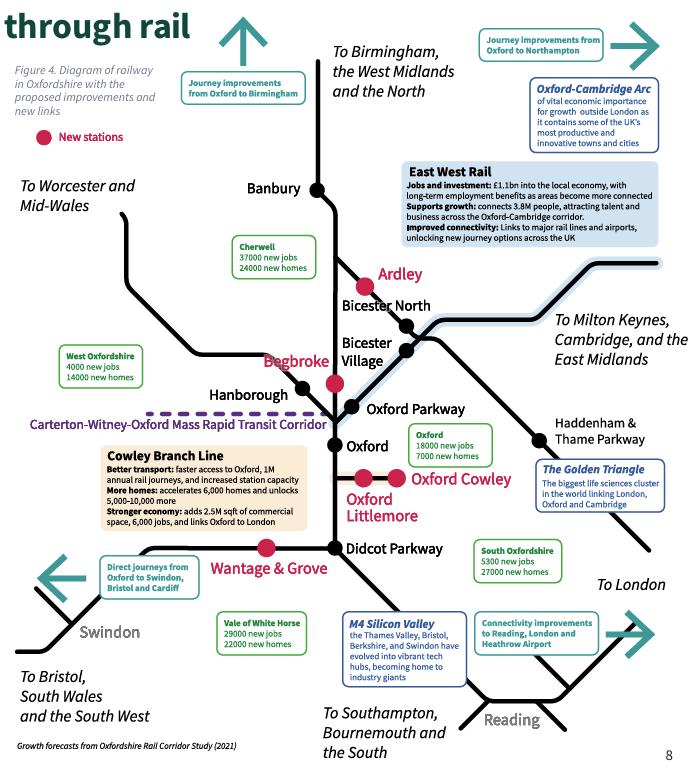
• There are several new stations proposed in the Plan: (see annex, Figure 4 for a diagram)
o Ardley
o Begbroke
o Oxford Littlemore
o Oxford Cowley
o Wantage & Grove
• The new proposed stations would be delivered in a phased approach:
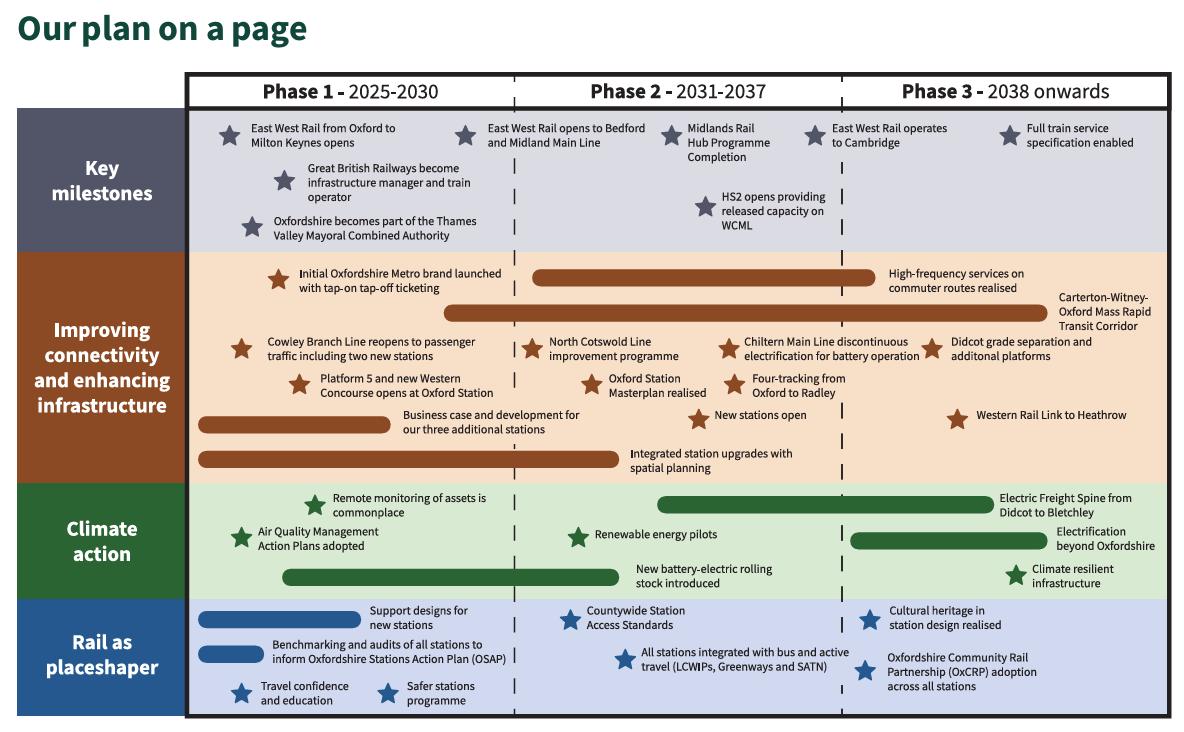
o Phase 1 (2025 – 2030) – Reopen the Cowley Branch Line (stations at Oxford Cowley and Oxford Littlemore); progress feasibility studies for Begbroke, Wantage & Grove, and Ardley; launch the Oxfordshire Stations Action Plan (OSAP).
o Phase 2 (2031 – 2037) – Deliver Begbroke and Wantage & Grove; continue development for Ardley; expand OSAP upgrades to embed mobility hubs countywide.
o Phase 3 (2038 onwards) – Complete Ardley if feasible; ensure all stations operate as fully integrated, community-led hubs.
• Oxford Station – further developments
o Phase 1 (2025 – 2030) will deliver Platform 5 and a new Western Concourse via the Network Rail Oxfordshire Connect project
o Phase 2 (2031 – 2037) will embed Oxford Station at the heart of the next phase of growth in Oxford, turning the station into a gateway.
o Oxford Station will become a transport interchange, integrated with active travel, local and regional bus services, and implement smart ticketing.
• Rail Electrification – a phased approach
o Phase 1 (2025 – 2030) – Oxfordshire County Council will work with Government, NR and TOCs as the industry procures new battery and bi-mode trains, and will support the early design and enabling works for the Electric Freight Spine
o Phase 2 (2031 – 2037) – the Freight Spine will be constructed, providing full electric operation between Didcot and Bletchley. Targeted electrification will also be required to decarbonise the Chiltern Main Line, East West Rail and the Regatta Line.
o Phase 3 (2038 onwards) – electrification would be extended beyond the County borders to connect with other national corridors.
• Oxfordshire Metro concept – an integrated transport network
o The Metro would bring together rail, buses, walking and cycling.
o The concept includes a single ticketing platform; timetable coordination (for buses and trains); seamless travel planning; longer operating hours; more frequent services; and a consistent brand.
Member Briefing: OxRail 2040: Plan for Rail
Published September 2025
o Phase 1 (2025 – 2030) – will begin work on integrated ticketing and other early priorities. Further steps will rely on progress on securing further devolved transport powers.
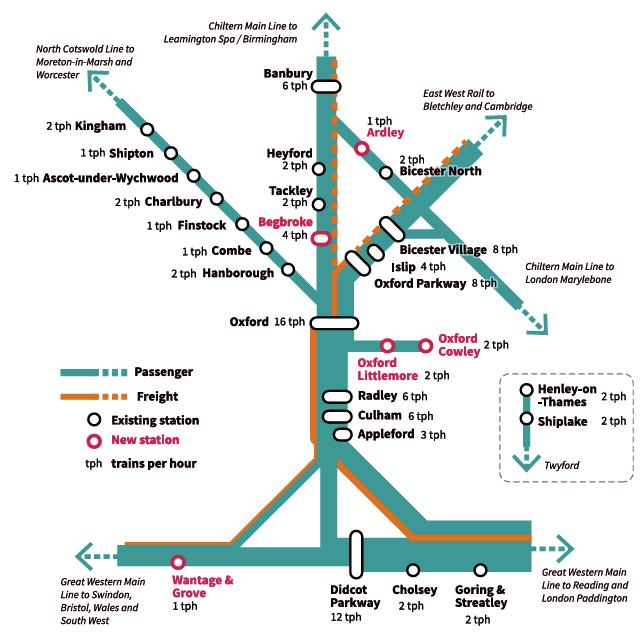
• An increased number of services at stations across Oxfordshire (see annex, Figure 5, for a diagram), to increase connectivity across the County. This would establish the ‘Science Line’, linking Oxfordshire’s leading centres of research, innovation, and advanced manufacturing.
• Better connections to Oxford’s innovation hubs
• Improvements for rail freight, including new rail freight interchanges and the electrification of the line from Didcot Parkway to Bletchley via Oxford and Bicester (the Electric Freight Spine)
• Many of the proposals laid out in the document are linked to the successful delivery of the East West Rail line in full.
• For a full timetable of the proposed activity, please see below: