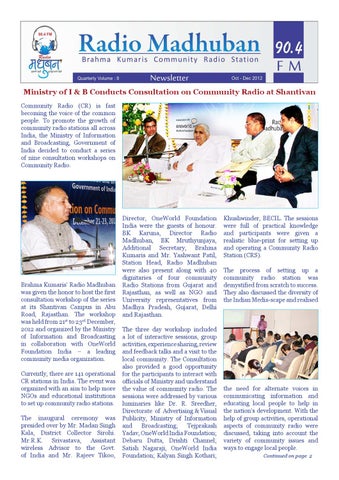
Ministry of I & B Conducts Consultation on Community Radio at Shantivan Community Radio (CR) is fast becoming the voice of the common people. To promote the growth of community radio stations all across India, the Ministry of Information and Broadcasting, Government of India decided to conduct a series of nine consultation workshops on Community Radio.
Brahma Kumaris’ Radio Madhuban was given the honor to host the first consultation workshop of the series at its Shantivan Campus in Abu Road, Rajasthan. The workshop was held from 21st to 23rd December, 2012 and organized by the Ministry of Information and Broadcasting in collaboration with OneWorld Foundation India – a leading community media organization. Currently, there are 141 operational CR stations in India. The event was organized with an aim to help more NGOs and educational institutions to set up community radio stations. The inaugural ceremony was presided over by Mr. Madan Singh Kala, District Collector Sirohi. Mr.R.K. Srivastava, Assistant wireless Advisor to the Govt. of India and Mr. Rajeev Tikoo,
Director, OneWorld Foundation India were the guests of honour. BK Karuna, Director Radio Madhuban, BK Mruthyunjaya, Additional Secretary, Brahma Kumaris and Mr. Yashwant Patil, Station Head, Radio Madhuban were also present along with 40 dignitaries of four community Radio Stations from Gujarat and Rajasthan, as well as NGO and University representatives from Madhya Pradesh, Gujarat, Delhi and Rajasthan. The three day workshop included a lot of interactive sessions, group activities, experience sharing, review and feedback talks and a visit to the local community. The Consultation also provided a good opportunity for the participants to interact with officials of Ministry and understand the value of community radio. The sessions were addressed by various luminaries like Dr. R. Sreedher, Directorate of Advertising & Visual Publicity, Ministry of Information and Broadcasting; Tejprakash Yadav, OneWorld India Foundation; Debaru Dutta, Drishti Channel; Satish Nagaraji, OneWorld India Foundation; Kalyan Singh Kothari;
Khushwinder, BECIL. The sessions were full of practical knowledge and participants were given a realistic blue-print for setting up and operating a Community Radio Station (CRS). The process of setting up a community radio station was demystified from scratch to success. They also discussed the diversity of the Indian Media-scape and realised
the need for alternate voices in communicating information and educating local people to help in the nation’s development. With the help of group activities, operational aspects of community radio were discussed, taking into account the variety of community issues and ways to engage local people. Continued on page 2
Radio Madhuban
Celebrating a ‘Green Diwali’ The Indian festival of lights, sparkle and prosperity, Diwali, was celebrated with great joy and fervour.
Newsletter
“Save Daughter - Save Water” -Mrs. Mamta Sharma (NCW)
Inspired by the ideals and valuebased practical teachings of Brahma Kumaris, the Parshad (corporator) publically announced live on air, that he will quit tobacco from that day and start a new life. He said that life is so precious and we must not make it a dustbin by consuming such items. BK Sudesh Didi, Director for BK centers in Germany highlighted the spiritual significance of Diwali. She explained that only a pure and clean mind can accommodate divine knowledge. Diwali is meant to celebrate brotherhood and enjoy. All throughout the day and also during the entire festive season, Radio Madhuban gave out a special message to the people- “to celebrate green Diwali”. Listeners were encouraged to not burst crackers and enjoy an eco-friendly Diwali with candles and diya. The issues of environment and pollution were highlighted to sensitize the public.
In the true spirit of Diwali, Team Radio Madhuban went to Global Hospital Trauma Centre, Abu Road, to spread the light of happiness among patients. The team distributed fruits to the patients and brought a smile on so many faces. Diwali welcomed a lot of guests to the studio as well. Many people from the community came to celebrate Diwali. A special live show on Diwali was broadcast and lot of listeners called in with their good wishes.
Oct - Dec 2012 ...Continued from page 1
Delegates from Radio Seven, Rudino Radio and Apno Radio shared their experiences about content generation, community engagement and designing creative programs. While delegates from Radio Madhuban, Tilonia Radio and Apno Radio shared their valuable experiences about manpower, technical and financial implications of running a CRS.
Mrs. Mamta Sharma, Chairperson, National Commission for Women visited the Radio Madhuban studio and shared her views with our listeners.
The participants were introduced to convergence and new media technologies like SMS, IVRS, online and internet radio. They were also informed about the sustenance of a community radio while discussing the advertisement policy, Micro Advertising & programme sponsorship.
I have been very closely associated with the Brahma Kumaris for a very long time and it is very pleasing to visit this spiritually inspiring complex - Shantivan in Abu Road. It is deeply motivating to see the effort and energy being put in spirituality and thus for complete upliftment of masses. I feel delighted to see so many empowered women, empowering others.
The most exciting part was the practical demonstration given by BECIL at Radio Madhuban’s studio to enable the participants to clearly understand the technical support system used for a community radio. The participants were very happy to freely use the equipment and learn about the new technology in use. Some of them also went on air and spoke to a caller in a show.
She said, women have been worshiped ever since the dawn of history. Women have been placed higher, if not equal to men even in the vedas and puranas. But the reality is a far cry from this. Today when people have started living for self-interest rather than selfrespect, it is pertinent to connect them to God through meditation.
The entire group also visited village Kivarli, where they got involved with the local community. They were introduced to the villagers and soon the group became a family and experienced the bond of a CRS.
Although, a handful of Indian women have worked wonders on a global platform, 78% women remain untouched by the progress of the nation. A lot has been initiated by the govt. for betterment of the villages and people must avail such benefits. Education and safety for women remain the prerequisites for empowerment of women. In her message to the listeners, she said “save daughter, save water” is the need of the hour. 2
It was a unique learning experience for all the participants wherein they clearly understood the entire operational mechanism of a community radio, from filling the application to going live on air. It was a very fruitful workshop and the feedback was outstanding. The team is greatly thankful to the Ministry of Information and Broadcasting, Government of India and the OneWorld Foundation India for selecting Radio Madhuban as the host of the first consultation. We look forward to hosting and participating in many such events in future.
Radio Madhuban
The state of Indian Agriculture The story of India revolves around its culture. The country’s traditional agricultural techniques made India an agro-based economy, which, for a very long time remained the backbone of the nation. Agriculture still sustains the majority population of the Indian subcontinent, but it is also indisputable that the state of agriculture, soil and land in India needs to be bettered. The then favourable green and white revolutions of the 20th century have today turned into the very basis of agriculture deterioration. In an attempt to find answers to the question of hunger, Team Radio Madhuban has been constantly interacting with policy-makers, decision-makers and scientists from around the country, collecting their critical opinions to solve this problem. And the team has concluded that it is now time for an organic revolution.
Newsletter correct measure but most chemical fertilizers contain only large proportions of urea, which provides only nitrogen to the soil thus it is devoid of other essential elements. This causes an imbalance in the soil composition, scaling down its quality and rendering it unfit for cultivation.
Bio vermin Compost:
In recent times, farmers have given up animal husbandry and thus have no means of livelihood, other than farming. Therefore in times of unfavourable climatic conditions, most farmers go through tough times and even commit suicide for they fail to sustain their families. Where on one hand science has given rise to these problems, on the other hand, it has also provided us with solutions. Scientists around the globe have developed ecofriendly techniques to counter the situation. Some of these easy, cheap and highly beneficial tools of science have been discussed below.
Indian agriculture today is faced with challenges like deforestation, soil deterioration, crop-quality degradation and severe economic problems. The excessive use of chemical fertilizers and pesticides has led to increasing soil erosion and pollution of land, air and water. Due to common practices, 30% of the urea goes into the air, 30% leaches with water and little is available for the crops. In most areas, the humus is washed away. Also the soil requires a mix of 16 elements including nitrogen, potassium, phosphorus, calcium, molybdenum, sulphur, iron, copper, boron, zinc, manganese and chloride in
Oct - Dec 2012
Bio – Fertilisers: A Bio-fertilizer is a substance which contains living microorganisms which, when applied to seed, plant surfaces, promotes growth. Bio-fertilizers add nutrients to soil through nitrogen fixation, stimulate plant growth, restore the soil’s natural nutrient cycle and enrich the soil. “A packet of bio-fertilizer costing Rs. 15 increases the output by 20% when used in a plot of one hectare”, says Dr C B Singh, Agronomist, Pusa University. 3
He adds that bio vermin compost is a very good alternative. Vermicompost is organic matter that has been decomposed and recycled as a fertilizer. At the simplest level, the process of composting simply requires making a heap of wetted organic matter like dried leaves, biodegradable waste, cow dung and waiting for the materials to break down into humus. The decomposition process is aided by shredding the plant matter, adding water and ensuring proper aeration by regularly turning the mixture. Worms and fungi further break up the material.
Bio Gas: Another very important source of energy is biogas or gobar gas. Biogas is a renewable energy source, produced from regionally available raw materials such as manure, sewage, human waste, green waste, plant material, and crops and recycled waste. It is environmentally friendly and can be used as a clean green fuel for motor vehicles, for cooking and to produce electricity for rural areas. Biogas qualifies for renewable energy subsidies in some parts of the world. The Deenabandhu Model is a new biogas-production model Continued on page 6
Radio Madhuban
Newsletter
Oct - Dec 2012
Photo News
Live coverage of Dussehra from Mt. Abu
Mr. Labh Shankar, Kivarli, giving info on Gau Sewa
Dr. Sunita, Agronomist, Pant Nagar University
Loyal Listener, Naugan at Radio Madhuban
Pravin & Kiran TV serial actors
Dr. Yashpal Singh, Metrological Scientist, Delhi
Live coverage of Navratri from Abu Road
Mr. Harmeet Singh Music Director, Mumbai
Mohan Bhai Half Marathon Winner
Famous Bollywood Actress Reema Lagoo
Knowing about the well-being of villagers of Kacholi
Mr. Prabhulal Soni Ji, Ex. Agriculture Minister, Raj
4
Radio Madhuban
Newsletter
Oct - Dec 2012
Photo News
College Students in the show ‘Youth Junction’
Guru Nanak Jayanti Celebrations at Gurudwara, Abu Road
Total Health Awareness by Dr. Jaishree, Naturopathist
Municipal Chairperson, Smt. Leela Devi, Mount Abu
Nukad Natak on AIDS Awareness
Mahila Gram Sabha, Amthala, Abu Road
Mrs. Lovely Katiyar, SP, Sirohi, visiting Radio Madhuban Stall at Rotary exhibition
Radio Madhuban team on World AIDS Day 5
Radio Madhuban
Newsletter
Oct - Dec 2012
National Commission for Rights – Its Role and Function
Article on: The state of Indian Agriculture
We were honoured to have Mr. Wajahat Habibullah, Chairperson, National Commission for Minorities, Govt. of India in our studios. The following is an interview where he discusses the rights of minorities and the work of his commission.
popular in India and usually has a capacity of 2 to 3 cubic meters. The Ministry of New and Renewable Energy offers some subsidy per model constructed.
...Continued from page 3
RM: Sir, could you please brief our listeners about the National Commission for Minorities. WH: It was officially recognized by the government in 1992, but had been established long back in 1983. At that time, the majority had a greater say in polity and social activities. But being a democracy, it was important to put everybody at an equal footing. Thus, a need was felt to uplift the minorities namely, Muslims, Christians, Parsis, Sikhs and Buddhists. The Commission was set up to ensure their rights as enshrined in the Constitution, to highlight their problems and help them through the governmental procedures. RM: What exactly does minority refer to? WH: There was a debate about this issue which was resolved in 2005 when the Supreme Court of India realised that India is a conglomeration of minorities, be it in terms of people, religion, language or gender. And therefore, only those groups who face a particular hindrance towards development shall be considered a minority and represented under this commission. RM: Have the minority classes been given some special rights as well? WH: The fundamental rights are the basic rights that every citizen is entitled to. But along with this, there are certain rights specially provided to the minority classes by the constitution to let them freely practice their religious and cultural traditions and educational norms.
RM: Are human rights common to all the people? WH: Definitely, the basic human rights like the right to live and the right to freedom of expression etc. are common to every citizen. India is a signatory to the universal declaration of Human Rights of the United Nations and the rights included in this charter must be provided to every citizen. RM: Where should minority classes go to seek redressal? WH: There is a National Commission for Women that looks after cases specific to women. There is also a National Commission for Children Welfare which works for safeguarding rights of children. Like, recently the commission has come out with an advisory for media houses to define and restrict the role of children in TV shows to prevent their exploitation. People must be informed and made aware of the national bodies that look into different matters of justice and redressal. RM: What is your message to our listeners? WH: India is a land that is thousands of years old and has been shaped by diverse opinions and ideas at various points in history. So many saints have travelled in this land spreading the message of peace and harmony. I therefore request all the people to work in brotherhood for national peace. 6
Using biogas can therefore solve a number of issues including improper sanitation, community health, climate change and waste management. Dr. Karamchand, Deputy Director of Agriculture, Palwal, Haryana added that ‘a family size of 8-10 people uses 75 Kg gobar gas per day, which can be easily produced if proper measures are taken’. Nowadays genetic engineering has also produced remarkable results. And further developments will aid the farmers to improve soil health and crop growth. Apart from this there is a dire need to remind people of the importance of animal husbandry and encourage them to take it. Buffalo, goat, cow and hen all are very important for the farmers. They help sustain the family and also earn an income. The government gives various incentives to farmers who adopt animal husbandry.
Role of Cow: Cow has been an integral part of Indian culture since the ancient times. All cow products have proved their immense significance in our lives. ‘Desi Cow’ milk has been found to be good for the brain. People who drink cow’s milk are active and intelligent. Cow dung is useful as raw material in biogas plants, to make industrial products like paints, coils, tiles, agarbattis and as organic manure in farms. It enhances the quality of soil. It has been used in Hiroshima and Nagasaki, where the atomic attacks left the soil barren for years. And the results are miraculous’, says Rajender Singh Rajpurohit, Adhyaksh, Rajasthan Goseva Ayog.
Radio Madhuban
Winter festival 2012, Mount Abu The colorful and joyous winter festival is organized by the Rajasthan Tourism and Municipal Board of Mt. Abu every year in the last week of December. The festival is a harmonious blend of cultural beauty and colorful tradition of the state, bringing together the rich heritage and warmth of its people. The celebrations begin with an extravagant procession to Nakki lake and end with ceremonial dazzling fireworks. The festival provides folk artists and classical performers an opportunity to showcase their incredible talent. It is not only a time for fun and frolic, but also gives people a chance to come together on social issues like female infanticide and safe driving, to learn and grow as a community. The festival has a lot of visitors from India and abroad.
Snake charmers: Madan Nath and Bansi Nath are snake charmers from Pushkar who have amused people with their unique talent for the past 10 years. “Sapera” is the name given to the snake charmers of India. Since the introduction of the Wildlife Protection Act of 1972 the Saperas numbers have been dwindling what was in the thousands is now limited to only a few hundred. Their professions and their religion are slowly being ‘phased out’.
Newsletter It is in the Bhat community’s love for tradition that the art of Kathputli survived the test of time. The tradition of Kathputli is based on folk tales and stories that convey the lifestyle of ancient Rajasthani tribal people. These puppets are not only a source of entertainment, but also provid moral and social education. The shows tackle problems like the dowry system, women empowerment, illiteracy, poverty, unemployment, and cleanliness.
Bioscope: Bioscope is an early 20th century movie/film projector. It used to be the sole source of entertainment for people until the television was introduced and even now, people love to see the brilliantly colored images of a bioscope. In the winter festival too, Ramjeet from Udaipur had come with his bioscope showcasing traditional paintings of Rajasthan along with pictures of famous monuments like forts of Amber, Jodhpur, Udaipur and others. At a time, 5 people could see this entire beautiful world set in the bioscope. Bioscope remains a joyful memory for most people.
Traditional dresses and jewelery: Rajasthani traditional dress and
Puppeteers: Kathputli, the attractive and beautiful wooden puppets dressed in vibrant colored traditional clothes, are native to Rajasthan. This string puppet theatre, being the most popular form of Indian puppetry, has been performed by the tribes since ancient times. It has today become an eternal part of Rajasthani culture and tradition. No village fair, no religious festival and no social gathering in Rajasthan can be complete without the Kathputlis. 7
Oct - Dec 2012 jewelry are famous all across the world. Govind Singh, a small local trader, had brought along a lot of items to sell. His stall offered a great variety to everyone. From Marvar and Jodhpuri dress to the intricately woven Rajputani dress, safa and dhoti, one could choose, mix and match and be dressed in traditional clothes from head to toe.
Social awareness: A young activist, Karan of Majh gaon, had also participated in the winter festival to spread awareness among people about female infanticide. His group of 140 people in Sirohi, take out rallies to spread awareness about the evil practice of female infanticide in order to curb the menace.
The essence of folk music: Kasturi Ji of Pushkar has kept alive the melody and music of Ravanhatha, a traditional Rajasthani instrument. It is a string instrument, with only 2 strings and a coconut bowl at the bottom. In western India, it was the first instrument to be learned by princes. It was a great attraction for the tourists and local people to listen to Rajasthani folk music on Ravanhatha.
Radio Madhuban
Addressing a Tribal Issue
Arjun Ram Meghawal, MP, Rajasthan shared his views with the listeners of Radio Madhuban. He brought to light a problem that district Sirohi faces, that of attack of travelers by certain tribals. Active during the night, the rogue elements attack the passer-by, beat him and take away all his valuables. They nurture a misunderstanding that rich people have taken their resources and thus they are the reason behind all their problems. He appealed to such people to understand and stop such activities. He also mentioned that Valuebased education must be promoted at school level to create ideal citizens of the country, to shape their character and help them progress. This will also prevent drug-addiction among people. Now listen to Radio Madhuban live anywhere in India on Value Added Services of mobile
Call Airtel – 55297 Rs. 2/ Day Tata Indicom – 522001 Rs. 11/ week
Newsletter
Aids to prevent AIDS Millions of people die of AIDS in the world every year. This fatal disease that has spread alarmingly in the past few decades continues to put the growing population at high risk. Dr. Anita, a Pathologist educated our listeners about AIDS. She informed that ‘Acquired Immune Deficiency Syndrome is caused by the Human Immunodeficiency Virus (HIV). The main reason for the spread of AIDS is blood transfusion which may take place due to unsafe sexual relations, reusing needle for drug delivery and unsafe blood transmission’. She also pointed that at first, infection with HIV may produce no symptoms. Some people, however, do experience flu-like symptoms with fever, rash, sore throat, and swollen lymph nodes, usually 2 - 4 weeks after contracting the virus accompanied by weakness and weight loss. She emphasized that it is of grave importance to rule out the basic fallacies about AIDS. It does not spread through ordinary contact, touching, living together, sneezing or coughing. We must however pay great attention to preventing any blood transfusion with the person affected by the virus. ‘She said’ to prevent AIDS from spreading, we must cover all wounds, properly discard used needles and maintain at all times safety in sexual practices. It is highly important for the blood donors to screen their blood before donating. In the end she sadly told that there is no cure for AIDS at this time. However, a variety of treatments are available that can help keep symptoms at bay and improve the quality and length of life for those who have already developed symptoms.
Reliance – 56300345 Rs. 30/ month
Purity is Mother of
Vodafone - 552013 Rs. 30/ month
Peace & Happiness 8
Oct - Dec 2012
Talking Illiteracy In modern times, despite tremendous progress in life and society, illiteracy is still a problem that majority of the world population faces. There have been several attempts to free people from the chains of illiteracy and its detrimental consequences, but the scenario in most places remains the same.
In Kyaria village where education is a rare privilege, Lovely Kumari has set up an example for society. Only 22, she is the first woman to be elected as a ward member in the Kyaria Village. Having completed her senior secondary education, she was encouraged and supported by all the villagers because they believed that only an educated member can improve their situation. She very rightly said on radio that “It is very important for everyone to get proper education and progress”.
Increasing community awareness Radio Madhuban was recently invited to participate in an exhibition organized by the Rotary Club in RICCO Colony. Chief Guest Mrs. Lovely Katiyar, SP, Sirohi greatly appreciated the efforts of Radio Madhuban to help in the upliftment of the locality. Building upon our motto, she suggested “Sunte Raho, Muskurate Raho, Satark Raho”. Seeing this, Rameshwar Lal Ji, Senior Citizens Club, also invited Radio Madhuban to put up a stall at Satsang of Sri Rajbapu Ji. It created a lot of awareness among the people about the radio and brought a lot of people in close contact with the team.