THE HEALTH AND WELLBEING BENEFITS OF NATURAL INSULATION PRODUCTS AND SYSTEMS Emerging evidence suggests that relying on ventilation strategies alone to provide healthy air inside low energy buildings is, in many cases, presenting significant risks to the health of occupants. Indoor air and occupant health
A recent article in the Architects’ Journal highlighted the findings of an, as yet unpublished study, by AECOM. Of the 55 homes visited, only two met ventilation guidance with most delivering less then half the recommended air extraction rates. According to the toxicologist, Paul Harrison, poor indoor air can lead to headaches, allergies, sore throats and asthma and if things go badly wrong with ventilation, then it can kill. Creating and maintaining a healthy and comfortable indoor environment is a complex and difficult challenge. Temperature, humidity and carbon dioxide (CO2) must be maintained at safe and comfortable levels. Moreover, the introduction of pollutants such as particulates and volatile organic compounds (VOCs) greatly influences indoor air quality. A robust ventilation strategy is clearly critical to CO2 levels, but the building fabric can play an important role in helping to manage temperature, humidity and pollution levels.
closing of windows and doors, for example. Natural insulations and systems tend to have high thermal mass relative to other types of insulation. This is due to the inherent physical properties of the cellulose or protein based fibres and significantly enhanced by the presence of chemically bound water contained in these fibres. Water has a very high heat capacity which is twice that of concrete so its presence in natural fibres adds to the ability of the insulation to absorb heat energy.
Summer overheating
High internal temperatures can cause respiratory or cardiovascular problems. Work by CIBSE and Arup suggests that most people begin to feel ‘warm’ at 25°C and ‘hot’ at 28°C. Their report also defines 35°C as the internal temperature above which there is a significant danger of heat stress. In vulnerable occupant groups, the impact of overheating can take effect much sooner with potentially much poorer outcomes. Low fabric thermal mass leaves buildings more vulnerable to uncomfortably high, and in some instances, dangerously high internal temperatures in summer. This problem of summer overheating has been identified, by the NHBC and others, as a particular problem in buildings vulnerable to excessive heat gain with inadequate ventilation. High internal summer temperatures are caused by heat from appliances and occupants, solar gain through windows and external heat penetrating through the fabric. It is the latter issue of penetrating heat where the thermal mass of natural insulation systems can delay the arrival of this heat energy so that it is emitted internally in the relative cool of the night. Of course, too much thermal mass will cause this heat to arrive the following day and compound the problem. Perhaps good design with natural systems can hit a ‘Goldilocks zone’ of just the right levels of thermal mass and thermal conductivity.
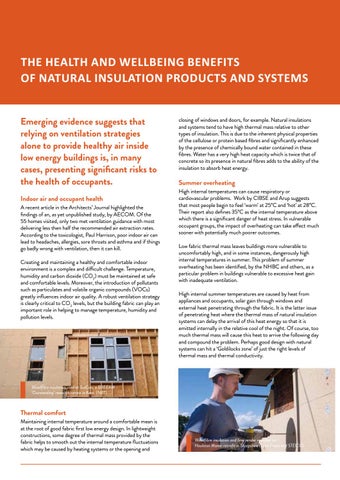
Woodfibre insulation used at SusCon, a BREEAM ‘Outstanding’ research centre in Kent. (NBT)
Thermal comfort
Maintaining internal temperature around a comfortable mean is at the root of good fabric first low energy design. In lightweight constructions, some degree of thermal mass provided by the fabric helps to smooth out the internal temperature fluctuations which may be caused by heating systems or the opening and
Woodfibre insulation and lime render installed on Houlston Manor retrofit in Shropshire (Lime Green and STEICO)