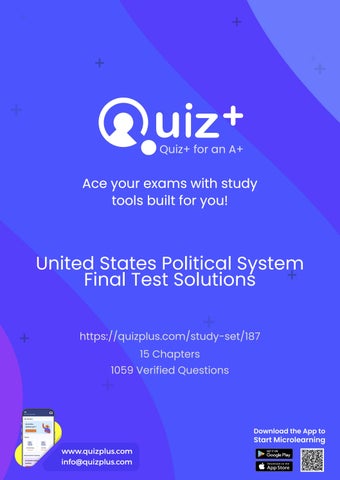
This course offers a comprehensive overview of the United States political system, examining its foundational structures, principles, and processes. Students will explore the Constitution, the roles and functions of the three branches of government, federalism, the electoral system, political parties, and interest groups. The course also analyzes the development and operation of American democracy, policy-making, civil liberties, and the influence of public opinion and media. Through case studies and current events, students will deepen their understanding of how the U.S. political system shapes and responds to societal challenges.
Recommended Textbook
American Government and Politics Today The Essentials 17th Edition by Barbara A. Bardes
Available Study Resources on Quizplus
15 Chapters
1059 Verified Questions
1059 Flashcards
Source URL: https://quizplus.com/study-set/187 Page 2
Available Study Resources on Quizplus for this Chatper
70 Verified Questions
70 Flashcards
Source URL: https://quizplus.com/quiz/2660
Sample Questions
Q1) Government strives to protect members of society from A) violence.
B) criminal activity.
C) instability.
D) insecurity.
E) All of the above are true.
Answer: E
Q2) The concept of universal suffrage refers to
A) the right of all adults to vote for a representative in government.
B) the right of all citizens to run for office.
C) the right of universal healthcare for all.
D) the belief that all persons deserve a fair trial.
E) a system of relationships between the states.
Answer: A
To view all questions and flashcards with answers, click on the resource link above. Page 3
Available Study Resources on Quizplus for this Chatper
70 Verified Questions
70 Flashcards
Source URL: https://quizplus.com/quiz/2661
Sample Questions
Q1) The Jamestown colony was established as
A) a trading post.
B) a military fort.
C) a settlement in Maryland.
D) the first French settlement in the New World.
E) a settlement for religious Separatists.
Answer: A
Q2) A constitutional amendment can be proposed by
A) a national convention called by Congress at the request of two-thirds of the state legislatures.
B) a two-thirds vote in each chamber of Congress.
C) the legislatures in two-thirds the states.
D) a majority vote in both chambers of Congress provided the amendment is not vetoed by the president.
E) Options A and B are true.
Answer: E
To view all questions and flashcards with answers, click on the resource link above. Page 4
Available Study Resources on Quizplus for this Chatper
69 Verified Questions
69 Flashcards
Source URL: https://quizplus.com/quiz/2662
Sample Questions
Q1) Which government system is used most in the world today?
A) Unitary system
B) Confederate system
C) Federal system
D) Bicameral system
E) None of the above is true.
Answer: A
Q2) Which two sets of powers do state governments have?
A) Enumerated and expressed powers
B) Reserved and concurrent powers
C) Direct and inherent powers
D) Expressed and implied
E) None of the above is true.
Answer: B
To view all questions and flashcards with answers, click on the resource link above.
Page 5
Available Study Resources on Quizplus for this Chatper
70 Verified Questions
70 Flashcards
Source URL: https://quizplus.com/quiz/2663
Sample Questions
Q1) If the police appear at your door and ask to enter
A) ask to see a warrant before the police enter.
B) read the warrant for the details of the search and observe the police activities, once inside without hindering the search.
C) ask that the police to wait until your lawyer arrives.
D) suggest that the police search your roommate's room.
E) Options A and B are true.
Q2) The Supreme Court rulings on freedom of speech
A) forbid municipalities from banning Nazi marches.
B) allow municipalities to ban sound trucks in the late evening hours.
C) forbid anti-loitering ordinances to cut down on gang activity.
D) allow municipalities to require parade permits for crowd control.
E) All of the above are true.
Q3) The free exercise clause, protecting freedom of religious practice is found in the A) Fifth Amendment.
B) First Amendment.
C) establishment clause.
D) Second Amendment.
E) religious amendment.
To view all questions and flashcards with answers, click on the resource link above.
Page 6
Available Study Resources on Quizplus for this Chatper
73 Verified Questions
73 Flashcards
Source URL: https://quizplus.com/quiz/2664
Sample Questions
Q1) The Equal Pay Act of 1963
A) requires employers to provide equal pay for substantially equal work.
B) requires employers to re-grade the pay scales for the comparable but different jobs held by women and men to make them more equitable.
C) requires that employers promote more women into managerial positions.
D) allows for men to be paid more than women with the same job responsibilities if they have families.
E) All of the above are true.
Q2) Contrast the approaches of Martin Luther King, Jr. and Malcolm X.
Q3) Today, there are approximately __________ unauthorized immigrants living in the United States.
A) 11 million
B) 111 million
C) 200 million
D) 1 million
E) 35 million
Q4) Explain the Supreme Court's decision in Brown v. Board of Education and the impact it had on education and the new problems it created.
Q5) Explain the arguments both for and against affirmative action.
To view all questions and flashcards with answers, click on the resource link above. Page 7
Available Study Resources on Quizplus for this Chatper
70 Verified Questions
70 Flashcards
Source URL: https://quizplus.com/quiz/2665
Sample Questions
Q1) Spending on public schools
A) has risen several times to an average of $12,500 per students.
B) is favored by a majority of those surveyed.
C) has a been a point of contention between Republicans and Democrats.
D) has dipped recently due to budget issues.
E) All of the above are true.
Q2) In recent years,
A) businesspersons have moved toward supporting the Democrats.
B) professionals with advanced degrees have moved toward supporting the Democrats.
C) businesspersons have remained largely Democratic.
D) professionals with advanced degrees have remained largely Republican.
E) it has become clear that there is no relationship between whether a person is a businessperson or a professional and the party they will endorse.
Q3) All of the following are true of public opinion \(\bold{except}\)
A) it plays a small role in our political system.
B) it can be expressed by letters written to newspapers.
C) it is shared in online forums.
D) it can be powerful.
E) it can be shaped by political leaders.
To view all questions and flashcards with answers, click on the resource link above.
Page 8
Available Study Resources on Quizplus for this Chatper
71 Verified Questions
71 Flashcards
Source URL: https://quizplus.com/quiz/2666
Q1) Political endorsements by interest groups are
A) important because the group can publicize its choices in its membership publication.
B) not very important because while candidates can publicize the fact that their campaign is endorsed by groups, they cannot identify the specific source of the endorsement.
C) relatively ineffective today.
D) a violation of campaign finance reform laws.
E) allowed only in local elections, but forbidden in races for federal office.
Q2) A public-policy interest that is not recognized or represented by a group is a
A) free rider.
B) common interest.
C) public benefit.
D) rational incentive.
E) latent interest.
Q3) What would be the unintended consequences if lobbying was abolished?
Q4) Explain the indirect techniques used by interest groups.
Q5) Describe legislative efforts to regulate the activities of lobbyists.
Q6) What are the differences between a social movement and an interest group? How are they related?
Page 9
To view all questions and flashcards with answers, click on the resource link above.
Available Study Resources on Quizplus for this Chatper
72 Verified Questions
72 Flashcards
Source URL: https://quizplus.com/quiz/2667
Sample Questions
Q1) All of the following are true of the elections of 2000 and 2004 \(\bold{except}\)
A) Al Gore won the popular vote for president in 2000.
B) George W. Bush became president in 2004.
C) commentators began to use the terms "red states" for those that had voted Democratic and "blue states" for those that voted Republican.
D) only three states changed their votes for president in 2004 from the 2000 election.
E) the Republican and Democratic Parties were very close in the number of votes each got.
Q2) Examples of party polarization include all of the following \(\bold{except}\)
A) party-line voting.
B) the end of overlapping party ideologies.
C) the rise of extreme ideology in the Republican Party.
D) the rise of liberal Republicans.
E) All of the above are true.
Q3) Contrast the two major parties in the United States today.
Q4) Explain the differences between the party-in-the-electorate, the party organization, and the party-in-government.
To view all questions and flashcards with answers, click on the resource link above. Page 10
Available Study Resources on Quizplus for this Chatper
70 Verified Questions
70 Flashcards
Source URL: https://quizplus.com/quiz/2668
Sample Questions
Q1) Which people are least likely to vote? How does this affect government policies?
Q2) Explain how the electoral college works, the situations in which it has produced controversial results, and the criticisms leveled against it.
Q3) Campaign blogs and podcasts
A) have improved candidates' ability to deliver their message to voters without media filter.
B) have made it more difficult for candidates to control their campaigns.
C) are not followed by mainstream news media.
D) are sometimes created for the candidate by professional strategists.
E) Options A and D are true.
Q4) In presidential elections,
A) voters elect the president directly.
B) the number of electors equals each state's number of senators (two) plus its number of representatives.
C) electors have always voted for the candidate who won their state's vote.
D) Options A, B, and C are true.
E) None of the above is true.
Q5) What are the theories of media bias? Is there evidence to support the claims of media bias?
To view all questions and flashcards with answers, click on the resource link above. Page 11
Available Study Resources on Quizplus for this Chatper
70 Verified Questions
70 Flashcards
Source URL: https://quizplus.com/quiz/2669
Q1) Explain the roles played by the members of the House and Senate leadership.
Q2) One of the most powerful agencies in Washington, the __________ assists in the preparation of the federal budget and monitors federal agencies throughout the year.
A) Council of Economic Advisers
B) Office of Management and Budget
C) Department of Budget and Commerce
D) House Ways and Means Committee
E) Senate Budget Committee
Q3) A temporary legislative committee established for a limited time period and for a special purpose is a
A) joint committee.
B) conference committee.
C) standing committee.
D) select committee.
E) rules committee.
Q4) Explain the difference between reapportionment and redistricting.
Q5) Compare the House of Representatives and the Senate by discussing four ways in which they are different.
Q6) Explain how a bill becomes a law.
To view all questions and flashcards with answers, click on the resource link above. Page 12
Available Study Resources on Quizplus for this Chatper
71 Verified Questions
71 Flashcards
Source URL: https://quizplus.com/quiz/2670
Sample Questions
Q1) The granting of release from punishment for a crime is called a(n)
A) reprieve.
B) congressional sanction.
C) pardon.
D) executive privilege.
E) impeachment.
Q2) Which of the following is an example of the president acting as head of state?
A) Sending new legislation on healthcare to Congress for consideration
B) Appointing a new person to be Secretary of State
C) Hosting the Queen of Great Britain and Northern Ireland at a special dinner in her honor
D) Sending troops and a hospital ship into an international disaster zone
E) Receiving a new ambassador from Russia
Q3) In the history of the United States, no president has ever
A) been impeached and acquitted.
B) died while in office.
C) been impeached and convicted.
D) resigned.
E) been impeached.
Q4) Analyze the president's functions as party chief and superpolitician.
Page 13
To view all questions and flashcards with answers, click on the resource link above.
Available Study Resources on Quizplus for this Chatper
70 Verified Questions
70 Flashcards
Source URL: https://quizplus.com/quiz/2671
Sample Questions
Q1) Amtrak, the U.S. Postal Service, and the FDIC are examples of A) cabinet departments.
B) independent executive agencies.
C) independent regulatory agencies.
D) government corporations
E) private corporations.
Q2) Describe the difference between whistleblowers and leaks. Provide examples of each.
Q3) Controversies that have led some to question whether Army rules have added to military fatalities include
A) the requirement that all Army medevac helicopters be accompanied by a gunship.
B) an incident when the Army supplied inappropriate ammunition for M-16 rifles that caused them to jam.
C) a failure to provide armor to military vehicles at the beginning of the Iraq War.
D) failure of the Army to equip medevac helicopters with the proper medical equipment.
E) Options A, B, and C are true.
Q4) Describe the different models of bureaucracy.
To view all questions and flashcards with answers, click on the resource link above.
14
Available Study Resources on Quizplus for this Chatper
71 Verified Questions
71 Flashcards
Source URL: https://quizplus.com/quiz/2672
Sample Questions
Q1) Jurisdiction refers to
A) rules and principles announced in court decisions.
B) the authority of a court to hear and decide a particular class of cases.
C) the constitutionality of a law.
D) statutory law.
E) the common law.
Q2) If a case is affirmed, it
A) means all justices unanimously agree on an opinion.
B) is sent back to the court that heard the case.
C) means the decision is valid and must stand.
D) will result in a new trial for the defendant.
E) is accepted as a case that the Supreme Court will hear.
Q3) A lawsuit seeking damages for "all persons similarly situated" is called
A) a class-action suit.
B) an amicus curiae suit.
C) a writ of certiorari.
D) a civil suit.
E) a procedural motion.
Q4) Describe the changes to the federal court system in an effort to fight terrorism
Q5) How do recent Supreme Court decisions show how the Court has moved rightward?
Page 15
To view all questions and flashcards with answers, click on the resource link above.
Available Study Resources on Quizplus for this Chatper
71 Verified Questions
71 Flashcards
Source URL: https://quizplus.com/quiz/2673
Sample Questions
Q1) Assess the advantages and disadvantages of a nation having a substantial immigrant population.
Q2) Explain the difference between "loose" and "tight" monetary policy and when they would be appropriate policy options.
Q3) Tight monetary policy theory dictates that when the economy is faced with inflation, the government should
A) increase the supply of credit.
B) increase taxes.
C) decrease the supply of credit.
D) decrease taxes.
E) take complete control of the economy.
Q4) Explain the impact of Keynesian economics on fiscal policy in the United States.
Q5) Discuss the Arizona Immigration Legislation. Why was it passed? What measures were struck down by the Supreme Court and why?
Q6) Explain the stages of the policymaking process.
Q7) Explain the problem of long-term unemployment and the affect on government spending.
Q8) Examine the federal budget deficit, why it occurred and what measures should be taken to bring it down.
To view all questions and flashcards with answers, click on the resource link above. Page 16
Available Study Resources on Quizplus for this Chatper
71 Verified Questions
71 Flashcards
Source URL: https://quizplus.com/quiz/2674
Sample Questions
Q1) U.S. foreign policy may be carried out through A) diplomacy.
B) economic aid.
C) technical assistance.
D) military intervention.
E) All of the above are true.
Q2) The power of the purse means that
A) the president controls the budget appropriations process.
B) the Congress retains the Constitutional power on spending authority.
C) The military branch heads determine the budget allocations for defense spending depending on the cost of weapons systems.
D) the president has the power to raise taxes in time of war.
E) All of the above are true.
Q3) Describe the difference between moral idealism and political realism and provide examples of each from the history of American foreign policy.
Q4) Explain the constitutional clash of powers between the president and Congress in the area of foreign policymaking.
Q5) In what ways has the United States offered humanitarian assistance in different parts of the world?
To view all questions and flashcards with answers, click on the resource link above. Page 17