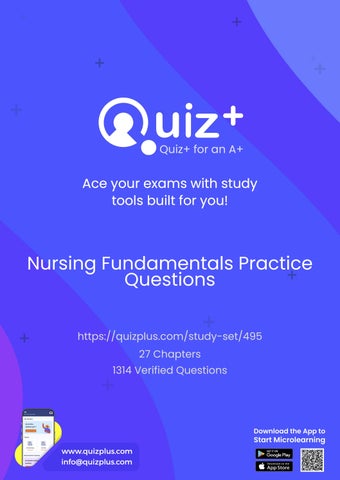
Nursing Fundamentals introduces students to the essential principles and skills required for a successful nursing practice. The course covers foundational concepts such as the nursing process, patient safety, infection control, communication techniques, vital signs monitoring, and basic patient care procedures. Students learn about professionalism, ethics, and legal responsibilities in nursing, as well as the importance of cultural competence and holistic care. Practical laboratory sessions and clinical experiences provide hands-on opportunities to apply theoretical knowledge, helping students develop critical thinking and essential psychomotor skills necessary for providing comprehensive and compassionate patient care.
Recommended Textbook
The Human Body in Health and Illness 3rd Edition by Barbara L. Herlihy
Available Study Resources on Quizplus
27 Chapters
1314 Verified Questions
1314 Flashcards
Source URL: https://quizplus.com/study-set/495 Page 2
Available Study Resources on Quizplus for this Chatper
32 Verified Questions
32 Flashcards
Source URL: https://quizplus.com/quiz/9136
Sample Questions
Q1) Which region is included within the left lower quadrant (LLQ)?
A) umbilical
B) left hypochondriac
C) epigastric
D) left iliac
Answer: D
Q2) The thoracic cavity is ___________ to the abdominopelvic cavity.
A) deep
B) distal
C) anterior
D) superior
Answer: D
Q3) Which of the following refers to the lower back region?
A) groin
B) axillary
C) umbilical
D) lumbar
Answer: D
To view all questions and flashcards with answers, click on the resource link above. Page 3
Available Study Resources on Quizplus for this Chatper
40 Verified Questions
40 Flashcards
Source URL: https://quizplus.com/quiz/9137
Sample Questions
Q1) A solution that has a pH of 6.8
A) has a neutral pH.
B) is alkaline.
C) is basic.
D) is acidic.
Answer: D
Q2) Which of the following acts as a catalyst?
A) an acid
B) an enzyme
C) a buffer
D) ATP
Answer: B
Q3) Which of the following illustrates antacid activity?
A) NaCl --> Na + Cl
B) HCl --> H + Cl
C) Mg(OH) + HCl --> MgCl + H O
D) KCl ---> K + Cl
Answer: C
To view all questions and flashcards with answers, click on the resource link above.
4
Available Study Resources on Quizplus for this Chatper
36 Verified Questions
36 Flashcards
Source URL: https://quizplus.com/quiz/9138
Sample Questions
Q1) G1,G2,the S phase,and the M phase are phases of A) the cell cycle.
B) mitosis.
C) protein synthesis.
D) the cell cycle that are specific to cancer cells.
Answer: A
Q2) Lysosomes are filled with
A) powerful enzymes that destroy cellular debris and pathogens. B) cilia.
C) DNA.
D) blood.
Answer: A
Q3) Which of the following best describes normal saline?
A) radioactive
B) hemolytic to red blood cells
C) isotonic
D) crenating to red blood cells
Answer: C
To view all questions and flashcards with answers, click on the resource link above. Page 5
Available Study Resources on Quizplus for this Chatper
35 Verified Questions
35 Flashcards
Source URL: https://quizplus.com/quiz/9139
Sample Questions
Q1) DNA
A) is double-stranded and stores the genetic code.
B) contains ribose as its sugar.
C) is located within the cytoplasm.
D) contains the following bases:cytosine,guanine,adenine,and uracil.
Q2) Which of the following is a double-stranded nucleic acid that is called the "blueprint for life"?
A) urea
B) DNA
C) gene
D) RNA
Q3) Which of the following terms is most descriptive of ribose and deoxyribose?
A) steroids
B) lipids
C) sugars
D) disaccharides
To view all questions and flashcards with answers, click on the resource link above. Page 6
Available Study Resources on Quizplus for this Chatper
45 Verified Questions
45 Flashcards
Source URL: https://quizplus.com/quiz/9140
Sample Questions
Q1) This disease is caused by a sporozoan carried by a mosquito.
A) typhoid fever
B) tetanus
C) malaria
D) Rocky Mountain spotted fever
Q2) Tinea is most related to A) ringworm.
B) tetanus.
C) systemic infection.
D) treatment with anthelmintics.
Q3) Amebic dysentery and giardiasis are A) mycotic infections.
B) caused by salmonella.
C) worm infestations.
D) caused by protozoan parasites.
Q4) Rickettsiae and chlamydiae are classified as A) viruses.
B) bacteria.
C) arthropods.
D) bacilli.
To view all questions and flashcards with answers, click on the resource link above. Page 7
Available Study Resources on Quizplus for this Chatper
33 Verified Questions
33 Flashcards
Source URL: https://quizplus.com/quiz/9141
Sample Questions
Q1) Stratified means
A) flat and shiny.
B) layered.
C) striped.
D) hard.
Q2) Chondrocytes and osteocytes form
A) squamous epithelium.
B) transitional epithelium.
C) astrocytes and ependymal cells.
D) cartilage and bone.
Q3) This type of tissue is found in organs that need to stretch (i.e.,urinary bladder).
A) transitional epithelium
B) loose connective tissue
C) adipose tissue
D) simple squamous epithelium
To view all questions and flashcards with answers, click on the resource link above.
8
Available Study Resources on Quizplus for this Chatper
35 Verified Questions
35 Flashcards
Source URL: https://quizplus.com/quiz/9142
Sample Questions
Q1) Which type of gland secretes vernix caseosa in the fetus?
A) sudoriferous
B) apocrine
C) eccrine
D) sebaceous
Q2) Which of the following is associated with the conservation of heat?
A) The person appears flushed.
B) The person sweats.
C) Melanin is secreted.
D) Blood vessels constrict.
Q3) Which of the following has the poorest prognosis?
A) freckles
B) vitiligo
C) melanoma
D) albinism
Q4) Anticancer drugs often cause hair loss,a condition called
A) alopecia.
B) hirsutism.
C) vitiligo.
D) keratinization.
Page 9
To view all questions and flashcards with answers, click on the resource link above.
Available Study Resources on Quizplus for this Chatper
62 Verified Questions
62 Flashcards
Source URL: https://quizplus.com/quiz/9143
Sample Questions
Q1) At which joint do the scapula and upper arm bone meet?
A) humeroulnar
B) radiocarpal
C) glenohumeral
D) sternoclavicular
Q2) At which joint do the femur and coxal bone meet?
A) hip
B) knee
C) ankle
D) wrist
Q3) The acetabulum
A) receives the head of the femur.
B) is the crest part of the iliac crest.
C) is located anterior to the symphysis pubis.
D) is a depression in the scapula.
Q4) What is the type of projection that articulates with the glenoid cavity?
A) crest
B) trochanter
C) spine
D) head
Page 10
To view all questions and flashcards with answers, click on the resource link above.
Available Study Resources on Quizplus for this Chatper
51 Verified Questions
51 Flashcards
Source URL: https://quizplus.com/quiz/9144
Sample Questions
Q1) The orbicularis oris muscle
A) surrounds the mouth.
B) flexes the head.
C) is the smiling muscle.
D) closes the eye.
Q2) This group of muscles moves the arm at the shoulder.
A) quadriceps femoris group
B) hamstrings
C) rotator cuff muscles
D) muscles of mastication
Q3) This group of muscles is located on the posterior thigh.
A) rotator cuff muscles
B) quadriceps femoris
C) hamstrings
D) muscles of mastication
Q4) The gastrocnemius and the soleus are commonly called the A) swimmer's muscles.
B) toe dancer's muscles.
C) muscles of mastication.
D) trumpeter's muscles.
To view all questions and flashcards with answers, click on the resource link above. Page 11
Available Study Resources on Quizplus for this Chatper
55 Verified Questions
55 Flashcards
Source URL: https://quizplus.com/quiz/9145
Sample Questions
Q1) The primary somatosensory area and the primary motor area are separated by A) Broca's area.
B) the central sulcus.
C) the pia mater.
D) the longitudinal fissure.
Q2) What is the function of the ependymal cells (choroid plexus)?
A) synthesize neurotransmitters such as ACh
B) form cerebrospinal fluid
C) phagocytose debris
D) secrete myelin
Q3) This structure plays a key role in personality development and emotional and behavioral expression;carries out the "executive" functions.
A) cerebellum
B) frontal lobe
C) basal ganglia
D) medulla oblongata
To view all questions and flashcards with answers, click on the resource link above. Page 12
Available Study Resources on Quizplus for this Chatper
50 Verified Questions
50 Flashcards
Source URL: https://quizplus.com/quiz/9146
Sample Questions
Q1) In order to achieve spinal anesthesia,Novocain is injected into the A) lateral ventricle.
B) central canal.
C) subarachnoid space.
D) dorsal root ganglia.
Q2) The ___________ nerve (tract)carries sensory information toward the brain.
A) phrenic
B) pyramidal
C) corticospinal
D) spinothalamic
Q3) What nerve is damaged by an ototoxic drug?
A) cranial nerve II
B) cranial nerve III
C) cranial nerve VIII
D) cranial nerve X
Q4) The oculomotor,trochlear,and abducens are cranial nerves that
A) innervate the extrinsic eye muscles (move the eyeball).
B) innervate the levator palpebrae superioris (lift the eyelid).
C) interpret sensory information from the optic nerve.
D) innervate the muscles of mastication.
To view all questions and flashcards with answers, click on the resource link above. Page 13
Available Study Resources on Quizplus for this Chatper
29 Verified Questions
29 Flashcards
Source URL: https://quizplus.com/quiz/9147
Sample Questions
Q1) A patient has vagally induced bradycardia (slow heart rate).Which of the following will relieve the bradycardia?
A) muscarinic antagonist
B) beta1 adrenergic blocker
C) vagomimetic
D) alpha1 adrenergic agonist
Q2) Vagal discharge activates
A) muscarinic receptors.
B) alpha1 adrenergic receptors.
C) beta1 adrenergic receptors.
D) the paravertebral ganglia.
Q3) Muscarinic receptors are
A) activated by norepinephrine.
B) located on the effector organs of the sympathetic nervous system.
C) activated by catecholamines such as adrenalin and dopamine.
D) activated by ACh.
To view all questions and flashcards with answers, click on the resource link above.
14
Available Study Resources on Quizplus for this Chatper
66 Verified Questions
66 Flashcards
Source URL: https://quizplus.com/quiz/9148
Sample Questions
Q1) Cerumen collects here.
A) middle ear
B) inner ear
C) outer ear
D) eustachian tube
Q2) Which structure is affected by the contraction and relaxation of the ciliary muscles?
A) cornea
B) lens
C) macula lutea
D) optic chiasm
Q3) What is the condition caused by impaired drainage of aqueous humor through the canal of Schlemm that increases intraocular pressure?
A) cataracts
B) glaucoma
C) strabismus
D) conjunctivitis
To view all questions and flashcards with answers, click on the resource link above. Page 15
Available Study Resources on Quizplus for this Chatper
60 Verified Questions
60 Flashcards
Source URL: https://quizplus.com/quiz/9149
Sample Questions
Q1) TSH
A) stimulates the thyroid gland to secrete calcitonin.
B) is secreted by the neurohypophysis.
C) stimulates the hypothalamus to secrete TRH,thyrotropin-releasing hormone.
D) is secreted by the anterior pituitary gland.
Q2) What is the stimulus for the release of insulin?
A) low plasma levels of calcium
B) high plasma levels of potassium
C) high plasma levels of glucose
D) low blood volume
Q3) Catecholamines
A) include cortisol,aldosterone,and testosterone.
B) are secreted by the adrenal cortex.
C) lower plasma glucose.
D) include epinephrine (adrenalin)and norepinephrine.
Q4) Which of the following is a function of parathyroid hormone?
A) It causes the excretion of calcium in the urine.
B) It stimulates osteoblastic activity to form bone.
C) It stimulates the thyroid gland to secrete calcitonin.
D) It increases plasma levels of calcium.
Page 16
To view all questions and flashcards with answers, click on the resource link above.
Available Study Resources on Quizplus for this Chatper
70 Verified Questions
70 Flashcards
Source URL: https://quizplus.com/quiz/9150
Sample Questions
Q1) This anticoagulant is secreted by mast cells (basophils).
A) plasmin
B) EPO
C) vitamin K
D) heparin
Q2) What does the hematocrit measure?
A) phagocytic activity
B) blood-clotting activity
C) percentage of red blood cells in the blood
D) the amount of bilirubin in the blood
Q3) Plasma
A) gives blood its red color.
B) is the primary oxygen-carrying part of the blood.
C) is considered intracellular fluid.
D) is the fluid part of the blood.
Q4) Erythroblastosis fetalis is primarily a problem involving
A) myelosuppression.
B) lack of intrinsic factor.
C) inability of the kidneys to secrete erythropoietin.
D) agglutination and hemolysis.
17
To view all questions and flashcards with answers, click on the resource link above.
Available Study Resources on Quizplus for this Chatper
50 Verified Questions
50 Flashcards
Source URL: https://quizplus.com/quiz/9151
Sample Questions
Q1) The atrioventricular node (AV node)
A) is the pacemaker of the heart.
B) is located in the upper part of the right atrium.
C) has a rate that is normally faster than the SA node.
D) delays the electrical signal coming from the atria into the ventricles.
Q2) All of the following are electrical terms except
A) sarcomere.
B) depolarization.
C) action potential.
D) repolarization.
Q3) What are ventricles "doing" during atrial contraction?
A) pumping blood into the great vessels
B) closing their AV valves
C) relaxing
D) opening their semilunar valves
Q4) The Purkinje fibers
A) open valves.
B) pull on the cusps of the valves.
C) conduct electrical signals throughout the ventricles.
D) close valves.
To view all questions and flashcards with answers, click on the resource link above. Page 18
Available Study Resources on Quizplus for this Chatper
45 Verified Questions
45 Flashcards
Source URL: https://quizplus.com/quiz/9152
Sample Questions
Q1) Systole and diastole describe the function of the
A) pericardium.
B) SA node.
C) myocardium.
D) mediastinum.
Q2) This term refers to a heart rate of fewer than 60 beats/min.
A) bradycardia
B) heart block
C) fight-or-flight response
D) tachycardia
Q3) Which of the following is the most likely consequence of a very rapid heart rate?
A) decreased ventricular filling (with blood)
B) failure of the AV valves to open
C) failure of the SA node to fire
D) failure of the cardiac impulse to enter the His-Purkinje system
To view all questions and flashcards with answers, click on the resource link above.
19
Available Study Resources on Quizplus for this Chatper
50 Verified Questions
50 Flashcards
Source URL: https://quizplus.com/quiz/9153
Sample Questions
Q1) Which of the following is most likely to cause portal vein hypertension?
A) carotid artery occlusion
B) defective valves in the deep veins of the legs
C) cirrhosis of the liver
D) ruptured aortic aneurysm
Q2) Which of the following vessels carries unoxygenated blood from the liver to the inferior vena cava?
A) portal vein
B) celiac axis
C) hepatic artery
D) hepatic veins
Q3) If this fetal heart structure failed to close after birth,blood would shunt from the left atrium into the right atrium.
A) ductus arteriosus
B) ductus venosus
C) foramen ovale
D) circle of Willis
To view all questions and flashcards with answers, click on the resource link above. Page 20
Available Study Resources on Quizplus for this Chatper
39 Verified Questions
39 Flashcards
Source URL: https://quizplus.com/quiz/9154
Sample Questions
Q1) Which part of the brain participates in the baroreceptor reflex?
A) cerebrum
B) corpus callosum
C) cerebellum
D) medulla oblongata
Q2) Which of the following is most related to the systolic reading,diastolic reading,and Korotkoff sounds?
A) cardiac output
B) blood pressure
C) the electrical activity of the heart
D) coronary blood flow
Q3) Plasma oncotic pressure is due primarily to A) blood pressure.
B) plasma proteins,especially albumin.
C) lymph.
D) electrolytes such as sodium and chloride.
To view all questions and flashcards with answers, click on the resource link above. Page 21
Available Study Resources on Quizplus for this Chatper
20 Verified Questions
20 Flashcards
Source URL: https://quizplus.com/quiz/9155
Sample Questions
Q1) What is (are)the lymphoid structure(s)that are generally removed during mastectomy?
A) spleen
B) liver
C) axillary lymph nodes
D) adenoids
Q2) What is the term that refers to the removal of the palatine tonsils?
A) appendectomy
B) lymph node resection
C) adenoidectomy
D) tonsillectomy
Q3) Which of the following is due to a viral infection involving the lymph nodes and is called the "kissing disease"?
A) Hodgkin's disease
B) elephantiasis
C) infectious mononucleosis
D) anaphylaxis
To view all questions and flashcards with answers, click on the resource link above. Page 22
Available Study Resources on Quizplus for this Chatper
37 Verified Questions
37 Flashcards
Source URL: https://quizplus.com/quiz/9156
Sample Questions
Q1) Which of the following are most associated with plasma cells and antibodies?
A) neutrophils
B) eosinophils
C) B cells
D) T cells
Q2) Which of the following is the treatment of choice for an anaphylactic reaction?
A) a bronchoconstricting agent
B) gamma globulin
C) epinephrine
D) histamine
Q3) Which of the following is (are)most related to antibody-mediated immunity?
A) tears
B) saliva
C) sneezing
D) plasma cells
Q4) What is the name of a severe hypersensitivity reaction?
A) cyanosis
B) immunocompetence
C) autoimmunity
D) anaphylaxis
To view all questions and flashcards with answers, click on the resource link above. Page 23
Available Study Resources on Quizplus for this Chatper
65 Verified Questions
65 Flashcards
Source URL: https://quizplus.com/quiz/9157
Sample Questions
Q1) Frontal,maxillary,sphenoidal,and ethmoidal
A) refer to the bones of the thorax.
B) are saliva-secreting glands.
C) are paranasal sinuses.
D) are lined with serous membrane.
Q2) Which substance greatly reduces the attractive forces among the water molecules lining the alveoli?
A) lysozyme
B) converting enzyme
C) mucus
D) surfactant
Q3) Surfactants are found within the
A) pulmonary capillaries.
B) trachea.
C) alveoli.
D) intrapleural space.
To view all questions and flashcards with answers, click on the resource link above. Page 24
Available Study Resources on Quizplus for this Chatper
82 Verified Questions
82 Flashcards
Source URL: https://quizplus.com/quiz/9158
Sample Questions
Q1) The elimination of gas that is produced during digestion and released from the anus is called
A) flatulence.
B) eructation.
C) deglutition.
D) mastication.
Q2) The common bile duct empties its contents into the A) stomach.
B) base of the esophagus.
C) duodenum.
D) cecum.
Q3) The wall of this structure secretes the disaccharidases.
A) gallbladder
B) duodenum
C) pancreas
D) stomach
To view all questions and flashcards with answers, click on the resource link above. Page 25
Available Study Resources on Quizplus for this Chatper
64 Verified Questions
64 Flashcards
Source URL: https://quizplus.com/quiz/9159
Sample Questions
Q1) The detrusor muscle is located in the A) urethra.
B) renal pelvis.
C) urinary bladder.
D) glomeruli.
Q2) The calyces receive urine from the A) proximal convoluted tubule.
B) collecting ducts.
C) glomeruli.
D) peritubular capillaries.
Q3) What is the urine-making structure of the kidney?
A) trigone
B) renal pyramid
C) renal capsule
D) nephron unit
Q4) Creatinine is
A) completely reabsorbed by the peritubular capillaries.
B) a waste product that is filtered and not reabsorbed.
C) a renal enzyme that activates angiotensinogen.
D) a renal hormone that stimulates red blood cell production by the bone marrow.
To view all questions and flashcards with answers, click on the resource link above. Page 26
Available Study Resources on Quizplus for this Chatper
42 Verified Questions
42 Flashcards
Source URL: https://quizplus.com/quiz/9160
Sample Questions
Q1) Which of the following is characteristic of acidosis?
A) pH of 7.55
B) a decrease in the concentration of hydrogen ion in the blood
C) urinary excretion of bicarbonate
D) pH less than 7.35
Q2) Respiratory rate is most sensitive to the effects of this ion.
A) Na
B) K
C) H
D) Cl-
Q3) Most diuretics increase urine production by blocking the effects of this cation.
A) calcium
B) bicarbonate
C) chloride
D) sodium
Q4) Which of the following can be defined as an H donor?
A) ion
B) tincture
C) acid
D) bicarbonate
To view all questions and flashcards with answers, click on the resource link above. Page 27
Available Study Resources on Quizplus for this Chatper
76 Verified Questions
76 Flashcards
Source URL: https://quizplus.com/quiz/9161
Sample Questions
Q1) The acrosome
A) secretes testosterone.
B) is the tail of the sperm.
C) contains enzymes that assist the sperm to fertilize an ovum.
D) is an ovarian structure.
Q2) The graafian follicle
A) matures within the fallopian tube.
B) is the mature follicle.
C) secretes gonadotropins.
D) causes the midcycle surge of LH.
Q3) Implantation of the embryo occurs within this organ.
A) ovaries
B) fallopian tubes
C) oviducts
D) uterus
Q4) The corpus luteum
A) is located within the uterus.
B) is a placental structure.
C) secretes gonadotropins.
D) secretes large amounts of progesterone.
To view all questions and flashcards with answers, click on the resource link above. Page 28
Available Study Resources on Quizplus for this Chatper
45 Verified Questions
45 Flashcards
Source URL: https://quizplus.com/quiz/9162
Sample Questions
Q1) Which of the following is most associated with organogenesis?
A) embryonic period
B) implantation
C) third trimester
D) neonatal period
Q2) What is in the "pill" that makes it contraceptive?
A) estrogen and progesterone
B) prostaglandins
C) human chorionic gonadotropin
D) prolactin
Q3) This word refers to milk production by the mammary glands.
A) implantation
B) parturition
C) lactation
D) quickening
Q4) What is the hormonal basis of the pregnancy test?
A) estrogen
B) prostaglandin
C) oxytocin
D) human chorionic gonadotropin (hCG)
To view all questions and flashcards with answers, click on the resource link above. Page 29