The Record is a formal account of the year at Queens’ College. The 2024–2025 edition is now available on the College website. In light of the current economic climate and in keeping with our commitment to reducing environmental impact, we will not be printing additional physical copies this year. We encourage alumni to read The Record online.
Visitor: The Rt Hon. Beverley McLachlin, P.C., Chief Justice of Canada
President
Mohamed El-Erian, M.A., D.Phil. (Oxon), D.Univ. h.c. (American Univ. of Cairo), D.Sc. h.c. (RCSI Univ. of Medicine & Health Sciences, Dublin).
The Rt. Hon. Sir Stephen Brown, G.B.E., P.C., M.A., LL.D.h.c. (Birmingham, Leicester & West of England), Hon.F.R.C.Psych.
Sir David Walker, M.A., LL.D. h.c. (Exeter), F.R.S.A.
Bernardo Sepúlveda Amor, Hon.G.C.M.G., LL.B., LL.D.h.c. (San Diego & Leningrad).
Nicholas Wills, M.A., F.C.A., F.C.I.M., F.C.T., F.R.S.A.
The Rt Hon. Lord Oxburgh, of Liverpool, K.B.E., M.A., Ph.D. (Princeton), D.Sc.h.c. (F.G.S.), Hon.F.I.Mech.E., Hon.F.R.Eng., F.R.S.
Sir Martin Harris, C.B.E., D.L., M.A., Ph.D. (London), LL.D.h.c. (Queen’s, Belfast), D.U.h.c. (Essex & Keele), D.Litt.h.c. Hon.F.R.C.P, Hon.F.R.C.S.E.
Michael Foale, C.B.E., M.A., Ph.D., D.Univ.h.c. (Kent, Lincolnshire & Humberside), Hon.F.R.Ae.S.
The Rt Hon. Lord Falconer of Thoroton, P.C., K.C., M.A.
Sir Richard Dearlove, K.C.M.G., O.B.E., M.A., LL.D. h.c. (Exeter).
Graham Swift, M.A., Litt D.h.c. (East Anglia & London), D.Univ.h.c. (York), F.R.S.L.
Sir Stephen Fry, M.A., D.Litt. h.c. (East Anglia), D.Univ.h.c. (Anglia Ruskin Univ. & Sussex).
Awn Shawkat Al-Khasawneh, M.A., LL.M.
Paul Greengrass, C.B.E., M.A.
Michael Gibson, M.B.E., M.A.
Mohamed El-Erian, M.A., D.Phil. (Oxon), D.Univ. h.c. (American Univ. of Cairo), D.Sc. h.c. (RCSI Univ. of Medicine & Health Sciences, Dublin).
Sir Robert Chote, M.A., Andrew Bailey, M.A., Ph.D., F.S.A.
Naomi Segal, M.A., Ph.D. (London)
Amma Kyei-Mensah, M.A., M.B., B.S. (London), M.R.C.P., F.R.C.O.G.
Phillippa Wells, M.A., Ph.D.
Emily Maitlis, M.A. D.Univ. h.c. (Sheffield Hallam).
Dame Alison Peacock, D.B.E., B.A. (London), P.G.C.E. (Warwick), M.Ed., D.Litt. h.c. (Brighton), D.L.
Sir Demis Hassabis, C.B.E., M.A., Ph.D. (London), F.R.S.A., F.R.Eng., F.R.S.
The Rt Hon. Lord Eatwell, of Stratton St Margaret, M.A., Ph.D. (Harvard), Doc. Pol. Res. & Prac. h.c. (Bath).
Mairi Hurrell, R.G.N., S.C.M.
The Rt Hon. Sir David Latham, M.A., K.C., P.C.
Sir John Chisholm, M.A., F.R.Eng., C.Eng., F.I.E.E., F.R.Ae.S., F.Inst.P. D.Eng. h.c. (Bath, Southampton and Brunel).
Sir Robin Millar, M.A., C.B.E., F.A.P.R.S.
Joanna Scanlan, M.A.
Jane Osbourn, M.A., Ph.D. (John Innes Centre, Norwich), O.B.E., F.Med.Sci.
Thomas Holland, M.A., F.R.S.L.
Khalid Abdalla, M.A.
Grace Prendergast, M.A. (Massey), M.Phil., M.N.Z.M.
Professor James Maynard, M.A., M.Math., D.Phil. (Oxon.). F.R.S.
Dambisa Moyo, Baroness Moyo, of Knightsbridge in the City of Westminster, B.S., M.B.A., (American Univ. in Washington), M.P.A. (Harvard). D.Phil. (Oxon.).
Professor Kelly Chibale B.Sc. (Zambia), Ph.D., F.A.A.S., F.R.S.S.Af., F.R.S.C.
The Rt Hon. Sir Guy Newey, M.A., LL.M., K.C., P.C.
Professor Stephen Oakley, M.A., Ph.D., F.B.A.
Bryony Worthington, The Baroness Worthington, M.A.
Catherine Thomas, M.A.
Shirley Day, Ph.D.
Mohamed El-Erian, M.A. D.Phil (Oxon)
Jamie Walters El-Erian
Robert Cripps, Order of Australia
Sir Demis Hassabis, C.B.E., M.A., Ph.D. (London), F.R.S.A., F.R.Eng., F.R.S.
Nicholas Blain, M.A., F.C.A., F.C.S.I., C.F.A.
Chris Rokos, M.A. (Oxon.)
John Reece, M.A.
Eugene Shvidler, B.Sc. (Gubkin Inst., Moscow), M.B.A. (Fordham)
Amir Bin Daim, M.A.
Amin Bin Daim, B.A.(Hons), Dunelm; MPhil (Cantab)
Naimah Khalid
Trevor Bradley, M.A. Anonymous (1987)
Anthony Spearing, M.A., Litt.D., Ph.D. h.c. (Lund). Life Fellow; Emeritus William R. Kenan Professor of English, University of Virginia.
Brian Callingham, M.A., B.Pharm., Ph.D. (London), F.R.Pharm.S., F.R.S.B., F.Br.Pharmacol.S. h.c Life Fellow; formerly Tutor and Fellow Librarian.
James Diggle, C.B.E., M.A., Litt.D., F.B.A. Life Fellow; formerly Praelector. Emeritus Professor of Greek and Latin.
John Carroll, M.A., Sc.D., F.R.Eng. Life Fellow. Emeritus Professor of Engineering. John Green, M.A., Ph.D. Life Fellow; formerly Senior Tutor.
Andrew Phillips, M.A., Ph.D. Life Fellow; formerly Tutor.
Robin Walker, M.A., Ph.D. Life Fellow; formerly Junior Bursar and Estates Bursar.
Andrew Cosh, B.A., Ph.D. Life Fellow; formerly Senior Bursar.
Richard Weber, M.A., Ph.D. Life Fellow, Emeritus Churchill Professor of Mathematics for Operational Research; formerly Tutor and Vice-President.
Allan Hayhurst, M.A., Sc.D. Life Fellow, Emeritus Professor of Combustion Science.
James Jackson, C.B.E., M.A., Ph.D., F.R.S. Life Fellow; Emeritus Professor of Active Tectonics. Christopher Pountain, M.A., Ph.D., Hon.F.C.I.L. Life Fellow; formerly Tutor. Emeritus Professor of Spanish Linguistics, Queen Mary College, London.
Richard Fentiman, M.A., B.C.L. (Oxon), Doctor h.c. (Athens), LL.D. h.c. (Cyprus), K.C. h.c. Life Fellow, Emeritus Professor of Private International Law.
The Rt Hon. Lord Oxburgh, of Liverpool, K.B.E, M.A., Ph.D.(Princeton), D.Sc. h.c. (Paris, Leicester, Loughborough, Edinburgh, Birmingham, Liverpool, Southampton, Liverpool John Moores, Lingnan Hong Kong, Newcastle, Leeds and Wyoming), F.G.S., Hon.F.I.Mech.E., Hon.F.R.Eng., F.R.S. Life Fellow; formerly President.
The Revd Jonathan Holmes, M.A., Vet.M.B., Ph.D., M.R.C.V.S. Life Fellow; Keeper of the Records; formerly Dean of Chapel.
Peter Haynes, M.A., Ph.D., F.R.S. Professor of Applied Mathematics. Assistant Director of Studies in Mathematics (Part II).
David Cebon, B.E. (Melbourne), Ph.D., F.R.Eng., F.I.Mech.E. Professor of Mechanical Engineering.
Hugh Field, M.A., B.Sc. (London), Ph.D. (Bristol), Sc.D., F.R.C.Path. Life Fellow, formerly Tutor. Lisa Hall, C.B.E., B.Sc., Ph.D. (London), D.Sc. h.c. (Chichester). Life Fellow, Emerita Professor of Analytical Biotechnology; formerly Tutor and Vice-President.
Richard Prager, M.A., Ph.D., C.Eng., F.I.E.T., F.R.Eng. Professor of Engineering. Chief Scientific Adviser at the Ministry of Housing, Communities and Local Government.
Roderic Jones, M.A., D.Phil. (Oxon). Life Fellow, Emeritus Professor of Atmospheric Science; formerly Tutor and Vice-President.
Anthony Lasenby, M.A., M.Sc. (London), Ph.D. (Manchester). Life Fellow, Emeritus Professor of Astrophysics and Cosmology.
Keith Priestley, M.S. (Washington), Ph.D. (Nevada). Life Fellow, Emeritus Professor of Seismology.
Christos Pitelis, B.A. (Athens), M.A., Ph.D. (Warwick), F.A.I.B. Life Fellow. Professor of International Business and Sustainable Competitiveness, University of Leeds.
Eivind Kahrs, Mag.art., Dr.philos.(Oslo). Life Fellow, formerly Tutor.
Andrew Gee, M.A., Ph.D. Professor (11) of Engineering. Director of Studies in Engineering and Financial Tutor.
David Ward, M.A, Ph.D. Life Fellow. Emeritus Professor of Particle Physics.
Jacqueline Scott, B.A. (Sussex), M.A., Ph.D. (Michigan). Life Fellow; Emerita Professor of Empirical Sociology.
John Allison, B.A., LL.B. (Stellenbosch), LL.M., M.Phil., Ph.D. Professor (11) of Public Law and Comparative Historical Jurisprudence. Armitage Fellow in Law. Director of Studies in Law for LLM and MCL students.
Beverley Glover, B.Sc. (St Andrews), Ph.D. (East Anglia), F.L.S. Professor of Plant Systematics and Evolution; Director of the Botanic Garden. Niccoli Fellow.
The Rt Hon. Lord Eatwell, of Stratton St Margaret, M.A., Ph.D. (Harvard), Doc. Pol. Res. & Prac. (Bath), h.c. Life Fellow, formerly President, Emeritus Professor of Financial Policy.
Murray Milgate, M.Ec. (Sydney), M.A. (Essex), Ph.D. Life Fellow; formerly Senior Tutor.
Richard Rex, M.A., Ph.D., D.D. Professor of Reformation History. Polkinghorne Fellow in Theology, College Lecturer in History, Director of Studies in Theology and Religious Studies, Deputy Praelector.
Anthony Challinor, M.A., Ph.D. Bye-Fellow (Physics). Professor of Cosmology and Astrophysics. Assistant Director of Studies in Natural Sciences (Astrophysics).
Ian Patterson, M.A., Ph.D. Garden Steward. Life Fellow, formerly Tutor and Fellow Librarian.
Clare Bryant, M.A., B.Sc. (Southampton), B.Vet.Med., Ph.D. (London), F.A.S.M., M.R.C.V.S., F.L.S.W., F.Med.Sci. Professor of Innate Immunity. Tutor for Graduate Students.
Martin Crowley, B.A., D.Phil. (Oxon), M.A. (Nottingham). Professor (11) of Modern French Thought and Culture. Tutor. Anthony L Lyster Fellow in Modern and Medieval Languages and Director of Studies in Modern and Medieval Languages (Part 1A and Part II).
Craig Muldrew, M.A. (Alberta), Ph.D. Professor of Economic and Social History. College Lecturer in History.
James Campbell, M.A., Dip.Arch., Ph.D., R.I.B.A., I.H.B.C., F.S.A. Professor of Architecture and Construction History. Seear Fellow in Architecture and Art History, Director of Studies in Architecture and in Design; Keeper of Pictures, Praelector.
Howard Jones, M.A., Ph.D. Assistant Director of Studies in Natural Sciences (Chemistry). Tutor for Graduate Students.
Martin Dixon, B.A. (Oxon), M.A., Ph.D., F.Ac.S.S., K.C. h.c. Professor of the Law of Real Property. Stuart Bridge Fellow in Law.
David Menon, C.B.E., M.D., B.S. (Madras), Ph.D. (London), F.R.C.A., F.Med.Sci., F.R.C.P. Life Fellow; Emeritus Professor of Anaesthesia.
Andrew Thompson, M.A., M. Phil., Ph.D. Senior Tutor, College Senior Lecturer in History.
Julia Gog, O.B.E., M.A., Ph.D. Professor of Mathematical Biology. David N. Moore Fellow in Mathematics, Assistant Director of Studies in Mathematics (Part III).
Ashwin Seshia, B.Tech. (Indian Inst. of Technology, Bombay), M.S., Ph.D. (Berkeley, California), F.R.Eng. Professor of Microsystems Technology. College Lecturer in Engineering.
Eugene Terentjev, M.Sc. (Moscow State), Ph.D. (Moscow), M.A. Professor of Polymer Physics. John Baldwin Fellow in Physics.
Graham Treece, M.A., Ph.D. Professor (11) of Information Engineering. Bye-Fellow (Engineering).
Ioanna Sitaridou, Ptychion (Aristotle Univ. of Thessaloniki), Licenciatura (Lisbon), M.A. (London), Ph.D. (Manchester). Professor of Spanish and Historical Linguistics. Tutor for Graduate Students; Director of Studies in Linguistics and Assistant Director of Studies in Modern and Medieval Languages (Part IB).
Andrew Zurcher, B.A. (Yale), M.Phil., Ph.D. Bruce Cleave Fellow in English; Tutor and Director of Studies in English (Part IA and Part IB).
Ana Rossi, B.Sc. (Univ. Nac. del Sur, Argentina), Ph.D. Tutor and Assistant Director of Studies in Natural Sciences (Pharmacology).
Jonathan Spence, M.A. (Oxon), D.L. Senior Bursar.
Graham McShane, M.A., M.Eng., Ph.D. Notley Fellow in Engineering, Assistant Director of Studies in Engineering.
Marie Edmonds, M.A., Ph.D., F.R.S. Professor of Volcanology and Petrology. Vice-President. Ron Oxburgh Fellow and College Lecturer in Natural Sciences (Earth Sciences).
Howard Stone, M.A., Ph.D. Tata Steel Professor of Metallurgy.
Janet Maguire, B.Sc. (Bristol), Ph.D. (London), F.B.Pharmacol.S. John Eatwell Fellow; Director of Studies in Medicine and in Veterinary Medicine, assistant Director of Studies in Natural Sciences (Pharmacology).
Laurence Tiley, B.Sc. (Manchester), Ph.D. (Reading). Tutor for Graduate Students. College Lecturer in Medical and Veterinary Sciences (Pathology).
Tore Butlin, M.A., M.Eng., Ph.D. College Lecturer and Champion Fellow in Engineering.
Stephen Price, B.Sc., M.B., B.S. (London), Ph.D., F.R.C.S. Professor of Neurosurgical Oncology. College Lecturer in Neurobiology, Pick Fellow in Medicine. Director of Studies in Clinical Medicine.
Andrew Rice, B.A., Ph.D. Bye-Fellow. Professor of Computer Science.
Edwige Moyroud, B.Sc., M.Sc. (École Norm. Sup., Lyon), Ph.D. (Grenoble/Lyon). Assistant Director of Studies in Natural Sciences (Genetics, Plant Sciences and Systems Biology).
Anna Paterson, M.A., Ph.D., M.B., B.Chir., M.Sc. (UCL/RCP), F.H.E.A. Pang Kam Ping Fellow in Medical Science, College Lecturer in Physiology.
Margaret Tait, M.A. M.Phil., Ph.D. Director of Academic Development.
Federica Paddeu, Abogado (Univ. Cat. Andrés Bello, Caracas), LL.M. Deputy Senior Tutor. Derek Bowett Fellow in Law, Director of Studies in Law.
Rowan Kitt, B.A. (Dunelm), M.A. (Birkbeck, London), PGCE. Director of Development. The Revd Timothy Harling, B.Sci. (Southampton), M.A. Dean of Chapel and Head of Health and Wellbeing.
Sarah Haggarty, M.A., M.Phil., Ph.D. Director of Studies in English (Part II).
Christopher Bickerton, M.A., D.Phil. (Oxon), Dipl. d’Études Approfondies (Geneva). Professor (12) of Modern European Politics and Society. College Lecturer in International Relations, Director of Studies in Human, Social and Political Studies (Part II).
Mark Williamson, M.A., Ph.D., C.Eng., M.I.C.E. Bye-Fellow (Chemical Engineering).
Charles Brendon, B.A., M.Phil., D.Phil. (Oxon.). El-Erian Fellow in Economics; Director of Studies in Economics; Risk Officer.
Ramsey Faragher, M.A., M.Sci., Ph.D., C.Phys., M.R.I.N., M.O.I.N. Bye-Fellow (Computer Science). Director of Studies in Computer Science (Parts II and III).
David Parker, B.Sc. (Wales), Ph.D. Assistant Director of Studies in Natural Sciences (PDN).
Graham Denyer Willis, B.A. (Toronto), M.A. (Royal Roads), Ph.D. (M.I.T.). Professor (11) of Global Politics and Society. Tutor for Graduate Students. Chris Rokos Fellow in Geography.
Ella McPherson, B.A. (Princeton), M.Phil., Ph.D. Anthony L. Lyster Fellow in Sociology, Director of Studies in Human, Social and Political Studies (Part I).
Claude Warnick, M.A., M.Math., Ph.D. Professor (11) of Mathematical Physics. Anthony L. Lyster Fellow and Director of Studies in Mathematics (Parts IA and IB).
Alastair Beresford, M.A., Ph.D. Professor of Computer Security. Robin Walker Fellow in Computer Science.
Andrew Marsham, B.A., M.Phil., D.Phil. (Oxon.). Professor (11) of Classical Arabic Studies. College Lecturer in Arabic Studies and Director of Studies in Asian and Middle Eastern Studies.
Gareth Atkins, B.A. (Dunelm), M.Phil., Ph.D. Tutor and Director of Studies in History and in History and Modern Languages and in History and Politics.
Jamie Blundell, M.A., M.Sci., Ph.D. Ursula Zoellner Professor of Cancer Research. College Lecturer and Lyster Fellow in Biological Natural Sciences.
Tyler Denmead, B.A. (Brown), M.Phil., Ph.D. Dean of College; Director of Studies in Education.
Peter McMurray, A.B. (Harvard), M.F.A. (Brandeis), Ph.D. (Harvard). Aliki Vatikioti Fellow in Music.
Andrew Bainbridge, M.B.A. (Sheffield Hallam), Assoc.R.I.C.S., M.I.A.M., Tech.I.O.S.H., C.B.I.F.M. Domestic Bursar and Steward.
Timothy Eggington, B.A. (Wales), M.A. (Cardiff), M.A. (Manchester Metropolitan), Ph.D. (London). Fellow Librarian and Keeper of the Old Library; Director of Studies in Music.
Jane Garrison, M.A., Ph.D., Ph.D. (Warwick), M.Sc., P.G.C.E. (Hertfordshire). Director of Studies in Psychological and Behavioural Studies and Assistant Director of Studies in Natural Sciences (Psychology).
Alison Bonner, M.A. (Oxon.), M.A., M.Phil., Ph.D., F.S.A. Bye-Fellow, Director of Studies in Anglo-Saxon, Norse and Celtic.
Paul Bambrough, M.A., M.B., B.Chir., Ph.D., M.R.C.P. College Lecturer in Anatomy and Assistant Director of Studies in Medical Sciences (Preclinical).
Christopher Clark, M.A., M.Eng., Ph.D. College Lecturer in Engineering.
Cristina Peñasco, B.Sc. (Univ. of Castilla-La Mancha), M.Phil. (Pontifica Comillas Univ. Madrid), Ph.D. (Rey Juan Carlos Univ., Madrid). College Lecturer in Politics and in Economics.
Neil Lawrence, B.Eng. (Southampton), Ph.D. Deep Mind Professor of Machine Learning.
Lucia Reisch, Dipl. Oec. (Hohenheim), M.B.A. (UCLA), Dr. Oec. (Hohenheim). El-Erian Professor of Behavioural Economics and Policy. Deputy Dean of College.
Gillian Fraser, B.Sc. (Glasgow), Ph.D. Assistant Director of Studies in Natural Sciences (Pathology and Zoology).
Christopher Smith, B.Sc. (U.C.L.), M.B., Ch.B., Ph.D. Bye-Fellow (Virology).
Challenger Mishra, M.Sc. (Indian Inst. of Science Educ. and Rsch., Kolkata), D.Phil (Oxon). Bye-Fellow (Computer Science); Director of Studies in Computer Science (Part IA).
Jasmin Jahić, Engin. Diplom (Tuzla), M. Robot (École Centrale, Nantes), PhD (Tech. Univ., Kaiserslautern). Bye-Fellow (Computer Science); Director of Studies in Computer Science (Part IB).
Susan Haines, M.A., M.Sci., Ph.D. Admissions Tutor.
The Revd Anna Jones, B.A. (Oxon.), M.A. (UCL), M.Phil., B.Th. Tutor and Chaplain.
Elizabeth Weir, B.A. (Univ. of Southern California), Ph.D. Bye-Fellow (Psychology).
Nicholas Morris, M.A., A.R.C.O., AdvPgDip (Birmingham Conservatoire). Director of College Music and Bye-Fellow.
Mansur Boase, M.A., M.Math. Bye-Fellow (Mathematics).
Jeremiah Mitchell, B.Sc. (Univ. of Illinois at Urbana-Champaign), Ph.D. (Northern Illinois Univ.). Bye-Fellow (Physics). Director of Studies in Physical Natural Sciences (Part IB).
Dominic Orchard, M.Eng. (Warwick), Ph.D., PGCHE (Kent). Schmidt Climate Futures ByeFellow in Computer Science.
Christopher Edsall, B.Sc., M.Sc. (Canterbury, New Zealand). Schmidt Climate Futures ByeFellow in Computer Science.
Marla Fuchs, B.Sc. (Rensselaer Polytechnic Inst., New York), M.Phil. Schmidt Climate Futures Bye-Fellow in Computer Science.
Eamonn O’Keefe, M.A., D.Phil. (Oxon), M.Phil. Research Fellow (History of the British Army).
Hamish Symington, M.A., Ph.D. Research Fellow (Plant Sciences).
Katharine Hendry, M.A., M.Sci., D.Phil. (Oxon), PGCertUTL (Cardiff). Bye-Fellow (Environmental Geoscience).
Joe Perkins, M.A., M.Phil. (Oxon.), M.Phil. Bye-Fellow (Economics).
James Brenton, B.Sc., M.B., B.S., (UCH, London), Ph.D., F.R.C.P. Professor of Ovarian Cancer Medicine.
Mona Jebril, B.A. (Al-Azhar University of Gaza), M.Sc. (Oxon.), Ph.D. Bye-Fellow (Education).
Rajesh Bhagat, B.E. (Panjab Uni., Chandigarh), M.E. (Indian Institute of Science), Ph.D. Assistant Director of Studies in Mathematics (Part III).
Mairi Kilkenny, B.Sc., M.Sc. (Cape Town), Ph.D. Director of Studies in Biological Natural Sciences (Parts IA and IB and Biochemistry (Parts II and III).
Jennifer Cobbe, LL.B. (Hull), LL.M., Ph.D., F.R.S.A. (Queen’s, Belfast). Tutor and College Lecturer and Fentiman Fellow in Law.
Krisztina Ilko B.A., M.Litt. (Eötvös Loránd Uni., Budapest), M.Litt. (Central European University, Budapest), Ph.D. Research Fellow (History of Art). Director of Studies in History of Art.
Lorena Escudero Sànchez, B.Sc., M.Sc. (Salamanca), Ph.D. (Valencia). Bye-Fellow (Mathematics).
Devon Indar, M.Eng., Ph.D. (Manchester). Assistant Director of Studies in Chemical Engineering.
Oscar Branson, B.Sc. (Bristol), M.Sc. (Southampton), Ph.D. Assistant Director of Studies in Natural Sciences (Earth Sciences).
Lorren Eldridge, M.A., D.Phil. (Oxon), A.F.H.E.A. College Lecturer in Law.
Sebastian Graves, B.A., M.Sc. (L.S.E.), Ph.D. (New York University). Ajit Singh Fellow and College Lecturer in Economics.
Lovleen Bhullar, B.A., LL.B. (Natl Law School of India Univ., Bangalore), M.Sc. (L.S.E.), LL.M., Ph.D. (SOAS), P.G.C.H.E. Director of Studies in Land Economy.
Amy Bonsor, M.Phys. (Oxon), Ph.D. College Lecturer in Astrophysics. Director of Studies in Physics (Part IA).
Sepideh Razavi, B.S. (Arak Univ., Iran), M.S. (Sharif Univ. of Technology, Tehran), M.Eng., Ph.D. (City College of New York). Rokos-Menon Senior Visiting Research Fellow, ByeFellow (Chemical Engineering). Assistant Professor in Chemical, Biological and Materials Engineering, University of Oklahoma.
Jack Williams, M.A., M.Math., Ph.D. Bye-Fellow (Mathematics). Assistant Director of Studies in Mathematics (Part IB).
Tobias Müller, M.A. (Ludwig-Maximilians-University), M.Phil., Ph.D. Bye-Fellow (Human, Social, and Political Sciences).
David Isaacs, M.A., M.A., Ph.D. (UCL). Bye-Fellow (English).
Tomaž Potočnik, B.A., M.A. (Univ. of Ljubljana), M.A. (Central European Univ.), Ph.D. (UCL). Bye-Fellow and Assistant Director of Studies in Classics.
Debangana Bose, B.Sc. (Calcutta), M.A., M.Phil. (Jawaharlal Nehru Univ., New Delhi), Ph.D. (Ohio State Univ., Columbus). Bye-Fellow (Geography). Director of Studies in Geography.
Simina Dragoș, M.A., M.Phil., Ph.D., Research Fellow (Education).
Jorge Agulló, Lic., M.Phil., Ph.D. (Autonomous University of Madrid), Research Fellow (Linguistics).
Svetlana Radionovskaya, B.A. (Univ. of the Arts, London), B.Sc, M.Sc. (UCL), Ph.D., Research Fellow in Quantitative Environmental Sciences.
Sarah Williams, M.A., M.Sci., Ph.D. Assistant Director of Studies in Natural Sciences Physics (Parts II and III).
Jerry Chen, B.A. (Boston Coll.), M.Sc. (Imperial, London), Ph.D. Bye-Fellow (Land Economy).
Alexander Borodavka, B.A., M.Sc. (National Univ., Kyiv), Ph.D. (Leeds). Bye-Fellow (Biotechnology).
Joana Nascimento, B.A. (Lisbon), Ph.D. (Manchester), M.Phil., F.H.E.A. Bye-Fellow (Social Anthropology).
Hannah Fry, M.Sci., Ph.D. (University Coll., London), F.I.M.A., F.R.Eng., B.S.A. h.c., Professor in the Public Understanding of Mathematics.
Alastair Key, B.Sc. (Kent), M.Sc. (UCL), Ph.D. (Kent). College Lecturer in Archaeology
John Harding, B.A. (Swansea), M.A. (Manchester), Ed.D., P.G.C.E., P.G.Dip.Sp.L.D., S.A.M.N.A.D.P., F.R.S.A. Head of the Accessibility and Disability Resource Centre, Bye-Fellow (Education and Disability Support).
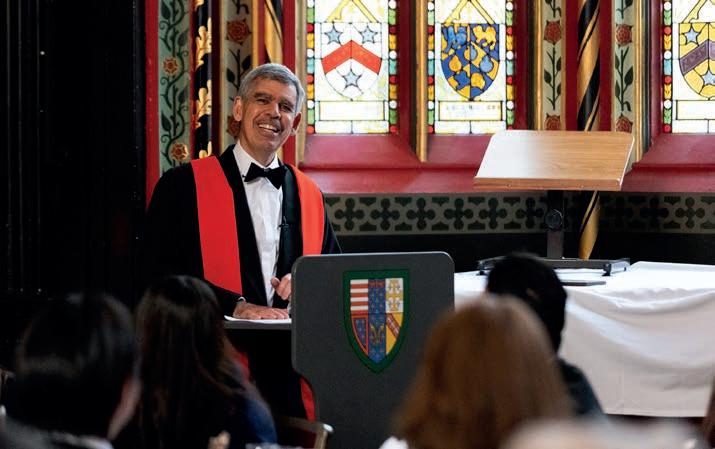
As I sit down to write my final introduction for the Queens’ College Record, I feel a profound sense of gratitude. The privilege of serving this extraordinary community as President has been, quite simply, the greatest of my life. To have had the opportunity to be at the heart of this vibrant College and witness its daily achievements has been an honour for which I will always be deeply thankful. My time at Queens’ has not only been a professional peak but also a personal journey of connection, learning, and immense joy.
Queens’ is more than just a collection of beautiful buildings; it is a living, breathing testament to the power of a truly cohesive and supportive academic community. It is a place where academic excellence and intellectual curiosity are celebrated, and where a spirit of rigorous inquiry is supported by genuine warmth and collegiality.
I have been continually inspired by the sheer talent of our students, whose brilliance fills our supervision rooms and whose energy animates our courts. The commitment of our Fellows to both research and teaching is a constant source of admiration, and our staff are the tireless heart of the College, ensuring that Queens’ remains a home to us all. The ability of this college to go from strength to strength would not be possible without the engagement of our alumni and donors. You continue to support and shape the College’s future and have been instrumental in helping us manage through the external turbulence of the last five years, including Covid, the energy shock, and the cost-of-living crisis.
Together, we have navigated challenges and celebrated many successes, including those detailed in this edition of the Record. We have seen our students reach new heights of academic excellence, our researchers push the boundaries of knowledge, and our College’s reputation grow on the national and global stage, including the awarding of a Nobel Prize to Demis Hassabis and a knighthood to Stephen Fry.
With the support of our donors, we have enhanced our physical environment, invested in the well-being of our community, and fostered a culture that is admired throughout Cambridge. These achievements are the result of the collective effort, passion, and commitment of our wonderful community. They are a strong foundation for doing even more, including the renovation of our Owlstone Croft site.
As I prepare to welcome Dame Menna Rawlings as our new President, I have an unshakeable confidence in Queens’ future. This College possesses an extraordinary sense of society, structural resilience, and spirit that will see it thrive for generations to come. Thank you for the enormous honour and joy of serving as the President of this amazing College. I look forward to watching Queens’ continue to go from strength to strength. While I may be stepping down from my role, you should have no doubt that I will always remain a devoted member and supporter of this incredible community.
Thank you, for everything.
MOHAMED EL-ERIAN
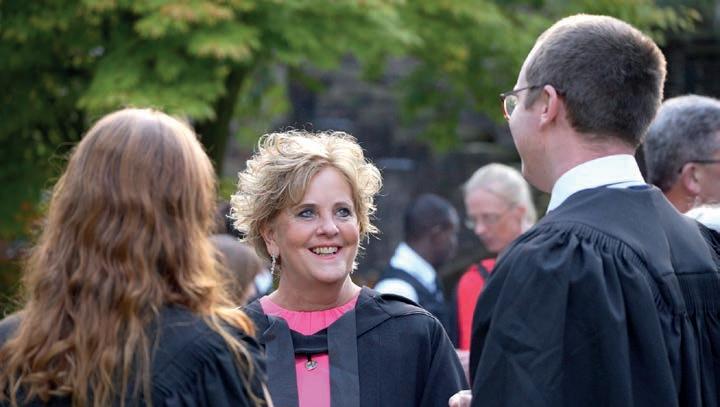
Almost as soon as Dr Mohamed El-Erian announced his resignation as President of Queens’, the process of electing his successor began under the watchful eyes and efficient management of the Vice-President, Professor Marie Edmonds, and the Senior Fellow, Professor Peter Haynes. Head-hunters were approached, nominations were invited, long lists and long short lists were compiled, and CVs scrutinised. The Governing Body whittled down a much longer list of potential candidates to five, who were then invited to the College for a round of interviews and meetings and to give a presentation to all Fellows. At the end of the Lent Term the Governing Body proceeded to a vote and the choice fell on Dame Menna Rawlings, the British Ambassador to France and Monaco.
Menna’s roots are in Wales where her family now live, but she grew up in North-West London, where her parents were teachers, and attended Northwood Comprehensive School. She studied for a BSc in Economics, specialising in International Relations, at the London School of Economics and joined the Foreign and Commonwealth Office on graduation. Her early career included tours of duty in Tel Aviv, Nairobi and Brussels. In 2002 she became Private Secretary to the Permanent Under-Secretary. She was Lead Policy Officer for G8African relations in the run-up to the G8 Gleneagles Summit, then served 2005-08 as Deputy High Commissioner and Head of the Political Section in Accra, Ghana. She then went to Washington D.C. as H.M. Consul General and also Counsellor (Corporate Services U.S.A.) leading the FCOD’s corporate operations in America. She returned to London in 2011 as Human Resources Director at the Foreign Office and became a Member of the Department’s Board. From 2015-19 she served as High Commissioner in Australia, before returning to
London to become Director General for Economic and Global Issues, leading, in particular, UK policy in the Asia-Pacific Region, the Americas, Africa and Commonwealth and Overseas Territories, and the UK’s international response to Covid . She became Ambassador in Paris in 2021, retiring in July 2025.
She completed an MBA at the Open University in 2011 and was awarded an Honorary DLitt of the University of London in 2025. She was created a Dame Commander of the Order of St Michael and St George (DCMG) in 2021 and a Commander of the Royal Victorian Order (CVO) in 2022. She was made a Commandeur of the Légion d’Honneur by President Macron after the State Visit of Their Majesties The King and Queen to France in September 2023.
Menna is married to Mark Rawlings and they have three children. She enjoys skiing, running, cycling and the classical violin. Her personal passions centre on promoting inclusivity and embracing lifelong learning. She has, needless to say, strong leadership credentials and has much experience of hosting events of every sort as well as dealing with financial issues and making the best use of historic buildings.
Professor Roderick Smith, Honorary Fellow and also a former Fellow, died in a tragic accident on 26 December 2024, his 77th birthday, whilst descending from Grisedale Tarn after an enjoyable family walk in his much-loved Lake District. After a degree in engineering from Oxford, he came to Queens’ for his PhD in 1971. He served on the Committee of the MCR. From 1975 to 1978, he was the Godfrey Mitchell Research Fellow and subsequently an Official Fellow and Director of Studies in Engineering from 1978 until 1988 when he left to be Professor of Mechanical Engineering at the University of Sheffield. He later moved to Imperial College, London, where he was Professor and Head of the Department of Mechanical Engineering. He was Chairman of the Future Railway Research Centre, a former President of the Institute of Mechanical Engineers, and Network Rail Research Professor at the Royal Academy of Engineering. He was elected as an Honorary Fellow of Queens’ in 2015 and was a frequent visitor to the College.
News also reached the College of the death on 27 December of one of our most generous Fellow Benefactors, Mr Stephen Farrant, at the age of 89. Stephen matriculated at Queens’ in 1956 and read English. On a trip to Greece, he met and married the distinguished Greek pianist and musician Aliki Vatikioti. His benefactions have, in particular, benefitted music at Queens’, though he gave substantial donations to several other college funds. The Senior Organ Scholarship is now named the Aliki Vatikioti Organ Scholarship in memory of Stephen’s wife, who died in 2004.
News has also reached the College of the death, in the summer of 2024, of a former Fellow, Dr Timothy King. Dr King was a Fellow and Assistant Director of Studies in Economics at Queens’ 1964-71. He was a University Lecturer in Economics and after leaving Cambridge had a distinguished career working for the World Bank, where he was a Senior Economist and Chief of Population and Human Resources Development Economics.
The College was thrilled to hear in October that Sir Demis Hassabis, Honorary Fellow and Fellow Benefactor, had been jointly awarded the 2024 Nobel Prize for Chemistry. With a colleague from Google DeepMind, he won the prize for creating the open-source AlphaFold2 AI model to calculate the structure of human proteins. “With its help, they have been able to predict the structure of virtually all the 200 million proteins that researchers have identified”, the Nobel committee at the Royal Swedish Academy of Sciences stated. Sir Demis read Computer Science at Queens’ and is the CEO of Google DeepMind. This is the first time that a Member of the College has won a Nobel Prize and Sir Demis is, of course, to be congratulated on such an outstanding achievement. A dinner was held in his honour in Old Hall in March.
Our most senior Honorary Fellow, Sir Stephen Brown, formerly a Lord Justice of Appeal and President of the Family Division of the High Court of England and Wales, celebrated his 100th birthday on 3 October 2024. The College offers Sir Stephen its warmest congratulations.
The College was delighted by the announcement in the New Year Honours List that our Honorary Fellow Stephen Fry had been awarded a knighthood.
The College is very pleased to welcome back Dr Sarah Williams, who has returned to Queens’ after an eighteen-month absence as a Fellow of Murray Edwards College. She is an Assistant Professor in High Energy Physics in the University and becomes once again an Official Fellow and College Lecturer in Physics. She is a member of the ATLAS collaboration at CERN, and also a contributor to the Future Circular Collider feasibility study.
Dr Oscar Branson has been elected to an Official Fellowship and College Lectureship in Earth Sciences, thus fulfilling a College teaching need in Earth Sciences and in particular Quantitative Earth Sciences. Dr Branson graduated from the University of Bristol with a BSc before going on to the National Oceanography Centre at Southampton to study for an MSc. He then came to Cambridge, to Jesus College, to undertake research for a PhD. From 2014-16 he was a Post Doctoral Research Assistant in the Department of Earth and Planetary Sciences, University of California Davis. He then became a Research Fellow at the Research School of Earth Sciences, Australian National University. Since 2019 he has been an Assistant Professor in the Department of Earth Sciences at Cambridge. He studies the formation of calcium carbonate by marine organisms, how these organisms manipulate chemical and physical processes to control crystal formation, and what complex ‘biominerals’ they produce. He is particularly interested in how biomineral formation may change in response to future climate change as well as the modification of sea water chemistry by ocean-based carbon capture and storage technologies.
Dr Lorren Eldridge has become an Official Fellow and College Lecturer in Law. She took her BA in Jurisprudence at the University of Oxford, followed by a DPhil in Medieval Law studying the historiography of local custom and the village community. She is particularly interested in understanding the legacies and connections between legal history and contemporary law, especially in the context of large reform projects in property law over the last 150 years. She taught extensively in Law at Corpus Christi College, Oxford, and holds a Postgraduate Certificate in Academic Practice in Higher Education (AFHEA). She was a Lecturer in Law at the University of Dundee 2021-22 and then an Early Career Fellow in Legal History at the Edinburgh Law School. She is qualified as a Solicitor in England and Wales. Since April 2024 she has been a Visiting Fellow at the Cambridge Centre for Property Law and has recently been appointed as an Assistant Professor in Private Law in the Faculty of Law.
Dr Sebastian Graves has recently been appointed to an Assistant Professorship in the University Faculty of Economics and has been elected as an Official Fellow and College
Lecturer in Economics at Queens’. He graduated with a BA in Economics from Girton College, Cambridge, before studying for an MSc at the London School of Economics, followed by a PhD from New York University. He worked as an Economist at the European Economics Research Department of Goldman Sachs from 2012-14. He then became a Research Assistant for Thomas Sargent and Simon Gilchrist, before moving to Washington, D.C., as an Economist and later a Senior Economist in the International Finance Division of the Federal Reserve Board. His research interests are in macroeconomics, with a focus on the implications of household and firm heterogeneity for business cycles and labour market fluctuations. He has been designated the Ajit Singh Fellow in Economics.
Dr Lovleen Bhullar has been appointed an Assistant Professor in Environmental Law in the Department of Land Economy and has been elected as an Official Fellow of Queens’ and College Lecturer in Land Economy. From 2020-24 she was an Assistant Professor in the Birmingham Law School and before that a Research Fellow in Regulation and Antimicrobial Resistance at Edinburgh Law School. Her first degrees, BA and LLB, were from the National Law School of India University, Bangalore. She then studied for an LLM in Environmental Law at the School of Oriental and African Studies (SOAS), University of London. There followed an MSc in Environmental Policy and Regulation at the L.S.E., before she returned to SOAS for a PhD in Law on water pollution in India. She worked first as an Adjunct Research Fellow, then as a Research Associate, at the National University of Singapore, before working as a Law Researcher for the Environmental Research Society, New Delhi. She taught Environmental Law at SOAS before moving to the University of Edinburgh. Her main research is in the role of law and policy in addressing antimicrobial resistance, climate change, environmental degradation and water pollution. She has recently contributed to the development of a framework climate law for a state in India and she was a member of the community of practice of the Environment and Human Rights workstream of the Prevention Project hosted by NYU. She is on the editorial boards of the Journal of Environmental Law, the Law, Environment and Development (LEAD) Journal, and Environmental Policy and Law. She has considerable experience of teaching environmental and energy law, tort, global law and globalisation and international trade law and policy.
Dr Amy Bonsor has been elected to an Official Fellowship and College Lectureship in Astrophysics. Since 2022 she has been a Royal Society University Research Fellow and Associate Professor at the Institute of Astronomy in Cambridge and from 2017-20 she was a Dorothy Hodgkin Research Fellow. She is a member of the Leverhulme Centre for Life in the Universe and the Cambridge Exoplanet Research Centre. She read for an MPhys at St Hilda’s College, Oxford, before a PhD in the Institute of Astronomy at Cambridge. She has worked as a Post Doc at both Cambridge and Bristol Universities and at the Institut de PlanétoIogie et d’Astrophysique de Grenoble. She has extensive experience in teaching both physics and mathematics for natural scientists. She studies planets orbiting the sun and other stars and is interested in how planets form and from what they are made. Her work aims to use our
understanding of Earth and the Solar System to further our understanding of planets outside our Solar System, whilst at the same time utilising the discovery and characterisation of planetary systems outside our Solar System to further our understanding of our own Solar System.
For several years, Queens’ has been looking to establish a Visiting Senior Research Fellowship. The recipient would be an academic, established, but at the beginning of their academic career, whose research and scholarship would benefit from a year embedded in a department, laboratory or faculty at Cambridge, The necessary funds have been raised, mainly through the generosity of Mr Chris Rokos, our Fellow Benefactor, and Dr Sepideh Razavi has been elected as the first Rokos-Menon Visiting Senior Research Fellow of the College. She is a tenured Assistant Professor in Chemical Engineering at the University of Oklahoma and will be working in the field of Biophysics at Cambridge. She was admitted to the Society as a Bye-Fellow in October. Dr Razavi studied for a BS in Chemical Engineering at Arak University in Iran and followed this up with an MS at Sharif University of Technology, Tehran. She then moved to the United States for an MEng and a PhD at City College of New York. After a postdoc at the University of Michigan, she moved to the University of Oklahoma as an Assistant Professor in Chemical, Biological and Materials Engineering. She studies the behaviour of colloidal particles at fluid interfaces and is also interested in the transition to green energy in gas-producing regions.
Several new Bye-Fellows were admitted in October. Dr Jack Williams is a Mathematician. He was an undergraduate at Clare College, taking his BA and MMath in 2015 and followed this with a PhD in String Theory; his research used twistors for dualities between gravity and quantum theory. Since 2015 he has been a College Research Associate at Clare and also Director of Studies in Mathematics, supervising extensively in the Tripos. He taught at North London Collegiate School for a year and has considerable experience in school outreach as a speaker, teacher and writer. Since 2015 he has been a Principal Examiner for the STEP papers and has also written several chapters in the textbooks used for Edexcel A Level Maths. He worked for ImpactEd as an impact partnership consultant, evaluating the impact of the work of educational charities 2020-21 before joining the Department for Education where he is a Strategy Lead, responsible for designing the UK’s post-16 mathematical education policy. He is a Governor of Cambridge Regional College and on the Advisory Board of QUEST, monitoring and evaluating charities supporting educational providers in Maharashtra, India.
Dr Tobias Mueller has been elected as a Bye-Fellow in Human, Social and Political Sciences. His BA was in Political Sciences and Law from Ludwig-Maximilians-University, Munich. After an MPhil in Politics and International Studies at Queens’ he returned to Munich for an MA in Cultural Studies and the Study of Religion. He returned to Cambridge and to Queens’ for a PhD. His thesis was entitled, “Muslims and the relational state: Contesting security, identity and diversity”. His research focusses on various religions, especially strictly observant ones,
gender and the state. He was a Junior Research Fellow at the Woolf Institute in Cambridge, before a year as a postdoctoral researcher at the Institute of Security and Global Affairs at the University of Leiden. He has returned to Cambridge after a spell at the Institute for Advanced Study in Hamburg as a Leverhulme Early Career Fellow at the Centre for Research in the Arts, Humanities and Social Sciences. Fron 2020-22 he was an Affiliated Lecturer in the Department of Politics and International Studies and has experience teaching in the HSPS Tripos.
Dr David Isaacs is a Teaching Associate in the Faculty of English and has been elected to a Bye-Fellowship at Queens’. He graduated in English from Peterhouse before studying for an MA in ‘Issues in Modern Culture’, followed by a PhD, at University College, London. He was an Associate Lecturer at UCL before returning to Cambridge in 2022. His research centres on the process of writing – the intellectual habits, the affective experience, the technologies and the material circumstances of writers in the post-war era. He focusses particularly on the writings and manuscript revisions of Philip Roth, J M Coetzee and Geoffrey Hill. Away from the academic world he has worked as a Research Assistant for Raindog Films and as an editor of short books and researcher for novels and documentary films. He has published some short fiction and is also a pianist and keyboardist. As a student he was a member of Cambridge Footlights and directed musicals and comedy.
Dr Tomaž Potočnik, who is a British Academy Postdoctoral Fellow in the Faculty of Classics, has been elected to a Bye-Fellowship in Classics at Queens’. A Slovenian national, he studied for a BA in Interlingual Communication, followed by an MA in Classics and Humanities at the University of Ljubljana. He also has an MA in Comparative History from the Central European University. These degrees were followed by a PhD on Latin and Linguistics at University College, London. His research interests include Latin linguistics, historical linguistics, Roman comedy and Cicero’s correspondence. He was a teaching assistant at UCL from 2020-24 before moving to Cambridge University and also works as a literary translator.
Dr Debangana Bose is a Teaching Assistant in the Department of Geography and until September 2024 she was the Philomathia Fellow and a Postdoctoral Research Assistant in the Department. She is a Human Geographer who specialises in India and has a great deal of teaching experience. After a BSc from Lady Brabourne College, Kolkata, she studied for an MA and an MPhil in Geography at Jawaharlal Nehru University, New Delhi, followed by a PhD at Ohio State University, Columbus. After a fixed-term Assistant Professorship at the University of Delhi, she lectured in Geography at Maynouth University in Ireland 2019-21. She has been elected to a Bye-Fellowship at Queens’.
This year three new Research Fellows were admitted to the Fellowship in October. Simina Dragoş is a member of the Department of Education at Cambridge. She undertook a BA in the Education Tripos at Emmanuel College, then moved to Fitzwilliam College for her MPhil and PhD. She works on aspects of historical research in post-1989 Romania, looking, in particular,
at the national history curriculum, maps used for educational purposes, film and public remembrance spaces. She has lectured for the Human, Social and Political Sciences Tripos, and also in Sociology for Anglia Ruskin University. She has made several podcasts and blogs.
Jorge Agulló comes to Cambridge from a Predoctoral Research Fellowship in Linguistics at the Autonomous University of Madrid. He researches in the field of syntax and its various interfaces from a variationist and theoretical perspective. His particular focus is on presumptive pronouns, but he is also interested in unstressed pronouns in Romance languages and in relative clauses. He took his Licenciatura (undergraduate degree), MPhil and PhD in linguistics at the Autonomous University of Madrid but has also spent some time at the Universities of Montreal and Grenoble Alpes. He speaks Spanish, English, Catalan, French and Italian. He is a member of the editorial board of the journal ‘Biblioteca de Babel; Revisita de filiologia hispànica’. He has been elected as a Research Fellow in Linguistics.
Svetlana Radionovskaya is a Research Fellow in Quantitative Environmental Sciences. She has dual British and Russian nationality and was educated in England. She researches in the fields of paleo-oceanography and geochemistry using sediment cores, mainly from the Iberian margin in the Northeastern Atlantic but also from a deep sub-Antarctic source. She is looking at the role of the oceans in marine oxygen-isotope stages in the paleoclimate of the Atlantic Ocean to study historical climatic changes and atmospheric carbon dioxide variability. Her first degree was a BA in Fine Art Drawing from the University of the Arts in London, before studying for a BSc (Econ) in Economics and Geography at University College, London. An MSc at UCL in Climate Change followed before a PhD at the Department of Earth Sciences in Cambridge. She is currently a Post Doctoral Research Associate at the British Antarctic Survey in Cambridge.
Dr Jerry Chen has been elected as a Bye-Fellow in Land Economy. He is currently an Isaac Newton Trust Fellow and PDRA in the Department of Land Economy and also an Affiliated Researcher at the Centre for Smart Infrastructure and Construction at the Department of Engineering. Dr Chen started his academic career as a Freeman Scholar at the University of Hong Kong before studying for a BA in Economics at Boston College. He then undertook an MSc in International Health Management at Imperial College, London, before embarking on a PhD at Queens’ and the Department of Land Economy. He was Vice-President of the MCR. His thesis was entitled, ‘Investigating the causality between built environment and subjective wellbeing’ and his research interests include urban modelling, econometrics, applied machine learning, human-centric planning and public health.
Professor Hannah Fry, the new Professor in the Public Understanding of Mathematics, joined the Fellowship as a Professorial Fellow in January 2025. Professor Fry is a well-known TV personality – she has made a number of shows and documentaries on the BBC, centred around mathematics, data and statistics, and has appeared regularly on popular national programmes such as Have I Got News for You, Question Time, The One Show, Would I Lie to
You, This Morning, Sunday Brunch, etc. She was the Royal Institution Christmas Lecturer in 2019. She has won the Disney+ Grierson Award for Best Presenter and the George Pólya Prize for Mathematical Exposition of the Society of Industrial and Applied Mathematics, as well as a number of prizes for teaching and presenting maths. She became Professor in the Mathematics of Cities at the Bartlett Centre for Advanced Spatial Analysis, University College, London, in 2022. Most of her career has been at UCL. She graduated with an MSci in Mathematics and Theoretical Physics, followed by a PhD in Applied Mathematics. She worked as a PDRA at UCL 2010-12, then as a Lecturer and Associate Professor. She is the current President of both the Institute of Mathematics and its Applications and the Mathematical Association. She is a Fellow of the Academy of Engineering and an Honorary Fellow of the Institute of Engineering and Technology and of the British Science Association. She is an advisor and collator of resources for Government, has collaborated on projects with Public Health England and also with several police services on a variety of projects, and frequently gives talks to the commercial sector and writes articles for the British and American press. Her books include The Mathematics of Love and How to be Human in the Age of the Machine
In January two more Bye-Fellows were elected and admitted. Dr Alexander Borodavka has been a Royal Society and Sir Henry Dale Fellow and Assistant Professor in Biotechnology in the Department of Chemical Engineering and Biotechnology since 2024. His research centres on virus particle assembly and understanding the dynamics of viral RNA genomes. He studied for a BA in Biochemistry, then an MSc in Virology and Microbiology at the Kyiv National University in Ukraine. He then undertook a PhD at the University of Leeds. From 2013-18 he held a Sir Henry Wellcome Fellowship jointly at the University of Leeds and the Ludwig Maximillian University of Munich, before becoming a Research Fellow at the Astbury Centre for Structural Molecular Biology, University of Leeds. From 2019-24 he was the Sir Henry Dale Fellow at the Department of Biochemistry at Cambridge. He has recently been awarded the Colworth Medal of the Society of Biochemistry. He lectures not only in Biotechnology but also in the Molecular Biology and Biochemistry courses in the Natural Sciences Tripos.
Dr Joana Nascimento belongs to the Department of Social Anthropology, where she has recently been elected as an ESRC Research Fellow. Her undergraduate degree at the Universidade de Lisboa was in Product Design. She worked as a Designer and Creative Researcher and as a Junior Exhibition Designer at the Calouste Gulbenkian Museum in Lisbon, before returning to academia to study for an MPhil in Social Anthropology at Cambridge. This was followed by a PhD at the University of Manchester where she was also a Teaching Assistant. She has also completed a Higher Education Learning Fellowship at Cambridge. She researches into the Harris Tweed industry of the Outer Hebrides. She has been a PDRA at the Cambridge Centre for Social Innovation at the Judge Business School and has been a Rokos-Menon PDRA at Queens’ since 2022 where she has been the PDRA Co-Convenor for the SCR-MCR Talks series. Her book ‘Working the Fabric: resourcefulness, belonging and island life in Scotland’s Harris Tweed industry’ was published in 2023. She
speaks Portuguese, English and French as well as having some expertise in Spanish, Latin, Scottish Gaelic and Cape Verdean Creole.
In the spring of 2025, Dr Alastair Key was elected as an Official Fellow in Archaeology and Anthropology. He has been an Assistant Professor in Palaeolithic Archaeology at the University since 2021 and was promoted to Associate Professor in 2024. He has been acting as the Queens’ Director of Studies in Archaeology and has experience of supervising and interviewing at several colleges. Before coming to Cambridge, he was based at the University of Kent where he was a Lecturer in Biological Anthropology 2015-16 and 2019-21 and a British Academy Postdoctoral Fellow 2016-19. He studied for a BSc in Biological Anthropology at Kent before undertaking an MSc in Palaeoanthropology and Palaeolithic Archaeology at University College, London. He returned to Kent for his PhD. He is interested in the ‘Acheulean’, the archaeological industry of stone tool manufacture by hominins in the Lower Palaeolithic into the Middle Palaeolithic Eras in Britain and Europe.
Dr John Harding has been the Head of the University’s Accessibility and Disability Resource Centre since 2008. In 2013 he became a Fellow Commoner of Queens’ and his advice on disability and the College’s obligations towards students who disclose any type of disability has been invaluable. In the summer of 2025, he was elected as a Bye-Fellow of Queens’. John took a B.A. at the University of Swansea in 1989. He worked for eight years for the Unipart Group of Companies before undertaking three years working with VSO in Namibia. He then studied for an M.A. in Development Studies at the University of Manchester. He was appointed to the post at Cambridge after working as Skills for Life Team Leader at Camden Jobtrain and then Learning Support Manager (disability) at Barnet College. He holds a PGCE in Adult Literacy from the Institute of Education, University of London, a Post Graduate Diploma in Adult Dyslexia, Diagnosis and Support from South Bank University, and is a Fellow of the Royal Society of Arts. He has recently completed a Doctorate in Education (EdD) at the University of Cambridge. He was a Board Director of the National Association of Disability Practitioners and is currently Company Secretary of the organisation as well as serving as Vice-Chair of the Standing Committee and Review Panel Chair for the NADP’s Professional Accreditation Scheme. He is himself a Senior Accredited Member of the NADP. John also serves on the Expert Advisory Board on Disabled Students in Higher Education at the Office of Students.
Dr Paul Bambrough, who has been a Bye-Fellow since 2019, supervises Anatomy for first year medical students and is the Director of Studies in Clinical Medicine, has been elected to an Official Fellowship. Dr Bambrough is a Consultant Interventional and Structural Cardiologist, Clinical Lead for Education and Co-consultant lead for Coronary Research at the Royal Papworth Hospital.
Professor Martin Crowley and Professor Graham Denyer Willis have been promoted within the University to full (Grade 12) Professorships. Professor Crowley has taken the title,
Professor of Modern French Thought and Culture and Professor Willis becomes Professor of Global Politics and Society.
The Vice-President, Professor Marie Edmonds, has been appointed Head of the Department of Earth Sciences. In May it was announced that she had been elected a Fellow of the Royal Society.
Professor Clare Bryant is also to be congratulated on her election as a Fellow of the Academy of Medical Sciences.
In October it was announced that Dr Jamie Blundell had been appointed Ursula Zoellner Professor of Cancer Research in the Department of Oncology. His research uses highthroughput data and generative AI to design precision T-cell receptor-guided therapies for cancer patients. The appointment follows an international search and is indicative of the importance and originality of his research in the field.
In January 2025 Dr Mona Jebril, our Bye-Fellow in Education and Academic Development, was awarded a Gates Cambridge Impact Prize. The prize defines impact as a demonstrable contribution to change in various fields, including the economy, society, culture, the environment, public policy, health and quality of life. The work recognised should be innovative, transformative and sustainable. It must also respect fundamental values such as human rights, freedom, democracy, equality and the rule of law.
Professor Martin Dixon has been made an Honorary King’s Counsel. He was nominated, according to the official citation, for his work on property law through his scholarship, coauthorship of leading practitioner texts, and participation in Law Commission projects as well as for his co-founding of the Modern Studies in Property Law Conference and for his Editorship of The Conveyancer
In February it was announced that Dr Kate Hendry had been awarded the Bigsby Medal from the Geological Society of London for services to geosciences.
Two Fellows of Queens’, Dr Tore Butlin (Engineering) and Dr Mairi Kilkenny (Biochemistry), were among the 14 academics awarded Pilkington Prizes for their contributions to teaching excellence by the University this year.
Now well into his ninety-second year, our oldest Fellow, Dr Brian Callingham, has arrived at the 60th anniversary of his election as a Fellow. A keen and semi-professional photographer, Brian has, for almost a quarter of a century, taken all the official photographs of new Fellows. A bout of ill health and the Covid pandemic meant that Brian faced a backlog of over 50 pictures to take. He has assiduously been ‘catching up’ with a whole series of photographic sessions over the last two years. However, he has decided to retire from this last of the many
college offices he has filled with such distinction over the years, drawing the line after the Fellows admitted during the Michaelmas Term 2024. With one final session with the camera in April 2025 he is up to date.
Former supervisees and colleagues will be familiar with the prowess of Professor Richard Weber with card tricks and the like. In retirement he has been developing this interest and, after due examination, has been formally admitted as a Member of the Magic Circle.
Dr Michael Loy resigned his Bye-Fellowship and left Queens’ at the end of the Michaelmas Term 2024 to take up a Lectureship in Classics at the University of Durham. In his short time as a Fellow he made significant contributions to the life of the College, most notably serving as Praelector and as Director of Studies in Classics.
The new Rokos Postdoctoral Research Associates, who have become Members of the SCR, are Dr Lucas Bulten (History), Dr Maya Danawi (Pharmacology), Dr Leif Deck (Engineering/Computer Science), Dr Lydia Hickman (MRC Brain Cognition Unit), Dr Joris Hoste (Economics), Dr Konstantinos Ioannidis (Behavioural Economics), Dr Dimitri Konen (Mathematics) and Dr Marissa Knoll (Sanger Centre). Dr Rami Alghamri has also been appointed for a year as a Postdoctoral Research Associate at Queens’.
Four alumni were proposed for election as Honorary Fellows in July 2024 and elected in October.
Professor Kelly Chibale is the Nevill Isdell Professor of African-centric Drug Discovery and Development at the University of Cape Town (Institute of Infectious Disease & Molecular Medicine) and the founder and director of the H3D Research Centre (the first Drug Discovery Centre in Africa) and H3D Foundation. He comes from a low income, low opportunity background and grew up in a home without electricity or running water in Zambia. He studied Chemistry at the University of Zambia, graduating in 1987. There being no opportunities for postgraduate study in his own country, he came to Queens’ in 1989 for his PhD, funded by a Cambridge Livingstone Trust scholarship. After Cambridge, he worked as a post-doctoral researcher in the University of Liverpool and then the Scripps Research Institute in San Diego, returning to Africa in 1996. He joined the University of Cape Town, was promoted to a Professorship in 2007 and became a Life Fellow of the University in 2009. His research focuses on drug discovery and the development of tools and models to contribute to improving treatment outcomes in people of African descent or heritage. His group are currently researching new treatments for malaria, for tuberculosis and for antibiotic-resistant microbial diseases. He has been awarded Gold Medals by both the South African Medical Research Council and the South African Chemical Institute and also won the Royal Society’s Africa Prize in 2023. He became a Fellow of the Royal Society of South Africa in 2009 and was elected a Fellow of the Royal Society of Chemistry in 2014. He has been described as
one of the 100 most influential Africans and is considered an inspirational leader in the pharmaceutical industry.
Sir Guy Newey (The Right Honourable Lord Justice Newey) is a Lord Justice of Appeal and has a considerable reputation as one the most original and intellectually impressive of current judges. He has delivered definitive judgments in some extremely technically challenging cases. He came up to Queens’ in 1977 and had a First Class record in the Cambridge Law Tripos and LLM, obtaining a Starred First in Part II. He was called to the bar at Middle Temple in 1982 and made a bencher there in 2010. He practised as a barrister in what is now Maitland Chambers. He became a QC in 2001. He often represented the Crown and achieved public prominence for his 2009 report into the collapse of MG Rover. He was appointed a deputy judge of the High Court of Justice in 2006 and then a full judge in 2010 (in the Chancery Division). He was knighted in 2010. In 2017 he was promoted to the Court of Appeal and was appointed as a member of the Privy Council. He is a member of a distinguished Queens’ family: his father, brother, sister and daughter all read Law at Queens’. He is a loyal supporter of Law at Queens’, and a regular attender at College activities. A role model for our students, he frequently speaks at student events and readily provides them with advice and guidance.
According to Professor James Diggle, his former pupil Professor Stephen Oakley is one of the most distinguished Latin scholars of his generation in the world. He has held the prestigious Kennedy Professorship of Latin at Cambridge since 2007 and is a Fellow of Emmanuel College. He matriculated at Queens’ in 1977 and, after his PhD, was a Research Fellow, then an Official Fellow, at Emmanuel College. He moved to Reading in 1998, where he was successively Reader and Professor of Latin. He was elected a Fellow of the British Academy in 2008. He is the author of a monumental commentary (literary, historical, linguistic and textual) on the books of the historian Livy, in four volumes totalling 3145 pages (OUP 1997–2005). These volumes have won very high praise – reviewers have said the books are of “permanent value for historians” and “a splendid achievement to which it is hard fully to do justice”. He has subsequently added other works including Studies in the Transmission of Latin Texts in two volumes (a third is on the way), exhaustive studies of the manuscripts and textual traditions of eleven Latin prose authors. In 2024 he was appointed to the Lyell Readership in Bibliography at Oxford, an annual honour involving the delivery of five Lyell Lectures, which has been held over the last 52 years by scholars of the highest rank, but only once before by a classical scholar.
Bryony Worthington (The Baroness Worthington) was born and brought up in Wales and read English at Queens’. She has made significant contributions to the promotion of awareness of environmental issues in public life, both in this country and globally. After graduation she worked as a fundraiser for Operation Raleigh and then for an environmental charity. By 2000 she was working for Friends of the Earth as an environmental and climate change campaigner. She has also worked for Wildlife and Countryside Link, at the Department for Environment, Food and Rural Affairs, and in the energy sector at Scottish and Southern
Energy. She was a key member of the team that campaigned for and drafted the UK’s worldleading Climate Change Act, setting legally binding targets to largely decarbonise the UK by 2050. In 2008 she founded ‘Sandbag’, a non-profit campaign group focused on increasing public awareness of issues surrounding climate change and on research & campaigning for effective climate policies, with a particular focus on the European Union Emissions Trading Scheme. She became a Member of the House of Lords in 2011 and was for a time the Labour Party’s Shadow Minister for Energy and Climate Change. She became a crossbench peer in 2018. She has been a Distinguished Academic Visitor at Queens’ and previously lived in Cambridge. In March 2020, Sandbag was renamed Ember, reflecting its expansion into a global organisation. She is also now a Trustee of UNICEF, a Trustee and Deputy Chair of the World Wildlife Fund’s UK Board and a Board Member of Jupiter Green Investment Trust.
As ever, Thomae Smithi Academia met in the Old SCR on Monday evenings at 8.45p.m. for a fifteen-minute talk on a topic of interest and an hour’s free-ranging discussion, the wine supplied courtesy of the late Dr Norman Hughes. In fact, this year began with wine: Professor Clare Bryant educated those attending on the subject of ‘Burgundy’. Next, in November, Professor Richard Fentiman marked fortyish years since his appearance on the 1985 BBC documentary with a seminar on the operations of international law: most of those present relished the challenge, and it is hoped that we met the required standard.
The Lent Term witnessed two talks: one by Dr Hamish Symington, ‘Pollination, Crops, Ecology, and Why Getting a Honeybee Hive is a Terrible Idea’, accompanied by some of the speaker’s own mead, and the other by Professor Andrew Marsham, ‘The Seventh-Century World Crisis’ in the long view.
Finally, in June, Professor Ioanna Sitaridou deployed a questionnaire via QR-code –certainly a first for TSA – en route to ‘Demolishing More Language Myths’. TSA remains in good heart and good health, with all of the talks reaching capacity and attracting attendance from across the range of the fellowship.
GARETH ATKINS
The Angevin Talks were a curated series of conversations hosted at Queens’ College, Cambridge, conceived and led by Anna El-Erian and Sneha Baptista. Designed to bring eminent voices from across public life, academia, the arts, and global affairs into dialogue with the College community, the series offered a unique forum for thoughtful and wideranging exchange in an informal, collegiate setting. The name and visual identity of the series drew inspiration from the Angevin dynasty — a nod to the College’s medieval heritage and its enduring engagement with ideas that shape the world. True to this spirit, the Talks invited speakers whose work resonates beyond disciplinary boundaries, sparking conversations that were as intellectually rigorous as they were accessible. Open to all members of the Queens’ College and Cambridge wide community, the series sought to enliven the cultural and intellectual life of the College, encouraging curiosity, dissent, and reflection. Though the series has now concluded, its legacy endures through recordings and ongoing conversations sparked within and beyond Queens’.
The 2024-25 speakers were Charlie Siem – Renowned Violinist; Joanna Scanlan – Award winning British Actress & Writer; Barbara Frenkel – Executive Board Member, Procurement Porsche AG ( this talk was organised in collaboration with the El-Erian Institute); Tai-Heng Cheng – Co Head of Sidley’s Global Arbitration, Trade and Advocacy Practice, Indra Nooyi –Former CEO of PepsiCo and Author of ‘My Life In Full’.
The logo for the Angevin Talks was designed by two current MCR members, Sneha Baptista and James Smith, both reading for the MSt in Architecture. Drawing inspiration from the President’s Lodge, the largest extant half-timbered building in any Cambridge college, the logo reflects the architectural richness of Queens’. As Sneha noted, the design “embodies the architectural language of the lodge with its unique and historic façade and cloisters that have welcomed many great speakers to the University.
Recordings and highlights remain available Angevin Talks – YouTube continuing to serve as a resource and inspiration for the wider College community.
Curated by Mrs Anna El-Erian & Sneha Baptista
HONORARY FELLOW 1991-2024.
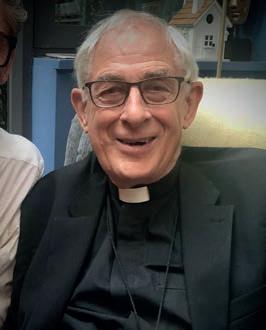
Bishop Mark Santer died on 14 August 2024 aged 87. He matriculated at Queens’ in 1957. A former Dean of Clare College, Principal of Westcott House (the Anglican Theological College in Cambridge), Bishop of Kensington and Bishop of Birmingham, he was elected as an Honorary Fellow of Queens’ in 1991. He was also Co-chairman of the second Anglican-Roman Catholic International Commission (ARCIC) alongside Bishop (later Cardinal) Cormac Murphy-O’Connor. ARCIC II published several reports and Mark made considerable contributions to the fields of ecumenism and dialogue between the Anglican and Roman Catholic communions.
Mark Santer was born in Bristol in 1936, the son of a prominent local clergyman, Canon Eric Santer. He was educated at Marlborough College, where he was in receipt of a clergy scholarship. He displayed a passion for the classics and languages at school and studied Latin, Ancient Greek and Hebrew. On leaving school he undertook National Service in the Army. He felt called to the priesthood whilst serving in the Forces but, on coming up to Queens’ in 1957, he began by reading Classics, obtaining a first in Part I in 1959. He then switched to Theology, again obtaining a first in Part II in 1961. He stayed on to study for Part III in 1962. A keen musician, he had learnt to play the organ at Marlborough and became the regular organist for services at Queens’. He was a stalwart of the St Margaret Society whilst at the College. Contemporaries remember a young man who exuded friendliness with his smiling face, serious, but always approachable and never daunting. He graduated B.A. in 1960 and M.A. in 1964. He trained for the Anglican priesthood at Westcott House in Cambridge. Before ordination, he studied for a short while in the University of Utrecht. While at Utrecht he attended a ‘sports festival’ in Communist East Germany (in fact a cover for a meeting of young Christians). There he met Henriette Weststrate, a Dutch psychologist from Amsterdam.
He was ordained as a deacon in 1963 and then as a priest in 1964. That year he also married Henriette. On ordination he was appointed as a Tutor at Cuddesdon College, the Anglican Theological College near Oxford, and simultaneously served as Curate of the local parish church, All Saints, Cuddesdon. The Principal of Cuddesdon at the time was Robert Runcie, a future Archbishop of Canterbury. In 1967 Mark moved back to Cambridge and was elected a Fellow of Clare College, where he spent 5 years as Dean and also served as a Tutor. He was
later elected an Honorary Fellow of Clare as well as of Queens’. In 1973 he was appointed as an Assistant Lecturer in the Faculty of Divinity, continuing in post until 1980.
In 1973 Mark was appointed as Principal of Westcott House. At his licensing, Professor Charlie Moule remarked that Westcott was getting “a principal at the height of his powers, outstanding in learning and pastoral ability”. By then he and Henriette had three young children, and the family were rapidly integrated into the life of the College, helping to establish a sense of community there. In terms of churchmanship Mark was an Anglo-Catholic, but he had little time for elaborate ceremonial and theatrical services. At Westcott he encouraged an atmosphere centred on the daily office and the eucharist with liturgical prayer and theological seriousness at the heart of the training regime. He appointed Mary Tanner, the first woman to be a member of Staff at Westcott. He also appointed Rowan Williams, a young and inexperienced Mirfield-trained theologian and, of course, a future Archbishop of Canterbury, to join the staff team. He steered Westcott in a new direction but also remained committed to the ecumenical aims of the Cambridge Federation of Theological Colleges, which included, as well as the more evangelical Anglican college Ridley Hall, the Methodist ministerial training college of Wesley House and the Presbyterian Westminster College. Peter Sedgwick, another Santer appointment, recalls that some people were unable “to work him out: he was ecumenical and yet Catholic, his vision based on a real knowledge of Reformed systematics and history as well as a commitment to a renewed Catholicism”. Whilst at Westcott, he cowrote with Maurice Wiles Documents in Early Christian Thought (CUP 1975).
After 8 years at Westcott, Mark was appointed Bishop of Kensington, one of the area assistant bishops within the Diocese of London. He was consecrated in St Paul’s Cathedral in 1981. To some members of the establishment, the appointment was perhaps quite surprising as Mark had made no secret of his left-of-centre politics, his lack of enthusiasm for the establishment of the Church of England, and his anti-nuclear convictions. He was a member of the Campaign for Nuclear Disarmament and had been on a number of CND marches. Only 44 at his consecration, he rapidly established collegiate relationships with the archdeacon and area deans and made himself available to the local clergy, establishing a reputation as a wise and sympathetic pastor. He established a pioneering ministry-development review programme, which was designed to sustain the clergy rather than examine them. He was seen as a rising star within the Church of England.
In 1983, he was appointed by Archbishop Runcie and the Anglican Consultative Council as the Anglican co-chairman of the second Anglican-Roman Catholic International Commission (ARCIC). Mark had spent a sabbatical at the English College in Rome where Bishop Cormac Murphy-O’Connor was Rector and no doubt the two churches had noted the good relationship between the two, which led to their appointments to co-chair the Commission. Mark contributed an important chapter reflecting on the formative memories of this sabbatical to a book which he also edited, Their Lord and Ours (SPCK, 1982). ARCIC’s
agenda was partly set by Rome and partly by the Lambeth Conference of 1978, with the aim of encouraging reconciliation between the churches, looking at a variety of topics where there was both similarity and divergence of doctrine. The topics covered while Santer and Murphy-O’Connor were co-chairmen included: Salvation and the Church (1986), The Church as Communion (1991), Life in Christ: Morals, Communion and the Church (1993) and The Gift of Authority (1999), The Commission was to be a major part of Bishop Mark Santer’s life for 15 years. Some of the Agreed Statements issued by ARCIC II were quite controversial and regarded with suspicion by both conservative Catholics and low church Anglicans. By the time ARCIC II was wound up, both churches had lost some of their enthusiasm for ecumenism. The two greatest achievements were perhaps the statements on morals and on authority, the final document from Mark’s time as co-chairman. In September1987, as ARCIC II was beginning its work on The Church as Communion, Pope John Paul II visited the Commission when it was meeting near Rome. Speaking on behalf of the Anglican members, Bishop Santer told Pope John Paul that, “we perceive your visit as an example of that loving care for the unity of all the churches which we, as Anglicans, are coming to recognise afresh as one of the gifts which inheres in the office of the Bishop of Rome”. Cardinal Joseph Ratzinger (later Pope Benedict XVI) also visited the Commission during one of its sessions and, in a debate reportedly greatly enjoyed by both theologians, relished discussing several theological issues with Bishop Santer.
Meanwhile Mark was enjoying growing influence in the Church of England. He was one of a small group who worked together to help draft Archbishop Robert Runcie’s key address to the Lambeth Conference in 1988 on the nature of unity and on the inclusiveness of the Anglican Communion. He was a member of the Church of England’s Faith and Order Advisory Group which involved work on an important document on the ordained priesthood – he drafted the patristic chapter. He was also a member of the commission that led to the Meissen Agreement between the German Protestant Churches and the Church of England.
In 1987 he became a Diocesan Bishop, moving to the see of Birmingham. Mark relished Birmingham’s inheritance of faith in both its Congregational history and that of Cardinal John Henry Newman. He was not afraid to court controversy. In a sermon to the West Midlands Judiciary, he challenged them to press for a reform of sentencing policy and help address the issue of overcrowded prisons. There was criticism in the right-wing press, but the Home Secretary asked for a private meeting to discuss the issues. When the Gulf War started, he tried his best to build bridges to local Muslim leaders, inviting them to his home. His staff meetings were convivial and effective, and he was as happy to serve at communion as to preside. He is remembered for suddenly dashing off in the middle of dinner parties to his study to find a theological tome to illustrate a point and for coming up with Latin quotations to cast light on theological issues. He was a connoisseur of wine and a member of the Wine Society. He was one of the first bishops to recognise the importance of safeguarding measures. Meanwhile he established excellent relations with local civic leaders, especially the Leader and Chief Executive of Birmingham City Council. He was a member of the NHS Trust
for Queen Elizabeth Hospital, serving as Vice-Chair after he retired. He became an Honorary D.D. of the University of Birmingham and an Honorary D.Univ. of the University of Central England. In 1999 he was awarded a Doctor of Divinity degree from Lambeth. He was elected an Honorary Fellow of Queens’ in 1991.
In 1994, however, his beloved wife Henriette died of cancer. He was by all accounts devastated by her loss and some feel any ambition he might have had for further preferment within the church died with her. In 1997, however, he married one of his late wife’s closest friends, a family friend for over 30 years, Sabine Bird. She was German by birth and had for many years worked as a Probation Officer. The wedding had to be in a registry office as she was a divorcée. The press had a field day, but the controversy soon died down. He retired as Bishop of Birmingham in 2002, staying on in the city for a while. He enjoyed his first experience as a parish priest, looking after the parish of King’s Heath during an interregnum. Sabine died in 2021 and the following year he moved to Poole to be close to family. He enjoyed drives, walks and chatting to friends on the telephone. He died peacefully at home, shortly after receiving holy communion. He is survived by a sister and brother (John Santer, Queens’ 1963), three children (Hendrika, Miriam and Diederick), three stepchildren, and 15 grandchildren.
JONATHAN HOLMES
C.ENG., F.R.ENG., F.I.MECH.E., F.I.M.M.M.
RESEARCH FELLOW 1975-1978, OFFICIAL FELLOW 1978-1988. HONORARY FELLOW 2015-24.
Professor Roderick Smith, Honorary Fellow of Queens’, died in a tragic accident whilst walking in his beloved Lake District during a family holiday on Boxing Day 2024, his 77th birthday. He was a very experienced walker and mountaineer, which makes his death all the more shocking. The Langdale and Ambleside Mountain Rescue Team were called out to help as he lay unconscious at Grisedale Hause, near Grisedale Tarn, but resuscitation attempts were unsuccessful, and the Team had to bring his body down from the mountain.
Rod Smith came to Queens’ as a Research Student in 1971. He was elected as a Research Fellow in 1975 and as an Official Fellow in 1978. He was appointed a University
Demonstrator (Assistant Lecturer) and Lecturer in Engineering and was Director of Studies in Engineering at Queens’ from 1979 until 1988. He left Cambridge to take up a Chair at the University of Sheffield in 1988 and went on to have a most distinguished career in Mechanical Engineering based in Sheffield, at Imperial College, London, and at Oxford University. He came back to Queens’ frequently and was always keen to catch up on the affairs of the College and his former colleagues and was delighted to be elected to an Honorary Fellowship of Queens’ in 2015.
Rod was born in Saddleworth, near Oldham, and attended Oldham Hulme Grammar School. He started his engineering training as a student apprentice with the David Brown Corporation of Huddersfield in 1967 before going up to Oxford in 1968 to read Engineering Science at St. John’s College. He came to Queens’ in 1971 to study for a PhD at the Department of Engineering supervised by Professor Keith Miller. He was Secretary (the equivalent of today’s President) of the MCR for two years from 1972-74, running the affairs of the graduate community with his characteristic common sense, friendliness, geniality and organisational ability.
In 1973 Rod met a young Japanese language school student, Yayoi Yamenoi, at a party in Cambridge. On one of their first dates, he took her climbing in the Lake District. Rod and Yayoi were married early in 1975. Rod loved Japan and Japanese culture and took every opportunity to visit the land of his wife’s birth. He spent a sabbatical term there in 1981. Over the years he worked extensively in Japan both with universities and also with Japanese railway organisations and manufacturers. The installation of the High-Speed Rail system across Japan threw up many new engineering issues and challenges. Rod was at the heart of an international exchange system for young engineers between Britain and Japan for the sharing and dissemination of ideas and expertise. Rod especially admired the teamwork, seriousness and attention to detail of his Japanese counterparts. In recent years he was Chairman of the Japanese Railway Society and held Visiting Chairs at universities in Kyushu and Tokyo.
In 1975 he was elected as the Godfrey Mitchell Research Fellow at Queens’. Over the years he published widely in areas of fatigue and structural integrity. In 1977 he was appointed as a Demonstrator in the Engineering Department by the University, and Queens’ elected him as an Official Fellow in 1978. In 1979 he became Director of Studies, ably supported by Dr Henry Cohen and Dr Jim Prentis as his Assistant Directors of Studies. One student of the period remembers that Rod made it plain to the fresher engineers that he expected them to work hard, reminding them that they had been selected from a much wider pool of applicants. As a supervisor, in both mathematics and materials, he was insightful and thoughtful. He was particularly sensitive to the difficulties experienced by some students whose schools had only been able to teach them single maths A level, giving useful and practical advice, for instance on books they might read to catch up with further maths.
He and Yayoi were very hospitable, entertaining engineers at their home. Students might, however, be expected to sample Rod’s home brew. This hobby was not without its hazards. One hot summer’s day Rod was at home when there was a tremendous crash behind the house. Rushing out into the back yard he discovered that his home brew apparatus had exploded. He was instrumental in setting up the Queens’ Engineers’ society, ‘QED’ (an intentional pun, of course, on the Latin tag often used by mathematicians Quad Erat Demonstrandum and Queens’ Engineering Department). In 1980 he was upgraded by the University to a Lectureship in the Department of Engineering. As a lecturer he had a remarkable facility for making complex scientific problems accessible to students. He gave a memorable, fascinating and entertaining, if somewhat alarming, talk to the E Society at Queens’ on metal fatigue, highlighting his ability to talk to a more general audience as well.
Professor Andrew Gee, the current Director of Studies in Engineering at Queens’ has written this appreciation. “I first met Rod in October 1987 when I arrived at Queens’ to study Engineering. He was my Director of Studies, unfortunately only for the one year before he left for Sheffield. Throughout that year, I had the pleasure of sitting in his rooms for a weekly “supervision”. I say “supervision”, because the truth was that we rarely discussed much in the way of technical engineering. I had few problems with the examples papers, so we talked about whatever fascinating issue Rod decided to enlighten us on that day. It was through Rod that I learned the meaning of the word “polymath” and the pleasure of education in the broadest sense of the word. We had wonderfully insightful discussions on a broad range of topics that continue to shape my world view to this day. After Rod left Cambridge, he continued to take an interest in my career, and I was honoured to consider him my mentor. On his frequent trips to Cambridge, he always found time to break bread and give freely of his expertise when I needed advice. It was at this time that I got to meet Yayoi and learn about Rod’s love for Japan and hiking in the mountains. A particularly memorable occasion was a Feast last year when I was seated next to Rod for dessert. We talked about organising a trekking expedition to his favourite valley in Nepal. Maybe one day I will get to do this, following in his footsteps literally as well as metaphorically. Rod has been taken from us far too soon, he had so much more to do and to give. All of us who knew him will miss him deeply.”
Rod was introduced to walking in the Lake District as a young boy by his father. All his life he enjoyed mountain walking, rock climbing and skiing. In 1973 he joined his PhD supervisor on an expedition to the iceshelf in Greenland. Faced with a tricky descent towards a river estuary, one of the other expedition members scanned the route with a telescope and spotted far away two polar bears athwart their path. Everyone took a look – only Rod pronounced the distant white blobs to be boulders. Slowly they approached the position of the ‘bears’ and Rod was proved to be right – the other expedition members never heard the last of their false identification. Then, whilst a Fellow, Rod led two expeditions of mostly Queens’ students to Arctic Norway. The first, in July 1976, was to the Svartisen
Ice Cap, the second in 1983 to Jostedalsbreen Ice Cap, north of Sognefjord (reports can be read in The Records of 1977 and 1984). Over the years he also led expeditions to Greenland, the Himalayas and the Karakoram. He was a proud member of the Cambridge University Mountaineering Club, the Fell and Rock Club, the Alpine Club (until recently he was responsible for the obituaries in the Club’s magazine, the Alpine Journal), the Arctic Club and the Yorkshire Ramblers’ Club. Above all he loved the Lake District and had made ascents of all the Lakeland ‘Wainwrights’ at least twice. He liked nothing better than walking and climbing in the fresh open air and had a zest for adventure.
Always well turned out with his trademark pipe (he gave up smoking later in life) and his inimitable Lancastrian accent (he was all his life, true to his roots, an avid fan of Manchester United), Rod’s sharp intellect, warm personality, ability to tell a story and above all his dry wit and great sense of humour made him a popular member of the SCR. There was real regret among his colleagues when he left Cambridge to take up a Chair in Sheffield in 1988. He retained a great affection for Queens’ and visited as often as he could. He especially enjoyed feasts and the opportunity to catch up with former colleagues and friends and students. Over the years he contributed four fascinating articles about the history of Queens’ to The Record. Two of these, on the Queensman and Arctic Explorer William Scoresby and on “Kateki-Sama: The statue of Erasmus in the Imperial Museum, Tokyo” were written when he was a Fellow and published in The Record in 1979 and 1988 respectively. Articles on Thomas Fyshe Palmer, the Queens’ Fellow convicted of sedition and transported to Australia, and on Osborne Reynolds (of Reynolds Number fame), Queens’ Fellow then Professor of Engineering at Owen’s College, Manchester, were written long after he had left the College and were included in the 1995 and 1997 editions. He took a Cambridge Doctor of Science degree in 1998.
At the University of Sheffield, he was Professor of Mechanical and Process Engineering from 1988 to 2000. He also served as a very robust and successful Head of the Department of Mechanical and Process Engineering there for three years, 1992-95. He was Warden of Stephenson Hall at the University and Senior University Warden 1997-2000. 1995-96 he was Chairman and a non-executive Director of the College of Railway Technology, Derby. From Sheffield he went on to Imperial College, London, where he was Head of the Department of Mechanical Engineering 2000-2005 and also Professor of Railway Engineering. He published extensively on structural integrity, railway engineering and energy, and was frequently invited to address international meetings and conferences. In 2006, on his return to St John’s, Oxford, his old undergraduate college, as a Senior Visiting Research Fellow, he gave the Jenkin Lecture to the Society of Oxford University Engineers, on “Railways: the technical challenges of their renaissance”. In 2007 he presented the 95th Thomas Hawksley Lecture for the Institution of Mechanical Engineers on “Energy for Transport”. He also delivered the 55th Hatfield Lecture at the University of Sheffield, “Railways and Materials: Synergetic Progress” and the Royal Academy of Engineering/Lloyd’s Register Educational Trust Lecture, “Carpe
Diem: The Dangers of Risk Aversion”. He was invited to lecture in many British universities, as well as many places abroad.
In parallel with his teaching and research career, Rod was increasingly involved as a technical consultant and also as a member of an investigating panel or as an expert witness after various accidents and disasters involving the failure of materials. He undertook consultancy work for British Steel plc (1987-90) as Consultant in Engineering to the Technical Director 198790. He was Consultant to the Health and Safety Executive on Materials and Structures, 1990-2000 and to the HSE Science subgroup. He was for many years a Consultant to the Board of British Rail and was a Member of the BR Research and Technical Committee (199296). He became involved in crowd safety research, assisting the Health and Safety Executive and playing a leading technical role in the enquiry following the Hillsborough football stadium disaster in 1989. He led a specialist group investigating the effect of volcanic ash on jet engines in 2011. He worked as an expert witness in many legal cases, both at home and abroad. He was frequently quoted in the press and made many radio and television appearances. His principal expertise lay in the cyclic fatigue failure of metals, especially in connection with the rail industry. He was heavily involved in the Hatfield Rail Crash Inquiry. He also served as an expert witness into enquiries and prosecutions following the rail accidents at Sandy, Potters Bar and Southall, as well as the inter-city express train derailment at Eschede in Germany which led to over 100 deaths. He gave evidence at inquiries into several shipping failures. Ultimately, he became so involved in railway work he had to step down as Head of Department at Imperial. He will be remembered there for his entertaining and informative lectures on all aspects of the rail industry and as a cordial and independent-minded colleague. From 2011 he was a Research Professor at Imperial.
His philosophy is well-summarised in the preface to his book, An Introduction to Fracture Mechanics for Engineers (2021), based on his lecture courses at Cambridge, Sheffield and Imperial. “It was clear that many people were put off fracture mechanics because of the complicated mathematical frameworks erected by many authors, sometimes so complicated that they hide the physical fundamentals concerning the separation of material. I have therefore relegated any formal mathematics to an appendix. I deliberately used the word engineers in the title because they are the people who shape our world, make things and create wealth—often relying on judgements based on imperfect information. And I was also writing from an engineering department, and not a metallurgy or materials or indeed a materials engineering department. Over the intervening years I have acted as an investigator of accidents and as an expert witness in many legal cases arising from failures. Two things have struck me as being particularly important: it is extremely important to see a failure, as far as possible, for real, and in the place it occurred. It is quite remarkable how this clarifies one’s thinking and enables one to ask the right questions. Secondly, I have been surprised, time after time, how, in many applications, the loads and therefore the stresses and strains to which components and structures are subjected in service, are largely unknown.”
From 1995, first at Sheffield, then at Imperial, he was the Royal Academy of Engineering Network Rail Research Professor of Railway Engineering and Chair of the Future Railway Research Centre. The principal funding for the Centre comes from Network Rail, the Royal Academy of Engineering and EPSRC and its brief is to concentrate on structural integrity, railway engineering, energy and sustainable engineering. He had an extensive knowledge of engineering problems and operational methods relating to the rail industry. He also held visiting Chairs in several countries, including Japan and Australia, as well as at York and City Universities in the UK. He was an Honorary Visiting Professor at the Academy of Railway Science of China. As Director of his own consulting company, he advised on many engineering issues throughout the world, holding research contracts with many important firms and railway companies. Back in Oxford, where he lived latterly, he agreed to join the Committee of the Society of Oxford University Engineers, serving as President from 2016 to 2020, and he did a lot to engage Alumni in events and talks.
He served as the 126th President of the Institution of Mechanical Engineers 2011-12. At the time of his death, he was a Vice-President of the Institution. In 2012 he was appointed as the Chief Scientific Advisor to the Department for Transport, remaining in office until May 2014. The Chief Scientific Advisor makes sure that the Department’s policies and operations, and its contributions to wider government issues, are supported by the best science and engineering advice available. He was President of the Engineering Integrity Society and a long- term supporter of and Director of the Forum for Engineering Structural Integrity. For eight years he was a Trustee of the National Museum of Science and Industry, which includes the Science Museum and the National Railway Museum in York, and, whilst in office, arranged the gift of an original Series Zero Shinkansen Japanese Bullet Train to the Railway Museum. He was the Chair of the Heathrow Airport Consultative Committee. Recently he has been an Infrastructure Commissioner for Wales. In 2007, Professor Smith was awarded the W M Thornton Medal (incorporating the Clark Maxwell Award) of the Institute of Metals Materials and Mining. He was a Fellow of the Royal Academy of Engineering, a Fellow of the Institute of Metals, Materials and Mining, and a Fellow of the Institution of Mechanical Engineers. He was awarded an Honorary Doctorate of Science by the University of Lincoln and an Honorary Doctorate of Engineering by the University of Sheffield.
The enforced home isolation of the Covid-19 pandemic gave him the time to listen and to think. He occupied himself by writing a simple guide to listening to classical music, a lifelong pleasure. St Mary the Virgin Church in Oxford was almost full to capacity for a Memorial Service on 7th March, a tribute to a remarkable engineer and a remarkable personality. Rod is survived by his wife, Yayoi, his sister Janet Thompson, his nephew and niece Adam Whitehead and Annabel Bruce, and his extended family in the UK and Japan. The College extends its deepest condolences to them.
FELLOW 1964-1969
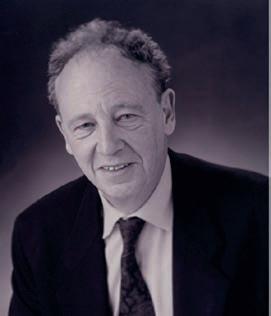
Timothy King, who was a fellow in Economics at Queens’ and Assistant Director and Director of Studies in Economics died at home in Ireland in May 2024 aged 85. He was born in London in 1938, grew up in Hampshire, and attended Bedales School where his father Cyril King, K.C., was Deputy Headmaster. The Bedales ethos was greatly to influence Timothy’s concept of service to others throughout his long life. He went up to King’s College, Cambridge, in 1957 and graduated with first class honours in the Economics Tripos in 1960. He then went on to the University of California at Berkeley where he gained an MS in 1962 and a PhD in 1965 and where he married his first wife Patricia with whom he had two daughters.
On his return to Cambridge in 1964, Timothy was appointed a University Assistant Lecturer and then Lecturer in Economics and became a Fellow at Queens’ College. He was first Assistant Director and then Director of Studies in Economics. The enthusiasm and empathy which he demonstrated as a teacher and mentor throughout his later life were already apparent at this time. In a tribute John Eatwell (Lord Eatwell), President of Queens’ 1997–2020, has written that Timothy, his first supervisor, was “kind and understanding” and that “he helped me adjust to the strange world of Cambridge and his teaching helped to ensure my first at the end of the year”.
In 1969, Timothy took up a position as an Economist in the Population Studies and Employment Division of the World Bank in Washington, D.C. Thus, a long and distinguished career in the world of development, which took him all over the globe, began. In 1980, he spent a fruitful year as an academic visitor at Nuffield College, Oxford, where he began to consider issues relating to population and immigration. By the mid-1980s, he increasingly focused on centrally planned economies.
After the fall of the Berlin Wall in 1989, Timothy was a member of early World Bank/IMF missions to Russia. He later met and married his second wife, Mary, who also worked on post-communist systems for the Bank. When she was posted to Budapest in 1998, Timothy took early retirement and, enthusiastically dedicated himself to his long-held ambition which was to research the economics of opera production. Sceptical colleagues often remarked that no rigorous economic analysis is possible for any opera production, but Timothy pressed on,
delving ever further into international comparisons of cultural financing with great enjoyment, contributing to journals on cultural economics and writing extensively on the topic.
In 2006, Timothy and Mary moved to Dublin, where he immersed himself in the Irish cultural scene and supported numerous musical festivals and the Irish National Opera. He also spent his later years researching his family history, discovering deep roots in Ireland and documenting his findings. His generosity to the Irish National Opera continues through his support of a new opera which was commissioned before his death. His legacy will also continue through a project to enable disadvantaged school children to prepare for and visit an opera production.
He died, with his wife at his side, on May 12th 2024. That his was a life lived to the full, with great generosity and élan, was demonstrated when, at his funeral, gifted performers gathered to express their appreciation in a musical celebration that he would have greatly enjoyed.
Stephen Farrant died in his adopted city of Athens at the age of 89 on 27 December 2024. He was the most generous benefactor to arts and music at Queens’ in the modern history of the College. Having come up from Kelly College, Tavistock, he matriculated at Queens’ in 1956. Much of his time as an English student was spent with the Bats theatre group and listening to classical and choral music.
After graduating, he was on his way to Japan when he met his future wife in Athens and, thus, “successfully failed to leave the country”, as he saw it. He married Aliki Vatikioti (19312004) who was a renowned Greek concert pianist. He spent his working life as a journalist, including a stint as Managing Director of Naftiliaki, a Greek shipping magazine.
Stephen worked closely with Queens’ to create endowments for the Aliki Vatikioti Senior Organ Scholarship; for the St Margaret Society (The Farrant Fund); for Bats (The Joanna Scanlan Fund); for Friends of Queens’ Music; and for the Arts Society (The Mary Beale Fund). These benefactions were made through The Friends of Aliki Vatikioti for Music & the Arts, a cultural foundation set up in memory of his wife. Stephen also funded scholarships for postgraduate students in Music, as well as providing money to support the post of Director of Studies in
Music and the lighting project in Chapel. The Governing Body elected Stephen to a Fellow Benefactorship in 2022.
He took great delight in hearing about the progress of music and the arts at the College, supported by these funds. He met with various alumni and Fellows of Queens’ as they passed through Greece, including the President, Dr Mohamed El-Erian. The Chapel Choir toured Greece in 2018 and Stephen attended a couple of the concerts. At the end of every piece, he turned to me and simply said, “This is marvellous!”.
ROWAN KITT
As always, members of staff come and go throughout the year. This year we have said farewell to Jack Wells, Ismail Khalifa, Michal Wolf, Nandor Nagy Wilson Rios Dos Mesquita (Catering), Andrew Wilson (Hospitality), Anna Piper-Thompson (Library), Josh Little (Sportsground), and Ping Crosby (Housekeeping). One of our longest-standing members of staff, Paul Knights, who has been Boathouse Manager for many years, retired in November.
We welcomed several new faces to the College, including Emily Webb (Alumni Office), Lucy Webb (Communications), Tom Stebbings (Sportsground), Olivia O’Neill (Tutorial Office), Sam Quinn (AV/Tech), Matt Cooper (IT), Sam Percival and Elliot Cobb (Library), Ellen Ellis (Human Resources), Adam Butler (Gardens), Rob Clarke (Hospitality), Sandor Katulin, Fabricio Electo e Morais and Lukasz Gibala (Catering), Anna Bellis Kennedy (Porters’ Lodge), Marijana Dolezelova, Giulia Ruggiero, Monica Zadura, Nasser Salmanmohajer and Dimitrios Savvidis (Food Services).
Sadly, Ian Arrowsmith, who worked for many years in the Porters’ Lodge, died in September 2024. After his retirement as a Porter, he continued for several years to work part-time in the Visitors’ Shop.
The Sports and Social Club team have been busy organising events. The traditional College Christmas events were held, starting with the Children’s Christmas Party. This was followed by a trip to the Arts Theatre for the Pantomime and a Christmas shopping trip to Norwich. The President and his wife Anna once again hosted mince pies and mulled wine in the President’s Lodge after the Staff Carol Service in the Chapel. Following an enjoyable Staff Dinner & Dance, the year ended with our usual sell-out raffle at the Staff Christmas Reception. Sadly, there was no Family Day Out this year, but there was a staff Ten Pin Bowling outing in February, a Quiz Night in April and a Staff Family Sports Day & BBQ at the Sportsground in June. There was a memorable Students vs Staff football match and some Bake Offs. The Head Porter organised another golfing day.
A number of Members of Staff celebrated 10 years at Queens’ this year, including Francis Kitteridge, Tamas Vegvari and Mahfoud Abdessaid (Catering), Keiron Molloy and Jonathan Bird (Maintenance), Vita Ramonaite and Kamil Kowalski (Porters), Donna Wilson (Accommodation), and Angelika Piotrowska and Malgorzata Szymkowiak (Housekeeping).
LORRAINE M LOFTUS, BURSARS’ ASSISTANT
As the 2024–2025 academic year draws to a close, Queens’ College can reflect with pride on a period of considerable progress across its built estate. At the heart of this year’s achievements lies the completion of the major environmental refurbishment of the Erasmus Building, a landmark moment in the College’s journey towards Net Zero. Originally designed by Sir Basil Spence and opened in 1961 as the first modernist building on the River Cam, Erasmus has now been transformed through an £8.6 million programme that preserves its architectural identity while revolutionising its energy performance, accessibility, and student accommodation.
The refurbishment was delivered on time and under budget, with a final outturn expected to be £7.6 million including VAT. It has fundamentally reshaped the building’s environmental footprint through the introduction of air source heat pumps, triple glazing, solar panels, Mechanical Ventilation Heat Recovery (MVHR) systems, and significant improvements to insulation and solar shading. These interventions are anticipated to reduce annual carbon emissions by approximately 50,000 kg. The rooftop heat pump system not only supports Erasmus but has been futureproofed to facilitate the decarbonisation of adjacent buildings (Cluster 1 – decarbonisation plan), anchoring the College’s wider sustainability strategy. The student living experience has also been completely reimagined, with all 41 rooms now ensuite and equipped with smart environmental controls, bespoke furniture, enhanced storage, and dimmable lighting options. A new accessible room and step-free access via lift have extended inclusive accommodation to the East side of the river for the first time. Conference guests will be the first to occupy the building this summer, allowing for final testing and trials, with students moving in from Michaelmas Term 2025.
The Nursery Relocation project, from Owlstone Croft to 26 Barton Road has also made substantial headway, with handover completed in June 2025. The £2.7 million scheme includes a new lift and modern facilities to accommodate the nursery’s move from its existing location. This project has been a partnership with Pembroke College and delivers an expansion on the number of child spaces, from 20 to 40. The relocation is a necessary enabling step for the wider redevelopment of the Owlstone Croft site.
The Owlstone Croft decarbonisation and redevelopment project, although subject to planning-related delays due to conditions requiring discharge, has continued to progress in the background. With £3.92 million already spent and a total commitment of £5.98 million, including the detailed design and tender process, the College stands ready to adapt its strategy if full construction cannot commence at the end July 2025. The Bursarial Committee has recommended a phased approach beginning with Block-B refurbishment and wider site demolition, which will enable the College to retain planning permission and Salix funding (£750,000) while transitioning towards full redevelopment. This approach also buys valuable time to refine the scheme’s cost and scope. The current budget sits at £34.5 million, though updated figures from Morgan Sindall suggest pressures that could push this towards
£39 million. To manage the displacement of students during construction, arrangements have been made to house postgraduates at Lucy Cavendish College’s Castle Street site under a proposed five-year lease, and undergraduates will be accommodated across Grange Road and newly secured sites at Panton Street and Norwich Street. This lease will also be used to support the wider decarbonisation plan, including Fisher refurbishment.
The College’s wider estate continues to be reshaped by the principles of its Silver Street Masterplan and decarbonisation roadmap. The Buildings Working Party was reformed in Michaelmas 2024 to oversee and validate the masterplan (Architects – Mikhail Riches), which continues to guide the phasing of refurbishment projects and capital investment. Among those already completed is the relocation of the College’s non-sensitive archives to the Chapel Building at Grange Road, in phase one of the archive project. The Library Committee has since requested further investment to refurbish this facility to house the full archive and Special Collections, currently stored at the University Library, with a £1 million budget earmarked when funding permits.
Other projects have been paused to focus resources on Erasmus and Owlstone Croft. These include the construction of new bedrooms at Grange Road, the refurbishment of the Sports Pavilion, and the Fisher Building upgrade (2027-2028), although the latter has progressed to feasibility stage. Planning is underway for significant infrastructure development, including proposals for Cluster 3 – decarbonisation plan, which will feed into future plant rooms at Fisher and Cripps. Preliminary Cluster 1 proposals are already being explored, with potential to decarbonise Walnut Tree Court, Friars, Docket, and the Chapel using the Erasmus ASHP system as a shared heat source.
Several smaller scale but important maintenance and improvement works have also been planned for the coming months. These include the refurbishment of the Cloister Court roof above the Bursary passage, and a survey of the riverbank between Silver Street and King’s College Bridge, which may lead to restoration works later in the year. A final and critical addition to the year’s projects is the impending refurbishment of the condemned Cripps kitchen floor. This essential work, due before the next academic year begins, presents a further opportunity to advance the College’s sustainability goals by removing the gas supply entirely and transitioning to all-electric cooking.
Taken together, these projects represent not only significant investment in the College’s infrastructure but also a clear and deliberate alignment with its environmental values and long-term strategic vision. With careful planning, targeted funding, and a commitment to sustainable design, Queens’ is not only preserving its historic fabric but also futureproofing its estate for the generations to come.
ANDREW BAINBRIDGE
As readers will all know, climate change is bringing with it new challenges for gardens and gardeners. The changing conditions mean that some plants fail to thrive, new pests may arrive, and new solutions need to be found, in Queens’ as everywhere else. This year, the growing season started very early, and there was less rainfall than usual. The spring went on to be one of the three driest and sunniest in Cambridgeshire since records began in 1836. The April showers never materialised, and the lack of rain meant that newly planted areas struggled to establish themselves, and hand watering was needed.
Another consequence of the dry spring was an increase of early pest and disease problems: aphids, scale insect and Box Moth caterpillars were rampant. In more normal years, we saw a lush spring growth of the lawns, but that was absent this year, and the lawns never had a chance to recover before the summer arrived. The redevelopment of the Erasmus Building meant that we lost Friars Court Lawn and part of Erasmus Lawn for over a year. These areas will be seeded and turfed in Autumn 2025.
Last year we carried out a tree survey, which identified a few trees with problems, some of which needed to be removed for safety reasons, but we also lost several other trees over the year from natural causes. A failing Populus nigra (black poplar) was felled on the Queens’ Green side of the Grove, as it had fallen prey to an infestation of Sesia apiformis (hornet clearwing moth); a Catalpa bignonioides (Indian bean tree) was blown over in Erasmus Lawn as a result of root decay; and a large Thuja plicata (Western Red Cedar) was removed from next to the Erasmus Building as part of the redevelopment. A larch on Fisher Drive died, and one of the young elm trees we’ve propagated from the Dutch-Elm-Disease-resistant elms in The Grove also failed. Where possible, we have planted new trees as replacements.
The greatest loss, though, was one of those two great elms, Ulmus × hollandica ‘Cicestria’, in The Grove. This tree was believed to have been planted in the early nineteenth century and survived the Dutch Elm Disease epidemic that swept Cambridge and much of the rest of England in the 1960s and 70s. Because of this tree’s historical importance, the decision to fell it was not taken lightly. We have known for many years that there were fungal fruiting bodies present around the base of the tree, and it has been constantly monitored for structural stability (the two main fungi are believed to be Laetiporus sulphureus and Rigidiporous ulmarius). Last year the tree was surveyed with sonic tomography to gauge the residual wood strength, and was dynamic load tested. Small-bore samples were also taken from several locations on the trunk to determine the extent of wood decay. The results were alarming: along with evidence of cracking in the stem, likely to be an early sign of stem failure, the investigations identified extensive decay, presenting an unacceptable risk of harm through stem failure. The risk of the enormous damage that would be caused if such a huge tree were to fall meant its removal was urgently necessary. We are hopeful that some of the good wood will be used to make something for the College Chapel.
In the wake of the Erasmus redevelopment, the removal of the Thuja and the loss of the Catalpa, we felt it was time to redesign the border along the east side of the garden. We divided the large border into two with the introduction of a bark path. Most of the large congested herbaceous plants were removed enabling a more varied planting of shrubs including Berberis × stenophylla ‘Corallina Compacta’, Corylus avellana ‘Red Majestic’, Viburnum carlesii ‘Aurora’; the lovely grasses Deschampsia flexuosa ‘Tatra Gold’, and Anemanthele lessoniana, and low growing perennials. Some plants were saved from Owlstone Croft, some created by division from existing stock and some were new purchases. Two new trees were planted as replacements: Sorbus aucuparia var. edulis ‘Rossica Major’ (a species of rowan that has white blossoms in the spring and red berries in the autumn), and Sorbus ‘Joseph Rock’ (another rowan, with leaves that turn orange, red and purple in autumn, contrasting with the butter-yellow berries). The thin border along the President’s wall was also replanted with snow drops, scented shrubs including: Daphne mezereum and Sarcococca hookeriana var. digyna ‘Purple Stem’.
And, finally, the fountain donated by the Seear family has been reinstalled on the patio area outside the Faith Centre.
Adam Butler joined us in January 2025 after completing his apprenticeship at Clare College and so Queens’ is now fully staffed with four full-time gardeners. All the garden staff deserve huge thanks and congratulations for what they have achieved this year despite the difficult conditions.
IAN PATTERSON, GARDEN STEWARD, AND STEVE TYRRELL, HEAD GARDENER
Queens’ Chapel makes a strong visual impact, however many times you’ve seen it before. It’s always fascinating to watch the faces of those visiting for the first time as they turn from the plainness of the Ante-Chapel towards the grandeur of the east end. Cue sharp intake of breath and a pause before some expression of ‘wow’! Bodley’s colourful ensemble of paint, textiles, stone and glass has seemed even more striking this past year as we’ve reaped the benefits of a lighting upgrade last summer. Besides greater energy efficiency and the capacity to vary the settings more subtly for different contexts in different seasons, the new configuration has brought definition and clarity to the Sanctuary area (including spotlights on the statues of Ss Margeret and Bernard, the Chapel’s join dedicatees) that has delighted even long-standing members with the sight of details previously hidden.
Visual impact will be one reason why so many members include a brief visit to the Chapel when showing family and friends around College. But perhaps there’s also something about the space that connects the present with the past in a particular way that other historic areas of the site don’t. Our sermon theme at Choral Evensong on Sundays during the Michaelmas and Lent Terms was ‘Identity and Belonging’, which yielded contributions from a diverse range of perspectives, including a deeply personal and affecting reflection from the President, Dr Mohamed El-Erian, which drew a large congregation, many of whom stayed for an informal buffet supper in Cripps Hall that laid the foundations of a graduallystrengthening Chapel community that has remained faithful throughout the year.
Grateful thanks to all this year’s guest preachers, as follows: Dr Mohamed El-Erian (Q1977); The Right Reverend John Sherrington (Q1977, Auxiliary Bishop of Westminster, and, since he came to speak, appointed and installed as Archbishop of Liverpool); Alison Rose (Principal, Newnham College, and former British Ambassador to Belgium); Dr Michael Loy (Q2012, Praelector & Director of Studies in Classics); Dr Victoria Turner (Tutor in Theology & Mission, Ripon College Cuddesdon); Dr Elizabeth Phillips (Director of Education and Engagement, Woolf Institute, Cambridge); The Revd Hannah Richardson (Anglican Chaplain, HMP Littlehey); The Revd Prebendary Isabelle Hamley (Principal, Ridley Hall, Cambridge); Dr Tobias Müller (Leverhulme Early Career Fellow, CRASSH; Bye-Fellow, Queens’); The Revd Augustin de Lamberterie (Assistant Chaplain, Fisher House); The Revd Jeanine Bossy (Pioneer Curate, St Andrew’s Cherry Hinton); The Venerable John Kiddle (Q1976, Archdeacon of Wandsworth); The Revd Dr Peter Anthony (Vicar, All Saints Margaret Street); The Revd Kristian Hewett (Bishop’s Advisor for Homelessness, Diocese of Ely); Brother Samuel, SSF (The House of Divine Compassion, Plaistow); The Revd Canon Anthony Lees-Smith (Canon Missioner, Chester Cathedral); The Revd Christine Campbell (Rector, St Mary’s Ashwell, St Nicholas’ Hinxworth, and St Vincent’s Newnham); Sister Charlotte Cummins, CJ (Assistant Chaplain, Fisher House Catholic Chaplaincy).
Their contributions were further enhanced by a new audio system – a first for Queens’ Chapel – installed before the start of the academic year as the first part of a two-stage project to make services and selected other activities available to the wider College community and beyond via live-streams and recordings.
Chaplaincy life was given a significant boost for a month during the Lent Term by the temporary addition of the Revd Jeanine Bossy, on placement during the final year of her curacy at St Andrew’s Cherry Hinton. Jeanine bought fresh eyes, energy and curiosity to all she took part in, from CU Bible Study to sung Latin Compline, which we were pleased to host in Chapel in February on the initiative of a small male vocal group from the Choir, greatly enhanced by an introductory talk by former Queens’ Chorister turned music librarian, Meg Webb. Chapel supporters and friends were also much buoyed by the ornithological gifts of regular Evensong attender John Harding, whose expert knowledge of the birdlife and
landscape of RSPB Fen Drayton Lakes made for a refreshing break from Cambridge for the 20 who took the short, guided bus trip one Saturday at the start of the Easter Term.
The Chaplain is here for everyone, regardless of creed or none, religious background or none, and the rich diversity of conversations that remit invites is a genuine privilege, hopefully reaping benefits for the whole community as we better understand each other. Watching people grow in their faith is also a gift, and so it is a joy to record one baptism and three confirmations among the student body in the past year. Connections of various kinds have also been forged through regular walks and craft sessions, as well as drop-in times for tea and occasionally more elaborate refreshments in the Faith Centre, from the hectic bustle of the freshers’ welcome party to the sombre reflection of a shared meal on Holocaust Memorial Day. The student faith group reps and JCR Faith Officer have between them helped to make the space in FF8 a home from home for those seeking to practise their faith in the College community, and also to encourage those gently stirring on the margins.
The Director of Music, Nick Morris, has given a fuller account of the Chapel Choir’s development and achievements during the year elsewhere, but the Chapel report would not be complete without due appreciation of the dedication and talent of this year’s pool of singers and organ scholars, who have maintained the regular round of choral worship across all three terms to an impressively high standard alongside their studies, and also risen to several higher occasions, both in College (including Remembrance Sunday, the Advent & Christmas Carol Services, the Benefactors’ ceremony, and a rousing if emotional farewell Evensong with Thanksgiving for Mohamed and Anna El-Erian) and further afield (including Ely Cathedral and St George’s Hanover Square, London as part of the church’s tercentenary celebrations). We record our grateful thanks to them and to our regular singing and organ teachers for all that they do to enhance the worshiping life of the Chapel, and to continue the noble tradition of liturgical music in this place.
It remains to record and celebrate the contributions of the Graduate Choir to the Chapel and the wider Queens’ community as it brings the activities of the past decade to a close. Originally conceived as an outlet for graduate students with different schedules and interests to those willing or able to commit to a chapel choir, the group was nurtured through the COVID period by Joanna Tsang (Q2011), who handed over the musical direction to Victoria Olphin in 2023. Joanna and Victoria between them have not only maintained the social strength of the Choir but also ensured their musical contributions to College events in recent years, notably the Staff Carol Service, sung eucharist on Ascension Day, and the MCR garden party. We thank them heartily for their dedication to further increasing the range of opportunities for those who enjoy singing to join in our endeavour to “serve the Lord with gladness and come before his presence with a song.”
THE REVD ANNA JONES (CHAPLAIN)
We are pleased to report that the library has successfully expanded its service provisions during the academic year. Key developments include the establishment of the new Lash Library and study space at Grange Road, which houses the Theatre History Collection (bequeathed by Queens’ alumni Bruce Cleave (1953) and Henry Burke (1953), founder of the Norwich Playhouse). Additional initiatives included the launch of a dedicated Instagram account for the WML student library, the implementation of some creative curated book displays in the WML and Armitage Room, and the expansion of our Information Skills programme for both undergraduate and postgraduate students. A notable addition to the Skills provision was the course ‘AI Tools for Literature Searching’, developed and led by our Graduate Trainee (Mr Elliot Cobb) and the Librarian, which proved highly popular and wellattended. Elliot also implemented several successful student engagement initiatives, with ‘Date with a Book’ proving particularly popular.
The Library maintains strong collaborative relationships with Directors of Studies, whose ongoing support and recommendations prove invaluable for collection development. This partnership enables the provision of relevant and engaging resources across disciplines. Student purchase requests increased substantially this year, with approximately 280 requests representing a 30% increase from the previous year. These requests encompassed academic titles, general fiction, and recreational materials including board games. The General Collection, featuring study guides, academic skills resources, fiction, non-fiction, and board games, continues to develop based on user feedback and remains heavily utilized. Over 1,500 new acquisitions were added to the main library collection to support undergraduate reading, graduate and Fellows’ research, and general interest materials.
While the University’s expanded e-resource provision (supported by substantial college library contributions), is well utilised and appreciated, physical books remain in high demand. Circulation statistics demonstrate consistent borrowing patterns for physical materials, with increased activity during peak periods. Notably, of the 280 individual purchase requests received, only four specified electronic format preference, indicating continued strong preference for physical materials.
Supporting Queens’ students academically and personally remains the WML’s primary objective. During Easter Term, the library provided weekday morning refreshments in the Munro Room to encourage student breaks and well-being, with donuts on Fridays proving especially popular.
The library gratefully acknowledges book donations received from Chris Lawrence (1984), Prof. Kate Hendry, Ben Riley-Smith (2006), Lucille Munoz, Alan Ereira (1962), The Rev. Laurence Hubbard (1957), Mohammed Alardhi, Prof. James Diggle (Life Fellow), Howard Davies (1961).
In September the Old Library welcomed to its Erasmus Collection a particularly rare copy of Erasmus’ Colloquies published in Leiden in 1604 [ER.2.06]. First composed by Erasmus as a Latin textbook comprising phrases and short dialogues, this work was, via subsequent editions, developed into a piece of literature that challenged Church and educational institutions of the day. We are most thankful to Mr Michael H. Miller (Peterhouse alumnus) for this wonderful donation.
Following on from its success last year, the Queens’ Oriental Collection Reading and Discussion Group continued to explore our historic ‘Oriental collection’ through a series of meetings in the Michaelmas and Lent Terms. Organised by Mr Elliot Cobb and two Queens’ PhD students, Mary Beth Lascurain and Jonas Wieschollek, eight meetings took place, focussing on manuscripts and printed books from the seventeenth to twentieth centuries, covering languages from across the Near East, including Hebrew, Syriac, Arabic, Coptic, Persian and Sanskrit. Lively discussion took place amongst the academics and students who took part and it was good to see our outstanding ‘Oriental Collection’ playing a part in the College’s teaching, learning and research. We are enormously grateful to the specialists in these fields who carefully and thoughtfully planned and facilitated these Reading Groups.
Our first exhibition of the academic year focused on the College’s magnificent collections of medical books. Opening in November, it showcased the wide range of medical textbooks used by students and fellows at Queens’ throughout the centuries, from sixteenth-century editions of Galen to the first edition of Henry Gray’s famous Anatomy published in 1858. Visitors were able to see woodblock and engraved illustrations demonstrating the evolution of medical science from antiquity via the emergence of anatomical representation in the Renaissance, cumulating with eighteenth-century accounts of Mary Toft. She reputedly gave birth to rabbits, seventeen times over (a hoax which fooled many physicians at the time).
Our main exhibition of the year took place in Lent as part of the Festival of Cambridge. Entitled Musae Reginales: Early Modern Manuscripts in Queens’ Old Library this exhibition attracted more than 500 visitors, some of whom attended one of two fully subscribed opening events that took place in the Munro Room. Curated by Dr Dunstan Roberts, the exhibition presented some of the most intriguing and significant items to have been discovered during our ongoing project to catalogue our collection of around 100 early modern manuscripts. Highlights included a sixteenth-century diplomat’s description of Russia, exercises written by students for their tutors in the seventeenth century, and a copy of a work by Cicero which was found under a bathroom floor in the President’s Lodge in the 1980s. Through these and other exhibits, visitors were offered vivid insights into the life of the College in the early modern period, interspersed with glimpses of the wider world which
awaited many of its graduates. The Exhibition was open from mid-March until early May.
In June, our Rare Books Curator, Ms Lucille Munoz, left her post at Queens’, having been at the college for over nine years. Through her cataloguing, exhibition, and other curatorial work, Lucille made an enormous contribution to the Old Library. We wish her well in her new position at St John’s College, Cambridge.
TIM EGGINGTON, LIBRARIAN
At the start of this academic year, the college archive changed its location. Most of the historical records were stored in two different places, one of which was not suitable for long-term preservation. During the summer and the beginning of the Michaelmas Term, the College Archivist organised the transfer of all the records and the reserve collection of the library to a new location on Grange Road. This transfer was carefully documented and organised to ensure that records and books were not misplaced or damaged during the move. Unifying the historical records in one place helps the Archivist and the team to work, preserve, and manage the collection effectively. Researchers and readers will also be more easily able to access our collections.
The Archivist has continued with the work of creating an inventory, cleaning, and boxing the collection in accordance with rigorous archival and preservation standards. This process facilitates knowledge of the collection and supports the creation of the ‘fonds hierarchy’ (an archival structure that organises records from the broadest level (fonds) down to series, files, and items, reflecting their original order and provenance) and further cataloguing. Although the collection is generally in good condition, some volumes and records will require conservation due to historic damage. These can then be made accessible once the appropriate access period is reached, allowing scholars, College members, and interested parties full access to these fascinating resources.
A new office and reading room have recently been created at Grange Road, where the Archivist can facilitate access to our collection to students, researchers, and a broad audience. This office/reading room features a large table that can accommodate up to four readers simultaneously, as well as providing a space for hosting workshops and presentations for College members.
Some departments have continued to transfer their records to the Archives, helping to safeguard important and valuable materials with the rest of the collection. The college has also received a few donations from alumni and patrons. The Archive is always grateful to accept new donations, further to expand this truly unique collection.
This academic year, one of the principal tasks of the Archivist has been the creation of archive policies, two of which were approved by the Governing Body in June 2025. These policies are essential for the functioning of the College Archives in accordance with British and international regulatory standards on archives and records management. The policies will be known as the Queens’ College Access Policy and Queens, College Archive Management Policy.
In and amongst this hectic process, the Archivist has, of course, enthusiastically assisted readers and answered enquiries (internal and external) regarding our collection.
The first webpage from Queens’ website regarding the Archives was launched in the early summer. The site contains brief and basic information about the framework of the College Archives and how to access and consult our collection.
Throughout the next academic year, the Archivist will continue to create policies and review the College’s retention schedules. She will start conducting workshops for students from Michaelmas Term onwards as a means of both promoting awareness of our archives and, more generally, how to use archives. Finally, she aims to begin cataloguing records into an archive management system, making them searchable online for the first time. These efforts will significantly enhance our understanding of the College’s rich history, and we look forward to the future possibility that the Queens’ College Archives will open up for research, teaching, and public engagement.
TIM EGGINGTON, COLLEGE LIBRARIAN
Standing in for Susan Haines as Acting Admissions Tutors during the 2024–25 admissions cycle initially seemed a formidable task. However, thanks to the outstanding support from Queens’ exceptional undergraduate and postgraduate admissions and outreach teams – Julie Duncan, Cathy Wardle, Olivia O’Neill, Khalida Anwar-Khan and Melania Vaccaro – together with the guidance of the Senior Tutor, we felt fully supported throughout. We would like to
thank the College for giving us this amazing opportunity, and we look forward to passing the reins back to Susan in September.
This year, the College once again attracted high numbers of strong undergraduate applications from the UK and overseas, with the admissions round running smoothly as in previous years. In common with the majority of Colleges, the interview stage of the admissions process remains online at Queens’, though we keep all aspects of our application assessment strategy under constant review in these rapidly changing times. Following the recent appointment of a Fellow and Director of Studies in Archaeology, Queens’ is also now looking forward to admitting undergraduate students onto the Archaeology Tripos in the coming admissions cycle.
In October 2024, the second cohort of Queens’ students studying on the University’s philanthropically funded Foundation Year in Arts, Humanities and Social Sciences joined the College. We are looking forward to welcoming our third cohort in October 2025. Appropriate achievement in the programme allows students to progress to one of 18 Cambridge undergraduate degree courses at the start of the following academic year.
We have increased the number of schools we have engaged with in our Link Areas of Bradford, Havering, Kent and Medway to over 150. We continue to work closely with IntoUniversity in Bradford and to develop our relationships with other third sector organisations, such as The Brilliant Club and icanyoucantoo, to support students from underresourced backgrounds in gaining access to the most competitive universities.
In July 2025, we welcomed thousands of prospective undergraduate applicants and their supporters to Queens’ for the main University open days, with a further opportunity for them to visit us in September as they make final preparations for their university applications. Thanks to our excellent team of student helpers (and the free ice-cream cart!), the open days were a big success.
At the time of writing, the process of making offers to postgraduate applicants hoping to join us from October 2025 is almost complete, and the College’s postgraduate studentships for next academic year have been awarded; this dedicated financial support continues to enable academically outstanding students to continue their studies as part of the Queens’ community.
Acting Admissions Tutors:
MAIRI KILKENNY (UNDERGRADUATE, STEMM), MICHELE GEMELOS (UNDERGRADUATE, ARTS, HUMANITIES AND SOCIAL SCIENCES)
JANE GARRISON (POSTGRADUATE)
Queens’ Badminton Team had an exciting season this academic year. With a mix of returning players, including Amey Madkaikar and Faron Molla, and fresh talent, the team experienced significant growth and achieved great success across a variety of matches. A key highlight of the season was, undoubtedly, the Lent Term Trial, attracting an overwhelming amount of interest. The response was fantastic, with numerous aspiring players showing a strong desire to represent the college. Standing out in the Trials, and demonstrating great potential, we welcomed two new players, Lucas Hoffmann and Ben Sims, who quickly integrated into the Team and consistently made positive contributions from the get-go.
In the highly competitive Cuppers tournament, Queens’ put up a strong fight but narrowly missed progression to the next round. Despite this, the performance highlighted the team’s resilience and potential. A special mention to Alston Xu and Isum Nanomi-Arachchige, who demonstrated exceptional team spirit and played brilliant badminton.
Looking forward, the Team is excited to build on this year’s successes, following a sharp upward trajectory. With a solid foundation and an enthusiastic pool of talent, we are ready to achieve even greater results!
Captain: Faron Molla
The 2024/25 season was a great success for the Queens’ Basketball Society, filled with challenges that the team overcame each and every time. Thanks to the recruitment efforts of last year’s captain, James Goh, the season started with a strong set of players. The team is a joint one with Fitzwilliam College, which continues to be a great support both in providing talent and also in helping out financially.
Beginning with some busy taster and training sessions, we looked to be in great shape for our first game against St. Edmund’s. Perhaps intimidated by our basketball prowess, they ended up being a no-show, leading to a stunning 25-0 first victory for Queens’. Of course, the higher you climb the harder you must fall, and news of an expected basketball fund not being available this year hurt some team morale. A couple of subsequent losses and a forfeit damaged the Michaelmas Term results, but there was the saving grace of a 39-33 victory over Trinity.
Here began the rivalry of all rivalries. The Trinity captain was unhappy with their first result, so came back with a vengeance in the Easter Term. Faced with the curveball of a missing
referee, we played the second game calling our own fouls, something which all basketballers have faced before. A stunning victory for Queens’ emerged. Not wanting to accept that we were the dominant force, Trinity called for a rematch given the lack of a referee. Knowing we had to prove that the first two matches weren’t flukes, our star players banded together to secure the final game: an outstanding 35-16 victory.
The 3-0 rivalry win paved the way for a 49-14 victory against Peterhouse, our best performance. A final draw against Selwyn & Clare Hall secured us a near-top position in our division, which means a likely promotion next year. Competing in the mini-cuppers, we won the first game with ease, filling us with motivation. Unfortunately, with exams coming up, the team was exhausted and we just missed out on making the final, but team spirit was still high, given the overall successes of the year.
The Captain would like to personally thank every member of the Queens’ Basketball Society for taking him onboard as captain this year. Special commendations go to Bakhtiyar Ayazbayev and Raph for their high scoring and consistency throughout the year. Lucas Wang Sili also deserves a shoutout for his inhuman energy and rebounding ability. Rather than just the star players, it was ultimately the team as a whole which led to such a successful year: being promoted a division, almost making it to mini-cuppers finals, and building great connections.
Captain: Ross Muncie
Social Media: James Goh
Fellow Patron: Dr Tyler Denmead
Team: Ross Muncie, Bakhtiyar Ayazbayev, Raph, Harrison Carter, Moh Q, Lucas Wang
This past year has been both busy and successful for Queens’ College Boat Club (QCBC). We’ve had great results in races, made important improvements to our facilities, and developed a strong novice program for our new members.
Michaelmas Term 2024 got our year off to a positive start. We kicked off with a big effort to get new members, the Novice BBQ drawing over 200 students. This significant interest meant we could form more than eight novice crews, showing how much our club is growing.
An intense pre-season training camp, which included valuable time on the water and helpful advice on athlete well-being, also got our crews ready. A main goal was to improve skills in smaller boats: purchasing and using two second-hand pairs really helped, and our QCBC quad even won its group at Small Boats Head. This focus on better skills in smaller boats truly helped the overall performance of our eights. Early in the term, our two women’s 4+
crews got top four finishes at Rob Roy’s Autumn Head. Our men’s second 4+ had a standout performance, winning its category in Uni 4s.
The QErgs 2024 event was a huge success with over 100 teams taking part, including a memorable Queens’ Staff Boat. The event, led by our QErgs President Brian Cuce and kindly sponsored by alumnus Michael Clark and a number of other donors who supported the event generously. We also added a new livestream for the first time. On top of that, our club put money into important facility upgrades, improving the Erg and Gym room with new floors, fresh paint, and updated gear – well received by our members.
We had five crews in the Lent Bumps. While our W1 and W2 faced tough competition, our M1 managed to bump Robinson M1, and our M2 bumped Fitzwilliam M2. Even though not all our crews hit their bumping goals, their effort was clear. Beyond college races, our QCBC members really stood out at the University level. Four of our athletes – Beanie Spain, Gigi Pezier, Josh Moore and Brett Taylor – were key to the winning Cambridge Blondie, Lightweight Women’s, Lightweight Men’s, and Goldie crews in the 2025 Boat Races. Individual successes continued at BUCS, where Gigi Pezier earned an impressive 2nd place in the Lightweight Women’s Championship 4 and Hattie Harvey came third in the Women’s Beginner 4+.
Our club also branched out with races outside Cambridge. QCBC crews went to Norwich Head, where our M1 was notably the fastest crew that day. Both our top women’s and men’s eights raced on the famous Tideway in London, taking part in the Women’s Eights Head of the River Race (WeHoRR) and Head of the River (HoRR) respectively, and doing very well among other top college crews.
Important club events throughout the year included our annual Boar’s Head Dinner, a key get-together for current and past members, which also celebrated the retirement of longtime coach Rob Jeffrey. A training camp in Cambridge before term started was super helpful for team spirit and improving skills, leading to strong results at Head of the Cam. Our alumni crews also showed they still had it, with the women’s eight impressively winning. Further progress was clear at the Radegund Mile headrace, where our M1 placed second and our M2 won their group.
In the May Bumps, the men’s crews had an outstanding campaign: M1 went up three, M2 also went up three, and our M3 was also successful in bumping. The dedication and hard work from all the boys really paid off. On the women’s side, our W1 had a tough campaign, going up one, fighting hard for that bump over the first two days. W2 showcased immense strength and resilience, managing to bump and row over despite facing two re-rows. And while our W3 earned spoons their team spirit was truly unmatched throughout the campaign and the result is only a reflection of how high they are on the river as a third women’s crew. This success wouldn’t have been possible without our amazing coaching team – a huge thank
you to Ed, James, Alex, Peter, Gabriel, Florence, and Gus for all their support and guidance.
Finally, our club has also worked on keeping its history alive. QCBC Secretary, Josh Prince, started a project to look into the Club’s past records, finding documents from way back in 1831 and highlighting big wins like the 1912 Henley Royal Regatta Wyfold Cup, 1962 Ladies’ Challenge Plate and 1963 Thames Challenge Cup. To sum up, the past year has been a period of success and growth for QCBC. We have done well in races, invested in improving our club facilities, and brought in many new members, putting our club in a strong position to build on this success next year.
President: Josh Moore
Junior Treasurer: Rone Newitt
Secretary: Josh Prince
Men’s Captain: Christian Scott
Women’s Captain: Freya Watts
Men’s Vice-Captain: Jou-Myu Wijnholds
Women’s Vice-Captain: Sophie Barlow
Men’s LBCs: David Chemaly, Vince Csajbok
Women’s LBCs: Chiara Dell’Orfanello, Amelie Maxey, Sophie Williams
Coxes’ Captain: Chiara Dell’Orfanello
QErgs President: Brian Cuce
Welfare Officer: Brett Taylor
Social Secretaries: Amelia Huntingdon/Hugo Deval
Reserve University Colours: Brett Taylor, Beanie Spain
Half Blue/Lightweight Colours: Gigi Pezier, Josh Moore
The Queens’ Chess Club has had a successful year, with the usual college league games accompanied by the return of club nights for keen chess players in the College to meet each other and play some games in a relaxed, informal atmosphere.
As for the college league, we went in seeded 7th out of 31, and after losing our first two matches, made a brilliant comeback to win the remaining five, including comfortable victories over high seeds Girton and Robinson-Selwyn. We finished with 5/7 in match points and 17/28 in game points, good enough for 5th place, overperforming our seeding in a very
successful season! Particular credit must go to Alex Cant for performing ably on Board 1 throughout and Adit Basu for a remarkable 6.5/7 individual season on Board 3.
Next year will hopefully see the Club continuing its revival, pushing for a podium finish in the college league and expanding club nights, potentially including collaborations with other colleges.
Captain: Freddie Reid
This year Queens’ Climbing Club has continued to remain active with regular meets every Wednesday before off-peak times to Rainbow Rocket. In addition to weekly RR meets the return of QCC merchandise bearing the iconic bridge logo has meant members of QCC are still recognisable in many other climbing venues. Next year there are some exciting new designs for merchandise in the works for people to look forward to, including an alternative boar logo. Alongside regular social climbing meets, members of QCC have taken part in competition climbing with QCC’s own Alex Maltby placing an impressive 4th overall in the yearly Varsity competition. As well as this impressive finish, a strong QCC presence also helped Cambridge to secure the overall win. As well as climbing, QCC has continued to run social events with a successful formal hall swap with Caius/Emmanuel in the Michaelmas Term and a Gardies swap with several other colleges in mid Lent Term.
Despite continued enthusiasm, numbers have slowly been on the decline. Whilst QCC still boasts a group-chat of over 80 members, the graduation of some of QCC’s most active members has posed a challenge to the society. Hopefully the coming year will bring a new wave of interest in climbing, which will help to re-vitalise QCC
President: Cameron Kirk
Building on promising performances from the previous year, Queens’ Cricket entered the 2024–25 season with quiet optimism. The squad combined fresh talent with returning experience, setting the stage for an exciting campaign. While results didn’t always go our way, the season offered a wealth of memorable moments and valuable lessons.
Our first major fixture was a spirited match against Christ’s in early May. Christ’s posted a daunting 170, and despite falling just 20 runs short, Queens’ responded with determination. Standout bowling came from Freddie Reid, Noah Chamberlain, and Rahul Shah, who
managed to apply pressure throughout the innings. With the bat, there were commendable contributions from Freddie Reid, Anshu Attavar, and Aditya Kalra, keeping us in contention until the final overs.
Next came a tightly contested 10-over fixture against a combined Magdalene/Trinity Hall side. Set 90 to win, our bowlers Gabriel Moore and Arya Labroo rose to the challenge, delivering with admirable control and economy. Though the shortened format didn’t allow much room for error, the team showed its adaptability and fight.
Sadly, while our hopes of progressing in Cuppers were dashed by the afore-mentioned losses, we did not get a chance at redemption as we received walkover victories against Selwyn and St Edmund’s due to scheduling challenges during the exam season—a frustration for all involved.
However, one fixture stood out for its sheer spectacle: a historic match against a visiting touring side, The Artists. In a rare 40-over game, The Artists racked up a formidable 280 in 33 overs before declaring. What followed was, perhaps, less glorious – Queens’ found themselves three wickets down in the first over, managing just 20 in reply. Though humbling, the match will live long in the memory for its eccentricity and sheer audacity.
While the season’s outcomes didn’t reflect our ambitions, the experiences on and off the field have laid the groundwork for future success. With a determined squad and lessons well learnt, we look forward to returning stronger next year.
Captain: Aditya Kalra
First Team Members: Noah Chamberlain, Gabriel Moore, Manan Bulani, Anagh Arora, Rahul Shah, Charlie Varcoe, Anshu Attavar, Shiven Shrivastva, Aryan Prashar, Arya Labroo, Toby Nee, Freddie Reid, Heramb Modugula, Rohan Marker, Aditya Kalra
With several of the Boars graduating at the end of last year, a cloud of apprehension hung over Barton Road as the Boars returned for the new season. But with a new crop of freshers, and co-captains Ben Grace and Isaac Morley at the helm, the Boars reached the Cuppers quarter-final, losing out to Trinity Hall, and narrowly avoided relegation in what became one of the most dramatic season finishes in recent history. Going into the final game of the season against Girton, the Boars needed a point to avoid the drop. But at 3-0 down with 10 minutes to play, dreams of continued First Division football felt distant. Aware of what was
at stake, the Boars galvanised themselves, scoring two goals in quick succession. Surely we couldn’t have come this far for it to end with a whimper… but as the game was drawing to its agonising close, Girton conceded a penalty. The spot kick was calmly dispatched to make the score 3-3, thus completing the Boars’ great escape – with the celebrations that ensued, you would be forgiven for thinking the Boars had won the league.
The Boars Second XI were led by captains Olly Dobson and Giorgio Amasanti through a well-fought campaign to a slightly disappointing but comfortable mid-table finish in Division 4. Despite a mid-season dip involving an early cup exit and a 3-match goalless streak, the largely new squad grew into the season strongly with a handful of convincing wins against tough opposition, leaving them confident and hopeful going into next season.
Boars Captains: Ben Grace and Isaac Morley
Boars 1st Team Members: Ben Sutton, Ben Brown, Freddie Reid, Élie Kouzmenkov, Luca Matta, Ben Grace, Oscar Drury, Louis Charvill, Isaac Morley, Alex Durrani, Felix Clinton, Toby Holmes, Matthew O’Donovan, Niels Redman
GREENS (Women and Non-Binary)
With our history of bad losses and staring at the bottom of Division 2, the Greens began the season with rather low hopes, yet determined to keep up our team spirit, beginner-friendly mojo and eternal optimism. The new recruits were very promising, and with regular trainings from coach Gary, the Greens soon got into shape and started the season off strongly with back to back 5-1 and 3-0 wins against Selwyn and Robinson. With Cuppers announced, things were looking grim for the Greens as we found ourselves in a group with top Division 1 teams Jesus and Newnham/Pembroke. Unsurprisingly, our Cuppers dream ended quickly with a 1-7 defeat against Newbroke. That being said, Captain Salomé Sivignon was determined that our journey would take us to the final of the Plate. After a walkover in the quarter finals, we found ourselves facing Peterhouse/Clare/Clare Hall, a Division One team, with 7 players vs 11. This game was one for the books, as the Greens beat all odds, winning 3-2, and headed to the final of the Plate. With a massive turnout from all our players, united by sheer willpower, a history of shocking losses, and cheered on by coach Gary freshly back from Spain for the occasion, the Greens won their first ever cup, beating Downing 6-0, and ending our season Plate Champions. With Emily Smith and Abi Evans co-captaining next year, the future is looking bright, and hopes are high for the next season of Greens football!
Greens Captain: Salomé Sivignon
Greens Team Members: Avneet Sapal, Abi Evans, Amelie Maxey, Bethany Conroy, Emily Smith, Julia Gog, Izzy Lowe, Ella Richardson, Ciara Boaden, Sophie Kuffa, Salome Sivignon, Jenny Kre, Marla Fuchs, Eve Semper, Benedetta Radice Fossati, Bissie Shupo,
Kitty Fay, Abby Hallett, Chloe Sainsbury, Emmie Savory, Isobel Gilham
QCAFC Committee:
President: Ben Sutton
Vice-President: Emmie Savory
Senior Patron of Football: Dr. Mohamed El-Erian
Senior Treasurer: Professor Julia Gog
Junior Treasurer: Freddie Reid
Events Officer: Avneet Sapal and Abi Evans
Communications Officer: Aidan Collins
The 2024-2025 season was an exciting, transformative period for QCM (Queens’/Clare/ Magdalene). After 2023-2024’s comedically lamentable showings, our quick rise into Division 1 of the College Hockey League feels deserved. This year, the standard of play across the team has been absolutely phenomenal. Win or lose, what defines this group is a good attitude and an irrepressible sense of humour, a sense of humour which is, funnily enough, more easily maintained when you’re winning than when you’re losing! The Michaelmas Term saw us easily end our protracted stay in Division 2 with a near-perfect run of matches and a comfortable place at the very top of the table.
To say that the Michaelmas Term was rosy, however, would be to elide perhaps the most controversial episode in recent College Hockey history. Our match against Jesus College, our closest competitors for the top spot, became fraught with accusations as we began to establish a convincing lead. After much finger-pointing, and some regrettable comments from a few hot-faced Jesuans, the opposing captain declared the match void (nice call, ref!). All captains attended what can only be described as a sports court to settle the matter, and I am proud to report that the ruling went in our favour. Having defended our honour and the top spot of the Division, we were promoted into Division 1 for the Lent Term. Here, of course, QCM faced more challenges than previously, but the College should be incredibly proud of the team’s seamless transition into a much higher level of play. We also got new kit! Our fresher players improved dramatically over this move, spurred on by the increased difficulty to take up central roles in the team’s structure.
Our endless thanks must go to our handful of formidable goalkeepers, Toby Holmes, Lil Bingham and Alex Armer of Magdalene, who showed up week-in, week-out and put in truly giant performances without fail. Off the pitch, our first Social Secretary Abi Green has been
nothing short of imperious in her organisation of some truly earth-shattering night-time socials. Last, but not least, thanks are very much due to the captains, Charlotte Jane O’Brien (Queens’), Alex Armer (Magdalene) and Theo Mellor (Clare), for their tireless commitment to this team, which would not be what it is without their hard work, good sportsmanship, and frankly masterful administrative skills.
Captains: Charlotte Jane O’Brien, Erin Lansley, Alex Armer, Theo Mellor Regular Players: Abi Green (Social Secretary), Rupert Greenwood, Julia Herrey, Kitty Hardwick, Niamh Downes, Sam Whitby, Sam Martin, Toby Holmes, Lil Bingham, Femi Owolade-Coombes, Nick Barclay, Charlote Bruce.
The 2024-25 academic year has been a victorious year for Queens’ College Netball Club. The Team won Division One, the highest level of university netball league. Led by Captain Georgia Piper and Vice-captains Frieda Dickson and Isabelle Tear, the Team has shown outstanding ability and determination throughout the year.
The season was also especially notable for the addition of three quality new players, Shanti, India and Coco, who won the vast majority of the player-of-the-match awards. Their performance has been a major driving force for the Team’s success, and the Team is excited that they will be captaining next year.
One of the season highlights was participating in the Oxford-Cambridge Sports day. We travelled to Pembroke College, Oxford, to play their college teams. Although the result did not go our way, the day was a valuable team-bonding experience.
Our Cuppers campaign was also a great success. We won all of our matches in the opening round and made it to the quarter finals. While we were defeated by eventual finalists St John’s College, our performance was incredible.
The year also saw an update to our kit. We received new jumpers that have become a regular and proud presence about College. These have boosted team morale, with the celebrated netball colours now regularly spotted across the College grounds.
Finishing the season in Division One is a tribute to the success of the Club. The combination of competition achievements, enjoyable experiences, and teamwork has made this season stand out for Queens’ College Netball.
Captain: Georgia Piper
Vice-Captains: Isabelle Tear, Frieda Dickson
This year has been a very successful year for Queens Stand Up Paddleboard Society. After taking one of the paddleboards to the Freshers Fair at the start of the year, it was clear to see that interest in Queens SUP society was not lacking. Unlike other societies, we operate more like a college facility – like the punts, music rooms and squash courts – allowing students to try out a new hobby free of charge by just booking them. Obviously, winter is not the time for river-based sports at which entry into the water is probable, so, as the punts go away so do the paddleboards. However, the Michaelmas and Easter Term have been jam-packed with eager paddlers gliding up towards Grantchester and enjoying some relief from the hot summer sunshine.
It has been lovely to see people take advantage of paddleboards, yet an inconvenient partner of increased use reared its head – increased damage! Punctures and broken fins have threatened the health of the paddleboard fleet, but after some trusty repairs and seemingly spontaneous recoveries, the President is passing on 4 functional paddleboards to the care of the new Queens’ SUP President, Finlay Wyer. Admittedly, due to gradual loss of fins, paddling with the boards at the minute involves a little more rotation than one might hope but I am sure this will be rapidly resolved next year.
President: Rachael Price
The 2024/25 season was a very successful year for the Club both on and off the pitch. Maintaining our partnership with Jesus College for the league matches, we welcomed Magdalene College Rugby Club to the team, playing with them in both the League and Cuppers. With these reinforcements, we started the league season strongly, victorious against St Catharine’s-Homerton, St John’s, All Greys (comprised of the postgraduate and mature colleges), Trinity-Christ’s and Downing-Caius. Particular highlights included some stunning running rugby against St John’s setting up several tries, Rupert Greenwood, in some of his first games for the Club, attempting some audacious offloading, and Ben Grace scoring a try with his first touch of the rugby ball for QCRFC.
Our winning streak was unfortunately stunted by a 3-0 loss to a reinforced Catz-Homerton team in the second half of the Michaelmas Term, but a hard-fought victory against RobinsonSelwyn set up a decider between Queens’-Jesus-Magdalene and Pembroke-Girton for victory in the League. Facing a very strong team with several University players, we sadly came up short, though the game was still level with five minutes to play. We finished our league run this year in second place, our highest finish since 2022.
Lent Term brought the contest of Cuppers and, having narrowly missed out on league victory, Queens’-Magdalene had to play our way into the Cup. Our first fixture was scheduled against All-Greys, a team we had beaten by 35 points in the Michaelmas Term. Unfortunately, the 15-man Queens-Magdalene were not able to match the 23-man All Greys squad, who had also drafted in three blues and the University captain in their attempt for Cuppers qualification. Although the score was 15-15 at half time, with particular highlights including our captain Noah Chamberlain running over the Blues captain to score, Matt O’Donovan treating another Blue to a fantastic dump tackle and an utterly dominant lineout featuring our own solitary Blue, Aidan Beaumont, several injuries and the difference in squad depth told in the second half, and Queens’-Magdalene were unfortunately beaten. This would lead to us playing Trinity-Christ’s (another team we beat previously in the year) at Grange Road in the final of The Boot division of the competition. Despite a fantastic turn out of players and supporters, with the game finely poised at 35-32 in Queens’-Magdalene’s favour with two minutes to play, a sublime run from the Trinity-Christ’s 13 unfortunately meant we were not able to get over the line on this occasion.
Queens’-Magdalene will be back next year, however, hungry for more success after several close defeats in important matches this season. Off the pitch, QCRFC had an important year. We held our first Alumni Dinner in Old Hall in the Michaelmas Term, well-attended by over 40 alumni and we hope the event will become an annual tradition for the Club. Meeting and catching up with players past was a wonderful experience for all. In the Lent Term, we welcomed back a great number of Old Boys to play in the annual alumni match, which again was a very close fought affair: QCRFC came out on top of the Old Boys on this occasion, 4235. It was a fantastic, flowing game of rugby and a great occasion, as ever, for the Club.
Finally, at the end of the Lent Term, the Club held its annual dinner, during which we reflected on our year, and Duncan Paterson, next year’s Club Captain, was awarded the Van de Lande cup for player’s player. The club AGM will be held after the exam period. We would like to congratulate two Queens’ rugby players who earned their blues this year: Ella Heathfield played at number 3 against Oxford at StoneX, and Aidan Beaumont earned his first blue playing at number 5 and contributing to a famous last-minute victory against the dark blues. Our congratulations also go to Alex Brooke, who played in the Centurions’ Varsity Match.
Despite not having a college women’s rugby team, Queens’ was well represented at the University level this year. Frankie Livesey-Stephens, a master’s student who took up rugby after the Queens’ freshers fair, played for the Tigers (the 2nd team), including their Varsity Match. Abbie Burton, a 2nd-year who also picked up rugby this year, balancing it alongside netball, overcame a broken ankle to play for both the 2nd and 3rd teams in their Varsity Matches. Ella Heathfield, a 3rd-year, played her second season for the Blues, starting at tighthead in the Varsity Match at StoneX.
Captain: Noah Chamberlain
President: Toby Nee
Fellow Patron: Rowan Kitt
Women’s Representative: Ella Heathfield
Junior Treasurer: Charlie Varcoe
Social Secretary: Alex Brooke
Kitman: Ben Grace
Alumni Officer: Duncan Paterson
First Team Players: Alec Doherty, Aidan Beaumont, Aidan Collins, Alex Brooke, Ben Grace, Charlie Varcoe, Duncan Parterson, Dylan Parekh, Ellis Baker, Felix Clinton, James Rowbottom, Matthew O’Donovan, Noah Chamberlian, Rupert Greenwood, Toby Nee.
Blues: Ella Heathfield, Aidan Beaumont
Queens’ Squash Club continued to build on the strength of the last few seasons with another good year of squash under our belts. We started strongly with a good presence at the sports and societies fair, which allowed us to recruit attendees for our taster sessions at the beginning of the Michaelmas Term. For the rest of the Michaelmas and Lent Terms we had the benefit of coach Rob’s wisdom at our Wednesday club night each week. There were regularly between 10 and 15 attendees to these sessions, which were great opportunities for players of a range of standards to develop their technical skills on the court.
Alongside weekly training, we continued to field two strong teams in the college squash leagues, with 5 regular players per team as well as a host of enthusiastic reserves. The First Team had a good showing in Division 1 with a second place finish overall, whilst the Second Team had a more difficult time in the Second Division and are at risk of demotion. Nonetheless, if demotion does occur, this will be a chance to have closer games and hopefully make it back to the Second Division during the next season.
Finally, Cuppers continues to be an important part of the college squash calendar. We had high hopes for our Cupper’s team, with Men’s Blues reserve Jai Matharu at first string, and University women’s number 1 Eleanor White at second string. With a clean sweep in the initial knockout rounds we qualified for the quarter finals with ease, however difficulties with availability meant our journey to the final ended there, with a close 3-2 loss in the quarters to a sporting team from Clare which featured men’s Blues Captain Raphie Reeves.
Captain: Eleanor White
Vice-Captain: Amey Madkaikar
Blues Player: Eleanor White
Half Blue Player: Jai Matharu
Queens’ College Tennis Club has continued to grow this year, giving many college members the opportunity to play tennis and to participate in competitions for the first time. Our aim has been to involve as much of the college community in tennis as possible. To this end we have run twice weekly social tennis sessions, providing a space and equipment for both beginners trying out a new sport and for experienced players to compete.
At the time of writing, Queens’ First Team are enjoying a successful cup run, having qualified for the knockout stage of Cuppers. We finished top of a group which included Kings 1, who had just been promoted into the 1st League Division. Queens’ 2 faced tough opposition in Jesus 1 and Pembroke 1, so were unfortunately not able to qualify for the knockout stage.
The College Sports Trip to Pembroke College, Oxford, was a highlight of the year. The tennis club travelled to Oxford with the College Football Club, the Basketball Team, and the Netball Team. A sunny day (and perhaps some Pimms) made for an enjoyable day out.
As the weather improves, social tennis has now moved to the grass courts at Barton Road, and the sun is attracting increasingly large social tennis turnout.
Team members: Gabriel Moore, Matt O’Donovan, Ellis Baker, Alex Volponi, Oscar Drury, Max Mussavian, Natasha Symes, Oscar Collin, Manan Bulani, Vince Csajbok, Joseph Chanot, Avneet Sapal, Taegan Hallahan, Ming Ye, Caterina Poddi, Olly Salter, Flora Altin, Callun Macdonald
This year we saw many new faces turning up to our games. Despite the inexperience of some of our players, they took, like a penguin to water, to Ultimate Frisbee, and the games we played throughout the year were very closely fought.
Indoor Cuppers was competitive throughout the tournament, with our new members really putting in the work throughout the tournament, even though this was a completely new format. We also had a fun brunch at Sidney Sussex, where we played boardgames too.
Captain: Mahmud Haji
This year, Queens’ Volleyball Club had an enjoyable and successful season. Like last year, we continued to train with Jesus and Wolfson Volleyball Clubs every Saturday of term, 9-11 am at the Kelsey Kerridge sports hall, which was followed by Queens’ or Jesus brunch for sausages, pastries, and tea.
In the Lent and Easter Terms, we joined the Cuppers tournament in a joint team with Girton (QuirtonTM). We started off the tournament with a win against Clare Hall. We then beat Trinity x Lucy Cavendish in a neck-and-neck match. During the game, Alex Mehta dug a very hard hit perfectly, making the whole audience gasp audibly. Finally, we came first in our pool by beating Downing 2-0. This was by far our best match. We had a strong block against their tall hitters, strong hits, and relentless defence. The star of the match was Charlie Beevers, who, despite only starting volleyball this year, executed a perfect dolphin dive to save a long rally. Despite our successes in our early stages, we lost a very tight match against St Catharine’s at the quarter finals, knocking us out of the tournament. Although we were sad, we still cherished our wins and fun moments of the tournament. Our players also supported the University volleyball teams at the indoor volleyball Varsity in March and even volunteered to line referee BUCS matches.
Throughout the season, Queens’ volleyball has gained popularity across the college, with up to 12 Queens’ members joining our regular trainings. This was thanks to the welcoming and friendly atmosphere and our lively energy. Micah Hayward, a first-year Natural Sciences student, brought his enthusiasm to the court every time and will take over as President and Captain for the next season. We will finish this season with a grass volleyball social to make the most out of the sunny weather, followed by a pub trip. Defne Abali qualified for a Full Blue this year, though his application is still ongoing.
Captain: Defne Abali
Social Media: Catalina Salter
First Team Members: Defne Abali, Catalina Salter, Oscar Collins, Mark Jacobsen, Micah Hayward, Alex Mehta, Stephanie Tee, Kendra Nydam, Sheng Ouyang, Charlie Beevers, Yash Makwana, Zoe (Wuyi) Zhuang
First Year:
First Classes and College Exhibitions
Firas Abdul Jabbar: Part IA Engineering
Jessica Brady: Part IA Modern and Medieval Languages
Joseph Brakoniecki: Part IA Engineering
Harrison Carter: Part IA Natural Sciences
Benjamin Chapman: Part IA Computer Science
Isabel Chua: Part IA Asian and Middle Eastern Studies
Nathan Croasdale: Part IA Engineering
Sasha Djuric-Fraser: Part IA History and Modern Languages
Sam Dodwell: Part IA Mathematics
Kezia Douglass: Part I Human, Social and Political Sciences
Lily Down: Part I Theology, Religion and Philosophy of Religion
Katie Dunn: Part IA Natural Sciences
Jia Eer: Part IA Engineering
Ayman El-Khamlichi: Part IA Engineering
Tejas Gharat: Part IA Engineering
Sophie Goodes: Part IA Economics
Isaac Halamish: Part IA History
Sofia Hametsina: Part IA Engineering
Edgar Harding: Part I Linguistics
Zhe Xi Ho: Part IA Engineering
Luke Holland: Part IA Mathematics
Amber Holt: Part IA Modern and Medieval Languages
Maisie Howard: Part IA Natural Sciences
Duy Huynh: Part IA Computer Science
Ching Lam Kam: Part IA Economics
Lily Krapichler: Part IA History
Shanti Lohan: Part IA Medical Sciences
Daniel Manning: Part IA Engineering
Yotam Margoninski Morrag: Part IA Natural Sciences
Viraj Mehta: Part IA Medical Sciences
Georgios Nicolaou: Part IA Chemical Engineering and Biotechnology
Shriya Peruri: Part IA Natural Sciences
Niall Quinn: Part IA History
Natalia Stevenson: Part I Linguistics
Sophie Tanner: Part IA History and Politics
Ella Tarin: Part IA Natural Sciences
Cem Toker: Part IA Engineering
Samuel Trueman: Part IA Music
Rishik Vishwanathan: Part IA Law
Ishmael Wadee: Part IA Medical Sciences
Alexander Williams: Part IA Natural Sciences
Susanna Wright: Part IA Natural Sciences
Dongye Xie: Part IA Engineering
Nathaniel Zehner: Part IA Engineering
Lucas van Heuven: Part IA Geography (with distinction)
Lara van Hunen: Part IA Design
Second Year:
First Classes and Foundation Scholarships
Jafaz Ally: Part IB History and Politics
Giorgio Amasanti: Part IB Engineering
Peter Baker: Part IB Engineering
Nicholas Barclay: Part IIA Human. Social and Political Sciences
Charlie Beevers: Part IIA Education
Lil Bingham: Part IB Geography
Anna Brigham: Part IB History
Justin Chan: Part IB Mathematics
Joseph Chanot: Part IB Engineering
Oscar Collin: Part IB Architecture
Aidan Collins: Part IB English
Keertisingh Dabee: Part IB Engineering
Jonas Dej: Part IB Natural Sciences
Hugo Deval: Part IB Asian and Middle Eastern Studies
Frieda Dickson: Part IB English
Louis Driver: Part IB Natural Sciences
Hannah Garnham: Part IB Natural Sciences
Toby Holmes: Part IB Mathematics
Erin Keeling: Part IB Mathematics
Élie Kouzmenkov: Part IB Architecture
Krystian Krupa: Part IB Architecture
Rohan Lall: Part IB Engineering
Christopher Lang: Part IB Computer Science
Erin Lansley: Part IB English (with distinction)
Isaac Lee: Part IB Economics
Kevin Liu: Part IB Engineering
Luca Matta: Part IB Engineering
Sophie Moody-Stuart: Part IB History
Imogen O’Keeffe: Part IB Architecture
Benjamin Pattison: Part IB Engineering
Abigail Rice: Part IB Economics
Isabella Roskill: Part IIA History of Art
Jake Safford: Part IIA Linguistics
Avneet Sapal: Part IB Chemical Engineering and Biotechnology
Yathaarth Sharma: Part IB Chemical Engineering and Biotechnology
Alexander Smiles: Part IB Economics
Gwennan Staziker: Part IB Architecture
Mured Summers: Part 1 Anglo-Saxon, Norse and Celtic
Alexander Thompson: Part IIA Linguistics (with distinction)
Jialaud Tianfield: Part IB English
Stavroula Tsouni: Part IA Classics
Niamh Whelan: Part IB English
Lucy White: Part IB English
Sam Wilson: Part IB Engineering
Louis Wood: Part IB Engineering
Finlay Wyer: Part IIB Engineering
Third Year:
First Classes and Foundation Scholarships
Alice Barber: Part II Education
Amelia Bates: Part II Psychology and Behavioural Sciences
Isabelle Brown: Part II Natural Sciences
Noah Chamberlain: Part II Anglo-Saxon, Norse and Celtic
Ryan Chung: Part IIA Chemical Engineering
Freyja Delap: Part II English
Manav Divecha: Part II Geography
Cai Evans: Part II Natural Sciences
Guy Flint: Part II Natural Sciences
Luke Gutteridge: Part II Geography
Charlotte Head: Part II Natural Sciences
Ella Heathfield: Part II Architecture
Rufaidah Husain: Part II Natural Sciences
Ansh Jaiswal: Part IIA Manufacturing Engineering
Aditya Kalra: Part IIA Engineering
Asa Kelsey: Part II Natural Sciences
Anirudh Khaitan: Part II Mathematics
Max Krefting: Part IIA Engineering
Albert Kwok: Part II Computer Science (with distinction)
Arya Labroo: Part IIA Engineering
Hugo Lange: Part II Mathematics
Harriet Lee: Part II English
Erica Lees-Smith: Part II History
Tabitha MacLachlan: Part II Natural Sciences
Alex Maltby: Part II Geography
Alex Mehta: Part IIA Engineering
Alex Mitchell: Part IIB Human, Social and Political Sciences
Eleanor Moss: Part II English
Ewan O’Mahoney: Part II Law
Isabella Pearl: Part II History
Gigi Pezier: Part IIB Theology, Religion and Philosophy of Religion
George Popovic: Part II Architecture
Joshua Prince: Part IIA Engineering
David Quinn: Part II English
Benedetta Radice Fossati Confalonieri: Part IIA Manufacturing Engineering
Patrick Reader: Part II Computer Science
Catalina Salter Martin: Part II History
Amir Sheikh: Part II Land Economy
Salomé Sivignon: Part IIB Human, Social and Political Sciences
Ben Smith: Part IIA Engineering
Gemma Stapleton: Part IIA Engineering
Oscar Tam: Part II Natural Sciences
Jiecong Tan: Part IIA Engineering
Stephanie Tee: Part II Law
Joshua Todd: Part II Natural Sciences
Martha Vine: Part II English
Vivian Wang: Part IIA Engineering
Emily Waters: Part II History
Eva Weinstein: Part II Geography
Sam Weisselberg: Part IIB Linguistics
Madeleine Wright: Part II History
Yue Wu: Part II Natural Sciences
Oliver Zhao: Part II Architecture
Gracie Zhou: Part II Computer Science
Fourth Year:
First Classes and Foundation Scholarships
Ellis Baker: Part III Natural Sciences
Beth Candish: Part III Natural Sciences
Justin Chen: Mathematics Part III
Emily Giles: Part II Asian and Middle Eastern Studies
Kate Godsmark: Engineering Part IIB
Susie Hicks Beach: Part II Modern and Medieval Languages
Thomas Hinton: Part III Natural Sciences
Samyak Jain: Mathematics Part III
Alfie Jones: Mathematics Part III
Aditya Krishna: Engineering Part IIB Engineering
Saoirse McGuinness: Part II Modern and Medieval Languages
Gus Molyneux: Engineering Part IIB
Erica Morgan: Part III Natural Sciences
Emma Munday: Engineering Part IIB
Shreyas Pandit: Mathematics Part III
Flynn Ryan: Mathematics Part III
Mridhula Sridevi Prabhakar: Engineering Part IIB
Calum Stevenson: Engineering Part IIB
Benjamin Sutton: Part III Natural Sciences
Stefan Titus-Glover: Engineering Part IIB
Sunaabh Trivedi: Engineering Part IIB
Leo Wilkinson: Part III Natural Sciences
Olivia Wood: Part II Modern and Medieval Languages
Yuqing Xue: Engineering Part IIB
Yuexuan Zhang: Part III Natural Sciences
Andy Zhou: Computer Science Part III
Graduate Students:
First Classes and Foundation Scholarships
Mia Biggs: LLM
Angel Delgado Garcia: LLM
Andrew Robertson: LLM
Isabelle Schipper: LLM
Year Prizes
The Foundation Year Extraordinary Prize: Elijah Denning
The Venn Prize: Jessica Brady; Yotam Margoninski Morrag; Lucas van Heuven; Rishik Vishwanathan
The Hughes Prize: Giorgio Amasanti; Oscar Collin; Hugo Deval; Louis Driver; Erin Keeling; Erin Lansley; Alexander Thompson
The Joshua King Prize: Giselle Pezier; Eva Weinstein
The Ruth Hendry Prize: Guy Flint; Thomas Yam
A B Cook Prize: Jessica Brady
Alison Roper Prize: Jonas Dej; Louis Driver
Braithwaite Prize: Luke Holland
Brendan Prize: Catalina Salter Martin
Brian Callingham Prize: Tabitha MacLachlan; Oscar Tam
Chalmers Prize: Guy Flint
Chris Hills Memorial Prize: Nathan Croasdale
Colton Prize: Anirudh Khaitan
Clayton Prize: Gigi Pezier
Clinical School’s Gold Medal: not awarded
Colin Butler Prize: Louis Driver
Construction Engineering Masters Prize: Daniele Costantini
C W Phillips Prize: Madeleine Wright
David Ward Prize: Yotam Margoninski Morrag
Emily Webster Prize: Maya Sterz
Engineering Alumni Prize: Kevin Liu
Gamble-Scott Prize: Kezia Douglass
Grant Prize: Yuexuan Zhang
Harold Bailey Prize: Isabel Chua
Henry Mosseri Prize: Shanti Lohan
James & Jean Bennett Prize: Thomas Yam
James Diggle Prize: Stavroula Tsouni
J. Leslie Firth Prize: Stavroula Tsouni
Kenneth Waghorne Prize: Amber Holt
Lawrence Peel Prize: Nathaniel Zehner
Lucas-Smith Memorial Prize: Rishik Vishwanathan
Lucy Caldwell Prize: Erin Lansley
Mathias Prize: Erica Lees-Smith
Max Bull Prize in Anatomy: Ishmael Wadee
Max Bull Prize in Veterinary Medicine: Jessica Whitehead
Melsome Prize: Rahul Shah
Michael Williamson Instrumental Scholarship: not awarded
M J Milgate Prize: Alexander Smiles
Northam Memorial Prize: Alexander Smiles
Openshaw Prize: Erin Keeling
Paul W Davies Prize: Yue Wu
Penny White Prize: Flynn Ryan
Prigmore Prize: Giorgio Amasanti
R A Ingram Prize: Ching Lam Kam
Redress Solutions Prize: Angel Delgado Garcia; Ewan O’Mahony
Robert Barnes Prize: Radhe Shantha Kumar
Susan Hamilton Prize: Alec Doherty
Taylor Prize: Sasha Djuric-Fraser
Wheatley Prize: Maisie Howard; Yotam Margoninski Morrag
Anglo Saxon, Norse and Celtic: Noah Chamberlain; Mured Summers
Architecture: Oscar Collin; Ella Heathfield
Asian and Middle Eastern Studies (Arabic and Persian): Emily Giles
Asian and Middle Eastern Studies (Chinese): Hugo Deval
Chemical Engineering: Ryan Chung; Avneet Sapal
Computer Science: Duy Huynh; Albert Kwok; Christopher Lang
Education: Alice Barber
English: Martha Vine
Foundation Year: Elijah Denning
Geography: Eva Weinstein; Lucas van Heuven
History of Art: Isabella Roskill
Human, Social and Political Sciences: Nick Barclay; Kezia Douglass
Land Economy: Amir Sheikh
Linguistics: Alexander Thompson
Manufacturing Engineering: Benedetta Radice Fossati Confalonieri
Mathematics: Alfie Jones
Music: Sam Trueman
Natural Sciences (Biology): Charlotte Head
Psychological & Behavioural Sciences: Amelia Bates
Theology, Religion and Philosophy of Religion: Lily Down
Abyngdon Prize: Martha Vine
Beament Prize: Sam Trueman
Cyril Bibby Prize: Mary Lascurain; Jonas Wieschollek
Duskin Prize: Millie Clark
Farr Poetry Prize: David Quinn
Hadfield Poetry Prize: Isabel Chua
Hickox Prize: Zane Soonawalla
Ryle Reading Prize: Haotian (Walden) Wu
Tyro Music Prize: Lily Down
Ph.D.s awarded during the year
Yusra Abdelhamid (Chemistry);
Joaquín Esteban Araos Henríquez (Medical Science at Cancer Research UK Inst.);
Giulia Avellino (Obstetrics & Gynaecology);
Iñigo Ayestaran (Oncology);
Adam Barton (Education);
Janet Chang (Engineering);
Jerry Chen (Land Economy);
Anna Clay (Biological Sciences at the Babraham Institute);
Mercedes Cornelius (Physics);
Juliette Davis (Genetics);
Lauren Deighton (Medical Science at the Cancer Research UK Institute);
William Etheridge (Chemical Engineering);
Fazilet Gokbudak (Computer Science);
Herman Guo (Physics);
Jifei Han (Earth Sciences);
Alice Handy (Engineering);
Olivia Hogg (Earth Sciences);
Owain Houghton (Materials Science and Metallurgy);
Eleanor Johnston (Biological Science at the MRC Laboratory of Molecular Biology);
Akhila Kadgathur Jayaram (Physics (Nanoscience and Nanotechnology));
Jacob Lamb (Connected Electronic and Photonic Systems (Chemical Engineering));
Filip Lastovka (Pathology);
Hanqi Li (Medical Science at the Cambridge Institute for Medical Research);
Marina Lirintzi (Genetics);
Eloise Lloyd (Biological Science at the Cancer Research UK Institute);
Layla Malouf (Biotechnology);
Irum Maqbool (Education);
Julie Matte (Biological Science at the Sanger Institute); Rubaiya Murshed (Education); Michael O’Donnell (Physics); Mahri Park (Chemistry); Charles Phillips (Computational Methods for Materials Science (Chemistry); Markus Pleijzier (Biological Science at the MRC Laboratory of Molecular Biology); Moritz Przybilla (Biological Science at the Sanger Institute);
Evgeniia Razumovskaia (Computation, Cognition and Language);
Lidia Ripoll Sanchez (Biological Science at the MRC Laboratory of Molecular Biology); Molly Rottman (Education); David Schmidl (Chemistry); Niklas Schmitz (Economics); Devina Shah (Biochemistry); Yaqi Sheng (Engineering); Jingyuan Shi (Physics);
Reetika Subramanian (Multi-Disciplinary Gender Studies);
Lifu Tan (Engineering (Graphene Technology)); Joseph Tsai (Engineering); Amy Waller (Engineering); Zhiwu Wei (Land Economy); Alice Whitehead (History); Maria Wiegand (Sociology); Evan Wroe (Chemistry); Yi-Lin Yu (Clinical Neurosciences); Teng Zhang (Engineering).
The JCR Committee of 2024–25 placed continuity, community, and welfare at the heart of its agenda. Building on the foundations laid by previous committees, this year’s cohort sought both to consolidate and to advance.
One of the most significant undertakings was ensuring the successful implementation of the new room balloting system — a particularly complex task in light of the Erasmus Building’s refurbishment and its resultant unavailability. The Committee also oversaw improvements to external accommodation, with diligent work by Michael Ferris and later Dylan Parekh focused on Owlstone Croft and Grange Road. Alongside this, a review and development scheme for the college room booking system was launched under the careful guidance of Oliver Greenwood, who quietly and consistently drove behind-the-scenes progress through the weekly Domus Committee.
Freshers’ Week set the tone for the year to come, thanks to the tireless efforts of Abi Green and Julia Sokolska. The QEnts Committee, led once again by the diligent Catherine Kirkland, delivered a roaring revival of Bounce and a series of Bops in the Fitzpatrick Hall. Their creative rebranding and organisational flair helped cement these events as calendar highlights. Our Buttery Steward Erin Lansley also brought a touch of sparkle to the dining calendar, with themed formals and the “ButterMeUpQueens” Instagram account — which sparked fierce debates over what truly makes a 10/10 Queens’ brunch.
Secretary Izzy Pearl provided the Committee’s steady heartbeat, maintaining consistent, clear communication with weekly newsletters and dynamic social media engagement. Her stenographic skills at committee meetings were a sight to behold.
On the welfare front, the JCR took meaningful steps toward inclusivity by introducing a new Trans and Non-Binary Welfare Officer while also reviewing and reforming the Male and Female Welfare Officer positions. These changes were made possible by the sustained and dedicated efforts of Freyja Delap.
Vice-President Ewan O’Mahony led this year’s QJCR Survey, which once again offered a valuable bridge between the JCR and SCR communities. The survey prompted several productive conversations with Queens’ members and helped guide the direction of advocacy throughout the year.
Our Sports and Societies Officers, Angus Chisholm and Emily Waters, kept a watchful eye on student life outside the classroom, and our Treasurer, Ellie Cawston, provided the crucial financial oversight that keeps student life and societies afloat.
Many thanks to the whole Committee for their hard work and support throughout the year, which was aptly celebrated with the traditional dinner in the President’s Lodge, at which the incoming and outgoing committees gathered in classic Queens’ fashion to reflect, hand over, and raise a glass to what has been a year of progress and participation.
JCR Committee 2024-25:
President: Noah Chamberlain
Vice-President: Ewan O’Mahony
Secretary: Izzy Pearl
Treasurer: Ellie Cawston
QEnts President: Catherine Kirkland
Access Officer: Amelia Bates
Accommodation & Facilities Officer: Oliver Greenwood
Academic Officer: Alex Mitchell
Class Act Officer: Grace Webster
Computer Officer: Patrick Reader
Disabilities Officer: Lucy White
Environmental Officer: Bram Heierman-Rix
External Accommodation Officers: Michael Ferris, Dylan Parekh
Female and NB Welfare Officer: Tamara Lake
Faith Representative: Sophie Cox
First Year Representatives: Abi Green and Julia Sokolska
Food Steward: Erin Lansley
Internationals’ Officer: Parijaat Jain
LGBT+ Officer: Freyja Delap
Male and NB Welfare Officer: James Goh
POC Officer: Raina Pal
Sports & Societies Officer: Angus Chisholm, Emily Waters
Women & NB Officer: Charlotte O’Brien
Laying Foundations: It has been a Year of Growth and Engagement in the MCR under the watchful eye of Brandon Staats, MCR President. At the heart of this year’s efforts was a simple ambition: to leave things better than we found them. That began with building stronger alignment between the MCR and College leadership. Through regular engagement with Fellows and staff, we’ve streamlined event approvals, secured support for new student initiatives, and — after months of discussion — successfully lobbied the College to reserve three in-college rooms for the MCR President, Vice-President, and Treasurer. While this does not benefit the current Committee (nor was it intended to), it ensures that future MCR leaders will be based on the Silver Street site, physically present to shape and support a more vibrant postgraduate community. The early signs are promising: we’ve just seen the first contested MCR Presidential election in several years—a small but significant sign of reawakened energy and interest in student leadership.
Under the leadership of our executive officers, the Committee functioned smoothly and cohesively, bridging logistical gaps and ensuring that no initiative fell through the cracks. Our Treasurer, Jessy Zhu, has kept a firm hand on the books, and in doing so, leaves the MCR in its strongest financial position since before the pandemic. The next Committee inherits a balanced budget and significant headroom for subsidised events. On the events side, Ida Jobe and Kenneth Hoong Hap Yap brought fresh energy to the Ents portfolio. Ida revived the Bops to great success, brought back more relaxed Woodville socials, and helped lead a number of excellent wine and cheese evenings, including a South African-themed night and a Caribbean spread at our garden party. Kenneth, in particular, took the lead on the quieter, nonalcoholic side of life: pizza nights and film screenings over the winter vacations ensured that international students staying in Cambridge had warm company and a full stomach; casual watch parties (including the Boat Race and mini-formal halls) added small but important touchpoints of community. He also helped coordinate intercollegiate walks — with the Grantchester strolls a perennial favourite — culminating in a Cambridge-to-Ely hike alongside Trinity College. The success of these events suggests an appetite for more low-pressure, highquality socialising, and we hope future committees continue to explore this space.
Beyond social events, the College ‘Family’ Scheme proved unexpectedly enduring, with some families still meeting regularly well after the Michaelmas Term. As Kenneth notes, future events that cater to or include family groups might help first-years feel more comfortable and connected from the outset. Eugene Shevchuk and Kat Tyzhuk, our indefatigable Formal Stewards, continued the tradition of packed Old Hall events and creatively themed formal halls, including a stunning Chinese New Year celebration and a warmly received Burns Night. Their attention to detail, from menu coordination to guest experience, helped restore Old Hall to its place as a centrepiece of the postgraduate calendar. Meanwhile, Kou Huang,
our Woodville Steward, ensured that the Room remained a versatile, welcoming space for everything from wine nights to film screenings, despite the ageing TV (which, it must be said, did its best but deserves a graceful retirement).
Adam Hexley, our Welfare Officer, launched a new Queens’ Running Club that has grown week-on-week and helped set a new tone for physical wellbeing and community. He and Ali Daud, our LGBTQ+ officer, also took the critical step of formalising the first LGBTQ+ postgraduate community at Queens’, building on existing networks and creating space for representation and visibility that will no doubt grow under Adam’s future tenure as LGBTQ+ Officer. In terms of communications, Brian Cuce kept things efficient yet human. This year saw the introduction of a LinkTree to consolidate event links and key information, the creation of WhatsApp groups for both current and incoming students, and – perhaps most importantly -a shift toward more casual, personable emails. As Brian discovered, humour and authenticity go a long way. His efforts helped new students integrate quickly, eased anxieties during arrivals, and fostered a tone of warm professionalism throughout.
Of course, it hasn’t all been smooth sailing. Housing – both its cost and its availability –remains one of the biggest concerns facing the postgraduate community. Felicitas Mundorf, our Accommodation Officer, has worked persistently to advocate for more transparent, timely, and fair housing processes. However, the reality remains that rising event costs and housing uncertainty continue to put pressure on students’ time and finances.
To alumni reading this: your support remains crucial in helping us keep the MCR inclusive and accessible for all. Even small contributions help subsidise events, improve social life, and make Queens’ a true home for its postgraduate students. In summary, while this year has had its fair share of socials and soirées, what we’re most proud of is strategy. We’ve aimed for structural improvements – better planning coordination with the College, housing support for MCR officers, a balanced budget, more inclusive events, and renewed communitybuilding. We believe these foundations will empower future committees to be bolder, more creative, and more representative of the postgraduate experience at Queens’. Postgraduate life at Cambridge often risks becoming transient and dispersed. But at Queens’, we’re seeing something different: roots being put down, traditions taking shape, and students stepping up. The MCR is once again a centre of gravity for postgraduate life – and if this year is any indication, the best is still to come!
MCR Committee 2024-2025:
President: Brandon Staats
Vice-Presidents: Victoria Xiao
Treasurer: Jessy Zhu
Academic Officer: Karan Tripathi
Accommodation Officer: Felicitas Mundorf
Communications Officer: Brian Cuce
Entertainments Officer: Alex Elson, Ida Jobe, Kenneth Hoong Hap Yap, Frantisek Pivonka
Formal Stewards: Eugene Shevchuk, Kateryna Tyzhuk
LGBTQ+ Officer: Ali Daud
Part-Time Students Representative: Xavier Malek
Welfare Officer: Adam Hexley
Woodville Steward: Kou Huang
The MCR-SCR talks provide a platform for the SCR and MCR to share the broad range of research currently happening at Queens’ and are designed to be accessible to all disciplines. Over each one-hour session, we combine a mixture of MCR and SCR speakers and allow plenty of time for Q&A to facilitate further discussions. The talks were organised by Karan Tripathi (MCR academic officer) and Dr Tamsin Spelman (PDRA). This year we held four of these talk sessions: three in the Michaelmas Term and one in the Lent Term.
We have had many interesting talks on a wide variety of topics from law to pure mathematics, from education to physics. From the SCR these have included talks on “Governance and interdependence in data-driven supply chains” from Dr Jennifer Cobbe; “Computational complexity and market outcomes” from Dr Konstantinos Ioannidis; “Chess Queens” from Dr Krisztina Ilko (Research Fellow); and “Assessing uncertainty in physics phenomena” by Dr Dimitri Konen. From the MCR talks have included hearing about interesting work on the “Mystery of the Universe” from Wei-Ning Deng; “AI and emotion in EFL writing: affective pathways for Chinese students” from Xiangning Li; “Why are our daily weather forecasts so unreliable? And how machine learning will change that” from Yuiko Ichikawa; “Optimising L3 vocabulary acquisition: do children benefit from instruction in both their L1 and L2?” from Tianyi Zheng; “Sustainable steel in the Gulf Co-operation Council (GCC) construction industry: challenges and opportunities” from Mohammad Al-Qattan and “Slow spin fluctuations In d-Electron Kondo Insulator FeSB2” from Nicholas Popiel.
MCR Academic Officer: Karan Tripathi
SCR speaker recruitment: Dr Tamsin Spellman
Cambridge University’s entrepreneurial landscape continues to thrive, with the Queens’ Entrepreneurship Society (QES) marking another milestone year in 2025. QES has become a leading force in supporting the entrepreneurial ambitions of students, researchers, and Fellows across disciplines.
What sets QES apart in the wider Cambridge ecosystem is its inclusive, interdisciplinary approach. By welcoming members from all academic backgrounds, QES fosters innovation at the intersection of fields, where the most transformative ideas are often born. Through tailored training, investor connections, and vibrant networking events, QES equips aspiring entrepreneurs with the practical tools needed to build and scale their ventures.
At the heart of QES’s approach lies its signature Develop, Incubate, Accelerate model. This three-phase journey guides individuals from the early ideation stage through to business development and investor engagement. The development phase focuses on skillsbuilding and idea validation; the incubation phase provides mentorship and a collaborative environment to test and refine concepts; and the acceleration phase offers selected ventures access to funding and high-impact networks.
A highlight of the QES calendar is the annual Queens’ Entrepreneurship Society Prize Competition, which awards £5,000 to each winning venture. Thanks to the generous support of its donors, the competition continues to be a launchpad for some of Cambridge’s most promising startups. This year’s prize winners are: Dressr by Hidde Heijnen and EurekaPad by Adelyn Wu and Zeyu (Zayne) Zhang.
Beyond the competition, QES has built a strong culture of entrepreneurial learning and peer support. Its events throughout the 2024–2025 academic year brought together thought leaders, experienced founders, and curious first-time entrepreneurs in an inspiring exchange of ideas. Highlights from this year’s QES events include: Venture Capital – An In-Depth Look at the Due Diligence Process, held on 31 Oct 2024; Navigating the Funding Maze: Key Challenges Startups Face in Raising Capital, held on 14 Nov 2024; How to Choose the Right Business Model for a Novel Entrepreneurial Idea? On 30 Jan 2025; Morgan Stanley Accelerator Program: Inclusive & Sustainable Ventures delivered on 6 Mar 2025.
In addition to her continued patronage, Qun Yang also serves as ‘Entrepreneur in Residence’, offering mentorship and strategic guidance to QES participants. As Queens’ College deepens its commitment to cultivating innovation and enterprise, the Queens’ Entrepreneurship Society stands at the forefront, empowering the next generation of changemakers. With its community-driven model and bold vision, QES continues to shape the future of entrepreneurship at Cambridge and beyond.
Fellows actively supporting QES in 2025: Professor Clare Bryant, Dr. Ramsey Faragher, Dr. Jasmin Jahić, Dr. Challenger Mishra.
Prize donors: Qun Yang, Founder of Biorbyt, Richard Hargreaves, Cambridge Angel and Entrepreneur
Honorary Patrons: Anna El-Erian & Siraj Khaliq
The Queens’ Classics Society enjoyed a vibrant and intellectually stimulating academic year, marked by engaging events and distinguished guest speakers. Our Michaelmas Term opened with a compelling talk by Dr Sebastian Marshall, held on 30 October in the Munro Room. Dr Marshall, a Cambridge alumnus who recently completed his PhD on Greek and Anatolian landscapes in Victorian travel literature, presented his new article “Relief in the Round: Terracotta Classicism and the Homeric Friezes of Ickworth House,” published in the Sculpture Journal. In Lent Term, the Society collaborated with the Cambridge University Italian Society to host Dr James Bradburne, the former director of the Pinacoteca of Brera in Milan and former Director of Palazzo Strozzi in Florence. On 12 February, he delivered a thoughtprovoking talk titled “The Future of Museums in Italy”, offering insights into institutional innovation and sharing his work at Brera. Another highlight of the year was our annual Queens’ Classics Dinner, held on 23 February. We were delighted to welcome esteemed guests including Professor James Diggle, Professor Stephen Oakley, Dr Tomaz Potočnik, and Dr Michael Loy. The dinner was a warm celebration of the Society’s activities and a treasured opportunity for students and supervisors to gather in good cheer and sing, as we traditionally do, the Greek version of the Drunken Sailor! Looking ahead, we aim to ensure that Queens’ remains a lively hub for Classics!
President: Vittoria Giulia Virginia Vegni
Committee: Ben Brown, Betty Blythe, Taaliya Leigh, Krissie Costa, Imogen Carter, Aidan Beaumont, Lucy St Clair Holborn, Holly Poynter, Stav Tsouni, Iphigenie Travers, Felix Clinton, Abby Hallet
Fellow Patron: Professor James Diggle
Over the past year, Queens’ Computer Science Society has had a variety of events designed to foster community, support networking, and encourage engagement within the cohort. One of the highlights of the year was our Annual Dinner, to which we invited alumni, fellows, and undergraduates to come together for a night of celebration, reflection, and shared
experiences. This event allowed us to build and strengthen relationships within the broader Computer Science network, bridging the gap between current students and former members of the Society. In addition to this, we organized a Mahal dinner and drinks outing at a local restaurant, which provided an informal setting for members to socialize and unwind. On the academic side, we continued our weekly Wednesday meetings, which included talks from external speakers on various topics relevant to the field, as well as team bonding activities for our cohort. These meetings helped nurture both professional growth and friendships within the Society.
Throughout the year, we also organized a variety of outdoor and social activities, such as a scenic walk from Eddington to Madingley Hall, a fun punting trip along the River Cam, and regular formal halls that brought together students for shared meals and discussions. These activities helped enhance the sense of community and gave our members an opportunity to relax and connect in a more laid-back atmosphere. Overall, this year has been one of growth, networking, and community-building, and we look forward to continuing to foster these relationships in the years to come.
President: Oliver Greenwood
Vice-President: Brace Godfrey
The 2024/2025 academic year was a significant one for our society, marked by a series of engaging events and the final year of Dr Mohamed El-Erian’s term as President of Queens’ College.
The Michaelmas Term began with a fireside chat with Dr El-Erian, chaired by the Society President, Ilai Avni. The discussion centred on the recently announced UK budget and the global economic implications of the impending US election. This event was complemented by a second fireside chat with the chair of the FT editorial board and Provost of King’s College, Gillian Tett, hosted by Society Vice-President, Freddie Reid
Later in the Michaelmas Term, in collaboration with the El-Erian Institute of Behavioural Economics and Policy, the Society hosted the Nobel Prize-winning economist, Michael Spence, and the President of the National Bureau of Economic Research, James Poterba. Chaired by Mohamed El-Erian, this insightful event focused on each of the speakers’ experiences within the world of economics and the future progression of the economics discipline.
The second half of the year brought two more compelling speaker events. In March, the Society President and Vice-President led a discussion with Tim Leunig, former economic
adviser to Rishi Sunak. The conversation focused on government policy, particularly in the housing and education sectors. The society concluded the academic year with a fireside chat with the FT columnist Sarah O’Connor. The discussion covered the economic journalism industry in general, as well as recent labour market developments, including the shorttermism of recent labour market legislation and the undesirable consequences on graduate employment of the adoption of AI by corporate firms.
This academic year also saw the introduction of post-talk dinners after each of these events, at which 3 or 4 students gained the opportunity for further discussion on related economics topics together with the guest speakers, Queens’ economics Fellows and the President of the College.
President: Ilai Avni
Vice-President: Freddie Reid
Fellow Patron: Dr Mohamed El-Erian
This year, the Queens’ College Education Society hosted termly formal dinners for undergraduate, postgraduate, and alumni students. These dinners were held in the Munro Room and the Old Senior Combination Room. At each dinner, undergraduate and postgraduate students presented their current scholarship. Presenters this year included: Duaa Karim, Victoria Xiao, Batya Reich, Nadifa Ibrahim, and Alice Barber. We also hosted a talk by Queens’ alumna, Cora Lingling Xu, now an Associate Professor of Education at Durham University, on her latest book, The Time Inheritors: How Time Inequalities Shape Higher Education Mobility in China
President: Dr Tyler Denmead
This year, QED has been packed with energy, laughter, and a whole lot of engineering spirit. We kicked things off with Mahal, a fun and chaotic start to the term at which engineers from every year came together for a night of food, conversation, and catching up. It was a great way to welcome the freshers and give them a taste of what QED is all about—fun, community, and making the most of our time together outside the lecture halls. Next up was a legendary treasure hunt challenge for freshers, at which many of them proudly wore their Queens’ boiler suits for the very first time. The event was filled with inventive tasks that sent teams racing across Cambridge, solving puzzles and completing challenges. One of the most
memorable stunts was sneaking into the Constance Tipper lecture theatre to write “QED” on the blackboard. It’s still there now, proudly reminding us of that wild day every time we walk into a lecture. From balancing acts to engineering-themed madness, the day had something for everyone and brought us together like nothing else.
Later in the year, we celebrated the QED Formal in Old Hall. The evening saw a series of speeches, toasts, and even a few engineering-themed challenges that determined the new committee. One of the most memorable moments was Strong Ding singing an amazing Chinese farewell song that made us all emotional. After the formal, we headed to Spoons for more drinks, then spent the rest of the night walking around Cambridge—stopping by the Engineering Department and soaking in the memories of the year.
President: Luca Matta
Social Secretary: Rohan Lall
Treasurer: Bee Ayazbayev
The Erasmus Historical Society enjoyed a vibrant and intellectually rich year, combining students and Fellows across disciplines through a wide-ranging programme of talks and social events. We began the academic year with our much-loved Non-History History Quiz, an early Michaelmas tradition that once again saw multiple student teams pit their wits against our Fellows team. As always, the questions ranged from the arcane to the absurd, and the evening set the tone for a sociable and intellectually engaging year. Much to the students’ delight (and the Fellows’ dignified dismay), the final scoreboard confirmed a resounding victory for youth over experience.
The Michaelmas Term also saw two fascinating speaker events. Professor Toby Green (KCL) gave a compelling talk titled, Crispina Peres: the life of a 17th-century West African Woman and the Language of African History, offering a thought-provoking narrative that challenged conventional approaches to global history. Later in the Term, Eleanor Ling, Senior Curator of Prints and Drawings at the Fitzwilliam Museum, provided an insightful look into her curatorial work and forthcoming exhibitions, which proved especially engaging for students interested in art history and material culture.
In Lent, we welcomed two further speakers. Ben Riley-Smith, Queens’ alumnus and Political Editor of The Daily Telegraph, returned to speak about his recent book Blue Murder, offering behind-the-scenes reflections on the Conservative Party’s turbulent recent history. We also hosted Dr Krisztina Ilko, Queens’ Junior Research Fellow, whose talk, A Medieval ChessboardCodex, explored the playful and symbolic significance of chess during the Global Middle Ages.
The term culminated in the annual History Dinner, this year made particularly special by the presence of Honorary Fellow Tom Holland. His visit sparked lively conversation and was a highlight of the Society’s calendar, celebrating both the study of history and the enduring Queens’ connection.
The Society, numbering around 30 members, consists of all students reading History, History and Modern Languages, and History and Politics at Queens’. Across the year, our events saw strong turnouts and enthusiastic participation, with students responding warmly to the variety of topics and speakers. We are especially grateful to all our guests for their time, insights and generosity in making this year’s programme so engaging. We are proud to continue fostering a space for historical curiosity, critical conversation, and community across the college.
Joint President: Freya Sutton, Maddy Wright and Flora Altin Fellow Patron: Dr Gareth Atkins
This year the QBLS Committee, with Diti Gupta as President, focused on hosting a range of events aimed at highlighting the diverse opportunities a legal career has to offer. In the Michaelmas Term, we started with hosting a series of dinners and application workshops alongside leading City law firms like Slaughter and May, Sullivan & Cromwell, and Herbert Smith Freehills. Dinners like this have been a longstanding tradition of QBLS, with students being given the opportunity to learn more about the process of training to be a solicitor and the skills required to be successful in this career.
In the Lent Term, we then hosted a Q&A panel with the help of our Director of Studies, Dr Federica Paddeu. We welcomed Queens’ alumni, Femi Adekoya, Fiona Lin, Jack Stewart and Isla Stone, who shared their experiences pursuing varied legal careers beyond the traditional solicitor route. This event proved especially valuable for first-year law students, many of whom found it instrumental in shaping their understanding of the career paths available to them.
The QBLS Annual Dinner, held during Lent Term, was a standout event of the year. We had the privilege of welcoming alumna Brona McKeown, who delivered a heartfelt speech reflecting on her time at Queens’ and sharing valuable career insights drawn from her own professional journey. Her reflections on how her experience at Queens’ shaped her path powerfully illustrated the outstanding quality and spirit of the Queens’ law community.
Alongside hosting such engaging events, our committee has worked hard this year in
revamping the QBLS website, creating a society Instagram page, and launching our very own ‘QBLS Journalists’ – all of which we hope will continue to grow under future committees.
President: Diti Gupta
Vice-President: Ewan O’Mahony
Treasurer: Toby Nee
Secretary: Michael Ferris
Events Officers: Martha Browne & Joe Barnes
Careers & Outreach Officers: Celeste Chai & Stephanie Tee
The 2024–2025 academic year has been a vibrant and rewarding one for Queens’ Maths Society. We hosted bi-weekly meetings on Wednesday evenings during term time, holding a total of 10 events with an average attendance of 20. This consistent engagement reflects the society’s growing profile and appeal across a range of students at Queens’.
Our calendar featured a strong mix of academic and social events. A particular highlight was Maths Mahal a lively and well-received evening of good food and good company. We also hosted several high-profile talks that broadened the intellectual scope of the Society. Professor Sean Hartnoll delivered a fascinating lecture exploring the connections between number theory and theoretical physics, while Professor Ben Allanach shared insights into the physics of supercolliders and current research at CERN. These events not only showcased cutting-edge mathematics and physics but also attracted a diverse audience beyond just mathematics students.
One of the year’s most meaningful achievements was our success in involving first-year mathematicians. Their enthusiasm and commitment were central to the society’s energy this year, and we’re pleased that the incoming leadership team is composed mostly of these first-year students — a testament to the society’s growing relevance and inclusivity.
Socially, our garden party was a standout event, and the society’s Instagram (@queens_ maths_society) was regularly updated to maintain engagement and promote events. The “Mathmo of the Week” tradition was revived and gained a cult following. We’re proud of this year’s achievements and are excited to see how the next generation will continue building on this strong foundation.
President: Oliver Dobson
Vice-President: Michael Lin
Treasurer: Toby Holmes
Secretary: Erin Keeling
Social Secretary: Haipei Jiang
Senior Treasurer: Dr Rajesh Bhagat
The Queens’ MedVetSoc has had another busy year, starting off strongly with the Freshers’ Picnic and Mahal curry night to welcome everyone back. These events were the perfect occasion to encourage cross-year mixing and help answer any potential questions about the upcoming year.
We have had several, well-attended, events throughout the year, including a Part II information session and welfare evenings. We also had the privilege of hearing from several ovarian cancer patients in the Michaelmas Term during an insightful talk, allowing us to understand better the patients’ perspective and the many challenges they had faced during their cancer treatment journey.
Our annual dinner was a great success, with impressive turnout and delicious food. Professor Paul Lehner was our pre-dinner speaker, and he gave a fascinating talk on the function of HUSH, protecting our genome from viruses, and its applications. Reverend Dr Charlie Bell, a Queens’ alumnus, gave an amusing post-dinner speech, with memories of his experiences as a medical student studying here with the same fellows as today!
The year was finished off with a Wine and Cheese night held in Old Hall, giving us a good opportunity to catch up with friends and fellows before exams began.
This has been a particularly successful year academically, with Queens’ students coming 2nd in the Part IB Tripos and achieving the Gold Medal in Part III Final MB Examinations. Congratulations to them and to everyone for another year of hard work.
President: Anagh Arora
Vice-President: Isabelle Brown
Treasurer: Ayoola Ishola
Pre-clinical Social Secretary: Marwan Selim
Clinical Social Secretary: Jennifer Ferguson
Webmaster: Rohan Marker
Veterinary Representative: Emily Downes
Part I Representative: Ishmael Wadee
Welfare Officer: Alesha Adimi
In 2024/25 the Milner Society had weekly study sessions and fortnightly social events. Of the social events the most notable was the Annual Dinner. This was a great event, attended by many students and fellows with drinks in Old Kitchens and dinner in the Old Hall. On the same day Dr Craig Walton spoke to us about his work on the origins of life in our annual speaker event. Craig joined us for the dinner and contacted us afterwards to tell us how enjoyable he had found the evening.
We were pleased by the numbers of people regularly attending the study sessions, it was nice to see that people enjoy them and they’re beneficial. Numbers attending events ranged from 5 to around 70 depending on event.
For the fortnightly socials, we started the year with a getting to know each other meeting and then our first official event: Mahal, a fun-filled evening at a curry house including science-themed outfits and lots of games. Then we had an internship mingle with the Stokes Society. Next, we held a formal swap at Queens’ with Sidney Sussex. To end the Michaelmas Term there was a bar swap with Homerton SciSoc. Similarly, in the Lent Term, we had a couple of bar swaps, a formal swap again at Sidney Sussex, and the highlight of the year: Annual Dinner.
President: Alice Archer
Vice-President: Izzy Lowe
Treasurer: Cai Evans
Graduate Officer: Isaac Baguley
Stash Officer: Asa Kelsey
Committee: Sally Yuan, Chloe Ke, Abi Evans
The Society has had another busy year of fun activities, bringing together MMLL students both within the college and across colleges.
We started the academic year with our annual subject dinner at Nanna Mexico, bringing together students across first, second, third and fourth years for a fun night of getting to
know each other. Highlights of the night include: the reuniting of 3 generations of a college family, Georgia Greig (grandma), Connor Nainthy (father), Edgar Harding (son); a 5 minute “foreign language only” challenge; and hearing all of the wonderful stories from the fourth years’ years abroad. The fun of the night was compounded by the fact that we were all dressed up for halloween too – best costume award went to Eve Semper (fourth year) who came dressed as Eve – apple included! The night ended back in Queens’ Bar for a more relaxed atmosphere with wonderful conversations between the year groups.
We have organised three different bar swaps with three different college MMLL societies: one with The Hill Colleges’ Linguists Society, another with the Jesus MMLL society at the Pickerel Inn, and one more with both the Selwyn and Corpus MMLL Societies in a college bar crawl. These allowed for a wonderfully informal way for MMLers from Queens’ to meet other students at different colleges informally, getting to practice language skills and discuss their papers.
Whilst it may seem that the Society has worked exclusively out of bars for a whole year, it has also served a very practical resource for our second years. With the year abroad looming, Professor Martin Crowley (first and fourth year MML Director of Studies) helped to arrange an informal session in the Michaelmas Term at which the fourth years could impart their wisdom to the second years. This proved extremely useful for the second years, who received advice on accommodation and different activities and were comforted by how much fun the fourth years had whilst abroad. This session led to Connor Nainthy (MMLL Society Co-president) finding an internship with a film production company in Mallorca after struggling to find something for the first half of his year abroad.
Co-Presidents: Connor Nainthy, Olly Salter
The Russell Society is formed of all undergraduate Psychological and Behavioural Sciences students in Queens’, of which this year there were ten. This year we have consistently met twice a term. We use our meetings as a way for students from all years to interact with each other, to talk about their wellbeing, and to give advice on academic matters. This year all of the students have definitely grown a lot closer than in previous ones, as we have encouraged more group discussion rather than breaking off into smaller groups. Hopefully next year the close between-year friendships will continue, allowing for future cohorts of Queens’ PBS-ers to be well supported.
President: Amelia Bates
Vice-President: Daisy Clifford
This year Queens’ Arts Festival has run one of the largest student exhibitions in Cambridge, as well as a series of workshops and events to make the arts more accessible to students. We began our year with a series of collage workshops and life drawing classes. At each we had considerable attendance from students both from inside and outside Cambridge. With the help of Élie Kouzmenov (Graphic Designer) and Bella Roskill (Communications Officer), we organised a submissions poster for our exhibition, titled “Lost Property”, and gained a considerable new number of followers on our social media (@queensartsfestival).
21 artists submitted works to this exhibition, and throughout the Lent Term the Festival organisers got in contact with each artist to receive and hang their work in our gallery space. This process culminated in an extremely successful launch night on the 12th of March. The day after we hosted a very popular, and free of cost, jewellery workshop, hosted by Benedetta Radice, a student at Queens’ who also runs her own jewellery brand. For all of this to come alive amidst a busy Lent Term, the commitment of the entire Committee was essential. The whole Committee co-curated the exhibition together. We ended this year’s events with a panel talk with some of Cambridge’s finest curators, including Andrew Nairne (the Director of Kettle’s Yard), Helen Ritchie (the Curator of the Contemporary Art Gallery in the Fitzwilliam Museum) and Annabelle Campbell (the Director of David Parr House), all hosted by QAF’s President. We are extremely grateful to Richard de Cordova for helping us set up the exhibition and giving us guidance throughout, as well as to our Treasurer Professor James Campbell. We would also like to express our gratitude to the Mary Beale and Greta Maxwell Funds for making all of this possible.
President of Queens’ Arts: Catalina Salter Martin
Vice-President: Eva Weinstein
Events Officers: Holly Poynter and Yuki Holley
Graphic Designer: Élie Kouzmenov
Communications Officer: Bella Roskill
This year has been another successful one for BATS. Under the guidance of last year’s Committee and previous president, Emma Dawes, BATS has now established itself as one of the most respected and sought-after theatre spaces and companies in Cambridge. The past three terms have overseen a changeover in Committee, the introduction of BATS night of new writing, two mainstage company productions, the first BATS/Magsoc collaboration on a
musical, a series of ‘black box’ shows, the creation of a sister film production company, and more. With a strong emphasis on championing new student writing, education, innovative technical challenges and high-quality theatre that pushes the boundaries and takes risks, BATS has thrived this year.
BATS has a Committee made up entirely of Queens’ students, this year we introduced new roles to the Committee such as New Writing Officer and Outreach Officer. BATS is also grateful for the patient and encouraging guidance of Richard de Cordova, Theatre Technical Manager, Sam Quinn, Theatre Technician, and Dr Andrew Zurcher, the Senior Treasurer.
We began the Michaelmas Term with ‘A Cauldron of BATS’, a new BATS night of new writing. The night’s ‘cauldron’ consisted of 15-minute extracts from new student-written plays, comedy, poetry and more. The Black Box (essentially just the stage of the Fitzpatrick Hall -the capacity is 40 seats, ideal when a more intimate audience is required) in the Michaelmas Term also hosted various film screenings, such as student-made film ‘Bright Young Things’, as well as a rehearsed reading of ‘Falstaff’, an adaptation of Henry IV by Queens’ student David Quinn. Later on in term, the Black Box hosted a new play by Jules Coyle and directed by Lily Ellis, ‘Managed Approach’, a piece of new writing about the UK’s first legalised redlight district in Leeds in 2014. After their sold-out and five-star run of ‘Managed Approach’ with BATS, the team are taking the show to the Edinburgh Fringe Festival this summer and were shortlisted for The Pleasance Charlie Hartill Fund 2025. In the Michaelmas Term, the Black Box also held a production of ‘Request Programme’, a one-act, one-actor entirely silent production, directed by Eoin McCaul. We had two main-stage productions in the Michaelmas Term. The first was ‘Professor Bernhardi’, directed by Charlie McGuire. The second was BATS’ company production of the term, ‘Cyrano de Bergerac’ directed by former BATS president Emma Dawes. Using Martin Crimp’s spoken-word adaptation of the text, this production utilised the technical facilities of the Fitzpatrick Hall with an incredible lighting design by Peter Baker to create a true main-stage spectacle.
Lent Term saw the return of ‘Cauldron of BATS’, now an established night of new writing which we hope will continue to be a bi-annual event in the BATS calendar. In the Black Box in Lent Term, BATS also hosted a variety of new student writing and compositions, including: ‘Taibshe’, a dance piece by Eoin McCaul, ‘Mensch’ a new play written by Jay Palombella, and ‘The Healing Room’ by Madeleine Whitmore.
The mainstage production of Lent Term was the first ever collaboration between BATS and Magsoc of ‘Once’ the musical. As a BATS company production, this show, directed by Queens’ students Coco Lefkow-Green and Connor Nainthy, tried to bring together as many BATS, Magsoc and Queens’ students as possible. With a production team of almost entirely Queens’ students, and cast from across the university, ‘Once’ brought a five-star reviewed spectacle of music, dance and drama to the Fitzpatrick Hall.
Finally, in the Easter Term, Queens’ students and directors Lucy White and Salomé Sivignon brought the BATS May Week production of ‘Twelfth Night’ to Queens’ Cloister Court. The production, music directed by Queens’ student Edgar Harding, incorporated music and the theme of a 60s music festival, bringing a new twist to the Shakespeare classic. The team also was fortunate to have Queens’ alumna Joanna Scanlan come to Queens’ to host a workshop for the cast.
This year, Queens’ has also seen the emergence of a new creative society: Silver Street Productions – Queens’ first film production society, championing student filmmaking through a love for cinema. During the Michaelmas Term, the team collaborated with BATS to merge the world of theatre with cinematic promotional trailers. Then, at the start of Lent Term, the team produced their first short film, The Hotel Bed (dir. Millie Hine). Following this success, Silver Street is establishing itself as a new creative voice within the College and looks forward to taking on more ambitious projects as the community of Queens’ and Cambridgewide filmmakers grows.
BATS has been able to thrive and grow this year due to the hard of work of students from Queens’ and across the university, as well as the support of Richard de Cordova and Sam Quinn within the Fitzpatrick Hall, and the generosity of the Scanlan-Michell fund.
BATS Committee:
President: Coco Lefkow-Green
Technical Director: Finlay Wyer
Communications: Noah Chamberlain
Artistic Director: Emma Dawes
Artistic Director: Imogen Carter
Secretary: Ella Thornburn
Show Contact: Betty Blythe
New Writing Officer: Aidan Collins
Workshop Officer: Edgar Harding
Event Managers: Charlie Beevers
Graphic designer: Flora Pizey
Welfare Officer: India Cowdy
Publicity Officer: Zara Tosun / Lily Down
Outreach Officer: Lucy White
General Technician: Peter Baker
Junior Treasurer: Sam Wilson
Videographer: Ellie Moss
Silver Street Productions Committee President: Millie Hine
Artistic Director: Aidan Collins
Technical Director: Finlay Wyer
Marketing Director: Lily Down
Mixed Media Director: Kitty Fay
The Chapel Choir has enjoyed another very successful year. In September, we welcomed Sam Trueman as Junior Organ Scholar. As an excellent keyboard player, a former chorister at King’s, and an alumnus of King’s, Ely, the Queens’ life suits him, and he has thrown himself into it with vigour. Our unusually large October intake of 14 singers meant that numbers were the healthiest they’ve been in several years, allowing some very firm new friendships to form.
The Michaelmas Term was busy, with a visit to sing evensong at Ely Cathedral, a joint service with the Schola Cantorum of English Martyrs Catholic School, Leicester, two carol services in Cambridge, and our annual Carol Service in London, this year held at All Saints, Margaret Street. For the first time, a consort mostly drawn from the upper voices of the choir also gave a very well-attended candlelit performance of Benjamin Britten’s ‘Ceremony of Carols’ in the Chapel, immediately before one of the College Christmas dinners.
Lent Term was a little quieter, but the Choir was delighted to be invited to take part in the tercentenary celebrations for St George’s Church, Hanover Square. Queens’ Choir joined with the professional choirs of St George’s and Grosvenor Chapel (the other church in the parish) for a heroically ambitious (and very successful!) Evensong – the music included the St Paul’s Service by Herbert Howells, Finzi’s extraordinary festival anthem ‘Lo, the full, final sacrifice’, and began with Thomas Tallis’s 40-part motet ‘Spem in Alium’, in which Queens’ singers were responsible for 25 of the parts.
As usual, we reduced the regular pattern to two services a week in the second half of Easter Term, to coincide with the main examination period. However, as the feast of Corpus Christi fell after most exams had finished, there was the unusual opportunity to sing Byrd’s Mass for Four Voices at an additional service of Choral Eucharist. The annual dinner in the President’s Lodge – always a highlight of the term – was slightly bittersweet, as it was our final opportunity to say thank you and farewell to Mohamed and Anna El-Erian, who have been wonderful supporters of the Choir and Chapel. The Choir were also delighted to have been able to sing at a farewell evensong organised by the College a few days earlier.
The academic year ended with a week-long tour to Sweden. Performing a programme of Vaughan Williams, Holst, Murrill and Bax, we gave two concerts in Stockholm (Cathedral and Sofia Kyrka) and performances in Sigtuna (Mariakyrkan) and Ockelbo. All of the churches had wonderful acoustics, and we received very warm welcomes (as well as large and enthusiastic audiences) everywhere we went. Wherever we went, there were opportunities for ‘Fika’, but a particular highlight was the day in Ockelbo (about two hours north of Stockholm), which included an opportunity to swim in the local lake before the rehearsal and a barbecue in the church garden after the concert. On the final day we visited Västerås Cathedral to provide the choral music at their main Sunday morning service, which we were delighted to hear attracted a noticeably larger congregation than usual.
We bade farewell to several graduating students, and we’re looking forward to welcoming back in the academic year 2026-27 the three MML students who are setting off on their years abroad.
Director of Music: Nicholas Morris
Aliki Vatikioti Senior Organ Scholar: Zane Soonawalla
George Philips Junior Organ Scholar: Sam Trueman
Choir Members: Natalia Stevenson, Cat Poddi, Iphigenie Travers, Lucy Ganss, Katherine Farr, Erica Lees-Smith, Lara van Hunen, Alyssa Price, Emma Radcliff, Lily Krapichler, Ashna Varghese, Katie Taylor, Sophie Williams, Stelios Sycallides. Jess Brady, Ewan James. Rohan Marker, Nathaniel Gunn, Charlie Robertshaw, Caleb Richards, Finley Armstrong, Yotam Margoninski-Morrag, Olly Salter, Nathaniel Zehner, Matt Bryan, Richard Sharman Assistant to the Organ Scholars: Ishmael Wadee
Queens’ CU has seen significant growth this year through the continued running of weekly Bible Studies in the Faith Centre. This year we went through some of the Parables and the Psalms, learning from them how to continue in faith through the busy Cambridge years. Seeing the CU members make time out of their busy weeks for fellowship has been a great encouragement throughout the year, especially during exam term.
In addition to Bible Studies, we ran a Church Search Breakfast and Text-a-Toastie to help the freshers settle into their faith lives in College and to share our faith, in addition to invites to central CICCU events. Overall, it has been a fruitful year for the CU.
College Rep.: Albert Kwok
This year, the Queens’ College Debating Society (historically known as the St Bernard Society) opened the year with a couple of informal sessions during the Michaelmas Term, organised by Ansh Jaiswal and Benedetta Fossati. The aim, as always, was to offer a relaxed and welcoming environment for college members to explore debating, whether as newcomers or as returning speakers. Our opening sessions focused on core techniques, followed by a few light-hearted debate topics to help ease into public speaking and build confidence, especially for those with limited prior experience.
Unfortunately, with the increased academic demands of our third year, the Society wasn’t able to maintain regular meetings throughout the rest of the year. While our time was limited, we’re glad to have provided a brief space for spirited discussion at the start of the year, and we hope to see the Society continue and grow in future years.
President: Ansh Jaiswal
Vice-President: Benedetta Fossati
In the Michaelmas Term we organised brunches in Queens’ buttery for members of the Society to be able to socialise and get to know one another. We have welcomed many new faces this year and it has been a pleasure getting to know them. We went on a trip to the Fitzwilliam Museum and explored exhibits ranging from art to ancient history. Finally, to end the Term, we hosted a movie night at which we watched Paddington in the Faith Centre with pizza and abundant snacks!
In the first part of Lent Term we organised another brunch and also a movie night at which we watched Little Women (again with pizza). We organised our first ‘paint and chill’ session in the Faith Centre where we painted on small canvases while socialising. Ramadhan fell in the second part of Lent Term and the Islamic society was able to provide opportunities for Muslims in college to socialise in the Faith Centre at Iftar. The President also hosted his annual Iftar with members of the JCR, MCR and SCR attending.
Things slowed down in Easter Term with many people busy with exams but we are hosting an Eid celebration on Parker’s Piece to celebrate Eid al-Adha which fell in the middle of exams this year.
President: Rufaidah Husain
Vice-President: Sadia Jussab
Treasurer: Islam Alfalouji
Communications Officer: Salma Yusuf
The Queens’ Jewish Society remains a vibrant hub of Jewish life at College. Following the success of last year’s wonderful Shavuot dinner, Queens’ JSoc has seen quite an uptake in membership. We began the year with several Interfaith events, including a discussion evening at the Faith Centre, at which we shared thoughts (and pizza) with other faith representatives on the role of prayer in our lives. This was also followed by the infamous ‘Q-anukah’ event, including dreidel, baked goods, and some iconic Jewish movies. We commemorated the 80-year anniversary of the Holocaust this January with a quiet service in the Faith Centre, hosted by our wonderful Chaplain, who offered support throughout the day. In February, we celebrated Tu B’Shevat – the birthday of the trees! We took this as an opportunity for some welfare arts and crafts, making drawings and cards to celebrate our relationship with nature. It was a nice opportunity to check in during a hectic moment of the year. During exam season, the QJSoc provided welfare goodie bags for students, and has planned an exciting Shavuot event to round off the year in June.
President: Isabella Pearl
Vice-President: Ilai Avni
Since its founding in March by Martha Rayner (current JCR Environment Officer), with support from Benedetta Radice Fossati Confalonieri, Queens’ Go Green has grown from just two members attempting to revive the old Queens› Nature and Environment Society (QNES), to a mailing list of nearly 50 students and over 100 Instagram followers (@queensgogreen –check us out!).
We have collaborated with other college green groups on events like the ‘Vegan Fiesta’ on Jesus Green, and we’ve promoted initiatives led by our college Chaplain, Anna Jones, including weekly ‘Cobweb Walks’ and a trip to Fen Drayton Nature Reserve to reconnect with nature.
Our first stand-alone Queens’ event – a plant pot painting and pizza night – was a hit, and a higher-than-expected turnout led to an emergency dash for more paint supplies and a stack
of more than 10 pizza boxes! (Lesson learned: if you offer free pizza to a large mailing list, people will come.)
We also worked with the catering team to continue the tradition of a ‘Green Formal week’ with fully meat-free menus, and promoting the week on our Instagram, including enlisting the JCR Food Steward (aka the Buttery Queen) to help rate the meals.
Over the summer, inspired by other colleges and student suggestions, we’ve launched a new ‘Hand It Down’ scheme, encouraging students to leave behind useful items for incoming freshers and returning students. Lugging everything from the combination room to the JCR office has been a true labour of love.
We’re just getting started, and next year we hope to run more socials, green schemes, and collaborations with other groups.
President: Martha Rayner
Committee: Isabel Clapp, Farah Osinibi, Isabel Chua, Benedetta Radice Fossati Confalonieri, Arnisa Rama, India Nimmoneser
The evening of the 19th of March saw the West Road Concert Hall host MagSoc’s triumphant return to the venue after a hiatus over Michaelmas with a prestigious programme. The first half of the concert was a performance of Beethoven’s First Symphony, conducted by Freddie Jemison, which was followed up after the interval with the MagSoc orchestra and choir performing Mozart’s Requiem under Queens’ Junior Organ Scholar Sam Trueman’s baton. The preceding Michaelmas concert, in our own Queens’ Chapel, enjoyed, too, no shortage of repertoire, nor, for that matter, of conductors, as the trio of Spencer Lee Boya, Daniel Morgan and Jack Robinson took to the conductor’s podium to conduct a diverse range of works by Beethoven, Strauss, Ravel, Debussy and Copland. The Michaelmas Term also saw the Chorus Christmas Concert, conducted by Erica Lees-Smith and Stelios Sycallides, which featured a fun selection of Christmas songs. Meanwhile, MagSoc’s weekly recitals continued to feature soloists and a variety of chamber ensembles – from Wind Quintets to Recorder Ensembles – and support the ongoing musical life at Queens’, culminating in the Tyro Prize concert, at which many amateur musicians stepped up to the challenge. In the face of stiff competition, the panel awarded the prize to a stellar performance of Sarah McLachlan’s Angel by singer Lily Down. The Abyngdon Prize, too, saw a huge number of applications encompassing a wide range of styles and genres exploring the brief ‘Punting down the Cam.’ A hauntingly beautiful song by Martha Vine, ‘Closer’, claimed the prize.
Interspersed throughout the year, periodic open mic and jazz nights in the QBar continued to extend the reach of Queens’ musical life as the Queens’ Jazz Band worked wonders to provide the student body with a creative outlet – and a welcome break from the rigours and long hours of studying at Cambridge. Meanwhile, MagSoc took to the Fitzpatrick Hall on multiple occasions, bringing to Queens’ the Big Band Roulette and, for the second year, ‘Dancing Queens’: a wonderful evening of musicals, with singing and dancing, accompanied by a big band. MagSoc also collaborated with BATS to put on the musical, ‘Once’, which also took place in the Fitzpatrick Hall, and was a great success.
Co-Presidents: Zane Soonawalla, Rohan Lall
Vice-President: Erica Lees-Smith
Secretary: Tadahito Boyle
Senior Treasurer: Prof Julia Gog, OBE
Junior Treasurer: Ollie Salter
Concert Managers: Jess Brady, Sam Trueman
Publicity Officer: Caterina Poddi
Librarian: Emily Waters
Recitals Manager: Eve Hoskin
Social Secretary: Yuvi Vithian
We regret to announce the deaths of the following Members of the College
Dr James N Stephens, PhD (1935) some years ago
Patrick G.H. Trewman (1938) some years ago
Miles L. Palin (1945)
Richard I. Crawford (1947) in 2014
George A. Hardy (1947)
Christopher S. T. Coleman (1948)
The Revd Professor Brian A. Gerrish, DD (1949)
Peter Kenyon, FHA (1949)
T. Adrian Kerwood (1949) in 2019
Professor Maurice W. Windsor, PhD (1949)
Michael D. Wright (1949)
Professor Douglas A Chamberlain, CBE, MD, BChir, DSc, OStJ, KSG, FRCP, FRCA (1950)
Dennis R. Brown (1951)
Joseph (Joe) Howgego (1951)
Michael J. F. Notley (1951)
Edwin C. Ashby, MB, BChir, FRCS (1952)
John H. Leadley (1952)
Dr Robin Marsh, MB, BChir (1952)
Robert K. Towers (1952)
Peter Wigley (1952)
Dr Alexander G. Young, BSc, PhD (1952)
George M. Davies (1953) in 2014
G. Peter Mills (1953) in 2023
Dr William (Bill) R. S. North, MSc, PhD (1953)
Dr Michael B. V. Roberts, PhD (1953)
William J. Robertshaw (1953)
Edward A. Smith (1953) in 2020
Dr John H. B. Christian, PhD (1954)
Dr Roy Fields, PhD, FRSC (1954)
Keith D. Marshall (1954) in 2024
Adrian P. R. Noble (1954)
The Revd Donald St J. Reeves, MLitt, MBE (1954)
John P. Sanders (1954)
Dr Derek E. Sibson, MB, BChir, FRCS (1954)
Commander Ian D. Anderson, RN, OBE (1955)
E. Colin Davies (1955)
Graeme E. Gilchrist, TD, FCIB (1955)
Raymond T. Harberd, FRES (1955)
Charles W. Love (1955)
Philip C. Robinson (1955)
Anthony (Tony) P. Chamberlin (1956)
Stephen G. B. Farrant (1956)
David G. Lloyd (1956)
Roy K. Lowe (1956)
David H. Smith (1956)
The Revd Michael R. Smith, ARCO (1956)
Professor George A. Starr, PhD (1956)
Graham J. Elliott (1957)
Ian Goodacre (1957)
The Venerable Christopher J. Hawthorn (1957)
The Revd Laurence A. Hubbard (1957)
Lt Col. Humphrey R. Nye (1957)
Professor N. Keith Rutter, PhD (1957)
Professor John M. Swales, PhD (1957)
Philip J. Meade (1958)
Dr John C. Meadows, MD, BChir, FRCP (1958)
Dr Stephen St C. Bostock, BSc, PhD (1959) in 2023
J. Richard Brock (1959)
Professor John A. Gatt-Rutter (1959)
T. D. Ian Hoskison, FCILT (1959)
Richard Hughes (1959)
Frank O. N. Jackson (1959) in 2021
Jonathan H. Riley (1959)
Dr John M. Wilkinson, PhD (1959)
Richard J Campbell, J.P., OBE (1960)
C. C. Anthony Glossop (1960)
Thomas G. Lowenstein (1960)
Dr Dorian G. W. Smith, MSc, PhD (1960) in 2013
Lt Col. E. A. Neil Winship (1960)
Dr Anthony E. W. Cooper, PhD (1961) in 2023
Peter F. N. de Vere Moss, FRGS (1961) in 2017
Ture C. Lindgren (1961) in 2023
John F. Hamilton (1962)
David C. Hawkins (1962)
Professor Andrew M. Soward, PhD, FRS (1962)
John M. Bibby, MSc (1963)
Neil Taberner (1963)
Max R. Creusot (1964) in 2015
William M. Hartley (1964)
Joseph (Joe) Hertzberg (1964)
Dr R. Timothy F. King, MS, PhD (1964)
Alfred E. Moreton III (1964) in 2016
Datuk Azzat Kamaludin, LLM (1965)
Rodney G. Knowles (1966) in 2019
Terence Wrigley (1966) in 2021
Steven E. Kreisberg, DipCrim (1967) in 2001
Nicholas G. Mercer (1967)
C. John Rowlinson (1967)
Dr Christopher M. P. Collins, MB, BChir (1968)
Alun P. Dacey (1968)
Roderick P. Harker, FCA (1968)
The Hon. John C. P. McCallum, PhD, PC (Can) (1968)
David C. Small (1969)
Dr Derek Steeple, PhD (1969)
Brian C. O’Loghlen (1970)
Nicholas R. Quartley, PGCE (1970)
Roderick A. Smith, PhD, DEng, ScD, CEng, FREng, FIMechE, FIMMM (1971)
Baron Jean-Louis M-G. de Gerlache de Gomery (1973) in 2023
Dr John P. Patterson, PhD (1973)
Philip C. Rose, LLM (1973)
Professor Jan Pieter Veerman, LLM (1973)
Arthur Stott (1975)
Russel P. Collins, FCA (1976)
Professor Hiroshi Shimazaki (1976)
Dr Evan S. Sloan, MSc, VetMB, MRCVS (1976)
Dr James (Jim) M. Price, MB, BChir, FRCP (1978)
Nicolas M. U. Rule (1978)
Adeshola A. R. Adeyemi-Bero (1984) in 2023.
Jacqueline (Jacqui) Mitchell, PGCE, ACA (1985)
Professor Daniel R. Wilson, PhD, MD (1992)
Lucy M. W. Tyler, née Flynn, MPhil (1995) in 2023
Mrs Emma J. Clark, née David, MPhil (2000)
Michael K. B. Keli, MPhil (2001) in 2014
Rebecca M. Clarey, PGCE (2006) in 2023
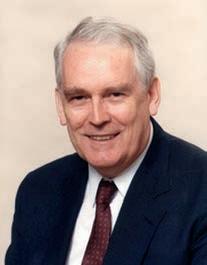
The Revd Professor B.A. Gerrish, STM, PhD, DD, (1949) aged 93. Brian Gerrish was born in London in 1931. He was baptized in the Church of England, and his childhood was marked by wartime evacuations and the London Blitz. He attended Dulwich College and came to Queens’ to study Classics in 1949. He was a member of the Boat Club. He decided to seek ordination in the Presbyterian Church and so, after graduation, he stayed in Cambridge to prepare for the ministry at Westminster College, the seminary of the Presbyterian Church in England (subsequently part of the United Reformed Church). He went to the United States with a Fulbright Scholarship to continue his theological education, earning a Master of Sacred Theology summa cum laude at Union Theological Seminary in New York (1956) and a PhD in philosophy of religion at Columbia University (1958). He was ordained in the Presbyterian Church of the U.S.A. and his early ministry included service as Assistant Pastor at West End Presbyterian Church in New York City. His teaching career began at McCormick Theological Seminary in Chicago, where he taught for eight years. In 1965 he joined the faculty of the Divinity School of the University of Chicago and in 1985 he became the John Nuveen Professor of Theology. During his service in Chicago up to his retirement in 1996, he was a formative influence on generations of students and scholars, also serving as co-editor of The Journal of Religion and as a university preacher. Upon his retirement he joined Union Presbyterian Seminary as Distinguished Service Professor of Theology and continued to teach and to mentor students with deep wisdom and grace until 2002. He was a noted authority in dogmatic theology and the history of Christian thought and wrote fifteen influential books, including Grace and Reason, The Old Protestantism and the New, A Prince of the Church, Grace and Gratitude, and Christian Faith: Dogmatics in Outline, as well as numerous essays and edited volumes. He received Fellowships from the Guggenheim Foundation and the National Endowment for the Humanities and a Doctorate of Divinity from the University of St. Andrews. Brian was a Fellow of the American Academy of Arts and Sciences and served as President of the American Theological Society (Midwest Division) and also of the American Society of Church History. He preached and lectured widely and served in several central church roles, most notably for seven years on the Special Committee to Draft a Brief Statement of Faith for the Presbyterian Church (U.S.A.). Colleagues and students alike appreciated his sly, erudite humour and his mischievous wit in his writing, his lectures, and his conversation. He is survived by his wife, Dr. Dawn DeVries, Professor Emerita of Systemic Theology at Union Presbyterian Seminary, by their daughter Heather, by two children from his first marriage, Carolyn and Paul, and by many students and colleagues who will carry forward his legacy of rigorous scholarship and faithful witness.
Professor D.A. Chamberlain, CBE, MD, BChir, DSc, OStJ, KSG, FRCP, FRCA (1950) aged 94. Douglas Chamberlain was born in Rhiwbina, Cardiff, where his father was a coal merchant. His progress at school was very poor and he was 13 before he could read. His parents eventually sent him away to boarding school at Ratcliffe College in Leicestershire. There a teacher realised he was very bright child but had a reading problem, well before dyslexia was a recognised condition. With extra help he was able to pass the exams to come to Queens’ to read Natural Sciences for Medicine. He was active in the Boat Club, despite having difficulty telling left from right. He managed a 2-1, though passing some of the professional exams caused him some difficulty (it is said that he only passed a surgical anatomy exam because one of the examiners mistakenly thought he was the son of a famous physician). He progressed to St Bartholomew’s Hospital in London for his clinical training, qualifying as a doctor in 1956. He remained at Barts for his pre-registration year; it rapidly became apparent that his talents lay as a physician and not as a surgeon. He worked at the Royal United Hospital in Bath and then at the branch of the National Heart Hospital in Maids Moreton, Buckinghamshire, where he studied for his MRCP. For his National Service he was commissioned in the Royal Army Medical Corps and served in Germany. After a spell of chest medicine at the Brompton Hospital, he returned to Barts as a Research Registrar in Cardiology. There was a year’s Fellowship at the Massachusetts General Hospital, working with the cardiac catheterisation laboratory, before he completed his four years as a Senior Registrar at Barts. His work centred around the autonomic nervous system, beta-blocker drugs, and cardiac pacing. From 1970-91 he was a Consultant Cardiologist at the Royal Sussex County Hospital in Brighton. From late 1970 Douglas, together with Dr Peter Baskett (Queens’ 1952, obituary in 2009 Record), introduced in their local areas the advanced training of ambulance personnel in resuscitation, the use of Entonox for pain relief and other life-saving techniques. This initiative had an enormous and transformative impact on prehospital and emergency care and these two Queensmen are considered the founding fathers of the paramedic profession in Britain and Europe. It was whilst teaching doctors, nurses and ambulancemen how to use Electrocardiogram (ECG) machines that Douglas Chamberlain notably developed the ’10 Rules of a Normal ECG’, the foundation for the interpretation of ECGs to this day. He played a major role in the development of the European Resuscitation Council (and edited its official journal Resuscitation), which aims to unify training and practice across Europe, and the International Liaison Committee on Resuscitation. He was also a pioneer in the installation of defibrillators in public places such as stations and football grounds and on aircraft and the training of ordinary people to use them – he had to use one himself when a friend collapsed during a meeting of the local Rotary Club. One tribute said, “He didn’t just save lives, he transformed how we save them”. In 1988 he was awarded a CBE. He was an Honorary Advisor to both the South-East Coast and London Ambulance Services and well into his late 80s made himself available night or day to answer calls from paramedics. He was an Honorary Fellow of the College of Paramedics. He co-edited an important textbook on resuscitation medicine and advanced life support, Cardiac Arrest: The
Science and Practice of Resuscitation Medicine and published over 200 papers. He was the winner of the 2008 British Medical Association Cardiology Prize. A Roman Catholic all his life, he was a committed member of the Church of the Sacred Heart in Hove. In 1989 he was appointed an Officer of the Order of St John by the Pope, and he also became a Knight of the Order of St Gregory the Great. He was awarded Honorary Doctorates of Science by the Universities of Sussex (1989), Hertford (2003) and Coventry (2008). After formal retirement, he continued as an Honorary Consultant at Brighton and was also appointed Honorary Professor of Resuscitation at the University of Wales in Cardiff. He married Jennifer Ellison in 1958. She survives him, along with their two daughters, Mary and Frances, and two sons, Peter and David.
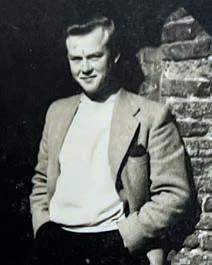
Dr R. Marsh, MB, BChir, MRCGP, DRCOG (1952) aged 91. Robin Marsh was born in London to Dr Frank and Mrs Margery Marsh in 1933. He spent his early childhood in Persia, where his father was Director of Pathology for the Anglo-Iranian Oil Company, later British Petroleum. While there, according to family lore, his father saved the Shah of Persia’s life, having been called in at the eleventh hour by the palace. Robin attended Repton School in Derbyshire where he read Natural Sciences for medicine. He completed his training at Guy’s Hospital in London, qualifying in 1959, and became a houseman at Lewisham General Hospital. In 1954 he had met Heather Vince, a trainee midwife at Addenbrooke’s Hospital – they were married in 1959. Two daughters, Fiona and Elizabeth, arrived in 1961 and 1965. In 1962 he entered general practice, joining a surgery in Hedge End, outside Southampton. After only six months, the senior partner unexpectedly announced that he was moving to Australia and offered him the practice. Robin accepted and the family moved into the premises, living ‘above the shop’. He was part of the generation of GPs that thought little of working 60 plus hours a week, providing home visits at all hours. He applied formidable energy and intellectual curiosity to his work and patients. Colleagues held him in great affection and report that he was invariably late for meetings because he had always “squeezed in another visit on the way”. As the practice grew more space was required, and the family moved out. By the time Robin retired at the age of 66, the practice had at least six doctors working in it, as well as support services. One of the practice buildings was named in his honour and ran as a teenage drop-in-centre for nearly 30 years. Robin was extremely proud of the surgery and that it was held up as an example of best practice. Over the years he also raised a huge amount of money for patients who needed additional support in terms of specialist equipment. He had a particular interest in diet as a preventative measure to ensure good health. The local health food shop made a good living on its bran sales as he directed everyone to buy bran as a part of his special muesli recipe. “He was a great believer in
Fybogel and surely must have prescribed more than any other GP!”, recalls a former colleague. Heather died of leukaemia in 2011. Robin served on the board of Queen Alexandra Hospital, Portsmouth, and later had a renal transplant there. He is survived by his second wife Joyce, whom he married in 2015.

The Revd G.C. Galley (1953) aged 91. Giles Galley was born in 1932 in Oakington Vicarage, Cambridgeshire. His father the Revd Canon Leonard Galley (1919) was the Vicar – Oakington is a Queens’ College living. The family subsequently moved to the parish of Whaddon, near Royston and Bassingbourn Aerodrome. When the War began, Giles became an expert aeroplane spotter and could identify anything in the sky. He was sent to a prep school near Woburn Sands at the age of 7. He was a very shy little boy but settled in quite well. His father moved to St Neots in 1943 and there Giles became interested in bell ringing, an abiding interest for the rest of his life. He won a foundation grant to attend Marlborough College, where he excelled in classics and maths. He was also musical and was the chapel organist. He came to Queens’, after National Service (during which he trained as a Russian interpreter), with an exhibition to read Classics. At Cambridge he pursued his interest in bells in the company of the Society of College Youths. He memorably brought some of them to St Neots in 1955 to ring for his sister’s wedding – a peal which lasted for three hours! After graduating he trained for ordination at Lincoln Theological College and was ordained deacon in 1958 and priest in 1959. After curacies at Great Yarmouth (1958-62), St Nicholas, King’s Lynn, (1962-66) and Leeds Parish Church (1962-69), he was given his first parish at St Michael’s, Orchard Park, near Hull. Giles then became Vicar of Strensall in North Yorkshire in 1979, where he served for 21 years until he retired to Stamford Bridge. He was also Rural Dean of Easingwold. In retirement he resumed his interest in bells, becoming President of the Yorkshire Association of Bellringers and ringing in York Minster, for some time as Captain of the Tower. He also rang in other countries, including Zimbabwe and South Africa. Sadly, partly owing to his long-term ill health, by the time he was 90 he was showing signs of dementia. He spent nearly two years in a care home and died of a chest infection in Scarborough Hospital. His funeral was packed with many bellringers and other close friends with whom he had been very popular. He is survived by his sister and her family.
G.P. Mills (1953) aged 91. Alarmed by the spread of Italian Fascism in Argentina in the late 1920s and early 1930s, Peter Mills’s father (a British citizen) sent his pregnant wife and small daughter to live in England. Peter was born in Bury, Lancashire, only three weeks after their ship from Buenos Aires had arrived in Liverpool. Thus, rather than growing up on the Campo, Peter found himself in Edgware during World War Two, climbing trees in Mill Hill Park to watch Doodle Bug explosions over London. After his mother died when he was 12, Peter threw

himself into sports, becoming Captain of both rugby and cricket at St Albans School and playing for Hertfordshire’s Under-18 XI. Towards the end of his National Service in Egypt, where he served as an engineer with the Royal Artillery, who were supporting the Parachute Regiment, he was invited to try jumping. He loved it and joined the Parachute Regiment as an officer in the Territorial Army. He later parachuted into Cyprus in 1956 and saw further active service over the next few years. He came up to Queens’ in 1953 to read Law. While still playing some cricket and rugby, he took up rowing, winning an oar in the Queens’ First Boat and competing at Marlow and Henley in 1954 as part of a successful Queens’ crew. On graduation, Peter initially played for the Wasps’ University side. He played cricket into his early seventies. Joining the Royal Sun Alliance Insurance Company as an investment analyst, he qualified as an actuary and joined the stockbroking firm Capel Cure Cardon. One of the earliest investors to understand the potential of the Australian mining industry, he personally went down the mine shaft at Kalgoorlie on a six-week visit to the continent in 1968. In 1970 he set up the equity department at Gilbert Eliott & Co, the fixed interest stockbroker. Peter built up the firm’s expertise in North Sea Oil stocks, helping several companies, including London and Scottish Marine, to finance exploration. Shortly before financial deregulation in 1986, Girozentrale Vienna (now Erste Bank) acquired Gilbert Eliott. Peter became joint Managing Director of the joint venture, and a frequent and enthusiastic visitor to Austria. As the traditional advisory relationship between stockbroker and client came under pressure, he decided to retire relatively early in 1990. Peter was a founding director of the Golf Fund, which invested in golf course development in the U.K., and was Senior Treasurer of Ashridge Golf Club where he played well into his eighties. A childhood illness, probably rheumatic fever, led to aortic valve problems which accelerated Alzheimer’s Disease, which he craftily concealed for several years in his eighties. Despite this, he remained agile and relatively fit and derived considerable joy from the younger members of his family. He retained his dry sense of humour and kindness and courtesy. Peter married Anne Larsson in 1959 and is survived by his children Heather and Stephen, five grandchildren and two great-grandchildren.
Dr W.R.S. North, MSc. PhD (1953). Aged 90. Bill North came up to Queens’ as an Entrance Scholar from Malvern College in 1953. He read Mathematics and went on to become a maths teacher at schools in Zambia and the UK. Later he studied part-time for a PhD at the University of London and became an epidemiologist with the Medical Research Council He worked for the MRC until his retirement. He then spent a couple of years teaching in Botswana, before settling in Dorchester. He retained an interest in maths, and statistics in particular, throughout his retirement, and was active in the Church as well as in many pacifist societies and other charities. He will be much missed by his family and his many friends in
Dorset. His father, John North matriculated at Queens’ in 1913 and his son Nicholas D North in 1980. A cousin, Dr Michael R North (1958) was also at the College.
Dr R. Fields, PhD, CChem, FRSC (1954) aged 91. Roy Fields was born in Gainsborough, Lincolnshire, in December 1933. As a boy and young man he sang regularly with the church choir. He attended Queen Elizabeth High School, Gainsborough, with a state scholarship. For his National Service he served in the RAF as a fighter control officer, a job which he enjoyed immensely, so much so that he had to decide whether to stay in the RAF or go to university. He opted to take up his place at Queens’ to study Natural Sciences, specialising for Part II in Chemistry. At College he was an active member of the Christian Union, of the D Society and of the Milner Society for Natural Sciences. He arranged to do a doctorate in the Department of Chemistry with Robert Haszeldine (Fellow 1954-57), who was then appointed as a professor at the University of Manchester Institute of Science and Technology (UMIST). Roy went with him to Manchester to complete his PhD. He joined the lecturing staff at UMIST and later became a Senior Lecturer there. Many of his students have described him as a true gentleman who was always ready to help if they had problems. He was a Chartered Chemist and a Fellow of the Royal Society of Chemistry. He attended church regularly until he was too infirm to do so. He met his future wife, Joan, whilst babysitting for mutual friends. They married in 1964 and had 2 children, Mark and Alison. Roy was very proud of his seven grandchildren, three are medical doctors in hospitals, three are currently undergraduates and one is studying for a DPhil at Oxford. He died suddenly and peacefully, sitting beside his wife of 61 years. He always said he was proud to have attended Queens’ College.
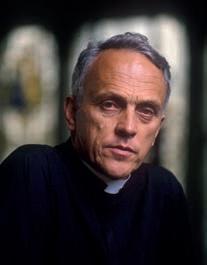
The Revd D.St J. Reeves, MBE (1954) aged 90. Donald Reeves was brought up in Chichester, the son of Barbara and Henry Reeves. His father was a garage proprietor, and he was sent to Sherbourne School in Dorset for his education. He was commissioned in the Royal Sussex Regiment for his National Service, which he completed before coming up to Queens’ in 1954 to read English. He was an accomplished organist and particularly enjoyed playing Bach. After College, he joined the British and was sent to lecture in Beirut (where he became acquainted with Kim Philby, unbeknownst to everyone at the time one of the ‘Cambridge 5’ Soviet spies). Neither of his parents were churchgoers, though there is a story that, as a youngster, he used to preach sermons to the family cat, so his decision to train for the Anglican priesthood was an unwelcome one for his family. He attended Cuddesdon Theological College, near Oxford, and was ordained deacon in 1963 and priest in 1964. He served his title as Curate of All Saints with St Philip, Maidstone. He was recruited in 1965 by the Bishop of Southwark, Mervyn Stockwood, to be his Domestic Chaplain. Stockwood was gathering around him a group of liberal and radical clergy later known collectively as the
‘South Bank Religion’. In 1968 Donald took a sabbatical year to work in Chicago with black civil rights activists at an urban ministry social project. The experience further radicalised him and he returned to England as a firm supporter of women’s ordination and gay rights, of ethnic and gender equality in the church and of liberal theology. From 1969-80 he was Vicar of St Helier in South London, before moving into the centre of the city as Rector of St James’s, Piccadilly. The church had been in decline, more used to society weddings than social activism, but under his leadership it became a hotbed of radical Christian thought. The church welcomed those of other religions and offered a warm sleeping place to vagrants. He began with a demanding programme of prayer, proclamation, and peace-making Though still Church of England, St James’s was international, inter-ethnic, inter-sexual, and interreligious. Street people rubbed shoulders with intellectuals. Many political figures, of every persuasion, were invited to speak at the church, even senior figures from the Soviet Union who were invited to discuss peace with their Western counterparts in the Rectory. He had, however, a knack of making friends with people who radically disagreed with him. Good-looking and highly sociable, Jilly Cooper is said to have called him a “dishy vicar”. He was acknowledged as one of the leading members of a socially active and progressive group of Anglican priests in London in the 1980s. When the anti-apartheid campaigner Trevor Huddleston returned to England from his post as Archbishop of the Province of the Indian Ocean, Donald gave him a home at the Rectory. On retirement in 1998 Donald, and his partner the artist Peter Pelz, set up the ‘Soul of Europe Project’ to try to promote ecumenism and interfaith reconciliation between members of antagonistic faiths. His work centred on the Balkans. He had some success persuading, for instance, local Kosovan authorities, fiercely Muslim, to enter into dialogue with the large Serbian monasteries, equally fiercely Orthodox Christian, in their midst. His biggest project was the rebuilding of the Ferhadija Mosque in Banja Luka in Bosnia, destroyed by the Serbs and then rebuilt by them with Turkish money. He was awarded an MBE in 2008 for interfaith work, conflict resolution, and peace building in Bosnia. In 2000 he preached in Queens’ Chapel lamenting the failure of the radical, theologically very liberal, wing of the Church of England to make much progress. Margaret Thatcher had called him a very dangerous man, so that is what he called his autobiography. A Very Dangerous Man was published in 2009. His books also included Making Sense of Religion (1989) and Down to Earth, a New Vision for the Church (1996). He and Pelz retired to Crediton in Devon. The activities of Soul of Europe were severely curtailed by Covid and the loss of Government funding is likely to bring about its close, a state of affairs which profoundly depressed Donald in his final years.
J.P. Sanders, FRICS (1954) aged 91. John Sanders was born in Cardiff in 1934, the son of Cliff and Renée Sanders. At Cardiff High School he honed his skills as scrum half for the 1st XV and opening batsman the 1st XI. He captained the Cardiff Schools U16s Cricket Team. He then spent two years with the Royal Engineers as part of his National Service based in Worcester and Camberley before becoming Movement Control Officer posted to Belfast. He came to
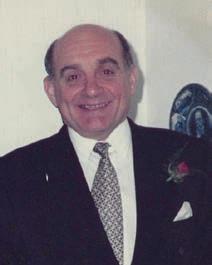
Queens’ in 1954 to read Land Management, one of several Cardiff High School pupils who came up to Queens during that era. John often mentioned his years at the College were among the happiest of his life. Despite the calls of the rugby field and the Anchor Inn, he graduated with a respectable 2:1. He captained the 1st XV at Queens’ in his final year and continued his playing at London Welsh thereafter. He always regretted not gaining a Blue. After College, he lived and worked in Nigeria as Land Officer for the Nigerian Railway Corporation, based firstly in Lagos and then in Enugu. He was awarded an international rugby cap for Nigeria (against Ghana). John became a Member, and later Fellow, of the Royal Institution of Chartered Surveyors, working at both Gerald Eve and Stephenson and Alexander in Cardiff before he set up his own real estate agency practice. He was a keen golfer, captaining Cardiff Golf Club in 1972 (the youngest ever captain still to this day) and Royal Porthcawl Golf Club in 1994. In 1964 at Cardiff Golf Club, John and his brother Roger achieved the highly unlikely feat of two brothers getting holes-in-one during the same club competition. John lived a full, varied and wonderful life, always known for his cheeky smile and a sparkle in his eye. He is survived by his wife, son and two daughters, stepdaughter, stepson, and 9 grandchildren.
D.E. Sibson, MB, BChir, FRCS (1954), aged 88. Derek Sibson was born, the oldest of four, in 1936 in Croydon to the Revd Edward Sibson (Queens’ 1928) and his wife Mary. The family moved to Histon, near Cambridge, when his father became vicar there. Later they moved to St Andrew the Less with Christ Church, Cambridge and, finally, to Little Shelford. His former home, the old Christ Church Vicarage at 73 Maids Causeway, is now owned by Queens’. Derek was a keen tennis player and an accomplished pianist and was often found occupied with some form of arts and crafts, making balsa wood aeroplanes or intricate marquetry pictures or learning calligraphy. No doubt the manual dexterity required for these activities serving him well in his later profession as a surgeon, and certainly in his numerous DIY projects around the family home. He gained a scholarship to the Perse School, Cambridge, and came up to Queens’ in 1954 to read Natural Sciences for Medicine. At College he expanded his racquet sports to badminton and squash and took up coxing. The annual family outing to watch the May Bumps was something that he continued into his adult life and for as long as he was physically able. He went to St Bartholomew’s Hospital in London for his clinical training. He subsequently rotated around a number of training posts in South London Hospitals, before settling on a career in General Surgery. In 1972, he became a Consultant General Surgeon at Kettering General Hospital, Northamptonshire, and remained in this post until his retirement in 2001. He was Chairman of the Surgical Division 1982-1990 and Clinical Director of the Surgical Directorate 1990-1994 at Kettering. He served as an honorary clinical teacher at Leicester Medical School from 1978-1998, for 8 years of
which he was an examiner in Surgery. He was also an examiner in Surgery for the FRCS and MRCS at the Royal College of Physicians and Surgeons of Glasgow. He authored a new chapter and rewrote another two chapters for Macfarlane and Thomas’ Textbook of Surgery (5th Edition, 1984). One of Derek’s great passions in life was church bellringing, learning in 1956 at Little Shelford. He rang his first peal in 1957 and rang a total of 4539 across his life of which he conducted 4014. He is one of only two people to have conducted more than 4000 peals and remains the leading conductor on tower bells. Derek served as Junior Steward, Senior Steward, Secretary and Master of the national bellringing society, the Society of Royal Cumberland Youths, and represented the Society on the Central Council of Church Bellringers continuously from 1963-2023. He was a member of the Records Committee of the Council for over 30 years, becoming Chairman in 1975. He then went on to serve as Vice-President (2002-2005) and President (2005-2008) of the Central Council. He played a leading role in numerous bell restoration projects over the years, including restoration or replacement of the bells at Shoreditch, Spitalfields and St Martin-in-the-Fields churches in London, as well as several projects closer to home in Northamptonshire. In 1962 Derek married Jane Langton, whom he met, very appropriately, in a belltower in London whilst he was a medical student at Bart’s. Bellringing was soon to become a major part of their married life, taking them all over the country. They had four children, Andrew, Richard, Nicola and Keith, though Richard died of leukaemia aged 3. Both Andrew and Keith followed in Derek’s footsteps into medical careers, and Nicola into medical research. More importantly all three learnt to ring and a family peal was rung at their local tower of St Botolph’s, Barton Seagrave, in 1987. After a 20-year gap, Jane revived her bellringing career and, with a little judicious juggling, they managed to ring Jane’s 3000th peal and Derek’s 4000th as conductor at the same time. After Derek retired, bellringing was to take them both abroad on numerous trips to the United States of America, as well as Australia, New Zealand, Canada, the Netherlands and Belgium. Derek was also an enthusiastic stamp collector, specialising in stamps of Great Britain, and amassed a huge collection containing a few rarities notably (to his enduring delight) an Edward VII 2d Tyrian plum. He was an avid ornithologist, spending many a holiday taking huge numbers of wildlife photographs – second only to his vast collection of photos of church belltowers. Most of his childhood holidays were spent in Dorset at Crusader (now Urban Saints) camps. Later family holidays were spent on or around the Isle of Purbeck in Dorset and these later resumed to include his grandchildren, Benjamin, Adam, Ella and Jack. Derek’s ashes are now interred below the church tower at St Botolph’s, so that he can continue to listen to the bells.
G.E. Gilchrist, TD, FCIB (1955) aged 90. Graeme Gilchrist was born in London and, apart from a brief evacuation to Scotland during the Blitz, boarding school in Dorset, National Service in Germany and university at Cambridge, spent his whole life in London. He went to Sherborne School in 1948 and became Head Boy. He formed a lifelong attachment to the school and was later a Governor (1985-2004) and helped to establish the Sherborne Foundation. After
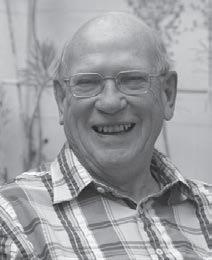
National Service in postwar Germany, he came up to Queens’ to read Economics. Graeme’s father had intended him to go to Corpus Christi College – an old Shirburnian, Michael McCrum, was then a Fellow of Corpus Christi, but did not think Graeme was ‘university material’. At Queens’ Graeme got a 2.1 and was Vice-Captain of Rowing. He was very proud of having rowed at Henley and returned to Queens’ to coach for a number of years. On graduation he started a career in the City. After 12 years at Barings Bank where he was told, “You have to realise, dear boy, that you are going nowhere if your name isn’t Baring”, he joined The Union Discount Bank of London, became Managing Director, and was closely involved in the ‘Big Bang’ of 1986 which revolutionised the way the City operated. Alongside his life in the City, Graeme was a member of The Honourable Artillery Company and rose to become its Commanding Officer 1970-72 and thereafter Regimental Colonel. He was later appointed Honorary Colonel Commandant of the Royal Artillery. He was Master Gunner within The Tower and served on the HAC Court of Assistants (established in 1616 to manage the civil and financial affairs of the Company). He was also a lowly pikeman in the Company of Pikemen & Musketeers, a ceremonial unit, formed of HAC veterans, tasked with providing a bodyguard and escort for the Lord Mayor of London when on official business. As a natural crossover from his life in the City, he also served as a financial advisor to the Royal Artillery Benevolent Fund, the HAC Benevolent Fund, as a Commissioner of The Royal Hospital, Chelsea, The Royal Hospital for Neuro-disability, and The Chindits Old Comrades Association (now The Chindit Society). He was also an Honorary Fellow of City University. He had many passions in life, notably Churchill, cricket, golf, history, Arsenal Football Club, Trollope, Eric Morecambe, Glyndebourne, tennis, classical music and Tommy Cooper. He is survived by his wife Susie, whom he married in 1981, son Thomas, stepson Barney and two grandsons.
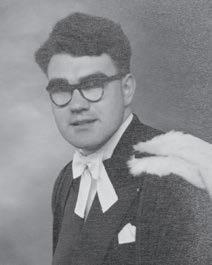
Dr I.B. Lawrence, PhD (1955) aged 90. Ian Lawrence was born in Raynes Park. He stayed in London during the War and recalled the sight of Spitfires and other planes overhead as he celebrated his 7th birthday on Battle of Britain Day, 15 September 1940. He went on to attend Raynes Park County Grammar School, also attending the Trinity College of Music Junior Department on Saturdays. These were happy days, and, when not introducing the music of Edmund Rubbra to the school Gramophone Society, he would rush to the Oval to watch his beloved Surrey dominate the County Championship. He completed his National Service with the RAF, spent at the Worth Matravers radio station. His place at Queens’ was
delayed by another year (and the demands of the Latin entrance paper), time gainfully spent working at the Merton & Morden Central Library. He therefore arrived at College in 1955 with more experience of life than the typical school-leaver. He read Part I Music, followed by a Part II in Geography. He threw himself into College and University music, becoming VicePresident (the equivalent of President today) of the St Margaret Society. He conducted the College Choir, and, in giving a solo spot to one Margaret Jones from Homerton College, he met his future wife. On graduating he became a teacher, first at Sevenoaks School, where he taught Music, English and Geography. Four years later he moved to Wallingford Grammar School as Director of Music. After that he took up a position at Maria Grey College near Twickenham (which later became the West London Institute of Higher Education), starting as a Lecturer and rising to be the Head of Education. He worked there for 21 years until taking early retirement in 1987. In the meantime, he gained his PhD from Leeds University in 1975. His thesis was published, Composers and the Nature of Music Education. This is just one of over 30 entries in the British Library Catalogue which range from music to music education to education to local history. Interest in the latter was sparked by the move from London to the Dorset village of Fontmell Magna, the ancestral village he had discovered during his National Service in Dorset, where he chaired the Parish Council and founded the Village Archive Society. A second retirement brought him back to Cambridge, attracted by the University Library, the musical life of the city, and a growing number of grandchildren. In 2008 he and his wife Margaret celebrated their 50th wedding anniversary in Old Hall, and he continued to enjoy visiting Queens’, especially for annual garden parties, attending his last one shortly before his 90th birthday in 2023. He is survived by his wife Margaret and by their three sons Stewart, Andrew and Christopher (Queens’ 1984 – currently the Bursar of Newnham College), and their five grandchildren.
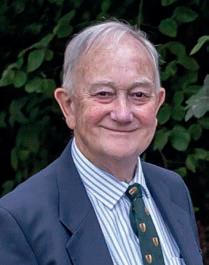
C.W. Love (1955) aged 89. Born into a working-class environment in North London, within walking distance of his beloved football team Tottenham Hotspur, Charles Love excelled in studies and won a scholarship to Mill Hill School. Following National Service at RAF Duxford, working on aircraft radio, he came to Queens’ to read Natural Sciences, achieving a double first. He then started a PhD in organic chemistry, at Oriel College, Oxford, believed to involve the first isolation of a tannin. Before completing his doctorate, he joined Imperial Chemical Industries as a plastics research chemist, which included a spell in Russia. ICI employed him for the full extent of his career, for the first 15 years at Wilton on Teesside, and the following 20 years as a planner from Welwyn Garden City. Charles spoke of his time at Queens’ with great fondness, especially the friends he made. He opened the batting for the cricket team, played hockey and lacrosse for the College, and was actively involved in bridge.
Antics included an incident dropping water bombs on tourists from a room overlooking Queens’ Lane, which resulted in the Senior Tutor stating that he had no option but to inflict a severe disciplinary sanction, requiring confinement to College for the entirety of the remainder of term – fortunately for Charles and his co-offenders, this was a matter of another 45 minutes! Charles’ enthusiasm for Queens’ meant he was thrilled when his son, James Love (1984), obtained a place to study Natural Sciences – they even shared a common tutor, the much loved and respected Dr Ken Machin. Other family Queens’ alumni include his great uncle, William Herbert Colton (1919), and his great nephew, Dr James Fearnley (2008). His hobbies included the study of lepidoptera. Charles passed away peacefully in September 2024 as a result of advanced prostate cancer. Maintaining his mental alertness and dry wit throughout his illness, his last year was spent in a care home in Harrogate (his hometown since 1997). Margaret, his wife of 60 years, lived in the same care home, on the dementia floor above his ground floor room, and he would make the journey to see her daily, despite his extreme frailty. One of his carers burst into tears on hearing he had passed away, saying he was “the kindest gentleman she had ever cared for, never once seeing him cross or upset” – this encapsulated how he had lived his life. As well as Margaret, he is survived by two children and four grandchildren.
The Revd M.R. Smith, ARCM, ARCO (1956) aged 88. Michael Smith was born in and brought up in Berkhamsted, Hertfordshire, where his father was a builder. He attended Berkhamsted School and was assistant organist and choirmaster of the local parish church. Before university he spent a year at the Royal School of Church Music. He was elected to the Phillips Organ Scholarship at Queens’ and arrived in 1956 to read for the Music Tripos. His duties involved playing the organ for services and also leading, organising and training the Voluntary Choir, both of which duties he performed assiduously and with considerable success. As an undergraduate he was fully involved in both the musical and religious life of the College and the University and in 1958 switched to the Theology Tripos for his third year. As well as the St Margaret Society he was active in Bats. On graduation he worked for a while as a teacher, notably at the Choir School at Canterbury where he was able to play the cathedral organ on occasion. But he was committed to taking Holy Orders as an Anglican clergyman. He went to Cuddesdon Theological College in 1964 and was ordained deacon in 1965 and priest in 1966. He was Curate of St Peter’s, Redcar in Yorkshire, before becoming Vicar of Dormanstown in 1970. In 1973 he moved to Worcester Cathedral as Precentor. He was Team Rector of St Barnabas with Christ Church, Worcester, 1977-83, and also Rural Dean of Worcester East. From there he moved to the Diocese of Carlisle as Vicar of Eskdale, Irton, Muncaster and Waberthwaite. From 1987 to 1993 he served as Chaplain of Uppingham School. Finally, he was Priest-in-charge of Stoke Lacy in Herefordshire and Diocesan Schools Officer until he retired in 2003. He continued to assist at churches around Weobley in Herefordshire after his formal retirement but eventually moved to Abergavenny. He continued to play the organ and the piano and to sing in various choirs into old age. In 1999 he married, as his second
wife, Jean Cooper, an examiner for the Royal Schools of Music, and enjoyed accompanying her to many countries in the course of her work. Jean predeceased him but he is survived by his three children from his first marriage, Adam, Ben and Rachel.
Professor G.A. Starr, PhD (1956) aged 89. George Starr was born in New York City in 1934 and attended Walnut Hills High School in Cincinnati, Ohio. After a B.A. from Yale University, he came to Queens’ to read English as an affiliated student and graduated in 1958. He went on to study for a PhD at Princeton University. In 1962 he was appointed as an Assistant Professor in English at the University of California, Berkeley. He was a lynchpin of the Department of English at Berkeley for almost 60 years until his retirement in 2021. He was one of the world’s leading scholars of Daniel Defoe, publishing two important books, Defoe and Spiritual Autobiography (1962) and Defoe and Casuistry (1971), as well as editions of many of Defoe’s works. His edition of Moll Flanders is considered standard in the field. He also published History and Reality of Apparitions (2005) and Religious Courtship (2006) and edited Serious Reflections During the Life and Surprizing Adventures of Robinson Crusoe. He published many articles on Defoe and on eighteenth century British literature. He won a Guggenheim Fellowship. He taught a variety of courses at Berkeley, ranging from eighteenth century literature to American humour, Utopias and Dystopias, to modern Californian novels and films. He also served the University in several administrative roles, most notably as Director of Graduate Studies in the English Department and as Member and Chair of two committees of the Academic Senate – the Committee on Budget and Interdepartmental Relations and the Committee on Committees. He was part of the University of California-wide taskforce which set up the University of California Merced, the tenth and most recent campus in the University of California system. His most distinctive and substantial service was to the University Library. He served on the Committee as both chair and member for five periods (1970-71, 1974-1976, 1977-1979, 1998-2001 and 2015-16). He also made major contributions to the English Department Library, shaping and guiding it for decades. He continued to maintain the library beyond his retirement and the library is now named in his honour. Colleagues and former students celebrated his contributions to scholarship, to teaching and to administration by publishing Reflections on Sentiment: Essays in Honor of George Starr (edited by Alessa Johns, published by the University of Delaware Press in 2016). He is survived by his wife, Julia Bader, and two children, Stephen and Klara.
The Ven. C.J. Hawthorn (1957) aged 88. Christopher Hawthorn was the son of the Revd John Hawthorn, for 35 years Vicar of Chatteris in the fens. He was educated at King’s College Choir School, then Marlborough College, where he excelled on the sports field as well as academically. He came to Queens’ in 1957 to read Mathematics. He played in the Cupperswinning First XI hockey team and was also a tennis player and member of the Kangaroos. He served as Honorary Secretary and Vice-President of the United Clubs. He was an active member of the Chapel congregation and switched to the Theology Tripos for Part II. After graduation, he went to Ripon Hall in Oxford to train for the Anglican ministry and was
ordained deacon in 1962 and priest in 1963 in the Diocese of York. He was to exercise his whole ministry in Yorkshire. He started as Curate of St James, Sutton-in-Holderness, a suburb of Hull (he famously scored a century for the local cricket team), until his appointment as Vicar of St Nicholas, Hull. Shortly after he arrived, the church had to be demolished because of subsidence. The Diocese were considering carving up the parish, but Christopher set about raising the money to build a new church, mainly by launching a catering company, staffed by church ladies, for cut-price wedding receptions and the like. He spent many nights on the end of the telephone as a Samaritan and worked a lot with the homeless. From 1972-79 he was Vicar of Christ Church, East Coatham, near Redcar, once taking a wedding wearing hockey kit under his robes. He then embarked on a 12-year stint as Vicar of St Martin-on-the-Hill, Scarborough. From 1982-91 he was also Rural Dean of Scarborough. He was Rotary President in Scarborough and chaplain to the summer shows. He became a Canon and Prebendary of York Minster in 1987. He liked to keep up to date with theology and was widely read and a serious thinker. He quietly took the marriages of people whose previous marriage had sadly failed and set his face against restrictive church practice and prejudice. He was an early supporter of the ordination of women. His churchmanship was middle of the road; dynamic and clear-headed about what needed to be done, his ministry was inclusive and always pastoral. In 1991 he was appointed Archdeacon of Cleveland. He also served as Chair of the House of Clergy of the Diocesan Synod. As archdeacon he has been described by the former Bishop of Whitby as, “much respected, always welcomed, law abiding but never rigid, traditional but open to new ideas, deeply spiritual but with a great sense of humour, serious in thought but with a lightness of touch”. He was ably supported in his ministry by his wife Margaret. They had four children, James, Richard, Andrew and Helen and eventually 11 grandchildren, who all survive him. Family holidays were usually spent beneath Wetherlam in the Lake District, helping on the local sheep farm, walking and climbing mountains and engaging in fiercely contested board games. Chris was a keen gardener and enjoyed watching sport on TV. He retired in 2001 to Strensall, then to Haxby, near Harrogate, and remained active in the Diocese with permission to officiate. He revived a boyhood hobby of philately and contributed learned articles on the stamps of the Levant. He will be much missed by a galaxy of friends from Lakeland shepherds to archbishops.
The Revd L.A. Hubbard (1957) aged 88. Laurence (Laurie) Hubbard was educated at St George’s School, Harpenden, and then, in common with most of his generation, spent two years in National Service. This was mostly spent in Singapore with the Royal Army Service Corps. He was the son of The Revd John Waddington Hubbard, FRGS, (Queens’ 1913) and followed his brother John Waddington Philips Hubbard (Queens’ 1955) to the College. He always looked back at his time at Queens’ with great affection. He started reading Law but found that it was not to his taste. He then turned to Theology. No doubt it was at about this time that he realised that he had a vocation for the Anglican priesthood. He always found the late Henry St John Hart (who always referred to him as “brother of Hubbard, son
of Hubbard”), the then Dean, immensely supportive. He went on to Wycliffe Hall in Oxford for ordination training and was ordained deacon in 1962 and priest in 1963. His first curacy was at St Thomas à Becket, Widcombe, Bath. It was here that he met Wendy, a chartered physiotherapist. They married in 1964 and were to spend over sixty years of married life together. For a great deal of his clerical career Laurie worked abroad. After training at the Church Missionary Society’s Trinity College in Chislehurst in 1965, he served with CMS in Kenya for several years. He was Missionary Vicar at St. Peter’s, Nyeri, and at St George’s, Nanyuki. He returned to England in 1973 as Vicar of St Mary’s, Pype Hayes, Birmingham, moving in 1979 to be Priest in Charge of St. Augustine’s and St. George’s, Colegate, Norwich. From 1985-93 he was CMS Area Secretary for Canterbury and Rochester. He then spent four years as CMS Chaplain in Damascus, Syria, before serving as The Mission to Seafarers Chaplain and Vicar at Aqaba, Jordan, until 2000. With his innate sense of fair play and concern for the underdog he found considerable fulfilment in offering solace and a listening ear to seafarers who perforce had to spend many months away from family and home. He finally retired to Quedgeley in Gloucestershire. Laurie was a devoted family man. He and Wendy had three sons and five grandchildren, of whom he was immensely proud. His recreations included reading, walking, gardening, carpentry, music, watercolour painting and model railway. He particularly enjoyed reading in and studying theology and biblical studies and Hebrew. After a long retirement his health began to fail, and he died peacefully on Saint Patrick’s Day 2025.
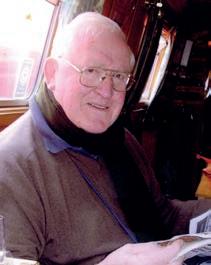
Lt Col. H.R. Nye (1957) aged 88. Humphrey Nye was born in Beckenham, South London, although his family moved to Dulwich shortly after the War. In 1946 Humphrey followed his elder brother David to Dulwich College, where he was a keen member of the CCF. David tragically drowned aged 16 while the boys were away together on a sailing camp in North Wales. Humphrey went on to become Company Sergeant Major of the CCF, played in the unbeaten 1953-54 1st XV, and was School Captain 1954-55. In common with many of his generation, he undertook National Service before university, in his case with 19th Signal Regiment in Singapore and Malaysia. This was followed by further service as a Territorial in the Royal Signals and in the Artists Rifles. He rose to the rank of Lieutenant Colonel in the Territorial Army. On going up to Queens’ in 1957 to read Mathematics, Humphrey continued his passion for rugby and sport in general, vice-captaining the college XV on their 1960 tour of France and also joining the Boat Club and the Kangaroos. After graduation in 1960 he stayed on at Cambridge to train as a teacher, carrying out his teaching practice at Haileybury. He was offered a job at the school and remained there for his entire career. At Haileybury, he was swiftly appointed an assistant housemaster and, after a few years, took over the Haileybury
CCF, serving two periods as Commanding Officer: 1970-1978 and 1990-1992. In between these he served for twelve years as Housemaster of Melvill. As Head of Maths he initiated computing at Haileybury. He was also master in charge of sailing and coached rugby at all levels in the school. In 1994 Humphrey moved to Shropshire to be closer to other family members who had also migrated from the London area. Early retirement gave him the opportunity to continue his service to the CCF and to travel. He led the Council for Cadet Rifle Shooting under-18s (Athelings) team tour of Canada in 1995 and supervised the UK CCF shooting contingent at the main Bisley meeting from 1997 to 2000. In later years he applied his puzzle-solving skills to family history, and continued to support many societies and good causes, both national and local. Following a gradual, then sudden, decline in his general health he moved into a nursing home in May 2024, passing away peacefully 6 months later. To the last, he was always good company, a generous host, and a dutiful and committed servant to everything in which he believed.
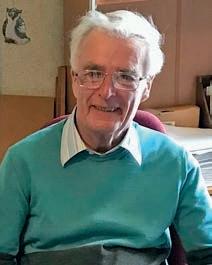
Professor N.K. Rutter, PhD (1957) aged 85. Born in south Manchester, Keith Rutter had a very happy childhood. He was the son of Polly Faulkner and George Rutter, an engineer. After a scholarship to Manchester Grammar School, he came up to Queens’ in 1957 to study Classics. At College he discovered a love of rowing, a pastime he continued to enjoy, eventually on rowing machines in the gym, until he was 84. He graduated with a first and two Latin prizes. He completed his PhD at the University of London in 1969 and published the work on the coinages of ancient Naples and Campania in 1979. This remains the standard work, as does the volume of Historia Numorum covering the ancient Greek coinages of Italy (2001). After temporary positions in Vancouver, Bristol and Liverpool, Keith took up a permanent post in the Department of Greek at the University of Edinburgh in 1971. He stayed there until his retirement in 2004, having been awarded a Personal Chair in Greek History and Numismatics in 2002. He was a devoted servant of the University, an inspirational teacher, and an influential scholar who published widely on aspects of ancient history and historiography beyond numismatics. He was a passionate enthusiast of Greek culture in all its phases, and a huge source of support to generations of students and colleagues around the world. The importance of Keith’s contributions in the field of Greek numismatics, particularly on the coins of the Western Greeks, is immense. He also wrote a more general book, The Greek Coinages of Southern Italy and Sicily (1997). After he retired in 2004, Keith continued to teach and write. He remained a highly popular lecturer, frequently returning to teach an honours course on Greek Coins to new generations of students. At his death, the next volume of his work on coins, about Sicily, was almost ready for publication. Two trips to Iran sparked an interest in Achaemenid coinage, the subject of another book that he had almost
completed. He also had a wider interest in Greek coinage and the Greek world: The Archaic and Early Classical Greek World: Using Coins as Sources is in the course of publication. Friends and colleagues are seeing all these books through to publication. In retirement he spent time in Athens, teaching and playing a major role in securing funding for the biannual Leventis Visiting Professorship and Conference at Edinburgh University. He learned Portuguese and visited Brazil three times to teach numismatics in both São Paulo and Rio de Janeiro. He was awarded the Royal Numismatic Society’s Medal in 2020. No one who knew him will forget his gentle, kind and convivial manner. In 1969 he married Wendy Millen, a teacher whom he had met at primary school, and they enjoyed holidays in Iran, Syria and Central America. A gym-goer, rower and mountain walker, he completed the Munros in 1987. With his daughter, Catherine, he enjoyed a number of high-altitude treks in Pakistan, India, Tajikistan and Peru. Wendy and Catherine survive him. He was a keen and key member of the Cambridge Society in Edinburgh, and also the Scottish Hellenic Society. He died at the age of 85 after a short bout of pneumonia.
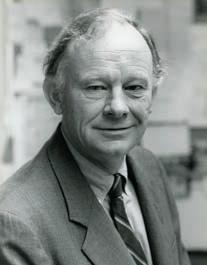
Professor J.M. Swales (1957) aged 86. John Swales, the oldest of three children, was born in Reigate and attended Lancing College before coming to Queens’ to read Moral Sciences (Philosophy). After Part I he switched to Part II Psychology in the Natural Sciences Tripos. After graduation, uncertain as to the course his life might take, he accepted a two-year position in the English Department of the University of Bari in Italy, followed by similar positions in North Africa and Europe. Thus began his career in the field of English language acquisition by non-native speakers. He completed a postgraduate degree in linguistics and English as a second language from the University of Leeds. He eventually settled at the University of Michigan in 1985 where he spent most of his career. As Director of the English Language Institute, he transformed the ELI into an unparalleled ‘English for Academic Purposes’ programme. He was instrumental in creating MICASE (Michigan Corpus of Academic Spoken English) and MICUSP (Michigan Corpus of Upper-Level Student Papers), groundbreaking corpora still widely used by teachers and scholars worldwide. He also served as Professor of Applied Linguistics until his official retirement in 2007 but remained an active scholar as Professor Emeritus, continuing to write, teach, and travel. He submitted his final contribution to the journal English for Specific Purposes in February 2025. He was best known for his groundbreaking work in genre analysis; he leaves behind a legacy of over six decades of work in applied linguistics that has shaped how scholars and educators approach discourse analysis, genre studies, and the teaching of research writing. John authored or co-authored 20 books and around 130 research articles and book chapters. His seminal works include Genre Analysis: English in Academic and Research Settings, Other Floors, Other Voices: A
Textography of a Small University Building, Research Genres and Applications, and the widely acclaimed textbook, Academic Writing for Graduate Students. He received honorary doctoral degrees from Uppsala University (2004) and the University of Silesia (2015). He was a much sought after speaker at conferences around the globe, with well over 300 colloquia, plenaries and talks to his credit. He was also co-editor of English for Specific Purposes from 1986-94. Despite his accomplishments, he was a humble scholar, always giving credit to others when it was due. A masterful teacher and materials developer, John bridged the gap between research and pedagogy – he enjoyed nurturing the next generation of scholars and instructors and was an inspiring mentor to junior colleagues and his doctoral students. He was always generous with his time, talent and intellect. He established the Michigan Morley Scholar Program, which brought together scholars doing outstanding ESP research in places such as Japan, Ukraine, Uzbekistan, Tunisia, Italy and Spain. To relax John was passionate about birding and spotting butterflies. These interests led to his co-authorship of The Birds of Washtenaw County, Michigan and The Butterflies of Our Local Park. When not outdoors, he investigated Honduran postmarks, where he found yet another discourse community, and published his insights in the West Indies Philatelic Study Group Journal. John is survived by his partner Vi Benner, his children Claire, Kirby and Harvey, his grandchildren Maxime, Lucas, Arabella and Margot and his sister, Ann Flack. He will be remembered not only for his scholarly accomplishments, but also for his wit, humour and storytelling – he was a great raconteur and seemed to have an endless supply of stories. He was a deeply kind human being who made a point of welcoming students, friends, newcomers, colleagues and visitors into his home.
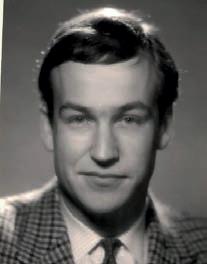
Dr J.C. Meadows, MD, BChir, FRCP (1958) aged 84. John Meadows was born on 25th March 1940, the son of Dr Swithin Meadows, Consultant Neurologist to the Westminster Hospital and the National Hospital for Nervous Diseases. He was educated at Westminster School and came up to Queens’ to read Natural Sciences for Medicine, obtaining first class honours in both Part I and Part II Pathology. He went on to St Thomas’ Hospital in London for his clinical training. He continued at St Thomas’ for his postgraduate training, ending as a senior registrar in neurology. He also worked at the Middlesex Hospital and the National Hospital for Nervous Diseases. In 1972 he worked for a year at the Veterans Administration Hospital in Boston, Massachusetts. He was appointed as a consultant neurologist at St George’s Hospital in 1974, but after a few years, he left to enter full-time private practice in Harley Street. There he built up a large and successful practice and treated many famous patients. In his early 60s, he retired early for health reasons and moved to Shropshire, where he had a house in Ludlow and a small farm in the country nearby. His later
years were beset with cancer and Parkinson’s Disease. He is survived by his widow, Trish, and sons Tom and Christopher; a third son, Richard, predeceased him.
J.R. Brock (1959) aged 86. Richard Brock was born in Bristol, the son of Arthur Brock, a teacher and businessman, and Eileen (née Scudamore). The family soon moved to the edge of Dartmoor. Richard in particular loved being in the countryside, and he collected and housed all sorts of creatures. He boarded at Bryanston School in Dorset, where his teachers encouraged his interest in nature, taking him on trips to study migrating birds and other wildlife. He went on to study zoology and botany in the Natural Sciences Tripos at Queens’, where he was also a successful squash and hockey player. After graduation, he wanted to start communicating his passion for the natural world, so he approached the BBC Natural History Unit in Bristol for a job. Jeffrey Boswall, a natural history radio producer, gave him his first position, as a general assistant. In 1964, when Boswall moved into television, he took Richard with him, giving him his first film to produce, Masters of Movement, which aired on Peter Scott’s Look series. He was a BBC Natural History Unit producer for 35 years and, in particular, had a long and successful working relationship with David Attenborough, starting with Eastward with Attenborough in 1973. This was a series following Attenborough as he travelled around Borneo and South-East Asia. They worked together again on the groundbreaking series Life on Earth (1979), with Richard taking responsibility for the sixth episode and amphibian segment, ‘Invasion of the Land’. He was then given the role of executive producer for the second part of Attenborough’s epic Life trilogy, The Living Planet (1984), surveying the world from an ecological point of view. A highly successful producer, Richard made many other films at the BBC NHU, notably for the Wildlife on One and The World About Us series. During his time at the BBC, Richard became increasingly aware of worrying changes in the natural world. He was upset that this was not being reflected in the films they were making. He left the Corporation in 2006 and set up Living Planet Productions and the Brock Initiative to produce his own films. He made more than 100 films for his Wildlife Winners and Losers series, and wrote a book called Planet Crunch (2021). He very much enjoyed sharing his passions about the natural world and our impact on it. Richard will be greatly missed by the villagers of Chew Magna, in Somerset, where he lived. He made friends all over the world, through film making and conservation, and inspired numerous young film makers, whom he called “bright green sparks”. In 1976 he married Gillie Day; they divorced in 2011. Richard is survived by his sister, Cherry, and his nephews, Julius and William, and niece, Emily.
R. Hughes, LLB (1959) aged 86. Richard Hughes was born in 1938 in Cardiff. His parents were Walter Hughes, a journalist who had served on the Western Front in the Great War as an Artillery officer, and Emily Palfrey. Richard’s grandfather was Thomas John Hughes (“Adfyfr”), a well-known 19th Century political reformist and Welsh journalist. Richard attended the Royal Grammar School, Henley, and then, from 1953, the Cardiff High School for Boys. He played rugby and cricket for the school and in 1956 was elected Head Boy. In 1957 he embarked on two years National Service as a Second Lieutenant in the Welch Regiment. He was posted to
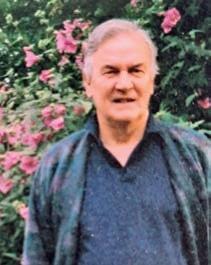
Cyprus for the E.O.K.A. Emergency and then, in late 1958, on to Benghazi, Libya. He came to Queens’ in 1959 to read Law. He excelled, achieving a first-class degree and becoming a Foundation Scholar. He met his wife Marie Rieb, a South African, in Cambridge Public Library in February 1963 after ice skating on a frozen River Cam. His chat-up line was, “Do you fancy some tea” – it didn’t fail. Whilst at Queens’ Richard took an active part in the life of the College as a committee member of the ‘D Society’ (chaired by the late Revd Henry St J Hart), and as a rugby union player for the College until he broke his thumb on the playing field. In his last year he lodged with Sir Frank Engledow, Emeritus Professor of Agriculture, who would regularly wake him up early on spring mornings to view the garden’s first winter aconites, snowdrops, crocuses, primroses, daffodils and tulips, and then make suitable recompense by treating Richard to delicious home-made jams and cakes for breakfast. After completing his LLB at Cambridge, Richard was offered an international law lectureship post at Sheffield University. However, he decided to move to South Africa, settling first in Port Elizabeth and then in Cape Town. Richard held legal advisory posts in Cape Town with the Royal Insurance Group Head Office in Africa and Mutual Life Assurance Co. Ltd Head Office between 1963 and 1966. He also worked as a freelance literary reviewer and opinion columnist, writing many pieces for the Cape Times, Cape Argus and Natal Mercury newspapers. In July 1966 Richard and Marie returned to England to live in Guildford and then Oulton Broad. He spent three years at the College of Law in Guildford, where he studied for the Law Society Finals, gained articles and was admitted as a solicitor. In 1971 they moved to Norton Subcourse, Norfolk. Richard became the Senior Partner in a general practice (Sprake & Hughes) based in Bungay, Suffolk, and Harleston, Norfolk. Under his leadership the firm thrived and attained a reputation for exceptional legal advice and service, especially in family and property law. Offers to merge or join with larger law firms were politely declined. Richard retired in December 1991, enjoying travelling, reading, gardening and visiting the family’s flat in Wanstead, London. Being a prodigious reader, he built up an impressive private library with books on poetry, literature, history, the classics and travel. He was a generous, caring, charming, compassionate, jovial and intellectually brilliant man, with a lively and refreshing sense of humour. His years at Queens’ held a special place in his heart and he viewed himself as a lucky man to have chosen such a very good place to be. He is survived by Marie and their son David.
C.C.A. Glossop (1960) aged 83. Anthony Glossop was brought up in the Peak District and came to Queens’ from Eastbourne College to read Law. He was a keen rugby player at College and was secretary of the Rugby Club in 1962-63. He also rowed three times in the May Bumps for the College 6th Boat. After a short spell in the Metropolitan Police, he qualified
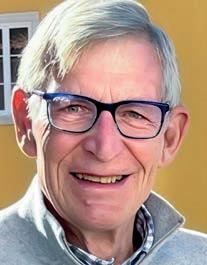
as a solicitor. He worked as Assistant Company Secretary for a firm of specialist engineers, Molins Limited, in London, before moving to Worcester in 1972. There he joined Redman Heenan International, a capital goods engineering group, as a Director. He was not expecting to live in Worcester for more than a few years but, in the event, spent the rest of his life in the city. He became Company Secretary of Redman Heenan in 1975 and took over as Chief Executive in 1982. He transformed the company into a property group and in 1986 it took over Clarke St Modwen Properties Limited. Over the next few years Anthony built St Modwen to become the UK’s leading regeneration specialist. He became non-executive chairman in 2004, retiring in March 2011. While St Modwen developed properties across the UK, the West Midlands remained its heartland, including commercial and housing developments in Worcester. A keen gardener himself, the project of which he was most proud was the restoration of Trentham Gardens, near Stoke-on-Trent, one of the greatest garden schemes of the 21st century. In retirement he remained a non-executive director of Robinson plc, an AIM listed packaging business founded in 1839 by his mother’s family. Anthony was very active in the local community where his property and legal backgrounds proved invaluable. He was a governor and trustee of St Richard’s Hospice in Worcester and chairman of its trading company, contributing in many ways to the development of the Hospice and care of the patients. He was a Fellow of Worcester University and Chairman of Worcester Citizens Advice Bureau. He was a board member of the Worcester Enterprise Agency, the West Midlands Development Agency and the Worcestershire Community and Mental Health Trust, as well as Chairman of Worcester Civic Society. He was a committed member of the Church of St Martin with St Peter, chairing the finance and management committee and taking on roles as a member of the Worcester East Deanery Synod and a Bishop’s representative on Faith at Work and the Holland House Trust. As a keen sportsman and regular player for Chesterfield and Blackheath rugby union teams in his younger days, Anthony was for many years a Board Member and then Chairman of Worcester Warriors Rugby Club and travelled far and wide to support them. He was Treasurer of the Three Choirs Worcester Festival 2021 and a great lover of the arts. He enthusiastically supported the Birmingham Royal Ballet and the Loughborough Festival Opera. He also had a lifelong passion for the outdoors. There were hikes with his family in the Lake District, where his wife, Julia, was brought up, and in the Worcestershire countryside. He was a beekeeper and a keen student of history and of current affairs. In tribute his family have said, “Anthony was never one to shout about his achievements, but the many organisations and individuals that he supported and mentored over the years have been unfailingly grateful for his wise counsel and sage advice, his careful listening and constructive challenge. In any conversation he would put people at ease, always ready with a (sometimes embellished!) anecdote, often with wit and humour. He was
an active, vibrant person with a great zeal for life and a generosity of spirit. He placed family at the centre of his life and leaves a much-loved wife Julia, two daughters, Clare and Katharine, six grandchildren and very many friends.”
T.G. Lowenstein (1960) aged 83. Tom Lowenstein was born near London and attended Leighton Park School. He read English at Queens’ and was briefly editor of Granta. His Director of Studies, Professor Tony Spearing, with whom he kept in touch for some years, remembers him as “an eccentrically intelligent student”. After graduation, he went to the University of Leicester to study for a Certificate of Education. From 1966-71 he taught at various secondary schools in London before travelling to America to teach literature and creative writing at Northwestern University, Evanston, Illinois. In 1973 he took a position with the Alaska State Museum. Off and on, between 1975 and 1988, he lived at Point Hope, Alaska. There he recorded and translated local history and the legends of the Inupiaq (the North Alaskan Inuit people). He chronicled something of an ancient and complex society dealing with the onrush of the modern world. His work as an ethnographer was recognised by several awards, including a Guggenheim Fellowship in the field of Folklore and Popular Culture and a Leverhulme Award. His ethnographic books include Stories from Point Hope (1973), Sea Ice Subsistence at Point Hope (1980), The Shaman Aningatchaq (1982), The Things That Were Said of Them: Shaman Stories and Oral Histories of the Tikigaq People (1992) and Ultimate Americans: Point Hope, Alaska, 1926-2009 (2009). He also developed an interest in Buddhist literature and returned to Cambridge as well as SOAS and the University of Washington to learn Sanskrit and Pali. He wrote The Vision of the Buddha: Buddhism – The Path to Spiritual Enlightenment (1996), Treasures of the Buddha (2006) and Classic Haiku (2007). He had a considerable reputation as a poet and published many volumes, of which the most well-known are The Death of Mrs Owl (1975), Filibustering in Samsara (1987), Ancient Land: Sacred Whale (1993), Ancestors and Species: New and Selected Ethnographic Poetry (2005), Conversation with Murasaki (2009), and From Culbone Wood – In Xanadu (2013). His last volume of poetry, The Bridge at Uji, was published in 2022. He also wrote extensively for the London Review of Books and other magazines. His interests included amateur chamber music, walking, gardening and cooking.
R.G. Rumary, LLB (1960) aged 83. After Oundle, at which he achieved prominence as Head of his House and as a valued member of the 1st XV, Richard Rumary came up to Queens’ in 1960 with an Exhibition to read History. After belated recognition that a professional qualification was more likely to keep the wolf from the door, Richard switched to Law in 1962. Having progressed to a LLB in 1964, Richard obtained articles with a Sussex solicitor and was swiftly taken into partnership in a thriving general practice. Repeated back problems, perhaps related to his rugby career, encouraged him, with his enquiring mind, not only to investigate their causes, but to undertake a lengthy training as a chiropractor, to help others. Once duly qualified in this specialist field, Richard used his legal experience and expertise to assist the fledgling British Chiropractic Association, following its statutory
incorporation in 1994, to develop a Code of Conduct; and played a quiet but decisive role in its creation. When retirement as a chiropractor loomed, Richard embarked on his third career, as an adviser for the Citizens Advice Bureau. He enthusiastically embraced the necessary training for this specialist role. His legal experience and his support for his patients as a chiropractor uniquely combined to enable him to deploy the qualities of kindness and empathy which made him such a valued member of the CAB team. Despite reaching his 80s, Richard remained an enthusiastic tennis player, and was apparently in good health, until he sustained a massive stroke, from which he never regained consciousness.
P.F.N. de Vere Moss, FRGS (1961) aged 79. Peter de Vere Moss was born in Shillong, Assam, in 1938, the son a Colonel in the Indian Army. The family left India when he was seven and returned to England. Peter attended Malvern College. At the age of 19, he joined the provincial administration of the Northern Rhodesia (now Zambia) Government as a trainee. In 1961 he came to Queens’ to study on the one-year Colonial Service course at Cambridge. He returned to Northern Rhodesia and became a District Officer. He had to contend with much internal political strife and become disillusioned with public administration, so, in 1965, he took a post with the Department of Game and Tsetse Control in Chilanga, near Lusaka. After a break to complete his education, including a degree with first class honours in Fish and Wildlife Biology at Guelph University in Canada, he returned to Zambia and became a Park Ranger at the Kafue National Park. He produced the first park management plan for the area. Back in the U.K., in 1978, he opened the Cardigan Wildlife Park, now known as the Welsh Wildlife Centre, with Ian Manning and David Lloyd. It included rare breeds of sheep, cattle and horses, as well as species such as bison, wildcats and wolves. In later life he set up Eco-safari, now the Ultimate Travel Company, which specialised in exotic holidays with conservation benefits for the destinations. He is considered one of the pioneers of eco-tourism. As a conservationist. he was consulted by governments around the world and became an Honorary Associate of the Durrell Institute of Conservation and Ecology, a Scientific Fellow of the Zoological Society of London and a Fellow of the Royal Geographical Society. His first marriage was dissolved, and he is survived by his second wife, Jill, and two children, as well as a child of his first marriage. He died in 2017, but the news has only recently reached the College.
J.F. Hamilton (1962) aged 80. John Hamilton was born into humble circumstances in Paignton, Devon, in 1944. Awarded a scholarship, John went to Sedbergh, a school which lies 50 miles east of the Sellafield nuclear power plant. Soon after his arrival, the plant, then known as Windscale, released radioactive material into a westerly wind in the UK’s worst nuclear accident. Mildly irradiated, one presumes, his school tie hung in his wardrobe throughout his life. He came to Queens’ to read Natural Sciences. After an academically brilliant first year, he took on lighting and stage management duties for the Marlowe Dramatic Society, for Cambridge Footlights and for Bats. The experience of touring with production companies revealed a talent for fixing real-world technical problems in tight
situations which would come to define his career. Around this time, he met Barbara Lawrence, the daughter of a retired District Commissioner in the African Colonial Service. He graduated in 1965 and joined IBM UK. The following year, he married Barbara at Mylor Church, Cornwall. In the sixties and seventies, John worked as a Systems Engineer and Product Marketing Manager for IBM UK, delivering IT systems for the GLC, the GPO and NatWest Bank among others. In 1979, when IBM UK opened their new HQ on the outskirts of Portsmouth, John and Barbara moved to Petersfield, Hampshire, where they built a happy family home with their two sons, William and Richard. In 1991, he was assigned to IBM Federal Systems as Lead Software Engineer for the Royal Navy Merlin Helicopter programme, responsible for air vehicle and tactical avionics software and liaising with the Ministry of Defence. He received an Exceptional Achievement Award for his work. Corporate restructuring led to John’s department becoming part of the US defence contractor, Lockheed Martin, where he was lead engineer on bids for both the Airborne Stand-Off Radar (ASTOR) and the Microwave Landing System (MLS). Following retirement in 2009, he and Barbara moved to Northumberland to be near their grandchildren. There John drew on a lifetime of project management experience to help oversee the bicentenary restoration of the nearby Union Chain Bridge, Britain’s oldest traffic-carrying, wrought-iron suspension bridge, which spans the River Tweed four miles upstream from Berwick-upon-Tweed. In June 2024, he received a terminal cancer diagnosis. Renowned for his ability to stick to a deadline, he was determined to spend Christmas Day with his family. John died peacefully among his family at his home during the night on Boxing Day 2024. He is survived by his wife Barbara, his two sons and numerous grandchildren.
Professor A.M. Soward, PhD, ScD, FRS (1962) aged 81. Andrew Soward was the son of Arthur Soward and his wife Sybil, née Greathurst, and attended St Edward’s School, Oxford. He came up to Queens’ in 1962 to read Mathematics, graduating with a first, then staying in Cambridge to undertake a PhD at the Department of Applied Mathematics and Theoretical Physics. At College he was a member of the Boat Club and also the C.U. Mountaineering Club. He continued fell walking and rock climbing all his life and also belonged to the Tyne Amateur Rowing Club. After his PhD, he moved to the USA to spend two years working on postdoctoral research, first at the Courant Institute of Mathematical Sciences, New York University, and then at the University of Colorado. In 1971 he was appointed as a Lecturer at the University
of Newcastle-upon-Tyne, becoming a reader in 1981 and Professor of Fluid Dynamics in 1986. He spent a further year in North America, 1977-78, carrying out research and teaching at the University of California, Los Angeles. He was awarded a Cambridge ScD in 1984 and in 1991 he was elected a Fellow of the Royal Society. He moved to Exeter University in 1996 as Professor of Applied Mathematics. On his retirement in 2009, Andrew and his wife moved back to the Newcastle area and, as well as maintaining links with Exeter as a Professor Emeritus, he became a Professor and Strategic Research Adviser in the School of Mathematics and Statistics at the University of Newcastle-upon-Tyne. He was one of the leading applied mathematicians of his generation with a focus on problems of fluid mechanics, in particular relating to geophysical and astrophysical phenomena such as the generation of magnetic fields in the Earth, Sun and other objects in the Universe. He became well-known in the field of magnetohydrodynamics and especially dynamo theory and also for his contributions to linear and non-linear stability theory. By powerful use of asymptotic analysis, he solved a number of very difficult problems in applied mathematics. He gave the first complete solution of the Stefan (freezing) problem in cylindrical geometry and, with C.A. Jones, provided the first completely correct solution of the spherical Taylor problem. He was for many years Editor of the Journal of Geophysical and Astrophysical Fluid Dynamics. His important and innovative contributions to science were recognised at an international meeting held in Newcastle in 2024 to mark his eightieth birthday. He married Elaine McCaully in 1968. They had two children Katie and Peter. He is survived by his wife, children and four grandchildren, Ellie, Josie, Elodie and Coralie. He died suddenly at home on 20th July 2024. He will be remembered with affection and gratitude by his colleagues and students and his many friends around the world.
R.K. Towers (1962) aged 81. Robert (usually known as Bob) Towers was born in Dartford, Kent. The family soon moved to Nottingham and Bob attended Nottingham High School for his secondary education. His early ambitions ranged from becoming a church minister to a chemistry teacher. His curiosity and passion for understanding the world around him led him to study Natural Sciences at Queens’. For Part II he specialised in Metallurgy. He sang in the Chapel Choir and was a member of the Boat Club. However, his main interests were bicycle racing and rifle shooting, and he represented the University at both sports. After graduation, Bob ventured to Scotland to take up employment with Colville’s in Motherwell, beginning a long career in the steel industry. This is also where he met the love of his life, Janette, whom he married in July 1967. He completed an MSc in Technological Economics at Stirling University and bought their first family home in Hamilton. Two children, Colin in 1968 and Lindsey in 1970, were born there. While initially reluctant and after much persuasion,
Bob eventually obtained a dog and thus began a long and happy tradition of beloved four-legged companions. His family will always remember the many holidays they shared, particularly trips in the famously unreliable turquoise Hillman Imp, to places like Holy Island and Brittany. Bob was a man of many talents and interests but, above all, he loved to talk, and over the years made countless friends. He had an innate ability to connect with people, and his circle of friends grew through his work, hobbies, and passions. These included watchmaking, photography, trains, winemaking, squash, choral singing, and amateur radio. He immersed himself fully in everything he did, and his enthusiasm and competence were evident in all of his pursuits, although his family might wish to differ over his prowess at winemaking. One of the more unusual stories from Bob’s life came in June 2014, when he was bitten by a bat. His son Colin, a pharmacist, had to administer a rabies vaccine. The family dynamic was one full of humour, love, and a little bit of unexpected adventure. In August 2018 he was overjoyed to become a grandfather to his beloved granddaughter Iona. Bob’s personality was a beautiful blend of warmth, optimism, humility, and kindness. He made everyone around him feel at ease, and his many friendships were a testament to his generosity of spirit. His father Basil E Towers (1925) was also a Queensman.
W.M. Hartley (1964) aged 79. William Hartley was born in Moorside, near Oldham, the village dominated by the mills and church built by his maternal ancestors the Mellowdew family, then moved to Buxton as a toddler. He was educated at Foremark Hall and Repton School. He won a place to study Law in Queens’, matriculating in 1964. He made many friends in Queens’ to whom he would stay close for the rest of his life. With his friends, he enjoyed fine dining, particularly at Miller’s Wine Bar, (so far as budgets allowed), and punting and croquet, among other pastimes. He established a ritual of afternoon tea with crumpets and often served sherry before Hall, a habit of generous entertainment which he continued throughout his life. After Cambridge he attended the Guildford School of Law, where he made further life-long friends and took his solicitors’ qualifying exams, passing his final papers at the first attempt in 1968. William then moved to London for two years of Articles with one of the City’s top firms, Slaughter and May. On completing Articles, he was offered a job with Slaughters where he stayed for some years before joining the family firm in Buxton. He was a talented and innovative lawyer in his field and attracted many of the older generation as clients to the firm. Outside the office William served for a number of years on the Solicitors’ Disciplinary Tribunal and as a local Tax Commissioner. He published two very useful textbooks for practitioners, Matrimonial Conveyancing (6 editions) and Declarations of Trust In the course of his practice, he acted for the Satterthwaite sisters who lived in Buxton in a house untouched since 1920. When the last one died, her will set up the Satterthwaite Trust
to benefit causes within the Borough of Buxton and he acted as one of the Trustees administering the fund. In retirement at Alderley Edge, William was kept busy visiting friends and taking holidays both in the UK and abroad. He also wrote five non-legal books, all based on his love of family and local history. His first book, The Mellowdews of Moorside, an Oldham Velvet Dynasty, stemmed from his research on his mother’s family tree and was augmented using documents from Oldham Archives and relatives. His family tree research also resulted in another book, The Hartleys, No Longer Shopkeepers. Further books included one about the Satterthwaite sisters, entitled Secrets, Skeletons and Pedigrees. He gave talks on the books wearing a specially purchased maroon velvet jacket. As well as family history he enjoyed walking and travelling.
J. Hertzberg (1964) aged 81. Joseph (Joe) Hertzberg was born in New York City and grew up in Scarsdale, the son of Abraham and Joan Naumburg Hertzberg. Abraham Hertzberg had attended Queens’, matriculating in 1935, so, after Joe graduated from Harvard University with a B.A. in History, he also came to Queens’ for a year to study British History. He had fond memories of his year at Queens’ and gave several generous donations to the College. After university, Joe initially worked for the small family-owned brewery, before joining Chase Manhattan Bank for two years. After that, he worked continuously in the field of personal investing, notably for DJD Investment Co. He also served on the Board of Advisors for the Lilian and Benjamin Hertzberg Palliative Care Institute at Mount Sinai Hospital. He was Treasurer of the Musicians Foundation and Treasurer of the New York Foundation for Elder Care. In addition to his love of music, he enjoyed auditing political science classes at Hunter College and keeping up on current events. He was also passionately devoted to a daily five-mile walk, regardless of the weather. He is survived by two brothers, two nephews, two grandnephews and his many devoted friends.
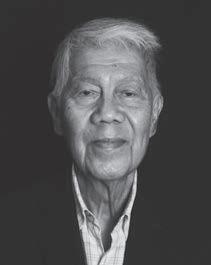
Datuk A.B. Kamaludin, LLM (1965) aged 79. Azzat bin Kamaludin (later given the Malaysian honorific title of respect, ‘Datuk’) came to Queens’ from the Royal Military College, Malaysia, with an entrance scholarship in 1975. He followed an uncle, the Hon. Suleiman Rahman (Queens’ 1933), to the College and read Law. The family were not wealthy, so he was unable to return home over the three years he was in residence, but, after a brief trip back to Malaysia, he returned in 1968 to study for an LLB (LLM). He was called to the Bar at the Middle Temple in 1970. From 1970 until 1979 he worked for the Malaysian Ministry of Foreign Affairs in various administrative and diplomatic roles. This included a notable post as Assistant Secretary to ASEAN, demonstrating his early dedication to regional cooperation, and he was an influential figure at the Law of the Sea conference. He was part of the permanent Mission of Malaysia to the United Nations in New York and also served in
Hong Kong. He was admitted an Advocate and Solicitor of the High Court of Malaysia in 1979, eventually establishing the law firm Azzat & Izzat. He was renowned for his legal acumen and was committed to justice and fairness. He practised law for many years as a partner of the firm and later served as a senior consultant. His integrity and wisdom led to his appointment to the Securities Commission from 1993 to 1999, at which he helped shape Malaysia’s financial regulatory framework. Throughout his life, Datuk Azzat generously shared his expertise across numerous corporate boards, including Axiata Group, Boustead Holdings, Dialog Asciata, Pulai Springs, Visdynamics Holdings and many others, as Chairman or as Non-Executive Director, bringing principled leadership to each role. His last board position was in Tune Talk, where he emphasized his dedication to “upholding values of honesty, integrity, and transparency” while benefiting “both customers and the wider community”. His commitment to education was evident in his service on the board of elc International School in Sungai Buloh, where he helped shape the future of countless young Malaysians. As a mentor, he freely gave of his time and knowledge to nurture the next generation of Malaysian leaders. “Datuk Azzat’s legacy lives on through the institutions he strengthened, the communities he served, and the countless lives he touched with his wisdom, kindness, and unwavering dedication to Malaysia’s advancement.” He has left an indelible mark on Malaysia’s legal, corporate, and educational landscapes.
T. Wrigley (1966) aged 73. Terry Wrigley was born into a working-class family in Lancashire and educated at St Mary’s College, Blackburn. He studied Modern and Medieval Languages (French and German) at Queens’. This led to a career in education, first as a schoolteacher then as an Education Officer for a Local Authority. He went on to work as a School Inspector and Advisor before taking a post as a Senior Lecturer at the Moray House School of Education, University of Edinburgh. He became a prolific researcher and writer. He was passionately opposed to an education system that seemed obsessed with measuring, comparing and ranking, and he spoke eloquently at conferences and meetings about what a much-more optimistic and hopeful education system could look like. As a life-long Marxist, he led the struggle for an education system that was, in his view, humane and equitable and which always started from the needs of the children. He understood how education systems work to reproduce the structural inequalities in society, and his work never shied away from a clear analysis of relationships between education and class. However, Terry also understood the importance of organised labour as the engine of social change, and that any efforts to bring about the type of change he believed in required academics and scholars to work with activists, in particular those working in trade unions. He has been described as a scholar-activist. Most notably he campaigned with union activists against SATs. His major publications included Schools of Hope, Another School is Possible and Changing Schools: alternative ways to make a world of difference (edited with Pat Thomson and Bob Lingard). He edited the journal, Improving Schools. Terry’s work directly challenged the curriculum reforms in English schools, and his critique of what he felt was an obsession with randomised
control trials as the gold standard was published by the British Educational Research Journal in 2018. He formally retired from the University of Edinburgh in 2010 but continued to work and research tirelessly, almost up to the day he died. In May 2020, as the Covid pandemic raged, Terry established a group of researchers and experts who were able to advise the Independent SAGE group on the safe opening of schools. The group (known as the emergency advisory group on learning and education or EAGLE) generated large amounts of evidence to guide decisions about safe school opening. A friend has written, “There was never any ego or self-aggrandisement with Terry. His interest was in making a difference, in particular for those young people most disadvantaged. He always did it quietly and without regard for personal gain or prestige”. He passed away in October 2021 from leukaemia.
C.J. Rowlinson (1967) aged 76. John Rowlinson was born at Crewe in Cheshire. He was the son of Barabara and Norman Rowlinson, who owned a timber company and was Chairman of Crewe Alexandra F.C. – this association no doubt sparked John’s life-long love of football and sport. He went to Shrewsbury School, where he was an outstanding footballer. He then spent a short time at Mercersburg School in Pennsylvania. He took the opportunity to drive across the U.S. before coming up to Queens’ in 1967 to read History. He played football for the University and the College. He started his career as a trainee journalist at Thomson newspapers in Newcastle-upon-Tyne before becoming a sports reporter with the Lancashire Evening Telegraph in Blackburn. In 1973 he applied successfully for a job in sports programming for the BBC. Rising through the ranks, he progressed to editing or directing Grandstand, the BBC’s live Saturday afternoon sports programme, as well as the midweek Sportsnight, and Match of the Day, working alongside such luminaries as Harry Carpenter, Jimmy Hill, Frank Bough and Des Lynam. For nine years he was also in charge of covering the Wimbledon fortnight. He reduced reliance on showing only matches from Centre Court and No.1 Court by increasing the number of cameras on outside courts. He championed the burgeoning careers of Sue Barker and Clare Balding and other women who he thought were good at the job, both behind the scenes and in front of the camera. One of his chief concerns at Wimbledon was the devising of plans to cover rain interruptions. He had a 50page dossier full of possible stand-by material, including clips from famous matches. During his time at the BBC, he was also responsible for outside broadcasts from the Olympic Games, the Athletics World Championships, the Football World Cups and the Commonwealth Games. In 1995 he was appointed Deputy Head of Sport at the BBC, and four years later became Deputy Controller, with direct responsibility for international sports coverage. He was, over the years, a very influential figure at the BBC as an editor, producer and director during the heyday of its television sports coverage. He eventually left the Corporation in 2002 to become TV Marketing Director, then Director of Television at the All-England Lawn Tennis Club. He negotiated rights contracts while ensuring broadcasters had all they needed to cover the two-week Wimbledon tournament as smoothly as possible. In 2009 he accepted an offer to become Head of Broadcast for the 2012 Olympics and Paralympics in London.
He began preparation almost three years before the start of the Games to get a head start on delivering the infrastructure needed to satisfy 15,000 members of the world’s broadcast media. He co-ordinated the event from a huge purpose-built International Broadcasting Centre in East London. Once the Games were over, John semi-retired, but worked as a nonexecutive director of The Great Run Company set up by the former athlete Brendan Foster to organise the annual Great North Run as well as other sporting events in the North. In 2016 he interviewed surviving members of England’s 1966 World Cup-winning side and wrote The Boys of ‘66 -- The Unseen Story Behind England’s World Cup Glory, an account of the goings-on in Alf Ramsey’s England camp. In collaboration with John Motson, he had previously written a History of European Cup Football, published in 1980. He and his wife Jane, née Booth, lived in Lambourn in Berkshire and he was a member of Frilford Heath Golf Club in Oxfordshire, played tennis at the Queen’s Club, and was a long-standing supporter of the Hawks’ Club of sportsmen associated with Cambridge University. He was an avid reader of history books. John had two daughters, who, along with Jane, survive him.
Dr C.M.P. Collins, MB, BChir (1968) aged 74. Christopher Collins came up to Queens’ from Ampleforth College to read for the Medical Sciences Tripos in 1968, and, having studied History of Art as his third-year subject, went on to complete his medical training at St Thomas’s Hospital in London. He returned to Cambridge to sit his medical finals, meeting his future wife, Sarah Lefanu. Throughout his professional life his interests remained wide-ranging, including music as well as art. After qualifying as a doctor, he spent a year working with the concert lighting crew Avolites, which was run by a close friend. His interests also included screen-printing and carpentry, and he read widely. In 1978 Christopher went to Mozambique, a country just emerged from a gruelling struggle for independence and desperately in need of qualified medical practitioners. He worked alongside Russian, Italian and Swedish doctors in Lichinga, capital of the northern province of Niassa. He learned the local language, Jauá, so that he could understand and talk to the patients, who had often walked for days through the bush to get to the hospital. He saw many cases of tuberculosis, dysentery, malaria and sleeping sickness. He then moved to Nampula, the regional capital, where he taught – in Portuguese – the first generation of Mozambique-trained health workers. He eventually returned to London to the Department of Pathology at University College Hospital. He loved the intellectual aspects of the discipline, the how and the why of diseases, their intricate behaviours. In 1986 he moved to Bristol with his family to a post as a Consultant Histopathologist at the Bristol Royal Infirmary and Senior Lecturer at the University of Bristol, where he taught veterinary as well as medical students. He was an enthusiastic and gifted teacher, remembered by a whole generation of vets and doctors. He
became particularly interested in bone tumours and set up the Bristol Bone Tumour Registry, through which he worked closely with colleagues in Glasgow, Birmingham and London. In retirement, he looked after his mother, read voraciously, pursued a particular interest in politics and enjoyed the company of his two granddaughters. He was delighted by the arrival, a month before he died, of a third granddaughter. His brothers Dr Patrick Q Collins (1971) and Justin R.F. Collins (1981) followed him to Queens’.
The Hon. J.C.P. McCallum, PhD, PC (Can) (1968) aged 75. John McCallum was born in Montreal, Quebec, the son of Joan and Alexander Campbell McCallum. He was educated at Selwyn House School in Westmount, Quebec, and Trinity College School in Port Hope, Ontario. He came to Queens’ in 1968 to read Economics. He was first year rep on the new JCR Committee 1968-69 and President of the JCR 1969-70. He played tennis for Queens’ and also rowed in the Men’s 6th Boat. He followed up his degree at Cambridge with a Diplôme d’Études Supérieures from the University of Paris 1 Panthéon-Sorbonne and a PhD in Economics from McGill University in Montreal. He then embarked on a highly successful academic career. He was a Professor of Economics at the University of Manitoba, 1976-78, and then at Simon Fraser University in British Columbia. In 1982 he moved to the Université du Québec à Montréal and then in 1987 to McGill University. He was appointed Dean of the Faculty of Arts at McGill (at a time when Justin Trudeau was a student there). He also became an Honorary Member of the Royal Military College of Canada. Whilst at McGill he secured funding for the establishment of the McGill Institute for the Study of Canada. He made major academic contributions to the study of trade, looking at the importance of internal trade in a nation in relation to trade between states. He wrote a book, Unequal Beginnings: Agriculture and Economic Development in Quebec and Ontario until 1870 and also co-wrote with C Barber Unemployment and Inflation: The Canadian Experience and Controlling Inflation: Learning from Experience in Canada, Europe and Japan. He left McGill in 1994 to become Chief Economist and Senior Vice-President of the Bank of Canada. As the Chief Economist he appeared regularly on the media and established a reputation for blunt speaking. Financial and political journalists alike were both surprised and enthused by his frankness. He is also remembered for his paper, The Cost of Doing Nothing, delivered at a Royal Bank conference following up the Royal Commission on Aboriginal Peoples. In 2000, to the surprise of many, he entered politics and was elected as the Liberal Party’s M.P. for Markham in Ontario, previously held by a Progressive Conservative. He was re-elected for various versions of the Markham constituency as the local population grew in 2004, 2006, 2008, 2011 (surviving something of a rout for the Liberal party in Ontario and in the country as a whole) and in 2015. After a brief stint as Parliamentary Secretary to the Finance Minister, John became a Cabinet Minister in January 2002 as Minister of National Defence. He became a Member of the Queen’s Privy Council for Canada. His term of office as Defence Minister is remembered for his securing of a large increase in the defence budget, the abolition of an historical inequality between officers and other ranks who had been severely maimed on active service, and the lead
Canada took in the NATO security mission in Kabul. There were a few gaffes, especially concerning his lack of knowledge of the history of the Canadian Army, and in late 2003, after Paul Martin took over as Prime Minister, he was moved to be Minister of Veterans Affairs, still in the Cabinet. He introduced, in particular, a new charter for veterans of the Canadian forces who had been physically or mentally injured. After the 2004 General Election he became Minister of National Revenue, combined with the jobs of Minister responsible for both the Canadian Post and the Canadian Mint. He was a Member of the Treasury Board, chairing the Expenditure Review Sub-Committee, and later also acted as Natural Resources Minister while his incumbent colleague was ill. In opposition after 2006, he shadowed the Finance Ministry, and for a while Transport. When the Liberals lost more seats in 2011, he became ‘critic’ to three ministers – the Treasury Board, the Minister for Human Resources and Skills Development and the Minister for Public Works and Government Services. After Justin Trudeau became party leader, John shadowed the Immigration portfolio. He became Minister of Immigration, Refugees and Citizenship when the Liberals returned to power in 2015. In 2017 he stepped down from the Cabinet to take on the job of Canadian Ambassador to the People’s Republic of China. He had a number of personal connections with China, not least the Chinese ethnicity of his Malaysian wife Nancy. He became embroiled in controversy when Canada arrested a prominent Chinese businesswoman whose extradition had been requested by the United States. He spoke out against this arrest and detention, especially after Canadian citizens were detained in China in what many saw as a tit for tat operation. In January 2019, at Mr Trudeau’s request, he resigned as Ambassador. For the academic year 2019-20 he was a ‘Distinguished Academic Visitor’ at Queens’, very much enjoying renewing his association with the College and giving a series of fascinating talks. With his great sense of humour, he was a much-valued temporary addition to the Society. He became an advisor and representative of several businesses dealing with China and an affiliate and Senior Strategic Advisor of the law firm McMillan LLP. John and Nancy had three sons, Andrew, Jamie and Duncan, who all survive him, along with six grandchildren. A parliamentary colleague has summed up his political career, “John served his country with intelligence, dedication and kindness”.
B.C. O’Loghlen (1970) aged 72. Brian O’Loghlen was born in Neath, South Wales but at the age of 5 moved to Radlett in Hertfordshire. He was educated in St Albans at St Alban & St Stephen Catholic Primary School and then at St Columba’s College. He came up to Queens’ in 1970 to read Economics but later switched to History. At College he was a member of the Table Tennis and Boat Clubs and was awarded a Half-Blue in Volleyball. Brian worked as a Company Pension Consultant at Noble Lowndes (Mercer after it was taken over) for his entire working life between 1973 and 2008 except for a short three-year period when he worked for Alexander Stenhouse. He was a member of his local tennis club for nearly 50 years serving on both its committee and board for several years and was chair of the tennis section for a decade. He also enjoyed playing golf and was a continually active gym member
following his retirement in 2008. Other hobbies included reading, listening to music and walking. The latter was often with the St. Columban Rambling Group. In 2015 he took on the role as Clerk to the Governors at a local Catholic Primary School and in 2022 stepped up to be Chair of Governors, a role which he found most rewarding. He died in University College Hospital, London, where he had been receiving treatment over a 22-month period, having been diagnosed with acute myeloid leukaemia in late 2022. His funeral and requiem mass were held at St. Saviours, Abbots Langley, which he had attended for 20 years and where he was a regular reader. Brian is survived by his wife Jane, his children Daniel and Sophie, three grandchildren, his brothers John and Niall, two stepchildren and three step-grandchildren.
Dr J.P. Patterson, Ph.D. (1973) aged 71. John Patterson was educated at Bury Grammar School, Lancashire, and obtained a place at Queens’ to read Natural Sciences. After graduation, he stayed in Research and Development, he travelled to both Japan and Russia several times. The Russian trip included travelling by Aeroflot to Siberia to visit a closed Russian city and later picnicking on the banks of the Neva River in St Petersburg at midnight with the Russian hosts. From 1992 to 2007, when he retired from BNFL, he held several senior posts with the company. He was Head of Research at Sellafield, Cumbria, followed by Head of Materials Technology, then Head of Fuel Technology. Finally, he became a member of the Executive of BNFL. In 1999 he was a member of a small senior project team negotiating the proposed partial privatisation of the company for the Government. He was made an Honorary Visiting Professor of the University of Manchester in 2004. In 2007 he joined Alstom Power in Baden, Switzerland where he was the Director of Materials and Chemistry until 2010, after which he was the University Relations Manager, developing worldwide university collaboration agreements. John joined M&I Materials, Manchester, in 2012 as Technical Director for the company, which manufactures transformer insulating fluid, silicon carbide resistors, tungsten heavy alloy components and vacuum oils and greases. John finally retired in September 2017. He was a volunteer for the National Trust at Dunham Massey, near Altrincham, for over 13 years. He could be found in the Elizabethan mill on Sundays, explaining the history of the mill and operating the waterwheel and saw. Latterly he had been driving the buggy, taking visitors from the carpark to the Hall. John leaves behind Janet, his wife of almost 45 years, son Simon, daughter Rachael, daughter-in-law Line, and grandchildren Alfie and Ida.
Dr E.S. Sloan, MSc, VetMB, MRCVS (1976) aged 71. Evan Sloan was born in 1953 in Reading, Pennsylvania, the third of four children of Joseph H Sloan, an engineer and businessman, and his wife Gene. He studied Agricultural Science at Ohio State University, graduating BSc cum laude. He then accepted a Teaching Associateship at Ohio State to study for an MSc in
Zoology and Parasitology, specialising in livestock parasites. His father had plans to move to the U.K. (which in the event did not come to fruition) for his business, so Evan decided to apply to British veterinary schools. As a graduate he could be admitted at Cambridge as an affiliated student, so he could complete his veterinary studies in five years, not six. He came to Queens’ in 1976, listing his interests on application as breeding golden retrievers, showing Nubian goats, horseriding, gardening, chess, fencing, music and tennis. He was well-liked in the College community as a friendly and enthusiastic individual. He participated in a University expedition to Western Alaska in the summer of 1977. He duly qualified as a vet in 1981 and became a Member of the Royal College of Veterinary Surgeons. He returned to the United States and served an internship in small animal medicine at the University of Pennsylvania School of Veterinary Medicine. He also worked at the North Shore Animal League in Port Washington, New York, and became a member of the American Veterinary Medical Association. He practised in New York State and the Poconos Mountains district of Pennsylvania, becoming a talented and much-valued veterinarian in the greater Stroudsburg area. In due course he became the owner of Smithfield Animal Hospital in East Stroudsburg and of the Stroudsburg Animal Hospital in Stroudsburg. He was active in the Stroudsburg Rotary Club and served as club president. In 2003, he obtained a diploma in Tropical Medicine and Infectious Diseases from the University of London. In 2012, he worked for the Wildlife Conservation Society at the New York Central Park Zoo. His love of travel and adventure took him all over the world. He visited more than 65 countries, rode his motorcycle and bicycle all over Europe, hitchhiked around the U.S, rode on horseback for an expedition in Mongolia, studied anthropological practices in the Indonesian islands and Papua New Guinea, and studied ticks and bats in Egypt. He was an avid mountain climber in South and Central America, a licensed pilot, a scuba diving expert and a yoga practitioner. He was fluent in Spanish and even became an apprentice in a French Culinary School in New York City. Evan was an accomplished artist, photographer, poet, painter, musician, composer, guitar player, and songwriter. He recorded four albums of original music in collaboration with his producer, the late Michael Herron: No Access, Love’s the Victim, Circle of Six and Tierra Mojada and he painted over 150 paintings. His sense of humour and of justice, his commitment, his love for nature and living beings improved the lives of many people. He is survived by his beloved wife Cindy and their two children Evangelina and Nathaniel, and also by his three siblings, David, Nina and Howard.
Dr J.M. Price, MB, BChir, FRCP (1978) aged 64. James (Jim) Price attended Haberdashers’ Aske’s Boys School before coming up to Queens’ to read Medical Sciences. He played hockey and cricket for the College and was Treasurer of the JCR. He graduated from Cambridge as
a doctor in 1984. He then joined the Royal Navy as a Medical Officer, training extensively in both medicine and gastroenterology during his six years of service. His time in the Navy shaped his professional ethos and laid the groundwork for his later contributions to the medical field. After his naval service, Jim transitioned to General Practice. He became a valued partner at a Chichester-based practice for 21 years. His dedication to patient care, his compassion, and his deep understanding of medicine earned him the respect of both his patients and his colleagues. He was a model of professionalism, always striving to improve the quality of healthcare in his community. In 2001, Jim joined the Institute of Postgraduate Medicine, the precursor to the Brighton and Sussex Medical School. He became a Senior Lecturer in Primary Care at the Medical School and, from 2001, Clinical Governance Lead with West Sussex Primary Care. His passion for teaching and curriculum development led him to play a key role in shaping the clinical aspects of the newly announced undergraduate medical school. His expertise, leadership, and dedication were pivotal in ensuring that BSMS became the institution it is today. He also made significant contributions to postgraduate medical education, leading master’s level programmes in medical and clinical education. His research focused on medical pedagogy, and he was particularly passionate about the application of complexity and complex systems theory to teaching and learning. Throughout his career, Jim pursued research in a wide array of areas, from leadership and commissioning to professional development, telemedicine and the concept of compassion in healthcare. He was instrumental in shaping the South-East of England Health Education Colloquium. Jim will be remembered for his warmth, generosity and commitment to education and patient care. With his partner Deborah he had four children. He continued to enjoy golf, hockey (latterly training youngsters) and running (especially for charity).
J. Mitchell, PGCE (1985) aged 58. Jacqui Mitchell was born in Bangor, County Down, in May 1966, daughter of Maureen and Jack. Her family attended Hamilton Presbyterian Church and she became an officer of the Girls Brigade. Jacqui won a place at Glenlola Grammar School and first visited Queens’ on a school trip, when she fell in love with the place. She excelled at school and earned a place to read Mathematics at Queens’, and also a year’s placement with British Nuclear Fuels at Sellafield. It was during this year, away from home for the first time, that Jacqui showed signs of the eating disorders and mental health issues that she battled, with varying degrees of success, for the rest of her life. She completed Part 1A of the Mathematical Tripos, before switching to read Computer Science. She had an active social life and was a member of the Christian Union throughout her time at the College. She enjoyed sport and played hockey and coxed one of the men’s boats in the Lent Bumps. After graduation in 1988, Jacqui trained as an accountant with PWC, where she met Stuart. They
later married. Jacqui had always wanted children, and she became a devoted mother of 4 –Katie, James, Chloe and Emily – whom she dearly loved. She supported her children in all their activities and encouraged them throughout their studies, helping them to realise their full potential. She organised dance shows and became treasurer of the local swimming club. Her love of the outdoors included gardening, walking, trekking and running, and she remained active in sport, taking part in the Great North Run and the Dublin Marathon. Her love of children and mathematics contributed to her decision to change career. She returned to Queens’ in 2005 to study for a PGCE in Secondary Mathematics. She became a successful and dedicated teacher. She returned to Northern Ireland for the last 10 years of her life, tutoring in mathematics and contributing greatly to her local community. Sadly, Jacqui was unable to overcome her eating disorders which eventually cut short her life. In her last wishes she wanted to raise awareness of eating disorders and mental health illnesses and hoped a greater insight into these conditions might help save others from the many difficulties she bravely faced.
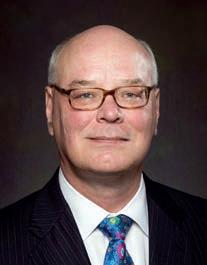
Professor D.R. Wilson, PhD, MD (1992) aged 68. Daniel (Dan or Danny) Wilson was born in Fort Worth, Iowa, and brought up in the nearby farming hamlet of Manson. He was the seventh of eight children of a country doctor, Dr Charles Wilson, and his wife Viola. He graduated top of his high school class and also excelled on the sports field – his American Football team was undefeated, and he was track captain as a sprinter. He was an Eagle Scout. He read Anthropology at Yale University before training as a doctor at Carver College of Medicine, University of Iowa. There followed an Internship, Residency, and a Fellowship at McLean Hospital & Harvard Medical School in Boston. He was eventually appointed to the Faculty there and from 1987 was Director of Neuropsychiatry. In 1992 he took a career break from medicine to come to Queens’ to study for a PhD in Social Anthropology. He was accompanied by his wife, Sandy, who had been his high school sweetheart. They were together for 53 years from the age of 15 until his death. It was at Cambridge that their much-loved daughter, Victoria, now herself a doctor, was born. He was later elected as an Overseas Fellow of the Royal Anthropological Institute of Great Britain & Ireland. He returned to the States to be Hospital Executive of Ohio’s largest state hospital and Medical Director of the Ohio Department of Mental Health and Addiction Services. He studied for a Diploma in Mental Health Leadership and Management at Case Western Reserve University. He was then appointed Professor of Psychiatry and Director of Forensic Medicine at the University of Cincinnati. Next he went to Omaha, Nebraska, as Professor and Chairman of Psychiatry and Co-Lead for the new Phoenix Medical Campus at Creighton University Medical Center, where he expanded the full-time psychiatric faculty tenfold, raised clinical service and revenue
sixfold in 10 years, and grew the research portfolio from zero dollars to $17 million. He served as President of the American Neuropsychiatric Association and was an invited lecturer at more than 200 universities or professional societies worldwide. A pioneer in the field of evolutionary neuropsychiatry, he was the Founding Chair of the World Psychiatric Association Evolution Section. He had hundreds of research papers to his name, spanning clinical psychopharmacology, forensic medicine and evolutionary neuropsychiatry, including more than 100 abstracts or presentations at national and international meetings. He was principal investigator on more than 80 grants. He testified as an expert witness in all manner of legal cases in county, district, federal, courts-martial, and international tribunals. He was a Distinguished Life Fellow of the American Psychological Association and a Distinguished Fellow of the American College of Psychiatrists. In 2012 he became Vice-President of Health Affairs and Dean of Medicine and Professor of Psychiatry, Neurology and Anthropology at the University of Florida-Jacksonville Health Science Center, overseeing the academic, clinical and research activities at the Center, which includes a 695-bed teaching hospital and schools of clinical medicine, nursing, and pharmacy. His last academic job was as President and University Professor of Western University of Health Sciences, in Pomona, California, from 2016 until his retirement in 2021. He continued at the University as President Emeritus and University Professor with a focus on international health education and services. Dan Wilson was a superb clinician, teacher, researcher, colleague and administrator, who never forgot his relatively humble origins and whose legacy lives on in patients mended, students taught, knowledge advanced, and institutions progressed. He died peacefully at home with his loving wife and daughter at his side after a brave battle with a rare cancer. He is also survived by four of his siblings and a multitude of relatives and friends gathered across all the years of an extraordinary life.
R.M. Clarey, PGCE (2006) aged 40. Rebecca Clarey went up to Christ Church College, Oxford, in 2001 to study Music. She was a talented pianist and flautist and a lively and popular member of her Faculty and College community during her time in Oxford. After graduation she remained at Oxford to study for a MSt degree. She came on to Queens’ in 2006 to undertake a PGCE. She became a teacher and most recently has served as an outstanding Head of Music at Salesian School in Surrey. She died from cancer in 2023.
The Allianz Scholarship(s), donated by Allianz Technology SE. Student Support: to sponsor scholarships for postgraduate students undertaking specific courses from the School of Humanities & Social Sciences, the School of Technology and the School of Physical Sciences.
The Dushkin Prize in Music, donated by Mr Peter Dushkin (2002). Student Support: annual prize for top performance in Music Tripos.
The Thomas Forster Prize in Part III Maths, donated by Dr Thomas Forster (ex-Fellow). Student Support: annual prize for top performance in Part III Maths.
The Queens’ Entrepreneurship Society Studentship, donated by Mrs Anna El-Erian Queens’ Entrepreneurship Society: annual studentship to support an under- or postgraduate student working alongside the QES board.