• OSB Boards: Strong, sustainable and cost-effective
• National award to honour timber engineering pioneer • Transforming Western Australia’s housing crisis
• OSB Boards: Strong, sustainable and cost-effective
• National award to honour timber engineering pioneer • Transforming Western Australia’s housing crisis
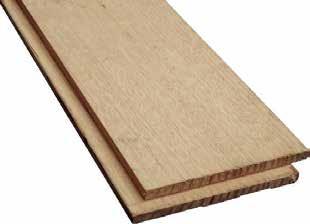
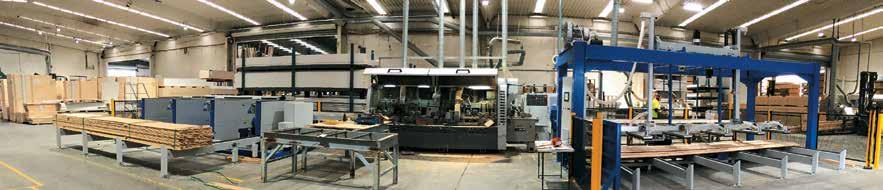
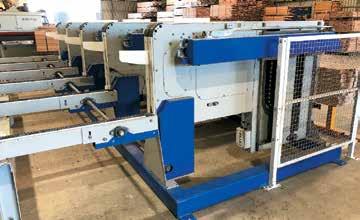
The Stacker is the perfect solution to continuously stack timber into packs all day long without any supervision. This machine is ideally suited to any moulding, finger jointing or docking line and will improve productivity and safety. The automated Stacker is a robust, reliable, economical and user friendly solution to stacking timber.
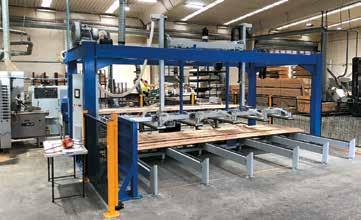
The Vacuum Lifter can be used to unload and load timber one piece, or a layer, at a time. When unloading a fillet sweeper can be incorporated to automatically clear the fillets in between the layers. The vacuum lifter is an extremely versatile piece of equipment that is a must for any high speed, heavy lifting, long piece, or repetitive applications.
Volume 36 – Issue 1
Incorporating Australian and New Zealand Timberman Established 1977
Front Cover:
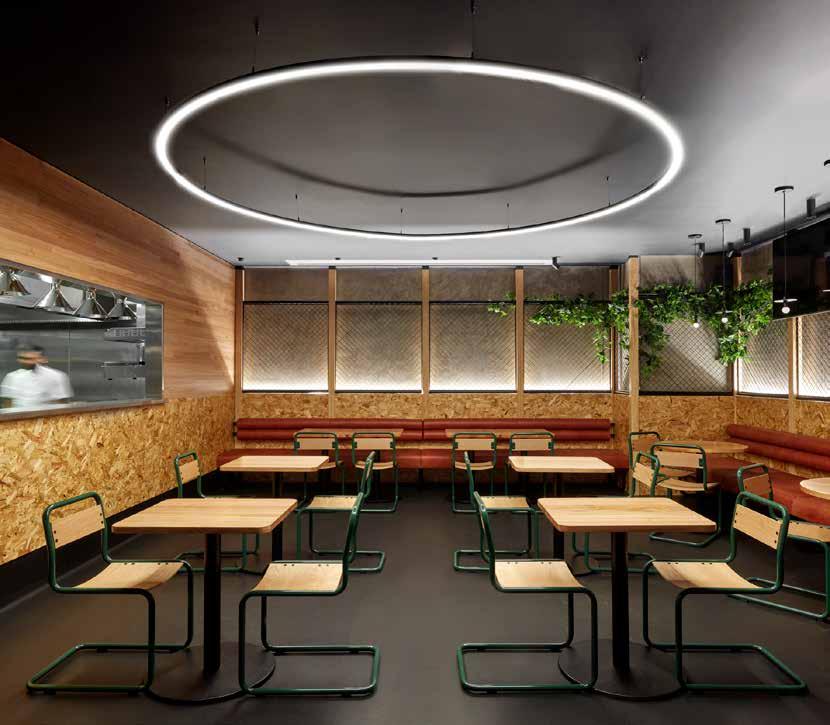
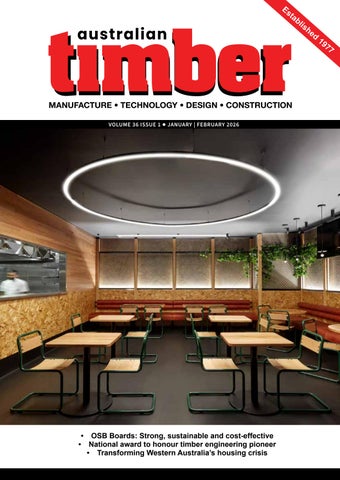
In Australia, the demand for OSB continues to grow as builders, designers and specifiers look for materials that balance performance with cost efficiency. OSB sheets offer consistent structural strength, efficient use of timber resources and a more affordable alternative to traditional plywood in many applications. From structural use through to feature walls and ceilings, OSB is proving itself as a smart, adaptable solution across residential and commercial projects. Picture: Damien Kook, A&D Pages 10-11
5 7 9
Publisher and Chief Executive: Hartley Higgins
General Manager: Robyn Haworth
Editor: Bruce Mitchell b.mitchell@ryanmediapl.com.au
Advertising: Jamie Richardson j.richardson@winetitles.com.au
Adelaide Office +61 (08) 8369 9514
Production & Creative Services: Robyn Haworth
Timber classifieds: j.richardson@winetitles.com.au
Adelaide Office +61 (08) 8369 9514
Subscriptions: subs@forestsandtimber.com.au
Adelaide Office +61 (08) 8369 9500
Subcription rates Free
Accounts:
Adelaide Office +61 (08) 8369 9500
Postal Address: 630 Regency Road, Broadview South Australia 5083
Phone: +61 (08) 8369 9500
Melbourne Office: Suite 2262, 442 Auburn Rd, Hawthorn VIC 3122 Phone: +61 (03) 9810 3262
Find us on Facebook @AustralasianTimber Website www.timberbiz.com.au
Conditions
The opinions expressed in Australian Timber Magazine are not necessarily the opinions of or endorsed by the editor or publisher unless otherwise stated. All articles submitted for publication become the property of the publisher. All material in Australian Timber Magazine copyright 2022 © Ryan Media. All rights reserved. No part may be reproduced or copied in any form or by any means (graphic, electronic, or mechanical including information and retrieval systems) without written permission of the publisher. While every effort has been made to ensure the accuracy of information, the publisher will not accept responsibility for errors or omissions, or for any consequences arising from reliance on information published. 14
The use of engineered timber is taking hold in South Australia when it comes to Government-funded buildings.
Cross-laminated timber (CLT) manufactured in Tarpeena, South Australia, by NexTimber by Timberlink, and glue-laminated timber (GLT) supplied by Australian Sustainable Hardwoods from Heyfield in Victoria featured in the construction of the recently opened Tonsley Technical College in Adelaide and the new Mount Gambier Technical College.
The opening of the Mount Gambier Technical College is a major win for regional South Australia, showcasing how worldclass learning facilities can be delivered using local skills, local materials and local manufacturing, according to the South Australian Forest Products Association.
It has been noted that the projects reflect a renewed focus on South Australia’s sovereign capability to manufacture essential building materials locally.
SAFPA CEO Nathan Paine noted the projects reflected a deliberate decision by the State Government to support South Australian jobs, industries and sovereign capability through public infrastructure
As South Australian Treasurer Tom Koutsantonis recently said on radio, “If we can’t make key building products ourselves and are entirely reliant on imports, in a changing and dangerous world that makes Australia incredibly vulnerable. COVID showed us the importance of having our own sovereign capability.”
Mr Paine points out that using South Australian grown and manufactured timber in government projects is a practical expression of that principle.
It’s a lesson quite a few other States could learn from,
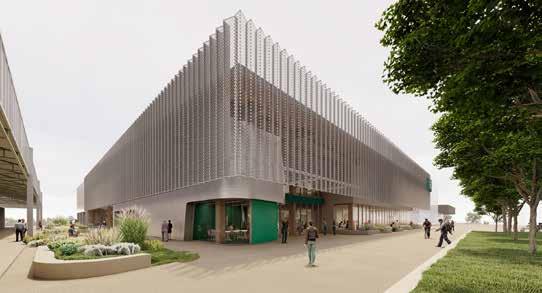
The opening of the Adelaide’s Tonsley Technical College marks a major milestone for South Australia’s forest and timber industries, which have proudly grown, manufactured and supplied much of the mass-timber material used in this state-of-theart educational facility.
Purpose-built to train the next generation of technicians, tradespeople and innovators, the College is also a practical learning tool for South Australia’s builders, architects and developers.
While mass engineered timber has featured in high-profile local projects such as the Adelaide Oval Hotel and an apartment development in Kent Town, it is still not widely adopted across South Australian construction. The contemporary design of Tonsley, designed by DAS and delivered by Sarah Constructions, demonstrates how mass timber can be used at scale in high-performance buildings.
Chief Executive Officer of the South Australian Forest Products Association, Nathan Paine, said the project highlights timber’s role in decarbonising the built environment
while supporting domestic manufacturing.
“Tonsley shows how local architects, builders and developers can deliver future-focused buildings that support South Australian manufacturing and help decarbonise the economy by storing carbon within the structure,” Mr Paine said.
“The College demonstrates the practical use of engineered mass-timber products, including cross-laminated timber (CLT) manufactured in Tarpeena, South Australia by NexTimber by Timberlink, and glue-laminated timber (GLT) supplied by Australian Sustainable Hardwoods from Heyfield in Victoria.
“By choosing locally manufactured timber over more carbon-intensive materials, the project supports forest growers, timber manufacturers and regional jobs, while reducing embodied emissions and locking away carbon for decades.”
According to the Association, the CLT and GLT used in the project are estimated to store more than 900,000 kilograms of carbon dioxide equivalent. When combined with local steel and concrete, the
building’s total embodied carbon is 3,792,548 kilograms of CO2, a 40 per cent reduction compared with a traditional build.
Simon Angove, Chief Sales and Marketing Officer at Timberlink Australia, which manufactured the CLT for the project, said Tonsley demonstrated the strength of South Australia’s timber capability.
“Projects like Tonsley show that South Australia already has the capacity to manufacture world-class engineered timber products locally and deploy them at scale,” he said. “This building demonstrates how locally made CLT and GLT can support jobs, reduce emissions and deliver outstanding buildings.”
Mr Paine said the industry was grateful for the State Government’s support.
“South Australia’s forest industries thank the Premier, Minister Boyer and Minister Scriven for supporting local manufacturing jobs by choosing South Australianmade timber for this spectacular building,” he said.r industries, with the State Government visibly endorsing the versatility of South Australian timber in the built environment.”
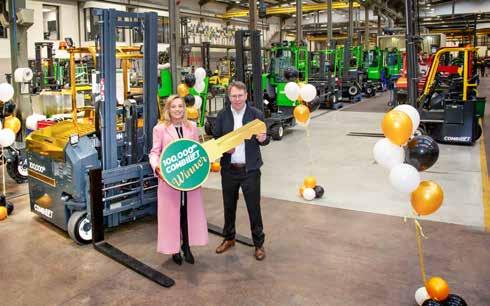
Global materials handling leader Combilift has celebrated a major manufacturing milestone by transforming its 100,000th forklift into a powerful force for good, raising and donating €100,000 to the United Nations International Children’s Emergency Fund to support children in crisis worldwide.
To mark the production of its 100,000th forklift, Combilift launched its largest-ever worldwide competition, offering the exclusive 100,000th “Golden Prize” multidirectional Combi-CBE in golden coloured livery as the prize. All proceeds raised were donated to UNICEF Ireland’s Children’s Emergency Fund.
The campaign generated €56,500 in ticket sales, and at a cheque presentation ceremony, Combilift announced it had topped up the total contribution to an impressive €100,000, underlining the company’s long-standing commitment to corporate social responsibility.
“This campaign was designed not only to celebrate a major manufacturing achievement for Combilift, but also to make a meaningful difference beyond the factory floor. By supporting UNICEF, we are supporting one of the world’s most effective humanitarian organisations and helping children who need it most,” Combilift CEO and Co-Founder Martin McVicar said.
The cheque was formally presented by Martin McVicar to Owen Buckley, UNICEF Ireland’s Head of Corporate Partnerships, and Michaela Plunkett, Business Development Manager, in
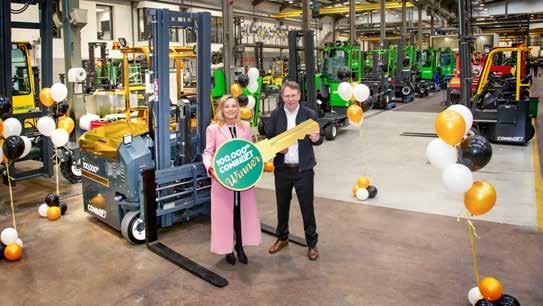
Monaghan.
“As we enter the winter season, our priority is ensuring children affected by war and natural disasters have access to warm clothing, safe shelter and continued education. This generous contribution from Combilift will help UNICEF respond quickly to urgent needs,” Mr Buckley said.
The winning ticket was purchased by Kareen Farrell, who travelled to Combilift’s headquarters in Monaghan to receive the one-of-a-kind 100,000th Combi-CBE “Golden Forklift.”
“I was absolutely delighted when I heard I had won, as I’m never lucky,”Ms Farrell said.
“My dad shared the competition details and bought a ticket to support UNICEF because it’s a children’s charity that helps children all over the world, so winning the forklift was an incredible bonus.”
The Golden Forklift was first unveiled at the IMHX Exhibition in the UK before embarking on a European trade show tour, attracting strong international interest and reflecting Combilift’s global cus-
tomer base and shared commitment to positive social impact.
Combilift was founded in 1998 and is based in Monaghan, Ireland, employing around 650
people. The company specialises in multidirectional and customised materials handling solutions, supplying customers in around 85 countries.
Enough structural timber is expected to be available to build Australian homes until at least 2050, according to an ABARES Insights paper.
Domestic softwood plantations meet most construction needs for structural sawnwood, and imports help manage demand swings, according to the paper.
Evidence suggests international markets can continue to be relied upon to provide a supplementary source of structural sawnwood when the domestic market needs it.
ABARES Executive Director Dr Jared Greenville said the paper provides confidence in the structural timber market.
“The data supports consumers and producers, ensuring that both sides of the market see structural timber as a reliable and accessible building material,” Dr Greenville said.
“It takes between 25 to 35 years to grow structurally graded sawnwood so this outlook of a reliable international market is welcome.”
Structural sawnwood imports rise when housing demand peaks and fall once demand returns to normal. This was demonstrated between 2020-21 and 2021-22 during the spike generated by COVID stimulus programs.
Australia’s softwood plantation estate accounts for about 60% of the value of Australia’s total log harvest or $1.4 billion a year.
Dr Greenville said Australia’s consumption of softwood sawnwood closely reflects building activity.
“Having diversified supply options reduces the risk of extreme domestic price swings for sawnwood,” he said.
SPEC Toolbox (formerly CLT Toolbox), the construction technology platform automating complex engineering for sustainable building materials, has successfully raised $3 million in a Pre-Series A funding round.
The investment was co-led by Black Nova and Investible, two of Australia’s most active venture capital firms.
This fresh capital will be used to accelerate the company’s product roadmap and drive the global adoption of modern construction methods by bridging the technical gap between product suppliers and designers.
Originally known as CLT Toolbox, the company recently rebranded to SPEC Toolbox after identifying that design bottlenecks were not unique to mass timber but stifled the adoption of all innovative building products.
By removing the technical barriers that often prevent designers from selecting modern materials, SPEC Toolbox has created a streamlined pathway for product suppliers to get specified.
“With these funds, we’re accelerating our product roadmap, onboarding new suppliers in new product categories, deepening existing technical infrastructure and accelerating our mission to make innovation easy to specify for engineers,” said Adam Jones, CEO of SPEC Toolbox.
The strong backing from leading VCs validates SPEC Toolbox’s approach to solving the construction industry’s affordability and sustainability challenges.
“SPEC Toolbox was born of real-world frustration with how

products get specified, which in turn was inhibiting adoption of modern and sustainable construction materials. The team has turned those insights into a platform that makes complex products easier to specify, at scale,” said Matt Browne, Managing Partner at Black Nova Venture Capital.
Ben Lindsay, Investment Principal at Investible, said that his company had been fortunate to watch SPEC founders Adam Jones and Ringo Thomas over the past 12 months.
“They’ve first captured a clearly defined cross-laminated timber niche and are now thoughtfully expanding into the much larger manufactured products market,” he said.
“Early customer response has been encouraging, and we were excited to co-lead this round alongside Black Nova in support
of what the team is building.” Global Traction and Momentum SPEC Toolbox has found clear product-market fit, effectively connecting innovative suppliers with a global network of designers. Since its seed round, the platform has rapidly expanded into Europe, the UK, and North America, surpassing 6,000 user signups and listing over 35 product suppliers. This momentum validates the platform as a vital link for the construction industry, driving adoption across all major regions globally.
The funding round saw significant continued support from an existing cohort of investors & new strategic investors including Archangel, Giant Leap, Australian Venture Partners, Impact Ventures, Understorey Ventures, Flying Fox, Gravel Road, Exhort Ventures, Electrifi Ventures & Energy Lab.
The Reserve Bank of Australia decision to raise interest rates by 25 basis points to 3.85 per cent at the start of February will leave the building and construction industry, and homeowners, carrying much of the weight of the nation’s economic challenges.
The RBA board in its decision statement said while inflation had fallen substantially since its peak in 2022, it picked up materially in the second half of 2025.
Master Builders Australia
CEO Denita Wawn said the pain of interest rate increases and high inflation is real and can be expected to suppress construction activity, including higher-density home building approvals, with new data today showing a 31.6 per cent drop during December and are particularly sensitive to interest rate movements.
“The vast majority of money for commercial building projects comes from private sector investment. Higher inflation and interest rates make business investment more expensive and less attractive by reducing returns and increasing the cost of inputs.
“The pain caused by (the RBA’s) decision will also fall on small construction businesses and mums and dads embarking on new builds as inflation and rate rises makes businesses more cautious and reduces margins in household budgets.”
Ms Wawn said that higher interest rates make the case for policy and fiscal reform in this year’s federal budget even more urgent.
“Areas including building productivity, reducing red tape, and fixing labour shortages require urgent budgetary attention and policy reform to put downward pressure on housing inflation and help the RBA meet its target.
“This can only be done with a strong and growing economy with the building and construction industry at its core. Building and construction activity has a sizeable impact on the performance of Australia’s economy with every additional $1 million of residential building work generating an extra $2.5 million in activity across the whole economy.
“Master Builders continues to call for red tape to be cut by at least 25 per cent and a continued commitment to modernise the National Construction Code to get more buildings off the ground, people into homes and improve economic conditions across the country.
“These reforms are urgent if the industry is to have any chance of completing 255,300 new homes this financial year to meet the National Housing Accord,” Ms Wawn said.
The Master Builders NSW arm said that despite efforts from
the Minns Labor government to speed up housing approvals, the Reserve Bank’s decision made it “even less likely that NSW can achieve the housing targets set by the federal government”. “The RBA’s decision to increase rates is in response to the stubbornly high level of underlying inflation in large part caused by increased costs and capacity constraints in the construction sector,” NSW MBA executive director Matthew Pollock said. “Cutting red tape, tackling labour shortages and finding solutions to finance and insurance challenges must be urgent priorities for government.”
According to the HIA’s estimates, Australia remains short of its housing needs by close to two million homes, with population growth continuing to outpace new supply.
“This is the central challenge facing the housing market in 2026,” HIA Senior Economist Tom Devitt said.
“A constrained supply of
new homes is adding to upward pressure on rents, prices and inflation itself, which in turn feeds back into higher interest rates.”
“It is particularly counterproductive that the shortage of housing supply is putting pressure on inflation and interest rates, further impeding new home building.”
HIA’s outlook shows detached home building strengthening across most states in 2026, led by Queensland, South Australia and Western Australia, with New South Wales and Victoria beginning to recover after lagging earlier in the cycle.
“The next housing upswing is taking shape, but it will not reach its full potential unless policy settings support it,” said Mr Devitt.
“Lowering the cost of delivering new homes through planning reform, improved land supply and lower government charges will be critical if Australia is to lift housing supply without reigniting inflation.”
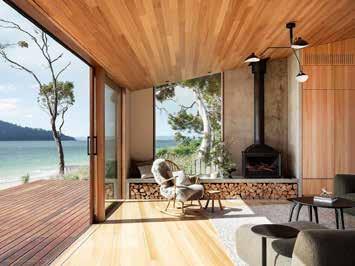
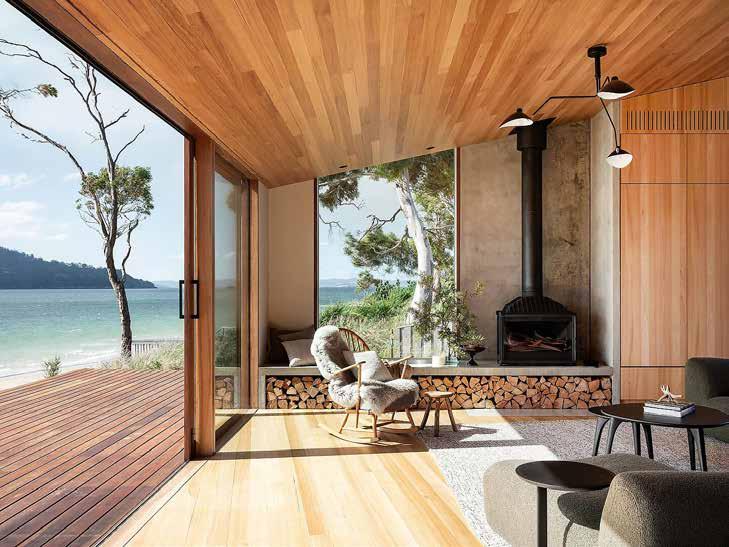
Tucked along the coastal northern tip of Bruny Island, Tasmania, Nebraska House is an architectural homage to light, landscape, and local materials, most notably, the refined, golden warmth of Tasmanian Oak.
Designed by Belgian-born, Tasmania-based architect Lara Maeseele, the home represents a culmination of her values: sustainable design, strong materiality, and deep respect for place.
Following the success of her award-winning Killora Bay project, also on Bruny Island, Lara was approached by the clients with a bold yet clear brief: create a spacious, light-filled family retreat using timber, with a particular emphasis on authenticity and durability.
The result is a home where Tasmanian Oak is not just a material, but a unifying design language.
For Lara, Tasmanian Oak was always the obvious choice.
“Timber provides warmth, texture and character with its grain and colour variations. It’s a better thermal insulator than plaster and has great acoustic benefits. It is far more sustainable than concrete or steel. It is generally more impact-resistant
than plaster, perfect for a family home that’s going to be used intensively. Long term, timber can always be sanded back, reoiled or even be reused elsewhere, if necessary,” says Lara.
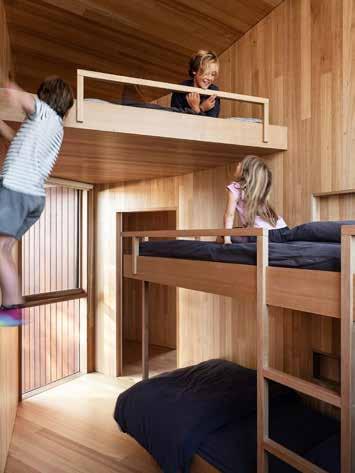
Throughout the residence, Tasmanian Oak is used extensively: as wall and ceiling linings, custom joinery, kitchen seating, and even in the children’s bunk beds. These elements are constructed using a combination of solid Tasmanian Oak and Tasmanian Oak veneer, as well as a staircase from Cusp, showcasing the timber’s versatility.
The consistent use of the beloved timber allows the interior to read as a singular, calm palette, one that brings natural cohesion to the varied spaces within the house.
Using 12mm tongue and groove wall linings and 18mm flooring, to maintain and enhance its natural appearance, the interior timber was treated with Cutek oil, a finish that protects while allowing the timber to breathe and age gracefully.
One of the standout qualities of Tasmanian Oak in Nebraska House is how it responds to natural light.
“The main goal was to make the home feel as light and open as possible. The natural colour

EXCELLENCE IN TIMBER DESIGN
Residential Class 1 – New Building
Architect: Lara Maeseele
Builder: Construction with Destiny
Location: Bruny Island, Tasmania
Photography: Adam Gibson
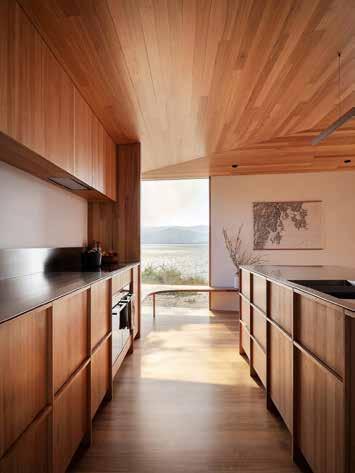
of the Tas Oak was essential to achieving that; it glows, especially in the morning and late afternoon light,” says Lara.
The timber doesn’t just brighten the space visually, it also enhances the home’s sensory experience.
“When you walk in, it feels warm and grounded. There’s a softness and calmness that timber brings that you just don’t get with other materials,” says Lara.
For Lara, using Tasmanian Timber—and specifically certified Tasmanian Oak, was non-negotiable.
“Bruny Island is such a special place,” she explains.
It’s such a unique environment, and with that comes a responsibility to approach our work with sensitivity and a strong commitment to sustainability,” says Lara.
“We knew from the beginning that Tasmanian Oak was the right choice, both in terms of aesthetics and sustainability, and we had no issues in sourcing it,” says Lara.
Nebraska House was designed to be shared by families, across generations. Its thoughtful layout, robust materials, and warm finishes create a space that feels as durable as it is inviting.
Balancing tranquil bedroom spaces with playful communal zones, the home encourages gathering and retreat in equal measure.
As with all of Lara’s work, the project reflects her commitment to local craftsmanship, environmental stewardship, and timeless design.
“Tasmanian Oak is one of my favourite materials, especially in delicate environments like this.
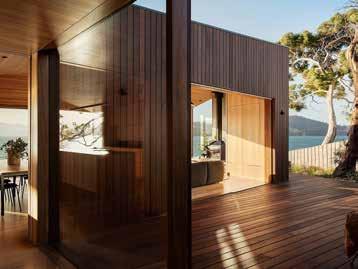
It has so much character, it tells a story, and it feels right.”
“I feel like in everything that we do, we need to take a closer look at what we have available here in Tasmania. We have so many beautiful products and materials and we’re just so lucky to live on an island that’s so unique; we need to embrace the timber that we have,” says Lara.
In Nebraska, that story is one of light, care, and connection— to the land, to the craft, and to the people who will continue to live in and love this extraordinary home for years to come.
In Australia, the demand for OSB continues to grow as builders, designers and specifiers look for materials that balance performance with cost efficiency.
OSB sheets offer consistent structural strength, efficient use of timber resources and a more affordable alternative to traditional plywood in many applications.
ForestOne supplies premium OSB boards, panels and sheets designed to meet Australian building standards and evolving design expectations. From structural use through to feature walls and ceilings, OSB is proving itself as a smart, adaptable solution across residential and commercial projects.
So, what is OSB board exactly? OSB stands for Oriented Strand Board, an engineered wood product made by bonding together thin wood strands in specific orientations using resin and high pressure. The strands are layered and compressed under heat to form strong, rigid panels with consistent structural properties. Unlike plywood, which is made from stacked veneer sheets, oriented strand board uses strands arranged in cross-oriented layers. This gives OSB sheets uniform strength across the panel, reducing weak points and improving load distribution. The result is a board that performs reliably in structural applications such as flooring, wall bracing and roofing.
Oriented strand board OSB is designed to be strong, stable and efficient. Because it uses smaller, fast-growing timber species and recycled wood products, OSB also supports more sustainable forestry practices. Its engineered composition allows manufacturers to maximise material use while delivering predictable performance. In

practical terms, OSB offers builders a dependable alternative to plywood, particularly where strength, consistency and cost are key considerations. It is this balance that has made oriented strand board a mainstay in modern construction.
OSB is not a single product but a category of engineered strand board available in different grades and formats to suit specific environments and loads. Understanding the types of OSB boards and sheets available helps ensure the right product is specified for each project.
Standard OSB sheets are commonly used for internal wall panels, roof decking and subflooring in dry conditions. These boards provide reliable structural support and dimensional stability, making them suitable for residential
construction where exposure to moisture is limited.
Moisture-resistant OSB, often referred to as OSB3, is designed for use in humid or damp environments. It offers improved resistance to moisture compared to standard OSB, making it suitable for semi-exterior applications, bathrooms, laundries and areas subject to occasional exposure. OSB panels are widely used in roofing systems, wall bracing and flooring systems where strength and rigidity are critical. Thicker OSB panels can also be used in joinery and cabinetry where durability and load-bearing performance are required.
Terms like ‘OSB ply’, ‘OSB plywood’ and ‘oriented strand board plywood’ are often used interchangeably, but they describe
different materials. OSB ply refers to OSB used in similar applications to plywood, rather than a hybrid product. Plywood strand board or strand board plywood are informal terms sometimes used to describe OSB as an alternative to plywood, but structurally they remain distinct products. OSB boards are engineered strand board products, while plywood is made from veneer layers. Each has strengths depending on the application, which is why both remain widely used across Australian construction.
The comparison between OSB and plywood is one of the most common questions in the building industry. While both materials serve similar purposes, their composition and performance characteristics differ in important ways.
OSB is made from compressed wood strands arranged in layers, while plywood is constructed from thin wood veneers glued together. The strand-based structure of OSB allows for more consistent strength across the panel, whereas plywood strength can vary depending on veneer quality and grain direction.
In uniform load-bearing applications, OSB often performs exceptionally well. Its engineered structure provides excellent stiffness and resistance to deflection, making it ideal for flooring and wall sheathing. Plywood can offer superior edge strength and is often preferred where visible finishes or fine detailing are required. One of the key advantages of OSB board plywood alternatives is cost. OSB is generally more economical than plywood, particularly in larger structural applications. This cost efficiency makes OSB a popular choice for builders working to budget without compromising performance.
OSB is commonly used in subfloors, wall bracing and roofing, while plywood is often selected for cabinetry, joinery and visible interior finishes. In practice, many projects use both OSB and plywood, selecting each material where it performs best. Understanding the difference between strand board plywood and traditional plywood allows builders and designers to make informed material choices rather than defaulting to one option.
OSB panels are widely used for wall and roof sheathing due to their rigidity and ability to provide effective structural bracing. When appropriately specified, OSB performs reliably and contributes to overall building stability. Sheets of OSB are a common choice for subflooring systems. Their consistent thickness and
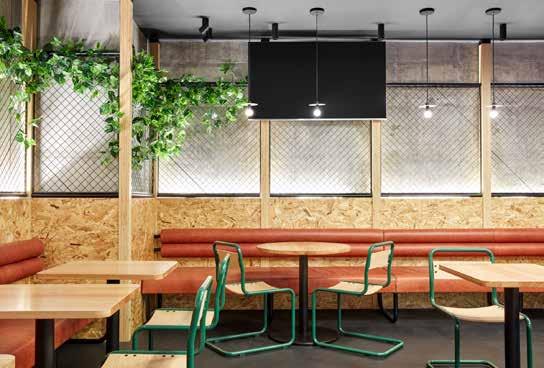
strength make them well suited to supporting floor loads, while moisture-resistant grades offer added protection during construction. Beyond structural use, OSB has gained popularity in cabinetry and furniture applications. Thicker OSB panels provide a strong, stable base for shelving, joinery and custom furniture, particularly in industrial or contemporary designs.
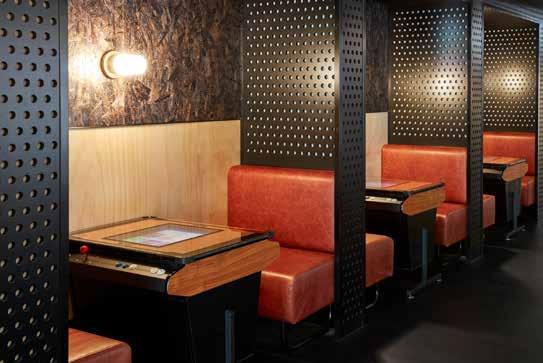
OSB has increasingly moved from behind walls to front-facing design elements. ForestOne’s DESIGNER OSB transforms oriented strand board into a decorative surface that can be painted, stained or powder-coated. With finishes including clear, limewash, white tint, black tint and solid black, DESIGNER OSB allows designers to embrace the natural texture of strand board while elevating it for modern interiors.
Selecting the right OSB board means understanding both the environment and the performance requirements of the application. OSB boards are available in different thicknesses and grades.
OSB2 is suitable for dry internal conditions, while OSB3 offers improved moisture resistance for humid environments. Higher grades provide greater strength and durability where required.
Consider whether the OSB will be used structurally, decoratively or both. Structural applications may prioritise strength and stiffness, while visible interior applications benefit from coated or finished OSB panels such as DESIGNER OSB.
Sustainability is an increasingly important consideration in material selection. ForestOne supplies FSC-certified OSB products, supporting responsible sourcing and efficient use of timber resources. Oriented strand board plywood alternatives like OSB use smaller wood strands and recycled material, reducing waste compared to traditional plywood manufacturing.
Careful selection ensures the OSB board performs as intended while aligning with environmental and design goals.
OSB boards have evolved from structural material into a versatile solution for contemporary construction and design. Their strength, consistency and affordability make them a practical choice for builders, while their distinctive texture and finish options create new design possibilities.
From structural OSB sheets and panels to decorative DESIGNER OSB used in interiors, oriented strand board continues to prove its value across Australian projects. When combined with responsible sourcing and innovative finishes, OSB delivers a compelling balance of performance, sustainability and cost efficiency.
ForestOne’s expertise in supplying premium-grade OSB boards and panels ensures builders and designers have access to high-quality products that meet both technical and aesthetic requirements. Whether used behind the scenes or proudly on display, OSB remains a smart choice for modern building and design.
Timber Queensland has announced the establishment of the Colin MacKenzie Award for Technical Excellence in Timber Application and Use, calling on industry partners across Australia to contribute seed funding to bring the new national award to life.
The award will honour the late Colin MacKenzie, who passed away on March 24, 2025, and whose four decades of leadership profoundly shaped timber engineering, Australian Standards, and building compliance.
The initiative responds to widespread calls from industry to formally recognise Colin’s legacy and continue the work he championed lifting capability, innovation, and confidence in the use of timber across Australian construction.
“Colin’s influence can be seen in almost every aspect of timber engineering and compliance standards,” said Timber

Queensland Chief Executive Officer Mick Stephens.
“This award will recognise the next generation of innovators and continue the legacy of technical leadership he dedicated his life to,” he said.
Timber Queensland is now seeking seed funding contributions from industry to establish the award as a permanent national honour.
The Colin MacKenzie Award will recognise individuals or small
teams who are advancing timber engineering and design across Australia.
“The award is intended for engineers, architects, designers, builders and researchers who are delivering real technical impact and helping to strengthen capability across the sector,” said Mick Stephens
“Judging will focus on technical merit, innovation, and the contribution a project or individual makes to improving knowledge, collaboration and sustainability in timber use and consider alignment with Colin’s vision for timber as a high performance, compliant and fit for purpose construction material.”
Mr Stephens said recipients will be honoured at a major industry event.
“We want this to be a significant national recognition, supported by an honour roll and a cash bursary that encourages excellence and inspires emerging professionals.”
Award objectives and judging criteria have been drafted, with industry feedback to be incorporated as the program is finalised. Full details will be released once funding commitments are secured.
“Following the call for support the best governance and funding model will be established taking into account ideas developed with other potential national and state partners given the broad reach of the award,” Mick Stephens said.
“By supporting this award, organisations will be investing in the technical capability our sector needs for the future.”
Organisations wishing to contribute are invited to complete an online form to indicate interest. Timber Queensland will contact supporters directly to facilitate contributions.
Big River Industries Ltd has acquired the business and assets of John’s Building Supplies, one of Western Australia’s most established trade-focused building materials suppliers
The acquisition strengthens Big River’s national trade network and expands its presence in the high-growth Western Australian construction market. John’s Building Supplies services builders, subcontractors and commercial customers across structural timber, engineered wood, cladding, lining and interior fit out categories.
Founded more than 40 years ago, the company has built a
strong reputation for service, reliable supply and long-standing customer relationships. Its operations align closely with Big River’s strategy of growing scale in resilient trade-focused segments and increasing its presence in key regional markets.
Big River CEO, John Lorente said the acquisition represents an important strategic milestone for the business.
“John’s Building Supplies is a high-quality Western Australian business with deep relationships and a long track record of supporting the trade,” Lorente said.
“This acquisition broadens our presence in a key growth region
and strengthens our offering across the structural timber, panels and building materials categories.
“We have great respect for the business John Lindsay and his family have built, and we look forward to welcoming the team into the Big River Group.”
John Lindsay, representing the owners of John’s Building Supplies, said joining Big River marks a natural next step for the company.
“Our family has always focused on providing trusted service, quality products and dependable supply to the WA trade market,” Lindsay said.
“Big River shares those same
values. Becoming part of Big River ensures our customers will continue to receive the personalised service they rely on, while benefiting from the scale, product range and national strength of a larger group.”
Existing customers and supplier partners will continue to be serviced without interruption, with both businesses working together to ensure a smooth transition. The existing management team will remain in place to support continuity for staff and customers.
John’s Building Supplies will continue to operate from its Western Australian site under the Big River network.
More than 6000 lineal metres of Tasmanian Celery Top Pine, recovered from beneath the waters of Lake Pieman, now features aboard the Spirit of Tasmania IV as part of the vessel’s interior fit out.
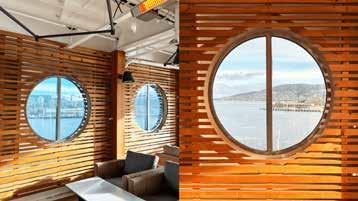
Hydrowood was engaged to supply sustainably salvaged timber for extensive wall cladding through the ship, bringing warmth, texture and a distinctly Tasmanian identity to the passenger experience.
Hydrowood was selected by Rauma Marine Constructions (RMC) and Spirit of Tasmania to provide Celery Top Pine for the vessel’s interior fitout.
Working collaboratively with AJB Furniture & Joinery and
Brock Building Systems, the timber was machined and profiled in Tasmania before being shipped for installation by Scan Marine in Finland, marking Hydrowood’s first contribution to an international ship build.
Celery Top Pine is known for its rich golden tone, fine grain and natural durability. It’s a timber long valued in boat building, joinery and architectural interiors. Installed as outdoor feature wall cladding on board the Spirit of Tasmania IV, it brings warmth and authenticity to passenger spaces while honouring Tasmania’s seafaring heritage.
For the Hydrowood team, the project represented a special contribution to a legacy vessel that will carry travellers, families,
tourists and locals between Tasmania and mainland Australia for decades to come.
To know that a material once lost beneath a hydro lake now forms part of one of Tasmania’s most recognised symbols of travel
is a moment of pride Hydrowood holds closely.
Spirit of Tasmania IV will begin transporting passengers and freight between Tasmania and Victoria in late 2026.
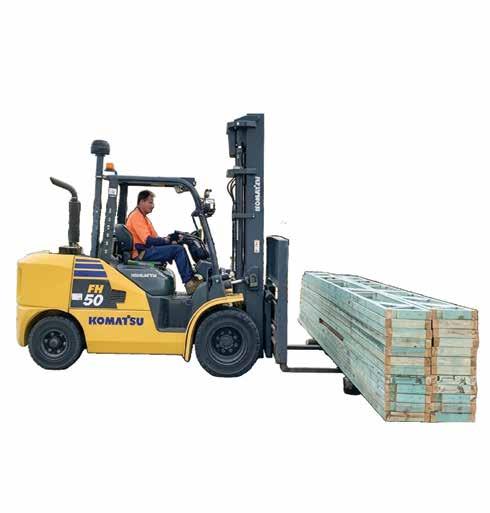
Komatsu Forklifts are built tough for timber handling. Delivering exceptional lifting power, stability, and precision, they make moving heavy, irregular timber loads safer and more efficient. With wet disc brakes and hydrostatic drive available on select models, you’ll enjoy improved fuel efficiency and lower operating costs. Count on Komatsu Forklifts for reliability, quality and durability in the harshest environments.
how Komatsu Forklifts can transform your timber operations.


From sacrificial formwork to sophisticated manufacturing: Clarinda Ho and Norm Roberts are leading OFFSITE’s ambitious mission to close construction’s productivity gap by building more efficiently and redefining housing delivery in Western Australia through modern methods of construction, scaling affordability at industrial speed. In an industry often resistant to change, Western Australian company OFFSITE represents a bold departure from traditional building practices. By bringing forward a five-year plan to completion in less than a year, OFFSITE has proven that speed, scale and performance can coexist - and that affordable living is a design choice backed by a manufacturing system, not a compromise in quality.
What began as a 2009 venture focused on sacrificial formwork has evolved into one of Australia’s most ambitious modern methods of construction (MMC) operations, with the mass production of prefabricated wall panels, floor and roof cassettes, stair cassettes, and other timber components, enabling the delivery of thousands of homes annually.
OFFSITE’s transformation story begins with an unlikely journey to Russia in 2019. The business, originally built around innovative concrete formwork patents, identified a need for timber frame capabilities to complement their existing operations. This led them to acquire a 2014 Weinmann timber framing line from Russia—one of the first HOMAG Weinmann lines in Australia.
“That Weinmann equipment became the backbone of initial operations in timber frame prefabrication,” explains Chief Strategy & Operating Officer Clarinda Ho, who, alongside Executive Chair
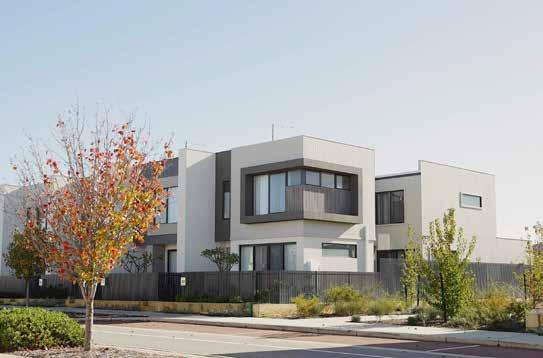
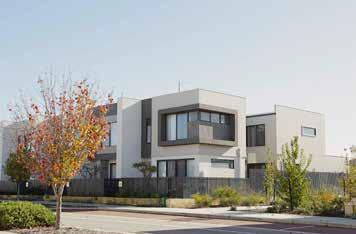
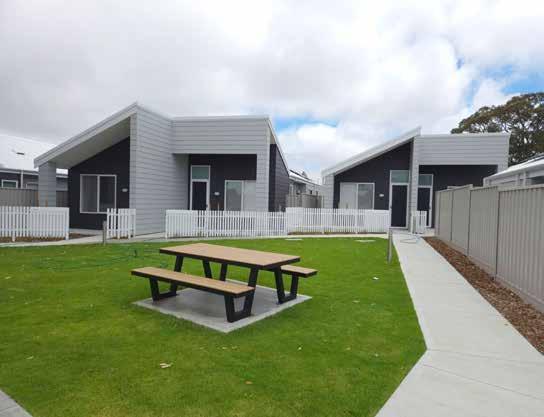
Calleya, Treeby 17 two storey homes.
Semi closed walls – timber wall frames, breathable wrap and cladding. Floor – floor cassette

Norm Roberts, had been engaged as ad hoc consultants with the business for over a decade before leading its acquisition.
The turning point came in late 2023 when the original owners sought an exit. Ho and Roberts assembled a consortium of founding Western Australian shareholders to acquire and recapitalise the business, setting the stage for dramatic expansion.
Today, OFFSITE operates from a facility that Ho describes as “three lines that go down the length of a rugby field”—three automated production lines capable of manufacturing wall panels with remarkable efficiency. The operation includes additional hand-built capacity for architectural nuances and houses one of only two Hun-
degger SPEED-Cut 480 machines in Australia.
This is the mindset behind modern methods of construction (MMC) and design for manufacture and assembly (DfMA). It is also the mindset OFFSITE have applied to turn a fragmented pipeline into industrialised housing production.
The manufacturing process is highly systematised: automated lines frame and nail panels together, add exterior components and cladding, then place finished products onto cradles for shipping. On-site installation of a house’s exteriors using cranes can be completed in 2 to 3 days—a stark contrast to traditional builds, which can take up to 18 months, including fit-out and finishing trades.
“Our Manager - Design Ron Sommerlatt describes the Hundegger SC-480 as having the equivalent productivity of 30 skilled carpenters working around
the clock,” Ho notes, emphasising the remarkable efficiency gains achieved through further automation.
Ron Sommerlatt was recruited from CarbonLite in Victoria via Germany and brings international experience crucial to DfMA — skills and expertise that Ho describes as scarce in the Australian market.
While OFFSITE achieves 1525% cost savings using scale and repeatability compared to masonry builds, the value proposition extends far beyond initial construction costs. The company approaches housing as asset manufacturing, considering lifecycle management (LCAM), maintenance costs, and energy requirements, viewed through both design and manufacturing lenses.
“We’ve been looking at that from that angle [LCAM] from day one, so it’s allowed us to move away from traditional procurement cri-
teria, which tends to lean towards price as a criterion,” Ho explains.
The manufacturing approach enables significant site work reductions and allows for easy upgrades to Passivhaus standards for an estimated 15-20% additional cost.
Executive Chair Norm Roberts explains the economics, “Keep in mind we’re a very small cost of the total build between the land and the finishings. They can upgrade either through wraps or actually nominate passive for about 15-20% more of our cost... and now, all of a sudden, you’ve got a Passivhaus.”
Perhaps most significantly, OFFSITE’s building methodology enables approximately 20% increases in lot yields due to their ability to install on-site in closer proximity without sacrificing amenity.
The company’s expansion story accelerated dramatically in September 2024 when an opportunity arose to acquire two production lines from a Geelong operation. Within weeks, OFFSITE had secured the equipment, shipped it to Western Australia, and then relocated in April 2025 to accommodate the expanded product capacity.
The housing “product” is not a single design; it’s a platform: common structural grids, MEP zones, panel interfaces and envelope systems that allow typological variety without re-engineering each time. Mass customisation via façade options, internal packs and performance tiers, without breaking flow on the lines. Critically, this product mindset clarifies where margin is
earned: in throughput and reliability, rather than in one-off markups on components.
The company has achieved a nameplate capacity of 2,500+ units annually. The Perth market alone demands 25,000 houses annually, but the industry can only supply 15,000.
“Our production order book is full until March next year,” Ho reports, driven primarily by developer adoption of buying the houses (60% complete with installation by OFFSITE) as a product at scale rather than traditional builders building on site.
OFFSITE’s market education ap-
proach emerged from a frustrating reality: builder markups were undermining their value proposition. When a government agency questioned whether OFFSITE delivered promised speed and cost benefits, the truth revealed a different story.
While OFFSITE completed installations in 1-3 days, builders took 11 months to finish projects. More significantly, builders marked up OFFSITE quotes by 65% to 98% to end clients.
This prompted a strategic shift. Committed to affordable, energy-efficient housing, OFFSITE developed standardised designs and worked directly with MMC-fa-
miliar builders to demonstrate true capabilities and pricing,
“We’re deliberately not a builder, but we have our own designs for manufacturing, then DfMA’ing them,” Ho explains. This strategy proved actual pricing points while demonstrating how manufacturing at scale with repeatable designs delivers programs over 26 weeks—bypassing traditional builder margins that obscured MMC’s real benefits.
OFFSITE is working with several builders who program their schedule to the product, not the other way around.
Continued page 20
The Australian company
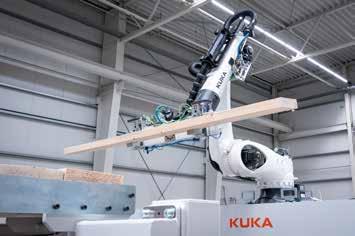
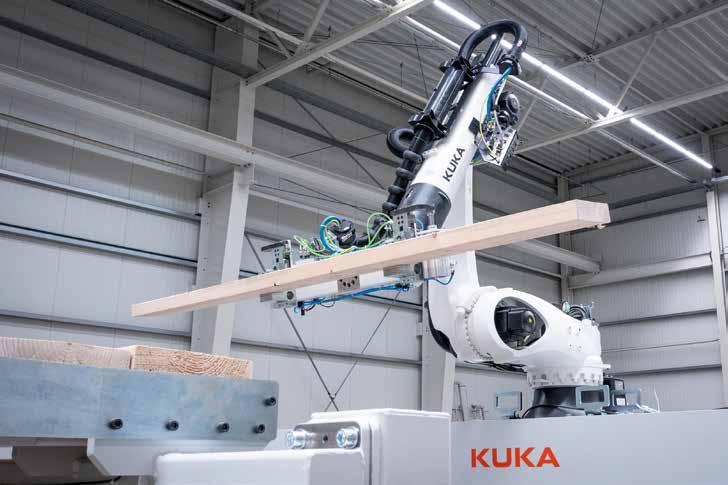
5North, a specialist in innovative construction solutions, and KUKA, one of the world’s leading providers of intelligent automation solutions, are building a state-of-the-art, fully automated production facility for 2D panels at the new manufacturing site in Adelaide. The fully automated production facility for 2D panels use cutting-edge robotics and conveyor technology to efficiently feed raw materials such as timber. The materials are then precisely cut, milled, and drilled. Robots also handle the accurate placement of components as well as bonding and screwing operations. This creates a fully automated manufacturing process, from material feeding to the finished
panel.
In the new facility, the production process is elevated to a new level using the latest robotic technology. The plant will be able to produce a finished 2D panel every ten minutes. These 2D building elements are prefabricated, flat components that play a central role in modern timber construction. They are made from wood-based materials such as radiated pine, cross-laminated timber or solid wood and serve as walls, floors, ceilings, or roof components.
The term “2D” refers to the fact that these elements are manufactured in two dimensions, length and width. Thanks to automated production, the panels are dimensionally accurate and ready for immediate use. On-site, the elements
only need to be positioned and connected, significantly reducing construction time.
At 5North believes everyone deserves an address and have a significant focus on Social and Attainable homes, delivered with sustainable and healthy materials. 5North is not the builder but with its new plant, it is setting new standards in the construction industry for our developer and construction clients.
Working with KUKA allows 5North to use technology and advances manufacturing to offer maximum precision, consistent quality, and an unprecedented production speed,” says Wayne Hughes, Founder and CEO of 5North.
The production of the 2D panels is scheduled to start in mid of 2026.
With this new technology, it will be possible to respond flexibly and quickly to different customer requirements. The highly automated manufacturing process ensures not only consistent quality but also reliable scheduling of orders, offering a major advantage for construction companies and end customers.
By combining digital planning with automated production, 2D panels are created that are perfectly tailored to the requirements of each project. This makes homebuilding efficient, sustainable, and future-proof.
“This is a milestone for Adelaide as a manufacturing site and will strengthen the competitiveness of the Australian construction industry,” adds Timo Heil, CEO of KUKA Systems EMEA.
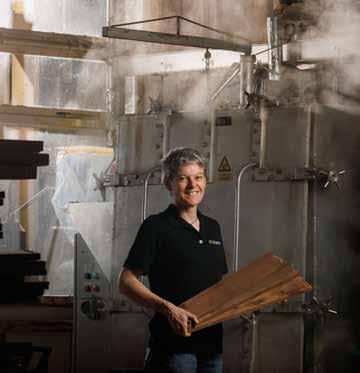
Rosie Sargent loves wood. It’s an incredible complex material, she says, that performs well and shouldn’t be underestimated.
It’s that love that gets the Bioeconomy Science Institute senior technologist up in the mornings. Rosie’s work centres around processing wood, mainly around wood drying and modification. “My work is really varied,” she says. “On any given day I could be reading literature and figuring out logistics for a processing trial, analysing data, or driving the forklift and stacking timber.”
Currently she’s helping some commercial clients scale-up a new process from the lab scale to the sawmill. “It’s exciting. We’ve been helping them find the best processing conditions and monitor the process to make sure it’s working the way they want.
Rosie and her team are also commissioning a new control system for kilns in the timber drying lab. “This will give us a bit more functionality and bring us up to date with the control system used in most New Zealand and Australian sawmills. Part of my job is to help sawmills better manage their drying processes, so being familiar with the latest control software is an important part of that.”
She has an engineering degree (chemical and process engineering) from Canterbury University. This field, she says, was a natural fit for her. “I was always really interested in science, but also very practical. My current role has a really good mix of the curiosity and discovery of science, plus the practical side working with equipment and machinery.”
Rosie started as a scientist with Scion (now part of the Bioeconomy Science Institute) 25 years ago, when it was the Forestry

Research Institute. Her work, she says, has always been ‘a bit fluid’, spread across a range of projects and areas. She’s led various projects for nine years and became a senior technologist in 2020.
She also worked over the 2020/21 summer at Carter Holt Harvey Tissue (now Essity) in Kawerau, helping improve the operation of the pulp mill. “I really like working with equipment, especially at pilot- and industrial-scale,” she says.
Working with mills has provided some memorable career moments for Rosie. “Setting up and running a mill trial is a real achievement,” she says. “You have a process that works on a smaller scale, then you are asking a whole mill full of people to stop what they’re doing and try your new process. It takes a huge amount of planning, but seeing something new working on an industrial scale is really exciting.”
Rosie grew up in Nelson. She moved to Canterbury for university before coming to the Bay of Plenty. The best thing about Rotorua, she says, is its location. “It’s central to a lot of outdoor activities and there’s so much to do close to town – lakes, bushwalking and mountain biking.”
“I really enjoy being active in the outdoors – mountain biking, tramping – the top of the South Island and Mt Taranaki are favourite spots, though I don’t get there as often as I’d like – and a bit of trail running, largelyon the trails around Lake Okataina.
She also enjoys making things. “I have three sewing machines, plus a workshop with metalworking and basic woodworking tools. I do enjoy gardening, but it gets neglected at the bottom of the list of hobbies. Mostly I grow hops, which I brew into one or two batches of IPA each year to enjoy with friends.”
Rosie and her partner Bruce also love going off on adventures. “We’ve got no kids, pets or houseplants,” she jokes. They’ve done some climbing on Ruapehu and Tongariro this past winter, and Rosie walked the Larapinta trail in the Northern Territory with a friend in July. “Finding time for all my hobbies is an ongoing challenge,” she laughs.
Back on the work front, the year ahead will bring plenty of challenges for Rosie and her team, too. “We’re really keen to start a project processing redwood
timber,” she says. “More and more redwood is being grown in New Zealand, and in 15-20 years there’ll be enough being harvested to justify a purpose-built redwood sawmill.
“For this to happen, we need to start learning more about what products we can make from different parts of the redwood tree, and to understand how best to process them.”
Rosie recently ran a two-day course on timber drying, for staff from Windsor Engineering and Automation & Electronics (A&E). The feedback was excellent, and she hopes to run further courses. She enjoys sharing her knowledge and passion for wood and says there’s always lots of interest in her work.
“People love the look and feel of wood. I sometimes have people wanting to look at or touch my research samples. I’m not sure that would happen if I was working with concrete or steel.”
The frame and truss industry is entering a period where the next set of decisions will have a real impact on business performance over the coming years. Rising input costs, ongoing labour constraints, changing product mixes and shifting housing demand are forcing manufacturers to take a hard look at how they operate and where they invest.
The 2026 FTMA National Conference and Trade Expo has been built around that reality. The theme, At the Crossroads, reflects the practical choices manufacturers are facing right now, not in theory, but on the factory floor and in the boardroom.
Key questions will be front and centre throughout the program. Do you invest further in automation, or focus on sweating existing assets? Do detached houses remain your core market, or do opportunities in multi-residential and mid-rise construction justify a shift in capability?
These are decisions manufacturers are already making. The conference is designed to provide the information, insights and realworld perspectives needed to make them with confidence.
Several speakers are already locked in, bringing a mix of market intelligence, business experience and practical insight. Tim Woods from IndustryEdge returns to the FTMA stage to deliver his indepth housing and timber market analysis, including forecasts that

KERSTEN GENTLE Executive Officer
FTMA Australia
help manufacturers plan capacity, investment and workforce requirements. His sessions are consistently valued for being datadriven and directly relevant to the industry.
The keynote address will be delivered by Michael McQueen, sponsored by MiTek. McQueen specialises in helping business owners deal with change and disruption, with a focus on practical decision-making rather than buzzwords. His session will look at how manufacturers can adapt to change without losing focus on what actually drives performance.
From a commercial perspective, marketing and sales are increasingly important, even in a traditionally productionfocused industry. Julia Hall from Twenty Nine Ideas will run a practical workshop covering how manufacturers can better position their businesses, communicate value and support sales growth in competitive markets.
In addition to the speaker program, the 2026 conference will introduce a major new element: a dedicated Trade Expo focused entirely on the frame and truss sector. For the first time, the FTMA National Conference will
include three hours of structured exhibition and demonstration time built directly into the agenda. This isn’t a side room or rushed break, it’s dedicated time to see new equipment, systems, software and services that manufacturers can actually use, and to speak directly with suppliers who understand the industry.
Networking remains a core part of the conference, starting with the Red Activities Day. This long-standing feature provides a relaxed way for attendees to connect before the formal sessions begin, with options including golf, gel blasting, a raftbuilding challenge or a Bushtucker Cruise in Mooloolaba. The day wraps up with the Red Activities Ice Breaker at Xperiences HQ at the Novotel Sunshine Coast Resort. Red Activities Day is sponsored by Pryda, Meyer Timber and Vekta Automation.
The conference will be held at the Novotel Sunshine Coast Resort and Sunshine Coast Convention Centre, recently refurbished and located just minutes from Sunshine Coast Airport. The venue offers the space and facilities required for both the conference sessions and the new Trade Expo, while keeping everything in one central location.
The event concludes with the National Conference Dinner, sponsored by Multinail. Alongside the industry awards, the dinner will again feature a Silent Auction raising funds for
SunnyKids, supporting vulnerable children and families in the local community.
For manufacturers looking to step back from day-to-day pressures and focus on the bigger decisions facing their business, the 2026 FTMA National Conference offers a practical, industry-focused forum to do exactly that.
See you on the Sunshine Coast in May 2026.


Employers should be aware that a major change is coming for super contributions.
From 1 July 2026, employers will need to pay super with each payday, not quarterly.
Now is the time to review your cash flow and update payroll systems to stay compliant.
The TTIA National Timber Members’ Hotline has previously had a number of queries seeking clarification on the entitlement due when an employee falls ill on a declared public holiday.
For clarification, according to the Fair Work Act (98), if the period an employee takes paid personal/ carer’s leave includes a day or part day that is a public holiday, the employee is taken to be on the public holiday and not absent on


Brian Beecroft CEO, TTIA
paid personal/carer’s leave. They must therefore be paid for the public holiday.
If a public holiday falls during a period of annual leave, an employee is paid for the public holiday. This includes any hours that fall on a part-day public holiday.
Under the Fair Work Act (s89), if a public holiday (or part-holiday) falls during a period of annual leave, or a period where an employee is
eligible for personal/carer’s leave (including compassionate leave) or community service leave, the employee is taken not to be on annual leave for each day eligible for the other leave or public holiday.
The period of annual leave is not extended by any such absence, but the employee is to be re-credited annual leave for each day of eligible absence.
An employee isn’t paid for any public holiday that falls during a time when the employee is on unpaid leave.
Whether a public holiday extends a period of long service leave will depend on the relevant Commonwealth, State, or Territory long service leave legislation.
Payment for Holidays not worked
Under the Fair Work Act (s116), an employee is to be paid at their ‘base rate of pay’ for their ordinary hours of work when absent on a specified public holiday.
Base rate of pay is an employee’s ordinary rate of pay excluding incentive-based payments and bonuses, loadings, monetary allowances, overtime or penalty rates or any other separately identifiable amounts.
This means an employee will be paid at their ordinary rate of pay excluding the appropriate public holiday penalty payment (had the employee worked) provided by the applicable modern award or enterprise agreement.
In the meantime, if you need any clarification on any award related issues, speak to one of the TTIA team anytime on (02) 9264 0011.
At the Timber Veneer Association’s AGM on November 20, 2025, the Committee looked back on a successful year of activities.
A new Member Portal was added to the TVAA website in February where information relating to meetings, veneer pressing stats, and technical data can be accessed via a passwordprotected “members only” section. This serves the dual function of adding value to the membership package as well as providing a single point for uploading such information, rather than circulating documents to each member individually.
The strategy of linking

PETER LLEWELLYN Technical representative, Timber Veneer Association of Australia
Committee meetings with visits to members’ premises again proved fruitful in 2025. Apart from providing an added reason for interstate members to attend meetings, such site visits allow an interchange of ideas and an opportunity to discuss innovations in the veneer industry.
The July meeting was held
in Coffs Harbour on the 23rd, with a visit next day to the Big River Group’s Grafton Production plant where close to 30 people, committee members and guests were welcomed by the company’s production staff.
As usual at the Annual General Meeting a new Committee was formed for the 2025-26 calendar year. Anthony Wardrop relinquished his position of TVAA President, but continued his commitment to the industry and TVAA by taking a position on the general committee. Evan Danahay, formerly Secretary, took over as Association President.
The incoming Committee
is comprised as follows:: Evan Danahay - Britton Timber (President), Chris Johnstone
- Ventech Australia (Vice President), Mark Sajowitz
- Independent (Treasurer/ Secretary), Anthony WardropMatilda Veneer, Luke Haigh - Opal Wood Corporation. Brad Simpson
- Henkel Australia, Ross Sprenger
- Bord Products, Henry DednamTimberwood Panels/ Big River Marc Robinson - Veneer Panels Plus .
TVAA ended 2025 after a year of productive activity for members and continued promotion of timber veneer through the Association’s website and range of publications.
Researchers at the University of Auckland’s Structural Timber Innovation Laboratory are breaking ground with durability programmes to open new applications for low carbon crosslaminated timber in demanding outdoor environments.
The novel product, which is made by stacking layers of thick solid wood boards crosswise and gluing them together, is increasingly used as a low-carbon option for walls, floors and roofs in buildings.
However, its use is largely limited to indoor environments, and has only rarely been used in applications such as bridges, facades, outdoor pavilions, and other infrastructure
“Our research aims to change that,” says Dr Gary Raftery, a research director in the University’s Circular Innovations Research Centre.
The team is conducting a series of long-term exposure trials using both outdoor and lab experiments that simulate extreme conditions.
They will then analyse the product using advanced tools, including a high-powered microscope that can reveal information in relation to the deterioration and a tool that can read ‘chemical fingerprints’.
This allows the engineers to identify the composition of the material and track how its chemical structure could change over time.
Raftery says cross-laminated timber is known for its strength and architectural versatility, but unprotected exposure to the elements can lead to biological degradation like rot and mold, dimensional instability, and structural compromise.
Working with industry partners, the team is meticulously

assessing adhesive and preservative systems to augment the performance of crosslaminated timber, while keeping sustainability front-of-mind.
“We want to ensure that solutions align with circular economy principles, so crosslaminated timber elements can be reused, repurposed, or recycled at the end of their service life,” he says.
“This data will give designers
the confidence to adopt more sustainable construction practices and further support a transition to low-carbon construction.”
Life-cycle analysis on end-of-life applications is also being conducted to assess environmental impacts.
Early findings are already informing design engineers and may contribute to future updates to building standards.
From page 15
“We are working with the broader delivery team to achieve a completion time of about 26 weeks after OFFSITE completes installation, targeting a 12 to 14 weeks in the future, explains Ho. “The gold standard overseas for this type of build is 10 weeks to completion.
The company engages extensively with government stakeholders, advocating for procurement reform and clearer definitions of MMC. Ho argues that the government could be more impactful if they specified outcome requirements more precisely. For example, through standardising particular housing configurations procured at scale, nominating a 26-week program, requiring
minimum asset performance and energy efficiency, and setting target price points in which the built form is to be delivered, and mandating specific methodologies to be used where appropriate.
Looking ahead, OFFSITE’s priorities are clear: complete the commissioning of the expanded capacity, broaden the ready-tobuild design library, and continue to compress cycle times from installation to handover. OFFSITE’s focus remains firmly on improving manufacturing and construction productivity. Longer-term plans include a second “Bravo site” facility, although Ho acknowledges that this represents a four-year, $150 million-plus investment decision.
Roberts explains why competition isn’t an immediate concern, pointing to the massive barriers to entry and the Nullarbor as a physical logistics barrier for possible east coast competitors. Any competitor would face a minimum four-year timeline to achieve installed capacity, necessitating substantial financial resources to operate at the necessary scale.
“Even at $150 million, that hasn’t paid for the completed factory,” Roberts notes. “That’s basically you’ve got your site and your down payment on the equipment.”
The company has already received inquiries from interstate markets, with backloading economics making supply to Adelaide a viable option. Queensland has
also expressed interest, despite the distance.
Beyond expansion, OFFSITE maintains broader industry development goals, promoting and advocating MMC. “Our purpose is to infect the Western Australian community with the benefits of MMC,” Ho states. “We are on a mission.”
OFFSITE’s rapid growth reflects broader industry momentum around modern construction methods.
Ho notes an increasing alignment between their messaging and recent government reports, industry publications, research, and member peak body initiatives through organisations like prefabAUS.