P R I N C E T O N
VARSITY CLUB
news
Super Six Claim Top Senior Athlete Awards 2005 PVC Banquet recognizes Players of the Year, league and national champions and an Olympian.
he 1965 Prince
Featuring ... Senior-Athlete Award Winners Spring Success Stories Hlafter Is The Best Medicine Alumni Award PVC Website Coming Soon 2004-05 Athletic Year In Review Keynote Senior Speeches Champions In The Communities
Each student-athlete who graduates from Princeton leaves some sort of mark, but there are a select few who truly etch legacies into the prestigous foundation of Princeton athletics. These are the young men and women who join one of two lists that includes names like Bill Bradley ’65, Keith Elias ’94, Emily Goodfellow ’76 and Kim Simons ’94. The 2005 winners of the William Winston Roper Trophy and the C. Otto von Kienbusch Award were announced at the Princeton Varsity Club Senior Athlete Banquet on May 26. The Roper winners were fencer Soren Thompson and baseball/basketball standout Will Venable. The von Kienbusch recipients were swimmer Stephanie Hsiao, golfer Avery Kiser, soccer player
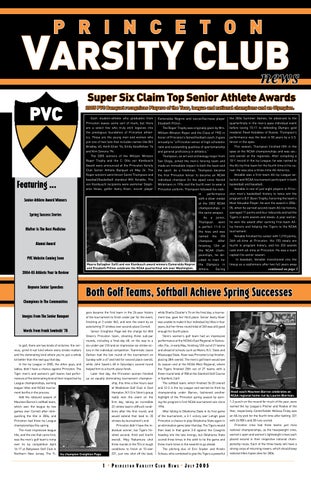
Esmeralda Negron and soccer/lacrosse player Elizabeth Pillion. The Roper Trophy was originally given by Mrs. William Winston Roper and the Class of 1902 in honor of Princeton’s famed football coach. It goes annually to “a Princeton senior of high scholastic rank and outstanding qualities of sportsmanship and general proficiency in athletics.” Thompson, an art and archeology major from San Diego, joined the men’s fencing team and made an immediate impact to both the team and the sport. As a freshman, Thompson became the first Princeton fencer to become an NCAA individual champion (in the epee) since Harold Winkmann in 1994 and the fourth ever to wear a Princeton uniform. Thompson followed his rookie performance with a silver medal at the 2002 NCAA championships in the same weapon. As a junior, Thompson went a perfect 11-0 in the Ivies and was named the IFA champion. After finishing 12th at the NCAA championships, he decided to train for Maura Gallagher (left) and von Kienbusch award winners Esmeralda Negron the Olympics in and Elizabeth Pillion celebrate the NCAA quarterfinal win over Washington. Athens. During
continued on page 3
Both Golf Teams, Softball Achieve Spring Successes
gers became the first team in the 26-year history of the tournament to finish under par for the event, finishing at 2-under 862, and won the event by an astonishing 31 strokes over second-place Cornell. Words From Frank Sowinski ’78 Senior Creighton Page led the charge for Will Green’s Princeton team, shooting three sub-par rounds, including a final-day 68, on the way to a In golf, there are two kinds of victories: the nersix-under-par 210 and an impressive six-stroke vicvous, grind-it-out kind where every stroke matters tory in the individual competition. Teammate Jason and the dominating kind where you’re just a whole Gerken had the low round of the tournament on lot better than the next guy that day. Sunday with a 67 and tied for second place overall, In the Ivy League in 2005, the other guys, and while John Sawin’s 68 in Saturday’s second round ladies, didn’t have a chance against Princeton. The helped him to a fourth-place finish. Tiger men’s and women’s golf teams had perforLater that day, the Princeton women finished mances of the dominating kind at their respective Ivy up an equally dominating tournament championLeague championships, earning ship, this time a few hours east league titles and NCAA tournaat Maidstone Golf Club in East ment berths in the process. Hampton, N.Y. Eric Stein’s group Add the rebound season of really won the event on the Maureen Barron’s softball team, first day, taking an incredible which won the league by two 22-stroke lead in difficult condigames over Cornell after relintions after the first round, and quishing the title in 2004, and would extend that lead to 35 Princeton had three Ivy League strokes by tournament’s end. championships this spring. Princeton didn’t have the inThe most impressive league dividual winner, but Tigers fintitle, and the one that came first, ished second, third and fourth was the men’s golf team’s romp overall. Meg Nakamura shot over its Ivy competition April three rounds in the 70’s in tough 16-17 at Ballyowen Golf Club in conditions to finish at 15-over Northern New Jersey. The Ti- Ivy champion Creighton Page 231, just one shot off the lead,
Images From The Senior Banquet
the 2004 Summer Games, he advanced to the quarterfinals in the men’s epee individual event before losing 15-11 to defending Olympic gold medalist Pavel Kolobkov of Russia. Thompson’s performance was the best in 50 years by a U.S. fencer in the epee. This season, Thompson finished fifth in the epee at the NCAA championships and was second overall at the regionals. After compiling a 10-1 record in the Ivy League, he was named to the All-Ivy first team for the fourth time in his career. He was also a three-time All-America. Venable was a first-team All-Ivy League selection and NCAA tournament participant in both basketball and baseball. Venable is one of just eight players in Princeton men’s basketball history to twice win the program’s B.F. Bunn Trophy, honoring the team’s Most Valuable Player. He won the award in 200405, when he earned second-team All-Ivy honors, averaged 11 points and four rebounds and led the Tigers in both assists and steals. A year earlier, he won the award after earning first-team AllIvy honors and helping the Tigers to the NCAA tournament. Venable finished his career with 1,010 points, 26th all-time at Princeton. His 155 steals are fourth in program history, and his 253 assists rank ninth all-time at Princeton. He was a team captain his senior season. In baseball, Venable transitioned into the lineup as a sophomore after two full years away
while Sharla Cloutier’s 74 on the final day, a tournament low, gave her third place. Senior Avery Kiser was unable to make it four individual Ivy titles in four years, but her three-round total of 245 was still good enough for fourth place. Stein’s women’s golf team had an impressive performance at the NCAA’s East Regional in Gainesville, Fla., in early May, finishing 12th out of 21 teams and ahead of schools such as Miami, N.C. State and Mississippi State. Kiser was Princeton’s top finisher, placing 28th overall. The men’s golf team would see its season end at the NCAA West Regional, where the Tigers finished 25th out of 27 teams with a three-round total of 908 at the Stanford Golf Course in Stanford, Calif. The softball team, which finished 36-20 overall and 12-2 in the Ivy League and earned its third Ivy championship under Barron, fashioned another highlight of the Princeton spring season by earning the program’s first NCAA tournament win since 1996. After falling to Oklahoma State in its first game of the tournament, a 3-1 victory over Lehigh gave Princeton a chance to play Oklahoma State again in an elimination game later that day. The Tigers would then lead in that game 3-0 against the Cowgirls heading into the late innings, but Oklahoma State scored three times in the sixth to tie the game and three more times in the seventh to go ahead. The pitching duo of Erin Snyder and Kristin Schaus, who combined to give the Tigers a powerful
• Princeton Varsity Club News • July 2005
Head coach Maureen Barron celebrates an NCAA regional home run by Lauren Bierman. 1-2 punch on the mound for much of the year, were named the Ivy League’s Pitcher and Rookie of the Year, respectively. Centerfielder Melissa Finley was an All-Ivy pick for the fourth time after batting .321 with 24 RBI’s and 28 runs scored. Princeton crew had three teams just miss national championships, as the heavyweight crew, women’s open and women’s lightweight crews each placed second in their respective national championship races. Each of the three boats will have a strong corps of returning rowers, which should keep national titles hopes alive for 2006.
Princeton Varsity Club
Hlafter, O’Brien Honored by PVC Building stadiums or rebuilding lives, both are credits to Princeton athletics
The mission of the Princeton Varsity Club is: “To implement and support programs that perpetuate and enhance the Performance, Values and Community of Princeton Athletics and the University.” The Princeton Varsity Club (PVC) recognizes the long tradition of athletic, academic and alumni success at Princeton University. It also recognizes that current varsity athletics, alumni letter winners and friends and supporters of Princeton Athletics represent a strong community built upon shared values and experiences. The PVC supports the notion that Princeton Athletics should aspire to be a model for collegiate athletics both in the Ivy League and in the broader collegiate athletics community. The PVC also supports the ongoing educational role athletics and the student-athlete play within the University community. The focus of the Princeton Varsity Club centers around:
• PERFORMANCE — enhancing the educational, athletic and post-graduate experience of our current student-athletes. • VALUES — acting as stewards who encourage, perpetuate and demonstrate the educational values inherent in intercollegiate athletics competition. • COMMUNITY — building a spirited collegiality among current and former Princeton varsity athletes and other supporters of Princeton Athletics as part of the long tradition of athletic excellence within Princeton University. The Princeton Varsity Club is operated by the Office of Athletic Relations, and PVC funds help support the following initiatives: a new PVC website, which will include an Advisory and Mentoring Program with a searchable database of alumni; support for the PVC Senior Student-Athlete Awards Banquet and presentation of PVC sweaters to senior student-athletes; support for the Princeton Athletics Friends Groups; career Night, which brings alums from diverse careers to campus for an evening event to assist current student-athletes in career planning; the PVC Speaker series, a lecture series that brings prominent figures in the world of college athletics to campus; the PVC News, which provides an insider’s view of Princeton Athletics, including features on student-athletes, coaches, and alumni; seasonal coaches’ luncheons where coaches provide an in-depth analysis of their teams and student-athletes speak about their experiences at Princeton University; “PVC On the Road” events where the athletics staff and coaches travel to major cities to host luncheons for area alumni; the “Tigers in the Community” program, which implements community outreach initiatives with student-athlete participation. The PVC acts in concert with the greater University community that supports the values and ideals of Princeton athletics. While Membership is open to all alumni letterwinners and members of the Princeton Athletics Friends Groups, it is also open to an alumni who is interested in supporting the mission of the Princeton Varsity Club. Membership dues are based on a sliding scale tied to year of graduation.
Membership Fees Levels of Support Class $75........................................ 1995-99 $100...................................... 1990-94 $150...................................... 1955-89 $100..........................1954 and earlier $150........................ non-letterwinners Graduates five years out (for this coming year that would include anyone in the Class of ’01 and above) may join the PVC at the Varsity Level for $50.00. Call 609-258-6696 for more information.
PVC Endowment Fund Please consider a gift, in addition to your annual membership, to this new initiative of the Princeton Varsity Club. This fund will be used to build a legacy for the future of Princeton Athletics and its student-athletes.
Princeton University architect Jon Hlafter first came to campus as an undergraduate in 1957. And while his schooling in the field of architecture at Princeton may have formally ended when he earned a master’s degree in 1963, architecture at Princeton has never stopped being his passion in the five decades since. As the University’s Director of Physical Planning beginning in 1969, and as the University Architect for the past two years, Hlafter has overseen hundreds of Princeton construction projects. Many of those have been projects directly related to the Department of Athletics, and the completion of those projects have given Princeton some of the best athletic facilities in the nation. No wonder, then, that Hlafter, a member of the Princeton Class of 1961, is the 2005 recipient of the PVC’s Marvin Bressler Award. The honor, awarded in the spirit of Professor Bressler, is given to that member of the Princeton family who, through heartfelt support of the University’s student-athletes and coaches, best embodies a belief in the lifelong lessons taught by competition and athletics as a complement to the overall educational mission. Perhaps the most prominent example of Hlafter’s planning and leadership is the striking Princeton University Stadium, completed in 1998 on the site of the former Palmer Memorial Stadium. Working with noted architect Rafael Viñoly, Hlafter helped craft a building that serves not only as the home of Princeton football but also as an extension and integral part of the daily life of the University. While the completion of Princeton Stadium was certainly a notable achievement, it has hardly been the only athletics project in Hlafter’s tenure. The Class of 1952 Stadium, completed in 1995, gave the Princeton lacrosse and field hockey teams a worthy home for their numerous achievements. Jon Hlafter DeNunzio Pool, completed in 1990, blended seamlessly within the campus’s Southeast corner and continues to be one of the finest facilities of its kind in the nation. There has also been the transformation of the Princeton boathouse to the Shea Rowing Center, and the original construction and now transformation of the Lenz Tennis Center, each blending the modern with the traditional in the best possible fashion. Campus-wide, Hlafter’s vision of the Princeton campus has resulted in many other building achievements. Whether it was the construc-
John O’Brien ’65 is more than just the president of the Milton Hershey School. He is a living example of what that world-famous institution has done for thousands of disadvantaged young people for nearly a century. O’Brien is also a living example of what Princeton University, and Princeton athletics, can help mold. And he certainly is a deserving winner of the 2005 Citizen-Athlete Award, presented by the Princeton Varsity Club for selfless and noble contributions to sport and society. “I’m certainly humbled by the honor, because I know that there were better athletes at Princeton than I,” O’Brien says. “But I do know that I owe a great deal of thanks to Princeton for playing a pivotal part in my development, values and character.” Princeton was the second of two institutions that both framed O’Brien’s life and continue to be the objects of a life devoted to service. The first was, and is, Milton Hershey, a school that began as an industrial school for orphaned boys in 1909 and today is the largest residential pre-kindergarten-12th grade school in the United States. To this day, the school continues to provide free room and board to its students, not to mention a free college education at any school in the nation after graduation, for over 1,000 financially and socially disadvantaged children. O’Brien attended Milton Hershey beginning in 1946 after being orphaned at the age of just three. 15 years later, he was a star both athletically and academically at the school and was recruited by Princeton to play football. A starting defensive back for the Tigers in 1962 and a member of the legendary undefeated 9-0 Princeton team in 1964, he graduated with a degree in psychology in 1965. “We had 18 seniors on that undefeated team, and 17 of them went on to get graduate degrees,” says O’Brien, who himself has a master’s degree in educational psychology from Johns Hopkins. “The value that those people brought to Princeton, and the character of those people, is hard to top.” More than half a century after coming to Milton Hershey, in the fall of 2003, the circle completed when O’Brien was named president of the school. He had served as interim president for six months prior to the appointment. Among his chief goals as president is to reestablish Milton Hershey’s focus on the most disadvantaged children, ones like himself many years ago. O’Brien’s career leading up to that appointment was a unique one that emphasized the values of education and teamwork he had seen first hand at Princeton. He worked in Princeton’s admissions office shortly after graduation, and then had a job with the National Institute of Education (NIE) before deciding to go out on his own with an idea in the late 1970’s.
tion of the Frist Campus Center, just five years ago, or the transformation of the then Princeton Inn to Forbes College in the early 1970’s, the campus is a better place thanks to that vision. Hlafter’s work in helping the Princeton campus maintain a blend of both historic and contemporary has not gone unnoticed either on campus or on a national level. A year ago, he was elected to the American Institute of Architects (AIA) College of Fellows, awarded to those have made a significant contribution to architecture and society on a national level. Out of a total AIA membership of over 70.000, only 2,500 have been honored with fellow status. He was also a principal adviser for the President’s Advisory Committee on Architecture, a group that makes key decisions for the campus. A decade ago, he helped develop and implement a master plan for campus buildings along with a group of outside architects.
The idea was this. He would combine John O’Brien his psychology degree with his background from NIE, to take corporate leaders into the outdoors to develop camaraderie and solve problems. When Smith Barney hired him in 1978, he began a business career taking managers into the wild—whether it be climbing rock walls or swinging on a ropes course—all in the name of community and teamwork. “I wanted to get beyond thinking that what I was doing was not bad ‘for an orphan’,” O’Brien told the Princeton Alumni Weekly last year. “I wanted to do something where I could say that what I was doing was ‘not bad for anyone.’” Though he may have wondered what he was doing on campus in the fall of 1961, as the first-ever graduate of a school for orphans to attend Princeton, the results certainly speak for themselves. In anyone’s book, John O’Brien’s life has been a startling success story.
P ri n c e t o n
V arsit y
I would like to help the Friends of Princeton Athletics with my gift of
My credit card number is
__ __ __ __ __ __ __ __ __ __ __ __ __ __ __
Exp. Date ___ ___ /___ ___
$
C lub Amount $_______________________
Name as it appears on card______________________________________________
❑ Enclosed is my check payable to Princeton University.
Signature___________________________________________________________ You may designate your gift for one or more listed below (indicate amount next to each sport). Only gifts of $50 or more may be split.
One check is sufficient to cover split gifts. ❑ I want to make my gift by credit card. Please charge to my ❑ AmEx ❑ MasterCard ❑ Visa ❑ Discover (Please fill out information at right.) My gift will be matched by__________________________________________
Gifts to Friends of Princeton Athletics are tax deductible to the extent allowed by law. Send Payment To: Princeton Varsity Club Princeton University P.O. Box 5357 (If you are affiliated with a matching gift company, please enclose their form with your gift.) Princeton, N.J. 08543-5357 • For gifts of securities, call Elizabeth Ritchie at 609-258-3374. •
$ Amt.
Sport
Account
_____ Princeton Varsity Club.... 76 (unrestricted) _____ Baseball/Softball 82 _____ Basketball..........................43 _____ Crew (PURA)....................48 _____ Fencing..............................57 _____ Field Hockey.....................19
$ Amt.
Sport
Account
_____ Football (PFA)...................41 _____ Golf...................................49 _____ Ice Hockey........................44 _____ Lacrosse.............................53 _____ Soccer................................77 _____ Sprint Football...................42 _____ Squash...............................71
$ Amt.
Sport
Account
_____ Swimming & Diving.........50 _____ Tennis................................55 _____ Track & Field/CC..............46 _____ W Volleyball......................95 _____ W Water Polo....................66 _____ Wrestling...........................54
July 2005 • Princeton Varsity Club News •
$ Amt.
Sport
Account
Self-Funded Varsities _____ M Volleyball......................96 _____ M Water Polo....................51
Princeton Varsity Club Announces New Website for Fall 2005 PrincetonVarsityClub.org will provide for both undergraduate student-athletes and alumni.
The new, official website of the Princeton Varsity Club (PVC), www.PrincetonVarsityClub.org, is scheduled to launch in early Fall 2005. As part of the PVC’s mission to implement and support programs that perpetuate and enhance the Performance, Values and Community of Princeton Athletics and the University, PrincetonVarsityClub.org will host a searchable Princeton alumni athlete database, online registration to participate as a mentor (as alum, parent, or friend) or mentee (as Princeton undergraduate or young alum) and links to team Friends’ lounges. To access the alumni database, alums, parents and friends may register on the PVC website for free. Registrants on PrincetonVarsityClub.org will be able to search alumni based on sport, region, class, and other classifications. Registration on the PVC website will also allow visitors access to the team lounges—dependent on affiliation as former player, parent, friend, or coach—to view recent team announcements and reconnect with former teammates. Organized around the Performance, Values, and Community of Princeton Athletics, the PVC website will feature testimonials by alumni student-athletes and friends of the Princeton athletic community. The “Performance” section of the PVC website will include archives of featured PVC testimonials and the PVC News, a list of Princeton Varsity Club award winners, a collective page of Princeton Athletic honors and a direct link to the official website of Princeton Athletics. (Note: The official website of Princeton Athletics, www. GoPrincetonTigers.com, will continue to be the source for the latest news and results of Tiger athletics; the PVC website will serve as the primary portal to connect current and former athletes and parents and friends of Princeton Athletics). The “Values” section of the PVC website will highlight the recent activities of “Tigers in the Community,” the PVC community program that connects athletes with the community by organizing and providing cross-sport opportunities to volunteer in the community. Pictures and event recaps of Tigers in the Community outings will be posted in this part of the website, along with recaps and archived lectures from the PVC Speaker Series. The PVC “Community” section will present the primary tools to connect members of the Princeton Athletics community, such as the searchable Princeton alumni athlete database and PVC Mentor Program. These tools will support and encourage former and current Princeton student athletes to reconnect with old teammates and participate in programs that will bring together former and current athletes across different sports and interests. Log on to www.PrincetonVarsityClub.org this fall to register on the website and get connected and participate in the Princeton Athletics community.
PVC Board of Directors
John Ingram ’83
Hewes Agnew ’58
Marty Johnson ’81
Jim Blair ‘61
Hayden Jones ’98
Gog Boonswang ’96
Devon Keefe ’01
Tara Christie ’97
Bert Kerstetter ’66
Ralph DeNunzio ’53
Bill Kingston ’65
Ed Glassmeyer ’63
Richard Korhammer ’89
Emily Goodfellow ’76
Hilary Pushkin Kusel ’94
Paul Harris ’54
Larry Lucchino ’67
Richard Kazmaier ’52
Tom Ludwig ’98
2004-05 review
Mike McCaffery ’75
Podie Lynch ’71
Richard Prentke ’67
John Mack ’00
from the sport. He hit .239 that season in 27 games. A year later, Venable was the team’s everyday designated hitter and saw time in the outfield en route to being named an honorable mention AllIvy. He batted .344, had 20 RBIs and stole 14 bases. As a senior, Venable raised his average another 40 points to hit a team-leading .385 with 33 RBIs, nine home runs and 35 runs scored. He became the team’s starting center fielder and earned first-team All-Ivy honors at the position. He was also a two-time first-team all-state pick during his Princeton career. Venable, who was drafted by the San Diego Padres, is an anthropology major from San Rafael, Calif. The C. Otto Von Kienbusch Award, presented in memory of a member of the Class of 1906, goes annually to “a senior woman of high scholastic rank who has demonstrated a general proficiency in athletics and the qualities of a true sportswoman.” Hsiao put together one of the greatest careers in the proud history of Princeton women’s swimming and diving. The East Asian Studies major from Irvine, Calif., broke through during her sophomore year by winning two events in the Ivy League Championships,
John Rogers ’80
Lauren Fortgang Mandell
Jay Sherrerd ’52
’91
Margie Gengler Smith ’73
Jack McCarthy, Jr. ’43
Frank Sowinski ’78
John McGillicuddy ’52
Gary Walters ’67
Aila Winkler Main ’92
(Athletic Director)
Kristin Green Morse ’93
continued from page 1
Jason Mraz ’89
Pictured clockwise from top left: Avery Kiser, Will Venable, Stephanie Hsiao and Soren Thompson. The two other von Kienbusch winners, Esmeralda Negron and Elizabeth Pillion, were pictured on the front page.
including the 100 breaststroke, an event she only began to compete in during that season. That win highlighted one of three team championships Princeton won during Hsiao’s career. She would win 13 events during her final two years, including seven as a senior when she would be named the 2005 Ivy League Championships Swimmer of the Meet. Both a two-time NCAA Championships representative and a twotime Academic All-Ivy selection, Hsiao succeeded in more ways than one during her Princeton career. Kiser made an immediate impact on the Princeton women’s golf team as a freshman and has led the team since. In four years, she has taken medalist honors in 11 different tournaments and has led the Tigers to 11 team titles. Kiser won the Ivy League Championship in her freshman, sophomore and junior campaigns to become the only Ivy League golfer to win three straight league titles. Her bid for a fourth fell a few strokes short earlier this year, her magical senior year. but Kiser finished fourth to claim All-Ivy honors for the fourth time Pillion, a psychology major from Villanova, Pa., brought a winin her career, becoming only the second Ivy women’s golfer to ning spirit to two Princeton teams. Pillion finished her career with do so. Kiser is the only Princeton golfer to compete in the NCAA two national championships and three Final Four appearances in Championships in all four years of her career. As a freshman and lacrosse and three NCAA tournament appearances and one NCAA sophomore, she earned individual invites, while as a junior and Final Four in soccer. She played in seven NCAA tournaments, a senior she competed as part of Princeton’s team entry as the compiling a 19-4 record in postseason events. Pillion, despite a Tigers won the Ivy League Championship in those seasons. Kiser limited background in the sport, walked onto the soccer team her is an Operation Research and Financial Engineering major from sophomore year. She became an immediate contributor that year, Rancho Palos Verdes, Calif. worked her way into the starting lineup as a junior and became a Negron, a Spanish major from Harrington Park, N.J., graduates second-team All-Ivy League defender as a senior. as the all-time leading scorer in soccer at Princeton for men and Pillion was a two-time first-team All-America and two-time women. She was also the keystone of Princeton’s unprecedented unanimous first-team All-Ivy selection in women’s lacrosse. She run to the NCAA Final Four this past fall, when the Tigers became was twice a semifinalist for the Tewaaraton Trophy, honoring the the first Ivy League school to reach the women’s soccer Final Four national player of the year, and she was a team captain in 2005. and the first Ivy school in any sport to reach the Final Four of a 64Her 150 career points rank 11th all-time at Princeton, and her team NCAA tournament. 46 career assists rank in the top 10 in program history. She also Negron set Princeton single-season records with 20 goals, 12 finished her career among the top 10 players in team history in assists and 52 points while earning her second-straight Ivy League both ground balls and caused turnovers. Player of the Year Award and third first-team All-Ivy honor last Pillion also earned NCAA All-Tournament team honors in both fall. She finished with 47 goals and 111 points, and she is second 2003, when the Tigers won their second-straight national chamall-time in assists at Princeton with 17. She also had four career pionship, and in 2004, when the Tigers advanced to the national Bill Bradley’s mark of 58 points in a Final Four contest has never been topped. overtime goals. She was a first-team All-America selection during championship game.
• Princeton Varsity Club News • July 2005
Ex Officio
Michael Novogratz ’87
Royce Flippin ’56
Dan Okimoto ’65
Bob Myslik ’67
Andre Parris ’97 Sue Perles ’75
Advisory Committee
Geoff Petrie ’70
Hamin Abdullah ’00
Tom Pirelli ’69
Chris Ahrens ’98
Bill Powers ’79
Alan Andreini ’68
Scott Rodgers ’71
Bob Baldwin ’42
John Scully ’66
Carl Behnke ’67
Mark Shapiro ’89
Priya Bhupathi ’02
Rod Shepard ’80
Bill Bradley ’65
Tina Smith ’95
Pete Carril h44, h52,
Trevor Smith ’03
h75, h84, h90
Charlie Stillitano ’81
Y.S. Chi ’83
Chris Thomforde ’69
Janet Clarke ’75
Bob Varrin ’56
John Claster ’67
Aditi Viswanathan ’89
Kiersten Todt Coon ’94
Frank Vuono ’78
Ahmed El Nokali ’02
Nathan Walton ’01
John Emery ’52
Bill Walton ’74
Bess Frank ’99
Marc Washington ’97
Debbie CampbellGarwood
Margot Wheeler ’87
’79
Becket Wolf ’97
Ward Glassmeyer ’89
Rick Wright ’64
Wyc Grousbeck ’83
Larry Zadra ’83
Sari Chang Guthrie ’84 Wendy Herm ’99
Undergraduate Advisory
Jay Higgins ’67
Board
Mike Higgins ’01 Chuck Huggins ’83
Chanel Lattimer ’05
John Hummer ’70
Weston Powell ’06
Ugwunna Ikpeowo ’96
Neil Stevenson-Moore ’05
P ee rr ff oo rr mm aa nn cc ee • V aa Wild Fall Successes Pace Another Strong Year At Princeton The two buses sat side-by-side, parked on the apron between Caldwell Field House and DeNunzio Pool, waiting to load two separate groups for the most improbable of journeys as television cameras and newspaper reporters and photographers were there to chronicle the scene. The date was Dec. 1, 2004, and the Princeton women’s soccer team and men’s water polo team were preparing to fly off to their respective NCAA Final Fours. Their participation brought to four the number of Princeton teams who would compete in the Final Four of an NCAA tournament in the calendar year 2004, tying UCLA and Stanford for the most in Division I. The performances of those two teams in the fall were the highlights of the 2004-05 athletic year at Princeton. It was a year that saw Princeton win the Ivy League’s unofficial all-sports points championship for the 19th straight time, and Yasser El Halaby’s third-straight national squash championship gave Princeton at least one team or individual national title for the 19th straight year as well. Stretching back 10 years, Princeton has won 110 Ivy League championships, 37 more than the next-highest total by an Ivy school. Princeton won Ivy League championships in men’s and women’s golf, women’s volleyball, women’s soccer and softball. In addition, eight other teams finished in second place, and 24 of the 33 teams in Ivy sports finished in the top half of the league standings. Princeton’s Class of 2005 combined to win 36 Ivy titles, the most in the league, and finished with a four-year total of 20 AllAmericas, 10 Ivy Player of the Year Awards and 156 All-Ivy League selections. Still, it was the remarkable fall runs of the two Final Four years that will be most remembered for the 2004-05 year. The women’s soccer team put together one of the most memo-
rable seasons in all of Princeton Gail Ramsay as the only players in athletic history. Competing as one college squash history to win four of 306 Division I schools, Princindividual titles. eton went 19-3 overall, including Princeton teams won three a perfect 7-0-0 in the Ivy League, Ivy championships in the spring, and then won four NCAA tournaincluding another sweep of the ment games to become the first Ivy golf titles. The men’s team won League team to reach the women’s its second straight title and fifth soccer Final Four and the first Ivy in the last six years and did so in team in any sport to reach the Final record-setting fashion, shooting a Four of a 64-team NCAA tournacombined two-under 862 for the ment. lowest three-round score in the Along the way, Princeton pro26-year history of the Ivy League duced two first-team All-Americas championships. (Diana Matheson, Esmeralda NeCreighton Page became the gron) and two Academic All-Ameri12th Princetonian to win the indicas, won the NSCAA team academic vidual league championship, folaward and was led by the Division I lowed by teammate Jason Gerken Coach of the Year, Julie Shackford. in second. Princeton, who finished the season On the women’s side, Meg Naranked fourth nationally, set the Ivy Yasser El Halaby won his third national title in 2005. kamura, Sharla Cloutier and Avery League record for wins in a season Kiser went 2-3-4 as Princeton won and goals in a league season. Princeton defeated Central Conits second straight title and third in five years. necticut and Villanova to reach the Sweet 16 and then defeated The softball team returned to Ivy League prominence after a Boston College 2-0 to reach the quarterfinals. Playing at home in one-year absence, giving Maureen Barron her third championship front of 2,504 chilled fans who jammed into Lourie-Love Field the in four years as Tiger head coach. Princeton, led by Ivy Pitcher of night after Thanksgiving, Princeton dominated Washington 3-1 to the Year Erin Snyder, won the league by two games over Cornell earn a spot in the Final Four at Cary, N.C., where the season would and won a game in the NCAA regional tournament in Arizona beend with a 2-0 loss to UCLA. fore being eliminated. The men’s water polo team, likewise, found itself matched Neil Mehrotra of the men’s lightweight crew won the Class of against UCLA in the Final Four at Stanford. To get there, the Tigers 1916 Cup as the varsity athlete with the highest academic standdefeated St. Francis 3-2 on Nick Seaver’s goal in overtime. Before ing at graduation. Chanel Lattimer of the women’s track and field that, Peter Sabbatini, who would be a team, Alex Brown of the women’s volleyball team and Joe Robinsecond-team All-America goalkeepson of the football team shared the Art Lane Award for contribuer, shut out the Terriers for nearly tion to sport and society by undergraduate athletes. 23 minutes, an eternity by water polo Will Venable and Soren Thompson shared the William Winston standards. Roper Trophy as the top senior male student-athletes. Venable Like Shackford, Tiger head coach was an All-Ivy basketball player and 1,000 point scorer and an Luis Nicolao was honored as the naAll-Ivy baseball player who was drafted in the seventh round by tional water polo Coach of the Year. the San Diego Padres; Thompson was an All-America fencer and The highlight of the winter came in NCAA champion who also turned in one of the best Olympic perthe form of the diminutive yet domiformances by an American fencer in the last 50 years. nant El Halaby, who continued his There were four winners of the C. Otto von Kienbusch Award as
Peter Sabbatini’s heroics in goal helped lead Princeton to the Final Four.
brilliant career with another national squash championship. El Halaby, who dominated Yale’s Julian Illingworth 9-6, 9-2, 9-1 in the final match, became the first men’s player to win the intercollegiate championship each of his first three years. He will enter his senior year with the opportunity to match Princeton women’s coach
the top senior female student-athletes: swimmer Stephanie Hsiao, who won 13 events and the Most Outstanding Swimmer award at the Ivy League championships her final two years; Kiser, who won three Ivy League women’s golf championships; Negron, who graduated as a two-time Ivy Player of the Year and All-America and the all-time leading scorer among men or women soccer players in school history; and Elizabeth Pillion, a two-time first-team AllAmerica and NCAA champion in lacrosse and All-Ivy selection as part of a Final Four team in women’s soccer.
How Great Thou Art Lane Recipients Honor Sport and Service. Alex Brown, Chanel Lattimer and Joe Robinson are the 2005 winners of the Art Lane ‘34 Award, presented by the athletic department and the Princeton Varsity Club to senior athletes for outstanding contribution to sport and society by an undergraduate. Joe Robinson Joe Robinson was a three-sport standout in high school and
had every intention of making his mark at Princeton on the football team. He did that in more ways than he likely could have imagined, and he didn’t limit his good works to simply Princeton. The sociology major from Mahwah, N.J., was introduced to the “Taking Kids Out” program (TKO) after his freshman year, and he became an integral member of the group during his final three years of college. Whether it was taking children from low-income families to baseball games, providing academic mentoring or simply driving the kids to campus each Monday night, Robinson’s contributions to TKO were immense. Robinson also gave 500 hours in the last two years to the Princeton Justice Project, and he helped bring in speakers for the Reconciliation Committee Conference on Reparations, while he also organized a conference commemorating the 50th anniversary of the Brown v. Board of Education Supreme Court decision. He has also worked with Big Brothers/Big Sisters of Mercer County, coached local youth teams and assisted in exposing children at a multi-cultural summer camp to the Princeton
July 2005 • Princeton Varsity Club News •
C campus and its educational resources. Alex Brown
Alex Brown has proven to be a leader both on and off the court for the Princeton women’s volleyball team. Her leadership as a player pushed Princeton to the 2004 Ivy League championship when Princeton put together three late-season wins in one week, including two on the road. As a middle-hitter, she was a
V C
aa ll uu ee ss
• C oo mm mm uu nn ii tt yy
Excerpts of PVC Keynote Speeches by Justin Reed, Ashley Sennett
Justin Reid Good Evening Everyone: I am honored to have been given this opportunity to stand before you, parents, friends, supporters, coaches, athletes and other Princeton officials, in an endeavor to speak about the importance of athletics at Princeton. First, I would like to offer congratulations to all of you for the hard work and dedication that you have invested in your Princeton experience. It has truly been a remarkable, exciting, challenging, and sometimes frustrating experience, but I know within my heart that as a group we have persevered because collectively we all share a common purpose in our desires to succeed in life and as teammates. We share a common bond in that we realize that in order to win on the field or court, as in life, we must work together as a team. We all realize and benefit from the sense of community fostered by being an active student-athlete on this campus. We, as student-athletes are able to forge life-lasting friendships because of the type of camaraderie we experience as a result of being athletes. As we have all come to the conclusion of our lives as Princeton studentathletes, many of you may have questioned what you got out of participating in your respective sport. As a track athlete, I really enjoyed the thrill of competition and knowing that I was working hard to improve myself both physically and mentally. Many of us are now better athletes than when we first arrived on campus freshman year. This is a testament to the hours upon hours of work we put in with our coaches and teammates. We have raced and competed to the very best of our abilities, but this may not be the most important aspect of being a Princeton athlete. It is my belief that my career as a Princeton athlete is much bigger than simply running around in a circle as fast as I can. Athletics has provided me with some of my best friendships, great sources of role models in my coaches, and some very fond memories. Perhaps most importantly, however, athletics has taught me much about myself and about life itself. I remember one day my sophomore year doing a hard workout on the track. We were supposed to run the 300’s in 37 seconds, but I believe we came in at around 40 seconds...on the first one. All the sprinters looked at themselves and began gearing up for the second 300 even though we had done the first one much slower than we were supposed to. It didn’t take long for Coach to come over to us and tell us, “Yes, you’re running another 300, but it’s going to be the first 300 all over again.” Of course during the workout we weren’t very happy about this and, admittedly, we probably weren’t very fond of Coach for those few minutes. But see, I learned something very useful that day from what he did. Yes, I may have become a stronger runner, but there is something else. He taught me that if I did something right the first time, you don’t have to do it again. Needless to say, we have run everything on time or faster in workouts since that day. I’m sure many of you all have had similar experiences. One of the other positive aspects of sports participation became very apparent to me during the self-segregation debate that gripped our campus a year ago. Facilitated by studies and stereotypes, some argued that many minorities on this campus did not attempt to meet and congregate with members of other races. Others argued that minorities were not welcomed in the same manner as whites and that some sort of implicit segregation was to blame. After being here four years, I can honestly say that both of these accusations fall short of painting a true picture of diversity at
crucial player in both Princeton’s offensive and defensive schemes, and her versatility landed her on the AllIvy first team in both 2003 and 2004. She never let volleyball affect her hard work in the classroom, and she was rewarded with an Academic All-Ivy honor in the fall of 2004. An Ecology & Evolutionary Biology major from Los Altos, Calif., Brown also positively affected the society around her. She spent four years as a member of “Kid Power,” which organizes Princeton students to teach local elementary school students about environmental science. She was the head coordinator of the group as both a sophomore and junior, which meant she needed to organize both the trips and the curriculum. She has volunteered with the local EMT, as well as a local wildlife rescue center. She also traveled to Panama during the spring of 2004 with members of her major to study coral reef preservation.
Princeton. It is my belief that the best way to combat any self-segregation or segregation is through events that put different types of people on similar ground. Athletics is one of the best vehicles to facilitate inclusion for all. The stereotypes that exist in forming the self-segregation argument are debunked by watching one of our many sports teams interact. There is a lot more interaction on this campus than people realize. Every day I went to track practice and interacted with people from all different ethnicities and races. It has led me to believe that events and activities can bring people together as long as they feel welcome. By participating in athletics at the collegiate level, we as studentathletes are afforded opportunities to learn so much about life. Much of what we learn and practice – time management, prioritizing issues, balancing academic and athletic pursuits – are all conducive to and consistent with acquiring the requisite traits to succeed in our professional endeavors. I hope that we can all utilize the lessons we have obtained from being student-athletes. While some of us may have dropped a tenth of a GPA point from being dedicated athletes and others may have gained a tenth of a GPA point from the daily organization and responsibility athletics involves, the lessons we have learned alone far outweighs anything we may have lost or gained. Learning to always give my best and to not be scared of failure will surely take me further in this world than that tenth of a point. Let’s always try to give our best, for if we don’t go through our lives at 110%, we will not know what we are truly capable of. Lou Holtz once said, “I won’t accept anything less than the best a player’s capable of doing.” In much the same way, Princeton Class of 2005: Let’s be the best we can be on and off the fields of competition, remembering all the lessons we learned along the way. Thank you. Ashley Sennett A couple of weeks ago my roommate and I hopped on a plane and made our way to St. Maarten. It was our “post thesis” trip. A trip to celebrate finishing that book that all Princeton seniors get an opportunity to write... I couldn’t imagine the post thesis trip would ever come. Well, I did finish. We all did! Congratulations....And as you all know, it wasn’t easy. But Princeton, PRINCETON UNIVERSITY, isn’t supposed to be easy. And being a student athlete here simply makes it more difficult. Finding time between class and practice to do work, read another chapter, or finish a problem set, when all you want to do is crawl into your bed and rest your tired muscles, seems impossible. But somehow we wrote those papers, finished those problem sets, and made it to class and practice. It was hard, but we did it. But why did we do it? This is question that I am sure everyone has asked themselves at least once. See, a unique thing about being a Princeton University Division I athlete is that we have a choice to play. We are non-scholarship athletes. I made a choice. There was an easier, perhaps more relaxing alternative. Not one of us ever had to play in order to get our great educations. So why did we? I first played because what an honor to play Division I field hockey and get one of the best educations in the world. But once here, I realized that choice I had to walk to the field, the turf... because it was there I would find all of you, and our teammates that had made a similar journey. Passing by the opportunity that we have as Ivy League, non-scholarship student athletes to give up on sports when those thesis pages just aren’t being written as quickly as you and I had hoped, but knowing every time I played the person next to me had made the same decision that day as I, reflected our common commitment and dedication to something we chose to do, not something we had to do. I know my teammates were uninhibited by scholarships and had the same pressures as me. For all of us to be on that field or on that court by choice says so much about our character. Dedicated, hard working individuals who have not only taken on the challenges of Princeton academics but managed and excelled at Division I athletics as well.
I believe the choice we have as athletes at Princeton and our dedication to not only athletics but also academics and longstanding traditions at Princeton have molded us into what I would call “classic sportsmen.” I was listening to commentator Frank Deford on National Public Radio the other day and his story was introduced as sports being dominated by money and steroids. But as I listened to his story, I realized it wasn’t about this. He did a commentary on Andy Roddick, the tennis player, and how in a recent match, the umpire declared Mr. Roddick the winner. The umpire called a ball out on the other player and Andy Roddick held victory in his hands. But Andy Roddick disagreed with the call, believing the ball was on the line, and the game was not over. The umpire allowed the game to continue and Andy Roddick’s opponent came back and won the match. Frank Deford did mention steroids and money scandals, but what he focused on was what happens when the cheering stops. What happens when Princeton University student-athletes’ careers come to close. He said that the choices we make as athletes are what we will carry with and what will be remembered. He said, “Andy Roddick went against the ways of the world” and made a choice to do what he simply and instinctively thought was right. His final quote was: “Once upon a time, we called such foolish innocents sportsmen.” Princeton student-athletes have continued a long tradition of sportsmanship. We have been able to do this because we have been taught the importance of academics and academic integrity and have made the conscious choice to take part in collegiate athletics. The culmination of these choices and lessons has led to a group of graduation seniors athletes whose characters are those exemplified by integrity, honesty and dedication. Princeton University Athletics regardless of changes like the newest equipment and best of facilities has not changed its tradition of having classic sportsmen. Yes, women are involved now, too – which is different, and I am glad about that, but the importance of and focus on good character of collegiate athletes at Princeton has remained. When I reflect on my experience as a student-athlete, I think of the titles, the wins and even the loses, but most of all I think of my fellow teammates, friends whom I regard as some finest sportsmen and women and people I have ever known. I must mention the parents here as well. Because every Princeton parent I have ever met, I would be proud to call my own—although, mine are the best and you can’t blame me for thinking that. But parents, your student athlete sons and daughters are incredible individuals who have all made tough choices these last four years and been successful. Much of their good character and whom I believe to be the classic sportsmen they are today has much to do with you. In closing, I realize that life is full of choices and I am glad I made this one. To be a four year Princeton University Varsity Athlete and have this unique opportunity to call you, all teammates, colleagues, friends and in a few days ... my fellow Princeton alums. I hope someday you all get a chance to reflect on and appreciate all the wonderful choices, both easy and hard and everything in between, and appreciate those choices that have influence where you are and who are at throughout your life. Thank you and congratulations.
Chanel Lattimer
Chanel Lattimer is a co-captain of the Princeton women’s track & field team. A sociology major from Severn, Md., Lattimer has battled injury throughout her career and remained a leader for the team both on and off the track. She has been a top performer in the sprints for the Tigers, and she currently holds the school record for the 60-meter dash indoors. Lattimer earned one of the nine prestigious “Spirit of Princeton” Awards for 2005. The award recognizes a select group of undergraduate students who have made positive contributions to the various facets of the University, including the arts, community service, student organizations, residential living, religious life and athletic endeavors. Lattimer was specifically recognized for her participation in community service through both her Christian fellowship and one of two historically black sororities on campus.
One other honor was given at the Senior-Athlete Banquet, and it also honored excellence away from athletic competitions. Neil Mehrotra of the men’s lightweight crew was named the winner of the Class of 1916 Cup. The Class of 1916 Cup is presented to the varsity letterwinner who, continuing in competition in his or her senior year, achieved at graduation the highest academic standing. It was given by the Class of 1916 on the occasion of its 50th reunion. An economics major from Eden Prairie, Minn., Mehrotra won the Read Award as the member of the lightweight crew who made the most improvement in his four years with the program.
• Princeton Varsity Club News • July 2005
Images from the Princeton Vars
July 2005 • Princeton Varsity Club News •
sity Club Senior Athlete Banquet
• Princeton Varsity Club News • July 2005
Frank Sowinski ’78 Speaks About the PVC Editor’s Note: Frank Sowinski ’78 was
programs that perpetuate and enhance
tion to becoming an alum.
the 1977 Ivy League men’s basketball
the Performance, Values and Community
Congratulations. And, as
Player of the Year. A successful business-
of Princeton Athletics.
(Athletic Director) Gary
man, he is a member of the PVC execu-
One very important PVC initiative is
Walters will tell you, you
tive board. These were his remarks at
tonight’s senior student-athlete awards
are about to transition
the PVC Banquet.
banquet where we not only recognize
from being a student-ath-
Welcome everyone to the Princeton
outstanding athletic, educational and
lete to becoming a stu-
Varsity Student-Athlete Award Ban-
civic achievement but also acknowledge
dent-athlete-citizen.
quet on behalf of the PVC and the PVC
and applaud all that you have done and
As you take your next
Board.
learned while striving to fulfill your po-
steps, “play to win” and
The PVC is a group of alumni student
tential as a student-athlete at Princeton.
know that the PVC is a
athletes and friends who are commit-
I’d like to take a moment to acknowl-
resource that can assist
ted to implementing and supporting
edge all the PVC board members who
you. We are embarking on
came here to celebrate your accomplish-
a number of initiatives in-
ments this evening.
cluding building a robust
We all congratulate you (to the audi-
website that will create
ence). Many of us can attest to what our
a PVC alumni directory,
athletic experience meant to us while at
team lounges for friends
the University and after we graduated.
groups and a mentoring
Personally, I had a chance to play bas-
program for student-ath-
ketball for Pete Carril many years ago.
letes.
TR A C K I N G T H E
tigers... On the Web
While I learned many things from coach,
We ask two things of you:
some of which are not repeatable, to this
First, stay in touch. Regis-
day I take away two lessons: the first is
ter to join the PVC so we can reach you,
tables, you may ask yourself, “What
Ticket Information 6 0 9 • 2 5 8 • 3 5 3 8
what it means to “play to win” and the
and, more importantly, you can reach us if
can I do?” However, no one has more
second is that there is nothing more im-
you need assistance. Second, give back.
credibility and access to undergradu-
Order 24 hours a day by phone or Web at
portant than the “quality of your work.”
As a group you have already done much
ates than you. We need your help.
www.GoPrincetonTigers.com
You too will take away your own lessons.
for others in programs such as Tigers
Again, please accept our congratula-
They are yours, they are personal and I’m
in the Community. We will look to indi-
tions on all you’ve accomplished. Wel-
sure that as a result of your experience
viduals such as you to help support PVC
come to your new team – that of all the
competing at Princeton University you
programs such as mentoring so that we
alumni who’ve preceded you. Together
are stronger, more resilient, and more
can help better support the student ath-
we can continue to support and cele-
capable than when you arrived here.
letes on campus. As you look at some of
brate the great tradition and legacy of
Now your time here is drawing to a
the credentials and accomplishments of
the Princeton student athlete.
close. You are about to make the transi-
some of the board members at the head
w w w. g o p r i n c e t o n t i g e r s . c o m
Tiger Sportsline 9 • 2 5 8 • 3 5 4 5
6
0
6
Sports Schedules 0 9 • 2 5 8 • 3 5 6 8
P rinceton V arsity Club News
Princeton University Department of Athletics Jadwin Gymnasium Princeton, NJ 08544-0071
Nonprofit organization U.S. Postage PAID Permit No. 179 Princeton, N.J.
(609) 258-5666 Gary Walters Director of Athletics Jamie Zaninovich Associate Director of Athletics for Athletic Relations/Marketing Jerry Price Associate Director of Athletics / Director of Athletic Communications Craig Sachson PVC News Editor/Assistant Director of Athletic Communications David Rosenfeld Assistant Director of Athletic Communications Brie Galicinao Assistant Director of Athletic . Relations/Marketing Yariv Amir Athletic Communications Assistant Nick Konawalik Athletic Relations/Marketing . Assistant Director Louise Gengler Assistant Director . of the Princeton Varsity Club Beverly Schaefer Staff Photographer . All photos © Beverly Schaefer unless noted Tennant Printing, DeLand, Fla.
Co
Princeton Varsity Club
Fu m ll pl Co im ve e ra nt ge ar of y Y th ea e r20 E 05 nd PV Is C su Ba e nq ue t
Published by Princeton University’s . Department of Athletics, Jadwin Gymnasium, . Princeton University, Princeton, NJ 08544-0071
S ports : the sweatiest of the liberal arts – D re w H yland ’ 6 1
July 2005 • Princeton Varsity Club News •
V E T N OV T E S TAM E N TVM