Southside inside - Enhanced coverage of San Francisco’s southern communities
December 2011
Serving the Potrero Hill, Dogpatch, Mission Bay and SOMA Neighborhoods Since 1970
A Tale of Two Churches: Saint Paul of the Shipwreck and Epic By Paul McDonald San Francisco is home to more than 550 churches, each with its own characteristics and congregations. St. Paul of the Shipwreck, a Catholic church consecrated in 1913 – and at its current location at Third and Jamestown Avenue since 1960 – is located at the southern border of the View’s Southside coverage area. Nine-month old Epic, a non-denominational Christian church at 543 Howard near Second Street, is situated at the paper’s northern edge. But more than age and geographic distance distin-
Bottom of the Hill Turns 20 By Rheba Estante
Potrero Hill’s not-so-best-kept secret nightclub Bottom of the Hill celebrated its 20th birthday last fall. Over its two decades the venue has established itself as one of the City’s top destinations for musicians and music lovers. The club is known for hosting talent before they become famous, such as Alanis Morrissette just prior to her release of Jagged Little Pill, Marilyn Manson, and pre-fame Oasis, who played their first American tour date at the club. Bottom of the Hill’s Ramona Downey is considered one of the best talent bookers in the business. Bottom of the Hill began as a restaurant. But after siblings Analisa Belli and Tim Benetti purchased the property its metamorphosis into a ground breaking nightclub began. At first Belli and Benetti hired a full staff of bar managers, pizza chefs, and wait staff. They initially offered live music as part of the dining experience, but soon began to focus on booking shows for in-house concerts. In the early days the owners didn’t think people would travel to then remote Potrero Hill to listen to music, but the neighborhood’s easy parking was a draw. Demand for musicians and their bands eventually over-
INSIDE
FREE
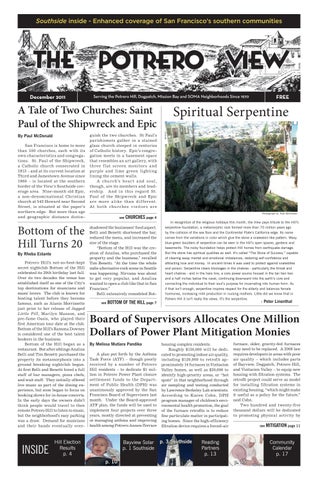
Spiritual Serpentine
guish the two churches. St Paul’s parishioners gather in a stained glass church steeped in centuries of Catholic history. Epic’s congregation meets in a basement space that resembles an art gallery, with th ree f lat screen mon itors and pur ple and lime green lighting lining the cement walls. A chu r ch’s hea r t a nd sou l, though, are its members and leadership. A nd in this regard St. Paul of the Shipwreck and Epic a re more a l i ke tha n d i f ferent. At b ot h c hu r c he s v i s it or s a r e Photograph by Paul McDonald
see churches page 4
shadowed the businesses’ food aspect. Belli and Benetti shortened the bar, reduced the menu, and increased the size of the stage. “Bottom of the Hill was the creation of Analisa, who purchased the property and the business,” recalled Tim Benetti. “At the time the whole indie alternative rock scene in Seattle was happening. Nirvana was about to get very popular, and Analisa wanted to open a club like that in San Francisco.” Belli extensively remodeled Botsee bottom of the hill page 7
In recognition of the religious holidays this month, the View pays tribute to the Hill’s serpentine foundation, a metamorphic rock formed more than 70 million years ago by the collision of the sea floor and the Continental Plate’s California edge. Its name comes from the variations in color which give the stone a snakeskin-like pattern. Waxy blue-green boulders of serpentine can be seen in the Hill’s open spaces, gardens and basements. The rocky foundation helps protect Hill homes from earthquake damage. But the stone has spiritual qualities as well. It’s called “The Stone of Success,” capable of clearing away mental and emotional imbalances, restoring self-confidence and attracting love and money. In ancient times it was used to protect against snakebites and poison. Serpentine clears blockages in the chakras - particularly the throat and heart chakras - and in the hara line, a core power source housed in the tan tien two and a half inches below the navel, continuing downward into the earth’s core and connecting the individual to their soul’s purpose for incarnating into human form. As if that isn’t enough, serpentine inspires respect for the elderly and balances female hormones, increasing milk production in nursing mothers. Little did we know that in Potrero Hill it isn’t really the views. It’s the serpentine.
- Peter Linenthal
Board of Supervisors Allocates One Million Dollars of Power Plant Mitigation Monies By Melissa Mutiara Pandika A plan put forth by the Asthma Task Force (ATF) – though poorly received by a number of Potrero Hill residents – to dedicate $1 million in Potrero Power Plant closure settlement funds to the Department of Public Health (DPH) was unanimously approved by the San Francisco Board of Supervisors last month. Under the Board-approved ATF plan, the funds will be used to implement four projects over three years, mostly directed at preventing or managing asthma and improving health among Potrero Annex-Terrace
Hill Election Results p. 4
Bayview Solar p. 1 Southside p. 10
housing complex residents. Roughly $150,000 will be dedicated to promoting indoor air quality, including $120,000 to retrofit approximately 14 furnaces in Visitacion Valley homes, as well as $30,000 to identify high-priority areas, or “hot spots” in that neighborhood through air sampling and testing conducted by Lawrence Berkeley Lab scientists. According to Karen Cohn, DPH program manager of children’s environmental health promotion, the goal of the furnace retrofits is to reduce fine particulate matter in participating homes. Since the high-efficiency filtration device requires a forced-air
p. 3 Southside
furnace, older, gravity-fed furnaces may need to be replaced. A 2008 law requires developers in areas with poor air quality – which includes parts of Bayview, Dogpatch, Potrero Hill, and Visitacion Valley – to equip new housing with filtration systems. The retrofit project could serve as model for installing filtration systems in existing housing, “which might make it useful as a policy for the future,” said Cohn. Two hundred and twenty-five thousand dollars will be dedicated to promoting physical activity by see mitigation page 11
Reading Partners p. 13
Community Calendar p. 17 p. 15
2
THE POTRERO VIEW
December 2011
Letters to the Editor
Publisher’s View
Tikkun Olam By Steven J. Moss Jewish mystics believe that to create the world God squeezed parts of his being into tightly-packed vessels of light. T hese vessels shattered under the concentrated pressures of the divine; the shards spun out, and lodged themselves as radiant sparks trapped within the material of creation. A good portion of a Jew’s purpose, the mystics say, is to release these sparks from the places in which they’re embedded, so they can reunite with God’s essence. This process of spiritual reunification is made possible by prayer – especially focused on the divinity – and mitzvot – following God’s commandments, including undertaking moral deeds that reflect acts of human kindness. T here’s no g reater shattering than genocide, the systematic extermination of a group of people. Families are splintered apart, bloodlines are eliminated, a generation of orphans is created. Yet humans have regularly committed genocide throughout our history, stretching at least from the slaughter of the Amalekites and Midianites recorded in the Hebrew Bible, to the Indian Removal Act of 1830 – in which 4,000 Cherokees and black slaves lost their lives – to one of our most recent tragedies, in Rwanda. More than 800,000 Rwandans, predominately “Tutsi” – a designation associated with income class and occupation, rather than racial or tribal affiliation – were killed in just three months in 1994, mostly with machetes. The slaughter produced perhaps 100,000 orphans, including children who lost their parents, and those who were abandoned because they were the product of rape. A previous genocide, the Jewish Holocaust, which took place not even a lifetime before Rwanda’s, also produced a large population of orphans. Some of these children – like my father-in-law Fred, who escaped Ger many when he was just nine years old; his mother was killed at Auschwitz, his father was shot into a mass grave – made their
way to foster families in the United States. Others fled to Israel, where many were raised in newly created youth villages, which combined the British boarding school model with the Israeli kibbutz to produce self-sustaining, education-oriented collective communities. A decade after the Rwandan genocide – during which many orphans raised themselves in a level of impoverishment that doesn’t exist in the western world – Anne Heyman, a South African-born Jewish lawyer living in New York City, brought the youth village concept to Rwanda, founding Agahozo-Shalom Youth Village in 2007. I visited Agahozo-Shalom in October, and witnessed a shattered – in pieces so small as to be pulverized – world being pieced back together. Adolescents who had arrived at the village four years earlier slumped over, malnourished, and ill-educated stood taller than me, and were able to explain Steve Jobs’ impact on commerce in English, a language they’d only recently acquired. One girl taught herself Spanish because she liked the way it sounded, adding a fourth language to English, French, and K i nya r wa nda. You ng ath letes played disciplined, team-oriented games of basketball and soccer; the chess championship, held in the dining hall, drew a couple hundred screaming, enthusiastic fans. Music and theater perfor mances were held, i nclud i ng plays i n wh ich the young actors grappled with their country’s and their troubled history. The youth village has its challenges. Girls, like teenagers everywhere, sometimes get pregnant before they turn 19. A fraction of the school’s graduates will go to college; the challenges of catching up academically after years of neglect are simply too great for many to overcome. Anxiety rates are high. Still, in a country with an expected lifespan of 51 years, and where one see publisher’s page 15
™ Masthead design by Giacomo Patri
Newcomb Greening Editor, Model Block members were appalled by the unsigned article about the Newcomb Street Model Block Program published in the View’s October edition (“Greening of Newcomb Block Still Underway”). No residents on the block were interviewed for the story. The two clergy members chosen as “spokespersons” – neither are block residents – made uninformed and negative comments, which resulted in the article’s many erroneous assumptions and conclusions. But the most serious error lay in the lack of acknowledgement of the hard work residents have sustained over six years to realize what block members see as a major accomplishment. One of the spokespersons tried to take credit for the project’s initiation. But the model block program has always been a resident-driven effort; credit for its realization rests with the residents of the 1700 block of Newcomb Avenue. The project was initiated by the San Francisco Redevelopment Agency, which identified five Bayview blocks to be included in a meeting to discuss where the model block transformation would take place. The number of Newcomb residents in attendance, and our commitment to own the project and advocate for it, made the selection of the 1700 block of Newcomb possible. This unique project started out as beautification of the residents’ homes and external streets. We partnered with numerous City – Department of Public Works, Police Department, Municipal Transportation Agency and nonprofit agencies – Architecture for Humanity, Friends of the Urban Forest – and the project received additional grant funds to better address the many issues plaguing Bayview residents. Residents identified project goals and strategies, including traffic speeding and crime abatement, storm drainage containment, greening, street lighting, and possible youth employment. Other press coverage, including from Bay Citizen and San Francisco Chronicle, provided insight and accurate descriptions of the Model Block Program. Model Block Program members continue to work to establish a template for community transformation, and to realize our dream for a better quality of life for ourselves and future generations. Michelle Mouton On behalf Newcomb Avenue Model Block members
EDITOR and PUBLISHER: Steven J. Moss PRODUCTION MANAGER: Lisa Tehrani DECEMBER STAFF: Lynne Barnes, Keith Burbank, Jocelyn Cremer, Carol L. Dondrea, David Egan, Rheba Estante, Debbie Findling, Elizabeth Gayner, Michele Hangee-Bauer, Tamara Hicks, Sasha Lekach, Peter Linenthal, Paul Liotsakis, Catie Magee, Paul McDonald, Sara Moss, Melissa Mutiara Pandika, Katrina Schwartz, Mauri Schwartz, Simon Stahl, and Ben Terrall Editorial and policy decisions are made by the staff. All staff positions are voluntary. Published monthly. Address all correspondence to: THE POTRERO VIEW, 2325 Third Street Suite 344, San Francisco, CA 94107 415.626.8723 • E-mail: editor@potreroview.net • advertising@potreroview.net (advertising) T he V iew is prin te d o n rec ycle d n ewsprin t with s oy- base d ink .
Copyright 2011 by The Potrero View. All rights reserved. Any reproduction without written permission from the publishers is prohibited.
Editor’s note: the reporter’s name, Bailey Debruynkops, was inadvertently left off of the story’s print version.
Library Editor, I strongly disagree with Mary P u r pu ra’s com ments about the Potrero Hill Branch Library (“Time for People-Oriented Development,” October issue). I never much cared
for the old library. It had an outdated, drab and awkward feel to it. It never made me want to linger. Granted, it’s sad that the chair area is gone, because it felt more like a living room than the table/chair arrangement on the second floor. Other than that, I miss nothing about the old library. And to say about a framed picture view of the Financial District “what does that say about a community’s values” is just silly. First, it’s not the only thing to see in this view – it’s a sweeping 180 degrees, after all – and second, that’s just how the building happened to be oriented when it was first built. I find the view breath-taking, Financial District and all. The way the view is framed now, to me, is even better than before. I can’t speak to the absence or presence of community input, since I don’t have any knowledge on how the design decision was arrived at. All I know is that I love the new design, I find it inviting and friendly and even uplifting compared to the old one, which was a stuffy bore to me. I may be in a minority in my opinion, and that’s fine. I just felt the need to let the View know that not everybody on the Hill agrees with Purpura’s editorial. Christine Pielenz 23rd Street
Footbridges Editor, For more than a decade, Vermont and Kansas streets have endured crime and vagrancy – as well as the division of the Mission and Potrero Hill communities created by the closure of the 25th Street footbridge – caused by California Department of Transportation (Caltrans) blight. Caltrans severed the 25th Street pedestrian artery because, it asserted, public safety was too costly to maintain. The pedestrian crossings at Cesar Chavez and Kansas Street, the area on 22nd Street behind San Francisco General Hospital, the 22nd Street footbridge, the McKinley Square entrance at the cul-de-sac on the crooked part of Vermont, and the space between McKinley Square and the 18th Street footbridge are all neglected in a way that creates a public nuisance, as described by the San Francisco Blight and Community Preservation Ordinance and the California Health and Safety Code. Caltran’s unwillingness to maintain these areas has caused significant damage to the surrounding community. Caltrans compounds the damage by co-opting neighborhood groups, which are divided on how to address the situation, by offering paltry sums to periodically clean-up select areas, and paint over reoccurring graffiti. Occasionally the department dispatches costly hazardous materials crews to remove the same vagrant camps year after year, without addressing the need for essential see letters page 6
December 2011
Short Cuts
No Chatting Chatz Coffee was u nable to conclude a lease agreement with the difficult property owners of the former Klein’s Deli space on 20th Street. Instead of a sandwich shop or restaurant, the corner will be occupied by Little Lync, offering child care, after-school, and parent education programs. While we wish the new enterprise the best, it’s a slow-moving tragedy for the 20th Street commercial strip that a more active retailer wasn’t able to secure the space. Many 18th Street restaurants are barely hanging on, and these establishments benefit from a concentrated node of eateries, which draws customers from throughout San Francisco. Without Klein’s or something like it, The Good Life Grocer y and other 20th Street merchants are left virtually islanded… Speaking of 20th Street, Flo Cimino says he’s “Back in action, baby!” after suffering a heart attack last July. His barber shop is open Tuesday, Wednesday and Thursday from 10 a.m. to 1 p.m., with more hours to be added as his doctors allow… Potrero Hill’s hot ticket for the last couple months has been the oncea-month d i n ner at Maxine Siu and Joel Bleskacek’s Plow, which celebrated its first anniversar y in October with the initial event. Held on a Saturday with only one 6:30 p.m. sitting, the meal features a fixed four-course dinner, served family style, with wine pairing f rom Ruby Wine, a nother Siu / Bleskacek venture. Great food,
shared with great neighbors. For reservations for the next dinner in January, which will probably sell out like the previous ones, drop by Ruby Wine… Christopher’s Books is offering a 20 percent discount on Steve Jobs… Support our local merchants by using cash as much as possible, which will save them credit and debit card fees.
Burglaries A crime wavelet on the Hill’s north slope was the topic of discussion when representatives from city and state agencies addressed more than 100 residents at last month’s third an nual com mu nity cr ime watch and safety meeting, held at Downtown High School. According to District Captain Paul Chignell, there were 13 home burglaries in the McKinley Square area in the past six weeks, many of them “hot prowl” crimes with residents at home at the time. Most involved “non-forced” entr ies, i n wh ich perpetrators entered through unlocked windows and doors. Among Chignell’s recommendations: keep doors and windows locked (duh!) and call police about suspicious activity. Some of the stolen laptops, phones and other items have been recovered at Seventh and Market streets, where there’s extensive “fencing” activity.
Spooky October marked another awesome Halloween on Potrero Hill. Baked distributed almost 700 delicious cookies, and Goat Hill Pizza kept hungry trick-or-treaters and those accompanying them well-fed with generous slices of pizza. A few 20th Street shops did play tricks on kids arriving after 7:30 p.m., claiming that they’d run out of goodies even while the costumed youth stood in front of racks of candy. Perhaps the shops are suffering from a lack of customers. Next year, these enterprises might want to think about distributing from their fruit bins, or maybe m a ke a v i sit t o C o s t co… L a s t month Roxanna Vega, a Good Life Grocery employee, thought she’d forgotten her car keys inside the store one n ight af ter her sh if t ended, and left the vehicle parked on 20th Street overnight instead of r et r iev i ng t he m. T u r n s - out Vega locked the keys inside her car. When she returned to work the next morning the vehicle was gone. The police quickly responded to her call; within 20 minutes of their departure Vega witnessed her car screeching right in front of the store and driving crazily west up the hill. The vehicle was later found near a pier, set on fire and left a crispy mess… The Port of San Francisco has forced The Ramp to remove it’s propane-powered out-
THE POTRERO VIEW
3
door heaters, alleging that they’re a fire hazard. The heaters will be replaced with natural gas-fired equipment, but that will take some time and expense. In the meantime, bring a coat… Salesforce. com plans to build a 500 car garage across the street from its new headquarters on Mariposa and Illinois streets. If you think there’s traffic congestion in Dogpatch now, wait five years…
Politics Just a day before the November elections, California Democratic Pa r t y c h a i r m a n a nd Ve r mont Street resident John Burton was spied entering Vermont Cleaners moments after Utah Street resident and Ed Lee campaign staffer Bill Barnes had arrived at the establ ish ment. Both were ca r r y i ng dirty laundr y… “Did you go to that great party last night,” asked a twenty-someth i ng gentlemen while riding American Industrial Center’s elevator the morning after last month’s election. “Yea h,” responded his female companion, “the shooting game they presented was awesome!” Yet another sign t h at it ’s h i g h-t e c h c om me r c e, rather tha n pol itics, that’s attracting our best and brightest. Or maybe the private sector just throws better parties than politicians... In addition to the obvious losers, others who didn’t fare well on election day included the Sierra see short cuts page 9
4
THE POTRERO VIEW
December 2011
Hill Votes for Herrera Mayor Results
District Attorney Results
Sheriff Results
Source: San Francisco Department of Elections “Statement of Vote Summary” November 17, 2011
Dogpatch resident Dennis Herrera was elected mayor, of Potrero Hill at least. On the strength of his local boy status - as well as endorsements from the View and the Potrero Hill Democratic Club - Herrera lead the pack, with 23 percent of the community’s vote. The Hill’s progressives left Ed Lee and John Avalos in a close tie for second place, and gave Ross Mirkarimi an extra push to win the sheriff’s race. Hill voters fell in line with City-wide patterns on ballot measures, except for Measure H which Hill voters opposed by 58 percent compared to 50 percent City-wide. City-wide voter turnout equalled 42 percent, compared to 40 percent on the Hill. Bayview-Hunter’s Point had the least amount of voters with only a 32% turnout rate.
Pilates makes the perfect
Holiday Gift!
churches from front page welcomed by staff and the pastor; on ly the g reeter’s age and dress style varied. Both services emphasized music. St. Paul’s offered a traditional 20 person choir backed by an organist/keyboard player and guitarist, while Epic featured a live five piece rock band that played multiple songs at the beginning of the service. And the liturgy focused on the same central spiritual themes. “It is a great desire of Epic Church to be for and serve the City of San Francisco,” said Ben Pilgreen, Epic’s youthful pastor. “We are actively involved in Being Jesus to our City. We are a Christian church that desires to live life as Jesus intended for us to live. We believe that we all have a part to play in what God is doing in the world.” Epic’s attendees were encouraged to sing along to the tunes; the lyrics were displayed against pa st or a l set t i n g s on t he la rge monitors. The songs were faithcentric, designed to appeal to a younger population that may not be attracted by traditional methods of worship. Indeed, Epic’s average member is well under 40 years old. According to Pilgreen, more than eighty percent of his congregants a r e “move r s a nd s h a ke r s i n a variety of industries, creating the future in technology, fashion, business, finance and science.” E pic r e f le c t s t he S out h of
Market demographic it aims to serve. The atmosphere resembled a corporate event. Volunteers – most under 30 years old – wore badges around their necks, like technology company employees. The church’s website invites visitors to follow activities on Facebook and Twitter, with messages that focus on mode r n- day conce r n s, such as “chasing sex/money/success/and relationships.” Meanwhile, the r ites of Catholicism play-out each Sunday at St. Paul of the Shipwreck. Pastor Paul Gawlowski just celebrated the 12th anniversary of his ordination. Along with Deacon Larry Chatman, Gawlowski offered the traditional Catholic liturgy with a humorous, friendly, musical flair. St Paul’s services included communion, baptisms, and the communal singing of “This is my story, this is my song” while all hold hands and gently sway. Last month, on a given Sunday, both church services included a roughly 20-minute sermon focusi ng on a topica l issue held up against a biblical story to reveal a take-home moral to be closer to God. At Epic, Pilgreen explored a reading of Mark, Chapter 4, verses 35 to 41, the story of Jesus asleep on a boat that encounters a storm. St. Paul’s sermon was delivered by a charismatic Chatmon, and centered on a story about a person who didn’t receive coffee after a large banquet because he neglected to have his cup turned upright.
December 2011
Potrero Power Plant Site Being Cleaned-Up By Melissa Mutiara Pandika After winning a decade-long battle to close the Potrero Power Plant, the City and County of San Francisco now faces an arduous road to remediate and, ultimately, develop the plant site. Prior to its March 2011 closure, the 34-acre Potrero Power Plant, located on the Central Waterfront, was one of the oldest fossil fuel-burning plants operating in California. Calls for the facility to be shuttered began shor tly af ter it was pu rchased f rom Paci f ic Gas a nd Ele ct r ic Compa ny (PG&E) by Souther n Company – now GenOn Potrero, LLC – in the late-1990s. The plant dumped heated water into the bay; its smokestacks belched particulate matter and greenhouse gases into an already disproportionately polluted corner of the City. As part of plant closure efforts, the City Attorney’s office filed a lawsuit against Southern C ompa ny – wh ich had be come “Mirant” – alleging that the plant’s unreinforced brick building failed to meet ear thquake standards. C it y At tor ney Den n is He r re ra reached a settlement with Mirant to permanently shutter the facility by the end of 2010. Simultaneously, the California Independent System Operator agreed to allow the plant to be closed once the Trans Bay Cable – a 55-mile long undersea
cable capable of transmitting 400 megawatts of power from the East Bay – was operational. Herrera’s settlement stipulated that Mirant pay $1 million to fund mitigation projects directed at the Bayview, Dogpatch, and Potrero Hill communities, as well as $100,000 to the City Attorney’s Office for legal fees. Mirant, now GenOn, paid the settlement funds in 2009 (see related article, this issue). The electricity now conveyed to the City through the Trans Bay Cable is largely generated in Antioch or Pittsburg; ironically both cities drew large numbers of AfricanAmericans from Bayview during the early-2000s, many of whom lost their homes to foreclosures. GenOn operates two major electricity generating units in Pittsburg; PG&E opened a power plant in Antioch in 2009, and is building a second facility in Oakley. A Pacific Environment Report issued last spring pointed-out that the new Contra Costa County plants will exacerbate already high rates of respiratory disease in the county, which is home to more than a dozen power plants and other industrial operations. According to PG&E representative Nicole Liebelt, the Antioch and Oakley plants are fired by natural gas, and employ technologies which allow them to use significantly less water and fuel, and produce lower greenhouse emissions, than the
former Hunters Point or Potrero facilities. Under the terms of its settlement with the City, GenOn is responsible for Potrero Power Plant site demol ition. Accord i ng to Tony Cordero, GenOn’s director of external affairs, the company has removed the plant’s three smaller combustion turbines and almost all of the hazardous materials used in plant operations. GenOn didn’t specify a completion date for the demol ition work. Meanwh i le, because PG&E owned the power plant site for nearly a century prior to selling it to GenOn, the utility is responsible for remediating it. “We take responsibility for past operation of the manufactured gas plant,” said Liebelt. “The PG&E cleanup effort is part of our larger program that we have to address the impact of [historically industrial] operations.” Site remed iation i nvolves a multi-stage process that includes an initial investigation to determine the type and location of contamination, followed by identification and implementation of an appropriate clean-up approach. The plant site has been divided into seven different work areas to allow remediation of certain areas to proceed even while other locations are studied or blocked by structures. “We have made significant progress on environmental investigation and
Trust Your Real Estate Transactions To the #1 Agent on Potrero Hill
SALE PENDING!
2 Level Condo w/Sweeping Views of the Bay • Two bedrooms, one bath • Remodeled kitchen and bath • Two large decks on each level w/pano views • Hardwood floors • Woodburning fireplace in living room • Great closet space • Lots of extra storage • Garage w/parking for one car • Walking distance to restaurants/shops www.647connecticut.com 647 Connecticut Street #1 Listed for: $649,000
NEW! Follow me on Facebook, Twitter and LinkedIn Also, check out my blog at www.susanolk.com
Listed-Sold in One Week w/Multiple Offers! Susan Olk CRS, CLHMS, DRE 00788097
415.550.8835 SusanOlk@ZephyrSF.com www.susanolk.com
THE POTRERO VIEW
5
remediation on all por tions, as well as those owned by GenOn,” said Liebelt. Except for the power generation area in the southeast corner, and the tank farm area fur ther nor th, where buildings and equipment prevent access, the investigation phase has been mostly completed. Remediation in these areas will start once structures are removed, and will likely take upwards of three years to complete. In the northeast and Pier 70 areas, PG&E has under taken a pilot remediation project to remove contaminants while testing other clean-up methods to determine the best approach. PG&E will issue a feasibility study detailing its preferred remediation approach for these two areas in 2012. In the offshore sediments area, PG&E is working to refine its remediation method, and will publish a feasibility study in 2013. “These areas are very complex, and implementing the remedy will take several years, as we anticipate multiple remediation approaches will be taken and require various agency reviews,” Liebelt explained. W hile PG&E is funding the cleanup, Joe Boss, a Rebuild Potrero community relations consultant and Dog patch resident, arg ued that that the financial burden of remediation ultimately falls on the utility’s ratepayers. “That’s what drives me crazy. Before PG&E went ba n k r upt, env i ron menta l cleanup was the responsibility of see cleaned-up page 4 Southside
Sales are happening in your neighborhood, keep your finger on the pulse. Sales are on an upswing with more activity and buyer interest in the marketplace. Prices are holding steady, and days on market have come down slightly in recent months. Properties that are in good repair and have nice updates are typically selling more quickly and much closer to the original asking price (and sometimes over). Location is important, so it’s no surprise that our coveted neighborhood is doing well. For all of your real estate questions and needs, contact me any time!
6
THE POTRERO VIEW
December 2011
letters from page 2 routine maintenance. The community should demand that the San Francisco Board of Supervisors enforce the Community Preservation Ordinance. This established protocol requires routine maintenance and inspections and timely repairs to bolster public safety, neighborhood stability and property values. It’s the City’s obligation to enforce this ordinance, and Caltran’s responsibility to maintain their property. Courts have held that neither the state nor its agencies are immune from civil suits to abate a public nuisance. Lack of basic city services – like street cleaning, tree trimming and pedestrian access – creates an environment that incubates vagrancy, crime, graffiti and disproportionate maintenance expenditures. Vermont and Kansas streets are an example of how blight causes problems. It’s in the Hill’s best interest to unite behind proper implementation of blight ordinances. Contact the District 10 Supervisor and insist that the City pressure Caltrans to maintain its property. Links to the relevant codes and ordinances and a blight log of the area can be seen at: facebook/ crooked truth. Concerned Citizen Vermont Street
History Night Editor, I feel honored and privileged to have been invited to be a speaker at Potrero Hill History Night. Peter Linenthal and Abigail Johnston learned that I was born and raised on Potrero Hill, and asked if I might give some insight into what life was like when I lived on the Hill from 1921 to 1948. I married Hill resident Frank Alioto in 1944; we moved to Santa Clara on January 1, 1948. I was pleased when my interviewer, Phil DeAndrade, didn’t ask my age outright, but graciously asked “when was I born?” Leaving the audience to figure it out! But the flyers all said “90 years of Potrero Hill history.” I loved that, enjoyed it. We had a wonderful turnout. Present were my wonderful daughter and son-law, Regina and Ed North; my beautiful and gifted granddaughter, Dr. Erika North; my sister-in-law; and many nieces, cousins, and dear friends. We did miss my wonderful grandson, Danny North, who was not able to attend.
It was a highlight in my life which shall not be forgotten. Every time I think about my goat’s footprints being displayed in the pizza parlor I get the biggest smile on my face and chuckle to myself. That goat is now famous. I am so thankful and indebted to Peter and Abigail for this opportunity. Potrero Hill is so lucky to have them carrying on their extensive research and keeping History Night going. They have also written two great books on “The Hill.” I heartily thank everyone again for seeing all of you and revisiting my beloved Potrero Hill. God bless dear old Potrero Hill, all its residents and all those truly interested in it. Hope to see all of you again. Good health and good fortune! Viva Potrero! Josephine Firpo Alioto (or please just Jo) San Jose
Fire Trucks Editor, Picture yourself traveling south on Folsom Street approaching 15th Street on a Satu rday mor ning. Traffic is light. Across from you, in the northbound direction, a bus is stopped at a bus stop. To your great surprise, an oncoming San Francisco Fire Department truck doesn’t slow-down and wait for the bus, and instead crosses over the center into your lane to get around it. No lights, no siren. Clearly, the truck isn’t responding to a call. Hopefully you’ll evade it. Other than when responding to calls, are fire trucks subject to the same traffic laws as the rest of us? I called the California Department of Motor Vehicles (DMV) for clarification. The technician put me on hold for about ten minutes. She came back with relevant code sections 21055 and 21066, which are explained at dmv.ca.gov. Commonsense and DMV code are clearly aligned: emergency vehicles are exempt from traffic regulations when answering a call, not otherwise. Section 21066 adds that regardless of the situation, drivers of emergency vehicles must proceed with due regard for the safety of others. Maybe the fire truck driver didn’t see me. I hope the incident was a rare exception. It could have turned out badly. Let’s hope our public safety employees and officers don’t think they’re above the laws intended to protect us all. Bob Kimball Mississippi Street
Cor-o-van Building to Become Residential, Medical Facility By Rheba Estante While there’s been no official word from the City and County of San Francisco on the Cor-o-van building’s future, Walden Development appears poised to develop the site into office space and a medical facility. Under the plan, the building would be demolished, with a new facility constructed in its place. “We have plans to develop the property. A portion of the land will become a site of a professional medical facility for Kaiser Permanente, and a separate area will be the used to construct 200 residential units,” said Josh Smith, Walden Development’s owner. “We believe that the project will strengthen the bonds of community in Potrero Hill that are characteristic of the neighborhood. There will be abundant open space available in the area based on our designs.” The Neighborhood Coalition to Save Potrero Hill believes that the Coro-van building has historic merit, and should be preserved. “A firm called Tim Kelly Consulting had originally been tasked with writing a historic review on the site. That first report indicated that the location had historic value,” said Rodney Minott, a coalition member and Hill resident. “Something happened after that because Walden Development hired another company to do the same thing as Tim Kelly, but their findings were contradictory.” If the Cor-o-van building and its associated property is declared a site of historical merit, development would be difficult. According to Smith, Southeast San Francisco has a deficit of community services and medical facilities, which the project will help address. He emphasized that the open space design
being planned won’t cause traffic congestion or reduce parking in the area. Smith also said that the San Francisco Historic Preservation Commission has determined that the metal sheets in the Cor-o-van building are not historic. “Kaiser Permanente is growing with San Francisco and is committed to continue meeting the health care needs of our members and the community. As the City continues to plan developments on the east side, we are decentralizing our services to ensure we have the capacity we need to continue providing high-quality health care for our members and patients now and into the future,” said Christine Robisch, Kaiser Permanente San Francisco’s senior vice president and area manager. “As part of our plan to do that, we have entered into a contract to acquire the Walden property and have developed preliminary plans for a new medical office building at that site, pending approval of the Kaiser Foundation Hospital and Health Plan board of directors.” Neither Kaiser nor Walden Development were able to provide a date when development would begin.
December 2011
Bottom of the Hill from front page tom of the Hill to bring her vision to light. “When we opened the club it was not what it is now, but we stuck to our strengths to make it into a premiere place,” said Benetti. “Analisa was not a musician but always had a creative eye for trends. Something was happening in Seattle in the early 1990’s, and that is what we wanted to bring to San Francisco. Analisa appreciated what it was and what it could be. Our strengths are that we provide a home to local and touring indie bands. Our booker Ramona Downey used her expertise to find bands that she felt were unheralded yet had a bigger future in the industry.” After graduating from law school in the late 1980’s, Benetti became Bottom of the Hill’s majority owner from 1995 to 2001. While he remains involved in the business, he now works as a lawyer for the City and County of San Francisco, lending his expertise to the club on legal, licensing, and administration issues. Bottom of the Hill is currently owned by Benetti, Downey, Kathleen Owen, and Lynn Schwarz. Analisa Belli is no longer involved in the club, but celebrated her 50th at Bottom of the Hill last month. “I started 15 years ago as a parttime cook and thought I would only be there a month. But I just loved it and made myself indispensable,” recalled Schwarz. “I became a bartender and manager and then seven years after
I was hired I was offered a partnership, which was gratifying. Ever since then I have been a co-owner and still bartend. We all bartend at times, but I also manage staff. Our chemistry as a quartet of owners is great and we really work well together.” “Ramona is one of the best bookers in the country and deeply entrenched with major agencies like William Morris. Bands that are touring contact her if they are going to play in San Francisco,” said Benetti. “She worked her way to being a booker of that caliber by being extremely aggressive and getting bands. She takes chances and it has paid off. Bottom of the Hill hosted Green Day and the Beastie Boys before they got famous. Ramona has a knack for identifying bands that are going to hit big and nurturing them. This has put the club on the map. Nowadays most of Ramona’s job is weeding out bands who want to play here, and she maintains her connections with local bookers.” Schwarz emphasized that the club is active in the wider community, through memberships in the Potrero Boosters Neighborhood and Potrero Dogpatch Merchants associations. Bottom of the Hill also hosts benefits for nearby public schools, such as Daniel Webster Elementary, and donates food to Potrero Hill History Night. “I like to think that people enjoy coming to the club. It’s a destination spot for music. People come to see a band and I would like to have more events,” said Schwarz. “We are kidfriendly, and since our spot is in a
THE POTRERO VIEW
7
What’s a Saint to Wear?
Photograph courtesy of St. Teresa of Avila
St. Teresa of Avila Catholic Church, located on 19th Street between Missouri and Connecticut, was recently painted. As part of the refurbishment process, 17 of the church’s stained glass windows will be restored. Some date back to the turn of the 20th Century, although most were made in the 1930s. Currently four are undergoing repairs, including the Saint Teresa of Avila window (above), in which St. Teresa will be reinstalled with a new brown habit. It turns out that St. Teresa, from the Carmelite order, has been depicted wearing the incorrect color habit and a misspelled name all these years. The refurbishment is being conducted by Hogan Glass in San Jose, and is parishioner-supported.
half-residential and half-industrial area we don’t disrupt the neighborhood. We also send staff out to make sure that our customers are not littering in the area, so our impact has been less negative. We love being in Potrero Hill because we have so many friends here and the weather is great.” Bottom of the Hill got some national publicity when the club was mentioned in a recent episode of the television show Parenthood. One of the characters was interviewing a potential nanny, and asked her why she dropped out of medical school. The response was: I’d rather be at Bottom of the Hill three nights a week listening to my favorite bands. A clip from that episode can be viewed on the Internet.
“We are just so grateful for the support from the Potrero Hill community. When I am down I look at yelp reviews and people really notice our mission to have the best music and have a nice environment where customers feel taken care of,” Schwarz explained. “People here know how to treat musicians and provide a real family experience.” “Rock and roll never dies… playing guitar is a great way to meet girls. It will never go out of style,” said Benetti. “There is energy and magic that can’t be re-created any other ways. When the music washes over you it’s an experience that you want more of. Rock and roll is a manifestation of dissatisfaction, and kids still feel that.”
8
THE POTRERO VIEW
December 2011
Debate Continues Over Sharp Park Golf Course By Ben Terrall Last fall, Supervisor John Avalos introduced legislation to close Sharp Park Golf Course and shift management of the San Franciscoowned land to the National Park Service’s Golden Gate National Recreation Area. The bill is expected to be considered by the San Francisco Board of Supervisor’s Community Operations and Neighborhood Services Committee this month or next. “City recreation and park resources are already hugely strained, and the impacts are being felt in our neighborhood parks,” said Meredith Thomas, Neighborhood Parks Council’s executive director. “Partnership with the National Park Service at Sharp Park will address critical infrastructure and environmental issues without drawing against funds that support parks in San Francisco County.” Under the legislation, Pacifica residents, who are currently granted San Francisco resident golf rates at Sharp Park, would pay San Francisco resident rates at all of the City’s other five golf courses. According to Brent Plater, executive director of the Wild Equity Institute, which supports the legislation, the bill would improve recreation and public access to the park, protect endangered wildlife and save taxpayers’ money. Plater believes that San Francisco has enough golf
courses, and that subsidizing golfers in Pacifica is an unwise drain on the City’s over-extended budget. According to Plater, climate changeinduced sea level rise will eventually flood the park, making golf impossible. “We’ve gotten unanimous support from the environmental community” for the legislation, said Plater. A 2008 San Francisco Recreation a nd Pa rks Depa r tment ( R PD)funded study by Proconsulting found that of the City’s golf courses only Harding Park operated above 50 percent capacity. Sharp Park operates at between 40 and 50 percent capacity, compared to an industry standard of around 60 percent. Public golf courses located in Alameda, Petaluma, San Jose, Livermore, and Oakland have recently been proposed for sale or closed. In late 2010, Adobe Creek Golf Course in Santa Rosa was closed due to declining demand. Earlier this year Governor Jerry Brown proposed the sale of Oakland’s Montclair Golf Course because it “serves no state function and should be sold off to pay debt.” Four hundred acre Sharp Park is home to two federally-protected species, the California red-legged frog and San Francisco garter snake. Six conservation groups filed a lawsuit against RPD last spring to stop golf course activities that kill or harm the endangered frog and snake. According to Plater, “more frogs have
been killed in the past winter” at the course. He explained that the golf course’s pumping excess water from the park left frog eggs high and dry, killing them. A peer-reviewed scientific study and restoration proposal for Sharp Park prepared by the Wild Equity Institute and Center for Biological Diversity and released last winter found that restoring the park’s natural lagoon, wetlands and beach processes would be the least costly land use approach. According to the study, losses at Sharp Park from 2005 to 2009 totaled almost $1 million. A June 2, 2010 SF Weekly article found that capital expenditures at Sharp Park Golf Course are likely to be double RPD’s estimates. “It makes fiscal sense for San Francisco to partner with the Park Service” on Sharp Park, said Peter Brastow, Nature in the City’s director, since the federal agency has “broader-reaching fundraising capabilities.” The Golden Gate National Parks Conservancy’s ability to raise funds is “practically without precedent,” said Brastow, while RPD’s funding capacity is “more haphazard. Parks Conservancy is the 501c3 that is authorized by federal law as the official support and fundraising arm of the GGNRA. Both organizations are headquartered at Building 201 at Fort Mason, and so enjoy a seamless working relationship that goes back now several decades. The
Conservancy raises millions and millions for the park [GGNRA] every year, with awesome access to wealthy San Franciscans and Bay Areans,” Brastow said. Sharp Park is within the Golden Gate National Recreation Area’s boundary, and adjacent to the Park Service’s Mori Point. According to Steve Krefting, board member and past president of the San Francisco League of Conservation Voters, treating Sharp Park and Mori Point as one area would benefit flora and fauna by connecting restored upland habitat at Mori Point to Sharp Park’s wetland habitat. Krefting also believes that a trail-restoration project, which would occur if the land was turned over to the National Park Service for management, would open up the area to greater numbers of people. Richard Harris, co-founder of the San Francisco Golf Alliance, pointed to the ethnically and demographically diverse population Sharp Park currently draws, many of whom are San Francisco residents who’ve been visiting the park for years. Harris is concerned that Avalos’ ordinance would permit the City to terminate the golf course without an adequate environmental impact review under the California Environmental Quality Act (CEQA), which “would not be a good precedent for the City.” RPD asked the San Francisco Historic Preservation Commission to designate the golf course as an historic resource under CEQA. But see sharp park page 18
Thank you! Photograph by Emily Payne
Our deepest gratitu de to all our friends and neig hbors from Potrero Hill and Do gpatch for your support in the recent election. We will n ever forget your friendship, an d we wish you our very best fo r a joyous Holiday Season and a happy New Year! Sincerely, The Herrera Family (Dennis, Declan & A nne)
December 2011
short cuts from page 3 Club, whose cynical endorsement of Leland Yee immediately after he waffled on a proposed shark fin ban didn’t do that candidate, or the club, any good. Similarly, negative campaigning bounced off Ed Lee’s bullet proof chest, perhaps because San Franciscans already know that most politicians are in somebody’s pocket, but principally due to the rise of the Asian-American vote. Move over, African- and, especially, European-American urbanites; you’re demographic dominance is over. And Jeff Adachi, brave politician that he is, should congratulate himself for triggering some level of public pension reform, and refocus his attention on running the best public defender’s office possible.
Portugal T he V i e w m ade one of t he biggest errors in its 41-year history in its October issue, when it identified Goat Hill Pizza owner Ph i l ip DeA nd rade as bei ng of Italian ancestry in a front page phot o g r aph . D e A nd r ade i s a proud son of Portugal. In honor of DeAndrade, the View reprints the following response to “What country has better looking people, It a ly or Por t u g a l? ” p o s t e d on Yahoo!Answers: “I’d say Portugal. I’m not Portuguese, but I have my best friend who is, and he is just great, in personality and also he is good looking. I visited Portugal several times, and I visited also Italy, but Portuguese people are slightly better looking than Italians, even their personality. So yeah, that’s it. I’m really very happy that I have a Portuguese friend and I hope we will always be. No offence for Italians, this is just my opinion. I hope I helped. :).” Amen, brother.
Change After she produced this issue, the View’s production manager, Lisa Tehrani, went on indefinite maternity leave in advance of the winter birth of her second child. Her duties will be taken up by San Bruno Street resident Jennifer Durrant. Thanks for all of the great issues, Lisa. You’ll be missed. And welcome to Jennifer!
THE POTRERO VIEW
9
Letter from The Hole at San Francisco Greece General By Paul Liotsakis My family and I expected to find anarchy, protests, and strikes when we arrived in Athens in early-November. Instead, amidst the political and economic crisis we found the Greece I’ve known since my childhood. Bustling streets crammed with cars and people, unannounced visits from friends and relatives, the hospitality of strangers, the delicious smells of home-cooked meals wafting down stairways and spilling out into the streets. Our two children – Theo, eight and Manoli, three – have been showered with smiles, hugs, kisses and candies from elders. After a week of cherished time visiting my ailing uncle in Athens, we made our way to Crete to tend to olive oil production. Life on the island was at its usual pace, right down to the travelling salesman who unexpectedly showed up at my grandmother’s house on the edge of the village peddling cakes, breads and other sweets, an occurrence that’s been happening for as long as I can remember. However, under appearances of normalcy people speak of a deep frustration, worry and uncertainty. Those with professional jobs – like my cousin, who works for an insurance company – are overworked, putting in eleven hour days. Her husband – a high-end furniture salesman – just received notice that his company has enough cash reserves to pay him until January. This couple is reflective of Greece’s middle class, with a six year-old daughter, a home in a forested suburb of Athens, and two cars. They’re now grappling with how to handle their upcoming car insurance and registration fees. Apparently thousands of Greeks are driving without registration and insurance because they can’t afford these expenses anymore. Many of those who work in public sector jobs have been forced into early retirement, are overworked or regularly unpaid. Before leaving Athens I spoke to Mrs. Anna, a neighbor of my uncle’s who’s closing her variety store and retiring after 30 years in business. Three years ago she had a steady clientele, and could have sold the store. In the current economy no one has the money to purchase a business, let alone
Claire-Laure spotted the new hospital construction at San Francisco General Hospital. See something unusual or unique around the neighborhood? Send the image, along with a caption and photo credit to editor@ potreroview.net. Who knows, it may get published. Large file sizes, please. Photograph by Claire-Laure
stock the shelves with inventory, and no bank in Greece will provide a loan for such an enterprise. Hundreds of small businesses around Athens’ main thoroughfare in Pireas – not so long ago a high-rent district – have closed down. Televisions blare every new political development 24/7, with non-stop talking heads giving their opinion. Politicians and media personalities seem to be living in their own universe. Many ordinary Greeks feel despondent about political events. As my cousin said, “no matter which party is in power, the politics is the same: they make us pay for everything and they pay nothing.” Younger people don’t seem to follow politics because all of the backroom dealings make the process unpredictable and the outcome predictable: the middle class pays for everything, while the rich shield themselves and take advantage of the system. Everyone I asked insisted that Greece shouldn’t leave the European Union, and felt that being tied to the euro was a good thing. No one offered a deeper analysis of what caused the crisis, and what needs to happen to get out of it, other than blaming politicians. The glue that keeps everything seemingly normal is a security net built on extended family networks and symbiotic relationships between work and private life, along with governmentprovided social security. For example, my uncle pays the equivalent of $100 a month for his home – which he’s lived in for the last 30 years – in the heart of Pireas because his employer owns the three-story apartment building he lives in and he was a reliable employee. Each relative I visited in the villages or city has been surviving off their savings. And they’re the primary reason travelling salespeople go from village to village; the elders still have money to buy things. The ancient Greeks believed that the highest form of development was to hand the next generation a world as little changed from the past as possible. They’d be disappointed at the winds of change sweeping through Greece today. However, as the older generation passes, I believe they’ve instilled in the next the ingredients for a vibrant culture. Hopefully, the straight and narrow path dictated by the hyper-capitalist global economy will leave behind fresher institutions without destroying the cultural fabric that makes Greece unique.
Unaccepted Streets: From Paper to Reality By David Egan Unaccepted Streets: From Paper to Reality is a plan designed by Sarah Moos that seeks to link the City’s most overlooked neighborhoods through a series of open spaces that would be part of the Blue Greenway, a 13-m ile long network that stretches from China Basin to Hunters Point. Moos, a graduate student at the University of California, Berkeley’s Department of Landscape Architecture and Environmental Planning, spent last summer surveying San Francisco’s unmaintained and underused “unaccepted” and “paper” streets for San Francisco Planning and Urban Research Association. An unaccepted street is a public right-of-way that wasn’t built to City standards; a paper street appears on maps but doesn’t actually exist. These streets are generally created when city planners lay-out and dedicate roads that are never built. According to Matthew Roth of SFStreetBlog, San Francisco has 529 acres of unaccepted streets, an amount of land that’s more than half the size of Golden Gate Park. Moos investigated 2,224 unaccepted streets and 323 paper streets, looking for opportunities to transform t he se a reas i nto u sef u l publ ic spaces. She collaborated with Scott Preston, AECOM Inc.’s development director, Marcel Wilson, a landscape architect, and David Beaupre, Port of San Francisco senior waterfront planner, who collectively determined which design interventions – including stairs, benches and plantings – might work best for particular spaces. According to Moos, open spaces improve community connectivity, as well as biodiversity and natural habitats. Redeployment of unaccepted and paper streets would create a new form of urban open space that takes advantage of underutilized areas and pieces them together into pedestrian-friendly passageways.
10
THE POTRERO VIEW
December 2011
KIDS ON THE BLOCK Geoffrey and Mayra Gonzalez welcome their new roommate, Becks Romo Gonzalez! Becks was born June 20, 2011 at 6:02 a.m., weighing eight pounds 12 ounces.
Double Trouble: Imogen Doumani is turning eight, but sometimes it seems like 16.
Left: Happy fifth birthday Ethan and Aidan! Your family loves you very much!
Right: Avalon and Jada visited the pumpkin garden stroll as twins last Halloween. Right: Our darling Sydney, can’t wait to see how you grow and change this year. Happy birthday!! Lots of love, Mommy, Daddy and Tate.
Happy birthday Sophia! Five years old and an ever evolving knowledge of animals! Love Mom, Dad and family.
Daisy’s first swing at McKinley Square.
The View is delighted to publish local kids’ birthdays, accomplishments, and milestones. Please email your image and/or caption to graphics@potreroview.net by the 18th of the prior month. High resolution photos, please!
TILLYKKE and happy sixth birthday Charlotte and Alex! Lots of love from Mor, Far and Morfar Leslie.
December 2011
mitigation from front page supplementing the activities of SF LIVE!!—District 10, an existing partnership of community-based organizations led by DPH. Six thousand dollars of these funds will be spent on multimedia outreach to District 10 communities, and $219,000 will be granted to SF LIVE!!—District 10’s subcontractors to provide free dance classes, healthy food demonstrations, and walking clubs. “You don’t have to figure out [how to lead a healthy life] by yourself,” Cohn explained. “You can be with neighbors. You get closer to doing those activities for yourself by doing them collaboratively with others.” One hundred and sixty thousand dollars will fund the expansion of two existing gardens, one located at the Potrero Hill Family Resource Center (PHFRC) at 85 Turner Terrace, and a larger plot on Texas Street. Thirty thousand dollars will be dedicated to lead testing, as well as developing the necessary infrastructure to construct the gardens, while $130,000 will be directed to PHFRC apprentices’ salaries, materials and supplies. Emily Weinstein, Rebuild Potrero’s community leader, explained that the garden project’s intent is to create short-term jobs during garden construction, as well as long-term opportunities related to ongoing maintenance. “The funding goes toward creation and ongoing maintenance of the garden program,” said Weinstein. “It is our hope that residents can be employed on the garden to learn how
to maintain it and be a part of ongoing maintenance.” The garden project will be folded into Rebuild Potrero’s other gardening initiatives, which are part of community relations efforts tied to plans to demolish the Potrero Annex-Terrace complexes and replace them with mixed-income housing. The bulk of the settlement funds – $464,000 – will be dedicated to the Promotion of Pediatric Asthma Education and Parental Education Project. Sixty thousand dollars will be used to fund an asthma educator at the Potrero Hill Health Center, who will provide one-on-one patient education as well as community outreach presentations. One hundred and seventy-nine thousand dollars will fund an asthma health worker at San Francisco General Hospital’s Pediatric Asthma Clinic, to provide case management for Potrero Hill patients, including home visits to promote control of asthma triggers and increase referrals to code enforcement agencies regarding unhealthy housing conditions. Two hundred and twentyfive thousand dollars will fund the Healthy Generation Project, a threeyear education pilot project to teach parents skills in child development, such as how to protect their children from environmental toxins and improve their diets. Housed at PHFRC, Healthy Generation leverages the work of an existing educational series led by University of California, San Francisco pediatrician Molly Burke, and is part of Rebuild Potrero’s efforts to educate Annex-Terrace residents. “It’s just a really exciting opportunity to bring community ideas that have
been articulated to fruition,” said Weinstein of the recently passed expenditure plan. Some Hill residents believe too great a proportion of the funds are being spent on behalf of Annex-Terrace and Visitacion Valley residents, without mitigating the harm power plant operations caused the most impacted areas. “I’m disappointed that it seems concentrated in one area of the neighborhood and not spread around,” said Stacey Bartlett, Potrero Residents Education Fund administrative president. In March Bartlett posted an electronic survey on multiple community listservs asking members how they’d spend the mitigation monies. The survey yielded more than 250 responses, which included recommendations to install solar panels at local public schools, rehabilitate Pennsylvania Avenue between Mariposa and 17th streets, and continue hardscape improvements to the Pennsylvania Garden on 18th and Pennsylvania streets. “We were excited when we saw the results and were slightly mystified when we heard [the money] was going elsewhere,” said Annie Shaw, who initiated the 17th and Pennsylvania Urban Renewal Project, and is the Pennsylvania Garden’s primary caretaker. “After that public outreach happened when people were surveyed, there was a complete silence on the line.” Shaw is leading efforts to rehabilitate a crime-ridden, debris-laden stretch of Pennsylvania Avenue by adding sidewalks on both sides of the street and a retaining wall along the street’s northern end, which slopes into the I-280 freeway, to prevent individuals who want to engage in illegal activities from entering the area. Hardscape improvements to the Pennsylvania Garden include building pathways, adding handrails, and terracing the back slope, a steep and inaccessible area. “It would have been so great to get the [mitigation] money,” said Shaw. “We would’ve been halfway done with the project by now.” While Barlett supports efforts to prevent and treat asthma, she doubted that power plant emissions contributed to asthma incidence as much as ATF claimed it did, pointingout that her children don’t have asthma, despite having grown up
THE POTRERO VIEW
11
near the plant. She also opposed the furnace retrofits, which she believes do more to mitigate poor air quality and asthma resulting from freeway exhaust than power plant emissions, and may ultimately prove ineffective. “What if you change out the furnace, and the parent is still smoking? That’s much worse than anything a furnace or hot water heater put out,” said Bartlett. Steven Moss, the View’s publisher, who was involved in plant closure efforts for more than a decade, including as a Power Plant Task Force (PPTF) member, and who has led furnace replacement programs under a San Francisco Department of the Environment initiative, agreed. “The furnace replacement initiative is a poor use of scarce funds. A few households that almost certainly weren’t impacted by the power plant will be more comfortable, but there are far better and more cost-effective ways to invest the money,” he said. PPTF members Joe Boss, a Dogpatch resident, and Karen Pierce, of Bayview, supported ATF’s recommendations. Boss provides community relations services to Rebuild Potrero, and Pierce works for DPH, which are the recipients of most of the mitigation funds. According to Bartlett, Cohn had seemed willing to compromise on some aspects of ATF’s expenditure plan. But she’s ultimately sympathetic with the idea of spending most of the $1 million on asthma initiatives. “Why wouldn’t you ask for everything you want if these are the areas that are most important to you, especially if there’s no resistance?” asked Bartlett. “I’m busy running a preschool and trying to advocate for my kids’ struggling elementary school,” she said. “I need more hours in the day.” “The Power Plant Task Force was burnt-out from its decadelong battle to close the plant,” said Moss. “Unfortunately, there wasn’t a more inclusive process to identify projects that would provide lasting benefits to the community.” “ATF had it together, and they made the recommendation,” said Bartlett. “I guess that’s the way it should be. I just feel like I failed as an advocate to see this through and get more attention, and I was just disappointed…there weren’t more people to make it happen for other areas of the Hill.”
Advertise in the View & Southside visit www. potreroview. net/advertise for more information local discounts expanded distribution
12
THE POTRERO VIEW
December 2011
DECEMBER 2011
N e i g h b o r h o o d N e w s F r o m SO M A t o B ay v i e w
BRITE Looks to Brighten Bayview By Sasha Lekach Bayview Residents Improving Their Environment (BRITE) came together after a series of unsettling crimes – many centered at corner or liquor stores, including an October shooting that left a 21-year-old man dead after he entered a Thomas Avenue market – spu r red community members to safeguard their neighborhood. The group, which has no official leadership, has met most Saturdays since late-September at such spots as Javalencia Café, located on Third Street and Fairfax Avenue. Starting with eight people, BRITE has grown to 25 individuals, though according to Bayview resident Matt Czajkowski it has no set agenda. BRITE’s evolving website outlines the group’s goals, which include addressing blight, improving aesthetics and safety, pursuing environmental justice, and cleaningup streets that are dirty and promote loitering. Czajkowski, who moderates the Yahoo group Better Bayview, believes that the 94124 zip code has ample numbers of neighborhood associations, merchant and advocacy groups, but sees BRITE as a way for residents to take more ownership of their community. “People used to be afraid to come out their house,” said Czajkowski, who has lived near Third Street and Jerrold Avenue for nearly 15 years. Now residents feel less helpless. “[They] don’t feel like they are in lawless country.” Six years ago Heba Williams moved to Bayview with her husband Paul; her now two-and-a-half year old daughter soon followed. Williams was attracted to the area by its affordable housing and good weather. She wasn’t blind to crime and street problems, but thought things would change. Instead, she’s dealt with drug exchanges in front of her home, human feces left by her garage and double-parking that makes her street inaccessible, accompanied by a fear to speak out. Williams believes that the store at Thomas Avenue and Keith Street, Friendly Liquor, is a main source of neighborhood violence and disregard for decency and laws. She’s become active with BRITE, and attends police meetings and discussions with city attorneys, in an effort to shut-down what she considers at least one liquor store too many in the community. According to Robert Davis, a longtime Bayview resident, BRITE has put fighting for two liquor store closures on top of their list: Friendly and Torino Market, located on Third see BRITE page 4
Solar Comes to Sunny Bayview By Katrina Schwartz Solar panels are steadily being installed in Bayview, prompted in part by nonprofit GRID Alternatives. Last September roughly 300 volunteers mounted solar panels on 13 houses, six of which were located in a cul-de-sac on Garnett Terrace near the top of Hunter’s Poi nt h i l l. T he gather i ng was part of GRID Alternatives’ annual fundraiser, the Solarthon, in which corporations sponsor a home and volunteers help install the panels. This year’s sponsors included Wells Fargo, Google, and Sungevity. It wasn’t easy to find 13 lowi ncome home ow ne r s who bot h qualified and wanted to partake in the project. “What we found works best is working with sweat equity housing programs, like Habitat for Humanity or People Self Help Housing,” explained Lara Edge, GRID Alternatives communication manager. T hose organ i zations prequalify entire neighborhoods for low-income programs. GRID also conducted door-to-door out-
reach to explain the program, its benefits, and help homeow ners determine whether they qualify for it. Mo s t of Gr id A lt e r n at ive s’ activities are funded through the Single Family Affordable Homes Program (SASH), which is part of the California Solar Initiative. SASH pays for solar installations to enable low-income homeowners reduce their energy bills. GRID A lt e r n at ive s a l s o r e c e ive d a n Environmental Justice grant from the San Francisco Department of the Environment, which helped pay for some of their Solarthon staffing costs. “I was somewhat skeptical at first, but I had already spoken to my neighbors, the ones who had gotten them, and my neighbor said that their PG&E bill was cut in half,” said Curtis Lee, one of the homeowners who received solar panels in September. “... but they explained the process to us and that cleared up the skepticism I felt,” explained Lee. According to Edge, suspicion
about the prog ram is com mon. “With low income communities there is a lot of distrust that they can actually get free solar because of how often have they been told ab out mor t g a ge pr o duc t s a nd things that are too good to be true,” she said. But GRID Alternatives works to explain the opportunity to convince people that they aren’t being duped. One of the nonprofit’s biggest assets is word of mouth. “Sometimes a homeowner gives back by spreading the word in their neighborhood,” said Edge. Lee’s story is typical of other Bayview homeowners. He and his fam i ly moved to thei r Ga r nett Terrace house in 1997, when 28 new houses were built there. Previously they’d been living in a public housing complex in the Fillmore. They took advantage of low first time homeowner loan rates to buy their own home “It makes you feel good. First you renting, now you a homeowner, and now I’ve got see solar page 4
Metropolitan Arts and Tech High School Students Showcase Bayview History By Paul McDonald Last month, high atop Hunters Point, Metropolitan Arts and Tech High School held its first studentcentric open house. “Project Exhibition: A Bayview Museum Night” showcased ninth graders’ talents in drama, sophomores’ efforts in digital media arts, global studies and biology, and eleventh graders’ works on American literature and United States history. While the ninth graders exhibited their dramatic abilities, the tenth and eleventh graders were stationed throughout the school, standing alongside their personally created tri-fold displays of news clips, photos and commentary focusing on local issues, including industrialization’s historic impact on Bayview-Hunters Point. Parents and g uests were provided with flyers listing questions to be asked of students to enable them to demonstrate that they’d thought deeply about their topic choices, such as “Why did you choose this topic and why should people care about it?”, “Define progress,” and “How did your play reflect an issue in the Bayview?” The prepared questions allowed attendees to spend time interacting with the students. A sense of pride emanated from the
Photograph by Paul McDonald
Metro High student Jeremy Loggins poses in front his Bayview history project.
high schoolers, a feeling that carried through to the many parents who came to witness their children’s educational development. Metropolitan A rts and Tech high school is one of four Bay Area Envision college preparatory schools whose mission is “To close the academic achievement gap and improve outcomes for underserved students by redesigning the entire high school experience.” Metro High’s study body is roughly 40 percent African-
American, 40 percent Latino, 10 percent European-American, five percent Asian-American, and five percent Pacific Islanders and mixedrace kids. Launched six years ago, the high school just signed a five year lease at 1195 Hudson Avenue, at Whitney Young Circle. The facility includes a well-appointed gymnasiu m, regal v iews and updated classrooms. The school currently has 120 students, but expects to grow to 250 in 2012, capping-out at 400.
D southside/potrero view | DECEMBER 2011 2
Providence Baptist Church a Bayview Mainstay By Katrina Schwartz Providence Baptist Church is one of Bayview-Hunters Point’s best known churches. Over its 65 year history it’s been a consistent presence in the community, providing support and spiritual guidance to its 900 members. The church has a philanthropic foundation associated with it, the Providence Foundation, whose mission is to improve the lives of Bayview-Hunters Point residents. The church’s pastor, Calvin Jones Jr., has been involved with the church since he was a boy, when his father was the pastor. Jones joked that at first he tried to run away from the church by going to college at the University of Washington, Seattle, on a football scholarship. “I wanted to have my freedom and do my own thing,” he said. According to Jones, his father never put pressured him to follow in his footsteps as a minister; he came to it on his own after pursuing his first love, football. After
graduating from university, Jones was d ra f te d i nto t he Nationa l Football League by the Denver Broncos. He played for the team for four years, 1973 to 1976. At the age of 26 he was ready to do something else. He moved back to Seattle and immersed himself in social service work, which lead him to becoming a pastor. In 1980, Jones was accepted to Harvard Divinity School, where he received his master degree. Soon after he graduated he was back in Bayview, serving as assistant pastor alongside his father at Providence Baptist Church. When Curtis Jones Sr. retired in 1990 after 28 years, the church elected Jones Jr. to be head pastor, a position he’s held for the past 20 years. Jones has incorporated his belief in ministry in action into his church leadership. Providence operates a homeless shelter from its gymnasium and social hall that houses 125 people nightly. Church members visit the municipal jail to mentor and study bible with the
Redeemer Community Church Welcomed into Bayview Community By Katrina Schwartz Redeemer Community Church is a relative newcomer to Bayview. Established in 2002 the church hopscotched from Excelsior, to Bayshore Boulevard, and to its current home at Third and Paul streets. Redeemer - which is part of the mostly AsianAmerican Cumberland Presbyterian Church – has felt welcomed by more established churches in the community. Cumberland Presbyterian is a breakaway sect of Presbyterianism, with a similar theology and practice as other Presbyterian churches. In 1894, the Cumberland Presbyterian Church sent Naomi Sutton as a missionary to Chinatown. She taught English, and cared for sick children in her home. In 1900, the church rented a store at the corner of Jackson and Stockton streets. In 1904 the Reverend Gam Sing Quah became Cumberland Presbyterian Church’s first Chinese pastor, and the basis for continuing expansion in San Francisco’s Asian-American community. “The church community in the Bayview is pretty strong,” said Redeemer Community Church’s Pastor Danny Fong. “Because we shared their zip code and they knew we were a church we started receiving mailings and invitations. Out of that we began developing a relationship.” According to Fong, there are tensions in Bayview related to the area’s changing demographics, but for the most part the church community has tried to bridge those gaps, rather than exacerbate them. Between the mid-1950s until recently Bayview-Hunters Point had been a predominately Afri-
can-A merican community. But the Latino and Asian-American population have steadily grown. Today, both Latinos and AfricanA me r ica n s m a ke up a f i f t h of District 10’s – which covers the area between Dogpatch and Visitacion Valley, including BayviewHunters Point – population, with roughly one-third of the district Asian-American. Language barriers and cultural differences can cause friction between newcomers and long-time residents, with the former sometimes feeling that their neighborhood is being “taken over.” But according to Fong, a similar stress doesn’t exist amongst the churches. “We don’t think of ourselves as just an Asian church,” he said. Redeemer Community Church has participated in events geared towards bringing together religious denominations that serve all ethnic backgrounds to help ease tensions and provide a forum to discuss people’s concerns. According to Fong, most of his 70 congregants don’t live in Bayview, but rather in Visitacion Valley, Bernal Heights and Portola. “We want to care about our neighbors. And the fact that our church is located there and we come here as often as we do, and we try to connect with other groups that really are more based here than we are. We begin to care about what they care about,” explained Fong. Fong said his church is committed to Bayview, and feels that the neighborhood is an important part of its identity. “We think that physical presence in a neighborhood matters,” he continued. “We want our church to have a presence and relationships with other churches and local schools.”
men, women, and youth imprisoned there. Serving the community is central to the church’s mission and values. According to Jones, one of the biggest changes he’s seen over his twenty years at Providence is in the ways parents relate to their children. “When we were children there wasn’t a choice to come to chu rch. W hereas now the k id s don’t have to if they don’t want to,” lamented Jones. He tries to tell people, “When you get older you are going to need it,” but parents seem to maintain less discipline. And that lack of discipline has spread to all parts of life, something Jones sees as a problem for Bayview. “Many times many parents are struggling too. I’m not trying to be insensitive to the needs. But we live in times when there are so many options. And with those blessings come some consequences,” said Jones. He hopes that his church can provide the guidance and faith young people need to make smart choices, stay in school, and become productive community members.
Subscribe to the View Just send a $36 check with your address to: The Potrero View 2325 Third Street, Suite 344 San Francisco, CA 94107
DECEMBER 2011 | southside/potrero view
All Hallows Church Celebrates 125 Years By Katrina Schwartz All Hallows Church is the oldest Catholic church in Southside San Francisco. When it was founded Bayview was mostly farmland, and was part of St. Peter’s Parish, centered in Mission Dolores. Sisters of Charity ran several orphanages Southside, where Father Timothy Fitzpatrick, pastor of St. Peter Church, would regularly celebrate mass with the sisters and children, as well as the few Catholics living in the nascent community. Gradually, as people settled in Bayview, Fitzpatrick decided it was time the area had its own parish. With permission from Archbishop Patrick William Riordan, the father started All Hallows Church in 1886. Fitzpatrick named the new Church after his seminary, All Hallows Seminary, located in Dublin, Ireland. When the church first started it mostly served Irish, Italian and F rench immigrants. W hen the Hunters Point Shipyard was at its peak production mid-century last, many African-Americans moved to the City from the Southern United States to work. Some of these new San Franciscans were from Louisiana, where there’s a strong Catholic tradition. All Hallows Church opened Our Lady of Lourdes Chapel just outside the shipyard to serve
heard in Catholic mass. According to Father Daniel Carter, the current pastor for both All H a l low s C hu r ch and Our Lady of Lou rdes Chapel, while the church a nd the chapel celebrate mass in different ways the diversity enriches the experience for all. “We had a mass for the celebration of A l l Ha l lows C hu r c h whe r e i n we brought i n the gospel choir, and the Hispanic choi r was there, a nd the Sa moa n people who make up the choir of All Hallows, all three choirs participated Photograph by Paul McDonald in the liturgy and it All Hallows Church in the Bayview. flowed very well,” explained Carter. All Hallows Church was foundthe burgeoning community in 1942. The chapel became a bastion of ed by the Marist order of priests, African-American Catholics living a F rench sect that did a lot of missionizing in the South Pacific in Bayview-Hunters Point. Lourdes has a unique service in the 1830s. The church’s Marist that includes gospel music in the orientation drew many Samoan liturgy, which a sound usually not congregants, who originally moved
St. Luke’s Women’s Center Meet & Greet
Meet our expert team of certified nurse midwives and physicians and learn more about our services: n Family centered prenatal care
n Centering program group prenatal care n Low intervention childbirth practices
(personal preferences respected)
n Continuity of care (pre-conception
through postpartum services)
Thursday, December 8 6 p.m. to 7 p.m. St. Luke’s Campus, California Pacific Medical Center Griffin Room, 1st floor
3555 Cesar Chavez Street, San Francisco
Call 415-641-6911 for more information and to reserve your space.
cpmc.org/stlwomen
Having a baby? Looking for a midwife/OB practice? The Women’s Center at St. Luke’s can help.
D3
to Bayview to work in the shipyards. When they arrived in the United St ates t hey wa nted somet h i ng familiar. The Marist order was the only type of Catholicism they knew, drawing them to All Hallows. According to Carter, his parish is now predominantly African-American, Samoan and increasingly Hispanic. Several Pilipino and Vietnamese families also attend the church. Carter was trained as a Marist priest, but left the order to become a Diocese priest – shifting his allegiance to the Archbishop of the San Francisco Diocese – in 1989. The move gave him more flexibility to help his mother in her old age. Carter was assigned to All Hallows in 1979, when he was still a Marist priest. When he left the order he worked elsewhere for a time, but was appointed back to All Hallows in 2006. Many things changed in that time, including a steep decline in the number of young AfricanAmerican families living in Bayview. Many moved to the East Bay, and only return to San Francisco to visit families. But the community continues to struggle with similar levels of violence as Cater encountered three decades ago. “We are still striving to make our area a place of peace and love and where all people can live in harmony, to make it a place for people of all backgrounds to live as a community and work together,” said Carter with hope in his voice.
D4 southside/potrero view | DECEMBER 2011 cleaned-up from page 5 View
solar from page 1
brite from page 1
PG&E,” said Boss. “After it filed for bankruptcy… they moved it over so that it would show up on its [monthly] bill.” Liebelt maintained that site clean-up “is funded by an established process that all utilities regulated by the CPUC follow.” “GenOn is keeping the community updated on the steps we have made regarding the shut-down and the removal of equipment by speaking to community groups and Supervisor Malia Cohen,” said Cordero. According to Liebelt, PG&E has engaged in similar outreach efforts over the last several years, including disseminating notices and newsletters about the utility’s activities, and participating in community planning meetings. The pr ime water front land beneath the Potrero Power Plant will be redeveloped after the site has been remediated. According to the San F rancisco Plan ning Department’s Central Waterfront Area Plan, although contamination of the site with manufactured gas residues, petroleum, asbestos, a nd other chem ica ls precludes housing even after it’s cleaned-up, opportunities exist for mixed-use developments, including large-scale commercial, as well as research and development facilities. The Planning Department identified the area surrounding Irish Hill – at the intersection of 22nd Street and Illinois Avenue, between the former plant’s switch and hoedown yards – as a potential park site. The Central Waterfront Advisory Group has been working closely with the Port of San Francisco, as well as environmental and community groups, to develop the Pier 70 site adjacent to the former plant. Their efforts culminated in publication of the Pier 70 Master Plan last year. While the Port of San Francisco has no jurisdiction over redevelopment of the plant site, according to the Master Plan once the former plant has been redeveloped it would be traversed by a trail and an open space network connecting various parks. Site redevelopment would enable 20th and 23rd streets to be extended to the shoreline.
solar panels, which I think was a blessing because if we’d had to pay for this we’d have had to pay $14,000 or $15,000,” said Lee, whose household includes his wife Robbie, who works at Alamo National at the San Francisco International Airport, their son Justin and his two young children Justin Jr. and Jamal. Lee stays home and takes
Street’s 4800 block. Torino is near where a September shooting injured a five-year-old girl who was walking with her father. BRITE is working with the Public Health Department in an attempt to use the Deemed Approved Uses Ordinance (DAO) to change the neighborhood’s business landscape. Through DAO, the land on which a liquor store is located can be permanently stripped of its ability to house an establishment that sells alcohol. According to city attorney Yvonne Mere, DAO isn’t the same as revoking a store’s liquor license, but affects whatever business may occupy the property even after the liquor store leaves. Tor ino’s ow ner attended an October community police meeting, standing in the back and taking in neighborhood concerns, but left before he could share his struggles to maintain a healthy business on Third Street. One of the officers at the meeting assured frustrated neighbors that the store owners “are just as scared of their clientele,” and frequently contact the police to complain about loitering and other threatening behavior in or around their shops. At a BRITE meeting held in October at the Bayview police station, located at 201 Williams Avenue, Mere and plain clothes police Sergeant Jack Hart met with about 10 BRITE members to discuss plans to make areas around corner stores – particularly Torino Market – safer. Both Mere and Hart emphasized the need for residents to call police whenever they spotted illegal activity, especially anything tied to a liquor store. They advised BRITE members to record their calls to 911, and keep a log of specific instances of drug deals, littering, defecating, or whatever happens. The group expressed a willingness to survey their neighborhood if such a timeconsuming activity would help rid the community of the handful of people who continually abused the area. “We want to create an atmosphere of we are not tolerating any bullshit here,” said Shane Mayer, a BRITE member. He asked Hart if greater efforts could be made to
care of his grandchildren while the other two are at work. “Those savings help people who aren’t working with much. We’re not working with much. We’re not poor, but we’re not rich. We’re just trying to make it,” concluded Lee. He’s excited to get his first Pacific Gas and Electric Company bill to see how much he’s saved. “It sort of modernized the neighborhood, in a way. It’s not an eyesore. They look nice when you come down the street and you look up and see solar panels on your house,” he continued contentedly. Lee credited GRID Alternatives with doing a great job of alleviating his community’s fears. He felt included in the installation process, and enjoyed learning how the technology worked. He said the Solarthon felt like a big street party, and his neighbors are pleased with the results. GRID Alternatives is happy too. They put solar panels on 13 homes, and are on track to reach their goal of 21 homes in San Francisco by the end of the year. The nonprofit estimates that the panels installed in Bayview in September will collectively produce 1.7 million kilowatts, resulting in total savings of $290,000 for the homeowners over the lifetime of the systems. Lee’s share of those savings will be close to $20,000.
punish small infractions – such as littering, unpaid meters and double parking – with fines and citations. “I don’t see the value of having eight liquor stores in four blocks,” said Mayer. Mere told the group that enforcing DAO was an extreme measure, and outlined other tactics that could be used to control liquor stores that attract drug dealing and use, shootings, and illegal guns. Mere suggested that BRITE record crimes, and focus on weaknesses in the business and legal aspects of the store’s operation. Mere cited an example of a liquor store located in the Double Rock housing complex that was threatened with having its liquor license revoked unless it maintained an approved proportion of food to alcohol. “The squeaky wheel gets the oil,” said Hart. The group ended the meeting with a plan to gather signatures that would identify issues with certain liquor stores, and record statements from neighbors about problems they’ve seen and encountered over the years. BRITE knows it isn’t the magic bullet that will turn Bayview into Pacific Heights. But its members see the group as action-oriented, willing to try different methods to affect change, instead of continually talking about the problems as some sort of neighborhood support group. “Ideas take time to manifest,” said Czajkowski.
December 2011
Tutors Help Webster Students with Reading Skills By Keith Burbank At 11 a.m. on a Wednesday, Zac Poxleitner, Daniel Webster Elementary School’s Reader Partners site coordinator, is in the library as kids walk past on their way to the playground. “Hi, Zac,” one student said. “Hi,” Poxleitner replied. “The kids are very excited. The tutors do a fantastic job. What they bring to the table really makes it special. The kids get 45 minutes of one-onone attention.” Poxleitner’s job is to connect students, teachers, tutors, and Reading Partners’ managers to help students improve their reading abilities. An Oakland-based nonprofit, Reading Partners is dedicated to helping children develop their literacy skills. It was first launched as YES Reading in 2001 in East Palo Alto, changing its name to Reading Partners in 2008. Reading Partners currently works in almost a dozen Oakland schools, eight San Francisco schools, and one in Sausalito. In addition, the program is active in South Bay cities, Sacramento, and Los Angeles, as well as New York – with seven participating schools – and Washington, D.C. Students work individually with a tutor for at least one semester, which usually lasts three months. On average, after 25 hours of work, participants jump one grade level in their reading ability. Kids are also offered complimentary books. After submitting a report about the book, they’re given another one. “This gets books into the home,” said Glennis Coursey, Reading Partners’ outreach coordinator for San Francisco and Marin County. No previous experience is necessary to become a volunteer tutor. “Many of our tutors have no experi-
ence tutoring,” Coursey said. “Tutors can be high school students, college students, working professionals, retirees, and stay-at-home moms. It’s easy to sign up. There is an online orientation that takes about 20 minutes to complete. The second step is to visit the school for a shadow session. This involves observing tutors tutoring, and going through the curriculum with the site coordinator, Zac. Usually tutors are ready to tutor after these two steps, but the site coordinator is always on-site during the tutoring sessions to answer any questions the tutor may have.” Tutors are asked to commit to 45 minutes a week for one semester. Students are tutored in 45-minute sessions twice weekly. “If a tutor can commit to twice a week, that’s awesome,” said Poxleitner. “Also, there are always opportunities for substitute tutoring,” Coursey added. “During the first tutoring session, the tutor gets to know the student, and the student gets to know the tutor,” Poxleitner said. “A nice thing about Reading Partners is the continuity between tutors and students. Students have the same tutor for the whole semester, or longer, which helps the two build a helping relationship.” Poxleitner and Coursey are Americorp volunteers; both have tutoring experience. “All the site coordinators are Americorp members, so they know what it’s like to volunteer,” Poxleitner said. “Everything is at the school that the tutor needs to be successful,” Coursey said. Poxleitner added, “The curriculum at the school tells the tutor, essentially, exactly what to say, exactly what to do. Plus, Reading Partners is designed to go at the student’s pace. Phonics is stressed first. When the student masters phonics, she focuses on comprehension.”
Reading Partners has operated at Webster for three years. Last year, 83 percent of the school’s participants accelerated their rate of learning, according to Coursey. Overall, 87 percent of students enrolled in a Reading Partners program exhibited measurable increases in their learning ability – and 100 percent of principals “report that their teachers feel better supported in teaching literacy according to the nonprofit ...Literacy is so tied to everything,” Coursey said. “Helping students be stronger readers will help them their whole life.” When the students and tutors are getting reading to leave, “everyone is smiling,” Poxleitner said. “The benefit tutors get is the relationship that is built. The same goes for the
THE POTRERO VIEW
13
student. The student feels ownership. That’s my tutor. And the tutor feels ownership. That’s my student.” Reading Partners would like 45 Webster students in the program, but doesn’t have enough volunteers. “Currently, 18 students at Daniel Webster are enrolled,” Poxleitner said. Parents can nominate their school to participate in Reading Partners through the organization’s website. There’s a waiting list; it varies how long a school must wait before it can be staffed. The nonprofit operates in elementary schools only, “But we are always growing into new schools and new cities,” Coursey said. “We are looking to grow in the Bay Area too. The PTA brought Reading Partners to Daniel Webster.” Tutors can sign up at www. readingpartners.org, or contact Coursey: 713.6163; gcoursey@readingpartners.org.
Cross-County Run that Started in Potrero Hill Ends in Bridgeport By Michele Hangee-Bauer
line to demonstrate to Americans that self-care, a healthy diet and lifestyle and regular activity is the answer to our current health care crisis and the prevention and treatment of chronic diseases. Their actions set an example for all of us.” According to Godby, he and the other runners connected with thousands of Americans across the Untied States, many of whom had never heard of naturopathic medicine.
Sacramento naturopathic doctor Dennis Godby arrived in Bridgeport, Connecticut, on November 17, completing a 3,250 mile run that started in Potrero Hill on July 17. “The Run’s” purpose was to raise awareness of natural medicine, and the need to address growing incidences of obesity, diabetes and other chronic diseases. The Run began on the Hill in part because the community is home to San Francisco Natural Medicine, a naturopathic clinic owned by Hill resident Dr. Carl Hangee-Bauer, American Association of Naturopathic Physicians president. Br idgepor t was chosen as The Run’s destination because it’s the location of the East Coast’s only naturopathic college: the University of Bridgeport. Naturopathic medicine emphasizes the prevention and treatment of disease, maintenance of optimal health, and promotion of an individual’s Photograph by Daniel Phelps inherent self-healing The starting line for The Run last July. process. Hangee-Bauer was in Bridgeport to celebrate the end of In the nation’s capital, the team met The Run. “Dr Godby and the three with 30 members of the U.S. Congress, other runners put their bodies on the including Senator Barbara Boxer.
14
THE POTRERO VIEW
December 2011
POTRERO BRANCH 1616 20th STREET 355.2822 Tuesday 10 am - 8 pm, Wednesday 12 noon - 8 pm Thursday 10 am - 6 pm, Friday 1 pm - 6 pm Saturday and Sunday 1 pm - 6 pm Monday CLOSED
By Lynne Barnes, Potrero Branch Librarian The library will be closed on December 24, 25, and 26 for the holidays.
December Programs for Adults IMBIBE at Potrero. San Francisco Friends of the Library member-exclusive cocktail party with a nautical theme, featuring beer from Anchor Brewing, gin cocktails from Anchor Distilling, and food from The Good Life Grocery, and featuring a special guest and Hill resident Rebecca Solnit, author of Infinite City. Free to Friends of the Library members; memberships start at just $35. December 2, 7 to 10 p.m. Morningstar Online Investment Tool Class. Learn how to research stocks and mutual funds online, use Morningstar stock screeners, and access key information, including market performance, profitability, total returns, fund management, fees and expenses, analyst reports and financial statements. December 4, 3:30 to 4:30 p.m. The Potrero Hill Book Club meets at the library every third Wednesday evening. December’s selection is Paula by Isabel Allende. December 21, 7 to 8:30 p.m. San Francisco Seed Library. In partnership with the San Francisco Seed Library, Potrero Branch has a variety of seeds available for “checkout.” Seed checkout is now self-serve. Look for the Seed Library seed packets on the first floor atop the DVD shelf and help yourself. The Seed Library is featuring seasonal plantings, including mustard greens, chard, beets, parsley, sorrel, cilantro and fava beans.
December Programs for Teens Your Space. Gaming, crafts, computers. Bring a friend; meet a friend; hang out in our program room. Okay to bring your own computers, gaming devices, and craft projects. December 1, 8, 15, 22, 29, 3 to 4:15 p.m.
December Programs for Children The Gnome Show. One day a wood gnome loses his favorite feather. He sets off on a magical journey and along the way meets a series of hilarious characters. He meets a mother with a child who wouldn’t sleep, a knight trying to marry an indecisive princess, a dragon with no friends, and a thirsty tree. With the help of the audience and the different characters, the gnome is eventually reunited with his beloved feather. For children of all ages. Space is limited. Call for a reservation: 355.2822. December 17, 4 to 5 p.m. Baby Rhyme and Play Time. For infants up to 18 months and their caregiver. December 6, 13, 20, 27, 1:15 to 1:45 p.m. Family Storytime. Storytime features stories, songs, and rhymes. For children up to five years and their caregiver. December 1, 8, 15, 22, 29, 10:30 to 11 a.m. and 11:15 to 11:45 a.m. Fun Flicks. This film program is offered every second Wednesday of the month and includes short films based on children’s books and stories. December’s films will be Max’s Christmas, Bear Snores On, Frederick, and Voyage to the Bunny Planet. Bring a snack. For children ages three to eight. December 14, 6:30 to 7:15 p.m.
Significant Leadership Changes at San Francisco’s Jewish Institutions By Katrina Schwartz Several of San Francisco’s prominent Jewish cultural and educational institutions are undergoing leadership changes, or even shutting down entirely. Although most of the adjustments have been prompted by voluntary resignations, ongoing economic challenges have been rough on nonprofit organizations, with each institution weathering the recession in its own way. Earlier this year Peter Stein resigned as executive director of the Jewish Film Festival, a popular annual event held each summer. After eight happy and successful years, Stein is retiring from the festival to pursue his own projects. “One of the hallmarks of Jewish life to begin with is to entertain multiple interpretations of pretty much anything,” explained Stein. The Jewish Film Festival “has offered a very wide depiction of what it means to be Jewish,” he continued. “And that has been something that we’ve been very proud of and has sometimes run afoul of more traditional community perspectives.” Stein’s commitment to diversity of perspective irritated some donors when the festival screened Rachael in 2009, a film that deals with the Israeli/Palestinian conflict. According to Stein, it’s important to put challenging material into the public
space to incite dialogue. Stein pointed to a few notable accomplishments that marked his time with the festival: staying open without major staff layoffs, and creating methods to engage with audiences year-round. “My hope was to raise the bar for what it means to be relevant to a larger community,” explained Stein, of the difficulties inherent in running a culturally-specific organization intended to attract non-Jews and Jews alike. “And for me in particular, it was important to embrace the challenge of what it means to be a media arts organization of the 21st century,” Stein said. The film festival only runs for three weeks, but the organization has been increasing its social media and online shorts programming to continually draw people to content. The constant outreach work excites incoming executive director Lexi Leban, who comes to the Jewish Film Festival from the Art Institute of California, San Francisco, where she was the academic director of the digital filmmaking and video production program. “The world of filmmaking has exponentially changed in the past five years. And there are a lot of new models out there for distribution. The challenge will be to keep the festival and the online opportunities relevant to young people coming up in the see jewish leadership page 19
December 2011
publisher’s from page 2 out of three adults is illiterate, the village is a beacon of secure excellence in a sea of hard-scramble subsistence agriculture. It’s a place these orphans proudly call home. And the future looks even brighter. The village is actively investigating developing production-scale agriculture – producing flowers and fruits for local and export markets – and even contemplating investing in a computer assembly facility, which would be a first in East Africa. These enterprises would create training and job opportunities for the village’s youth, and lift the entire region – even country – to a more prosperous economy. Jews aren’t alone in their re-
sponsibility to help heal the world; tikkum olam. Jesus Christ was on a healing mission. The Prophet Mohammad insisted that faith and kindness were inseparable. And secular Americans work to “save the world.” While the generation of Rwanda’s genocide orphans has almost reached adulthood, there will always be more children in dire need, youth made parentless by AIDs and other relentlessness diseases or economic circumstances. Agahozo-Shalom is more than an orphanage, and more than a school. It’s an oppor tunity for transformation, to help unify tiny spe ck s of d ispe r se d l ig ht. A s we celebrate the current cycle of holidays, consider expanding your gift-giving to include AgahozoShalom’s children: www.asyv.org.
THE POTRERO VIEW
15
A Simple Life of Religious Freedom
Portrero Hill’s Molokan community - a religious sect of Russian immigrants that left their homeland in 1904, and settled on the Hill in 1906, just four months after the Great Earthquake and fire - was the subject of a book of watercolor images by Pauline Vinson, Hilltop Russians in San Francisco, printed by the Grabhorn Press in 1941. The Molokans were persecuted for their non-Orthodox beliefs, and fled Russia in search of religious freedom. Above: Vinson captured the Molokan Church
Images courtesy of Graborn Press/Work Projects Administration
on Carolina Street, built in 1932 and still standing. Prior to its establishment, the community gathered in one another’s homes for religious services. Vinson’s thoughtful reflections on the community are detailed in her artwork. In his foreword, William Saroyan quoted her descriptions as “Oblivious of time and change, they follow a solemn and quiet pattern of peasant life. Deeply religious, but protestant and puritanical, the first of these pilgrims reached San Francisco when the city had climbed only part way up the Hill. ‘It was all yellow flowers and there were no houses,’ one of the first settlers said. ‘We wrote and told our people in the old country, and soon many families arrived.’ Today the old people and many of those who were children when they arrived preserve an authentic bit of peasant life and culture unique in this country and almost certainly changed in their native Russia.” Inset: A Molokan woman; Molokan tenets required that a woman’s head be covered when outside her home.
News and Tips? e m a i l e d i t o r @ p o t r e r o v i e w. n e t
- Lisa Tehrani
16
THE POTRERO VIEW
December 2011
Peace, Love and Harmony at Goat Hill Pizza We proudly serve Vegan Pizza with melty goodness of Daiya cheese
S A N F R A NC I S CO ’S S O U R DO UGH P I Z Z A S I N C E 19 75
DELIVERY & TAKE OUT:
415-974 -1303 DINE IN & TAKE OUT: www.goathillpizza.com
415-641-1440
Need a handyman? Florist? Find local providers in the View’s online Merchant Directory - we list all Potrero Dogpatch Merchant’s Association Members www.potreroview.net/merchants
Advertise in the View & Southside visit www.potreroview.net/advertise for more information local discounts - expanded distribution
December 2011
THE POTRERO VIEW
17
c o m m u n i t y CALENDAR December 2011
Through December 4 Theater: Language Rooms Golden Thread Productions and Asian American Theater Company present Language Rooms. Yussef el Guindi’s play tells the story of Ahmed, a shining example of the American Dream who works in a Homeland Security detainment facility, when h is loyalties are questioned. Winner of the Edgerton Foundation New American Play Award. Thursday through Saturday 8 p.m.; Sunday 7 p.m. Tickets: $20 students and seniors; $28 general admission. Thick House, 1695 18th Street. Information: goldenthread. org.
Through December 23 Family: The Nutcracker Sweets Ma rk Foeh r i nger’s Nutc racke r Sweets presents 50 minutes of family entertainment with a unique take on the Nutcracker. With a reorchestration of the or ig inal Tchaikovsky score, whimsical and artful scenic design, and unparalleled storytelling, the show takes the audience on an enchanting journey. Join the dancers for the Candy Land Party in the Roundabout of the Children’s Creativity Museum (next door to the theater) after all 4 p.m. shows in December (an additional ticket is required to attend the Candy Land Party). Saturdays and Sundays 11 a.m., 2 p.m., and 4 p.m. Tickets: $18 to $35. Children’s Creativity Museum (formerly Zeum), 221 Fourth Street. Information: mfdpsf.org.
2
Fundraiser: Farley’s 18th Annual Holiday Party and Benefit for SF Smiles
Farley’s hosts a charity event for SF Smiles, a group that helps the developmentally disabled artists of The Arc, Art Production Center, and Janet Pomeroy Center. View the artists’ works and contribute to a good cause. Live music and dancing. Donate to a winter clothing drive by bringing your coats, scar ves, gloves, and hats. Stay for the official annual lighting of Farley’s outside Christmas lights at 6 p.m. Free. Farley’s, 1315 18th Street.
2-3
Dance: A Midnight Flurry
Zaccho Dance Theater presents an aerial dance performance by the DGK aerialists. Enjoy live music and grace in the air, and celebrate the generosity of the season by donating to the special stockings for the company’s favorite charities. Friday 8 p.m.; Saturday 10 p.m. Tickets: $10 to $20 sliding scale. Zaccho Dance Theater, 1777 Yosemite Avenue, Studio #330. Information: email seesonya@gmail.com.
3
Spirituality: Saturday Morning Meditation Workshop
San Francisco Buddhist Center hosts a three-hour workshop introducing the art of Buddhist meditation for anyone looking to develop greater clarity, stability, and focus in their life in a supportive setting with practical instruction, guidelines, and advice. The workshop will focus on the mindfulness of breathing, the cultivation of loving kindness, walking meditation, body awareness, and posture. Teachers are from the San Francisco Buddhist Center. 9:30 a.m. to 12:30 p.m. Suggested donation: $20 to $35. Yoga Sita, 1501 Mariposa. Information: sfbuddhistcenter.org.
scale assemblages, generally ranging in size from six foot by six foot to eight foot by nine foot, and constructed primarily from computer components and other high-tech devices. Zaklikowski collected and disassembled unwanted electronics for several years before using his hoard of components to create “Brainiac” in 2007, one of six works to be exhibited. Opening reception: December 9, 6 to 8 p.m. Gallery hours: 7 a.m. to 6 p.m. Free. Dogpatch Cafe and Art Gallery, 2295 Third Street. Information: dogpatchcafe.com.
Ghosts on Arkansas Street
Wintersongs Kitka presents seasonal music from a wide variety of Eastern European ethnic and spiritual traditions. Wintersongs showcases material ranging from Slavic folk carols to meditative Eastern Orthodox sacred choral works, pre-Christian solstice celebrations, humorous Yidd i s h C h a nu k a h son g s, a nd original new pieces inspired by wintertime’s beauty and mystery. 7:30 to 9:30 p.m. Tickets: $20 advanced purchase; $25 at the door; $5 discount for students, seniors, and groups. St. Gregory of Nyssa Episcopal Church, 500 De Haro Street. Information: saintgregorys.org.
11
Community: Potrero Boosters Holiday Party
Join your neighbors for a festive holiday gathering at Axis Cafe. Open to all Potrero Hill and Dogpatch residents. 3:30 to 6:30 p.m. Free. 1201 8th Street. Information: www.potreroboosters. org.
15
Music: Soul Delights
The ever-popular Soul Delights return to Farley’s, with old-time favorites and seasonal tunes. 7:30 p.m. Free. Farley’s, 1315 18th Street.
17
Forty-two year Arkansas Street residents Phil and Jeanie Makanna have produced five books and 32 years of calendars featuring historic aviation. Their GHOSTS-2011 calendar was awarded International Calendar of the Year, and Phil was recently given the Lifetime Achievement Award by the International Society for Aviation Photography.
3
Holiday: Third Street Warehouse Holiday Sale
More than 80 Bay Area de s i g ne r s a nd m a nu f ac t u r e r s sell their discontinued inventory, samples, and product overruns at the American Industrial Center. Get all of your holiday shopping finished in one day. 9 a.m. to 4 p.m. Free admission. 2575 Third Street. Information: 3rdstreetsale.com.
4
Performance: Folk Favorites: A Cabaret
A cabaret featuring the casts of Boxcar’s four upcoming Sam Shepard plays—True West, Buried Child, Fool for Love, and Lie of the Mind—as well as other favorite Boxcar artists. 7:30 p.m. Tickets: $22 to $26. Boxcar Theatre Studios, 125A Hyde Street. Information: boxcartheatre.org.
December 9 through January 31 Art: Hard Drive Universe John Zaklikowski’s Hard Drive Universe is an exhibition of large-
10
Music: Weihnachtsfest: A Baroque Christmas
Bay Choral Guild presents a baroque Christmas, with C.P.E. Bach’s Magnificat and J.S. Bach’s Christmas Oratorio, Cantatas I and VI. The BCG chorus will be joined by four vocal soloists and the Jubilate Baroque Orchestra. 8 to 10:30 p.m. Tickets: $25 general; $20 senior; $6 student. St. Gregory of Nyssa Episcopal Church, 500 De Haro Street. Information: saintgregorys.org.
11
Holiday: Noise Pop Holiday Shop
Bottom of the Hill hosts the Noise Pop Hol iday Shop, with 25 local artists and ve ndor s of fe r i n g t he i r u n ique specialty items for the holidays, plus a bake sale, silent auction, and raffle. Noon to 5 p.m. Bottom of the Hill, 1233 17th Street. Information: bottomofthehill.com.
11
Music: Kitka Women’s Vocal Ensemble’s
Theater: KMLZ Holidaze
Killing My Lobster and Z Space present a special one-night-only event. KMLZ Holidaze answers the question: What do you get when you lock a dozen comedic writers/performers in a room for 50 hours between Thanksgiving and Christmas? The performance will feature sketches and shenan igans about fam ily, tradition, that weird channel on the TV that plays the fireplace, animals singing Christmas carols, the proper spelling of Chanukah Yule logs, fruitcakes, and nutjobs. 7 and 10 p.m. Tickets: $15 to $20. Z Space, 450 Florida Street. Information: killingmylobster.com.
18
Holiday: Santa Visits Farley’s
For the second year in a row Farley’s will have a visit from Santa. Come talk to St. Nick and his helpers, have your picture taken, and get a candy cane. 3 p.m. Free. Farley’s, 1315 18th Street.
29
Music: Captain Casual Blues Band
The Blues Bender himself will be playing a pre-New Year’s gig at Farley’s. Come by, enjoy one of the cafe’s favorite bands, and get yourself ready for the New Year. 7:30 p.m. Free. Farley’s, 1315 18th Street.
18
THE POTRERO VIEW
December 2011
S.A.D in the Winter? By Jocelyn Cremer, Ph.D., Tamara Hicks, Psy.D, and Elizabeth Gayner, Psy.D. Many San Franciscans notice a pattern of moodiness as the light starts to wane in the fall and winter. Seasonal Affective Disorder (S.A.D.) was first discovered by Norman Rosenthal and his colleagues in 1984. Despite some early skepticism, it’s now considered by psychologists as a valid type of depression. S.A.D.’s fall/winter symptoms are often descr ibed as “w inter blues.” S.A.D. individuals can feel depressed, low energy, oversleep, overeat, have difficulty concentrating and isolate themselves. Up to one-fifth of sufferers don’t meet S.A.D.’s full diagnostic criteria, yet experience lethargy and/or mood symptoms in the winter. Researchers have a number of theories about how light effects mood. According to Dr. Tom Lila, a National Institute of Mental Health researcher, one prevailing theory is that S.A.D is related to a circadian rhythm delay. Prevalence rates for S.A.D. follow the trend of available light. In Florida, 1.6 percent of the population suffers from it; in New Hampshire 9.7 percent have S.A.D. Some changes can be easily
i ncor porated i nto one’s l i fe to offset decreasing daylight hours. According to Jon Preston, Ph.D., a leading S.A.D. scientist, light on the retina, particularly in the morning, can help set circadian rhythms and stabilize mood. Preston suggests 10 minute or longer walks during the fall and winter, without sunglasses, rain or shine. This strategy adds exercise, a natural antidepressant. Individuals with S.A.D. symptoms should consider traveling to sunnier locales during winter breaks, getting adequate sleep, increasing sunlight coming in to home and office, and seeking support from friends and family. There are a variety of treatme nt s ava i lable for S. A .D. A first line intervention is a light box – phototherapy – a dev ice that emits light that mimics sunshine. This approach requires the patient to sit before the light box for approximately 30 minutes. An alternative is a hat that emits light under the brim – light visor – that may be more convenient to use. Unfortunately, light therapy doesn’t work for everyone. For more severe symptoms of depression and/or failed phototherapy, cognitive behavioral treatment with a psychotherapist is warranted. Depending on the severity of the symptoms, antidepressants can be a useful adjunct to psychotherapy. Luckily, here in Potrero Hill, we’re out of the fog bank and can take advantage of more sunshine than the rest of the City, thus should
be happier than residents of other neighborhoods. Whether you have a case of S.A.D. or just mild winter blues, there are many ways to feel better.
Major Depressive Disorder with Seasonal Pattern Major depressive disorder with seasonal pattern is a constellation of depressive symptoms that follow a seasonal course, and aren’t explained by a general medical condition or substance use. Symptoms include a two-week period of a depressed mood, or loss of interest or pleasure. To full meet diagnostic criteria, an individual must be experiencing five of the following indications: • Depressed mood most of the day, nearly every day. • Diminished interest or pleasure in most activities nearly every day. • Change in appetite, with weigh loss or gain. • Insomnia or hypersomnia nearly every day. • Physical agitation or retardation nearly every day. • Fatigue or loss of energy nearly every day. • Feelings of worthlessness or excessive inappropriate guilt • Diminished ability to think or concentrate, or indecisiveness nearly every day. • Recurrent thoughts of death or recurrent suicidal ideation or plan.
sharp park from page 8 last fall the commission declined to do so. Led by Commissioner Alan Martinez – who asserted that the existing golf course is “a fragment of what it once was” – the Commission unanimously voted that it did “…not concur on the integrity of the golf course,” meaning that the course no longer contained the features that would make it historic. “The mayor, the Board of Supervisors, as well as the Recreation and Park Com m ission al l have directed the Recreation and Park Department to look into alternative solutions to restoring Sharp Park. So as a response, the Department has developed the Significant Natural Resource Area Management Plan. Now the plan is going through an environmental review process with the SF Plan n ing Depar tment,” said Connie Chan, RPD’s deputy director of public affairs. Plater asserted that the plan “wants to ensure golf continues at Sharp Park no matter what the costs, and the financial and environmental costs are substantial.” The Potrero Hill Democratic Club initially discussed Avalos’ legislation last summer, tabling the issue to provide time to gather more information. Last fall longtime Hill resident and Sierra Club San Francisco Bay Chapter Chair Arthur Feinstein convinced the club – over Harris’ objections – to endorse the legislation, by a vote of 11 to four.
December 2011
jewish leadership from page 14 world,” said Leban. She expressed admiration for the curated online shorts that Stein started, and wants to expand it to continue reaching multigenerational audiences. Leban looked forward to “being more immersed in the film world.” While the film festival is expanding, and identifying new niches within an ever more media savvy world, the Jewish Theater is faltering. The 2011-2012 season will be the theater’s final curtain call; sufficient resources aren’t available for the company to continue. “The Jewish Theater is really interested in, and really good at creating new work. And that’s a much more expensive undertaking,” explained Sarah Schwartz Gellar, the theater’s executive director. The theater tried producing existing plays, a less expensive way to run a company, but didn’t feel it met their goals. “That’s the big hole. There are not a lot of professional Jewish theaters out there that are creating new work,” said Schwartz Gellar of the void that will be left once the Jewish Theater closes. After twelve years as the director and chief executive officer of the Contemporary Jewish Museum (CJM) Connie Wolf is moving on to become the director of the Cantor Arts Center at Stanford University. “This is a very bittersweet moment. This museum is my home,” said Wolf. She’s optimistic about the museum’s future, believing that every new challenge should be seen as an opportunity. During her time as director, the museum constructed a new building near the Yerba Buena Arts Center, which Wolf feels exemplifies CJM’s welcoming approach. “I love the way in which there is an interdisciplinary approach, a way in which we think innovatively and think big and bold in terms of our programming and outreach,” raved Wolf. “And the way in which we think about Jewish life in the future. I think those things are at
the core of what this museum is,” she finished. Wolf, like other leaders of culturally-specific institutions, spoke about the need to make programming relevant to all people, not just Jews. When asked about some of her favorite CJM exhibits she couldn’t choose, instead excitedly describing the recent Curious George exhibit and many others. Brandeis Hillel Day School is in the midst of a search for a new head of school to replace Chaim Heller, who will be leaving his post at the end of the 2011-2012 academic year. Heller couldn’t be reached for comment on his 17 years at Brandeis, seven of which he led the school. News of his retirement is posted on the Brandeis Hillel Day School website, which notes Heller’s work to grow the institution into the “vibrant two campus school it is today.” The leadership changes at these institutions aren’t related. “I think the fact that a lot of people are leaving their postings right now is purely coincidental,” confirmed Gellar. In most cases the previous director finished a lengthy stint in their position, and is ready to move on to new challenges. While all of the organizations collaborate with one another, they don’t rely on each other so much that the concurrent changes will affect the strength of San Francisco’s Jewish community as a whole. “Often times leaders of institutions are presumed to be attached to the institutions at the hip because they are the face of the organization. But the organizations do exist beyond the personalities of their leaders,” said Peter Stein. “The Jewish community in San Francisco is at a moment now where being a Jewish institution isn’t the defining factor. It’s one of many factors; and that’s exciting,” said Rabbi Noah Kushner, who, in starting The Kitchen earlier this year – with a mission to help individuals engage with Judaism on whatever level is comfortable for them – is part of the changes the City’s Jewish community is currently undergoing.
THE POTRERO VIEW
19
Get a Job By Mauri Schwartz The View asked Hill resident and career expert Mauri Schwartz to answer questions from job seekers. Submit your questions to editor@potreroview.net. Q: I’m going to follow your recommendation to network during the holidays, and have scheduled several events. I’ve avoided networking in the past because I’m just not good at going into a room of strangers and starting conversations. Do you have any advice? A: I’m sure you’re better at it than you think, but I do have 10 helpful tips to make mingling easier. Set achievable goals before you go. Commit yourself to meeting three to five new people with whom you have meaningful conversations. Once you’ve reached your goal, you can leave. Usually, by then you’ll realize that it’s kind of fun and you’ll stay longer. Force yourself to go. The more you do it, the better you’ll become, and the more enjoyable it’ll be. Find a networking buddy to go with. Take a friend or colleague who also needs to network. Think of it as an evening out together. When you’ve both reached your goals, you can leave and go to dinner together. Be sure to split up as soon as you arrive at the event. Remember that everyone else is there for the same reason. Present yourself attractively and smile. Other people will smile back, and you’ll both feel better. Find someone who is standing alone and go up to that person and introduce yourself. They’ll really appreciate it, and you’ll be on your way.
Refine your elevator pitch; have a clear message. Before you go, plan what you want people to know about you. If you’re asked ‘what do you do?’ be prepared to give a 30-45 second spiel that succinctly conveys who you are and what you want. Make it intriguing enough to elicit questions, which will allow you to provide additional details. Use active listening skills, show interest in others, and ask good questions. Make sure you understand what the person you’re chatting with wants, and think about how you can help them. Focus on what you can do for them rather, than what they can do for you. Think of it as networking karma: supporting someone in an endeavor automatically makes that person want to return the favor. Bring business cards with you and make sure you get cards from the people you talk with. After the gathering write on each one where you met the person and a short note about the conversation. The next day follow-up with an email saying that it was nice to have met them and remind them of some specifics of your conversation. Be sure to act on any commitment you may have made in your conversation. If you’ve made a meaningful connection, ask them to connect on LinkedIn. Don’t ask them to connect if you’ve just barely met them. Mauri Schwartz is President / CEO of Career Insiders www. CareerInsiders.com.
Photograph by Emily Payne
www.potreroview.net
20
THE POTRERO VIEW
December 2011
John Trujillo, 1923 ~ 2011 John Trujillo passed away peacefully October 14, 2011, at 10:30 p.m. He was 88 years old. Trujillo, who lived at 395 Missouri Street, was known for cleaning the sidewalks and gutters, dusting windows, picking-up paper and cigarette butts, and putting away trash cans on garbage day, mostly on the south side of 18th Street, between Texas and Missouri streets – though he occasionally hosed-down the sidewalk on the north side of the block – a service he volunteered to do. He’d warn visitors if they were parked in a spot scheduled for street cleaning, so they could avoid a ticket. “Each day he would come by my store about 7:45 a.m., and he brought me a cup of coffee,” said Marwan Halteh, Trujillo’s best friend and coowner of New Potrero Market. “He helped me with the newspapers, and sometimes he helped me unload the delivery truck. After that he would start cleaning the block, and he would be done by 10:30 or 11 a.m. Then he would go home for a nap or something to eat; he loved to cook, the same way as his parents, and didn’t ever eat frozen foods. Then he would be back at Farley’s to chat with others.” “John lived around the corner,” said Roger Hillyard, former owner of Farley’s. “If you paid someone, even $50 per hour, they wouldn’t have done as good of a job of cleaning as John did. We chatted over time. He would clean, and then sit in Farley’s and have a cup of coffee or hot chocolate. John liked to tell stories about when he lived in Arizona and about his visits to Mexico.” “He loved Mexico,” Halteh said. “He saved every article about Mexico he read in the newspaper.” Trujillo was born in Phoenix, Arizona, September 9, 1923, to Inez T. Trujillo and his wife – whose name the View was unable to confirm – both from Mexico. He remained in Arizona until the United States Army posted him to the Philippines during World War II. After he moved to San Francisco he worked as a nurse for
Laguna Honda and San Francisco General Hospital. He knew how to take care of seniors from his work as a nurse, Halteh said, and didn’t want to go to the hospital until he was close to death. He never married, claiming he stayed single because he was poor, “He was retired pretty much the whole time I knew him,” Hillyard said. “Nobody told him to clean the street. He took it on himself. And he didn’t want help. You couldn’t help him do it. This was his thing. He took it totally to heart.” “John wasn’t ever busy all day, and as he got older he spent more time sitting and drinking hot chocolate. He had family. A sister-in-law. But he never spoke with his family. Sometimes they would call Farley’s to see if John was okay. And we would let them know how he was doing. We sometimes wouldn’t see him for days. Sometimes he cleaned the street each day, sometimes not,” said Hillyard “Two, three, or more people in the neighborhood checked in on him,” Halteh said, “a pediatrician who lives two doors away, and a woman who took time to speak with John when she saw him outside. Peter Coonen checked in on him too, and helped install rails to help him navigate the stairs to his home, the bathroom inside his home, and anywhere he needed to use his hands.” “People liked him,” Halteh said. They talked to him,” and he befriended many Hill residents. “He would go off to Safeway by himself and come back with his groceries,” Hillyard said. “He took care of himself. He was a very independent person. He cherished that. That’s why he didn’t want to bother his family.” Hillyard added that Trujillo suffered from prostrate cancer. “He had radiation treatment for it, but he didn’t take too well to the treatment.” Death records indicate Trujillo died of natural causes. Trujillo is survived by his sisterin-law, Marguerite Trujillo, nephews, William, Ralph, and Gilbert Trujillo,
and nieces, Mary Dee Singh, all of Arizona, and Mary Ellen Byrnes of Santa Rosa, California. Two brothers died before him, Augustin M. Trujillo, September 30, 1983, and Refugio “Ralph” M. Trujillo, September 11, 1991. Trujillo was buried at Holy Cross Cemetery in Colma, after a funeral mass at St. Theresa of Avila Catholic Church.
-Keith Burbank
WANTED: CRIME REPORTER The View needs a new crime reporter. $150 monthly stipend for a local writer to compile statistics and write one article a month. Email editor@ potreroview.net.
HOW TO PLACE A CLASSIFIED AD: UPDATE, POST, & PAY ONLINE Visit www.potreroview.net & follow the instructions for placing your ad. COST $25 for up to 200 characters including spaces. Recieve an additional 20% discount provided for ads paid for six months in advance!
MAIL OR CALL IN YOUR AD View Wants Ads 2325 Third Street, Suite 344 San Francisco, CA 94107 415.626.8723 / office@potreroview.net * Payments and/or text changes must be received by the 18th of each month for ad to appear in the following month's issue.
CLASSIFIED ADS Community Activities SENIORS (60+) - DON’T EAT ALONE! Join us for daily lunch and add to your social life. Mon-Fri, hot nutritious meals-your first time with us you get a free lunch! Bingo, cards, birthday celebrations, special events, and other activities. For more information, call Dolores Maghari at 415.826.8080. PH Neighborhood House, 953 De Haro St.
For Sale TOMBOY TOOLS Ergonomically designed for a smaller hand. Discover our quality tools for women at home parties, events & online. On Potrero Hill Cathy Ritter 7293955 www.tomboytools.info/cathy.
Garden Services EXPERT GARDEN & LANDSCAPE SERVICES We do it all - garden maintenance, design, construction, irrigation systems, lighting, stonework, tree service & fine pruning. No job too big or too small. Free estimates, excellent references, insured, over 20 years experience. Call David at 415-846-7581. DAN’S GARDENING SERVICE Year round maintenance. Expert care. Garden
design, installation, renovation, clean up. Specialize in Native plants, child friendly gardens. Call Dan at 415.994.7342.
Home Services CARPENTRY & PAINTING also: plumbing, seismic/structural work, stucco, roof repairs & gutter cleaning, tree trimming. www.FarWestConstr.com Jim Kennedy, 415-276-1990 Ca. Lic. 751689. E M S PLUMBING Licensed & Insured contractor for your plumbing needs. Water heater 10+ yrs old? Thinking of going tankless? 4th generation Potrero Hill resident. Call Ed 596-0883 Lic#945019. TOM’S PLUMBING Tom has been satisfying Potrero Hill customers for over 30 years. All plumbing needs handled promptly and efficiently at a very low cost. Keep it local and call Tom Keats: 415-8243538. ELDERFRIENDLYRENOVATION.COM Live safely and comfortably in your own home no matter your physical condition. Call for a consultation. (888) 850-5051 Alfred Bay Lic. Gen. Contractor (499766). HANDYMAN EXTRAORDINAIRE! 20 years experience Repair Remodeling Elec Plumbing Light Fix. DOORS! Windows Cabinets Decks Staircases Built. $40-50/hr
mike@trivelocarpentry.com. Mike(415)3082380. COLOR & INTERIOR DESIGN HOLIDAY SPECIAL The holidays are upon us! Need to freshen up that guest room, want a new color in the dining room? Let HGTV?s designer Kathyjean help pick out those perfect colors and meet your interior design goals. Need a gift idea? Give the gift of color as a unique present. Go to http:// www.180color.com or call 415-285-3014 and order your gift card. 20% off with ad. HANDYMAN EXTRAORDINAIRE! 20 years experience Repair Remodeling Elec Plumbing Light Fix. DOORS! Windows Cabinets Decks Staircases Built. $40-50/hr mike@trivelocarpentry.com. Mike(415)3082380.
Housekeeping CLEANING PROFESSIONAL 25 years Experience. Apartments, homes, or offices. Roger Miller, 415-794-4411 9a-5p or 415664-0513. DO YOU NEED HOUSECLEANING? We will do it just call Sara and Marco 4153108838.
Photography
FREE PORTRAITS BY PROFESSIONALLY TRAINED HOBBYIST I am a retired professional who now does portrait photography as my hobby/passion. I have a studio on Potrero Hill with top quality equipment where I do free portraits & prints for families or individuals. There is no catch, professional quality for free, and fun for all. Contact me at alcastino@ mac.com and I will send a link to sample photos.
Rentals SPACIOUS AND BEAUTIFUL Furnished guest garden apartment. Private. 1/2 blk. to restaurants. Non-smoking. 2 people. Short term only. 415-861-3208. CHARMING GARDEN APARTMENT One BR, 2-night minimum. Fireplace, patio, deck, French doors. 415.641.4488
Technology Services COMPUTER PROBLEMS DRIVING YOU BUGGY? Problems fixed! 25 years of industry experience. Personal IT consulting to small businesses or busy professionals. We can install and/or help shop for computer/network/printer or setup/ troubleshoot wireless networks. If you’re not technical, don’t worry we are. Rob 415.244.3305 rob@sfcomputech.com.
December 2011
Crime & Safety REPORT Sponsored by Mainline Security
Captaining Bayview’s Police District Akin to Running a Small Business By Sasha Lekach The Bay view police distr ict covers one-fifth of San Francisco’s hilly geography, essentially the City’s entire Southside. The sunny district is led by Captain Paul Chignell, who has been with the Police Department (SFPD) for years. “I’ve been in the force for forever,” Chignell said. Chignell joined the SFPD just days after he turned 21 years old. Chignell, 62, operates from a police station located at 201 Williams Avenue, a few blocks west of Bayview’s Third Street commercial corridor, through which Muni’s T-line connects Visitacion Valley to Downtown San Francisco, and places in between. Responsible for nearly 72,000 residents, the Bayview District’s 155 officers are busy 24/7. “Bayview is a more violent district, it’s extremely challenging,” Chignell said. As of mid-October the district had experienced nine murders this year, and more than 400 burglaries. In early 2011 Chignell succeeded Police Chief Greg Suhr as Bayview captain after Suhr was appointed the
City’s top cop. He requested the post after serving at the San Francisco International Airport, a potential hotspot in case of emergency or disaster, but on most days “very boring,” according to Chignell. From 2004 to 2007 Chignell was the Ingleside District’s captain; he performed the same role at the Taraval Station until 2009, when he was dispatched to the airport. On a Monday afternoon a week before Halloween, Chignell’s office was decked-out with spooky decorations. A large district map and a whiteboard on which the hierarchy of the station’s officers was detailed covered parts of the office walls. Chignell described the district’s hard-working officers as far more important than its captain. “You can’t be a mediocre cop in Bayview,” he asserted. On a typical day, Chignell – who on paper works an 8 a.m. to 5 p.m. schedule, with weekends off– goes through an always full inbox – cascades of administrative paperwork, including notices, memorandums, and commendations that need his
signature – before moving onto emails and returning phone calls. He spends considerable amounts of time on the phone, talking to the district attorney’s office, investigators at the Hall of Justice, lieutenants in the field, and community members. The station often works with youth and public housing residents, particularly at the Double Rock and Hunters View housing complexes. According to Chignell, captaining a police station is similar to managing a small business. He has to ensure that his officers are properly trained, human resources personnel are on top of payroll issues, the station’s facilities – which include a gymnasium, break room, lockers, holding center, computer rooms, and small memorial garden in the parking lot – are maintained, and equipment and police vehicles – marked and unmarked vehicles and bicycles – are kept running. And then there’s actual police work. The Bayview station issues community newsletters in electronic and paper form three times a week; other stations publish weekly updates. These missives are a significant component of Chignell’s duties. He writes the captain’s message, and with an officer’s help, puts together the tri-weekly letter, which is sent to roughly 30,000 subscribers. The newsletter’s “principle is transparency,” according to Chignell, which make the updates “a crime-fighting tool.” Chignell believes that if residents know what’s happening on their streets they’ll be more prepared, and more likely to report any incidents they see. The newsletter’s contents include police activity across the district, advances in big cases, and notices about such things as gun drop-off programs and community events. When he’s not at his desk, Chignell is in the community, often giving pre-
THE POTRERO VIEW
21
sentations to activists, students, and residents. He facilitates the district’s community meetings, which are held in the station’s community room on the first Tuesday night of each month. October’s meeting drew roughly 30 people, who heard from city attorney Yvonne Mere, assistant district attorneys Rebecca Prozan and Tinetta Thompson, and a Department of Public Health representative. At the meeting Chignell addressed a homicide that took place on October 1 on Keith Street and Thomas Avenue, and shared information about an arrest in connection with a September shooting on Third Street in which a five-year-old girl was wounded in the knee. “One homicide is too many,” he told the audience. The conversation moved on to the importance of getting guns off the streets. During the meeting’s comment period, which was facilitated by Chignell, issues raised by participants ranged from blighted homes, illegal parking and homelessness. Chignell, who spent the meeting taking notes and keeping track of complaints said, “I pledge to look into things…I’m obligated to look into these issues.” As the meeting crept past it’s official ending time of 8 p.m. Chignell advised the crowd, “Don’t wait on ceremony, call the station.” Each day brings surprises, according to Chignell. “There is a lot of energy in this district,” he said. With Third Street a main source of problems, Chignell said the community’s biggest issues are violence, drugs and blight. Chignell believes that community policing – in which “people respect police, police respect the people” – ia essential to counter these challenges. He acknowledged that police can act to restrict peoples’ movement and freedom, but they “have an obligation to protect the community.”
City Violation Notices Increasing in Southside
Source: San Francisco Department of Public Works
The number of Notices of Violation has doubled in Bayview-Hunters Point and Potrero Hill over the past two years, and increased almost tenfold since 2000. Notices are issued as a result of complaints, City inspection, and permit reviews. Given the community’s changing demographics, the spike in notices is likely the result of more complaints coming in from fed-up residents, many of them new to the neighborhoods, as well as continuing blight caused by unkempt buildings. Potrero Hill accounts for two percent of notices Citywide, Bayview-Hunters Point is responsible for six percent, with the highest counts in the Mission/Bernal Heights, which accounts for 14 percent of the total.
22
THE POTRERO VIEW
December 2011
Bayview Police Station Captain’s Community Meeting is held on the first Tuesday of each month. The December will be held at the Bayview Station, 201 Williams Avenue. Next meeting: December 6, 6 p.m.
Dogpatch Neighborhood Association usually meets the second Tuesday of each odd-numbered month. Next meeting: January 10th. Voting membership is open to anyone living in or owning property or a business in Dogpatch. For more information or to join/pay online: mydogpatch.org. McKinley Square Community Group is a communication and discussion group regarding events and activities, clean up days, improvement and beautification, and other concerns, such as crime in the neighborhood. MSCA board meets approximately quarterly on the second Wednesday of the month. Look to the online discussion group for postings of upcoming meetings. http://groups.yahoo.com/group/ McKinleySquareCommunity. Locations vary between the Potrero Hill Neighborhood House and Downtown High School. For updates, including sustainable gardening and park workdays, and our grant progress, check out the MSCA blog at: http://mckinleysquareblog. blogspot.com. Potrero Boosters Neighborhood Association meets the last Tuesday of each month at 7 p.m. (social time begins at 6:45 p.m.) in the wheelchairaccessible Potrero Hill Neighborhood House, 953 De Haro Street. For more information: www.potreroboosters.org or email president@ potreroboosters.org. December meeting cancelled; join the Boosters for a holiday party on the 11th instead at Axis Cafe, 3:30 to 6:30 p.m.
Potrero Dogpatch Merchant’s Association meets the second Tuesday of each month at 10 a.m. at Goat Hill Pizza, corner of Connecticut and 18th streets. Visit www.potrerohill.biz or call 341.8949. Next meeting: December 13th, 10 a.m.
Potrero Hill Democratic Club meets the first Tuesday of each month at 7 p.m. at the Potrero Hill Neighborhood House, 953 De Haro Street. For more information: 648.6740, www.PHDemClub.org. Next meeting: December 6th, 7 p.m.
Potrero Hill Garden Club usually meets the last Sunday of the month at 11 a.m. for a potluck lunch in a local home or garden. Discussions are held on organic, edible, or ornamental gardening appropriate for Potrero Hill’s microclimate. Call 648.1926 for details. Starr King Open Space The Starr King Open Space Board Meeting is on Tuesday, December 13th, 6 to 7:30 p.m. in the library of Starr King Elementary School, 1215 Carolina Street. The third Saturday of each month come learn about our native flowers while being a steward for our land. The next Land Stewards Work Party is December 17th, 9 a.m. to 1 p.m. Meet at the Open Space along Carolina Street, across from Starr King Elementary School. For more information: www. starrkingopenspace.org; email the Board of Directors at starrkingboard@gmail.com; voice mail 415-633-6756.
December 2011
THE POTRERO VIEW
23
24
THE POTRERO VIEW
December 2011