Last month, Mayor London Breed signed an $11.1 billion budget for each of fiscal years 2018-19 and 2019-20 that reflects greater emphasis on reducing homelessness, increasing housing affordability, and keeping streets clean and safe. According to the San Francisco Chronicle, much of the budget had been composed by former Mayor Mark Farrell, who negotiated with then Mayor-Elect Breed and Budget Committee Chairwoman Malia Cohen. The budget passed at a July 31 Board of Supervisors meeting.
In announcing the newly adopted budget, Mayor Breed said that during the next two years, San Franciscans
will see more law enforcement officers on foot patrols to help address violent and property crime. Sixty million dollars was added for homeless prevention programs, including $4.4 million for a youth Navigation Center, $12 million to support a rapid-rehousing initiative for people who’ve recently become homeless and $6 million for street medical teams to assist people suffering from drug addiction, among other services. The monies will also pay for 430 new permanent supportive housing units for unhoused individuals.
Compared to the $365 million to be spent on programs to address homelessness under the Breed budget, Mayor Ed Lee had allotted $305 million. Another mid-sized municipality, Seattle, spent
more than $77 million of its $5.6 billion 2018 budget on homelessness. Applied Survey Research data indicate that in 2017 the City of Seattle’s population of unsheltered individuals was 3,841; the equivalent number for San Francisco that year was 4,353.
“This budget will address our most pressing issues while also making a number of critical investments in our future,” said Mayor Breed. “What we see on our streets is unacceptable, and these budget investments are a key step to ensuring that San Franciscans see and feel a difference in all of our neighborhoods.”
“This $11 billion budget is a re -
BUDGET continues on page 10
 BY JESSICA ZIMMER
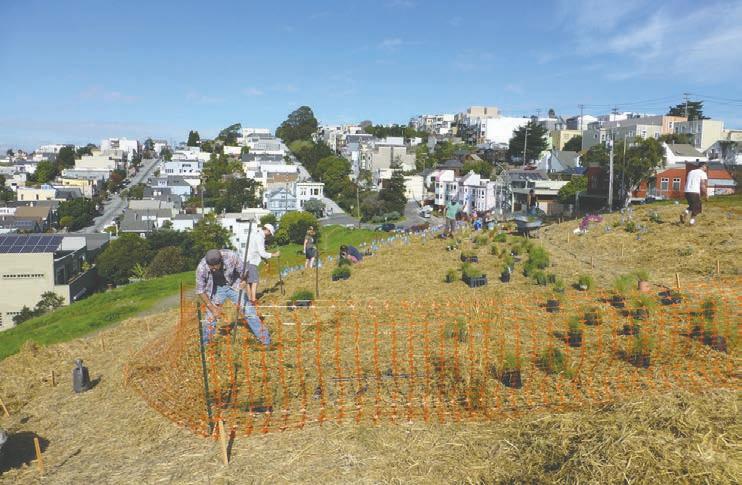
Starr King Open Space is slowly being returned to its indigenous flora, with the cultivation of a native plant garden and creation of a plot to be conserved by students at adjacent Starr King Elementary School.
“We have been coordinating with Literacy for Environmental Justice, a nonprofit in southeast San Francisco that promotes environmental health, getting native plants from their nursery to propagate our garden. This fall, Education Outside, an AmeriCorps program, will work with fourth and fifth grade classes to cordon off the An-
nex, a 50 foot by 50-foot area to educate students throughout the school year,” said Bill Gollihur, a Starr King board member who serves as a stewardship and volunteer coordinator.
Gollihur said the board anticipates cultivating native grasses in the area that’s presently covered by Coral Road after that street’s pavement has been removed and the home under construction on adjacent De Haro Street has been completed.
Nine Starr King board members, who aren’t compensated, are elected from and by Potrero Hill residents to serve two to three-year terms. They must be at least 18 years-old. Votes
are held annually in May at a general board meeting. If a member is unable to serve the remainder of their term, the board selects a replacement. Present members include Maureen Kelly Loya, president, Annabrooke Temple, vice president, Daniel Fineman, treasurer, and Siobhan Dolan, secretary.
According to Alyssa Pun, LEJ’s restoration and stewardship coordinator, 1,728 plants belonging to 27 different native plant species have been planted across the three and half acres of the open space. Species include blue wild rye, red fescue, blue fescue, purple needle grass, aster, yarrow, buckwheat, mule’s ear, lomatium, soap plant, sticky cinquefoil, Islais cherry, and oak trees.
“Teens ages 14 through 18 from Bayview and Hunters Point have helped with the maintenance work and planting for the native plant garden,” said Pun.
Peter Brastow, senior environmental specialist for the San Francisco Department of the Environment, said the Department provided $20,000 from the San Francisco Carbon Fund to support development of the native plant garden. “The Carbon Fund is a climate mitigation program that provides grants to projects throughout the City, including for greening. Every time a City employee books a plane flight for a work-related purpose, a percentage
Last summer, Animal Care and Control (ACC) picked up an abandoned a dog at Progress Park that was so emaciated and dehydrated that staff had no choice but to euthanize him.
Dubbed “Sweetie Boy” by ACC because “he seemed like a sweet dog and could use a boost,” ACC spokesperson Deb Campbell said the mastiff weighed between 60 to 70 pounds. Normal weight for a canine of his breed is typically 100 to 150 pounds. “He could have been as much as 90 pounds underweight,” she said. “It would take many weeks for a dog to become as emaciated as Sweetie Boy.”
Immediately after Sweetie Boy came to ACC’s attention he was rushed to an emergency veterinarian. “He was very weak, not responsive, and tests showed he had azotemia. And his organs were not functioning properly,” Campbell added.
Azotemia is an elevation in blood urea nitrogen, related to kidney function and hydration status. The most common causes for excess azotemia is dehydration or renal disease. “Given that this dog was treated aggressively with IV fluids for several hours and never produced any urine, it was an indicator of a poor prognosis,” Campbell said.
ACC decided to euthanize Sweetie Boy at the end of the day he was picked up to alleviate his suffering. “Our goal is to save animals, not euthanize them; this decision was difficult and heartbreaking for our staff,” she added.
The case sparked outrage and dismay on neighborhood website, NextDoor. The original post asking for information about the abandoned dog garnered more than 100 comments, with many residents calling for the dog's abuser to be punished.
The investigation remains open, with no leads. ACC has little to go on, Campbell said. “What would help us is if residents and/or businesses in the area have security footage from July 16; they may have caught something that would help with the investigation,” she said.
The District Attorney’s (DA) office has been increasing its prosecution of animal cruelty cases. Recently, the DA
The terrorist attack ushered in a period of war-without-end, marked the partial disintegration of much of the Middle East – Afghanistan, Iraq, Libya, Syria – brought to life America’s security state, distracted U.S. foreign policy away from the new world order emerging in Asia, and, arguably, gave us President Donald Trump. The horror of that day is seared into our souls. It’s a part of our DNA, reshaping our emotional and intellectual faculties.
PUBLISHER’S PUBLISHER Steven J. Moss MARKETING MANAGER Laura ODonovan PRODUCTION MANAGER Helena Chiu ACCOUNTING MANAGER Catie Magee THIS MONTH’S CONTRIBUTORS Copyright 2018 by The Potrero View. All rights reserved. Any reproduction without written permission from the publishers is prohibited.SHORT CUTS
Serpentine Subject to Shakedown
The resulting fear and anger lingers like gigantic threatening storm clouds, far larger than the rebuilt World Trade Center, prompting many of us, mostly in Red States, to yell a long and loud expletive to the rest of the world, angry flames that Trump and his supporters continue to nurture.
On the ground, the area in and around the former Twin Towers sparkles with the best, and the worst, of America. Cascades of water flow into two large square pits, down, down, down into the ground, like the collapsing of the buildings and our collective sense of safety. Nearby, Manhattan’s largest indoor shopping mall, operated by Westfield, sits under a roof-sculpture that could represent the bones of a diving whale or skeleton of a crashing jumbo jet. At an impeccably renovated Battery Park, clusters of tourists mix with lovers of all colors, while children frolic on grassy meadows in the shadow of multimillion-dollar condominiums affordable only to the wealthiest 10 percent.
9/11’s direct wound has more than healed. Lower Manhattan is healthier than ever, acknowledging, through the Memorial & Museum and its grounds, what’s been suffered, what’s been lost, countering it, in nearby parks and amusements, with a roar of happiness and triumph, of life. It’s a testament to what New York – and California –wants to be: a place that remembers its history, but strives to mark it with peace, prosperity, and compassion.
Recently, Serpentine, in Dogpatch, got an email from a person calling herself a “PR manager” with the subject line “Reputation.” The sender, who said her name was “Natasha Nixon,” claimed she’d been hired by one of Serpentine’s competitors to share negative information, such as “awful photos of the food containing hair and insects. I don’t want to hurt your restaurant reputation therefore I offer you to have a deal,” the email reads. “I’ll refuse to fulfill this order if you compensate me the amount that I’ll lose in case of failure to fulfill order.” The letter went on to say that if Serpentine chef Tom Halvorson paid the requested amount she’d name the competitor “so you can report him to the police.” Halvorson, who was given two days to respond, notified law enforcement. District Attorney George Gascón followed-up by issuing a public warning about an email extortion operation directed at San Francisco restaurants. Several local chefs have said perpetrators threatened to spread undesirable data about their eateries unless they’re paid money.
Smuin Ballet now owns a De Haro Street warehouse, built in 1949, which once was home to the Metronome Ballroom. The dance company, named for its founder, Michael Smuin , who died 11 years ago, bought the twostory building for $4.7 million in an all cash offer, $1 million over asking. The troupe needs another $2 million to build out the space, with fundraising efforts linked to Smuin’s 25th anniversary season, which starts this month. Possible structural upgrades, to be completed by this spring, include locker rooms with showers for the 16 company dancers, and separate rooms for physical therapy, wardrobe and administrative meetings.
Last Spring, San Francisco General Hospital abruptly laid off up to nine social workers from its Medical
 VIEW Jacob Bourne, Damon Guthrie, Peter Linenthal, Steven J. Moss, Rebekah Moan, Jessica Zimmer Editorial and policy decisions are made by the staff. Published monthly. Address all correspondence to: THE POTRERO VIEW, 1459 18th Street, Number 214, San Francisco, CA 94107 415.643.9578 • E-mail: editor@potreroview.net • production@potreroview.net (for advertising)

Surgical unit, a roughly 33 percent reduction in those positions. “It came out of nowhere,” recalled Dr. Scott Goldberg, a resident physician. “There was no announcement.”
The temporary social workers, who had been contracted through an independent staffing agency in early 2017, were given 10-day notices. The fund through which they and other provisional workers were being paid had been depleted, all contracted employees were let go, according to Dr. Todd May, SFGH’s chief medical officer. Roughly 21 remaining permanent social workers are responsible for the inpatient medicine unit; social workers have gone from handling 10 to 19 patients a day to sometimes seeing more than 40. With fewer social workers, Goldberg believes the pace of discharges has slowed; according to the hospital there’s no correlation between the loss of social workers and release delays. In response to employee complaints, last summer SFGH administrators announced that they’d hire five more permanent social workers, a process that could take until the end of the year to complete.
Buena Vista Horace Mann School to House the Homeless
Starting this November, Buena Vista Horace Mann School’s gym, on 23rd Street, will be transformed into a nocturnal shelter for 20 of the school’s homeless kindergarten through eighth grade students and their families, up to 60 people at a time. The $700,000 program, funded by the City and County of San Francisco, may be the first of its kind in the country. According to Clauda DeLarios Morán, Horace Mann’s principal, the administration was moved to create lodging because of the number of students who asked staff to spend the night at the school, where they felt safe. “It’s like we have a huge mansion in the middle of the Mission District. It’s empty, dry, safe.” The shelter will operate from 7 p.m. to 7 a.m. during the week; until 10 a.m. on weekends. Families will be given breakfast and dinner, as well as assistance to connect them with long-term
SHORT CUTS continues on page 14
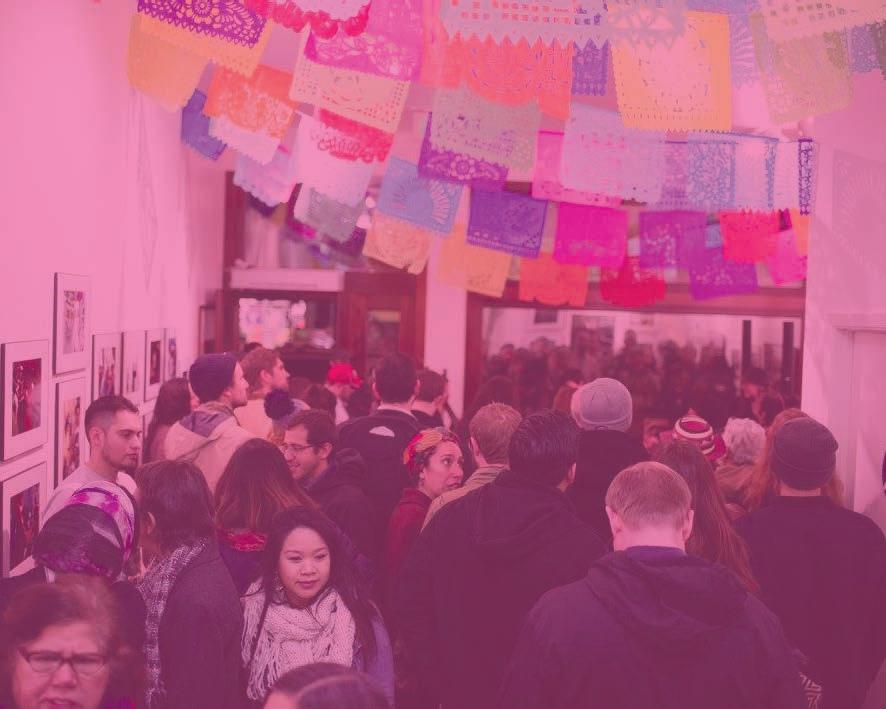
Five District 10 Supervisor candidates debated each another in front of an attentive audience last summer, in one of more than a dozen forums likely to take place before this November’s election. The event, held at the Southeast Community Facility, was hosted by the United Democratic, Eastern Neighborhoods Democratic and Willie B. Kennedy Democratic clubs, moderated by Joe Eskenazi, Mission Local columnist. Contenders Gloria Berry, Theo Ellington, Tony Kelly, Uzuri Pease-Greene and Shamann Walton passionately exchanged viewpoints within an overall atmosphere of camaraderie. According to the City’s Department of Elections, Asale-Haquekyah Chandler is also in the race; Neo Veavea is running as a write-in candidate.
Last month, the San Francisco Chronicle reported that as of June 30 Shamann Walton had raised the most campaign funds, $174,738, spending $125,776. Theo Ellington took in $131,921, expended $54,750. Tony Kelly collected $91,121, dispersed $25,847. Uzuri Pease-Greene and Neo Veavea each raised less than $4,000.
Ellington told the Chronicle that he was “confident” about the race, which he conveyed through his self-assured handling of questions during the debate. When asked by contender Berry which of the candidates he’d hypothetically vote for if forced to withdraw
from the contest, he conveyed that he hadn’t given it any thought.
In recent San Francisco campaigns alliances between candidates have emerged as an important element in winning ranked choice voting, or instant runoffs, which allow voters to select their first, second and third choices for a position. If no contender wins a simple majority of first choice selections, second choice ballots are tallied until a majority is reached, and so on. The system appears to encourage candidates to align with their competitors to garner second or third choice votes.
During the debate, candidates asked one another questions, and gave opening and closing statements. Audience members also posed a few queries, with Eskenazi handling most of the inquiries. The cover-up of environmental contamination at the Hunters Point Shipyard was a central topic of discussion, including what should be done to resolve the issue.
The Hunters Point Shipyard is San Francisco’s largest redevelopment project since the 1906 earthquake, an effort to transform a former United States Navy Shipyard into a largescale development, with thousands of residential units, commercial spaces and amenities. The area was known to be contaminated, in part, by the Navy’s previous use of nuclear materials on the land. Tetra Tech, a contractor hired by the Navy to test the site for radio -
active and industrial contamination, has been accused of extensive data falsification. Political conversation now focuses on what parts of the site need to be retested, who should pay for it and who should ultimately be held accountable. Retesting plans led by the California Department of Health have been criticized as inadequate.
“This is a classic example of our leaders putting politics and money over the wellbeing of Bayview Hunters Point,” said Ellington. “District 10 has been dumped on for far too long. I will no longer stand for this and the community shouldn’t stand for this. This wouldn’t happen in any other District.”
Ellington, who is a Shipyard resident, is participating in a lawsuit against Tetra Tech and developers
Five Point and Lennar that claims that testing fraud and lack of transparency about the extent of contamination warrants financial compensation for reductions in property values, as well as potential health implications
All five candidates agreed that Tetra Tech, the U.S. Navy, and the City should be held accountable for their respective roles in issuing possibly unreliable information about contamination levels, and bear financial responsibility for retesting the entire site. Two Tetra Tech employees were convicted for fraud related to the scandal; the company hasn’t been held liable. The U.S. Navy and City also haven’t assumed responsibility for the
lack of testing oversight and decision to proceed with development plans even though some thought site clean-up had been inadequate.
Kelly emphasized that from the earliest stages of redevelopment planning there was a fundamental conflict between simultaneously moving forward with building and selling properties while attempting to complete cleanup of the area. He said the site should’ve been fully cleaned up before construction began.
Both Pease-Greene and Berry as-
CANDIDATES continues on page 14
• Over 35 years of experience selling real estate in San Francisco
• Over $350,000,000 in sales in San Francisco
• Top Producer at Zephyr since 1997
• Certified Residential Specialist and Certified Luxury Home Marketing Specialist
• Member, Million Dollar Guild
• Member, Mayfair International
From some of her many satisfied clients:
“Susan Olk is one of the nicest and hardest working San Francisco real estate agents in the city. It is no wonder that she was one of the top 20 Real estate agents in the country and Susan could not be nicer. She has my vote for the top producer or SF Real Estate agents in the market based on her knowledge and experience working with buyers and sellers!!!!”
“Susan has been my realtor for more than 20 years. I’ve used her for 6–7 transactions. I have always been very satisfied with her service and professionalism. She knows the market. She gives good advise based on her many years experience. I’ve referred her to others who are also happy with their experience with Susan. As long as I have real estate in San Francisco, Susan is my realtor.”




Built in 1958, the Hall of Justice, located at 850 Bryant Street, has been plagued with safety problems – including sewage leaks and rodent infestations – and doesn’t meet seismic standards, prompting the City to identify alternative space for the criminal justice activities housed there. Last fall, the City and County of San Francisco signed a lease at 350 Rhode Island Street, owned by Lexington Lion San Francisco LP, securing room for the District Attorney’s Office and San Francisco Police Department. According to John Gavin, chief policy advisor for the City’s Real Estate Division, the lease is part of a phased relocation of Hall of Justice occupants that’ll be completed by the end of 2019.
“The lease term is for 15 years, from July 1, 2018 through June 30, 2033, with one five year option to renew, for a total 20-year term through 2038,” stated a Budget and Finance Analyst report discussing the first relocation phase. “The District Attorney’s Office and Police Investigations Unit would occupy 350 Rhode Island Street in phases, as the leases with existing tenants at that location expire. The initial base rent is $51 per square foot per year; first year base rent is $4,319,445 for approximately 84,695 square feet.”
The DA will take up roughly 84,695 square feet of space and will move in during the relocation’s first phase. In the next phase, SFPD will occupy 40,427 square feet; together inhabiting part of the first floor, all the second,
third and fourth floors, with a total of 125,122 square feet.
Gavin said that the City is currently modifying the space, with the initial project phase expected to be completed by early next year. Swinerton Buildings is the general contractor handling improvements for the District Attorney’s Office; a contractor hasn’t yet been selected for the areas to be occupied by the Police Department. Revel Architecture & Design is devising the improvements.
“The proposed lease will allow the District Attorney’s Office and San Francisco Police Department to continue to be within close proximity to other services associated with the Hall of Justice,” stated a San Francisco Planning Department document. “The physical proximity to these government activities is important to the efficient functioning of daily activities of related agencies. The proposed lease will allow these important government services to function during the Hall of Justice’s proposed re-accomodation period.”
The Officer of the Chief Medical Examiner, which had been located at the Hall of Justice, moved into a new facility at 1 Newhall Street last year. The Adult Probation Department will relocate to 945 Bryant Street next year; Police Property Control will lease space at 777 Brannan Street. The Hall of Justice also houses a County jail; however there have been no announcements about when or where the inmates will be moved.
Sheriff Vicki Hennessy told the Board of Supervisors last year that


though plans have been made to move municipal staff out of the Hall of Justice, the County Jail’s future hasn’t been addressed. The sheriff is working with the City’s Capital Planning team to develop housing for Hall of Justice inmates at County Jail Number Six in
San Bruno and to improve a County Jail facility at 425 Seventh Street.
“In advocating for the renovation of County Jail #6, I am advocating for these prisoners to live in a modern,
RHODE ISLAND continues on page 17


“If anyone is thinking of selling, call Claudia. Not only will she get the job done but she will get you the best price for your place.” - Layne F. “Claudia is a true professional We will always feel deeply grateful to her for helping us through one of the most important transitions in the life of our family.” - Adam G.
“Claudia was always on point with price predictions and very knowledgeable about the market.” - Wei H.
Claudia Siegel Realtor® DRE#: 01440745
415.816.2811 | Claudia.Siegel@compass.com
Claudia.Siegel.com
Credentials: Senior Real Estate Specialist® Certified Residential Specialist®








Four early-20th Century brick buildings at the former site of the Potrero Power Plant are all that’s left of what was a center of industrial growth in San Francisco between 1870 and 1940, a period during which, according to Dr. Paul Groth, efficiency and productivity became a national religion.
The buildings housed early Pacific Gas and Electric Company activities, played a role in rebuilding the City after the 1906 earthquake and fire, and are central to Pier 70’s history. The future of these brick buildings is uncertain, subject to the San Francisco Planning Commission’s approval of Associate Capital’s proposed development plans for the site.
The structures have significant problems, and are “Red Tagged;” the public isn’t allowed to enter them. Nearly half of Station A was torn down in 1983, compromising structural integrity. It, as well as the Gas Meter Shop and Gas Compressor Building, has been without roofs since 2001. The structures’ owner, Associate Capital, has found brick and mortar deterioration. Two of the edifices are near the constant hum from PG&E’s South Switchyard.
Building preservation will compete with other expensive amenities: more affordable housing, reduced density and building heights, and greater amounts of open space.
Last month, the San Francisco Planning Department’s Historic Preservation Commission called for creative solutions and open-minded approaches to preserving the buildings. Concepts that have been floated include modifying the structures, moving all or part of a building, and using materials harvested from the site in new contexts. Commission president Andrew Wolfram cautioned that developments without older buildings run the risk of being bland.
Associate Capital has promised not to repeat Mission Bay’s blocky uniformity. The company plans to preserve the iconic 300-foot smokestack, repurpose adjacent Unit 3 as a hotel, include historical styles and materials in its designs, and rely on Macchiatto, a Potrero Hill design firm working for Pier 70, to interpret history. Drafts of Associate Capital’s Design for Development and Infrastructure Plan will be published this month. Project approvals are scheduled for late 2019.
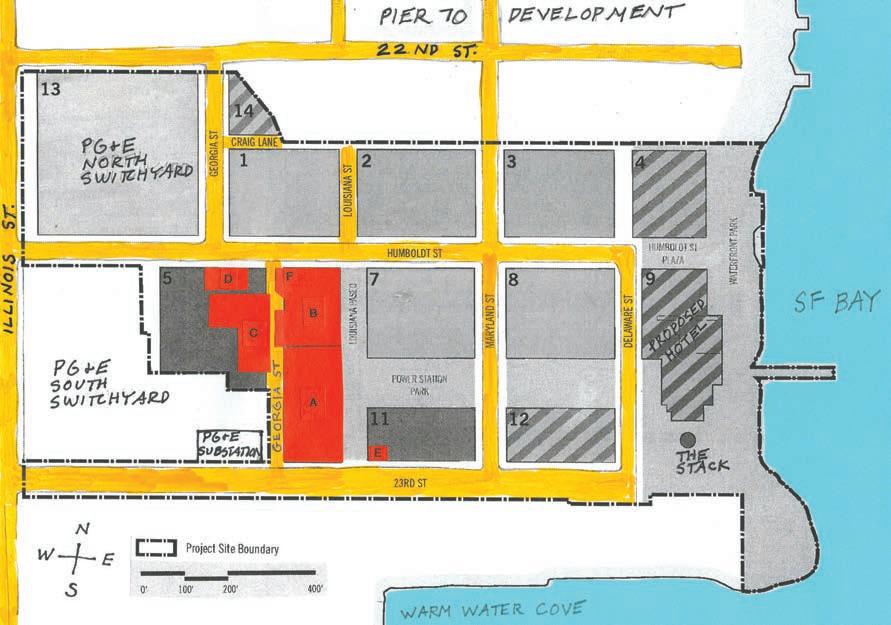
A: Station A, south portion
B: Station A, north portion
C: Gas Compressor Shop
D: Gas Meter Shop
E: Gatehouse
F: Station A’s Machine Shop Facade

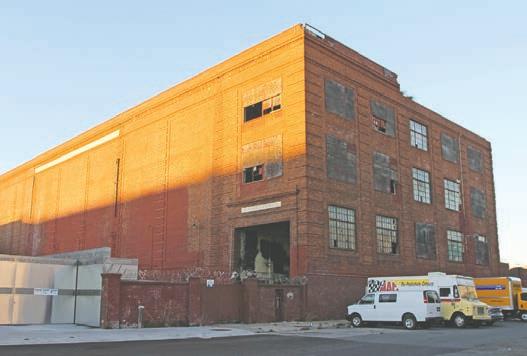
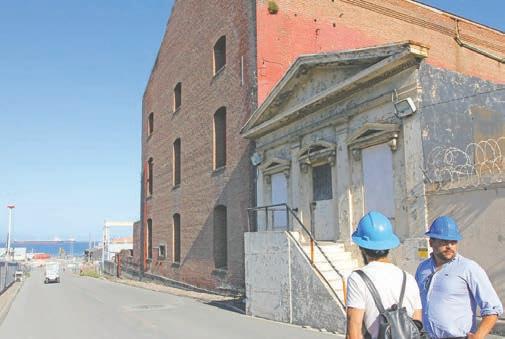


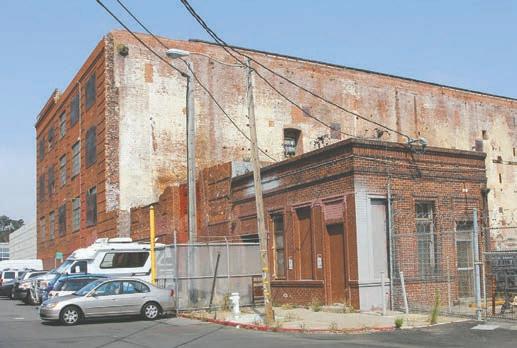
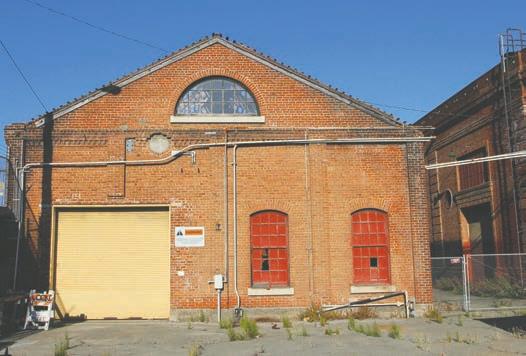


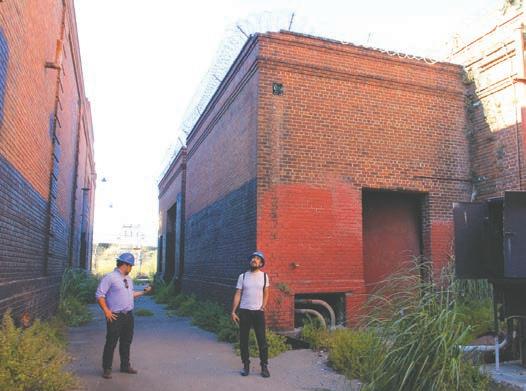
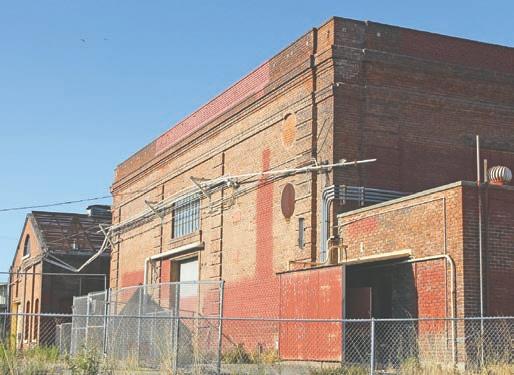

West facades of Gas Compressor Shop and beyond, Gas Meter Shop. Both are exposed to a constant hum from the PG&E South Switchyard.



 BY JESSICA ZIMMER
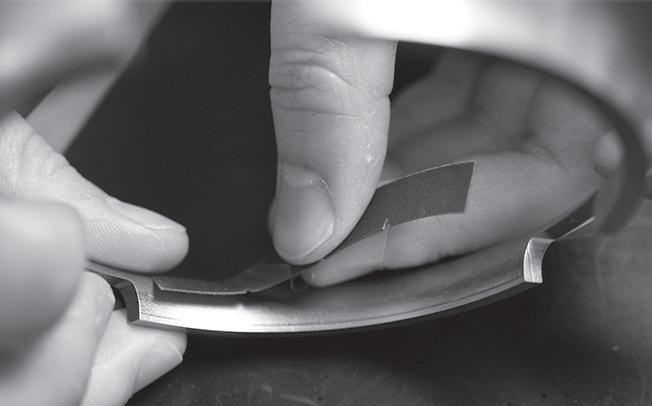
Over the past five years, Pacific Coast Highway International, an engineering firm located at 135 Mississippi Street, has engaged in numerous industrial design collaborations and sponsored exhibitions for California College of the Arts (CCA) students. PCH’s Potrero Hill office, housed in a building previously owned by the San Francisco Bay Guardian , contains 3D printing machines, a laboratory to assemble wearable products like vests embedded with smart technology, and multiple meeting spaces.
According to PCH Chief Executive Officer Liam Casey, the facility makes it possible for engineers to fabricate and replicate products quickly. “Industrial designers and companies can see and feel products early in the development phase, and make adjustments and refinements based on prototypes and builds made in Potrero Hill,” he said.

Claudia Ceniceros, PCH vice president of global communications, said the facility offers the equipment needed to design-engineer and develop manufacturer-ready products. “We work from the initial concept phase, where we define, explore, and architect products to the design-for-manufacturing and supply network phase,” said Ceniceros.
The company’s U.S. headquarters is home to about 60 Bay Area-based employees, including electrical, mechanical, and firmware engineers, as well as human resources, marketing, and information technology staff. A few PCH employees work in offices located in Cape Town, South Africa, but most – 70 percent – of the firm’s workers are in Shenzen, China, where PCH manufactures and provides global distribution services.
“We love being in Potrero Hill because the weather is great, there are many good restaurants we frequent, and the neighborhood has good


energy. It’s a great location to get to Silicon Valley because it’s close to the freeway. Plus, there are many worldclass industrial design studios and startups in Potrero Hill and SoMa,” said Ceniceros.
According to Casey, who founded the company in 1996 in Ireland, many Hill employees bike to work. He said it’s valuable to be near colleges and universities, venture capitalists, angel investors, engineering talent, and established companies. “We would love to have a closer relationship with UCSF. We see an opportunity to grow our relationship,” he said.
With his office located close by CCA’s Eighth Street campus, Casey serves on the college’s board of trustees. PCH hosts the industrial design senior thesis exhibition for graduating industrial design students, an opportunity for CCA graduates to show off their work to investors and the local industrial design community.
“It’s a chance for our grads to pitch the industry. Their work may consist of eight-foot by four-foot presentation boards, mockups, 2D visualizations, full-scale prototypes, and sometimes working prototypes, as well as an iPad to show videos of how the object works. PCH allows 35 to 40 students to set up projects and invites the industrial design industry for that evening. It’s always packed,” said Helen Maria Nugent, CCA dean of design.
PCH engineers also critique CCA students’ work during junior and senior design reviews. “These occur mid-semester and end-of-semester. Students working on a design product present their body of work to external panelists. They show renderings and models. These are moments where our students can step out of being in school. It’s very nerve-wracking but it’s a productive way for students to get
PCH continues on page 15
Low interest rates and powerful demand have continued to keep the Potrero Hill market strong. Many homes have attracted multiple offers after short periods on the market.
If you have been thinking of selling your home, now may be an excellent time to take advantage of strong demand from buyers.
1330
The
sales price for a home on Potrero Hill this year has been $2,122,498.
you’d like a free report on the value of your home, call Tim Johnson at 415-710-9000.
Tim
tim@timjohnsonSF.com
www.timjohnsonSF.com
Let the neighborhood know about your event. Send a note to production@potreroview.net by the 20th of the month.
1 sat
First Saturdays in Dogpatch
A neighborhood-wide event held monthly, rain or shine. Details at LoveDogpatch.com. Bay Area makers, small businesses and food trucks: pop-up in Dogpatch the first Saturday of every month. More info at https://bit.ly/2Lo5ekM.
9/2/18 through 10/31/18
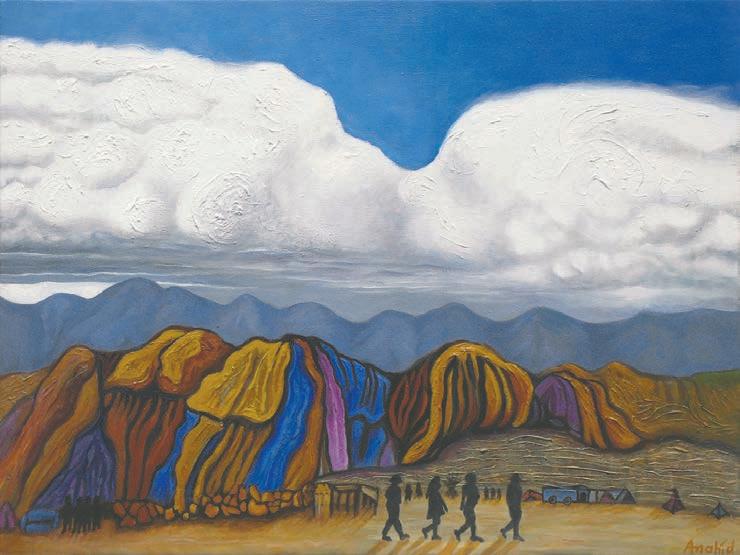
Art: Mystical Landscapes
Anahid Arslanian, whose work is informed by her love of nature, is an Armenian-American artist, born in Iran, and a long-time resident of the G2 Arts Building. Her work has been exhibited in Armenia and the Czech Republic, and is in private collections across the globe. Opening reception: September 9, 2 to 4 p.m. Exhibit: 10 a.m. to 7 p.m. Collage Gallery, 1345 18th Street. To see more of Anahid’s work: https:// bit.ly/2BC4mJL
5 wed
Music: Soul Delights
Live music by Soul Delights. 7:30 to 9 p.m. Farley’s, 1315 18th Street.
6 thur
Art: Jessie Bunn
Opening for local artist Jessie Bunn. 7 to 9 p.m. Farley’s, 1315 18th Street.
9/6/18 through 9/13/18
Film: San Francisco Green Film Festival
Launched in 2011, the San Francisco Green Film Festival is the West Coast’s leading event for films and discussions about people and the planet, bringing audiences vital stories from the environmental frontlines. This’ll be the first year the festival takes place in the fall, to align with crucial environmental discussions and actions happening this year. Tickets: $15 per screening; $13 members; $125 for a full pass to the festival’s week of films, panels, and events. Screenings free to those aged 18-and-under or with student identification. For more information, schedule, location, and tickets: greenfilmfest.org
9/7/18 and 9/8/18
Dance: Dancing Dreaming Isadora Two evening performances highlighting choreography from the traditional Duncan repertoire as well as Mary Sano’s original work, performed by Sano and Her Duncan Dancers, accompanied by live musicians performing classical and contemporary music. 8 p.m. $35 general; $25 student; $40 at the door. Package discount

available for both performances. ODC Theater, 3153 17th Street. For more information and to purchase tickets: ODC Theater Box office 415.863.9834 or https://bit. ly/2o1ESvV
8 sat
Community: SF Giant Sweep Join your neighbors as we get swept up with civic pride and do our part to keep our City clean. Grab a broom and dustpan, sweep the sidewalk in front of your home or business and pick up litter in your neighborhood. If you don’t have tools to get the job done, the San Francisco Public Works Department will supply them in the morning. 9 a.m. to noon. Free. Locations throughout San Francisco. For more information: https://bit.ly/2MwmUAk
10 mon
Spiritual: Tashlique at Ocean Beach
Reset your system with a modern spin on a 600-year-old Rosh Hashanah ritual, tashlich. This custom of ridding ourselves of all our bad vuggum (karma) from the previous year and getting a fresh start for the new one is traditionally enacted by tossing crumbs into the ocean; we’ll provide birdseed instead to be stewards of our wildlife and environment. Join us for an engaging ritual and joyful
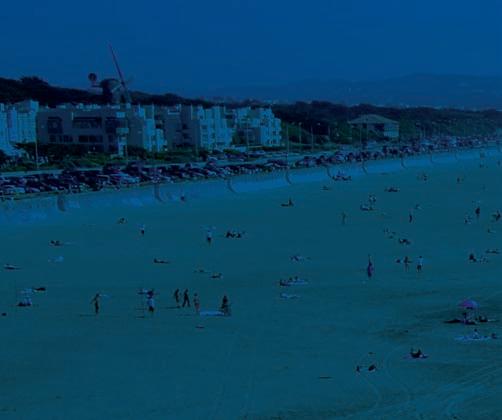
noise accompaniment from shofar blowers, members of Jazz Mafia and the Ministers of Sound of the Saint John Will-I-Am Coltrane African Orthodox Church. Bring a shofar to blow along with some of San Francisco’s finest players. Enjoy our twist on the traditional sweet with s’mores roasted over a bonfire. Presented by Reboot, with the Jewish Community Center of San Francisco. 5 to 7 p.m. Free. Ocean Beach near JFK Drive (across from Beach Chalet). For more information: https://bit.ly/2MIyB6f
11 tue
Family: Free Toddler Tuesdays at Salesforce Park
Join Toddler Tuesdays for fun in the sun with rotating activities and entertainment, like story time, magic, and games. Free. 10 to 11 a.m. Salesforce Park, Children’s Play Area, 425 Mission Street. For more information: https://bit.ly/2NgdpkP (choose Children & Families)
12 wed
Family: Parenting in the Age of Social Media
Social media can be a landmine for today’s tweens and teens. Learn research-based methods for helping kids use social media in healthy ways and tips for promoting digital









well-being in your own life. Led by Common Sense Media. 6:30 to 8:30 p.m. $15. University of California, San Francisco-Mission Bay, Genentech Hall, 600 16th Street. For tickets and more information: https://bit. ly/2PwFu9l
Music: Daniel Berkman
Live music by Potrero Hill resident, Daniel Berkman, a composer, multiinstrumentalist and innovator of the kora, a 21-stringed harp/lute from West Africa. 7:30 to 9 p.m. Farley’s, 1315 18th Street.
13 thur
Music: James Everett
Rhythm and blues, jazz, and pop singer. 7:30 to 9 p.m. Farley’s, 1315 18th Street.
Environment: Constructing Architectural Ecologies Symposium Keynote
Part of the California College of the Arts’ (CCA) Global Climate Action Summit, the Constructing Architectural Ecologies symposium opens with a keynote address by Dr. Adrian Parr, recently named dean of the College of Architecture, Planning and Public Affairs at University of Texas at Arlington. Her presentation will examine how built environments are turned into weapons of war, as with the leveling of cities like Aleppo or Gaza, and the ecological ramifications of warfare as it pertains to the built environment and sustainable design. This event is organized by the Architectural Ecologies Lab at California College of the Arts, with support from Kreysler & Associates,
CCA Architecture Division Lecture
Series, and CCA’s MFA in Writing program. 6 p.m., with reception to follow. Free. CCA Nave Alcove, 1111 Eighth Street. For more information: https://bit.ly/2BEMTjW
15 sat
Music: Marc Maynon and CD
Onofrio
Performing folk music. 7:30 to 9 p.m. Farley’s, 1315 18th Street.
9/15/18 and 9/16/18
Spiritual: Autumn Moon Festival
Moon Festival celebrations have been held throughout Asia for more than 1,000 years. The holiday is a time to reflect upon the bounty of the summer harvest, the fullness of the moon, and the myth of the immortal moon Goddess, Chang O. The Moon Festival is often compared to a sort of “Chinese Thanksgiving” because of its spirit of gratitude and inclusion of abundant food. To celebrate the occasion, Grant Avenue, in San Francisco’s Chinatown, will be filled with arts and crafts booths, cultural exhibits, children’s activities, food, corporate sponsors, and entertainment. In its 28th year, the San Francisco festivities will open with a grand parade on Saturday at 11 a.m. on California Street and Grant Avenue; the dragon appears on Sunday at 5 p.m. as the event’s grand finale. Admission is free. For more information: 415.982.6306, www.moonfestival.org
16 sun
Family: Children’s Creativity Festival
Celebrate the creative and innovative spirit of San Francisco with a variety of hands-on, familyfriendly activities throughout the Yerba Buena Children’s Garden. 10 a.m. to 4 p.m. Free. Children’s Creativity Museum, 221 Fourth Street. For more information: https://bit.ly/2LlskbO
20 thur
Music: Ben Barnes
Ben is a fiddle player, singer, and songwriter. 7:30 to 9 p.m. Farley’s, 1315 18th Street.
24 mon
Community: Student Housing Ribbon Cutting Ceremony
Designed by Leddy Maytum Stacy
Architects, 75 Arkansas features apartment-style housing for more than 200 California College of the Arts students, a multi-purpose event space that’ll support the college’s expansive programming, and ground floor retail spaces. The building manifests CCA’s commitment to sustainability and is a step forward in the college’s San Francisco campus expansion, which includes creation of student housing and a building designed by Studio Gang architects slated to open in academic year 2021-22. 11 a.m. California College of the Arts, 75 Arkansas Street. For more information: communications@ cca.edu.
26 wed
Literature: Potrero Hill Book Club
Potrero Hill Book Club. 7 to 9 p.m.
Farley’s, 1315 18th Street.
27 thur
Music: Kevin Patrick McGee
Live music by singer-songwriter, Kevin Patrick McGee, whose poetic, and occasionally amusing, original tunes span alt-country, bluegrass, folk, and rock. 7:30 to 9 p.m.
Farley’s, 1315 18th Street.
29 sat
Music: Tom West
Live music by Tom West, an Australian indie-folk artist. 7:30 to 9 p.m. Farley’s, 1315 18th Street.
30 sun
Community: Sunset Piano
This fourth annual free familyfriendly event features local musicians playing piano. Beer provided by Anchor Brewing and Harmonic, with wine and soft drinks also on offer, as well as kids’ activities and food trucks. 3 to 7 p.m., Starr King Open Space, Carolina Street near Coral Road. For more information: https://bit. ly/2PMP7Rp


flection of the values of the City of St. Francis, supporting the City’s most vulnerable with compassion and problem solving. It is the result of a robust, transparent, and inclusive process, with open and vigorous discussion of our priorities,” said Board president Malia Cohen. “I’m proud of our investments to reduce street homelessness, champion public safety for all citizens, clean our streets and parks, and keep our commitment to the residents of San Francisco.”
Almost $6 million will be spent on legal counsel for tenants facing eviction. One million dollars will be expended to care for the more than 350 people housed in 37 different facilities contracted by the San Francisco Department of Public Heath to provide behavioral and medical services. Eight hundred million dollars was allotted to build new and preserve existing affordable housing, totaling nearly 3,000 units over the next two years.
The San Francisco Department of Public Work’s budget is pegged at $374.3 million in FY2018, $306.4 million in FY2019. Of that, $13 million will be spent on street cleaning, including adding five new staffed public restrooms, extending operating hours for the five existing ones, and expanding hypodermic needle litter disposal team operations. The City’s Fix-It crew, which responds to quality of life issues identified by residents, will receive an additional $750,000.
A total of $1.7 million will be spent implementing 272 policing reforms recommended by the Obama Justice Department, such as improving com-
munity policing, providing anti-bias training, and ensuring greater accountability. One and a half million dollars will pay for four new positions at the Department of Police Accountability, which deals with police officer misconduct. Another $1.5 million will be allocated over the next two years to the San Francisco Fire Department to field a Medical Assistance Response Team to respond to calls that don’t require ambulance or fire engine services.
According to the U. S. Census Bureau, San Francisco had a population of 884,363 in 2017; the City will spend approximately $12,551 per resident annually. This expenditure level is the highest in San Francisco’s history; per capita spending for the 2014-15 fiscal year was $9,433. Seattle, with 724,745 residents, will spend $7,727 on Seattleites based on its 2018 fiscal year budget; per citizen spending for Seattle in the 2014-15 fiscal year was $6,744. Washington, D.C., with a population of 693,972 and a 2019 fiscal year budget of $14.5 billion, will devote $20,894 per citizen. In 2014-15 fiscal year per capita spending for the nation’s capitol was $15,624, the highest among the country’s 100 largest cities. San Francisco came in second highest that year.
Roughly half of San Francisco’s budget supports City-related business operations, such as the Port of San Francisco, Municipal Transportation Agency, San Francisco International Airport and Public Utilities Commission. The other roughly 50 percent funds such departments as Public Health, Police, Fire, Recreation and Parks, among others.
Of the yearly $11 billion (not considering transfer adjustments), around

21 percent will go toward community health, four percent will be spent on culture and recreation, 12 percent on administration and finance, 13 percent for such municipal responsibilities as retiree subsides, 14 percent on human welfare and neighborhood development, 15 percent for public protection, and 39 percent on public works, transportation and commerce.
In contrast, Seattle allocated 55 percent of its FY2018 budget on utilities and transportation, five percent for health and human services, 12 percent on public safety, three percent for neighborhoods and development, and seven percent on arts, culture and recreation.
According to the Seattle Times, Seattle is the nation’s fastest growing large city, with an 18.7 percent population increase since 2010. SFWeekly reported that although San Francisco’s population is at all-time high, it grew by just about 10 percent since 2010; the 2017 population estimate is less than one percent more than in 2016, making it the smallest annual increase for the decade. The FY2018 budget is 24 percent larger than the 2015-2017 budget.
The present budget reflects a rise in total labor costs of $244.3 million, or 4.9 percent, for fiscal year 2018, and $183.3 million, or 3.5 percent, for fiscal year 2019. The increases were attributed to salary hikes for many employees. The 2015-2017 budget reflected a $154.7 million jump in total labor costs, or 3.6 percent for fiscal year 2015, and $153.9 million, or 3.4 percent, for fiscal year 2016. Those surges were attributed to higher wages and more hiring.
According to the San Francisco Chronicle, the City had 30,626 employees in 2016. A decade prior, before the
Great Recession, there were 21,162 employees. That number then dropped by 1,000 employees during the economic downturn and subsequently increased by 4,500 workers over the course of several years. The current budget shows 31,320 employees for fiscal year 2018 and 31,606 for 2019.
STARR KING from front page
of the price of the ticket is put into the Carbon Fund,” said Brastow.
The Open Space is divided into two parts, the larger portion across Carolina Street, with a smaller plot to the left of Starr King Elementary School. Liam O’Brien, a lepidopterist and conservationist, said the City has a large number of natural areas like Starr King Open Space that “are rather comprised, quite fractured and small.” He believes it’s important to cultivate native species. “The non-native plants are like a tsunami on our native hillside. In some places, nothing endemic is left,” said O’Brien.
Gollihur said seeds for grasses cultivated in the native plant garden come from open areas in Bernal Heights and Candlestick Park, as well as San Bruno Mountain. “One of the ways we control non-native plant growth is by replacing the invasive grasses with perennials. Many invasive species are annual. They only grow once a year. Unfortunately, they’re really bad for fire fuel. They build up all this matter, this thatch. So, we mow the Open Space and introduce native plants that can survive with less water. Those plants are pretty competitive,” said Pun.
STARR KING continues on next page
According to Jake Sigg, member and former president of the Yerba Buena chapter of the California Native Plant Society, the fact that the Open Space is a serpentine grassland doesn’t stop vegetation from doing well in it.
“Serpentine soil is deficient in several elements, like calcium. In place of that, it has magnesium. That’s problematic for most plants, which can’t handle the magnesium. Yet there are degrees of serpentine toxicity. Some serpentine areas of California have less than others. The Starr King serpentine is not as toxic as most serpentine,” said Sigg.
Sigg said the high number of Oxalis plants – a shamrock-like plant with a bright yellow flower – in the Open Space presents an additional concern. Oxalis has a reputation for taking over plots, excluding native species. “This is a bulb, so pulling out the green, leafy part of the plant doesn’t work. It can keep coming back indefinitely. You have to kill the bulb,” said Sigg. Sigg said the only feasible way to kill Oxalis is with herbicide. “Digging is forbidden because you damage the soil structure…assures that only invasive weeds will growth there henceforth,” he said.
Native plants at risk in the Open Space include the Yellow Mariposa Lily (Calochortus luteus) and Silvery Lupine (Lupinus albifrons). These wildflowers provide food for native butterfly species like the Woodland Skipper (Ochlodes sylvanoides) and the West Coast painted lady (Vanessa anabella). In turn, native predators feed on the butterflies. “Butterflies are pretty much food at all four stages of their life, egg, caterpillar, pupa, and adult. They’re a movable feast for all the rest of nature. About 80 percent of butterflies at the adult stage are eaten by birds and spiders,” said O’Brien.
George Spencer, Education Outside instructor, said understanding the links between the different plants and animals that live in the Open Space is a goal for Starr King-Annex students. The Annex project is part of Education Outside’s work to engage Starr King Elementary School pupils in science knowledge and stewardship, creating lifelong learners and community leaders.
“The Open Space surrounds the school. Utilizing it really empowers the students to get involved in a place that’s so near and dear to them. Students already do a lot of work on greening the School. They pick up litter because it’s




very windy up there. Trash just blows around the area. They sort trash into the different recycling bins. That’s a big part of meal time. Connecting students to the idea of urban greenspaces should be exciting,” said Spencer.
Spencer said the number of students who participate in the Annex depends on how many teachers voluntarily signup to take their classes there. Education Outside funds Spencer’s position.
“We’ve been trying to cut down the foxtails. They’re not native and they’re a hazard to dogs’” said Loya. “We are in desperate need of volunteer help for weeding. We have workdays with free coffee and bagels every second Saturday of the month from 9:30 a.m. to 12:30 p.m. It’s a great way to get to know your neighbors.”
Gollihur said that nearby homeowners plant non-native species in the Open Space. “We’ve seen rose bushes that aren’t native. We can take those out. But there’s a bunch of eucalyptus planted at the top of the Hill. It would be a lot of money to cut them down,” said Gollihur.
In addition to insects and plants, the Open Space is home to gophers and rats, though few mammals are drawn to it. “We don’t have a water source. That keeps the larger animals like skunks away. You often see hawks and crows hunting in the Space. They swoop around up here because they like the wind that comes up through the Mission District. It allows them to hang there on the average windy day,” said Gollihur.
“Starr King Open Space is a privately held natural area, the only one with this kind of arrangement in the City. It’s a natural area and a community park. This has proved successful,” said Brastow. “We play a support role for a lot of land managers in terms of integrated pest management and biodiversity. The City does not have oversight per se of privately owned lands like this one. The only time there would be a concern is if there was a public nuisance on the property.”
During World War II, the spot that’s now Starr King Open Space housed Pier 70 shipyard workers. After the war, the housing was demolished. The land sat vacant for roughly four decades, until it was dedicated as a green space in 1984.
The Department is collecting information about San Francisco’s biodiversity, including related to the Open Space. “I am leading a project funded by the Urban Sustainability Directors Network,” a peer-to-peer network of local government professionals across the

(415) 579-0015 for
U.S. and Canada that seeks to create a healthier environment. We started the project in January 2018. We are funded by Seed Fund Grants, the USDN, and the Presidio Trust. The total budget is $119,000. This money creates a toolkit for the City to figure out which sites and which species are critical to maintaining biodiversity. The goal is to create a model of citizen science with apps like eBird and iNaturalist. Since Starr King Open Space is a natural area in the middle of the City, it allows folks to go out and collect data about the plants and animals on it with very little coordination. That is very valuable,” said Brastow.
Pun anticipates people will want to help collect data. “I think education is a huge strategy here. By working with the school and the neighborhood, the board is already ahead,” said Pun.
See page 9 for details on Starr King Open Space's annual Fundraising event on September 30.

someone’s phone or security footage, is so important is it’s a game changer and provides the evidence needed to charge these cases,” Campbell said.
secured a guilty verdict against Wakeen Best, who threw a dog off a parking garage. The office has recently charged men with felony cruelty in three other cases: Puppet, a small dog who was killed Downtown; Skunky, a pit bull puppy who was bludgeoned to death; and Juicy, a canine who was beaten in a Bay Area Rapid Transit station.
“One of the reasons video, from
“No pet needs to suffer like this,” said Potrero Hill resident Tom Strother. “They can be surrendered to ACC or the SPCA and will be cared for in a humane way. If they are sick and need to be euthanized, at least it can be done without suffering. I don’t know how to begin to process this type of information. It hurts to see those images; yet it feels important that everyone sees them.”
If people have any information about this case they should call ACC at 415.554.9400 or email acc.dispatch@sfgov.org. Reports can be made anonymously.


YOUNG ADULT CATHOLICS (YACS)
YACS was formed to strengthen the community of young adult parishioners.
We provide an inclusive pla�orm to share perspec�ves on Catholicism, sup� port one another, serve the community, and socialize outside the church se�ng. We meet in the Parish Hall Sundays a�er the ��:��am �ass. We also organ� ize regular social ac�vi�es in the city. Please join us! Contact us at: St.TeresaYACs@gmail.com
S����� ������
Saturday Vigil 4:15 pm
Sunday 8:30 am 10:00 am











Movie and a Meal
In partnership with the Potrero Hill Family Support Center (PHFSC), we’ll present a family-friendly film, and PHFSC will provide a meal. The September selection is McFarland, USA. In a hardscrabble California farming town, Coach Jim White sees the potential for a cross-country running team among the area’s high school students, most of whom are the children of farm workers. Based on real events, McFarland, USA will have you cheering! Rated PG. 128 minutes. Friday, September 21, 3 to 5 p.m.
Saturday Snacktivity
With food provided by The Good Life Grocery, we’ll offer a wholesome snack and fun activity. All ages welcome. Saturdays, 11 a.m. to 12 p.m.
Introduction to Internet Searching
Searching the World Wide Web can be a difficult and frustrating task, but it doesn’t have to be. This class will provide basics on effective searching. Sunday, September 9, 2 to 3 p.m.
The Literate Goat Book Club
Focusing on literary fiction, this book club meets on the second Tuesday of the month, celebrating its third anniversary. All are welcome. Tuesday, September 11, 6 to 8 p.m.
Taste of North Africa, Middle East, and Central Asia
Featuring sample snack foods from many counties. Sunday, September 13, 6 to 7 p.m.
Sabor a Salsa
This salsa-making class celebrates Latino-Hispanic Heritage Month. Join for a tasty journey of the senses, to learn a brief history of salsa and how to prepare it, with a tasting of a few different varieties. Sunday, September 16, 3 to 4 p.m.
Baby Rhyme and Play Time
Songs and rhymes for infants up to 18 months old and their caregiver(s).
Tuesdays, 1:15 p.m. and Thursdays, 11:15 a.m.
Toddler Tales
Books, rhymes, music, movement and more for toddlers 18 to 36 months and their caregivers. Thursdays, 10:15 to 11 a.m.
Puppy Dog Tales!
Reading to a therapy dog is wonderful for children who are learning to read, or for whom extra attention in vocabulary or grammar is desired. Your child will adore reading to this calm canine companion in a non-judgmental setting! For ages four to eight, but older welcome. Saturdays, September 8 and 22, 12 to 1 p.m.
Algerian Sweet Treats
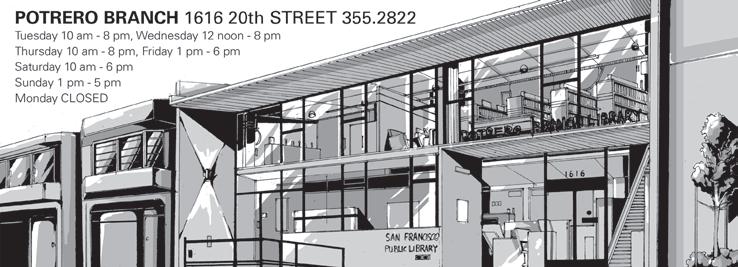
Local baker, Nora Takouat, will teach patrons how to make the delicious authentic Algerian dessert, khamsa bniwen, which means “hand shaped sweet” and includes chocolate, nuts and honey. Space is limited; please sign up in advance at the branch or by calling 415.355.2822 Saturday, September 22, 4 to 5 p.m.
housing. There are purportedly 60 Buena Vista students who are homeless; an estimated 2,100 homeless pupils citywide. Seems like a good idea to look at schools as possible development sites for affordable housing for teachers and students.
The much talked about “midterm” elections will soon be upon us, with dozens of local and state ballot initiatives to consider, a few of which call for additional taxes, the resulting revenues dedicated to good causes. But, does the City and County of San Francisco need more tax revenues; it already spends more than $11 billion a year, about as much as Azerbaijan’s annual national expenditures, with a population ten times greater than San Francisco’s. Certainly, budget savings could be found somewhere, to pay for expansion of needed programs. Yet neither the Mayor nor Board of Supervisors seems to pay much attention to how well the underlying bureaucracy over which they preside performs, save for occasional railings over Muni’s performance. But that’s not what’s on the ballot. What is:
Proposition A, t he Embarcadero Seawall Earthquake Safety Bond, would issue $425 million in bond debt to pay for repairs and upgrades to the battered Embarcadero seawall. The seawall protects an estimated $100 billion in property and infrastructure that’d be at risk in a major earthquake, and which is likely to come under greater stress as the climate changes. While it’s not an excellent time to launch a multi-million-dollar construction project, given high cement and steel prices, the work needs to be done. There might be better ways to finance it, however, including developing “hazard districts” through the City, where taxpayers pay for the risk mitigation needed for their specific area, whether sea walls, improved rainwater runoff schemes, air quality improvements, or earthquake protections. If A is approved, hopefully the City will time the resulting bond issuance and project expenditures to coincide with the next economic downturn.
Proposition B, Privacy First Policy, sponsored by Supervisor Aaron Peskin, stipulates a number of personaldata-protection protocols with which businesses would have to abide to get a permit from the City or do business with it, including allowing individuals to access personal information about them the companies collect. A good idea, but is this issue best handled at the local, state, or federal levels..?
Proposition C, Our City, Our Home, would levy an average of about 0.5 percent in gross receipts tax on corporate revenues above $50 million. The $280 to $300 million raised would pay for almost a doubling in funding for housing and homeless services. A quarter of the monies would be dedicated to mental health services; around 15 percent to help prevent homelessness, 10 percent to create 1,000 extra shelter beds, with the remainder routed to build, rehabilitate and preserve some 4,000 housing units. Past View reporting suggests that the City does a poor job with the hundreds of millions of dollars it already spends combatting homelessness, and dedicated taxes, while easier to
pass at the ballot, straitjackets future budget choices. Still, perhaps a sea of taxpayer cash will raise all homeless boats…
Proposition D, sponsored by Supervisor Malia Cohen, would place a gross receipts tax on cannabis businesses starting in 2021, the proceeds of which would flow into the general fund. For retail cannabis shops, the tax would be 2.5 percent on the first $1 million in revenue, 5 percent on revenues above $1 million. Non-retail cannabis enterprises would be taxed 1 percent on revenues up to $1 million; 1.5 percent on gross receipts above $1 million. Is there any basis for these percentages, or levying additional taxes on weed at all? How does this new duty fit into the City’s overall tax and spend scheme? Oddly, given that Cohen is running to be on a tax-focused agency, the State Board of Equalization, nobody knows…
Proposition E, sponsored by Supervisor Katy Tang, would reallocate about $32 million generated by the existing 14 percent hotel tax to arts, cultural organizations and projects rather than going to the general fund. Ballot box budgeting is generally a bad idea; the Board of Supervisors and Mayor are elected, in part, to decide how best City revenues should be spent.
Much has been made of Russian meddling in the election that brought us the Trump Administration, in all its glory, with continuing shenanigans this political season. With the whiff of treason in the air, it’s worth remembering that the U.S. government itself is notorious for inserting itself into overseas votes, in such places as various “Banana Republics,” Chile, Italy, and Serbia. Russia considers itself tampered with by America, ejecting a U.S. “aid” mission six years ago over misgivings about American-funded “pro-democracy” groups. Right or wrong, it’s quite likely that Russian President Vladimir Vladimirovich Putin views whatever election-related interventions his surrogates engaged in as tit-for-tat. Doesn’t make it kosher, and certainly not a defense for any coordination by Trump campaign officials. It just is what it is, global politics-style.
CANDIDATES from page 3
serted that the issue of environmental contamination isn’t isolated to the Shipyard but pervasive in District 10. Southside neighborhoods have historically been thought to have high toxin levels due to their industrial past, including the former operations of the Hunters Point and Potrero power plants. According to Pease-Greene, community members need to pay more attention to real estate developers’ plans and ensure that all land targeted for development that’s suspected of being contaminated is properly tested.
Berry called for a moratorium on any new building projects in the Shipyard until all necessary testing and cleanup is completed. She said she’d work with City Hall on this issue and personally research companies contracted to do testing to ensure that
CANDIDATES from previous page
they follow ethical standards.
Walton spoke about several family members who lived near the Shipyard who died at young ages from illnesses that could’ve been caused by the contaminated land. He called for Tetra Tech to pay for re-testing the site, and said that the City should ensure that the company is never again involved in development projects within its jurisdiction.
Walton said his professional experiences well-equip him to be supervisor, especially his previous role as a San Francisco Board of Education member, during which he dealt with citywide issues. Many Districts face similar problems, he said, and share common geography and infrastructure, such as the waterfront, necessitating a supervisor who can work effectively with other neighborhoods. Walton also pointed to his experience as executive director of Young Community Developers, a Bayview-Hunters Point nonprofit which contributed to the building of affordable housing units while providing job training for local residents. He also served as an economic mobility task force member for HOPE SF, which works to build and maintain public housing in District 10.
All the candidates were concerned that District 10 has been subjected to substantial development without corresponding infrastructure, amenities or environmental protections, as exemplified by the Shipyard fiasco.
Kelly, who has been endorsed by the Democratic Socialists of America, asserted that the District faced systemic racism, and called for getting
to the roots of the problem, such as geographically concentrated pollution, high unemployment rates, and a lack of parks. He said that provision of free City College and eliminating poverty will make communities safer. “Safety is not more cops,” Kelly said. “Safety is fewer reasons to call the cops.”
“The more skill-sets a young person has the better they will do and the better decisions they make,” said Walton. “We need to provide police offers with resources so that they can spend time in the community and get to know young people, build relationships.”
In addition to eliminating educational disparities, and increasing the availability of drug addiction treatment services, tackling police brutality is one of Berry’s top priorities. The 2015 police officer shooting of Mario Woods in Bayview, with no subsequent charges filed, sparked local outrage. Berry wants to take a “tough” approach to the issue while encouraging community patrolling initiatives, officers spending more time getting to know residents.
Berry also called for District Attorney George Gascón to resign for not holding officers accountable for excessive use of force. According to a 2017 Mission Local article, 19 people have been killed by San Francisco police officers since 2011; Gascón closed 11 of those cases without filing charges. Protests by Bayview activists followed the killing of Jessica Williams in 2016 by a police officer in Bayview. The cop involved in the shooting, Sergeant Justin Erb, wasn’t charged. However then-Police Chief Greg Suhr resigned in the wake of protests related to several shootings by officers citywide.
“All of the available evidence suggests Sgt. Erb faced a volatile and unpredictable situation looking uphill at an approaching car when he fired his gun at Williams,” the DA’s office said in a statement.
“I’m flabbergasted that the DA is saying it is okay to shoot at a person who appears to have been fleeing in a car,” San Francisco public defender Jeff Adachi told the San Francisco Chronicle. “How can you justify shooting a person when you easily could have stepped out of the way?”
All the candidates cited making housing more affordable as a top priority. They also echoed one another’s desire to see more grocery stores in the District. Walton advocated for greater access to healthy options, such as through food pantries that supply quality produce for low-income households. Pease-Greene suggested that in addition to having increased choices to procure healthy food there should be an expansion of programs that deliver nourishing foods to the needy. Ellington said he met with a group of pastors in the District who said that the number one issue facing seniors in their congregations is hunger.
“The Supervisor is actually supposed to work for the people in their community,” Pease-Greene said, in a backhand criticism of the current Supervisor, Malia Cohen, who is running for the Board of Equalization. “I don’t want to use this as a stepping stool. I want to give a voice to those who are not being heard and not being listened to.”
“We all have friends who have been pushed out of San Francisco and if we don’t change radically and work much
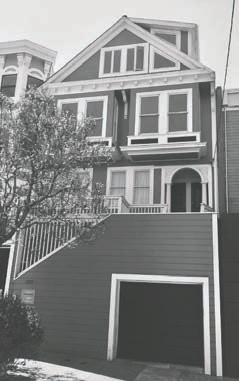
850 WISCONSIN (Top Unit)
2,202 sq. ft. (per condo map)
TOP of the HILL! 3-Bdrm, 2-Bath CONDO that lives like a house— with direct Downtown VIEWS! Gourmet eat-in Kitchen w/rear deck, shared landscaped garden, open Living/Dining room. Upstairs—an entire floor to yourself! Huge Living Room + enormous Master Suite; French doors onto private deck. VIEWS, skylights and natural light throughout; in-unit laundry; full 2-car garage w/enormous storage area. Unbelievable opportunity on the Hill.
O ered at $1,800,000
850-A WISCONSIN (Lower Unit)
813 sq. ft. (per condo map)
Handsome 2-Bdrm, 1-Bath CONDO, newly-refurbished from floor to ceiling! Hrdwood floors & new carpet, all new paint, sparkling new kitchen w/stainless, remodeled bath, huge walk-in closet, in-unit laundry. Front sun deck; storage room & add’l storage area. Walk in and live here!
O ered at $899,000


harder to keep us here, a lot of us aren’t going to be here,” said Kelly. “So, we have a choice this November. We can double down on fighting systemic racism and inequality and we can finally use the budget, our land and power to work for opportunities and justice for everyone. We’re not going to get that change from politicians. We need an advocate with experience, values and commitment to stand up for us and our neighborhoods instead of big developers, big companies and big banks.”
PCH from page 6
better at what they do,” said Nugent.
Nugent said PCH employees help CCA industrial design students understand how to make their concepts a reality. “Often design ideas get dumbed down. That’s the exact opposite of what happens at PCH. They’re about how you can make things possible,” said Nugent.
Philip Winter, co-founder and chief executive officer of Nebia, a Y-Combinator company that makes a water-saving shower system, said his employees value working with PCH because the firm is “world-class at designing high-end and technically challenging consumer products. We’re located at 17th and Alabama streets, about a 20-minute walk or bike ride from their office. To have them in our backyard is amazing. Our work requires a lot of technical and creative brainstorming. We would do weekly or twice-weekly check-ins in person. The really complicated problems to solve are much easier to work through in
PCH continues on page 17

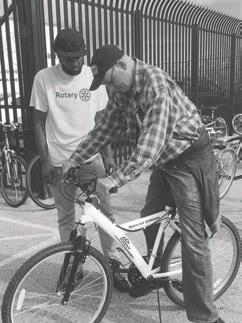
As a founding member of the SOMA Rotary Club of SF, I ask your support for our 7th Annual BIKES 4 VETS—an ongoing project in collaboration with the Veterans Lions Club and our own SFPD. Each year we recondition and repurpose donated and abandoned bicycles for a Veteran’s Day Bike Give-away & celebration. These bikes are often the only way for our Vets to get to work, a doctor's appointment, or to the VA Center. Please donate a bike in any condition to this project—call me today for free pick-up and tax receipt.
SOMA Rotary Club of SF is a growing group of dedicated volunteers who put our time, talent and resources to work in our own back yards—doing the work to make our neighborhoods better not just for a few, but for everyone. Please visit SOMArotary.org. It's FUN—and very rewarding!


well-functioning facility that affords them safe housing and access to educational, vocational and treatment programs that maximize their potential for life in the community after incarceration,” stated Hennessey.
page 15
person,” said Winter.
Nebia began working with PCH in its early product development phases.
“When we started working with PCH’s team, all we had were a few prototypes and the core technology. There were still many core features that were un-designed. One thing we wanted the shower system to do was slide up and down without any buttons, something that’s never been done before. PCH’s design team worked and worked on it. Now the product uses a coil system to move up and down, and it really feels magical. The product is manufactured in the U.S. We’ve now shipped over 15,000 Nebias around the world,” said Winter.
Winter said his staff have found PCH’s team to be good partners. “You develop a lot of empathy working together. Grinding on a problem alongside folks you trust and respect helps you focus on the fact that it’s all about making the best product possible,” said Winter.
PCH’s ability to design different types of products appealed to Brett Lovelady, founder of Astro Studios, an industrial design firm located on Sixth Street. “We’ve designed drones for 3D Robotics and have recently collaborated on a cosmetics project for L’Oreal. We do the industrial design. They turn that into producible, engineered CAD files and prototypes. They have the exper-

tise and perspective for manufacturing things around the world,” said Lovelady.
Lovelady said he appreciates PCH’s direct connection to China. “The Bay Area is the gateway to Asia. PCH is doing a really good job of bridging the cultural exchange that allows us to make smarter deliverable products,” said Lovelady.
Yves Behar, founder of fuseproject, an industrial design firm located on 16th Street, said he’s grateful that PCH has become familiar with the local industrial design culture. “The success of their work is a result of their talent and the way they fulfill their mission of helping companies realize their vision. There is a similar ethos among the businesses and artists that make up Dogpatch and Potrero Hill,” said Behar.
Behar said Southside has long been a creative hub. “Over the years, the presence of designers, artists, and independent businesses across a wide spectrum of industries can be deeply felt here. With new prominent gallery spaces and artist studios, this area is consolidating its reputation for the design and art hub of San Francisco. We’re seeing more investment in the area as well, in terms of landscape architecture, creating green spaces, and more housing. It’s a neighborhood that continues to thrive by being about creativity, engagement and innovation,” said Behar.
Behar’s team has collaborated on a number of projects with PCH, including the redesign of a sun care product – MY UV patch – packaging for products from La Roche Posay, a skincare company; and a UV Sense product. “We often try new products on our street, Carolina, or in the Potrero Hill athletic field that’s next to our office,” said Behar.

First Saturdays in Dogpatch: A neighborhood-wide event held monthly, rain or shine
• Explore neighborhood shops 11 a.m. to 7 p.m.
• Enjoy great food & drink 11 a.m. to 11 p.m.
• Discover maker market at Center Hardware + 1234 Indiana Street, 11 a.m. to 4 p.m.
• Be inspired at late-night gallery openings at Minnesota Street Project, 6 to 8 p.m.
• and much more. See all the details at LoveDogpatch.com
Bay Area makers, small businesses and food trucks: pop-up in Dogpatch the first Saturday of every month. Find out more at https://bit.ly/2Lo5ekM
Green Benefit District
Check out the Green Benefit District’s extension of the Minnesota Grove path to 24th St and upgrades to the sidewalk garden on 25th between Minnesota and Indiana. Thanks to Public Works for heading our call to repave 25th St between 3rd and Pennsylvania.
Want to get more involved in your neighborhood? Consider volunteering in one of our district parks. Want to add street trees and sidewalk gardens to your block? Contact the GBD at Info@GreenBenefit.org
Potrero Boosters Neighborhood Association
Be in the know. Meet your neighbors. Make the Potrero a better place. Monthly meeting: Last Tuesday of the month, 7:00 pm at the NABE. 953 De Haro @ Southern Heights.
Philipe Manoux, vice president of engineering at PCH Lime Lab, the company’s design engineering division, first got to know Potrero Hill when he lived in Bernal Heights more than 10 years ago. “I used to come here to skateboard. Bottom of the Hill and Thee Parkside, with punk rock and indie music, were a big lure. They’re still there. Now we do happy hours at Thee Parkside frequently on Fridays. I’ve gotten to know not only the industrial design firms like Box Clever and Branch Creative that we work with, but also Deluxe Distribution, a skateboard company across the street from us. We’ve visited each others’ studio spaces and we’ve 3D printed a few
things for them. Normally we wouldn’t cross paths,” said Manoux. Manoux said being close to 18th Street and the wide variety of Potrero Hill restaurants enables PCH to make a good impression on clients. “We’re able to bring people out for lunch after a meeting and people are often just surprised…with all the little gems. They say, “What is this neighborhood all about?” said Manoux. “Our physical neighborhood celebrates uniqueness and originality. Nothing here is mundane or boring. That helps us with our design work. As a product development and creative services team, we have to avoid group-think.”

Cleaning professional since 1986. Offices, apartments, homes, and buildings. Roger Miller 415-794-4411 References given with bid.
Walking distance to the beach, with the crashing waves visible and audible from the place. Includes kitchenette and lovely patio. $175 plus cleaning fee, two-day minimum. Editor@potreroview.net; 415.643.9578.
Walking distance to the beach, with the crashing waves visible and audible from the place. Three bedrooms, two baths, with a lovely deck. Minimum two nights: $350, plus cleaning fee. Editor@ potreroview.net; 415.643.9578.
Guitar Lessons, all levels. Expert Potrero Hill teacher, acoustic/ electric; rock, folk, blues, country. Lessons at my home; first meeting free; sliding scale. John Lewis, unclejohnzband@yahoo.com.
View editor available to work with writers at all levels. Groups also available. $50/hour. Editor@ potreroview.net; 415.643.9578.
Gorgeous, rustic, Muir Beach space and stunning Mission Dolores home available for day rentals. Perfect for six to 10 people engaged in retreats of all kinds: writing, yoga, teambuilding, strategy sessions. $175 an hour. Editor@potreroview.net; 415.643.9578.
Got something you need to sell? Have a service you provide? Our Classified Ad section is just the place for you! Cost: Each classified ad is $25 for up to 200 characters, including spaces. A 20-percent discount will be provided for ads paid for six months in advance. Payment, and/or corrections, must be received by the 18th of each month for the ad to appear in the following month’s issue. Please email all classified ads to office@potreroview.net
Help Your Community Newspaper, Get Exercise, and
Earn $500/month! Looking for reliable delivery person to distribute the paper, including homes and sites.
Contact: editor@potreroview.net
San Francisco Arts Commission News
GrantsApplication Window Now Open
Get to know your community, and help sustain your neighborhood newspaper. Modest base pay, plus commission. Send note and résumé to: editor@potreroview.net



San Francisco Arts Commission’s Grant Guidelines for 2019-2020 are now online. Grants are available for individual artists, youth arts, social justice, organization projects, capacity building, literary teaching artists, facilities planning and improvements. Applications due beginning in October. Learn more and apply at sfartscommission.org.
Annual Grants Convening On September 20, 5-7:30 pm
Join us in the Herbst Theater for a celebration of San Francisco’s artistic community featuring performances, videos, and awards to the San Francisco Arts Commission’s Artistic Legacy Grant award winner and more. Free and open to the public, with a reception to follow.
Now Recruiting Grant Panelists to Serve in Early 2019
T e San Fran is o rts ommission see s indi iduals ased in t e ay rea o are deeply no ledgea le a out t e arts nonpro ts ultural e uity and issues in historically underserved communities. Learn more and apply at sfartscommission.org/panelists.
COMMUNITY DEVELOPMENT STRATEGIES
NOTICE OF FUNDING AVAILABILITY
T e Mayor s e o ousing ommunity e elopment M is pleased to announ e t e a aila ility o unding or spe i ed pro e ts and ser i es under the following strategy areas:
REQUEST FOR PROPOSALS (RFP) TO BE ISSUED: onwww.sfmohcd.org and at 1 South Van Ness Avenue, 5th Floor
PRE-SUBMISSION WORKSHOP for PUBLIC SERVICES: at 1 South Van Ness Avenue, 5th Floor
PRE-SUBMISSION WORKSHOP for CAPITAL PROJECTS & HDG: at 1 South Van Ness Avenue, 5th Floor
DEADLINE FOR SUBMISSION:
by hard-copy original and USB drive copy
RFP Questions? Email michael.king@sfgov.org
Need alternative formats for persons with disabilities? Email eugene. annery s go .org or all 415 701 5598
August 20, 2018 by 5:00 p.m.
August 22, 2018 at 9:00 a.m.
August 23, 2018 at 9:00 a.m.
September 7, 2018 at 5:00 p.m.
Board of Supervisors Regularly Scheduled Board Meetings December Meetings
Come and see your local government at work, the Board of Supervisors hold weekly meetings most Tuesdays at 2:00 p.m. in Rm. 250 of San Francisco City Hall.
•September 4 •September 11•September 18•September 25
You can also view them online at www.sfgovtv.org .
LANGUAGE INTERPRETATION AVAILABLE UPON REQUEST CHINESE…. SPANISH…. FILIPINO
e uests must e re ei ed 48 ours in ad an e re uired or interpretation. For more in ormation see t e oard o Super isor s e site www.sfbos.org, or call 415-554-5184.
The City and County of San Francisco encourage public outreach. Articles are translated into several languages to provide better public access. The newspaper ma es e ery e ort to translate t e arti les o general interest orre tly. o lia ility is assumed y t e ity and ounty o San Fran is o or t e ne spapers or errors and omissions.





The View invites its readers (including kids!) to nominate their nanny, child care provider, or babysitter to appear in a monthly feature honoring these essential caretakers. Submit your entry (up to 300 words with a photograph). One winner will be published a month, and receive a $100 gift card.
Send to editor@ potreroview.net by the 20th of each month.





Kids 12 years and younger can submit a photo once a month, before the 20th, with the winning image receiving $35.
Teenagers from 13 to 17 years old are eligible for a $50 prize. Please send submissions to editor@potreroview.net
Check out these past winning entries!