
Minnesota Street Grove Reopens as Urban Oasis
BY DANNY PHAM
Pier 68 to be Used to Dock Recreational Vehicles
BY JESSICA ZIMMER
District 10 Supervisor Shamann Walton’s condemnation of a municipal plan to store towed recreational vehicles (RVs) at Pier 68 was the first time many Dogpatch residents heard about the idea.
“The Mayor’s Office, the Department of Emergency Management, the Port and the Department of Homelessness and Supportive Housing are once again strong-arming and treating District 10 as a dumping ground for the City’s hardest challenges,” Walton wrote in a press release. “Along with SFMTA, they are secretly trying to quietly trash District 10 again by storing towed RVs at Pier 68 after the mayor failed to deliver his promise of creating 1,500 shelter beds by this past June.”
On November 1, the City began ticketing or towing large vehicles parked for more than two hours throughout San Francisco. The targeted vehicles exceed 22 feet in
length or seven feet in height: camp trailers, fifth-wheel travel trailers, house cars, trailer coaches, mobile homes, RVs, and semi-trailers. As of last May, the Healthy Streets Operations Center had identified 501 such vehicles, 437 of which were being used for habitation.
The owners of RVs occupied for housing may be eligible for $175 per linear foot buyouts in exchange for the vehicle. Those participating in the Large Vehicle Refuge Permit program were given a temporary reprieve from sanctions while they connected with housing and other services. According to the Large Vehicle Program’s website, the permit lasts six months or until the dwellers receive “an appropriate offer of non-congregate interim or permanent housing,” whichever comes first, after which they’re vehicle is subject to ticketing and towing.
To be eligible for the permit, people must have been living in a large vehicle on May 31, 2025 – at which point access to the program
was closed – the RV has to be listed in the Large Vehicle database, and household members’ only form of shelter must be the identified vehicle. RV residents were placed in the database by San Francisco Homeless Outreach Team workers.
“Our kids deserve to grow up with both safe, stable homes and clean, accessible sidewalks; and we can only provide that by getting RVs off the street and helping families move into permanent housing,” said Charles Lutvak, spokesperson for Mayor Daniel Lurie, in response to a query from the View. “As families move, empty RVs will be held temporarily at a City-owned lot with available space and then dismantled. Government has spent years failing to address this issue; we are doing what it takes to do right by San Francisco families.”
Jackie Thornhill, San Francisco Department of Emergency Management communications manager, told the View that the storage site has
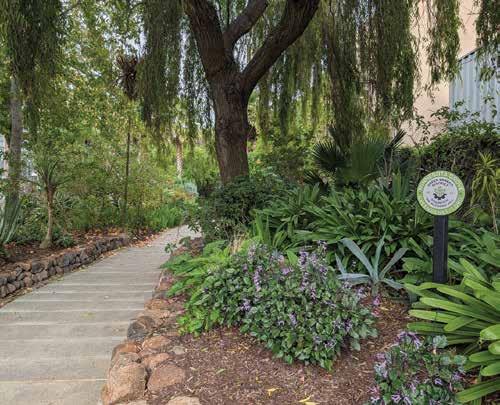
A renovated Minnesota Street Grove reopened last summer. The green space, tucked between 24th and 25th streets, is largely the creation of community efforts.
“This redevelopment and reopening has been a long time coming,” said Donovan Lacy, Dogpatch & Northwest Potrero Hill Green Benefit District (GBD) executive director. “It represents the culmination of years of work by community members, local business owners, San Francisco Public Works, and the Green Benefit District.”
The Minnesota Street Grove was first created in 2008 by Dogpatch and Potrero Hill residents. For many locals, the Grove has long been a hidden gem; a sliver of lush land lined with mature trees
and natural landscaping in one of the City’s fastest-developing former industrial corridors. According to Lacy, the renewal project was born partly out of necessity: municipal requirements called for improved American Disability Act (ADA) accessibility, prompting the GBD to envision a broader renewal.
“The impetus for the renovation was City requirements to provide better ADA accessibility,” Lacy explained. “We took the opportunity not only to create a wider and more accessible pathway but also to install beautiful wooden benches and new planting areas. These improvements make the Grove safer, more comfortable, and more enjoyable for everyone.”
The renovation added a wider ADA-compliant walkway, new irrigation systems, and expanded green space, with improved pedestrian safety features such as a sidewalk bulb-out at the Grove’s southern edge.
“Some of the elements that will likely go unnoticed are the improvements to the watering system,” Lacy said.
“They’ll allow us to plant and maintain more green space while reducing our overall maintenance costs.”
The improvements fit into the GBD’s mission to build and sustain green, accessible public spaces in Dogpatch and Potrero Hill.
“The Minnesota Grove exists in sharp contrast to the industrial areas that surround it,” said Lacy. “It represents a vision of what our public spaces can become; inviting places where residents and visitors can stop for a moment and enjoy their natural surroundings.”
From San Francisco Public Works’ perspective, the Grove’s reopening is more than a local success story. It’s a model for how public agencies can partner with neighborhood groups to reimagine shared spaces.
“It’s the reopening of a public space that was already unique, beautiful, and beloved, but now safer, more accessible, and set up to withstand decades of community use,” said Benjamin Peterson, Minnesota continues on page 4
Daniel Webster to Continue General Education Track, for Now
BY CHAITANYA TONDEPU
On a quiet stretch of Missouri Street in early October, families at Daniel Webster (DW) Elementary attended a community meeting led by San Francisco Unified School District’s (SFUSD) communications team to discuss ‘great news for the future of the Spanish Immersion program’. The district was set to announce the institution’s conversion into full Spanish Immersion, and the end of DW’s general education (GE) track.
The potential impact on the roughly 360-student campus wasn’t small. Based on the school’s current structure—two Spanish Immersion (SI) classes and one GE class per grade from kindergarten through third; paired SI and GE classes in the combined fourth/fifth—roughly one-third of Daniel Webster’s pupils participate in the GE track. Eliminating GE would mean shifting an entire segment and
dozens of children away from a program that’s long anchored the campus and provided a neighborhood option for Potrero Hill families.
The proposal’s suddenness prompted concerns about teachers’ positions, families being split between campuses, and how such a transition would affect siblings and the role Daniel Webster plays in the community.
Parents described what followed as an intense 24 hours.
“The news hit the same day as a press release about Mission Bay opening as English-only,” one parent said. “Then it was a flurry of activity; parents emailing, the PTA stepping in, teachers worried about their jobs.”
Within a day, SFUSD Superintendent Maria Su sent an email stating that the district had decided not to pursue the plan and instead “will closely monitor Webster’s enrollment and program needs as we open the new Mission Bay Elementary school.”
“The plan was to start phasing in the new structure
the following year, but once we received feedback and questions from DW, we decided to assess the data next year before making any decisions,” said Laura Dudnick, SFUSD director of communications. “Currently there are no changes in DW next year or the year after.”
“It was a complete 180,” recounted a parent. “The whole thing is kind of a mess; caused a lot of distress in the community. The Board made a hasty decision and then unmade that decision.”
For Daniel Webster families and staff, the proposed phase-out prompted questions about job security and how classes would be operated if GE disappeared. At community and workforce meetings, district officials didn’t offer concrete answers. Several GE teachers reportedly believed that they were about to lose their positions, creating what one parent described as “24 hours of panic” before the plan was reversed.
“I can’t find experienced candidates to fill bilin-
Webster continues on page 9
Minnesota Grove - Renovation II. photo: steven j. moss
Fiction: Girth Worms
BY STEVEN J. MOSS
VIt seemed like a good idea at the time. I’d just come back from India and had lost a lot of weight on account of a worm I’d picked up there. Ten, fifteen pounds, gone in a matter of weeks. I copied a bunch of signs and stuck them on telephone poles around the neighborhood: “Eat as much as you want; lose weight fast; new diet pill just in from the Orient.” I didn’t know whether India was in the Orient or not but figured it didn’t matter.
My first customer was an extremely large woman hauling a baby carriage. She was wearing a bluish over-sized pants-suit-thing that looked like it was made of a blend of polyester, Glad sandwich bags, and bubble wrap. All shiny, crinkly, and thick in a way that implied it could be used as a survival suit on Mars. Her infant was tucked away in an old-fashioned carriage, like what my little sister might have used to push around her
baby-wet-her-pants doll in the 1980s. The customer sat down in the metal fold-out chair I’d placed in front of my desk, which I’d garbage-picked the day before.
“How can I help you?” I asked, trying to look concerned, but professional.
Her eyes darted around my apartment, checking out the stacks of old magazines, piles of dirty clothes, and “found art.”
“Uh, well, I’m here for that diet pill you advertised? You know, on the telephone poles?”
For a minute I envisioned my tattered signs stapled to the shredded wood of creosote-soaked telephone poles, and thought, ‘what am I doing?” But I said, “Oh yeah, the new diet pills that I just picked up in the Orient. Sure, sure. Would you like to buy, ah, purchase some from me?” I nodded my head ‘yes,’ and she responded by doing the same.
“Yeah, I mean, that’s why I’m here.”
She made it sound as if there couldn’t be any other
possible explanation for her to be in my apartment. Her eyes wandered over to my collection of bottle caps – I had hundreds of Mr. Pibb, RC Cola, and rare regional brands – and then darted back to me. All the while she kept nodding. She flung her hands down on her ample lap.
“I had a baby a few months ago and can’t seem to lose the weight. I’ve tried everything; Weight Watchers, Nutrisystem, vomiting. Nothing seems to work.”
“Uh huh,” I said, reaching into the back of a desk drawer where I’d hid a vial of weightloss remedy. I brushed past old rubber dinosaurs, movie stubs, and campaign buttons.
“Well, here we go.”
I leaned towards her, my arm outstretched, a small caplet in my hand. “Take this, and call me in the morning.” I winked.
She stared back at me without moving. I noticed that her eyes bulged, like the eyes on the rubber fish squeeze toy I bought at the aquarium.
“Um, here.” I walked over, squatted, and put the pill in her hand. “Take this with some water. In a week
Girth Worms continues on page 9
c
short cuts
Bathroom in Yard
The Potrero Yard, built in 1915, spans more than four acres, edged by Bryant, 17th, Hampshire, and Mariposa streets. One hundred years ago the two-story structure located on the site housed and repaired San Francisco’s iconic street cars. Today the Yard has space for 146 trolley buses, including the sixty-foot-long accordion-style models. America’s greenest vehicle fleet, supporting the 5 Fulton, 5 Fulton Rapid, 6 Haight/Parnassus, 14 Mission, 22 Fillmore, 30 Stockton, and 49 Van Ness/Mission routes, runs from Yard. Several years ago, a modernization planning effort was launched to improve the Yard’s working conditions, increase indoor space available to repair vehicles, and meet seismic safety standards. Affordable housing was originally included in the scheme. But facing a $307 million deficit, the San Francisco Municipal Transportation Agency drastically shrunk the residential development portion. A revised strategy reflects less than a quarter of the housing originally proposed, one hundred affordable units, to ultimately be leased through DAHLIA, the San Francisco Housing Portal run by the mayor’s office. Importantly to the neighborhood, the revised plan retains a public bathroom, to be located on 17th street across from Franklin Square Park, two retail spaces, a lobby entrance for SFMTA employees, and a
700-square-foot accessible community room. The Tard will be beautified by local artists selected by the San Francisco Arts Commission. The redeveloped Yard is projected to open in 2030.
Crooked Lot
For decades the oddly shaped lot at the southern end of McKinley Square Park has been subjected to intermittent community-sparked improvement efforts, none of which have lasted more than a few years. The space, west of the bottom of Vermont Street’s crooked section, isn’t a part of the historic park at 20th and Vermont streets. Instead, it’s under the San Francisco Public Works’ jurisdiction, according to Annie Yalon, Public Works deputy director of policy and communications. Yalon encouraged those who want to improve the largely derelict lot to investigate the Street Parks Program, a Public Works initiative to foster community-managed spaces on municipal property. “This will ensure we can support the community in creating a more welcoming space for families to enjoy,” said Yalon. Other possible funding sources for those willing to organize a development effort include the Community Challenge Grant, applicants for which must be a 501c3 nonprofit or have a fiscal sponsor that meets the criteria.
Walton Aid to Run
In October Natalie Gee, chief of staff and legislative aide to District 10 Supervisor Shamann Walton, filed paperwork to run for the open District 4 supervisor seat in the June 2026 election, representing the Sunset District. Gee started working for Walton as his campaign manager in 2017. Walton, who terms-out as D10 supervisor at the end of next year, said he’ll donate money to and appear at events in support of Gee.
Newspaper Needs Some Book Learning
You’d think an article featuring a bookstore would be scrubbed clean of factual errors and spelling mistakes. Not so with last month’s “Christopher’s Books a Neighborhood Bestseller,” which was chockfull of misinformation, including: the former pharmacy that occupied the space was called “Wulzens,” not “Wilsons;” the enterprise’s founder, Christopher Ellison, was a lawyer, not an attorney, a relevant distinction in his home country of New Zealand; Jackson Tejeda, whose name was misplaced in two different ways, is not a co-owner; and the name of a popular book is Corelli's Mandolin not Captain Corelli's Mandolin. Yeesh. The View apologizes.





Annex-Terrace Redevelopment Problems Persist
BY MARK STEENSLAND
OThe plan to rebuild the Potrero Annex and Terrace houseing complex began in 2005, as part of HOPE-SF, a collaboration between the Mayor’s Office of Housing and Community Development (MOHCD) and the San Francisco Housing Authority (SFHA).
Proposition A, passed by voters in 2016, provided bond monies to fund the project. That same year, BRIDGE Housing Corporation (BHC) was awarded the construction contract. In 2019, it completed the first 72 units, at 1101 Connecticut Street, and most recently finished work on EVE Community Village, formerly known as Block B, located immediately adjacent to the Annex.
Progress at Annex-Terrace, however, has been delayed by problems, some of which date to 2022, when the Eugene Burger Management Corporation (EBMC) was responsible for managing the property. In addition to not performing proper maintenance, EBMC did little to prevent squatters from occupying empty units scheduled for demolition, creating conditions that San Francisco Fire Department officials believe contributed to a 2023 blaze that killed 40-year-old Richard Gescat, who Mission Local reported was a probable squatter, and displaced numerous residents and trespassers.
The trouble deepened when allegations emerged that an EBMC employee, Lance Whittenberg, was renting units to residents who paid cash, which he kept. After Whittenberg was fired by EBMC, an investigation conducted by the City Attorney’s office produced no corroborating evidence that he’d engaged in such activity.
The City allowed EBMC’s Annex-Terrace management contract to expire, hiring as a replacement Bell Properties in 2025. District 10 Supervisor Shamann Walton agreed this was a necessary step and added that no one has complained to him about Bell.
aEditor,
Changing property managers didn’t resolve the City’s obligation to relocate current Annex tenants before demolition of existing Annex buildings can begin to make way for the next development stage, something MOHCD spokesperson Anne Stanley said SFHA is coordinating with Bell properties and BHC.
According to the July agenda for a Citywide Affordable Housing Loan Committee meeting, which convened to vote on allocating funding for affordable housing development, BHC wanted to start demolishing Annex buildings last September. That didn’t happen because many of the units remain occupied despite municipal efforts to empty them. In a statement provided to the View, BHC said there was no specific timeline update to share, but it remains committed to moving forward with demolition as swiftly and responsibly as possible.
Ora Prochovnik, Director of Litigation and Policy for the Eviction Defense Collaborative, said the Housing Authority has been assisting everyone it considers authorized lease tenants by giving them either a substitute unit on site or Section 8 vouchers to find a new place on the market. But SFHA hasn’t offered these options to residents who claim they were paying Whittenberg because they view them as unleased.
Prochovnik disagreed with this position. “We believe many of them are eligible for the same assistance,” she said, “because of the legal history of their occupancy of those units.”
In the latest round of the continuing battle, the City issued new 60-day eviction notices in September, effectively waiving notices that were delivered 18 months earlier. As a result, lawsuits filed against the previous notices will now likely be dismissed; new lawsuits can’t be started until November 22, the day after the September notices expire.
In addition to eviction notices, the City has tried other methods to get Annex residents to vacate the units, including $5,000 Airbnb credit
letters to the editor
“Pakistan,” by Steven Moss, in the November View, kindled memories of my own experiences in Pakistan and Afghanistan from 1989 to 1997, when I’d go for two to four months a year as an aid worker. Reading "narrowing their eyes in mild hostility" when Moss said he was an American saddened but didn’t surprise me. A difference from my experience in 1989 when people would say "Amreeka ! Good !" That was in Peshawar, capital of what’s now called the Khyber-Pakhtunkhwa Province. Then the area was still known by the British era designation "Northwest Frontier Province."
By the time I left in 1997, American foreign policy had angered both Afghans and Pakistanis. While the reasons are complex, I think the basic one is that the United States failed to acknowledge the contributions of both
cards. Some have taken the offer, but others remain.
Adding to the complexity, a change in leadership was initiated when Dr. Tonia Lediju stepped down as the Housing Authority’s chief executive officer in August after six years in the position. Statements issued by the Mayor’s Office and Dr. Lediju didn’t disclose a specific reason for her resignation, nor did she respond to multiple requests for comment.
Following her departure, Mayor Daniel Lurie appointed Dan Adams, who has served as MOHCD director since January, 2024, to take over as the Housing Authority’s interim CEO. Adams previously served as MOHCD Deputy and Acting Director from 2017 until 2020.. A request to speak with Mr. Adams was answered by Stanley, who said that he wasn’t giving interviews.
According to Stanley, the Mayor directed MOHCDto identify opportunities to combine SFHA and MOHCD functions.
“In his current roles as both Director of MOHCD and Acting Executive Director of SFHA, Dan Adams is focusing on increasing program alignment and coordination between the two agencies,” Stanley said.
She described the effort as consistent with the City’s 2019 memorandum of understanding with the U.S. Housing and Urban Development (HUD) when it assumed responsibility for key functions of the Housing Authority, a process initiated by Lediju when she was appointed by Mayor London Breed to oversee SFHA’s finances after HUD informed the City that both the Housing Choice Voucher (HCV) and the public housing programs were in default. Within a year, Lediju had cured the default to HUD’s satisfaction.
“Defining the SFHA leadership role and recruiting for that position is pending completion of MOHCD's and SFHA's integration planning,” Stanley said, work she expected would be completed in the first quarter of 2026.


The Potrero Dogpatch Merchants Association | potrerodogpatch.com
We meet on the 2nd Tuesday every two months. Next meeting: December 9, 9:45 to 11 a.m. at the Goat Hill Pizza, 300 Connecticut Street.
Celebrate with Santa!
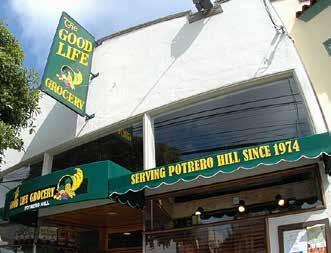
Join us at Hair Fair (next door to The Good Life) on December 11 from 4:30 to 6:30 p.m. Bring the whole family to meet Santa! Hot drinks! Cookies! Toys!
Dogpatch Art & Business Association DABA | dabasf.org
DABA hosts regular events and meetings, providing valuable resources and strong neighborhood connections
Business owners, artists, art institutions, and community members are invited to get involved! Here are a few ideas:
• Join DABA (dabasf.org) and become an annual supporting member
• Join our leadership team to help drive impact in the community
• Sign up for our newsletter to find out about member meetings, opportunities, and local news
• Follow us on Instagram @destinationdogpatch to learn more about Dogpatch businesses, events, and activities
• Explore Dogpatch through a curated wayfinding map of local businesses, available online at https://linktr.ee/exploredogpatch
Dogpatch Neighborhood Association (DNA) | dogpatchna.org
We nurture civic participation & community building while fostering the unique character of Dogpatch. Our meetings are open to all, but membership is the lifeblood of the organization. You do not have to live within the Dogpatch boundaries to be a member or come to meetings, you just need to care about what happens in Dogpatch. Monthly Meetings are held the second Tuesday of every month - 7 p.m. at The Dogpatch Hub.
There’s no monthly meeting this month but join us on December 9th for the joint DNA/PBNA Member’s Holiday Gathering at the Dogpatch Hub from 5:30 to 8:30 p.m. And don’t forget about our Community Meet n’ Clean on December 14th at Esprit Park from 12 to 1:30 p.m.
JOIN DNA TODAY!
Friends of Jackson Park (FoJP) | friendsofjacksonpark.org
Happy Holidays from FoJP! In this season of gratitude, we want to say thank you for your generosity towards Jackson Park. As you think about your yearend giving, we hope you will consider supporting our efforts to renovate and revitalize this important piece of our neighborhood.
Let’s build the park our neighborhood deserves.
Donate today at https://www.friendsofjacksonpark.org/donate Got big ideas? Love planning parties? Want to help bring the fun to life? Join our crew! Email us at info@friendsofjacksonpark.org — we’d love to have you.
Green Benefit District | GreenBenefit.org
Get involved with the Dogpatch and NW Potrero Hill Green Benefit District! The GBD’s Monthly Board Meeting is taking a break until January 21, 2026. However, we hope to see you at our Annual Tree Lighting at Woods Yard Park on Friday, December 5!
Help make the Green Benefit District greener. Our next GBD volunteer event is at the Vermont Greenway & Eco-Patch on Saturday, December 20, at 10:00 am. Sign up for a GBD volunteer event at greenbenefit.org/volunteer or report an issue at greenbenefit.org/report-a-problem.
The Potrero Boosters Neighborhood Association | potreroboosters.org
countries to our Cold War victory. That lack of gratitude translated into a material neglect of impoverished and war-ravaged nations. Though U.S. foreign policy disappointed Afghans and Pakistanis, people always treated me and other Westerners with kindness and respect.
I was encouraged to read that though Afghans and Pakistanis have reason to remain angry at U.S. foreign policy – regardless of which party is in power – the people Moss met put aside political feelings and treated him with the hospitality and respect they showed Westerners in the ‘90s. That also wasn’t surprising. Nice to know that their great customs remain. It’ll be a great advance for peace when our governments finally get around to learning the mutual respect we regular folk practice.
The Potrero Boosters Neighborhood Association informs, empowers and represents the residents of the Potrero District on issues impacting our community in order to develop and maintain complete, vibrant neighborhoods. Our monthly meetings are held on the last Tuesday of the month in person at either the Potrero Hill Neighborhood House or the Dogpatch Hub, and we continue to offer a Zoom option for those who cannot attend in person. All community members are welcome!
In lieu of our December meeting, we are co-hosting a holiday party with the Dogpatch Neighborhood Association. Go to www.potreroboosters.org to learn more and join us today.
Starr King Open Space | StarrKingOpenSpace.org
Join our monthly volunteer days on the second Saturday of the month. This month it is December 13th at 10 a.m. Donate to help keep Starr King Open Space open, accessible, and well-maintained for our neighborhood.
Isaac Williams 20th Avenue
Hill Resident Sews Gifts
BY STEPHANIE LAM
Barbara Zerbe’s Potrero Hill garage is packed with embroidery machines. Zerbe owns Barbara’s Embroidery, which she operates from her Arkansas Street home. The 62-year-old relies on her Tajima machines to fulfill custom orders, including threading together artwork for local enterprises like KQED and stitching children’s names onto school backpacks.
Many Bay Area embroiderers focus on bulk orders, declining one-off requests. Zerbe tries to fulfill smaller remits even during Christmas, like adding a cheery phrase to a stocking or a nickname on a pocket-sized gift.
“I know that the small stuff is often really, really important,” Zerbe said. “I like to be able to connect with people and do jobs that can’t necessarily be done otherwise.”
Before Zerbe became a full-time embroiderer, she sold hand-designed shirts on Fisherman’s Wharf. She purchased an embroidery machine with the intention of using it to design her shirts, teaching herself how to operate the equipment. When tourism in San Francisco dipped in the early 2000s, she moved her shirt business into her garage and started taking custom embroidery orders to make money. When tech companies re-emerged in the City in 2005 after the dotcom bust, and sought out embroiderers to help customize clothing, Zerbe pitched them her services.
“It was the right time, right place,” she recalled.
For decades, Zerbe embroidered while balancing another job: raising three kids. During the day she’d take care of her family; at night when they slept, she’d quietly work on orders in the garage.
When her kids got older, they learned how to use the machines and help complete orders for pocket money. Zerbe joked that embroidery is a family business; all her now adult kids know how to embroider. Her eldest son owns his own embroidery shop, Sew Marin, in San Rafael.
“They all really appreciated it I think,” she laughed.
close proximity of so much vegetation,” he said. “It was a tough balancing act to work efficiently without damaging the landscape.”
To protect the Grove’s character, Public Works installed temporary fencing and collaborated closely with the GBD to troubleshoot where planned walkway construction overlapped with planted areas.
“We worked hand-in-hand from design through construction,” Peterson said. “Donovan Lacy and Andrea Banas from the GBD were incredible liaisons between the project team and the community, and their operations manager, Juan Lainz, was integral to the work on planting and irrigation plans. They were fantastic partners every step of the way.”
The Minnesota Street Grove project aligns with San Francisco’s larger urban greening and climate resilience goals, according to Peterson. Through Public Works and its Bureau of Urban Forestry, the City has committed to expanding canopy coverage and equitable access to green spaces, particularly in historically overlooked neighborhoods such as the Bayview, South-ofMarket, Dogpatch, and Potrero Hill.
“In 2015, the City adopted its Urban Forest Plan, which aims to plant 30,000 new trees by 2040,” Peterson said. “We’re focusing on parts of the City with the lowest street tree coverage which are areas impacted most by heat and development.”
In 2023, the department secured a $12 million federal grant to plant and maintain 3,500 new street trees in low-canopy neighborhoods. The program includes a workforce development component, hiring 30 people to gain hands-on experience in surveying, planting, and maintaining trees, helping prepare them for long-term employment in the public or nonprofit sectors.
With construction complete, Minnesota Street Grove stewardship now returns to the Green Benefit District, which’ll handle day-today maintenance, tree care, and graffiti abatement. Public Works will sustain the surrounding streets, sidewalks, and curb ramps.
“This project also included a variety of street and sidewalk improvements along Minnesota, 23rd, 24th, and 25th streets,” Peterson said. “We repaved Minnesota Street, reconstructed sidewalks, and built new ADA-compliant curb ramps to make the area safer for pedestrians.”
The improvements extend beyond aesthetics. They reflect an evolving philosophy about how green spaces contribute to urban well-being.
As Lacy put it, “The Minnesota Grove invites residents and visitors to stop for a moment and enjoy the natural surroundings. We hope neighbors will continue to enjoy this urban oasis for years to come.”
24/7 security. It’s not visible from the street and can accommodate between 20 and 30 large vehicles. Voluntarily relinquished vehicles are stored for a minimum of 15 days before they’re dismantled.
“These situations rely on verification and documentation processes, which will vary case by case… why the LV program includes case management services for occupants. There is no limit to how many times a vehicle towed outside of the relinquishment process can be reclaimed. Fee waivers are available for people experiencing homelessness or who are low-income. Impound lots are open 24 hours a day, including holidays,” said Thornhill, indicating that towed vehicles can be reclaimed by paying the ticketing fee.
Last month, District 10 Supervisor candidate J.R. Eppler, and Michael Berkowitz, Dogpatch Neighborhood Association (DNA) president, expressed their frustration over the storage proposal in correspondence to the Port of San Francisco. The communication stated that the scheme wasn’t disclosed during a Department of Homelessness and Supportive Housing September presentation to DNA nor at the Port of San Francisco’s Southern Advisory Committee meeting in October.
“The lack of transparency on an issue with such potential local impact is troubling. District 10 has consistently stepped up to help the City address its most complex challenges, but too often we are asked to do so without notice or collaboration. The community can only work with the City if the City is willing to work with us,” stated the letter. “Our community has shown that partnership can work. The Dogpatch Neighborhood Association collaborated closely with the City on the Dogpatch Navigation Center, and the Potrero Boosters did the same with the Homeless Stayover Shelter at Downtown High School.”
The Coalition on Homelessness (CoH) held
crosswords
a press conference last month, alongside RV occupants, calling for RV residents to be protected from displacement and tows.
The RV ban and Large Vehicle Refuge Permit program are “cruel measures by design,” said Jennifer Friedenbach, CoH executive director. “Now those who should qualify but were never notified have no path towards permitting as the process has closed. The City permit program has set up endless barriers for individuals and families in RVs. It's almost as if the process was intended to banish RV residents and eradicate visible poverty instead of getting people into housing.”
Gabriel Medina, executive director of La Raza Community Resource Center, a San Francisco nonprofit that provides services to low-income families and individuals, said that while the City targets households sheltered in RVs, thousands of others sleep on the streets and in cars, parks, and school gyms.
“The City should be setting up safe parking and RV parks, while working to get everyone indoors,” said Medina.
Roughly 8,323 people were observed experiencing homelessness on January 30, 2024, the date of the City’s last Point-in-Time count, which is conducted every two years. The count estimated 1,444 households were living in vehicles, a 37 percent increase from the 2022 count. Even more people need assistance to avoid losing housing. The Department of Homelessness and Supportive Housing stated in 2024 that in excess of 20,000 people seek homeless services in San Francisco annually.
Daniel Webster
from front page gual positions as it is,” DW Principal Anita Parameswaran said. “There wasn’t one staff member who was on board.”
Set to open in August 2026, Mission Bay Elementary School will be English-only, offering Pre-K, Transition Kindergarten (TK), and
San Francisco Public Works public information officer. “Our goal was to enhance the Grove’s amazing original design rather than reimagine it entirely, and we think we succeeded.”
Peterson said the project’s biggest challenge was balancing construction needs with preservation of existing plant life.
“Working within the Grove, especially when constructing the new walkway, was challenging due to space constraints and the
Seeking Tennis Partner
Freelance Writers Wanted
Modest pay, interesting assignments. Contact: editor@potreroview.net
Sixty-something male intermediate tennis player looking for (semi) regular rally or game partner. Email editor@ potreroview.net Legal Notices
The View accepts legal notices. Please contact: production@potreroview.net; 415.643.9578.
The Green Benefit District and Public Works plan to hold a ribbon-cutting ceremony in early to mid-December, officially celebrating the Grove’s reopening. For long-time Dogpatch residents, it’ll mark the return of a favorite neighborhood space and what community collaboration can achieve.
“We’re thrilled to reopen this beloved green public space,” said Lacy. “It’s been a true community effort, and we can’t wait to see everyone there.”
Write Your Own Obituary
We're all going to die; why leave the writing of your obit to someone else? Whether you believe the end is imminent or just something you contemplate idly whilst taking a shower, you can control your own destiny, or at least how it's reported. Or, after examining your life story and finding it lacking, add to it! Up to six people in three two-hour sessions, $150. Interested parties should contact editor@potreroview.net
Got something to sell? Have a service to provide? Each classified ad is $25 for up to 200 characters. www.potreroview.net/advertise
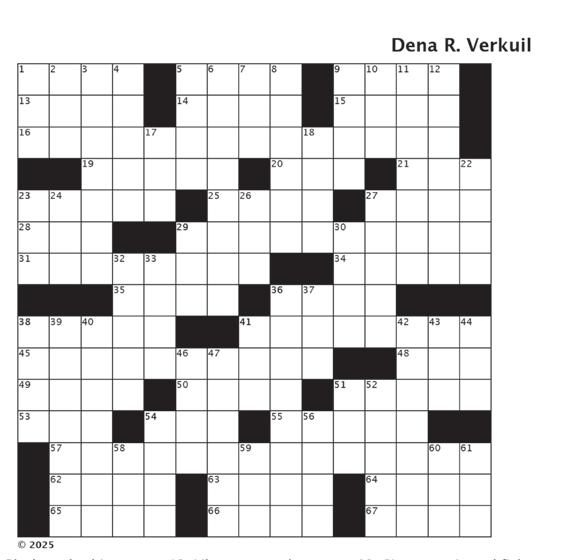
volcanic peak Like Eeyore AQI monitor Swift followers?
Like most students at Downtown High School Stat for Laila Ali Green space in academia “You said it, sister!” King or queen John of England "As if!"
Unhinged commentaries Seoul singers At sea 32 Pillar of
Minnesota Street
front page
Pier 68
from front page
kindergarten in its first year, expanding to TK to fifth grade by 2032. The district’s original idea was to gradually phase out DW’s GE program. Under the concept, English-instruction kindergarten would end in fall 2027. The school would gradually become an all-Spanish-instruction campus by roughly 2032. Families seeking an English pathway would be directed to the Mission Bay campus, with one year of overlap between the two schools before GE disappeared from Webster entirely.
“Currently DW can only accommodate about 10 percent of students who live in the attendance area for GE,” Dudnick emphasized. “At the same time, we saw a high interest in DW’s Spanish Immersion program and saw that they won’t be able to accommodate everyone that requests as well. We thought splitting it this way can accommodate as many families as possible for both tracks.”
Webster continues on page 9

“SF
SFFLORIST.com





























Dogpatch-based Architect Olle Lundberg Remembered for His Design Talent, Kindness
OBITUARY
BY REBEKAH MOAN
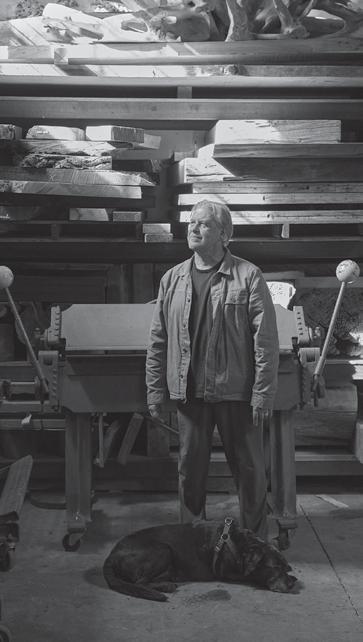
Many adjectives can be used to describe Dogpatch-based architect Olle Lundberg, who passed away unexpectedly on October 31, 2025. The two that crop up most often are “kind” and “exceptional designer.”
His firm, Lundberg Design, is a nationally recognized design and fabrication practice. But it was his personal qualities that many recall as much as his award-winning work. His wife of 33 years, Mary Breuer, said he gave people the benefit of the doubt, often befriending those others might ignore, mentoring many aspiring designers.
“He had a unique take on the profession of architecture, and the ability to describe important ideas about the significance of design at any scale in a compelling way, influencing many practitioners and clients,” a social media post from his firm Lundberg Design said. “His legacy of craft and material-focused architectural design work has made an indelible imprint on the practice of architecture, which will be carried on by his firm.”
Thomas “Olle” Lundberg was born in Cincinnati, Ohio, on January 7, 1954, two weeks after his parents emigrated from their native Sweden. He attended Washington and Lee University as an English major and received a Master of Architecture from the University of Virginia. While there, he met Bob Marquis, a visiting lecturer, who helmed a notable architecture practice in San Francisco, Marquis Associates. Lundberg moved across the country to join Marquis in 1980, after practicing with VMDO in Charlottesville, Virginia for several years.
In 1984, he designed and built a house for his sister, Anne Kimball, in Washington, Connecticut, where she still lives.
“Olle (Tom to me) was my older brother,” Kimball wrote on social media. “He was my rock, a mentor and father figure to my children, and leader of our family. He inspired us beyond measure. How lucky I have been to live in a home that he designed and built for me. My heart will never be the same, but he would be honored to know how he left his mark on the world. Such a kind, generous, beautiful man in every way. He lived an amazing life.”
Lundberg left his fingerprints in many places, but especially in San Francisco. After completing his sister’s house, he returned to the City, founding Lundberg Design in 1987. In 1996, he moved his growing practice to Dogpatch, renovating a mattress factory on Third Street to accommodate the firm’s integrated architecture practice and fabrication shop.
“Olle saw potential in people, objects, and ideas,” Breuer said. “He often made sculptural elements for his clients’ projects out of ordinary objects, seeing opportunity where it is often overlooked. His work helped transform objects, neighborhoods, and landscapes into new and improved places. Dogpatch is a good example: our investment in an old mattress factory on Third Street shaped his career, enabled the integration of craft into his architecture practice, and contributed to the transformation of an area of SF that had lain fallow for years, recapturing the importance of craft that Dogpatch had long been known for.”
Lundberg’s work can be seen throughout the City, in the form of the wavy Muni bus shelters. He’s known for his labor on the former Twitter headquarters, restaurants such as Flour + Water, Mourad, Nari, and Slanted Door, and many high-end residences.
“He took risks that others considered almost impossible,” Breuer said. “The most outstanding example was a global search for the right vessel for us to live on, resulting in the purchase of a decommissioned car ferry in Iceland, locating its former crew, and having them sail it to SF through the Panama Canal. We lived on that ferry – the Maritol – for 10 years, first at Pier 54 and then at Pier 50 before moving to Dogpatch.”
On dry land, Lundberg turned two dilapidated 1930s fishing shacks in a secluded
enclave at Bodega Bay into elegant-but-small vacation homes. He spent many years building a spectacular cabin compound on the Sonoma coast north of Jenner for himself, his wife, and their dogs. Hosting friends and colleagues at their outdoor kitchen, pizzas would emerge frequently from the oven he designed, often with innovative combinations of ingredients. Lundberg and Breuer cultivated a large vegetable garden at the compound.
Food was one of Lundberg’s passions. He partnered with the late Charles Phan, chef/ owner of Slanted Door, to create the former Hardwater, a bar known for its simple elegance and extensive whiskey collection at Pier 3. In addition to Phan’s iconic Slanted Door restaurant, Phan and Lundberg collaborated on many Bay Area restaurant ventures.
“He always dived deep when he was curious about something and developed unusual expertise in wide-ranging products beyond bourbon, like cheese, hot sauce and charcuterie, all of which he made himself,” Breuer said. “Bourbon was one of his most enduring passions and he became a recognized expert in the bourbon community nationally. Hot sauce was another. In both categories, he collected well over a thousand bottles.”
At the time of his passing, he was planning a series of engagements for his recently released book, Olle Lundberg: An Architecture of Craft. Published by Princeton Architectural Press/Chronicle Books, the book traces his personal and architectural journey – from his experiences as a University of Virginia student to becoming a go-to architect for the Bay Area’s digital and hospitality elite. His accolades include several Best of Year Awards from Interior Design and Architects Newspaper
“Every day, I was astounded by how he saw the world and lived in it. I am everlastingly proud of him and fortunate to have had a ringside seat for 33 years,” Breuer said.
“Olle Lundberg: a great mind,” design lecturer and author Diane Dorrans Saeks said on social media. “Rare. Kind. A maker. A dreamer. I have admired him for many years. I console myself with the thought: he was a great human. His spirit will live on.”
across San Francisco. Several parents argued that would effectively diminish priority for local children and force especially lower-income and South Slope families to travel farther for English-instruction seats. Parameswaran emphasized that the GE pathway is deeply rooted in the school’s history and central to its student body composition.
“The majority of our Black kids are in our GE pathway,” she said, “and some rely on being able to walk to our school. Rerouting them all the way down the hill is not okay.”
Under the proposed phase-out, those families would have to travel to the Mission Bay campus; a longer and less accessible journey for many.
As a result of Mission Bay Elementary’s 2026 opening, SFUSD will soon be managing three elementary schools in a dense and diverse enrollment zone, reportedly the fastest growing in San Francisco. For Daniel Webster families, the jarring episode demonstrated how tightly woven the school is into Potrero Hill. The district’s rapid reversal suggests that community voices continue to carry weight at SFUSD.
“This is our local public school,” one parent said. “When decisions are made and unmade this fast, it shakes the community. People make real choices about housing and childcare based on this stuff.”
VGirth Worms
from page 2
or two you’ll lose the weight.” I jumped up and clapped my hands twice. “That’s it.” I nodded again. She nodded back.
“Are these things safe?” She squinted at me.
“How do you mean, safe?” I leaned against the front of the desk, trying to look like one of those doctors pitching prescription medicine on television.
“Safe. You know. Safe. For me to take.” She was still nodding, but her face jiggled a bit, as if for emphasis.
“Safe, sure. It’s made of all natural, all organic ingredients, imported from the Orient direct to your, um, my door.” I almost winked but decided I’d better not.
“Okay.” She seemed satisfied with my answer, which was good, because it was the only one I had. “How much do I owe you?”
“$20. American.”
She bent over, rummaged through her Hefty-sized purse, and pulled out two crumpled bills.
“I hope it works.” She grunted.
“It will, believe me, it will.” I licked my thumb, counted the tens, and stashed them in the desk drawer.
“Now, call me in a month for a follow-up appointment; I like to make sure my customers are fully satisfied.”
I sat down and smiled. She didn’t leave her seat. I nodded my head in the direction of the door, like my friend Fred’s imitation of a doll I’d picked up at free Bobblehead day at Oracle Park. She remained immobile.
“Well, you’d better go clothes shopping; you’re going to need a whole new wardrobe!” She scowled at me, heaved herself up, stuck her purse under her arm, and wheeled her baby out the door.
Business was brisk for a couple of weeks. Three, already too-skinny teenage girls, giggling as if the air itself was funny; a business man with no chest and a stomach that jutted out like he’d swallowed a bean bag chair; two middle-aged women of typical dimensions; a thirty-something professional woman who reminded me of my sister; she had the same blond/brown hair, cut short. I told her she didn’t need to lose any weight; she looked great. But she just frowned and handed over the money. All of them except one of the middle-aged women made purchases, after which I’d ask them to call me in a month. I made $120, and then the traffic stopped.
‘TIS THE SEASON

When the winter chill hits, warm up at Farley’s! Sip a cozy drink, soak up the festive spirit, and share some holiday cheer with your neighbors.
Eliminating GE at Webster would reduce neighborhood access to a school that’s long served Potrero Hill. A language-program-only
a

Olle Lundberg. photo: courtesy of mary breur
Fiction:
Daniel Webster
from front page
Daniel Webster would become
citywide institution, with students likely coming from
Girth Worms continues next issue
COMMUNITY CALENDAR
ART: CYANOTYPES ON FABRICS WORKSHOP
ART: IN LIGHT YEARS
Snow, fire, and the sublime power of nature anchor San Francisco photographer Andrew Owen’s exhibition In Light Years. His images capture Northern California’s beauty alongside the scars of human-made destruction. Small Works, 1113 Connecticut Street, Suite Four.
NOW–JAN 4TH 2026
WINTER: “LIGHTSCAPE” AT THE BOTANICAL GARDEN
Meander along a one-mile path with more than one million twinkling lights, tunnels of color, lantern trees, glowing sculptures, and water features. On offer will be food and drinks, including chicken and waffles, tacos, dim sum, s’mores, kettle corn, hot chocolate, and more.5 to 8:15 p.m. Tickets: $16 to $50. San Francisco Botanical Garden, 1199 Ninth Avenue. For more information: https://bit.ly/47YTgue
4TH THU
COMMUNITY: NOE VALLEY WINTER WINE WALK
Sip on a variety of wines from local wineries while strolling through the streets of Noe Valley. 4 to 7 p.m. $45. Pick up your glass at the Noe Valley Town Square, 24th and Sanchez streets. For more information: https://bit.ly/49gk0sz
5TH FRI–14TH SUN
HOLIDAY: LET’S GLOW SF OPENING NIGHT
An all-ages, family-friendly festival of holiday themed projection art. Animated projections will illuminate eight iconic buildings across the City’s core and feature work by 19 artists from around the globe. A convergence of technology, art, and the holiday spirit. 5:30 to 10 p.m. Free. For more information: https://bit. ly/4peMW8Z
CRAFTS: SCRAPPY STOCKINGS
Sew and customize holiday stockings in this beginner-friendly workshop. No experience needed; just bring creativity and leave with a handmade heirloom to treasure. 11 a.m. to 2 p.m. From $49.87, sliding scale. SCRAP, 2150 Newcomb Avenue. For more information: https://tinyurl. com/2u3d8dba
History Night at Pier 70
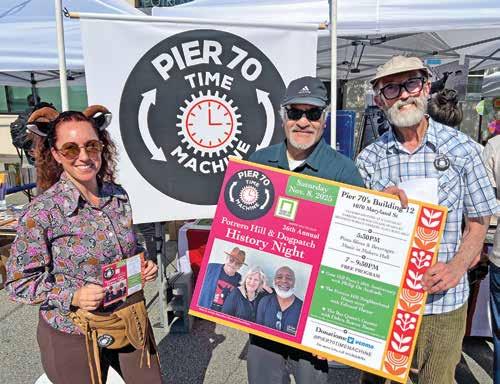
WThe 26th annual Potrero Hill & Dogpatch History Night brought more than 350 attendees, the most ever, to the handsomely repurposed Building 12 at Pier 70 last month.
At the start of the event Potrero Hill Archives Project director, Peter Linenthal, and Bethlehem Shipyard Museum director, Bill Perez, announced a collaboration to create the Pier 70 Time Machine, a 4,000 square foot neighborhood history museum, made possible by a below-market lease from Brookfield Properties. The gallery will feature exhibits, children’s activities, film shows, and trivia nights.
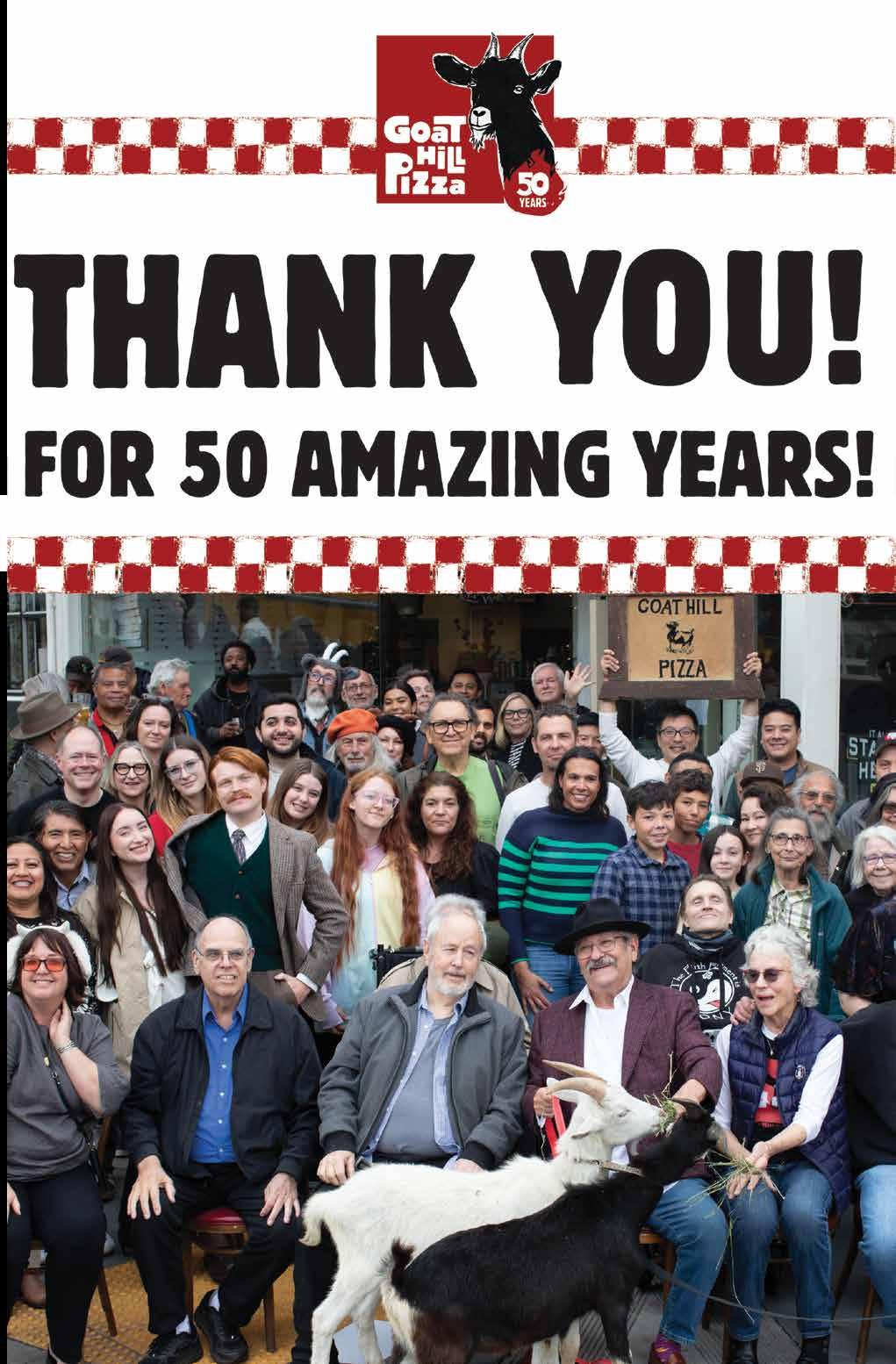
Goat Hill Pizza co-founder, Philip DeAndrade, a seminary drop-out, spoke about the restaurant’s emergence as a community hub over the past 50 years. DeAndrade, who helped launch U.S. Representative Nancy Pelosi’s political career, was joined by the Speaker Emiritus, who arrived to a standing ovation.
“There’s nothing more optimistic than
Cyanotypes is an early photographic process that uses sunlight to create vivid blue-and-white prints. Students will learn about its history, how it’s used today, and how to make their own prints on fabric and paper. Pre-coated materials will be provided; participants can dive right into arranging shapes, exposing them to sunlight, and rinsing out their images. Each student will create multiple cyanotypes, refine ideas, and experiment with different objects and layering techniques. We’ll also explore ways to display or reimagine the prints-as wall hangings with dowels, sewn into tote bags, or collaged into zines and more. Beginners welcome. 18+ years. 12 to 4 p.m. $150. California College of the Arts, 145 Hooper Street. For more information: https://bit.ly/3LE5GjM
COMMUNITY: NĀ LEI HULU’S HOLIDAY MARKET
Explore aloha-inspired handicrafts and products at Nā Lei Hulu’s Holiday Market featuring items created locally and in Hawai’i. 11 a.m. to 5 p.m. Free admission. Daniel Webster School auditorium, enter via 435 Texas Street gate. For more information: https://NaLeiHulu.org
THEATER: “A VERY HITCHCOCK CHRISTMAS”
Featuring five cinnamon-spiced, deliciously dark short plays inspired by Psycho, Dial M for Murder, Shadow of a Doubt, Strangers on a Train, and The Birds. 7 to 8:30 p.m. Live and simulcast available. Admission: Free; suggested donation of $10 to $30. Potrero Stage, 1695 18th Street. For more information: https://bit.ly/49Tt3Qm
HOLIDAY: THE BOX SF ARTISTS AND MAKERS FAIRE
Support local artists in the heart of San Francisco. Originally the William Randolph Hearst printing plant built in the 1920’s, The Box SF is now home to two floors of event space, as well as an antique printing and vintage advertising mercantile modeled after an 1850’s country store. 11 a.m. to 5 p.m. Free admission. 1069 Howard Street. For more information: https://bit.ly/4nSpQUJ
starting a small business,” said Pelosi “...perhaps getting married”.
Beaver Bauer conveyed her artistic journey. In the 1970s, she performed as part of Angels of Light. She went on to design dazzling costumes for local theaters, and is now working on The Bus Queen’s Gazette, a series of portraits of people seen on the 22-Fillmore. Her work will be featured at the Main Library next Fall.
Potrero Hill Neighborhood House director Edward Hatter brought the evening to a close with a video on the history and mission of “The Nabe,” which is housed in a Julia Morgan-designed landmark building on De Haro Street at Southern Heights, “Come to the Nabe and see what we’re doing,” Hatter said.
HOLIDAY: SUNSET HOLIDAY MERCANTILE IN GOLDEN GATE PARK
Featuring 50+ artisan makers and vendors, plus live music, food, children and family activities. 11 a.m. to 5 p.m. Free admission. San Francisco County Fair Building, Ninth Avenue and Lincoln Street. For more information: https://bit.ly/3WZ07Pn
8TH MON
STORYTELLING: MONDAY NIGHT MARSH
Three people perform up to 20 minutes of their work-in-progress piece. After each show, there’ll be a conversation between audience members and performers, allowing for the opportunity to give and receive feedback. 7 p.m. In-person: $13 to $35 sliding scale, or stream via Zoom for free. The Marsh, 1062 Valencia Street. For more information: https://tinyurl.com/2s5dtas8
HOLIDAY: LOCAL WOMEN’S BUSINESSES
Featuring 30+ local women-owned enterprises offering artisan goods, packaged foods and beverages, holiday-themed items, fashion accessories, wellness and lifestyle products, community and nonprofit vendors. 3 to 6:30 p.m. Tickets: $11.69. One Market Street. For more information: https://tinyurl.com/9m58ab4t
13TH
CRAFTS: WINTER CRAFT DAY AT RANDALL MUSEUM
Every corner of the museum will be filled with seasonal activities exploring arts, crafts, nature and science. The whole family can join in the wintery fun and create keepsakes and gifts. 10 a.m. to 2 p.m. Free admission, with low-cost activities. Randall Museum, 199 Museum Way. For more information: https://bit.ly/3M31aLJ
ART: PETRYKIVKA STYLE ORNAMENT
DECORATING WORKSHOP
Petrykivka is a traditional Ukrainian style of decorative painting. Rich in Ukrainian symbolism, this folk-art style utilizes distinct brushing techniques in its many floral and natural images and motifs. Students will learn techniques using traditional tools and come away with two of their own hand painted ornaments. All materials provided. 12 to 3 p.m. $103.22. Attendees will receive a 15 percent discount on any ARCH purchases on the day of class. ARCH Art Supplies, 1490 17th Street. For more information: https://tinyurl.com/yz6kfk7z
HANUKKAH: 25-FOOT-TALL MENORAH
This is the first giant public Menorah outside of Israel, which has inspired thousands of Menorahs around the world. Free. Union Square Park, Geary and Powell streets. For more information and full schedule: https://bit.ly/49mkHRe
ART: WINTER SOLSTICE INNER SUNSET ART WALK
Discover a diverse range of local art and music. Participating galleries and businesses will offer something to sip and/ or special seasonal promotions to enjoy while you shop. 5 to 8 p.m. Free admission. Inner Sunset, Ninth Avenue and Irving Street. For more information: https://bit. ly/3LExhBo
HOLIDAY: “A CHARLIE BROWN CHRISTMAS” WITH THE SAN FRANCISCO SYMPHONY
Live actors, an animated backdrop, and music performed live by the San Francisco Symphony. The first half of the concert features selections from Vince Guaraldi’s full Peanuts catalogue, celebrating 60 years of his music for Charlie Brown and the 75th anniversary of Peanuts. Performances at 2 p.m. and 7:30 p.m. Tickets $50 to $75; kids’ tickets half off. Davies Symphony Hall, 201 Van Ness Avenue. For more information: https://bit.ly/3K5l5cp
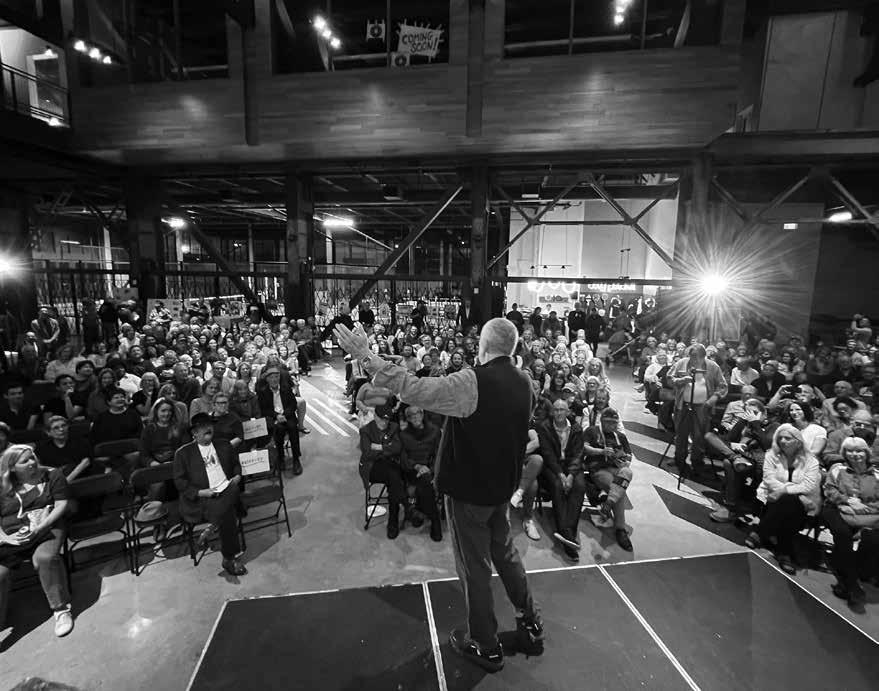
Keith Goldstein warmed up the History Night audience. photo: potrero view staff


of Equalization.
For a full list of current or upcoming Boards, Commissions and Task Forces,
org/vacancy-boards-commissions-task-forces.
Want to work for the City?
Visit the website https://careers.sf.gov/ and find a job that’s right for you!
Department Announcements
Child Support Services Child support matters can be complicated, stressful, and confusing. The

Support Services helps parents understand the process so they know their rights and options for making and receiving support payments. We are available to assist you in person or by phone. Virtual services are also available. Call us today at (866) 901-3212 for more information. Enroll online or schedule an appointment
sf.gov/dcss to
how we can help you.
Count on WIC for Healthy Families!
WIC is a federally funded nutrition program for women, infants, and children.
You may qualify if you:
•Are pregnant, breastfeeding, or just had a baby;
•Have children under age 5; and
•Have low to medium income; and/or
•Receive Medi-Cal, CalFresh (Food Stamps), or CalWORKS (TANF) benefits; and
•Live in California
WIC Provides:
•Nutrition education and health information
•Breastfeeding support
•Food benefits for healthy foods (like fruits and vegetables)
•Referrals to medical providers and community services
You may qualify:
•If your family’s income is within the WIC Guidelines.
Learn more at: MyFamily.wic.ca.gov or www.wicworks.ca.gov
Enroll early! Call today to see if you qualify and to make an appointment.
Newly pregnant, migrant workers, and working families are encouraged to apply.
Emergency Management sf.gov/ReadySF - The place to find everything you need to know before, during, and after an emergency. Stay ready, so you don’t have to get ready. Brought to you by the San Francisco Department of Emergency Management (DEM).
Housing Authority
The Housing Authority of the City and County of San Francisco (Authority) is actively seeking new property owners to participate in the Section 8 Housing Choice Voucher (HCV) program. The program provides housing assistance to eligible individuals and families by paying a portion of their rent to private property owners.
Key benefits:
1.Guaranteed Monthly Rent: Property owners can rely on timely direct deposit rental payments from the Authority.
2.Expanded Tenant Pool: Property owners gain access to a broader pool of prospective tenants.
3.Community Impact: Partnering with the Authority supports affordable housing and the community.
We are interested in expanding housing opportunities in San Francisco zip codes 94129, 94123, 94105, 94127, 94114, 94131, 94116, 94118, 94158, 94122, 94107, 94117, 94112, 94121, and immediate suburban areas. For more information, please contact us at customercare@sfha.org or learn more at www.sfha.org.
Rent Board IMPORTANT NOTICE FOR LANDLORDS
San Francisco landlords need a license before imposing annual and banked rent increases on tenants according to the City’s rent control laws. To obtain or renew a license, property owners are required to report certain information about their residential units into the San Francisco Housing Inventory each year. Property owners can submit their Housing Inventory information to the Rent Board in a few ways, but are strongly encouraged to complete the process online at portal.sfrb.org. Once the system accepts the submission, a rent increase license will be automatically generated and readily available. Owners can also deliver a paper Housing Inventory form to 25 Van Ness Ave., Suite 700, San Francisco, CA 94102 or to rentboard.inventory@sfgov.org. Assistance is available by calling 311 or emailing rentboard.inventory@sfgov.org. Visit sf.gov/rentboard for more information.

CHOOSE A SHIRT OR CAP SUPPORT YOUR VIEW
To celebrate our 55th anniversary, The View is gifting one limited-edition t-shirt or cap for donations of $60 or more (while supplies last)!
55th ANNIVERSARY TEES
Unisex cotton t-shirts available in two designs printed in brown on natural tone fabric. Super comfy 100% preshrunk cotton jersey.
55th ANNIVERSARY CAPS
Mesh back truckers cap with an adjustable snapback closure available in two designs. Stone colored cap has brown imprint. One size fits all.
YES! I would like to support the View with my contribution of: $
Choose your gift: Limited Edition T-shirt: Newsboy Activist Circle size (unisex): M L XL
Please send my gift to:
Limited Edition Cap (one size): Newsboy Activist




Enclosed is my check.
“Activist” Tee on Cream
“Newsboy”
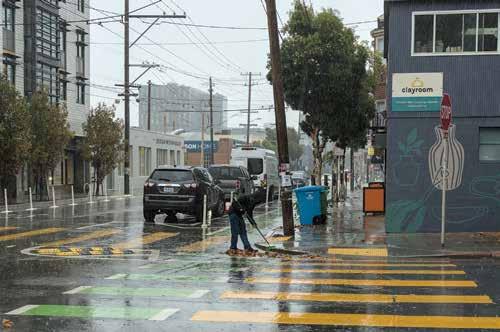
On November 13, a man cleans leaves from a gutter at the corner of 17th and Arkansas streets while an atmospheric river dumps over an inch of water on San Francisco. photo: thomas hunter ii
Senator Scott Weiner hands Philip De Andrade a certificate during the Goat Hill Pizza 50th anniversary celebration in front of an audience of 100 humans and two goats. photo: thomas hunter ii