1. “This is Me” from the 2008 Seminal Film CampRock
2. “I Touch Myself”
3. “The Star-Spangled Banner”
4. “Finally for this one night, I'm about to have a fun night / With this Munchkin boy Galinda found for me / And I only wish there were / Something I could do for her / To repay her, Elphaba, see? / We deserve each other / And Galinda helped it come true / We deserve each other, me and Boq”
5. “The Star-Spangled Banner” if you’re Fergie
6. A beautiful harmonica solo
7. Slam poetry
8. Weird Al’s 11-minute odyssey, “Albuquerque”
9. “The Backyardigans Theme Song”
10. “Pontifical Hymn”
“Time to write diaspora poetry about this.”
“I don’t want to be formally diagnosed with gay.”
letter from the editor
Dear Readers,
In preparation to write this last editor’s note of mine, I read through past post- goodbyes from so many people important to this magazine—some warm, hazy names from before I arrived, others the people who make post- post- for me. I’m struck with the feeling I always get nearing a graduation, or the end of a friend’s trip, or the final bite at a family gathering: how unfair it is that beautiful things must come to an end. Why can’t we make one more Top 10 that has 35 entries, most of which will inevitably be biblical and chronically online and illegible, some of which will be near impossible to cut? Why can’t we have more Scandinavian Swimmers (the sour ones!), and articles that make me tear up, and copyediting debates about numbers? Why not one more crossword? But perhaps the beauty of being a part of something like post- is knowing all of this goes on. post- is the people who show up to prod, the writers and illustrators, our wonderful readers. I will miss being in the thick of it, but more so I am feeling so lucky and grateful that, even if just for a while, I was in that magic, enveloped by it, sharing it with good friends, knowing that many more will find it too.
Our lovely writers of the last issue of post- this semester are also contemplating goodbyes and the changes that come with them. In A&C, Eleanor interviews women at Brown on age-gap relationships and perhaps leaving behind our preconceived
notions, while Jack catalogues the changes in radicalism in both himself and the characters of Gregory Maguire’s Wicked books. In Feature, Sasha traces her journey with a narcolepsy-like disorder and how she’s changed in making decisions. As a senior, Grace gives advice to first-years that she wishes she knew then in a Lifestyle guide. Our Narrative writer Christina moves through different lives of her own and the Fauconniers (both Cubist artist and writer), while the other, Vanessa, describes what it’s like returning to musical theater after an interlude. In post-pourri, Ina shares some “secret menu” dining hall items you should try out before you leave this semester. Finally, don’t miss Lily’s full crossword (bonus points if you avoid getting into a state of confusion…)! I have spent almost every Wednesday (formerly Thursday) night of my college experience at 88 Benevolent St., and I wouldn’t have it any other way. For how else would I have met Joe (who believed in me more than myself), and Tabitha, Klara, Kathy, Elijah, Susanne (who kept me grounded but light with joy), and this semester’s prod team, especially AJ, Elaina, Jessica, Daniella, Gabi, Michelle, Indigo (who make me believe the best years of post- are to come). I am indebted to a long post- lineage. What a special feeling, to be a part of something that makes saying goodbye so difficult. I must keep this brief at risk of crying, but I am just marveling at finding family and communion. How unfair it must come to an end, but then again, how beautiful that it goes on?
Crying & missing & loving,
Emilie Guan Editor-in-Chief
action potential
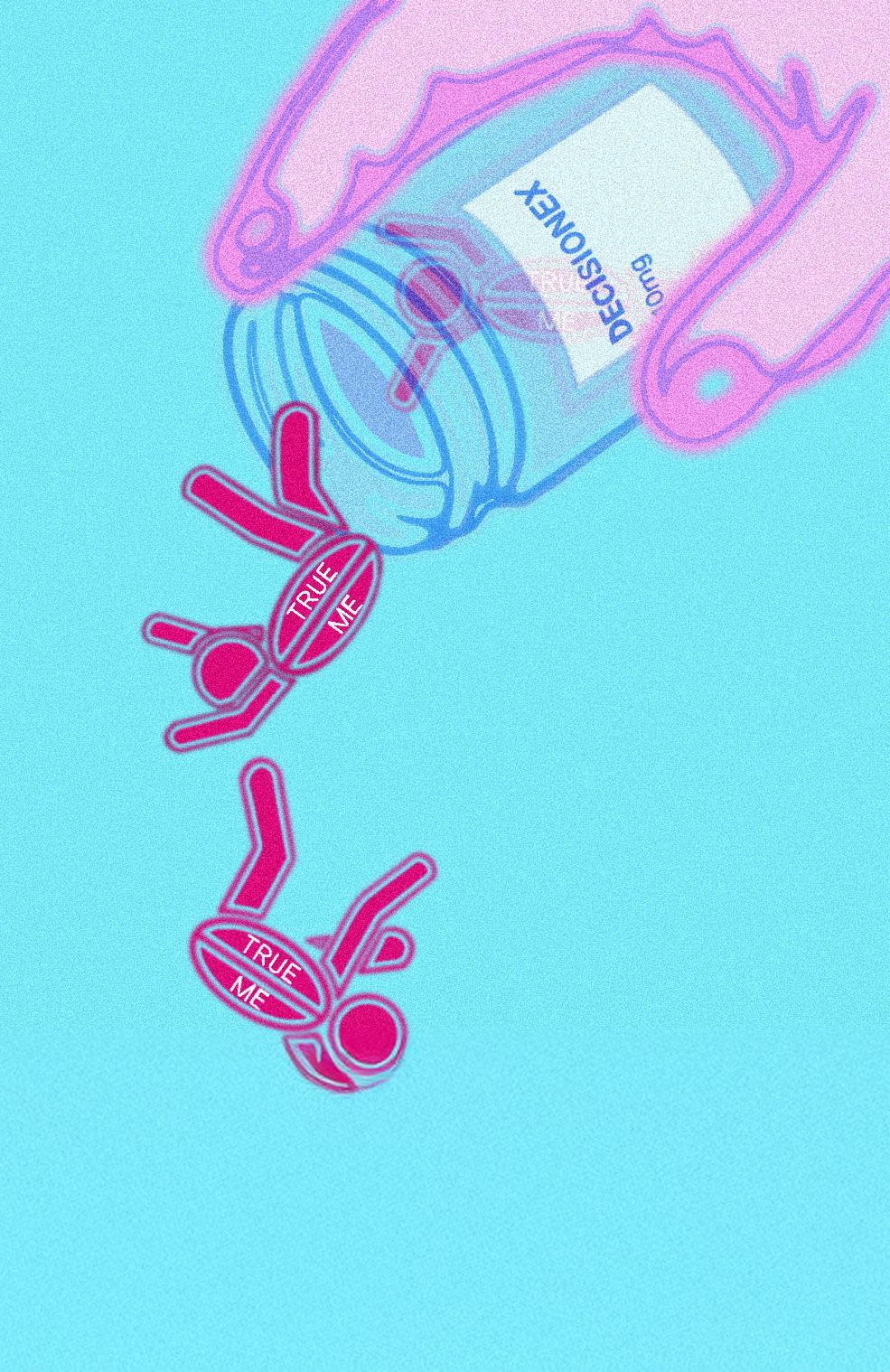
decision fatigue
by sasha gordon
Lands of opportunity are frequently co-inhabited by lesser-known creatures: decisions. Opportunities gambol and frolic around, but if you look closely, tailing each opportunity is a little decision or two, nipping at its heels, encumbering it just a tiny bit. This ecosystem is more complex than we may have been taught. It’s difficult to make a decision, that’s for sure, and as of yet, we don’t really know where these critters come from. Regardless of their provenance, they’re notably difficult to deal with. Decisions tend to run away from their assigned handlers, taking more time to be pinned down than anticipated and generally putting things behind schedule, or on a different
timeline entirely. A siege of decisions is incredibly effective at inducing fatigue, and can even overwhelm a poor, lone opportunity with their superior numbers.
Presented with so many decisions, it’s common to experience paralysis and fatigue. This, that, and even the other all appear to be reasonable choices, and often, truly no amount of information can settle the matter. College, in particular, is a favorite habitat for decisions. They like to trickle in slowly, and then rush in all at once, incapacitating their prey when they’re already somewhat down. Course registration,
next year’s roommates, or even the dreaded j-o-b (usually only referred to in hushed tones) are especially strong phenotypes. Like I said, most don’t know how to make decisions. Decisions tend to appear semi-randomly, and one deals as best they can. Some try to handle each decision individually and with care, while others prefer to tackle all of the decisions in a big batch at once and hopefully buy time before the next round shows up. I, at one point, almost didn’t have to make any decisions, until one was made for me. Today, I’ve decided to tell that story and introduce the decisions that followed me after.
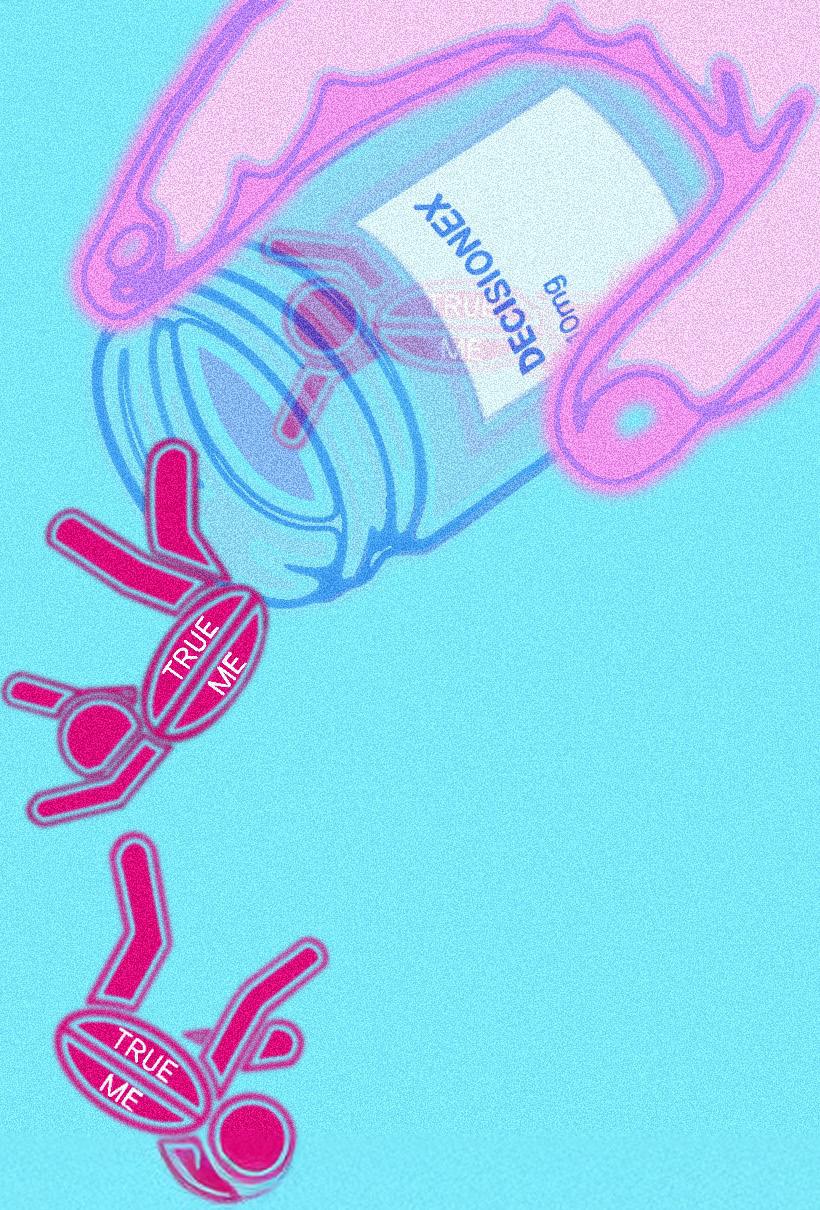
Illustrated by Minglu Du @duminglu_art
This year, I was put on a stimulant for a narcolepsy-like disorder. It’s been a long time coming, but I don’t like acknowledging that, saying that there’s some inevitability to me ending up taking Armodafinil. It’s really funny to me that they’re called stimulants. I understand this is the language of the brain—of regions and active impulses and electrical signaling— but seeing as we don’t fully understand the mechanisms of this particular drug (true, concerning fact), I feel justified in interpreting the term colloquially. Stimulant. As if in our chronically overstimulating world, I’m somehow understimulated. As if I sleep, then sleepwalk, through my days out of boredom. If anything, it’s embarrassing. I feel that by accepting the stimulant, I concede that I am incapable of propelling myself through the day. I wasn’t always like this. I long for the particular engagement with stimuli that my slightly younger self had, unfettered as she was by internal obstacles—she read, she wrote well, she spoke with some degree of articulateness. I don’t. I feel a loss there of some “real,” truer version of myself.
I’d like to introduce you to True Me. True Me is most easily identifiable around age 14, in my case. True Me kicks butt. Sitting at her desk, she comfortably vanquishes essays, conquers problem sets, and fortifies debate cases. Commanding the necessary inner drive wasn’t always easy, but it was relatively painless and definitely doable. True Me is likely anxious, too, but it’s the kind of anxiety that’s shown on TV: successful junior lawyers drumming their perfectly lacquered nails on the desk too much, eyes still laser-focused on the courtroom proceedings. It’s tidy. True Me has worries and True Me has fears, but True Me is also a machine that kills uncertainty by racing ahead of it and getting the job done, establishing a reality ahead of time instead of catching up to it. True Me didn’t know what she wanted to do in her life, but that’s fine because whatever it is, she’ll be prepared and on top of it and handle it all just fine, thank you very much. True Me is someone outside of just a work ethic too. She’s confident, funny without being biting, stylish— the whole package.
I think True Me would have really liked college, but unfortunately, she’s not here at present, because I’m not her. I had thought my semi-regular dozing that occurred throughout the tail end of high school was more so a general malaise than anything else, and that I’d perk back up once I had everything I wanted: Brown. Unfortunately, this was not the case. Across both semesters last year, I slept through about 40 percent of my lectures. These were courses I loved and seats I’d stalked Coursicle for, but you wouldn’t know it if you walked into the room. I can play it out for you right now: I’d be listening, following the content without issue.
Thinking to myself, this is awesome. Going great. Wait, I missed that? Oh no. I’d jerk awake and try to blink myself into alertness. These “sleep attacks,” as I’ve heard them called, aren’t restful, true sleep. You wake up far groggier than before, unable to concentrate on your surroundings or anything beyond staying awake. Thus, while I may appear to be awake, I couldn’t tell you anything that happens in a class after that point. I get a pulsing unilateral headache, the pain always behind my left eye, perhaps compromising my hemisphere of rational, orderly thought. The throbbing spot is heavy like an actual stone, how I imagine a malfunctioning Neuralink might feel. It’s all-consuming, yet somehow not a physical pain, rather a neurological one. Tylenol doesn’t fix it.
I felt pretty worthless, to be honest. Here I was, disappointing what felt like everyone, but was primarily myself. I didn’t attend any lectures that spring for one of my biology courses—it was too embarrassing to sit there slumped over, hoping the professor wouldn’t notice. I was so far from True Me. A series of sleep disorder tests revealed not all that much. The one thing I could try, the doctor said, was a stimulant.
“It’s not an amphetamine, so it’s not addictive like Adderall,” she said. “And it works pretty immediately—we could start you on it next week. It’s very common.”
I’ve usually been hesitant to embrace treatment courses of indefinite duration, but my doctor made it sound so easy. I’d just go to the pharmacy, pick up a little pill, and go back to being myself, right? This was a core component of my thought process around the stimulants—I would go back to being myself again. I thought that this narcolepsy “cure” could somehow holistically reset my present self to True Me.
I think many of us tote around a True Me, distinctly not an inner child, but a reference from which we identify specific losses and deficiencies. Perhaps you know it as an “ideal self.” It is far easier to locate losses than gains within ourselves. This is a nebulous thing, this ideal self imbued with more potential than we have now, and I find it to be a companion on a permanent guilt trip. I know there’s a version of me out there who could have already done the tasks that I’ve been shuffling from list to list for five weeks at this point, yet I’m somehow here instead of her. I don’t think I would now be me if I were True Me, though. See, the thing about True Me is that she never really had to make decisions.
Unquestionably, True Me was going to walk home from school and open her notebooks, finish every assignment that evening, and then do not much else. She didn’t need to think about it—there were assignments; they would get done. She would do them well, neatly, and in a timely fashion, and that would be that. Yet now, from my False Me vantage point, I don’t think that’s what it’s all about. Don’t get me wrong, this narcolepsy business sucks. But it forced cascades of decisions out of me, ones I actually had to deal with one way, or deal with by doing nothing: skip this class, don’t take that one, go to the doctor, et cetera. A new story. Inching closer to taking the wheel of the ship of my life. And this one “decision” that isn’t really a decision,
this perhaps different creature of narcolepsy, is one that I can dissect. It’s fatiguing to think of handling future decisions, but this one has come and gone.
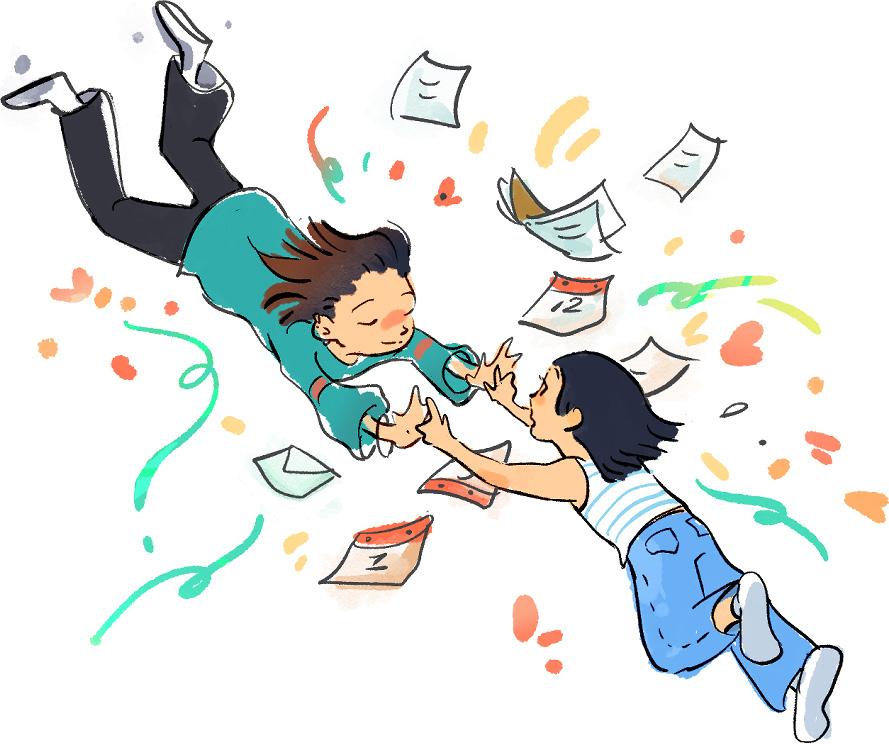
Under the assumption that I wasn’t always like this, I’m free to wonder what triggered the disorder. I unravel the months of my calendars, looping September to June and back over again, round, and round, and round. I trace these threads to a note from my junior year history teacher, remarking on my penchant for naps. I see my first positive COVID-19 test, six months earlier. Before even that, though, I see a 9 a.m. elective sophomore fall, the last 20 minutes of which I reliably slept through. I remember a not-quite-concussion incurred while sailing, and while I think it was later in this sequence, I remember thrashing underwater and sitting oddly at the bottom of the boatramp, unable to climb up the 18-foot incline. I later called my father to pick me up, strangely, and now see it as portending more to come. I hit my head lightly a few times a week and aggressively a half-dozen times in each racing season. Hmm. Farther back, in the depths of my watery memories, I see a trip to New York City with my mother at the very tail end of February 2020 and an odd cough she had. I think of my memories as stacked up vertically in my body like shoeboxes, immersed in some kind of vital soup that makes up the corporeal me. The most recent are at the top, and in order to reach the dregs at the bottom, I swirl a ladle round and round, scooping up rough-hewn primordial bits that I think of like vegetables in stew. I use the word waterlogged a lot when describing my body, my thoughts, my experience of waking and alertness. There’s a lag on many actions for me, as if I need to let them drain out before I can proceed. You wouldn’t put a wet plate on the dinner table, right? You’d let it drip first. So it wouldn’t be waterlogged.
The very first day on my stimulant, early this summer, I felt as if a magnet had been pressed into my brain, right at the top, and it was pulling me up towards the sun, if not wholly into it. I was literally buzzing, talking faster than I could think. I was actually energetic, not just awake enough. I was thrilled, so excited to see True Me come out, to give her a chance to try her hand at college and at being 19. The opportunity passed. By day three, everything was pretty normal.
Today, I remain waterlogged. I’ve slept through just two classes this term instead of last fall’s ninety-two, but I feel not all that different. I don’t actually nod off. I can’t wake up in the morning anymore. That’s new. I have, however, somewhat learned to deal with decisions. They still follow me doggedly, alerting me to their neglected condition quite frequently and exhaustingly, but they are admittedly fewer in number. When you can’t do it all anymore, you have to make some choices. In this one case, it taught me something: not how to make the decisions, that’s still up to the scientists in the Land of Opportunity, but that you do, in fact, need to make some.
the art of
dismemberment
in which i am a 20th-century cubist
by christina li
by Candace Park
The scene is Paris, 1912. Following an excursion to Amsterdam for a personal exhibition, artist Henri Le Fauconnier returns to his home galleries. He is among his fellow Salon Cubists again, the spearheaders and rulers of the burgeoning movement that has taken over the public Parisian salons—mainly due to their notoriety. The doors are shut and the lights are off as the hungry crowd awaits the grand opening of this year’s Salon des Indépendants, ready to indulge in the delicacies of fine art while tearing apart those they deem outrageous to the very practice of artistry. It is the annual gallery event held by the formal art society of Paris—a time to celebrate the best of the year— and the Cubists have made it their stage. Off to the right, a piece hangs shrouded in shadow, the colossus of paint and labor spanning the entire wall. When the guards finally receive the signal, they open the floodgates; eyes begin to scour the disembodied limbs and shapes warping across the canvas. At 2.5 x 3.5 meters, Le Fauconnier’s Les Montagnards attaqués par des ours (Mountaineers Attacked by Bears) is his largest painting to date. Soon, it becomes clear that his work is met with equally large outrage from the public, culminating in editorial backlash and mass protests. Echoing similar responses to the previous year’s similarly “outrageous” exhibit, he is at the top of the movement again. He is Le Fauconnier after all, the Falconer.
Now, sometime in the 21st century, a quick Google search of “Henri Le Fauconnier” lands on several images of Cubist artwork and articles about early movement leaders now overshadowed by Picasso’s dominance in modern memory. There is a single blackand-white photograph among them: a narrowfaced and severe-looking man with a receding hairline. This is not a portrait of the painter.
Instead, writer
Prix Goncourt Fauconnier’s “This article see Henri
The scene perusing “Stories by of documents—some school creative opening wanders of typework, feel rooted novel.” It cover of What would the emotion, could be. featuring Christina author. Christina debut author.
Li. I had
Henri Charente, coast. Henri Hesdin, France, Christina Midwest Christina and stayed
Henri Gabriel Paris to in 1901, He joined Jean-Paul Académie brief period becoming
Illustrated
Instead, the picture portrays French writer Henri Fauconnier, the 1930 Goncourt winner for literature. On Le Fauconnier’s Wikipedia page, the first line reads: article is about the painter. For the writer, Henri Fauconnier.”
·
scene is Chapel Hill, 2021. I sit at my desk, Google Drive. Inside a folder entitled by Christina” are years upon years’ worth documents—some are short stories from middle creative writing ventures, others are the chapters of abandoned novels. My mind as I consider this personal graveyard typework, imagining a future where I finally rooted enough in an idea to call it my “debut It is a comforting thought: my name on the a story to one day share with the world. would that feel like? I decide to simulate emotion, Googling my name to envision what be. Instead, what appears are headlines, all featuring images of one particular book cover:
Christina Li, Stanford senior, upcoming debut
Christina Li, Stanford senior, upcoming author. Christina Li, Christina Li, Christina been beaten to it. ·
Henri Fauconnier was born in 1879 in Charente, France, a town by the southwestern Henri Le Fauconnier was born in 1881 in France, a town by the northern coast.
Christina Li was born around 1999 in the before moving to the West Coast.
Christina N. Li was born in 2006 in North Carolina stayed there.
·
Henri Le Fauconnier, named Henri Victor Fauconnier at birth, initially moved to begin legal studies at Université Paris but quickly left to pursue art full-time. joined the studio of French Romanticist Jean-Paul Laurens, then moved to the private Académie Julian that same year. It is during this period that he added the “Le” to his name, becoming Le Fauconnier. Historically, there is
little explanation for the name change, as very few direct quotes from him remain—whether purposefully or not. Perhaps he anticipated his fellow name-bearer, setting out to differentiate himself both by name and art as he soon began deviating from the dominant 19th-century trends of Fauvism and Impressionism, opting to test the boundaries with the Cubists.
Today, Christina Li is a Stanford graduate and full-time author based in New York City. She has four books published in the young adult and middle school genres, with a fifth book deal announced for summer 2026. She has thousands of followers on Instagram and TikTok cumulatively, often collaborating with a close circle of fellow YA authors. Her novels line the “L-O” sections of bookstores, and I begin contemplating my entire life—name included. I begin to brainstorm pen names, which is to say I begin to dismember myself. Chris? Tina? Christa? Nana? What if I just added my middle name, maybe the pinyin wouldn’t look too bad…Fuck it. I’ll just become a Seraphina Li.
For the Henris, at least one was a writer, the other a painter.
While working on Les Montagnards attaqués par des ours, Le Fauconnier also completed another piece, Le Chasseur (The Huntsman), in 1912. Here, he maintains his signature Cubist blur of iconographies, roughly constructing imagery of a hunter firing at the mallard ducks scattered around him. Based on his initial pencil sketches, however, scholars consider this a rare instance where Le Fauconnier appears to intend a selfportrait—the hunter standing in for himself, the artist. Other than this, there are no photographs or realist portraits of the famous Cubist. Upon reflection, this well may have been his purpose all along: to have his art stand for itself, and for himself as well. He is Le Fauconnier, the Falconer. The wielder of his own art.
·
· Li means “plum” in Chinese. “The plum” is definitely not the flashiest, and “Christina The Li” just doesn’t flow as well (or at all, in fact). When I sit at my desk, I continuously return to my archive of unfinished drafts. Inside are previous worlds riddled with misplaced commas and workshopped character arcs; the older they are, the more painful they are to reread. They are, however, ultimately my own—and more than just the literal letters that compose my name.
unlikely
inevitability, musical theatre, and what it feels like to create again
by vanessa tao
Illustrated by Angelina So Instagram @ang_i_i_
The stage lights switch on. The pit plays its first notes, and the audience goes quiet.
I’m on my eighth hour behind a soundboard, carefully watching the backstage curtains while I wait for the first actor to come onstage so I can unmute his mic at the perfect time.
“Feel alright for the rest of your life,” Mendel, one of the main characters, chants in Musical Forum’s rendition of Falsettos. The rest of the cast springs out alongside him and belts the line over and over, voices vibrant as the crowd cheers. I let them get loud, fingers nervously hovering over all seven actors’ sliders at the soundboard as I listen for the dreaded feedback loop that’s been plaguing the past two shows.
This is the Saturday night show, though— the last one, the saddest one, the loudest one—a goodbye. The audience is charged; the actors are singing like they need the world to hear; the pit is playing for their lives; my stage manager is reciting her cues through tears.
A spike of adrenaline runs through my fingers as Jason, Mendel’s stepson, croons a high note, voice ringing bright through the tired speakers. I debate turning her down until I remember that every line performed tonight will be the last.
Screw it. Let them have their moment.
I take my fingers off the soundboard and let the rest of the song run free. I close my eyes, riding the bass, surfing through the harmonies I’ve balanced for hours, sinking into the melodies I’ve come to know so well in just a week. For a second, it feels like I’m dancing at the edge of a cliff.
I remember how the sun looks in the mornings back home, golden beams draped over the snow-tipped mountains. I remember the tenor of my middle brother’s laugh, how it blends with my mom’s giggles and my oldest brother’s belly cackle. I remember the scrape of my dog’s claws on the hardwood, running to plant little kisses all over my face every time I come home.
Feel alright for the rest of your life.
The last line of the opening song rips through the auditorium. The crowd whoops
while the actors gasp for air, grins plastered on their faces as the pit improvises extra chords to match the longest, loudest cheers we’ve heard all week.
I take a deep breath, partly relieved that the speakers let us go so loud, partly in awe that our show can bring an audience to their feet. Parents and friends, professors and general lovers of musical theatre, all cramming shouts and claps and stomps into every corner of little Fishman Studio.
As I balance the actors’ voices for the next song, fingers skimming across the soundboard, I wonder if I’m remembering how to breathe again or if I’ve found a new way to do it.
✴ Today in Vietnamese class, we learned that the words for “miss” and “remember” are the same.
This year, I picked up playing piano again. I played it for nine years and then, stereotypically, quit the second my parents let me and didn’t touch a key for a long time. Recently, though, I’ve found myself tapping my fingers on tables, wondering what they still remembered. Scared they might be hollow. Scared they might not remember anything at all.
see further past the fence, and I’m brave enough now to wave to the joggers passing by. I’m learning new habits, better habits, and it’s familiar, more pleasant. I’m wondering if I can keep these new patterns in my fingers without losing the old ones.
I wonder whether I’m more scared of missing or forgetting you.
I tried listening to the show on Spotify. Scrolled through every version I could find,
If I said that in Vietnamese, it might also mean I was scared of missing it.
I wonder if I miss you or if I remember you. I wonder if I’m still allowed to miss you, even after I’ve forgotten how to remember you.
Restarting lessons has been fun. It feels a lot like walking barefoot over the lawn in my childhood backyard, except the grass is longer than I remember it to be, and the fence is drooping, tired. Most of my time is spent picking up after my dog instead of blowing bubbles and throwing water balloons, but I can
skimmed through every song. I couldn’t find any that came close to how our show sounded, so I stopped. I’m worried that listening to other versions too much would corrupt my memory of the only one I wanted to hear. I hear every song all the time anyway, each playing in my head in some feverish symphony: what would I do / buy a farm / I want it all / feel alright / to love you / is this therapy?
✴
Recently, I read “The Light That Shines When Things End” again. You know it—it's that one Tumblr post from the late 2010s to early 2020s that resurfaces again and again. In case you don't,
though, the premise is that the narrator wishes there was a bright light that follows everyone around, shining whenever something is about to end.
Something about the image of the last line made me think of you. You with the lights, you with the show lights, you with the lights in your eyes. I wonder if any of them shone when you left, like the post imagines. I wonder if the lightbulbs in your mom's room flickered, or buzzed, or if
lovers
to breathe through your lungs, to source my air through your skin.
In the meantime, I'll start learning how the lighting console works. And when I'm finally good enough, when I can finally create a bit of the magic that you did, I'll make them shine brightest on the Saturday night shows. I'll cheer your name on the last note of every Saturday night, always.
✴
they really got brighter. I wonder if your sister can stand to sit in an auditorium, and watch a musical, and look at the lights, knowing it's not you making them dance anymore.
I got to sit and watch the stars with you for a bit—a few little specks of time—and for that I'll be forever grateful. They've never looked the way they did with you.
But it's time to go now. I get this feeling that if I don't get up off the ground now, I never will.
I hope I’ll see you wherever we go next. If I don't, jump in some leaves for me. Play a good song while you're at it, and in the meantime, I'll remember every once in a while what it was like
My piano teacher tells me to slow down, play the measure note by note, slower and slower, until I can get through the entire line without a mistake.
Saying goodbye to you worked the same way. I'm slowing down, day by day, minute by minute. That house you pointed out, that house you liked the color of— this time, I stop and look at it. I breathe, and I remember you, I hear the leaves you walked through, I feel the crisp October air on my cheek. I am slowing down our time together, minute by minute.
Gently, quietly, until I can feel the rubato of Chopin and the pressure of my fingers on ivory, slowly until I can feel your absence shrink into a quiet ache, and the spikes in my stomach dull.
I keep walking, hands in my pockets, as I huddle against the wind.
✴
While Marvin holds Whizzer and takes a deep breath, dipping his voice into the harmony line of “Four Unlikely Lovers,” I think about where I am. Standing behind the soundboard, I marvel at the life that has unfolded before me, the millions of choices flowing like tributaries into lakes and oceans so far away I can’t even see them. A week ago, I had never even stepped foot on the fourth floor of Granoff, and now I’ve spent upwards of fifty hours twisting in and out through its studios and floors and secret closets.
I think about how much changes in the span of a week, a day, an hour.
I think about how unlikely it was for us to meet. What tiny choices did we make for it to happen? Fourth grade, if I had failed my placement test like I meant to and never switched schools; fifth grade, if I had never met M, and M never dragged me into her band rehearsal; sixth grade, if you hadn't watched that one episode of The Flash the same night I did and thought to talk to me about it—what were the chances, really, that you'd stumble into my life the way you did?
What were the chances, really, that this show would come together the way it did? I joined without a lick of experience on the Monday of show week; the pit didn’t have a drummer until the Monday of show week; the set was still getting drilled together Monday night of show week.
“What a group we four are / Four unlikely lovers / Let's be scared together.”
It doesn't matter how much I stand here and think about the shape of my choices. You grew up halfway across the world, you grew up breathing salt air—meeting you was unlikely. Meeting you was inevitable.
Four unlikely lovers, and yet every single night, on the fourteenth song of the second act, they inevitably coalesce around a hospital bed and sing quiet “I love you”s to each other. Every single night, on the final song, Whizzer dies, Marvin loses him, and he asks a tearful audience, “What would I do / If I had not met you?”
✴
I’ll forget you. I’ll forget how to hurt over you—it’ll be my way of missing you. The ache will get quieter and quieter, shaking itself loose from my head the same way this show will eventually drain from my ears. I won’t be able to turn it up and bring it back, no matter which levers I flick on a soundboard.
Sit me down in front of a piano, though, and my fingers will never forget the way they ran hungry across the keys, hammered out the chords to your favorite song under the cover of the blazing afternoon sun. Sit me down in front of a stage, and I’ll never forget what it feels like in that last breath—the actors’ gasp before they belt their final lines, the pit ballooning their stomachs to play one more phrase, the audience opening their mouths wide as they dry their eyes and leap up off their seats.
The lights flick off. In that moment, that last, dazzling, feverish breath, I remember how to begin again. My hands come off the board, and the studio falls silent.
All I can hear are the ringing echoes of “Do you regret?” followed quickly by “I'd do it again / But what would I do / If you had not been / My friend?”
older men
in conversation with women on the hetero age gap
by Eleanor Dushin
Illustrated by Isabelle wang
About once a week, I wake up across the river in the bed of a 30-year-old man (sorry, Mom). I kept this routine to myself for a few months, and when I eventually told friends, they usually reacted with, “No, you’re not,” “Are you joking?” or “Is he rich?” To almost everyone, the idea that this could be a good decision was out of the question.
I recently came across a quote from Maggie Nelson’s book Bluets, in which she writes about a night in the ER:
"… a young doctor inside asked me to rate my pain on a scale of 1 to 10 … I said “6”—he said to the nurse, Write down “8,” since women always underestimate their pain. Men always say “11,” he said. I didn’t believe him, but I supposed he might know."
Just write down 6, I thought. How is discounting a woman’s comfort any better than calling her pain into question? If I was saying that I was comfortable, why weren’t people believing me? And how do you maintain a relationship, whether sexual or romantic or something in between, that has so much judgment cast upon it? I decided I needed to talk to the women of Brown who were dating older men. For the sake of anonymity, everyone is named Eleanor. I refer to myself as Big Eleanor.
19 and 39, 2024-2025
Eleanor: We met at a coffee shop. He started up a conversation, and we were just chatting. We randomly started getting into some pretty deep conversation. Later, we were texting and we hung out and somehow it quickly turned a little bit sexual. The second time we hung out, we had sex: That was my first time. He had a brief crisis about “Oh my God, you’re so young,” because over two times the age is a little crazy.
And then I guess it ended up being a sex thing.
Big Eleanor: How long were you seeing him?
Eleanor: It wasn’t that frequently, but it was over a long
period of time, around 6 months or a year.
I will firmly stand by the fact that I wasn’t groomed at all. He was kind of a boy to me. I just felt like he was still very lost. And I think it had a lot to do with him having just gotten out of a decade-long relationship where he built a life with someone and it fell apart, so he had to reconfigure his life.
B.E.: Do you think that impacted your selfimage?
Eleanor: Absolutely. It was strange, because it was more that when it fizzled out, I didn’t feel like I had an explanation, so I felt like I had done something wrong, but obviously now I know that isn’t true. I just felt like, especially because it was pretty kinky, I had given a lot of myself, and then was forgotten.
B.E.: Did that upset you more than it would have had he been your age?
Eleanor: I think so, yeah. We have that expectation that older people have it all together. And even though he showed me all the signs that he didn’t have it together, it still stung when he didn’t have it together. And it’s not like I wanted anything long-term; I just wanted him to be mature about it. At that point, he wasn’t, but he is now.
B.E.: So how was the age gap impacting the way you acted toward him?
Eleanor: I tried to suppress my teenage urges. I didn’t want to be emotional, clingy, confused, so when I felt that way, I would just push it down and pretend I was mature enough for him, which I was in some ways. But at the same time, at the core of it, there’s so much life I haven’t lived.
It was never so much, “Oh, he’s old,” as it was, “I’m young.” I mean, I’m doing my homework. “Yeah, I can come over when I finish my homework.” Like, what?
But I’m just gonna say it, the age gap is a huge turn-on for me. I’ve always been really into a power dynamic and I want to be on the receiving end of that, and an age gap automatically sets up a power dynamic. But I could walk away whenever I wanted to, and I didn’t want to walk away. And people think you don’t walk away because you can’t walk away.
A lot of people also think that age-gap relationships are more serious than they are, as if you can’t have a casual relationship with someone who’s older than you.
B.E.: Do you have any regrets about the relationship?
Eleanor: No.
+++ 19 and 27, 2023
Eleanor: We both worked at the same restaurant in the city. He was a server, I was a hostess, and I worked that job the entire summer full-time, so I would see him every night. I wasn’t treated like I was 19 by any means. I didn’t feel like I was childish, and I didn’t present that way. I felt like I was old enough to hold my own and not have anyone question how old I was or who I was. If I was ever with an older man who was more established, it might feel like there was a bigger power dynamic. But he was a server, we were equals, we were working at the same fucking restaurant.
Big Eleanor: So it’s about seeing this person as an equal?
Eleanor: Right, and if you can’t, then that’s the gap.
B.E.: There are a lot of imbalances in agegap relationships that also exist in relationships between people who are the same age. If you have two 24-year-olds, one of whom has a parent paying their rent, the other who’s supporting themself, I don’t think that means they can’t have a successful relationship. Yet there’s still an imbalance there.
Eleanor: There’s a money imbalance. There’s an imbalance in every scenario, whether it’s their ages or not. I think age is just the one that’s played the most upon because there are enough bad examples of it.
I guess you’re not a fully-formed adult brain until 25, but what the hell else are you supposed to do between the ages of 18 and 25 except learn? And if you look back after a few years and say, “That was just a guy I dated,” and don’t feel like anything weird was happening inside, then that’s probably it. There doesn’t have to be anything deeper.
B.E.: Did you tell anyone you were hooking up with a 27-year-old?
Eleanor: Just my best friend. I was not in the mood to listen to very many people tell me what they thought about it.
B.E.: Is there any way you speak about it now that you wouldn’t have spoken about it when you were 19?
Eleanor: Well, now I’m 22 and more people believe me. When the story was coming out of my 19-year-old mouth, which it didn’t often, I felt like people really saw me as a child still, and that’s part of why my relationship with someone that much older would be frowned upon.
B.E.: If we’re moving toward a culture of believing women’s pain, why aren’t we believing their comfort?
Eleanor: A woman can fully acknowledge her own comfort as much as she can acknowledge her own pain. You should be able to make that decision, and you shouldn’t be questioned on that.
There is a shame factor that comes with saying, “I’m 20, and I’m seeing a 30-yearold.” I think that exists because of trends of relationships that look like that, and also that women are told that it’s an uncomfortable situation. They might think, “Okay, yeah, that was a bad relationship,” even if that’s not what they thought in the first place, just as much as a woman is not given her full permission to feel the pain that she feels. I think that’s the same. If you’re pushing a narrative that this should be bad and this is bad, then they’ll likely come out of it thinking, “Yeah, that was bad,” just as much as they’ll come out of a bad situation thinking, “Oh, I’m so fine!” if they’re told they should feel fine. It goes both ways. You need to give women the full ability to feel the way they feel. If you don’t, you leave women devoid of the autonomy to make their own decisions. If you can fully say you feel comfortable, then I’m listening to you. That’s how my friend said it: “Okay. You’re telling me you’re comfortable. I hear you. And if you ever don’t, let me know,” and that was that, instead of being like, “Are you sure?” and egging something out of me because she didn’t think it should be that way. It’s like that book. What if she really was a 6? Why the hell does she have to be an 8?
wicked and the illusions of radicalism
My political awakening, like many in my generation, emerged less from a genuine pursuit of truth than as a performance shaped by the constant scrutiny of social media. Every opinion I shared was quickly disseminated, retweeted, or critically examined, leaving me trapped in an endless cycle of public evaluation. The pandemic years intensified this experience. My beliefs shifted leftward, becoming more radical and tinged with a quiet resentment for the liberal friends with whom I had once knocked on doors and dialed voters for Joe Biden.
That resentment became a kind of depression-tinted cocoon. I immersed myself in dense left-wing texts, growing steadily more cynical about American democracy. Every conversation became an opportunity to rail against the empire, dissect the cruelties of capitalism, and dismiss the incrementalism of liberal organizing. Over time, I grew rigid—unyielding, suspicious of dissent, and increasingly isolated in my activism.
It was during this period, in early 2021, that I picked up Gregory Maguire’s Wicked: The Life and Times of the Wicked Witch of the West. I had long cherished the musical adaptation. For me, “Defying Gravity” was a pop anthem of queer resilience, a song I clung to as a closeted gay teenager in a scrappy, Catholic, working-class suburb just west of Philadelphia.
The novel startled me with its stark disillusionment and unvarnished political themes. For readers unfamiliar with Maguire’s work, the land of Oz appears not as a realm of whimsy and magic, but as a fractured Greek tragedy. Elphaba, marginalized for her green skin, seems destined to become Wicked. Oz is riven politically, racially, and religiously by suspicion and fear. The Wizard rules with an iron fist, using Animals as scapegoats for the country’s anxieties; they are surveilled, rounded up, disappeared, and confined to camps. Even the Yellow Brick Road is recast as a symbol of unfettered industrialization: an infrastructure project that destroys local economies and displaces indigenous communities in the name of progress. Mistrust gradually intensifies, ultimately culminating in graphic violence as the narrative progresses beyond the confines of
Wicked is, in large part, an admonition against the seductions of radicalization. Maguire’s parable suggests that revolutions driven by anger or violence rarely fulfill their promises and can even betray their own ideals.
In 2021, I saw parts of myself in Elphaba. Driven by idealism, she grows ever more distrustful of Oz’s political order, withdrawing into academic study and ultimately joining a clandestine terrorist cell in the Emerald City, bent on resisting the Wizard’s regime. Her story reads as a cautionary tale about the perils of radicalization and the loneliness of hardened convictions. Elphaba’s radical cell accomplishes almost nothing. Her attempts to assassinate both the Wizard and Madame Morrible fail, and in the chaos, she inadvertently leads her lover, Fiyero, to his death. Elphaba’s grief transforms into paranoia; everyone becomes a potential threat. Unable to distinguish friend from enemy, she retreats into complete isolation, her ideals succumbing to suspicion and bitterness. By the end, she is alone in her castle (save for the flying monkeys), defeated, and estranged from the very Animals she once hoped to liberate.
The musical offers a different, more positive vision of change. Glinda, operating within institutions she did not create and benefiting from privileges she rarely questions, nonetheless accomplishes more than Elphaba’s
insurgency ever could. She ultimately repels the Wizard from Oz, safeguards the Grimmerie, rallies the Ozians toward renewed hope, deftly manages Dorothy’s disruptive arrival, and brings Madame Morrible to justice. Glinda begins insulated by privilege, her self-interest as bright and buoyant as her signature bubble. Yet the musical, wickedly attuned to the alchemy of subtle politics, charts her slow awakening. Glinda eventually acquires a conscience, learning that real power in Oz can be wrested from the Wizard. In comparison, Elphaba’s insurgency flares with moral clarity, but burns out before she accomplishes her goals, undone by the system’s inertia.
The path Glinda walks, however, is one Elphaba can never claim. From her first uncertain steps at Shiz, Elphaba is marked as other, her green skin a visual shorthand for all that is inconvenient, foreign, and undesirable. Glinda, on the other hand, floats upward by the circumstances of her birth. She is conventionally attractive, effortless, fluent in the language of social ease. Glinda serves as the peak of the social hierarchy at Shiz, and is thus offered the latitude that Elphaba is denied. This unevenness complicates the neat moral split between the two. Elphaba does not choose radicalism so much as she is cornered into it by the system that bars her from participating on any terms but its own. Elphaba
Shiz University.
and Glinda’s paths reveal an uncomfortable political truth: working within the system is a privilege for those it deems palatable, a power tied to appearance, identity, and the art of politicking, granted unequally from the very start.
Maguire’s novel, however, deliberately denies Glinda the same justice-oriented arc. Book-Glinda enters the aristocracy by chance of birth and gains proximity to power, yet she accomplishes almost nothing with it. She is the embodiment of institutionalism’s comforts rather than its potential—adored, insulated, and politically inert. If musical-Glinda represents a hopeful scenario for insider reform, bookGlinda is the leftist critique of that premise: she exposes how institutions often reward pleasantness and conformity without requiring meaningful action. Yet even as musical-Glinda is propelled by self-interest, her willingness to learn from Elphaba and ascend to a position of power ultimately leaves her better equipped to pursue justice from within.
This contrast is precisely why musicalGlinda is the more compelling figure for an institutionalist reformer argument. She demonstrates what institutional power could achieve under idealized conditions, while book-Glinda shows how easily that same power collapses into complacency.
As Philadelphia's streets filled again in the spring of 2021 and the hush of lockdown faded, I found myself setting aside Karl Marx and Angela Davis and drifting back into the orbit of old friends—the same liberals I once regarded with an adolescent scorn. In their company, the anger that had animated my earlier politics began to dissolve, replaced by something almost like purpose. It was a quiet, almost imperceptible shift, but it felt like stepping out of Elphaba’s storm and into Glinda’s steadier light.
Yet the world, newly reopened, did not offer everyone the same reprieve. Camila, a friend whose path once paralleled mine (we met through political organizing), only seemed to become more disdainful, moving steadily in the opposite direction.
I saw Camila’s arc become a mirror of Elphaba’s. As I gravitated back to the familiar rituals of liberal organizing, Camila seemed to slip further from reach. She spoke of revolution and reconstructed herself in a way that felt both deliberate and inscrutable. Her rhetoric intensified, her social media posts became increasingly incendiary, and the distinction between protest and provocation diminished. She began openly calling for violence against civilians she considered complicit in “American imperialism,” thereby justifying the same brutality she once condemned. Witnessing
how the tragedy of elphaba helped me return to liberalism again
by Jack DiPrimio
Illustrated
by emily chao @ambedo_llamb
this transformation was deeply unsettling. I searched her words for any trace of the friend I once knew, but she was gone.
Camila has since disappeared from the world we once shared. She left the United States and later reemerged in Iran; her image now occasionally appears on Chinese state media, where she criticizes the United States and echoes Russia’s war narrative.
Reconciling her current actions with our shared beginnings feels impossible. We met as idealistic high school students, opposing wealth inequality, campaigning for Bernie Sanders and Elizabeth Warren, and maintaining a cautious belief in electoral politics.
None of the causes she once embraced have materialized, and her politics seem to have swallowed her whole. She is now a fugitive from the state and widely condemned online. Camila never wore the label “wicked,” but she now resembles book-Elphaba with her growing absolutism and warped sense of justice. Her spiral illustrates why this pattern matters: as in Wicked, moral certainty can transform into fanaticism, collapsing movements from within. What begins as righteous conviction can quickly metastasize into isolation and symbolic “resistance” that achieves nothing except reproducing the very injustices it sought to confront.
In contrast, I still think change can happen from within if one is strategic, persistent, and willing to work with imperfect people. The difference between musical-Glinda’s optimism and book-Glinda’s complacency mirrors the tension I now feel in my own life. My decisions to work on Capitol Hill, pursue degrees in political science and public policy, and spend years on campaigns all reflect a belief in the eventual power of institutions. Still, I have seen how working inside institutions can make people more like book-Glinda: comfortable, insulated, and slow to challenge the very systems they want to improve.
Since relating more to Glinda, I’ve found that it brings both pride and worry. I still believe in the value of institutional power, but I am also aware of its risks. My challenge is not becoming complacent like book-Glinda, while maintaining the moral imagination that first drew me to Elphaba.
several things i wish i knew
There’s so much I wish I had known before going into college. Not because I didn’t get advice—I received so much advice, and most of it ended up being garbage. But that’s the point of college, isn’t it? To find yourself and figure out what you want, not what the thousands of voices surrounding you are telling you you should want.
I’ve compiled a list of advice I, as a senior, would give myself if I were to do everything all over again—advice I wish I’d heard instead of what I actually got. Some of it might be contrarian—intentionally so! I hope this helps even one person find their footing a little faster and feel a little less alone :)
1. things will not go according to plan
If there were one universal truth I could give you to summarize the college experience, it would be this. You’re fresh out of high school. You’ve spent 18 or so years with your life laid out for you. If you’ve had any choice in your education, it is likely to have been about which level of physics to take or which teacher to swap. You probably lived with your parents or other people who wouldn’t let you do just whatever you wanted, people who put restrictions on how you spent your time and when you went out and what you ate for dinner every night.
College is a liberation. All of a sudden, you’re given complete control over nearly every aspect of your life—it might be your first time living away from home. It’s almost certainly your first time having so much agency over your education. But this liberation is also daunting, because no 18-year-old really knows what they’re doing.
It’s so tempting to cope with having real freedom for the first time by making four-year plan after four-year plan after four-year plan. To help you feel in control, you might map out all the courses you’ll take, or all the clubs you’ll join, or all the research you’ll do, or the job you’ll have after graduation. These might lead into each other—your investments class will help you break into the investments club which will help you break into investment banking.
Here’s the kicker, though: I guarantee you that nothing will happen as you’ve imagined it. A class you were really looking forward to will suck or not be offered the year you were planning on taking it. You won’t get that club officer position. Professors will go on sabbatical at the most inconvenient times. You’ll get rejected from jobs over and over and over again, until a search for “We regret to inform you” in your email inbox highlights hundreds of hits in a row.
Almost nobody I knew in freshman year is doing what they thought they were going to be
doing. Some of it is personal—people decided they just don’t enjoy a field of study as much as they thought they would. But a lot of it is just firmly outside your control. As an example, the recent political targeting of universities has made all of my academia-bound friends reconsider their options, and the recent cancellation of Brown’s concurrent master’s programs has sent many of my friends flailing. Right now, nobody can get the jobs that they want.
You don’t know what the future will look like four years from now. If you believe that statement, believe this, too: There is no value in making long-term decisions at this point in your life. Instead, treat everything like an explorer. Seek out people who interest you, not because you want to become them, but because you’re interested in what you can learn from them. Take classes not because they’re potentially useful for your career, but because they might teach you something interesting and lead you in unexpected directions. Every time you decide to do something, ask yourself why. If your main answer has anything to do with the fact that it might help you become a specific person or do a specific thing, and not because you think it’ll teach you something new or interesting about yourself or the world, don’t do it.
Instead, embrace the uncertainty. Try out all sorts of things. Take unexpected opportunities as they come. You go to one of the most exploratory and academically progressive colleges in the United States: Use that to your advantage!
2. you will miss out, and you will have to be okay with it
You’re at Brown—it’s probably a safe assumption to make that you’re an overachiever with too many interests and a desire to take on the world.
But you can’t take on the world. There’s too much going on at once. In all likelihood, you probably won’t even be able to take on all the classes you decided to take and all the clubs you decided to join and all the social meetups you agreed to on your Google Calendar.
The hardest part of college, in my experience, is figuring out what to prioritize. The old cliche of only being able to choose two out of sleep, friends, and school has largely held true for me. You feel like you want to do everything because you fear missing out on something life-changing, but at the cost of your health and at the risk of burnout. You want to fill every nook and cranny of your schedule, maybe just to appear busy or to tell other people how busy you are, or because you see everyone around you up to such amazing things, and you
don’t think you can compare.
The world will keep spinning if you decide not to do something. If you have a tough midterm at 9 a.m. tomorrow, it’s okay to say no to dinner with your floormates tonight—your floormates, and the restaurants on Thayer for that matter, will be there for you another day. If you’re already going to be juggling a part-time job and three tough classes, it’s okay to not add a fourth class in archaeology because you found it mildly interesting—archaeology will always exist, but protecting your peace now is more important. The hard truth is that if you overcommit, like I did the past couple of semesters in a row, you’ll find that in the end, you did not put enough into your commitments to learn from them in the first place.
Finding your balance is hard. I still haven’t quite figured it out yet. But don’t let anyone convince you that you’re not doing enough, because you are! Remind yourself that there’s plenty of learning and growing to be had after college, too; you don’t have to cram everything into these four years.
3. everything matters less than you think it does
As a freshman, you may feel like every single decision is going to define the rest of your life. I get it. I remember feeling this way. I agonized over whether or not I should S/NC my intro econ class, or whether I should take an English class instead of a history class, or whether I should go to the semesterly Cheese Club meeting instead of rehearsal.
The truth is that very little of this actually matters. I think back on my freshman year and imagine where I’d be if I’d made the other decision. It’s not difficult—I’d be right where I am now.
Try not to get hung up on the little things. It doesn’t matter if you can make that lunch talk. It doesn’t matter whether that professor honors your regrade request or what grade you get on that midterm. It doesn’t matter whether you get an A or a B or an S in an elective. It doesn’t even matter if you get a B or a C in your major— you’re a freshman; you’re taking intro-level courses that have very little to do with what you’ll do in the future. It doesn’t matter if you can’t get into VISA 100 your first semester, or if you pick Professor Smith over Professor Jones in MATH 100, or if you don’t get an internship this summer.
It’s difficult to see because everything you do now constitutes such a large percentage of your college experience. But trust me—take everything that will happen to you in the next month or so, and scale your expectations of it down by about a factor of three. You have so
much time left. Even if you do make a mistake now, or you don’t like the way things are going for you, there are so many opportunities to adjust.
4. there is no correct answer
You might be feeling the pressure to figure out exactly what to do with your life. It feels like all of your classmates have dream jobs or dream concentrations or know exactly what field of research they want to go into for their Ph.D.s. The way our society frames adulthood, there’s this notion that there is a correct path—a job that you’re meant to do, a question that you’re meant to answer, all things you’ve worked toward since you were a child.
Don’t waste your time looking for a correct answer. There isn’t one. No one is meant to be an accountant or an engineer or a journalist, and I think convincing yourself otherwise is a waste of time and your own potential. No adult really has it figured out either. You have the capacity to contain multitudes; don’t restrict yourself to the limited subset of the world you know about.
Instead, keep your mind open and invite possibilities, even if it’s not what you quite expected. The best career advice I’ve gotten has nothing to do with my skills or my values: Be opportunistic and take advantage of whatever comes your way. There is no other way to go through life.
This is scary to realize; having a concrete goal to work towards simplifies your life quite drastically. But if you’re like me, and you have a million interests and sudden hyperfixations bouncing around your head, know that you don’t have to choose—you just have to let things choose you and not get too hung up on why.
Don’t rush! You’ll figure things out about yourself, little by little, and you just have to trust the process.
5. go outside
If you’re feeling overwhelmed, or sad, or stuck, the number one thing that helps me is also something that’s shockingly accessible. Go outside! Fall and spring are beautiful on campus, and there are so many benches where you can do work beneath the cherry blossoms or hang out with the baby bunnies. Staying connected to your surroundings is so important but so easy to forget when you’re absorbed in your world of study-classhomework-repeat.
I don’t just mean go outside as in leave your dorm and enjoy the outdoors. I also mean leave campus. Take the RIPTA
somewhere—it’s free! Go downtown to watch Waterfire, or window shop at a crafts store, or hang out at the RISD library. Providence has so much to offer if you’re willing to leave College Hill once in a while. And if Providence is ever feeling too small for you, you can take the commuter rail to Boston or the RIPTA to Newport or, if you’re feeling adventurous one weekend, the Amtrak to New York. Take a deep breath of fresh air and remind yourself that the world is bigger than your commitments.
6. ask for help
Lastly, ask for help; you can’t make this journey alone. This may look like a lot of things—if you’re sick and you don’t feel well enough to complete your work, please go to Health Services instead of assuming you can tough out your illness. If you don’t know how to complete your assignment, go to office hours instead of bashing your head against the wall staring at the same problem for three hours. There is so much support on this campus—the Curricular Resource Center, for one, offers academic coaching and drop-in academic advising hours. The Sheridan Center for Teaching and Learning offers free tutoring. The Writing Center can help you with your papers. The Center for Career Exploration offers career counseling and mentorship programs during breaks. If you need help with something more serious, all of the academic deans are available to meet one-on-one.
These are just the university resources. Depending on who you are and what you want, there are so many people you can reach out to. Your professors have mentorship written in their job description, and presumably you have a
helpful Meiklejohn whose entire job is to help you transition into college. If you’re underrepresented in a field, there’s probably a club that offers mentorship and community for you. And, of course, your peers are going through this transition the same way you are, and older students may have already experienced what you need help with. Don’t feel afraid or too proud to take advantage of any of these resources; the people around you want you to succeed.
Four years later, I still have no idea what I want to do after I graduate. My transcript and resume are still incoherent. I never “figured it out”—I just walked in circles a bit more. But the difference now is that I’m more okay with not knowing, and I try to take things a little less seriously. Everything still feels very uncertain, but I’m less worried about things I can’t control. These are things I wish I knew as a firstyear, but they are things I still have to remind myself of now. It’s hard! But I know that you will have a wonderful four years ahead of you if you let yourself enjoy it. Good luck—we are all rooting for you :)
POS T-P OURRI
BEFORE YOU GO
brown dining services: secret menu
things to do when you get bored of the ratty
by ina ma | Illustrated by Lila Vianna (jademademoon_art)
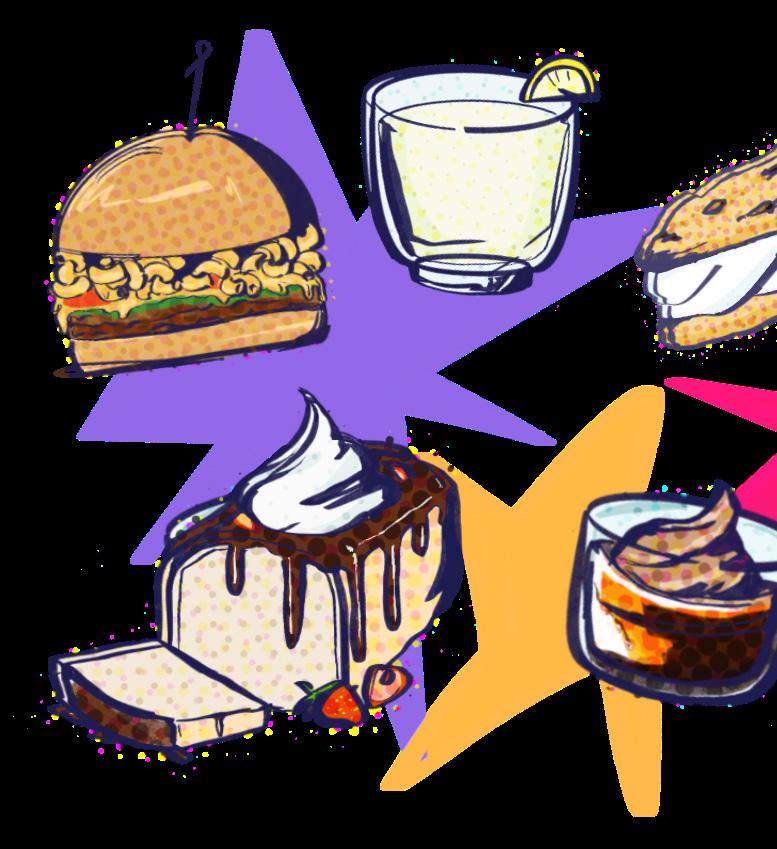
As the weather gets colder, the 12 p.m. Ratty line grows noticeably shorter. Even the Andrews salmon line keeps itself under 30 minutes on Tuesday evenings, when I stop by during what would be prime dinner time before my immunology conference. Whether you are avoiding the cold weather or your palate craves something new, here are some recipes to spice up your next visit to the dining hall.
“slop”
soft serve chocolate ice cream crumbled oreo
dessert of the day: chocolate cupcake chocolate fudge waffle cone on top lightly mix
milkis
one-third each: lemonade milk sprite
spruce up your salad the deli section has spinach and arugula to add to a salad
matcha yogurt
jo’s chobani plain nonfat greek yogurt scoop of matcha powder
pesto pizza
slice o’ pizza pasta bar pesto
chipwich one chocolate chip cookie ratty soft serve two chocolate chip cookie
mac and cheeseburger standard v-dub burger mac and cheese on top instant heart attack
quesadilla southwest station on weekends panini press
soda float soft serve soda (root beer or orange fanta/crush)
affogato soft serve ratty coffee
for further reading: avocado toast panini
state of confusion
Lily Coffman
Across Down
1. Bad moods
6. Quick chow on some grub
10. DCU rival
13. High ranking Ottoman official
14. Classic crossword cookie
15. Lovato of internet fame
16. Big name in games
17. A Nashville high schooler's understanding of the world
19. Pluck
21. Four-time Olympic gold medalist in discus
22. Bread box?
23. Postive response to a suggested activity
25. Needed to take on a date, say Pierre
29. Tourney format
30. Remove the skin of, as an orange
34. One who makes edits
37. Member of the 2024 "Golden Girls"
39. Ink on a mug?
41. Popular floral girl's name
42. Way to ride a large, horned mammal at the Roger Williams Zoo
45. Penniless
49. What UCS might go by at a different school
50. More tidy
51. Certain Cape Cod catch
55. Midwestern bovines causing some trouble
58. Heavy reading
59. Kendrick of song battle fame
60. Danish shoe brand
61. One who errs
62. Cryptography org.
63. Tough guy
64. Teeny tiny building blocks
1. Trade punches
2. "Hoof guy" of social media
3. "Your guess ____ good as mine"
4. Laryngophone
5. Reach by boat
6. Thing to pass in class
7. Mine material
8. Observe
9. Obama's birthplace
10. Word before Cristo or Carlo
11. Math subgroup
12. Place to be in while awaiting delivery
15. Bonus
18. Vegan, but not gluten-free, meat substitute
20. Award given to a meat dress-clad Lady Gaga
23. 1950's presidential nickname
24. Playground retort
25. "Could've Been" singer
26. Hebrew leader
27. The female version of a hustla
28. Ankle ailment
31. Totally in love with
32. "Put ____ on it!"
33. Holler
35. Composer Rachmaninoff
36. Cabled wifi alternative
38. There might be an intricately drawn one in the corner of your notes
40. Explosive material
43. Dallas-Houston dir.
44. Mysterious Christie
45. Early Peruvian
46. Bright colors, as a middle school boy might wear
47. Singer of the "Total Drama Island" theme song
48. Phrase often followed by "boy" or "girl"
51. Kiss across the pond
52. Snowballs, in a snowball fight
53. Clothes line
54. Nine-digit IDs
56. BYU or NYU
57. Hosp. area
Thank you for reading magazine.
New issues every week.
“How to capture my unbounded love for all these people, for telling their stories, for carving pumpkins and hanging trinkets on the wall and oversharing and coming together because we agree how important and powerful and beautiful this all is? The past three and a bit years have gifted me this family for which I will never have the words to fully express my adoration and appreciation. All I can say is thank you.”
— Joe Maffa, “editor’s note [f24] [11]” 12.5.24
“This is my last ever editor’s note at postand it’s hard not to get mawkish, so I will try to make it simple: Read post-! This magazine changed my life.”