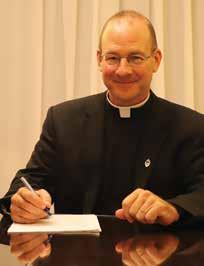
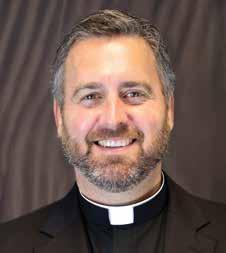
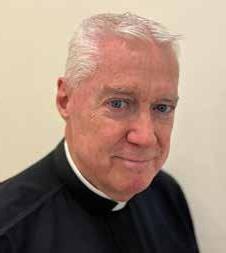
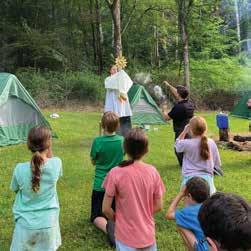
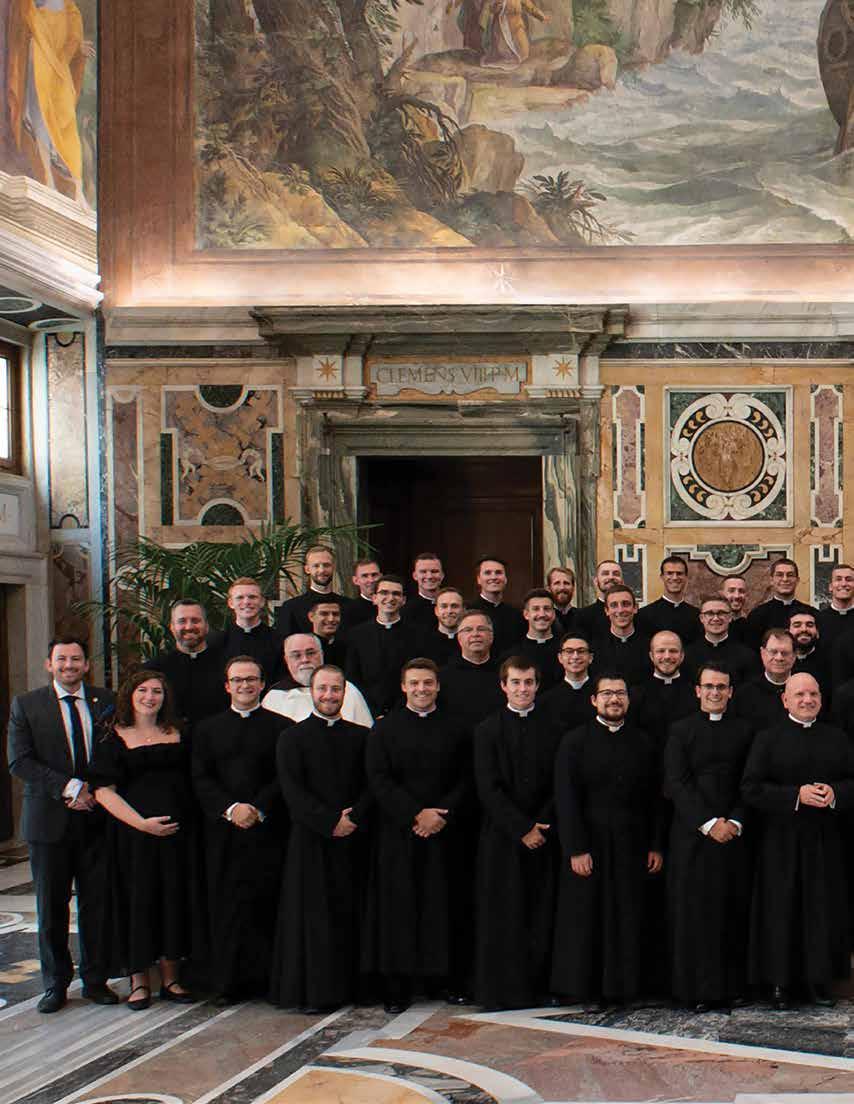
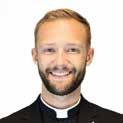
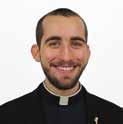
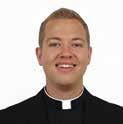
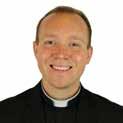
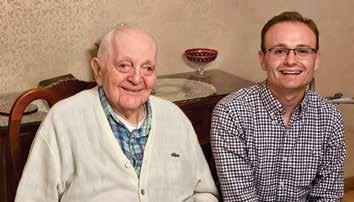
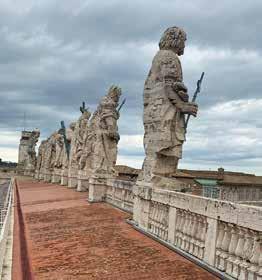
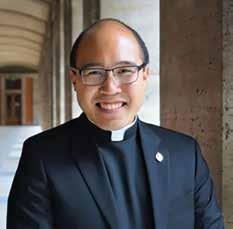
There are good things happening at the College these days! We have twenty-two new deacons in the Class of 2026, thirty-four new men joining us at the College for the first time, and two graduates of the College to welcome back as members of the formation team. Our community is together again, and it’s a real grace to reunite with our brothers and continue our journey together.
We’re also grateful for our summer experiences, including the pastors and communities who hosted us on our apostolates—both at home and around the world—and our new friends who opened their lives to us. We’re grateful for time spent with our families and friends at home.
After all these gifts, I often find myself moved to gratitude. Even more than the numbers and milestones, there’s a faithfulness that never changes—the faithfulness of God and of his people. The moments of grace, the little conversions of
heart that we experience every day—these are what keep us moving onward together toward the Lord. And for us seminarians, we experience many of these gifts through the generosity, friendships, and prayers of those who love us and who love the College.
Every good gift is from above, from our Father who never changes in his faithfulness (Jas 1:17). We thank him for his goodness to us.
With gratitude,
Graham Fassero ‘27 Diocese of Richmond
Contributors
EDITOR-IN-CHIEF
Graham Fassero ‘27, Diocese of Richmond
ASSISTANT EDITORS
Liam Daigle ‘28, Diocese of Worcester
Christian Howlett ‘28, Archdiocese of Saint Paul and Minneapolis
PHOTO EDITOR & PHOTOGRAPHER
Christopher Tillotson ‘27, Diocese of Worcester
ASSISTANT PHOTOGRAPHER
Ryan Both ‘28, Diocese of Austin
Administration
of The Pontifical North American College RECTOR
Rev. Msgr. Thomas W. Powers ‘97
VICE RECTOR
Rev. Michael Pratt ‘11
CARL J. PETER CHAIR OF HOMILETICS
ROMAN ECHOES FACULTY LIAISON
Rev. Peter John Cameron, OP
SUPERIOR, CASA SANTA MARIA
Rev. Msgr. William V. Millea ‘80, C‘89
DIRECTOR, INSTITUTE FOR CONTINUING THEOLOGICAL EDUCATION
Rev. Edward Linton, OSB
EXECUTIVE DIRECTOR, INSTITUTIONAL ADVANCEMENT
Mark Randall, CFRE
For more information about The Pontifical North American College, subscription questions, or to learn about ways you can financially support “America’s Seminary in Rome,” please contact Mark Randall, CFRE, Executive Director, Institutional Advancement.
This publication is written, edited, and photographed by the seminarians, deacons, and student priests of The Pontifical North American College.
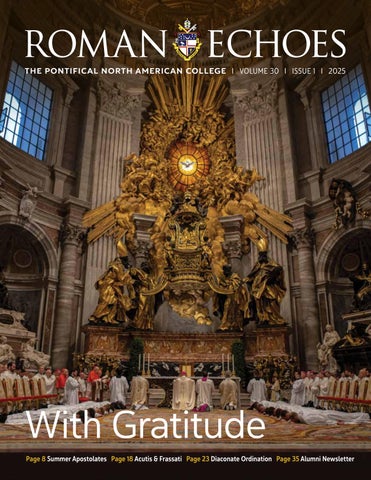
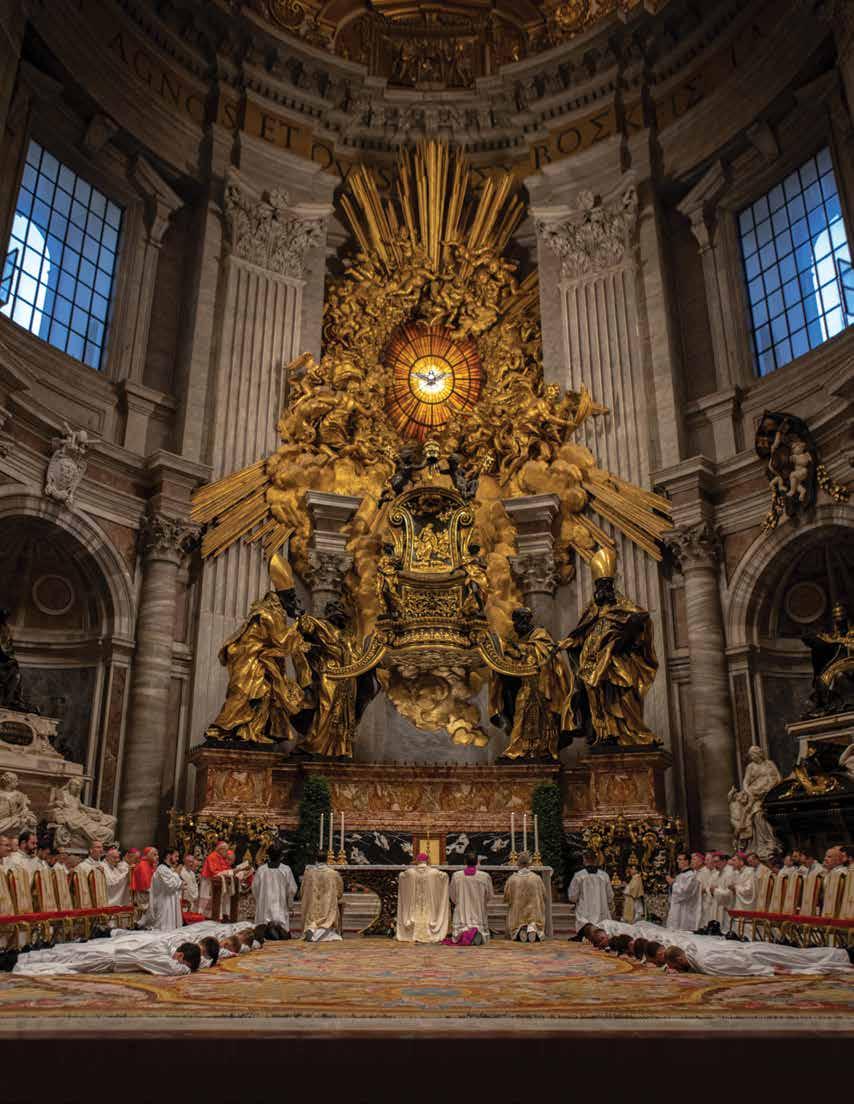
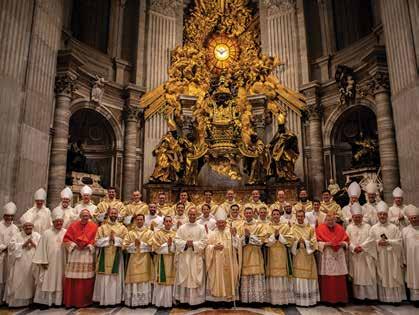
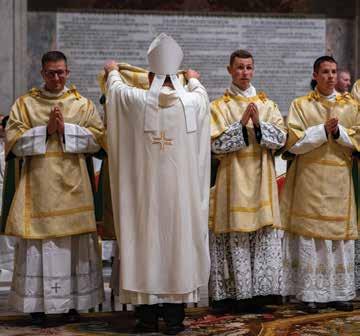
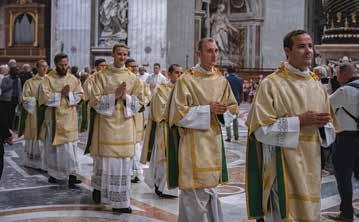
COVER: Deacon candidates lie prostrate for the Litany of Supplication during their ordination at the Papal Basilica of Saint Peter in the Vatican on October 2nd.
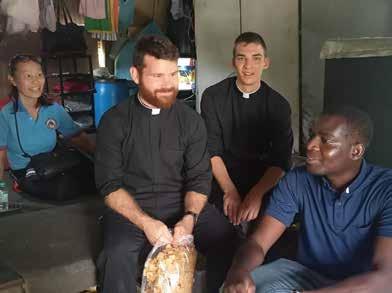
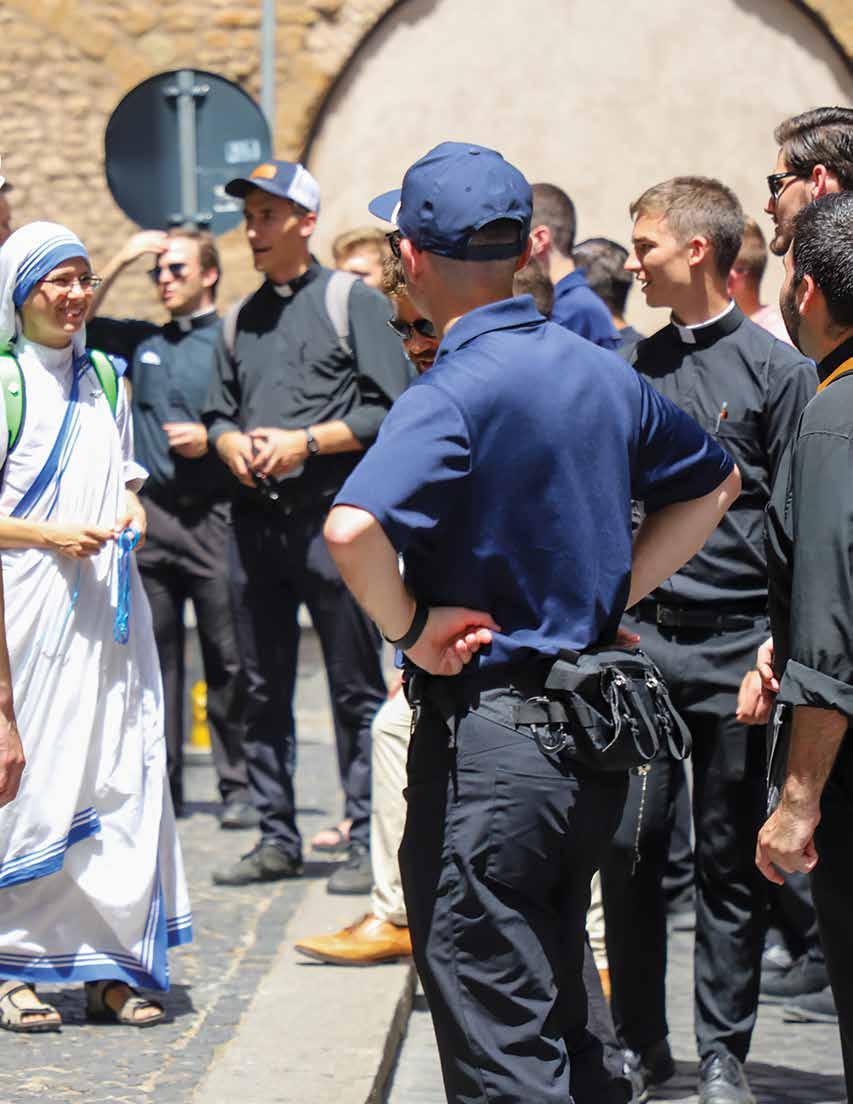
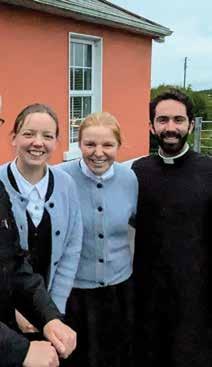
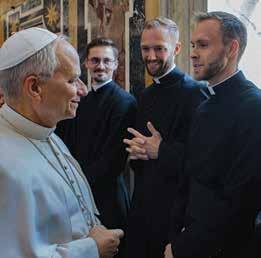
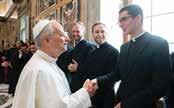
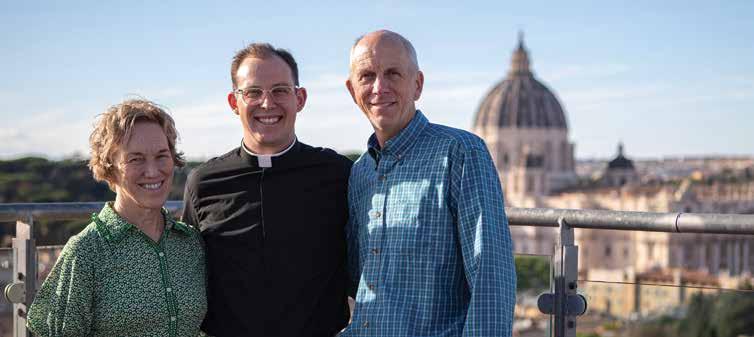
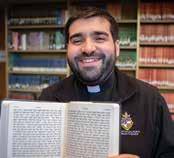
THIS PAGE: Sister Anastasia, M.C., on pilgrimage in Rome, meets seminarians and encourages them to become holy priests.
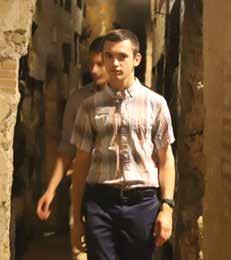
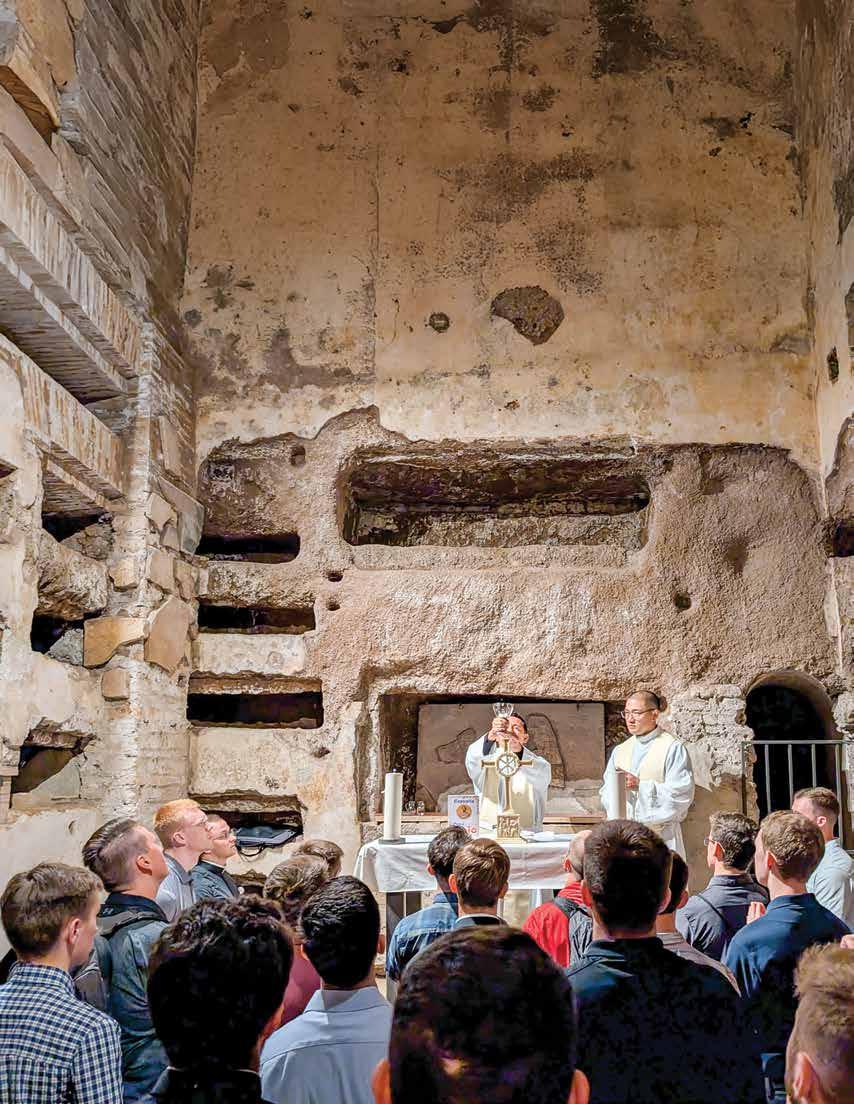
BACK COVER: Rev. Armando Tolosa celebrates Mass in the Catacombs of Saint Callistus.
RECTOR’S CORNER
There is a sublime connection between gratitude and grace. Gratitude is at the heart of Christianity, and it is a grace when we can be men and women of gratitude.
Dear Friend of the Pontifical North American College,
Every evening of the week—except one—we gather as a community here at the College to pray Evening Prayer in the Immaculate Conception Chapel. On Tuesday evenings, however, we pray Evening Prayer in smaller groups with the other residents on our respective hallways.
Along with building fraternity on the corridors, one of the purposes of gathering for prayer by hallway is so that the seminarians, deacons, student priests, and formators can share a special grace with each other from the past week. It is a good opportunity for all of us to speak about how we experienced God acting in our lives, how we sensed his love and mercy in a special way, or how we sensed his presence in an encounter. It is always a moment of gratitude.
As you know, the Italian word for “thank you” is grazie; but what you may not know is that the Italian word for “grace” is grazia. Indeed, there is a sublime connection between gratitude and grace. Gratitude is at the heart of Christianity, and it is a grace when we can be men and women of gratitude.
Jesus gives us the greatest example of gratitude, even giving thanks to the Father at the Last Supper before laying down his life for our salvation (Lk 22:17). Mary, too, gives us the first Christian prayer of the New Testament in her Magnificat, a prayer of complete gratitude to God for saving his people through Jesus (Lk 1:46-55). And all the saints had grateful hearts, giving thanks “in all circumstances” (1 Thes 5:18).
Grazie to all of you who support our mission at the College; our entire community counts you as a grazia not only weekly, but every day!
Be assured of my prayers and the prayers of the entire community of the Pontifical North American College.
Sincerely yours in Christ,
Rev. Msgr. Thomas W. Powers ‘97
Rector
Reverend Christopher D. Donley ‘11
THE EDITORS
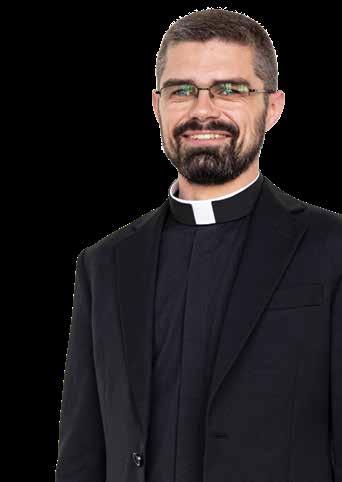
Reverend Christopher D. Donley ‘11 was ordained for the Diocese of Pittsburgh in 2011. He holds a license in dogmatic theology from the Pontifical University of Saint Thomas Aquinas. Until returning to the College this year, he served as pastor of Divine Mercy Parish and as chaplain to Pittsburgh Central Catholic High School, Point Park University, and Catholic Charities. He is the founder of Move a Mountain Missions, Brother Andre’s Cafe, and Gift of Mary Women’s Shelter. He is certified as a spiritual director through the Institute for Priestly Formation.
In July 2025, Father Donley began his service as a formation advisor at the College. He will also serve as Coordinator of Apostolic Formation.
ROMAN ECHOES: In Pittsburgh, you founded a shelter for women, two cafes that provide employment for the intellectually and developmentally disabled, and a ministry that feeds and clothes hundreds of people each day. How did your time at the College prepare you for your service to the needy?
FATHER DONLEY: One way was in the formation itself, being taught by the seminary formation team the importance of sacrifice, being a priest for the other, and not being afraid to be stretched.
Second, in my apostolic work with the Missionaries of Charity here in Rome. I went every week, serving men dinner. And they have a shelter for women who live there. And then—Easter, Christmas, any breaks we got—I would go to live with the Missionaries of Charity. I went to Ethiopia, Calcutta, Russia, Ireland. They were incredible experiences.
ROMAN ECHOES: What was it like to receive the call to return to the College as a member of the formation team?
FATHER DONLEY: When I was asked, my bishop said, “What I’d like you to consider is leaving the front lines of serving the poor, to go fire up more future priests to want to get out on the front lines to serve and love the Lord.” How can you say “no” to that?
ROMAN ECHOES: Do you have a favorite way to sum up the gospel?
FATHER DONLEY: Saint Paul says, “Let all you do be done in love.” At the heart of everything we do, at the heart of Jesus Christ—everything he does, everything he has done, everything he will do, is done in love. If we emulate that, it’s very simple.
ROMAN ECHOES: Is there a grace of your time in Rome that brings you to a place of gratitude?
FATHER DONLEY: My grandparents bought me my ordination chalice, and I asked my grandma what she would like me to write on the bottom. Without hesitation, she said, “To serve is to reign.” So when I look at that on my chalice every day, it helps me to think of how God is calling me to live out my priestly identity—and it’s through service. So I’m grateful for the people the Lord has put in my life to show me how to reign, how to be the best I can be, and to do that in that servant-leadership way. n
Monsignor William V. Millea ‘80, C‘89
THE EDITORS
Monsignor William V. Millea ‘80, C‘89 was ordained for the Diocese of Bridgeport in 1980 by Pope Saint John Paul II. He holds a license in patristics and the history of theology and a doctorate in canon law from the Pontifical Gregorian University. Since 1989, he has served in the Holy See, retiring as head of the English-language desk of the Vatican Secretariat of State. He also served as a Papal Master of Ceremonies and is presently a protonotary apostolic de numero. For twenty-seven years, he taught a seminar for students of the Pontifical North American College.
In July 2025, Monsignor Millea began his service as superior of the Casa Santa Maria, the College’s house of continuing formation for priests pursuing graduate studies in Rome.
ROMAN ECHOES: What is a favorite memory from your time studying at the College?
MONSIGNOR MILLEA: It was probably the election of John Paul I. It was one of those magnificent sunsets against the facade of Saint Peter’s. Everything was glowing, and then you saw these red cardinals out there, and the doors open, and out came the announcement of the Pope. That was a great moment. The election of a pope is always a moment of great hope for the Church.
ROMAN ECHOES: You’ve described your study of canon law as “theologically rich.” Can you explain?
MONSIGNOR MILLEA: Canon law deals with the mystery of grace at work in the Church, at work in people’s lives. I was grateful that our professors at the Gregorian understood that and made that very much a part of their teaching. It is not simply positive law: It’s a question of understanding how grace is at work through the structures of the Church. Canon law is constantly delving into the background of the text, which is the Church’s struggle to incarnate the gospel in a human community.
ROMAN ECHOES: Do you have a favorite prayer or scripture to meditate on?
MONSIGNOR MILLEA: I’ve found the praying of the Divine Office to be very enriching, very stimulating—and also intriguing in terms of the original texts, the history of the texts, the use of the texts. Through the Office, my prayer is very much grounded in Scripture and the patristic authors.
ROMAN ECHOES: Of all the graces you’ve received in Rome, is there a grace that you are particularly grateful for?
MONSIGNOR MILLEA: As you get older, you tend to realize how the finger of God has guided you through your life, and that creates an amazing sense of gratitude to God for his providence. My own prayer starts at this point of gratitude, and a consciousness that we’ve received much more than we can ever give back. The hymn of Ephesians says that we’ve been predestined to glory by God’s grace—by God’s infinite, unmerited grace. And we respond to that grace with immense gratitude. n
The Ends of the Earth
This summer, the Class of 2028 served in apostolic work on six continents. Thank you for your prayers for us as we grow in our love for the Church around the world!
ITALY:
Assisi, Italy
Canale d’Agordo, Italy
Milan, Italy
Pordenone, Italy
Romano d’Ezzelino, Italy
Rome, Italy
Sanguinetto, Italy
Siena, Italy
Turin, Italy
Verbania, Italy
Verona, Italy
Dorgali, Sardinia
EUROPE:
Medjugorje, Bosnia
Luton, England
Oxford, England
Saint-Malo, France
Düsseldorf, Germany
Carna, Ireland
Derry, Northern Ireland
Trondheim, Norway
Kraków, Poland
Fátima, Portugal
Edinburgh, Scotland
Madrid, Spain
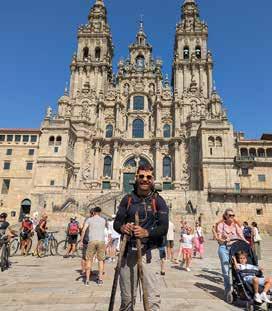
Santiago, Spain
AFRICA:
Dakar, Senegal
Arusha, Tanzania
ASIA:
Calcutta, India
Hyderabad, India
Bishkek, Kyrgyzstan
Bangkok, Thailand
Pleiku, Vietnam
AUSTRALIA: Sydney, Australia
NORTH AMERICA: Orange, California
Washington, D.C.
Austin, Texas
Huttonsville, West Virginia
Cedarburg, Wisconsin
SOUTH AMERICA: Buenos Aires, Argentina
The Church United around the World
DYLAN STEFANICH ‘28, DIOCESE OF EVANSVILLE
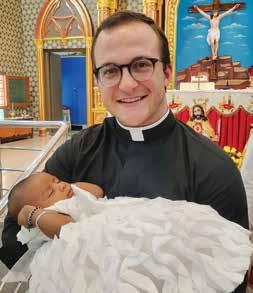
This summer, I spent three weeks in Hyderabad, India, with a priest friend of mine.
India is not a Christian country. Because of this, Christians are persecuted in a variety of ways. If a priest is accused of converting someone, he can be fined and sent to prison. The converted person may face intense social or political persecution, and some outspoken Christians have “disappeared” in the face of corrupt government authorities. The list goes on.
Despite this, the faithful of India witness to their love for the Gospel of Jesus Christ profoundly. One young girl said that, after converting from Hinduism to Catholicism, she had asked her teachers, “What has your god done for you? My God died for me, and even for you, so that we can have eternal life.” What boldness for the sake of Truth! On another occasion, Father and I were celebrating Mass in the poorer villages outside the city. The people had little, but the church was packed. That one moment in their week—the Holy Mass, where they encounter our Eucharistic Lord—is all they want.
It was in these experiences and countless others that God revealed to me the true unity of his Universal (i.e., Catholic) Church. If you dig through the Earth from the United States, you can end up in India on the opposite side. And what do you find? You find a strong little community of Catholics who believe in and worship the same God that we do. They attend the same Mass, receive the same Sacraments, and pray the same prayers that we do. In our world of division, God showed me this summer what “One, Holy, Catholic, and Apostolic” means. What a blessing it is to be Catholic! n
Corpus Christi in Tanzania
CHRISTOPHER DIXON ‘28, DIOCESE OF COLUMBUS
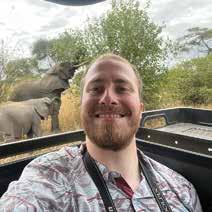
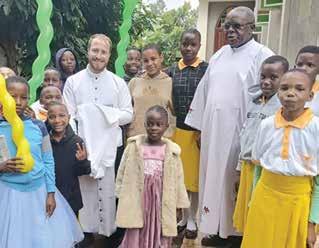
I spent my first-year summer apostolate in Tanzania, near Arusha, with some time near Moshi as well. I arrived in the country not knowing the language, food, or culture, but I gradually came to know each of these aspects. My second Sunday in Africa was the Solemnity of Corpus Christi, and in order to enable the participation of all in the procession, the church and the mission church each had only one Mass. The pastor and I took the very bumpy road to the mission church, while a seminarian on his pastoral year and the two parochial vicars took the other. It was raining that day, but that did not stop us from going through the mud to the various tented stational altars that had been set up in the village. By the time the procession had ended, the hymns were complete, and we had returned to the church, my white cassock (the normative vesture there) and surplice had become rather muddied. Even the mud did not impede the great celebration of the day. n
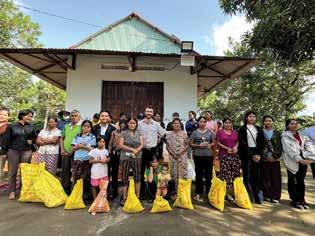
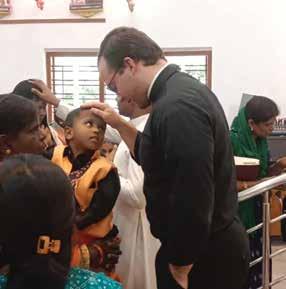
top: Dylan Stefanich ‘28 (Evansville) holds a newly baptized child in Hyderabad, India. bottom: Christopher Dixon ‘28 (Columbus) with local Catholics in Tanzania.
Nothing Stops the Love of Christ
ANTHONY VERA ‘28, DIOCESE OF SIOUX CITY
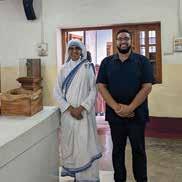
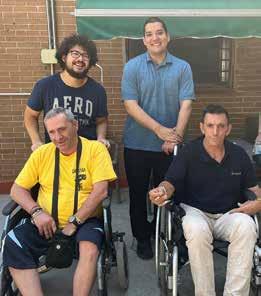
This summer, I spent five and a half weeks with the Missionaries of Charity in Madrid. The sisters’ white habits with blue stripes have always been synonymous with charity for the poor for me ever since I heard about Saint Mother Teresa of Calcutta, but encountering their way of life has completely recontextualized what self-gift means to me. I worked, slept, and ate in a complex that had a convent, a house for the elderly, and a house for the sick and dying. It was like living in a family; there was always work to do, so I was always busy. I commend the Spanish for their cultural siesta in the afternoon! My routine became helping people out of bed, showering them, serving Mass, getting meals ready, changing diapers, and taking people out for walks in the city. It was a new experience for me to engage in such intimate work, and while I was nervous at first, as I reflected on the experience, I realized there’s nothing left to stop me now from loving someone! I truly learned that the more I gave of myself, the more the Lord would provide. I highly recommend everyone to spend some time serving the poor with the Missionaries of Charity; it’s life-giving work and a life-changing experience! n
The Love of God in Thailand
GABRIEL LUGO ‘28, DIOCESE OF CHARLOTTE
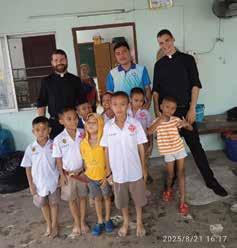
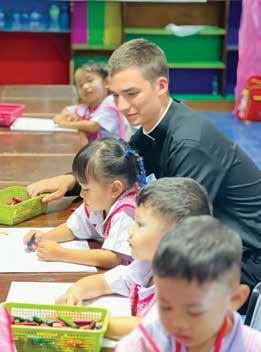
This summer, Ronan Ostendorf ‘28, Diocese of Charlotte, and I were blessed to visit Thailand for two weeks. Thai culture is Buddhist and—unlike Christian culture—does not emphasize the need for helping the poor. The Catholic Church in Thailand is small but engages in many charitable works, ministering to Christians and Buddhists alike. Many of the apostolates we visited were kindergartens and schools. They work to provide a safe place for growth and education for children of all ages. At one school, we were asked to use images to review the English words the students had been learning, while at others we were simply invited to be with the children during various activities. Some of the missions also operate orphanages for children who have lost parents or have escaped abusive situations. They aim to provide the love the children deserve as the little ones of Christ.
This love is the essential element of Christian charity that makes the missions truly Catholic. We do not help the poor just because they are poor—that is philanthropy, laudable but not unique to Christian charity—rather, we help the poor because we recognize ourselves as poor before God: unworthy yet receptive of his love. From this knowledge, we can see and participate in God’s love for our neighbors. n
top: Anthony Vera ‘28 (Sioux City, left) and Noah Hernandez ‘28 (San Angelo, right) minister with the Missionaries of Charity in Madrid.
bottom: Gabriel Lugo ‘28 (Charlotte) visits schoolchildren in Thailand.
Moments of Grace
REV. MR. NICHOLAS MARTELL ‘26, ARCHDIOCESE OF PORTLAND IN OREGON
This past summer, I had the blessing and privilege to be ordained as a transitional deacon at our cathedral in Portland, Oregon. The experience—and overwhelming joy—of being ordained at my home cathedral, in the presence of the People of God who have been praying for me for years, is incomparable.
In seminary, we often speak of the “grace of orders”—the grace associated with the Sacrament of Holy Orders that we receive at our ordination. This grace is real, and it is powerful. Today, almost four months later, I am still experiencing profound joy in my ordination and in the diaconal ministry that I have engaged in since.
During my ordination, I could feel the presence of the Holy Spirit and the grace of the sacrament, especially during two important moments in the ordination rite.
The first moment was during the Litany of Supplication, as I lay prostrate on the floor of our cathedral while the People of God prayed for me. During this moment on the floor, I submitted myself to the will of God and to the service of his people. Emblazoned in my mind was the image of the entire cathedral, the people of the Archdiocese of Portland, whom I will be serving for the rest of my life, coming together to thank God for the gift
of my ordination and to pray for his blessing on my diaconal ministry. It was a beautiful image that I have often returned to and reflected on when I face inevitable challenges in ministry and in my continuing studies.
The second moment was during the Prayer of Ordination—the moment that I became a deacon. As my archbishop spoke the words of the prayer, I felt the presence of the Holy Spirit, and I could sense grace entering my soul—the grace that would mark my soul forever and configure me in a deeper way to Christ the servant. It was an intense moment, and it brought me to an emotive and outward experience of joy. I remember looking up at the end of the prayer with a huge smile on my face as I made eye contact with one of the deacons standing next to my archbishop. This was a moment that I will never forget and that has stuck with me over these last four months.
I am eternally grateful to God for choosing me to be a deacon. I am eternally grateful to my archbishop, not only for ordaining me as a deacon, but for allowing and encouraging me to be ordained at home with the people of our archdiocese. It was an experience that I would not trade for anything. I cannot wait to be ordained as a priest and to continue ministering to the People of God. n
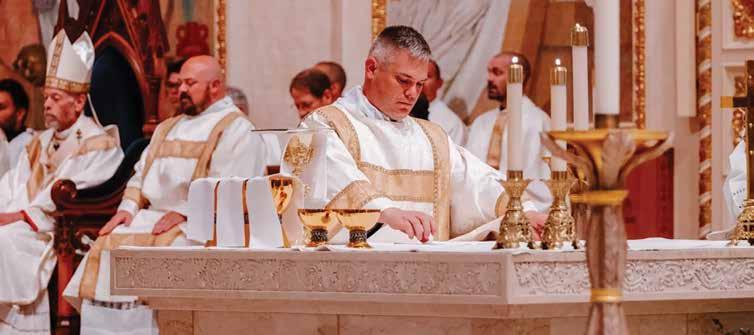
Rev. Mr. Nicholas Martell ‘26 prepares the altar after his ordination at Saint Mary’s Cathedral in Portland, Oregon. Photo courtesy of Archdiocese of Portland in Oregon.
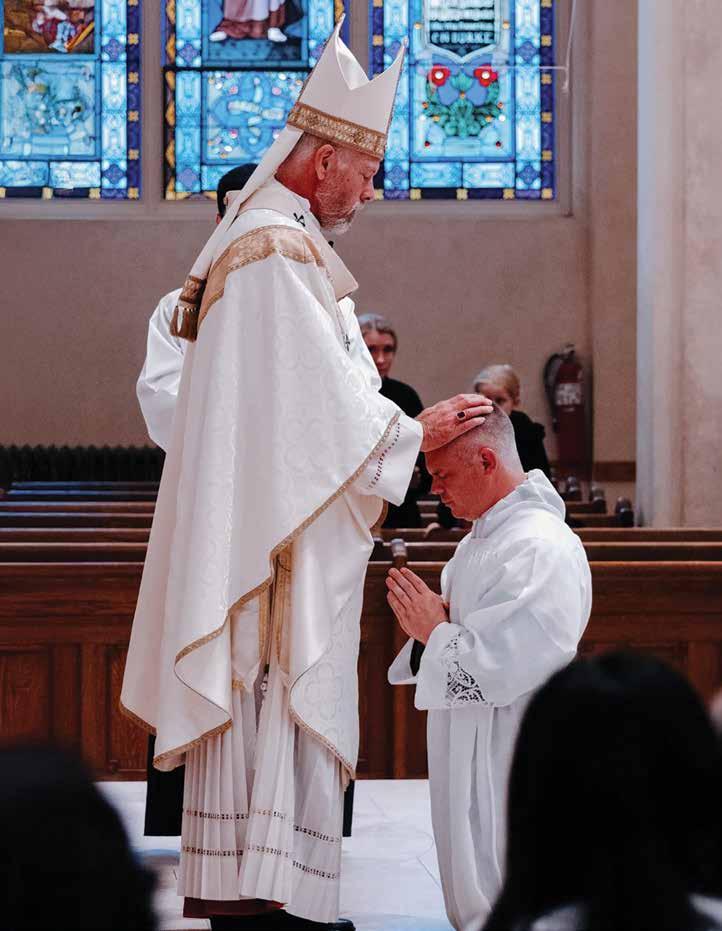
The Most Rev. Alexander K. Sample ordains Rev. Mr. Nicholas Martell ‘26 as a deacon at Saint Mary’s Cathedral in Portland, Oregon. Photo courtesy of Archdiocese of Portland in Oregon.
The Saints of Rome
NICHOLAS HAYS ‘29, ARCHDIOCESE OF BALTIMORE
After completing our time at language school, either in Siena or Assisi, our thirty-three first-year seminarians returned to Rome to continue our time of orientation. A major part of this orientation is becoming familiar with Rome itself—not only in the sense of getting around, but even more in getting to know the people and places that make the city truly eternal. These people and places are the saints and the sanctuaries made holy by their labor and the continued presence of their earthly remains. It is only in Rome that we can have such a familiar acquaintance with so many of them. Steeples and domes crowd the skyline to mark where many a victorious saint of Christ lies. The largest of these, of course, is that of the Papal Basilica of Saint Peter in the Vatican, where the Prince of the Apostles himself lies.
My most moving experience thus far in Rome has been our visit to Saint Peter’s tomb. Taking a winding “scavi” tour through the ancient necropolis under the floors of the basilica, we came to a small room with a shelf-like hole in the wall. In the hole lie the bones of Saint Peter—the fisherman who dropped his nets and followed Christ—all the way to Rome. As we looked upon those bones that toiled for Christ and for his Church, Reverend JunHee Lee ‘13, Coordinator of Human Formation, opened his Bible and read the verse, “You are Peter, and on this rock I will build my Church, and the gates of Hades shall not prevail against it” (Mt 16:18). It was a surreal experience, looking right at the bones of the man to whom Christ himself spoke those words. Our faith suddenly takes on a new tangibility right before our eyes here in Rome. n
Brothers Dwelling in Unity
MICHAEL TUPTA III ‘28, DIOCESE OF WHEELING–CHARLESTON
The experience of being a new man at the Pontifical North American College is momentous for any seminarian. And last year, as my diocese’s only seminarian studying at the College, I faced the additional challenge of needing to foster fraternity with my diocesan brothers back in the United States.
This previous academic year in Rome allowed me to grow in appreciation for my diocesan brothers in a way that is not possible when I was with them back in the diocese. The Diocese of Wheeling–Charleston is the entire span of the beautiful state of West Virginia, which covers more than 24,000 square miles in the heart of the Appalachian Mountains. Being a priest in our spread-out, rural diocese will require a similar level of intentionality in order to have priestly fraternity in the future as it presently does to connect virtually, given the distance and time zone difference of living in Rome. For our diocese, sending seminarians back to the College is closely linked to an increase in priestly vocations. Thanks be to God!
This August, as part of the orientation team, I was pleased to welcome the new men of the Class of 2029. One of those new men was one of my own diocesan brothers, Mr. Joseph Derico. I am grateful for his friendship and brotherhood, and I look forward to growing in fraternal love of our blessed Lord here in the heart of the Church. Praised be Jesus Christ! n
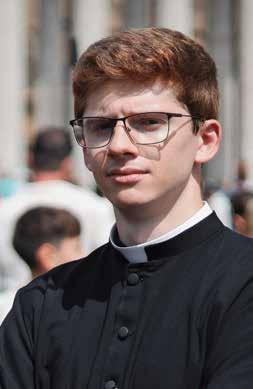
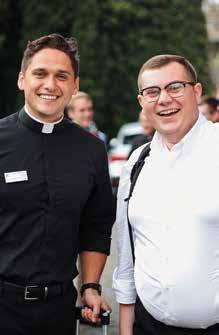
top: Nicholas Hays ‘29 (Baltimore) waits for the Angelus to begin in Saint Peter’s Square. bottom: Michael Tupta III ‘28 (Wheeling–Charleston, left) welcomes Joseph Derico ‘29 (Wheeling–Charleston, right) to the College.
Journey of a Lifetime: A Pilgrimage to the Pope
CARTER ANDERSON ‘29, DIOCESE OF HELENA
After reading Giants in the Earth, a tale of O.E. Rølståg’s adventure into the American frontier, I came upon an anecdote from the author’s life. At a young age, Rølståg once traveled two days on foot to obtain a copy of Ivanhoe. What a voracious desire for the written word! It echoes the profound yearning for the Word that drives any pilgrim’s journey. Though the jaunt from the Pontifical North American College to the Apostolic Palace is far from rigorous or daunting, the Holy Father’s reception of our first-year class on August 24th resounded with the resonance of such a pilgrimage.
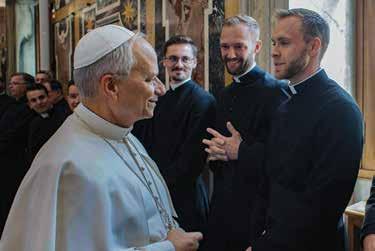
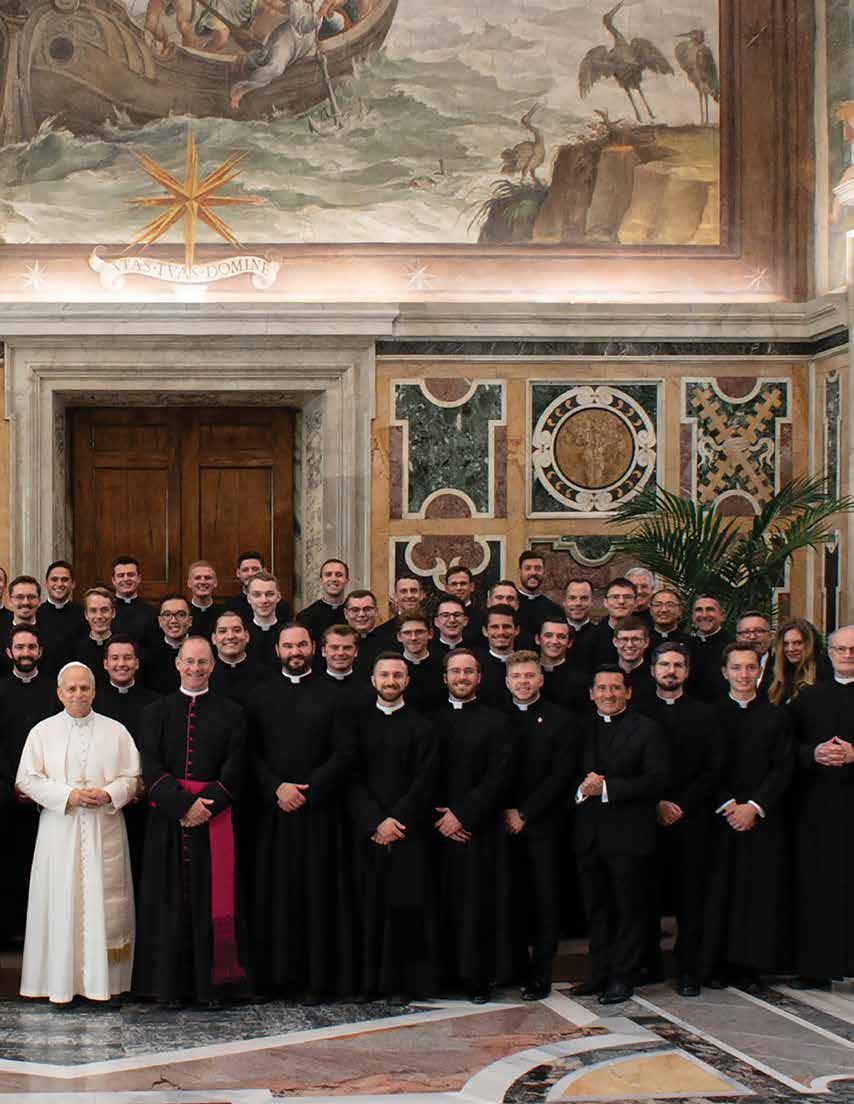
Pope Leo XIV warmly welcomed our class to the Eternal City and greeted everyone present. After honoring the great work and dedication of our Rector, His Holiness encouraged an openness to the Lord’s grace in our lives. Smiling, he reminded us that God’s work is often a surprise and promptly glanced down at his own papal garb.
“Pray for perseverance,” Pope Leo exhorted us, as he related a story of a revered mentor from his years of formation. Throughout the address, his missionary impulse was palpable—“let us go now and pray with the people of God!” After singing Ad Multos Annos as our parting gift, we followed the Holy Father’s instruction and joined the crowds gathered in Saint Peter’s Square to pray the Angelus.
It was a momentous day. What has lingered with me since has been a deep gratitude and renewed strength to spread the Gospel. The Christian life as a journey requires such moments of encounter. As my classmates and I begin formation at the College, far from that American frontier of Rølståg’s wanderings, I yearn to bring the joy of the Gospel to a world so in need of Christ. n
The Good Shepherd
PAUL GUERTIN ‘29, DIOCESE OF SAINT CLOUD
In the past few months, we new men have visited many churches and holy sites throughout Rome. Many of these places contain images depicting Christ as the Good Shepherd. The identity of Christ as the Good Shepherd, found in John 10, is one that many of us are familiar with and might see frequently in our own churches in the United States. However, I have realized that the image of the Good Shepherd is not solely contained in paint and plaster but also in living images. Here at the Pontifical North American College, I have encountered many people—the saints of Rome, the Holy Father, and the faithful and zealous priests serving our seminary as formators—who manifest the pastoral identity of Christ and the love of the Father. They remind us that Christ is always and forever the Head of the Church, his bride, ever guiding her and protecting her. As men pursuing the priesthood of Jesus Christ, these images impress upon us the desire to let our hearts be conformed to his Sacred Heart, so that in time, we may share in his saving action on the cross and be united in love with our Good Shepherd. n
top: His Holiness Pope Leo XIV speaks with Carter Anderson ‘29 (Diocese of Helena). bottom: Paul Guertin ‘29 (Saint Cloud) visits the Catacombs of Saint Callistus.
RECENT AND UPCOMING
Events
July 23
Welcome “New Men” to the College
July 28 – August 20
First-year Italian language schools in Assisi and Siena
August 21 – 28
First-year orientation
August 24
Audience with His Holiness Pope Leo XIV
August 29 – 31
First-year fraternal weekend in Assisi
September 1 – 27 Fall workshops
• Italian language tutoring
• Preaching workshops and practice
• Pastoral ministry workshops
• Seven-day retreats by class
The Class of 2029 meets His Holiness Pope Leo XIV in the Apostolic Palace.
October 2
Diaconate ordination at the Papal Basilica of Saint Peter in the Vatican
October 6
University classes begin
October 19
Day of Eucharistic adoration
October 24
Oktoberfest party
November 2
All Souls’ Mass at Campo Verano Cemetery
November 23
Day of Eucharistic adoration
November 27
“Turkey Trot” 5K run around the Vatican walls
November 27
Thanksgiving Mass and dinner
November 29
“New Man/Old Man” variety show
November 30
Spaghetti Bowl football game and cookout
OCTOBER
NOVEMBER
December 6 – 7
Advent weekend of recollection in-house retreat
December 8
Immaculate Conception Mass and dinner: patronal feast of the College
December 12
Christmas party
December 14
Evening of sacred music for Advent and Christmas
December 20
Christmas break begins
DECEMBER
The College Welcomes Carlo Acutis’ Family
RONAN OSTENDORF ‘28, DIOCESE OF CHARLOTTE
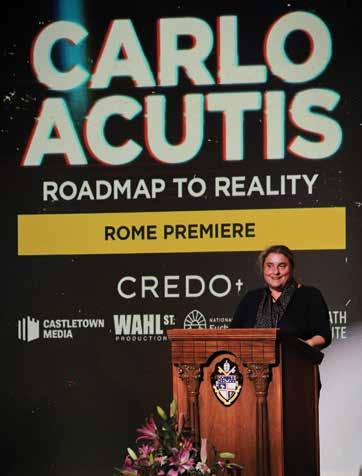
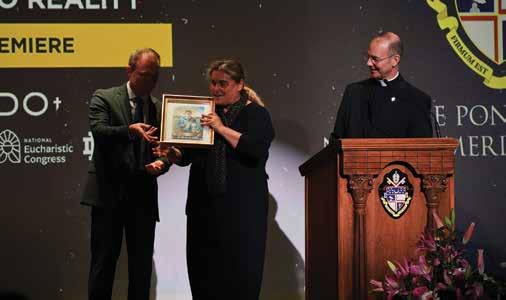
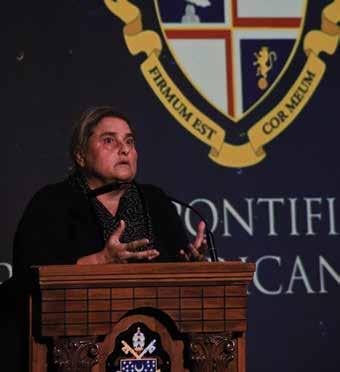
On September 5th, the College welcomed the family of Saint Carlo Acutis for the Rome premiere of Carlo Acutis: Roadmap to Reality, a documentary on the life of the young saint. Mrs. Acutis spoke after the film. Saint Carlo Acutis was canonized two days later.
Right up until the event, I didn’t have a devotion to Saint Carlo Acutis. In fact, I was a little skeptical, since it seemed to me that a good deal of the buzz surrounding him was because he was just a regular guy who played video games. But this was because I had never actually heard his whole story.
Like many Italians, Saint Carlo was born into a culturally Catholic—but practically secular—family. From a young age, he expressed a keen interest in the faith, and it was this, coupled with
a deep love for the sacred, that profoundly impacted his mother. Continually finding herself “out of her depth,” as it were, she began researching the faith so that she could actually answer his deep questions. And when Carlo realized who the Eucharist is, he had an ardent desire to receive the Blessed Sacrament, which, to his great joy, he was finally able to do at the age of seven. His experience of union with our Eucharistic Lord was so great that he immediately started going to Mass and spending time in adoration every day. As he matured, so did his love for Jesus, such that it was quite natural that he should share this love with those around him, including, for example, his Hindu babysitter Rajesh, who came to faith and remains a faithful Catholic today. But when Carlo encountered the spiritual indifference of his peers, he was dismayed and sought to remedy this as best he could. This inspired his project of documenting Eucharistic miracles, which he shared on a website for which he wrote the code himself.
While Saint Carlo was remarkably proficient in modern technology, he also had a remarkably clear conviction that one must use his God-given time wisely. So when he got a Playstation at about age eight, he resolved to limit himself to using it only one hour a week. He used his time so well, in fact, that when he found out he was about to die, he was quite at peace with this fact, seeing as he had done the best he could with his life.
Mrs. Acutis seems to have assimilated this peculiar perspective, so foreign to modern society—a perspective firmly comprehending the horizon of eternity. It was powerful to hear her say with firm conviction: “There is nothing higher than to be a priest, because through your work, your sacrifice, you will be able to help souls to reach paradise.” Perhaps it was so moving because she has seen this up close, seen all the ordinary priests who had helped her son in their daily offering of the sacraments. How could she not love the priesthood that brought Saint Carlo safely through death itself? This is the kind of witness that makes a seminarian want to be a holy priest.
In any case, Saint Carlo is a regular guy in a way, but he is not just a regular guy—he is one of those fierce, indomitable spirits who lived so as to shine with eternal glory, having come to know a “love as strong as death”—the love of Jesus Christ.
I pray to Saint Carlo Acutis much more now. n
Mrs. Antonia Salzano Acutis speaks during her visit to the College.
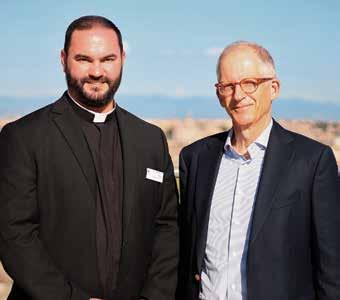
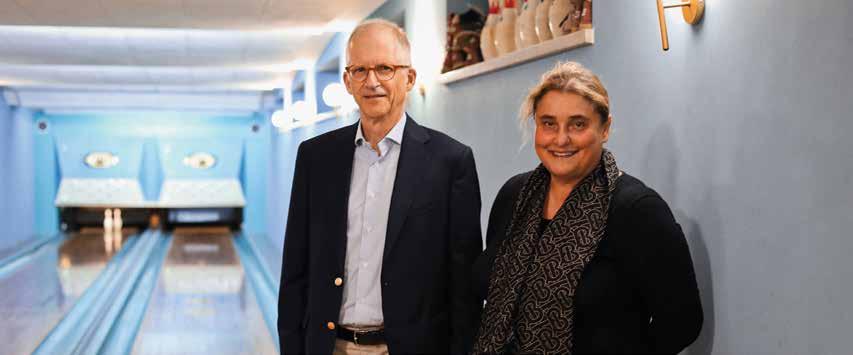
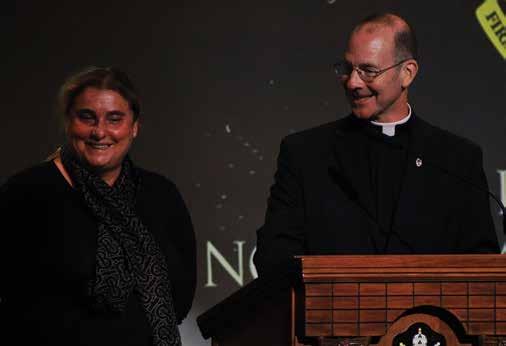
top left to right: Rev. Michael Pratt ‘11, Vice Rector, and Mr. Andrea Acutis at the College; Mr. Tim Moriarty, CEO of Castletown Media, presents Mrs. Acutis with an image of her son as Rev. Msgr. Thomas W. Powers ‘97, Rector, looks on. middle: Mr. and Mrs. Acutis at the College. bottom left to right: Mrs. Acutis speaks during her visit to the College; Mrs. Acutis and Monsignor Powers.
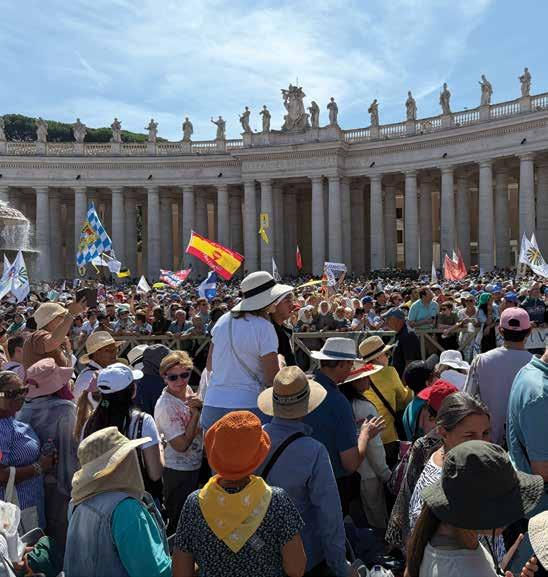
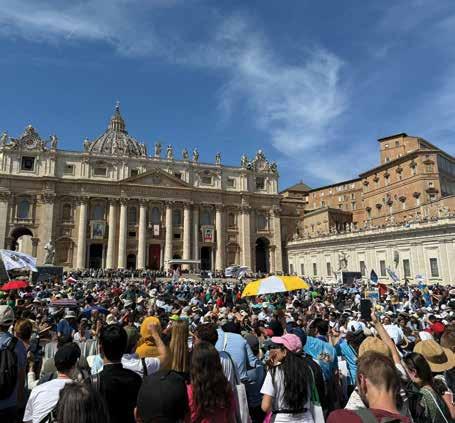
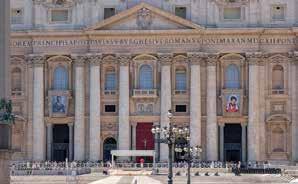
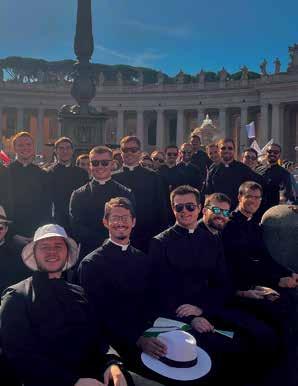
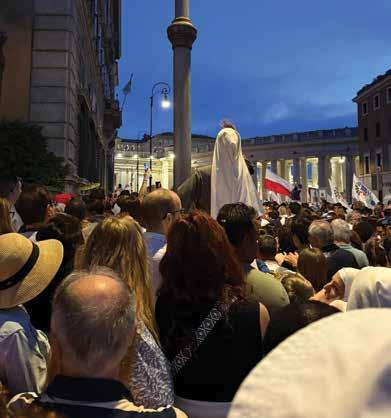
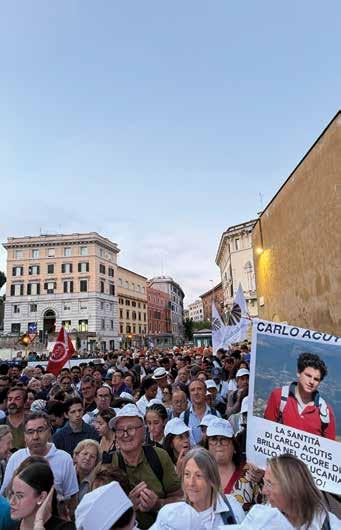
left top to bottom: Crowds celebrate the canonization of Pier Giorgio Frassati and Carlo Acutis; Crowds greet His Holiness Pope Leo XIV. right top to bottom: The Papal Basilica of Saint Peter in the Vatican; Seminarians present at the canonization; Crowds queue for the canonization.
God Is Glorified in His Saints
DAKOTA GATES ‘29, DIOCESE OF SAINT PETERSBURG
On September 7th, we seminarians woke up at an absurdly early hour, hoping to get good spots at the canonization Mass of Saint Pier Giorgio Frassati and Saint Carlo Acutis. As we approached Saint Peter’s Square, the number of pilgrims already gathered at the entrances shocked us. Many pilgrims had even spent the night sleeping on the cobblestone streets.
While waiting for the gates to open, we were met by exchanges of smiles, conversations, prayers, and some elbows of those who wanted to claim a better place in line. Though the crowd seemed reckless at times, the anticipation
and joy of the celebration of two soon-to-be-canonized saints was evident.
The gates opened and the crowds began to move, but as we got closer to the square and saw that it was already almost full, our chances of getting inside seemed to fade away. However, one thing I’ve learned about the spiritual life is that, if you want to get somewhere quickly, you should find a group of religious sisters to travel with—and we had happened to meet a group of sisters just that morning. We found the sisters and, with their tenacity, finally made it into the square with our new friends.
The celebration was to begin soon. This was my first large event in Rome, and the universality of the Church was becoming evident to me now. People from different places, backgrounds, ethnicities, and languages were all united by the Catholic Church in one place.
“All of you, all of us too, are called to be Saints!”—These are the words with which His Holiness Pope Leo XIV concluded his welcoming address to the pilgrims before the Mass. This is something I hear often, especially living among the saints of Rome, but it is sometimes hard to believe. However, during the Mass, the Pope said, “We declare and define Blessed Pier Giorgio Frassati and Carlo Acutis to be saints and we enroll them among the saints.” Hearing those words made it a reality for us.
To live in this time, when ordinary people are being raised to sainthood, means that sainthood is attainable for all of us. Pope Leo pointed out the youth of these two saints and how they left everything to follow Jesus. He exhorted us young people to “not squander our lives, but to direct them upwards and make them masterpieces.” Witnessing the canonization of these two young men and participating in the Eucharist—which they deeply loved—inspired me, my brother seminarians, family, and friends, both present and back home, to strive for virtue so that we too may one day become saints, for “God is glorified in His Saints.” n
Draw My Heart to Yours
REV. MR. REED ROBINSON ‘26, DIOCESE OF NASHVILLE
I don’t remember a time in my life when I didn’t want to be a priest. My vocation has been something that God put on my heart before I can remember. My mother even told me that when I was born, I came out with my hands folded, as if in prayer. The quote from Jeremiah always strikes a chord with me: “Before I formed you in the womb I knew you, and before you were born I consecrated you” (Jer 1:5).
My family was a major part of hearing the call of God. I grew up praying the Rosary every night with my family and going to daily Mass with my parents and some of my siblings, especially during the school year. There was never a mountaintop moment where I heard Jesus speak to me and tell me to be a priest. Rather, in the many quiet moments of praying the Rosary and the early morning Masses, he continued to draw my heart to his own and to hear the call he had in store for me.
It was at those daily Masses before school that God put the first priest into my life who drew me closer to the priesthood. Reverend John O’Neil, a wonderful Irish priest who was chaplain at my school, celebrated the Mass with a reverence and a gentleness that I loved dearly. I served Mass every day for him from the fourth to the eighth grade. The Mass quickly became—and has remained—my home.
It was in middle school that I began to attend “Fraternus,” a youth group specifically for young men. It focused on discipleship, fraternity, and virtue. In Fraternus, I learned how to develop my own prayer life outside of what I did with my family, as well as how to talk about my faith and my struggles with peers who also wanted to become men of faith. It was at Fraternus that I met the man I would ask to be my confirmation sponsor, Jimmy Mitchell. Jimmy was a young adult and a leader in Fraternus, and his joy and love for the Lord were—and still are—infectious. He mentored many of us and aided us in growing in love for Jesus.
As my prayer life grew and matured into high school, I continued to go to daily Mass and to pray. Our chaplain there, Reverend Gervan Menezes, was a huge part of my continued discernment and following of Christ. “Father G,” as we called him, invited students to pray the Liturgy of the Hours with him before daily Mass, and I went every day to pray with him and then to serve Mass.
As I look back on my life and reflect on how God has helped me to hear and to follow his will, I am filled with gratitude. He placed all the right people at the right times in my life so that I could lay down on the floor and promise myself to him and to his Church. n
New Deacons
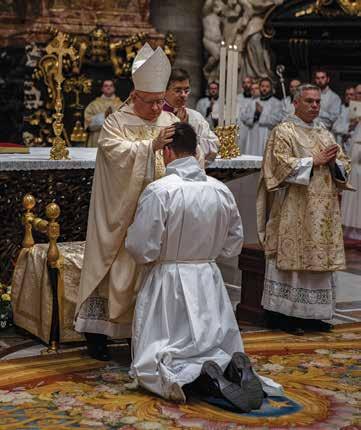
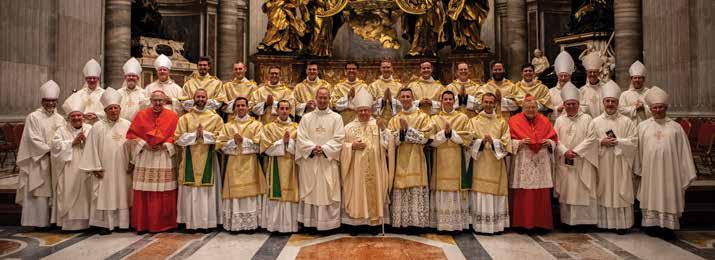
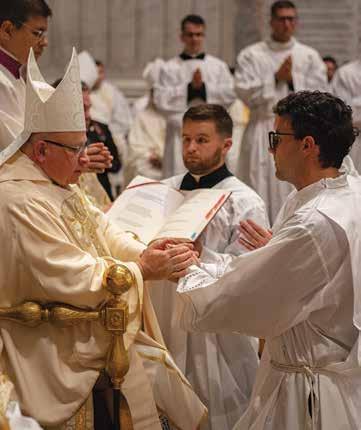
Sixteen men were ordained deacons by the Most Reverend Joseph G. Hanefeldt ‘84, Bishop of Grand Island, on October 2nd at the Papal Basilica of Saint Peter in the Vatican.
NEWLY ORDAINED:
Rev. Mr. Charles DeReuil II ‘26, Archdiocese of Saint Paul and Minneapolis
Rev. Mr. Patrick Ernst ‘26, Diocese of Fort Wayne–South Bend
Rev. Mr. Michael Figura ‘26, Archdiocese of Omaha
Rev. Mr. Lucas Folan ‘26, Diocese of Paterson
Rev. Mr. Stephen Howard ‘26, Archdiocese of Sydney
Rev. Mr. Noah Huddleston ‘26, Diocese of Grand Island
Rev. Mr. Thomas Johnson ‘26, Diocese of Great Falls–Billings
Rev. Mr. Thomas Kollasch ‘26, Diocese of Sioux City
Rev. Mr. Kyle Lang ‘26, Diocese of La Crosse
Rev. Mr. Steven Lang ‘26, Archdiocese of Saint Paul and Minneapolis
Rev. Mr. Kaleb Mitchell ‘26, Diocese of Helena
Rev. Mr. Brendan Parlett ‘26, Archdiocese of Washington
Rev. Mr. Mateusz Puzanowski ‘26, Diocese of Providence
Rev. Mr. Reed Robinson ‘26, Diocese of Nashville
Rev. Mr. Nicholas Waldron ‘26, Diocese of Rockville Centre
Rev. Mr. Charles Warner ‘26, Diocese of Saginaw
MEMBERS OF THE CLASS OF 2026 ORDAINED IN THEIR HOME DIOCESES:
Rev. Mr. Jacob Derry ‘26, Diocese of Lansing
Rev. Mr. Nicholas Martell ‘26, Archdiocese of Portland in Oregon
Rev. Mr. Andrew Messer ‘26, Diocese of Toledo
Rev. Mr. Mauricio Romero ‘26, Diocese of San Angelo
Rev. Mr. Mitchell Schumann ‘26, Archdiocese of Galveston–Houston
Rev. Mr. Alexander Turpin ‘26, Diocese of Albany
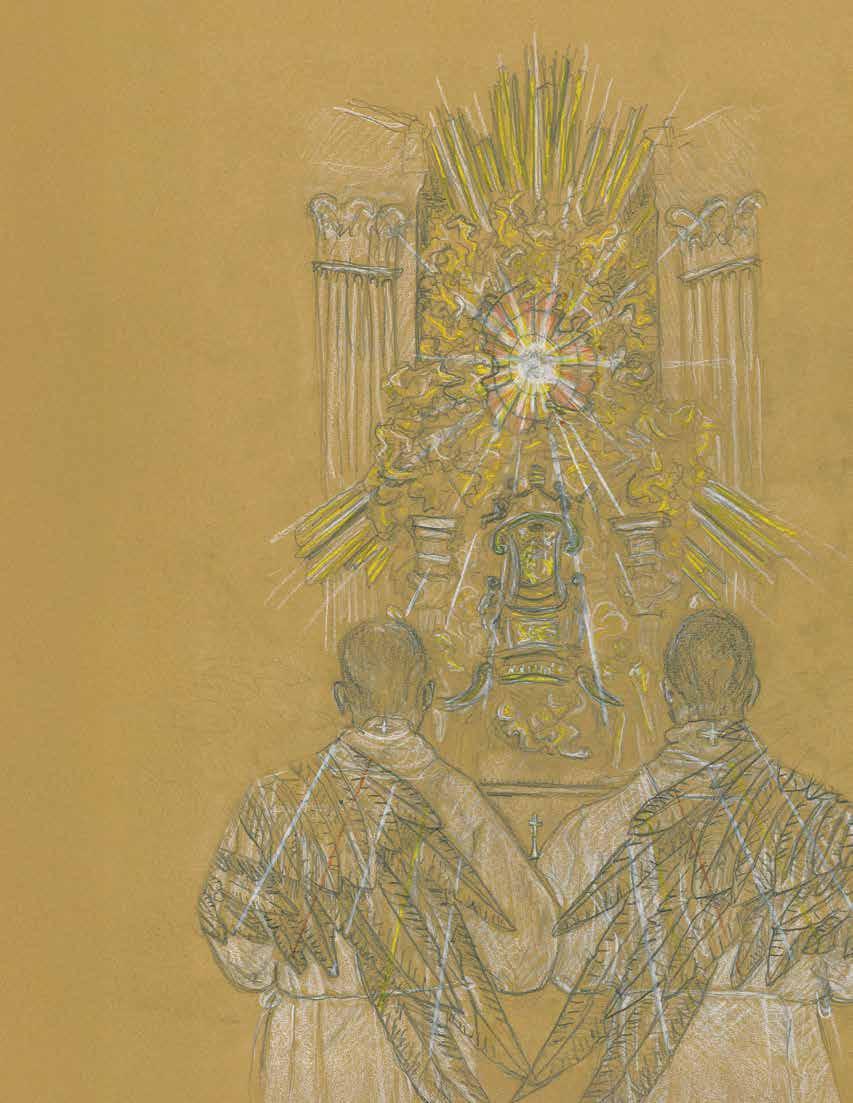
Sketch Guardian Angels by Rev. Mr. Stephen Howard ‘26 (Sydney).
Always with You
FROM THE HOMILY OF MOST REV. JOSEPH G. HANEFELDT ‘84, BISHOP OF GRAND ISLAND
My dear beloved sons, thank you for your generous response to the Master who has called you and is sending you out as laborers for his kingdom.
Having lain down before this very altar myself to be ordained over forty-two years ago, I recall the flood of emotions that you are undoubtedly experiencing. I share your gratitude for the Lord’s invitation to follow him as an ordained minister in the Church. I also sense your trepidation to take on such great responsibilities. I’m sure you have doubts about your own capacities and competencies. But most of all, I know of your great joy that this day has come.
With all that stirs in you who are about to be ordained—and in our hearts as well—let us ground our thoughts, feelings, and desires in the Word of God that we have just heard proclaimed: “Before I formed you in the womb, I knew you. Before you were born, I dedicated you. A prophet to the nations I appointed you. Do not be afraid, for I am with you.” Notice the verbs here— they’re very important for us. For what we celebrate here today is God’s divine action in your lives. Even before he created you, he knew you, he dedicated you, he appointed you, and he will be with you always. My sons, let this amaze you, and take it personally—God’s election, God’s choosing you.
None of us is worthy of this election—to be known, dedicated, appointed by God for ordained ministry. In the Liturgy of the Hours, we pray Psalm 51: “For my sin is always before me.” Unworthy as we may be—even sinful at times—we also must remember that before we were even created, he knew us, he dedicated us, he appointed us, and he remains with us to deliver us.
So I suppose my first encouragement for you this evening is to get over yourselves—Oh, you’re not perfect? Really? Amazing. That’s not what Jesus asks. As we so often do, we avoid focusing on what we have, and we stress over what we don’t have. Rather, we ought to focus on what God sees—his grace in you, his abiding presence to accompany you through everything.
Yes, before he formed you in the womb, the Lord knew you, he dedicated you, and he appointed you, and he will always be with you in every circumstance. Now open your heart to the grace of your ordination so that your life and ministry can be one of generous service to the Lord who has called you to labor for souls. n
top: The newly-ordained are vested as deacons during Mass at the Papal Basilica of Saint Peter in the Vatican. bottom: The Most Rev. Joseph G. Hanefeldt ‘84 lays hands on Rev. Mr. Mateusz Puzanowski ‘26 (Providence).
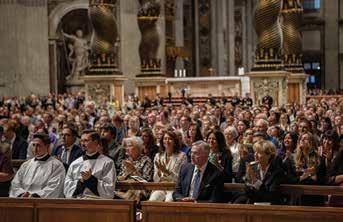
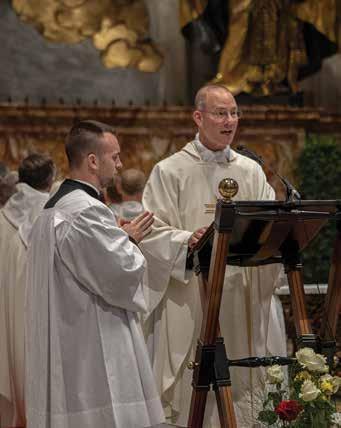
clockwise from top: New deacons celebrate their ordination; Family and friends applaud the election of the candidates; Rev. Msgr. Thomas W. Powers ‘97, Rector, welcomes the congregation; Newly ordained deacons process from the basilica; Bishop Hanefeldt receives the promise of obedience from Rev. Mr. Nicholas Waldron ‘26 (Rockville Centre).
Hope in the Eyes of Jesus
FROM THE FIRST HOMILY OF REV. MR. STEPHEN HOWARD ‘26, ARCHDIOCESE OF SYDNEY
Hope is about destiny. It’s about a vocation. Not a vague, abstract vocation. Not the sense of vocation as, “What am I going to do with my life? How am I going to sort out my problems?” Those are good things, but they are not the fulfillment of the deep desire of our hearts.
All of life is an anticipation. It’s an anticipation in the way that I anticipate an embrace from someone I love, a kiss from someone I love. Our entire life is this moment before the embrace, before the kiss. And that could be described with the word “hope.” This is the Year of Hope, and you have been brought to the “Eternal City” of hope. Perhaps part of your motivation is to see me, but really, Jesus has brought you here to give you hope.
This anticipation and this hope includes the brokenness of sin, includes disappointment, suffering, death; includes it most triumphantly, and also most painfully, in the Cross—the Cross of Christ, and the cross of our hearts. And yet our lover and Creator, who wants to marry us, tells us again and again, “You are no longer forsaken.”
Earthly marriage—the vocation for most of us—is the image of Jesus Christ’s marriage with the soul. And the majority of peo-
ple are called to earthly marriage. But our first vocation—every single one of us—is marriage with God. That is the definition of holiness—to be one with God.
In an earthly marriage, we make each other holy through failure and through forgiveness. Similarly, in the sacred marriage of Jesus and the soul, we are made holy through failure and forgiveness. Even Jesus, the perfect God-man, failed. The Cross is the greatest failure in history: God is killed by his creatures whom he came to save. And yet he transforms that into the greatest victory. And he will do the same to the cross and the suffering in your life: He will turn it into the greatest victory of your life.
Really, our failures and our disappointments are signs of hope. I always want something more—I always yearn for a deeper love, a more satisfying love, a more joyful, faithful, fruitful, intimate love—a love where I can look my lover in the eyes, and can be seen, and understood, and known. And those eyes are the eyes of Jesus Christ. It is where our failures, and his failure, meet in that gaze—and where his wounds and my wounds meet in the Sacrament of the Eucharist—that we are healed, and that hope comes to fulfillment. n
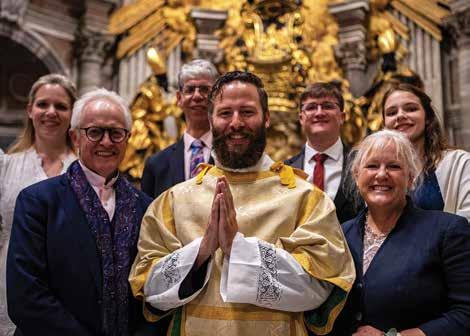
left: Rev. Mr. Stephen Howard ‘26 (Sydney) with his family after his ordination.
right: Deacon Howard points to the Cross during his first homily in the Chapel of Our Lady of the Rosary at Domus Australia in Rome.
The Greatest Love
FROM THE FIRST HOMILY OF REV. MR. STEVEN LANG ‘26, ARCHDIOCESE OF SAINT PAUL AND MINNEAPOLIS
During my last retreat, I was reflecting on just how much I am loved and how much love has brought me to this place, to ordination. I can see that here in this church, surrounded by people who made this trip out of love for me.
And as I was reflecting on this great love that I’ve received, I also reflected on the times that I’ve rejected love. It’s easy to reject love sometimes. We have different reasons. We desire to do our own thing, to have our own time. We might think we don’t need love.
This is what we have today in our reading about the exiled Israelites (Bar 1:15-22). They’re sitting in mourning because they realize that they’ve rejected God. They have this great God who led them from Egypt, who gave them kings and prophets and showed his closeness to them. But when times were good, they forgot about their need for him.
We have the same thing in our Gospel (Lk 10:13-16). Jesus says, “Woe to you, Chorazin! Woe to you, Bethsaida!” It really stings to hear, but God isn’t cursing them. He doesn’t want something bad for them because he feels rejected. It’s the other way around! He has a great love for them—He wants to
give Chorazin and Bethsaida a great gift. That’s the very reason why he’s there working miracles in their town—because he has so much he wants to give them! He wants to prove to them, he wants to show to them, that his love is overwhelming. But they don’t understand their need for him.
So it is with us. Like Chorazin, like Bethsaida, it’s easy for us to forget that we need God. We’re complacent, we’re comfortable, we can live our lives behind a “white picket fence.” We feel good, so we forget about God.
Finally, something tears down the picket fence, the nice life that we’ve built for ourselves. Something goes wrong, and then we find this yearning for God, then we finally invite God in.
Lucky for us, God is continuously pouring himself out for us. He’s continuously there for us. God’s love, God’s gift, the outpouring of himself—it’s greater than any other gift we could receive. It’s greater than any other love we could receive. It would be a great cause for sadness if we were to forget the great love that God desperately desires to pour out upon us. So let us turn to him with open hearts and ask for the grace to receive his love. n
top: Rev. Mr. Steven Lang ‘26 (Saint Paul and Minneapolis) after his ordination. bottom: Deacon Lang reads the gospel during his first Mass as a deacon at the Basilica of Saint Lawrence Outside the Walls.
VOICES OF NAC
Where do you find yourself overwhelmed with gratitude?
I am overwhelmed with gratitude for the generosity of the lay faithful in my home diocese, who contribute to my formation by giving their resources and by offering daily prayers that I may become a holy priest.
Shae Bills ‘29, Diocese of Helena
The priests I knew growing up overwhelm me with gratitude. The ministry, example, and now brotherhood of each of them have shown me the face of Christ in the vocation I am privileged to follow.
Rev. Mr. Lucas Folan ‘26, Diocese of Paterson
Experiencing the Blessed Virgin Mary’s intercession and maternal presence in my life, especially during the years in Rome.
Zavior Franck ‘27, Diocese of Duluth
I’m immensely grateful for the opportunity to share the hospitality of the College with pilgrims and other guests visiting Rome.
Jacob Mutchler ‘28, Diocese of Scranton
The Journey
Dillon Johnson ‘27, Diocese of Rapid City
Last semester, I enjoyed our class on the cardinal virtues: prudence, temperance, and fortitude (justice is covered in a separate class).
Led by Sister Catherine Joseph Droste, O.P., we traced their roots in Aquinas, but more than that, we discovered how they breathe life into daily Christian living. Prudence helps us choose rightly when the road splits. Temperance steadies the heart so that desires serve rather than rule. Fortitude lends courage when the cross feels too heavy. What struck me most was how practical these virtues are; a pastor who lacks prudence, temperance, or fortitude will struggle to shepherd his people well. Aquinas’s clarity—and Sister Catherine’s contagious zeal—reminded me that virtue is not an abstract theory but a roadmap to holiness.
September brought a variety of pastoral skills workshops, including instruction on preaching at funerals and weddings. Here, the classroom meets the raw edges of life—tears of joy, tears of loss. In both, a priest is called to stand as witness, to speak Christ’s presence into moments too deep for ordinary words. It is a humbling art: to listen, to honor, and to hold out hope in the light of the Gospel. More than homiletic technique, the workshop emphasizes listening to families, honoring their stories, and pointing them to the hope that Christ alone can give. Learning how to speak hope into joy and into sorrow is stretching me in ways no textbook can!
This fall, we begin a course on the Eucharist, the mystery at the center of everything. We study it as sacrifice, presence, and communion—through Scripture, the Church Fathers, and the Church’s Living Tradition. For us seminarians, this study comes as we draw nearer to the altar itself, where one day we will speak the words of consecration and hold in our hands the mystery itself! If virtues teach us how to walk, and pastoral practice shows us how to accompany others, then the Eucharist is where the journey finds its source and summit: the love of God made flesh, broken and shared, renewing the world.
The Death of One: the Faith of Many
Jacob Miller ‘28, Diocese of Metuchen
One of my favorite classes this past year was our class on the Pentateuch and historical books of the Old Testament. Although this is a lot of material to cover in class, the study was beyond beneficial and fruitful for my prayer life and helped me to grow in my own relationship with our Lord.
Of everything we learned in the Old Testament, I found our study of the patriarch Joseph to be especially interesting. After Joseph, the son of Jacob, dies in the book of Genesis, we see in the next book, Exodus, the rise of an entire people known as the Israelites. This people starts out as one man, Jacob, and then, through his sons, becomes an entire people.
Similarly, after Christ dies on the Cross, we see in the next book, the Acts of the Apostles, the birth of the Church—all the faithful who have come to believe in Jesus Christ. Both the people of Israel and the Church start with twelve leaders—for Israel, the twelve sons of Jacob; for the Church, the twelve apostles—and then multiply into millions of people. Through Joseph’s obedience and trust in God, his family is saved and fed, sparking a faith that would carry on for generations. Similarly, in Christ, we are saved, fed, and given a faith that has been carried on by generations who have persevered, suffered, and even been killed for the Faith.
As we studied these parallels, I prayed on the scriptures for days! I was struck by our professor’s ability to connect Old Testament figures with their fulfillment in Christ. Through our study of Sacred Scripture, we learn more about what it means to become more like Jesus Christ. My delight is to find Jesus in the Old Testament, and I aspire to fall in love with him more every day and to become holy like him.
An Evening of Sacred Music for Advent and Christmas
MR. DAVID SWENSON, COORDINATOR OF LITURGICAL MUSIC
Life is full of anticipation and waiting—waiting in line, anticipating a meeting with a long-awaited friend, and waiting at a restaurant for your food to arrive, just to name a few examples. This year, my wife, Clare, and I feel the anticipation keenly as we await the birth of our first child! During this time, we feel further drawn into the mystery of the Incarnation. The seminary community is also feeling this anticipation, because, although Advent comes every year, we still wait in anticipation for the coming of Christ at Christmas.
This year, the choir of the Pontifical North American College will sing a concert of sacred Advent and Christmas music with a particular focus on the three comings of Christ—His first coming at Christmas two thousand years ago; his continued coming to us now in the Church, in the sacraments, and in our hearts; and his coming in glory at the end of time. Three pieces stand out that are worth mentioning here.
Our first piece, O Magnum Mysterium, by Morten Lauridsen, quietly and joyously contemplates the infant Jesus. In his first coming, Jesus comes as one so lowly as to lie in a manger and be guarded by barn animals. His second coming is sung in Anton Bruckner’s composition Locus Iste. While originally written to celebrate the annual dedication of a church, it is used here as a reminder of Jesus’ ongoing presence today in his Church and in the hearts of the faithful, the body of Christ. The last piece, Lift Thine Eyes by Felix Mendelssohn, uses the text of Psalm 121, reminding us to look towards the mountains from which the Lord, our helper, will come.
I pray that this season of Advent and Christmas finds us all ready. Come, Lord Jesus! n
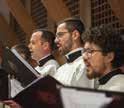
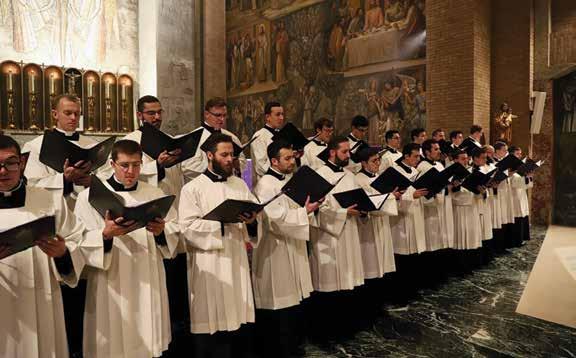
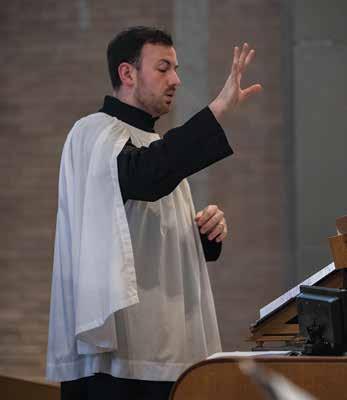
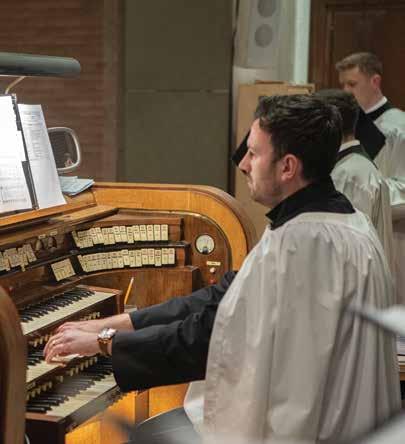
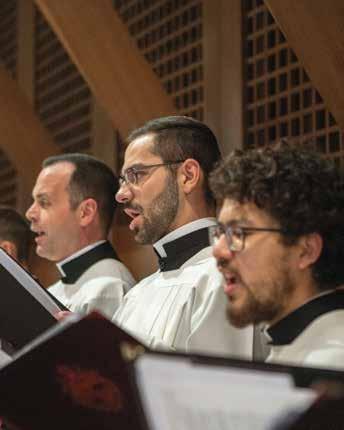
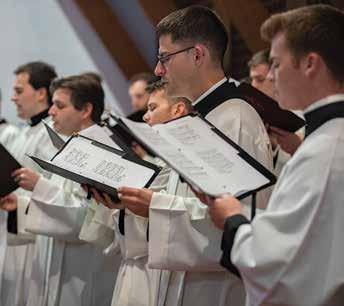
College choir, directed by Mr. David Swenson, Coordinator of Liturgical Music.
Rome, the Finest Teacher
BRENDAN FINNEGAN ‘27, ARCHDIOCESE OF HARTFORD
An alumnus of the College recalls the 1950 Jubilee.
In the Cortile degli Aranci at the center of the Pontifical North American College, a plaque reads, “Rome is herself the mentor and the finest teacher of future priests.” This is certainly true for the longest-serving bishop in the United States (57 years), the Most Reverend Daniel A. Cronin ‘53, Archbishop Emeritus of Hartford and former Chairman of the College’s Board of Governors. In an interview, Archbishop Cronin kindly shared with Roman Echoes the story of how Rome shaped him as a priest.
Archbishop Cronin’s formation by the city of Rome began in 1949, when he arrived at the College’s original home, now the Casa Santa Maria. He is grateful, as our seminarians are today, for the gift of jubilee years. On Christmas Eve 1949, he was in attendance when Pope Pius XII opened the Holy Door of the Papal Basilica of Saint Peter in the Vatican for the 1950 Jubilee. Archbishop Cronin is especially grateful for two events during the 1950 Jubilee. First, he crossed the threshold of the Holy Door of each papal basilica with the seminarians of his camerata (corridor). Second, he recalls standing beside a fountain in Saint Peter’s Square when Pope Pius XII appeared on the loggia to declare the Dogma of the Assumption. Seventy-five years later, Archbishop Cronin can still quote part of the declaration in Latin.
The Pontiff who occupies the Chair of Peter during a seminarian’s time in Rome takes on the role of a teacher par excellence Pope Pius XII, who was pope during Archbishop Cronin’s time as a seminarian, was the first successor of Saint Peter whom he saw up close and personally. Archbishop Cronin recalls the “stately and competent” bearing of the Pope, whose life and teaching have inspired his ministry throughout his life.
Archbishop Cronin served in the Holy See’s Secretariat of State under Pope Saint John XXIII. He was able to learn from the Holy Father in meetings with foreign officials and in first-hand participation in events surrounding the Second Vatican Council. Archbishop Cronin recalls a private audience with Pope Saint John XXIII on the third floor of the Apostolic Palace in Castel Gandolfo, with a beautiful breeze off Lake Albano. Ecclesiastical affairs were on the docket, but most memorable was the rosary—blessed by the Pope—that Archbishop Cronin’s mother in Boston received afterward. The semblance between the two men is striking, both in their joyful disposition and in their episcopal mottoes based on the virtue of obedience.
Later, as a conclavist to His Eminence Richard Cardinal Cushing of Boston, he witnessed the election of Pope Saint Paul VI. Additionally, he served as a translator between Pope Paul VI and English-speaking dignitaries.
Archbishop Cronin is grateful for the teaching Rome gave him over the years, and he is hopeful for the future. He quipped, “Pope Leo XIV is a gem. He encapsulates the best of Pius XII, John XXIII, and Paul VI.” Archbishop Cronin’s advice to current seminarians is always to say “yes” to what the Church asks of you, knowing that the Lord will be with you on every step of your priestly adventure.
To Archbishop Cronin, Ad multos annos! n
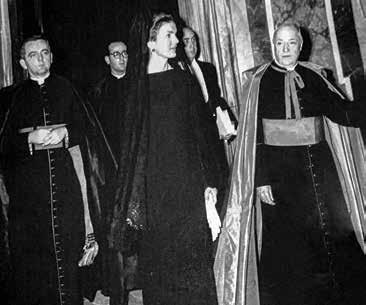
top: The Most Rev. Daniel A. Cronin ‘53 (left) with the author, Brendan Finnegan ‘27 (right). bottom: Archbishop Cronin (left) escorting Jacqueline Kennedy (center) around the Vatican in 1963.
ALUMNI
In this issue’s Alumni segment, Rev. Jose Lim ‘23 (Metuchen), reflects with gratitude on his vocation, his priestly ministry, and his formation at the College.
Reflecting upon this new journey of priesthood, the word gratitude regularly comes to mind. I am grateful to Jesus Christ for the ministry that I am privileged to serve in, for the vocation that I have been blessed to have been invited into, and for the great adventure of the priesthood which, in many ways, I realize I have just begun. Much of this adventure, I am incredibly grateful to say, was brought to life through my time as a seminarian at the Pontifical North American College.
I never expected to be invited to attend the College, and I was, therefore, in-
Grateful for the Call
REVEREND JOSE LIM ‘23, DIOCESE OF METUCHEN
credibly surprised when the Most Reverend James F. Checchio ‘92, Bishop of Metuchen and former Rector of the College, asked me if I would consider continuing my formation on the Janiculum Hill. He gave me twenty-four hours to decide, and after a morning of quiet prayer, I accepted Bishop Checchio’s generous invitation to spend the next five years in the Eternal City. I had no idea just how this small and yet significant moment of grace would transform the rest of my life.
Within a few months, I had packed my bags and found myself moving into a new community, to a new city, to wrestle with a new language, to meet new students and faculty, and to see the universal Church in a way that I never before experienced. In particular, the richness of friendships at the College and the growth of my prayer life there helped me to realize that the greatest joy of my life was to be a priest of Je-
Over 15,000 followers, fans, and friends – join us!
sus Christ and to live as a witness of his love on behalf of the Church. I will be forever grateful to God for the College. My time there gifted me with experiences I will treasure for the rest of my life, friendships that will sustain me for years to come, and the realization that I am simply a small part of an incredible family known as the Catholic Church.
As a parish priest in my home diocese, the Diocese of Metuchen, not a day goes by where I do not think of my years in the Eternal City, the brothers who walked alongside me, the priests who guided me, and the College that formed me. The lessons of priestly identity, the truths of our Catholic faith, and the mission of sharing the Gospel of Christ Jesus continue to feed my ministry in my parish, its adjoining school, and in the hospital that I serve. Although I have traded the Immaculate Conception Chapel in Rome for Immaculate Conception Church in Annandale—and the aule of the Roman universities for the patient rooms of Saint Peter’s University Hospital in New Brunswick—the experiences and bonds that formed me in Rome will forever remain in my heart. I am grateful to Jesus Christ and his Church to be able to say that I am a son of alma mater—the Pontifical North American College. n
For Your Calendar, With Gratitude
MARK RANDALL, CFRE • EXECUTIVE DIRECTOR, INSTITUTIONAL ADVANCEMENT
The theme of this issue—gratitude—is an especially fitting one for me to reflect upon as head of the Office of Institutional Advancement. It is, in many ways, the easiest topic to write about, and one I have addressed often, because the Pontifical North American College quite literally stands upon the generosity of our benefactors, alumni, and friends. From our founding in 1859 to this very day, your support has made our mission possible. Grazie mille!
As we move through the fall, I invite you to take a few moments to review the various communications you’ll be receiving from us—the NAC Magazine, our “New Man,” “All Souls,” and “December 8th Annual Appeal” mailings, your 2026 wall calendar, and more. Each piece offers a glimpse into the life of the College and the men who are preparing here to serve the Church in the US with faith and dedication.
Our Restored in Hope 2025 Jubilee Campaign continues to progress well, yet your partnership remains essential to ensure that our campus is equipped to serve future generations of seminarians for the next quarter century and beyond.
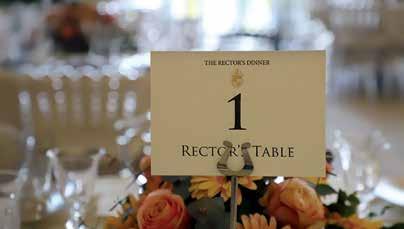
I am also delighted to announce the return of the Umiltà Dinner—please plan to join us in Baltimore, Maryland, on November 9th. And be sure to mark your calendars for April 16, 2026, when we will gather in Rome for the 31st Annual Rector’s Dinner—an evening that promises to be truly memorable. Tickets and tables will be available beginning in early January 2026.
To learn more about these initiatives and the many ways you can continue to support our mission, please visit www.pnac.org. Thank you for your past generosity and for your ongoing investment in our important work. n
For more information about The Pontifical North American College, subscription questions, or to learn about ways you can financially support “America’s Seminary in Rome,” please contact Mark Randall, CFRE, Executive Director, Institutional Advancement.
Tel: (202) 541-5411
Fax: (202) 470-6211
Email: pnacdc@pnac.org
Website: www.pnac.org
Cardinal Christophe Pierre, Apostolic Nuncio to the US, and Norman and Darlene Ferenz of Oldsmar, FL.
“NOVA ET VETERA” alumni newsletter
FALL 2025
My Fellow Alumni,
As we continue our ministries across the country and world, I offer each of you every blessing in this new season of priestly service. Whether in parish work, specialized ministry, or graduate studies, we remain bound by the grace of our Roman formation—both on the Janiculum Hill and in the heart of Rome at the Casa Santa Maria.
Some of you welcomed seminarians this past year for summer or pastoral experiences. Their presence not only helps their formation but also reminds us of our own years of preparation and of the truth that priestly formation never ends. Ongoing growth—spiritual, intellectual, pastoral, and fraternal—remains essential for us as we carry forward the mission of Jesus Christ in his Church.
Looking ahead, plans are already underway for alumni connections during Diaconate Ordination Week in Rome in fall 2026. Mark your calendars now for this opportunity to renew bonds with one another and with the College.
This Jubilee of Hope began with our January reunion and photo with Pope Francis. It was a beautiful moment of grace and closeness to the Holy Father in what would be the last months of his life. Our tireless Holy Father Pope Francis gave us the final witness of pouring himself out to the end as an enduring example of pastoral presence and blessing for the flock entrusted to his care.
I am grateful to report that, thanks to your response to our September e-mail dues appeal for the goal of our annual dues, namely to support the full-time priest faculty of PNAC with a Christmas gift, we are well on our way to that support for this December! Please keep dues and donations in mind: $75 annually, payable to PNAC Alumni Association, mailed to: Immaculate Heart of Mary Parish, 8 Carman Road, Scarsdale, NY 10583. Donations above this amount are gladly accepted.
Please also continue to send alumni news—if not used immediately, we will keep it for future Roman Echoes. We commend all in new assignments, and in a special way congratulate Bishop Thomas Hennen, newly ordained Bishop of the Diocese of Baker (Oregon)!
On a personal note, this August I began as Vice-Rector and Dean of Seminarians at St. Joseph’s Seminary, Yonkers. For ease of the process, all alumni mail should continue to be received at Scarsdale.
As some may be headed to the Jubilee 2025 in Rome with our new Holy Father Pope Leo XIV, and as others begin to plan for our reunion in 2026, may we recommit ourselves to Christ’s mission and to the bond we share with the successor of Peter. And may now Saint Pier Giorgio Frassati continue to urge us: Verso l’alto!—Always to the heights!
In Christ,
Monsignor Luke M. Sweeney ’01 and former Adjunct Spiritual Director Executive Secretary, PNAC Alumni Association
alumni member update
LTC US ARMY (RET.) FRANCIS MATTHEW GLYNN, STB ‘66 (Richmond) participated in the January 2025 alumni pilgrimage, and shared memories of being stationed in and near Rome during his time at the Embassy and during military assignments.
VERY REV. MICHAEL G. RYAN ‘67 (Seattle) became pastor emeritus of St. James Cathedral in Seattle after serving for 37 years as cathedral pastor.
REV. JOHN R. VAUGHAN ‘74 (Owensboro) retired from the pastorate and transitioned to senior clergy status in June 2025.
MOST REV. CHARLES DANIEL BALVO ‘76 (Holy See) Nuncio to Australia and New Zealand, was also present.
REV. MSGR. JEFFERSON J. DEBLANC, JR. ‘77 (Lafayette) is moving to residency at St. Peter Parish, New Iberia, Louisiana, where he began his priestly journey in 1977, and to chaplaincy at nearby Consolata Home for priests, religious and laity who cannot live on their own. He will have no admin duties, which will help him as a senior priest to focus more on prayer and service in his new assignment.
REV. PATRICK J. DOLAN, PHD, STHD ‘78 (Louisville) has been involved in the US Military, in addition to his parish duties. The Apostolate Militare International sent him and a senior Dutch Psychiatrist to Ukraine to train chaplains, cadets, and civilians in the 5 stages of helping prevent and recover from the invisible wounds from war.
2024 Archdiocese of Dubuque gathering: From front left, clockwise: Rev. Scott F. Boone ‘01, Rev. Anthony J. Kruse ‘11, Rev. Nicholas B. March ‘04, Rev. Mark Allen Ressler ‘76, Rev. Mark D. Murphy ‘14, Most Rev. Scott E. Bullock ‘91, Very Rev. Brian M. Dellaert, JV, JCL, STL ‘05, C’16, Rev. Dennis Conway ‘17, Rev. Kyle M. Digmann ‘14, Rev. Jeffrey Alan Dole ‘15, C’25
REV. MSGR. MICHAEL G. CLAY ‘79 (Raleigh) has published a second edition of A Harvest for God: Christian Initiation: A Primer for Christian Initiation in Rural/Small-Town Culture and Latino Culture and has launched a website (Harvest4God.com) to assist initiation ministers seeking resources to form inquirers, catechumens, and candidates in the OCIA.
REV. MSGR. FRANCIS X. BLOOD ‘79 (St. Louis) is in his fourth year as senior associate pastor at St. Joseph in Manchester, MO. He reports that he enjoys ministry in English and Spanish, and that there are also Brazilian and Filipino communities in the Archdiocese. The parish has 2,500 households and many vibrant faith sharing opportunities in multiple cultures and age groups.
Summer
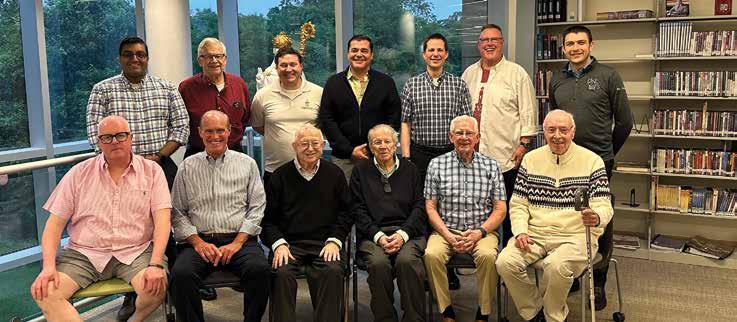
The Boston PNAC alumni gathered in June 2025 at Pope St. John XXIII National Seminary. Seated (Left to Right): Rev. Paul B. O’Brien ‘91, Very Rev. Brian R. Kiely ‘78, Most Rev. William Francis Murphy ‘65, C‘74, Most Rev. Arthur L. Kennedy ‘67, Rev. Msgr. William Patrick Fay, PhD ‘74, Rev. Msgr. Peter V. Conley ‘64; Standing (L to R): Rev. Denis N. Nakkeeran ‘20, Rev. John E. MacInnis ‘70, C‘81, Rev. Kevin P. Leaver ‘17, C‘18, Rev. Christopher Boyle ‘19, C‘20, Rev. Thomas K. MacDonald, Jr ‘13, C‘18, Rev. William T. Kelly, STD ‘88, C‘95, Rev. Joseph Ferme IV ‘22
REV. PETER JOHN MUHA ‘88 (Gary) reports that after serving for two and a half years at St. Joseph Parish in Dyer, Indiana, he is now pastor of St. Mary Church in Crown Point. The parish has 2,000 households on the books and 550 children in the pre-K through 8th grade school.
REV. THOMAS BUFFER, STD ‘91, C‘01 (Columbus) started the Substack, “A Shepherd’s Care,” with analysis of the influence of the New Apostolic Reformation within the Catholic Church. fatherthomasbuffer.substack.com
REV. BRIAN F. MCGRATH ‘92 (Springfield, MA) became pastor at St. Agnes in Dalton, MA. The parish, in the heart of the Berkshires, ministers to eight towns through two churches, a pre-school – 8th grade parochial school, and a small cemetery.
REV. JOHN P. CUSH, STD ‘98, C‘15 (Brooklyn) has just published his new book, A Concise Introduction to Bernard Lonergan, SJ (En Route, 2025).
REV. MSGR. MICHAEL E. TUREK S‘99 (St. Louis) is retired in residence at Saint Margaret of Scotland Parish in St. Louis as of July 2025.
REV. NICHOLAS ROUCH C‘00 (Erie)
Currently serving as Vicar General and Pastor of St. Julia Parish in Erie.
REV. JOSE JUAN SERNA STL ‘00, C‘03 (Stockton) is serving as pastoral center chaplain and parochial vicar at St. Anne’s Lodi.
REV. ALEJANDRO E. VALLADARES ‘00, C‘03 (Mobile) shares of his prayers for the PNAC Class of 2000 for 25 years of priesthood. “Through the prayer of Our Lady of Humility, may we remain faithful to our ministries until the hour of our death! Amen!”
REV. THOMAS W. KUNZ, VE, JCD ‘04, C‘12 (Pittsburgh) was appointed General Secretary, Vicar General, and Moderator of the Curia of the Diocese of Pittsburgh on July 15, 2025.
HON. JOSEPH L. SHETLER ‘06 (Cole County, Missouri) was appointed by Missouri Governor Michael L. Parson to serve as associate circuit judge for the 19th Judicial Circuit (Cole County, Missouri) and was sworn in on October 11, 2025.
REV. LLANE B. BRIESE ‘10, C‘16 (Atlanta) has a new article, “Salvation Stories: The Rhetoric of Story in Sacred Scripture,” that was published in Gregorianum 106 (2025): 3-22.
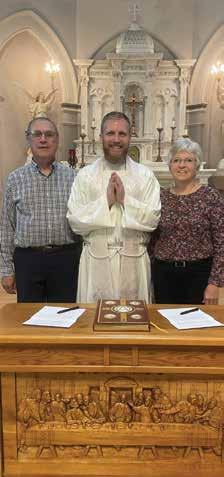
Rev. Jeff Dole ‘14 (Dubuque) with his parents at his installation as rector of Saint Pius X Seminary in Dubuque, IA.
VERY REV. MICHAEL S. SEDOR, STL, JCL ‘12 C‘19 (Pittsburgh) was appointed Associate General Secretary, Episcopal Vicar for Canonical Services, and Vice Chancellor of the Diocese of Pittsburgh on July 15, 2025. He remains Judicial Vicar as well.
REV. RYAN BROWNING ‘13 (Rockford) was appointed Pastor at St. Peter Catholic Church in Geneva, Illinois.
VERY REV. ALAN MICHAEL GUANELLA ‘13 (La Crosse) was named Judicial Vicar of the Diocese of La Crosse as of July 1, 2025.
REV. CHRISTOPHER P. GRAY ‘13, C‘17 (Salt Lake City) is the Rector of the Cathedral of the Madeleine, as of August 1, 2025.
REV. ROBERT M. ROCHELEAU F‘13 (London, Ontario) is still grateful for a wonderful sabbatical in the fall of 2013 with a tremendous group of brothers who he prays for daily. He shared that he has returned to Rome often since then, and remembers the program fondly. He continues to serve as pastor in Windsor, Ontario with a Family of Parishes.
REV. JOSEPH R. LARACY, STD ‘13, C‘19 (Newark) is currently on a Seton Hall University faculty sabbatical devoted to scholarly research and writing for the academic year 2025-2026.
REV. JEFF DOLE ‘14 (Dubuque) has been appointed Rector of Saint Pius X Seminary in Dubuque, IA.
REV. JOSEPH A. WEBER, JR. F‘15 (St. Louis) is officially retired from the Archdiocese of St. Louis, but staying active serving as administrator of St. Anthony the Great Byzantine Church, Eparch of Parma.
REV. TIMOTHY JOSEPH FURLOW ‘15 (Portland, OR) has been appointed the Director of Ongoing Formation for Clergy in the Archdiocese of Portland in Oregon.
REV. ANDREW M. DEROUEN ‘20 (Lake Charles) began the JCL program at CUA this Fall.
DEATHS
Rev. James L. Harrison ‘56 (Atlanta) – March 7, 2025
Rev. James A. Coriden ‘58, C‘61 (Gary) – February 7, 2025
Most Rev. Stanley G. Schlarman DD ‘59 (Belleville) – April 28, 2025
Rev. Msgr. James R. Tracy ‘61, F‘72, F‘11 (Camden) – April 23, 2025
Most Rev. John G. Vlazny ‘62 (Portland, Oregon) – May 23, 2025
Rev. J. Lawrence Richardt ‘63 (Indianapolis) – July 7, 2025
Rev. Msgr. Hugh J. Corrigan ‘64 (New York) – September 7, 2025
Most Rev. Carl F. Mengeling STD C‘64 (Lansing) – July 1, 2025
Rev. Msgr. James E. Pieper C‘65 (St Louis) – August 1, 2025
Rev. Msgr. Robert Senetsky C‘66 (Eparchy Of Passaic) – September 3, 2025
Rev. David E. Noone ‘67 (Albany) – June 15, 2025
Rev. John P. Bergstadt ‘68 (Green Bay) – April 6, 2025
Most Rev. John R. Gaydos ‘69 (Jefferson City) – September 6, 2025
Rev. J. Patrick Gaza ‘69 (Gary) – June 18, 2025
Rev. James J. Walsh ‘69 (Cincinnati) – January 29, 2025
Rev. Msgr. William P. Ward, Faculty 1970-74 (Scranton) – June 27, 2025
Most Rev. Lawrence E. Brandt JCD, PhD ‘70, C‘82 (Greensburg) – June 8, 2025
Rev. John F. Brezovec C‘70 (Altoona-Johnstown) – May 19, 2025
Rev. Msgr. Francis J. Schneider ‘83 (Rockville Centre) – February 17, 2025
Rev. Msgr. James R. Kolp F‘88 (Youngstown) – February 5, 2025
Rev. Msgr. James F. Fetscher F‘89 (Miami) – August 16, 2025
Rev. Charles Gregory Butta ‘91 (Washington) – May 20, 2025
Rev. Msgr. Joseph D. Harrington S‘94 (Helena) – July 7, 2025
Rev. Bernard C. Grady F‘98 (Dubuque) – August 29, 2025
Rev. Czeslaw M. Krysa SLD C‘98 (Buffalo) – June 9, 2025
Rev. Msgr. Stephen T. Barnett S‘98 (Sioux Falls) – May 23, 2025
Rev. Cornelius Kelleher F‘00 (Duluth) – July 17, 2025
Rev. Msgr. Thomas J. Healy F‘01 (Brooklyn) – May 10, 2025
Most Rev. Michael J. Byrnes C‘03 (Detroit) – May 30, 2025
Rev. Francis E. Connors F‘03 (Burlington) – May 7, 2025
Rev. John Jay Comerford S‘06 (Carmelite, Chicago Prov.) – September 5, 2025
Rev. Daniel J. O'Rourke S‘06 (Great Falls-Billings) – June 24, 2025
Rev. John P. Lucas JCL ‘69, C‘80 (Chicago) – April 5, 2025
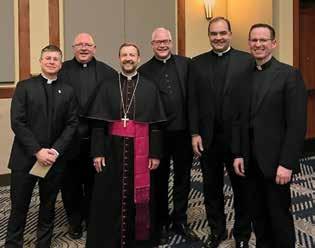
A group of alumni gathered at the reception following the ordination of Most. Rev. Thomas Joseph Hennen ‘04 (Baker) (From left to right) Rev. Lucas Ethan Tomson ‘07 (Spokane); Rev. Brad C. Pelzel ‘02 (Sioux City); Most Rev. Thomas Joseph Hennen, Rev. Christopher M. Mahar ‘04 (Providence); Very Rev. Carter H. Griffin ‘04, C‘10 (Washington); Rev. Nicholas B. March ‘04 (Dubuque).
THANK YOU FOR YOUR PARTICIPATION IN THE ALUMNI ASSOCIATION
Thank you for your participation in the Alumni Association of the Pontifical North American College! Please continue your support of the Association by paying your yearly alumni dues of $75 online at pnacalumni.org or mail a check to the Alumni Association.
PNAC Alumni Association
c/o Msgr. Luke Sweeney 8 Carman Road Scarsdale, NY 10583
Title:
Name:
Class Year: CSM Year: ICTE Year/Session:
Arch/Diocese:
Assignment:
Street Address:
City:
Phone:
State: Zip Code:
Email:
Submit news items for the next Nova et Vetera
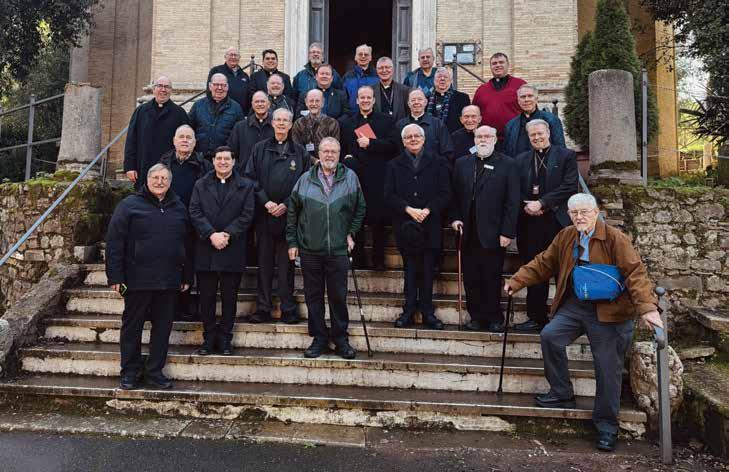
Our 2025 Jubilee Year PNAC Alumni group at the Abbey of Tre Fontane, the site of St. Paul's martyrdom, on the steps of the church, Santa Maria Scala Coeli.