In our Christian lives, there are several types of joy. Christmas joy is the childlike glee of something long-awaited having arrived. Easter joy is different. It is still childlike, although more sober and arguably more mature. It comes after a period of sickness, so to speak. Not all is right in the world; not all is right in our souls. Christ, our God who came to earth, died. We go through the Cross to get to the resurrection. We fast before we feast.
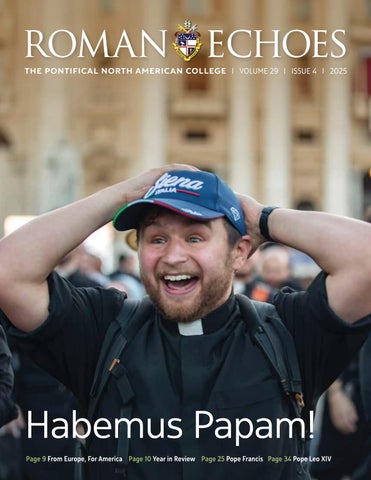
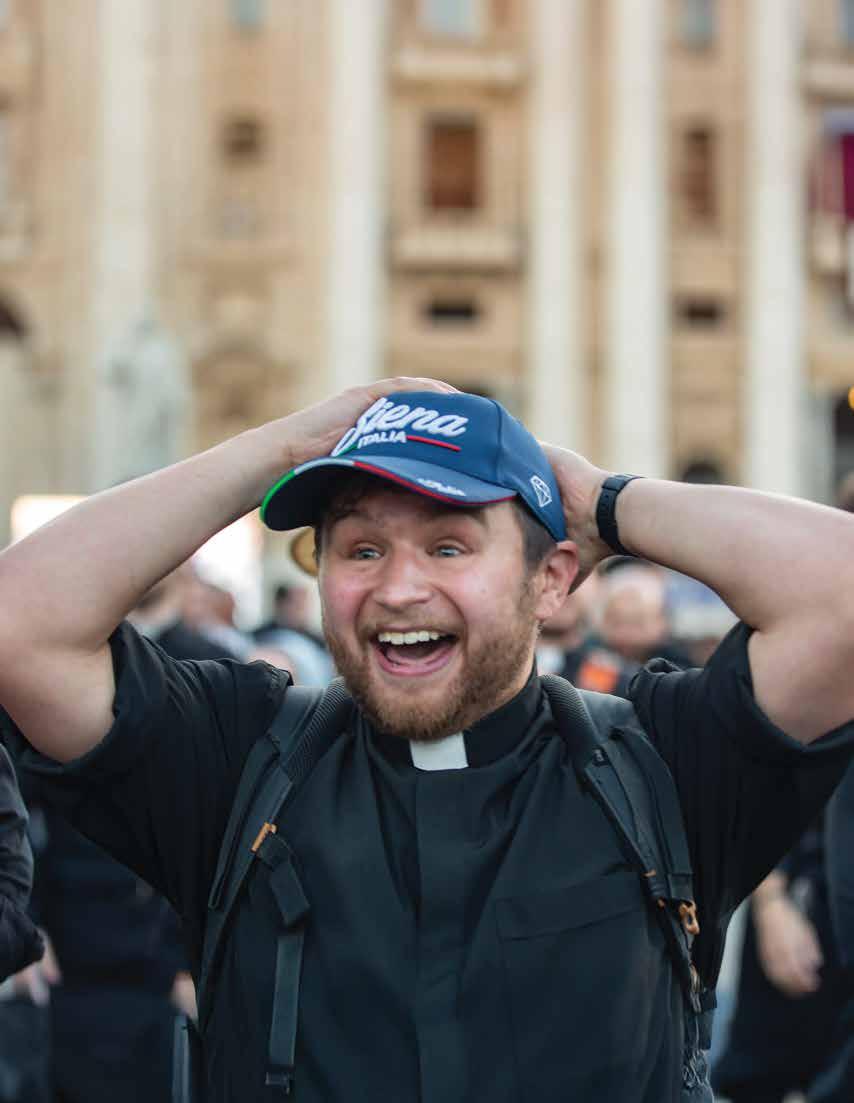
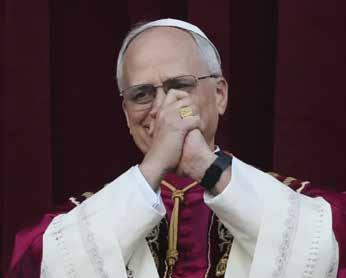
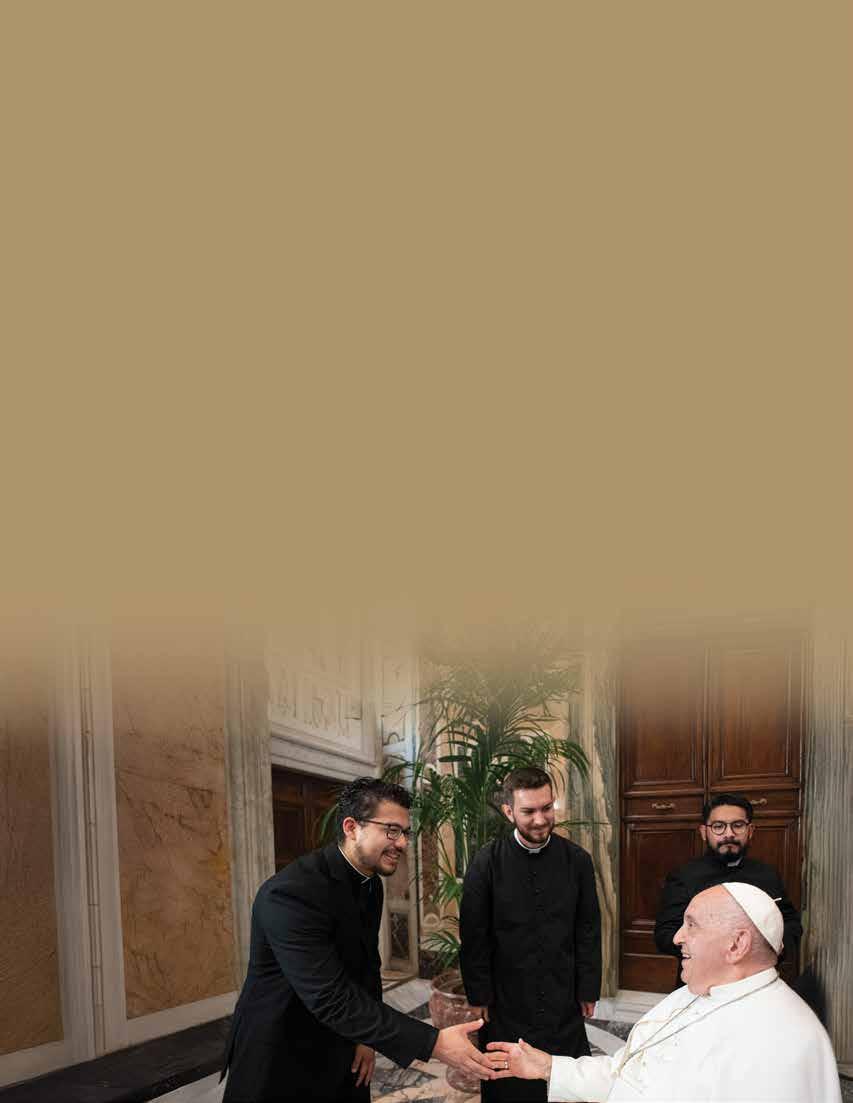
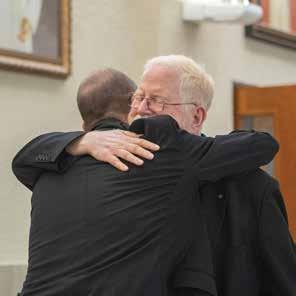
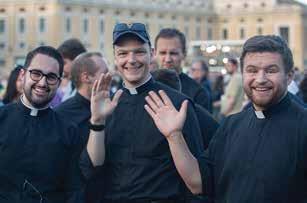
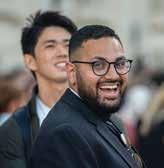
The joy captured on the face of Bruce Cargill ‘27, Diocese of Metuchen, in the cover photo, is an Easter joy. His expression—one of the purest and most genuine I have ever seen— comes after a period of mourning. Pope Francis passed away, and the seat was empty for some days. We could not look to the Holy Father, to the Rock of the Church, for there was no Holy Father. Bruce’s expression is one of surprise, like that of a child whose father returns unexpectedly from a long journey. For a moment he freezes in shock, excitement, and joy. Then comes the cry: “Guys! He’s here! Look—Dad’s home!” And Bruce’s expression comes with an anticipation of the future. “He’s here!” means, “Let’s run to him, sit at his feet, and listen to his stories.” I run to my father not just because his stories are interesting but because they order my soul and reveal the heavenly Father’s love for me.
During this time, we remember the past and continue to pray for the repose of Pope Francis’ soul. We allow the shock, excitement, and joy to permeate our lives. And we look to the future as pilgrims of hope, running to Pope Leo XIV to hear his words and see the doctrinal unity and missionary character of the Church. This unity comes not from the strength of the Vicar but from the free gift of Christ, who who prays to the Father that “they may all be one; even as you, Father, are in me, and I in you…that the love with which you have loved me may be in them, and I in them” (John 17:21, 26).
A new Fisherman sits on the Chair, casting into the deep. May the nets be full at the size of the catch. And may we find ourselves there when the catch is hauled ashore.
As we review the past year in this issue of Roman Echoes, we continue to hold you in prayer. Please do the same for us. May God bless your summer!
Editor-in-Chief
Kyle Lang ‘26, Diocese of La Crosse
Contributors
EDITOR-IN-CHIEF
Kyle Lang ‘26, Diocese of La Crosse
ASSISTANT EDITORS
Graham Fassero ‘27, Diocese of Richmond
Brendan Finnegan ‘27, Archdiocese of Hartford
PHOTO
EDITOR & PHOTOGRAPHER
Steven Lang ‘26, Archdiocese of Saint Paul and Minneapolis
ASSISTANT PHOTOGRAPHER
Christopher Tillotson ‘27, Diocese of Worcester
Administration
of The Pontifical North American College RECTOR
Rev. Msgr. Thomas W. Powers ‘97
VICE RECTOR
Rev. Michael Pratt ‘11
CARL J. PETER CHAIR OF HOMILETICS
ROMAN ECHOES FACULTY LIAISON
Rev. Peter John Cameron, OP
SUPERIOR, CASA SANTA MARIA
Rev. James J. Conn, SJ
DIRECTOR, INSTITUTE FOR CONTINUING THEOLOGICAL EDUCATION
Rev. Edward Linton, OSB
EXECUTIVE DIRECTOR, INSTITUTIONAL ADVANCEMENT
Mark Randall, CFRE
For more information about The Pontifical North American College, subscription questions, or to learn about ways you can financially support “America’s Seminary in Rome,” please contact Mark Randall, CFRE, Executive Director, Institutional Advancement.
Tel: (202) 541-5411 Fax: (202) 470-6211
Email: pnacdc@pnac.org Website: www.pnac.org
This publication is written, edited, and photographed by the seminarians, deacons, and student priests of The Pontifical North American College.
COVER: Bruce Cargill ‘27 (Metuchen) celebrates the election of Pope Leo XIV.
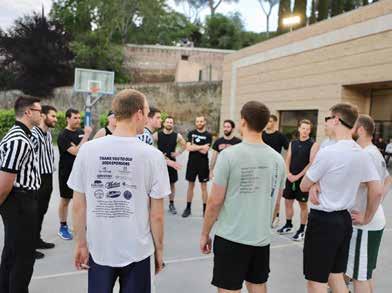
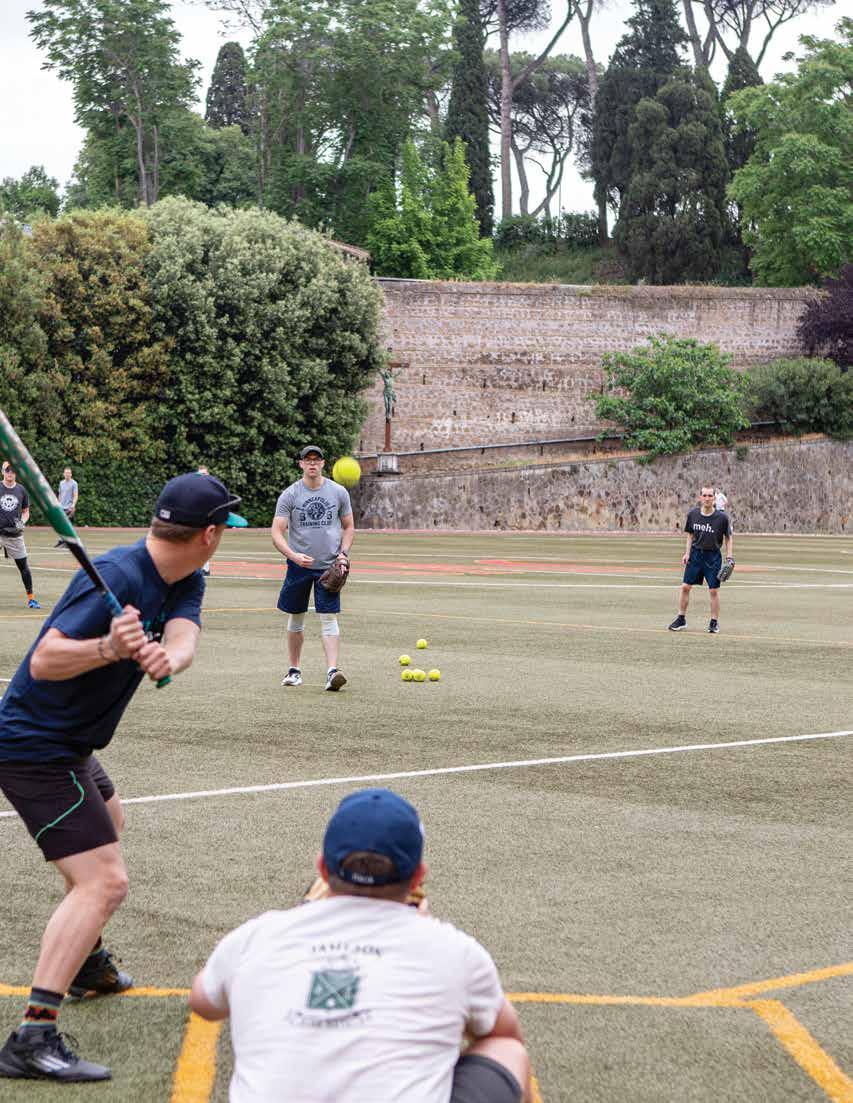
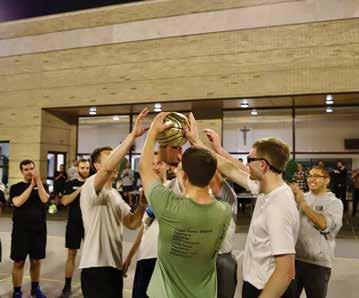
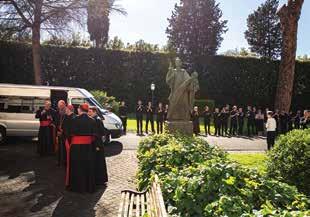
THIS PAGE: Seminarians enjoy the annual University Softball tournament.
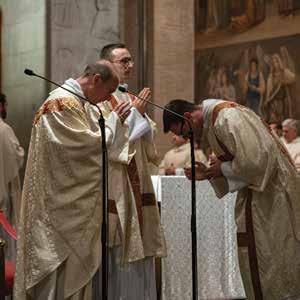
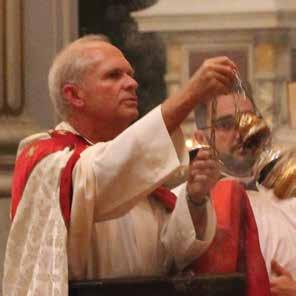
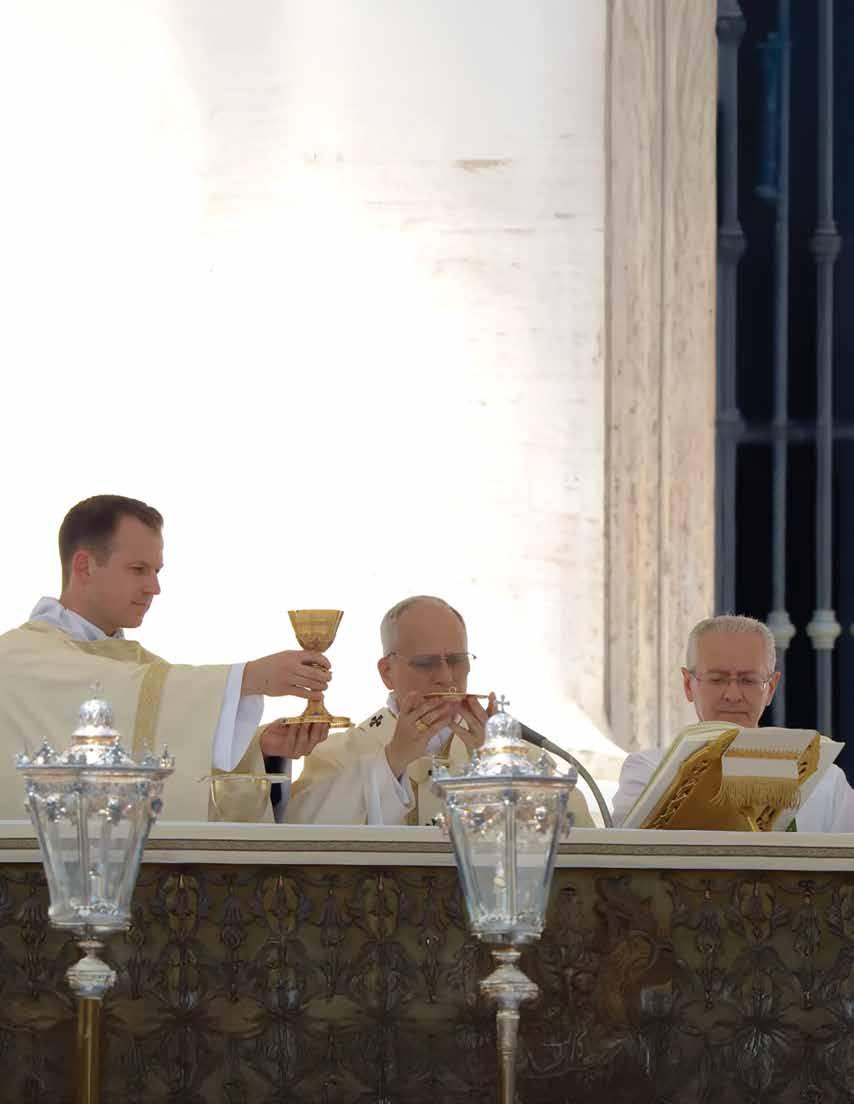
BACK COVER: Rev. Mr. Robert Williams ‘25 (Tulsa) assists Pope Leo at the altar during Holy Mass for the Jubilee of Families, June 1.
RECTOR’S CORNER
The College was blessed to play an important role in the events that took place from the death of Pope Francis through the Inauguration Mass of Pope Leo XIV.
Dear Friend of the Pontifical North American College,
Over the official entrance of the College is a Latin inscription that reads, “The young men who have come here from the distant shores of America, looking upon the Vatican Hill, strengthen their faith and their love for the Roman Pontiff.”
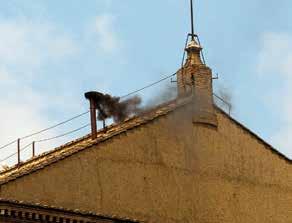
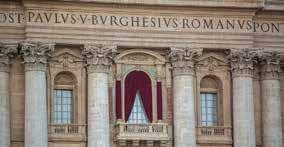
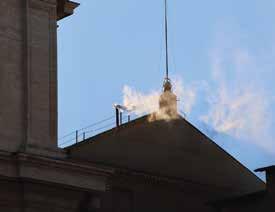
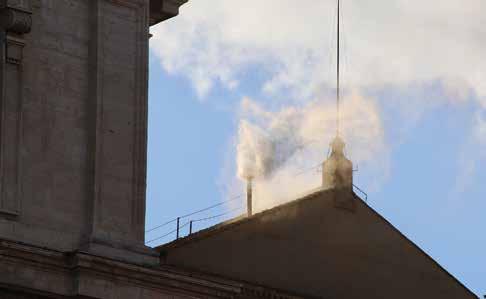
Those words came to life in a palpable way when on May 8th, “looking upon the Vatican Hill” from the College, we saw the fumata bianca—white smoke—flowing out of the chimney on the roof of the Sistine Chapel. Those of us who were not already in Saint Peter’s Square ran down to join hundreds of thousands of men, women, and children from every continent to wait for the words, Habemus Papam. How exciting it was to hear that an American had been elected Pope!
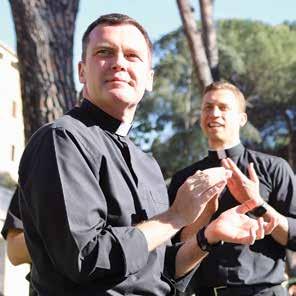
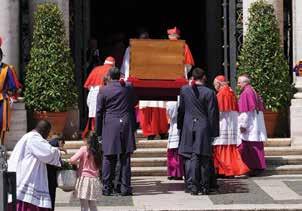
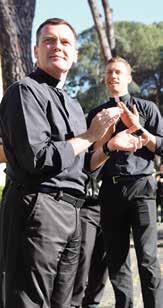
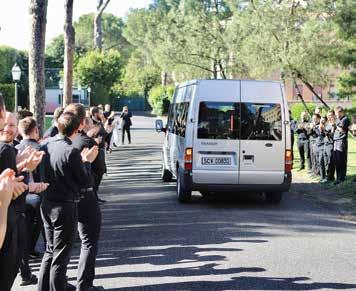
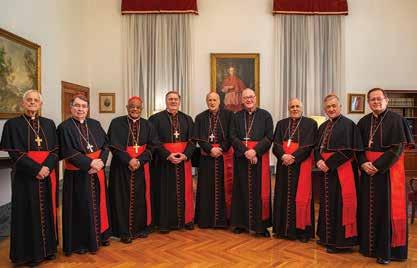
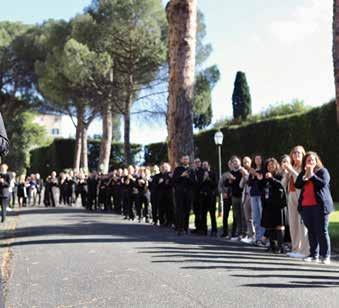
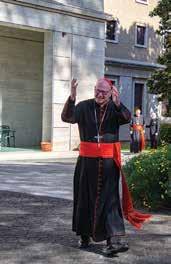
The College was blessed to play an important role in the events that took place from the death of Pope Francis through the Inauguration Mass of Pope Leo XIV. We hosted the American cardinals who had come to Rome, thoroughly enjoying the meals and conversations we had with them; we clapped out the cardinals as they departed the College for the conclave—and clapped them back in when they returned! We facilitated an extraordinary post-conclave press conference, with over eighty news outlets present, to hear the voting American cardinals speak about their experience; and, at the Inauguration Mass, we had solid representation from the College: one of our deacons, Reverend Mr. Nicholas Monnin ‘25 (Fort Wayne-South Bend), chanted the Gospel; our Director of Counseling Services, Dr. Mark Glafke, read the second reading; and over fifty of our deacons and seminarians distributed Holy Communion to the lay faithful.
Last Thanksgiving, then-Cardinal Robert Francis Prevost came to the College to celebrate Mass for our community and to join us for the very American meal of turkey, mashed potatoes, and pumpkin pie—of which he took two pieces home! We hope to have him, now as Pope Leo XIV, back here at the College in the future. Until then, our seminarians will continue to pray for him every day and “strengthen their faith and their love for the Roman Pontiff.”
Be assured of our prayers for you and your family, and thank you for your support.
Sincerely yours in Christ,
Rev. Msgr. Thomas W. Powers ‘97 Rector
Little Shop, Big Impact
REV. MR. ALEXANDER TURPIN ‘26, DIOCESE OF ALBANY
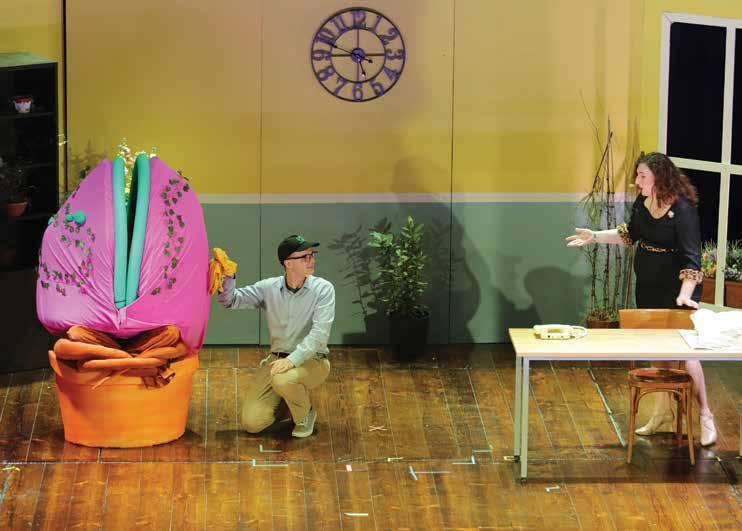
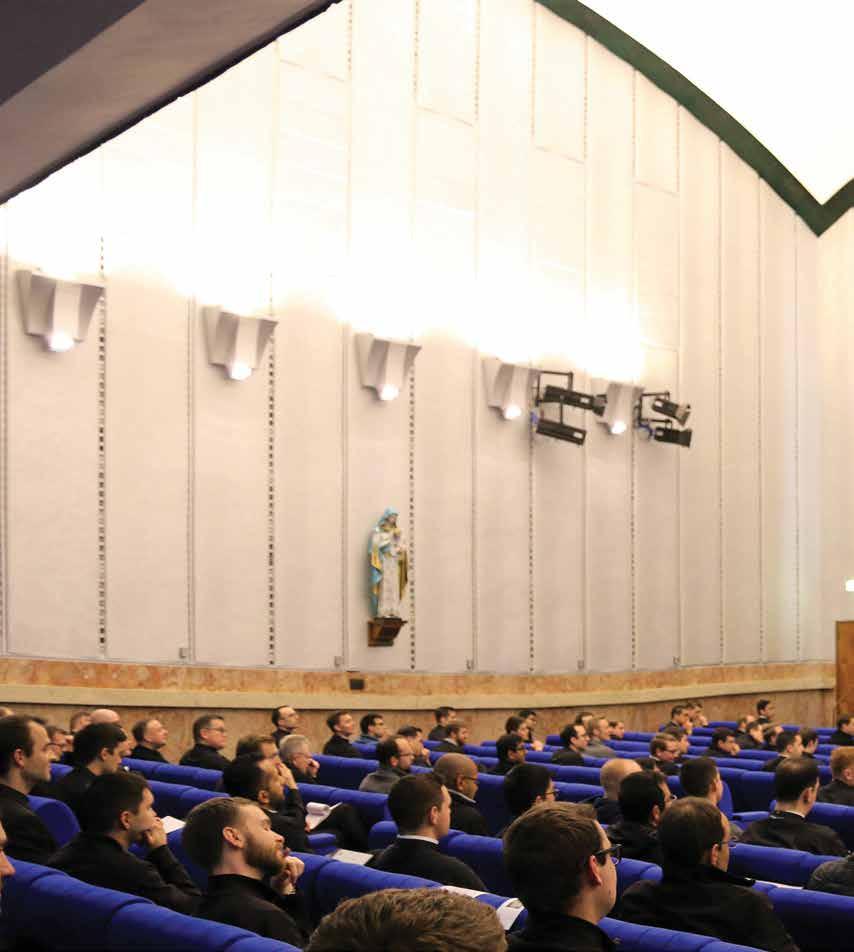
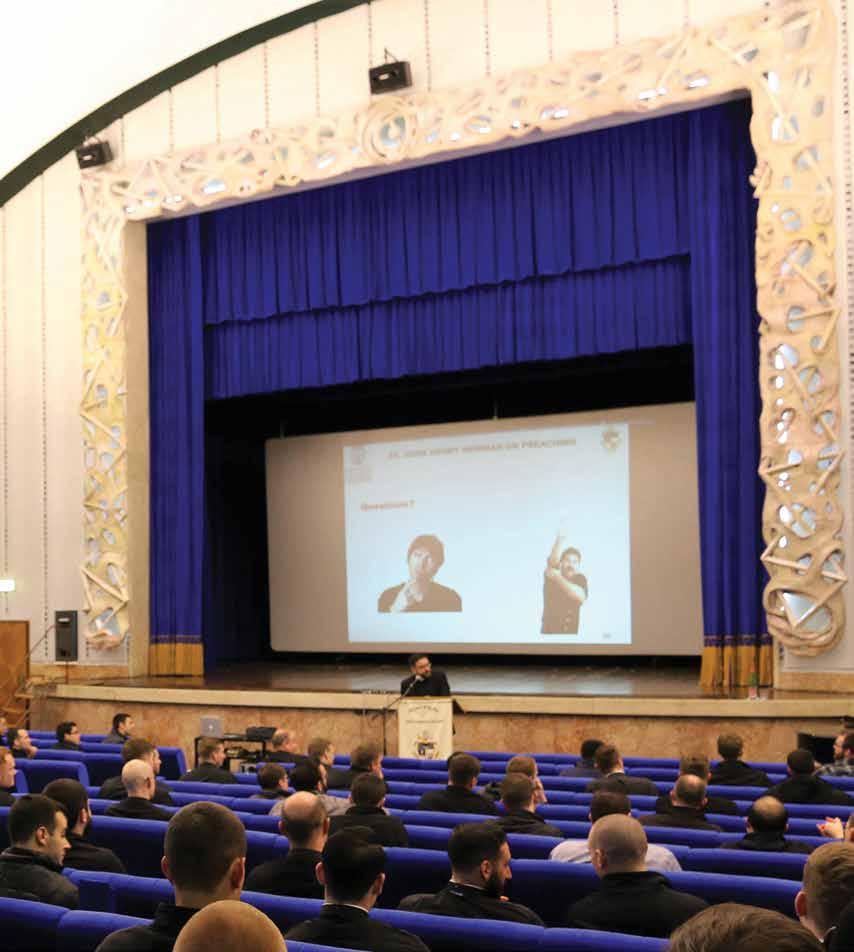
This April, the seminary put on a production of the modern classic Little Shop of Horrors by Howard Ashman and Alan Menken. Following a meek flower shop employee who crosses paths with what turns out to be a man-eating plant, it is a hilarious, cautionary tale about the consequences of sin, filled to the brim with catchy songs and lovable characters. Thanks in part to a grant from the Strake Foundation, the Corso Auditorium has been upgraded with amazing new sound and lighting capabilities, which opened many possibilities to us and allowed us to produce the first musical at the College in twenty-five years!
Though I had the great joy of being the director of this year’s production, the execution of such a show is truly a team effort. It offered us the chance to revel in the talents that God has given to the men in the house. The biggest blessing from the helm of this project was to see men from all over the United States put their gifts toward a single goal, all for the benefit of their brother seminarians and the glory of God.
We are especially proud to have had the highest number of first-year seminarians in many years take part in the production, leading to countless new friendships. We thank God for the arts and their ability to grow our faith and camaraderie. n
Jakob Pohlman ‘27 (Worcester) and Clare Swenson in Little Shop of Horrors
Faith in Motion: Fully Alive
CONNOR LYNCH ‘27, DIOCESE OF DES MOINES
As winter’s hibernating hush gave way to Rome’s radiant spring, seminary sports come alive with laughter, energy, and brotherhood. For the seminarians, dings of the bat, swishes of the basketball, and triumphant cheers are more than just a break from studies—they are a celebration of weekly traditions made new, a renewal of spirit, and friendships enlivened. These precious moments of fraternity remind us all that the path towards priesthood and service of God is not walked alone, but together, with a rhythm of work, prayer, and joyful leisure.
Beneath the Roman pines that enclose our little piece of America, the seminarians embrace these light-hearted joys. In sport and in spirit, we live Saint Paul’s call to “run so as to win” (1 Cor 9:24) and echo Saint Irenaeus’s timeless truth: “The glory of God is man fully alive.” n
The Grace of Ars
LIAM DAIGLE ‘28, DIOCESE OF WORCESTER
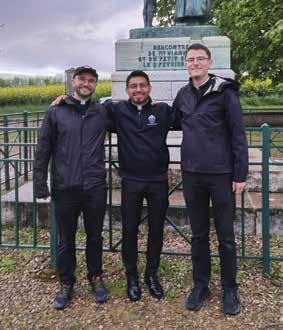
At the beginning of our Easter Octave vacation, I was able to visit the village of Ars, France, with a group friends from the Pontifical North American College. We went on pilgrimage to visit the famous Curé d’Ars, Saint John Marie Vianney, and to see the place where this priest had been a shepherd for many years. A priest of the nearby seminary, which fosters vocations for the international francophone community, guided us and told us about the life of the saint. We also spoke with several religious sisters who serve the visitors of this small town and its impressive basilica. As I learned more about Saint John Vianney, what struck me most about his character was his simple form of generosity. He lived his priesthood in such a way that he held nothing back from the Lord. The fruit of this kind of life is clear. Many souls flocked to him as a spiritual father and sought out his advice and pardon in the confessional. The amazing thing about generosity is that it is accessible to all. Having walked through the humble rooms of the saint’s house and prayed at the decorated chapels of the nearby church, constructed by Saint John Vianney himself, I desire to imitate this saint’s generosity, so as to radiate more fully the profound love of Christ. n
top to bottom: Seminarians compete in the College’s annual Hall Ball tournament; Jakob Wyder ‘26 (Saint Maron of Brooklyn), Rubén Castañeda ‘28 (Mobile), and Liam Daigle ‘28 (Worcester) in Ars.
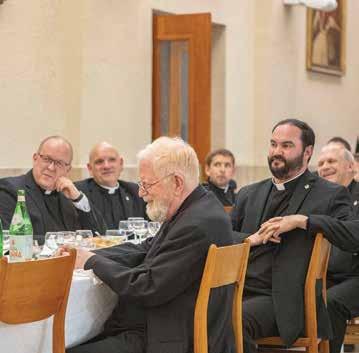
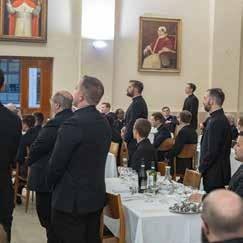
Closing Banquet
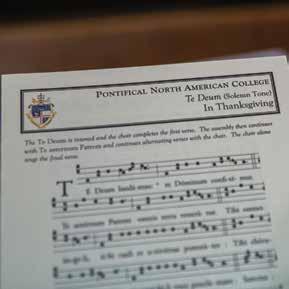
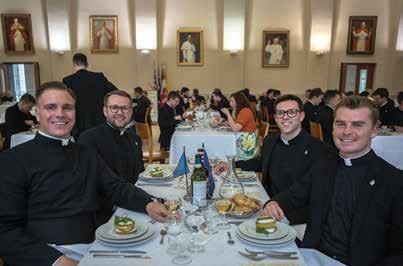
After Mass and the singing of the Te Deum, the annual closing banquet concludes with the sending of deacons, student priests, and departing faculty to preach the Gospel in their respective dioceses.
From Europe, For America
REV. MR. THOMAS O’DONNELL ‘25, ARCHDIOCESE OF BALTIMORE
Saint John Neumann, one of the few canonized priest-saints connected to the United States of America, inspires me to sanctity in a variety of ways. I grew up exploring the streets of Baltimore and nearby towns where Neumann was a Redemptorist pastor. My great-aunt was a School Sister of Notre Dame, and Neumann first brought her order to our country. When she died, I remember a first-class relic of Neumann and a stack of Magnificat missals as her only possessions.
After these years in Rome, I’ve found another connection with Neumann: his months-long trip through western Europe in his mid-twenties, happily ending in his ordination to the priesthood by Bishop John DuBois in 1836. Born near Prague, Neumann set aside a promising lay career to pursue the priesthood. He hoped to be ordained at home and then to go as a missionary to the United States. Instead, a sick bishop and a surplus of priests delayed his ordination indefinitely. In the middle of the night, Neumann departed for America, leaving his parents and sisters, aware that they would never be able to attend one of his Masses, whenever and wherever he might finally be ordained. Neumann trekked through Germany and France before sailing across the Atlantic to reach New York with only one dollar in hand. Neumann’s diaries from this period record his hopeful, longing, and grateful prayers to Jesus, showing how the soul of a saint was formed by these many challenges.
Certainly, my situation is more comfortable. When I follow Neumann’s footsteps in Munich or Paris, it’s not in
search of a bishop to ordain me or a diocese into which I can incardinate. Unlike Neumann, I will have my family present for my ordination and first Mass. Generous stipends and gifts make my travels less outwardly sacrificial.
But, like Neumann, I have found myself in European capitals full of world-class architecture and history hunting for an open confessional or a quiet Blessed Sacrament chapel. With Neumann, I’ve imagined my future as a priest in the United States while praying in foreign cathedrals and shrines, practicing local languages in hopes of using them in future ministry. In our travels, we both have tried to find where the Holy Spirit is working—in dedicated pastors, flourishing religious orders, active lay people. The apparent godlessness of certain cities could be discouraging, yet hope is often reinvigorated by finding a thriving parish community in some far-flung corner of town. Neumann visited Paris in a period of post-revolutionary secularization not too different from our own day, when birth rates and migration patterns are unpredictable, and people cross continents and oceans looking for a fresh start.
Praying one’s breviary in Paris while visiting the tombs of the saints is not a long-term vocation. Still, Neumann’s experience suggests that such travels can form a holy priest. My travel weekends weren’t for sightseeing, but for my sanctification. And, like Neumann, my end goal has always been being ordained a priest on American soil—where the mission begins n
Rev. Mr. Thomas O’Donnell ‘25 (Baltimore) with diocesan brothers Andrew Chase ‘26, John Anderson ‘27, and Benjamin Oursler, ‘26.
2024-2025 Year in Review
Priestly formation is a journey in which the four dimensions of human, spiritual, intellectual, and pastoral formation are woven together to conform the heart of the seminarian to the heart of Christ.*
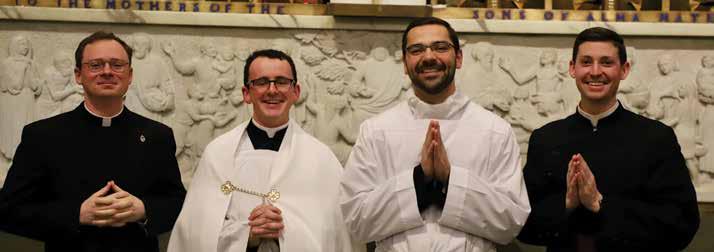
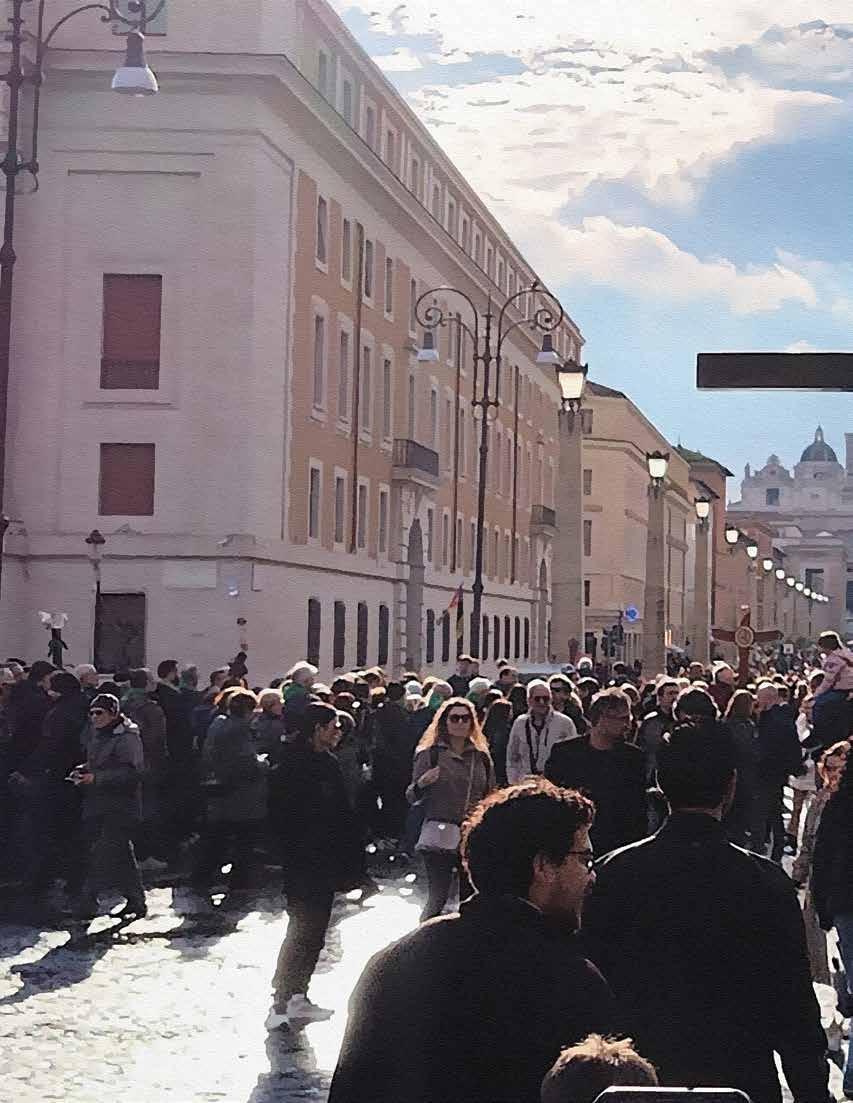
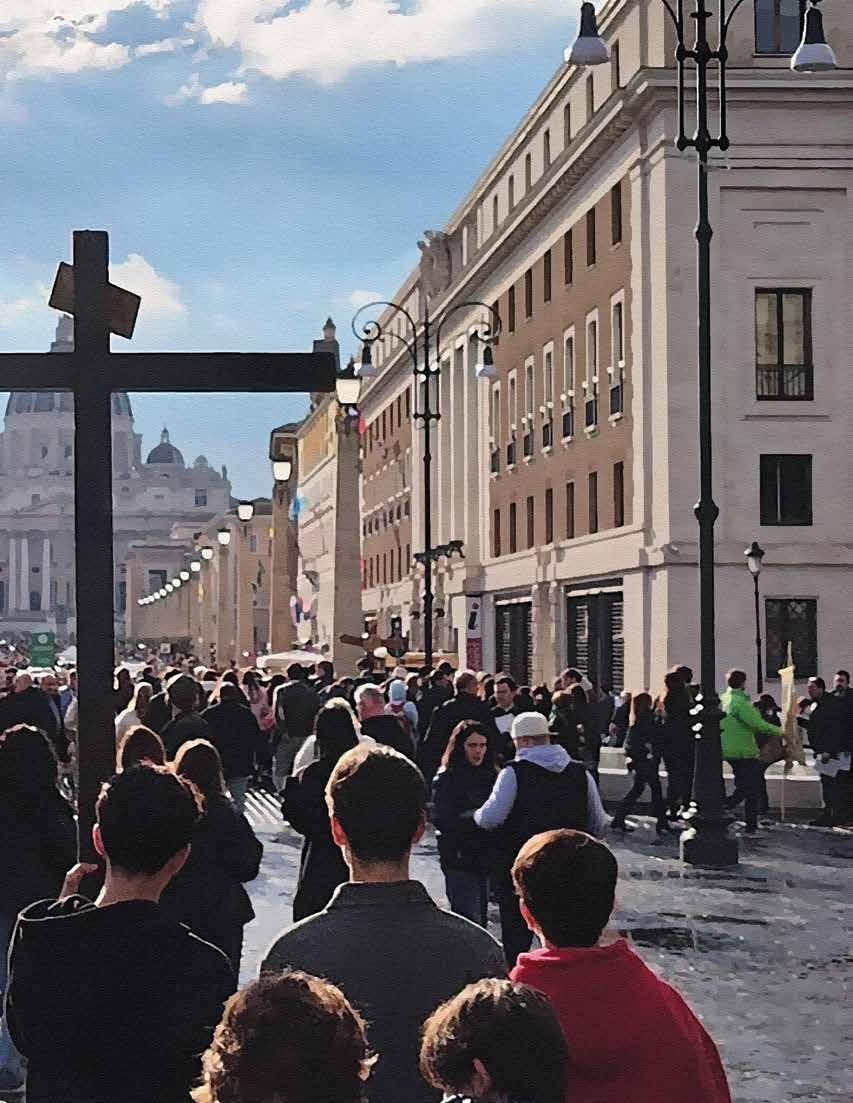
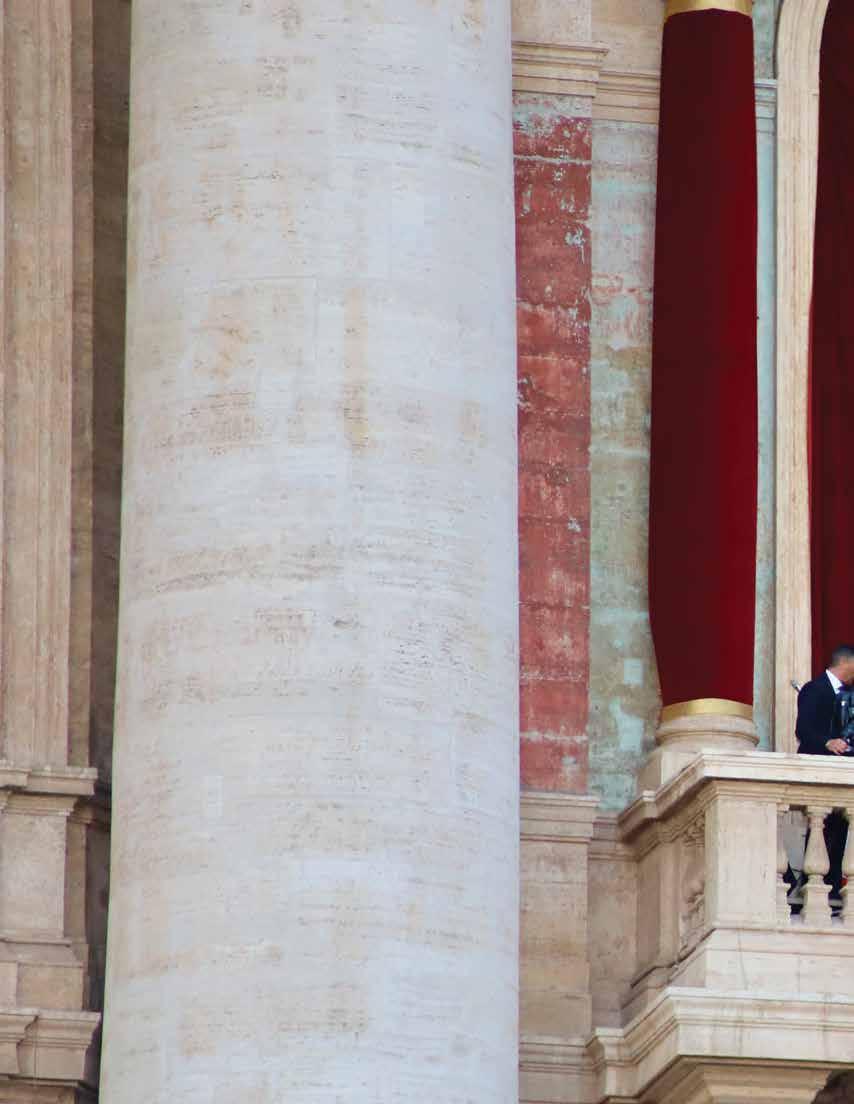
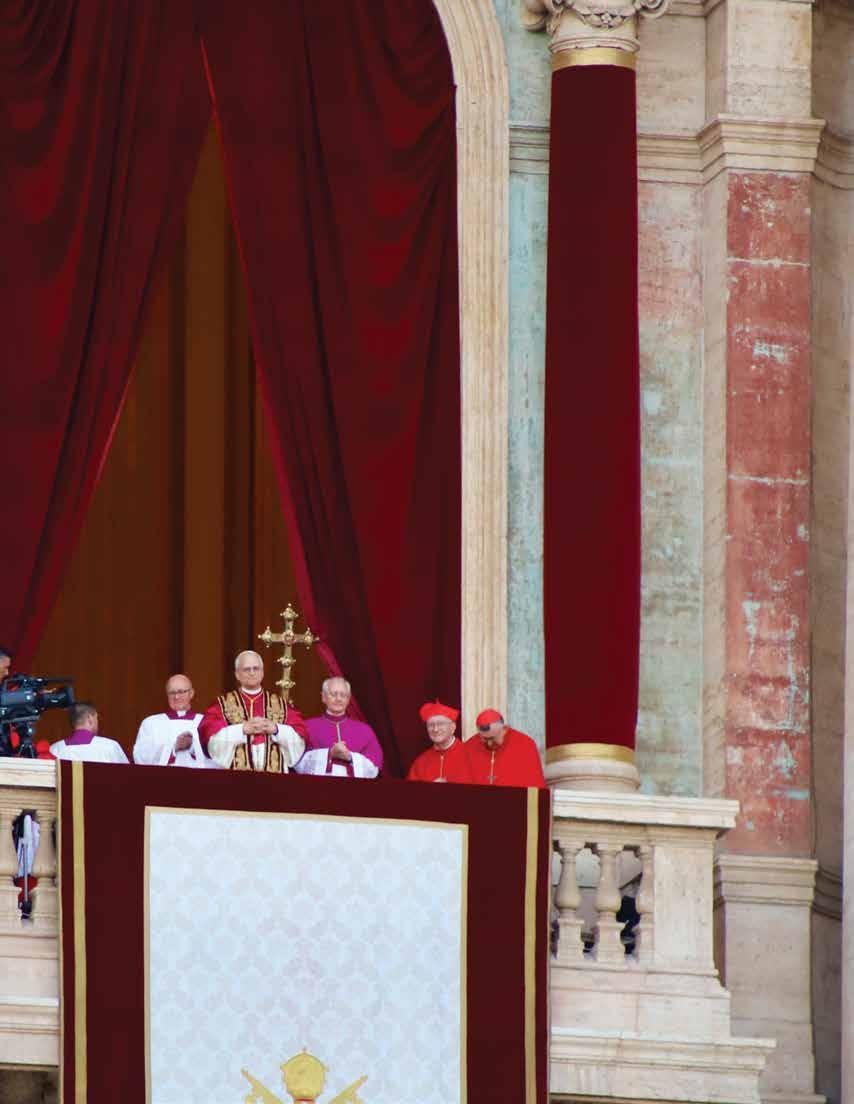
process toward the Papal Basilica of Saint Peter in the Vatican.
Human Dimension Kind Words and Roman Traffic
RUBÉN CASTAÑEDA ‘28, ARCHDIOCESE OF MOBILE
One day during the first week of Lent, I was returning from the Angelicum to the Pontifical North American College on my bicycle. When I was five minutes from the College, I collided with a motorino, fell off my bike, hit the pavement, and dislocated my left shoulder. The driver of the motorino ran with a motherly instinct to pick me up, worried about what had happened to me. She helped me get on my feet and led me to a nearby store to sit down. She gave me some water to drink. I managed to pop my dislocated shoulder back into place, and from this moment I remained calm. I assured her that I was fine and there was nothing to worry about. At the end of our conversation, I told her that God loves her and that I would pray for her.
Looking back on my response—“I am fine. God loves you. I will pray for you.”—I was surprised. I don’t think I would have responded like this ten years ago, because I used to let my emotions take control. This causes me to thank God for the grace he has given me through my past five years of seminary formation. God has been forming me as a man of “authentic realization of self” and guiding me to greater self-possesion. In Pastores Dabo Vobis, Pope Saint John Paul II exhorts candidates to the priesthood to grow in affective maturity toward self-possession of our emotions, speech, and responses.
In my own life, I can see that God is at work. Reflecting on this aspect of my growth reminds me how important our words can be—either uplifting or destructive. Saint Paul advised the Ephesians to “never let evil talk pass your lips; say only the good things men need to hear, things that will really help them” (Eph 4:29). Silvia, after hearing that God loves her and that I would pray for her, left with calmness and a smile of joy on her face. The words that I said to her were perhaps just the words she needed to hear that day.
Self-possession is not only for seminarians, it is an invitation to all of us baptized Christians. We can grow in this virtue by patiently letting the Word of God live in us. We need to dispose ourselves intentionally to daily growth in this virtue, particularly so that our speech may always be uplifting. As we entrust ourselves to God, may his grace be with us and guide our every action to the glory and love of God.
Pastoral Dimension We Have Seen the Lord
REV. NICHOLAS STELLPFLUG ‘25, DIOCESE OF GREEN BAY
Over the past two years, I have helped lead catechesis for Confirmation at the church of Santa Maria in Monserrato degli Spagnoli. While there is much to teach the students, catechesis is not just a time for learning information. Catechesis is a time for encounter. In Deus Caritas Est, Pope Benedict XVI says, “Being Christian is not the result of an ethical choice or a lofty idea, but the encounter with an event, a person, which gives life a new horizon and a decisive direction.” Thinking back to my own time in Catholic school and catechesis, a lot of information about the Catholic faith has stuck with me, but what stands out most vividly are the experiences of the presence of Jesus.
In the midst of a culture that highly values productivity and efficiency, it becomes easy to focus on deliverables: the things we need to do, the catechesis material we need to cover. But the restless search for productivity and results will not help someone to live truly what they profess to believe.
This year, we began focusing on facilitating encounters with Christ. A lot of the students like playing soccer, and I used the example that someone can study soccer and talk about it all they want, but there is no substitute for the experience of going out and playing a soccer match. If things remain theoretical for us, we will never be able to enjoy the gift of living what we believe. Our catechesis sessions began with an introduction to the topic and a brief lesson, followed by guided meditations in the chapel, giving the students time to sit with the Scripture and listen for the voice of God speaking to their hearts. We gave a teaching on the Eucharist followed by Adoration and Benediction with a meditation on John 15. We gave a teaching on sin, mercy, and reconciliation, and a meditation on the Parable of the Lost Son from Luke 15.
Instead of focusing on what we communicate, we focus on who we communicate to the students. It is not just about the intellectual material, but about how the material helps us to encounter Jesus Christ in one another, in the Church, in Scripture, and in the sacraments. As is written in the Song of Songs, “I found him whom my soul loves. I held him and would not let him go.” We, too, have experienced this great love of God, and we want to share it with everyone we serve.
Intellectual Dimension All Roads Lead to the Kingdom
STEPHEN HOWARD ‘26, ARCHDIOCESE OF SYDNEY
Studying in Rome took a lot of effort and time for me to get used to. Besides adjusting to living on another continent, I had expectations regarding the learning experience, and certain habits of personal study, which meant I was confronted with yet another level of culture shock. The most immediate factor was what felt like a grinding passivity, contrasted paradoxically with a truly massive amount of information. Semesters consist of more-or-less eight courses, each of which cover its theme both broadly and thoroughly in an experience that could be likened to a mad dash across a gigantic, hilly field of thick molasses.
Though tongue-in-cheek, the above describes fairly accurately how I felt in my first year—a time when I really had to face the reality of the Cross. Little did I know that the degree program was carefully constructed to synthesize masterfully those great minds who prepared the road before us—a road that the Lord inspired them to prepare for his people to come to him, to help them to embrace his Holy Cross, and to walk confidently to his wedding banquet. I’m delighted by how much I have retained years later, and how integrated it has become in my spiritual and pastoral life. Things I’ve heard in lectures or read in books have seeped into intimate moments of prayer and poured out in conversations with peers, pilgrims, and parishioners alike. How is it that what felt like an impenetrable mystery about the sacraments—taught to me in a foreign language—could float to the surface of my mind right when a person stands before me, hungry for a healing word from me, a man without power to administer the sacraments? How is it that an often-dry experience of information overload could result in a burst of fatherly love in my heart?
What was once merely intuitive in me has become informed, thanks to those who paved the way, but primarily thanks to the grace of God who calls me to be his minister. The Holy Spirit is actively shaping us, not merely as automatons, nor as gnostic wizards, but as men alive with the mind of Christ who loves his people and who wishes them to be transformed by his love. He is transforming me too, and I’m no longer stumbling through thick tar, but walking confidently on paved roads, with the Cross, and with the Shepherd.
Spiritual Dimension Until We Rest in You
JAKOB POHLMAN ‘27, DIOCESE OF WORCESTER
“Take my yoke upon you and learn from me, for I am gentle and humble in heart: and you will find rest for your souls” (Mt 11:29).
Ever since I was a little kid, I have been obsessed with Lucius Quinctius Cincinnatus. Appearing in Livy’s Ab Urbe Condita, Cincinnatus was a model of Roman civic virtue. He was an honorable man, a notable leader, and a brilliant tactician. Beyond all these characteristics, however, his farm was what fascinated me; after serving his country so honorably, he returned to a place of rest, where his wife and children awaited him and where he engaged in simple labor, despite his distinguished career. Growing up as a Navy brat, I was constantly moving with my parents around the eastern seaboard, and the idea of a stable home where I was grounded in rest was, and still is, a powerful desire. Cincinnatus’ farm, for me, became an image of rest and relief from the hardship of the world, and a place of stability and comfort.
Fast-forwarding almost twenty years, my first year at the Pontifical North American College was a difficult one, and one where I did not expect to immediately find a lot of rest and refreshment. Imagine my surprise, then, in discovering old maps of Rome which located the College in a lonely corner of Cincinnatus’ field. God, in his Divine Providence, was mindful of this childhood interest and gave me an opportunity to live it out in a physical way. He was offering me a place of rest.
Even when it seems like the whole world is upended, God constantly offers us a place to rest, and that place is in his very self. While I was looking for an idyllic image of rest which doesn’t exist, God used that desire and that image to teach me to seek him. Even if my heart feels restless amid the changing tides of the world, it can find rest, so long as it seeks that rest in him.
The Fifth Dimension of Formation Rome!
ANTHONY VERA ‘28, DIOCESE OF SIOUX CITY
Monsignor Thomas W. Powers ‘97, Rector of the College, often refers to Rome as the “Fifth Dimension of Formation.” Below, Anthony Vera ‘28 (Sioux City) reflects on how Rome has shaped him during the past year.
Coming from the peaceful, rural life of Le Mars, Iowa, I have found that Rome offers many new experiences, challenges, and opportunities for growth. It is a city filled with characters—from charming store owners to confused tourists to those living in extreme poverty. Walking to and from school has provided opportunities to serve others and to build meaningful relationships. Helping people on the streets and forming genuine connections with those in need has taught me to live the Catholic value of service to my neighbors.
The Pontifical North American College has a special relationship with the unique city of Rome. Our class was blessed to meet Pope Francis upon our arrival, and I was blessed to be able to ask personally for his advice on how best to engage our priestly formation. Now approaching the end of my first year, I have been blessed to pray at Francis’s wake and funeral Mass, saying goodbye to a spiritual father. Now the house is buzzing with excitement at the election of the first Pope from the United States, Leo XIV! Being present at such a significant event for our Church is a joy.
Being in the heart of the Church has allowed me to gain a greater understanding of and a genuine connection to the universal Church. Our hospitable seminary has provided a great location to host friends and classmates for lunch while giving them a magnificent view of the Eternal City. Furthermore, it has been a joy to host parishioners and priests from my diocese who come to see us. They are a pleasant reminder of the love and support we have back home.
The greatest strength of Rome is the spiritual nourishment available from its abundance of beautiful churches and holy saints. It is a blessing to visit the resting place of saints on their feast days and to ask for their intercession. This Lent was particularly impactful for me as I participated in the Church’s ancient tradition of going to the Station Churches throughout the holy season. Not only did the penitential early rising provide a space for prayer in the beautiful sunrises, but exploring new churches and saints helped me learn the layout of central Rome, which every day feels more like a second home.
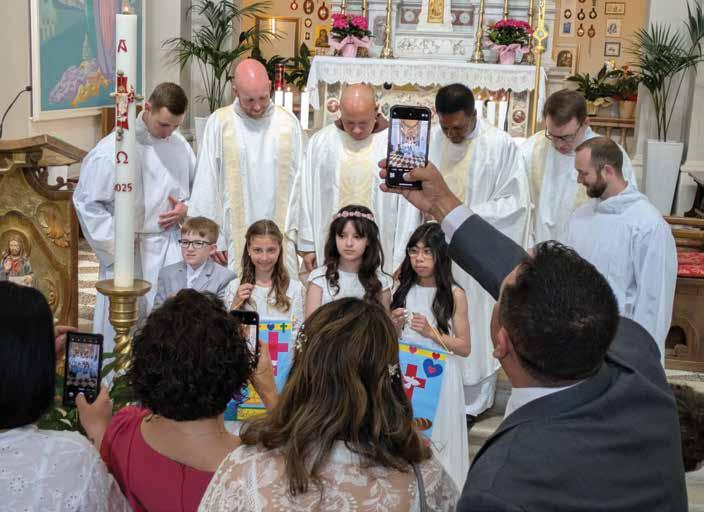
First Holy Communion in Aviano
CHARLES WARNER ‘26, DIOCESE OF SAGINAW
The Saint Joseph Parish community at Aviano Air Base held a First Holy Communion Mass for four children on a Saturday morning during the Easter season. Providentially, the date aligned with my being on base for my apostolic ministry. It was a beautiful celebration and a fitting culmination of the year after having become familiar with the parishioners. Family and friends were in attendance, with some even traveling from outside of Italy to attend. Other parishioners were present to support and share in their joy. Everyone’s coming together demonstrated the beauty and importance of the Eucharist as the source and summit of our faith, which
provides us with spiritual nourishment. Instead of the parish chapel, the Mass was held at a local church, Santuario della Madonna del Monte di Marsure, the site of a sixteenth-century Marian apparition, where Mary appeared to an elderly farmer who would always stop and pray at a small chapel on the hill before beginning his day’s work. This Mass was a special moment for the parish family to celebrate the children who received the Eucharist for the first time, at a place where the Blessed Mother once appeared and where Catholics have been receiving the Lord for centuries. n
Stealing Prayers
NEAL ANDERSON ‘28, DIOCESE OF SAINT CLOUD
One day, I biked with other seminarians to a part of the city where we have gotten to know many of our homeless brothers and sisters. As I got off my bike, I realized I had forgotten my bike lock. I was in a dilemma. In this part of the city, any unguarded asset worth more than five euros usually finds a new owner quickly. I decided to risk it. I propped my bike on the sidewalk, and in a last-ditch effort to replace my bike lock, I did what any practically-minded seminarian would do: I left my simple, black-roped Rosary on top of the bike seat. Then I left for the walk. After good conversations, prayers, and seeing many homeless people smile, I returned to where I had left my bike. It was gone! The rosary, that is, not the bike. I said to myself, “Of course it’s gone! Why did I not see this coming?! Alas, I have used it every day for a long time now. How am I going to get a new one like it?!” More frustrated than I thought I would be, yet with a certain delight, I biked back to the seminary, grateful that the “culprit” wanted to steal prayers, rather than a new set of wheels. n
From Basilicas to Brain Freeze
REV. MR. CHRISTIAN CORONA ‘25, DIOCESE OF TYLER
Lent in Rome is ripe with traditions. Of the many traditions pilgrims can take part in, one is the Seven-Church Walk. This is a pilgrimage to the four major papal basilicas and three other minor basilicas in Rome. This pilgrimage, started by Saint Phillip Neri in the sixteenth century, consists of 15.5 miles on foot. Much to my surprise, the students at the University of Dallas’ Rome campus were enthusiastic about walking many miles in the footsteps of the saints. We set off in the cool spring morning of Holy Saturday and managed to visit all the churches. By the end of the day, they were tired, grateful, and intent on enduring the many hours of the upcoming Easter Vigil Mass. We reconvened on Divine Mercy Sunday for one of Rome’s lesser-known Easter traditions, the Seven-Gelateria Walk. Again, to my surprise, the students were enthusiastic about celebrating the Lord’s Resurrection with much gelato and rejoicing. Although we had to walk through the rain, the students endured their sugar rushes until the end. It was truly a gift to accompany the students as they grew in their love of their Lord, his Church, and its many traditions. n
Hope in the Presence of the Lord
JACOB MILLER ‘28, DIOCESE OF METUCHEN
My apostolate is serving as a catechist at Santa María in Monserrato degli Spagnoli, a Spanish-speaking parish in Rome. I have been blessed to serve at this apostolate with three other seminarians, who have become good friends of mine, as we teach Confirmation prep together. We meet every other Saturday and attend the Vigil Mass afterwards at the parish. A grace this semester has been bringing the students up to the chapel for prayer at the end of each lesson. Each time we have brought the students up to pray; it has had a profound impact on them. Watching the students take prayer seriously and engage the time we provided for them in the chapel touched each of our hearts. Afterwards we do a grace sharing, where the students speak of the peace and joy of God’s presence. While teaching can be challenging, these moments have been very affirming, in that, even if the teens do not memorize our lessons, we can still say that we brought our students to Jesus. We know they were able to experience peace and prepare their hearts to receive the Holy Spirit, our Counselor and Advocate. n
The Soil Is Ready to Receive
JOSEPH SCHON ‘28, DIOCESE OF BISMARCK
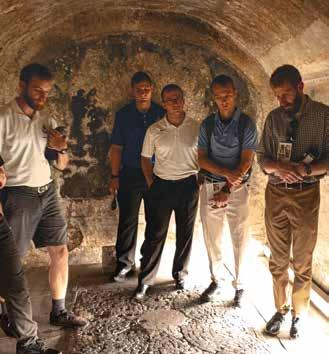
This year, the Pontifical North American College restarted the Catacombs of Saint Callixtus tour apostolate, after the pandemic had put a pause on the seminarian-led tours. There are four of us tour guides from the College who have the joy of bringing this apostolate back. In my preparation for the tours and by giving a few of them, I have seen the great opportunity for evangelization that this apostolate offers.
The people who visit the catacombs are well disposed to receive the Gospel. For those who are Christians, the history of the ancient Church becomes manifest to them tangibly, allowing the Gospel to be received in a new way. Others, those who are not yet Christians, can be evangelized by the preaching of the kerygma which the early Church martyrs believed and lived. In everyone that I meet at the catacombs, I see hearts ready to receive the Gospel which is ever full and ever new. I find that it is easy to preach this Gospel message to them. I see it as my duty and my joy to throw the bountiful seeds onto the soil and then let the Holy Spirit do the heavy lifting. n
Travels with Monsignor Powers and Father Romano
THE EDITORS
Each year, the Rector and the Director of Admissions visit seminaries in the United States to speak with men who are applying to the College for the coming year. This year, Monsignor Thomas W. Powers ‘97 and Reverend Michael Romano ‘07 visited thirteen states via planes, trains, and automobiles! n
Departing Faculty
THE EDITORS
Monsignor Shane Kirby ‘04
Monsignor Shane Kirby ‘04 (Scranton) has been the Director of the Newly Ordained Program at the Casa Santa Maria since 2020. While he will remain in Rome as the Substitute Promoter of Justice of the Supreme Tribunal of the Apostolic Signatura, we are sad to see him leave the Casa. Monsignor, we pray for you as you move to the Villa Stritch, and we thank you for serving us these past five years!
Reverend Dave Hulshof ‘81
For the past four years, Reverend David Hulshof ‘81 (Springfield–Cape Girardeau) has been a joyful presence on campus, serving as Coordinator of Apostolic Formation. Affectionately referred to as “Pastor Dave,” at least in seminarian circles, we have received much from his sincerity, humility, and priestly experience. He is the kind of priest who would stop by when seminarians were hanging out just to say “hi” and to grab a slice of pecan pie, which inevitably turned into two hours of regaling us with stories and lessons from his parish ministry. We gained much from his wisdom and insight!
Father Hulshof will take his wealth of experience as vocations director, pastor, and seminarian formator to serve at Immaculate Conception Parish in Springfield, Missouri. We are grateful to you, Father Hulshof! God bless your apostolate.
Reverend James Conn, S.J.
Reverend James J. Conn, S.J. (Boston) superior of the Casa Santa Maria, has been an exemplary model for priests and seminarians of a life of dedicated service to the Church. Since he began as superior in 2019, scores of priests residing at the Casa Santa Maria for advanced studies have received his wise counsel and mentorship.
Father Conn’s fifty-nine years in the Society of Jesus has been marked by various missions in the Eternal City. Father Conn earned a doctorate in canon law at the Pontifical Gregorian University in 1983. A canonist and Latinist par excellence, he taught at the Gregorian for seventeen years and consulted for various Vatican dicasteries. Father Conn will begin a new mission at Georgetown University this summer, assisting various Church organizations. Father Conn, thank you for showing us the joy of a life lived “for the greater glory of God.”
Reverend Michael Romano ‘07
Reverend Michael Romano ‘07 (Camden) concluded six years of service at the Pontifical North American College in June. He has served as Director of Admissions, Formation Advisor, and Rector’s Dinner coordinator since 2019.
We always joked that Father Romano “knows us better than we know ourselves.” Besides reading every word of our applications, he is intentional about talking and laughing with us and sincerely serving the whole house.
Father Romano has been appointed as Rector of Mount Saint Mary’s Seminary in Emmitsburg, Maryland, beginning in July.
Father Romano’s cheerful, obedient “yes” to his new assignment is evidence of his love for the Lord. The College is sad to see him leave, but confident that his leadership and presence in his new ministry will be a great gift to the Church.
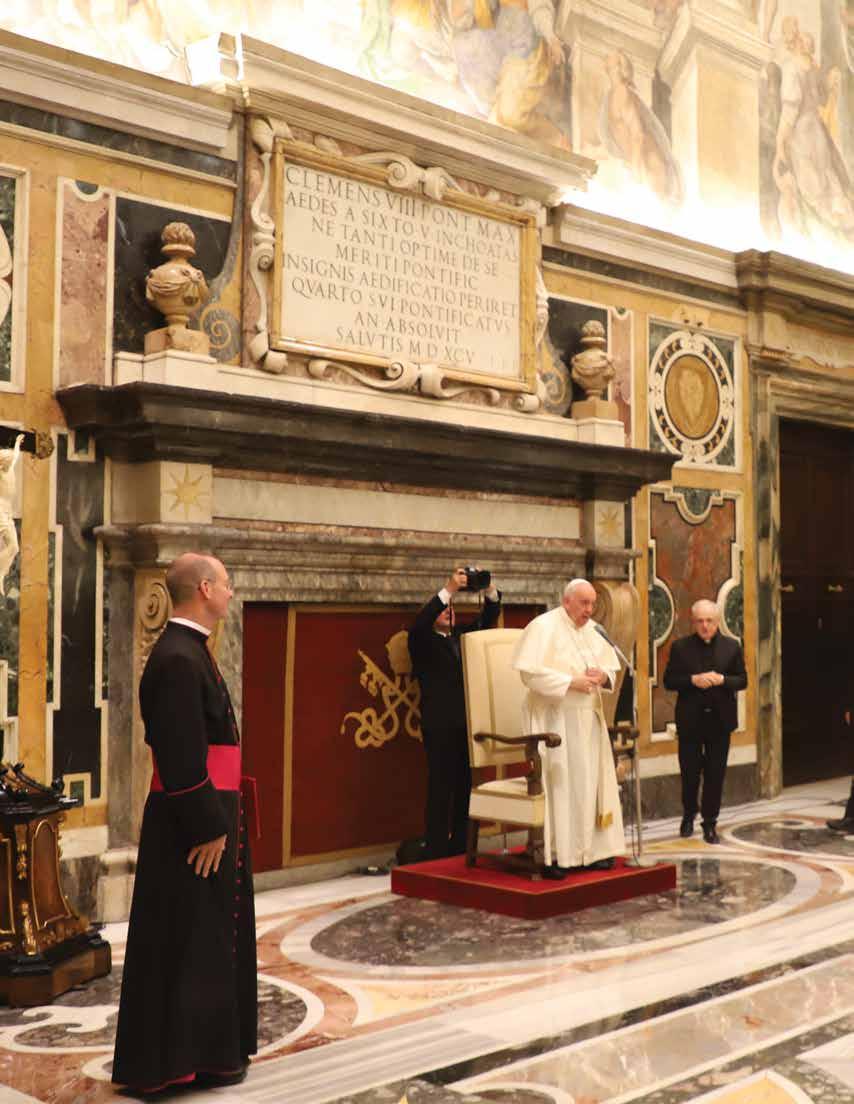
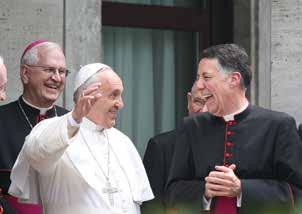
His Holiness Pope Francis addresses seminarians. insets: Pope Francis celebrates Mass at the College.
A Fellow Friend in the Lord
REV. BRENDAN HURLEY, S.J., COORDINATOR OF SPIRITUAL FORMATION
Early in my life as a Jesuit I came to accept a few propositions as given truths: a Jesuit would never be Pope; Blessed Peter Faber, SJ, would never be canonized; and the rift between the Roman Catholic and Eastern Orthodox Churches would never be healed. While I stood in Saint Peter’s square, on a dark, cold, and rainy evening in March 2013, I witnessed the first proposition invalidated. Later that same year, the second proposition was overruled. I am left with reservations about the third proposition.
There are many reasons to have expected a Jesuit would never be Pope. The more convincing ones emerge from the charism of and formation in the Society of Jesus. Jesuits understand themselves as being in the place of Jesus’ companions, who follow him and are sent out to evangelize. Standing in the shoes of the Vicar of Christ poorly fits that self-identity. A Jesuit would neither think of himself in that way nor aspire to it. The only conceivable path towards stepping into that role is through an interior life so united to the Second Person of the Trinity that its acceptance would be an act of obedience to Divine Love. Cardinal Jorge Bergoglio undoubtedly recognized the cross that was being extended to him on that March evening: to shepherd the Church while being placed alongside Christ crucified, a place cherished by Saint Ignatius of Loyola.
Peter Faber, SJ, a student with both Ignatius Loyola and Francis Xavier in Paris, bridged these two strong-willed men. Faber tutored Xavier in theology and Ignatius guided Faber out of his scrupulosity. The three became “friends in the Lord,” forming the nucleus of the first Jesuits. Contemporaries like Saint Francis de Sales attested to Faber’s sanctity.
Yet, while Ignatius and Xavier were canonized by 1602, Faber was only beatified in 1872. It seemed as if his humility in life would be enshrined through remaining uncanonized. Yet Pope Francis’ devotion to Faber and his extraordinary ability to speak to all manner of souls moved the Pontiff to declare him a saint on December 17, 2013. Pope Francis, in Dilexit Nos, includes Peter Faber among those “Jesuits who spoke explicitly of the heart of Jesus.” This devotion to Faber reveals a spiritual characteristic of Pope Francis. Freed from self-interest, Pope Francis trusted that the Holy Spirit would bring to fruition what he has inspired to be done, despite widespread contemporary criticism.
Dilexit Nos may prove to be the clearest expression of the Pope who Jorge Bergoglio became: “The Church also needs that love, lest the love of Christ be replaced with outdated structures and concerns, excessive attachment to our own ideas and opinions, and fanaticism in any number of forms, which end up taking the place of the gratuitous love of God that liberates, enlivens, brings joy to the heart and builds communities.” It is the gratuitous love of God that inspired Pope Francis which gives me hope even for the reunification of West and East.
A Journey Up the Gianicolo
BRENDAN FINNEGAN
‘27, ARCHDIOCESE OF HARTFORD
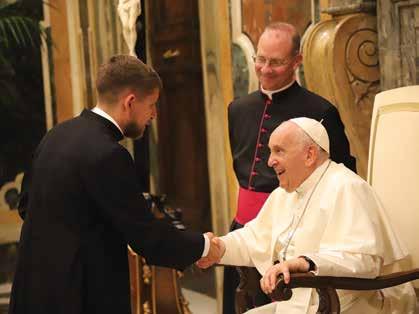
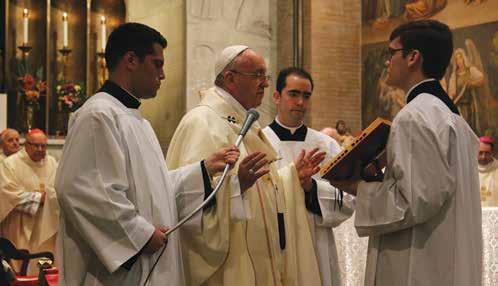
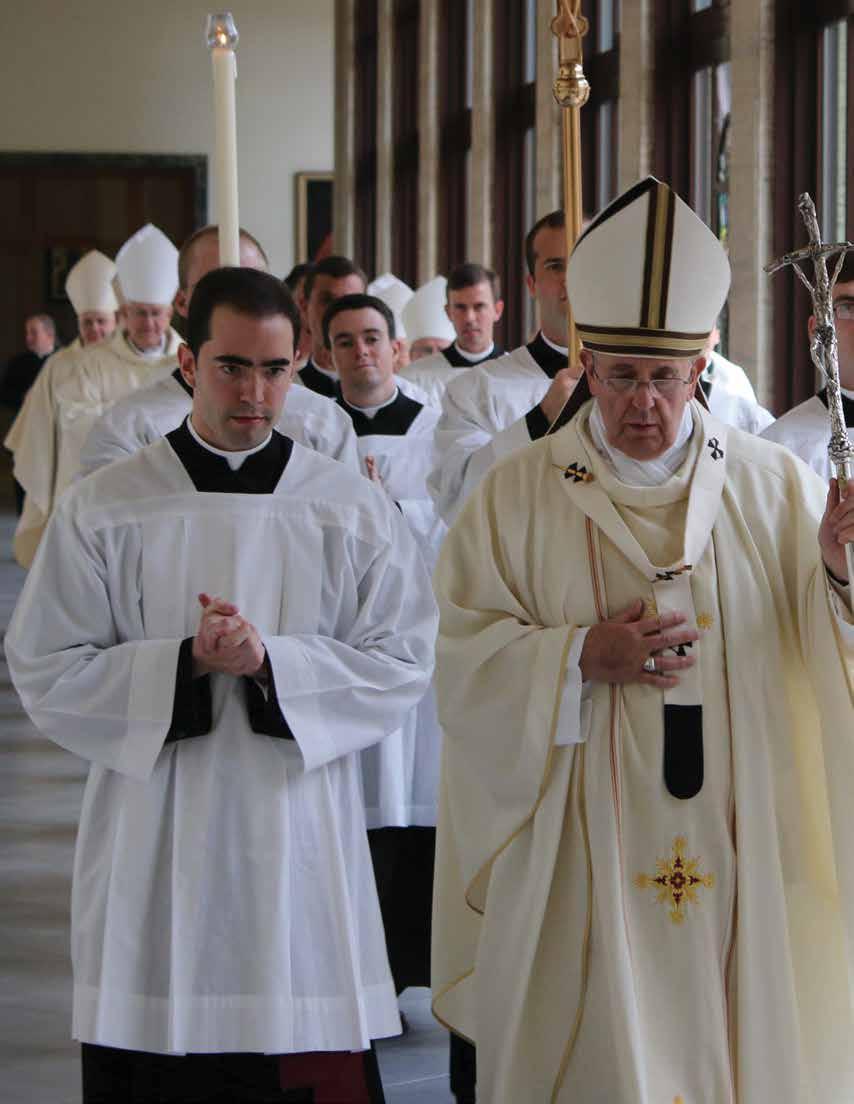
On May 2, 2015, Pope Francis made his first visit to a Roman seminary, trekking up the hill from the Vatican to the Pontifical North American College. The Holy Father, after being greeted by the College community, celebrated Mass in the Chapel of the Immaculate Conception.
The day of the Holy Father’s visit was marked with a missionary spirit. In the morning, seminarians attended a series of conferences in the Corso Auditorium on the missionary example of then-Blessed Junípero Serra. Later, during Mass, the Holy Father preached on the theme of missionary discipleship, a major pillar of his entire pontificate. He preached that Junípero Serra and Our Lady of Guadalupe are two of the eminent reasons for the conversion of the Americas and are models of holiness for the Church today. The example of Junípero Serra is one that priests and seminarians should emulate, as the Holy Father said:
“[He left] his home and country, his family, university chair, and Franciscan community in Majorca to go to the ends of the earth…all in an effort to proclaim the Gospel and its encounter with Christ.”
The Holy Father channeled the same message and energy a few months later when he visited the United States in the fall of 2015. In Washington, D.C., he canonized Saint Junípero Serra, the main protagonist of his message to the College community, as a priest worth imitating. In the June 2015 issue of Roman Echoes, the Most Reverend James F. Checchio ‘92, C‘97, Bishop of Metuchen and former rector, aptly summarized the day’s importance: “To have the successor of St. Peter come to our home was an occasion of great joy for us, and renewed us with evangelical fervor for the Gospel.”
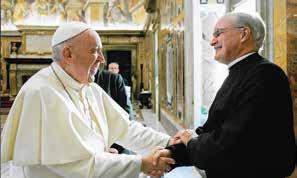
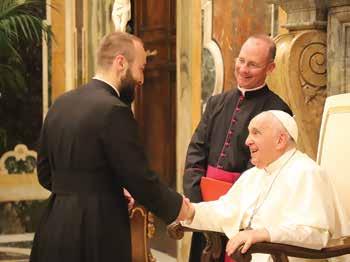
insets left to right Matthew Kehoe ‘27 (Milwaukee) meets Pope Francis; Pope Francis laughs with then-Rector Reverend James F. Checchio ‘92, C‘97.
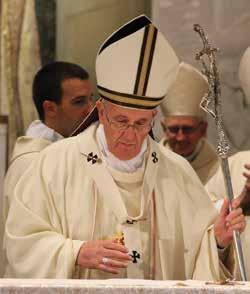
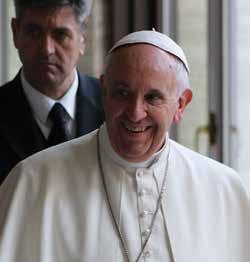
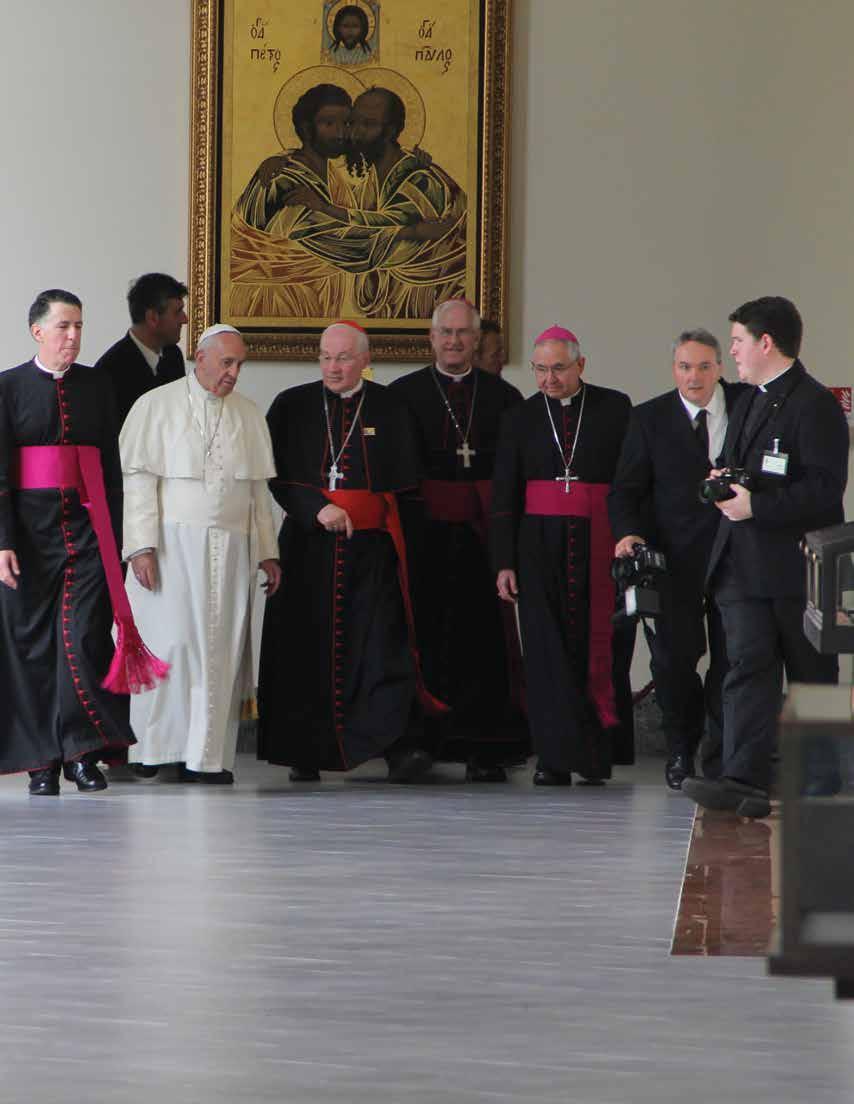
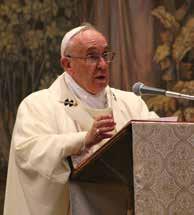
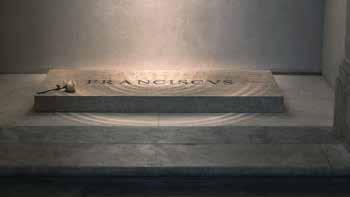
Pope Francis in procession before Mass at the College, 2015. insets top to bottom Pope Francis preaches; Funeral Mass of the Holy Father; Tomb of Pope Francis in the Papal Basilica of Saint Mary Major.
Easter Message of the Holy Father Pope Francis’s Last Public Address
Dear brothers and sisters, Happy Easter!
Today at last, the singing of the “alleluia” is heard once more in the Church, passing from mouth to mouth, from heart to heart, and this makes the people of God throughout the world shed tears of joy.
From the empty tomb in Jerusalem, we hear unexpected good news: Jesus, who was crucified, “is not here, he has risen” (Lk 24:5). Jesus is not in the tomb, he is alive!
Love has triumphed over hatred, light over darkness and truth over falsehood. Forgiveness has triumphed over revenge. Evil has not disappeared from history; it will remain until the end, but it no longer has the upper hand; it no longer has power over those who accept the grace of this day.
Sisters and brothers, especially those of you experiencing pain and sorrow, your silent cry has been heard and your tears have been counted; not one of them has been lost! In the passion and death of Jesus, God has taken upon himself all the evil in this world and in his infinite mercy has defeated it. He has uprooted the diabolical pride that poisons the human heart and wreaks violence and corruption on every side. The Lamb of God is victorious! That is why, today, we can joyfully cry out: “Christ, my hope, has risen!” (Easter Sequence).
The resurrection of Jesus is indeed the basis of our hope. For in the light of this event, hope is no lon-
ger an illusion. Thanks to Christ—crucified and risen from the dead—hope does not disappoint! Spes non confundit! (cf. Rom 5:5). That hope is not an evasion, but a challenge; it does not delude, but empowers us.
All those who put their hope in God place their feeble hands in his strong and mighty hand; they let themselves be raised up and set out on a journey. Together with the risen Jesus, they become pilgrims of hope, witnesses of the victory of love and of the disarmed power of Life.
Christ is risen! These words capture the whole meaning of our existence, for we were not made for death but for life. Easter is the celebration of life! God created us for life and wants the human family to rise again! In his eyes, every life is precious! The life of a child in the mother’s womb, as well as the lives of the elderly and the sick, who in more and more countries are looked upon as people to be discarded.…
In the Lord’s Paschal Mystery, death and life contended in a stupendous struggle, but the Lord now lives forever (cf. Easter Sequence). He fills us with the certainty that we too are called to share in the life that knows no end, when the clash of arms and the rumble of death will be heard no more. Let us entrust ourselves to him, for he alone can make all things new (cf. Rev. 21:5)!
Happy Easter to everyone!
Pope Francis celebrates Mass at the College.
VOICES OF NAC
What is a memory you have of Pope Francis?
My class had the privileged opportunity for a private audience with Pope Francis in August before classes began. The first thing he said to us was, “Non bevete troppo!” Don’t drink too much! He then shared one of his favorite prayers with us, the Prayer for Good Humor by Saint Thomas More, a good reminder to laugh at oneself with the Lord!
Andrew Beine ‘28, Archdiocese of Milwaukee
A fond memory I have of Pope Francis is his warm greeting to my classmates and me upon our arrival in Rome. He welcomed us and encouraged us all to “spiritual commitment and fidelity to the Gospel and to the Church.”
Patrick Ernst ‘26, Diocese of Fort Wayne-South Bend
I remember Pope Francis’s smile and the warmth he showed when he met people. His witness to the joy of the Gospel will stay with me.
Jack Kristensen ‘27, Archdiocese of New York
When Pope Francis addressed us seminarians he emphasized that holiness does not consist in a perfectly balanced life where each day looks exactly like the previous one. Instead, holiness consists in following the Holy Spirit in submission to the Will of God!
Rev. Mr. Jacob Tschida ‘25, Diocese of Duluth
The Spirit & The Conclave
From a Homily Preached on April 28
REV. MR. GERARD GAYOU ‘25, ARCHDIOCESE OF WASHINGTON
When you walk through Manhattan, it can be easy to forget about the wind. There are blocks of buildings so big and so packed together that they can block any wind from getting through—even on a gusty day. But then you hit a wind tunnel: a rushing blast of air that shoots along an open street, a gap in the buildings. The blast can even knock you off your balance. You suddenly remember the power of the wind, and you realize that the wind has been blowing the whole time, even if you didn’t feel it.
Walking through Rome, there can be a similar effect these days: grand events, news analysis, and anticipation of the conclave are so packed together that it’s easy to forget about the Holy Spirit. Jesus explains the Spirit with this image of the wind, and he says it blows where it wills. But how can the Spirit blow where he wills when there seem to be so many obstacles to him? He’s made himself dependent on fallen men who have the freedom not to listen to him.
On Saturday, I hit a wind tunnel. Some of the deacons and acolytes, before Pope Francis’s funeral Mass, had the privilege of praying in the Blessed Sacrament chapel. Uniquely, many cardinals were already there praying because it was near their vesting area. Deacon Robert Williams joked that it felt like we were in a conclave, and he even decided to cast a vote, writing on a piece of paper, “Father Kurt Belsole.”
But the cardinals I saw in the chapel were much more than the names I had seen in news articles: They were men on their knees, staring at the tabernacle like they believed someone was there who loved them and guided them. It was a blast of fresh air for me, reminding me of the power of the Holy Spirit and of the Eucharist that has been working in these men for decades, and in the Church for millenia.
The wind is always blowing; God is always working, even in extreme circumstance. The Apostles in the first reading make the remarkable statement that God used even Herod and Pilate and the enemies of Jesus to do what his will had long ago planned to take place. He uses even sin to accomplish his will.
But he wants hearts in which he can move freely. God wants to make us the wind tunnels of the world. The thing about wind tunnels is that they are born of empty space, a gap in the buildings. The only thing we need to offer him is empty, receptive space in our hearts, which God wants to fill with his Spirit through prayer and through the Eucharist. If he can work even through hostile, obstructed hearts, imagine what he can do in this world through docile, receptive hearts.
“La Pace Sia Con Tutti Voi!”
First “Urbi et Orbi” Blessing of the Holy Father
Peace be with you all! Dear brothers and sisters, these are the first words spoken by the risen Christ, the Good Shepherd who laid down his life for God’s flock. I would like this greeting of peace to resound in your hearts, in your families, among all people, wherever they may be, in every nation and throughout the world. Peace be with you!
It is the peace of the risen Christ. A peace that is unarmed and disarming, humble and persevering. A peace that comes from God, the God who loves us all, unconditionally.
We can still hear the faint yet ever courageous voice of Pope Francis as he blessed Rome, the Pope who blessed Rome, who gave his blessing to the world, the whole world, on the morning of Easter. Allow me to extend that same blessing: God loves us, God loves you all, and evil will not prevail! All of us are in God’s hands. So, let us move forward, without fear, together, hand in hand with God and with one another other! We are followers of Christ. Christ goes before us. The world needs his light. Humanity needs him as the bridge that can lead us to God and his love. Help us, one and all, to build
bridges through dialogue and encounter, joining together as one people, always at peace. Thank you, Pope Francis!
I also thank my brother Cardinals, who have chosen me to be the Successor of Peter and to walk together with you as a Church, united, ever pursuing peace and justice, ever seeking to act as men and women faithful to Jesus Christ, in order to proclaim the Gospel without fear, to be missionaries.
I am an Augustinian, a son of Saint Augustine, who once said, “With you I am a Christian, and for you I am a bishop.” In this sense, all of us can journey together toward the homeland that God has prepared for us.…
Today is the day of the Prayer of Supplication to Our Lady of Pompeii. Our Mother Mary always wants to walk at our side, to remain close to us, to help us with her intercession and her love. So I would like to pray together with you. Let us pray together for this new mission, for the whole Church, for peace in the world, and let us ask Mary, our Mother, for this special grace:
Hail Mary, full of grace, the Lord is with thee. Blessed art thou among women, and blessed is the fruit of thy womb, Jesus. Holy Mary, Mother of God, pray for us sinners, now and at the hour of our death. Amen.
From Leo XIV’s first homily as Pope:
“Then I will truly be a disciple of Jesus Christ, when the world no longer sees my body.”
Ignatius was speaking about being devoured by wild beasts in the arena—and so it happened—but his words apply more generally to an indispensable commitment for all those in the Church who exercise a ministry of authority. It is to move aside so that Christ may remain, to make oneself small so that he may be known and glorified, to spend oneself to the utmost so that all may have the opportunity to know and love him.
May God grant me this grace, today and always, through the loving intercession of Mary, Mother of the Church.
His Holiness Pope Leo XIV
GRAHAM FASSERO ‘27, DIOCESE OF RICHMOND
Each Thanksgiving Day, Americans living in Rome gather at the Pontifical North American College to celebrate Mass and to enjoy Thanksgiving dinner together. Last Thanksgiving, our Mass was celebrated by an American cardinal unknown to most of us. He shared a story about his family, pointed toward gratitude for God’s blessings, and reminded us of the needs of the poor.
None of us suspected that this man would be our next pope.
Most of us were present when Pope Leo XIV first appeared on the balcony above Saint Peter’s Square, and again for his first Regina Caeli address the following Sunday. In his addresses, we were delighted to recognize echoes of Pope Francis—“God loves us all, unconditionally!”—and of Pope Saint John Paul II—“Do not be afraid!”
Since then, we have followed the Holy Father’s words with excitement. His public addresses have expressed his missionary heart, his love for the needy, and his desire for peace. The bookworms among us note that the Pope enjoys the Fathers of the Church—referencing Ignatius of Antioch, Augustine, and Gregory the Great in his first days. I myself love that his first addresses began by naming Jesus as the Good Shepherd
and ended with an invocation of our Mother Mary.
As we get to know our new Holy Father better, we look forward to the gifts that the Holy Spirit will offer us through him. No doubt, Pope Leo’s message will remain the timeless Gospel of the
Church—the love of God revealed in Christ—but now in a new voice, with a new face, leading us toward new graces that we have yet to discover.
And maybe he will even come back to the College for another Thanksgiving dinner. n
Biography of Pope Leo XIV
1955 Born Robert Francis Prevost to Louis and Mildred Prevost. He is the youngest of three brothers. Attended school, served, and sang in the choir at Saint Mary of the Assumption in Riverdale, Illinois.
1973 Graduated from Saint Augustine High School Seminary in Michigan.
1977 Degree in mathematics from Villanova University. Joined the Order of Saint Augustine.
1981 Professed solemn vows and ordained as a deacon.
1982 Master of Divinity from Catholic Theological Union while teaching at Saint Rita of Cascia High School in Wrightwood, Illinois.
1982 Ordained a priest at the Church of Santa Monica degli Agostiniani by Archbishop Jean Jadot.
1984 Licentiate of Canon Law from the Angelicum in Rome.
1985 Joined the Augustinian mission in Peru.
1988 Doctor of Canon Law from the Angelicum.
Vocation director and missions director of the Augustinian Province of Our Mother of Good Counsel, based in Illinois.
Worked with the Augustinian Novitiate in Wisconsin.
1988 Lived in Trujillo, Peru, serving in the seminary, as a canon lawyer, and in parishes and missions.
1999 Prior Provincial of the Order of Saint Augustine.
2001 Prior General of the Order of Saint Augustine. Based in Rome and traveling around the world.
2014 Consecrated bishop at Saint Mary’s Cathedral in Chiclayo, Peru.
2015 Named Bishop of Chiclayo. Obtained Peruvian citizenship.
2023 Prefect of the Dicastery for Bishops.
2023 Created cardinal by Pope Francis.
May 8, 2025 Elected 267th pope, taking the name Leo XIV.
Our Lady of Humility
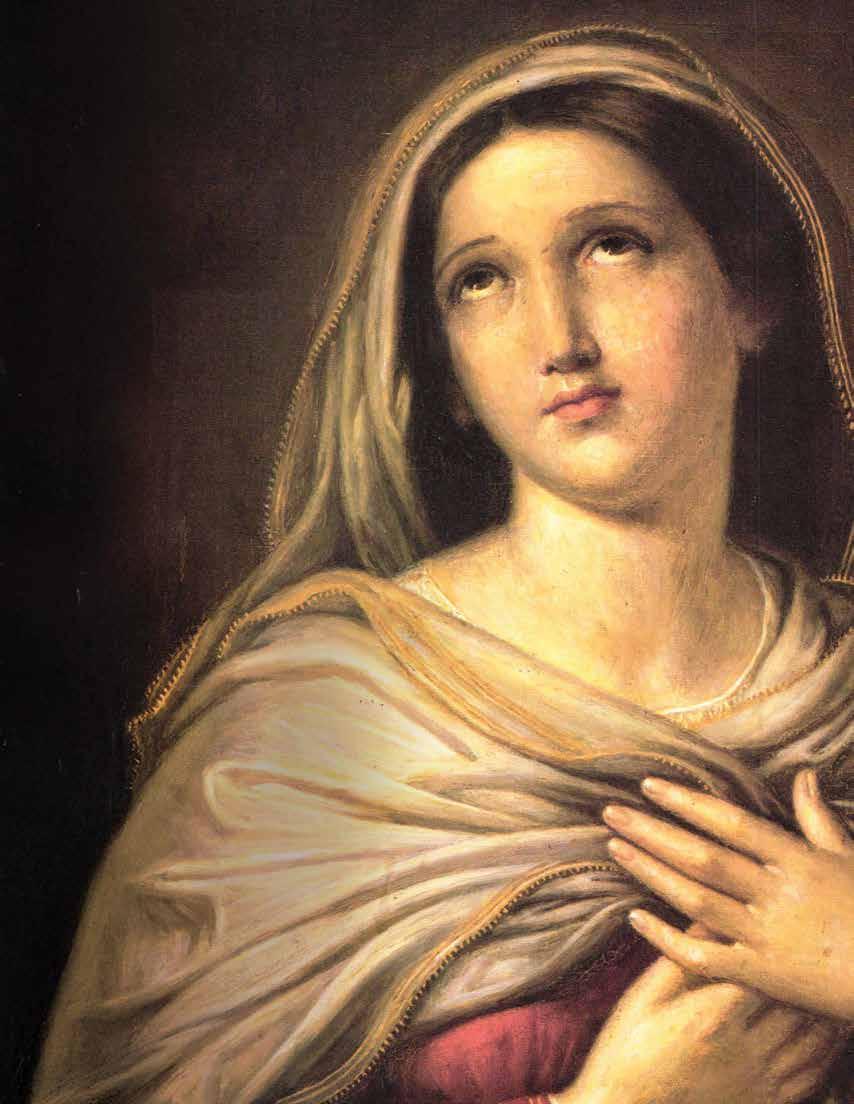
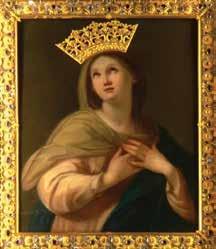
The history of the icon of Our Lady of Humility is not widely known. Monsignor Gaetano Bedini was responsible for much of the restoration of the Pontifical North American College’s original campus, now the Casa Santa Maria. The altarpiece had been lost, likely during the French occupation. Bedini was devoted to the image of the Madonna della Misericordia in Rimini, which in 1850 was seen moving her eyes miraculously. He commissioned two images to be made using the Rimini Madonna as a model: one for a church in his hometown of Senigallia, and the other for the main altar of the College, where it still stands today. Our Lady of Humility, pray for us!
Lovely Lady dressed in blue, Teach me how to pray—
God was just your little boy, Tell me what to say!
Did you lift him up, sometimes, Gently on your knee?
Did you sing to him the way Mother does to me?
Did you hold his hand at night?
Did you ever try
Telling stories of the world?
Oh! And did he cry?
Lovely Lady dressed in blue, Teach me how to pray—
God was just your little boy, And you know the way.
Poem by Mary Dixon Thayer, popularized by Venerable Fulton J. Sheen
Inset image of the original Madonna della Misericordia painted by Giuseppe Soleri.
ICTE Roman Moments
INSTITUTE FOR CONTINUING THEOLOGICAL EDUCATION
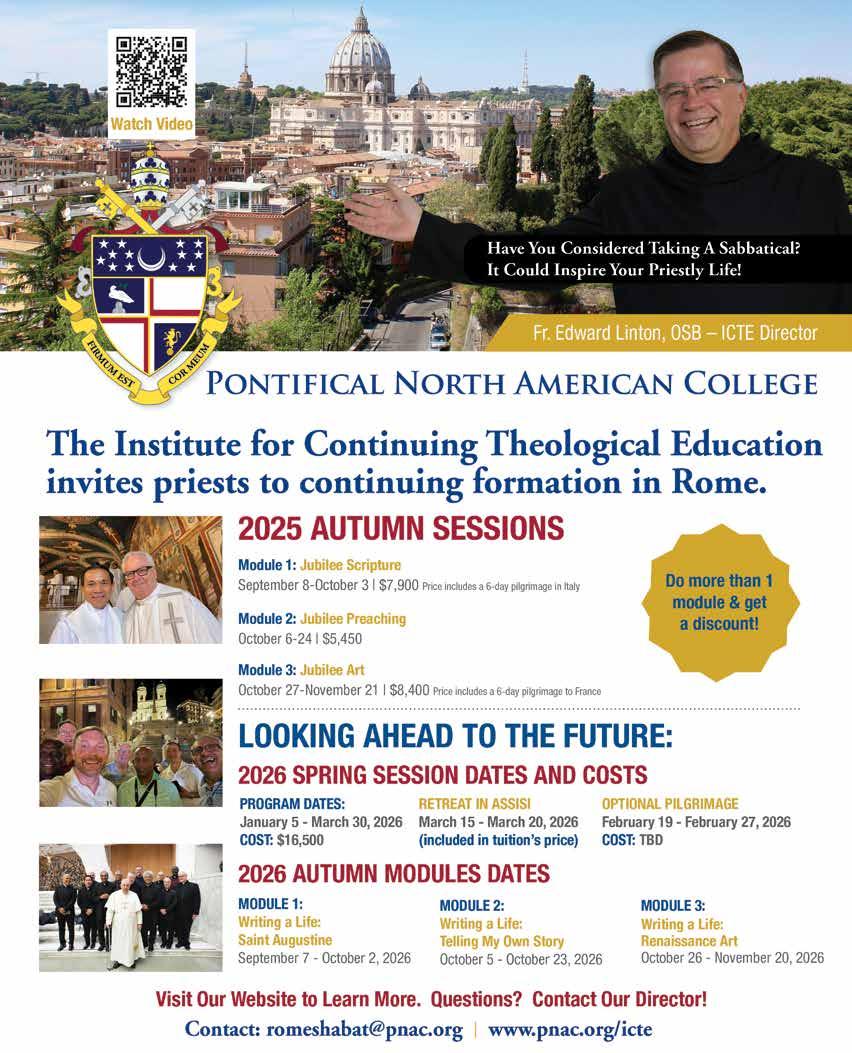
ICTE has been committed to the ongoing education and formation of clergy since 1971. Three autumn modules are offered, as well as a spring semester. If you are a priest interested in ICTE as a sabbatical experience, please contact romeshabat@pnac.org.
REV. EDWARD LINTON, O.S.B., DIRECTOR OF THE INSTITUTE
Making a spur-of-the-moment decision to walk past Saint Peter’s Basilica is just one of the wonderful experiences of living in Rome. I often take advantage of this opportunity after dinner once the tourists and pilgrims have dispersed. Even though I try to avoid crowds, on May 8th I felt an urge—perhaps it was the Holy Spirit—to alter my ordinary schedule and walk past Saint Peter Basilica’s before dinner. “I will just walk by to see what is happening,” I told myself.
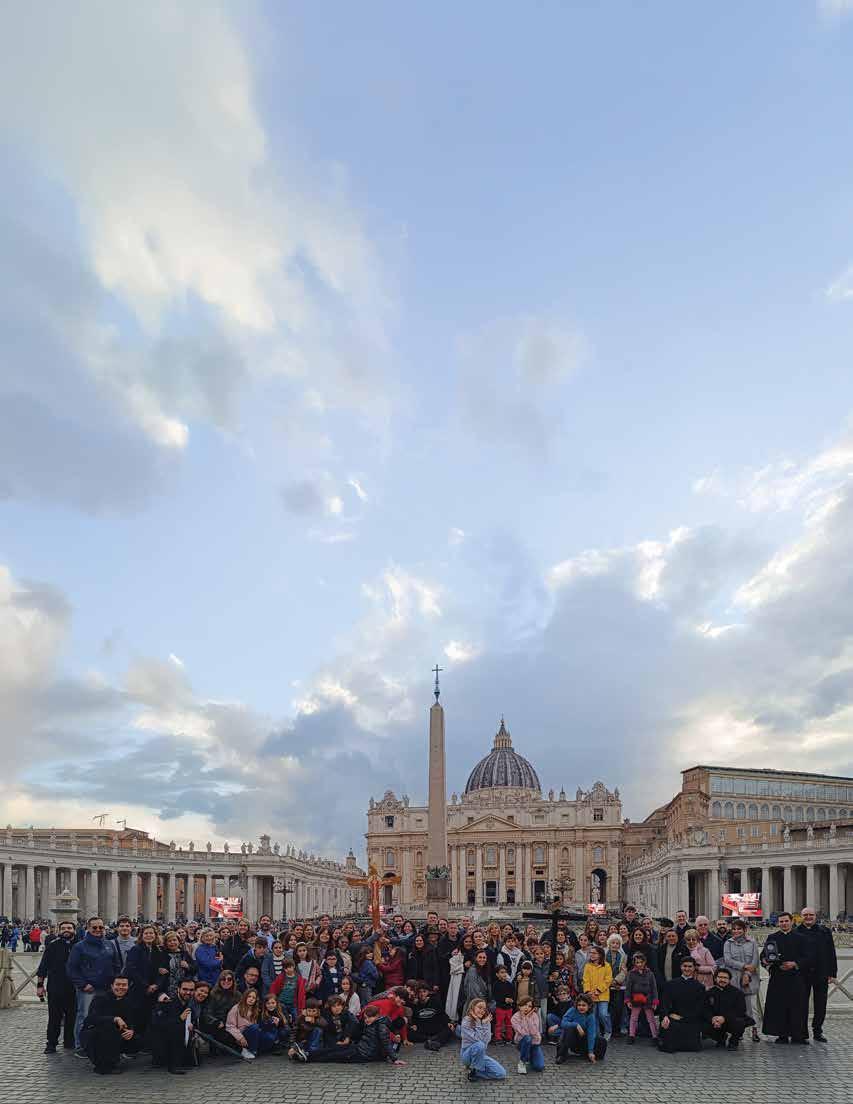
One block away from the Via della Conciliazione, I heard a loud cry coming from Saint Peter’s Square. People started running past. When I turned the corner, I could see that there was white smoke! The enthusiasm of the crowd overtook me. I made my way with saints and sinners alike within the embrace of Bernini’s colonnade. A group of seminarians invited me to wait with them for the announcement.
We waited just below the obelisk. The obelisk once stood in Nero’s circus where Saint Peter was crucified, and for that reason, it is called “the witness.” Since being moved to the center of the square in 1586, it has witnessed the announcements of those called to be Saint Peter’s successors. It witnessed the announcement of Pope Leo XIV and
FOR THEOLOGICAL EDUCATION
the immediate cheers of the crowd. It witnessed the expressions of congratulations to anyone with an American accent from faithful from around the world. It witnessed Pope Leo’s first words as our shepherd.
Even in normal times, when there is no conclave happening, priests who participate in ICTE’s programs are also witnesses. They witness their own inner transformation through exposure to art, theological ideas, and holy places. They witness enthusiasm by the faith of pilgrims from throughout the world and
gain inspiration. They witness how living in a community of priests at ICTE can motivate and encourage them in their own journey.
The Institute for Continuing Theological Education invites all priests to consider being a witness to life of the Church in Rome! We still have a few places in our autumn modules, and we are accepting applications for our Spring Program. Please write romeshabat@pnac.org for more information. n
CSM CASA SANTA MARIA
The Casa Santa Maria serves as a house of continuing formation and residence for English-speaking priests who are assigned to pursue graduate-level studies in Rome. Below, Rev. Richard Vigoa C‘25 (Miami) reflects on his time studying in Rome.
Cobblestones and Saints
REV. RICHARD VIGOA C‘25, ARCHDIOCESE OF MIAMI
As I wrap up my studies in Rome this June, I can say without hesitation that this has been one of the most enriching and grace-filled times of my priesthood. I came to pursue a doctorate in spirituality at the Angelicum—but I quickly discovered that Rome forms a priest in ways beyond academics.
Monsignor Thomas W. Powers ‘97, rector of the College, refers to Rome as “the fifth dimension of formation.” He’s right. That phrase may sound abstract at first, but in truth, it is deeply incarnational. The physical city of Rome—its churches, architecture, cobblestones, and saints—forms the soul of anyone who walks it with faith. Rome does not just offer theology; it embodies it. It demands that we live liturgically.
Each day, I pass places where martyrs bled, basilicas where the bones of saints lie in silence, and tabernacles whose lamps flicker beside centuries-old frescoes. This city breathes with the Church. There is something profoundly shaping about studying in the city where Saints Peter and Paul are buried, where popes have walked. One cannot help but pray differently, walk more slowly, think more deeply. Rome stretches the imagination and grounds the soul.
When I arrived at the Casa Santa Maria, I was not sure what to expect. But I was immediately welcomed—not as a visitor, but as a brother. The priests here are impressive in academic ability, integrity, generosity, and zeal. I have been deeply encouraged by the caliber of men living
here. They give me great hope for the future of the Church in America. The Casa Santa Maria itself is a sign of the Church’s care for her priests. Its continued renewal—both in the beauty of its surroundings and in the community that lives within—speaks to a Church that invests in those who serve her. Here, priests find not only solid theological study, but also fraternity, prayer, and the space to grow in joyful holiness.
This was also a sacred time in Rome. I was here for the death of Pope Francis. The days of mourning reminded me that the Church is not about this man or that one, but always about Christ and his mission to bring salvation to the world. With the election of our new Holy Father, Pope Leo XIV, we turn the page with gratitude and hope, trusting that the Holy Spirit continues to guide the Barque of Peter.
To any brother priest considering further studies or a sabbatical: come to Rome. Walk her streets. Pray in her churches. Let her saints speak to your heart. Here, you will rediscover not only the intellectual depth of our faith, but the beauty and sacred weight of your priesthood. n
ALUMNI
In this issue’s Alumni segment, Rev. Joe Brodeur ‘24 (Providence), reflects offers a reflection as he prepares to return home for priestly ministry.
“Domine, Quo Vadis?”
REV. JOE BRODEUR ‘24, DIOCESE OF PROVIDENCE
The story is told of Saint Peter, that while fleeing the city of Rome during the persecution of Nero at the urging of the Christian community, he encountered the risen Lord on the Via Appia walking the opposite direction. “Domine quo vadis?” he asked: “Lord, where are you going?”
“To Rome, to be crucified again,” the Lord responded.
No more words were necessary. Peter understood the Lord was calling him back to lay down his life for the sheep, which he did, being crucified upside-down on the Vatican Hill, where his bones rest to this day.
I remember praying in the Church of Domine Quo Vadis that marks the place of this encounter toward the end of my time in formation, and there I asked the Lord my own question: “Lord, why did you bring me here to this place to be formed for the priesthood?”
“For the same reason I brought Peter here—to teach you martyrdom.”
And Rome does just that, in so many ways—“O Roma Felix! You who have been consecrated by the glorious blood of the two princes,” as an inscription on the roof of the College reads overlooking the place of Peter’s martyrdom.
The latest news and photos from Rome.
Over 15,000 followers, fans, and friends – join us!
facebook.com/PontificalNorthAmericanCollege
Rome truly affords the unique opportunity to walk in the footsteps of Peter and live in the company of his successor, which we have done with our late Holy Father, loving his flock fino alla fine, and look forward to doing so with our new pope.
But martyrdom does not just mean suffering and death! It first and foremost means bearing witness to the risen Lord Jesus, and what better place to do that than in the city where so many holy men and women have given such powerful testaments of faith by their lives.
To walk in the footsteps of the saints— especially the apostles and martyrs—and read their writings in the places they were written or at the tomb of their authors is nothing short of a life-changing experience.
Now as I prepare to return home to a life of ordained ministry in the Diocese of Providence, the question of Peter again comes to mind, “Domine, quo vadis?”
Fortified by the gift of these years in the city consecrated by his blood and hallowed by the example of so many others, I go back in the confidence that the Lord is leading me on. n
OFFICE FOR INSTITUTIONAL ADVANCEMENT OIA
Great Joy – Thank You!
MARK RANDALL, CFRE • EXECUTIVE DIRECTOR, INSTITUTIONAL ADVANCEMENT
This issue of Roman Echoes is an extraordinary one. It not only presents the incredible recent events of a papal funeral, conclave, and inauguration, but it does so through the eyes of the Pontifical North American College resident community.
For our current seminarians, deacons, student priests, formation team members, and lay staff, being in the shadow of the Vatican City State during that time was nothing less than a once-in-alifetime experience. From our mourning at the death of Pope Francis, to our elation at the election of Pope Leo XIV, what a milestone this has been.
Members of the College family who do not live in Rome, such as our alumni and lay benefactors, have also been on this historical journey with us, if only in spirit. The phone calls and emails asking for papal liturgy tickets and schedules have increased 400% since the election of Pope Leo XIV. Our Visitor’s Office is working overtime to handle all the inquiries, many of which originate in my office in Washington, DC.
Everyone is excited when a new Successor of Peter is elected, but certainly this American Pope is generating additional interest and curiosity. Adding the fact that this is a Jubilee Year and millions were already planning to come to Rome, makes this a very special time for our many friends.
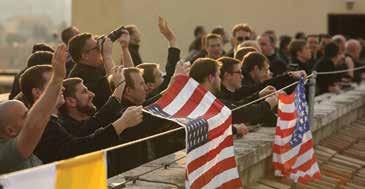
The photos in this issue reveal the tremendous joy that permeated the community once the white smoke was visible from the Sistine Chapel on May 8th. I was reminded of a similar photo from the last conclave in 2013. When Pope Benedict XVI left the Apostolic Palace for the last time, he flew via helicopter to Castel Gandolfo, flying very close to the College. Our seminarians and faculty quickly assembled on our rooftop, with American and Vatican flags, waving joyfully as Pope Benedict flew overhead. Some say you could see him looking down and waving back.
If nothing else, these experiences reiterate once again how important it is to have an American seminary in Rome. The opportunity to add a fifth dimension of formation, Rome (see page 16), is a unique and special gift for every man who comes to study in the Eternal City.
Thank you for all you do to help us keep this opportunity a reality: by being a friend or loyal son of alma mater, by offering your prayers, and by your generous financial support. n
For more information about The Pontifical North American College, subscription questions, or to learn about ways you can financially support “America’s Seminary in Rome,” please contact Mark Randall, CFRE, Executive Director, Institutional Advancement. Tel: (202) 541-5411 I Fax: (202) 470-6211 I Email: pnacdc@pnac.org I Website: www.pnac.org