Something So Right
As playwrights, Lindsay and Crouse clearly had a Midas touch. They produced hits starting with Anything Goes and continuing through The Sound of Music. Life With Father was one of their biggest successes. They talked about how to write the play for two years before sitting down and doing it in 17 intense and excftl_ng days.
In 1939, after being turned down by several prominent directors, Lindsay and Crouse mortgaged their assets to produce what turned out to be a shaky tryout of Life With Father at a summer stock theater in Skowhegan, Maine. They took the play to Baltimore for a further try-out on October 30 The play finally opened on Broadway on November 8, 1939 and ran tor 3,224 performances before closing on July 12, 1947.
The stories that were incorporated into the play originally appeared in The New Yorker magazine before Clarence Day, Jr. published them in three bestselling books: Life With Father, Life With Mother and God and Father. In 1947, Warner Brothers released a film version featuring William Powell and Irene Dunne that is re-run on television almost monthly. Is it magic?
Reviewers of the original production, which starred Lindsay and his wife, Dorothy Stickney, as Father and Mother.found the key to the play's success in its freshness and universality. The Life With Father stories m ade their debut in the period between the World Wars; the play opened at the beginning of World War It and ran for almost a full decade tilled with sorrow and global stress. Audiences followed Walter Winchell's advice in The Daily Mirror, "Life With Father is indeed charming entertainment when it is not provoking robust laughter Go and enjoy it The happy Days are here again!" In 1967, New York Times critic Vincent Canby called Life With Father " a masterpiece of vignette writing Life With Father is as pretty and pleasant a postcard as anyone received from a lost, bygone era."
Wendy Nardi
"Life with Clarence Day's father, in all the late-Victorian magnificence of their Madison Avenue home, must have been a ioyful, glorious and certainly continuously exciting adventure Dramatized with faithful adherence to the high spirit of the original stories, we have a stage play in which the senior Mr. Day will ride still further, in his loud and conquering fashion into the hearts of all who see and hear him"
-SIDNEY WHIPPLE, N.Y. WORLD-TELEGRAM
Real Thing Is A Real Hit
Faced with the strongest demand for tickets in its history, the Public Theater extended its production of The Real Thing tor five additional performances through November 2. The critics raved:
"There's a word for the Public Theater's Real Thing: brilliant! : outclasses everything in the first ten seasons!" Ed Blank, The Pittsburgh Press
"The Public has mounted a tine production. The acting is superb!" Ann Curran, Market Square
Ticket sales for The Real Thing have passed records set by Sylvia Sidney in 'night, Mother and by Private Lives - two of the Public's biggest hits. If you're one of the Pittsburghers who were "Sold Out" of The Real Thing, be part of the Life With Father excitement by ordering your tickets now. Better yet, subscribe to the Public today and don't risk missing a moment of our exciting 11th season. The "Public's off to a 'Real' good start!" Pittsburgh Post-Gazette
"They have captured all the life which bubbled in the stories, and all the richness of character of the man who became simply 'Father' to thousands, and all the comedy which was so tender and at the same time so vigorous. You would never have dreamed any one could do so beautiful a job of translation It is gay and funny and, l think, by all odds the most engaging, happiest play in town:'
-RICHARD LOCKRIDGE, N Y SUN
Lindsay and Crouse: An Example of Teamwork
Playwrights Howard Lindsay and Russel Crouse maintained one of the longest and most successful collaborations in the theater. The partnership began in 1934 when together they revised the book for Anything Goes. They continued to write and produce shows as a team until separated by death. Among the most memorable of these were Red, Hot and Blue, Life With Father, State of the Union, Call Me Madam and The Sound of Music. For these efforts they garnered several Tonys, an Oscar and a Pulitzer Prize. They also co-produced some of Broadway's most outstanding plays including Detective Story, The Hasty Heart and Arsenic and Old Lace.
Lindsay had a long theatrical career as both actor and director prior to his work as a writer and producer. His first big break was in 1921 as actor/director of the George S. Kaufmann/Marc Connelly hit, Dulcy. In 1927, he co-authored his first play, Tommy. In 1933, he directed Fred Astaire in The Gay Divorcee, which led to Astaire's successful film career. In 1934, he revised the book for Anything Goes with Russel Crouse and after 1936 they worked together exclusively until Grouse's death in 1966. Lindsay had married the actress Dorothy Stickney in 1927 and they played opposite each other as Mother and Father in Life With Father Crouse, on the other hand, was never an actor He began his career as a newspaper reporter and first achieved fame as the writer of a signed column for the New
York Post. He always considered himself on a "leave of absence" from the Post.
The theatrical aspect of his career began in 1931 when he became the head of the publicity department of the Theatre Guild, a position he held until 1937. That same year he collaborated with Oscar Hammerstein II and Morrie Ryskind on The Gang's All Here. In 1933, he collaborated with Corey Ford on the musical Hold Your Horses. He began his collaboration with Howard Lindsay on Anything Goes and he worked with no one else thereafter.
The two men and their wives were more often together than they were with any other people. When Grouse's daughter was born, he named her Lindsay Ann Crouse as a living monument to their partnership.
In 1959, the team of Lindsay and Crouse were awarded a special Tony for a partnership that had lasted thirty years and created thirteen shows - many of which were splendid successes. Throughout their long association, they always remained friends. Neither man had the ego that demanded sole credit for their work. They never could seem to remember who had first come up with an idea or written a funny line. Among the many theatrical collaborators in history, Lindsay and Crouse stand alone as a team that remained close friends and effective collaborators for over three decades.
Stephen Berwlnd
father's Trousers
It was a curious fact that everything that Father had ever owned seemed to be permanently a part of him. No matter what happened to it, it remained impressed with his personality. This isn' t unusual in the case of a ring, I suppose, but the same thing was true even of Father's old neckties, especially from his point of view When he gave me an old necktie or a discarded pair of trousers, they still seemed to him to be his. Not only did he feel that way about it but he made me feel that way, too. He explained to me that he gave things which he didn't care about to the coachman or the Salvation Army, but that when he had a particularly handsome tie which had plenty of wear in it yet, or a pair of trousers which he had been fond of, he saved anything of that sort for me.
Excerpt from: Life With Father by Clar-
ence Dayro Jr _
ather Finds Guests In The House
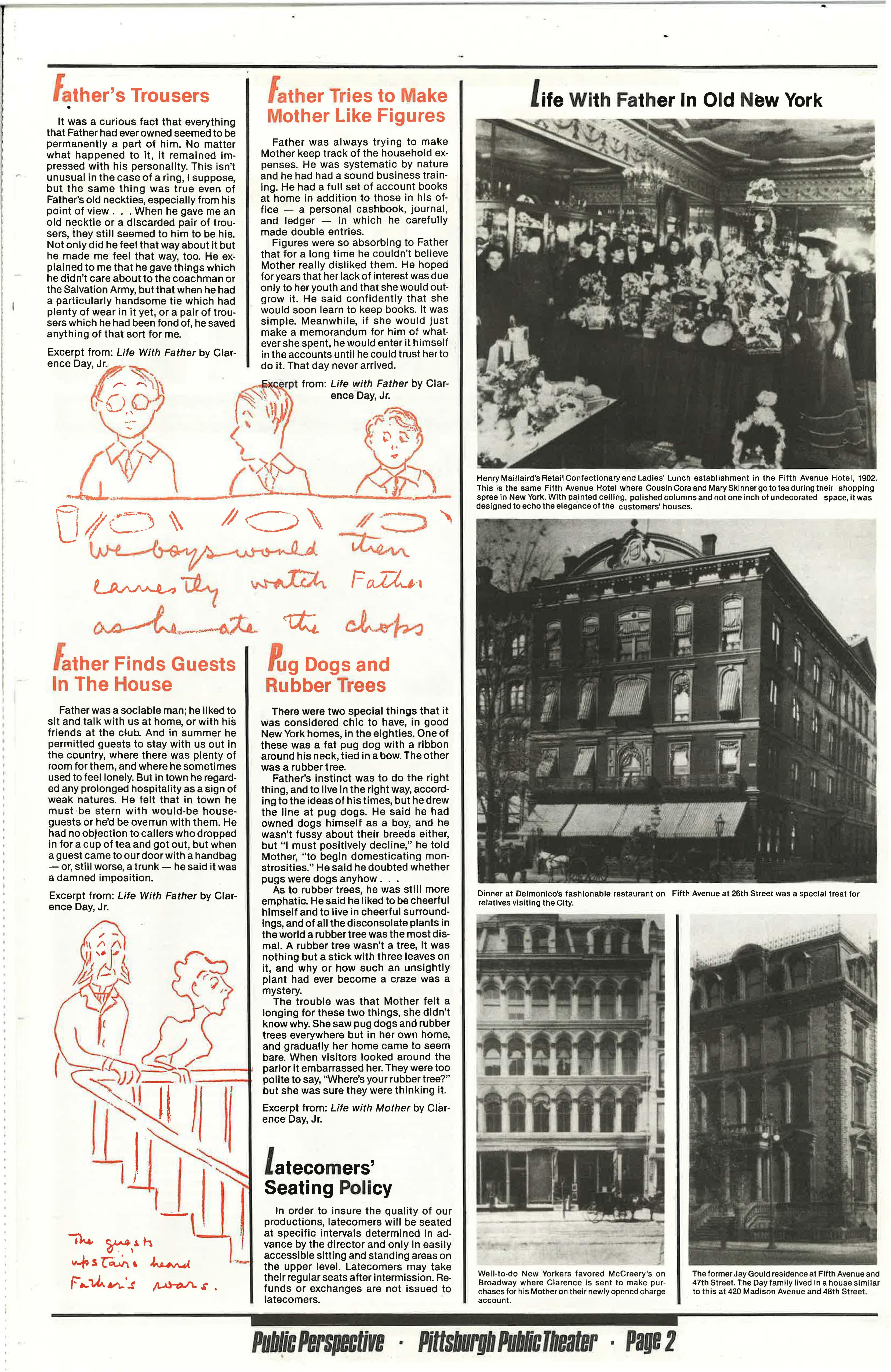
Father was a sociable man; he liked to sit and talk with us at home, or with his friends at the c~ub. And in summer he permitted guests to stay with us out in the country, where there was plenty of room for them, and where he sometimes used to feel lonely. But in town he regarded any prolonged hospitality as a sign of weak natures. He felt that in town he must be stern with would-be houseguests or he'd be overrun with them. He had no objection to callers who dropped in for a cup of tea and got out, but when a guest came to our door with a handbag - or, still worse, a trunk - he said it was a damned imposition.
Excerpt from: Life With Father by Clarence Day, Jr.
father Tries to Make Mother Like Figures
Father was always trying to make Mother keep track of the household expenses He was systematic by nature and he had had a sound business training. He had a full set of account books at home in addition to those in his office - a personal cashbook, journal , and ledger - in which he carefully made double entries.
Figures were so absorbing to Father that for a long time he couldn't believe Mother really disliked them. He hoped for years that her lack of interest was due only to her youth and that she would outgrow it. He said confidently that she would soon learn to keep books. It was simple. Meanwhile, if she would just make a memorandum for him of whatever she spent, he would enter it himself in the accounts until he could trust her to do it. That day never arrived.
t from: Life with Father by Clar-
ence Day~ r.
l'ug Dogs and Rubber Trees
There were two special things that it was considered chic to have, in good New York homes, in the eighties. One of these was a fat pug dog with a ribbon around his neck, tied in a bow. The other was a rubber tree.
Father's instinct was to do the right thing, and to live in the right way, according to the ideas of his times, but he drew the line at pug dogs. He said he had owned dogs himself as a boy, and he wasn't fussy about their breeds either, but "I must positively decline," he told Mother, "to begin domesticating monstrosities " He said he doubted whether pugs were dogs anyhow As to rubber trees, he was still more emphatic. He said he liked to be cheerful himself and to live in cheerful surroundings, and of all the disconsolate plants in the world a rubber tree was the most dismal. A rubber tree wasn't a tree, it was nothing but a stick with three leaves on it, and why or how such an unsightly plant had ever become a craze was a mystery.
The trouble was that Mother felt a longing for these two things, she didn 't know why. She saw pug dogs and rubber trees everywhere but in her own home, and gradually her home came to seem bare When visitors looked around the parlor it embarrassed her They were too polite to say, "Where's your rubber tree?" but she was sure they were thinking it.
Excerpt from: Life with Mother by Clarence Day, Jr.
l atecomers' Seating Po li cy
In order to insure the quality of our productions, latecomers will be seated at specific intervals determined in advance by the director and only in easily accessible sitting and standing areas on the upper level. Latecomers may take their regular seats after intermission. Refunds or exchanges are not issued to latecomers.