Published by All Life Media, LLC. Pittsburgh PetConnections was created in 2012. Our mission is to publish a high quality, informative publication focused on the Human-Animal Bond. We support local businesses and also assist local non-profit businesses for pets and people, to give back to our great Pittsburgh communities.
MAGAZINE PUBLICATION STAFF
Carla Mader, Publisher
Candace Curphey, Marketing Advisor 512-554-7573
Pamella Solomon, Graphic Designer
CONTRIBUTING WRITERS
Kristin Hermann
April Minech
Bernadette Kazmarski
Becky L. Morrow, DVM MS CAWA
from the publisher
Welcome to the Fall 2025 Edition of PetConnections! Volume 13, Issue 1 -
Dear Pet Lovers,
Volume 13 Issue 1
Our 14th Anniversary!
We appreciate you picking up a copy and reading our Fall 2025 issue of PetConnections! We have all the fun fall events going into winter that you don’t want to miss! Also, more stories and tips to make this fall season healthy and fun for you and your furry family!
IN THIS ISSUE:
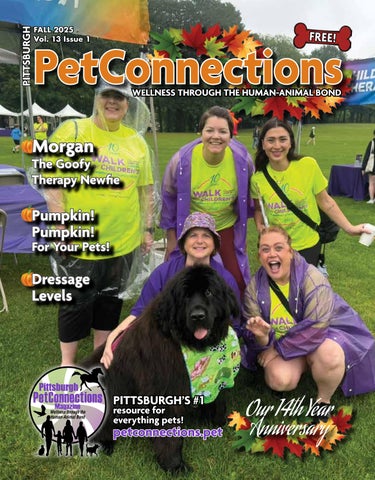
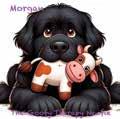
Cover Story: Morgan, the Goofy Therapy Newfie
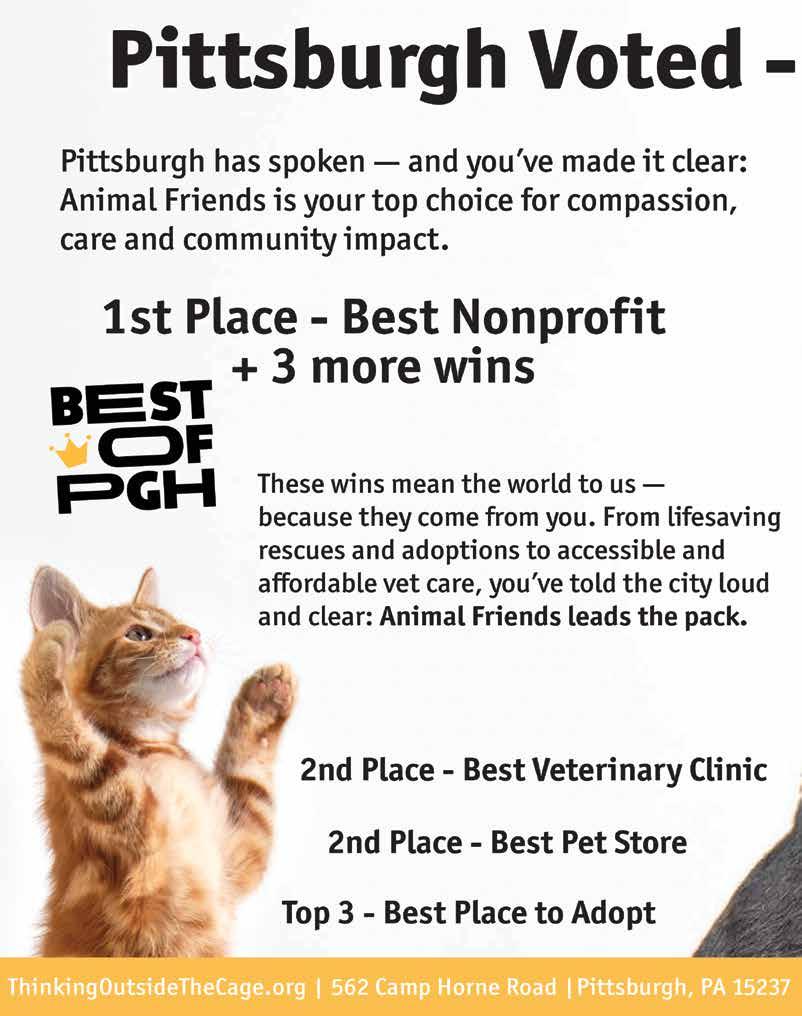
Rescue & Shelter section: Animal Friends was voted Best of Pgh! Congrats! –see their ad.
Check out our articles on Northeast Boston Terrier Rescue (NEBTR), and Short Noses Only Rescue Team (SNORT).
Bernadette Kazmarski writes about the benefit of offering pumpkin to your pets.
Equine Affairs: Learn from top-notch Dressage instructor, Kristin Hermann, on how to ascend through the levels of Dressage.
News & Events: Fall is packed with exciting pet-friendly events! Stay in the loop by following us on Facebook at facebook.com/petconnectionsmagazine or visiting our revamped website at www.petconnections.pet.
Share your events, pet remembrances, or contest entries by emailing pghpetconnections@gmail.com for a chance to be featured online and in print!
GET INVOLVED
Support local shelters through volunteering, donating supplies, or attending events.
Promote your business with our affordable advertising options! Directory listings start at just $99/year, with featured listings at $299, appearing both in print and online. Contact our sales team at pghpetconnections@gmail.com for details.
About Us: PetConnections is published quarterly (March, June, September, and a special Holiday issue in December). Ouwr print copies are restocked every six weeks at distribution sites, but our online reach is bigger than ever, with over One million impressions! Subscribe for your personal copy or explore our full-service pet media solutions to grow your business at www.petconnections.pet.
Please follow us on Instagram and Facebook (@petconnectionsmagazine) for daily tips, articles, and real-time event updates.
Wishing you and your pets a fun and safe fall season!
Warmly,
Carla Mader Publisher
Small ad budget? Highlight a new service, product or business, affordably! We have you covered with our directory listings for your business starting at $99 per year and featured directories $299, and these are both in print and on our website directories. Contact our sales team or email us for more information on directories and advertising.
PetConnections is published quarterly as follows: March, June, September, and special Holiday issue in early December! Our print copy distribution sites will be replenished every 6 weeks. Our online presence has always been much greater than in print with now over 600,000 impressions! To subscribe to your own personal copy of PetConnections, please contact us below.
Did you know? PetConnections has evolved into a full-service specialized pet media company, providing services for advertising in print and digital marketing platforms to help our sponsors grow their businesses. Contact us below for information on advertising or sponsoring!
Please submit any correspondence to: pghpetconnections@gmail.com Please check us out on the web & subscribe at: www.petconnections.pet Follow and “Like” us on Facebook! https://www.facebook.com/share/15ePn6iKf3/
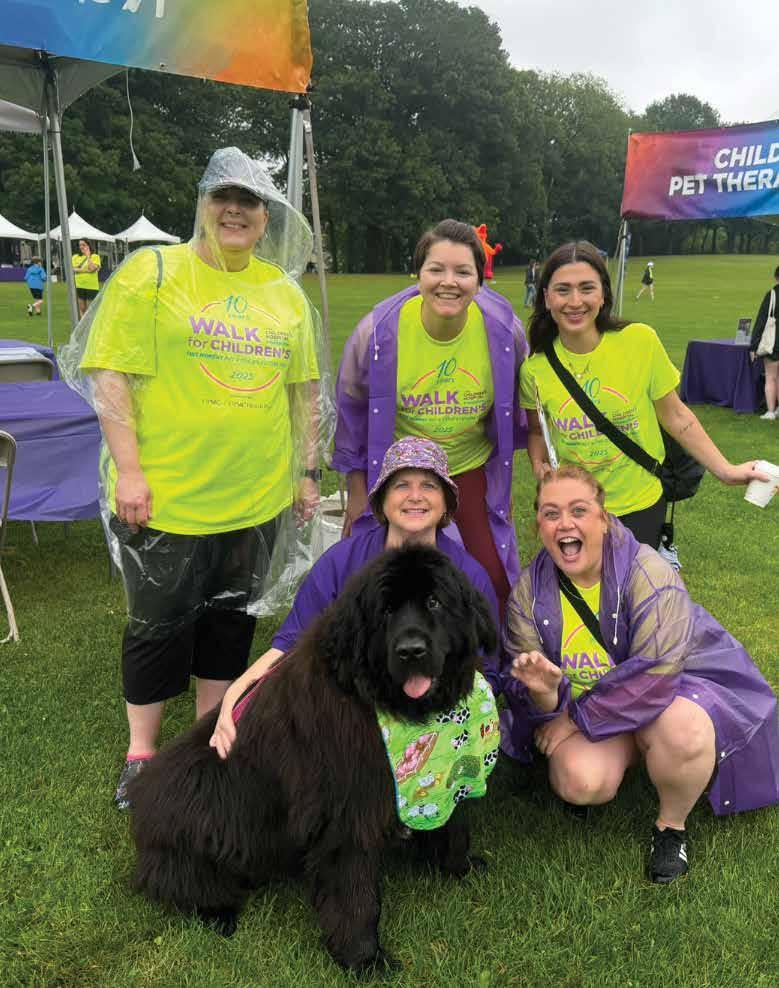
Photo provided by Sarah Mitchell
HUMAN ANIMAL BOND
by April Minech
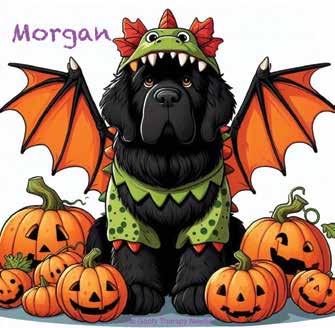
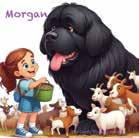
The Goofy Therapy Newfie Morgan
Experiencing your child suffering in the hospital must be a parent’s worst nightmare.
Watching the daily necessities of treatment and keeping up a brave face helps bring some comfort and knowing it is not enough. Enter a therapy dog; your child smiles and their face softens as they reach for a few pets and for a little while everything feels normal and right in the world. No bright lights, doctors, or sterile cleaning smells – just a child and a dog sharing a moment of joy.
That’s what happened to Sarah Mitchell, on the first of many trips to the hospital with her daughter, starting when she was four. When she saw the magic a dog could do,
Sarah knew she wanted to bring that joy to other children: “it was just something I needed to do.”
She started searching for a dog to train and settled on Morgan, a (now) 160lb Newfoundland. “She’s actually a difficult breed for therapy work because of her size, but that’s the breed that I’m attached to,” Sarah explains. Her first dog was a lab named Shadow that she got at 16, but when she passed her husband suggested getting a Newfoundland. “All that drool!” She thought but trusted him and they brought one home.
“That was it for me; I fell in love with the breed.”
Newfie rescue was familiar with Sarah and contacted her when a bonded pair of 12- year-olds needed a home. Living on an 80-acre farm she figured she had the room and welcomed them to her family. When she went to pick them up, she was told of another dog that was fearful and not doing well so Sarah took that dog as well. “It just grew from there,” she says. (Morgan currently lives with six other Newfies, so Sarah has a total house pet weight of roughly half a ton).
When searching for a puppy from an experienced Newfoundland breeder, she went to meet a litter and chose Morgan because she had a special gentleness about her.
They started basic training and earned a CGC (Canine Good Citizen certification is a 10-skill test that teaches good man-
ners to dogs and responsible dog ownership to their owners) from a local training center. The pair then went to Children’s Hospital for the next round of testing and passed, though a fateful turn stopped their journey: on the way home from the test the pair was in a car accident.
Morgan tore both of her ACLs and needed surgery to repair them and time to heal for six months. When she had recovered, Sarah contacted Children’s Hospital to resume the work and COVID hit so no dogs were allowed into the hospital. The hospital program works from a bank of about a dozen therapy dogs one at a time, but when Morgan finally got the call, the Therapy dog qualifications at the hospital had changed.
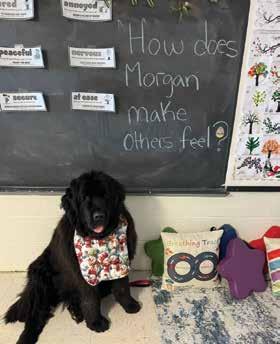
All dogs would need to be certified by a 3 rd party program, so Sarah chose one of the accepted organizations and started the new program. The test had several parts, including a trip to the grocery store. Morgan had to walk up and down every aisle while people ran by her or stopped to pet her and remain calm; she also toured two medical facilities. Once she passed those, Children’s Hospital required her to go through their own testing. Morgan went to libraries, elder care homes, and schools. She rode elevators, had wheelchairs bumped in to her, medical equipment fall beside her and people with masks walk up to her and reach to pet. After acing everything, Children’s welcomed Mogan and Sarah to their rotating therapy dog team of thirteen other employees. They visit the hospital twice a month; “We would do more,” Sarah says, “But she’s required to be bathed within 24 hours before each visit - which takes about 2 ½ hours - and I’m not sure about how it would affect her skin.” In between the hospital visits, Morgan travels to schools and elder care facilities. There were requirements for Sarah as well; she needed to pass a written test and receive clearances for working with children, including fingerprinting.
A regular visit at Children’s starts by going through the nurses entrance as Morgan can be a magnet for attention. Once on the property, she is insured through the hospital for things like stepping on someone’s toe or encountering a person who would be allergic.
They check in on the 6 th floor as volunteers and complete some paperwork before being assigned by the hospital for preapproved visits. “She always spends an hour with the kids in the oncology unit, then ChildLife points us to the doctor approved patients. We don’t get to decide where to go.” And anyone who wants to pet Morgan needs to sign a waiver.
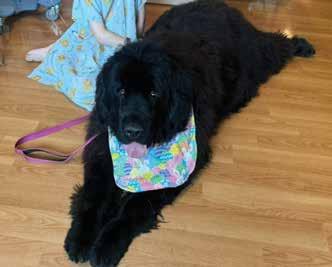
Many of the people on the unit are what Sarah calls “frequent flyers” and Morgan is allowed to enter certain rooms where children (already approved) are waiting to receive their treatments. They sit on the floor with her, ask for her paw and give her hugs. For one special girl, Morgan does tricks for ice cubes. Sarah brings a double handled leash that allows kids to hold a loop on Morgan’s collar and “walk” her while Sarah remains attached to the leash at the back end. On one special occasion, she was allowed to walk a child into the OR who was too afraid to continue. She calmed him and when the hospital team told him to say goodbye to his parents until after the surgery, he replied: “Bye Morgan. I love you.”
“Morgan’s walked children into treatment areas, sat with them during procedures and helped a child relax enough to have bloodwork taken.
That’s the power of a therapy dog.” -Sarah Mitchell
Sarah also makes original stickers featuring Mogan to hand out at visits. The children (and some adults) have started collecting the stickers and look forward to getting each new release. “I create about 110 stickers per month to hand out.” She says. Sarah got the idea when she learned that Children’s Hospital provides trading cards for all of their therapy dogs and Morgan’s were not ready yet. Knowing the kids would be looking for one - from a heads up by her daughter - she came up with the stickers so the kids would have a gift from her first visit. The idea gained popularity, and some nurses collect them to place in their lockers.
Morgan also has a book coming out in December titled: Morgan – The Goofy Therapy
Newfie and it explains Morgan’s journey to become a therapy dog. “A lot of people ask to bring their dogs to the hospital for comfort and are unaware of the process to reach that point. But Morgan has the magic; I’m just her Uber driver.”
You can follow Morgans adventures here: Morgan’s Instagram Morgan_therapynewfie
RESCUE AND SHELTER
NEBTR
by April Minech
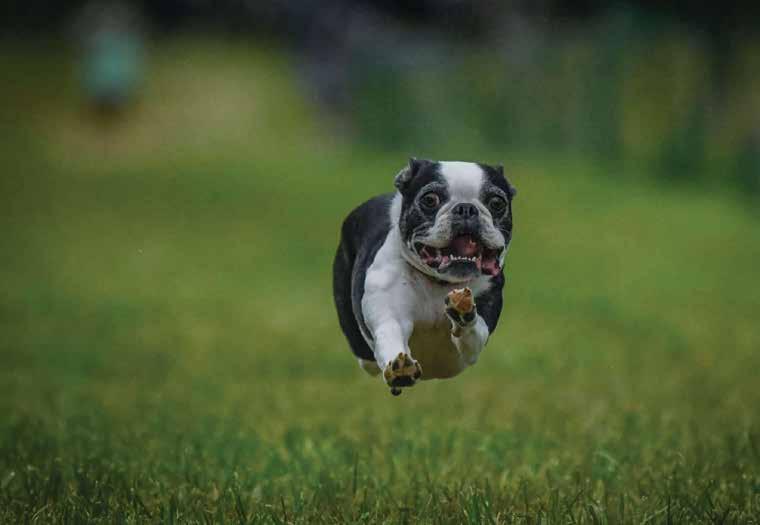
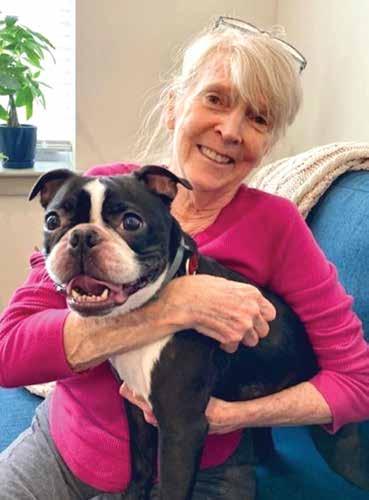
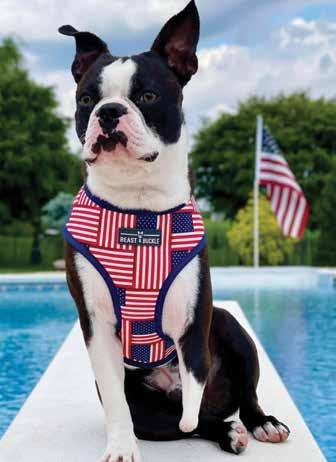
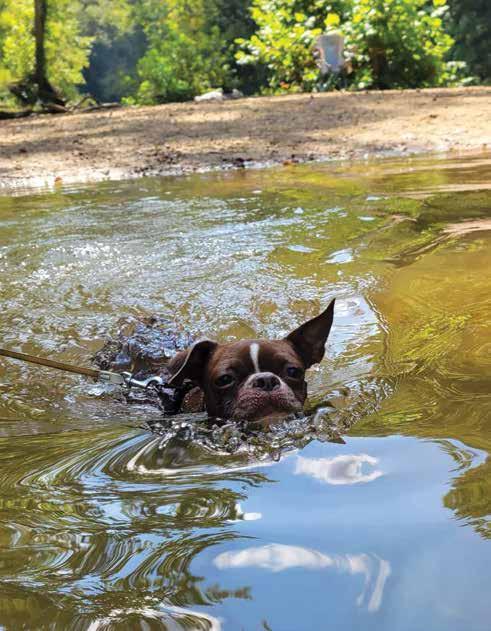
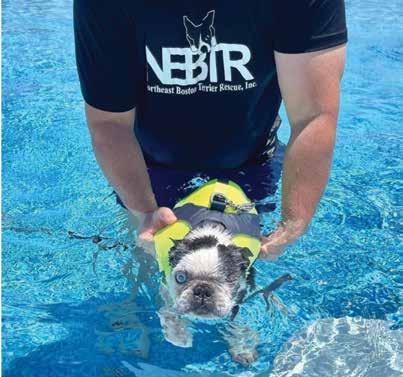
There are several Boston Terrier Rescues across the United States, and the organization closest to Pittsburgh is known as NEBTR, or Northeast Boston Terrier Rescue. The coverage includes New York, New Jersey, Pennsylvania, and Connecticut, providing assistance for all Boston Terriers and BT-mixes.
The mission of the Northeast Boston Terrier Rescue (NEBTR) is to rescue, provide medical care for, and find permanent "forever" homes for Boston Terriers in need. The organization is run by volunteers in the northeastern United States.
The NEBTR organization is entirely volunteer-run, from board members and managers to those who help with transport and medical or training visits. NEBTR has about 200 volunteers and takes in over 100 dogs a year, including those who need hospice. They rely on fundraising events to cover extensive medical bills, with 37 dogs crrently in their care. They try not to turn any surrender request away, but as with most foster based rescue they can only accept as many dogs as there are foster homes.
The rescue was started in New York by Sheryl Trent and several breed-confirming women that had dedicated their love and lives to Boston Terries and wanted to provide resource for dogs that were in need.
To learn more about how to help, you can visit them online here: https.//nebostonrescue.comfb @nebtr Instagram @ northeastbostonrescue
NORTHEAST BOSTON TERRIER RESCUE
RESCUE & SHELTER
By April Minech
SNORTSHORT NOSES ONLY RESCUE TEAM
Jennifer Popovich, a public de fender, has found renewed posi tivity by fostering special needs animals. “Humanity kind of stinks right now, so when you see the good being done it’s a nice thing.”
It all began through volunteering at a local shelter around 15 years ago, helping with behavioral cats in the medical department. The shelter housed some cats that were seriously compromised and rath er than having them spend time in a cage, Jennifer brought them home. She wanted to provide them with a comfort ing setting where they could have loving, constant care for whatever time they had left. “Some were longer term than others. One cat, Pumpernickel, was with me for three years,” she says.
a member of the intake team, is responsible for managing cases in New Jersey and Pennsylvania. “Whenever someone fills out a surrender form, I try to network the dog withing our group of volunteers to see if anyone can take the dog. If there’s more than one offer, we look at who’s closer or who fits with the dog’s needs and arrange transport.”
SNORT has roughly 200 volunteers and 27 currently within their care and they place about 100 dogs annually.
Her first foster cat was Duquesne, a small 4-year-old with kidney issues. He needed fluids several times a week and she decided to foster him at home to provide the care. As sometimes happens, she became a foster-failure and adopted him; with her care he lived to be 10 years old. Her tendency with fostering has always been to take on animals that need a little more. “It’s always heartwarming watch them improve and heal enough to be adopted.”
She also fosters French Bulldogs with IVDD (Intervertebral Disc Disease, a degenerative spinal condition in which the discs between the vertebrae bulge, leading to pain, weakness, incoordination, and paralysis). One example of the heartwarming ending she received came after caring for a frenchie named Charlie for three months. He was adopted right before Christmas by a family willing to take in a special needs dog. “When the family came to pick him up, they brought along a matching pair of pajamas to them and their other dog who was also in a wheelchair,” she says, smiling. “You learn not to feel sorry for these dogs and appreciate what they can do instead and find families that see that as well.”
Having fostered a dozen or more IVDD dogs, Jennifer explains that each one is different. Some come to her having been paralyzed for a while, so they’re not surgical candidates. Learning the skills to use wheels or a “drag bag” – a bag that at-
taches with suspenders if the dog is able to move around on its own and be protected from scratches – can take time. Vanna, who was adopted without expectations for surgery after becoming paralyzed, now leads an active life and even enjoys boat rides. “I still keep in touch with her family and they send great Vanna photos!”
Others who are just showing symptoms have a chance for recovery. Coco came into SNORT rescue paralyzed in need of surgery and Jen took care of her through recovery and physical therapy. She ended up staying. Although certain dogs recover mobility and can be adopted in improved condition, there’s always a chance they could have a flare up.
Special needs vary, as seen in the case of a pug named Milo dropped off at a shelter. Already ten years old, he had a very large inoperable tumor on his left nostril. Placed up for adoption in his condition there was no interest. His prognosis was a three week to three-month window, rescue decided surgery wasn’t a good option but approved Jen to foster and take him to her holistic vet, Dr. Doug Knueven. She states, “He received a combination of Chinese herbal remedies, steroids, and Tagame, and he ended up living to be17½. The tumor ended up shrinking to be almost undetectable.”
Currently, Jen volunteers for SNORT (Short Noses Only Rescue Team) a regional breed specific rescue that operates from Maine through Virginia. As a foster-based rescue, they can only accept dogs if suitable homes are available to meet the dogs’ specific needs. Jennifer,
Depending on the situation, Jennifer feels that sometimes the bond created with a special needs dog means that it’s in the dog’s best interest not to move on to new home. “That’s how I felt pretty quickly about my current Boston Terrier foster, Ainsley,” a 5 year old puppy mill rescue. Her life, like so many mill dogs, consisted of a cage and small kennel run inside of a barn. There can be a delicate relationship between rescues and breeders; nobody wants to support what the mill breeders are doing but there’s also nowhere for the dogs to go when they age out. Nobody volunteered to take Ainsley, so Jen stepped up. She also temporarily fostered a second Boston LuLu from the mill so both dogs came in together. “Ainsley was so afraid of people and the new experience of a car ride that it took three of us to get her into my car. She pancaked and back peddled out of sheer terror.” For the first week at her home. Ainsley felt some comfort with LuLu there as she was the only thing familiar but she still struggles to interact comfortably. After putting so much time trying to bring Ainsley out of her shell, Jen decided to adopt her so they could build a relationship working at Ainsely’s pace. “It would have been so difficult for her to make progress then go through another transport and settle in another home,” she quickly realized. “If she never progresses to the point of doing nose work or other outside dog activities, it’s okay for her to be however she is.”
www.snortrescue.org
Instagram: @snortrescue
SNORT is an all-volunteer registered 501(c)3 non-profit rescue based in the Northeast. Its purpose is to rescue brachycephalic dogs (mostly French Bulldogs, Boston Terriers, English Bulldogs and Pugs) from shelters and owners who can no longer keep them and place them into loving homes.
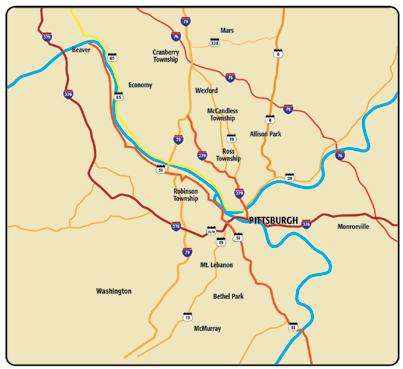
Ad Locator Map
ANIMAL FRIENDS ad on page 8 / map A
ASGARD RAW PET FOOD ad on page 30 / map B
BARTMAN PLUMBING ad on page 25 / map C
BEAVER COUNTY HUMAN SOCIETY ad on page 11 / map D
CHARTIERS CUSTOM PET CREMATION ad on page 28 / map E
CHEYENNE VETERINARY WELLNESS & SURGICAL CENTER ad on page 15 / map F
COVENTRY STABLES ad on page 24/ map G
DENISE MARASCO HOWARD HANNA ad on page 15 / map H
GRIN RESCUE ad on page 15
HUMANE ANIMAL RESCUE ad on page 12-13 / map J
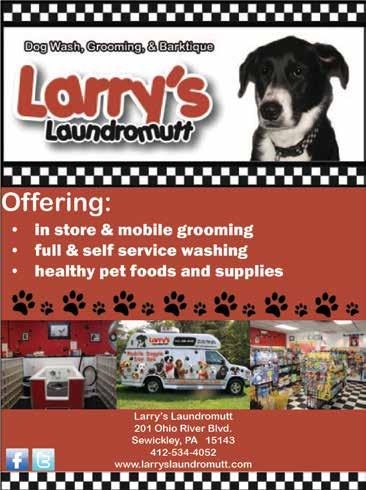
LARRY’S LAUNDROMUTT ad on page 15 / map K
PETS AFTER DARK ad on page 2 / map L
PORTRAITS OF ANIMALS ad on page 19
REBOUND PET REHABILITATION ad on page 25 / map M
SALTY PAWS DOGGIE ICE CREAM ad on page 3 / map N
UPSWING CANINE BEHAVIORAL SERVICES ad on page 14
DID YOU KNOW?
PetConnections has evolved into a full-service specialized pet media company, providing services for advertising in print and digital marketing platforms to help our sponsors grow their businesses.
Contact us for information on advertising or sponsoring! PetConnections is published quarterly as follows: March, June, September, and special Holiday issue in early December!
Our print copy distribution sites will be replenished every 6 weeks.
Our online presence has always been much greater than in print with now over a million impressions!
To subscribe to your own personal copy of PetConnections, please contact us.
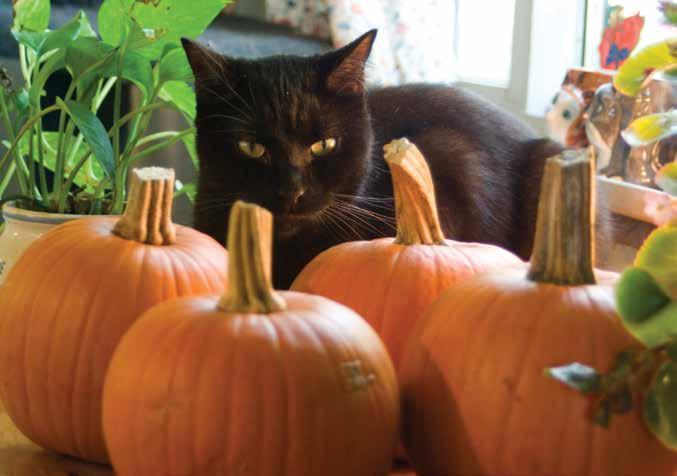
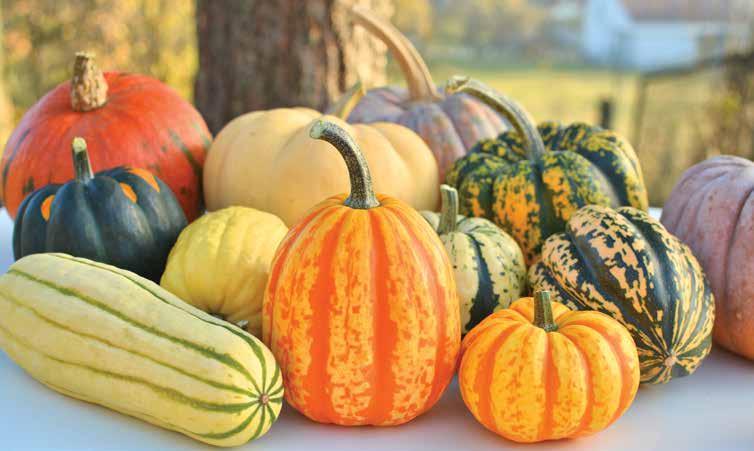
PUMPKIN! PUMPKIN! Just Plain Pumpkin!
Autumn is the time for pumpkins!
Get some fresh organic pumpkins now to process for your cat—or dog—snacks for yourself, and free bird seed for your feathered friends, and your own fresh home made pumpkin pies.
Pumpkins are elemental in our Halloween tradition, color, shape, jack-o’-lanterns and all manner of decorations, in part because this is their season of abundance, and they are a most versatile and nutritious fruit.
Curcurbita pepo actually originated in a family of many squashes in Central America. Native Americans planted them as one of the “three sisters” of corn, pole beans and squash interplanted to support each other. They are grown all over the world, and in many cultures are much more than a seasonal decoration but are a principle food source for their ease of growth and high nutritional value.
PUMPKIN FOR YOUR PETS
• Softens the stool in the case of constipation, also helps bind loose stool by absorbing excess fluid and soothing inflamed intestines in the case of diarrhea;
• Contains vitamins and minerals delivered in a readily accessible form, among them beta carotene and vitamins A and C and mineral potassium.
BASIC DOSAGE
The basic dose is about one to two teaspoons of puree per 15 pounds. Mix with canned food or dose gently with syringe.
Most cats and very small dogs: one teaspoon; larger cats and small to medium dogs; two teaspoons; dogs larger than 30 pounds: three teaspoons/one tablespoon. Many pets, including cats, really like it. It’s safe enough to give every day, and if they don’t need it, it doesn’t do any harm.
BUY CANNED OR BUY FRESH LOCAL PUMPKINS AND EASILY PREPARE
CANNED PUMPKIN: Only purchase canned “pumpkin,” not “pumpkin pie filling” or a can with any other ingredients.
FRESH PUMPKIN: All pumpkins have about the same amount of fiber and nutrients, varying amounts of fruit sugar.
Bernadette Kazmarski
• Smaller pumpkins, like a small plastic play ball, three pounds, 20 inches circumference sold as “pie pumpkins”, have fine smooth flesh and more sugar that average.
• Medium-sized pumpkins used for jacko’-lanterns, field pumpkins are often fed to livestock and have about 75% as much sugar, generally preferable for pets.
• The extra-large ones seen in competitions are raised for size and weight, not nutrition, but have lots of fiber and buckets of seeds.
OTHER WINTER SQUASHES: Pumpkin is a winter squash like butternut or acorn, all have about the same amount of fiber and nutrition and can be used interchangeably for pets or pies.
GOURDS: Gourds are edible but don’t have any of the nutrition or fiber you’d find in pumpkin, use them for decoration.
PREPARING
YOUR PUMPKIN
The small “pie pumpkin” or 3 lbs. raw pumpkin will yield about two cups of pureed pumpkin by either method.
ROASTING
Preheat oven to 350.
• Cut pumpkin in half top to bottom, pull off stem and toss on floor for cat toy, scoop out seeds and keep in a bowl.
• Place halves of pumpkin in a shallow pan with ¼-cup of water, cover with foil, roast for at least one hour, until tender.
• Let cool, peel, cut into chunks and mash or puree in food processor.
COOKING
Halve and quarter pumpkin top to bottom, scoop out seeds, keep in a bowl.
• Peel skin and cut flesh into 1” chunks, place in heavy pot, add one cup of water.
• Set on medium heat, cover, check every 15 minutes to stir the chunks, mashing as they soften, about 30 minutes.
• Remove the lid, reduce heat to low, and cook about about 30 minutes to allow moisture to evaporate, stirring frequently, cool.
STORING
• For pet’s use, scoop tablespoons of puree into sections of an ice cube tray, remove one at a time to thaw.
• For larger amounts, freeze by the cupful in plastic containers. A 9” pumpkin pie takes about two cups of pumpkin.
PUMPKIN
SEEDS
FOR YOU: Preheat the oven to 300 degrees, rinse the seeds and remove as much of the muck they are stuck to as possible.
• To a bowl that will hold about twice as much in seeds as you have, add a quart of water and ¼-cup of salt, stir to dissolve.
• Add seeds, let soak for 30 minutes to an hour, drain off liquid.
• Lightly oil a cookie sheet and place the seeds in a single layer, bake for 20 minutes, stir, bake for 20 minutes more.
• Let seeds cool. Store in tightly closed jar.
FOR BIRDS: As above, but use only one tablespoon of salt.
SOME RESOURCES FOR PUMPKIN FACTS
Can Cats Eat Pumpkin? https://www.petmd.com/cat/nutrition/ can-cats-eat-pumpkin
Pumpkins for Pets: http://davesgarden. com/guides/articles/view/1817/
USDA AGRICULTURAL RESEARCH SERVICE, NUTRIENT DATABASE
Raw pumpkin: https://fdc.nal.usda.gov/ food-details/168448/nutrients
Pumpkin boiled, drained, no salt: https:// fdc.nal.usda.gov/food-details/168449/ nutrients
PET RESOURCE DIRECTORY
ANIMAL EDUCATIONAL EXHIBITS
NORTH: GREATER PITTSBURGH AQUARIUM SOCIETY www.gpasi.org
THE PITTSBURGH ZOO & PPG Aquarium pittsburghzoo.org
THE NATIONAL AVIARY nationalaviary.org
ANIMAL-RELATED WRT, PHOTOGRAPHY & RETAIL
APRIL MINECH CUSTOM PORTRAITS /PET INSPIRED ART www.ladybugdelightz.etsy.com
SOUTH: CHEYENNE VETERINARY WELLNESS & SURGICAL CENTER 412-884-3162 cheyennevets.com
FIX UR CAT (724) 416-3265 fi xurcat.org
VETERINARY SPECIALTY & EMERGENCY SERVICES NORTH/SOUTH/EAST: PITTSBURGH VETERINARY SPECIALTY AND EMERGENCY CENTER, INC. 412-366-3400 724-809-2000 pvs-ec.com
BLUE PEARL PET HOSPITAL NORTH 412-366-3400
BLUEPEARL PET HOSPITAL SOUTH 724-366-3400
BLUEPEARL PET HOSPITAL EAST 412-810-6732
GREATER PITTSBURGH AREA: PETS AFTER DARK mypetafterdark.com 855-AFTRDRK (238-7375)
When Breathing Becomes Hard and Ears Become Itchy -
The Hidden Impact of Feline Inflammatory Polyps
Becky L. Morrow, DVM, MS, CAWA
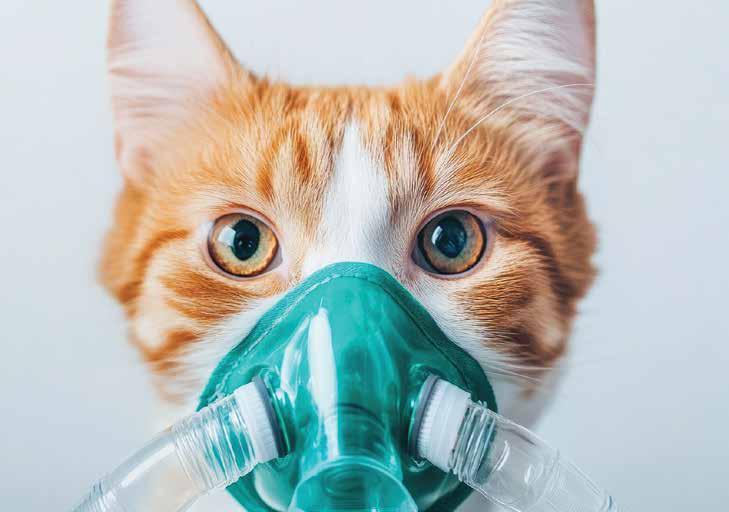
Among the various conditions that can affect a cat’s ears, nasal cavity, and throat, few are as often overlooked, and as rewarding to treat, as inflammatory polyps. These soft, non-cancerous growths can appear above the soft palate near the back of the throat (nasopharyngeal) or in the external ear canal, but they almost always originate in the middle ear or the Eusta-
chian tube (what makes the ears “pop” to even out pressure on either side of the ear drum). Kittens and young cats that have had upper respiratory infections are especially prone to developing polyps. The inflammation of the upper respiratory tract can cause swelling and blockage of the Eustachian tube, leading to trapped fluid, pressure changes, and overgrowth of local tissue that eventually creates the growths. Viruses such as feline herpesvirus are suspected contributors to this ongoing inflammation, though the exact cause is still not fully understood.
In many cases, a polyp can look like a stubborn upper respiratory infection that just won’t go away. Cats may breathe noisily, have constant nasal congestion or discharge, or make extra effort when inhaling. They may gag, struggle to swallow food comfortably, or have a change in their voice. Kittens are often very thin since nasopharyngeal polyps make it difficult to eat and breathe. When a polyp affects the ear, the signs may involve the vestibular system, with head shaking, loss of balance, a head tilt, and abnormal, darting eye movements, but more often than not, we see cats with a yellowish discharge or even the polyp sticking out of the ear. Almost every cat we see with pus in the ear canal has a polyp hiding underneath. Some cats may even have multiple polyps at the same time (we have seen up to three!).
Veterinarians who have not seen inflammatory polyps before may keep treating for upper respiratory infections with different antibiotics because the signs can be so similar. An important clue is that polyps often cause discharge from only one side of the nose, whereas respiratory infections almost always affect both sides. Even if a veterinarian suspects a polyp, they might not realize how simple they are to diagnose and how quickly they can be treated. I remember the first nasopharyngeal polyp I ever diagnosed in a very thin, underdeveloped kitten who just could not get better from what seemed like a bad upper respiratory infection. Treating her with antibiotics helped a little, but she still could not breathe normally and remained congested. When I anesthetized her and looked at the back of her mouth, the prob lem was obvious - there was a large bulge in her soft palate nearly blocking her airway.
At that point, I had already fallen in love with this little “foster cat” (who became a permanent member of my family!), and I was nervous about removing the polyp myself. After placing a breath ing tube, I carefully pulled the soft palate forward with a spay hook and immediately saw the large pink, fleshy mass. I grasped it with hemostats and applied steady traction until it released from its stalk inside the Eustachian tube. I will never forget how this sweet kitten who had struggled to eat and breathe woke up and was immediately better. She had a temporary change in her pupil size and a protruding third eyelid (called Horner's syndrome), but this resolved within a couple of weeks. Twelve years later, she is still happy and breathing perfectly!
Back then, I thought this would be far more complicated and even considered raising money to send her to a specialist. I am so glad I did not. Unfortunately, many veterinarians were taught that expensive imaging such as computed tomography (CT, or “cat scan”) or magnetic resonance imaging (MRI) is needed, along with an invasive surgery called a bulla osteotomy. While CT and MRI can reveal changes to the bony structures of the middle ear, they are rarely necessary. Most polyps are discovered without any ad vanced imaging at all, simply by examining the back of the throat or ear while the cat is under anesthesia. Only very early polyps, still confined entirely inside the middle ear, would require imaging to detect. If a cat shows signs of middle ear disease that does not
respond to treatment, x-rays will be performed anyway to get enough information to guide treatment.
Over the years, we have removed hundreds of nasopharyngeal and otic polyps, although nasopharyngeal polyps are much more common. While one of the few scientific papers on the topic suggested that removing otic polyps carries about a 50% chance of recurrence, our success rate with the traction technique has been far better (closer to an 80% cure rate). We have only had one cat with a nasopharyngeal polyp that needed a second quick procedure to remove residual tissue, and we have never seen
Veterinarians who have not seen inflammatory polyps before may keep treating for upper respiratory infections with different antibiotics because the signs can be so similar.
An important clue is that polyps often cause discharge from only one side of the nose, whereas respiratory infections almost always affect both sides. Even if a veterinarian suspects a polyp, they might not realize how simple they are to diagnose and how quickly they can be treated.
hips, I have a posture aid when I sit to teach, and I adjust my back and arms when I drive! I am continually conscious that my toes point straight ahead when I walk, my shoulders lifted, and my head held high. (Right, this is tough not to look down when we walk.)
Using your photos I create a lasting gift for yourself or a loved one.
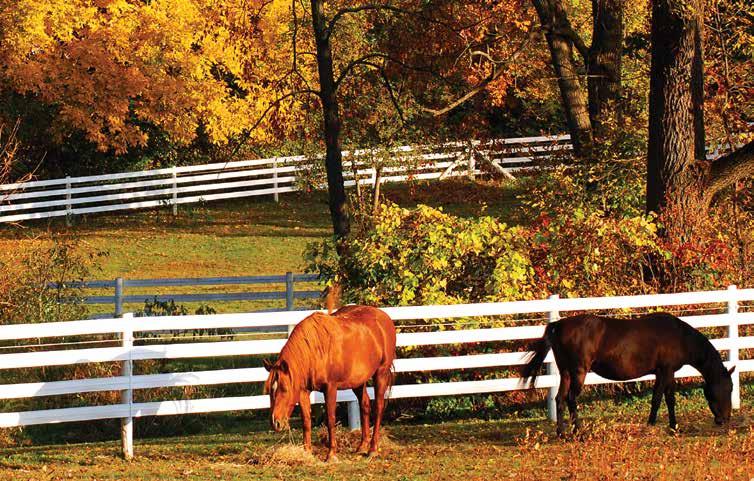
Learn how to ride & train with clarity. All horses & riders benefit utilizing simplified gymnastic training or ‘dressage’. Visit our Facebook page “Home School Your Horse” for training tips. The chestnut coat is brushed with gold, A tale of autumn to be told. Through amber leaves, he walks with grace, A gentle rhythm sets the pace.
The author at the beginning of her dressage journey, all rounded in the back. I changed it and learned how to sit up when I ride!
EQUINE AFFAIRS
DRESSAGE LEVELS INTRO TO FOURTH LEVEL
ESTABLISHING CORRECT BASICS IS KEY TO PROGRESSION
by Kristin Hermann
Dressage riding is simply gymnastic training for horses. The levels in dressage show the progression of training. Horses typically don’t come already trained and even if you bought one with training you still need to be able to communicate to it in a complimentary way. Becoming familiar with the levels of dressage enables the rider to understand the progressive gymnastic training of the horse.
The lower levels are the basics and the most challenging to achieve. Training the horse requires not just an understanding of why and how but the rider’s ability to influence the horse. Even the tests in dressage are progressive. For instance, Training Level test one is easier than Training Level test two and it is the same in all the tests. The Third test in each level is always the most challenging.
Good basics are required to move through the levels in dressage. First is establishing rhythm, relaxation and then contact or connection over the back (on the bit) and this is done at
Intro and Training Level. Keeping the horse relaxed, rhythmic and connected or round at all three gaits is paramount for dressage progression.
Throughout the process of training dressage, the rider is continually fluctuating between training the horse ~ longitudinally (back to front) and laterally or side to side. What follows is my perspective of the levels and brief understanding of the purposes.
Intro is a n introduction to dressage, the gaits of the horse, movements and the arena. Also, introduced is the value of the twenty meter circle, straight lines and a free walk. The ride should flow in both directions with the horse softly bending on the circles in the direction of travel with a good rhythm. Intro introduces the rider to straight lines and circles.
Training Level is the hardest level because this is where all the basics are developed. Twenty meter circles at the trot and canter accepting some contact or “on the bit” in both directions including straight lines at the walk and
the “stretchy trot” is introduced. The movements should flow and transitions are done in-between the letters to show smoothness and fluidity. First we train the horse in Training Level to go “down and round” to lift the back and seek the contact and then when this is established we start with training the horse “under and up” to develop the more uphill carriage desired in First Level.
Here is a video showing a nice Training Level trot relaxed, rhythmic and round or accepting the contact. https://share.icloud.com/photos/ 04bajSUTilN9w1Kd-fXzCoX2Q
If you can ride your horse on the bit at all three gaits, but more particularly at the trot and canter, you are ready to move on.
FIRST LEVEL is started after the basics of Training Level are confirmed. In First Level the training starts to establish more push or impulsion from behind to get the horse “uphill” in order to transfer more weight from the frontend to the hind quarters. Continued on next page
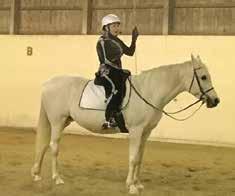
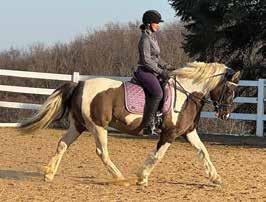
Intro horse and rider. Learning the basic movements, riding 20 meter circles, corners and straight lines. The horse does not need to be on the bit, just moving freely from behind over the back to a light contact
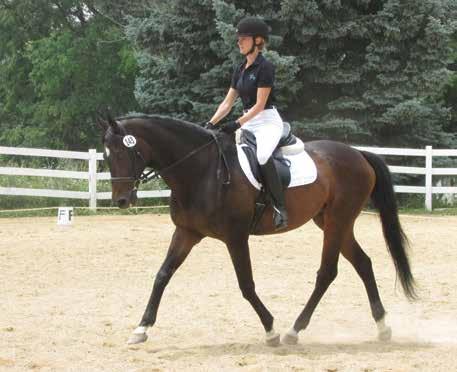
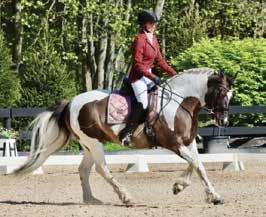
Nice Training Level trot. The horse is stepping into the contact and softly flexing at the poll, plus the rider is showing good form.
The exercises to do this are leg yielding, smaller circles at the trot from twenty to ten meters and at the canter fifteen meter circles.
First Level training starts to compact the horse a little with the smaller circles so lengthening the gaits is introduced to keep the horse elastic over its back. The last thing we want to do with training is contract the horse’s muscles. In other words, as we begin to coil the gaits with smaller circles and lateral work, at the same time we also learn to lengthen them.
Training the trot lengthening is way easier than the canter. We first need a balanced canter before considering to lengthening it. Also, the shallow loop in First Level Test three at the canter begins the concept of the counter canter required for Second Level. And still at First level the stretchy trot and free walks are required. Of course, none of this is of value unless the horse is correctly working over its back and on the bit or aids which should have been established in Training Level. In addition, at First Level transitions are now at the letter instead of in-between the letters, as the training starts to get more precise. Video Schooling First Level ~ https://www.facebook. com/share/v/19qFiLPpGN/?mibextid=wwXIfr
SECOND LEVEL begins collection with shoulder in, haunches in, counter canter, rein-back, walk canter and canter walk. The halt on centerline is from the trot with no walk steps. At Training and First Level you walk into the halt. As the horse coils or collects with the lateral work required in Second Level the “medium” gaits are developed to show more expressive than the lengthen gaits required at First Level. A horse has to be balanced (not falling on the forehand) to do Second Level with its weight shifted to the hind quarters. If you have mastered ten meter circles at the canter with the horse relaxed, rhythmic, round and straight then we know your horse is balanced on the hind end at the canter.
Training this is not easy, as the horse has to be straight on the circle so it does not fall in or lean and, the same with the rider. This is why you turn from the outside rein to keep the horse in balance. (A topic for another article.) Also, the poll has to be up as the highest point and flexed as this shows the horse is accepting the contact. A horse cannot canter “up hill” or come under and up if its poll
is too low. A horse has to be stepping under from behind to lift “under and up” but if a rider is heavy handed the horse cannot come under and up. These are all prerequisites that are preferably established in Training and First Level. First a good canter and a good trot and then the movement.
THIRD LEVEL ~ begins flying changes of lead one in each direction, half pass and extended gaits. Third Level is the level that separates the boys from the men. Many horses can’t do changes. And if you can’t do changes you can’t move past Second Level. As the horse’s gait collect in Third Level, the horse should also be able to extend. Thus, we coil the gaits to collect but at the same time we extend. The half pass is a combination of the shoulder-in and haunches in. In Half Pass the horse is banana shaped in the direction of travel and the shoulders and haunches should be alignment. As we know all these exercises create more atheletism with in the horse. Also in Third Level, the release of the reins over the centerline at the canter is shown. This shows the judge that horse is on the bit in “self carriage.” When the rider gives the reins and the horse stays in a frame and does not reach for contact it shows that the horse is not being held together with the reins. Self carriage or the horse being light in the contact, in my opinion is the holy grail of dressage.
FOURTH LEVEL requires three flying lead changes across the diagonal and begins the walking turn on the haunches plus quarter pirouettes at the canter. In addition everything else we have mentioned half pass, shoulder in, haunches in, lead changes and canter to halt! None of these levels are easy and Third and Fourth level are certainly challenging with so many additional movements to show the horse’s progression. And, advancing up the levels cannot be done without the good basics that are established in Training Level.
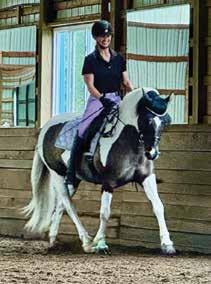
Video schooling PSG which is after Fourth Level. This is the Appaloosa that inspired this article. This pair started at Intro 7 years ago, with correct basics and a lead change they climbed the levels…https://www.facebook.com/ share/v/16BNGJCgBj/?mibextid=wwXIfr Don’t need a fancy Warmblood just a nice horse with a willing attitude and decent gaits, good riding helps, lol!
At my school of riding, the basics of rhythm, relaxation and contact or the horse accepting connection back to
As we move up the levels, the rider learns to coil the horse’s gaits on smaller circles but also learns to lengthen the gaits. Got to keep that top line elastic, we also continuously stretch our horses down and out.
Pony nicely accepting being on the bit or aids at the canter. It is harder to ride the canter on the bit than the trot because the rider needs to follow the “longitudinal motion” at the canter. This pony is soft at the poll, balanced on the outside rein with a light position to the inside. Rider’s inside leg could be forward. You mean we are not perfect, :-) For dressage, you have to be on the bit to move up the levels, these basics are established in Training Level.
front are mandatory to succeed. Once the rider has this in both directions on the circle at the walk, trot and canter then they learn how to keep these basics on straight lines and then start with lateral work. All the while every student and horse learns how to stretch the horse to seek the contact or connection over the back. Stretching your horse for the dressage tests is not required after First Level, but is recommended to keep the horse’s gaits supple and not contracted.
Any aspiring dressage rider should read the purposes of each level, which is on the tests upper left hand corner under Purpose. All tests list what is new in each level and typically what is new is double points. Also, a must read on the tests is the collective remarks at the bottom of the test. The training of dressage is progressive and if you have good basics and the horse has three quality gaits there is no reason you cannot progress through the levels.