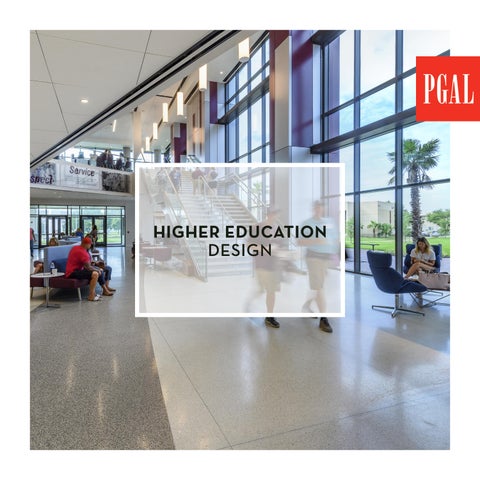
HIGHER EDUCATION DESIGN
alexandria • atlanta • austin • boca raton • dallas/fort worth • denver • hoboken • houston • las vegas • los angeles • salt lake city • san diego
pgal .co m
PROJECT EXPERIENCE At PGAL, we create dynamic, future-ready environments that support the evolving needs of higher education. Our designs prioritize flexibility, inclusivity, and innovation to enhance learning, collaboration, and campus life. With experience on more than 100 campuses, our work spans academic buildings, laboratories, student housing, support facilities, and campus master plans. Through adaptable spaces, integrated technologies, and sustainable strategies, we help institutions remain resilient and responsive. PGAL brings a fresh design perspective paired with the discipline of a long-established firm. Rooted in collaboration and shaped by educational trends, our work reflects the ingenuity and vision of the collegiate mindset.
RICE UNIVERSITY MARTEL, JONES, + BROWN COLLEGES location: houston, texas Rice University’s Martel, Jones, and Brown Colleges expand three residential colleges with 337 new beds, classrooms, and commons buildings that strengthen student life, academic support, activities, and longstanding campus traditions.
The Jones College addition links two previously separated buildings, introducing a central stair tower and a new commons. At Brown College, a colonnade of cast-inplace columns and blue glazed clay brick creates a distinct entry sequence.
At Martel College, a circular stair tower connects the new residential wings to the commons, creating a recognizable courtyard landmark. Layered architectural expression, with a strong base, middle, and top, is reinforced through exposed concrete framing and a tall port entry.
Each commons building supports dining, film, and theater activities, with shared kitchen and servery spaces. Living units use abundant natural light and contemporary furnishings, offering an appealing alternative to offcampus housing while keeping students connected to the residential college experience.
UNIVERSITY OF NEVADA ADVANCED ENGINEERING BUILDING location: las vegas, nevada Designed with partner firm SmithGroup, the University of Nevada Advanced Engineering Building gives the College of Engineering 50,000 square feet of teaching, research, and collaboration space. The three-story facility brings together a maker space, wet and dry laboratories, student and faculty offices, an active learning classroom, divisible classrooms, a flexible auditorium, and a central lobby that supports daily connection. Its layout organizes offices for faculty, postdoctoral researchers, and graduate students along the second floor’s west bay and bridge, with enclosed laboratories in the center bay and an open lab with movable benches and desks to the east.
On the third floor, additional wet labs with fume hoods and sinks are arranged for utility-free flexibility. Exposed systems, including steel cross-bracing and visible ceiling infrastructure, serve as teaching tools while supporting durability, maintainability, acoustic performance, and a clear academic character.
FLORIDA ATLANTIC UNIVERSITY STILES-NICHOLSON BRAIN INSTITUTE location: jupiter, florida Florida Atlantic University’s Stiles-Nicholson Brain Institute adds 60,000 square feet of research and teaching space to the Jupiter campus, supporting the university’s Life Science Initiative and growing brain science program. Developed through collaboration between the Charles E. Schmidt College of Science and the Harriet L. Wilkes Honors College, the three-story facility brings together advanced laboratories, classrooms, faculty offices, support areas, and a vivarium for research. Open gathering spaces give researchers, faculty, and students places to connect outside formal lab and classroom settings.
Located near the campus core, the building strengthens ties with partners such as the Max Planck Florida Institute while giving Florida Atlantic University adaptable laboratory space for changing research priorities. PGAL’s design supports interdisciplinary education and life science research through flexible planning, clear circulation, and shared spaces that make collaboration part of the building’s daily use.
UNIVERSITY OF HOUSTON FERTITTA CENTER location: houston, texas The renovation of the University of Houston Fertitta Center reshaped the university’s basketball facility into a Division I collegiate arena focused on fan experience, student-athletes, the university community, and longterm revenue goals. PGAL and AECOM addressed the building from the outside in. Outdated precast panels were replaced with a curtain wall system that brings natural light into the arena and improves visibility from the exterior. Northeast and southwest lobbies now serve as open fan zones with food service, gathering areas, and clearer access to seating.
Inside the bowl, mid-court seating was shifted closer to the action, and floor-level student sections were added opposite the team benches to strengthen game-day energy. Additional upgrades included more than 700 premium seats, advanced sports lighting, an enhanced audio system, improved video boards, and expanded concession and restroom facilities, giving the renovated arena the capacity and operational support needed for major game-day crowds.
TEXAS STATE UNIVERSITY STEM BUILDING location: san marcos, texas Texas State University’s STEM Life Sciences Building will add 170,000 square feet of academic and research space in San Marcos, supporting the university’s goal of achieving R1 National Research University status. The site drops 50 feet from east to west and rises 40 feet from north to south. PGAL, serving as Architect of Record with design partner Ayers Saint Gross, used those grade changes to organize multiple entries across several levels, improving circulation for roughly 2,000 students moving through daily class transitions.
Inside, the building will house instructional spaces, laboratories, and adaptable learning environments that support different teaching and research needs. Exterior materials and massing relate to the Texas State campus, while the interior focuses on clear routes, visual connection, and spaces that help students, faculty, and researchers move between instruction, collaboration, and discovery.
UNIVERSITY OF HOUSTON-DOWNTOWN GATOR EXPANSION location: houston, texas The University of Houston-Downtown Gator Expansion begins a phased reorganization of the One Main, Academic, and Girard Street Welcome Center buildings, strengthening the connections between learning, student services, and campus life in downtown Houston. The first completed phase relocates the Testing Center from the third floor of the Girard Street Welcome Center and the Academic Support Center from the ninth floor of One Main to the fifth floor of One Main. This move opens the Girard Street Welcome Center’s third floor for a future centralized resource hub for career services, health services, disability services, and counseling services.
Phase two adds a new floor above the Girard Street Welcome Center for financial aid, cashier, and student accounting services, along with seminar rooms, technology-enhanced classrooms, active learning environments, and informal gathering areas. A seating area at the connection between the three buildings will help tie the campus network together.
UNIVERSITY OF HOUSTON-DOWNTOWN MARILYN DAVIES COLLEGE OF BUSINESS + PARKING GARAGE location: houston, texas The Marilyn Davies College of Business gives University of Houston Downtown a 132,500-square-foot academic facility organized for varied class sizes, teaching methods, and daily student support. Instructional spaces include a 90-seat tiered lecture hall, mid-sized lecture rooms with adjacent breakout areas, seminar rooms, computer labs, and 33 classrooms ranging from 20 to 60 seats. Distance learning, multimedia presentation, and real-time instruction are built into the teaching spaces, while centrally located faculty offices improve access for students.
The academic core also integrates the Career Development Center and Resource Center, keeping advising and student resources close to classrooms. Informal study areas, collaboration zones, and meeting rooms bring natural light and downtown views into the student experience while supporting interaction among students, faculty, and industry partners. A five-level, 348,000-square-foot parking garage with 632 spaces sits behind the building to preserve views, with visitor and faculty parking, elevator access to the college, and an elevated student deck.
SAM HOUSTON STATE UNIVERSITY ACTIVE LEARNING CENTER location: huntsville, texas The Active Learning Center gives Sam Houston State University a more visible academic anchor at a key west campus intersection in Huntsville, Texas. The 46,421-square-foot renovation and expansion brings together the Teaching and Learning Center, active learning classrooms, learning studios, faculty triage and support spaces, and informal student areas. Flexible classroom layouts and integrated instructional technology support participatory teaching models across departments, while shared study and collaboration spaces extend learning beyond scheduled class time.
PGAL’s design strengthens movement between Avenue J and the historic quad. A shaded exterior colonnade guides students along major pedestrian corridors, and a central atrium carries those pathways through the building to improve visibility, connection, and activity at the campus edge. The result is a practical, student-centered facility that supports modern instruction while giving this part of campus a stronger sense of place.
UNIVERSITY OF TEXAS RIO GRANDE VALLEY PORT ISABEL MARINE ECOSYSTEM RESEARCH FACILITY location: port isabel, texas Along the Gulf of Mexico, the University of Texas Rio Grande Valley Port Isabel Campus needed a durable research facility that could support marine science growth while responding to coastal site challenges. PGAL is providing programming, design, and construction administration for a 14,725-square-foot modular laboratory facility within a prefabricated metal panel building. Designed for a $16 million budget, the facility includes seven flexible lab modules, graduate workspaces and offices, a classroom, conference room, break room, lobby, small study areas, and protected space for critical building systems.
The design responds to AE and VE flood zone requirements, stringent wind ratings, hurricane resilience standards, corrosion resistance, and soils with low loadbearing capacity. A Controlled Modulus Column ground improvement system was integrated to help meet the substantial completion deadline. The site plan works with the existing retention pond, campus circulation, and gravel paths while anticipating future improvements such as boat ramps and expanded parking. Sheltered outdoor work areas support experiment preparation and hands-on instruction for students and researchers, enhancing their daily experience.
LAMAR UNIVERSITY IDIQ SERVICES location: beaumont, texas Through a multi-year Indefinite Delivery Indefinite Quantity (IDIQ) contract, Lamar University turned to PGAL for architectural services that could respond to varied campus needs without a one-size-fits-all approach. The work paired assessments, planning, and targeted renovations to help the university understand building conditions, prioritize repairs, and reduce disruption to daily campus operations. Assignments included condition assessments, exterior envelope evaluations, façade renovations, and building rehabilitation for the Mary and John Gray Library, Geology Building, Social and Behavioral Sciences Building, and Chemistry Building. PGAL also studied adaptive reuse of a
former industrial facility for shipping and receiving, along with renovation of the existing shipping and receiving building into a marching band music annex. Completed through phased assignments, the work helped Lamar University address deferred maintenance, extend the useful life of existing facilities, and support continued campus growth.
LONE STAR COLLEGE LEARNING RESOURCES + NURSING CENTER location: cypress, texas Lone Star College-CyFair’s Learning Commons renovation turns the Learning Resource and Nursing Center into a more useful campus hub for study, collaboration, and student support. PGAL’s interior design and furniture, fixtures, and equipment work reorganized the lobby and concourse into a range of open study settings. Built-in banquettes, pod-style seating, markerboard walls, group tables, and quiet zones give students places to work together or focus between classes.
Because the existing structure left many areas visually and acoustically exposed, PGAL coordinated early with manufacturers to refine ceiling treatments. PET felt, wood slats, and suspended clouds reduce sound travel while helping define zones within the open commons. The renovation also added a staff office suite with a reception area, three private offices, a conference room, copy room, and work room with integrated counter space, supporting student services and faculty collaboration in the same central campus setting.
TARLETON STATE UNIVERSITY LILLIAN STREET DORM location: stephenville, texas Tarleton State University’s new Lillian Street residence hall supports the university’s long-range master plan and continued shift toward a stronger academic, residential, and campus experience. Approved by the Texas A&M University System Board of Regents, the $120 million, five-story project will add housing for roughly 920 to nearly 1,000 students in Stephenville. Located on North Lillian Street, the residence hall responds to Tarleton State’s growing enrollment and need for additional on-campus living options.
The project represents a key investment in student life and campus capacity, giving more students the opportunity to live close to academic, social, and support resources. As Tarleton State builds on its 125-year legacy, the residence hall will advance a campus environment where student success, community, and long-term growth remain closely connected.
UNIVERSITY OF FLORIDA HONORS VILLAGE location: gainesville, florida University of Florida Honors Village brings 1,407 students into a residential community at the center of the university’s primary housing district in Gainesville. The five-building complex includes four residential towers, ranging from five to six stories, and a one-story commons building. Together, they provide more than 415,000 square feet of housing in single- and doubleoccupancy rooms. Units are organized into 20- and 40bed communities, each with dedicated laundry, lounge, and kitchen spaces to support daily student life.
A central courtyard shaded by mature trees connects the village to a major pedestrian corridor and the broader academic campus. Open lawns, seating areas, a hammock area, and covered and uncovered bicycle parking for more than 400 bikes support a relaxed campus setting. Groundfloor amenities include spaces for music, art, mindfulness, gaming, study, and Honors College administration. Delivered through fast-track design-build, PGAL served as Architect of Record with Associate Architect Walker and Weitz Construction.
UNIVERSITY OF LOUISIANA AT MONROE WARHAWK VILLAGE APARTMENTS location: monroe, louisiana Delivered through a public-private partnership, Warhawk Village gives the University of Louisiana at Monroe 372 beds of student housing on a 4.5-acre site near Bon Aire Drive and the university’s athletic complex. The development includes two low-rise residential buildings with 127 fully furnished apartments in one-, two-, and four-bedroom layouts, serving a mix of student needs. Along Bon Aire Drive, the three-story building acts as a transition to the adjacent neighborhood, helping buffer parking activity and reduce light and noise spillover. Its ground floor includes 2,400 square feet of white box retail space for future community use.
Facing the athletic complex, the four-story building houses most student apartments. A secure ground-level lobby supports access control and resident services, while an adjacent office suite provides space for university staff focused on student engagement and residential life. Shared amenities include a business office, mailroom, fitness center, game room, and maintenance storage.
NEVADA STATE COLLEGE THE VILLAGE location: henderson, nevada Located in Henderson, Nevada, The Village has 252 beds of apartment-style student housing organized around both privacy and community. The four-story development was designed in two phases and includes one-, two-, and four-bedroom units, each with private bathrooms. A dedicated staff apartment supports residential life operations, while shared amenities, including a computer lab, mailroom, laundry room, activity space, social lounges, and enclosed study areas, give students places to study, gather, and unwind.
PGAL organized the site around two central courtyards that support recreation and quieter outdoor use. Views from common spaces to the landscaped plaza and pool help connect interior student life to the outdoors. Warm masonry, stucco, and metal panels respond to the desert setting and establish a unified campus identity. Building orientation enhances daylight and frames views of the surrounding mountains and valley, while interior transparency strengthens connections between indoor and outdoor spaces.
UNIVERSITY OF NEVADA LAS VEGAS UNIVERSITY GATEWAY location: las vegas, nevada The University Gateway Project is the first development supporting the University of Nevada Las Vegas’ vision for Midtown UNLV, a connected mixed-use district serving both campus and community needs. Phase one introduced an 813-space parking garage and a 10,422-square-foot home for the UNLV Police Department, helping reduce congestion while strengthening campus safety and access. Phase two added a seven-story mixed-use building that anchors the district with 21,574 square feet of ground-floor retail, 46,680 square feet of office space across two levels, and 204 residential micro-apartments above.
Studios through six-bedroom units serve faculty, graduate students, and local professionals, with shared amenities including a rooftop deck and pool. Together, the phases bring parking, public safety, retail, office, and housing into one compact development that supports UNLV’s longterm campus edge strategy.
TEXAS A&M UNIVERSITY PARK WEST DEVELOPMENT location: college station, texas Park West gives Texas A&M University a 3,410-bed student housing community on 48 acres adjacent to campus, expanding options for students while improving the link between housing and the university core. Developed through a public-private partnership, the project includes 12 three-story walk-up apartment buildings, two five-story apartment buildings, and the eight-story Texas Wrap. A central boulevard connects the site to the campus and organizes the large development into a walkable residential district.
The five-story buildings are arranged in C-shaped configurations around landscaped courtyards with green space, a pool, outdoor kitchen, and fire pit. Texas Wrap encloses two secure courtyards, provides 1,886 beds, and integrates with a seven-level garage offering 1,200 spaces. Above the garage, a rooftop amenity deck includes a large pool, cabanas, food and coffee venues, and a fitness center with views toward Kyle Field. Ground-floor retail, a two-story open lobby, study lounge, activity spaces, and staff apartments support the community. The three-story flats provide an economical housing option with access to shared amenities.
FLORIDA INTERNATIONAL UNIVERSITY BAYVIEW HOUSING location: north miami, florida Bayview Housing delivers a nine-story, 410-bed residential complex along the bay in North Miami, anchoring Phase 1 of the university’s master plan. The building uses its waterfront setting to shape the student experience, with views to the ocean on the east and state parkland to the north. The ground floor functions as an activity hub, combining three academic classrooms, office support space, laundry, a gaming room, fitness center, computer lab, conference room, and a multipurpose club room with kitchenette. An open lobby connects directly to an outdoor courtyard, curvilinear pool with beach entry, and large sun deck.
Student residences occupy levels two through nine and include 24 studio apartments, 64 two-bedroom, one-bath units, and 64 two-bedroom, two-bath units. Sky lounges on each residential floor take advantage of the views, while a top-floor lounge with a cantilevered observation window gives students a shared place to overlook the bay.
FLORIDA ATLANTIC UNIVERSITY PARLIAMENT HALL location: boca raton, florida Florida Atlantic University Parliament Hall provides firstyear students a 600-bed housing and dining complex that supports the university’s Living Learning community model in Boca Raton. The 188,000-square-foot residence reflects the scale and character of the surrounding campus while offering flexible suite options for new students. Units include both single- and double-occupancy arrangements, giving residents different levels of privacy within a shared community setting.
Ground-floor amenities bring academic and social activity into the daily residential experience. A large multipurpose space, study rooms, two classrooms, housing offices, and a welcoming lobby support learning outside the classroom, while a faculty-in-residence apartment and two staff apartments strengthen the residential support network. The complex also includes laundry facilities, a fitness center, outdoor courtyard, volleyball court, barbecue area, and a 12,000-square-foot dining room with clerestory windows and lakefront views. Parliament Hall earned LEED Gold certification.
TEXAS A&M UNIVERSITY AT GALVESTON ATLANTIC + PACIFIC RESIDENCE HALLS location: galveston, texas The Atlantic and Pacific Residence Halls add 600 beds and 169,200 square feet of residential space to Texas A&M University at Galveston, strengthening student life and creating a welcoming environment on the university’s ocean-oriented campus. Each unit houses four students in two private sleeping areas, with a shared bathroom and common entry space. The complex also includes administrative offices, reception areas, study lounges, laundry rooms, and wired card-access security systems that support safety and convenience.
The project extends student life outdoors with seating walls, barbecue areas, and gathering spaces that create places for residents to relax and connect. A new pedestrian and bicycle circulation system links the residence halls to the broader campus network. Secure lighting, clear wayfinding signage, and accessible bike racks make movement across campus easier while supporting alternatives to driving. By adding housing, amenities, and campus connections in one project, the residence halls help Texas A&M University at Galveston expand residential capacity while reinforcing a cohesive campus experience.
FLORIDA ATLANTIC UNIVERSITY INNOVATION VILLAGE location: boca raton, florida Innovation Village expands student life on the north side of Florida Atlantic University’s Boca Raton campus with two seven-story residential buildings designed for upperclassmen. The development-design-build project accommodates 2,400 students and supports the university’s long-term housing goals within the campus master plan developed by PGAL. Residential options include four-bedroom, twobath units, along with private single and double rooms for housing staff. Outdoor amenities, including a heated pool, barbecue areas, volleyball courts, and open green space, give
residents places to gather, study, and recharge. One building includes in-unit laundry to support more independent living. The other provides shared laundry rooms, a computer lab, group study and conference spaces, a fitness center, and flexible areas for student events and gatherings. Together, the buildings balance privacy with community, giving students a residential setting connected to academic life, recreation, and campus traditions. The project achieved LEED Gold certification.
UNIVERSITY OF NORTH TEXAS HONORS + LEGENDS RESIDENCE HALLS location: denton, texas The University of North Texas Honors and Legends Residence Halls add 500 beds and 174,000 square feet of on-campus housing for honors students and the broader university community in Denton. PGAL planned the concurrent two-building program for a dense campus site, aligning the three-story, brickclad buildings with the university’s master plan while supporting academic and housing goals. The design balanced long-term durability with manageable bed rates, giving the university an attractive housing option that remains practical to operate.
Residents live in 980-square-foot, semiprivate twobedroom suites with shared common space, including a kitchenette and living room. Additional features include a 1,200-square-foot faculty apartment, an 800-squarefoot director’s apartment, a learning center with media capabilities, adjacent gallery and gathering space, a TV room, game room, computer lab, study rooms, and sound-isolated music practice rooms.
TARLETON STATE UNIVERSITY PARKING GARAGE + RETAIL location: stephenville, texas PGAL led programming for Tarleton State University’s first integrated parking garage and retail facility, working with the university and Texas A&M System Facilities teams to evaluate site potential, user needs, and long-term campus value.
An active ground-floor retail zone is planned for restaurants, a bookstore, and additional retail opportunities. Indoor and outdoor seating areas extend the garage beyond parking, creating a flexible destination for campus interaction and commercial activity.
Located at Washington Street and North St. Felix Street in Stephenville, the proposed five-level structure anchors a key campus gateway near the university’s baseball field. The concept accommodates 645 vehicles across approximately 280,200 square feet, helping ease existing parking challenges while also supporting future campus growth.
Planned to be finished in Tarleton Red brick, the façade relates to surrounding campus buildings, reinforces the campus edge, and improves pedestrian flow along one of the university’s primary corridors.
TEXAS A&M UNIVERSITY POLO GARAGE FACILITY location: college station, texas Texas A&M University’s Polo Garage Facility combines parking, recreation, dining, and campus services in one mixed-use structure serving a busy pedestrian corridor in College Station. The five-level garage is supported by three tenant spaces that expand the facility beyond transportation. A 27,000-square-foot office suite for Transportation Services sits above the parking levels and includes work and storage rooms, large and small conference rooms, a call center, open work areas, and a shared reception and break room designed to connect multiple departments.
A 30,000-square-foot satellite Recreation Center supports fitness and wellness programs with a fitness studio, multipurpose space, and a 17,000-square-foot strength and conditioning area. Free weights, cardio equipment, and an indoor turf zone are surrounded by full-height glazing to bring in daylight and views. The facility also includes a dining venue with national and local vendors and a 100-seat outdoor patio that helps connect the building to campus life.
UNIVERSITY OF TEXAS AT AUSTIN EAST CAMPUS PARKING GARAGE location: austin, texas The University of Texas at Austin needed 2,000 parking spaces on its East Campus without interrupting access or compromising the protected Capital View Corridor. Delivered in two phases, the 756,000-square-foot East Campus Parking Garage uses poured-in-place, posttensioned concrete and provides 7,000 square feet of flexible support space. The structure is also planned to accommodate a future transit hub and 28,000 square feet of office space. To protect the sightline from the historic Mueller Airport Control Tower to the Texas State Capitol, PGAL shaped the garage around the corridor rather than treating it as
a simple box. The design recesses the garage half a level into grade, uses open-air construction with efficient 10-foot, 2-inch floor-to-floor heights, takes advantage of the site’s slope to add a level, and steps an additional deck outside the corridor boundary. The result provides five levels beneath the corridor and seven at the southern edge, balancing clearance, capacity, and function.
FLORIDA INTERNATIONAL UNIVERSITY PARKING GARAGE 6 TECH STATION location: miami, florida Parking Garage 6 Tech Station is a secondary campus gateway that does more than add parking. The sevenlevel mixed-use facility brings together transportation, academic, retail, and service functions in a highly visible location on the Miami campus. The garage provides 2,100 spaces and includes master planning for a future transit hub supporting local and rapid bus service. At ground level, 51,500 square feet accommodates a CrossFit gym, optical shop, multipurpose mall corridor, and an outdoor food kiosk with patio seating. Five classrooms, training labs, and conference rooms for the School of Computer Science
and Information Technology expand access to academic programs within the same facility. A scissor ramp system with dual entry and exit points improves circulation during peak periods. Sensors and digital signage guide drivers to available spaces on each level, helping the garage manage daily demand while supporting the university’s long-term campus mobility goals.
FLORIDA INTERNATIONAL UNIVERSITY PARKING GARAGE 5 MARKET STATION location: miami, florida Florida International University’s Parking Garage 5 Market Station turns a prominent Miami campus gateway into a mixed-use hub for parking, retail, academic, and public safety functions. The seven-level garage adds 2,100 parking spaces and offices for parking authority staff. At street level, 30,000 square feet of classrooms and retail space center on an open rotunda used for gathering, shopping, and student services. The project also includes a new university police department, bringing service and safety functions into a visible, accessible location for students, staff, and visitors.
PGAL used architectural precast panels, metal and concrete elevator cores, glass, aluminum finishes, and a covered walkway to break down the garage’s scale and connect it to the surrounding campus. A new roadway and circulation system redirects half of garage traffic away from peak-hour bottlenecks, helping the facility serve daily campus demand while reinforcing its role as a secondary campus gateway.
UNIVERSITY OF FLORIDA SW PARKING GARAGE AND TRANSPORTATION + PARKING OFFICES location: gainesville, florida The University of Florida’s Southwest Parking Garage and Transportation and Parking Offices pairs a six-level, 946-vehicle garage with a 10,000-square-foot office component, creating the first LEED Platinum-certified university garage in the nation. Located on a triangular Gainesville site, the project separates public service from parking operations without isolating the two. A two-story office building fronts the street, giving transportation and parking services a clear campus presence. The garage sits behind it and blends brick and precast materials with nearby campus buildings.
The office entry uses a two-story atrium and contrasting brick elevator tower to create an identifiable public face. Inside, a large lobby, 48-foot service counter, conference rooms, offices, and support areas help staff manage highvolume service needs and daily administrative work in one accessible location.
UNIVERSITY OF CENTRAL FLORIDA LIBRA PARKING GARAGE location: orlando, florida At the University of Central Florida, Libra Parking Garage serves as the central access point to Academic Village while supporting student housing, wellness and recreation facilities, pedestrian circulation, and the campus core. The design-build structure provides more than 1,080 parking spaces and uses brick and concrete banding to relate to nearby campus buildings. Horizontal and vertical fins follow the site’s curved geometry, and precast detailing drawn from adjacent housing gives the large garage a residential scale.
Open stair towers and glass-backed elevator cores make circulation easy to understand, while sloped metal roofs protect key movement areas and add visual definition. Site improvements include a new connector for vehicles, buses, and pedestrians, establishing a clear entry to Academic Village and improving traffic flow through the widening of Libra Drive. The result is a campus parking facility that manages daily access needs while reinforcing the character and organization of the surrounding district.
HOUSTON CITY COLLEGE NORTHLINE CAMPUS PARKING GARAGE location: houston, texas At Houston City College’s Northline Campus, a threelevel parking garage replaced a large surface lot with a more efficient, long-term parking solution for students, faculty, staff, and visitors. The precast concrete structure provides 466 spaces in its initial phase and is planned to support two future levels, increasing total capacity to 800 vehicles as campus demand grows. By consolidating parking vertically, the project reclaims valuable campus land for future academic and site improvements.
PGAL’s design uses a clean, linear façade that relates to nearby campus buildings without adding unnecessary cost or material complexity. The restrained architectural approach helped control construction costs and preserve funding for future enhancements, while delivering a durable garage that supports the campus’s evolving transportation needs.
FLORIDA ATLANTIC UNIVERSITY DAVIE CAMPUS CENTER FOR ONLINE & CONTINUING EDUCATION location: davie, florida As part of a continuing services contract, Florida Atlantic University transformed a 1,450-square-foot suite in the Liberal Arts Building into the Davie Campus Center for Online and Continuing Education. PGAL’s design offers a dedicated production environment for digital learning and continuing education beyond the traditional classroom. A front zone supports audio recording and editing, with a curved acoustical glass wall separating the suite from the corridor while keeping the work visible. Toward the rear, a video recording studio includes an open ceiling, pipe grid lighting infrastructure, a green wall, and acoustic treatments to support flexible, high-quality production.
The compact suite pairs technical production needs with an approachable setting for faculty and staff. Seating and work areas provide room for preparation and collaboration, helping the center support online courses, digital content development, and continuing education programs across the university.
SAM HOUSTON STATE UNIVERSITY MAFRIDGE FIELD HOUSE RENOVATION location: huntsville, texas Sam Houston State University planned the Mafridge Field House renovation and addition to support its transition to a Bowl Championship Series conference with facilities aligned to higher competitive standards. The planning effort focused on renovating the existing visitor team locker room within a nine-month schedule and adding new spaces where the current field house, football field, and running track left little room for expansion. PGAL studied the ground floor to accommodate required wet areas next to the football field and track, then organized new locker rooms, coaches’ offices, and support spaces within a two-story addition.
Working with the structural engineer and construction manager, PGAL evaluated system requirements, material availability, and envelope options that could support the schedule and fit the campus aesthetic. The plan established a buildable approach for strengthening the Bearkats’ athletic facilities.
level 1
level 2
SAN DIEGO STATE UNIVERSITY ROOM 1551 RENOVATION location: san diego, california San Diego State University’s Room 1551 renovation improves the Office of the Registrar’s daily operations within a compact, high-traffic transaction area.
durable setting suited to steady daily use. Minor airflow adjustments account for the added glazing, helping the renovated space function as intended.
PGAL relocated the service counter closer to the entrance, giving students and visitors a clearer point of arrival while opening space for a new doorway to the back office. The updated layout improved staff circulation and added a work area behind the counter to support productivity within the limited footprint.
The result is a more organized, accessible registrar environment that supports both public interaction and behind-the-scenes staff work.
A glass divider above the counter balances visibility with separation between visitors and staff. In the waiting area, new lighting and flooring create a cleaner, more
TEXAS A&M UNIVERSITY INTERDISCIPLINARY LIFE SCIENCES BUILDING 1ST FLOOR LAB location: college station, texas Within Texas A&M University’s Interdisciplinary Life Sciences Building, PGAL renovated 4,600 square feet of first-floor synthetic chemistry laboratories to better support research and instruction in College Station. The project replaced outdated lab casework and added a cold room, new lab furnishings, enhanced safety equipment, and upgraded electrical, data, plumbing, and heating, ventilation, and air conditioning systems. These targeted improvements helped the labs meet contemporary operational demands without changing the building’s core academic purpose.
PGAL also improved the student and faculty spaces that support day-to-day lab work. New office layouts, designated student work areas, and a break room provide more functional support outside the lab benches. Refreshed interior finishes and integrated graphic signage strengthen wayfinding and give the renovated floor a clearer visual identity.
UNIVERSITY OF HOUSTON WOMEN’S VOLLEYBALL LOCKER ROOM + LOUNGE location: houston, texas The University of Houston’s women’s volleyball program wanted a locker room and lounge that could support Division I training, recovery, and team connection while carrying the Cougars’ identity throughout the space. PGAL’s interior design organized the renovation around a custom oval locker room with an open lounge, film review area, kitchenette, private training and shower rooms, and a dedicated officials suite. A backlit University of Houston logo anchors a glass-look feature wall, framed by red accent lighting and a sculpted ceiling that echoes the room’s oval form.
A sloped cloud element reinforces the focal point and draws attention to the team mark. Spa-style restrooms use large-format terrazzo-look tile, etched glass shower doors, and custom vanities with integrated storage for athlete use. Durable wood-look finishes and textured surfaces add warmth to a performance setting where athletes can prepare, recover, and recharge.
UNIVERSITY OF TEXAS RIO GRANDE VALLEY SCHOOL OF PODIATRIC MEDICINE RENOVATION + REMODEL location: harlingen, texas Within an active academic building in Harlingen, the University of Texas Rio Grande Valley School of Podiatric Medicine needed a three-floor renovation that could satisfy state accreditation requirements without interrupting daily operations. PGAL worked with university stakeholders to sequence the work in three phases, keeping the school operational while reconfiguring underperforming space and upgrading critical infrastructure. Ground-floor back-of-house, operations, janitorial, and storage areas were reorganized for new podiatry administrative offices, with a student lounge and café added for study and respite.
The second phase converted former offices into anatomy, gross anatomy, plastinates, and microbiology laboratories. Because existing systems could not support these mission critical environments, mechanical, electrical, and plumbing upgrades were incorporated for performance, safety, and long-term flexibility. The final phase moved displaced departments to the third floor, completing a full-building transformation that supported accreditation, advanced clinical training, and continued use of the Clinical Education Building.
TEXAS TECH UNIVERSITY HUMAN SCIENCE AUDITORIUM 169 location: lubbock, texas Texas Tech University’s Human Science Auditorium 169 renovation renewed one of the campus’s original, heavily used academic spaces for modern instruction, collaboration, and events. PGAL worked with faculty and campus stakeholders to plan a comprehensive upgrade that respects the auditorium’s history while improving daily performance. Infrastructure systems were modernized, fixed seating was replaced with integrated power and data, and upgraded stage lighting, acoustics, and a large bezel-less display screen support lectures, presentations, and special programs.
The adjacent anteroom was reimagined as a welcoming study and collaboration space for informal learning and gathering. New wood slats, acoustic treatments, and suspended clouds improve sound control and help define the shared environment. With disciplined budget management and clear priorities, the renovation gives the College of Human Sciences a renewed academic destination that supports both instruction and community use.
TEXAS A&M UNIVERSITY BUSH SCHOOL 1ST + 2ND FLOOR RENOVATION location: college station, texas The renovation of the first and second floors of the Allen Building gives Texas A&M University’s Bush School of Government and Public Service a more functional academic environment while preserving the school’s identity and legacy. The project introduced new classrooms, conference rooms, research areas, collaborative study zones, faculty and student breakrooms, a student mailroom, and expanded office space.
Dedicated areas for Bush School Centers and Institutes support group work, meetings, and team-based projects, while murals honoring President George H.W. Bush reinforce the values of the school and its namesake PGAL’s renovation updated the main corridors with modern doors and frame systems, acoustic baffles for improved sound control, and a reconfigured central core. A refreshed interior palette, integrated technology, and improved daylight create a shared academic setting that better supports students, faculty, and daily campus activity.
GEORGE WASHINGTON UNIVERSITY ADMINISTRATIVE CONSOLIDATION location: washington, d.c. George Washington University consolidated administrative departments into 33,000 square feet on the second floor of Enterprise Hall, creating a more connected workplace for staff and university leadership in Washington, D.C. PGAL’s programming and interior design process engaged university leadership and department heads to test multiple planning options and align the renovation with varied user needs. The final layout includes 112 dedicated and hoteling workstations, new and refreshed private offices, team rooms, conference spaces, storage, and a new employee lounge for informal interaction.
Selective demolition and architectural upgrades were coordinated with heating, ventilation, and air conditioning improvements, power and data infrastructure, and integrated security systems. Existing furniture was reused where practical, and finish selections aligned with university standards to support a smoother transition. Clear circulation, ample daylight, and a mix of collaborative and focused work areas help the renovated floor support daily administrative operations in one centralized setting.
TEXAS A&M UNIVERSITY AT GALVESTON ACADEMIC BUILDING COMPLEX location: galveston, texas The Academic Building Complex at Texas A&M University at Galveston expanded the campus in two phases, adding more than 148,000 square feet of instructional and student-focused space while redefining the main campus entry.
Phase two added a multifunctional student commons at the campus entrance. The first floor includes a campus bookstore, café, and commuter lounge, while upper levels provide a divisible multipurpose room for career fairs, graduation ceremonies, and business functions.
Phase one delivered modern classroom and laboratory space, including 120-seat lecture halls and 90-seat general classrooms. The third floor supports the Physics and Chemistry Departments, with laboratories designed for organic and general chemistry instruction. Lab layouts, casework, and storage were planned to prioritize safety, adaptability, and hands-on learning.
PGAL also provided civil engineering services for site utilities, drainage, accessible pathways, redesigned parking, and improved campus connections, linking the front of campus directly to the new complex.
TEXAS A&M UNIVERSITY AT GALVESTON SEIBEL STUDENT SERVICES CENTER + MARY MOODY NORTHEN STUDENT CENTER RENOVATION location: galveston, texas Texas A&M University at Galveston expanded and reorganized its student services facilities to create a clearer hub for student life on its ocean-oriented campus. The two-phase project added a new 10,000-square-foot Student Services building and renovated the adjacent Mary Moody Northen Student Center. The new building provides dedicated office, meeting, and support space for Student Affairs staff, with specialized areas for student life, counseling, and career placement services. A maroon entry marquee and broad steps define the main entrance and strengthen the connection between the two facilities.
With student service functions relocated, the Northen Student Center was repurposed as an event and reception venue. A flexible meeting and dining room with seating for 100 expands the campus’s ability to host special functions, community events, and student gatherings while supporting everyday student needs.
TEXAS A&M UNIVERSITY HELDENFELS BUILDING TEACHING LABORATORY SPACE location: college station, texas Texas A&M University renovated 10,300 square feet on the second floor of Heldenfels Hall to create updated instructional space for both the Departments of Biology and Chemistry. The project introduced 10 teaching laboratories, with five dedicated to biology and five to chemistry, along with prep rooms, chemistry support areas, and administrative offices. Designed for flexibility and durability, the renovation preserved the building’s 1970s brick veneer while adding new flooring, updated lighting, and integrated display cases.
Behind the finishes, PGAL coordinated infrastructure improvements needed to support contemporary teaching labs. Upgrades included a new heating, ventilation, and air conditioning system, an improved electrical room, acoustic ceilings, and a secure intermediate distribution frame (IDF) room for audiovisual and building systems. The result gives faculty and students more functional lab environments while extending the usefulness of an existing campus building.
NEVADA STATE COLLEGE NURSING, SCIENCE + EDUCATION BUILDING + JAMES E. AND BEVERLY ROGERS STUDENT CENTER location: henderson, nevada To accommodate rapid enrollment growth, Nevada State College added two major buildings that elevate student experiences by providing more instructional space, campus services, and places to gather. The 62,000-square-foot Nursing and Science Education Building supports nursing, science, and education programs through specialized classrooms, department offices, and a 250-seat lecture hall. Flexible layouts allow the building to serve interactive, evidence-based learning today while adapting to future academic needs.
Next door, the 66,800-square-foot James E. and Beverly Rogers Student Center brings student life functions into one visible campus hub. Student services, executive administrative offices, a library and information technology center, informal gathering spaces, a bookstore, ballroom, and student organization areas support both daily use and campus events. PGAL also integrated infrastructure improvements, including new sidewalks, shaded outdoor plazas, enhanced landscaping, and a central plant sized for future growth. Together, the buildings and site work create a more connected, walkable campus in Henderson.
HOUSTON CITY COLLEGE NORTHLINE CAMPUS location: houston, texas Houston City College’s Northline Campus expansion added an academic building, parking garage, and central utility plant to support instruction, student services, and long-term campus growth. PGAL organized the new work around the existing campus axis, using established pedestrian routes to shape circulation and preserve open space for future construction. The academic building has two primary functions: adding classroom capacity and providing student services that support the educational process.
A compact plan around a conventional core maximized views and daylight in classrooms. Program spaces include a biology lab, kinesiology lab, 160-seat lecture hall, art studio, and vanguard instructional rooms. Adjacent site improvements added a landscaped courtyard large enough for student gatherings and improve pre-function space for the lecture hall, helping the campus support both daily learning and special events.
HOUSTON CITY COLLEGE NORTH FOREST CAMPUS location: houston, texas Houston City College’s North Forest Campus work gave the college a practical framework for expanding workforce training while improving the student experience on an active campus. In collaboration with HCC, PGAL developed a master plan and delivered renovation and new construction work. The new building supports trades education with training labs for welding, plumbing and pipe fitting, electrical, and heating, ventilation, and air conditioning programs. Conventional classrooms, collaborative learning areas, and student amenities support the hands-on training labs.
The renovation also included a complete interior refresh, all-new mechanical, electrical, and plumbing systems, a new roof and roof structure, replacement windows and doors, a covered entry, and site improvements that make the campus easier to navigate and use. While construction was underway, HCC continued offering academic classes in a previously renovated section of the original building, allowing campus operations to continue through the transition.
UNIVERSITY OF HOUSTON CENTRAL PLANT location: houston, texas The University of Houston Main Campus Central Plant expansion increased chilled water capacity to support several campus projects while turning a typically hidden utility building into a visible learning resource. The project added three 2,500-ton chillers and replaced four existing cooling towers with high-efficiency 5,000ton ceramic cooling towers. A fifth 5,000-ton tower was added to serve the expanded capacity. The work also introduced 3,000 square feet of administrative office space topped with rooftop photovoltaics to support university sustainability goals.
Rather than conceal the plant, PGAL’s design uses aluminum and glass to give students, faculty, and visitors a view into the system’s operations from a prominent location near the library and a new pedestrian plaza. The cooling towers are housed in masonry-clad concrete structures that relate to surrounding campus buildings. Open sides allow falling water to create a visible and audible rain effect, giving the facility a public presence while maintaining plant performance.
UNIVERSITY OF HOUSTON SCIENCE TEACHING LAB location: houston, texas The University of Houston Science Teaching Lab amplifies instructional capacity for chemistry and biology with a 105,000-square-foot addition designed around flexibility, safety, and student engagement. The project adds teaching labs and reserves 24,000 square feet of shell space for future research. Each lab accommodates 24 students in groups of eight across three bench stations, giving students clear sightlines to demonstration benches, whiteboards, and projection screens. The room configurations support lectures, pre-lab instruction, hands-on experiments, and team-based work.
Chemistry labs include fume hoods, instrumentation benches, and secure storage. Biology labs use sit-down bench heights to better support microscope work. Dedicated service zones next to each lab help organize materials, streamline class transitions, and improve daily operations for faculty, staff, and students.
TEXAS A&M UNIVERSITY ENGINEERING RESEARCH BUILDING location: college station, texas Texas A&M University’s Frederick E. Giesecke Engineering Research Building is a 70,000 square feet of research space for nanofabrication, materials characterization, corrosion science, and energy research. Designed to advance the Texas A&M Energy Institute, the building integrates prefabricated nanofabrication laboratory modules, the Corrosion Science and Materials Reliability Laboratory, and flexible office and research areas for faculty, staff, and students. A high-bay structure supports portable lab modules, allowing specialized research environments to be inserted or adapted as needs change.
PGAL’s interior planning used daylight as an organizing tool. Full-height interior glass at perimeter offices draws natural light into open work areas. Conventional research and office spaces are arranged to encourage and promote cross-disciplinary interaction. The project also included site design, drainage engineering, utility coordination, parking lots, and accessibility compliance. Thermocromex and curtain wall systems distinguish the building from the research park’s traditional brick and cast stone while supporting a fasttrack construction schedule.
TEXAS A&M UNIVERSITY 1972 WING LABORATORY location: college station, texas Texas A&M University’s 1972 Wing Laboratory renovation transformed a 15,000-square-foot academic wing into a modern instructional and research environment for synthetic chemistry. Originally built in 1972, the space was reconfigured to meet contemporary laboratory demands while continuing to serve faculty and students in an existing campus building. The updated facility includes new chemistry labs, instrument labs, office space, study and interaction areas, and dedicated zones for daily lab operations.
PGAL’s design emphasized daylight, efficient lab function, and durable materials suited to high-use research and teaching spaces. Interior improvements include new casework, resilient flooring, refreshed finishes, and upgraded life safety systems. The fire sprinkler system was fully updated to meet current codes, helping improve both compliance and building performance. The result is a revitalized academic setting that supports advanced research, hands-on instruction, and evolving needs of faculty and students.
HOUSTON CHRISTIAN UNIVERSITY HUSKY STADIUM location: houston, texas Husky Stadium provides Houston Christian University a 5,000-seat home for football and broader athletics, with infrastructure planned for future expansion to more than 15,000 spectators. The west grandstand includes 468 chairback seats and premium boxes, supported by two press box sections and a central covered camera deck for media and broadcast operations. At field level, a ticketing and concession building anchors the north end of the grandstand, while matching concessions and restrooms at the south end help distribute service points and improve circulation on game days.
Beyond the fan areas, the complex includes locker rooms, coaching offices, and a strength and conditioning center serving all Husky athletic programs. A synthetic turf field supports collegiate play and anchors the facility within the university’s larger campus master plan. The project gives Houston Christian University a scalable athletics venue that supports current needs while allowing room for long-term growth.
FLORIDA ATLANTIC UNIVERSITY SCHOOL OF SOCIAL WORK location: boca raton, florida Florida Atlantic University’s School of Social Work renovation improves the day-to-day function of an existing academic building through targeted upgrades across three floors. The interior work included selective demolition, reconfigured wall layouts, updated ceiling finishes, and improved lighting to create a clearer, more adaptable setting for students, faculty, and staff. New offices and modular furniture support changing academic and administrative needs while making better use of the existing floor plan.
Exterior improvements added new landscaping and lighting, giving the building a stronger campus presence and making it easier to recognize and approach. Together, the upgrades create a more cohesive academic environment while extending the long-term value of the facility.
FLORIDA ATLANTIC UNIVERSITY BARRY & FLORENCE FRIEDBERG LIFELONG LEARNING CENTER location: boca raton, florida Florida Atlantic University renovated the Barry and Florence Friedberg Lifelong Learning Center to extend the useful life of a campus facility built around continuing education and evolving program needs. PGAL’s work focused on the spaces that shape daily operations for lifelong learners and staff. Interior updates included a new reception and waiting area, refreshed conference rooms, renovated offices, an executive suite, secure storage, copy and supply space, a data entry area, and a break room with an adjacent kitchen. Access to a walk-out terrace gives the center an additional place for gathering and informal use.
Building performance was addressed alongside the interior renovation. A full roof replacement and new mechanical system improve energy efficiency and indoor climate control, supporting more reliable operations for a program with varied events, classes, and user groups. The result is a clearer, more functional setting that helps the center serve Florida Atlantic University’s lifelong learning community over time.
FLORIDA ATLANTIC UNIVERSITY HARBOR BRANCH OCEANOGRAPHIC INSTITUTE RESEARCH II location: fort pierce, florida Florida Atlantic University’s Harbor Branch Oceanographic Institute Research II introduces a 42,000-square-foot marine science complex to the university’s Fort Pierce campus, supporting advanced oceanographic research in a coastal setting. The two-story, three-building complex includes 18 modular lab lines, 40 private offices, and four collaborative bullpen areas. Flexible lab planning supports a range of scientific disciplines, while direct water views and abundant daylight connect researchers to the surrounding environment.
A three-story, glass-enclosed lobby defines the main entry and serves as a campus landmark for marine science. Outside, a landscaped courtyard and tree-lined plaza connect the new facility to the adjacent Link Building, giving researchers, faculty, and students shaded places for informal collaboration, study, and reflection. PGAL’s design pairs adaptable research infrastructure with spaces that support focus, connection, and long-term use on Harbor Branch’s growing campus.
EMBRY-RIDDLE AERONAUTICAL UNIVERSITY JOHN MICA ENGINEERING + AEROSPACE INNOVATION COMPLEX location: daytona beach, florida As the first building in Embry-Riddle Aeronautical University’s Research Park, the 50,000-square-foot John Mica Engineering and Aerospace Innovation Complex extends research capacity while strengthening connections with industry partners and the Daytona Beach community. The facility includes flexible laboratories, collaborative research areas, business incubator and leasable spaces for industry partners, and a rooftop laboratory. Its centerpiece is an 18,000-square-foot wind tunnel that supports advanced aerodynamics research and gives faculty, students, and partners access to specialized testing space.
PGAL worked with the College of Engineering to program laboratories and shared research areas around the building’s equipment, systems, and space needs. Careful coordination helped fit new equipment and building infrastructure within the allotted footprint while meeting Federal Aviation Administration height limits tied to the adjacent Daytona Beach International Airport flight path.
UNIVERSITY OF CALIFORNIA SAN DIEGO INTERNATIONAL CENTER PROJECT location: san diego, california PGAL provided programming, space planning, schematic design, master planning, and site investigation for the proposed 36,000-square-foot UC San Diego International Center. Envisioned to support future administrative and academic growth, the project included a 20-space underground parking garage, multi-departmental administrative offices, tutoring and learning centers, and indoor and outdoor pre-function spaces for collaboration and campus engagement.
The center was planned as a welcoming setting for international engagement and academic support, with flexible gathering areas designed to serve students, faculty, staff, and visitors. Although the project received Design Review Board approval, it was not funded and did not advance beyond schematic design.
UNIVERSITY OF NEVADA LAS VEGAS ADVANCED DENTAL EDUCATION location: las vegas, nevada As part of University of Nevada Las Vegas’ first design-build team, PGAL designed and constructed the Advanced Dental Education Building, which is used for the school's Orthodontic Education and Training Program. The project includes operatories, labs, classrooms, seminar rooms, and administrative offices. To balance the school’s professional and academic needs, PGAL separated public academic spaces from the functional, clinical space where dental procedures and support activities occur. These spaces are defined by a series of nested canopies that provide shade and define the main entry.
The lobby and waiting area are separated by a glazed interior partition, which also includes a children's play area. All patient interaction areas reflect current HIPPA requirements for patient privacy, providing acoustic and visual separation from other office activity. The project was not registered as a LEED building at the owner's request, but was nonetheless designed using many aspects of high-quality sustainable design, from public access and landscaping to controlled daylighting and energy management systems.
UNIVERSITY OF CALIFORNIA SAN DIEGO UCSD IDA + CECIL GREEN FACULTY CLUB RENOVATION location: san diego, california PGAL renovated the UC San Diego Ida and Cecil Green Faculty Club to expand the building’s role as a place for faculty, staff, alumni, and guests to gather, dine, and exchange ideas. The work converted an existing meeting room into an alumni lounge and transformed the former storage room into a small food prep and servery space for small plates and private functions. The existing lounge, bar, and conference room were also updated to better support events and daily use.
Outdoor improvements extended the patio with new doors, a trellis, an overhead shade structure, a pizza oven, and a pizza bar, creating a more functional prefunction and dining area around the central courtyard. PGAL also renovated the events and banquet room, updated the main dining hall finishes, converted an administrative office near the entry into an immersion and ideation center, and refreshed bathrooms and connecting corridors.
FLORIDA ATLANTIC UNIVERSITY COMPREHENSIVE MASTER PLAN + MASTER PLAN UPDATE location: boca raton, florida Florida Atlantic University (FAU) needed a planning framework broad enough for three campuses and clear enough to guide long-range campus decisions. PGAL led a master planning effort that examined academic programs, research goals, student life, infrastructure, enrollment targets, technology needs, and environmental responsibility across FAU’s Boca Raton, Jupiter, and Broward campuses. The Comprehensive Master Plan organized those priorities into a flexible roadmap for coordinated campus development, including academic, research, housing, and infrastructure needs. It also emphasized smarter density, multimodal connections, and more cohesive
development. A later master plan update responded to shifts in policy, funding, and university objectives. In both efforts, faculty, students, administrators, and community members helped shape a shared direction for FAU’s future.
COLLEGE OF SOUTHERN NEVADA HENDERSON CAMPUS MASTER PLAN location: henderson, nevada PGAL led the College of Southern Nevada (CSN) Henderson Campus Master Plan to help the college make the most of its second comprehensive campus. The plan establishes a 10- to 20-year framework for growth, giving CSN a practical guide for future buildings, outdoor gathering areas, parking access, and campus identity. It balances flexibility for evolving academic programs with clear development strategies that support a stronger arrival experience and a connected campus
The framework also creates consistency across CSN campuses through shared design guidelines, building densities, parking ratios, standard colors, materials, and landscape concepts. At the same time, the plan allows the Henderson campus to keep its own character within the larger CSN system. A later update incorporated athletic facilities, including two soccer fields, a softball field, and a baseball field, helping the plan respond to changing campus priorities while maintaining a long-term view.
TEXAS A&M UNIVERSITY REED MCDONALD LABORATORY + CHEMISTRY DEPARTMENT MASTER PLAN + PHASE 1 location: college station, texas Texas A&M University’s Reed McDonald Laboratory renovation began with a master plan to upgrade laboratory infrastructure, building systems, and shared support spaces across the Chemistry Department. Phase one transformed the 17,000-square-foot Reed McDonald Laboratory from an outdated facility into a higher-performing instructional and research environment for organic and analytical chemistry. Existing workstations were replaced to improve lab function, while flexible layouts were introduced to support future research needs and evolving teaching methods.
The renovation prioritized safety and compliance through code-related upgrades aligned with current life safety standards. Electrical and data infrastructure were replaced throughout the building, giving advanced laboratory operations stronger support across all floors. Together, the master plan and first phase established a practical framework for continued improvements to the department’s teaching and research spaces.
architecture engineering interiors planning
alexandria atlanta austin boca raton dallas/fort worth denver
hoboken houston las vegas los angeles salt lake city san diego
p g a l .co m