



Q: Why Financial Literacy is important?
A: Financial literacy is important for all students, regardless of their background or future career path.
• Debt Management — Students can learn how to borrow responsibly and avoid high-interest debt cycles. They can also learn about credit scores, loan terms, and repayment strategies.
• Saving and Investing — Students can learn the importance of saving, even small amounts, and the benefits of investing at a young age.
• Setting Financial Goals — Students can learn how to balance a budget and set aside money for savings or investing.
• Becoming Independent — Students can learn to make their own financial decisions and become more independent.
• Contributing to the Community — Students can learn how to contribute positively to their communities and the economy.
Q: What changes would you like to see surrounding the youth and finances?
A: More education around becoming more financially capable and that youth are especially vulnerable to identity theft because of the number of people who have access to their confidential records. Training youth in how to access and read their credit reports could help them remain free from scammers as well. More recently, we have found that youth and residents of St. Louis struggle with a variety of economic hardships that come from a variety of sources.
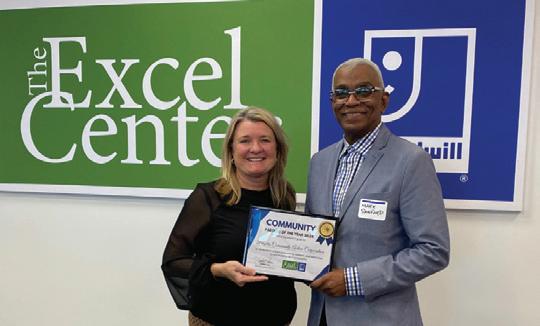
Hardships may be attributed to forms of inequity: pay and benefit gaps for women and people of color, racial and gender wealth gaps, generational poverty, and economic-related expenses, housing and job loss. Families that PCAC serves have been hit hardest by inflation and recent sticker shock on necessities like food, utilities, transportation and gas. Although financial literacy education can’t predict or prevent a family crisis, it can help individuals and families weather tough times with more resilience, less trauma and stress. Understanding money management can help youth and their families improve their economic situation and prepare for a future based on selfsufficiency.






Since I was in high school, I knew that my dream was to become a physician. I could not imagine myself having any other profession in my life, even with the thought of many, many years of school in the future.
My mother has inspired my desire to become a physician in order to guide individuals through their pain. As well, my patients at the pharmacy I worked at triggered my love for making sure people had the right resources, support and comfort throughout their healthcare experiences. However, I did not come from a family of physicians, nor did I have anyone I could rely on to ask questions about the steps needed to becoming one.
After lots of research, I found that scholar programs from a university into a medical school existed. Scholar programs allow you the opportunity to apply straight from high school as a pre-medicine student in college. If you are accepted, they give you the necessary resources and requirements that are needed as a pre-medicine student in order to succeed and become accepted into a medical school.
For the application, they want to see that you are determined and in love with the idea of becoming a physician one day. I applied into the Saint Louis University Medical Scholars Program straight out of high school. Although there are GPA requirements that you must maintain to stay into the program, they provide students with the necessary tools so that you can thrive in the premedicine environment.
There are usually not any requirements or classes that you specifically need to take in high school. However, I recommend you take classes that you are genuinely interested in and that can challenge you in order to better prepare you for college. If you are interested in medicine, you can not see yourself being any other healthcare profession, and you too are confused on the journey needed to become a physician, consider looking into the various amounts of scholars programs around the country.
— Lourdes

Most consider “non-traditional” medical students to be anyone who took time between finishing their undergraduate degree and starting medical school, a path that is becoming increasingly common. Currently, I am a first-year medical student who took a nontraditional path to admission. Prior to medical school, I worked for four years as a hospital-based occupational therapist. I really enjoyed working as an OT, but ultimately couldn’t ignore something pulling me to medical school to learn more. Regardless of if you currently work in healthcare or not, here are a few things I learned along the way that may be of value to someone else considering a “non-traditional” path to medical school.
1. You don’t have to have majored in a “core” science to apply. Often, you hear about pre-med students majoring in biology or chemistry in preparation for medical school, but this is not required for admission. As long as you take the pre-requisite courses outlined by each school, you are eligible to apply. These classes typically include two semesters of biology, general and organic chemistry, and physics, plus one semester of biochemistry. Some schools require more; the schoolspecific requirements can be found online at aamc. org (for MD schools) or aacom.org (for DO schools). Medical schools will assess both your overall GPA and your GPA in the “core” science classes, but you can be a competitive applicant with any major. It might even
make you a more memorable applicant if you have a unique major that you can speak passionately about in interviews.
2. Pre-requisite classes can be fulfilled from just about anywhere. As I mentioned, there are certain required courses that must be taken to apply for medical school. That being said, many schools accept these courses be taken from any accredited institution, including community colleges in most cases (but you should double-check each school’s specific requirements). In St. Louis, we are fortunate to have many academic institutions where one can apply as a “non-degreeseeking student” and enroll in only those classes they need to fulfill pre-requisite requirements. For me, this was critical so that I could “shop” around for classes that would fit into my schedule and allow me to continue working full-time. As a result, I had transcripts from four different local colleges by the time I applied to medical school.
3. Your experiences will be an asset. When I first started thinking about pursuing medical school, I was concerned about being older than the average applicant. But I’ve come to feel grateful for the experiences I have had thus far. During the admissions process, I found that medical school interviewers were eager to talk about my previous career and experiences. Plus, memories of positive patient encounters have been especially helpful
in maintaining my perspective as I trudge through my first-year classes.
I hope these tips can be a useful place to start, but please note this advice is not encompassing of all admission requirements. The medical school application process takes time. Beyond taking pre-req courses, the to-do list includes the following: preparing for and taking the MCAT; shadowing physicians; participating
in volunteer and research opportunities; budgeting for the expense of application fees; drafting a personal statement; submitting individual school secondary essays; and practicing for interviews. I wish the best of luck to anyone who may be reading this and considering starting your own journey to medical school. You got this!
— Amber Stefanski
For as long as I can remember, “a doctor” has always been my answer to the infamous question of “what do you want to be when you grow up?”
My reasoning behind this lifelong aspiration of mine was simple: it’s what my dad does. My dad has always been my biggest role model, and I strove to emulate him in every way possible. While following in my dad’s footsteps was been my primary motivation to practicing medicine, I’ve discovered my ambition to become a physician is rooted in much more than merely following in his footsteps, but it is also my way of combining my passion, values, and skillset in a way that benefits the greater good.
My process to medical school started my senior year of high school when I took chemistry. I was fortunate enough to have a teacher that was both passionate and genuine about his students and the content he taught. His chemistry class reaffirmed my desire to follow a career path rooted in science. Other courses I really enjoyed taking in high school were calculus and economics.
My economics class greatly influenced my path to medicine. Even though it was a business class, it cultivated my critical thinking skills that contributed to my success in many college courses.
When I entered college, I was exposed to the other side of medicine: the community that is served by physicians and the social determinants of their healthcare access. Here, I was able to integrate classroom lectures with local experience. Courses such as public health, medical ethics, and sociology exposed me to injustices in the world, and subsequent involvement in the community allowed me to witness it first-hand.
My passion to be an advocate for underserved communities developed through volunteering in my undergraduate city, Milwaukee, WI, where a large
percentage of the population is underrepresented and underserved by the healthcare industry.
Volunteering at hospitals and local elementary schools cultivated my drive to establish genuine connections with my community. I spent time at a local clinic meeting local community members and educating them on nutrition, playing with young children on a cancer floor at the hospital, and participating in Big Brothers Big Sisters. I highly recommend anyone to participate in Big Brothers Big Sisters because it pairs a struggling grade school child with an older mentor. With this program, I served as a positive role model for someone who needed someone to talk to, and while this program is intended to help the kids, it was also very rewarding personally.
An important part of becoming a doctor is understanding that everyone’s path to medicine is unique, and there is not a singular ‘right’ path to medical school. As the field of medicine is very diverse, so too are the physicians within it. Personally, I’ve always liked learning, so my path was dictated by educational curiosity. I took many classes in school that furthered my knowledge in the human body and deepened my interest in it.
My advice to people interested in medical school is to follow your passions. It could be your community, your classes, working at a hospital, etc. The most important aspect of preparing for medical school is becoming involved in classes and extracurriculars not to check off boxes for an application, but to develop your own character and better prepare you for your career. Following a path dictated by your genuine interests is the best route to take because it allows you to choose a journey that reflects your true goals, passions, and values in your trek to becoming a doctor.
— Patrick Sweeney

Fortunately for me, I wanted to do a career path that was “acceptable” to my parents. I do remember though my parents telling my sister that if she didn’t transfer to the journalism school (she needed a 3.5 to transfer), they would pull her out and transfer her to state college which was cheaper. Sound familiar?
The turning point for choosing a career usually starts during the pre-university or university era. In this period, when individuals experience difficulties in both their psychological and social lives, asking them to make decisions that will affect their entire lives will increase
individuals’ stress and prevent them from making sound decisions. During the high school years, individuals who do not yet fully know themselves and cannot identify their advantages, shortcomings, opportunities, and the dangers that their choices will cause may have to choose a profession and career that is not suitable for them later. This can negatively affect the happiness levels of individuals and reduce their life satisfaction.
Listen to their stories, What would you do?
My name is D. Ethan and I’m currently a 20-yearold student who attends the University of Indiana. I’m pursuing a major in Creative Media Advertising while working on my minor in Digital Marketing. I plan to combine these two degrees to work in the Product Design field. So what is Product Design? It’s the process of creating new products or enhancing the design or functionality of previous products for businesses to sell to customers. This involves the development of ideas through a


systematic process that leads to the creation of potential innovative products. According to Zippia, there are about 15,331 product designers currently employed in the United States. But unfortunately, only 1.1% of that number identifies as black or African American.
I would be lying if I said that I always dreamt of becoming a product designer. My true passion has always been the environment and the organisms and animals that call it home. This strongly influenced me to want to become a marine biologist or even a zoologist going to college. However certain family members and people around me tried to discourage me from pursuing this field because they warned me that the money wasn’t good. I listened and felt the pressure to become either a lawyer, doctor, engineer, or businessman after this.
That’s when I found myself finding an interest in finance and looking more into the business sector. I entered my first year of college as a finance major but something didn’t feel right. I lacked the passion and excitement I once had in Marine Biology. I still was very fascinated with the business world and took a step back
to elevate my strengths within. That’s when I found my new passion in Marketing which allowed me to express my creative outlet. This led me to where I am today and I don’t have regrets because I now have entry-level knowledge on finance which can help separate me and give me an advantage compared to other competitors in my field.
Now my goal is to work with a company that prioritizes outdoor exploration and that is environmentally aware. I would love to specialize my product design with their apparel and do my best to improve the overall experience and comfort of clothing. I see myself collaborating with other brilliant minds in the future to help elevate advertising on the digital level as well.
At times I wondered what life could be like if I stuck with my original passion but as I thought long and hard about my future I realized that I could make a positive contribution to the environment in various ways that didn’t require me to necessarily specialize in that field. I plan to raise awareness and educate the youth of our communities on the importance of taking care of the planet we live on and I hope by doing this digitally that I will be able to reach a massive young audience online. Promoting the values of a company that aligns with my beliefs is how I plan to balance my passion with my current profession.
“The money will always be there but doing something in the world that means something to you and can impact others.” — Dr. Richardson
— Ethan McLeod
Student loans are a way for people to pay for higher education if they have no other source of financial aid. Loans help students pay for their dream schools and the classes they will take to reach career goals. The other side of student loans is that you have to pay all the money you borrowed back, which may not be an easy task. According to Education Data Initiative, the average cost of college is $35,331 per student per year. Repaying loans late can ruin your financial goals and put you into debt, along with ruining your credit score.
Although loans can help you pay for college, eventually, you will be faced with the fact that you will have to return the money you borrowed in full and on time, and this could take years to pay off.
With concern around your financial goals, there is a possibility that your loans can get in the way of you buying the things you want or feel you need and becoming more difficult to meet your financial goals, such as purchasing a vehicle, moving into your first apartment or buying a home.
If you do not pay your student loans in a timely manner this can result in your credit score dropping. Credit
scores are an important part of our economy, they determine what we are eligible for. The penalties for not paying on time can result in added fees, interest, and wage garnishment. This can harm your financial standing.
After you graduate from college you may expect to take a break before you join the working world, those ideas may be postponed due to you having to find a job to pay off your student loans.
If you have already gone through with getting student loans and are currently struggling to pay them off, or would like to avoid the struggle, you can use specific grants and scholarships to help pay off your debt. Grants and scholarships help eliminate almost half of your student loan debt. To find these kind of opportunities, you should look into Scholarship360.org, usstudentloancenter.org, and bold.org. When visiting these sites you can search “grants to pay off student loans” and “student debts” on bold.org.
— Shayla McClendon

At some point, we all desire to get out and explore the world whether it be a 3-hour flight or a 30-minute drive, but as we all know, it takes a good amount of money to get out and travel. Remembering all considerations, paying for tickets, rental transportation, hotels, food, and recreational activities can all be pricey. Start saving early, the average cost of a trip out of the state can cost a little over $1,000, If you are not interested in spending over $1,000 for a trip you should pick inexpensive destinations, cheaper transportation, it is okay to be frugal with your spending, and travel with others.
Before you hop on the plane or in the car you should research the location(s) you are traveling to. Determine a budget for a certain location and if you can afford to stay there.
The best way to get a cheap flight is to monitor the days that tickets would be the cheapest. Plane ticket prices fluctuate depending on the season, weather, days of the week, and holidays. For example, a plane ticket to a destination during a colder season where tourism is not as heavy can be significantly cheaper, but during the holiday season for instance, Thanksgiving and Christmas, plane tickets will be some of highest prices to pay to travel. Some of the least expensive days to travel are during the early part of the weekdays for instance, Monday, Tuesday, and Wednesday. To make the tracking process easier, use the sites Skyscanner and Orbitz to see which days are the cheapest to fly.
Remember there is nothing wrong with being frugal when visiting another state or country. There will be many beautiful locations, and souvenirs that will be appealing and hard to turn away from, but you must remember to be responsible with your spending. You will need a great amount of your funds for food, and activities. Skyscanner and Orbitz can help you find cheap hotels wherever you decide to stay.
Traveling with others can cut down the cost of fees, there is also the golden rule when traveling “safety in numbers,” this can also come with “saving in numbers,” pay less on meals, and less expensive trips when you split cost with friends and family. The goal is to have fun and create great memories.
— Shayla McClendon

We all know how hectic life can get in school whether you’re in high school or college, the work can be stressful at times. We must talk about these things because if they are not addressed in a timely manner, it could be detrimental for the people in need. Having poor mental health can make it harder for you to excel in school, but also out of school. There are many ways to make sure that your mental health stays strong, but first we need to talk about what could cause your mental health to decline. Examples of ways to cause one’s mental health to steadily decline are an increase in stress, anxiety, and or depression. In addition, the arrival of COVID-19 caused the rate of stress, anxiety, and depression to double in many teens. But it could be other factors such as bullying, homework overload, academic pressure, verbal or physical abuse, unresolved grief, and the relationships you may have at school, or financial problems. According to Firstup, a website that specializes in helping employers reach their employees and provide communication


between the two, when an employee doesn’t come to work as often, it would cause the other workers to have to do overtime, affecting the business. It would also decrease the work quality, decrease the team morale and engagement. Absenteeism is the practice of staying away from work or school for long periods of time. It is said that absenteeism costs employers about $225.8 billion a year for the loss of productivity. According to Education Week, it was reported that 42% of high school
students have experienced the feeling of hopelessness and or sadness. Now that we have established these issues, we can come up with ways to reduce them.
Some ways you can keep your mind in a healthy state are by doing relaxing activities. Prayer, meditation, getting sunlight, making sleep a top priority, regular exercise, setting goals, practicing gratitude, and staying connected with your friends and family, or people that you can go to when you’re in need of help are ways and examples to improve mental health. Having a job could also help with your mental health, depending on the job it could provide calmness, and it could help you focus, all while putting money in your pocket. Having a hobby could increase your happiness, increase your life satisfaction,
and lead you to a better life. All of these are examples of self-care. Everyone needs to practice some sort of selfcare to keep their minds on track. This also helps you in keeping up with your tasks and assignments.
In the midst of a mental crisis, whether it’s you, a family member, or friend, you can use the 988-crisis hotline just text or call the hotline or you can go to this website 988lifeline.org. You can also contact Behavioral Health Response. The local number is 314-469-6644 for people who live in Eastern Missouri, if you don’t that’s okay, you can contact the 988-crisis hotline. If you want to learn more about crisis services, you can visit this website dmh.mo.gov.
— Zimena M.
A lot of ways you can have entertainment and be financially successful in, a good example being streaming. Advertising and Sponsorship can help grow your views in this stage of business. TV shows, sports events, and online platforms can earn money through advertisements and sponsorships. Companies pay to have their products featured or advertised to large audiences.
Crowdfunding and fan support can help increase your sponsorship in the long term. A good example of this is the popular platform Patreon, which allows creators to receive direct support from their fans. Crowdfunding campaigns can also help pay for projects before they are even produced.
Live streaming and online content creation on platforms like YouTube, Twitch, and TikTok can monetize their content through ads, donations, and sponsorships. Popular creators can earn solid income from their online presence.
Streamers like Kai Cenat make substantial profit from these streaming industries. He is currently the all-time most-subscribed Twitch streamer and the 10th most followed Twitch streamer with approximately nine million followers, surpassing fellow streamer

Ludwig Agren’s record during a February 2023 sabaton. He was named “Streamer of the Year” at the 2023 and 2024 Streamer Awards.
With streaming you can work on your own schedule and do not have to overwork yourself because it can be an at home thing. There are a lot of benefits from streaming like popularity, money and getting to know other steamers and get advice from them.
By expanding income from streams and leveraging the popularity of their content, entertainment ventures can achieve financial success.
— Joseph Harriel
Improving communication skills can open up a lot of opportunities for making money. Here are a few ways you could pick up on to help.
Public speaking could become a motivational speaker or a keynote speaker at conferences and events. The main source of many motivational speakers’ income comes from speaking engagements. They often get their income by selling books on-site and online.
Coaching is a job you can get paid for using communication. Becoming a communication coach for individuals who want to improve their public speaking, negotiation and writing are important skills to have in these specialties.
Writing and content creation is a nice skill to have when you have good communication skills. Use your skills to write books, articles, or create online courses about effective communication. Each of these paths can be lucrative, especially if you build a strong reputation in your field.
Active listening is practicing how to prepare to listen observing what verbal and non-verbal messages are being sent, and then providing good feedback for the sake of showing the message being presented. Active listening is listening to understand and it could help you learn different languages.
With that being said improving your communication skills you can achieve good income with different jobs.
— Joseph Harriel
If you’re on social media using Facebook, LinkedIn or Instagram, we encourage you to stay connected with People’s Family of Corporations. Here are our social media tags and URLs.

@peoplesfamilyofcorp
@bjkpeopleshealthcenters
@peoplescommunityactioncorp
www.Linkedin.com/company/peoples-health-centers-inc www.Linkedin.com/company/people-s-community-action-corporation/ www.LinkedIn.com/company/peoples-family-of-corporations/
@peoplesfamilyofcorporations
@bjkpeopleshealthcenters
@peoplescommunityactioncorp