upgrade He adds: “It has little or no advantage or disadvantage over normal timber frame when it comes to airtightness, thermal bridging or insulation. A slight disadvantage [compared to a normal Cygnum timber frame] could be that we lose the benefit of insulation between the studs.” Though it wasn’t built to passive house, the brettstapel building was constructed to a very similar spec as the passive house certified, timber frame school, though no airtightness test or PHPP analysis was done on the Pod building. The passive house school building, also known as the KS2 building, has timber frame walls featuring 400mm deep timber I-beams, insulated with Warmcel, while the roof has a similar structure with a zinc finish externally. “The biggest challenges in meeting the passive house standard were slightly unfavourable form factor — lots of double height spaces in the KS2 building — and a relatively large number of external doors, which can be tricky in terms of airtightness,” George says. The ground floor of both buildings features an insulated slab foundation system, while IFT Rosenheim certified windows from Internorm feature throughout.
heating and ventilation. Low space heating demand enables simple, minimal heating solutions — in this case, a single domestic condensing gas boiler in each building, delivering hot water to radiators, which are controlled by thermostatic radiator valves. “We have found this quick response system is suitable for the school environment where a quick warm-up is needed before the start of the teaching day,” George Mikurcik says. “You can dump all the fancy controls,” Alan Clarke adds. “The people who run primary schools from day-to-day are not facilities managers.” In the Pod building the gas boiler also provides hot water, while in the passive school building decentralised electric water heaters do the job. Some of Architype’s previous passive house schools featured building management systems that shut down the MVHR (mechanical ventilation with heat recovery) in summer, switching over to automated natural ventilation via the windows, and extract fans in the bathrooms. But Alan Clarke says this was overly complex.
The heating and ventilation design was kept as simple as possible for both buildings. Architype had learned from their previous passive house schools that overly sophisticated setups — building management systems, automated windows and the like — can be problematic in schools, where staff just want simple controls.
At Burry Port, the team ditched the BMS and let the MVHR run all year around, with a summer bypass mode kicking in automatically when needed. One advantage of letting the MVHR run all year is that you can give occupants back total control over opening and closing windows — you don’t need to worry about air quality suffering if occupants forget to open them. “As we’ve got the MVHR ticking along in the background, we can say open the windows if you want, or don’t open them,” Alan says.
“Space heating has become a really non-critical issue in passive house schools,” says Alan Clarke of passive house consultancy Elemental Solutions, who advised on the
In addition to the MVHR, the passive house school building has a simple strategy for manual ventilation, with handle-controlled vents at low level in the classroom and
actuator-operated windows higher up — the latter linked to simple on/off switches, with no automation. This simple system also avoids the capital and service cost to the school of a BMS. But apart from energy and ventilation, what were the team’s design goals? For one, to make the old and new school buildings work together, creating a secure courtyard in between. There was also an emphasis on simple materials — the untreated larch cladding, zinc roofs, low VOC materials and finishes inside. The aim, architect George Mikurcik says, was to create a vibrant and healthy teaching environment. “We have paid particular attention to acoustic design in order to create calm and comfortable spaces,” he says. As with several previous Architype projects featured in Passive House Plus, the ceiling finishes included Troldtekt acoustic panels – a cement-bonded wood product with numerous health and environmental certifications. Architype’s consideration for sustainability starts from the ground up – including the ground floor finishes, which variously consisted of 100% biodegradable Marmoleum flooring from Forbo, which includes a mix of renewable natural materials and recycled content; Noraplan Ultra Grip rubber flooring, which is manufactured to strict ecological criteria; Paragon carpet tiles with 65% recycled materials & BRE Environmental ratings of A/A+ and a resin seal on the concrete floor slab. Architype are among the most highly decorated architects ever featured in these pages, such is the breadth of envelope-pushing sustainable projects in their portfolio. This project recently added to the practice’s
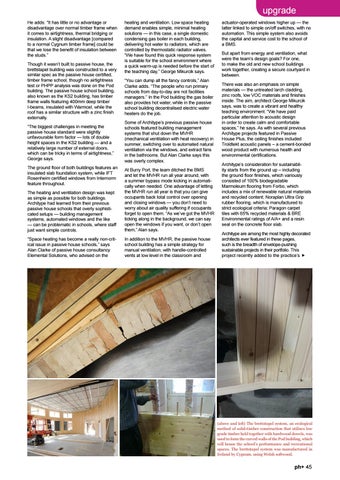
(above and left) The brettstapel system, an ecological method of solid-timber construction that utilises low grade timber held together with hardwood dowels, was used to form the curved walls of the Pod building, which will house the school’s performance and recreational spaces. The brettstapel system was manufactured in Ireland by Cygnum, using Welsh softwood.
ph+ 45