VIEW
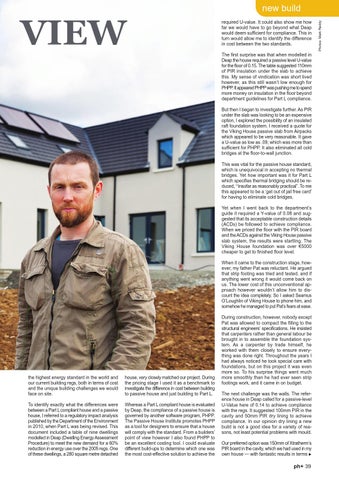
required U-value. It could also show me how far we would have to go beyond what Deap would deem sufficient for compliance. This in turn would allow me to identify the difference in cost between the two standards. The first surprise was that when modelled in Deap the house required a passive level U-value for the floor of 0.15. The table suggested 110mm of PIR insulation under the slab to achieve this. My sense of vindication was short lived however, as this still wasn’t low enough for PHPP. It appeared PHPP was pushing me to spend more money on insulation in the floor beyond department guidelines for Part L compliance. But then I began to investigate further. As PIR under the slab was looking to be an expensive option, I explored the possibility of an insulated raft foundation system. I received a quote for the Viking House passive slab from Airpacks which appeared to be very reasonable. It gave a U-value as low as .09, which was more than sufficient for PHPP. It also eliminated all cold bridges at the floor-to-wall junction. This was vital for the passive house standard, which is unequivocal in accepting no thermal bridges. Yet how important was it for Part L which specifies thermal bridging should be reduced, ‘“insofar as reasonably practical”. To me this appeared to be a ‘get out of jail free card’ for having to eliminate cold bridges. Yet when I went back to the department’s guide it required a Y-value of 0.08 and suggested that its acceptable construction details (ACDs) be followed to achieve compliance. When we priced the floor with the PIR board and the ACDs against the Viking House passive slab system, the results were startling. The Viking House foundation was over €5000 cheaper to get to finished floor level. When it came to the construction stage, however, my father Pat was reluctant. He argued that strip footing was tried and tested, and if anything went wrong it would come back on us. The lower cost of this unconventional approach however wouldn’t allow him to discount the idea completely. So I asked Seamus O’Loughlin of Viking House to phone him, and somehow he managed to put Pat’s fears at ease.
the highest energy standard in the world and our current building regs, both in terms of cost and the unique building challenges we would face on site.
house, very closely matched our project. During the pricing stage I used it as a benchmark to investigate the difference in cost between building to passive house and just building to Part L.
To identify exactly what the differences were between a Part L compliant house and a passive house, I referred to a regulatory impact analysis published by the Department of the Environment in 2010, when Part L was being revised. This document included a table of nine dwellings modelled in Deap (Dwelling Energy Assessment Procedure) to meet the new demand for a 60% reduction in energy use over the 2005 regs. One of these dwellings, a 280 square metre detached
Whereas a Part L compliant house is evaluated by Deap, the compliance of a passive house is governed by another software program, PHPP. The Passive House Institute promotes PHPP as a tool for designers to ensure that a house will comply with the standard. From a builders’ point of view however I also found PHPP to be an excellent costing tool. I could evaluate different build-ups to determine which one was the most cost-effective solution to achieve the
During construction, however, nobody except Pat was allowed to compact the filling to the structural engineers’ specifications. He insisted that carpenters rather than general labour be brought in to assemble the foundation system. As a carpenter by trade himself, he worked with them closely to ensure everything was done right. Throughout the years I had always noticed he took special care with foundations, but on this project it was even more so. To his surprise things went much more smoothly than he had ever seen strip footings work, and it came in on budget. The next challenge was the walls. The reference house in Deap called for a passive-level U-Value here of 0.14 to achieve compliance with the regs. It suggested 100mm PIR in the cavity and 50mm PIR dry lining to achieve compliance. In our opinion dry lining a new build is not a good idea for a variety of reasons, not least potential problems with mould. Our preferred option was 150mm of Xtratherm’s PIR board in the cavity, which we had used in my own house — with fantastic results in terms u
ph+ 39
Photos: Mark Reddy
new build